Operator
Good afternoon, and welcome to NewScale Power's Second Quarter 2026 Earnings Conference Call. Today's call is being recorded. A replay will be available on NewScale's Investor Relations website for 30 days. At this time, I would like to turn the call over to Ramsey Hamaday, Chief Financial Officer. Please go ahead.
Thank you, Operator. Joining me today is John Hopkins, President and Chief Executive Officer of NewScale. We will begin by providing an update on our business, followed by a discussion of our financial results. We will then open the phone lines for questions. This afternoon, we posted supplemental slides to our investor relations website. As reflected in the State Harbor Statement from Slide 2, the information set forth in the presentation and discussed during the course of our remarks in the subsequent Q&A session includes forward-looking statements Thank you, Ramsey.
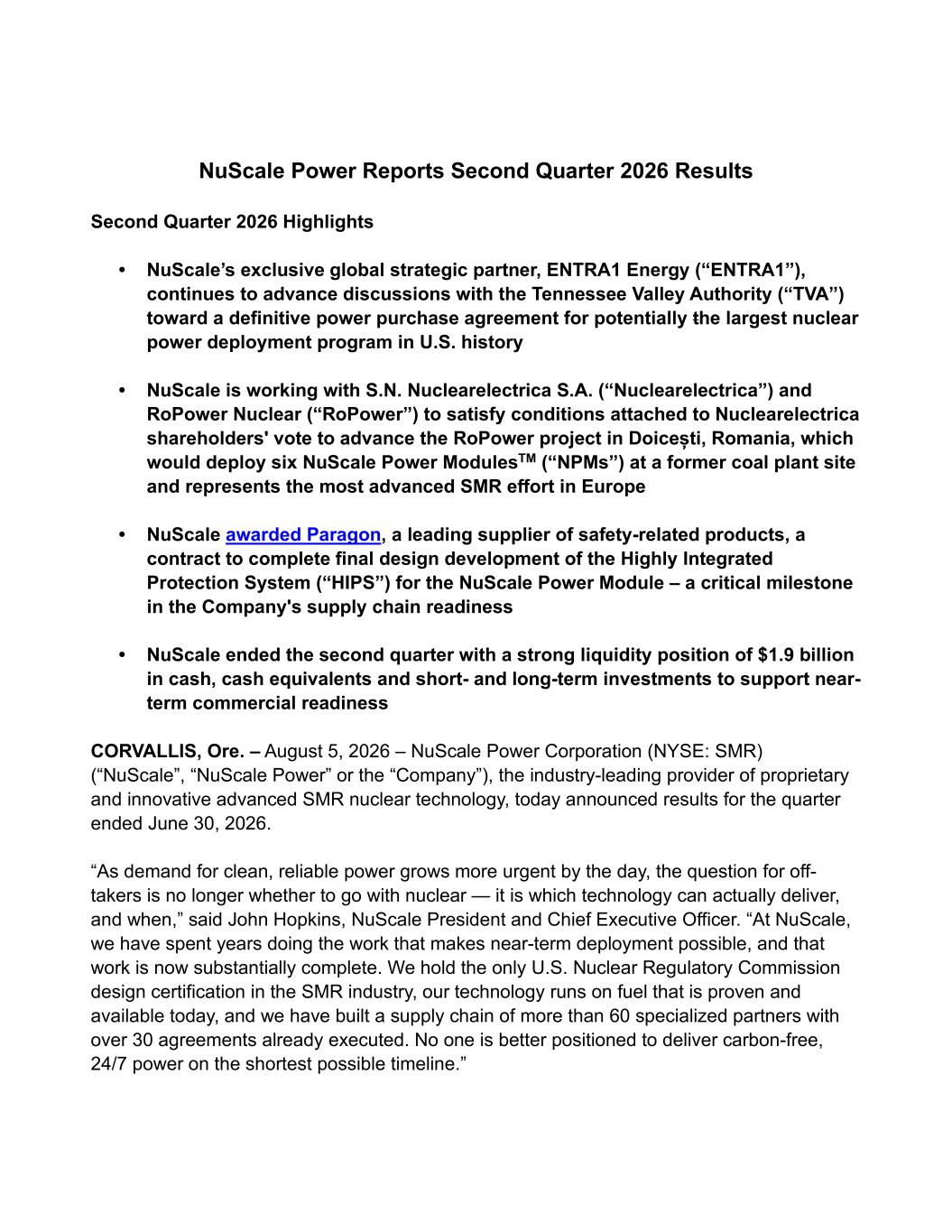
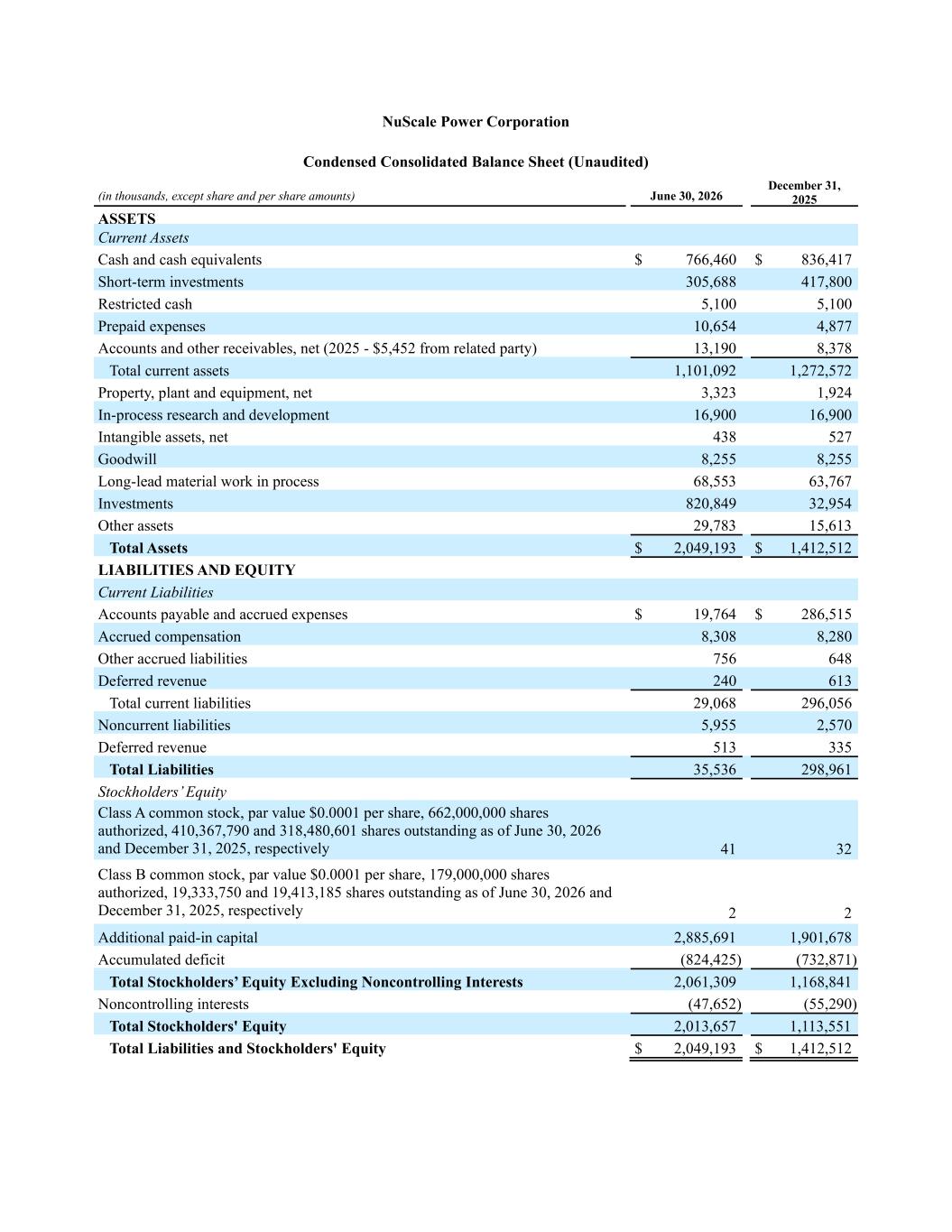
I want to start with a simple observation about where the market stands now. The demand for reliable, carbon-free power is not building slowly. It is accelerating. Every major hyperscaler, every large industrial off-taker, every utility with an eye on the next decade is now engaged in some version of the same conversation. We need power now. We need it to be clean. And we need it on a timeline that actually maps to our business. That urgency is real, and it is growing. What I want to address today is what separates a company that can meet that urgency from one that cannot. Because the answer to that question is not branding or ambition. It is readiness. And readiness in this industry is a function of years of deliberate work, work that does not generate headlines, but that determines more than anything else whether a nuclear project gets built on time and on budget or does not get built at all. That distinction is what I want to focus on today. Let me start with context, because I think the history here explains why engineering and design maturity matters more than most investors currently appreciate. The global AP1000 expansion, the most recent large nuclear construction project in the United States, is the clearest example of what happens when a project goes to construction before the engineering is substantially complete. When that project started, the detailed design was not in an advanced state of completion. Significant engineering decisions were still being made on active construction sites. That result contributed to years of delays and billions in cost overruns. This is not a story about nuclear being hard to build. It is a story about what happens when you start construction without a mature, detailed design. NewScale has spent years deliberately applying the hard lessons of past large-scale nuclear projects. We've made significant, sustained investment so that when we go to market, the engineering is as complete as possible. That investment is the foundation of everything I'm going to share with you today. A brief word first on two pillars of a readiness position, regulatory approval and fuel readiness. NUSCIA remains the only SMR company to have received design certification from the U.S. Nuclear Regulatory Commission, including standard design approvals for two of our designs. The NRC's design certification is the global gold standard for nuclear safety. Certification takes years. There are no shortcuts. We'll operate using standard low-enriched uranium, a proven fuel source which is available today from established suppliers from around the world. Several other designs being marketed today require high-assay, low-enriched uranium, or HALU, which is not available on a commercial scale. That dependency is a fundamental supply risk embedded in their programs that does not exist in NuScale. The combination of NRC approval, conventional fuel, and a mature supply chain that I'm not to describe, that combination along with engineering is what commercial readiness actually means. No other company in this space has all four. NuScale's role in an Inter1 energy plant is that of technology systems integrator and engineer of record. We are responsible for the NuScale power modules and services. Supporting delivery of the NuScale power module, we have assembled a network of more than 60 specialized suppliers. Each supplier brings deep domain expertise in a specific system. Fuel, safety and instrumentation and controls, valves, cranes, and modular handling. Each holds detailed design responsibility for their own scope, with NuScale providing the overall integration. Here's where we stand. The detailed design for the critical path components of our modules, the systems that govern schedule and cost, is mature. We've already negotiated supplier agreements with more than half of our 60-plus supplier relationships, many whom we believe to be best in class. This means when we execute an OEM, many of our suppliers will already have designed, scaled, tested, and in some cases began production of components. Taken together, this shortens the path to actual power generation, not by months, but by years. And support certainty of execution. Let me highlight a few of our suppliers. Doosan Interability is one of the world's foremost manufacturers of heavy neutral components. They are our strategic partner on the major components of our modules, the heavy forgins at the heart of every new scale power module. What you see on this slide are photographs taken at Doosan's facilities in South Korea. Actual components and active production for new scale power modules. Framitone is one of the world's leading needs of fuel companies. Fuel design has a long lead time, years, not months. Rather than wait for a signed customer contract before beginning that work, we entered into a dedicated agreement with Framitone to complete the fuel design. Our fuel supply will be ready as customers come online. This quarter, we announced that Paragon has been awarded a contract to complete the final design development of the safety instruments and control systems for our new scale power modules. These three partners are examples of the depth of our supply chain ecosystem. Doosan on major portions of the modules, Framitone on fuel, Paragon on safety control systems, and we have comparable relationships across cranes, module handling, valves, and motors. With additional announcements expected. I'll briefly discuss key commercial updates from the quarter. Interwind Energy, our strategic partner, continues to advance discussions with the Tennessee Valley Authority toward a definitive power push agreement for potentially the largest nuclear power deployment program in the U.S. history, utilizing new-scale SMR technology. Our understanding is that these discussions are active and progressing. We look forward to providing a further update as milestones are achieved. Next is RoePower. NewScale is working with Nuclelectrica and RoePower to satisfy conditions attached to Nuclelelectra shareholders' vote to advance the RoePower project in Dorchester, Romania, which will deploy six NewScale power modules at a former coal plant site and represents the most advanced SMR effort in Europe. Finally, let me now turn to another area when New Scale is building last in advantage, our energy exploration centers. This quarter, we opened our 12th E2 center at the University of Virginia's College at Wise, supported by a grant from the Virginia Clean Energy Innovation Bank. These centers deliver immersive, hands-on nuclear training in high-fidelity simulation environments designed specifically for the next generation of plant operators, technicians, and engineers. Another highlight is our liquidity position. NewScale closed the second quarter with approximately $1.9 billion in cash, cash equivalents, and investments. Our cash position reflects a conservative approach to liquidity as we anticipate near-term commercial deployment. Now I'll turn the call over to Ramsey.
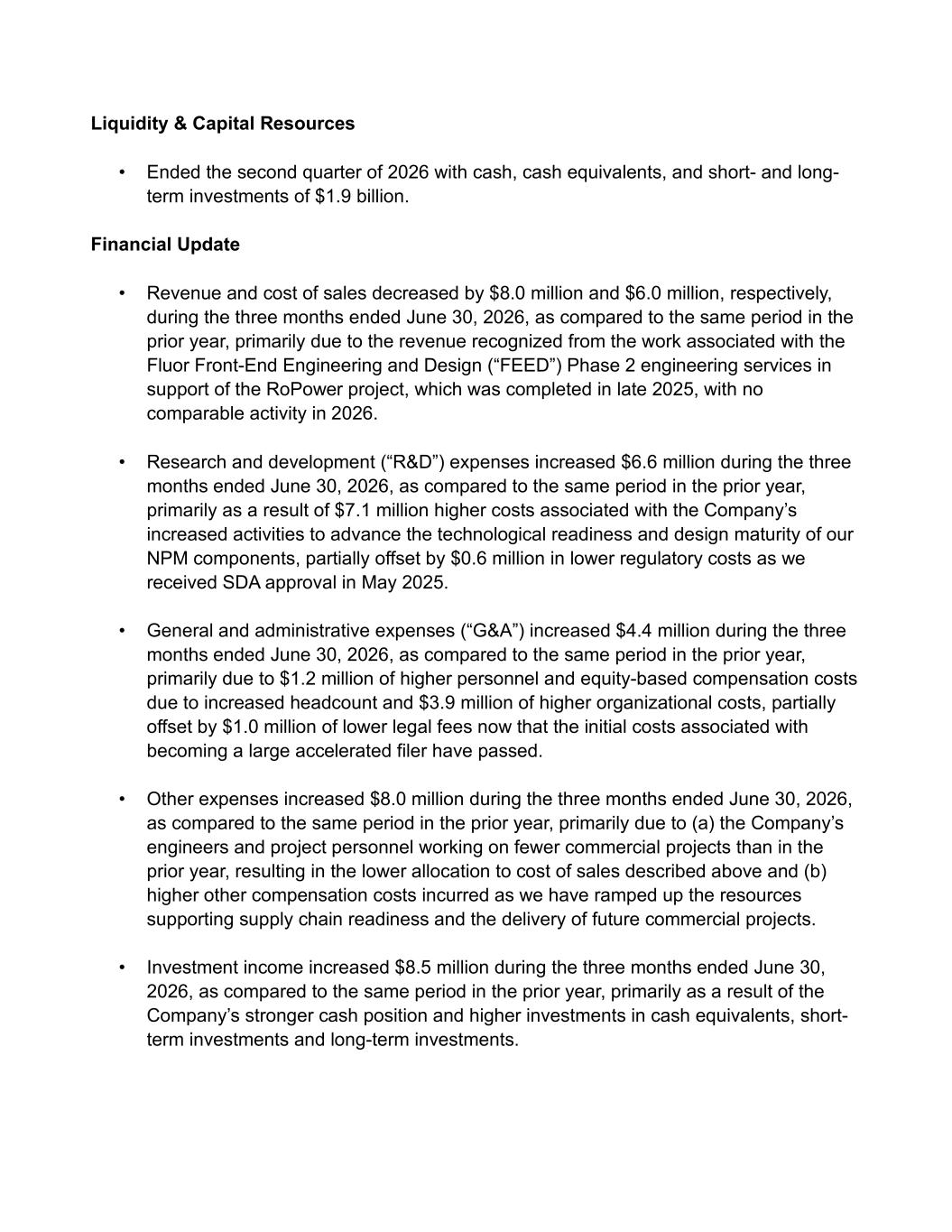
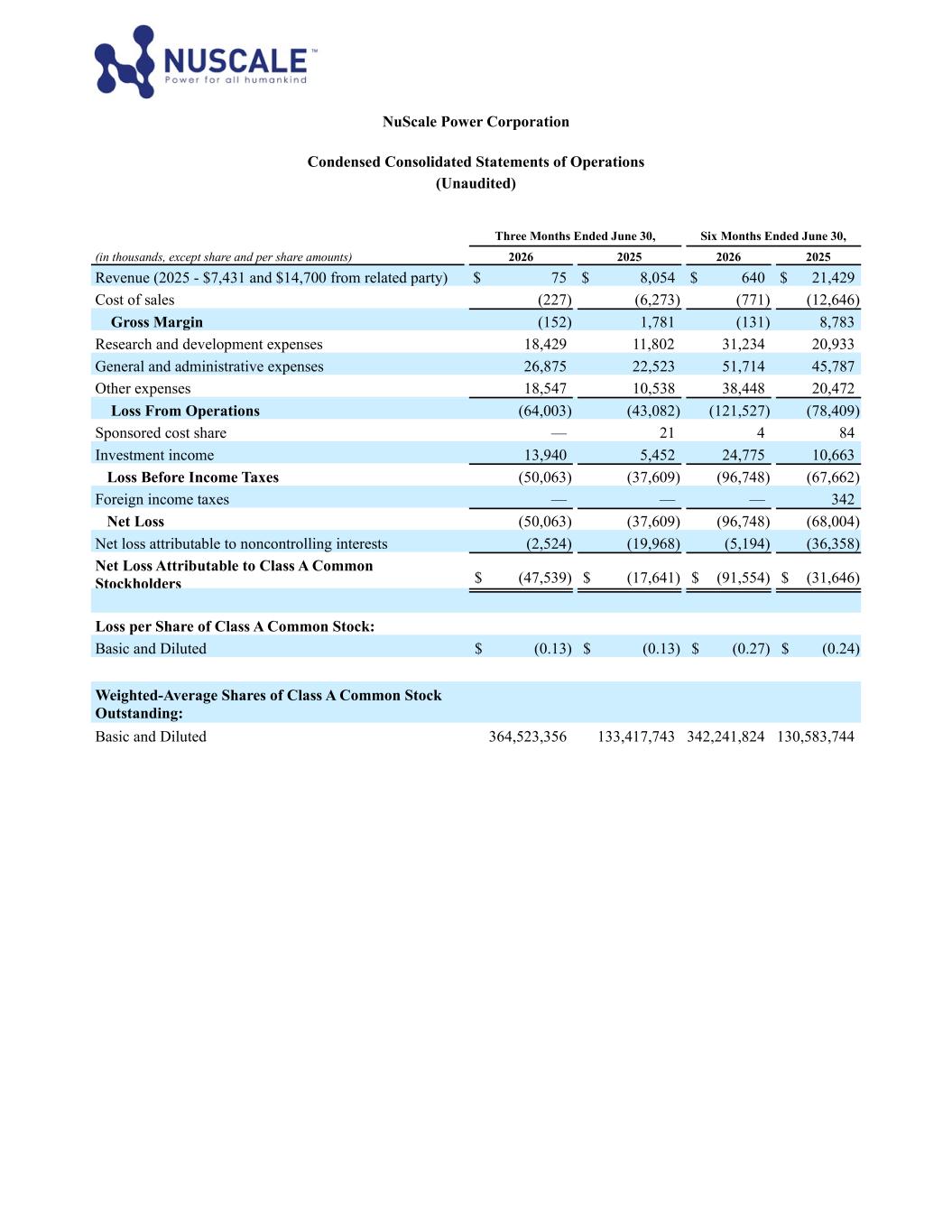
Thank you, John. Good afternoon. Our financial results are available in our filings, so my focus will be on explaining major line items, which can be found on slide 7. U-Skill reported revenue of $0.1 million for the three months ended June 30, 2026, compared to $8.1 million in the same period last year. The year-on-year decrease reflects the completion in late 2025 of the FLIR front-end engineering design phase 2 work in support of the Road Hour project. That scope had no comparable activity in the current quarter. As project activity advances, we expect both our product and services revenue to grow. We closed Q2 with approximately $1.9 billion in cash, cash equivalents, and investments, an increase of $900 million since March 31, 2026. As John said, this increase in liquidity reflects a proactive approach to conservatively positioning the business as we continue to deploy capital for commercial readiness. When we invest in supply chain agreements, we reduce the time to deployment and de-risk the cost structure of our first projects. Finally, on slide 8, you will find a capitalization summary. With that, thank you again for joining us today. We will now take your questions. Operator, please go ahead.
Operator
We will now begin the question and answer session. If you would like to ask a question, please press star 1 to raise your hand and join the queue. To withdraw your question, press star 1 again. We ask that you pick up your handset when asking a question to allow for optimum sound quality. If you're muted locally, please remember to unmute your device. Please stand by now while we compile the Q&A roster. Your first question comes from the line of Eric Stein with Craig Hallam Capital Group. Your line is open. Please go ahead.
Speaker 1
Hey, this is Luke. I'm for Eric. Thanks for taking our question. So, first one here, the decisable financial and trade commitments from Japan and South Korea play into the timeline at all for converting PBA to a firm PBA. How are you thinking about those in the equation here?
Renzi Hammity, CFO. Look, I think those announcements and the ideas behind them are very promising. I don't know that that's built into the particular capital structure for the plant. And I, you know, I stress that Nuskill builds reactors, our commercial partner, and for one, builds plants. I know they have a great relationship with the Japanese, as do we, so we remain hopeful. But I wouldn't say that the PPA or the capital structure is dependent upon that cash. I think it would benefit, but it's not dependent.
I do remember that, as stated, a piece of these investments is slated for energy projects in the U.S., which also includes SMRs.
Speaker 1
Understood. Can you just maybe talk a little bit more about EnterOne's project pipeline and how that's evolving just in terms of end users? Have you seen any particular customer type or use cases, any particular traction for the new scale applications, and whether that's just within the data center industry or other?
Yeah, we continue dialogue with hyperscalers, data centers. You know, our focus right now has been for readiness for TVA when the announcements get made. But others, you know, that we talked to, and I think you've recognized the need right now for clean energy. You know, Texas just came out and stated here today that they have to shut down data center promotions because of lack of energy and water. We're an answer to that, and we're precisioning ourselves to move forward as, you know. It's really the timing of the customer and when they need their energy, and we're ready to enter into discussions at any time.
Operator
Your next question comes from the line of Nate Pendleton with Texas Capital.
Good afternoon. Thanks for taking my question. Good afternoon. Thanks for taking my questions. John, I wanted to go back to where you really started the call and dig into the competitive landscape as you see it, really focused on the Gen 3 Plus Lightwater SMR segment on slide three. Beyond the head start you guys have with NRC approval, How do you view the durability of your technology advantage if we roll forward the clock a few years? Does that fit with design, commercial structure, or supply chains?
I think we're in a position right now, over the last 10 years, we've been working steadily to get ready for deployment, and we are near-term deployable. You know, I commented about over 60 suppliers, which half of them we have, that's a services agreement. You know, we have 12 modules in which a lot of them are currently in production, which are long-lead items, and we've been working on those over a two-year period. So if I look at the landscape moving forward, we're ready to deploy now, as I commented earlier. If you look at future state, you know, nothing stays static. We'll continue to promote this project and look at ways to improve efficiencies and costs, But we feel like we're in a very good position.
And then maybe shifting gears a little bit, I wanted to touch on the process heat opportunity. From recent disclosures, I think there's a blog post from Dr. Reyes, the high-temperature steam potential seems really encouraging. Do you expect these applications to use the standard Voyager 12 or 6 configurations, or will this be a distinct product? And then perhaps should we think – how should we think about the potential parasitic load that's needed to support that compression step to boost the temperature to that 500-degree level?
Well, Jose has been out promoting – in fact, he spoke at Sierra Week at the Petrochemical Conference. He's speaking here, coming up again, on – you know, we worked with the national labs in the ability for our reactor as a light water reactor to produce the steam and pressure requirements needed for process heat, and we think we're in a very good position to, you know, and again, compounded with an emergency planning zone, if you look at what these process companies are looking for, the further you are from a given site, the end user, it dissipates. Having the approval of the emergency planning zone, we're right up next to the end user. We can provide process heat. We can provide electricity. You know, the intro and model also supports the fact that if you go to an area like Baytown or Corpus or anywhere we have a high-density of process companies, we could build, own, and probably have somebody operate the plant. You could be Entergy or whomever. That allows us on that fence line. They're not inside the evacuation zone. It doesn't entail any business interruption to provide the requirements those companies are looking for. If it's electricity or ammonia production, hydro production, or, to your point, process heat. Very enthusiastic about that opportunity. We do believe district heat and process heat is going to be, and the ability to dry cool are very much distinctives that we have that are going to be, again, I mentioned today, you know, just earlier I heard on a report that Texas, everywhere you go, there's droughts. There's water restrictions. Having a combination of emergency planning zone and being able to dry-cool using air condensers is going to be extremely important going forward.
Operator
The next question comes from the line of George Gianarricas with Canaccord Genuity. Your line is open. Please go ahead.
Hi, everyone. Thank you for taking my questions. So, TVA made a few disclosures and I think some media comments today regarding their nuclear roadmap. I'd love to get your perspective on what you took away from the commentary, maybe an update on your bilateral discussions beyond what you've already said, and maybe any specificating items remaining before reaching a definitive contract. Thank you.
Hey, George. All I can say at this time is that we're extremely encouraged by our conversations that Infra1 and TVA are having. And, you know, we've heard similar that it was announced in a conversation today that TVA is actively engaged. And it's the same what we're hearing. The conversations we understand are progressing well. And I can tell you that when the agreement is signed, New Scale will be ready to implement.
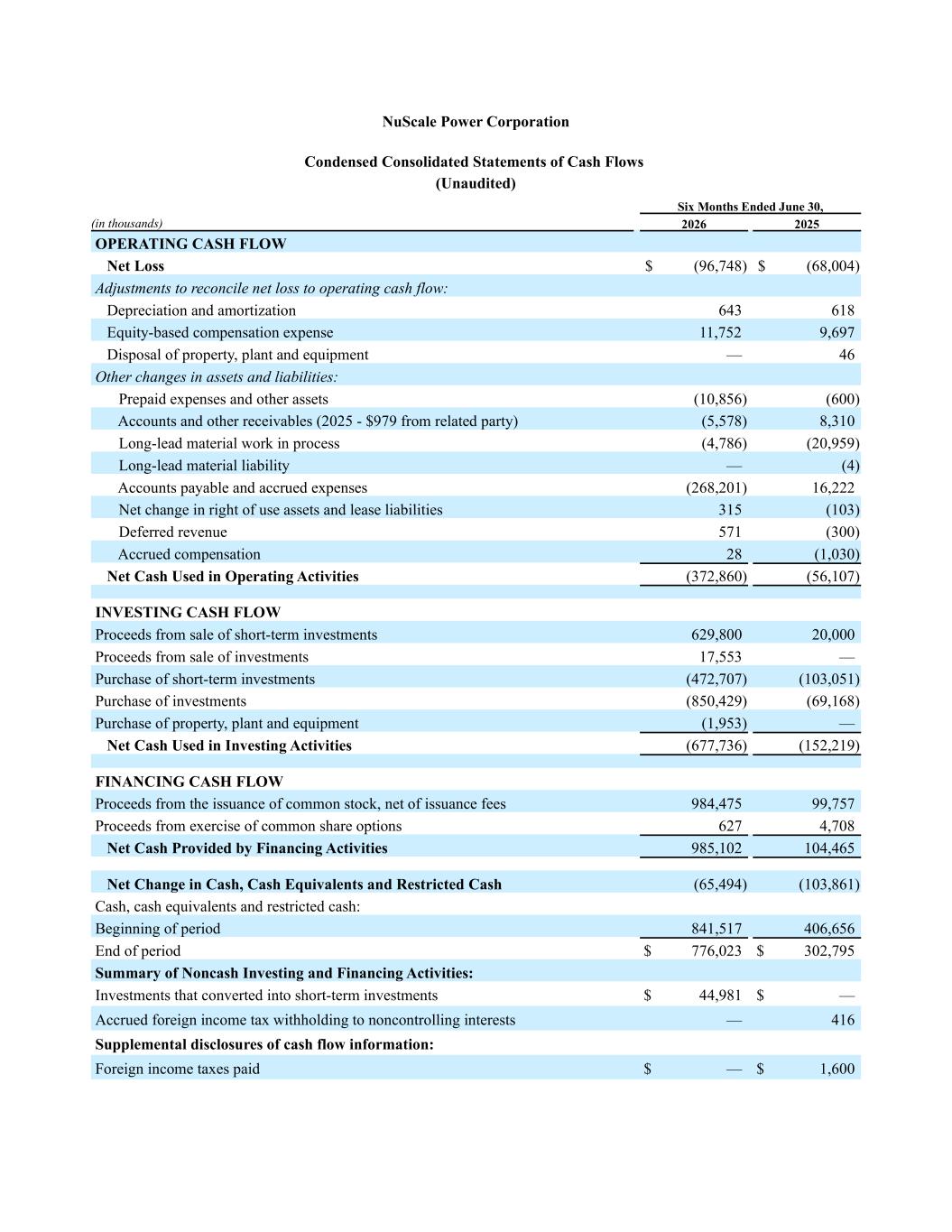
Thank you. And one more question, just a little bit of a minutiae item. I noticed that in your balance sheet the investments increased significantly. I haven't gone through your queue yet. Can you just sort of talk about what compelled that to move up to $800 million relative to last quarter?
Hi, George. This is Ramsey. How are you doing? Good, how are you? Good, good. This is really just a treasury strategy. As we bolster our balance sheet, we kind of pull away from this idea of traditional startup, You know, per rate and runway and more about cash allocation and long-term planning. And that's what $1.9 billion gives us, the ability to plan long-term. It gives us optionality. And as you have that amount of cash on balance sheet, you know, you tend to look into longer-term instruments. You know, we're in a strategy strategy, all high-grade, but if you look at longer-term instruments, so there's really a classification on the balance sheet. But it's all cash and cash-like investments. Great. Thanks, guys. Thank you. Thank you.
Operator
Your next question comes from the line of Mark Bianchi with TD Cohen. Your line is open. Please go ahead.
What's it going? This is Establan. For Mark. Thanks for taking the question. So I wanted to ask on the Romania project. I believe Rope Power earlier this year had some new contingencies around an FIV, including a proposal on sort of the purchase cadence of the power modules. And I think there was also a more recent update to stick with New Scale rather than considering other technologies for the project. Can you walk us through some of those updates and when we should expect further progress on the project?
Yeah, I could probably use John to speak, and I appreciate the question. You know, we, as you know, we're a subcontractor to Florida Corporation, who is a prime contractor, and we completed successfully the front-end engineering design. There is a new government that's coming in that's being seated as we speak. Myself and my COO are planning to go to Bucharest to meet with that government probably later this month. But we're ready to go. You know, we're just waiting on the green light to finalize our contract agreements, but as I said, phase one went well. Now we're going into what's called the pre-EPC, which will take it up to the final notice to proceed, which is probably another year from now.
Okay, thank you. And my follow-up is on the combined operating license application. I know you had already completed a meaningful amount of work there on the COLA from the previous CFTP project. And I think you're still engaged with the NRC with that. So I just wanted to get a little bit more color on how much of that COLA is standardized and can be carried over to another U.S. project. You know, roughly how much time and probably regulatory costs that could save.
That's a great question. We're looking at what we have done for the previous budget you commented on. About 60 percent of that COLA can be utilized. And as soon as these PPAs are put in place, that's one of the first initiatives we'll have is starting the construction operating license agreement with the customer. So, again, about 60 percent of that, we can move over to this next project.
Thank you. I'm from the back.
Operator
Your next question comes from the line of Derek Soderbergh with Cantor Fitzgerald. Your line is open. Go ahead.
Hi, this is Drew Norquist on the line for Derek. Thank you guys for taking questions. Just going back on Rope Power, did you guys highlight what sort of conditions need to be satisfied in order to move on, and if that's in your hands or if that's more in Rope Power's hands?
Actually, and the first phase that needs to get done, really, is the completion of the plan contractor to come into contract arrangement with the customer, And then we will enter into contract negotiations with the prime PPC. So we're all kind of in a wait mode right now, waiting for things to progress, and that's one of the reasons we're heading over to meet with the new government to talk about what are the next steps.
All right. Thank you. I'll turn it over.
Operator
Next question comes from the line of Greg Lewis with BTIG. Your line is open. Please go ahead. Your line is open.
Yeah, hey, thank you, and good afternoon, and thanks for taking my question. Ramsey, I was hoping to talk a little bit more how you're thinking about the liquidity position. Clearly, you made some moves to really bolster that heading into the back half of this year and in the next year. So just kind of clear up any kind of broad stretch you can give us around, you know, let's just assume that, you know, we eventually get these contracts from TVA to move forward. Is there any kind of timeline you can give us in terms of when we're going to have to start deploying that capital Yeah, I'm just kind of curious around that.
Sure. Thank you for the question. Let's talk about a few ideas. We did bolster our cash, $1.9 billion. It reflects a strong liquidity position. It reflects a conservative approach to liquidity. And, you know, as clients people on the line, I think we all understand liquidity is one of those things where it's, you know, it's often there when you don't need it, and it's often not when you do. And so we took the opportunity last quarter to bolster our liquidity and set ourselves in a pretty good position. What this does is it changes, and I think I mentioned this in an earlier question, it changes the framework by which we look at our cash. You know, we've diverged from those startup metrics, we've diverged from burn rate, And we provide optionality, and now we think about capital allocation. And as I think about capital allocation for a company that's engaging production, you know, first-of-a-kind technology, you know, one thing that comes to my mind is ideas around working capital, changes in our OPEX, and how cash enables the business to be in a better position to deliver, you know, Let's deliver our product when we say we're going to do it, and the cost we say we're going to deliver at. And so that's the gunshot of the change. Like, when do we expect that draws in cash will happen? You know, I think that question is similar to when do we expect commercialization to happen. Some of our expectations have been reflected in some of the announcements we've seen, for example, with Framatome over the last quarter. We expect commercialization to happen soon, so we're preparing for it. We're investing in the supply chain. We're investing in design and finalization. We're investing in fuel systems. So you can read into our expectations based on our actions, but ultimately, you know, the commercial contract is the main catalyst, and we're ready for it. And I think it's a great position for us to be in.
Okay, and so as we think about some of those parts of the supply chain that need to be addressed, Yes, I imagine we'll spend a lot of time thinking about the cost associated with those moving to commercialization. Is that things that we're starting to look at now, or is it more kind of getting everything in ready mode for when we eventually get the green light from our first commercial partner?
Now, we're working, as I said, we've been working for years with these key suppliers, and they're strategic suppliers. Some of these suppliers are investors in new scale. They're not looking for a one-off project. They're looking for the opportunity for sustainable supply, and they give us very competitive rates. You know, as an OEM, about 30, maybe 30-plus percent is going to be our cost, and then the rest is going to be the UTC and other contractors. So I believe we have a very good handle with what our suppliers are, you know, offering us in terms of being on a competitive basis. And the bottom line, they have to prove competitiveness, so it's not open-ended.
Operator
Your next question comes from the line of Craig Share with Toohey Brothers. Your line is open. Please go ahead.
Good afternoon. Thanks for taking the questions. So, first, I mean, you sound very confident about pending, you know, first-of-a-kind customer FIDs, so presumably around TDA. Would you expect with the first FID to be in a position to share with the street new scale level margin clarity, or would that be a bit of a moving target with the first order?
No, I think internally we have expectations of where we want our margins to come out. I think we all acknowledge that, you know, first-of-a-kind may be more challenging than end-of-a-kind. I think we get to end-of-a-kind pretty quickly with fifth manufacturing we're engaging, and we want to be able to provide guidance to the street, but I want to be able to provide guidance based on our OEM contracts, our supplier contracts, And doing it absent or prior to that real visibility, I think it just becomes a little bit problematic. So as soon as we can, as soon as we're confident, we'll start to provide guidance. And I think you as analysts will have a better construct, you know, come out with your price targets and understand the value that we're creating within our business for our shareholders.
Understood. Good. So I want to talk a little about speed to market, because that was most of your prepared comments and your leadership there, given the fact that you're ahead on the regulatory and you preordered these 12 modules. So, obviously, we're getting other announcements that are more immediate and are not SMRs, right? I mean, we're getting announcements of behind-the-meter, you know, CT projects for 18 months deployment, maybe, you know, three to four years on CCGTs. You know, given the fact you've already, you know, deployed resources and relationships for your first 12 modules, from FID on the first project, how quickly can that be producing power? And then is there a gap on the second project, since you don't have that on order today? And given your great liquidity position, is that a reason to put more on order today or in the near future?
Our position right now, I just want to get the first module up and running to showcase. And remember, these are redundant systems. But the last thing that's going to happen after the plant is built and the balance of plant and the reactor building, Then NuScale will move DART modules into the factory, and we'll erect them one at a time. Once the first one or first two are up and running, they're operational, we bring the second one in, and we bring the third one in. And if you remember, the NuScale module is predicated not on doing any given one plant at any given time. There's multiple plants. These are fungible assets. We build them in a factory, and we ship them. Now, with the magnitude of what we're talking about with TVA, I mean, anywhere from 6 to 8 gigawatts, It's massive. It's a massive undertaking, but it's one project at a time.
Any thoughts on, you know, the first 12 modules being online, given the progress you have there?
Oh, you know, we've stated publicly that, you know, from a first pouring of safety-related concrete to mechanical completion will generally take, you know, a little less than 40 months, but that does not entail. We've still got the up front dealing with the NRC and the licensing process. So, you know, construction timeframes are within that window, we believe, you know, within a 40-month window for construction, or in a concrete to mechanical completion.
And so, you know, hopefully with the NSC, we've had great conversations. In fact, the team was just with the Nuclear Regulatory Commission last week. They're doing a lot of things, particularly in that front-end advancement to help get contractors or get technologies to move quicker on the licensing front. So we're hoping maybe what would typically take a two-year, it could be reduced significantly.
Operator
Your next question comes from the line of Ellen Page with Truist. Your line is open. Please go ahead.
Hi. Thanks for the question. And maybe just to start, the power plant business had negative revenue in the quarter due to a negotiation with SOAR. How do we think about that impact, or how does we think about the real power progression going forward under that new price agreement? And any more color you can provide would be great.
Yeah, I don't think the negative revenue number is really indicative of some ongoing trend with real power, with our margins there. You know, that was an adjustment. And what you really saw is, you know, we had work with FLIR related to PSAE2 in the prior quarter, two prior quarters, pardon me, or in the same quarter period in the prior year, Which we didn't have this year. So, that revenue is gone. There's an adjustment. What you saw is negative margin. It looks a little funny, but it's not indicative of the trend. And we're talking about pretty small numbers on a pretty small basis. So, I wouldn't read much into that.
Okay, great. And then, maybe just on PDA, is there any, like, milestones in particular or next steps you can call out ahead of a PPA, or we're just kind of waiting for those negotiations to be complete?
I think, as I stated in the comments, the talks are progressing. We're very active with Inter1 and communications on a daily basis. Our chief commercial officer is involved with it again on a daily basis, so we're in a mode right now that as soon as these PTAs are definitized, we're ready to move. And by move, I mean enter into, you know, start the COLA position, start the front-end engineering design, and initiate the OEM contracts or negotiations.
Operator
Your next question comes from the line of Brian Lee with Goldman Sachs. Your line is open. Please go ahead.
Hey, guys, this is Tyler Bissett, and I'm from Brian. Thanks for taking our questions. And there's been a lot of focus on TVA, but I'm curious if you can discuss any other pipeline opportunities. So, you know, what other engagements are out there and any other details you can provide on timing, geographies, or types of customers that InterOne is working with?
You know, I'll just say, as I said earlier, we're in a lot of discussions with the hyperscalers, With the governments, with the international, but our focus right now is to try to get these working with Inter1 to get TVA across the goal line. But as you know, I mean, everybody needs energy. You know, we were part of the mix, and, you know, customers have different strategies, and our strategy right now is if they're ready to move and they need near-term deployment, we're willing to talk.
Operator
Your next question comes from the line of Sundaria Leyer with V. Riley Securities. Your line is open. Please go ahead.
Thank you, team. This is Sundaria on behalf of Ryan Finkst. Most of my questions have been answered, but just a couple more. On the supply agreements that you mentioned have been signed with more than half of your suppliers, What are some of the long lead items left to achieve on that supply chain?
I think we're in pretty good shape. As I said, the real long lead items are four genes, which are being in production currently. They've been in production for the last two years. We mentioned, you know, we use conventional fuel. Premitone is our fuel supplier. That fuel will be manufactured in the state of Washington. Paragon, we mentioned, for instrument and control, for safety, that's ahead of schedule. So I think, again, I don't see any problems with being able to respond, as I said. We're good to go.
Yeah, that's good to hear. Thank you. And one more, following up on that Romanian project, Roe Power, Could that treasure any revenue generating services in 2026, or should we think about it in 2027 and beyond?
We certainly hope so. You know, if you look at Romania in general and if you look at the success on the front end in engineering design, it's really up to the timeline of the customer and when we're going to start the next phase. So if we get the contract in place, yes, they'll be right with you next year.
That's great. Thank you. I'll turn it over.
Operator
Your next question comes from the line of Vikram Bagri with Citigroup. Your line is open. Please go ahead.
Hey, guys. This is Vignesh for Vikram. Thanks for doing the question. Just wondering, could you help us think about the cadence of OPEX over the next few quarters? I think you mentioned previous to current rent over time, but any color or range would be helpful in kind of some of the key drivers. on the incremental spend. Thanks.
Hi, this is, this is, I don't give too much of, of, of guidance on future OPEX. I don't think we're in a position to do that, and we generally don't give guidance yet. But I will look to the past 10 quarters. Starting from the beginning of 2004, right through the end of 2005, this management team kept OPEX within, uh, uh, somewhere around like a two or three million dollar band between like We had 41, 44 per quarter. We were deliberate, we were targeted, we executed, and we were consistent. Over the past two quarters, as we moved, you know, we had worked with Rural Power originally back in 2005. As we got to 2006, some of that work went away. We kept those same engineers. They went from the cost of goods sold line down to OpEx. So we saw a bit of a bump up in OpEx Because, you know, we need those people. They're executing our projects, and we expect to continue executing our projects in the near future. So we kept those people. You saw a bump up in OPEX. But, again, you know, OPEX was within like a million or so this past quarter, as it was within Q1. So without comedy or providing guidance, I think the lesson to take away is that management is deliberate. We're precise. We control OPEX. We're active on it. And what we won't do, which I think this may be to the heart of some of your questions, is allow OPEX creep to come up and start to impact our liquidity. So I would just take the lesson away that we're pretty conservative and we're pretty well-focused and disciplined here. We're not going to model on valuation, but I think that's the best we're going to get.
Operator
There are no further questions at this time. I would like to now turn the call back over to John for closing remarks.
Yeah, thank you, Operator. And again, thanks, everyone, for attending. You know, as we heard throughout this Q&A, we get questions about when is NewScale moving from potential to proven, and it's a fair question. You know, we're in discussions regularly with hyperscalers and utilities and governments. The bottom line is the preconditions for us to move are in place. The regulatory approval exists. Our fuel supply exists. The engineering is mature. The supply chain is mostly contracted. As we stated, we've got long-lead items in production. Our liquidity ramp-up for manufacturing is in place. You know, the market's waiting for definitive agreements, and once they're in place, we're ready to move. So I'm looking forward to the next session we all get together, and again, thanks for joining us today. Thanks, everyone.
Operator
This concludes today's call. Thank you all for attending. You may now disconnect.