Operator
Good afternoon, and welcome to the Universal Technical Institute’s Second Quarter 2025 Earnings Call. All participants will be in listen-only mode. After today's presentation, there will be an opportunity to ask questions. Please note, this event is being recorded. I would now like to turn the conference over to Matt Kempton, Vice President, Corporate Finance and Investor Relations. Please go ahead.
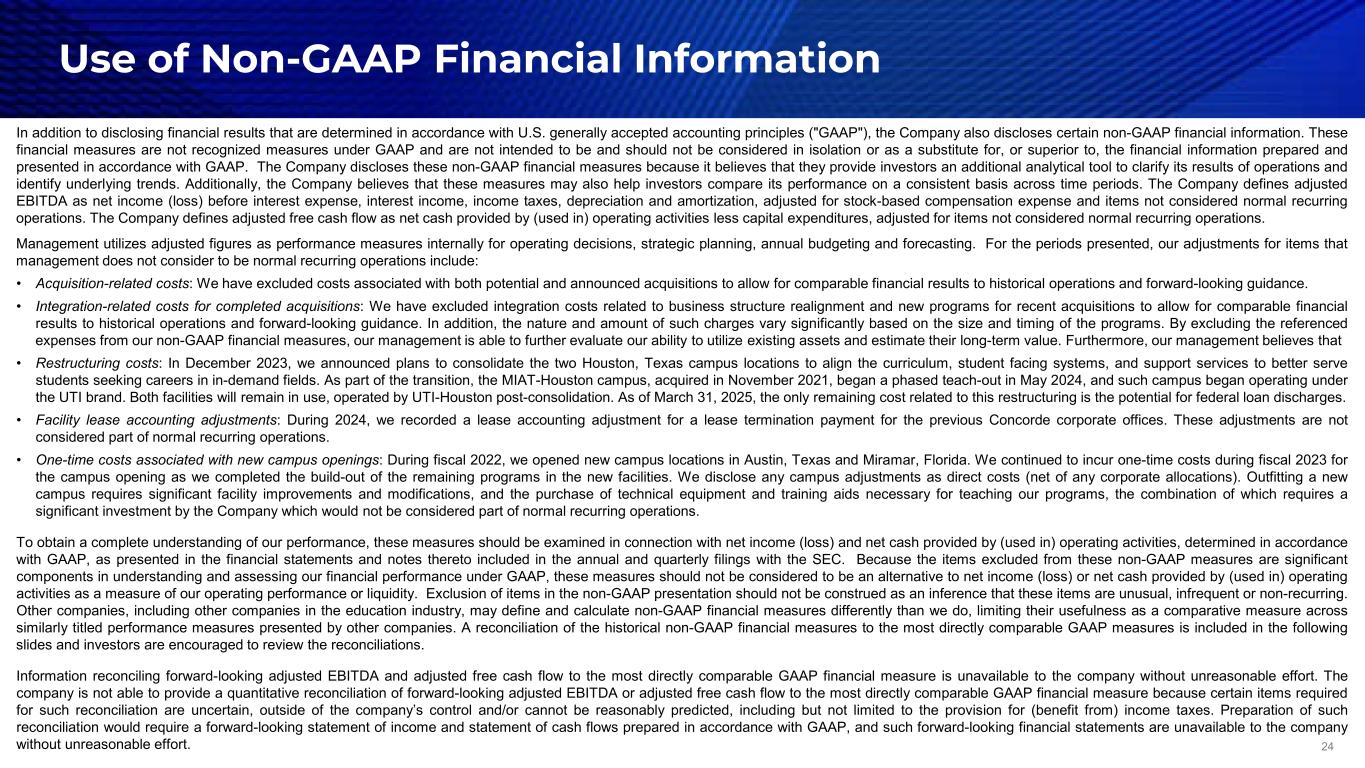
Hello and welcome to Universal Technical Institute’s fiscal second quarter 2025 earnings call. Joining me today are our CEO, Jerome Grant; and CFO, Bruce Schuman. Following our prepared remarks, we will open the call for your questions. A replay of this call, its transcript, and our investor presentation will be archived on the Investor Relations' section of our website at investor.uti.edu, along with our earnings release issued earlier today and furnished to the SEC. During this call, we may make comments that contain forward-looking statements as defined in the Private Securities Litigation Reform Act of 1995, which by their nature, address matters that are in the future and are uncertain. These statements reflect management’s current beliefs and expectations and are subject to a number of factors that may cause actual results to differ materially from those statements. These factors include, but are not limited to, those discussed in our earnings release and SEC filings. These statements do not guarantee future performance, and therefore, undue reliance should not be placed upon them. We do not intend to update these forward-looking statements as a result of new information or future developments, except as required by law. Please note, unless otherwise stated, all comparisons in this call will be against our results for the comparable period of fiscal 2024. The information presented today also includes non-GAAP financial measures. These should be viewed in addition to and not as a substitute for, the company’s reported results prepared in accordance with U.S. GAAP. All non-GAAP financial measures referenced in today’s call are reconciled in our earnings release to the most directly comparable GAAP measure. For more information regarding definitions of our non-GAAP measures, please see our earnings release, financial supplement, and investor presentation. With that, I will turn the call over to Jerome Grant, CEO of Universal Technical Institute for his prepared remarks. Jerome?
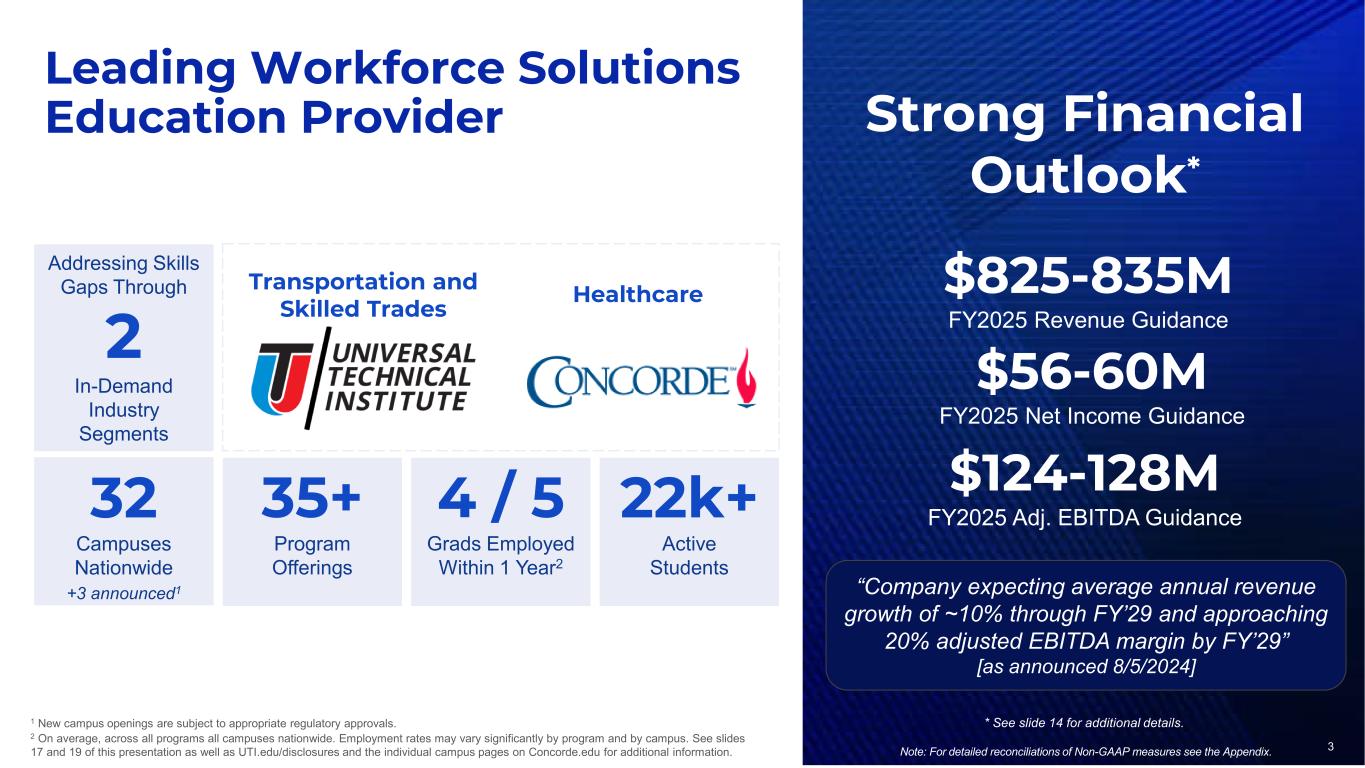
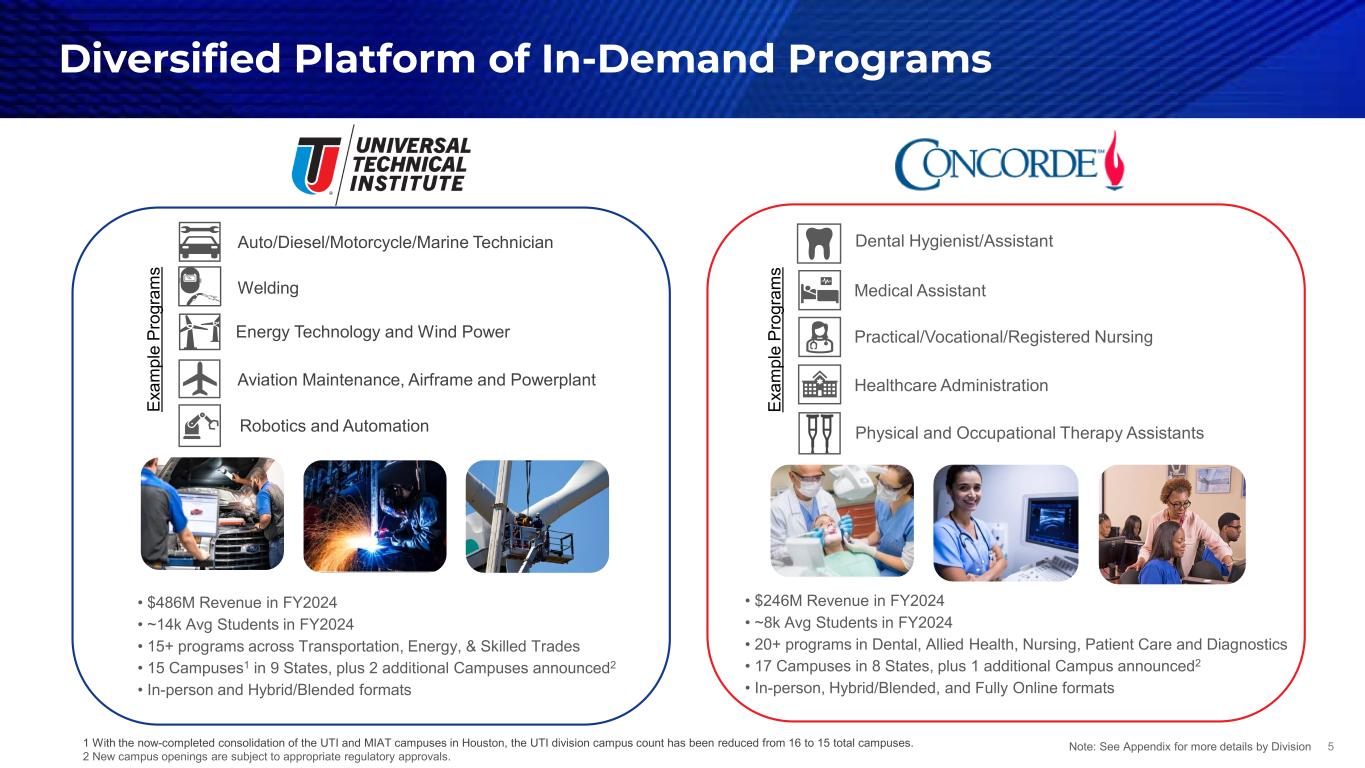
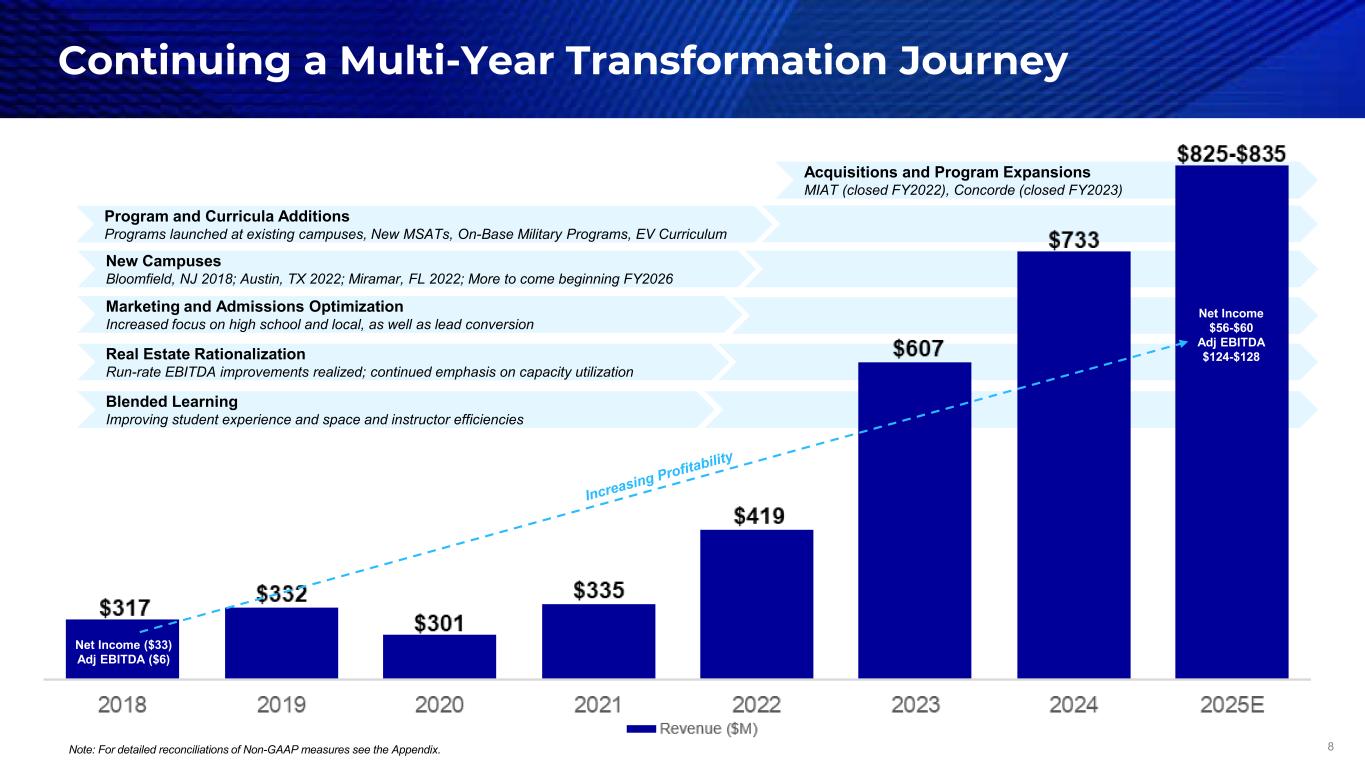
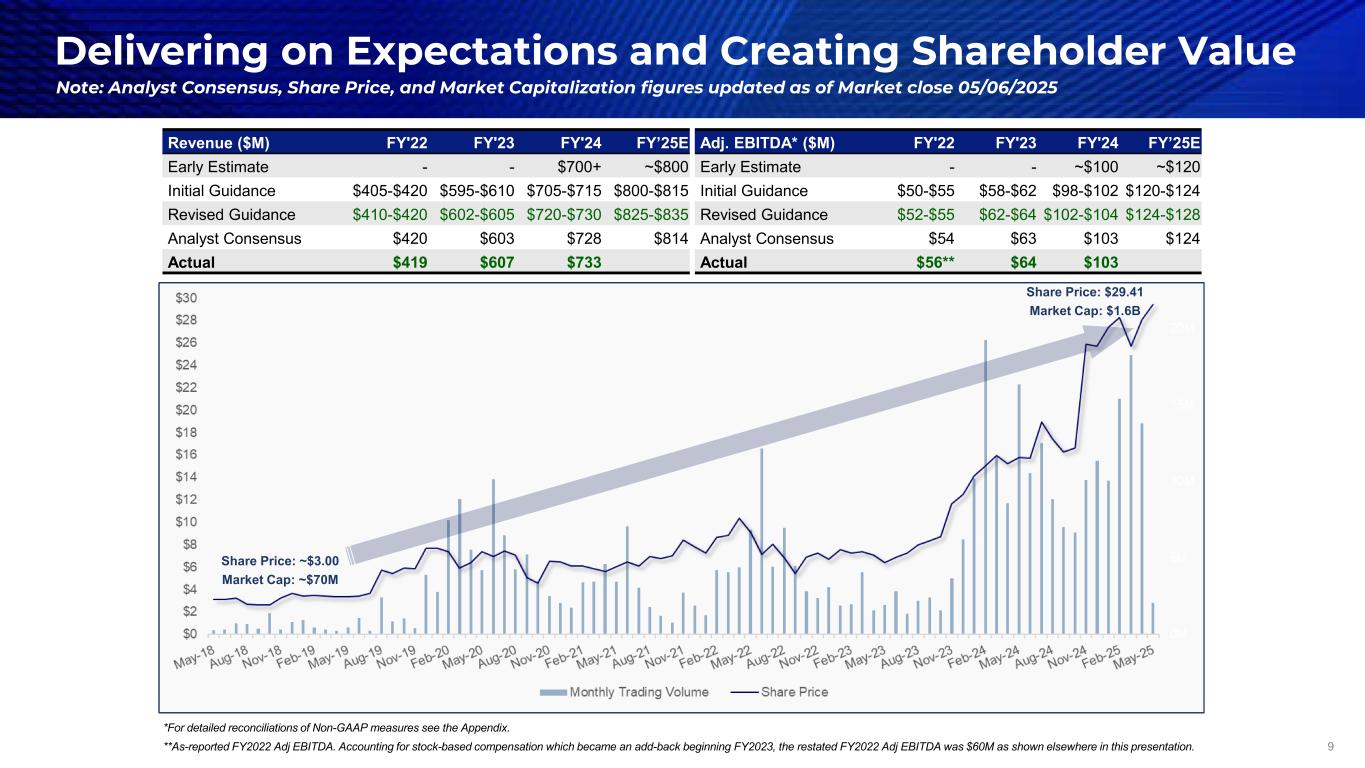
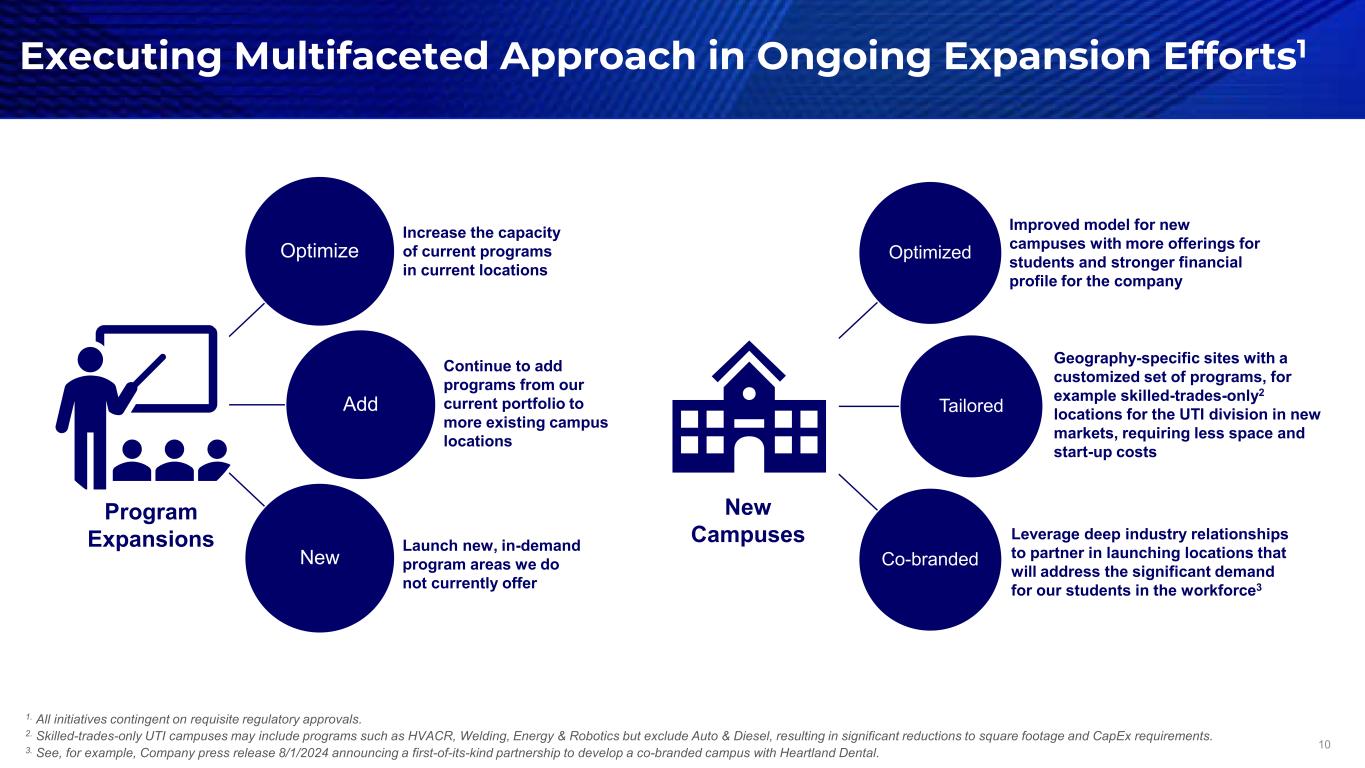
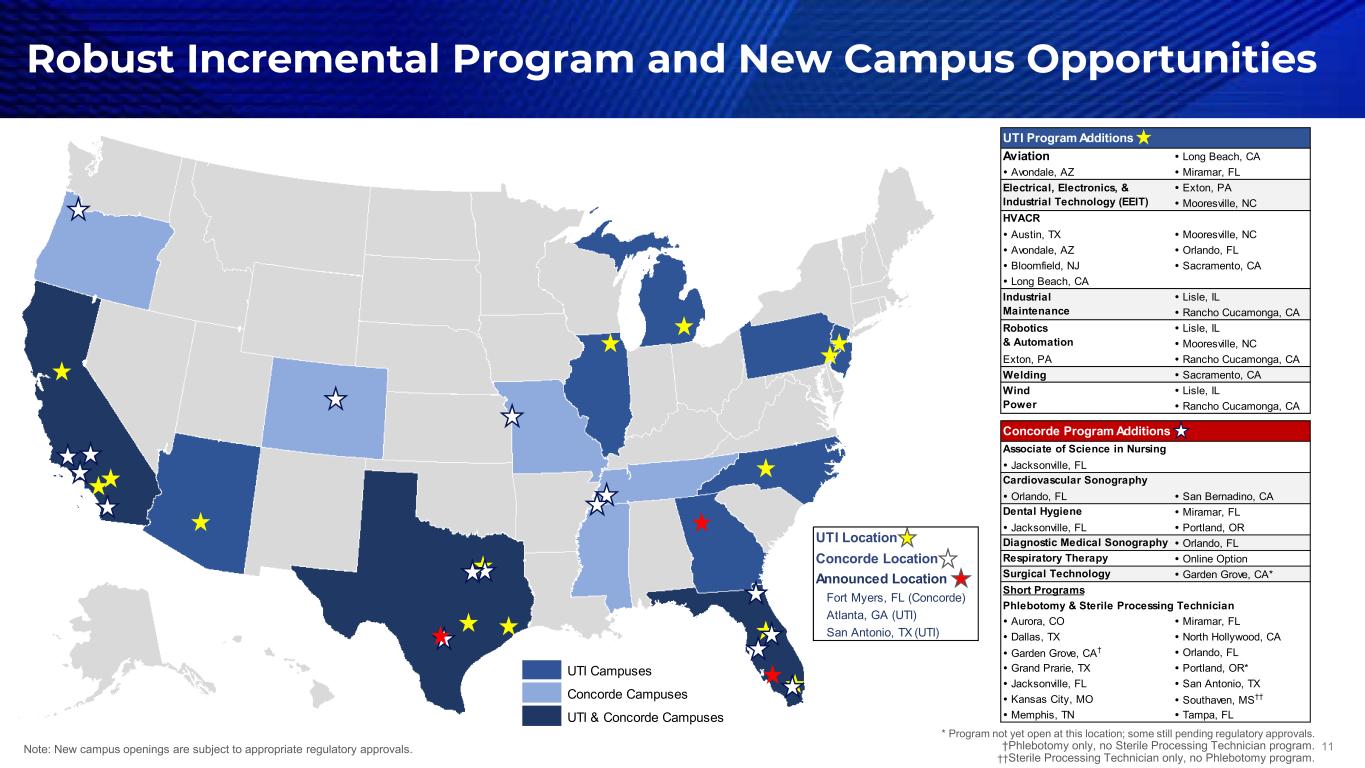
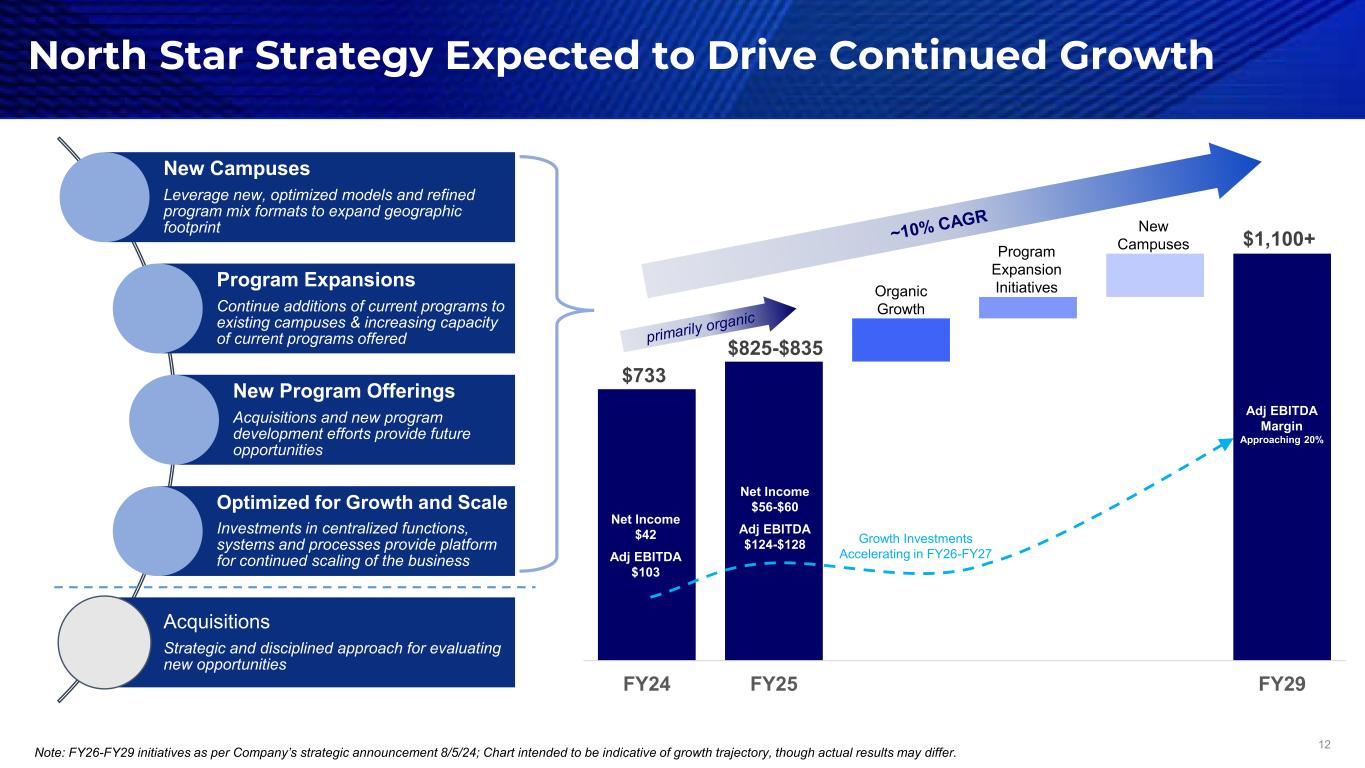
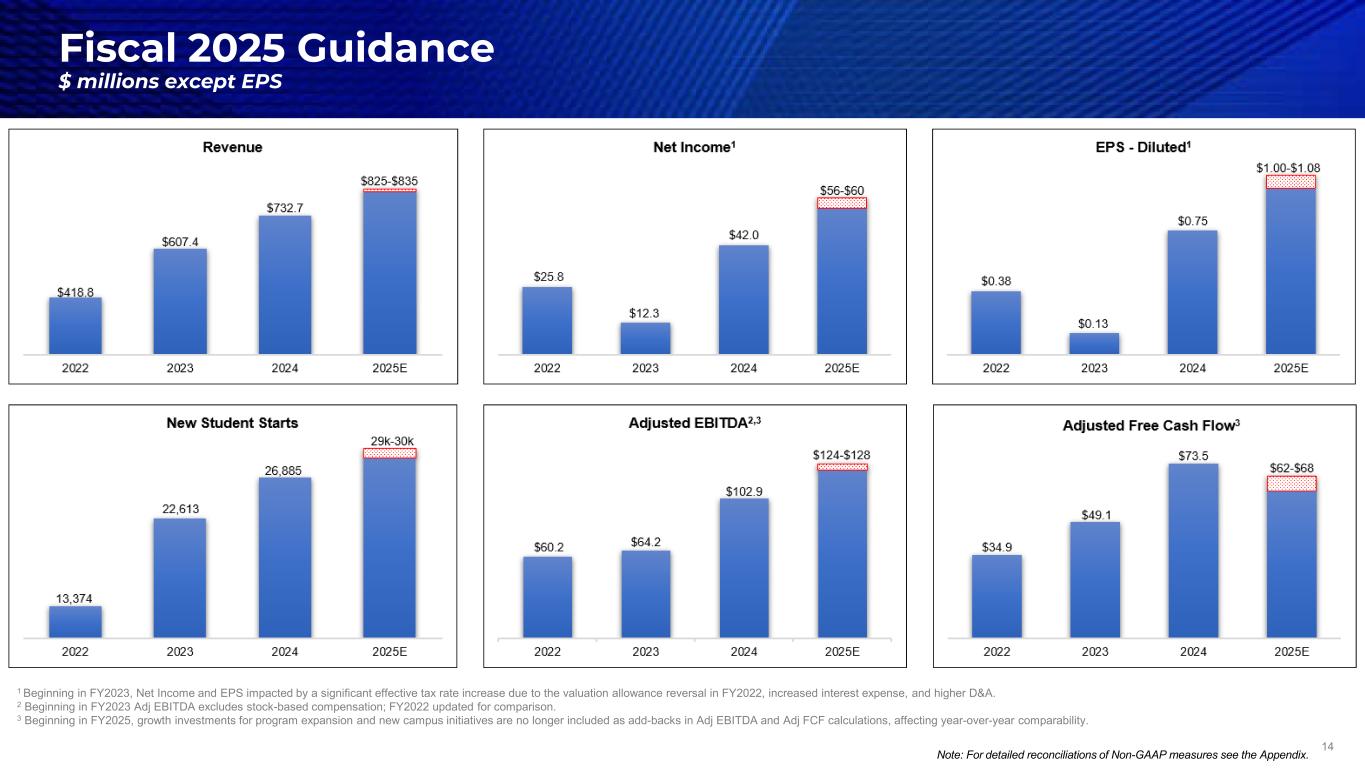
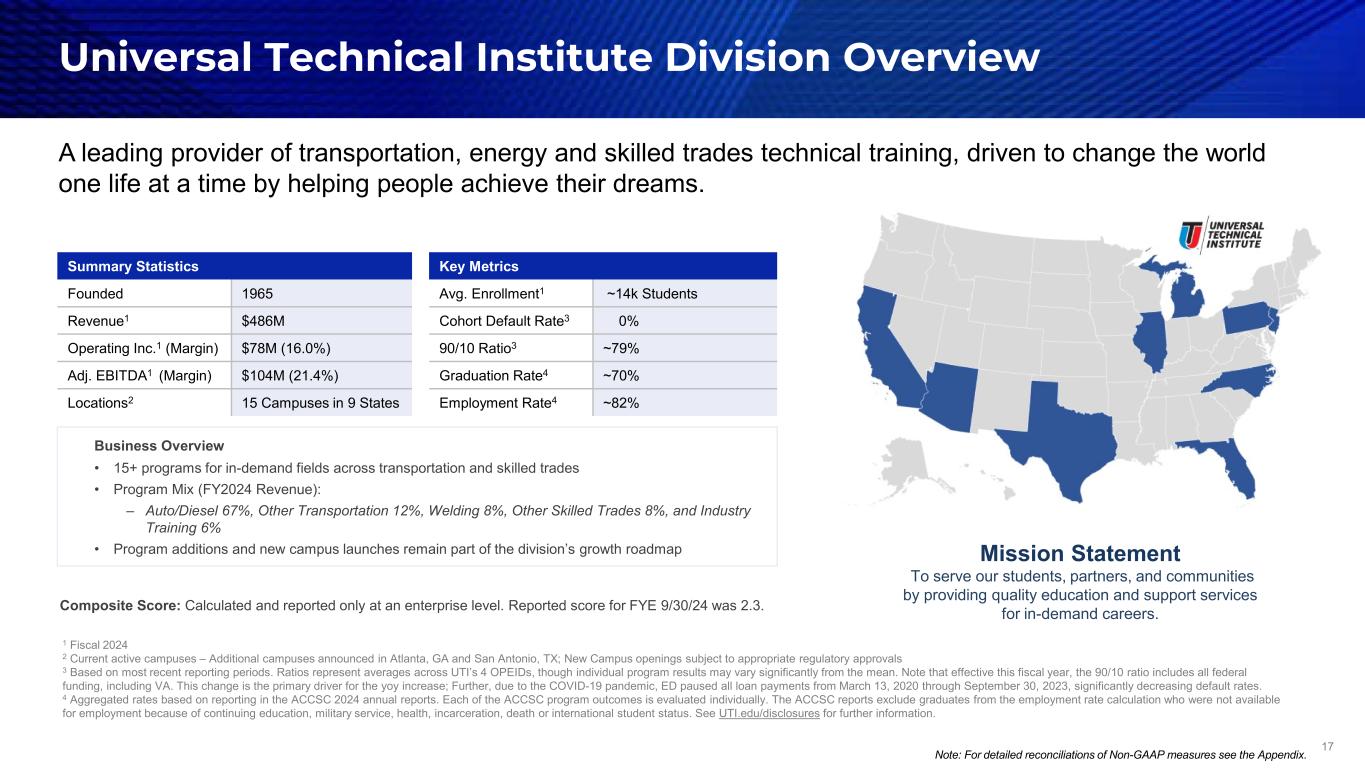
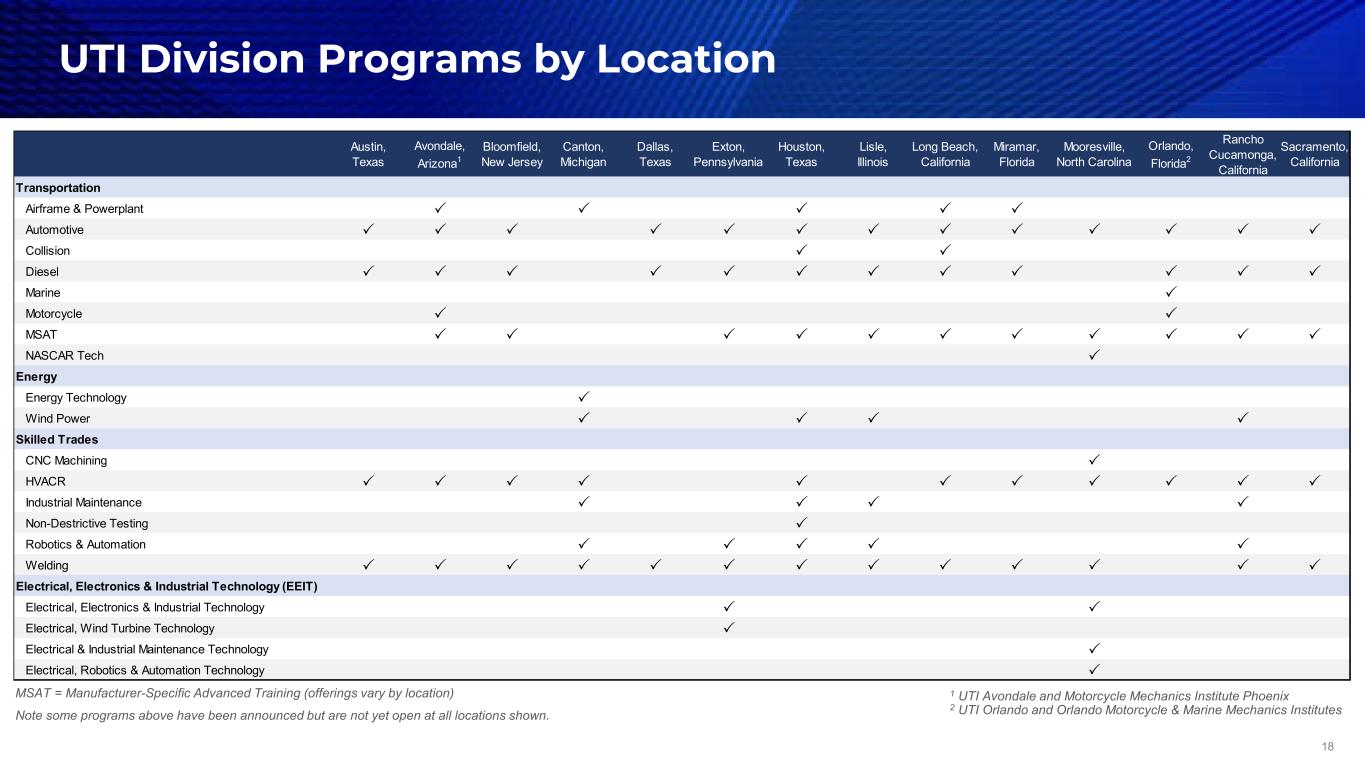
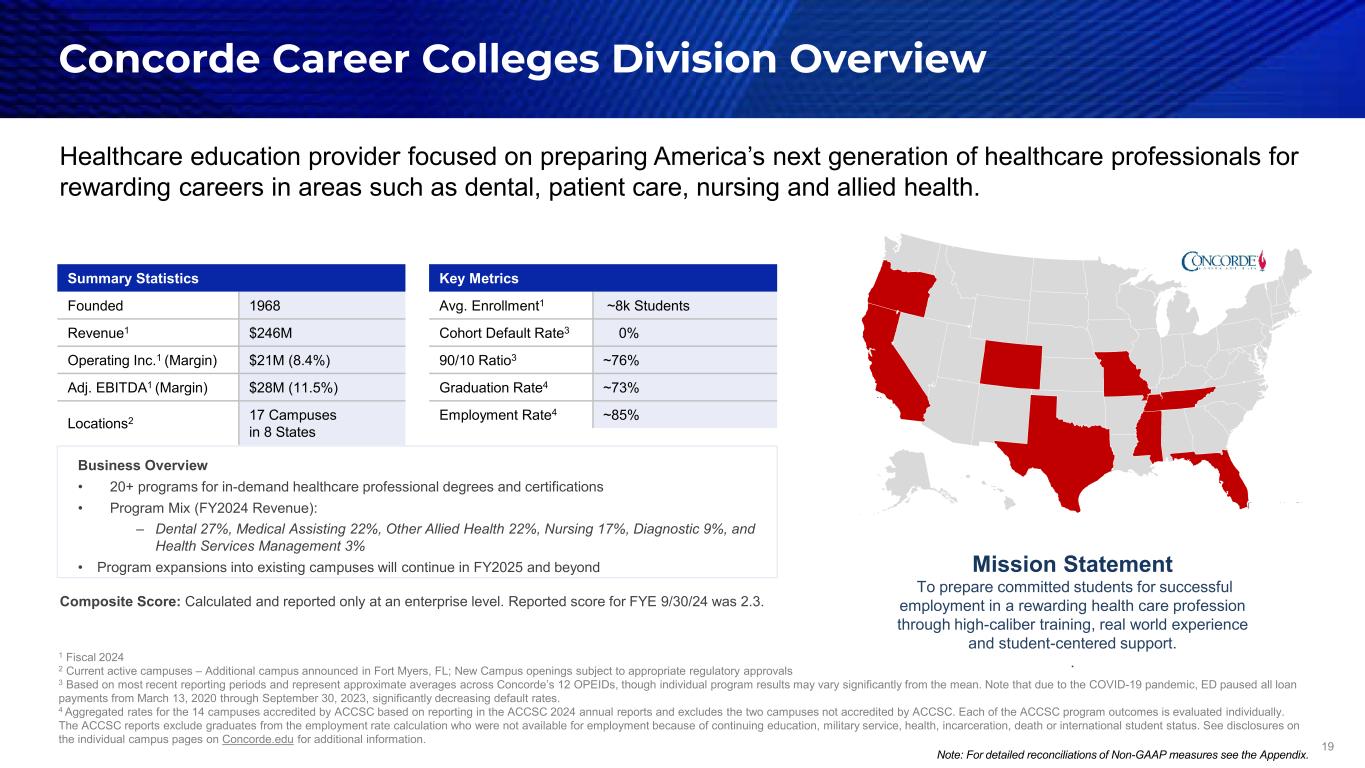
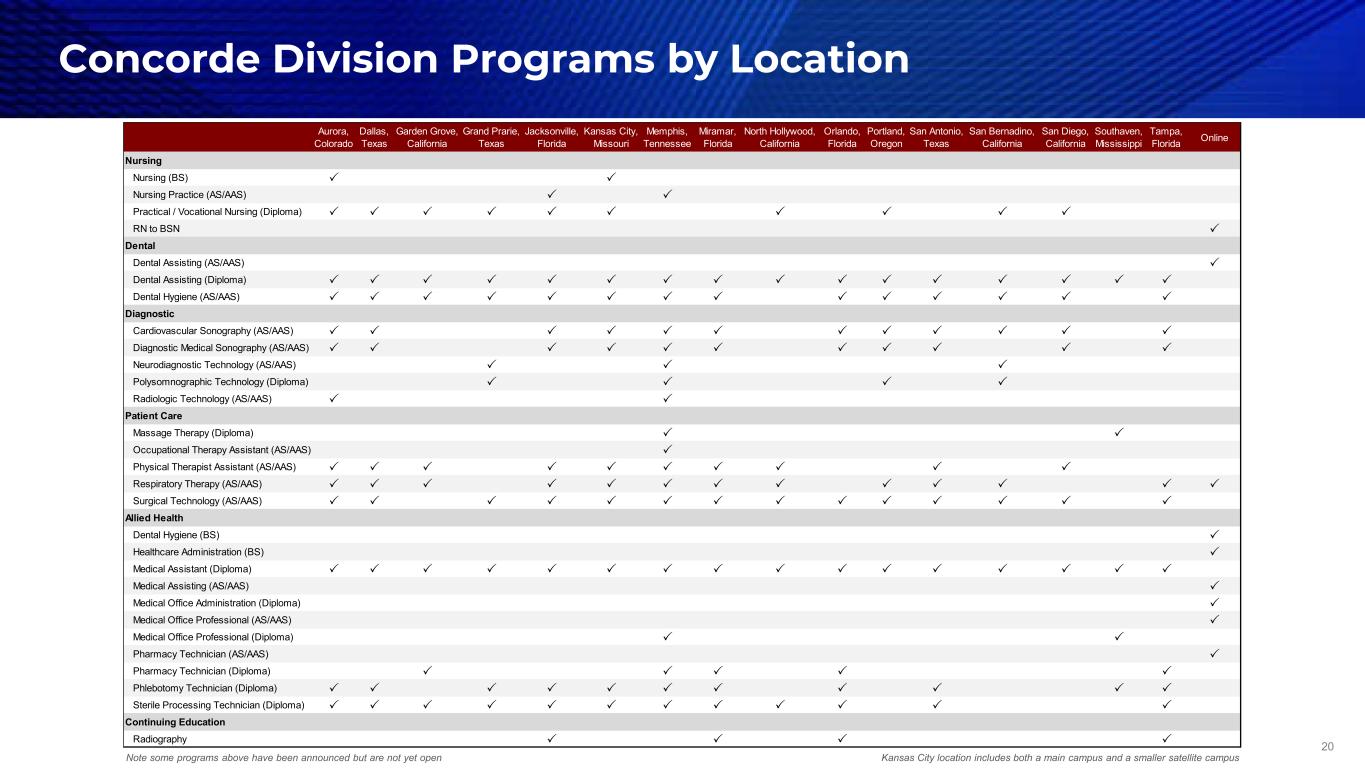
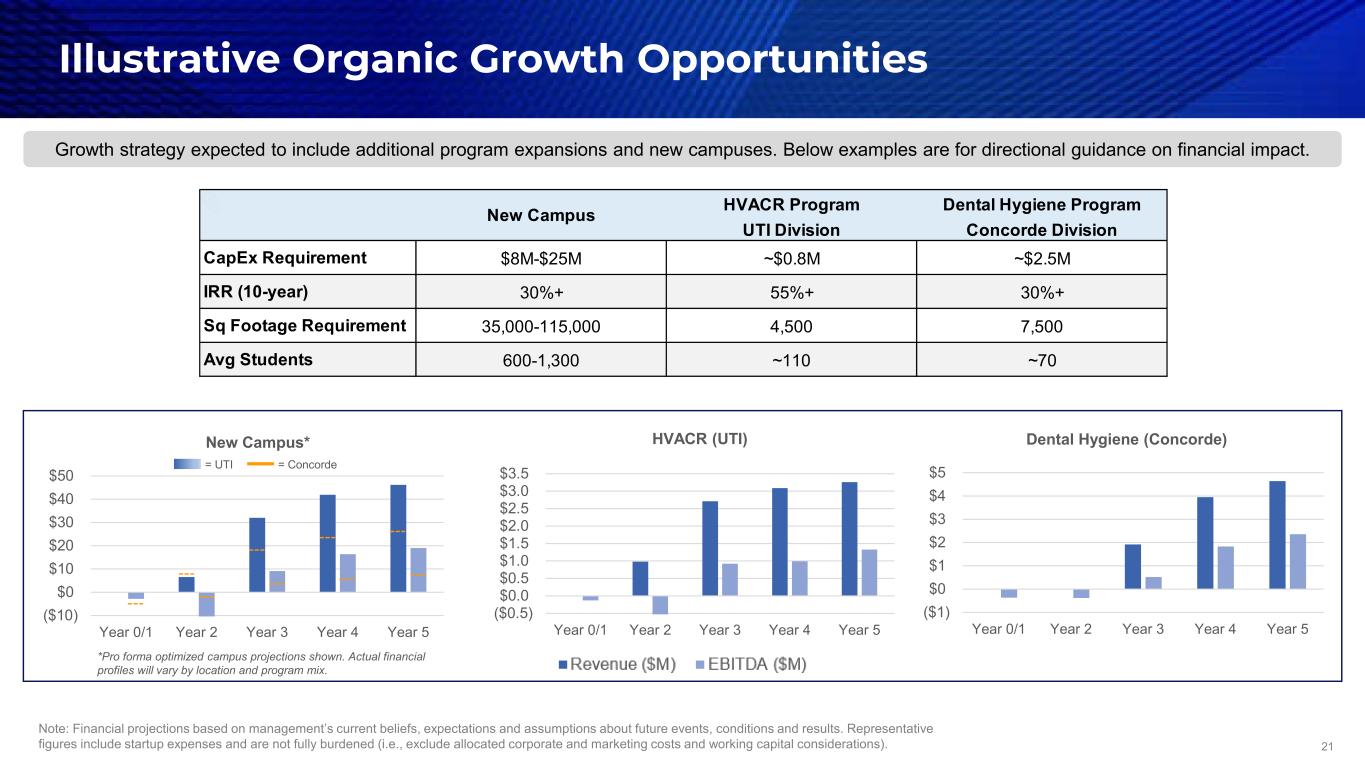
Thank you, Matt. Good afternoon everyone and thank you for joining us to discuss our results for the second quarter of 2025. Over the past few months, I've heard from many of you, which is great as we pride ourselves on keeping the lines of communication open with the investment community. With everything going on in Washington, many of you were interested in how we're responding to the changes already made and potential changes in the regulatory environment. So, before I get into our strong Q2 results, I'd like to start today's call by briefly sharing my views on recent regulatory developments and the broader macro environment we're operating in. Despite our initial cautious outlook for both the 2025 top and bottom line heading into the presidential election and recent developments across the higher education regulatory landscape that may suggest otherwise, I’m pleased to share that we have not experienced any disruptions to our operations or growth trajectory. As a matter of fact, the lines of communication with the new leadership team within the Department of Education have only strengthened since the inauguration. Our expansion plans remain firmly on track and depending on how circumstances evolve, we may actually be positioned to accelerate the growth of our Concorde and UTI divisions. We certainly will share specific news on that front as plans take shape. With respect to tariffs, we expect impact, if any, to be minimal for us, but we'll keep monitoring for changes. From a macro environment perspective, demand for skilled labor, particularly across the trades and healthcare continues to strengthen in this environment. The ongoing supply and demand imbalance in these critical sectors and improving dialogue in favor of trade schools over traditional 4-year degrees is generating additional tailwind for our business. Employers continue to voice their urgent need for well-trained professionals and our campus network and program offerings are increasingly aligned with that demand. With that, let's move to the results for the quarter. We maintained strong operational momentum throughout the second fiscal quarter of 2025, continuing to deliver results that exceeded our expectations. We executed with discipline and consistency, staying focused on our growth, diversification, and optimization strategy, while navigating a dynamic macro environment and prioritizing outcomes for our students. Given the broader uncertainty in the market, we were conservative with our estimates and deliberate with our spending throughout the quarter. As a result, and in conjunction with the favorable environment for our graduates, both revenue and adjusted EBITDA significantly outperformed forecast. Revenue for the second quarter increased nearly 13% year-over-year to $207.4 million. Average full-time active students grew over 10% year-over-year to 24,604 students, with the new student starts growing more than 21% year-over-year. Net income increased 47% to $11.4 million with diluted earnings per share of $0.21. Adjusted EBITDA grew approximately 28% year-over-year to $28.9 million. We are pleased with the strong results we are sharing today. They serve as a powerful proof point of our business model strength and resilience, reinforcing our confidence in achieving our long-term goals. We remain firmly committed to delivering both year-over-year top and bottom line growth throughout the second half of 2025. Now, to our division-specific highlights for the quarter. Starting with Concorde, the division continued to deliver robust year-over-year growth, driven by sustained marketing investments and the effectiveness of our admissions team, as well as strong program demand. Our marketing and admissions investments in Concorde continue to generate very strong conversion rates, driving new student starts. We're continuing to test the elasticity of the Concorde model, and we've yet to find the ceiling on how far we can push ROI. Regarding Concorde program expansion strategies, our previously announced initiatives remain on track, including the launch of a brand-new nursing program in Jacksonville, Florida in mid-fiscal 2025, our Dallas nursing program capacity expansions, which is set to add 60 additional students later this year, and the 10 non-Title IV short course programs rolling out across the Concorde campuses in 2025. With optimization in mind, we're relocating our Aurora, Colorado campus to Denver. This is part of our ongoing plan to enhance operations, expand programs, and improve margins. The new campus will occupy 60,000 square feet and will open in February of 2026. This reimagined space will include new simulation labs for students to gain hands-on experience with real-life medical scenarios, as well as additional space earmarked for other high-demand programs and a larger dental hygiene clinic. Shifting to our partnerships. I'm pleased to announce that we broke ground on our new co-branded Heartland Dental campus in Fort Myers, Florida last month. This first-of-its-kind campus, set to open in early fiscal 2026, will train up to 190 dental hygienists and assistants annually. As previously mentioned, this campus will begin as a non-Title IV campus, with plans to apply for Title IV funding once Concorde's growth restrictions are lifted. We expect this location to contribute more than $4 million in annual revenue as the campus scales. Turning to our UTI division. The UTI division maintained strong year-over-year improvements, largely as a result of program expansions, the immense market demand for skilled collar workers, and our strong lead conversions. Building the foundation for UTI's continued success are our ongoing expansion efforts. This quarter, we made exciting progress on our program expansion initiatives. As we previously announced, we have eight full-length programs launching across UTI campuses this year. In March, we added our HVACR program to our UTI Orlando campus and most recently launched our Electrical Electronics and Industrial Technology, or EEIT program at UTI's Xtend and Mooresville campuses. This new 12-month EEIT program will train students for entry-level careers in low-voltage electronics and high-voltage electrical systems for certain residential and commercial construction applications. This program also includes the maintenance of industrial technology, including industrial robotics, hydraulics, and mechanical systems. By expanding our portfolio with in-demand programs, we're continuing to reach even more students in high-demand employment areas. Additionally, as part of our North Star strategy, Phase 2, we plan to open three campuses in 2026, subject to regulatory approval. These are the Heartland-Concorde co-branded campus, a fully optimized UTI campus with a comprehensive set of program offerings in Atlanta, and most recently, we announced the last of the three campuses in 2026, our inaugural skilled trades-focused UTI campus in San Antonio, Texas. The San Antonio campus will offer programs in high-demand skilled trades, including HVACR, welding, and electrical technologies, aligning with our strategy to diversify our educational offerings and meet the evolving needs of the workforce. This expansion marks a significant step in broadening our program offerings beyond our traditional transportation-focused training. We anticipate that this campus will open in the first half of fiscal 2026. When fully ramped, this campus should contribute upwards of $23 million in revenue with significant margin contribution. Our optimization efforts are also progressing well. We expect our MIAT Canton campus, along with the Motorcycle Mechanics Institute, Marine Mechanics Institute, and NASCAR Technical Institute campuses to efficiently operate under the Universal Technical Institute brand in the coming months. With the sustained robust performance across both divisions, our conservative spending, and a favorable macro environment, I'm pleased to announce that we are raising our fiscal 2025 guidance ranges once again. We now anticipate generating consolidated revenue between $825 million and $835 million, reflecting approximately 13% year-over-year growth. We now expect adjusted EBITDA between $124 million and $128 million, and we now expect new student starts to be between 29,000 and 30,000. Bruce Schuman, our new Chief Financial Officer, will walk through our updated fiscal 2025 guidance in depth in just a moment. Bruce recently joined as CFO, bringing deep experience from high-growth multisite organizations and a proven track record for leading financial operations through transformative periods. His leadership will be critical as we pursue significant growth and profitable opportunities driven by rising demand for skilled trades and healthcare professionals across the U.S. We're excited to have Bruce on board and on the call with me today, and look forward to his partnership in advancing our strategy. We also promoted Todd Hitchcock to Chief Operating Officer. Todd has been instrumental in every phase of our transformation, including developing and driving the North Star strategy focused on growth, diversification, and optimization. His leadership and operational alignment, shared services, and campus performance has been key to our success. In his expanded role, Todd will strengthen our market position as we scale to meet the growing workforce demands. Supporting these efforts, Adrienne DeTray recently joined as Chief Information Officer to lead the build-out of a modern technology and data platform, further enhancing our operational visibility and the student experience. I'm thrilled that our team is now fully in place to execute on Phase 2 of our North Star Strategy with great focus and precision. With that in mind, I'd like to take a few moments to reiterate what Phase 2 of our North Star strategy entails both operationally and financially. Operationally, we remain committed to launching at least six new programs each year across Concorde and/or UTI campuses, pending regulatory approval. In addition, we plan to open at least two new campuses annually beginning in fiscal 2026. We've already announced nine new programs for fiscal 2025 and three campuses for fiscal 2026, demonstrating that we're not only on track to meet our objectives, but positioned to exceed them. Financially, this organic strategy should result in revenue exceeding $1 billion by the end of 2029 and adjusted EBITDA margins approaching 20%. As we mentioned on our last call, it's important to note that our EBITDA margins will reflect increased investment in fiscal years 2026 and 2027. These strategic investments are expected to temporarily moderate margin growth before new campuses and programs begin to scale, ramping margin expansion significantly in fiscal 2028 and 2029. With that, I'll turn the call over to Bruce, our CFO, to review our second quarter financial results. Bruce?
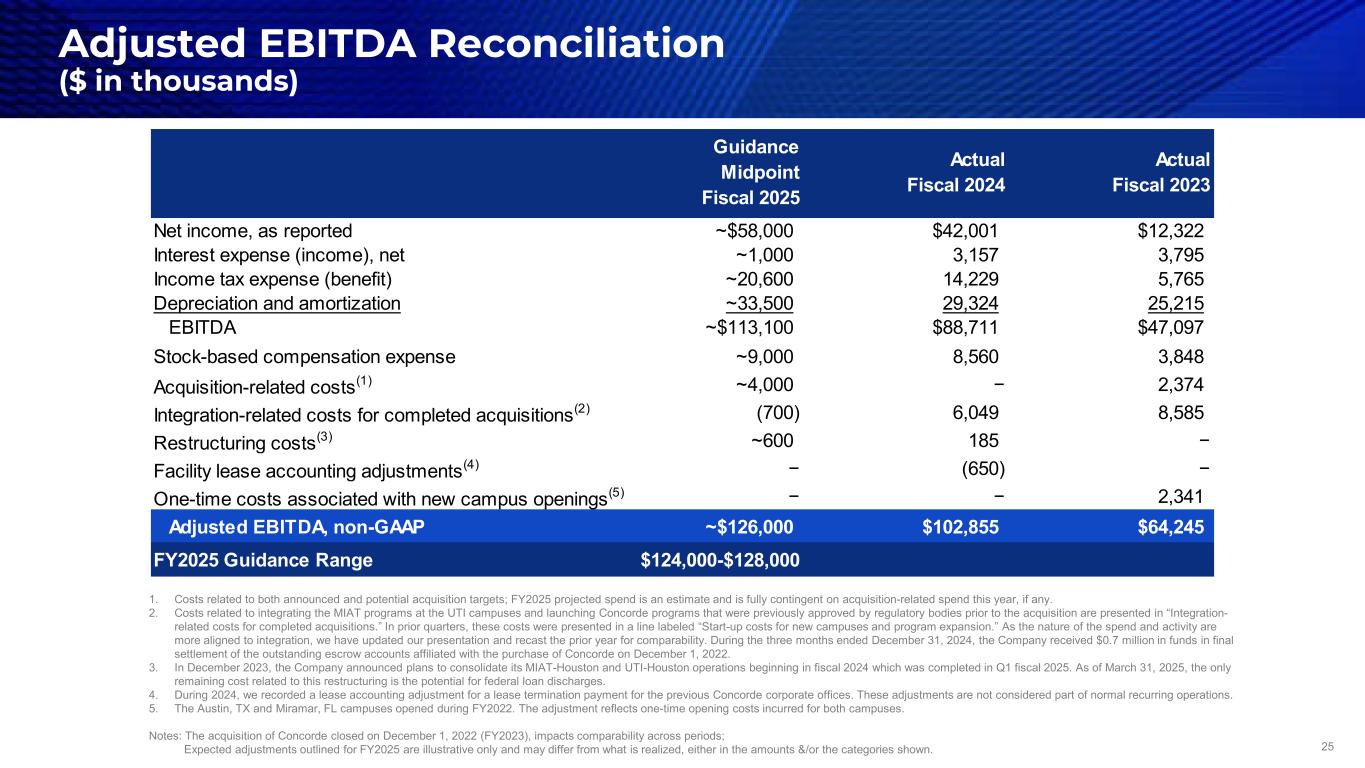
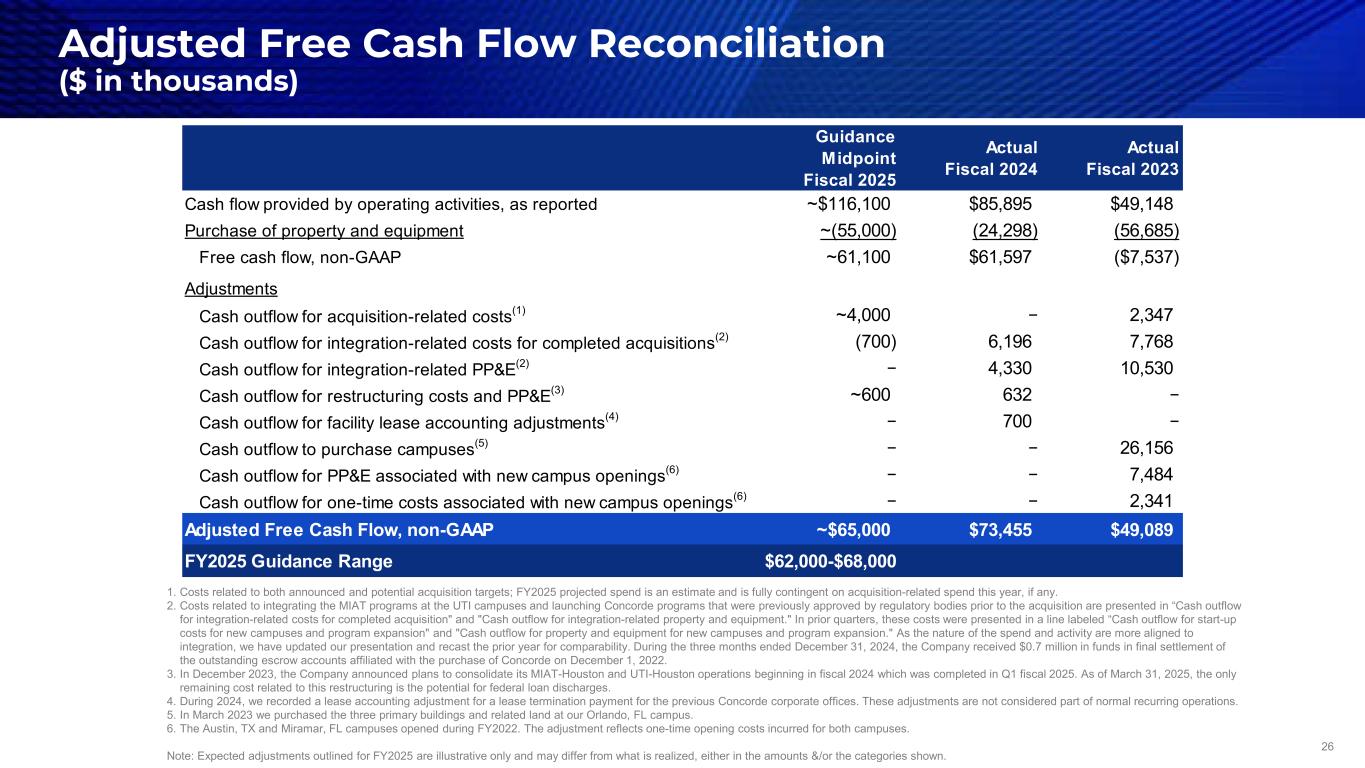
Thank you, Jerome. It's a pleasure to be here with you all on my inaugural earnings call with UTI. I am thrilled to be part of a company that plays such an important role in providing the U.S. economy with the skilled workforce solutions that are critical for growth. I look forward to partnering with Jerome and the leadership team to help drive the next phase of our North Star Strategy. With that, let's dive into our second quarter results. Q2 marks another quarter of consistent execution as we outperformed our expectations and delivered strong growth. For the second quarter, average full-time active students increased 10.3% year-over-year to 24,604 students. New student starts increased 21.4% year-over-year to 6,650 starts, exceeding our expectations. The Concorde division drove a 15.5% increase in average full-time active students compared to Q2 2024, while new student starts rose 15.9% year-over-year in the second quarter. These increases were driven by further investments in Concorde's marketing and admissions and the effectiveness of those teams. The UTI division generated a 7% increase year-over-year in average full-time active students for the quarter. New student starts grew 26.4% year-over-year in the second quarter. The year-over-year increase is largely due to robust demand for skilled collar workers and strong lead conversion rates. Turning to our financial performance. Second quarter revenue on a consolidated basis increased 12.6% year-over-year to $207.4 million. Concorde contributed $73.2 million, an increase of 20.3% over the prior year quarter, while the UTI division contributed $134.2 million, an increase of 8.8% over the prior year quarter. From a profitability standpoint, consolidated net income for the second quarter was $11.4 million or $0.21 per diluted share. Adjusted EBITDA for the second quarter was $28.9 million, a year-over-year increase of 27.8%. As Jerome mentioned earlier, we were deliberate in our spending throughout the quarter, which helped drive performance in all key financial metrics. Included in these results is $400,000 of growth investment spend, primarily on our program expansions. At the end of the quarter, we had 54.4 million shares outstanding and total available liquidity at the end of the quarter was $235 million, including $40 million of short-term investments and $99 million of remaining capacity on our revolving credit facility. During the second quarter, we paid down an additional $25 million on our revolver ending with positive net working capital of $13.4 million. Year-to-date, operating cash flow was $22.2 million and adjusted free cash flow was $8 million. Year-to-date, capital expenditures were $14.3 million as we continue to progress our program expansion and new campus initiatives across both divisions. Fueled by our strong second quarter performance and ongoing execution on our strategic priorities, we are raising our fiscal 2025 guidance ranges across all key metrics. Starting with revenue. We now expect to generate between $825 million and $835 million of revenue for fiscal 2025 or approximately 13% year-over-year growth at the midpoint. This reflects the strong growth in average full-time active students from program expansions and deliberate investments we've made this year. Total new student starts in fiscal 2025 are expected to range between 29,000 and 30,000. Regarding the balance of the year, we anticipate both Q3 and Q4 revenue growth rates to be in line with our full year guidance of about 13%. For starts, due to increasingly tougher comparable periods, we expect Q3 growth in the mid to upper single digits and Q4 likely closer to low single-digit growth. Adjusted EBITDA margins by quarter should follow a similar pattern as last year due to the seasonality in our business. For fiscal 2025, we are raising our net income expectations to a range of $56 million to $60 million with diluted earnings per share projected between $1 and $1.08. We anticipate full year adjusted EBITDA to now range between $124 million and $128 million, or around a 23% year-over-year increase at the midpoint. We now expect 2025 full year adjusted free cash flow to range between $62 million and $68 million, which continues to assume approximately $55 million in CapEx spend. Consistent with our historical cadence, we still anticipate the bulk of our cash generation and year-over-year growth to occur in the fourth quarter. Looking ahead, we are entering an exciting phase of investment to fuel our next chapter of growth. As Jerome mentioned, I want to reiterate that while our investments for Phase 2 of the North Star strategy are expected to generate significant returns over the next five years, our margin expansion over that time frame will not be linear. As new campuses ramp and program expansions are built out, we anticipate EBITDA growth in fiscal 2026 and into 2027 will slow as a result of the associated growth investments. As these initiatives scale, we expect to build meaningful momentum, setting the stage for significant EBITDA growth acceleration into fiscal 2028 and 2029. We are confident these strategic investments will unlock even greater growth opportunities and further strengthen the scalability of the broader UTI model. In addition to today's earnings call transcript, we encourage everyone to review our press release, financial supplement, investor presentation, and the upcoming 10-Q filing. These materials provide the latest updates on our consolidated and segment results, strategic initiatives, and guidance. Thank you to our team members, partners, students, and investors for your continued support. I'll now turn the call back over to Jerome for closing remarks.
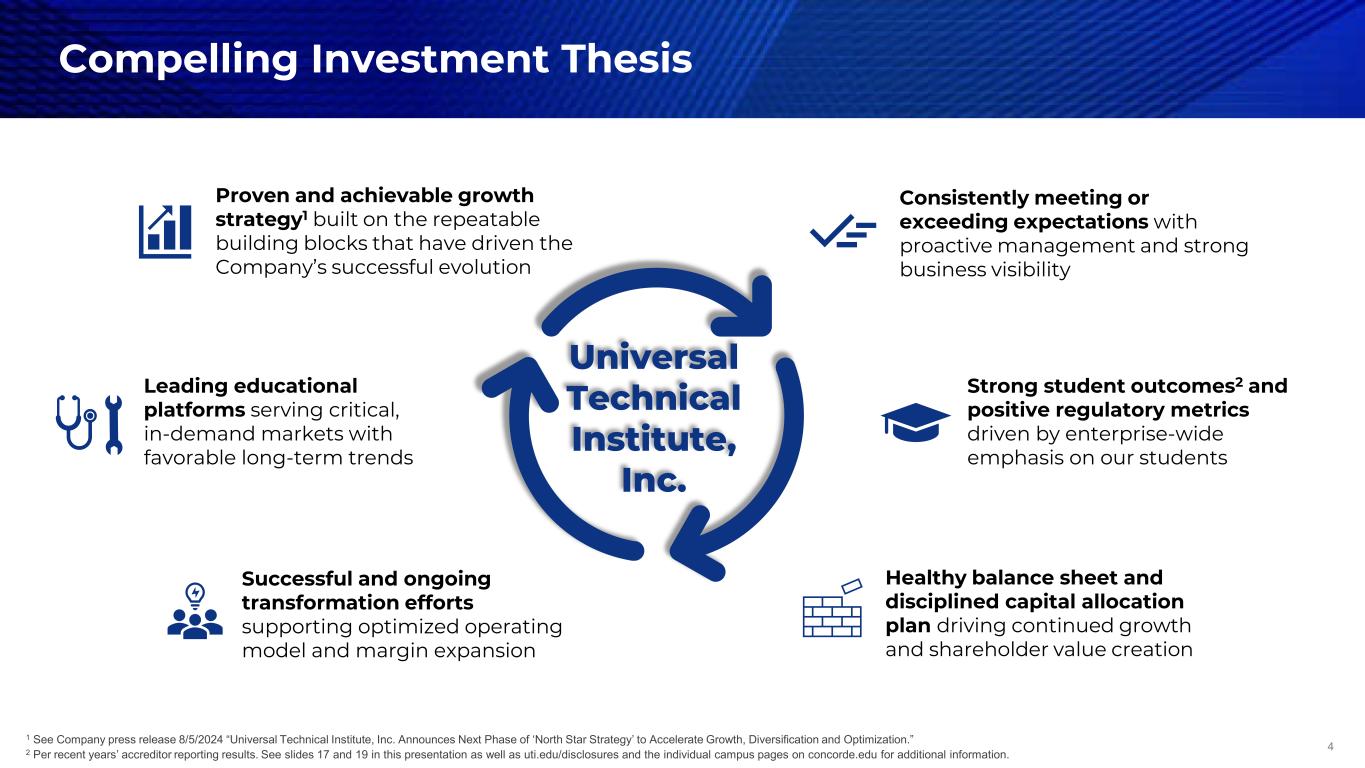
Thank you, Bruce. Our team continues to execute on growth, diversification, and optimization as part of our North Star Strategy. While favorable macro trends, particularly the ever-rising demand for skilled trades and healthcare professionals provide a solid foundation to build upon, it’s our execution, operational rigor, and commitment to student outcomes that are driving our success. Looking ahead, our growth initiatives remain sharply focused. Organically, we are: one, growing our campus footprint into greenfield locations; two, expanding the reach of our existing programs and adding new in-demand offerings; and three, deepening industry relationships and broadening our partner network. Inorganically, we continue to pursue strategic acquisitions that will enhance our educational reach geographically and complement our portfolio with a particular focus on healthcare. With strong momentum, a fully aligned leadership team, and a clear prudent strategy, UTI is exceptionally well positioned to continue to drive sustainable growth and long-term value creation. Our healthy financial profile, extraordinary outcomes, and consistent execution give us confidence in our ability to continue delivering meaningful stakeholder returns into the years ahead. We appreciate your continued support and look forward to keeping you updated on our progress. As always, we encourage you to visit our campuses to see firsthand the impactful initiatives we're driving. Please don't hesitate to reach out if you'd like to schedule a tour. And now, I'd like to turn the call over to the operator for Q&A.
Operator
We will now begin the question-and-answer session. Our first question comes from Mike Grondahl with Northland Securities. Please go ahead.
Speaker 4
Hey, guys. Thanks and congrats on a really nice quarter. Two kind of quick questions. One, very strong new starts, any campuses or programs to really call out in there because of that performance? And then secondly, you mentioned in the press release taking advantage of favorable tailwinds. I can think of trades over four-year colleges, job demand, the administration. Maybe just highlighting what you see as those tailwinds, just to make sure I understand them.
Well, thanks, Mike. Jerome here. Thanks for joining. Why don't we take those questions in reverse. First of all, the things that are fueling what we're seeing some pretty impressive lead generation. You actually much answered the question with the points you made for what's driving it is that there's significantly more energy being focused right now on the notion that 4-year colleges aren't necessarily for everyone. And that message is resonating with parents, and we're hearing it when we're talking to parents, if you understand that for just about everything we do in both divisions, the parents are involved in this decision because most of our students are still dependent staff and most parents are brought in the decision. So that message is beginning to get through quite strong. I think some of the messages around the political environment of onshoring and we want to build more here. We want to be a stronger infrastructure here is actually making people say, okay, what kind of jobs are those? Those are jobs where you're a welder or you're an electrician or the American auto industry, and things along those lines. And so that's, again, what we believe and what we're hearing is fueling heightened interest in the skilled collar areas. And then finally, your first question, which was are there any particular areas? Well, we've continued to put increased marketing investment in the healthcare side pretty much across the board. There's particular strength in our clinical courses. That tends to be the front door where people come in and say, I want to be a nurse or a physical therapist or something along those lines. And so as we continue to work on the project talked about and put in place to really get the biggest potential out of our clinical courses, we're seeing a lot of strength in our clinical courses. That's one thing to highlight. And then on the UTI side, I think highlighting the skilled trades. The cornerstone of UTI has always been the auto diesel curriculum, and it’s still holding strong and moving along nicely. But our program expansions tend to specifically be around proliferating much more in the way of skilled trades on the legacy UTI campuses. And what we're seeing is those are filling faster than our models. We are seeing that the interest is higher, more local and more adult, which is actually good for mature decision-making and the ability to start faster. And those would be the things I’d highlight for what we're seeing.
Speaker 4
Thanks for that. Congratulations again.
Operator
Our next question comes from Jasper Bibb with Truist. Please go ahead.
Speaker 5
Hey, good afternoon guys. I heard the enrollment in revenue comments for the second half, just I guess curious how that enrollment growth breaks out for UTI and Concorde at the segment level in the third and fourth quarter? And I guess, was the increase in new start guidance driven by one segment or you ended up outperforming the plan at both schools?
The analysis of the third and fourth quarters involves considering the mix and our ongoing commentary about Concorde. We will maintain our investment in identifying growth opportunities on the Concorde side. However, as we reach our capacity for clinical courses, sustaining the high double-digit growth we've observed may become challenging. This is partly because we initiated this project in the latter half of last year, and we're now reflecting on those initial investments. While we are eager to capitalize on growth opportunities, it's not prudent to make projections at this time. Regarding UTI, much of the remainder of the year is linked to high school activities, which are largely concluding now. Currently, we are focused on supporting the high school students who have committed to enrolling in June, July, August, and September. The bright spots and positive surprises in the UTI sector are primarily seen in skilled trades like welding and HVAC. These trades typically attract adult learners or those who graduated high school a year or two ago, whereas recent high school graduates often show interest in automotive careers. While the auto diesel sector is performing well, it hasn't experienced the same growth as the skilled trades. Thus, with our focus on high school and the work we've accomplished over the past year, we expect growth trends to be in the high single digits and mid-single digits in the fourth quarter.
Speaker 5
Yeah. No, that's helpful. And then on the comments around higher growth investments in 2026 and 2027, maybe driving for our EBITDA growth versus 2028, 2029. I think the EBITDA or CAGR in your five-year plan is about 15%. So I imagine you're saying 2026 is much lower than that. But is there any way to kind of, I guess, more specifically frame a range for what EBITDA growth looks like in 2026?
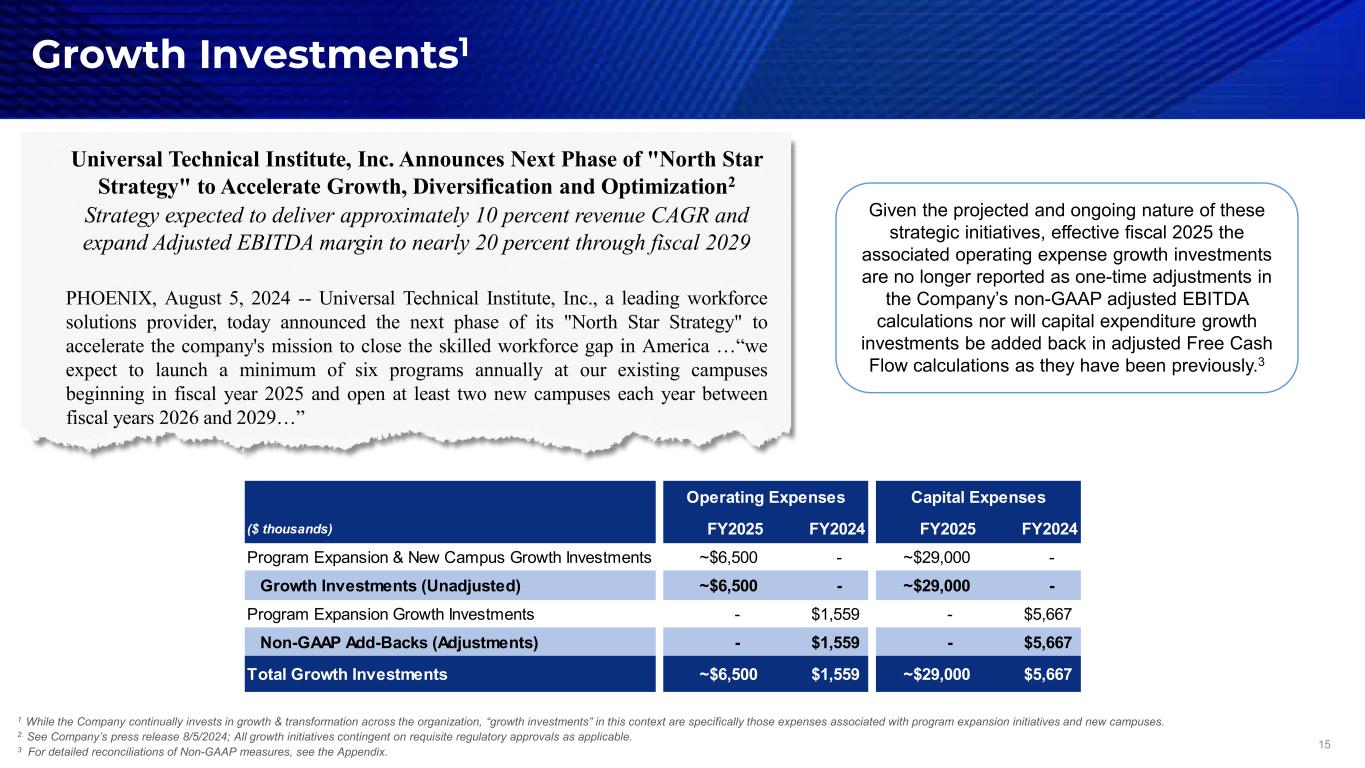
We introduced the concept last quarter, explaining that we paused campus construction for two years to integrate our two acquisitions while only launching Austin and Miramar. This creates a gap in strategic investment for 2024 and 2025. However, with plans to open three new campuses in 2026 and additional programs yet to be announced for that year, along with investments for 2027, we anticipate a much more significant strategic investment compared to 2024 and 2025. It’s important to note that we are no longer including these strategic investments in our non-GAAP measures due to our collaboration with the SEC and related regulations. We will communicate what the strategic investment entails, but it will not be part of our adjusted EBITDA as it was previously. We remain confident in an average growth rate in double digits from 2025 through 2029 and expect to be nearing a 20% margin by the end of that period.
And Jasper, this is Bruce. I would like to add that when examining the revenue component of the five-year compound annual growth rate, we expect revenue to grow in a roughly linear manner. However, on the EBITDA side, we anticipate a change in growth patterns, with a slower growth rate in 2026 and 2027, followed by a significant increase in EBITDA growth by 2029. We remain confident that we will reach the 20% margin by 2029.
Operator
Our next question comes from Bruce Goldfarb with Lake Street Capital Markets. Please go ahead.
Speaker 6
Hi, Jerome, Bruce, congratulations on the great results. Thanks for taking my questions. Could you comment on trends and employer demand for both transportation and skilled trades graduates and healthcare graduates?
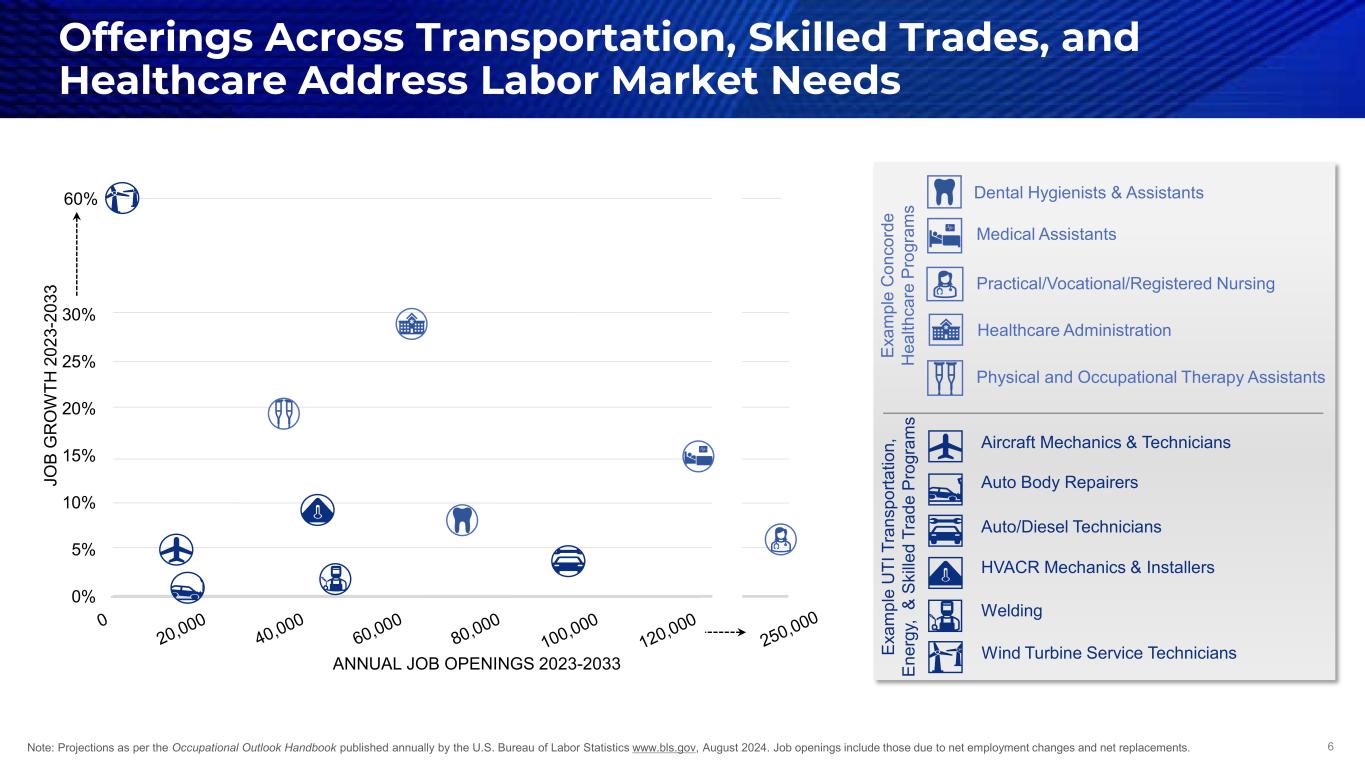
Transportation has been a core area for UTI for 60 years, and we believe it will continue to be our most reliable sector moving forward due to our established position in the transportation trades. Currently, we are experiencing steady and growing demand in transportation, though it is not explosive. There are typically three or four job openings available for UTI transportation graduates, and we expect this to continue or even increase, particularly as the workforce ages over the next decade. Skilled trades is a newer area for UTI, especially after acquiring MIT, which added HVAC, electrical, wind energy, and aviation to our offerings. We're currently expanding these programs to our legacy UTI campuses and integrating them with our two MIAT campuses, including plans to merge auto diesel programs into Canton. Our projections for these programs are based on rational assessments of the data, and we are seeing demand that meets or exceeds these expectations. There is significant demand for welders as we see increased ship and plane construction in the U.S., and there is a shortage of electrical workers to support the growing number of data centers, along with a high need for HVAC technicians. We are pleased with the demand trajectory in skilled trades, which is surpassing our initial estimates, and we are expanding our facilities to accommodate this growth. In healthcare, the challenge has been not just understanding the demand but leveraging the potential of our Concorde acquisition to meet it. The supply-demand imbalance in healthcare is even greater than in transportation and skilled trades. We continue to collaborate with marketing and admissions on Concorde campuses to attract more students and address this significant demand. We are excited about our ability to draw in more individuals to meet the needs in this sector. Did I answer your question?
Speaker 6
Thank you. I have a couple more quick. Could you comment on the level of activity in your corporate development efforts and also seller attitudes versus what was versus 6 months ago?
Probably comparable to maybe a little less activity out there. If you think about it, people are seeing what we're seeing, which is demand becoming robust, more focused on the skilled trades, more focused on health care, more focus on 4-year colleges aren't necessarily what you'd want, doesn't mean that there aren't opportunities that are out there. But the number of for-sale signs probably is a little smaller than what we would have expected.
Speaker 6
It makes sense. And then in terms of marketing spend, what is the plan for marketing spend? Is it going to be more level or targeted for certain quarters for the next several quarters?
We're going to continue to invest. We've seen some really nice kind of ROI, especially on our Concorde marketing spend, very good return, very good lead conversion. We'll continue that. It's a little bit of the program-dependent, but you will see us ramp marketing as we feel like there's a good ROI to do so.
Operator
Our next question comes from Griffin Boss with B. Riley. Please go ahead.
Speaker 7
Hi, good evening. Thanks for taking my questions. I appreciate the level of detail you provided in the prepared remarks and the Q&A. So just one for me, if I could just drill down into this EBITDA trajectory. I guess what I'm hearing with regard to that in the next couple of years, it comes down to the magnitude between OpEx investment and CapEx investment. So I guess what I'm hearing is there's going to be significantly higher OpEx investment in '26 and '27, I guess, on that education services expense line. Is there any way you can handicap that for us? Like what that OpEx investment is looking like this year? And then what it would look like going forward in more of an investment-heavy year like '26 to '27?
Yes. Thanks, Griffin, this is Bruce. I don't really have a guide for you on '26. Yes, we're still working on that. I'll put it maybe in perspective for you. Second half of this year, we put this in our supplement too. We have about $6 million of growth OpEx, very focused on campus build-out, some early hiring we have to do, very focused on that kind of North Star Phase 2 strategy. We do have some pretty significant CapEx as well. We were public about we have a $55 million CapEx spend for this year. We still have about $40 million of that to spend, and 70% of that is fully focused on growth investments, new campus build-outs, program expansions that are mission-critical to make sure our 2026 growth stays on track, and we look forward to sharing that with you as soon as we can. So, hopefully, that puts it in perspective for you.
Operator
Our next question comes from Raj Sharma with Texas Capital Bank. Please go ahead.
Speaker 8
Hi. Thank you for taking my questions. Great quarter, great continued results.
Speaker 8
My question is on starts, are the gains in starts purely from better marketing, great lead gens like you commented? Or would you attribute any to higher uncertainty or beginning to see any increased uncertainty in an impacted economy?
I can't pinpoint an impacted economy at the moment. We've predicted a recession several times over the years without any changes in employment. Therefore, I don't think the economic factors we observe are negative or positive. The main reason for the increase in starts, which we're excited about and believe we can expand further, is the enhanced investment we're making to help them reach their full potential and complete their clinical courses. As this progresses to core courses like medical assisting, that's where we see significant improvements. Additionally, for UTI, particularly in skilled trades, we've introduced many programs at our campuses. We assess market trajectories based on the best available information, and the remarkable performance in those areas is driving the early year growth for UTI. We're seeing increased demand in HVAC and welding, and one of our recent initiatives is expanding capacity by adding more welding booths at several campuses due to this rising demand.
Speaker 8
Right. So, largely from the demand/supply, the gap, and your great execution on the marketing side, you still haven't seen any from sort of the potential rise in unemployment or a weakening economy. That's fantastic. The young adult starts were really high, military up a lot. Anything in particular going on there on the military side?
We've increased our military recruitment from 16 to 26 recruiters and are now in the second full year of this expansion. As mentioned previously, this is when we really start to see the results. We have also focused on the veteran population, specifically those who have been out of the military for over a year but are utilizing their GI Bill. It’s surprising how many veterans are unaware of their GI Bill benefits. Therefore, we’ve made a concerted effort to provide more information about these benefits and how veterans and their families can take advantage of them. We’re noticing positive outcomes from this initiative. Our team is performing exceptionally well in this area, and we are also adding adult representatives on the Concorde side as the lead flow is exceeding our expectations due to our investments.
Speaker 8
Great. And then just on the Concorde restrictions, they end in 2026, any plans there, what you are teeing up to? And you also commented that you could possibly be speeding those growth plans of bringing them forward a little bit more. Could you comment on that? What could those be?
We're ready to go. Our real estate team and our program and campus launch teams have been formed and are on the starting line ready to go. And so one thing we want to do is we want to leverage the stronger relationships we have with the Department of Education to get those conversations going, so that we're ready when the growth restrictions are lifted. And if it's possible for them to be earlier, we'll continue to press on that. And as I said in the call, we think that the new Department of Education, although smaller, is working in a significantly more efficient and communicative fashion and that we're generally happy with what we're seeing and the communication we're having them.
Speaker 8
Great. And just one last question, I promise. The guidance rate appears conservative in the results, considering you have full-time active students across all programs already in their seats. The start of the second half won't significantly affect the fiscal 2025 year results. My sense is that any additional costs from new programs or campuses won't either. My question is what could go wrong or hinder you from achieving the low end of your guidance, given that your business model is in place and has been delivering results recently?
We feel very comfortable and confident in our new guidance ranges that we put out there. You've hit a lot of the points yourself there, meaning you've kind of answered some of your own questions as you laid out. Again, I think what tried to illustrate was that we've also been working very, very hard to get more of our high school population into the third quarter from the fourth quarter, which slams them towards auto diesel. It also monetizes them more throughout the year, which is good to see. But we're just signaling that we likely won't see those same robust double-digit growth rates in that period because it does slant significantly to the high school population. Thank you very much, operator. And I'd like to thank everyone for attending today. As always, Bruce, Matt, and I are available for follow-up questions over the next few days. And we look forward to speaking with our investors and analysts as we report third quarter 2025 results in August. Have a great evening, and thank you for your time in joining us. Bye-bye.
Operator
The conference has now concluded. Thank you for attending today's presentation. You may now disconnect.