Operator
Greetings, and welcome to the Amerant Third Quarter 2025 Earnings Conference Call. As a reminder, this conference is being recorded. I would now like to turn the conference over to your host, Laura Rossi, Head of Investor Relations. You may begin.
Thank you, Kate. Good morning, everyone, and thank you for joining us to review Amerant Bancorp’s third quarter 2025 results. On today's call are Jerry Plush, our Chairman and CEO; and Sharymar Calderon, our Senior Executive Vice President and CFO. As we begin, please note that discussions on today's call contain forward-looking statements within the meaning of the Securities Exchange Act. In addition, references will also be made to non-GAAP financial measures. Please refer to the company's earnings release for a statement regarding forward-looking statements as well as for information and reconciliation of non-GAAP financial measures to GAAP measures. I will now turn it over to our Chairman and CEO, Jerry Plush.
Thank you, Laura. Good morning, everyone, and thank you for joining us today to discuss Amerant's third quarter 2025 results. First, I want to thank everyone for adjusting their schedules to accommodate the rescheduling of our earnings call this quarter. We intend to establish this new time frame as when Amerant will report going forward, so our team has the appropriate time to prepare each quarter end. We greatly appreciate your understanding. Similar to the approach we implemented last quarter during today's call, I'll start with some overall comments, and then Shary will provide commentary on results and asset quality. Then I'll provide several prepared remarks on some strategic updates in order to allow time for Q&A. You will note today that there are several new slides in the deck this quarter that we think show capital levels and asset quality quarter-to-quarter comparisons in an easier to follow format. While we continue to make progress in key areas of our strategy, our primary focus this quarter was on asset quality over loan growth. I'll provide more details on this in a minute, but the increase in nonperforming asset levels must be immediately addressed, and I will cover the plan here in the fourth quarter to approach achieving reduced levels in the coming quarters. Clearly, the higher provision from a detailed loan-by-loan review kept us from achieving consensus or better overall results this quarter. We will also provide some color on progress so far here in the fourth quarter on this call. Otherwise, you will see solid performance as shown by an outstanding net interest margin and higher net interest income. Shary will cover the other P&L items in detail shortly. I do want to note in advance that while core expenses rose $2 million over the prior quarter, this increase was from legal expenses related to trust services and to asset quality resolution efforts as well as higher consulting expenses in connection with our AI governance build-out and ERM enhancements, and we do not expect a continuation of expense at these levels in the fourth quarter. Regarding expenses, please note that in my closing remarks, I'll also provide more color on our planned expense reduction initiatives already underway, which will begin to be seen in the fourth quarter and throughout 2026. On the funding side, our core deposits increased while total deposits remained stable given the planned reduction in broker deposits we previously indicated on last quarter's call. We continue to focus on the quality and mix of deposits as a priority. International Banking continues to strengthen its presence across LatAm. It is worth noting that approximately 50% of the new accounts opened during the third quarter of 2025 originated from other countries, most notably Argentina, Guatemala, Costa Rica, Bolivia and Peru. This expansion reflects the success of our business development initiatives, client relationship management and targeted marketing efforts throughout the LatAm region. Loans declined by 3.4% quarter-over-quarter, as again, our focus was on asset quality over growth, but our pipeline build is underway here in the fourth quarter. Approximately $288 million of the loan decline in 3Q was related to payoffs and asset quality-related sales. As I promised earlier, we'll turn back to asset quality and addressing asset quality head-on was and will continue to be our top priority. 3Q was the quarter with the highest volume of annual and limited reviews along with covenant testing with over $3.5 billion in loans reviewed. We did see continued deterioration in both classified and criticized. While we exited $35 million in nonperforming loans through third-party refinancing payoffs, charge-offs, transfers to OREO and upgrades, as I previously noted, additional downgrades to NPLs were primarily driven by the receipt of borrowers' updated financials and certain covenant failures in the quarter. We are all in on driving progress post-quarter end, and we believe we have a line of sight on several significant opportunities to do so already. For example, we just, as in this past Friday, received an $11.8 million full payoff, which results in an $8.7 million recovery of previous charge-offs, $341,000 of interest income to be recorded in the fourth quarter as well as a recovery of $188,000 in legal expenses, and again, all of which will be recorded in 4Q. Our coverage of reserves over NPLs is at 0.77x due to the increased level of NPLs. Please note that all NPLs with balances over $1 million were individually evaluated for exposure to charge-offs and our reserves, which explains the increase in provisioning for credit losses in 3Q and in specific reserves quarter-over-quarter. While Shary will provide additional detail on this, I wanted to just put this upfront, and we'll go through more detail in NPLs, ACL and the specifics on the provision for credit losses. Let's turn to capital. If you look at capital, all levels remain very strong. Our Board declared a quarterly cash dividend of $0.09 per share, reinforcing confidence in Amerant's long-term outlook and capital strength. We also intend to resume share buybacks post-earnings when the blackout period ends under the existing remaining authorization and 10b5-1 plan as we continue to execute on our strategy going forward. With that, let me turn it over to Shary now to cover 3Q results in detail.
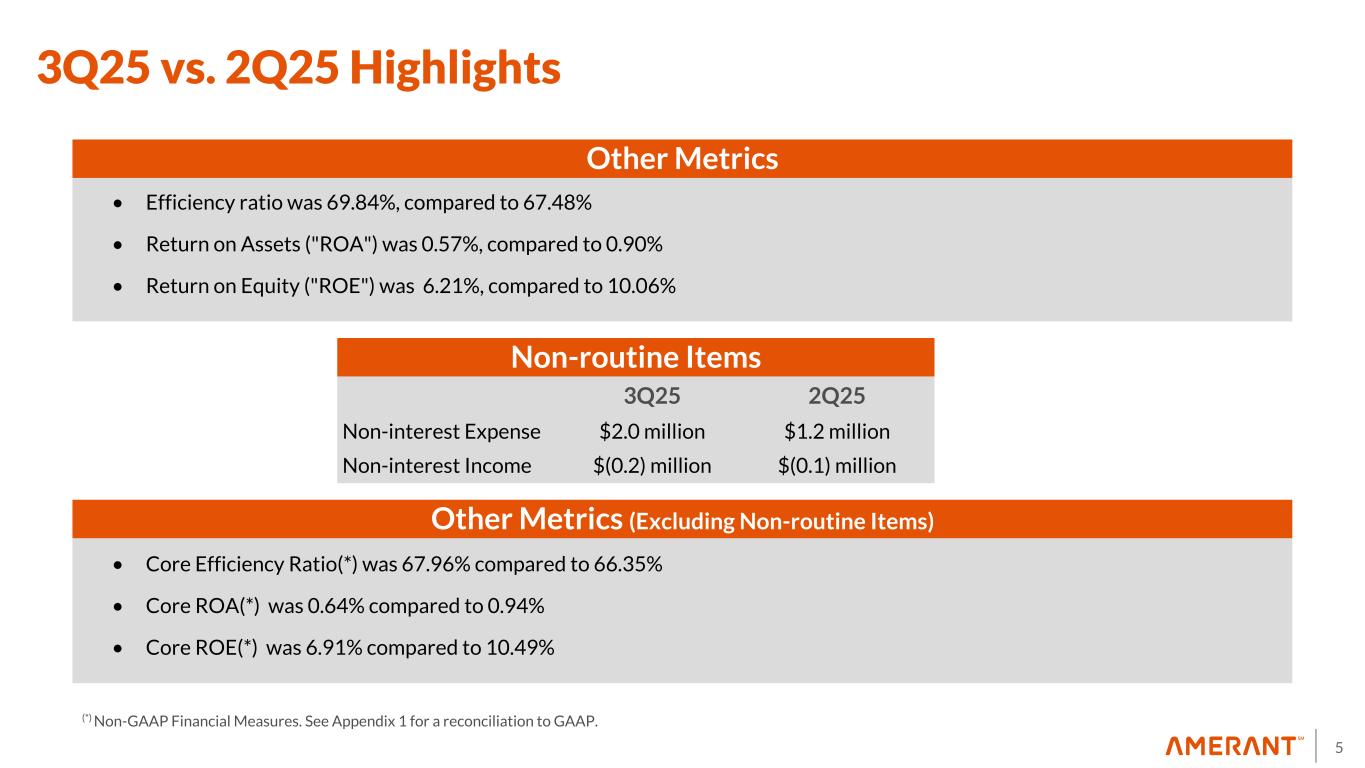
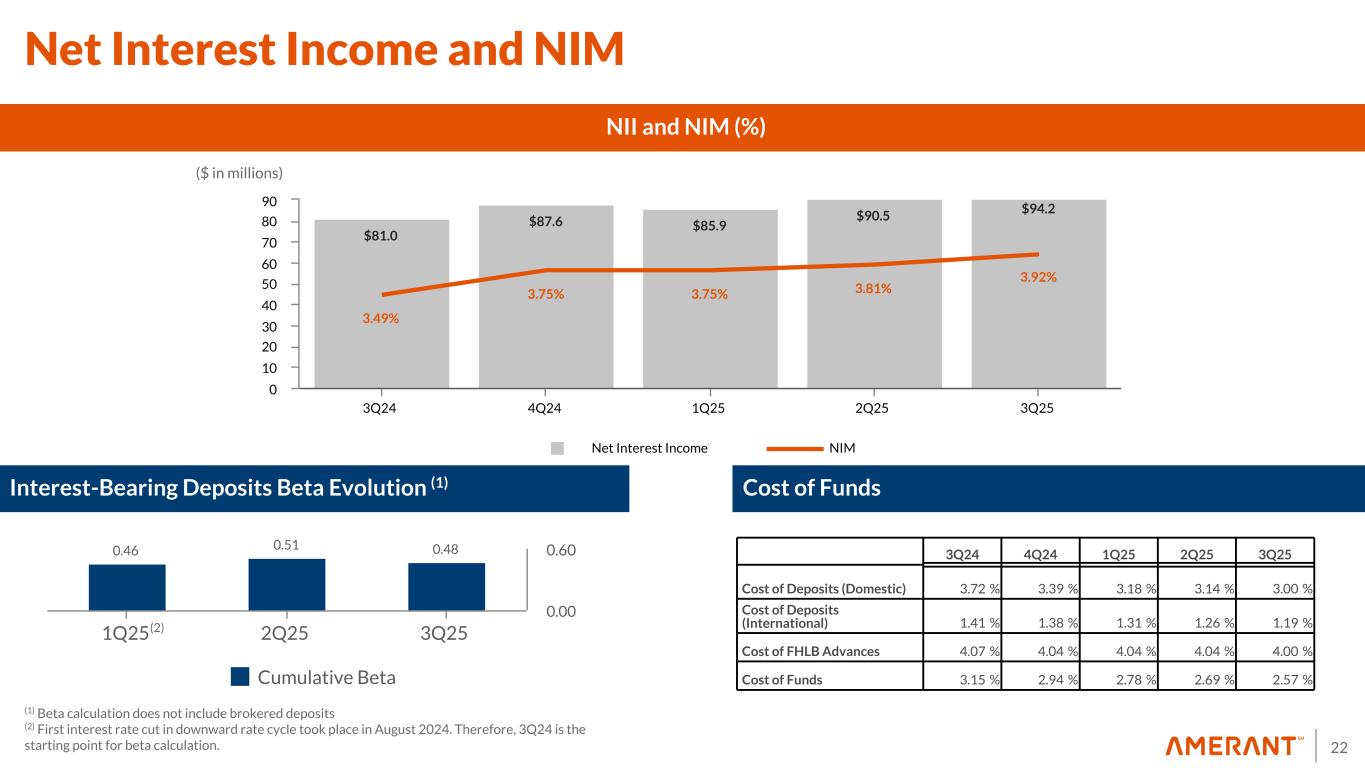
Thank you, Jerry, and good morning, everyone. Let's turn to Slide 3. Here, you will see the highlights of our balance sheet. Total assets reached $10.4 billion as of the close of the third quarter. As we guided in the second quarter, we offset lower loan originations, loan payoffs and paydowns with purchases of investment securities. Total investment securities were $2.3 billion, up by $336.8 million, all of which are highly marketable securities and were classified as available for sale. Total gross loans were down by $247.4 million to $6.9 billion, primarily driven by increased prepayments and the sale of a large substandard loan, which more than offset loan production in the quarter as well as the focus on asset quality over production, which delayed the business pipeline materializing. On the deposit side, total deposits were relatively flat, only down by $5.6 million to $8.3 billion, although core deposits increased by $59.4 million. Additionally, as we previously guided, we reduced brokered deposits by $93.7 million and partially replaced this funding with FHLB advances, which increased by $66.7 million. Brokered to total deposits now stand at 6.6% of total deposits, well below our maximum of 10%. In the third quarter, we restructured $210 million of fixed rate FHLB advances and changed the original maturity at lower interest rates. We incurred an early termination and modification penalty of $3.4 million, which was deferred and is being amortized over the term of the new advances as an adjustment to the yields. The net effect is an improvement in the cost of this source of funding. Our assets under management increased $104.49 million to $3.17 billion, primarily driven by higher market valuations. As I've shared in past calls, we continue to see this as an area of opportunity for us to grow fee income going forward. Looking at the income statement on Slide 4, you will see that we had a strong net interest margin, which was higher than projected at 3.92% due to higher average rates for both loans and securities, lower average rates on deposits, lower average balances in interest-bearing deposits, including broker deposits. The NIM increases were partially offset by higher average balances in the investment securities portfolio, lower average loan balances and placements as well as higher average balances on time deposits and FHLB advances. Net interest income was $94.2 million, up $3.7 million, primarily driven by higher average rates on loans and securities and lower average balances and rates on deposits. Noninterest income was $17.3 million, while noninterest expense was $77.84 million. On a core basis, however, core noninterest income was $17.5 million, while core noninterest expense was $75.9 million. We had guided noninterest expense for this quarter to be approximately $73 million. The variance to actual results was primarily driven by $2.4 million in expenses on professional fees, as Jerry just described, and $1.4 million in higher other expenses primarily related to earnings credits, which are provided to certain commercial deposits in the mortgage banking industry to help offset deposit service charges incurred. Also adding to the variance of noninterest expenses were noncore expenses of $2.0 million recorded during the quarter, which I will describe in the next slide. Pre-provision net revenue was down at $33.6 million in 3Q '25 compared to $35.9 million in 2Q '25, and core PPNR was $35.8 million, a decrease of $1.4 million or 3.7% compared to $37.1 million in 2Q '25. The core PPNR impact was primarily from the higher expenses we do not project occurring again at the same level in the fourth quarter, as I just referenced. A reconciliation of core PPNR and the impact on key ratios is shown in Appendix 1 included in this presentation. Next up in Slide 5, you can see ROA and ROE this quarter were 0.57% and 6.21% compared to 0.90% and 10.06%, respectively, and our efficiency ratio was 69.84% compared to 67.48%. These ratios were primarily impacted by the decrease in net income and the increase in expenses during the quarter, respectively. This quarter, we had $2 million in nonroutine noninterest expenses, which included $900,000 in losses on loans held for sale carried at the lower of cost or fair value in connection with the sale of one substandard owner-occupied loan, $500,000 in net losses on sale and valuation expense of an OREO in Houston, a single-family property and $600,000 in expenses related to the downsizing of Amerant Mortgage. Turning to Slide 6. As you can see, we have added a new slide, as Jerry referenced, showing the quarter-over-quarter comparison of our capital ratios. Our capital ratios are very strong and continue to reflect improvement across the board. Our CET1 was 11.54% compared to 11.24% last quarter, mainly driven by lower risk-weighted assets and from net income during the quarter, while partially offset by $10 million in share repurchases and $3.8 million in dividends. During the third quarter, we also repurchased 487,657 shares at a weighted average price of $20.51 per share compared to tangible book value of $21.56 as of June 30. Moving on to asset quality. We added 2 new slides here as well this quarter. As you can see on Slide 8, nonperforming assets increased to $140 million or 1.3% of total assets compared to $98 million or 0.9% of total assets in the prior quarter. I will cover the drivers of this increase in the next slide. Additionally, special mention loans totaled $224.4 million, with the increase primarily driven by 3 commercial loans totaling $106 million, 2 CRE loans totaling $25 million and 3 owner-occupied loans totaling $20 million. All loans have acceptable mitigants in place, including adequate loan-to-value ratios, interest reserves, personal guarantees and other structural enhancements. These increases were partially offset by $31 million in further downgrades to classified loans and $30 million in payoffs. These increases are the result of rigorous efforts by portfolio management, credit and credit review complemented by an independent third-party firm brought in to ensure timely reviews of updated financial information and risk rating, including identification of any possible deteriorated conditions to allow us to be more proactive in expediting resolution. Through these reviews, we covered approximately $3.5 billion in the loan portfolio through covenant testing or annual or limited financial reviews. We expect to continue to prioritize efforts on proactive credit quality measures, including continuing to use independent third-party assistance. Moving on to Slide 9. The increase in nonperforming loans was primarily driven by the downgrade of 3 CRE loans totaling $31 million, of which one is a single-tenant property that is currently vacant and the other 2, which missed contractual milestones. Please note that all 3 loans have adequate collateral coverage and did not require reserves. Adding to the increase in nonperforming loans were 9 commercial loans totaling $38.9 million, downgraded due to updated financials and missed projections as well as other smaller loans totaling $7.2 million. These additions were partially offset by the payoff of 2 commercial loans totaling $21.2 million, charge-offs for the quarter totaling $9.5 million and other net reductions of $4.1 million, which include loan transfers to OREO, upgrades and paydowns. In addition, substandard loans and accruing status increased by $84 million, primarily driven by 2 CRE loans totaling $49.5 million, one due to updated financials and the other due to missed contractual milestones. Both loans have adequate collateral coverage. Adding to the increase were 6 commercial loans totaling $37.1 million, primarily due to updated financials. Important to note that the majority of these loans exhibit adequate payment performance or have other acceptable mitigants in place, including adequate loan-to-value ratios, interest reserves, personal guarantees or other structural enhancements, which support the continued accrual status. These increases were partially offset by $78.2 million from payoffs and $30.5 million in the sale of one substandard loan. In the next slide, we show the drivers of the provision recorded in 3Q and impact to the allowance for credit losses. The provision for credit losses was $14.6 million in the third quarter, including the release of $700,000 in loan commitments. The provision was comprised of $7.8 million in additional specific reserves, $8.9 million to cover charge-offs, $3.6 million due to credit quality and macroeconomic factors, offset by releases of $2.3 million due to the reduction in loan balances and $2.7 million due to recoveries. During the third quarter of 2025, gross charge-offs totaled $9.5 million related to 2 commercial loans totaling $4.1 million, several small business commercial loans totaling $1.8 million, 1 CRE loan totaling $1.3 million, indirect consumer loans totaling $1.8 million and other smaller balance loans. Lastly, the allowance for credit losses coverage ratio increased to 1.37% of total loans, up from 1.20% in the second quarter. Excluding specific reserves, the coverage ratio rose from 1.17% to 1.23%. In the next slide, I'd like to provide some details on our expectations for the fourth quarter of 2025. In terms of loan growth, we currently have a pipeline for 4Q of approximately $350 million via organic production and $150 million via our newly launched syndications program. As we continue to focus on asset quality, we expect some of this loan production and purchases of syndications to be partially offset by reductions in criticized assets as well as payoffs and maturities with the net loan growth for the quarter being between $125 million to $175 million. This represents approximately a 2.5% increase from 3Q 2025. Regarding deposits, we expect growth to be in line with loan growth. We will evaluate a further reduction in brokered as well as other higher-cost deposits. Looking at profitability, we project our net interest margin to be approximately 3.75% for the fourth quarter. We continue to project noninterest income to be between $17.5 million and $18 million in 4Q. Regarding expenses, we expect them to decrease to the range of $74 million to $75 million. We expect the efficiency ratio to be in the high 60s given the lower growth from payoffs and asset quality-related reductions. We project core ROA to be between the mid-80s and low 90s, although we could possibly get closer to 1% given recoveries on collections from previously charged-off substandard loans like the one Jerry just referenced. And with that, I pass it back to Jerry for additional comments and closing remarks.
Thanks, Shary. Finally, turning to the final slide we will cover. I'd like to provide some color on the topics shown here. So first, regarding expense reduction initiatives. We've launched an expense reduction initiative with an initial goal of achieving a baseline of $2 million to $3 million in savings per quarter in 2026. Again, this is a baseline and the analysis of additional opportunities are in process. There's going to be more to come on this. You'll begin to see the start of these reductions in the fourth quarter. Examples of items that we are either evaluating or already implementing include contract reviews, transferring certain tasks from third parties to in-house resources and outright expense elimination. Please note, we're in the process of evaluating every opportunity by detailed line item reviews for additional reductions. Next, regarding commercial banking leadership. I've asked Mike Nursey to step into the Head of Commercial Banking role recently vacated by our former Chief Commercial Banking Officer, as previously announced during the third quarter via Form 8-K. Mike is a seasoned leader with over 35 years of banking experience and is well known and respected in the Florida marketplace. We also intend to further build out our commercial teams in both Palm Beach County and the Greater Tampa market in the coming months. As we just announced last week, we've added Angel Medina to bolster our in-market leadership and business development efforts here in the Greater Miami County marketplace. It has been well received, as Angel is well known and respected here as a senior leader. He just started with us this week, and we anticipate that he will be a significant contributor to growth opportunities in this marketplace. Next, the heightened emphasis we're placing on reducing nonperforming assets. There is no question this is job one. We are realigning even more select personnel in order to drive resolution as prudently and expeditiously as possible and aligning more personnel to proactively address upcoming covenant testing and financial statement updates. We've complemented our in-house reviews with a well-known third party to expedite risk rating testing in the third quarter and to assess a significant portion of the portfolio, as I previously mentioned, for any signs of potential concerns. We expect to continue to invest in these reviews in the fourth quarter to ensure timely completion of the review scheduled for 4Q. We launched an extended multi-hour all-hands leadership weekly meeting to address special assets as a working group to monitor and drive progress. We will be looking to provide a mid-quarter update on progress via our investor presentation, which we will file ahead of the upcoming Piper Sandler Conference in mid-November. Now, turning to buybacks to give an update. With respect to capital management, while we'll continue to take a prudent approach, carefully balancing the need between retaining capital to support growth initiatives or growth objectives compared with buybacks and dividends to enhance returns, we intend to utilize the $13 million remaining in our current authorized buyback program this quarter, given where our stock is currently trading. In 3Q, we utilized a 10b5-1 plan to repurchase 487,000 shares for $10 million in the quarter, as Shary previously noted, and we intend to do the same thing here in the fourth quarter. As we wrap up today's comments, I want to underscore the priorities we've outlined and emphasize a number of key underlying strengths here: strong capital levels and outstanding net interest margin, opportunities for additional fee income from growing assets under management, a heightened focus on driving expense discipline, and most importantly, an increased focus on accelerating progress on asset quality. We've taken decisive steps this quarter to strengthen risk oversight, and we'll continue to allocate resources and leadership focus to accelerate progress. While this quarter reflected the impact of this proactive approach to credit risk, we remain confident in the strength of our franchise and the opportunities ahead. With leadership changes in commercial banking, further strengthening of bank strength in special assets and credit, targeted growth initiatives in key markets and lines of business, and a clear plan for cost reductions and capital deployment, we are positioning Amerant for the better in the coming periods. I'd like to thank you for your continued support as we execute on these commitments. With that, I'll stop, and Shary and I will look to answer any questions you have. Kate, please open the line for Q&A.
Operator
Our first question comes from the line of Michael Rose with Raymond James.
Speaker 4
Maybe I'll just start off with the same question I feel like I've asked the past 2 quarters, just on kind of the lay of the land, where you guys think you are on credit. I know the migration is probably as frustrating to you as it is to us. But if I go back to when you raised capital about a year ago, I think the expectations were for much stronger financial performance. It looks like the resolution of some of these credits over the next couple of quarters is certainly going to weigh on growth performance, etc. So Jerry, I guess the question is, when do you think we kind of hit the inflection point on credit? When do you think realistically you can get back to a more sustainable, durable 1% plus ROA?
I appreciate your question and completely understand your perspective. The third quarter marked the highest level regarding our portfolio, which exceeded $3.5 billion. This means that over half of the portfolio was assessed for annual reviews, limited reviews, or covenant tests during the quarter. The activity level is significantly lower in the fourth quarter. As I mentioned earlier, we have a clear view of the situation. I provided a specific instance of a notable resolution, and I believe we are making good progress on both special mention and substandard items. The most challenging aspect is the timing of these resolutions, which has less predictability. However, it's important to note that just a few weeks after the end of the quarter, we resolved a significant item, and there are several others where we have a positive outlook. With all the comments I've made, and Shary shares this belief, the teamwork across departments gives us a better perspective for earlier identification and resolution, rather than experiencing the flow we observed this quarter. Additionally, our expense initiatives are crucial, and we will provide more details at the upcoming investor conference. We are currently starting from a very low baseline and are ready to implement reductions as we adjust our projections. There are substantial opportunities ahead for us, and it mainly involves realigning our priorities. It's also worth noting that we have seen a revival on the credit side, with some solid standings already booked in the fourth quarter. As Shary mentioned, we will witness not just the return of organic growth but also the initiation of our syndication program, which is vital for us because we aim not only to acquire but also to participate. Given the scale of our exposures, we believe this approach is wise for fostering growth and ensuring prudent risk management.
Speaker 4
Okay. I appreciate all that commentary. Shary, just a quick one for you. The margin guide for the fourth quarter implies a step down. I'm sorry if I missed this, it's a busy morning. But what's going to specifically drive that step down from this quarter's level?
Sure, Michael. The guidance that we gave for the fourth quarter is close to the 3.75%. A couple of drivers into that number compared to 3Q is we're now going to see a full quarter's worth of repricing on the asset side on the floating rate loans. After the rate cut that occurred in September, we now will see the full quarter showing that impact. We're also including an update in terms of an additional rate cut happening now, which will impact 2 out of the 3 months of the quarter. That would be offset by the repricing of our deposits. We continue to see a beta close to 40 as we did in the past. We definitely see the assets repricing faster than the deposits. The other thing, Michael, is that within the number that you see in 3Q, we have collections on some special assets, which created a higher level of the NIM. We do expect some of those things to happen in the fourth quarter as we continue to collect on those, but the guidance we're giving is more on the normalized NIM.
Yes. Michael, and I just would like to add to Shary’s comments that I think you're also going to see production given the rate decrease that happened in September and the anticipated decrease resulting in lower yields on new production coming in as well. What it does not include is if there's any recoveries, as I just referenced on that one credit of interest income that previously had been reversed. If we have recoveries on interest income, that could obviously be a positive.
Speaker 4
Okay. I appreciate the color. And maybe just one last one for me, and this is back to you, Jerry. You've been in the seat for a bunch of years now. I know you're not happy with the performance. I know investors aren't. But just given the health of M&A markets at this point, is there a point in time where you might want to consider strategic alternatives?
Yes. Michael, we've consistently stated that as a publicly traded organization, our focus is on our ability to execute and achieve results. We need to consider any opportunities that arise. Currently, our main priority is to get things back on track and to achieve the returns that Shary mentioned as a positive step forward in the fourth quarter. We believe we are taking all the right steps based on our current situation, and we will evaluate everything as it comes up.
Operator
Our next question comes from the line of Russell Gunther with Stephens.
Speaker 5
I wanted to just start on the loan growth discussion. I appreciate all the color there. Jerry, maybe as you think about what the kind of go-forward organic opportunity is and the sustainability of that kind of $125 million to $175 million net loan growth guidance. And then maybe just more specifically on the syndication activity. I know you gave us some color as to what we would expect from a growth perspective in 4Q. How should we think about sort of the ebbs and flows participating in versus participating out?
It really depends on the opportunities that our business development and relationship managers create. Our Head of Syndication is already collaborating on various possibilities with the team. We have clearly shown our capability by participating in our first major deal, which was the raise acquisition financing where we acted as a syndication agent. This demonstrated our readiness to engage in deals like that and support the syndication process. Looking ahead, I believe this is beneficial in two ways. Initially, we were transparent about expecting more volume to be purchased rather than us being actively involved. However, I anticipate that by 2026, our participation will increase significantly. We are focusing on reducing hold sizes to under $30 million for deals, while recognizing that there are larger opportunities available. This approach will aid in our growth, but we also need to prioritize prudent risk management and keep hold sizes lower moving forward.
To complement that, the way we see it is on the short term, and short term, I mean now in the fourth quarter, we're focused on the buy side and creating that 2-way relationship. Starting in 2026, the efforts will be more on the sales side and making sure that when we get opportunities that come to our table, we're able to participate with some portions out and be there.
Speaker 5
Got it. Okay. I appreciate it. How should we think about the size of the investment portfolio kind of alongside the net loan growth guidance you guys are expecting?
Look, Russell, I think we previously indicated that without loan growth or to bolster the balance sheet, we chose to focus on expanding our portfolio. Moving forward, it's clear we prefer to allocate those funds towards loan growth rather than further investment growth. You may see some additional growth here, but this would be the last period for that. There could also be some contraction during this period. One of the scenarios we're considering is how much of that we want to maintain in the fourth quarter.
To that, the investment portfolio has been made on the fixed rate side. Valuation has been really good and provides an opportunity for liquidity to redeploy wherever we want, like from a loan perspective or to repay off some higher-cost deposits.
Speaker 5
Got it. Okay. Super helpful. The last one for me would be a follow-up on the asset quality discussion. Charge-offs came in pretty close to what you had expected for this quarter. As you address the inflow that occurred in 3Q, what is the outlook for realized loss content over the next couple of quarters?
Yes, I will provide some insight on that. We analyzed each credit individually and made adjustments as necessary. If a charge-off or specific reserve was required, we implemented those. One way to view it is through the lens of established specifics where charges may arise, but we have already accounted for them. Our assessment of charge-off activity, in relation to the business book and the indirect, leads us back to the...
We're seeing something close to 30 to 35 basis points. A portion of that is related to the amount that we still have in the indirect consumer portfolio and some small commercial loans. The excess would be if we were to charge off some of the loans that currently have specific reserves.
Operator
Our next question comes from the line of Stephen Scouten with Piper Sandler.
Speaker 6
I guess maybe one more kind of follow-up around credit would be, can you give us any color on the vintages of credits that saw incremental reserves or these specific reserves you were just referencing? I'm trying to get a feel for if this is just lingering credit issues from the past or if these are some issues that are burgeoning up on some of the faster growth we've seen over the last couple of years.
Yes. Look, I think it's a mix. You can look back to where it was a much lower rate environment. For example, we've looked at credits that are either going into the pass watch or special mention category. We're evaluating, given the low rates they're at, what would the potential refinancing risk be under current rates as these things are looking to mature. Credit issues span anywhere from the 2020 to 2024 range because, again, you're looking at a lower rate environment in those earlier years and a higher one more recently.
Speaker 6
Got it. Okay. The follow-up is, what gives you confidence today that the worst could be behind us here after maybe hoping to feel that way like a year ago? Do you keep a lid on loan growth until there's greater certainty these issues are kind of in the past?
Yes. In the third quarter, our focus has been on prioritization. The loan growth we anticipate will be more selective concerning the types of industries we engage with, and we expect minimal growth in commercial real estate. A significant factor in this approach involves syndication. Regarding asset quality, we've increased our personnel allocation, and our proactive efforts are currently underway, which enhances our confidence in resolving these issues. The open communication and proactive initiatives are becoming increasingly noticeable within the organization.
Speaker 6
Okay. Just last thing for me, just around expenses and the potential expense initiatives. I know you noted some expenses this quarter were elevated and shouldn't repeat in some of those categories. I want to make sure I heard you right. Jerry, you mentioned $2 million-$3 million a quarter. I'm assuming that's annualized. How do you think about where you hope the expense base will get in 2026? Is the hope to keep it flat, or do you think we could see actual net reductions in the overall expense base?
Sure. I'm going to start with driving from the 3Q to the 4Q expectation. There were expenses that we're not expecting to recur, like downsizing of mortgage, some legal expenses on the trust side, including surrendering the license in Cayman, and some investments. That takes us to what I want to call the normalized level of $74 million. On top of that, we expect some additional reductions through some initiatives, which includes reviewing third-party contracts and seeing if we can shift that back internally. This leads us to the $2.5 million to $3 million, which would be per quarter, not annualized, of what Jerry just mentioned. We do expect a net reduction starting 2026.
Yes. To add to that, the disciplined way we're approaching it is that the $2 million to $3 million are early identification items. The process we're going through is a very stringent line by line review for opportunities. Again, whether it's bringing tasks in-house, evaluating if we need the level of help we have, we are scrutinizing every single item. At the same time, we are prioritizing investments on the risk side. The one area where we would continue to build out would be areas with business development opportunities in both Tampa and Palm Beach. There are offset priorities to find reductions to achieve greater savings than the established baseline.
Operator
Our next question comes from the line of Woody Lay with KBW.
Speaker 7
Just had another follow-up on credit. I was just interested, have you all used third-party reviews in the past? Or is this really the first quarter that you've used the third party?
In the third quarter of last year, we had a limited review. This year, it was a more considerable effort. Our view is designed to give some comfort on accuracy of risk rating and timeliness of risk rating. A lot of this is the scrutiny that you get by being in the regional bracket. This builds the internal teamwork between credit, credit reviews, and a proactive approach. This was the highest quarter, right, for annual reviews, limited reviews, and covenant testing.
Speaker 7
Yes. So I think about 50% was reviewed in the third quarter. How much of the loan portfolio do you expect to be reviewed in the fourth quarter?
Yes. I want to say it's in the $1.3 billion to $1.5 billion range. Remember, a lot of that is quarterly covenant testing. You've probably gone through the bulk of annual reviews at this stage.
Speaker 7
Got it. When you consider the 12 credits downgraded to NPA in the broader industry, we observe some weakness in the subprime consumer, particularly in auto. In terms of your downgrades, are you identifying any significant trends affecting these borrowers, or do they appear to be unrelated?
Yes. I don't think you see exposure in a material way. We aren't involved in NDFIs. When you look at ours, particularly in commercial real estate, it's related to construction underway. Timing-wise, are they still on track? Delays create issues. We anticipate some refinancing risk over the next 12 to 24 months. We initiated early identification of these.
It's important that it's not only on the industry side that we're seeing these loans; they span multiple industries, and the drivers for these items are different. It's whether a covenant was missed, a milestone in a construction project, or a milestone in the repositioning of one. No concentration exists in terms of that risk.
Speaker 7
Do you feel like this is my last follow-up? Do you feel like you're being more aggressive with some of the downgrades than you have been in the past? Or has the strategy been pretty consistent?
Yes. We are being more proactive. Timeliness makes a difference. The earlier we get in front of a customer and get to a resolution, the better outcome we expect to have. That drives this level of reviews and the timeliness of these actions.
Operator
This concludes our question-and-answer session. I would like to turn the floor back over to management for closing comments.
Thank you, Kate, and thank you, everyone, for joining us today to review Amerant’s third quarter results. I hope all of you have a great day. Thank you.
Operator
Ladies and gentlemen, thank you for your participation. This does conclude today's teleconference. You may disconnect your lines, and have a wonderful day.