Operator
Good afternoon, ladies and gentlemen, and welcome to Array Technologies' second quarter 2026 earnings conference call. At this time, all lines are in listen-only mode. Following the presentation, we will conduct a question-and-answer session. If at any time during this call you require immediate assistance, please press star zero for the operator. This call is being recorded on Wednesday, August 5, 2026. I would now like to turn the conference over to Sarah Shepard, Senior Director of Investor Relations. Please go ahead.
I would like to welcome everyone to Array Technologies' second quarter 2026 earnings conference call. I'm joined on this call by Kevin Hofstetler, our CEO, Keith Jennings, our CFO, and Neil Manning, our President and COO. Today's call is being webcast via our Investor Relations site at ir.arraytechinc.com, where the related presentation and press release are also available. Today's discussion of financial results includes non-GAAP measures. A reconciliation of GAAP to non-GAAP financial measures can be found in the related presentation and on our website. We encourage you to visit our website at ArrayTechInc.com for the most current information on our company. As a reminder, the matters we are discussing today include forward-looking statements regarding market demand and supply, our expected results, and other matters. These forward-looking statements are subject to risks and uncertainties that may cause actual results to differ materially from statements made on this call. We refer you to the periodic reports we file with the SEC for a discussion of risks that may affect our future results. Although we believe that the expectations reflected in the forward-looking statements are reasonable, we cannot guarantee future results, levels of activity, performance, or achievements. We are under no duty to update any of these forward-looking statements to conform these statements to actual results, except as required by law. I'll now turn the call over to Kevin.
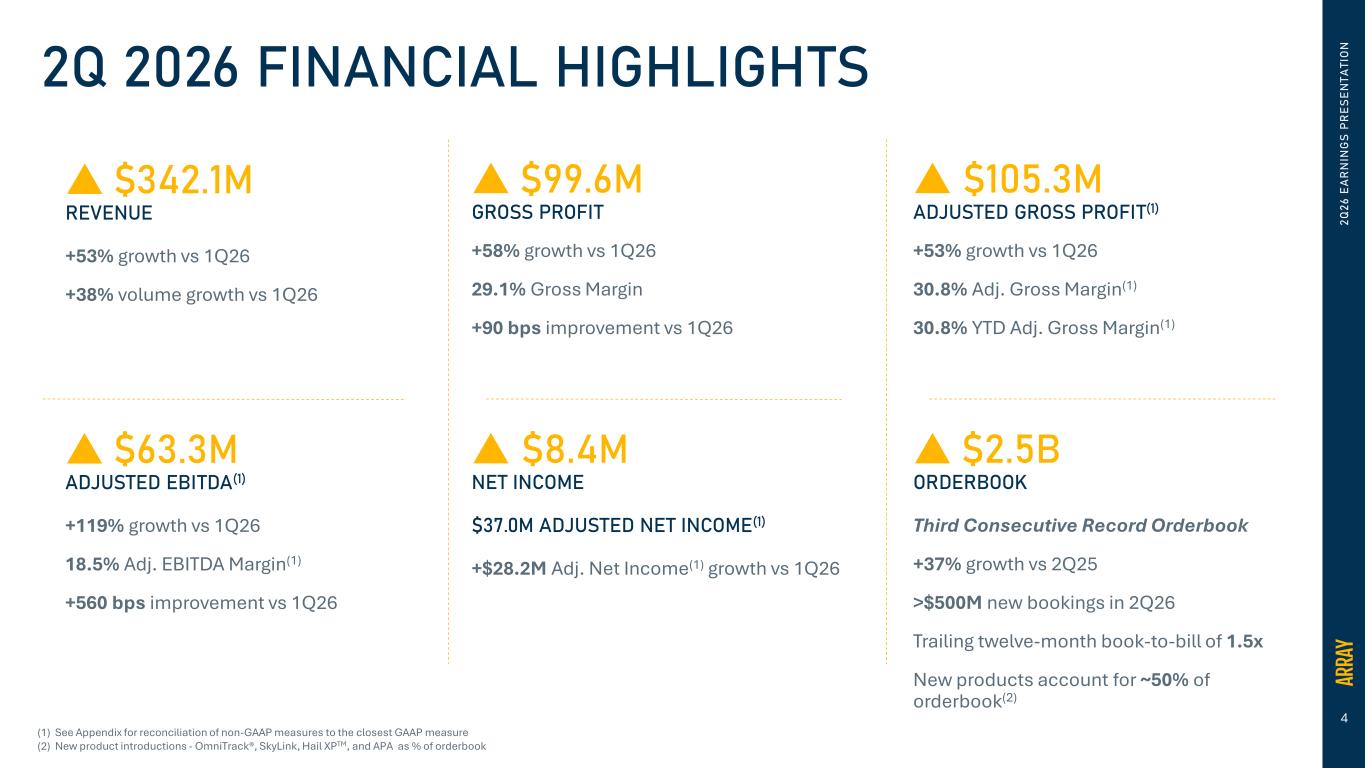
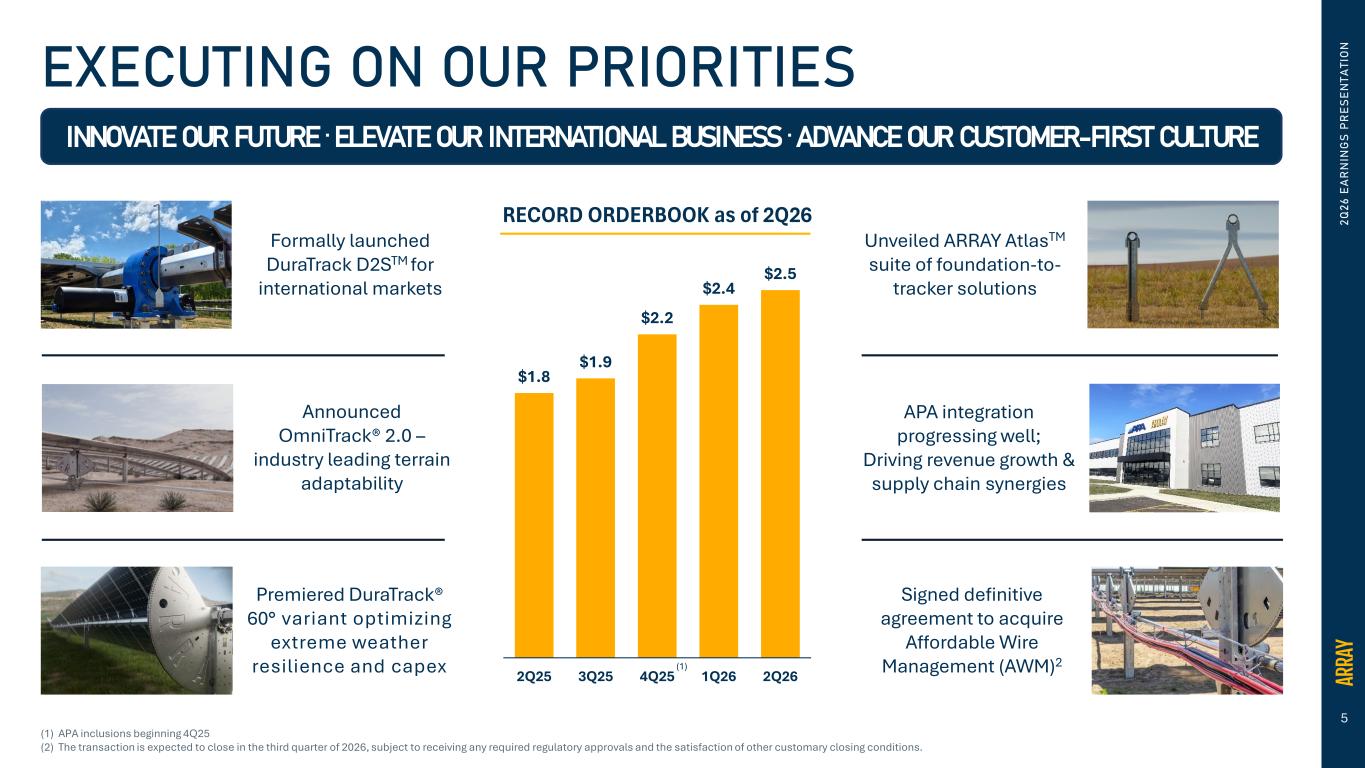
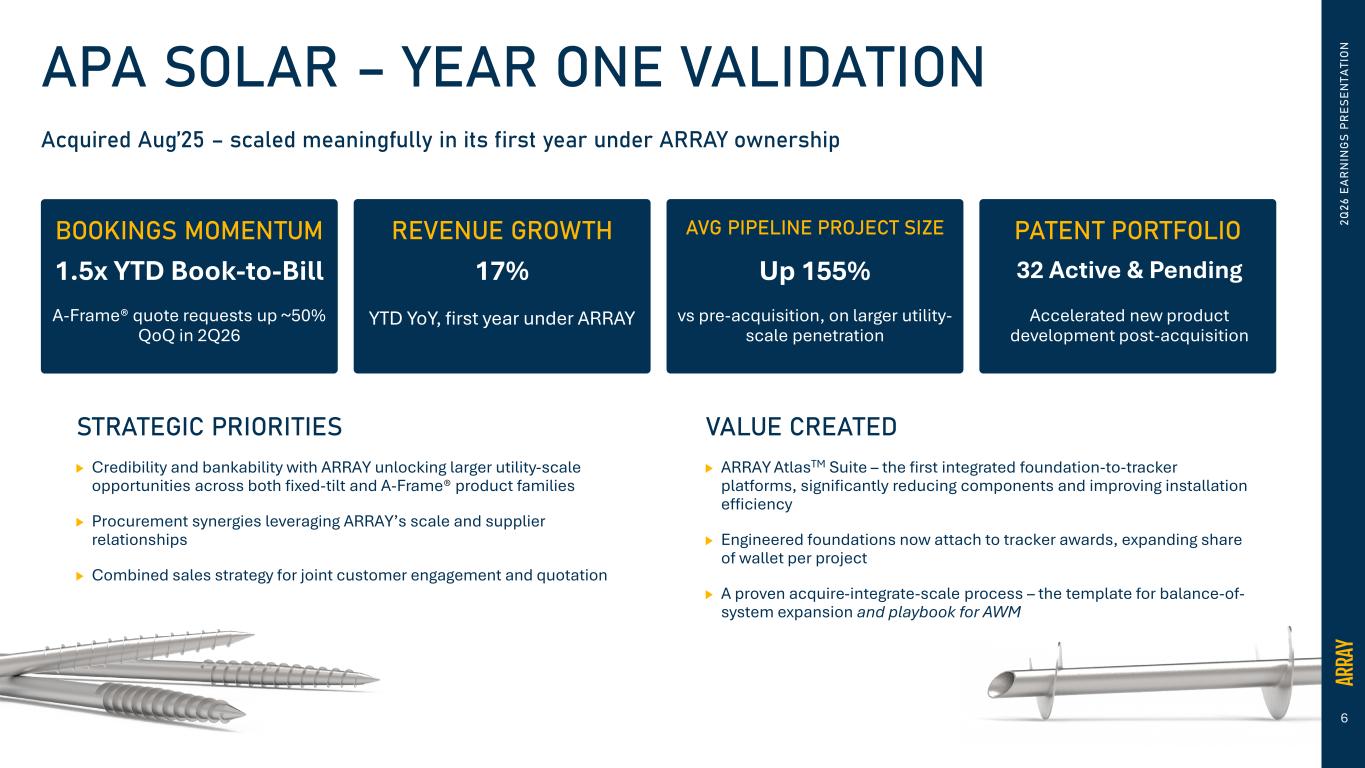
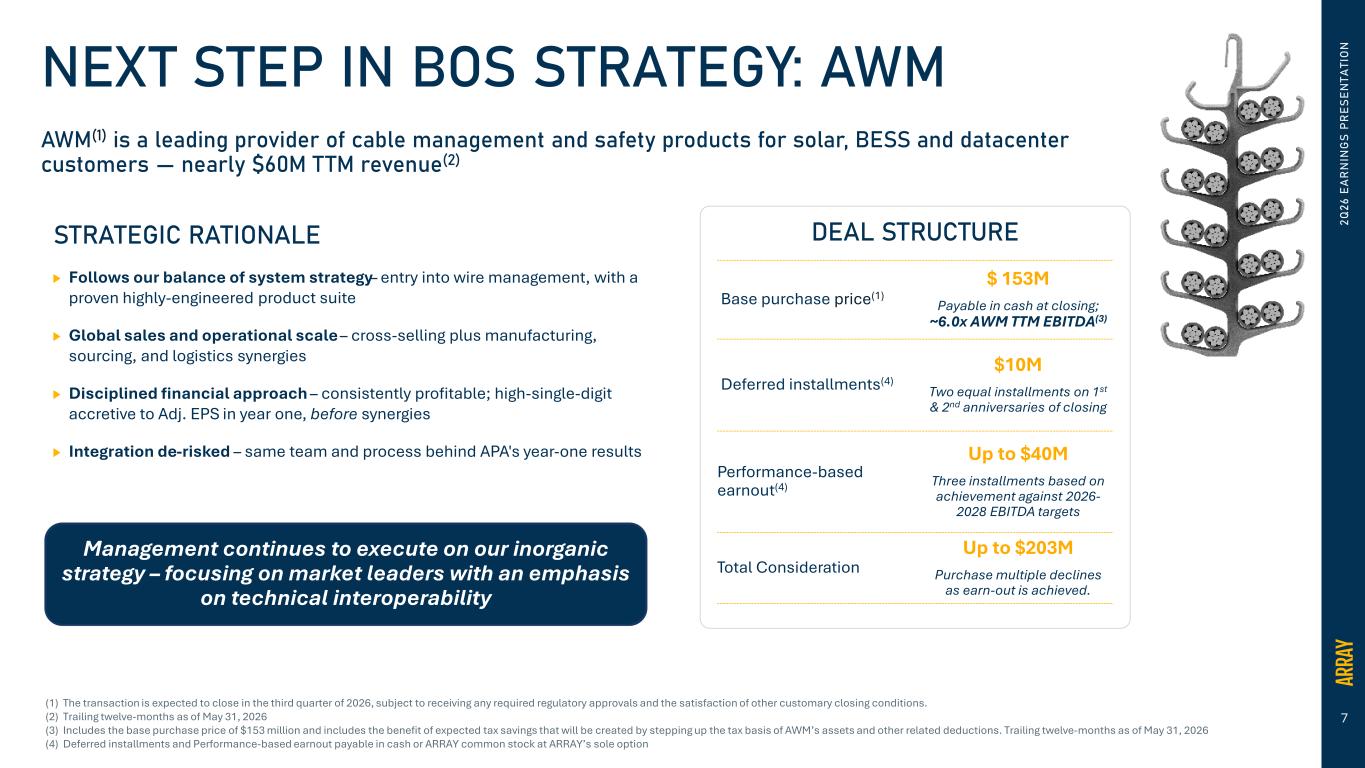
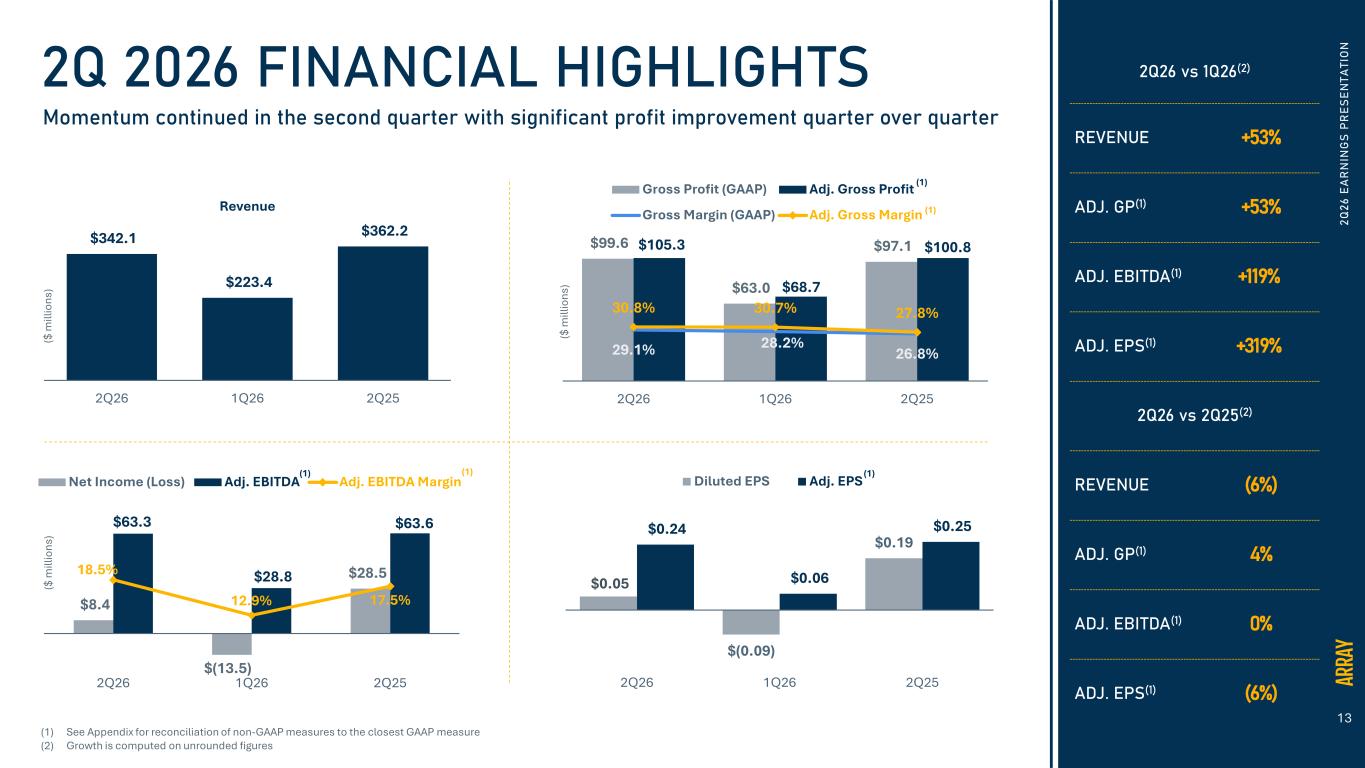
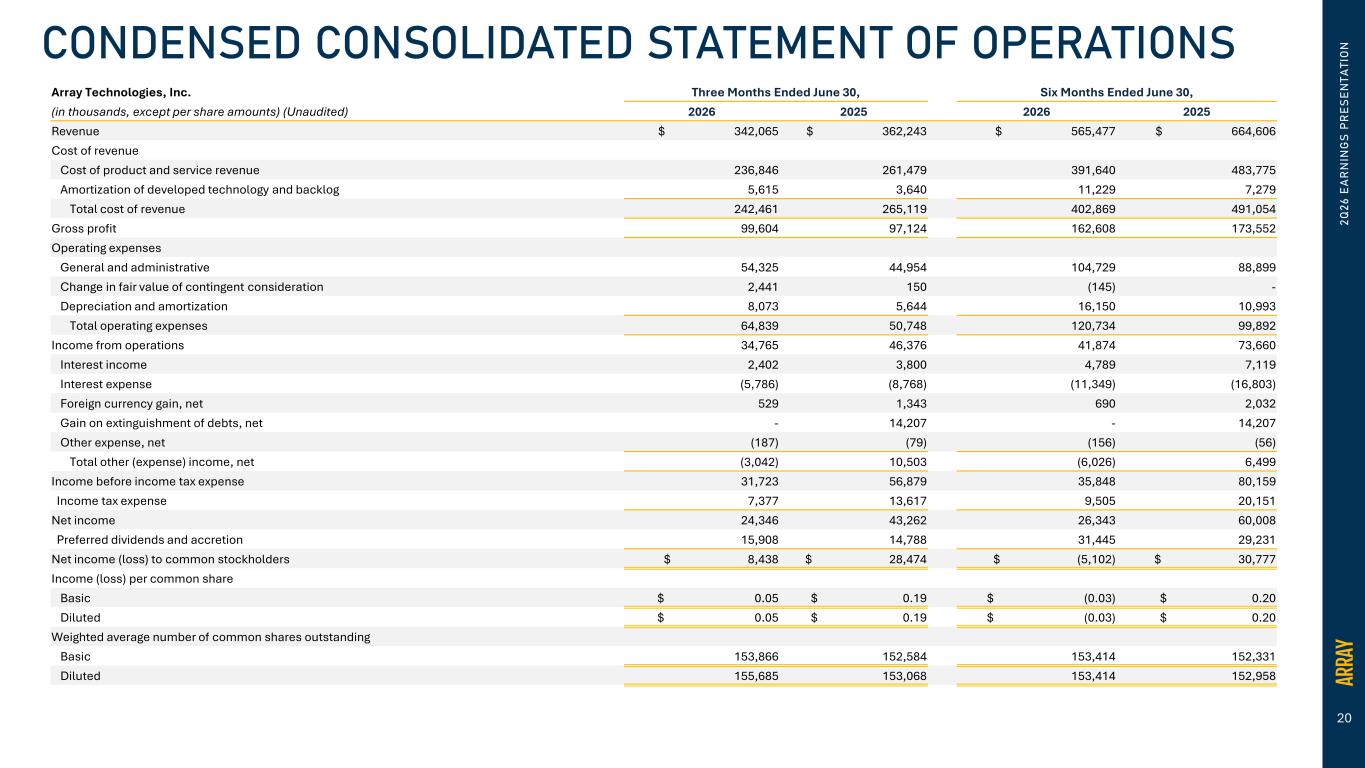
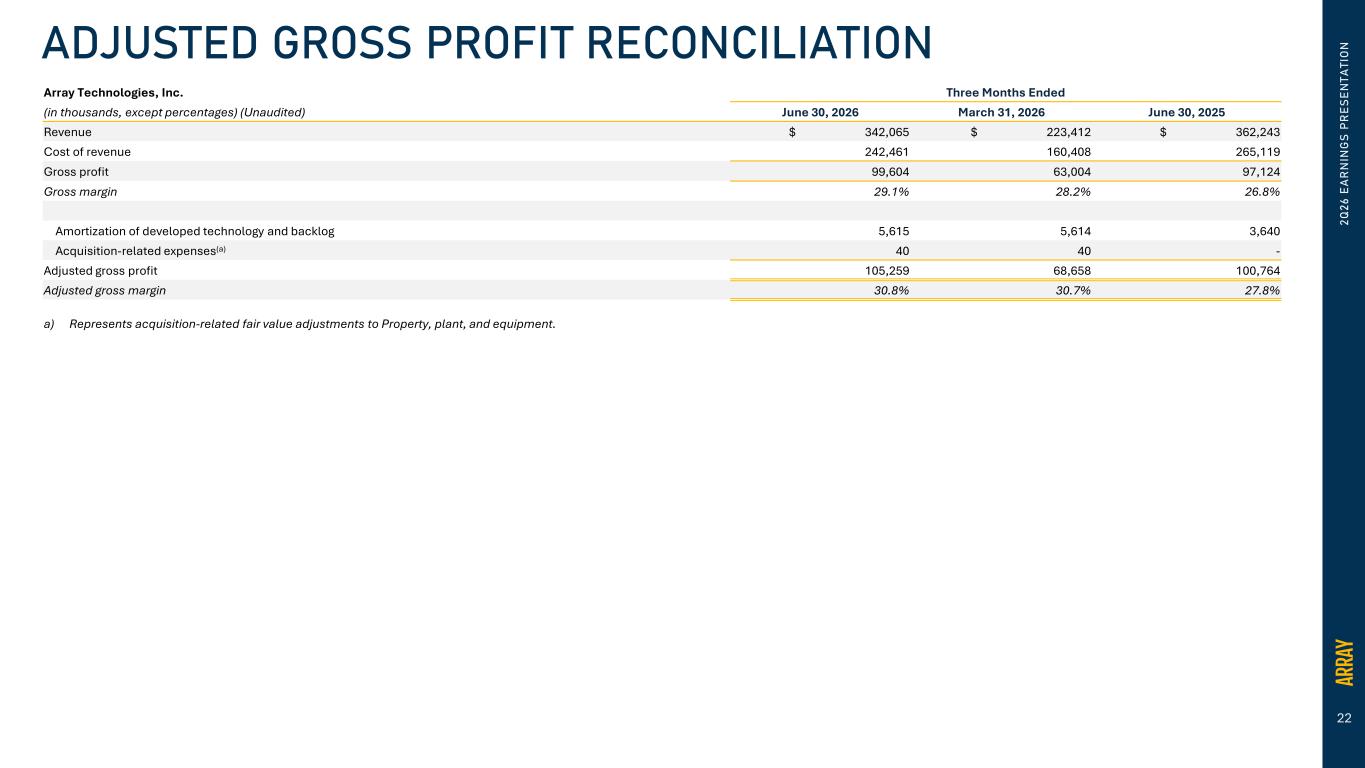
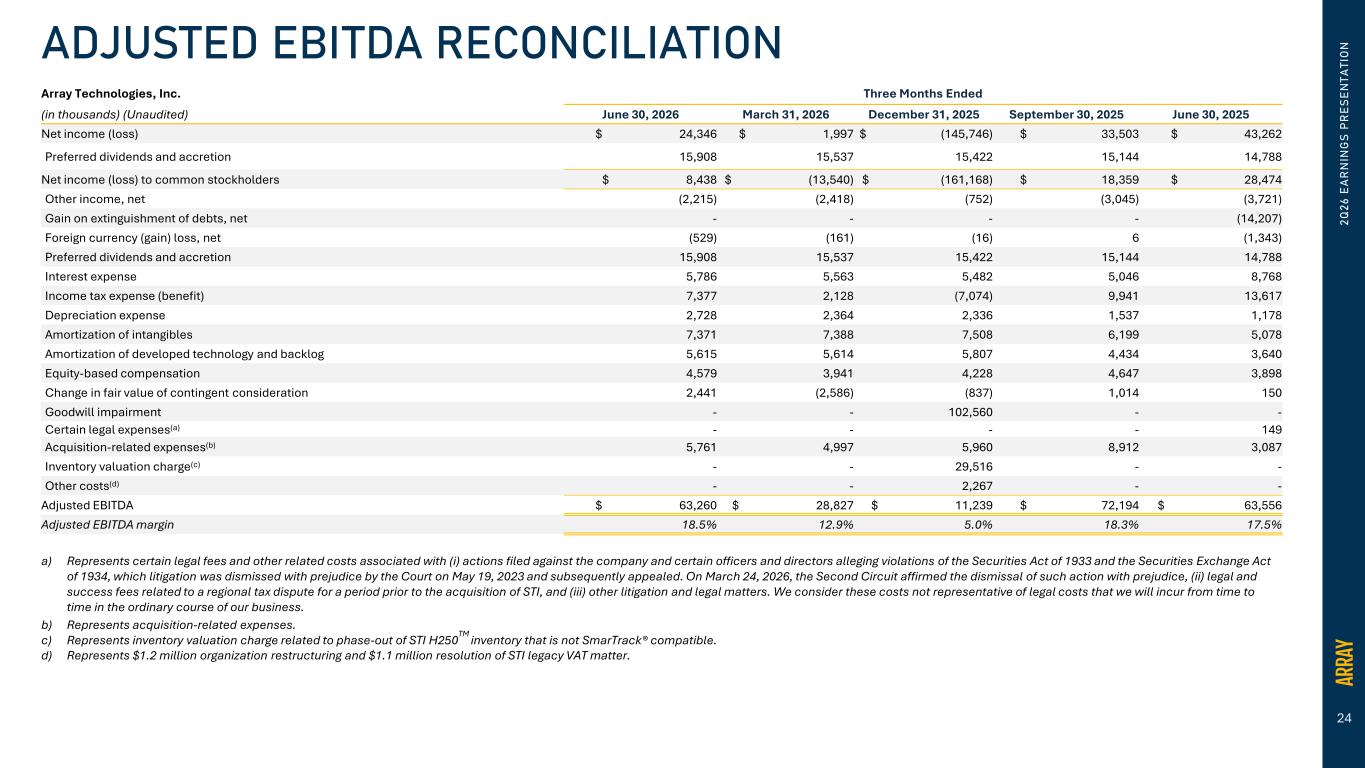
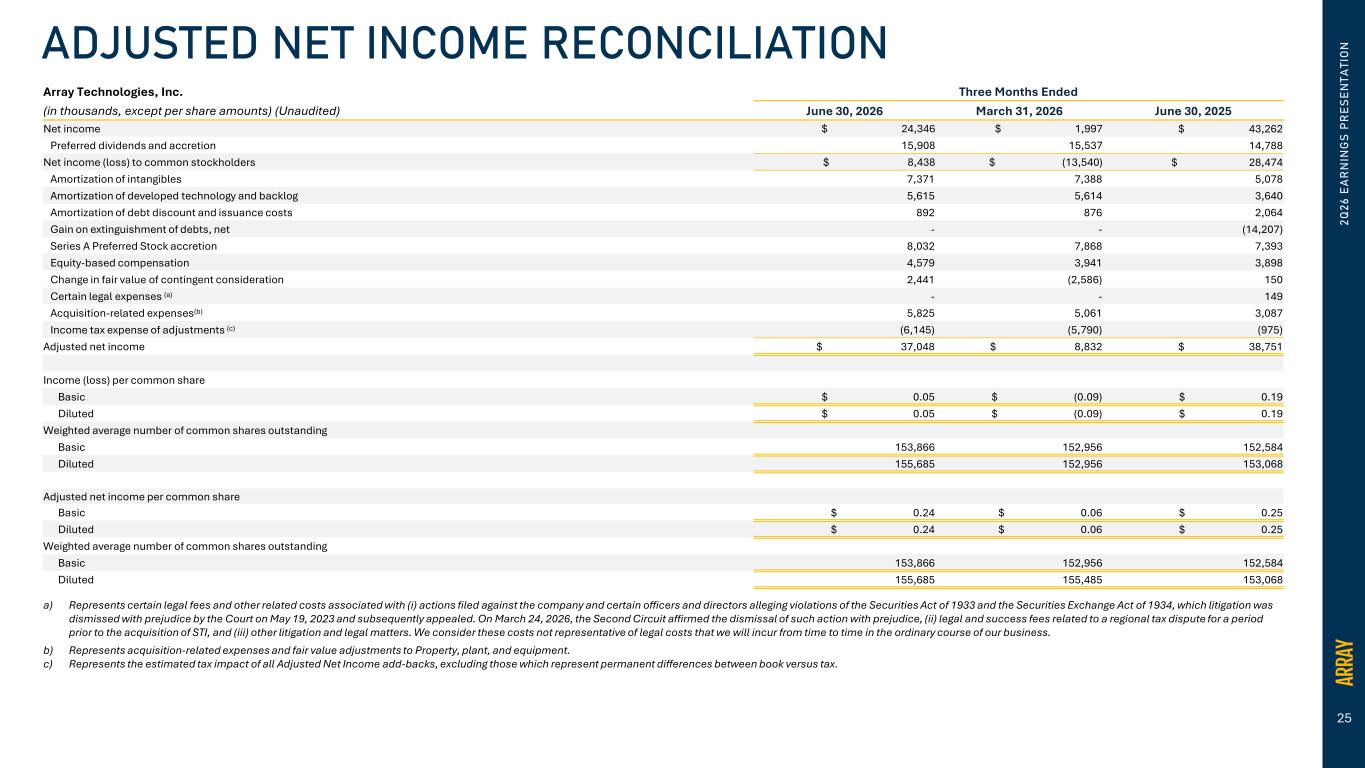
Thank you, Sarah. Good afternoon, everyone, and thank you for joining us. I'll begin with second quarter highlights and recent business updates. I'll then pass it to Neil and Keith to cover our innovation updates and financial performance. Let's begin on slide four with a brief discussion of our financial performance for the court. Q2 is a quarter of exceptional momentum across every key metric on the page. Revenue came in at $342 million, up 53% versus the first quarter, driven by 38% tracker volume growth and substantial sequential growth within our APA business as project activity accelerated. That top-line strength flowed through to profitability. Adjusted gross profit was $105 million, up 53% sequentially versus the first quarter, with an adjusted gross margin of 30.8%. Our year-to-date figure also stands at an impressive 30.8%, reflecting strong first-half execution. We also achieved adjusted EBITDA of $63 million, more than doubling the first quarter, with adjusted EBITDA margins also improving 560 basis points sequentially, coming in over 18%. On the bottom line, we delivered net income of $8 million and adjusted net income of $37 million, an increase of nearly $30 million versus the first quarter. Our traction on new products and our continued commercial, supply chain, and operational execution give us real confidence in our profitability trajectory for the balance of the year. Finally, as a continuing proof point of our strong commercial momentum, I'm pleased to report we achieved a third consecutive record order book this quarter of $2.5 billion, up 37% versus the same period last year, with over $500 million of new bookings in the quarter, roughly half of which came from our Tier 1 customers, including several projects greater than 500 megawatts. This brings our 12-month trailing book-to-bill ratio to an impressive 1.5 times with over $1.8 billion of new bookings. I'll now turn to Slide 5 to discuss some of our recent business updates and how we continue to execute against our strategic priorities. Our focus remains anchored in our three strategic priorities. innovating our future, elevating our international business, and advancing a customer-first culture. I want to begin by recognizing our cross-functional teams whose execution has enabled our most ambitious and prolific year of new product introductions in Array's history. We're listening to our customers, translating their feedback into differentiated solutions, and leading through innovation in utility-scale software. In the past few months, we formally launched Duratrack D2S for international markets at Intersolar Munich, extending our differentiated flagship technology into important new growth geographies. During the second quarter, we also announced Omnitrack 2.0, our next-generation terrain-following And in July, we announced the development of our Duratrack 60-degree variant, which is engineered for greater resilience in extreme weather environments while optimizing CapEx and lowering insurance costs for our customers. In partnership with APA, we also launched the Array Atlas suite of foundation-to-tracker solutions that gives customers a more complete, integrated offering, engineered from the ground up, and bringing a real competitive solution to traditional piles. Neil will provide more details on each of these exciting innovations shortly. Finally, touching on our M&A strategy, our APA integration is progressing very well, and we signed a definitive agreement to acquire Affordable Wire Management, or AWM, which we expect to broaden our electrical balance of system offering, deepening the value we deliver to customers, while also extending our business into battery storage and data center applications. We expect to close this acquisition in the third quarter of 2026, subject to receipt of regulatory approvals and the satisfaction of other customary closing conditions. Moving to slide six, I want to take the time to discuss our M&A updates in greater detail, beginning with APA's progress now that we are nearly one year post-close. When we acquired APA last August, the thesis was simple. Take a strong, well-led, growing fixed-tilt-racking and engineered foundations business, enable benefits from a raised scale and bankability, and then accelerate its growth by expanding its access to significantly larger utility-scale solar opportunities. One year in, our results say we did exactly that. APA's year-to-date book-to-bill is over 1.5 times, and pipeline quoting activity continues to grow substantially sequentially. This early momentum has resulted in a first-half revenue 17% ahead of 2025, and the business remains on track to hit our 2026 target of significant double-digit revenue growth and margin expansion. APA's average pipeline project size has more than doubled since the acquisition, a clear signal that demand is rapidly accelerating and the playbook we are deploying is working. So what has enabled this progress? It starts with the market intimacy and foundation engineering expertise brought forward by the leadership of APA. This, when coupled with the credibility and bankability of Array, brings APA into utility-scale conversations that simply weren't available to it on a standalone basis across both the fixed-tilt and A-frame portions of their business. We're also putting Array's scale to work in procurement, warehousing, and logistics, leveraging our supplier relationships to drive margin expansion. The bigger story, though, is what this combination has unlocked for Array as a whole. We are pleased to introduce the Array Atlas suite of products, the first step of many into integrated innovation between Array and APA. Our first integrated foundation to tracker products designed exclusively for multiple Array tracker platforms with APA engineered foundations. The array Atlas products meaningfully reduce component counts and are designed to dramatically improve installation efficiency in the field. Our engineered foundations now attach to Tracker Awards, expanding our share of wallet on projects and creating additional opportunities for margin accretion over time. Since closing, we've seen an ever-expanding pipeline of joint opportunities. And importantly, we've proven we can acquire, integrate, and scale. Our integration process serves as a template for expanding across the balance of systems, and it's exactly the playbook we're applying to AWM, which I'll turn to next on slide 7. Affordable Wire Management is a leading provider of cable management and safety products, serving solar, battery storage, and data center customers with nearly $60 million in trailing 12-month revenue. The pending acquisition reflects our disciplined M&A strategy, acquiring category-leading, profitable businesses with differentiated technology that strengthen our integrated platform and create real customer value through a high degree of technical interoperability and ease of installation. The strategic rationale of the deal comes down to four points. First, we're executing our balance of systems strategy by acquiring a differentiated leader in an adjacent segment with a suite of proven and highly engineered products. While lower price than trackers, these products are critical for installer and asset owners. Second, our global sales footprint combined with our operational scale. We're cross-selling to our existing global customers and leveraging our economies of scale across our manufacturing, sourcing, and logistics footprint creates very real revenue and cost-energy opportunities. Third, a disciplined financial approach. AWM is a consistently profitable market leader, which we expect to be high single-digit accretive to a raise adjusted EPS in year one before synergies. The base purchase price, combined with the anticipated benefit of stepping up the tax basis of AWM's assets, represents an attractive six-times trailing 12-month EBITDA multiple, which, by design, improves further as the earn-out is achieved. And fourth, we believe the integration is de-risk. Like in the case of our acquisition of APA, AWM's founders and existing leadership team will continue to run the business, supported by the same integration process that helped drive APA's outstanding year-one results. With that, I'll turn it over to Neil to discuss our recent innovation update.
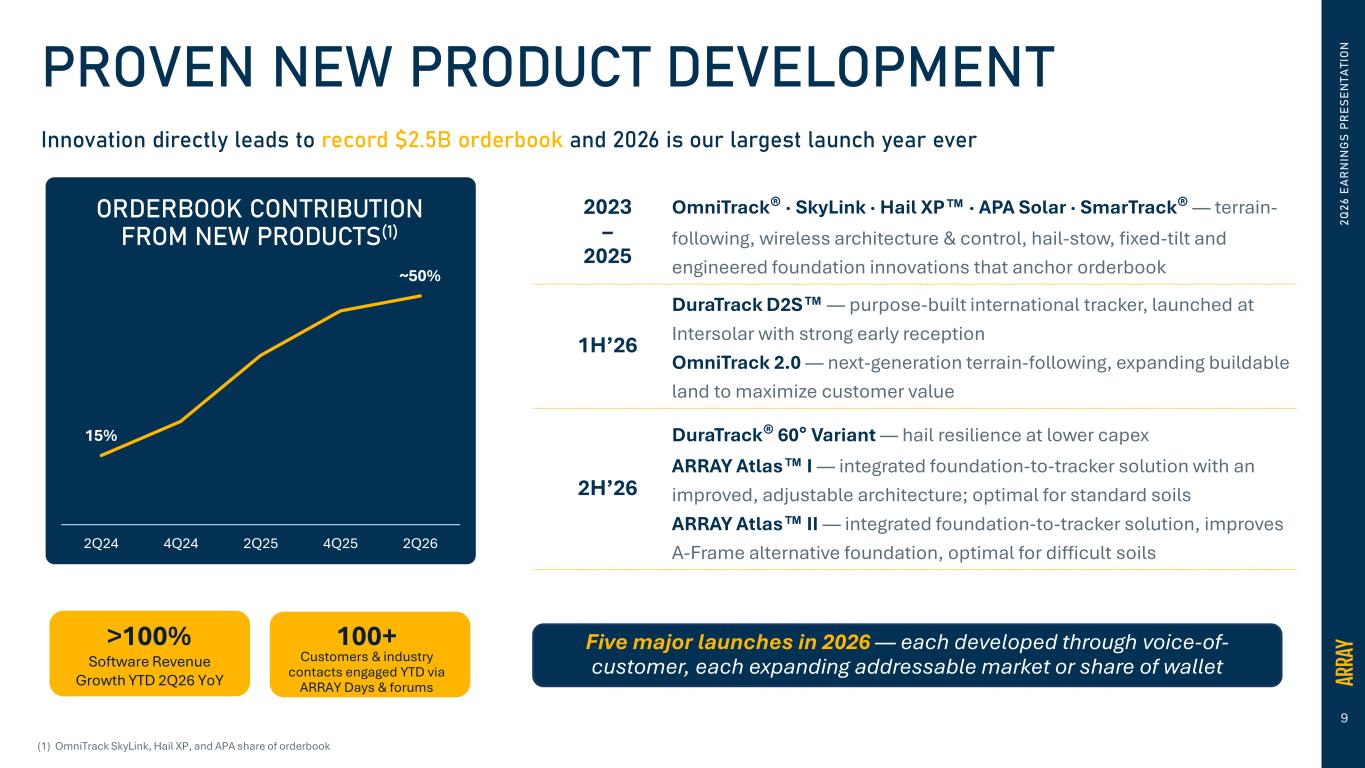
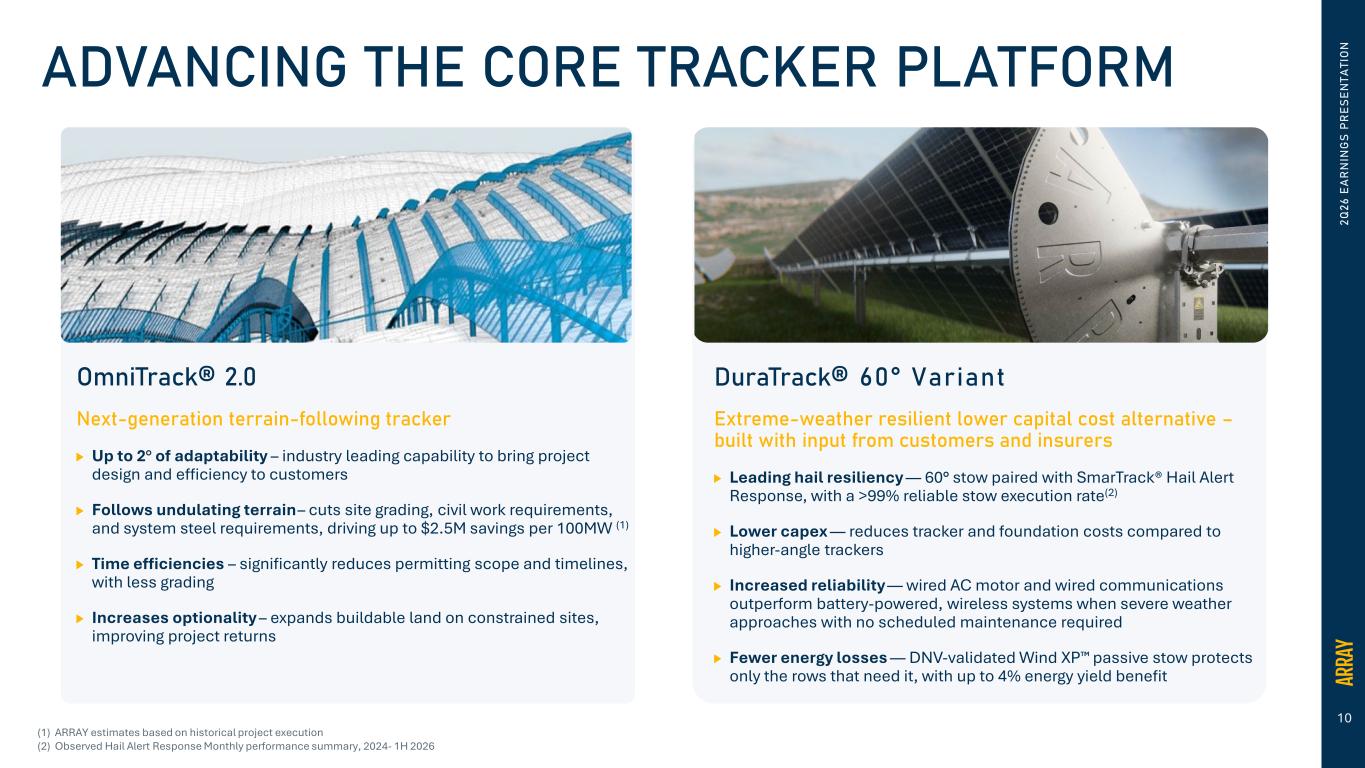
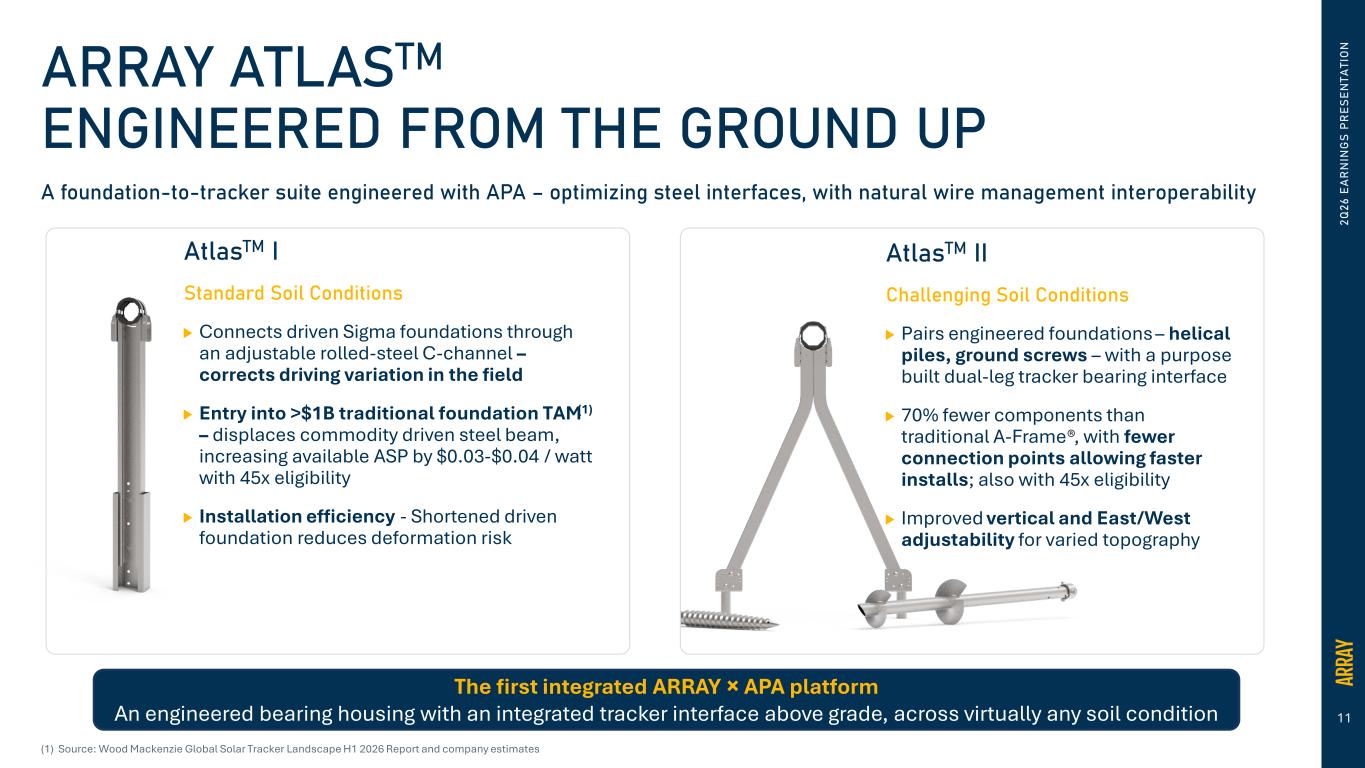
Thank you, Kevin. 2026 is our largest launch year ever, with five significant product introductions, each developed through deep voice of customer engagement, and each expanding our addressable market or potential share of wallet on every project. Innovation continues to be the driving force behind our record $2.5 billion order book. Products launched in 2023, Omnitrack, Skylink, SmartTrack, Hale XP, and APA account for roughly 50% of our order book and drive nearly half of our revenue in 2026, compared to a third in 2025, a powerful indicator that our focus innovation strategy is translating into customer adoption and real commercial success. Software revenue alone doubled year-to-date, demonstrating our customers' willingness to embrace our value-maximizing offerings. Feedback from the hundreds of customers and industry contacts we've consulted over the last two years has informed the next evolution of our portfolio. Let's walk through these exciting updates. Turning to slide 10. In the first half of 2026, we launched Omnitrack 2.0 and formally launched DuraTrack D2S. Last quarter, we highlighted D2S, a purpose-built international tracker, which we formally launched at InterSolar Munich in June. Earlier, customer reception has been strong. It delivers DuraTrack reliability with our patented, differentiated passive windstow technology and our proven architecture. This is a two-row format that international markets have been demanding. This supports our momentum in markets like Turkey, Colombia, and Peru with regionally optimized design and logistics. We're equally as excited about Omnitrack 2.0, our next-generation terrain-following tracker. This upgrade now accommodates an industry-leading silk change up to two degrees between adjacent posts, allowing the system to traverse a greater degree of undulating terrain. This cuts site grading, silver work, and structural steel requirements by a substantial amount, saving up to $2.5 million for every 100 megawatts. For reference, this would be between 20% to 25% of the overall cost of the tracker in this application. Plus, grading also means reduced permitting scope and shorter timelines and expands buildable land on constrained sites, directly improving project returns for our customers. Also, recently at our third annual insurance forum in Boston, intended by insurance leaders from more than 25 companies, we announced the DoraTrak 6-degree variant, delivering extreme weather resilience at a lower capital cost. This product was built with direct input from customers and insurers, as that continues to be our standard practice in new product development. What are insurers asking us for? Protecting asset in a hailstorm without paying for greater tracker capability than the site needs. That's what this product does. The 60-degree so is paired with our patented SmartTrack hail alert response and executes reliably more than 99% of the time. And because it runs on a wired AC motor with wired communications, it keeps working precisely when severe weather takes down battery-powered wireless systems. This solution delivers an incredible resilience at a lower capital cost than higher angle trackers, including foundations. And a third-party validated, unique to our array, WindXP Passive Stow protects only the roads that need it, preserving up to a 4% energy yield benefit in high wind regions. The 60-degree variant fills the portfolio between the standard door track and hail XP, cost-effective risk mitigation for moderate hail regions, such as Texas and the Great Plains. It is expected to be available to quote later this year with deliveries expected in mid-2027. Finally, turning to slide 11 in the Array Atlas suite, which launched just last week. Atlas is a foundation to track our product line engineered with APA and is our first integrated array APA platform, integrated foundation and bearing housing interface above grade, capable of performing in any soil conditions. Atlas One is how we enter the more than $1 billion traditional foundation market for standard soils. It's a cost-competitive, insulation-optimized alternative to the commodity pile approach and a more efficient use of steel versus a standard pile. The problem it solves for customers is its variability in the field. It's adjustable, sigma-shaped channel corrects for pile-driving variation on site, displacing the commodity-driven steel beams, and the shortened-driven portion of the below-grade foundation lowers deformation risk. Atlas II takes that same approach into challenging soils, pairing helical piles and ground screws with a dual-leg bearing interface and an integrated bearing housing. What that means on site is simple. 70% fewer components than APA's traditional A-frame, fewer connection points, faster installs, and more vertical and east-west adjustability when the topography demands it. Notably, both solutions are engineered to work with AWM's wire management products through predefined holes, again focusing on installation efficiency for EPC partners. As both Atlas solutions seamlessly optimize foundation integration with the array tracker, they qualify for 45X manufacturing credits. Together, the Atlas platform allows us to serve virtually the entire foundation market, modernizing fragmented commodity steel-driven interfaces, deepening our share of wallet in every project we win, and delivering a more integrated, efficient solution for customers that further differentiates array in the market. Let me be clear, these innovations aren't happenstance. They're a result of a deliberate multi-year investment in our product development engine. In 2025, we opened our Array Innovation Center, or AIC, in our Chandler, Arizona facility. Our purpose was threefold. One, we co-located our existing engineering resources with product management, product marketing, and dedicated engineering labs for software, hardware, and electronics. Two, we partnered locally with Arizona State University to develop a pipeline of new engineering talent and began working with several ASU engineering teams to accelerate our development efforts, and three, we launch our customer experience center where we host our array days and industry forums. Coupled with the investments in our technical sales team, the collective results of these efforts is what we are experiencing today, a richer, customer-driven new product development pipeline with reduced development cycle times, enabling consistent quarter-over-quarter execution. We welcome our analysts, customers, and shareholders to visit our array innovation center to experience the energy of our development efforts firsthand. Across our portfolio, the common threads are terrain adaptability, severe weather mitigation, domestic content confidence, and software-enabled optimization through SmartTrack, continuing to raise evolution from a traditional tracker supplier to a differentiated technology and solutions partner. This is our innovation engine working exactly as designed. All in all, when you view our collective efforts in new product development with our continued investments in supply chain, AI automation, and commercial engagement, you see the basis for our continued strong execution quarter over quarter. With that, I'll turn it over to Keith to discuss the quarter's financials in more detail. Thank you, Neil.
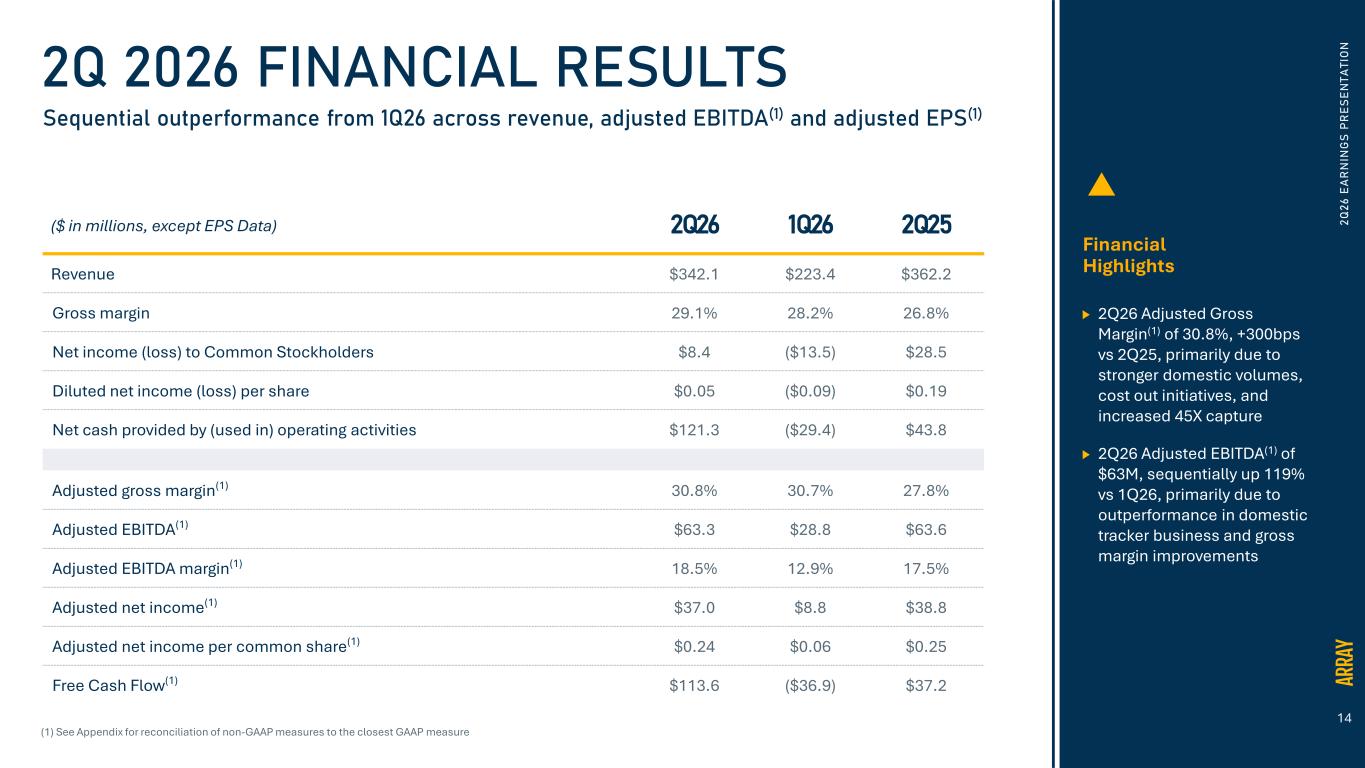
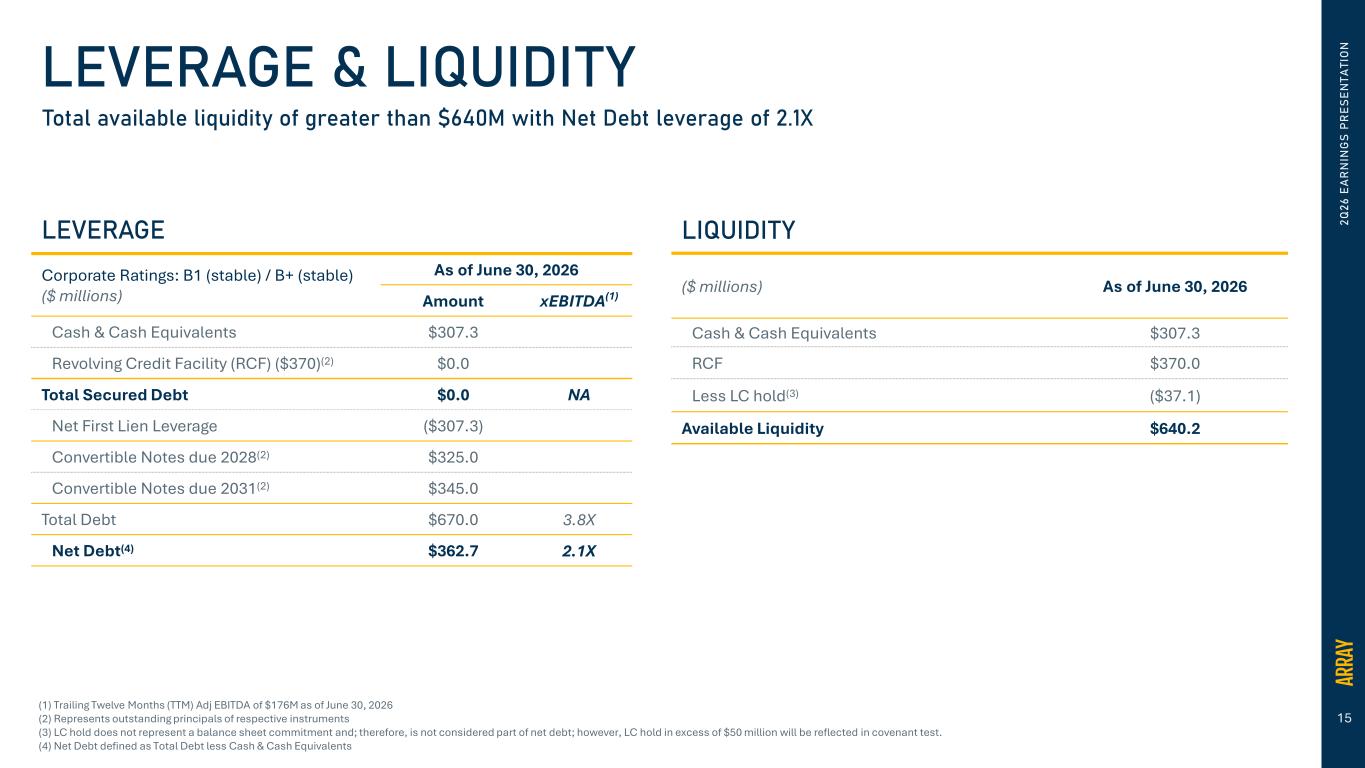
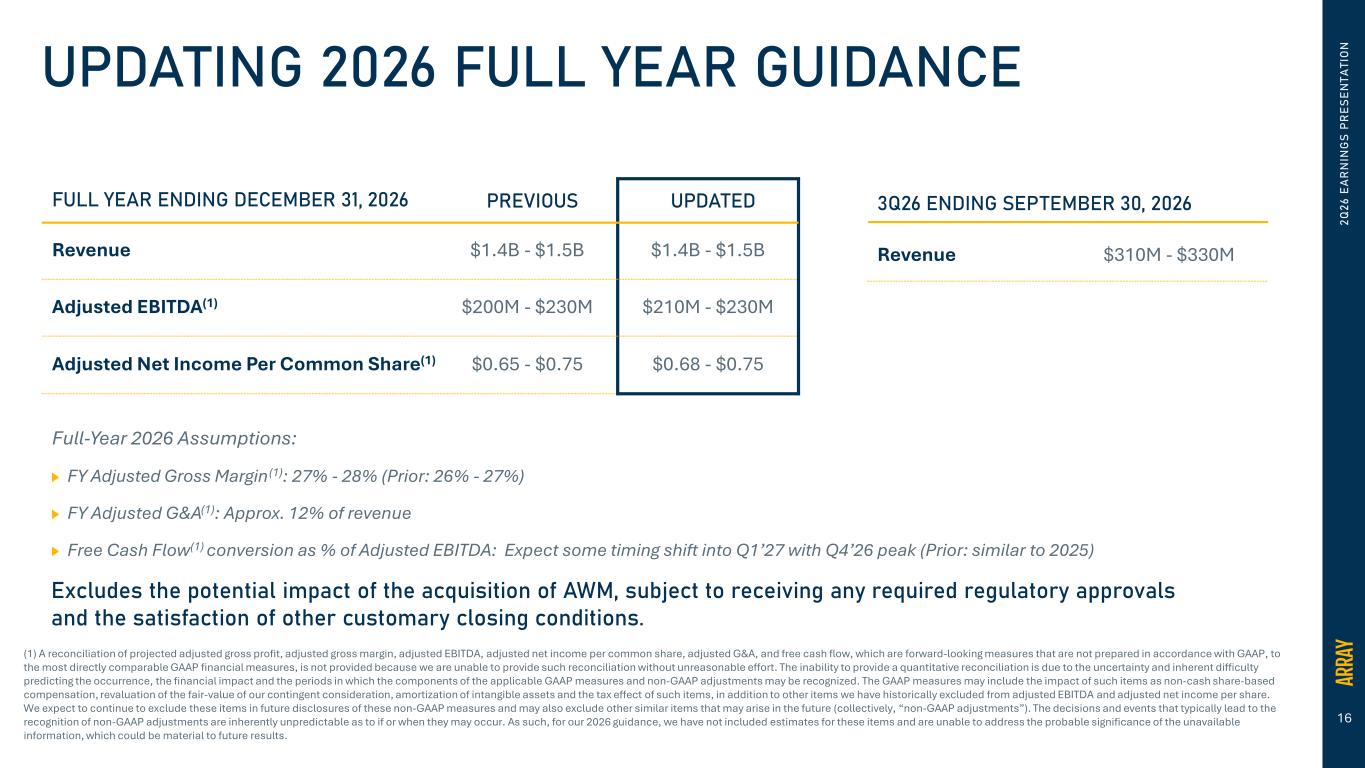
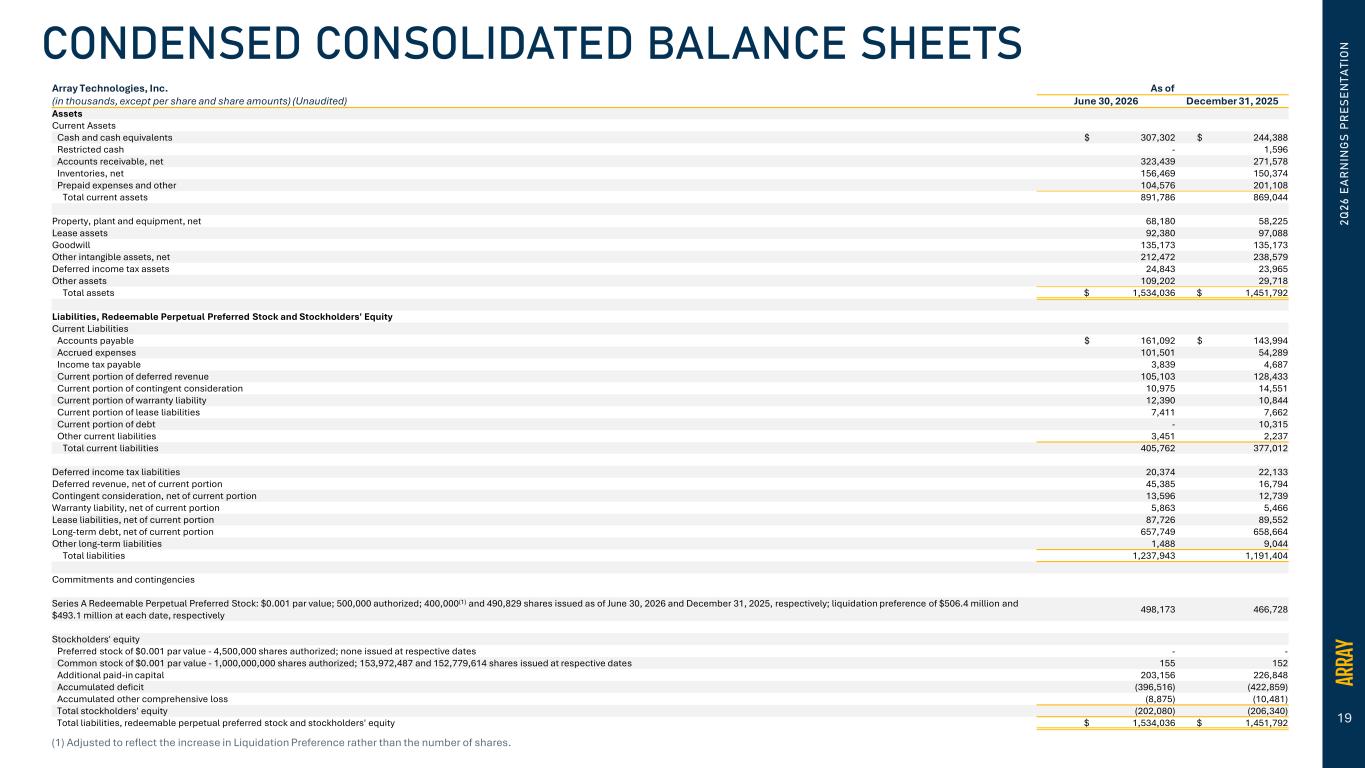
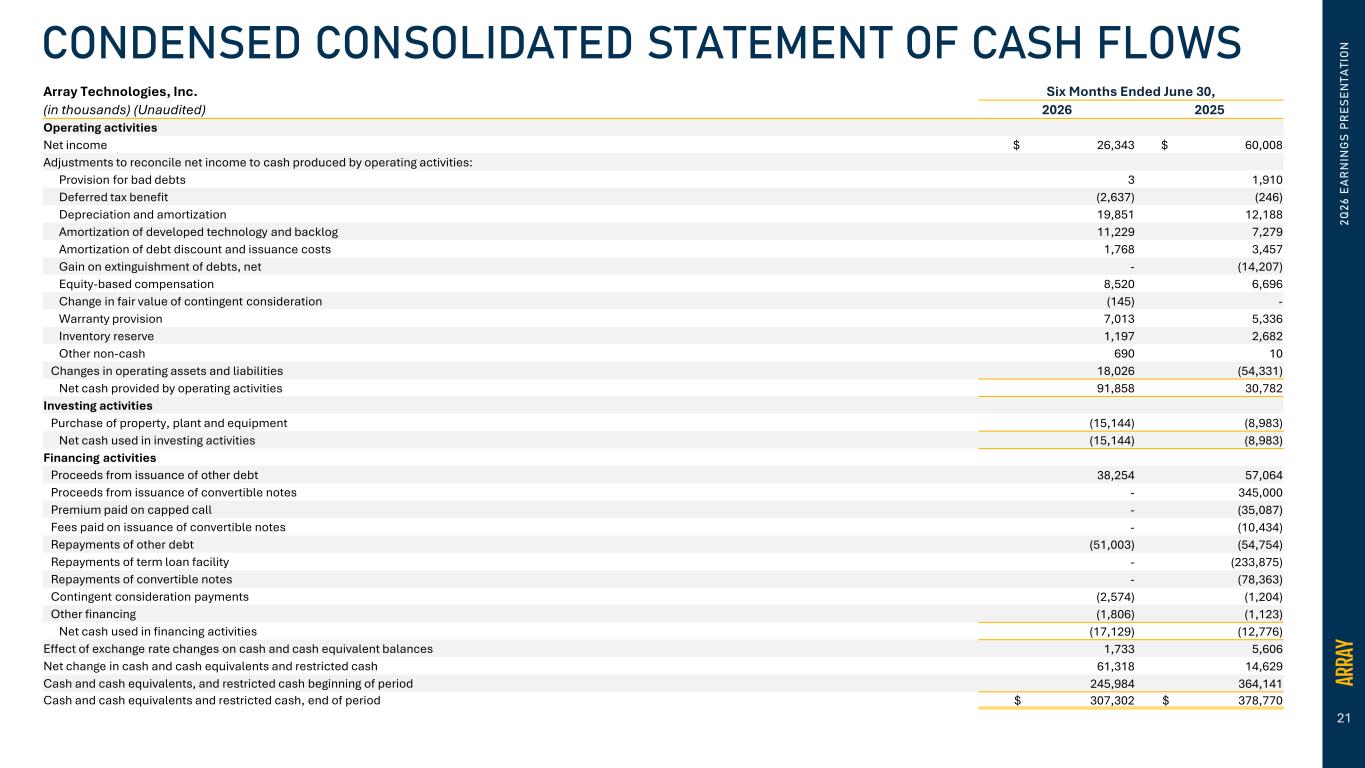
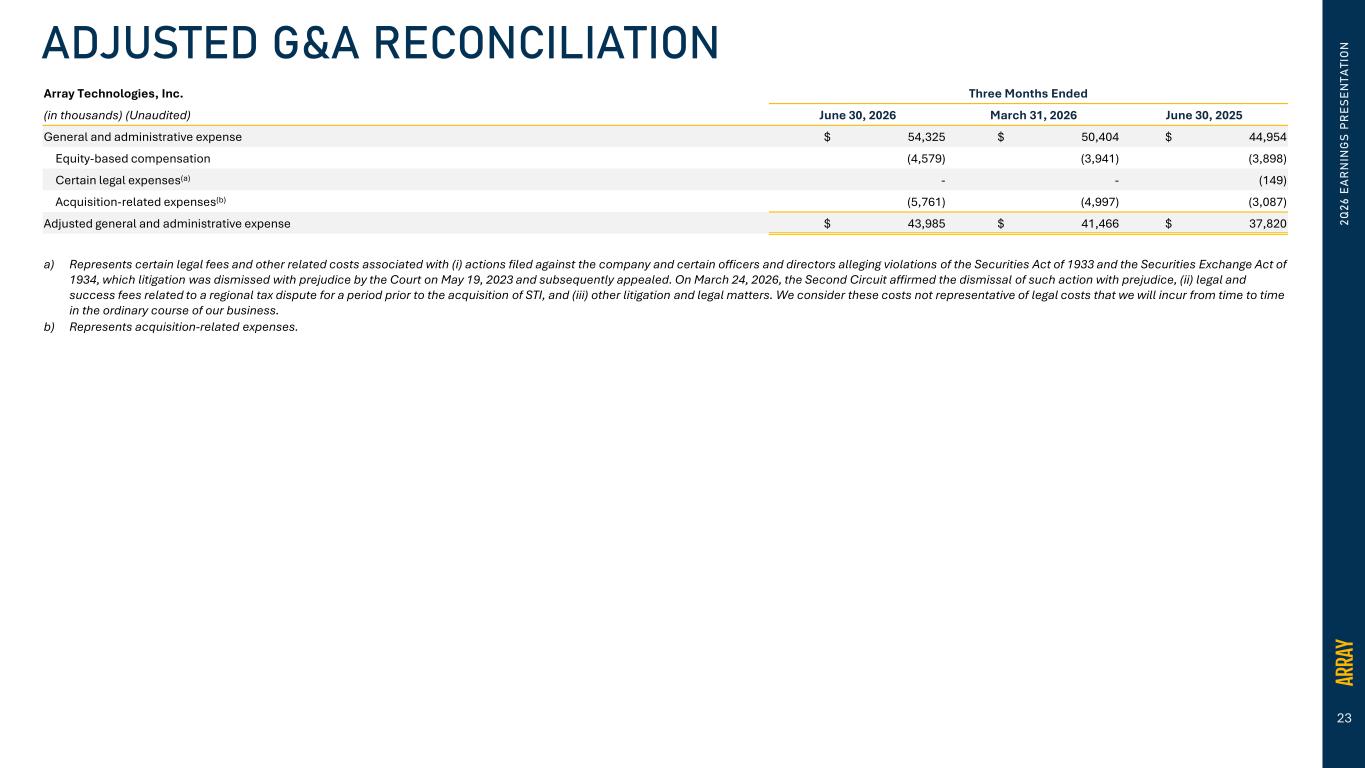
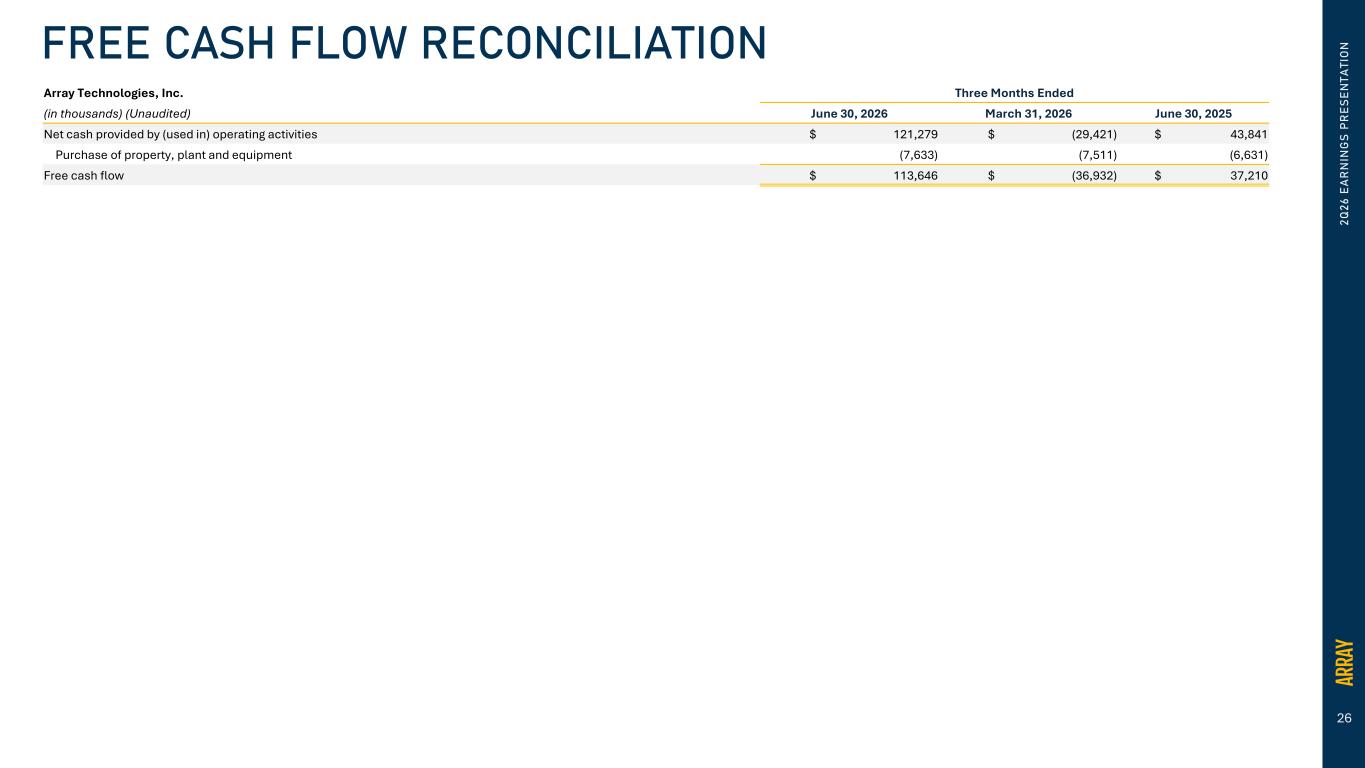
Slides 13 and 14 summarize our second quarter financial performance, which outperformed across all T&L targets. Revenue, adjusted gross margin, EBITDA, and EPS all outperformed. Revenue was $342 million, which was a 53% improvement over our first quarter results and above our guidance of $300 to $320 million, primarily driven by customer-driven pull-forward activity in our domestic tracker business, strong execution against a healthy domestic backlog, and continued strong commercial momentum at APA. We continue to meaningfully improve our profitability through sourcing, productivity initiatives, and cost management. Adjusted gross profit was $105 million of 53% sequentially versus the first quarter, and adjusted gross margin was 30.8% of 300 basis points year-over-year and up 10 basis points sequentially versus the first quarter. Importantly, unlike the first quarter, which included over 300 basis points of one-time benefits, one-time items this quarter had less than 50 basis points of impact. Our margin performance was driven by higher domestic mix, including APA, strong execution on our cost-out initiatives, and incremental 45X capture. As we look forward, we expect second-half margins to be influenced primarily by the absence of the one-time tariff recovery and catch-up 45x benefits we achieved in the first quarter, as well as our previously guided increase in international mix. We continue to see the strong results on our productivity initiatives largely offset increased commodity and logistics input costs. Adjusted SG&A was $44 million, or just under 13% of revenue. This represents 570 basis points of improvement from the previous quarter as we delivered our targeted cost savings plus incremental reductions through hiring and discretionary spend control. Adjusted EBITDA was $63 million, up 119% sequentially, and our adjusted EBITDA margin was 18.5%. of 560 basis points from the first quarter. The improvement was driven by higher volume, gross margin flow through, and continued discipline on operating costs. Gap net income to common shareholders was $8 million, a substantial improvement over the first quarter. Diluted earnings per share was $0.05, while adjusted earnings per share was $0.24, cents, compared to adjusted earnings per share in the first quarter of six cents. I want to highlight our outstanding cash generation this quarter. We ended the quarter with $307 million of cash, up over $100 million sequentially, driven by accelerated 45X collections. Free cash flow in the quarter was $114 million, and we invested $8 million in capital expenditures, primarily associated with the plant setups in our new Albuquerque facility plus incremental production capacity at APA along with tooling for the new Atlas product suite. We ended the quarter with more than $640 million of total available liquidity, including our fully undrawn $370 million revolver net of letters of credit. Net debt leverage was 2.1 times trailing 12-month adjusted EBITDA, down from 2.7 times at the end of the first quarter and well within our targeted range. With this strong cash and liquidity position, we expect, when approved, to fully fund the acquisition of AWM with cash on hand. Finally, a word on our Series A preferred equity capital. Dividend on this instrument will transition to cash pay in the third quarter, and this is reflected in our 2026 expectations. We continue to evaluate our alternatives regarding the preferred shares and will balance any decision against our leverage targets, the after-tax cash cost of refinancing alternatives, available liquidity, and the opportunities available across our capital allocation priorities. Turning to our 2026 outlook on slide 16, with the support of our strong first our performance, we are updating our full-year guidance. It is clear to us, based on the reported utility-scale solar activity, conversations with our customers, and our growing $2.5 billion order book, that demand remains strong. As a reminder, we guide to what our visibility supports. Our revenue guidance reflects a bottoms-up view of customer delivery schedules, order book coverage, and our latest commercial discussion. Accordingly, we are reaffirming our full-year revenue guidance of $1.4 to $1.5 billion. We are monitoring near-term project timing primarily related to permitting and site readiness, which may push recognized revenue below the midpoint of the full-year guidance range. Importantly, this would not be lost business, but customer timing shifts to 2027. While our quarterly revenue cadence continues to be influenced by seasonality and customer project timing, the underlying demand and pipeline activity remain very healthy. Given these timing dynamics, we expect revenue in the third quarter to be between $310 and $330 million. The team has been focused on supporting shipment timing in the second half through securing the required supply and inventory logistics. The incremental shift of revenues from Q3 to Q4 will impact our free cash flow conversion timing, shifting some collections into Q1-27. As a result of our operations team's excellent execution, we now expect consolidated adjusted gross margins to expand to 27% to 28%, 100 basis points above our previously communicated guidance range. Our strong first half performance benefited from one-time items, carry recovery, and incremental 45X catch-up benefits that will likely not repeat in the second half. Second-half gross margins will also be impacted by increased international mix. Our continued focus on productivity initiatives is expected to partially offset higher metals and logistics costs in the second half of the year. We are increasing the lower end of our full-year adjusted earnings ranges. We now expect to deliver adjusted EBITDA in the range of $210 to $230 million and adjusted EPS in the range of $68 to $0.75, driven by the adjusted gross margin expansion and continued focus on cost discipline. Be clear, our updated guidance excludes any expected revenue and margin contribution from our recently announced planned acquisition of AWM. We look forward to providing an update following the close of the acquisition, which we continue to believe to be in Q3, 2026, subject to regulatory approval and satisfaction of customary closing conditions. AWM will be an exciting addition to our portfolio. We expect high single-digit accretion to adjusted EPS in year one before synergies. Let me leave you with three takeaways that reinforce that Array is working well. First, Q2 was a quarter of execution-driven outperformance. Revenue, margin, and earnings all came in ahead of our forecast. Second, cash generation was exceptional. More than $100 million of sequential build. net leverage down to 2.1 times on continued trailing LTM EBITDA growth, contributing to the ability to comfortably fund AWM with cash in hand. And third, operational resilience and execution capabilities are enabling us to improve our full-year earnings guidance. With that, I'll now turn it back to Kevin for closing remarks.
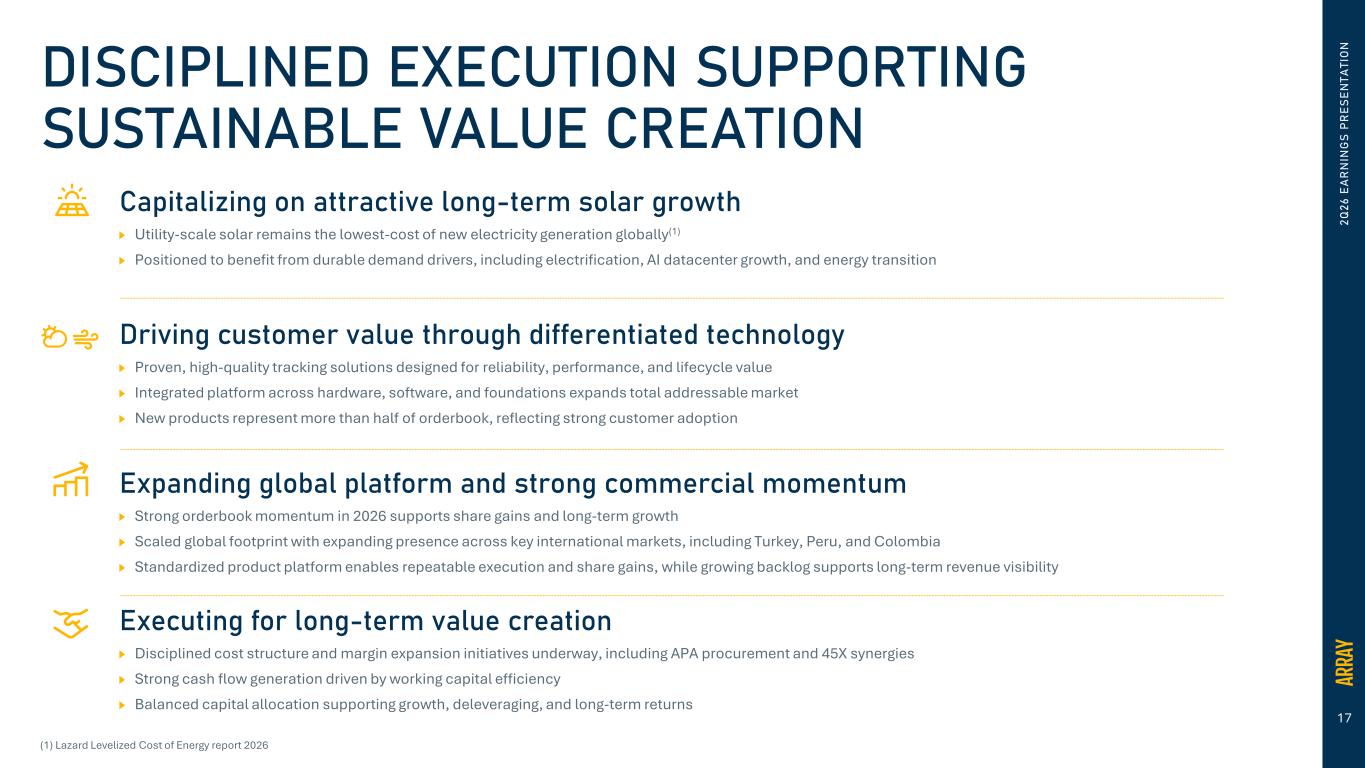
Thank you, Keith. To wrap up, I'm proud of how the team executed in the second quarter, delivering results well above expectation, our third consecutive record order book of $2.5 billion, strong cash generation, and surpassing 100 gigawatts of trackers delivered globally. All this while demonstrating our incredible innovation engine. We are using 2026 to expand the platform, strengthen margins, and set up durable growth. Five significant new product launches, APA's first year validating our M&A playbook, and now AWM extending it. We remain laser-focused on delivering our strategic initiatives. Thank you for your time today and for your continued interest in Array. With that, we'll open the line for questions. Operator?
Operator
Thank you. Ladies and gentlemen, we will now conduct a question and answer session. If you have a question, please press star followed by the number one on your touchtone phone. You will hear a prompt, a three-tone prompt acknowledging your request. If you would like to cancel your request, please press star 2. Please ensure you lift the handset before pressing any keys. Your first question comes from the line of Joe Orsha from Guggenheim Partners. Please go ahead.
Gosh, thanks. I made it first. Hello, everybody.
You've commented in the past regarding the pace of backlog conversion sort of over the subsequent six quarters. I'm wondering if you might be able to provide us with an update today regarding that. Yeah, Joe, great question. It's still very consistent at that 80% to be converted in the next six quarters.
I'll yield to the next person.
Operator
Your next question comes from the line of Brian Lee from Goldman Sachs. Please go ahead.
Hey, guys. Thanks for taking the questions. Maybe first on the gross margins, I mean, you guys have been doing a fantastic job, 30% plus, both in 1Q and 2Q. I know you inched up the margin guidance for the year 27 to 28 now. But I guess what changes in the second half to maybe not maintain the run rate you saw in the first half, even though it does look, based on the revenue guidance, that you're going to have better volumes and revenue in the second half? I don't know if it's just a mixed thing, but can you kind of walk through some of the puts and takes for the second half, first half, sort of margin step down here?
Hi, Brian. Good to hear you. Well, first, the first half margins are to be commended at, I think, 30.8% on average. However, they're not to be fully extrapolated. In the first half, we had a few one-time items, particularly in Q1, that should be adjusted out. And they account for roughly 200 basis points of that. So you're looking at a normalized 28.8 for H1. When we look at H2, there's a few things that are happening. First, we will have the step up of international mix. I think international in H1 only accounted for roughly 5% of our revenues. And then in H2, they will go back up to a higher number, you know, not as close as a past run rate, but it does step back up very strongly. The second thing that happens in the second half is we have a few domestic projects and some input costs to deal with. So while we're doing well in the U.S., we have to remember that the macro factors have created increased metals and logistics costs that we have to deal with in the second half. And also, we will not have the, you know, again, we talked about that, the benefit of some of the one-time items.
Okay, super helpful. That color definitely makes sense. And then maybe the second question could also be for you, Keith. I appreciate you alluding to the PREF here. I guess housekeeping, that does flip the cash payment starting in Q4 this year, correct? And then I guess in relation to that, are you currently engaged in looking at alternative financing options? Or are you, I mean, what's the sort of sense of urgency? Are you not looking for something there until maybe the payments step up in future years? just trying to understand your thought process around how you're going to, um, approach the, uh, the prep. Thank you.
Sure. Um, so yeah, so the prep flips to cash pay, I think in August of this year, um, we will be obligated to, um, pay roughly 12 million dollars, uh, through the remainder of 2026. Uh, it starts at a, uh, coupon rate of roughly six and a quarter and it does step by 50 basis points each year. So let's, you know, as we think about PREF, first, I want to say that we are very comfortable in servicing the PREF. We are cash generative. We continue to grow EBITDA and earnings. And so, you know, our outlook on the PREF is the same. You know, we look at it against all the options that we have. We look at it against our leverage level. We look at it against the available capital market options that we have. So at six and a quarter, it can coupon rate until interest rates change or come down or our credit profile changes, then it becomes very competitive against the cost of debt that could replace that. So we always look at the after-tax cash cost of servicing any instrument. And, of course, you know, we're balanced against our strategic options are or in terms of, you know, the priorities ahead of the business in terms of organic or inorganic options. So, you know, we are looking at it. We're looking at, you know, we've always been looking at it. And so we will continue to look at it. But in terms of the servicing, you know, we're comfortable servicing it where it is. And if there's something that comes out to be, you know, has a better profile from a corporate finance standpoint, then we will go ahead and execute it. So we are always, and by the way, we're always in dialogue with our investment banking partners on what the options are.
Makes sense. I'll pass it on. Thank you, guys.
Operator
Your next question comes from the line of Philip Shen from Roth Capital. Please go ahead.
Hey, guys. Thanks for taking my questions. First one's on bookings. Our quick math suggests bookings were $442 million. But, Kevin, I think you talked about $500 million of bookings in the quarter. My guess is it's some rounding. So I just wanted to understand what might we be getting wrong there. And then, importantly, on a go-forward basis, you've been on this pretty healthy $400 million to $500 million quarterly bookings cadence. would you expect that to maybe even accelerate and pick up in the coming quarters? Thanks.
Yeah, Phil, look, I'll take the first one. You're right. It's rounding. We did over 500 million, just over 500 million of new gross bookings in the quarter. And I should note that no significant cancellations out of the order book as well. So really strong quarter of commercial momentum. Again, to note that our $2.5 billion backlog is now 37% ahead of where it was this time last year. It's just incredibly significant. Look, we don't project or forecast bookings externally. We think we have now, as you put it, consistently, we've booked over $1.8 billion of new orders net in the last four quarters. And we think that's just substantial commercial momentum. So it's not only the quantum, but we're winning larger programs, more multi-program awards as well. So we feel really, really good about our commercial momentum at this point. And the fact, again, the quality of the order book is quite substantial at this point. We talked a few times about some of the elements of that being that it is now over 95% domestic and fully supported by really good strategic customer commitments. Should also note, as I do on every one of these calls, Phil, we've not made any changes in the definition of our order book. So, the increase that you're seeing is truly continued strength and momentum, primarily in domestic bookings, which are really a direct result of our successful commercial transformation that we've been talking about now for about two years, right? The domestic book to bill was well over 1.4 times in the quarter. So, again, quite substantial.
No, I was saying, and the other point we continue to make is that half of the order book now is tied to developers, IPPs, or utility specifications at this point. Even if we may get a purchase order from an EPC ultimately, half of the order book is now being driven by those specifications at the developers, IPPs, and utilities, which has significantly increased in the last two years. So we're really proud of our commercial momentum at this point.
That's important to have them require you guys in their projects. Shifting over to AWM, wanted to just check in and get some additional detail about this acquisition. Sounds like there's some really nice margins there. Was wondering if you could share what kind of market share AWM has in the U.S. Our work suggests it's kind of an oligopoly between you and Cab Solar. And maybe the AWM share is closer to 40%. And then what has prevented them from going international? And is that an opportunity for you guys ahead as well?
Yeah, those are great questions. Look, we love the AWM acquisition. It's disciplined adjacency, not just a roll-up strategy, really expanding our balance of systems, offering to a great engineered category that we really understand. and with customers that we're already serving domestically, right? So start there. So when we talk about our trailing 12 months, that was as of May. We feel they are a market leader at this point domestically. To your point, it is largely an oligopoly with two leaders than others below that. But I can tell you that the growth rate of AWM, remember, this is a company that's only five years old. So five years ago, they answered the market, and they're already a market leader in this space due to some very, very strong engineering capabilities. And effectively, they looked at this space and said this was a space that hadn't had innovation and engineering thrust upon it, and noting that its largest competitor is primarily a not-for-profit, right? So we really liked this acquisition. We think it has a lot of opportunities to expand. International is certainly one of the legs that we will help them expand significantly, but likely not for the first, say, six to nine months post-acquisition. We're going to stay very, very focused on the supply chain synergy opportunities. And when we did a side-by-side set of analytics on our customers, some of their strongest targeted customers happen to be our largest customers, right? So we're going to stay focused on the front-end commercial synergies first, back-end synergies. That is the supply chain logistics warehousing, and that's going to be the first six to nine months before we begin to platform them internationally. But there's substantial growth opportunities internationally.
Great. Thanks, Kevin. I'll pass it on.
Operator
Your next question coming from the line of Colin Rush from Oppenheimer. Please go ahead.
Hi there, guys. This is Andre Adams on for Colin. I was just hoping to stick on the order book for a second. Could you give us a sense of the share of orders with both Array and APA content in there and how much cross-selling opportunity remains and how quickly do you think you could get to comparable sales synergies with AWM?
Yeah, so I would say while we're just now getting our first series of orders with the joint orders, that is, between APA and Array, they're just beginning at this point, right? just landing, and we've landed our first, and we have several now in the very, I would say, near bucket. And this is really about us learning to jointly quote, jointly put packages together, take them to our customers. So, that's still very new, but we couldn't be more excited about the pipeline of those joint orders at this point. So, I think we'll talk more about it at our APA days coming up in a few weeks, but quite significant opportunity. I think the bigger is as we've gone out and sold joint customers, APA is now bidding on many, many more utility scale projects. And we referenced that in their average size of their order has more than doubled in its first year under Ray. So while we're working on some together and joint programs, We're being very, very careful to not bring it jointly and then ask your customer for a discount. If we could sell them individually at a higher price, we're going to focus there. But make it easy for the customer to give us an order for both parts of that business, if that makes sense. So stay tuned. We're really excited about that. I think with AWM, again, that ability to look at the customer lists, share that, and very aggressively work together, that's going to be near immediate. it. We're excited about what we can do with AWM as well in that safe space.
Great. Thank you for the color.
And just on the field labor savings that you're able to drive with some of the new product introductions, can you speak to kind of rate of adoption and incremental opportunities for improvement in field labor savings that you're focused on? hey it's neil i'll take that one so just for example when you look at the atlas product that we announced last week um atlas 2 um 70 percent fewer components than the legacy a-frame product so it's got fewer connection points overall driving a faster installation and ultimately when you look at the atlas 1 product it solves for a lot of problems that the epcs have in the field with pile variability. So, when that happens, you know, it takes a lot of extra time from an EPC. So, one of the things that this allows us to do is to custom fit and size each pile height with the adjustable channel that slides into a sigma pile. So, ultimately, that also drives a lot of efficiency in the field for EPCs as well. And we think that particular product will bring with it roughly three to four cents average selling price per watt in addition to a typical tracker sale. So that opportunity really expands the market for us as well. So we think there's a lot of insulation efficiency for Atlas, along with the other products we've launched in the last couple of years. So one important point that we'll say is that when you look at our order book, it's made up of over half of it is now a new product launched since 2023. And over half our revenue in 2026 will be around new products as well. And one of the things that's really resonating is around that installation efficiency in addition to solving customer problems in the field. So overall, the innovation pipeline is really driving strong and installation efficiency is a big part of that.
Let me just add to that. Look, we've been co-developing some ideas with AWM for some time, for almost a year at this point. So as we were developing the Atlas suite of products post-APA acquisition, those teams worked together very, very effectively. In fact, AWM launched a new product that is actually being manufactured at APA. Those that are going to join us at the APA days in a couple of weeks, the technical days, we'll look forward to showing you some of that. And then as we design the Atlas I, the foundation in Sigma, the Sigma pile with the C channel that we talked about earlier, that was also designed with particular hole and bolt patterns to be able to bolt the AWM wire management directly on without having to drill additional holes in the field. So it's really about that interoperability. So the foundations, the AWM system, and the trackers and the components that we provide in the field are all very, very interoperable, and we had a key eye on interoperability, both when we acquired APA and then extended that eye to AWM. So we really look forward to hosting some of you that are going to join us in a couple weeks at the APA technical days. You'll be able to see that integration of both products, and it's pretty impressive.
Thanks so much for all the call, guys.
Operator
Your next question comes from the line of Corinne Blanchard from Deutsche Bank. Please go ahead.
Hey, good afternoon. Thank you for taking my question. Could you talk a little bit about the guidance? And maybe, you know, that's imply a pretty heavy 4Q. I'm just trying to understand what gives you the full confidence to achieve that 4Q and to be within the guidance. Yes, that would be helpful.
Good. Thank you, Connie. Great question. Look, we're maintaining the revenue range because our current customer schedule and order book visibility continue to support it. You know, we are, however, raising profitability because the first half execution, you know, makes cost out progress and so forth. And 45X capture are stronger than expected. So, you know, that, you know, explains the earnings push up. But when you think about the revenue side of it, the shape of the year, you know, we tend to guide to what our visibility supports. And at the moment, we do see the customer orders. We do see the schedules. And when we think about it, we do believe that we can deliver into this zone. And if you think about it from a context standpoint, yes, the space of H2 has roughly a 60-40 between Q3 and Q4. But to give you context, this business shipped approximately 4.5 gigawatts of product back in Q2 2023, printing greater than $500 million of revenue. And so that was pre-ABA in our portfolio. And when you add APA and you add a stronger suite of execution capabilities, I'm confident that with the preparations taken, that if the externalities hold, we will deliver on this guidance. And so, you know, the externalities, as you know, are, of course, interconnection, weather, site readiness, and customer timing. But those things that are outside of our ring fence, you know, those externalities, We tried to adjust our range and indication and risk by pointing towards being probably below the midpoint of the guidance range. But at the same time, everything that is inside of our fence post in terms of inventory, logistics, readiness, cruise, we are taking all the steps to ensure that we deliver on this.
Thank you. And maybe for the follow-up, can you talk about the free cash flow conversion that you're expecting for the rest of the year? Do you expect it to be similar to 2025, or do you expect any change there?
So we are changing our free cash flow guide, or I should say updating it. So when we entered the year, we expected to convert about the same pace at which we converted in 2025. However, with the shift in the cadence and shape of the year and having a 500 million plus Q4 of revenues, the ramp for that or the peak in that quarter pushes our collections into 2027 and so we at this time are you know are expecting to convert I would guess somewhere in the range not guess but you know our models are showing that it's in the range of 20 to 25 percent of EBITDA so it's roughly you know half of what we were expecting when we started the year not because of anything else other than just the shape of how working capital and collections moved.
Operator
As a reminder, if you have any questions or follow-up, please press star one. Your next question comes from the line of Chris Dendrinos from RBC Capital Markets. Please go ahead.
Yeah, good evening, and thanks for taking the question. I wanted to follow up here on the AWM acquisition, I guess maybe more just from a strategic standpoint? And you've got the connectors now, but you don't have the eBoss wires. And so just how do you think about the eBoss wire strategically? Is that something you ultimately go after just given the synergies of having that complete system? Thanks.
Yeah, I mean, that's a great question. Obviously, we look at that as a very logical extension of what we're doing. We like that space. I think we're waiting a little bit for some of the noise in the space to settle, right? We think it's certainly an attractive space. I'll leave it at that.
Operator
Your next question comes from the line of V. Lynn Nasano from Wolf Research. Please go ahead.
Thanks for taking my question. Sorry I joined a little late.
Operator
I don't think anybody's touched on the Section 232 that's kind of been in the news the past couple days.
Just wanted to check in if you guys have any updated news on kind of how that could impact you in the sector overall.
Yeah, look, I mean, you're reading probably everything we are. We're on calls with the leading industry associations and having that. But I think we'll reserve comment until we see the actual language that is likely expected to come out here before the end of the week. so I just don't think it would be wise for us to opine on that until we get a really good view of that because there's lots of different views out there in the in the ethosphere on that one right now so bear with us as we get through the actual language and we'll try to get a better understanding of what it means for the industry and then what it means for array so stay tuned this is the conclusion of our Q&A session this concludes today's conference call thank Thank you for your participation, you may now disconnect.