Operator
Greetings, and welcome to the Bridger Aerospace Second Quarter 2026 Earnings Call. As a reminder, today's call is being recorded. It is now my pleasure to introduce your host, Anne Hayes, CFO. You may begin.
Thank you, and welcome everyone to our Second Quarter 2026 Earnings Call. Joining me today is our President and Chief Executive Officer, Sam Davis. Before we begin, I would like to take this opportunity to remind everyone that during the course of this call, management may make forward-looking statements which are subject to risks, uncertainties, and other factors that could cause actual results to differ materially from those expressed or implied by such statements as described in our 2025 annual report on Form 10-K and other filings we make with the SEC from time to time. Except to the extent otherwise required by law, we undertake no obligation to revise or update any forward-looking statements. In addition, we may discuss certain non-GAAP financial measures such as adjusted EBITDA.
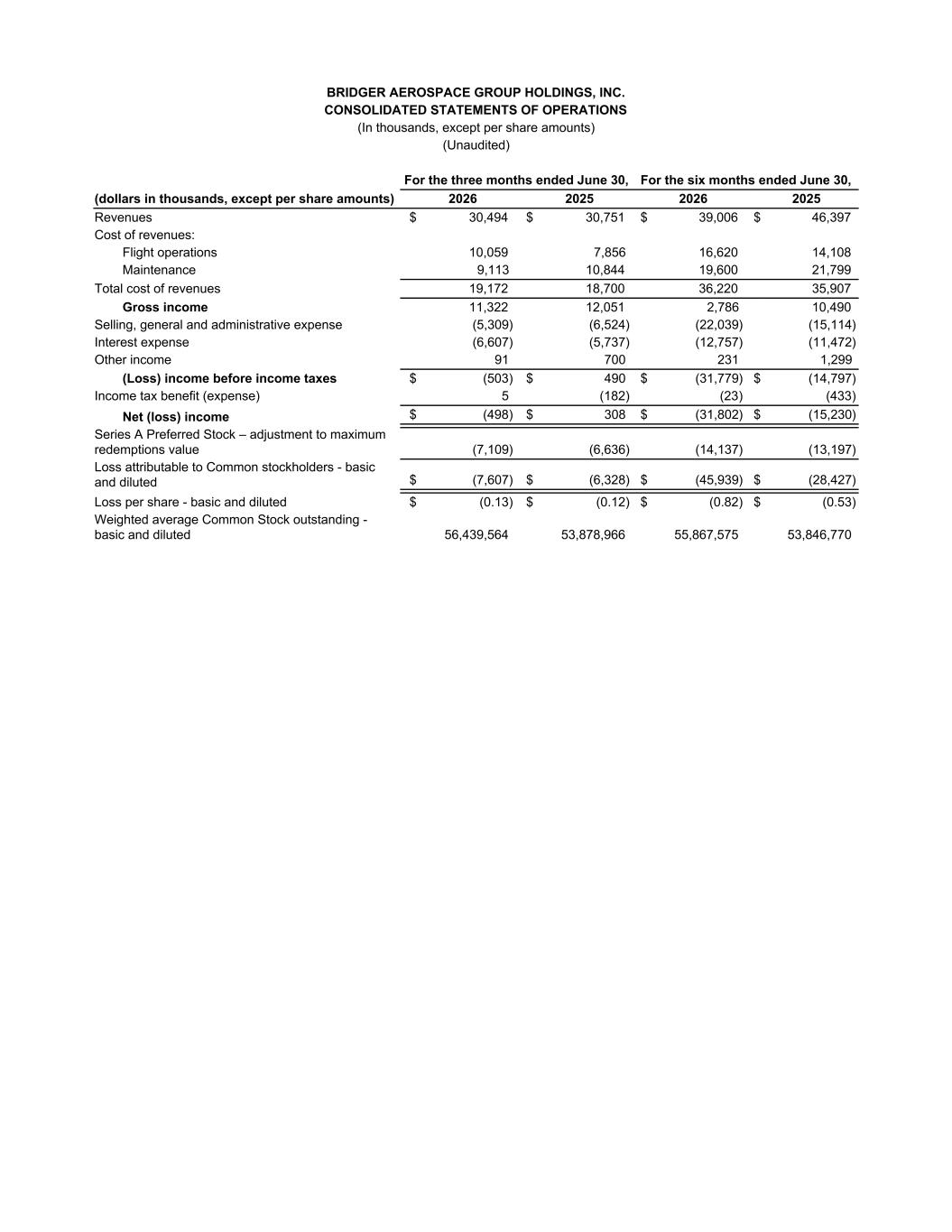
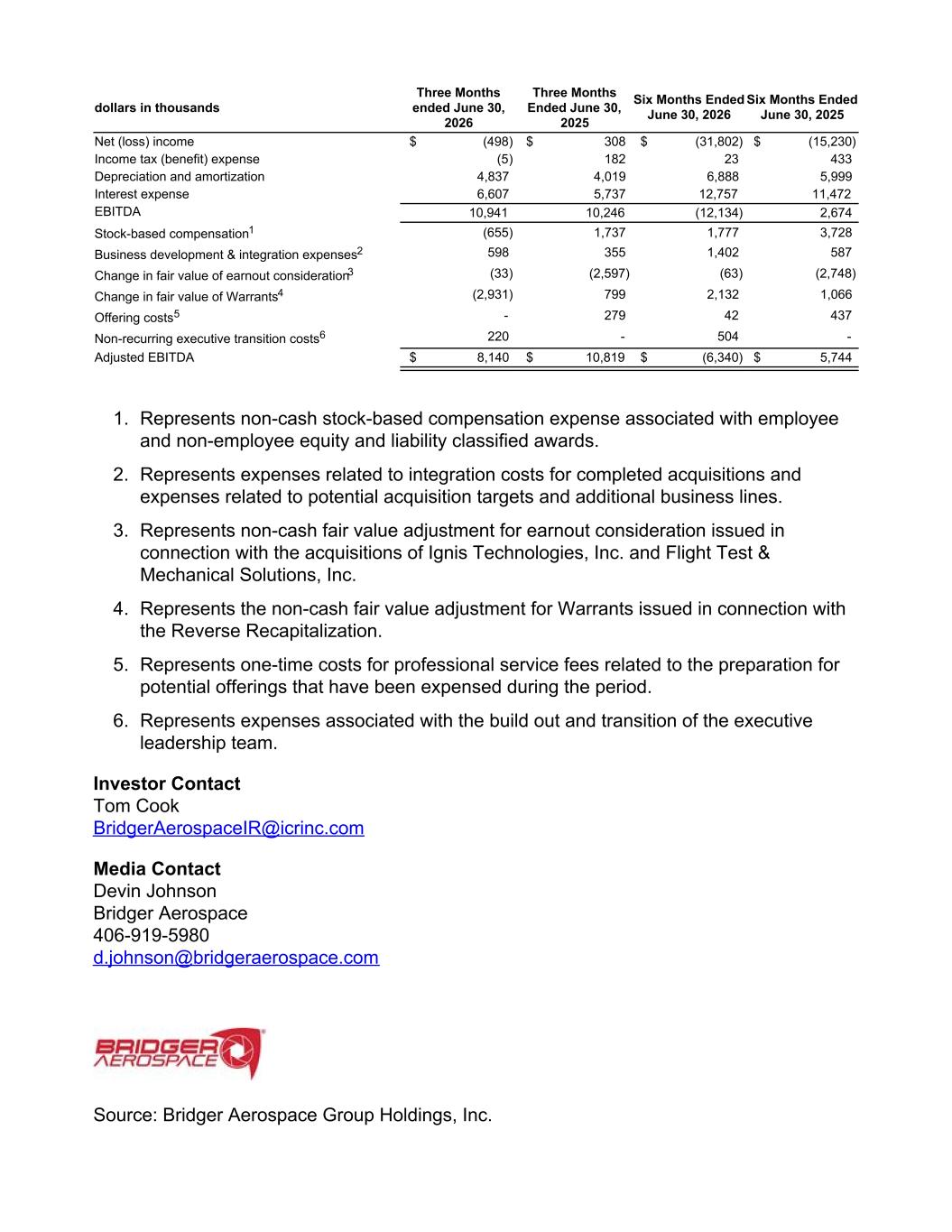
Please refer to our earnings release for the calculation of these measures and the appropriate gap reconciliation with that i'd like to turn the call over to sam thank you ann and welcome everyone as we entered 2026 our focus was on ensuring our fleet our technology and our people were fully prepared for what we believed would be another active wildfire year today just a few months later we're seeing that preparation translate into execution and i'm incredibly proud of the long hours and diligence the bridger team has shown throughout the year so far our second quarter financial results were in line with our expectations revenue was 30.5 million dollars essentially flat compared to the prior year period reflecting the timing of non-recurring return to service work on our spanish scoopers in 2025. excluding that impact revenue increased year over year which ann will walk through in more detail shortly first i'd like to start with an update on some of the highlights from the second quarter. During the quarter, the U.S. Forest Service awarded us two 160-day task orders covering four of our super scoopers, the longest guaranteed task orders in Bridger's history. These orders will activate on a staggered basis into October and November, reflecting the agency's anticipated need for wildfire suppression well into the fourth quarter. Longer contract durations like these improve our fleet utilization give us greater operational visibility and allow us to better plan maintenance and staffing and we believe they reflect a broader shift toward year-round wildfire preparedness among our government partners we also deployed our most advanced platform the king air 350 under a department of the interior task order this aircraft incorporates dual sensor capability and real-time data dissemination into a software As wildfire response becomes increasingly intelligence-driven, we believe these aircraft are becoming force multipliers, providing incident commanders with real-time situational awareness that improves proactive decision-making throughout an incident. Shortly after quarter end, we announced a $58 million contract with the Texas A&M Forest Service to acquire, modify, and deliver three King Air 360 multi-mission aircraft over the next three years. Texas is building one of the nation's most advanced state wildfire aviation programs, and we are proud to have been selected to help design and deliver that capability. This contract is a notable example of how our opportunity extends beyond simply operating aircraft into engineering, modification, and integrated intelligence work, and we believe it represents an attractive new avenue of non-seasonal, long-term growth. Also, following the quarter, we announced a collaboration with DaVinci's, Europe's leading provider of emergency aerial services, deploying our two newest super scoopers in Portugal. We are glad to support one of Europe's most demanding fire seasons in recent history. Commitments there came somewhat later than expected, but consistent with Europe's more cautious approach to long-term contracts with private operators. this has been more than offset however by the demand we're seeing here with our us-based super scoopers now let's turn to look at the fire conditions fire conditions today accelerated throughout the quarter with above normal activity across multiple regions of the west as of early august more than five and a half million acres of burn across the u.s while europe is experiencing one of its most severe wildfire seasons in years We are currently at a preparedness level of five, the highest level on a national scale, meaning firefighting resources nationally are fully committed. We've even seen international crews mobilize to support U.S. efforts, including more than 60 firefighters from Australia and New Zealand in recent weeks. Current drought conditions and long-range forecasts suggest this activity will continue, and we expect demand for our services to remain strong through the remainder of the season. Now, let me provide a quick update on IGNIS. Technology continues to be an important differentiator for Bridger. During the quarter, we expanded IGNIS through a strategic partnership with TrackPlus, integrating real-time aircraft tracking, mission information, and aerosuppression intelligence into a unified operating picture. Over time, we believe software and data will become an increasingly valuable complement to our aviation assets. these developments reinforce our conviction that bridger has an evolving integration into a solution that combines aerial suppression airborne intelligence engineering expertise and software not simply an aerial operator and we believe this diversification can help smooth our revenue and earnings visibility over the long term this provides a competitive edge to our aviation contracts increases our utilization while we're deployed and opens the door for standalone use of our software in the field while the second quarter reflects the seasonal ramp up of our business the underlying fundamentals remain strong with demand continuing to build and our fleet fully engaged we believe Bridger is well positioned and we remain focused on executing our mission with the utmost focus on safety and efficiency I'd like to thank our employees for their continued dedication and vigilance in the field and our government partners and shareholders for their continued trust and support with that i'll turn the call back over to ann to review our financial results for more detail thanks sam bridger continues to execute against significant growth opportunity and as the business scales we're focused on ensuring we have the financial infrastructure processes and discipline to support that growth over the long term as mentioned last quarter i
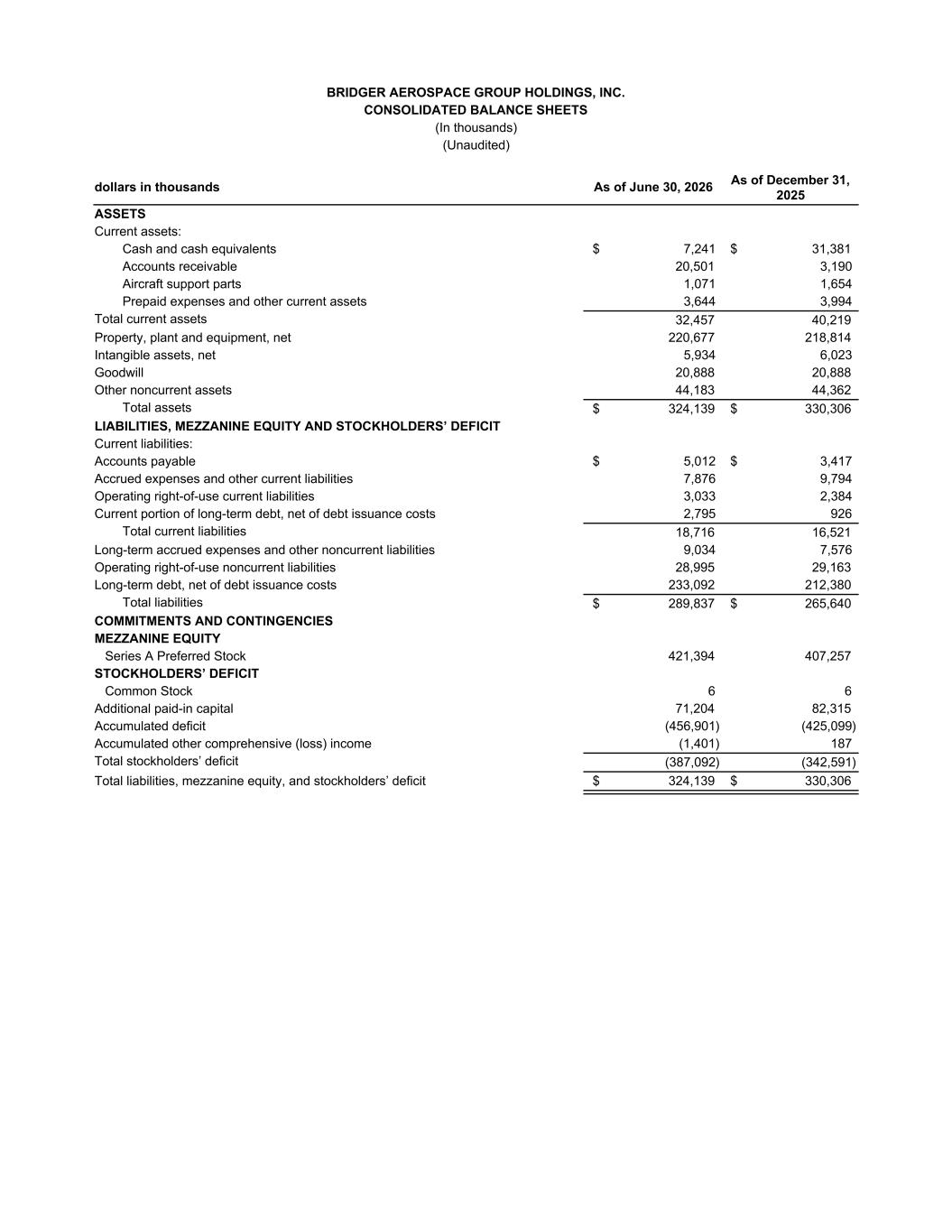
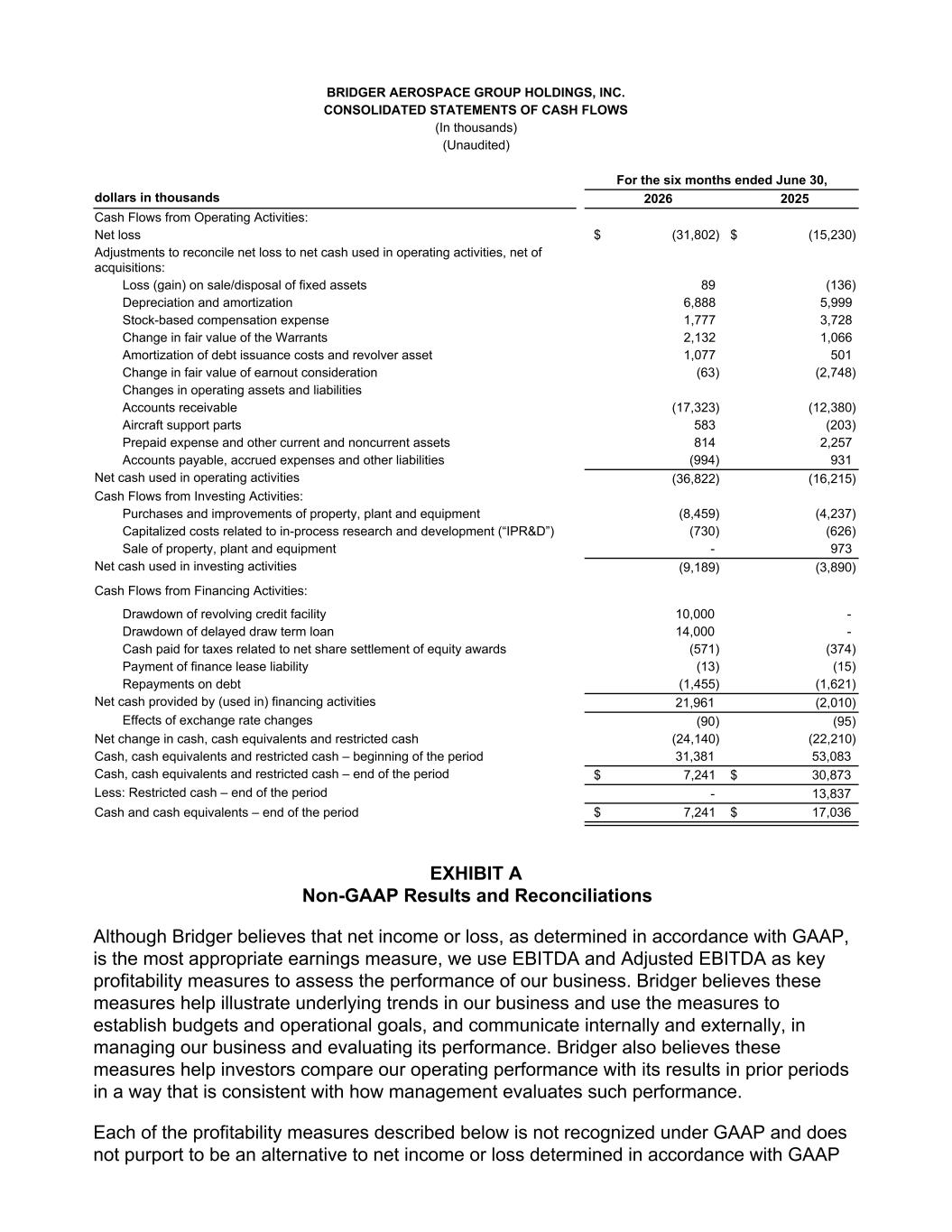
am focused on continuing to build and strengthen the finance function at the company and to support anticipated growth especially as we ramp up for new programs with new fleets with that let me walk through our second quarter results looking at our results for the second quarter of 2026 revenue was 30.5 million compared to 30.8 million in the second quarter of 2025. while revenue was generally consistent with the prior year period it's important to note that the prior year quarter benefited from $5.1 million of non-reoccurring return-to-service work on the Spanish super scoopers, which was mostly non-contributing to margin, compared to $0.8 million in the current quarter, a delta of $4.3 million. Excluding this non-reoccurring activity, revenue increased 16 percent year-over-year, primarily reflecting increased super scooper flight hours during the quarter and continued demand for our aerial firefighting services cost of revenues was 19.2 million compared to 18.7 million for the second quarter of 2025 when excluding the return to service work on the spanish scoopers cost of revenues increased 32 the increase primarily reflects the operating costs required to support increased fleet utilization during the quarter. It also captures fleet expansion, including sensor modifications to our two new King Air 350 aircraft and fleet readiness as we entered peak fire season towards the end of June. As a reminder, and given the continued volatility in fuel prices, I'd like to briefly touch on Bridger's exposure to fuel costs. Fuel expense is largely a pass-through cost across our portfolio. Under all of our Super Scooper fire suppression contracts, fuel is fully reimbursed by the customer while on contract. Across the majority of our light fixed-wing contracts, we either benefit from economic price adjustment mechanisms or fuel is similarly treated as a pass-through expense. As a result, fluctuations in fuel prices generally have limited impact to on-contract flying. Where we do see an impact is across support areas like airfare and other workforce travel and costs for our MRU or mobile repair unit diesel trucks that follow our fleet and act as on-the-ground repair stations when aircraft are not operating at night. Selling general and administrative expenses were 5.3 million compared to 6.5 million in the prior year period. The year-over-year decline was primarily driven by lower non-cash expenses, including changes in the fair value of warrants, stock-based compensation, and contingent consideration. Interest expense for the second quarter was 6.6 million compared to 5.7 million in the prior year period, reflecting an additional $25 million drawn for fleet expansion and $10 million in short-term borrowings on the credit facility revolver during heavy maintenance periods in Q1 and Q2. For the second quarter of 2026, we reported a net loss of $0.5 million compared to net income of $0.3 million in the prior year period. As a reminder, our reported earnings per share include the impact of the adjustment to the redemption value of our Series A preferred stock. Loss attributable to common stockholders was $7.6 million, or $0.13 per diluted share, compared to a loss of $6.3 million in the prior year period, or $0.12 per diluted share. Adjusted EBITDA was $8.1 million compared to $10.8 million in the second quarter of 2025, A reconciliation of adjusted EBITDA to net income is included in Exhibit A of the earnings release we issued today. Turning to the balance sheet, we ended the second quarter with $7.2 million of cash and cash equivalents, compared to $31.4 million at year-end 2025. The decrease primarily reflects seasonal working capital usage, including the timing of customer receipts strategic investment in aircraft production slots continued investment in modernizing our fleet with sensor and other technology capabilities capital expenditures and continued investment in fleet readiness to support peak fire season operations as expected the second quarter represents a period of elevated working capital investment as aircraft are deployed and operations ramp up during the peak fire season We continue to expect cash generation to improve as the fire season progresses and receivables convert to cash. We also continue to maintain significant financial flexibility through our credit facility, including a delayed draw feature of up to $100 million, which is designed to support future fleet expansion and capitalize on growing demand for our services. As of June 30th, we had approximately $75 million of remaining availability under the facility. Turning to our outlook, we are reiterating our full year 2026 guidance of $135 to $145 million in revenue and $55 to $60 million in adjusted EBITDA. This represents continued strong growth, including 29 percent growth in revenue when excluding non-reoccurring return to service work recognized in 2025 on the two Spanish scoopers. As Sam mentioned, our two Spanish scoopers are flying a shorter than planned summer fire season in Europe, after which we intend to reposition these aircraft to the U.S. for higher value opportunities. The third and fourth Spanish scoopers are still undergoing return to service work. We continue to expect improved operating cash flow generation over the course of the year, driven by increased fleet utilization and higher levels of fire activity during the peak season. As we expand our multi-mission fleet mid-year, we expect the sensor-enabled Air Attack Program to contribute to growth in 2026 and support attractive margin expansion in our fleet over time. With that, operator, we are now ready for questions.
Operator
Thank you. If you would like to ask a question, please press star 1 on your telephone keypad. To leave the queue at any time, press star 2. Once again, that is star 1 to ask a question. Our first question is from Austin Muller with Canaccord. Please go ahead. Your line is open.
Hi, good afternoon. You have the lease agreement in place for two scoopers with Portugal. Can you just talk about where we're at with European negotiations, just considering the catastrophic wildfire season there? And could those planes be moved to the USA in October if there's not further progress?
Hey, Austin, good to hear from you. Great question. Yeah, I'll just be candid the late uh pickup of those aircraft on contract is is just an indication of the hesitancy for europe to turn to private operators until you know things are developing like we see overseas right now um that is heavily influencing our decision given the demand we see in our u.s fleet for what happens to those aircraft as they finish their work there in portugal So we did partner with Avinci's to lease those to Avinci's as they operate them. So that was a great outcome for us, just later than anticipated. And we do think there will be continued talks with European countries based on the year they're having. And we think the success they'll see with having these two scoopers in Portugal. But for Bridger's internal purposes, we're planning on a move to the U.S. um without that commitment with the economics and demand we see here and if we think about next year and the overall fleet is the goal to lock up as many of your scoopers and mmas as possible into a 120 day or longer task order absolutely that's been a deep part of our strategy and we've chipped away at that methodically year after a year. This year, we look at eight of our nine surveillance aircraft on multi-year guaranteed commitments. We have four of our six here in the U.S. on guaranteed 160 days, and that's been a long and drawn-out process of improving that, so we continue to capitalize on that. And I will say, given the demand we see, the extensions into Q3 and Q4 with the Forest Service, the Department to the interior we now consider this to be the norm and something we can continue to move the baseline for the entire fleet we also see that the more those days are guaranteed the higher flight hours we see across the fleet because once we're committed and pre-positioned we're effective for flying in initial and direct attack and so those two things seem to be symbiotic in our utilization Great.
Operator
Thank you for your question. Our next question comes from John Sigmund with Stifle. Please go ahead. Your line is open.
Hey, good afternoon, guys. This is actually Sebastian Rivera on for John today. Apologies if I may have missed this in the opening remarks, but is there any portion of these recent contracts with Texas A&M, Avinci's and the DOI King Air 350 baked into this 2026 revenue guide?
Yes, I will say that for the Avinci's and for the King Air that we have at the Department of the Interior, we anticipated those and had those into our guidance. The Texas A&M, because that's a three-year program that starts more towards the end of this year, it's going to be a slow ramp up, but we don't think it will be impacting our guidance overall. So that's where we're reiterating what we have. The Texas contract is a delivery of three aircraft starting in 2028, actually, to the customer. And so over the next three years, we recognize milestones with most of those starting effectively in 2027, if that makes sense.
And then, yeah, and on that Texas contract, can you maybe just walk through the accounting treatment there, given it's a little bit different nature contract. Yes, I'll turn that. As far as rev recognition. Yeah, I'll turn that again.
Yeah, you're exactly right. So, this will be a different, you know, a different business for us. It's modification, so it's more of cost-to-cost accounting. That's why in 2026, the majority of the work will not be done until until 2027, we may, you know, we may place orders for the three king heirs from Textron and we may receive some cash payments. But as far as recognizing revenue, we anticipate, you know, it's preliminary to say, but very little to be in this year. And if so, it may not be margin generating revenue.
Speaker 5
Thanks. I'll turn it over. Thank you.
Operator
Thank you for your question. Our next question is from Mark Smith with Lake Street. Please go ahead. Your line is open.
Speaker 5
Hi, guys. I wanted to ask a little bit about the guidance here, kind of looking at what we've booked year-to-date in revenue versus reiterated guidance. Can you just walk us through kind of back half ramp, you know, what's already contracted versus kind of depended on fire activity and what gives you the confidence in holding the guidance range.
Hey Mark, good to hear from you. I'll take that and then I'll let Ann add a little bit of flavor. So going into this year, last year I'll remind you that we had a below average fire year in terms of overall activity and we saw some unique fire activity especially in Q1 with the Palisades fire that made our typical bell curve a little bit different than normal. And then activity kind of dropped off in terms of fires in September and October. This year, we saw a fairly normal ramp up, and we see the activity in Q3 now at an all-time high and continued outlooks into Q3. And the commitments that we have that are coupled with that from the Forest service and the doi going into q4 which we've never had is kind of the uh shift from a from a 1h you know to a 2h uh half of the year uh recognition of the bulk of our revenue um even more so than than maybe last year but um uh fairly typical with what we see in q3 being the bulk of revenue. And then kind of the last comment I'll make there is there could be a few days here or there or the fleet flying, you know, 30 hours in a day, which we've been seeing across the scooper fleet that could really move the needle a few million bucks, whether it's June 30th or July 1st, that we've kind of see that take effect as things got ramped up. And maybe last comment there, we've also seen a little bit of a strategy with their agencies as they've committed later into Q3 and Q4 to making sure that our assets are set for the peak of the season. So as we got deployed, we noticed a little bit of a staggered deployment so that they had the last half of the year covered for fire activity.
Speaker 5
And then just as we think about revenue coming out of Europe with this new contract in Portugal, can you give us any more insight into maybe how much of an impact that this makes and maybe how much was, you know, maybe disappointing on a late start to that contract?
You know, I can speak to it at a high level. I will tell you there's two components to this lease. We are leasing, you know, not by month but also by hours and, you know, as we've seen even the headlines from Europe hitting over here that they are having a very active fire season. So there is a variability to that contract as well. So I can't, you know, I can't say for sure how much we will make up. I, you know, I can say that we did miss in Q2, you know, in our internal estimates, just when we thought Europe would pick up, you know, kind of what Sam has said, though, between the U.S. flying more than, you know, a fire season like last year, as well as Europe, you know, potentially flying these harder than we we are anticipating now, there is room to, you know, make up all of that gap that we have and then some.
Speaker 5
Okay. And then I did just want to confirm, it sounds like the plan is still to roll these two planes into the U.S. after the season's done.
Yeah, that's currently the plan, Mark. Obviously, we have to um see what materializes overseas especially uh what we hope is the the commitment is now there for unfortunately the terrible headlines we see um on the activity but i will i will tell you with the economics and the utilization demand here in the u.s uh until that commitment materializes in a in a like for like comparison the plan is to finish out the fire season and begin to move those over to the U.S.
Speaker 5
Thank you, guys. Thanks, Mark.
Operator
Thank you for your question. At this time, there are no further questions. I will now turn the call back to Sam Davis for closing comments.
Thank you again for joining us today and your interest in Bridger. Please reach out to our investor relation team with any questions, and we'll be participating in a fireside chat at the Canaccord Growth Conference in Boston next week for any interested investors. Have a great Thank you.
Operator
This brings us to the end of today's meeting. We appreciate your time and participation. You may now disconnect.