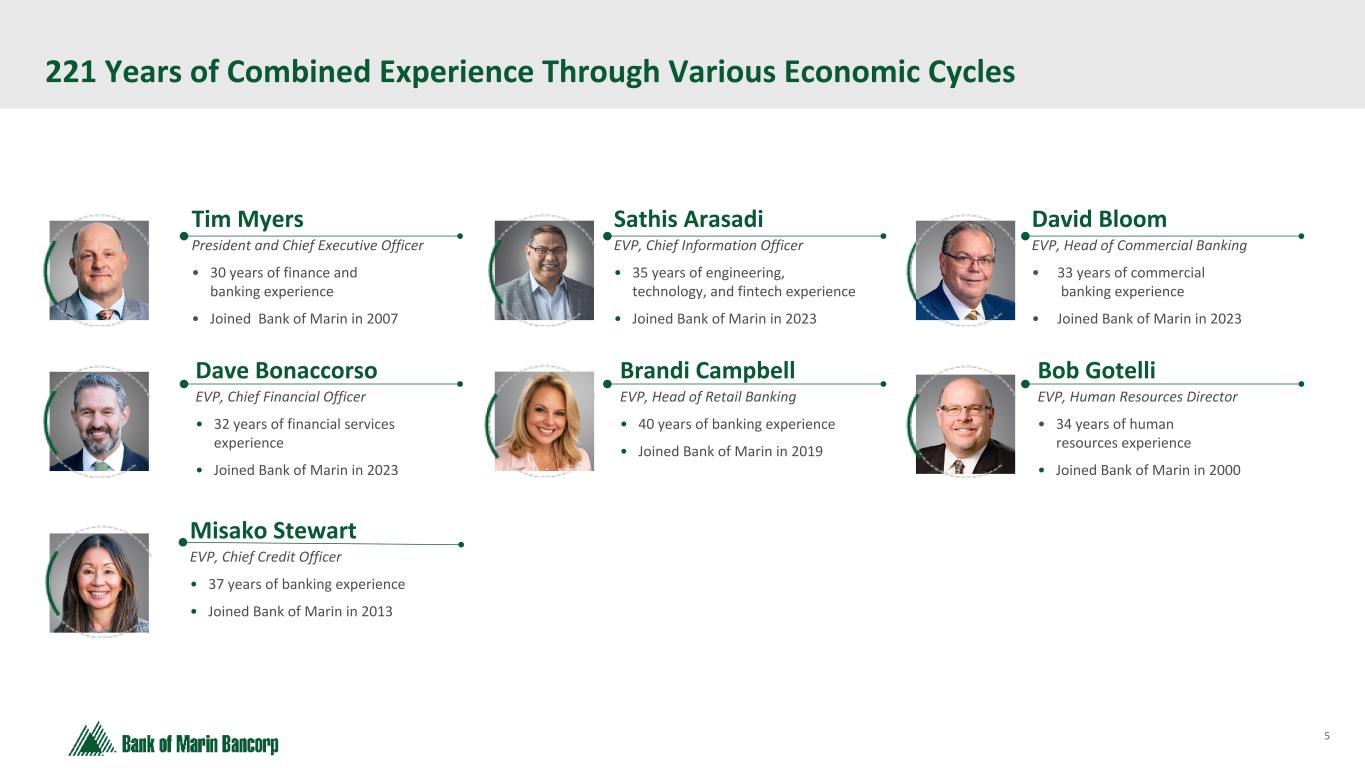
Good morning, and thank you for joining Bank of Marin Bancorp's earnings call for the second quarter and June 30, 2026. I am Chrissy Meyer, Corporate Secretary for Bank of Marin Bancorp. During the presentation, all participants will be in a listen-only mode. After the call, we will conduct a question-and-answer session. Joining us on the call today are Bank of Marin President and CEO, Tim Myers, and Chief Financial Officer, Dave Bonacorso. Our earnings news release and supplementary presentation, which were issued this morning, can be found in the Investor Relations section of our website at bankofmarin.com, where this call is also being webcast. Closed captioning is available during the live webcast, as well as on the webcast replay. Before we get started, I want to note that we will be discussing some non-GAAP financial Please refer to the reconciliation table in our earnings news release for both GAAP and non-GAAP measures. Additionally, the discussion on the call is based on information we knew as of Friday, July 24, 2026, and may contain forward-looking statements that involve risks and uncertainties. Actual results may differ materially from those set forth in such statements. For a discussion on these risks and uncertainties, please review the forward-looking statement's disclosure and our earnings news release, as well as our SEC filings. Following our prepared remarks, Tim, Dave, and our Chief Credit Officer, Nisalko Stewart, will be available to answer your questions. And now I'd like to turn the call over to Tim Myers.
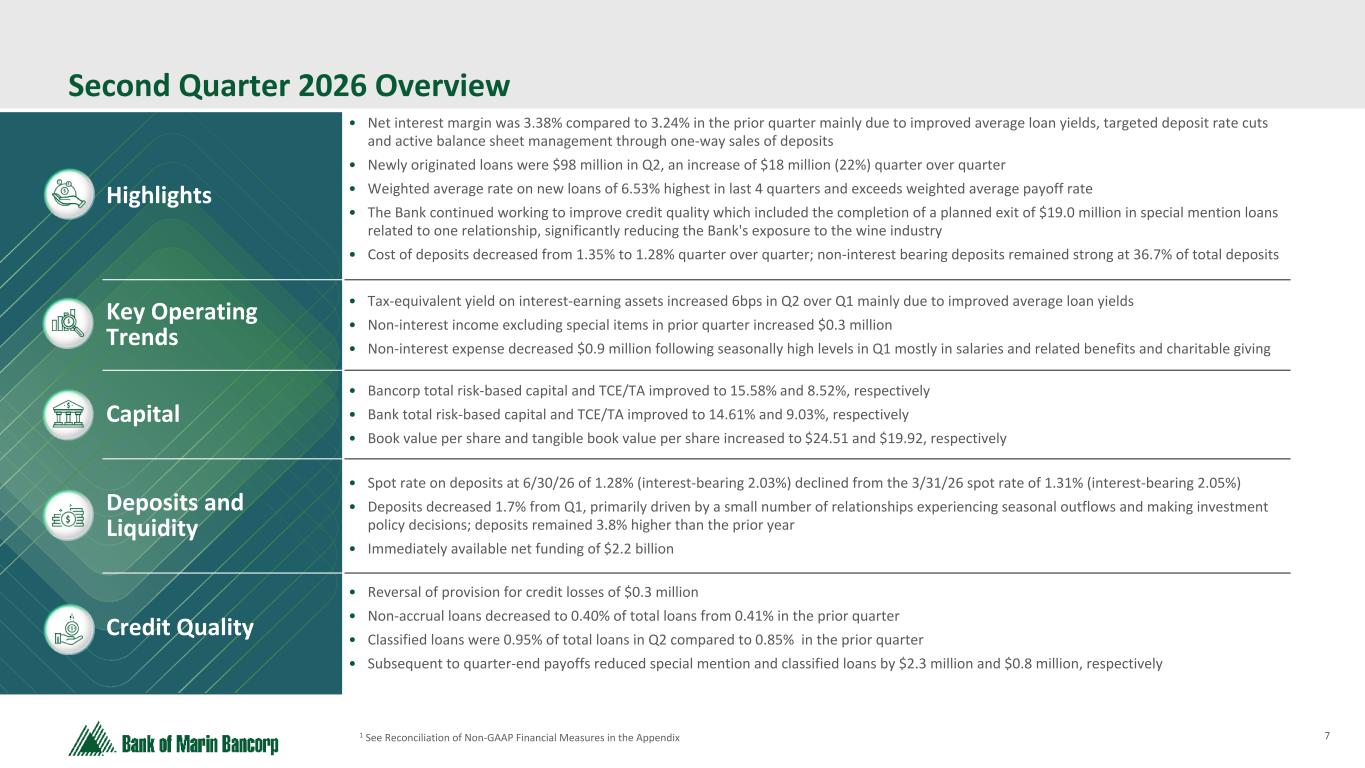
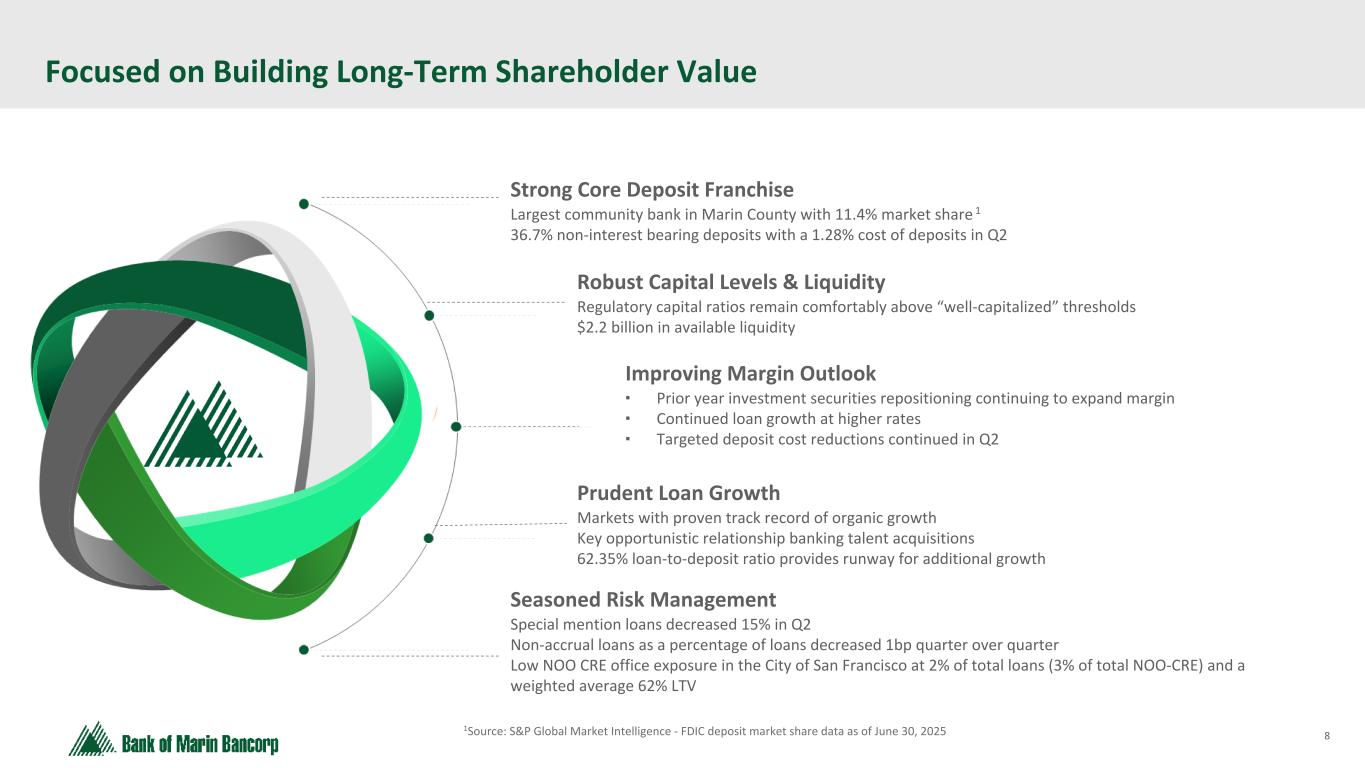
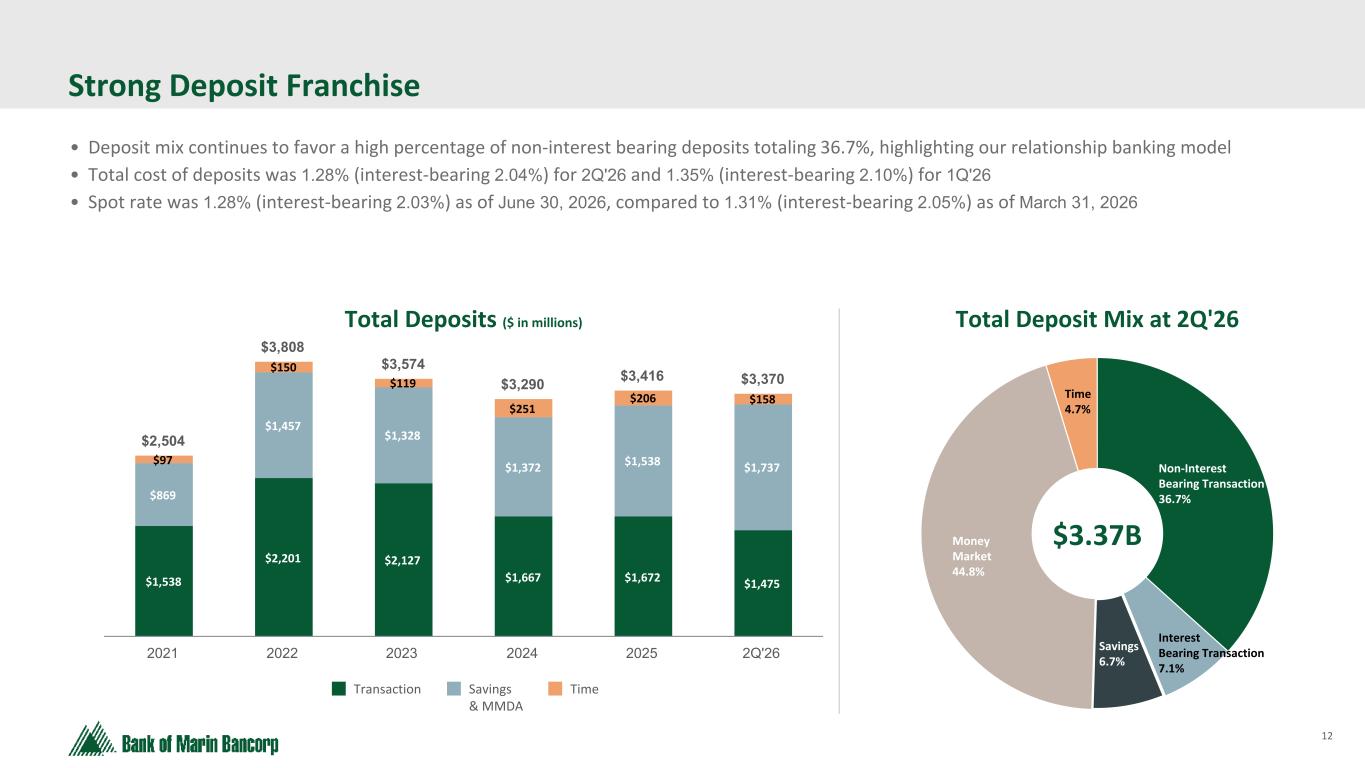
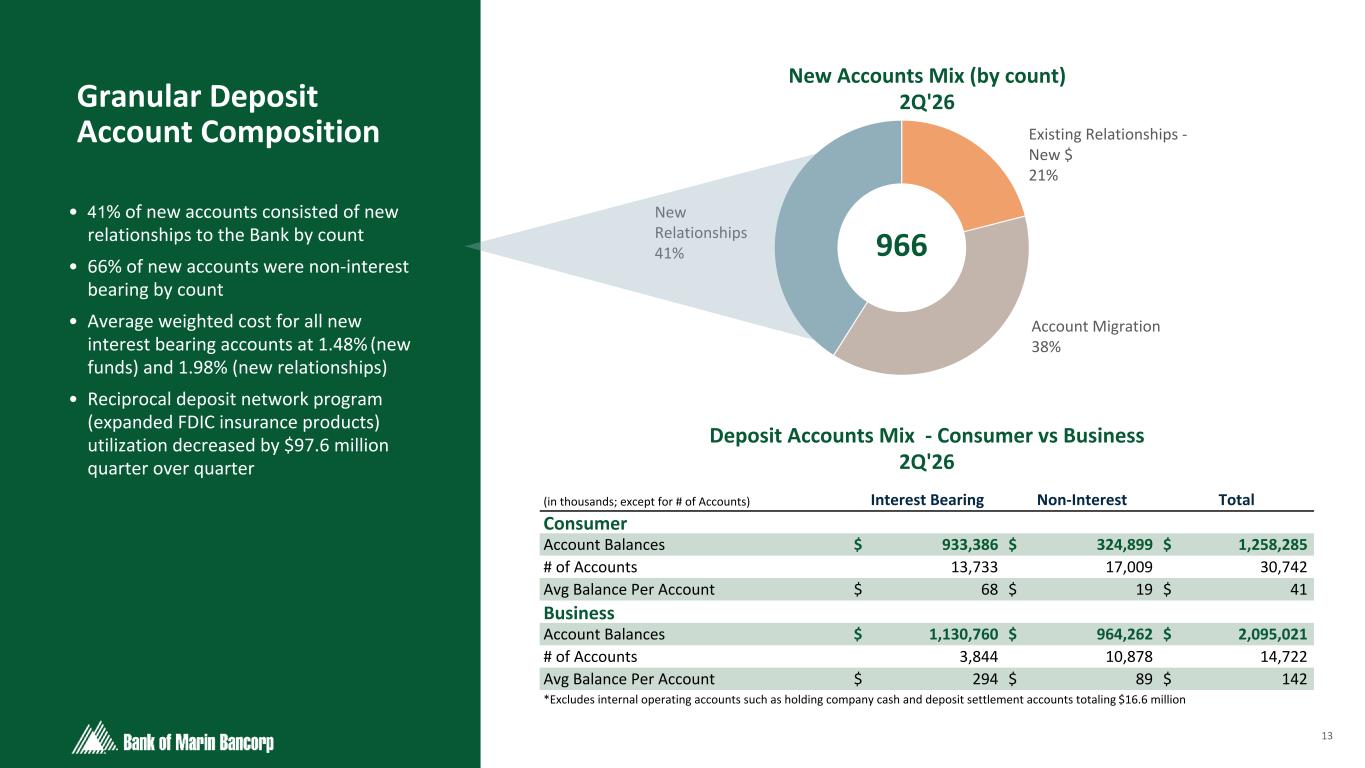
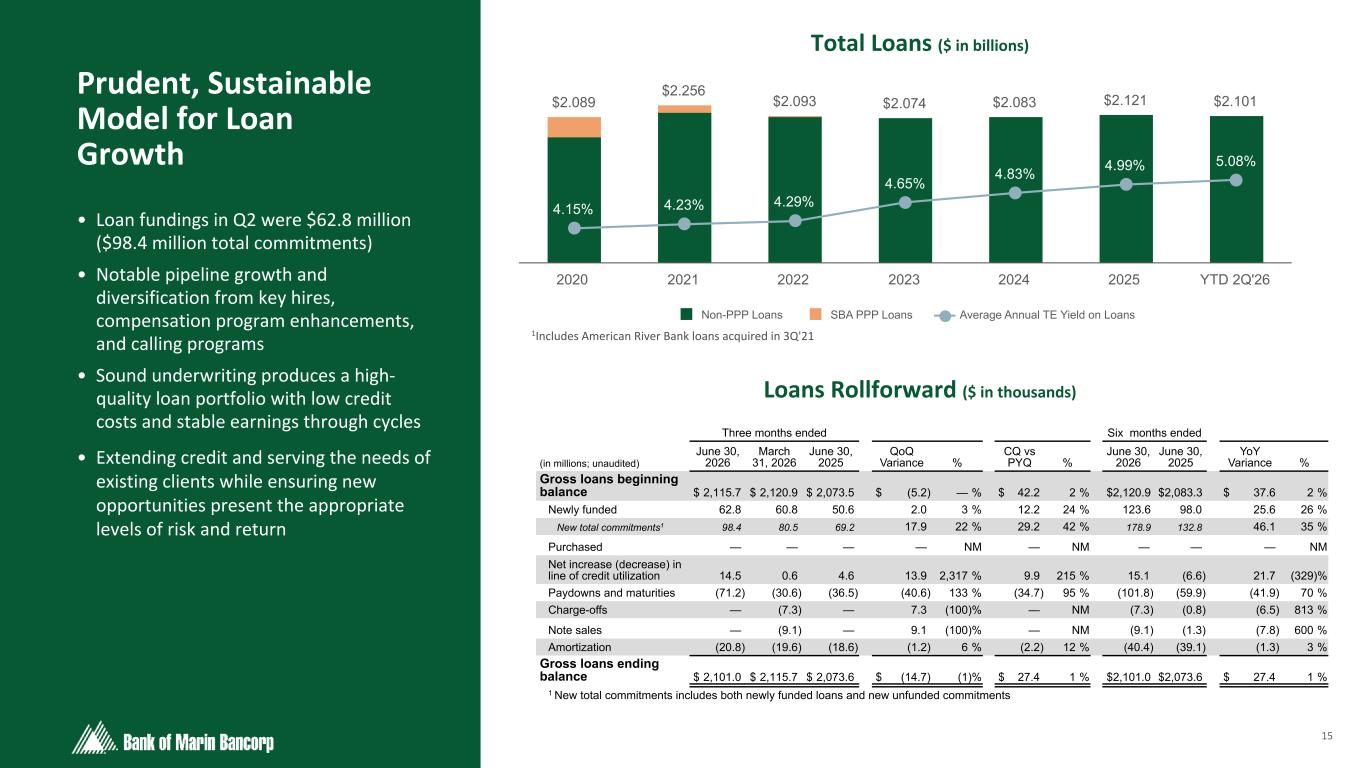
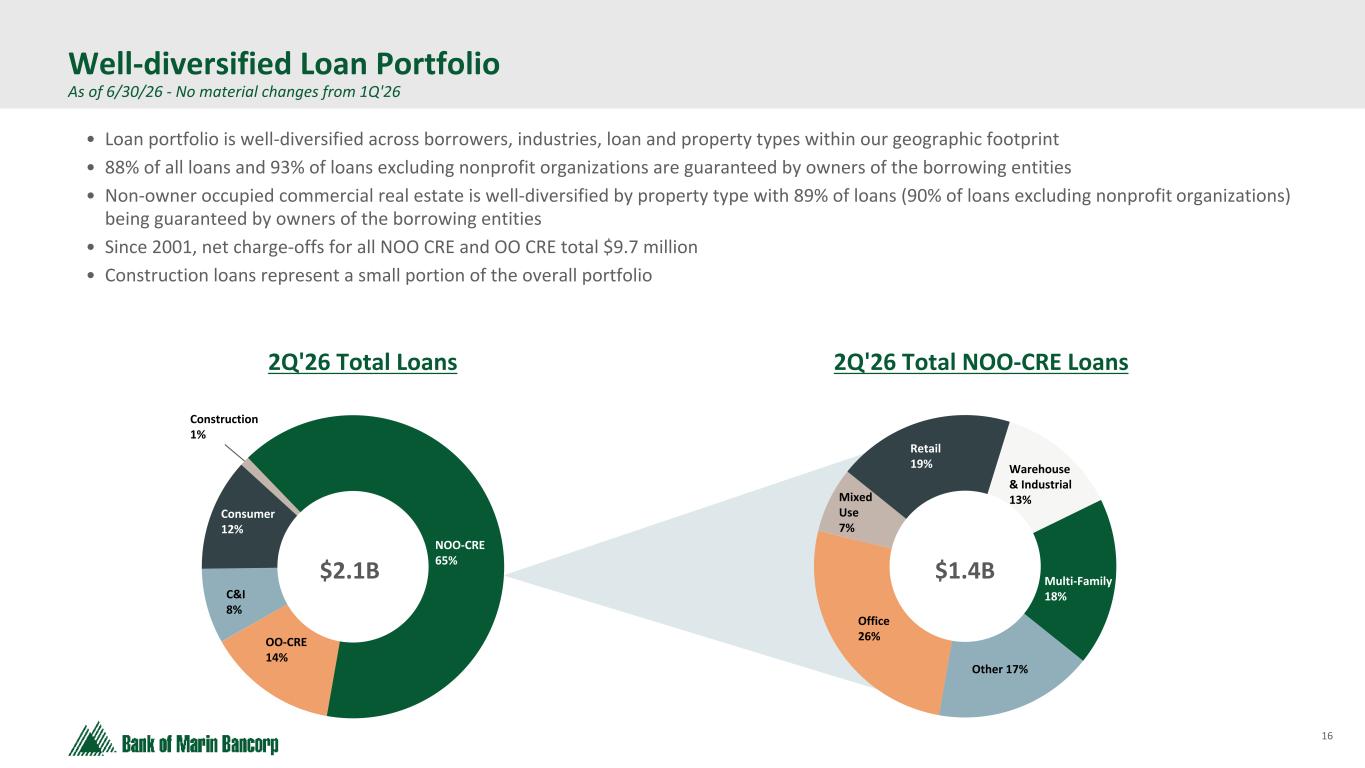
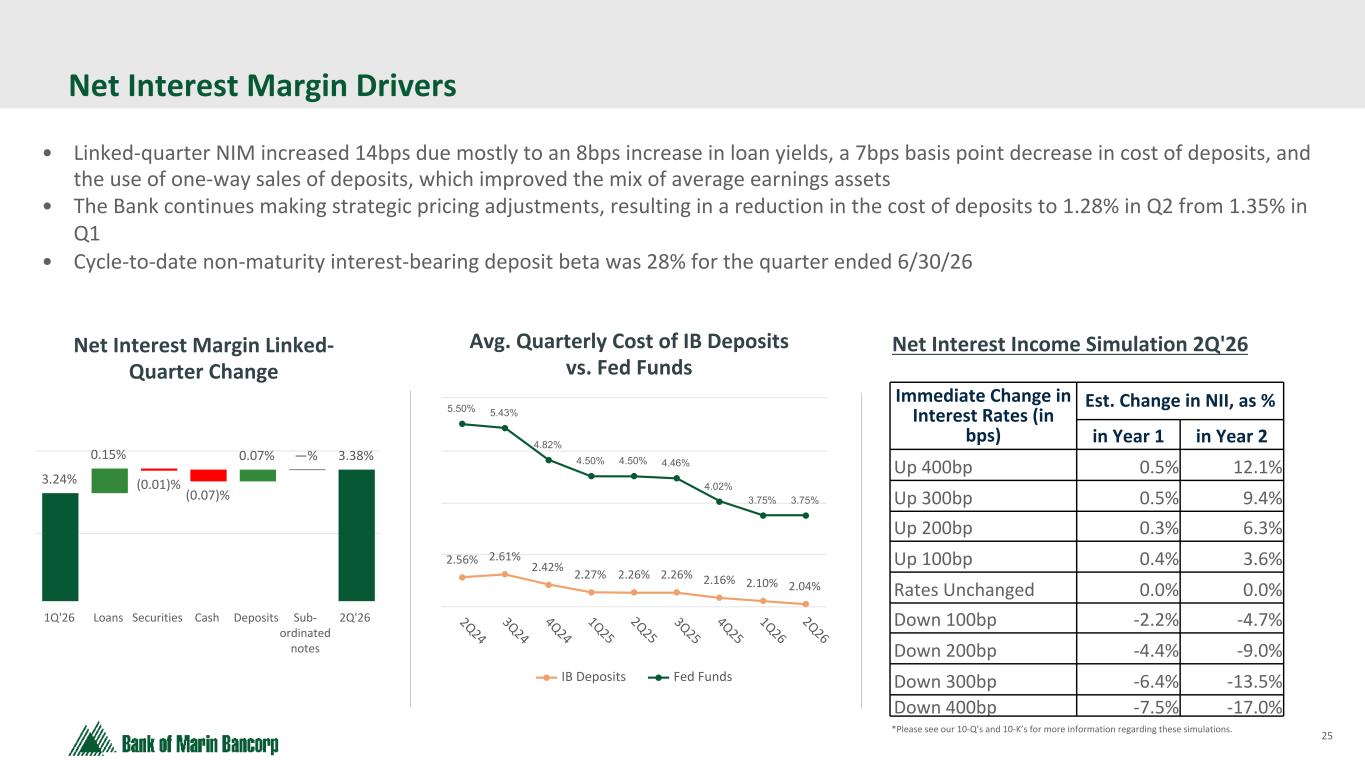
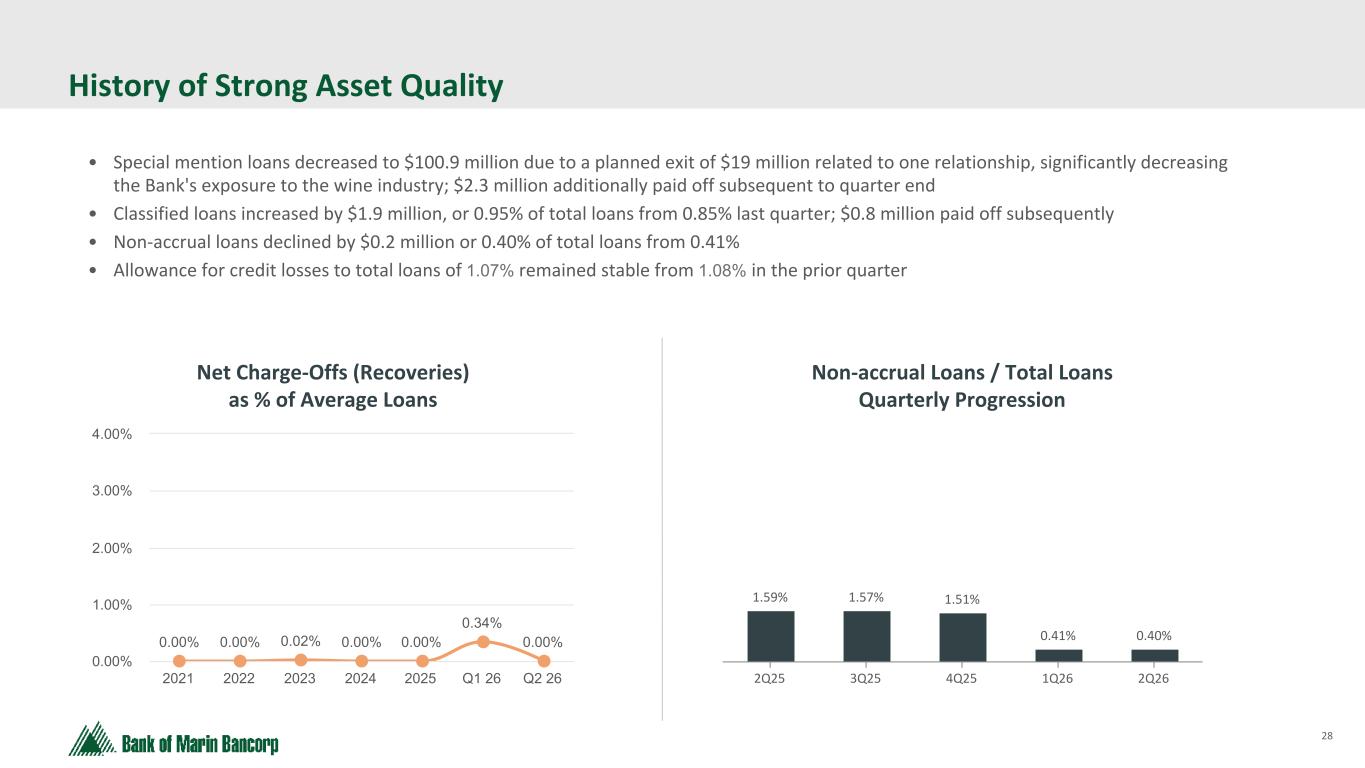
Thank you, Chrissy. Good morning, everyone, and welcome to our quarterly earnings call. Our second quarter results reflected another quarter of improving financial performance, increasing profitability, and enhanced earnings power for Bancomer and Bancorp. We expanded net interest margin, reduced funding costs, improved operating profitability, further reduced credit risk, and strengthened capital, all while continuing to build the client relationships and platform that support long-term sustainable growth. As a result of our efforts, net income and earnings per share nearly doubled compared to the second quarter of 2025. Our tax equivalent net interest margin expanded 14 basis points to 3.38%, reflecting improved loan yields, targeted deposit rate cuts, and disciplined balance sheet management. These results demonstrate that the platform we have been building is translating into improved profitability and increasing operating leverage. We are now focused on translating improving loan production, relationship growth, disciplined deposit management, and continued proactive credit management into durable earnings power over time. During the quarter, we originated $98 million in new loan commitments, of which $63 million funded, a 23% increase over the prior year's period. This reflects the continued efforts of our commercial banking team and our focus on relationship-driven and growth across existing and newer markets, including the greater Sacramento area. To support this momentum, we continue to invest in talent and key markets, adding a regional manager to oversee our East Bay commercial banking offices and expanding our commercial banking team in San Francisco. At the same time, period and loan balances declined modestly in the quarter to $2.1 billion dollars, due primarily to elevated payoff activity, including the planned exit of a $19 million criticized relationship. While this payoff was an important de-risking action, it offset positive production trends. Importantly, the yield profile of new production remains attractive, and we believe this healthy production, continued relationship development, and disciplined underwriting will continue to translate into sustainable balance sheet growth over time. Credit quality continued to improve as special-mentioned loans declined meaningfully following the planned exit of the previously mentioned $19 million relationship. Non-accrual loans declined from 0.41% of total loans to 0.4%. Net charge offs were minimal, and we recorded a $320,000 reversal of provisions for credit losses. Our allowance for credit losses remained stable and sufficient at 1.07% of total loans. On deposits, total balances declined at $58.2 million in the second quarter. The decrease was primarily attributable to a small number of relationships and reflected seasonal customer activity and investment policy decisions, rather than any underlying shift in deposit trends. Deposits remained near their strongest levels in recent years and were up nearly 4% from prior year quarter. While deposit pricing and structure remain competitive, our balanced approach to relationship management and our focused outreach to customers seeking alternative banking solutions continue to generate strong new client activity. We added nearly 1,000 new accounts during the quarter, of which 41% came from new relationships. Our relationship banking approach, combined with disciplined pricing, enabled us to reduce our average cost of total deposits to 1.28% in the quarter. Overall, the second quarter showed that we are building momentum across the areas that matter most. stronger earnings, a wider margin, reduced credit risk, and a stronger capital base. With that, I'll turn the call over to Dave Bonacorso to discuss our financial results in more detail.
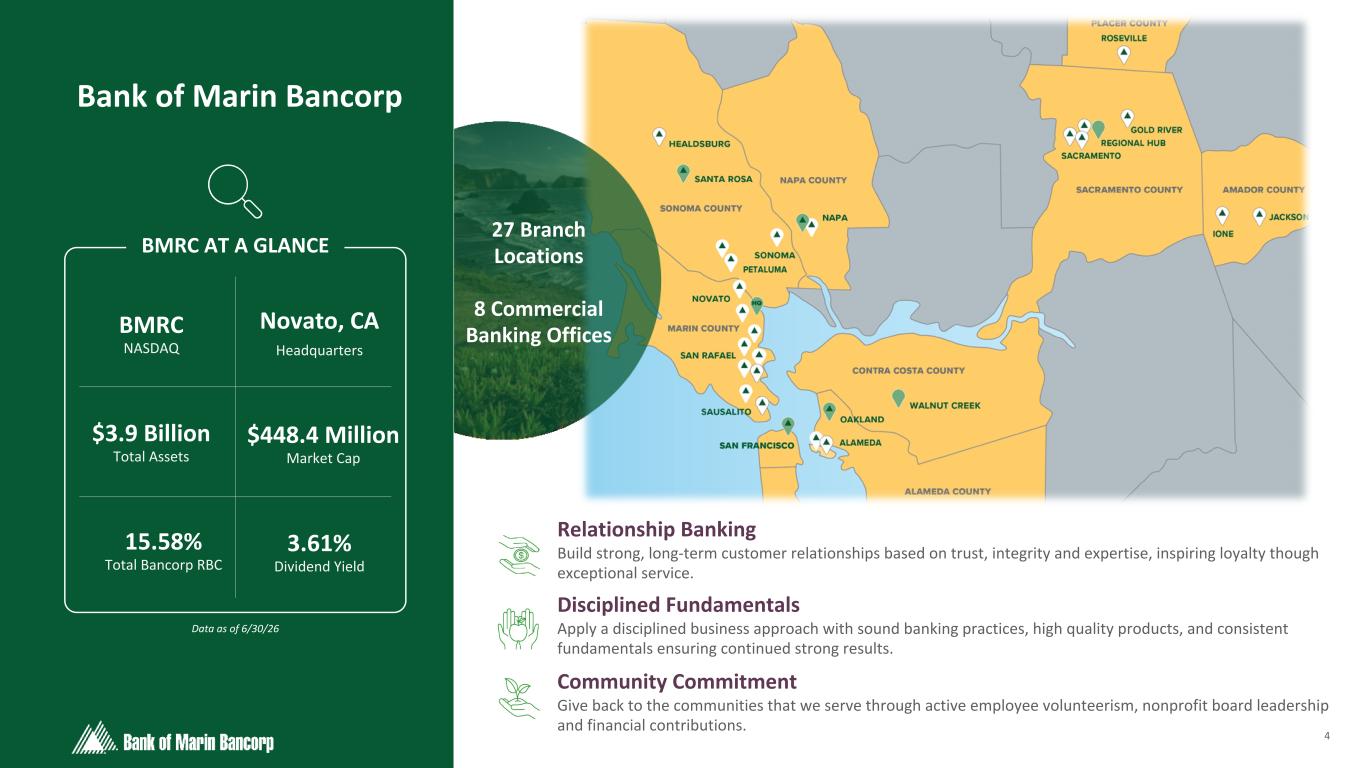
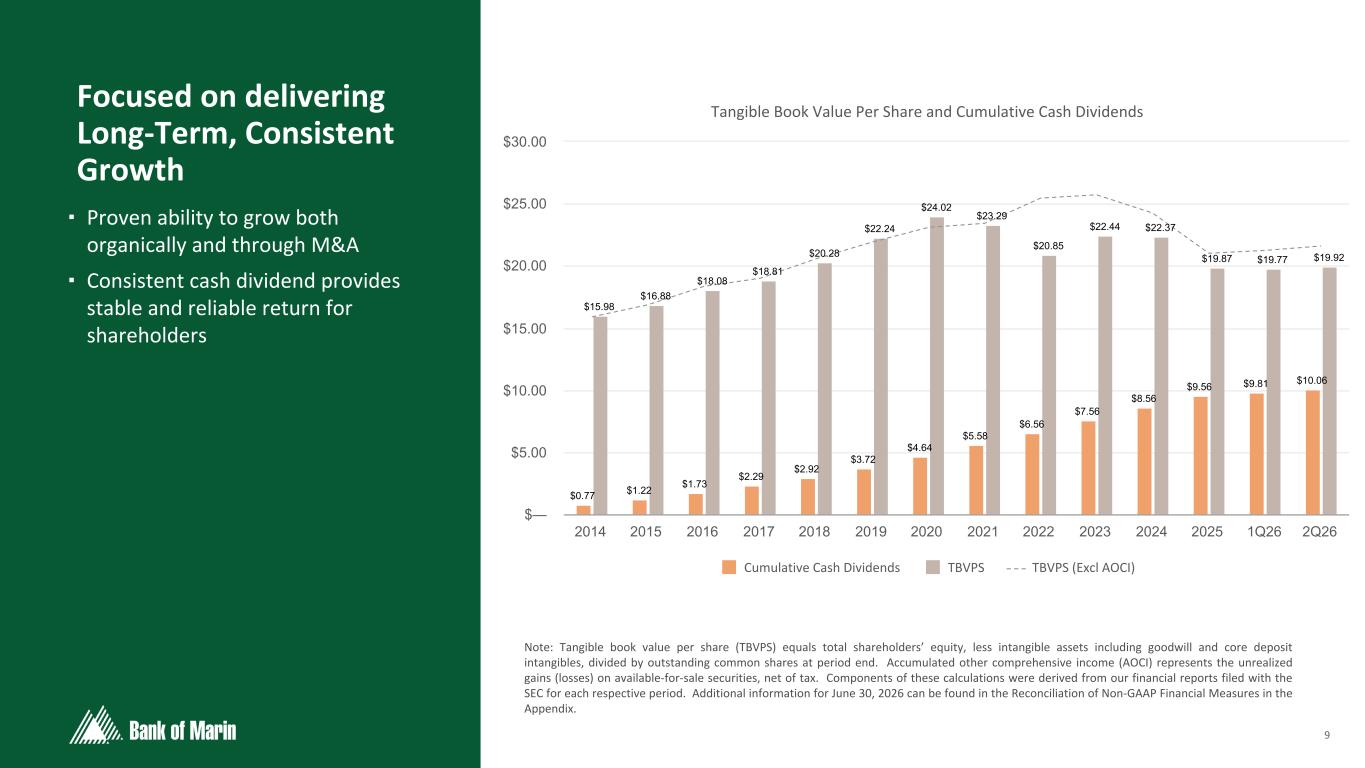
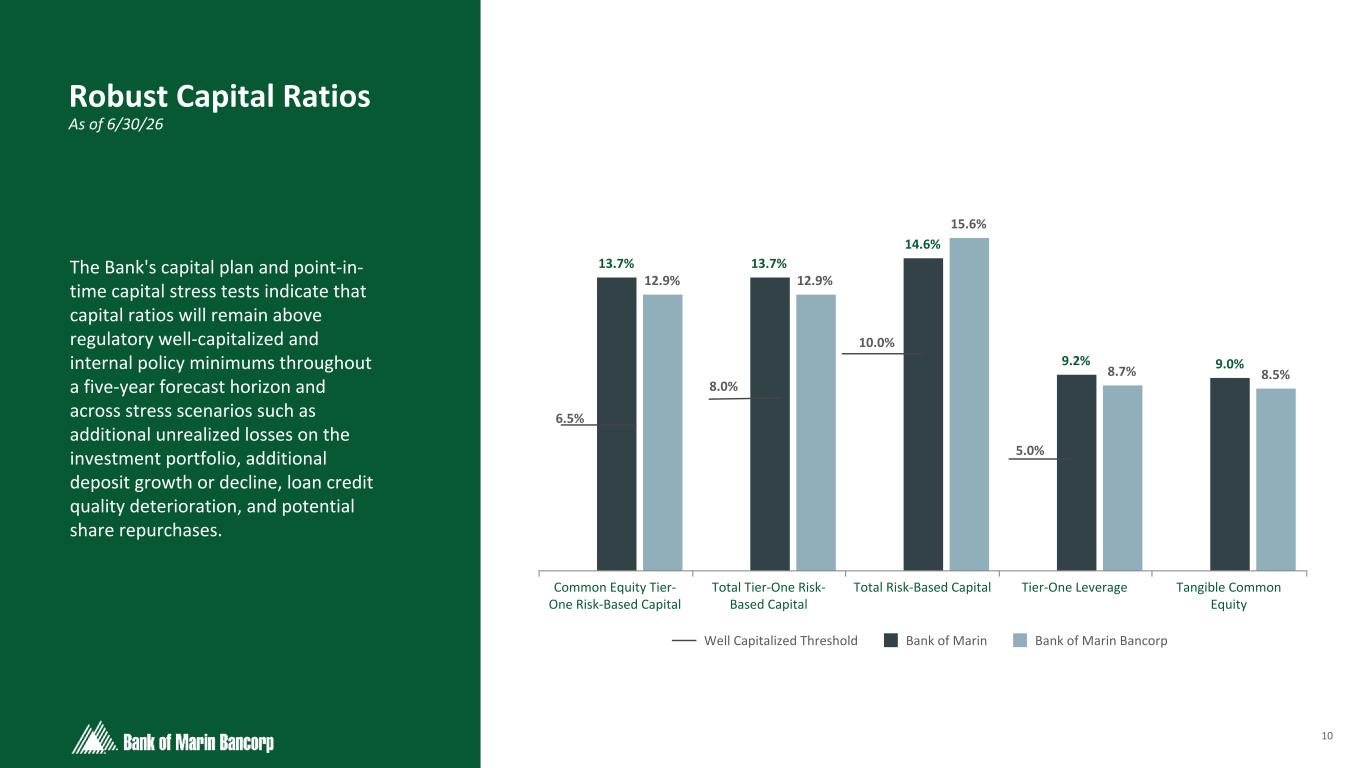
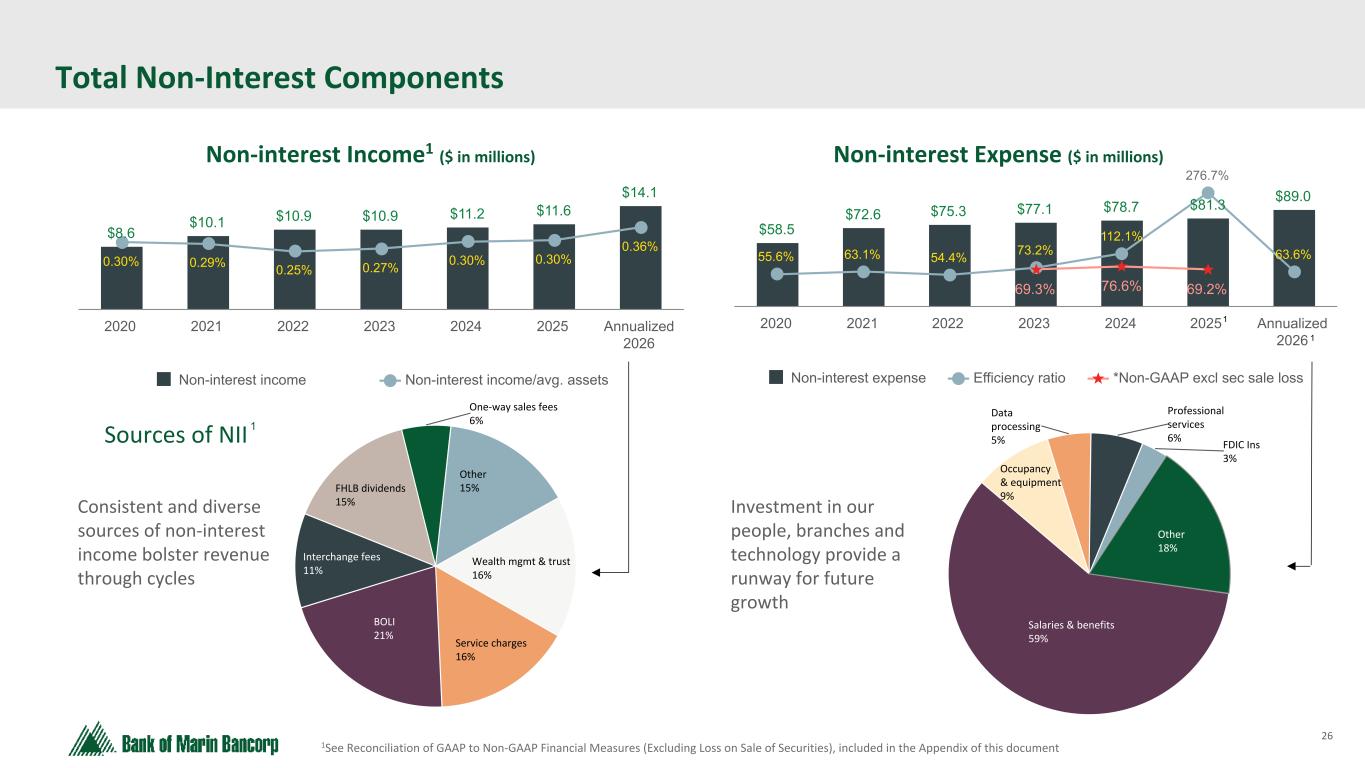
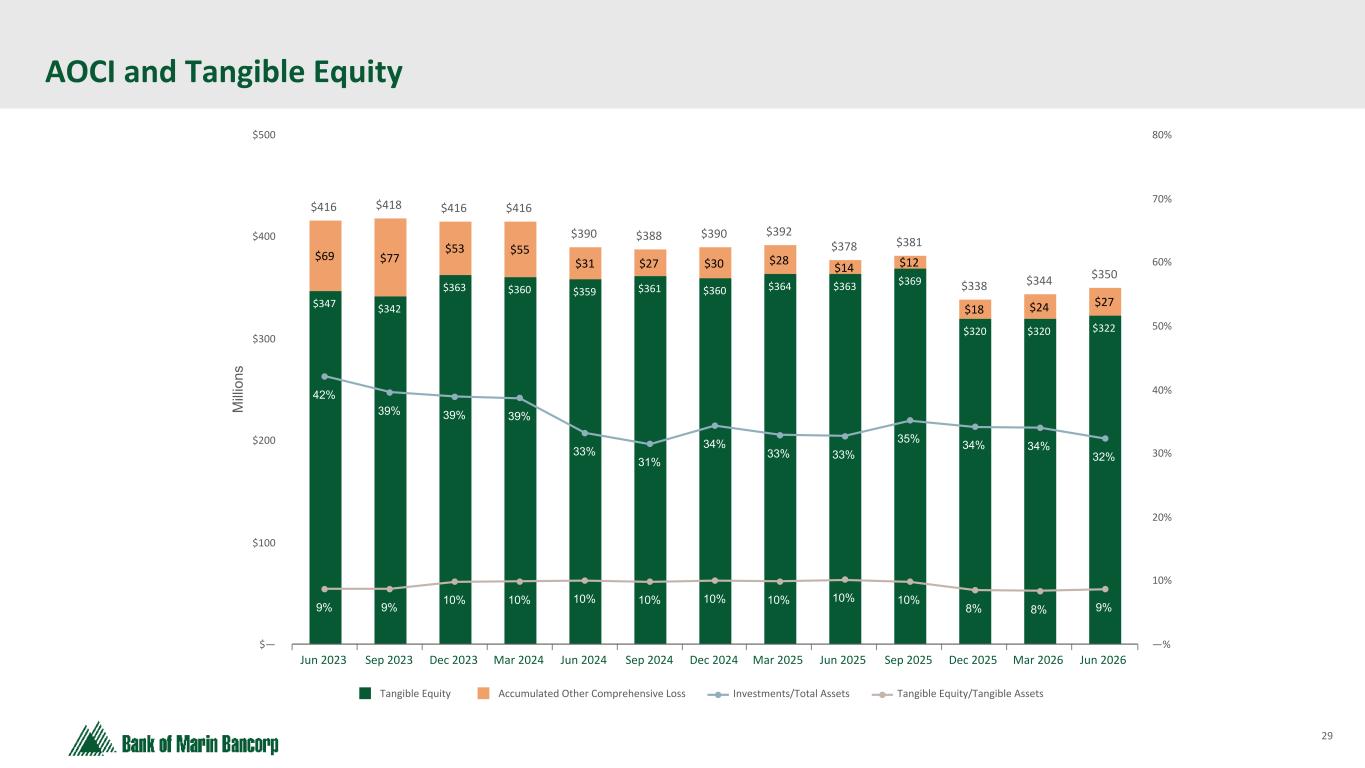
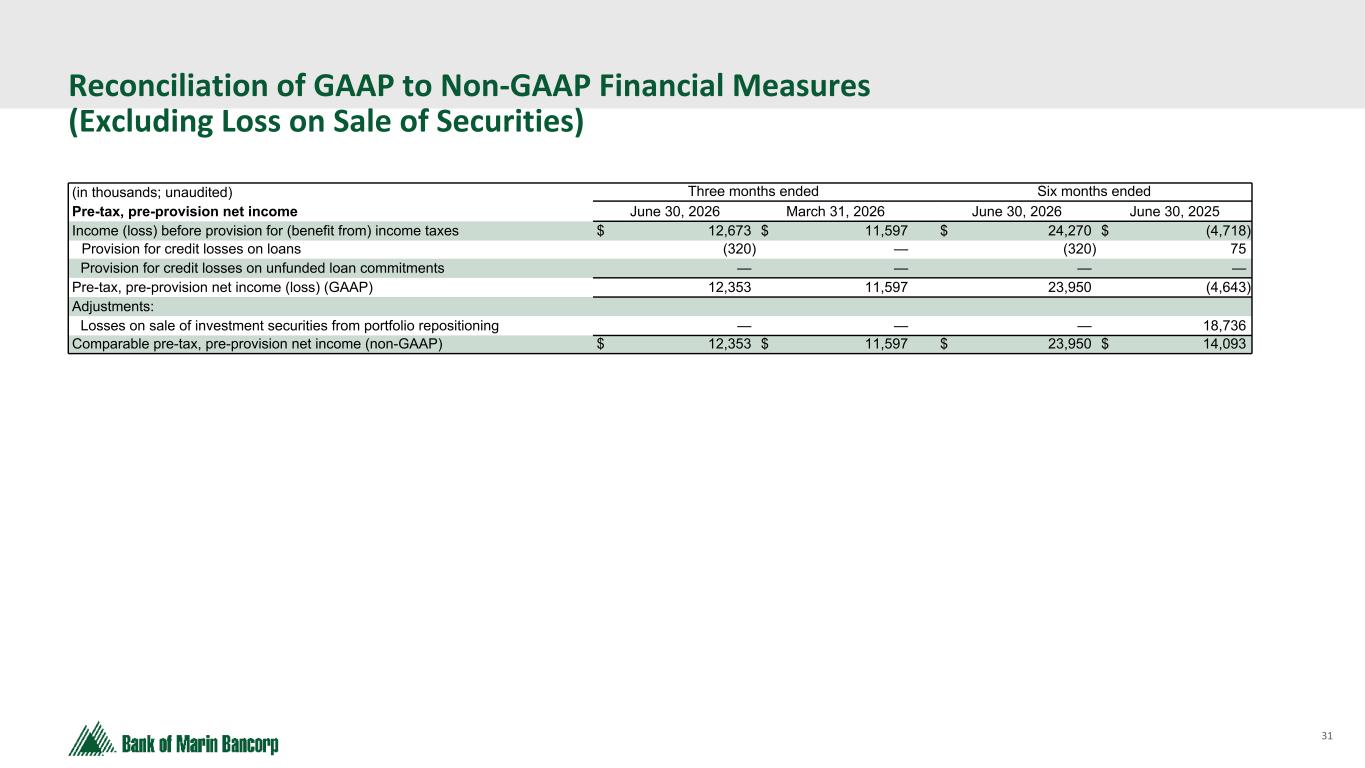
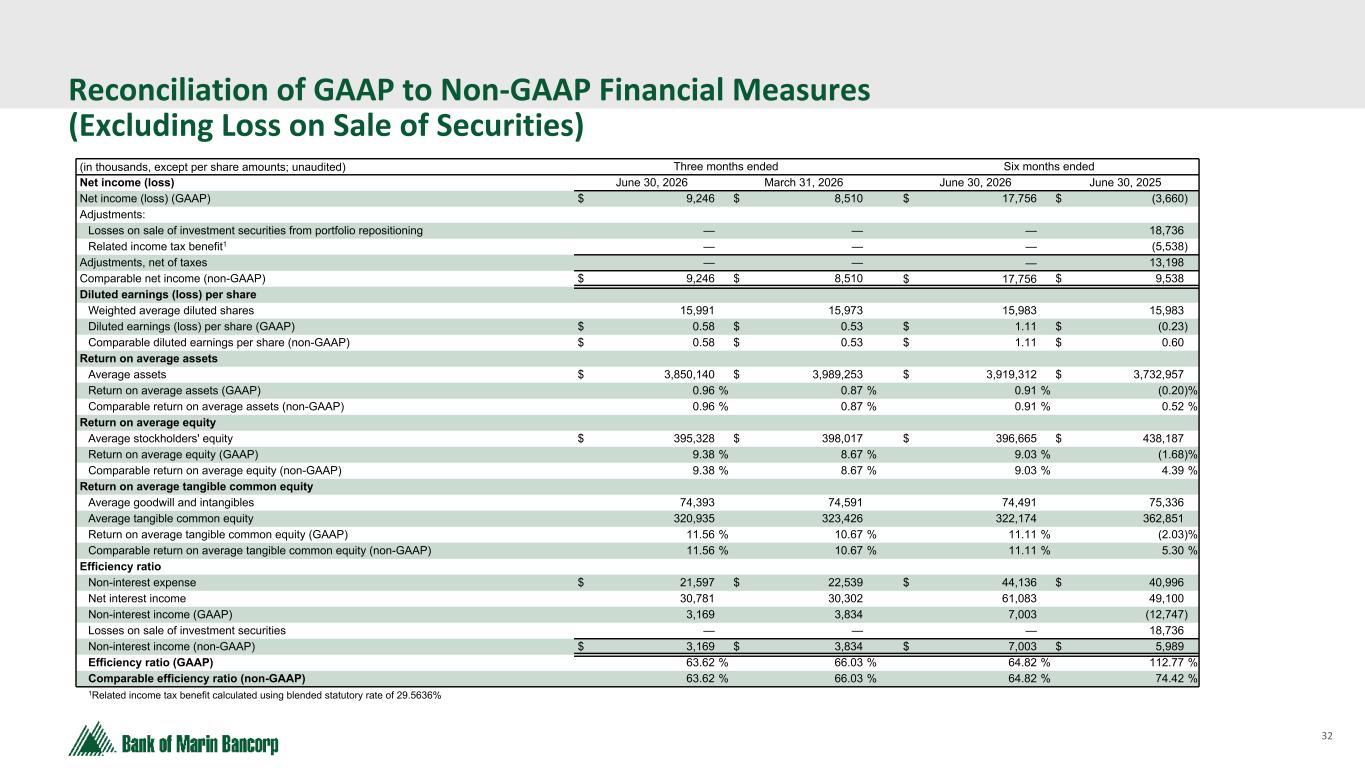
Thanks, Tim. Good morning, everyone. Our second quarter net income was $9.2 million, or $0.58 per share, compared with prior quarter net income of $8.5 million, or $0.53 per share. Return on average assets increased to 0.96%. Return on average tangible common equity grew to 11.6%, and our efficiency ratio improved to 63.6%. Our net interest income increased from the prior quarter to $30.8 million, driven by higher interest income on loans due to an increase in yields and lower interest expense on deposits. Our yield on new loan fundings increased to 6.53% during the second quarter, which was a 62 basis point improvement over the prior quarter. We continued to make targeted cuts in deposit rates, which resulted in a 7 basis point decline in our quarterly cost of deposits and a 3 basis point decline in our spot cost of deposits from March 31st to June 30th. Our non-interest income was down by $665,000 during the quarter, almost all of which was attributable to a decrease in dividend income on FHLP stock, including a special dividend, as well as bowling death benefits received in the first quarter that were not repeated in the second. Setting aside these special items, non-interest income increased by $293,000, a portion of which is attributable to fees earned on one-way sales of deposits as part of our active balance sheet management strategy. In addition to growing non-interest income, these one-way sales lowered our quarterly cost of deposits and contributed to our 14 basis point expansion in net interest margin. As we expected, our non-interest expense improved by $942,000 during the second quarter, following last quarter's elevated seasonal levels and salaries and related benefits, as well as charitable contributions. For the second half of 2026, we expect non-interest expense to continue near the first half of 2026 pace as we invest in people and technology, which we believe will fuel our growth and ultimately drive shareholder returns. As Tim mentioned, we recorded a reversal of the provision for credit losses on loans of $320,000 during the quarter, and our allowance for credit losses remained stable in 1.07% of total loans. We strengthened our capital position during the quarter. Our tangible common equity ratio increased 19 basis points to 8.52%, and our total capital ratio increased 32 basis points to 15.58%. Our Tier 1 leverage ratio increased 43 basis points to 8.66%, and our tangible book value per share increased $0.15 to $19.92. Given this continued strength, our Board of Directors declared a cash dividend of $0.25 per share on July 23rd, the 85th consecutive quarterly dividend paid by the company. With that, I'll turn it back over to Tim for closing comments.
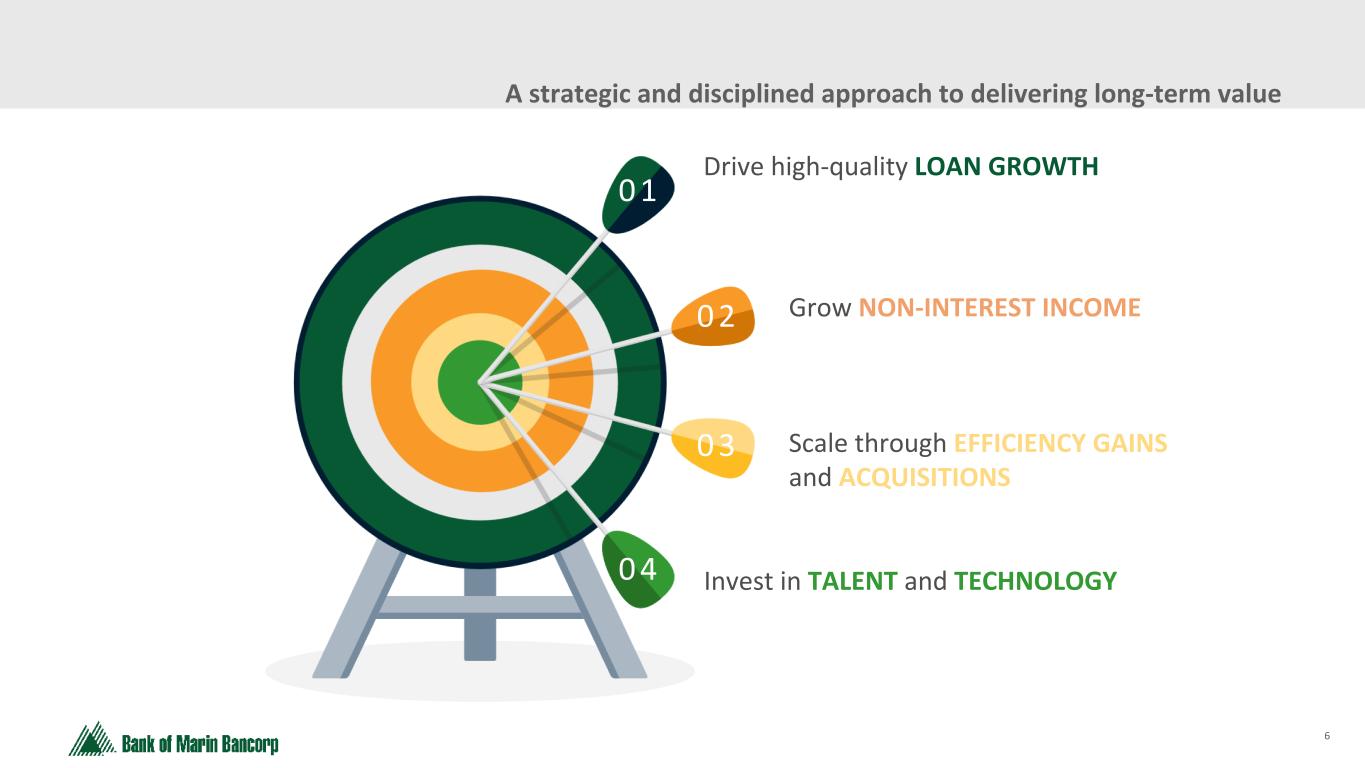
Thank you, Dave. To close, the second quarter was another quarter in which Bank & Merin materially advanced our strategic focus areas, improving profitability, expanding margin, reducing balance sheet risk, strengthening capital, and continuing to build new client relationships. Our work over the past several quarters has created a stronger earnings trajectory and reduced risk. We are now focused on translating improved loan and deposit trends and relationship growth into a more optimized balance sheet to continue driving operating leverage and shareholder returns. We believe our success this quarter provides encouraging evidence across each of those areas. With that, I want to thank everyone on today's call for your interest and support, and we will now open the call to your questions.
Operator
If you would like to ask a question, please click on the raise hand button at the bottom of your screen. Once prompted, please unmute your line and ask your question. We will now pause a moment to assemble the queue. Our first question will come from David Feaster with Raymond James.
Hey, good morning, everybody. Good morning, David. How are you? Oh, doing great. I wanted to start on the loan side, you know, exclusive of the wine loan runoff loans, pretty stable quarter over quarter. You talked about increasing production. How do you think about, you know, and also like in the slide deck, you talk about pipe, it sounds like pipelines actually improved pretty well as well. So I'm just curious if you could elaborate a bit on the strategy to increase production and drive accelerating loan growth, you know, the pipeline growth that you're seeing there in the composition and just, again, how do you think about loan growth as we look forward?
Yeah, thank you. So a lot of that has been driven by, you know, over the last year or so, new hires we made to the bank, and we continue to be opportunistic. opportunistic. So during the quarter, we hired a team of three people in San Francisco and just hired a new leader for our East Bay market. So if you look at a map and where the productions come from, those areas, which historically have been some of our better producers, have fallen off. And so a lot of it's trying to keep doing what we do right, improve what we're not doing right, and that would be getting more pistons firing at one time. So part of that's hiring driven. I would say the mix looks very similar, although we continue to have an increased focus on C&I. I don't want to say we've hired exclusively to do that, but some of the hires should accelerate that. But if you look at the Outstandings Plus commitments, year to date through June, we're almost double what we were last year. So, you know, certain industries aren't real heavy borrowers, but that brings the non-interest bearing deposits, the treasury management income. So we will continue to attack all those angles. There's no real immediate business lines that we're going after right now outside of being pretty industry agnostic. But we will continue through that hiring to look for opportunities where maybe there's some verticals we need to take advantage of. So hopefully that answers your question. But it really is the blocking and tackling of calling activity, building a pipeline, a smoother, more efficient process internally to close those in a timely manner. or bid on them, get a commitment, then close, and just managing the entire process better. And I think over the last, you know, year and a half, that's what we've gotten much better at, and we'll continue to try to hire into that and get more out of the folks that have been here for a while. And again, get that tide to rise so that the totals continue to rise with it.
Okay. So it sounds like there's a pretty high degree of confidence that productivity, production is going to continue to increase. And look, I mean, there's been a lot of disruption across your footprint. When you talk about where you're seeing productivity, there's been a lot of disruption. I'm curious, how do you think about, I guess, have you seen any opportunities capitalized on that yet or is it still to come?
And then just appetite for continued hiring coming out of that and potential client acquisition and just when do you think that that could all start to manifest now the timing of it's hard so i answer that in reverse order all four of those hires that i mentioned all came out of some degree of disruption uh some more immediate or recently than than others but all of them came from that and with those people tend to come opportunities and so we're not gonna dance on any graves from you know any any disruption but our job is to be opportunistic hire people and then take advantage of what they bring to the table and so you know without giving too much specifics that's exactly what we're doing okay and maybe you know let's
shift gears to deposits um you know could you just talk about first of all the competitive landscape for funding and your ability to continue to defend your deposit franchise because your deposit base is phenomenal um and then there there's just a lot of moving parts right i mean with the one-way sales you know the other deposit sales that you had and some of the seasonality I guess, how do you think about utilizing the deposit networks that you guys are a part of? How do you think about core deposit growth going forward and some of just some of the other, you know, just the competitive landscape for funding today?
I'll start at the back end and then refer to Dave on how he manages the deposit networks. He's done a great job to take advantage of the benefits that provides as a big arrow in our quiver. But, you know, our deposit franchise, if you will, is outstanding, as you noted, but nothing about it changed. So the decline, if you look at the reasons we've had, a number of big customers that we've talked about fairly repeatedly that have fairly big seasonal inflows, outflows that don't always match a direct calendar year type seasonality, whether it's campaigns, marketing campaigns. And so, you know, we had one customer with a $74 million outflow in the quarter. They continue to open accounts. They continue to move money in. But that moves the total needle. A couple of other instances, albeit, although it was a smaller piece of the total pie, was people with investment policies or I would call it government-funded activities where, you know, they're beholden to look for other investment rate opportunities or investment opportunities at a higher rate than willing to provide. But we maintain all the operating business. And so most of it falls into that. Obviously, there's some tax outflow. in the quarter, but nothing there of any note of people leaving the bank. And so we will continue to see that degree of volatility, if you will. Sorry, money coming in and out. None of this signifies anything, as long as we continue to add a lot of new accounts, a lot of new relationship, build granularity, which you see with that number of new relationship accounts being opened every quarter and again with the greater focus on cni effort that's going to bring more non-interest bearing again the treasury the related treasury management fees and it's just continuing on that path it's a very uh active sport for us uh i think we mentioned the word a couple times targeted rate cuts we don't just move rack rates up and down we figure out where we can do it to have the best and least impact on the bank to the positive and negative. Excuse me, sorry. We got it cold.
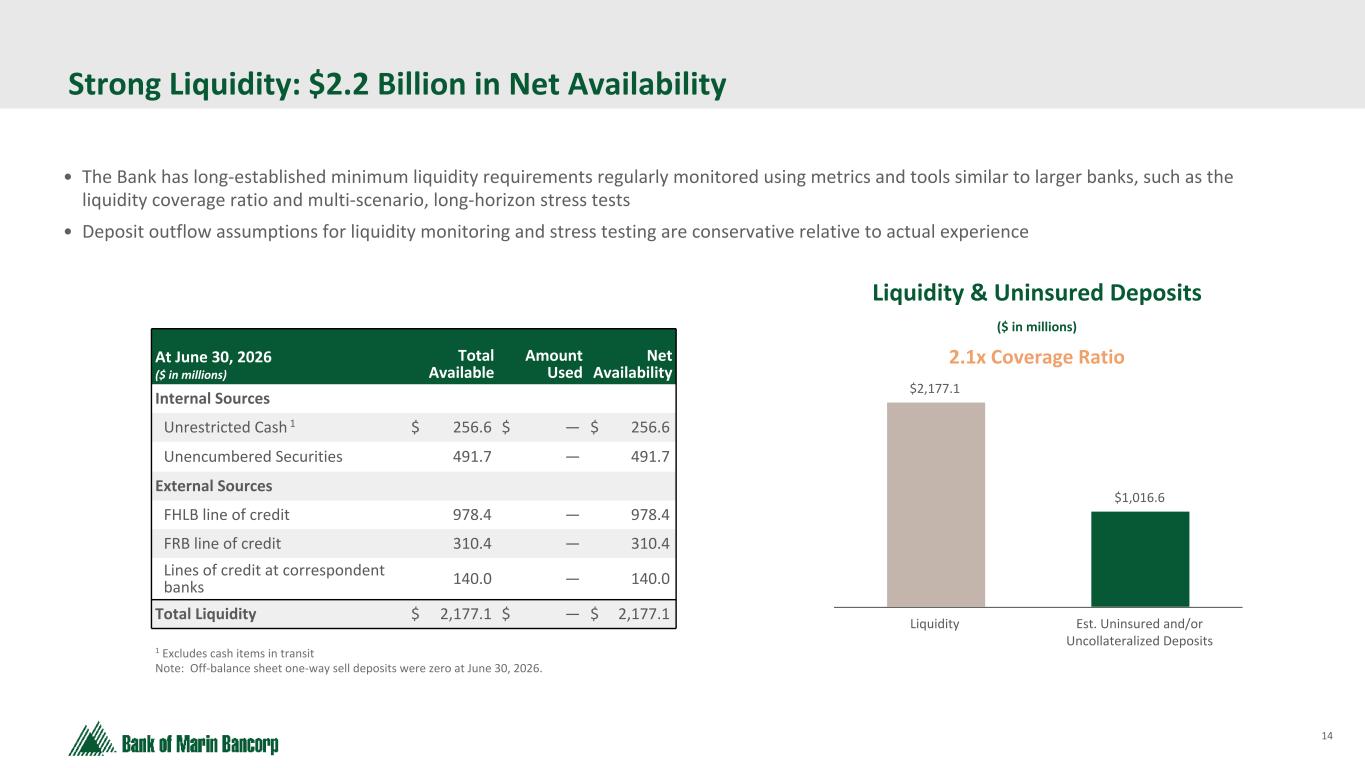
Sure, yeah. So on one-way sales in general, I'll just say we're always looking to actively manage the balance sheet. Use of one-way sales has persisted for a few quarters now, a little bit larger this quarter. Part of that is to manage expected deposit volatility, but it's also a risk management You know, it gives us some balance sheet flexibility. We have a securities portfolio that's 100% AFS now. And so, you know, by shrinking the balance sheet rather than keeping it the same size, we're avoiding additional AOCI risk if we purchase securities. So if you look at a NIM calculation, you know, really what the one-way sales do is it reduces our excess cash, which is a relatively low-yielding asset, and we're moving relatively high-cost deposits off the balance sheet. So, you know, the numerator of the NIM calculation gets more efficient, and the denominator is you're reducing your earning assets. And so with the reduction in earning assets, you're also providing some benefits to ROA, leverage ratio, et cetera, things that are a function of average assets over time. So, you know, overall, we like the strategy. It was a little bit larger this quarter, and it's something we think we can persist.
That's great. Thanks, everybody.
Operator
Your next question will come from Jeff Rulis with DA Davidson.
Thanks. And maybe, Dave, just staying on that margin, I appreciate the commentary sort of re-accelerated higher and it sounded like I was a little bit on the high side. But if you could just tell us about, you know, future momentum with the margin where you see that. And if you could, if you had a June average for the month. Thanks.
Sure. So 14 basis point improvement on a quarterly basis is a pretty high bar. But I think there's plenty of reasons why a major portion of that can persist. It's probably harder to reduce deposit rates than it was six months ago, let's say. Not seeing any real upward pressure there. So that's the good news. And then we continue to have benefits from repricing the CD portfolio. And as Tim mentioned, we do some targeted cuts from time to time where we can. But the bigger opportunity is really on the loan side. we had a large increase in our loan yield in the quarter, eight basis points up. The yield on new funded loans was quite a bit higher than last quarter. And by definition, those have been on the books for a partial quarter. So, you know, that provides some tailwind there. Our June loan yield was a 518. So that's sort of the exit level, you know, you may want to consider. A couple other things. We continue to do our typical ALM run and look at where we think loan yields will be a year from now on a monthly basis. And we still think we're looking at about 20 basis points or so of monthly loan yield benefit a year from now. Yeah. Let's see. You asked about one more thing before I get there. I'd say it's a little small, but unfunded construction commitments are up a little bit and those haven't drawn yet. And so that could be a little bit of a tailwind, too, because those tend to be relatively high yielding loans. You asked about NIM for the month, I believe, tax equivalent NIM for June 348. That was with a relatively high level of one-way sale benefit. And so I think probably a better launch point for a more normalized level of one-way sales was probably 344, 345, something like that. That's a good proxy for where we are.
I appreciate it. Thank you. And maybe, Tim, if I could ask you about just kind of rerun the capital priorities as those levels continue to build and, you know, we saw where the dividend is, you know, kind of layering and repurchase opportunity versus any M&A, helpful to kind of revisit.
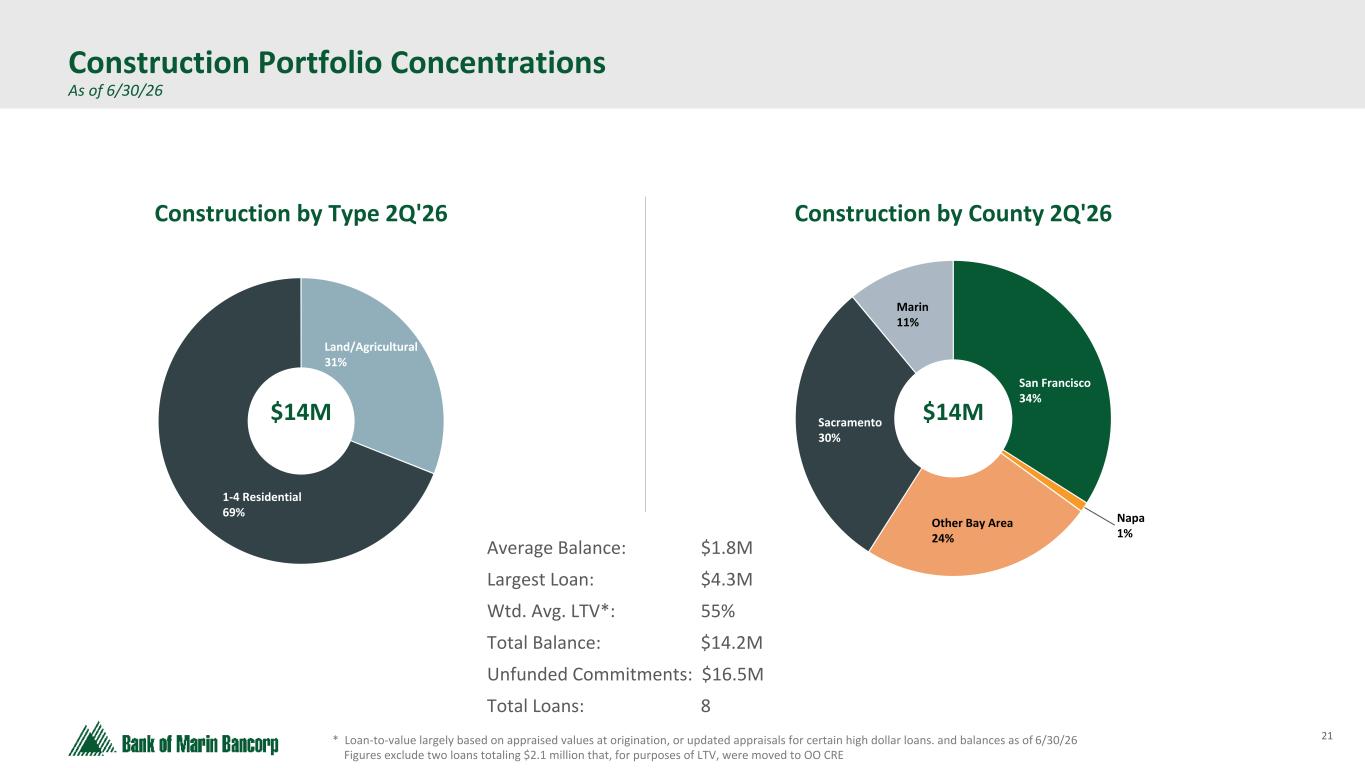
I do want to touch on something Dave said, and it also will answer something that David Feaster asked. We're talking about margin loan production. We are starting to see a revival of our construction lending activity. And much of what we've done in the past and continue to do are things like condo and single-family resident infill projects in San Francisco and nearby areas. And that really production had fallen off for a couple of years for obvious reasons. And we're really seeing that come back to life. That was a big contributor to the outstanding balances growth in the quarter, or at least compared to the prior year. And so that, as Dave mentioned, is a higher yielding loan for us. All the same borrowers, excellent credit quality, but that is another piston that hadn't been firing for us. And it's nice to see that back. And so that should help both balances and yield. And those projects are just kicking off, so we won't see the payoffs at project completion for a while. On the capital priorities, you know, obviously we were making some small purchases when our tangible book value, or we were trading both tangible book or right at it. And we still have about $24 million approved. We are beholden for approval of the shareholder dividend with the California regulator to their calculation of what's permitted, which requires us, you know, because of the losses we've taken on the balance sheet restructurings, potentially could cause us to go back and ask for permission. As we said before, when we got working together with them to execute on the balance sheet trade, the large held to maturity trade with just sub debt, you know, it was going to manage all that and then build the capital back up to some level of peer median or something, you know, within distance of that, that would give them comfort. And so we continue to build through the improved earnings. And, you know, we'll start to have those conversations, but I wouldn't call any buybacks imminent for that reason.
Operator
Your next question will come from Woody Lay with KBW.
Hey, thanks for taking my questions. Wanted to start on the loan yields and follow up there. I was just hoping for some more color on, you know, obviously dependent on mix, but it sounded like new loan rates are coming at. higher yields quarter over quarter, just any incremental color you could provide there. And maybe if you also had any color on the rate on the loan payoffs you saw in the quarter.
So we had a comment. I'm trying to remember the exact delta between. I can give you the payoffs.
The yield on payoffs for the quarter was 586. So it was 653 on new originations 586 on payoffs got it and what were there any like one-time um interest recoveries that that flowed through loan yields or was it all um on the order of 30 uh 35 40 000 for the quarter very very yeah it was not not like uh for example q4 of last year which was pretty material so we've been trying to be very disciplined witty at funding quality loans new loans you know as close as we can to 200 over, you know, relevant index.
You know, sometimes we get more, sometimes we get less, but certainly try not to get into the race to the bottom for really aggressively structured fixed rate type pricing. But again, the higher proportion of CNI kind of construction is helping that.
Yeah. And could, you know, maybe as it relates to there, can you just talk about the competition you're seeing and how that's impacting pricing or structure? Because it feels like a major theme this earnings season has been on the competition side.
Sorry, guys. I came down with this cold over the weekend. It's causing me to cough. We are seeing aggressive pricing. I don't want to throw anyone under the bus. We're walking away from things that are the 150 over in that range. We are seeing more deals go out with a non-recourse request and we're being very cautious of those.
Yeah, nothing else to add. Didn't step away for a moment.
Yeah. All right. Maybe just last for me, Dave, have one follow-up for you. You mentioned, you know, expenses in the third quarter could look like, you know, kind of the trend we've seen over the first half of the year. You know, the salaries line was, you know, there's a little bit of a gap between the first and second quarter. You know, do we split the difference there? How should we think about that gap in salaries and what that implies going forward?
I think Q3 salaries wise is probably a little bit closer to Q2 than it would be for Q1. There's just a lot of things that are unique to Q1 in terms of the annual resets and incentive compensation, et cetera. So I think probably closer to Q2, probably a little bit higher than Q2 would be my guess. And just other lines, I think we have some projects that will be accelerating in Q3, so that would that could lead to a little bit higher expense in projects, but I think overall, you know, we're going to be somewhere between the Q1 level and the Q2 level, or said differently, second half looks a lot like the first half on average overall.
Got it. All right. Well, I appreciate the color. Thanks for taking my questions.
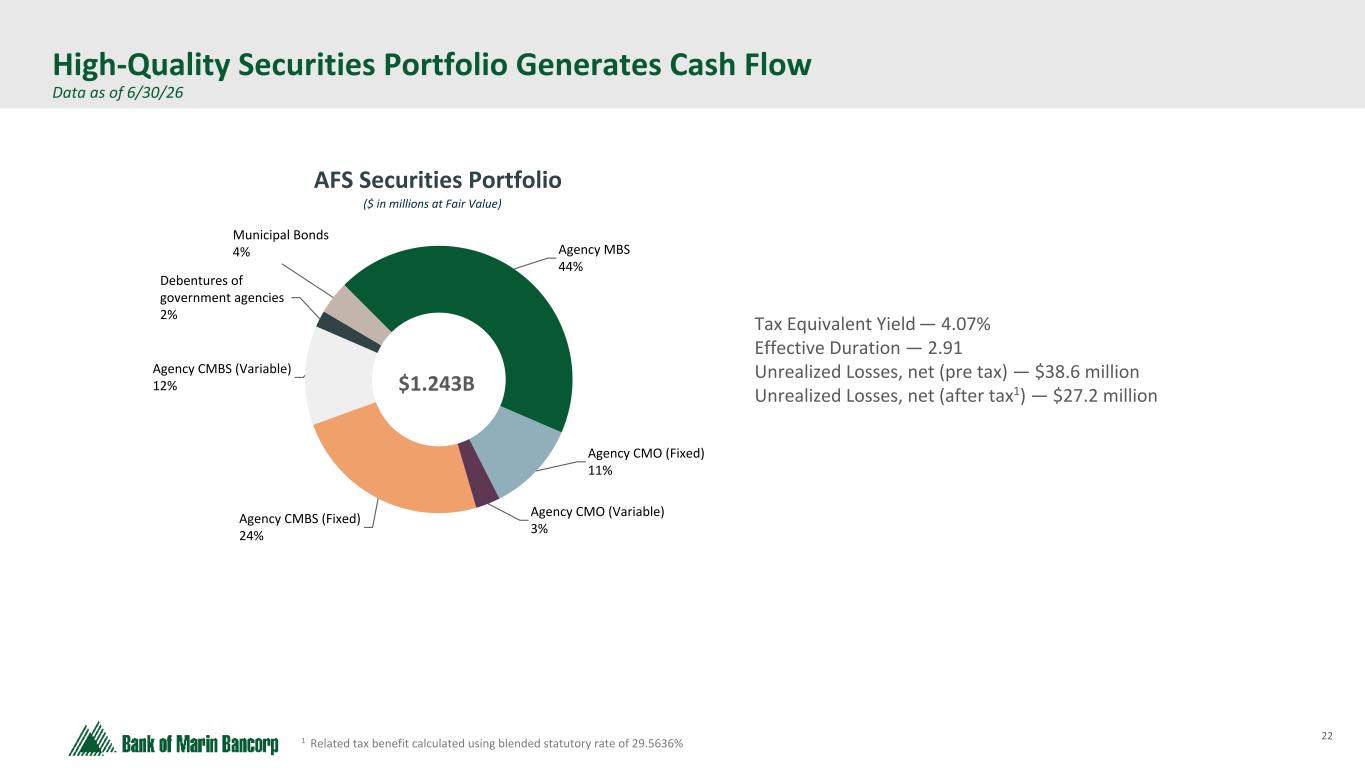
Our next question will come from Matthew Clark with Piper Sandler. hey good morning um just on the securities portfolio it's been coming down the last few quarters um want to get a sense for whether or not that might continue as you as you try to fund loan growth or um or should we anticipate that you might start to reinvest in the securities book so overall i mean our portfolio is large relative to the size of the balance sheet so So we're working hard to make that a smaller piece, make loans a larger piece.
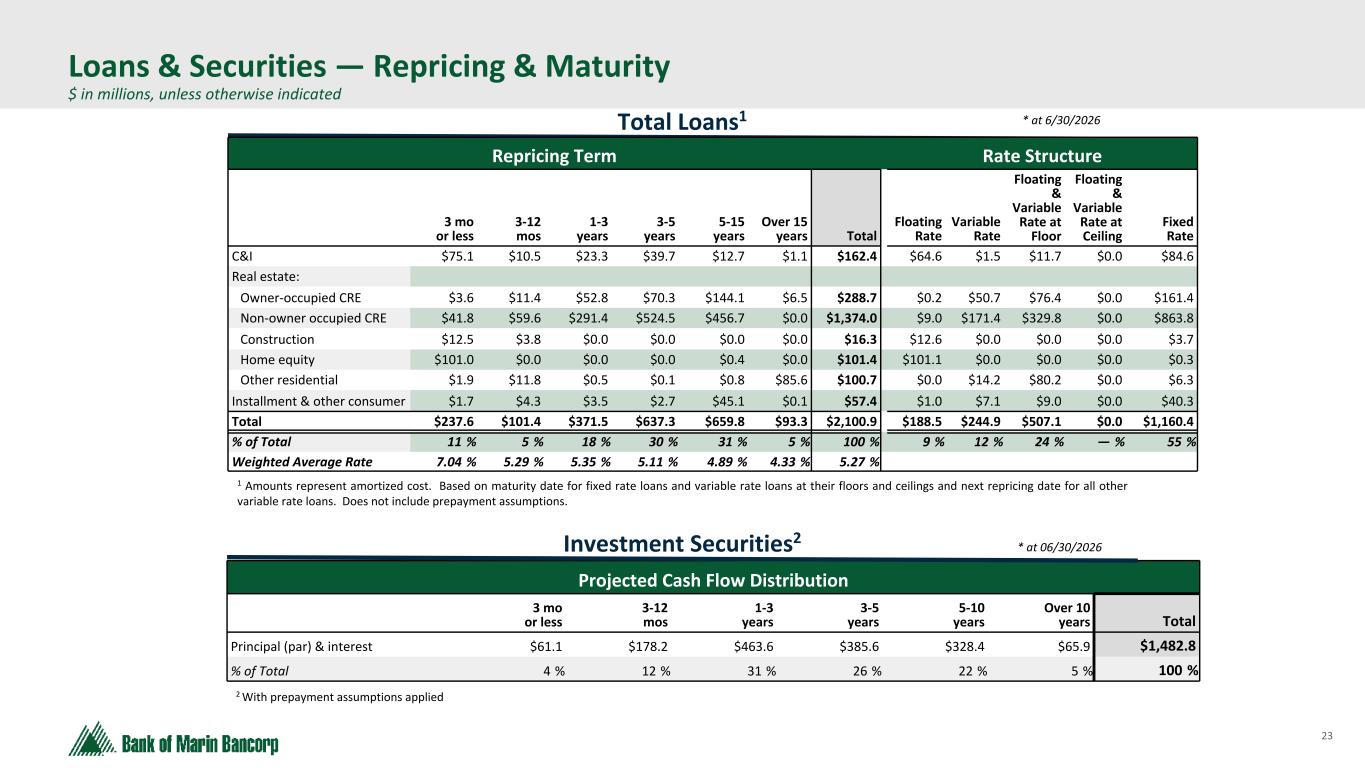
I believe we haven't bought anything since January. I think that probably changes sometime in Q3, just kind of legging into the market a little bit, maybe in line with what tends to be our usual positive inflows deposit-wise. So that's my expectation. But I don't expect the portfolio to grow significantly over time. We do get about $200 million or so, or we're expecting $200 million in payoffs over the next 12 months. So, I think the portfolio likely comes down and we'll be looking to just manage the balance sheet a bit more efficiently and get that percentage lower and loans up.
Thanks. And I'm not sure if Tim's back or not, but I wanted to touch on M&A, unless I missed it a little earlier, but any update on the M&A front and your appetite there?
No, no update. I'm sorry. Thank you for reminding me. I failed to answer the second part of Jeff's question, which was, that's always going to remain a priority for us over episodic buybacks. If there's something that provides attractive franchise value enhancement, there's nothing imminent or in the works. But that remains a priority to the bank to explore those opportunities.
Thank you. as a reminder if you'd like to ask a question please click on the raise hand button at the bottom of your screen and we have no further questions at this time i'll hand it back to tim myers for closing remarks thank you everybody again i apologize for the coughing fit there with my cold but i appreciate all the good questions and as always please reach out if you need anything further. Thank you.