Operator
Good afternoon, ladies and gentlemen, and welcome to the C.H. Robinson fourth quarter 2024 conference call. At this time, all participants are in a listen-only mode. Following the company's prepared remarks, we will open the line for a live question and answer session. To ask a question, please press star 1 on your telephone keypad. If anyone needs assistance at any time during the conference, please press star 0. As a reminder, this conference is being recorded Wednesday, January 29, 2025. I would now like to turn the conference over to Chuck Ives, Senior Director of Investing
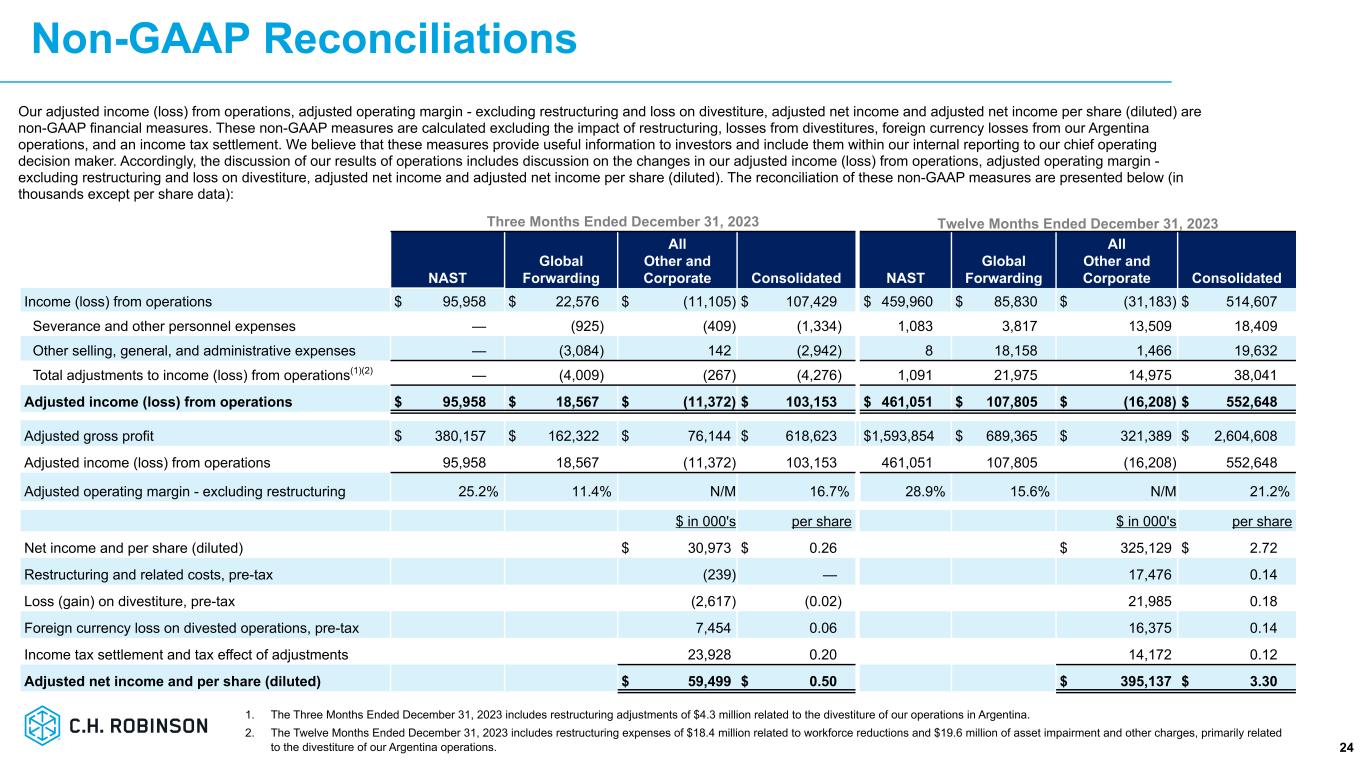
Thank you, Shamali, and good afternoon everyone. On the call with me today is Dave Bozeman, our President and Chief Executive Officer, Michael Castagneto, our President of North American Surface Transportation, Arun Rajan, our Chief Strategy and Innovation Officer, and Damon Lee, our Chief Financial Officer. I'd like to remind you that our remarks today may contain forward-looking statements. Slide 2 in today's presentation lists factors that could cause our actual results to differ from management's expectations. Our earnings presentation slides are supplemental to our earnings release and can be found in the investor section of our website at investor.chrobinson.com. Our prepared comments are not intended to follow the slides. If we do refer to specific information on the slides, we'll let you know which slide we're referencing. Today's remarks also contain certain non-GAAP measures and reconciliations of those measures to GAAP measures are included in the presentation and with that i'll turn the call over to dave
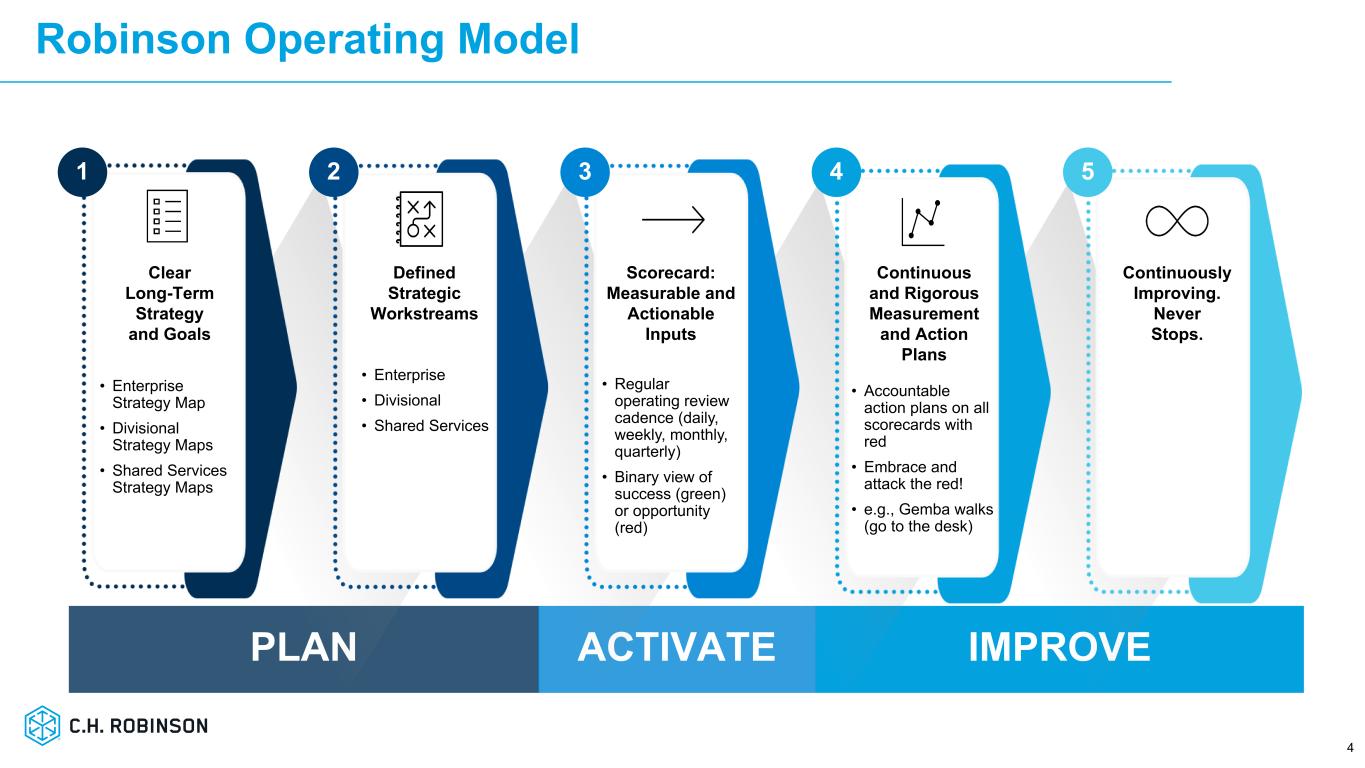
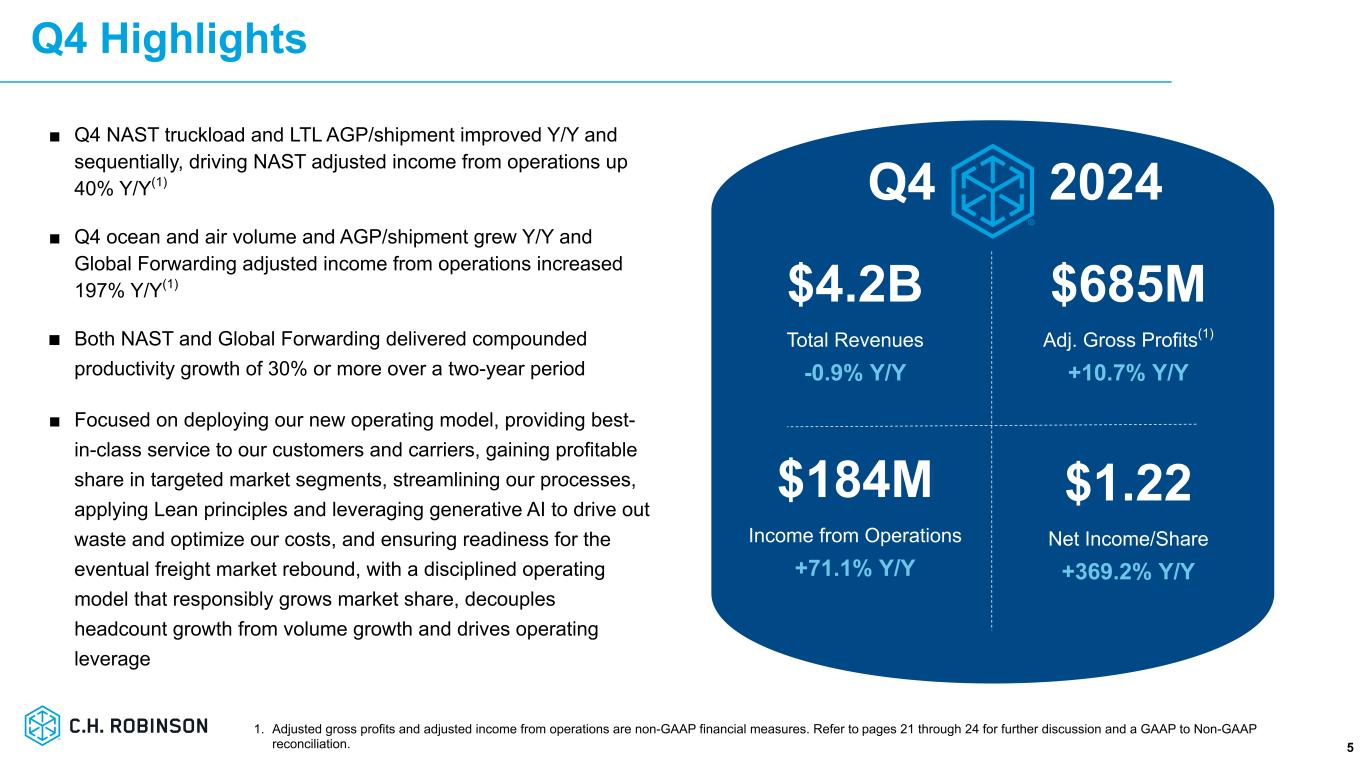
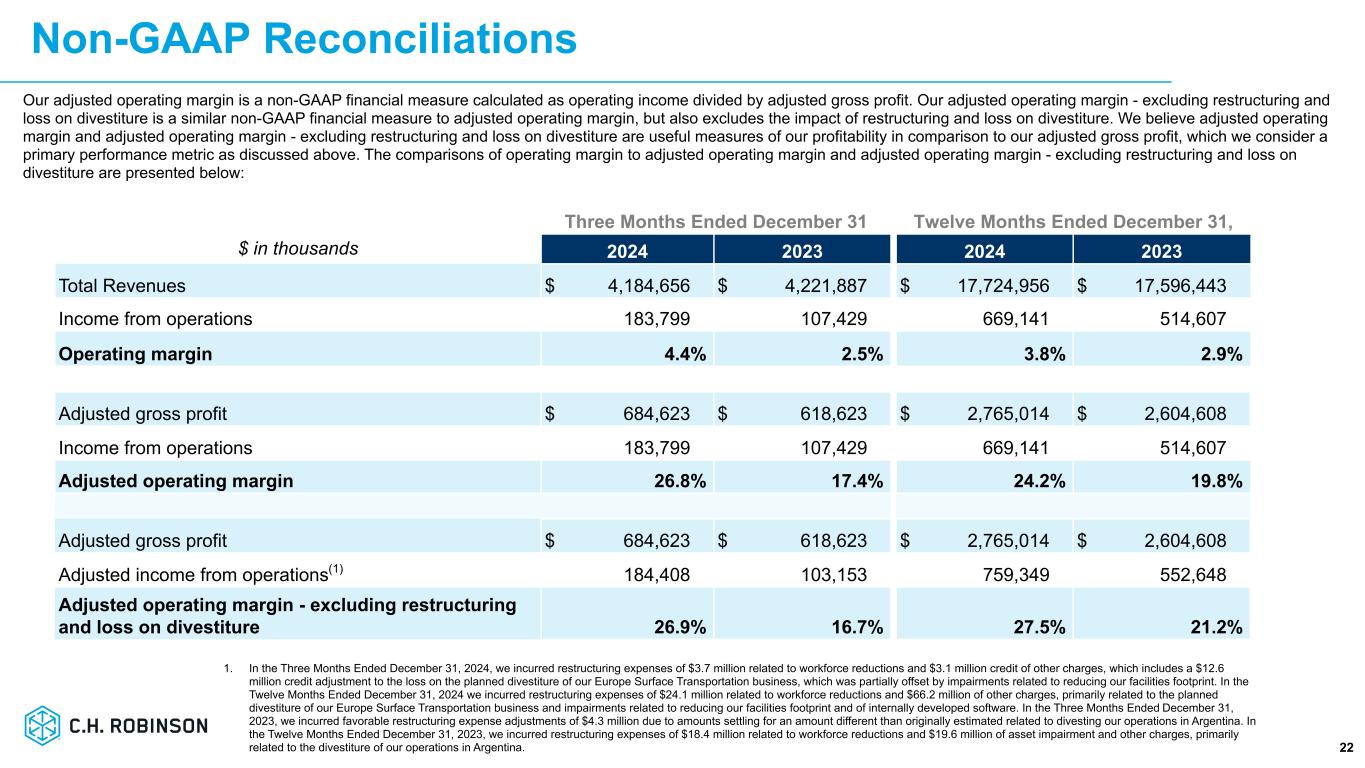
thank you chuck good afternoon everyone and thank you for joining us today i'd first like to acknowledge the challenges that many people are facing due to the severe weather and natural disasters in certain regions of the country including the recent wildfires that damaged and destroyed many homes and businesses in the Los Angeles area. Our thoughts are with everyone who has been impacted and we extend our gratitude to the first responders who worked tirelessly to keep people safe. I'm proud of the support that our company and our employees provided to help those in need as well as our customers. Turning to our fourth quarter, we've talked extensively over the past year about our new robinson operating model and the discipline execution that the model is enabling as well as how we're leveraging our industry-leading talent and technology to raise the bar in logistics the benefits of these efforts were never more evident than in the significant year-over-year improvement in our q4 financial results In what continues to be a historically prolonged freight recession with market growth in 2024 that did not materialize as had been projected, the difference in our execution versus last year is stark. our people are embracing the discipline needed to generate higher highs and higher lows across market cycles resulting in a higher quality of volume greater productivity and expansion of our gross profit and operating profit margins in a trucking environment where the cost of purchase transportation increased in q4 due to a decline in industry capacity our dynamic costing and pricing tools, our revenue management practices, and our cost of higher advantage enabled us to provide greater value to our customers and at the same time improve our NAS gross margin both year over year and sequentially. In our global forwarding business, the team has debunked the thesis that Robinson couldn't continue to improve productivity when volumes are growing. Throughout 2024, I've been impressed with and highly appreciative of the team as they continue to be nimble and highly engaged with our customers to help them navigate various market disruptions and to provide differentiated service and solutions. As a result, our ocean and air shipments grew each quarter on a year-over-year basis, and each grew more than 5% for the full year through improvements in process standardization and automation and embracing the rigor of our operating model the forwarding team decoupled headcount growth from volume growth reduced their average headcount for the year more than 10 percent and achieved productivity improvement of greater than 15 for the full year over the two-year period of 23 and 24 we delivered compounded productivity growth of 30% or more in both global forwarding and NAST. And as we said at our investor day in December, we view our productivity as evergreen improvements that we do not expect to give back. Enabled by the operating model disciplines and tools that are being applied across our company, we expect to further advance our productivity as we grow our businesses, including both NAST and global forwarding. The productivity improvements have lowered our cost to serve and increased our operating leverage. Combined with our expanded gross margins, this resulted in a 79% year-over-year increase in our enterprise's Q4 adjusted income from operations. I want to thank our people, one of our greatest competitive advantages, for their relentless efforts to embrace our new operating model and execute in a fit, fast, and focused way, as we keep pushing the bar higher on exceptional service to our customers and carriers and on financial performance across market cycles. Our new operating model has changed how we discover and inspect root cause issues and quickly implement countermeasures to improve the level of our operational execution. The reliability of our operating reviews continues to increase as we leverage our data-rich environment to inform our decision-making and enhance our competitive differentiation. This is showing up in improvements such as more disciplined pricing and better decisions on the volume that we're seeking. We are still early in our journey, but the operating model is helping us execute a solid strategy even better. And we expect further improvement as the accountability that the operating model demands is embraced deeper in the organization. I'm confident in the team's ability to drive a higher and more consistent level of discipline in our operational execution. As freight markets continue to fluctuate due to seasonal, cyclical, and geopolitical factors, we continue to remain focused on what we can control, including deploying our operating model and lean principles across the company, providing best-in-class service to our customers and carriers, gaining profitable share in targeted market segments, and leveraging game-changing generative AI to improve our service, workflows, and cost at scale, not in theory. We also continue to focus on ensuring that we'll be ready for the eventual freight market rebound with a disciplined operating model that responsibly grows market share, further decouples headcount growth from volume growth, drives additional operating leverage, and generates incremental operating income. I'll turn it over to Michael now to provide more details on
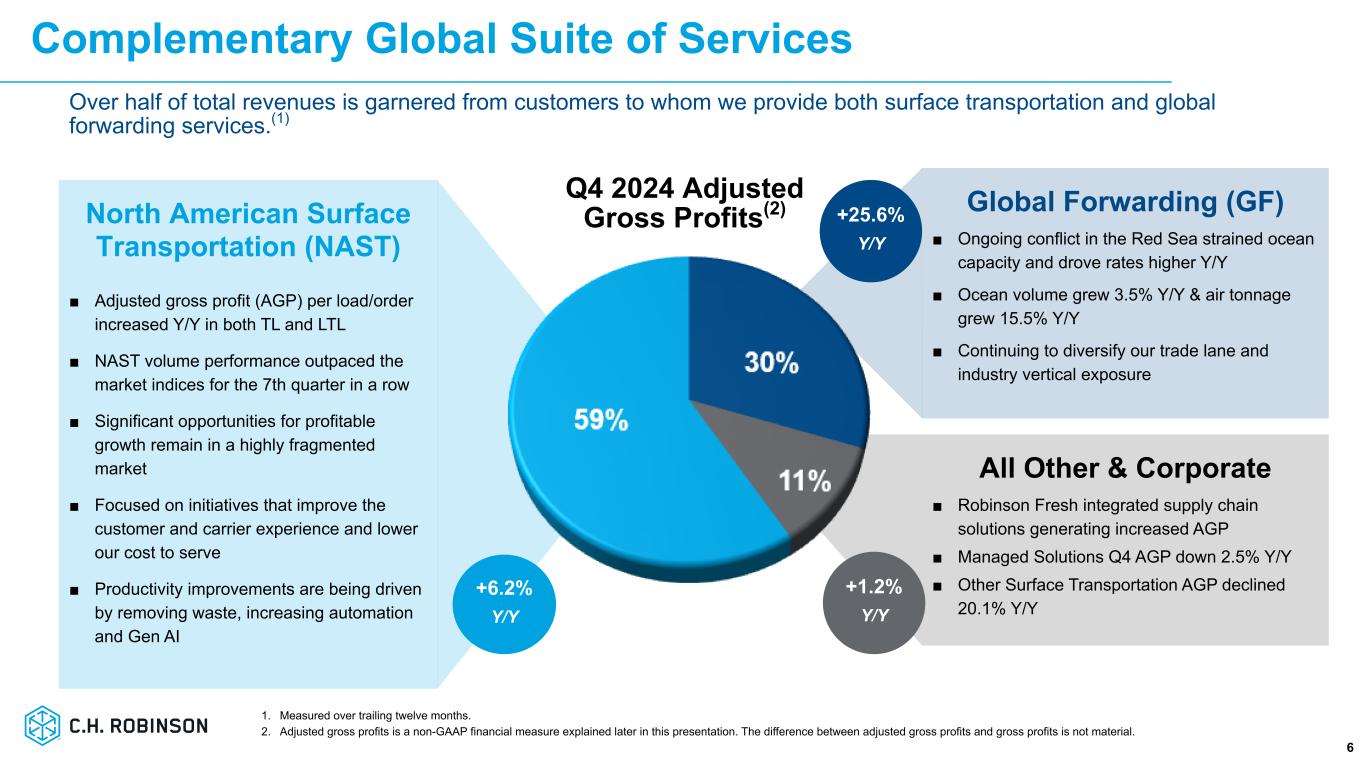
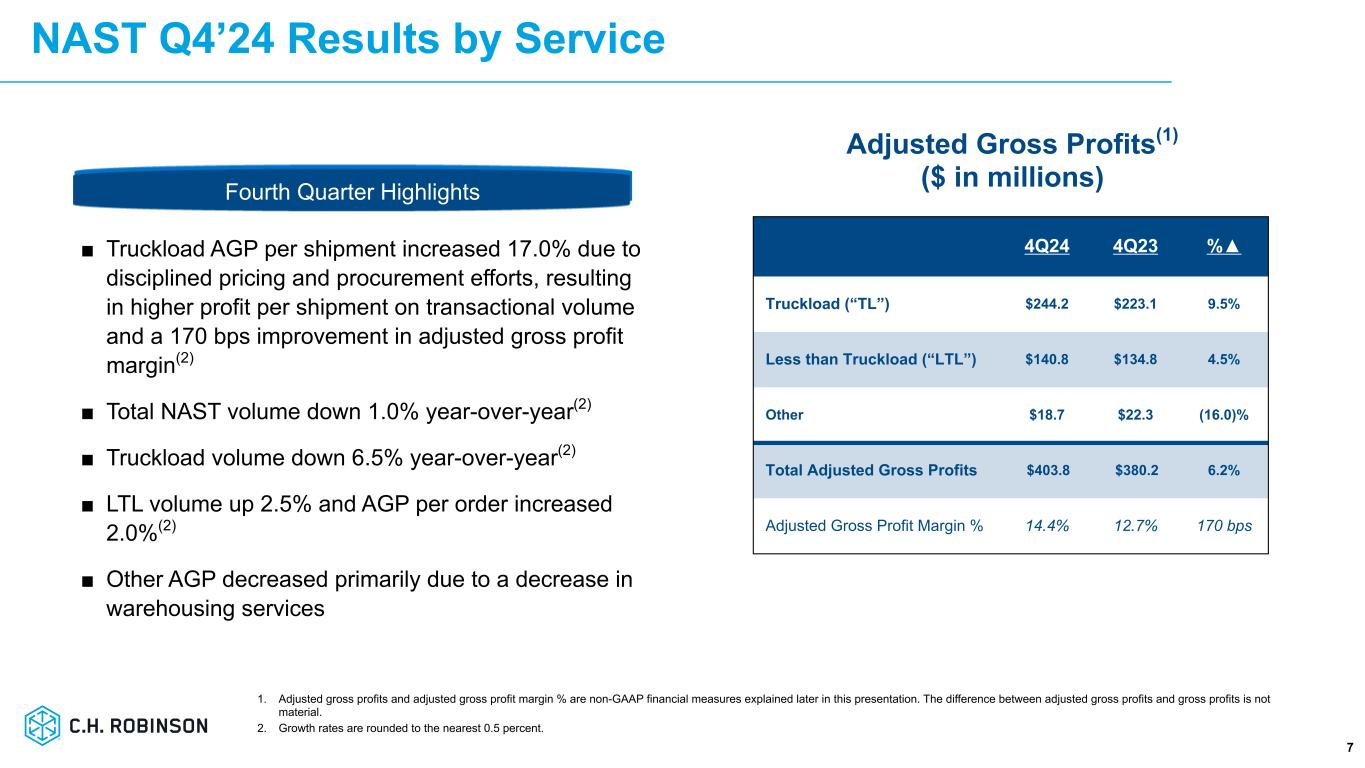
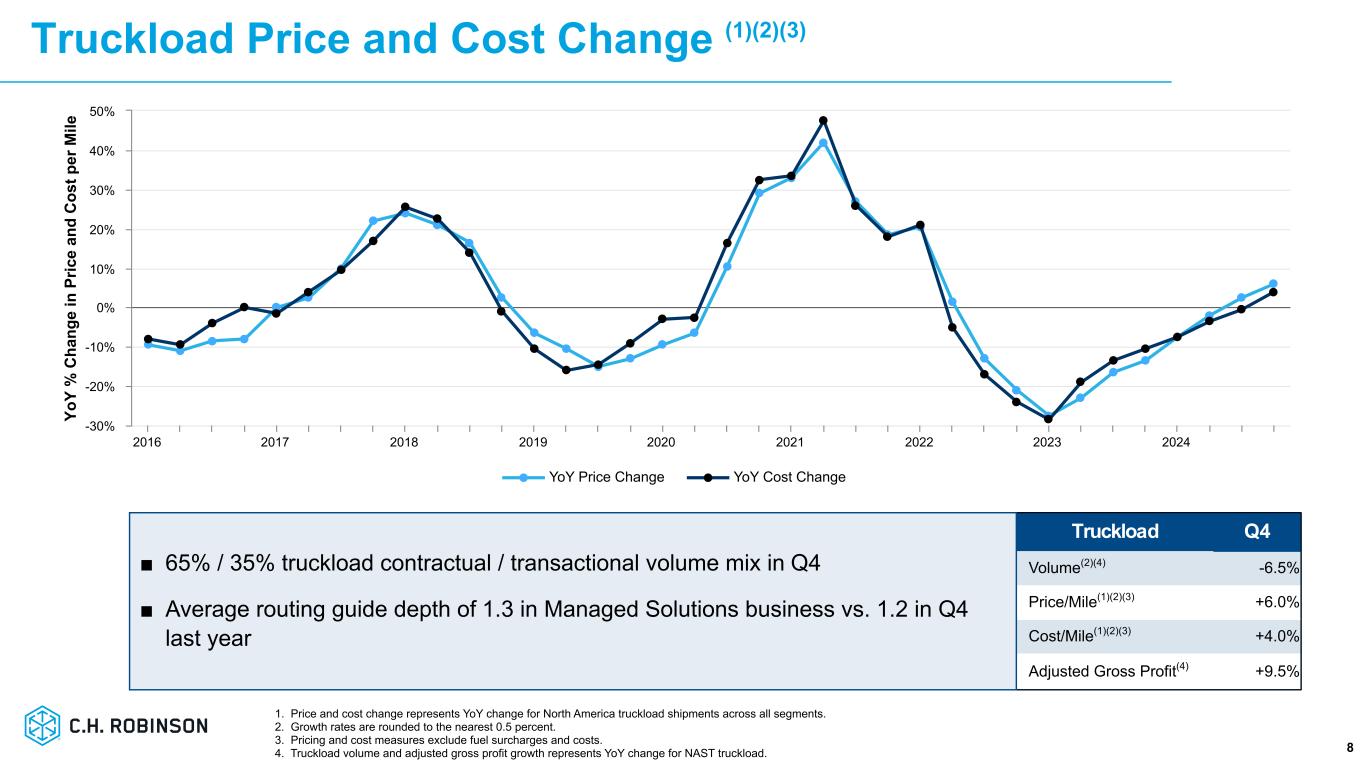
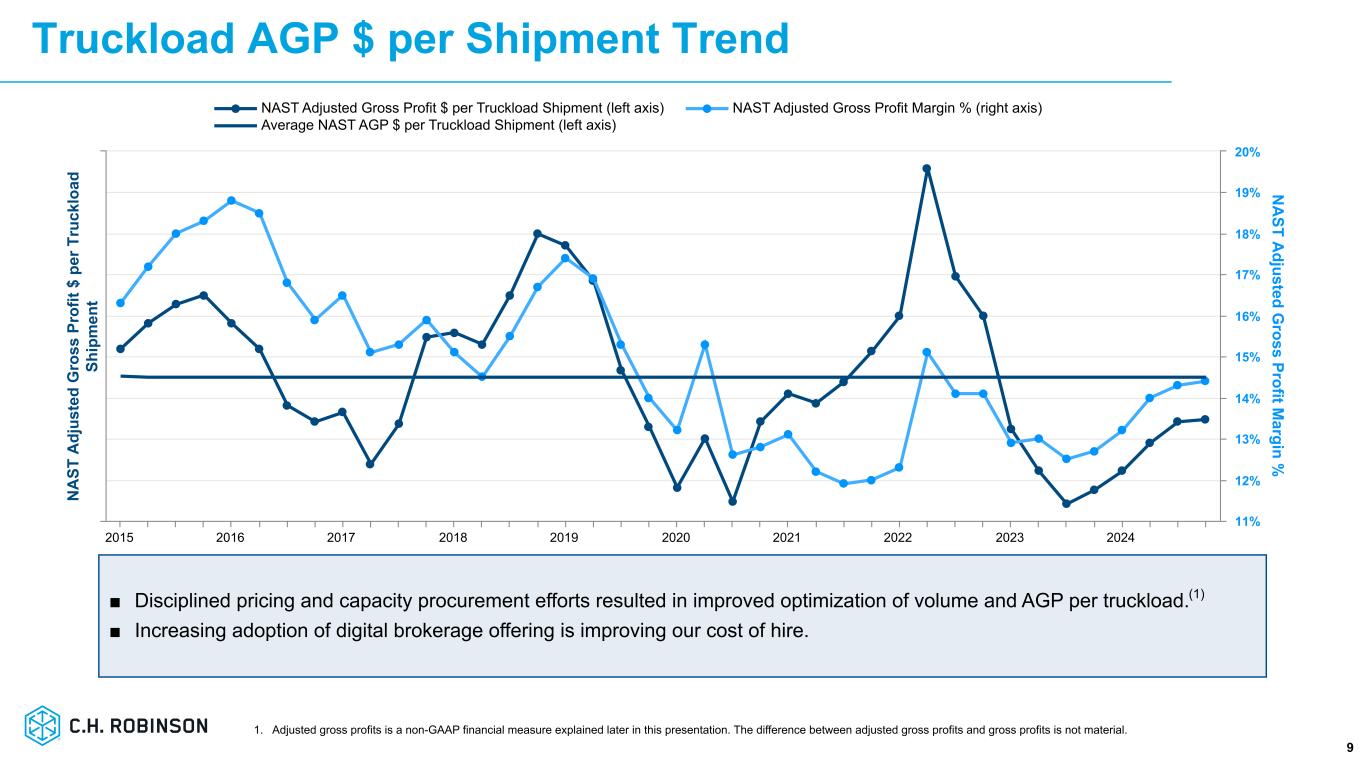
our NASS results. Thanks Dave and good afternoon everyone. In Q4 we delivered further optimization of our NASP volume, our gross profit margin, and our adjusted gross profit per shipment, resulting in a 40% year-over-year increase in our adjusted operating income. From a volume standpoint, the market continues to be in a prolonged freight recession, as Dave mentioned. The cash freight shipment index in Q4 was down 3.2% year-over-year and down 4.8% sequentially and it was the lowest q4 reading the industry has seen in the last 15 years at the same time the truckload line haul cost per mile excluding fuel surcharges increased due to a decline in industry capacity our resilient team of freight experts responded to the challenging freight environment by improving the quality of our volume with pricing discipline and a cost of higher advantage delivered by our procurement teams and the growing usage of our digital brokerage capabilities all of this led to an improvement in the agp yield within both our transactional and our contractual truckload business and 170 basis point year-over-year improvement in our nast gross margin supported by our operating model and armed with innovative of tools, our team also delivered a sequential improvement in NASS gross margin and truckload AGP dollars per shipment, despite the rising cost of purchase transportation. From a volume perspective, our total NASS volume declined approximately 1% year-over-year, outpacing the index for the seventh consecutive quarter. This included a 2.5% increase in LTL volume and a 6.5% decrease in truckload volume. our team is continuously testing the best combination of volume and margin to improve our earnings we know we have the optionality to increase our volume when the conditions are right and we are ready to pivot when it makes sense to do so but we're going to maintain our discipline from a market balance perspective we continue to be in a drawn-out stage of capacity over supply although carrier attrition is occurring and moving toward better balance each quarter due to a seasonal decline in capacity the dry van load to truck ratio and spot rates experience some upward pressure during the holiday season and the subsequent winter storms similar to last year but the load to truck ratio and spot rates are expected to return to pre-holiday levels once the storms abate what stands out is that our execution is markedly different than last december and january as we're making better decisions on the optimal freight for us and making better use of our proprietary digital capabilities. In our LTL business, the 2.5% year-over-year increase in our Q4 shipments was driven by strength across several of our LTL services. By leveraging our vast access to capacity, our broad range of LTL services and solutions, and our high level of customer service, our LTL team continues to onboard a solid pipeline of new business and build on our existing LTL business that exceeds $3 billion in annual revenue. Looking ahead to Q1, it is typically a seasonally weaker quarter compared to Q4, with the 10-year average of the cash rate shipment index reflecting a 2.5% sequential volume decline from Q4 to Q1. As Dave said, regardless of market conditions we remain focused on what we can control our people and their unmatched expertise enable us to deliver exceptional service and greater value to our customers and carriers in line with a disciplined and focused approach to capture growth opportunities in targeted customer segments such as small and medium businesses we have invested in our sales organization and we will continue to deliver industry-leading solutions to customers and carriers as recently announced one of those solutions is the introduction of ch robinson financial an innovative digital payment solution for carriers that is aimed at setting a new standard of speed and efficiency unmatched by any other freight provider it marks a significant leap forward in fostering financial stability and streamlining operations for carriers as dave called out earlier i also want to take a moment to thank the nas team for their incredible work in 2024 our performance and improvements throughout the year reflect their commitment to our customers carriers and each other through their continued engagement with the ch robinson operating model our people are delivering improved results in a very difficult marketplace and i am proud to lead this team i'll turn it over to a room now to provide an update on the innovation we're delivering to strengthen our customer and carrier experience and improve our agp yield and operating leverage thanks michael and good afternoon everyone as i mentioned at
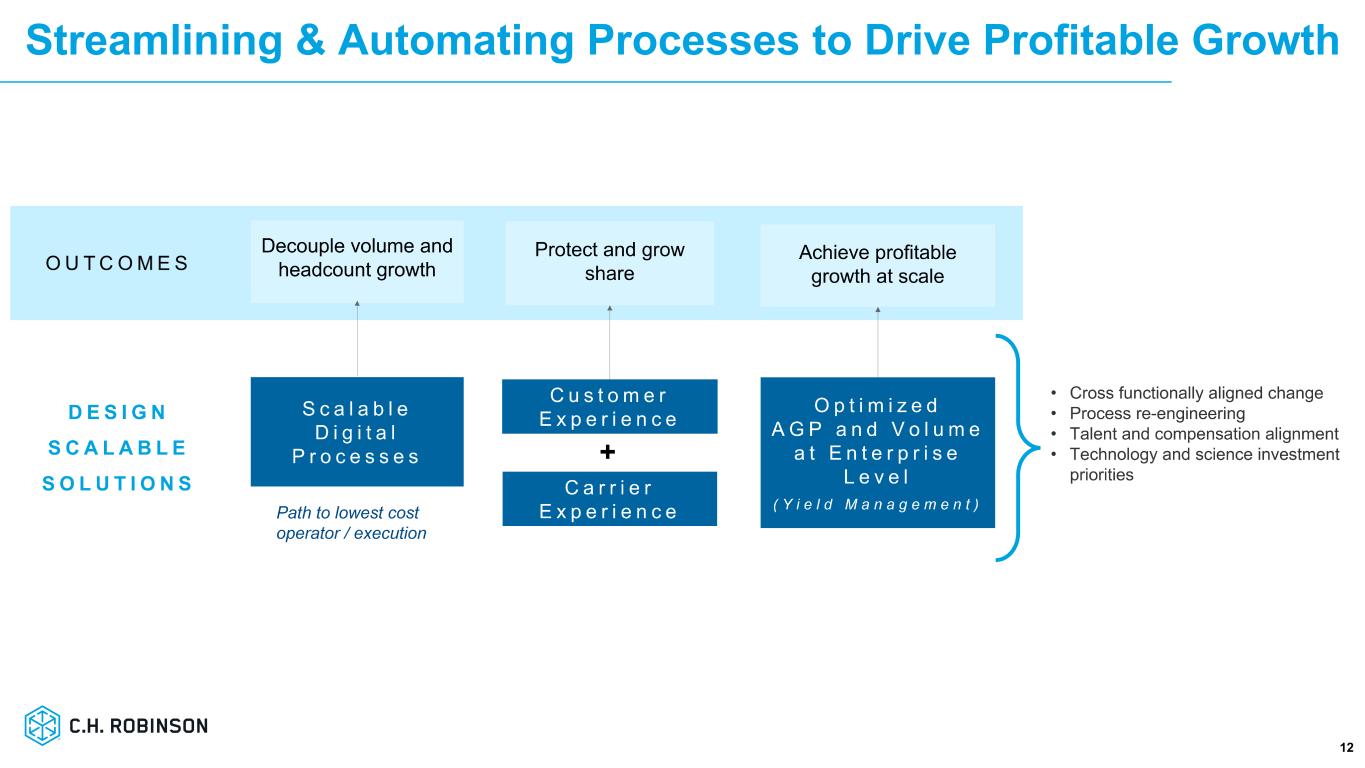
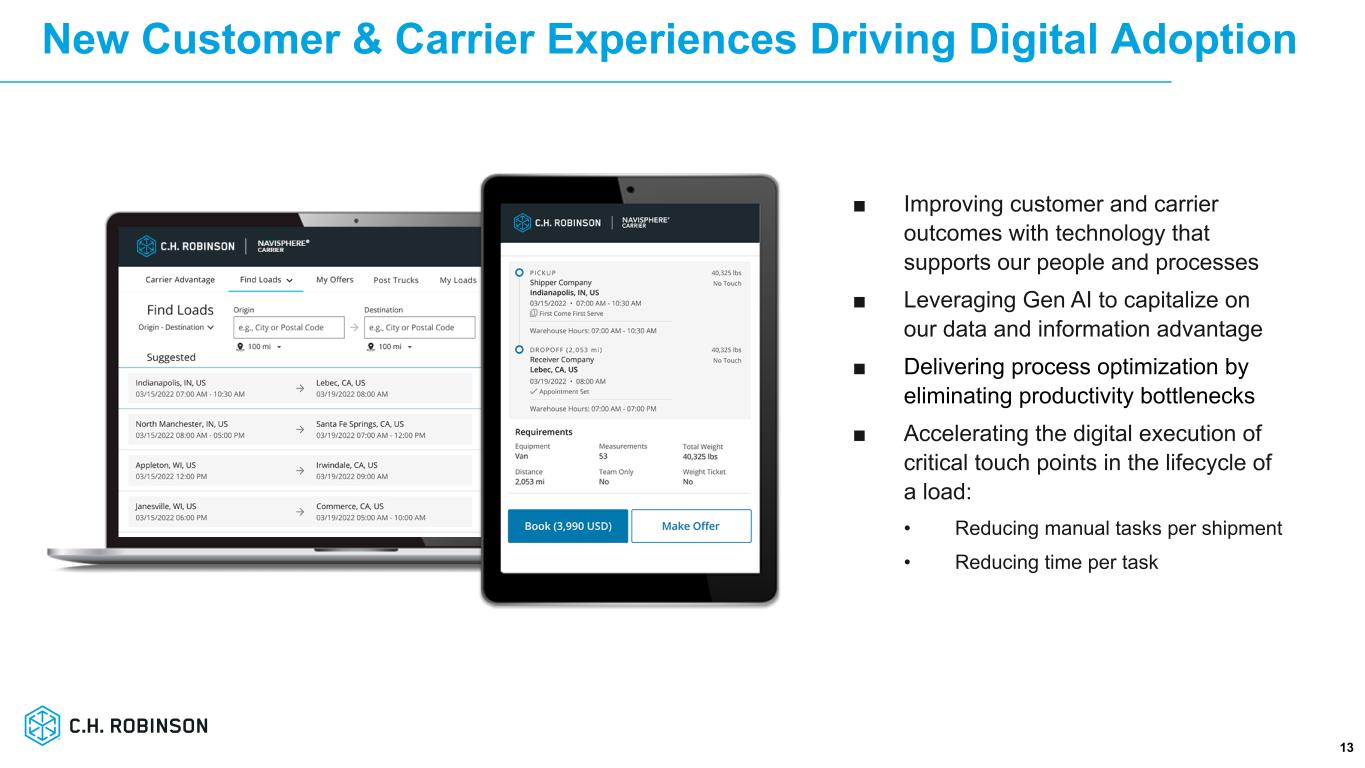
our investor day in december ch robinson is in prime position to disrupt from within to lead the industry forward in a way that others cannot match the innovations that we bring to the industry and our customer supply chains such as automation powered by gen ai have a market-wide impact due to our size and scale and we are not just talking about doing this we are already doing it for thousands of global customers as an example without proprietary technology that reads classifies and responds to incoming emails we've been able to automate more than 10 000 transactions per day this automation across the quote-to-cash life cycle of an order whether it be quoting order entry, load tenders, appointment scheduling, or other manual tasks, enables us to reduce our response times and provide a better and more uniform experience for our customers and carriers. It also creates business model scalability, thereby enabling us to decouple headcount growth from volume growth and to create greater operating leverage. In the fourth quarter, as throughout 2024, we continue to scale our process innovations at our use of GenAI. After utilizing GenAI to automate orders that are tendered via email, the automation of our order tenders increased 1,150 basis points compared to Q4 of last year and 440 basis points sequentially. And while the automation of this process has now reached nearly 90%, the other points in the order lifecycle have more runway for improvement. The increased automation in our order entry process and other points in the order lifecycle enabled us to increase our NASP and global forwarding shipments per person per day by more than 30% over the two-year period of 2023 and 2024. And although our productivity improvements won't continue to compound at these levels, we expect to continue increasing our productivity in 2025 and beyond to create further operating leverage. We also continue to increase the rigor and discipline in our pricing and procurement efforts, resulting in improved AGP yields across our portfolio with continued innovation in our digital brokerage and dynamic pricing and costing we're responding surgically and faster than ever to dynamic market conditions by performing more frequent price discovery and enhancing the quality of the pricing that we deliver along with our operating model this was a major contributor for the year-over-year improvement that we achieved during the seasonal market tightness and throughout 2024 But, as I also said at our investor day, a digital-only approach has proven to be ineffective in the logistics industry due to the level of complexity and variation in freight characteristics that necessitate human expertise. The active role that our people play from a human-in-the-loop perspective leverages their deep domain expertise and drives feedback to our algorithms on a regular basis in the form of expert market adjustments. And through our revenue management discipline, our teams are armed with intelligence on targeted countermeasures that they can take to implement a disciplined pricing strategy based on individual customer value propositions. Ultimately, we are innovating and disrupting from within to deliver on three items that are key to our strategy. Transforming the customer and carrier experience to drive growth, delivering business model scalability, and driving gross margin and operating margin expansion. With that, I'll turn the call over to Damon for a review of our fourth quarter results.
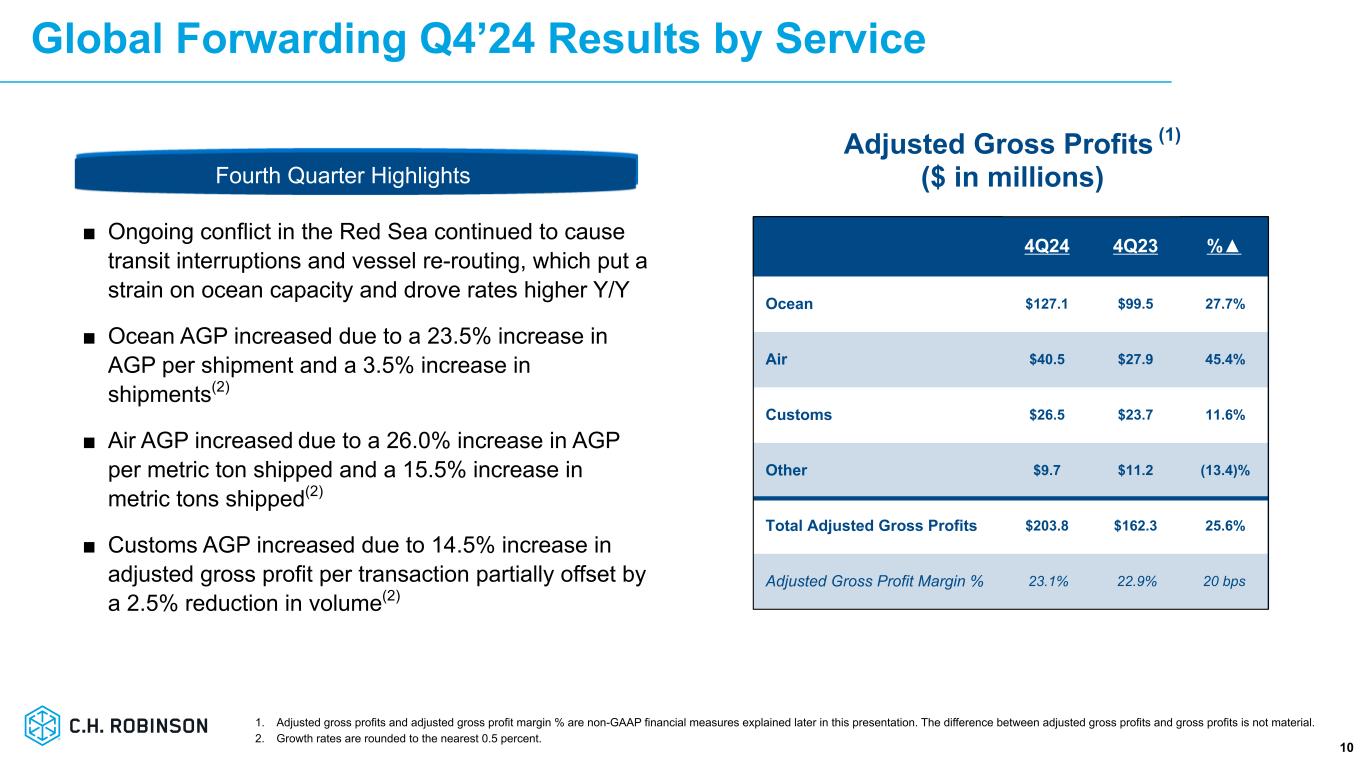
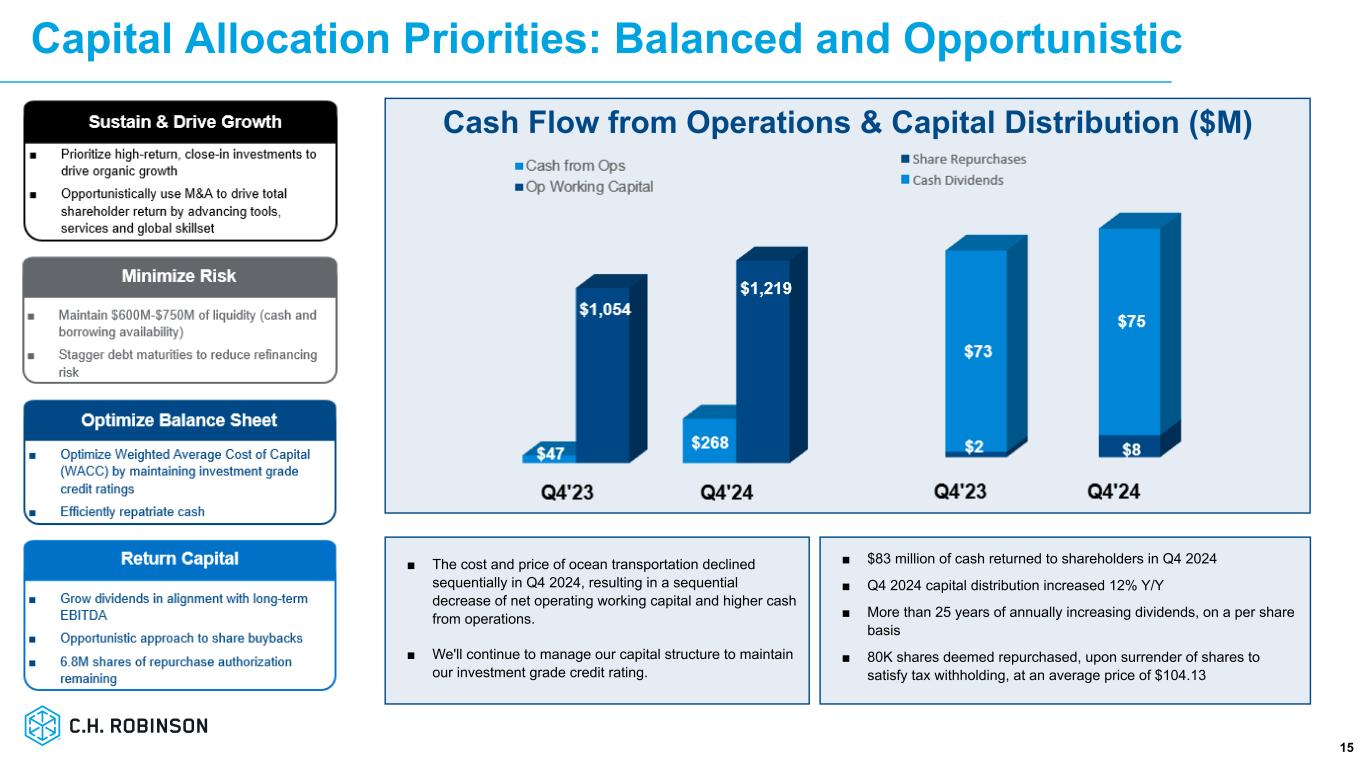
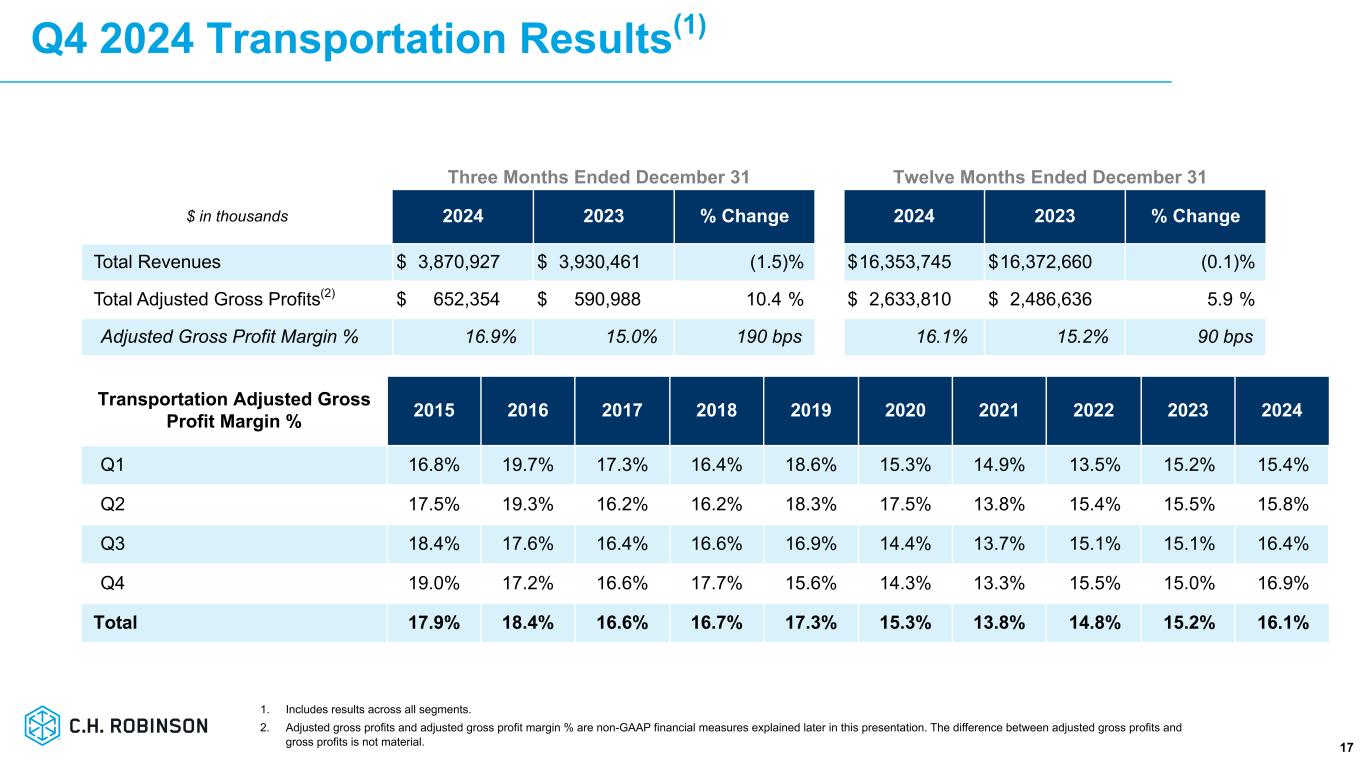
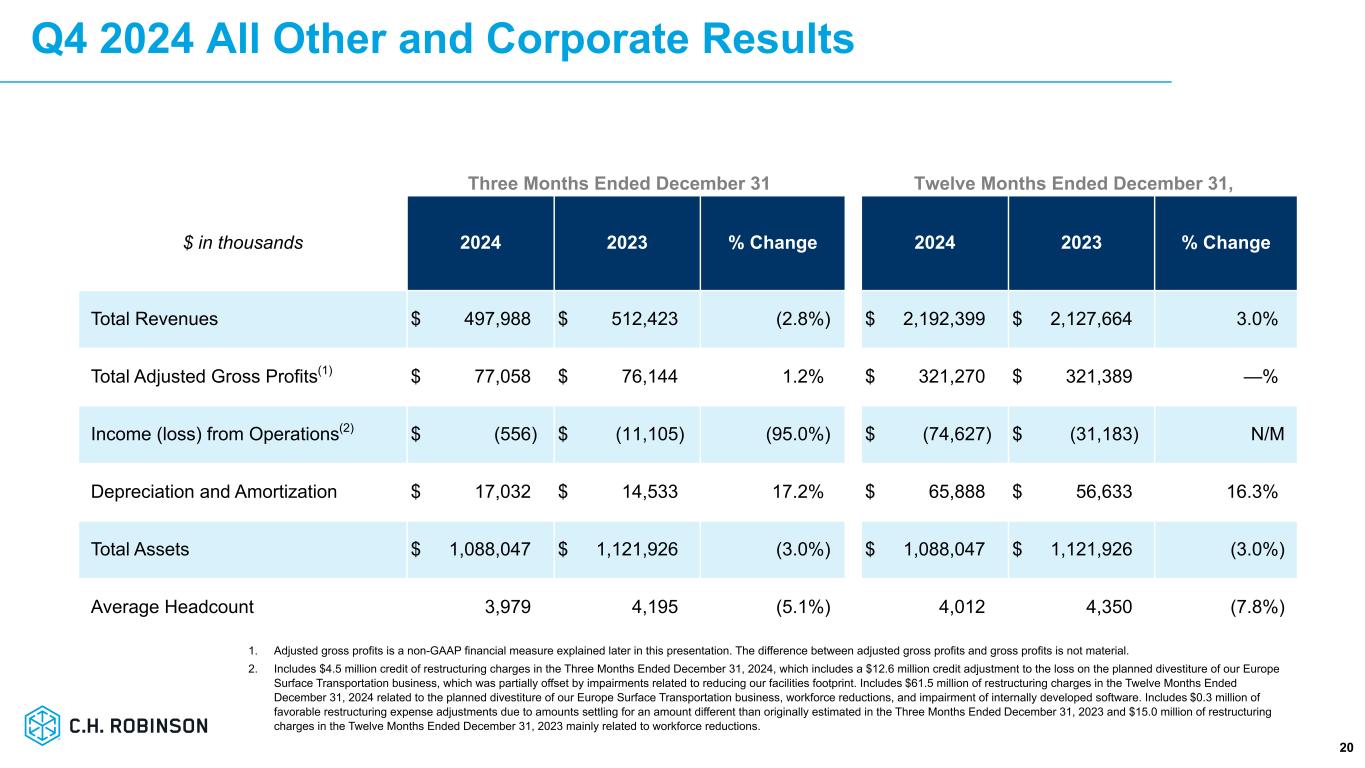
Thanks, Arun, and good afternoon, everyone. As covered by Dave and the team, we delivered significant year-over-year improvement in operating income in Q4, driven by an increase in AGP while reducing cost through our operational discipline and productivity initiatives, and thereby driving higher operating leverage. In the face of continued soft market volume and rising spot cost due to declining capacity, disciplined procurement of capacity and revenue management improved the quality of our volume and our AGP, which was up 66 million, or 10.7%, year-over-year, driven by a 25.6% increase in global forwarding and a 6.2% increase in NAST. On a monthly basis, compared to Q4 of last year, our total company AGP per business day was up 9% in October, up 6% in November, and up 12% in December. From an expense standpoint, our total operating expenses, excluding restructuring charges, declined $15.3 million year-over-year. Q4 personnel expenses were $354.4 million, including $3.7 million of restructuring charges related to workforce reductions. Excluding restructuring charges in the current and prior year, our Q4 personnel expenses, were $350.6 million, down $12.5 million due to our continued productivity and cost optimization efforts, and despite an increase in incentive compensation related to our improved financial results. Our average Q4 headcount was down 9.5% compared to Q4 of last year. Moving to To SG&A, Q4 expenses were $146.4 million, including a $12.6 million decrease in the loss related to the planned divestiture of our European surface transportation business, and $9.5 million of other restructuring charges, primarily related to reducing our facility's footprint. Excluding these, SG&A expenses were $149.6 million, down $2.7 million year-over-year, with the expense reduction across several expense categories. Turning to our 2025 annual operating expense guidance, we expect our personnel expenses to be $1.375 to $1.475 billion. This includes some headcount decline, including those related to the planned divestiture of our Europe surface transportation business, and driven by continued productivity improvements, partially offset by investments in our team, as we reward the talented people that fuel our progress. We expect 2025 SG&A expenses to be $575 to $625 million, including depreciation and amortization of $95 to $105 million. Although most of our SG&A expenses are subject to inflation, we expect continued cost improvements to partially offset the inflationary impact. Shifting back to Q4, our effective tax rate for the quarter, excluding the tax impact of restructuring charges, was 12.4%, resulting in a full-year tax rate of 18.7%. We expect our 2025 full-year effective tax rate to be in the range of 18 to 20%. our capital expenditures in q4 were 15.2 million bringing our 2024 total to 74.3 million for 2025 we expect capital expenditures to be 75 to 85 million from a balance sheet perspective we ended q4 with approximately 1.2 billion of liquidity comprised of 1.04 billion of committed funding under our credit facilities and a cash balance of $146 million. Our financial strength continues to be a key differentiator in our industry as it enables us to continue investing and improving our capabilities. Our debt balance at the end of Q4 was $1.38 billion and our net Net debt to EBITDA leverage at the end of Q4 was 1.61 times, down from 2.08 times at the end of Q3. This was primarily driven by the improved performance of the business and the resulting increase in our trailing 12-month EBITDA, as well as a decrease in our net debt balance. Overall, our Q4 financial results are a testament to our disciplined execution and our focused focus on profitable growth, and I am optimistic about our runway for further improvement. With that, I'll turn the call back to Dave for his final comments.
Thanks, Damon. As I reflect on the noteworthy progress that we made in 2024, I'd like to thank the Robinson team for all the work they've put in to get to this point. I don't take their efforts and dedication for granted, and I commend them for helping us get more fit, fast, and focused, and for embracing the discipline that the new operating model demands. Our improved execution at the bottom of the freight cycle is delivering improved financial performance. We're making better and faster decisions on capturing the right freight at the right price to deliver a higher quality of volume. I believe the disciplines and practices that we have implemented at Robinson can endure through a prolonged freight recession, through a market inflection, and through any part of the freight cycle. As I've mentioned during the past year and at our Investor Day in December, all the changes we're making are aimed at our North Star of generating incremental operating income by focusing on growing market share and expanding our gross and operating margins. We expect to continue growing market share by reclaiming share in targeted segments and by leveraging our robust capabilities to power value-added services and solutions for our customers and carriers that drive new volume to our four core modes and expand our addressable market. We're optimizing our gross profit by monitoring key input metrics and responding faster to error states and changing market conditions with countermeasures and innovative technology that improves our execution, such as our dynamic costing and pricing tools and our digital brokerage capabilities. And we're improving our operating leverage and operating income margins by embedding lean practices, removing waste, and expanding our digital capabilities, such as leading the logistics industry on implementation of the game-changing capabilities of Gen AI. We are arming our people with better tools and moving with greater clock speed and urgency to seize opportunities and solve problems in order to win now and to be ready for the eventual freight market rebound. On my first earnings call in August of 2023, I said that I looked forward to leading this great company to new heights and sharing our progress with all of you along our journey. While there's still more grass to cut, I believe we're on the right path, and I'm pleased with the progress we've made on evolving our strategy and improving our execution by instilling discipline with our new operating model this concludes our prepared remarks i'll turn it back to the operator now for the q a portion of the call thank you we will now be conducting a
Operator
question and answer session if you'd like to ask a question please press star 1 on your telephone keypad a confirmation tone will indicate your line is in the question queue you may press star 2 to remove yourself from the queue for participants using speaker equipment it may be necessary to pick up the handset before pressing the start keys. One moment, please, while we poll for questions. Our first question comes from the line of Chris Weatherby with Wells Fargo.
Please proceed with your question. Yeah, hey, great. Thanks. Good afternoon, guys. You know, I guess I wanted to kind of just make sure that I understood sort of the approach that you're taking to the market as it stands today. So at the Investor Day, you outlined gross margin opportunities, also sort of productivity opportunities on operating margin expansion. And I think while you outperform sort of the market from a volume standpoint in NAS, I guess TL was down sort of in that six and a half percent range. So I guess I just want to make sure I, you know, kind of get some clarity on how do you think about those separate opportunities of the gross profit margins and then ultimately the operating margins as we're in this type of market? So I guess how should we expect you to try to balance those priorities, particularly as we turn over into 1Q and 2Q, where maybe we're seeing some recovery, maybe we're not. It's still a little bit unclear.
Yeah. Hey, Chris, this is Dave. Good to hear from you and good to see you at Investor Day. A number of things in what you said there, it certainly still is a very tough market out there for us, which is why I'm really proud of the team and how they're really navigating the waters here within NAST. I'm going to have Michael go a little bit deeper into the team and where you're getting at, and then we can also circle back to it as well when he's done it. We don't double click enough on it, but Michael, let's go a little bit further on that one.
Yeah, thanks, Chris. I think you called out really what we're trying to make sure we accomplish, which is the quality of volume that we manage and execute for our customers and carriers. And Q4 continued to be a very competitive marketplace where demand is just not where the market needs it to be. And with that in mind, we're prioritizing making sure that we haul the right freight, that we deliver a very high level of service. And through the tools that we've implemented, you know, we were able to expand our gross margins in a rising cost market, which was a challenge we really set out for ourselves during some of the work you saw us talk about at Investor Day. And so really, to Dave's point, proud of the work the team did. Certainly, as we head into Q1 and Q2, we would want to share the same sentiment that you have, that hopefully those shoots of volume start to come forward. But even then, we're going to still maintain that discipline that we price things correctly, we haul the right freight, we meet our customer service expectations, and we deliver strong bottom line numbers as a result.
Yeah, Chris, and then, again, just kind of put a period on that. It's really about that flexibility. With our model and where we're going, if we start seeing this thing inflect, you know, Michael and team and the rest of the team across Robinson, as we said in Investor Day, we are prepared with the flexibility for when this market starts to come back. And, again, driving at higher lows, if it's steadier throughout the year, we're prepared to continue to deliver what you're seeing here. So thanks for the question.
Operator
Thank you. Our next question comes from the line of Bascom Majors with Susquehanna International Group. Please proceed with your question.
Thanks for taking my questions. We're a couple months removed from when you put the plan together. to share with us in december just curious if you could walk through some of the cyclical puts and takes on the path to 26 as you feel today and you know if you know there's any other leanings in either direction on any of your businesses compared to to what we heard in early december thank you
hi bascom this is uh this is damon um you know look you know certainly investor day was a good event for us i think our message came across loud and clear you know we we feel good about the targets we laid out in Investor Day and the mix of those targets between businesses and initiatives. So I would say there's not been any pivot or change from our position on how we laid out Investor Day in December and what we see today. So again, we feel good about the targets we laid out. We feel good about the path in which we will deliver those targets. And you're touching on an exact reason on why we gave a range for the market, right? No one knows what the market's going to be between now and 2026, but we're going to control what we can control and keep the discipline. And as Michael mentioned, the focus on the quality of volume. And I think all of that will certainly line up to delivering those 2026 goals the way we laid them out in December.
Operator
Thank you. Our next question comes from the line of Ariel Rosa with Citigroup. Please proceed with
your question. Yes, this is Ben Moore on for Ari. Thanks so much for taking our call. Great to see you guys at the Investor Day. On your two key areas for revenue growth, you mentioned enterprise versus S&B markets. What would you say you're in in terms of inning for both of those? Is it more like seventh inning for enterprise, but a whole lot more like third inning for SMB. And then on your cross-selling opportunity as your second area, you've noted 20% of global forwarding AGP growth comes from relationships that began at Nest, and there could be more runway. How much opportunity is left from this cross-selling across your segments? Would you say you're in the third inning there. I would love to hear your thoughts on both these areas of growth.
Yeah, Ben, this is Michael. Thanks for the question. I think overall, I'd say we're in early innings in all aspects of that business. You know, we believe while we've done business in certain verticals for a long time, and SMB is something that is core to our history and something we've done for a long time, that we have a lot of runway in front of us in those areas to grow, but also to move up the value stack and deliver more and more capabilities and services to our customers. You know, as you think about then that next stage of cross-selling, whether it's NAS to GF, GF back to NAS, or the example we gave with our RMS announcement right before Investor Day of bringing those two teams together, we have a tremendous opportunity in front of us to maximize the value of one Robinson. And certainly while we've seen the benefits of that, there's no way we could say that we've maximized that opportunity. And so we feel really good about what we presented back in December and feel really aligned to those opportunities. And more importantly, we're going to hold ourselves accountable to maximize the impact of the different aspects of our divisions and make sure we bring the full scale and capabilities of Robinson to all of our customers.
Yeah, Ben, and sorry for that interruption there. The only period I put on that, on what Michael said, you know, I just came off the road. I'm talking to the teams and, you know, they are really fired up on this. This certainly is early innings of this game, but from an S&B perspective, these guys are going out and getting it. We feel really good to Damon's question and answer to Bascom earlier. We feel really good about what we've laid out on this growth trajectory, and the team is really aligned, and Michael and the team are doing a nice job on driving that accountability. So, thanks for the question, and again, apologize to everyone for the disruption.
Operator
Great. Thanks so much for the color. Our next question comes from the line of Brian Ozenbeck with J.P. Morgan. Please proceed with your question.
Hey, afternoon. Thanks for taking the question. So, I guess maybe for Michael, can you just give us some color, if you can, about maybe demand or indications of demand across any particular verticals and customers that you're speaking with and then also along with vines where you think we're sort of starting off the year within within the bid season as things start to start to get ramped up here thank you
yeah thanks thanks brian you know i think what we saw in q4 was a continuation of of a marketplace that had very high adherence to route guides, a very, very competitive transactional space. And the team did a really nice job of, you know, really weaving through that for the best results we could deliver. You know, an example of that is, you know, we feel really good about the health of our contractual business, our wins as we're going into those RFPs, you know, saw we beat the cash shipment index in our contractual space in Q4. So really lining up to that concept of the optionality we discussed earlier of making sure that, you know, when we're engaging customers directly on their business where we can bring the value proposition of Robinson to the table, we're winning. And then we're being really smart about the transactional business where we're winning on a day-to-day basis where incumbency has less value, right? And we aren't going to see the long-term benefits of getting super aggressive in that space based on the current market. You know, you asked about kind of moving into Q1. Q1 is a traditionally heavy RFP space. And I'll just keep saying what I said about Q4 is we feel good about the strategy we have from how we're engaging customers, our pricing strategy for that space. But we're not – I wouldn't say we're seeing uptick yet in the overall demand in those RFPs. It continues to be a marketplace that we're seeing impact of carrier exits, but we're not seeing impact of demand increases at this point.
Okay. Appreciate that, Mike. Thanks.
Operator
Thank you. Our next question comes from the line of Tom Wadewitz with UBS. Please proceed with your question.
Yeah, great. Good afternoon. I wanted to see if you could offer some thoughts about, and I apologize if I missed this earlier, but how do you think about truckload volume growth in 2025? Do you think that's something that you transitioned to in second half? I guess you have to maybe share your underlying view on how the market progresses, but do you think we should be optimistic that you get into that? And then I guess another component of that would be, you know, did have some weakness in truckload volume in 4Q, focused on, you know, kind of the right loads and everything. When the market starts to tighten, do you think you get a bigger swing, you know, a significant swing in the truckload volumes? Or do you think that that's going to tend to be gradual? Thank you.
Yeah, Tom, thanks for the question. I think we want to make sure we continue to reiterate the optionality that we feel we have in truckload volume right now. You know, we're taking a very disciplined approach for what volume is the right volume for us in the current marketplace. I don't think anyone on this call would give you a crystal ball of what we think is going to happen in 2025 from a volume perspective. I think everybody in our industry has been trying to predict that for the last 36 months, and it keeps extending. But I feel really good that when the market inflects, we will have the tools and the talent to maximize the impact of that inflection. You know, we saw it seasonally in Q4, and then with the storms that happened again this January. And we said it in our prepared comments that, you know, our performance was markedly different. and I just couldn't be more proud of the team and how they managed a situation where, you know, seasonal cost increases, storm-related events, and we're handling that in a much more disciplined
and effective manner. What about when you see this swing? Do you think that the way you're set up, you might have kind of a big step up in volume, or do you think it ends up being just more gradual?
i i think tom it would depend on the type of swing and and that's the part where uh we listen we do uh mock-ups we do testing of what we think uh will happen and we're prepared for it but i think we all have to make sure we do the right thing depending on on how that inflection happens and whether it's a gradual inflection or or a very quick turnaround where i am confident is regardless of what it is, I think we have the tools and talent to execute against it. Okay, great. Makes sense. Thank you.
Operator
Thank you. Our next question comes from the line of Ken Hexter with Bank of America. Please proceed with your question.
Hey, great. Good afternoon. Maybe just a little bit on the forwarding side. Can you talk about given how far, I guess, maybe the squeeze we've already seen on rates and then what, what i guess could happen as maybe shipping starts to return to some normal shipping patterns uh how that impacts the the forwarding side um and then any any side thoughts on on headcount as well
thanks so hi ken thanks for the uh the question um so as we laid out an investor day um you know as part of our 2026 um oi walker or bridge you know we did have a um an item in there related to rate normalization, right? And that was both rate normalization for truckload and rate normalization for global forwarding. So as the forwarding market returns to, call it more normalized levels of rates, we have taken that into consideration as we've built our path forward for 2026. So I'd reference you, you know, as far as the net impact of that for the enterprise, I would reference you back to the net $10 million headwind that we showed by 2026 for rate normalization for the enterprise. And certainly, you've got tailwind coming from truckload in that $10 million, and then you've got headwind coming from ocean rate normalization from our forwarding business. Specifically to your question around headcount, as Dave mentioned in his opening comments. You know, the global forwarding team did a fantastic job in 2024, you know, debunking the thesis that we can't separate headcount from volume growth. In fact, it's no longer a theory in our global forwarding business. It's actually a fact. And in 2024, that business demonstrated decoupling headcount from growth throughout the year. And certainly those lessons we've learned, those tools and skills that we've we've honed to execute that in 2024 what will carry forward into 2025 um to whatever market we uh we see from a from a forwarding perspective so just to clarify
your comment on the the rates um going back to normalization on investor day i totally remember the slides um but do you think that's kind of where we're settling out as things get is back to normal historical or do you think given the amount of capacity added on we start seeing maybe
additional pressure on the shipping rates. Yeah, so our view hasn't changed and consistent with what we laid out in Investor Day, we see the ocean rates normalizing back to the levels we saw in the second half of 2023. So that's the math that supported our OI bridge and market normalization assumptions in Investor Day, and we stick to that viewpoint as of today. Sounds good. Appreciate the
Operator
time. Thanks. Thanks, Ken. Thank you. Our next question comes from the line of John Chappell with Evercore ISI. Please proceed with your question. Thank you. Good afternoon. I know
we've touched on a lot here, but just kind of a bigger picture question, thinking about the path forward. You're obviously very focused on profitability thresholds that you want to hit. You've done a great job on the cost side. At a certain point, the market will come back and you're going to want to get your share or better of volume. So how do you think about balancing this desire to win back the Robinson share, or again, better, while still keeping some of these profitability thresholds that you've set for yourself over the last year? Yeah, John, good to
hear from you. A couple things on that question. One, it's everything we've been really discussing and that we laid out in Investor Day as well. We have put together our operating model discipline that sets us up for the basis of that question, and that's with our people being at the forefront of that strategy and technology, giving them the tools to drive that technology. That's going to allow us to really drive growth that we've talked about in the verticals. It's going to allow us to drive and take share in a small, medium business segment. And on top of that, when the market inflects, we have a history that will drive the transactional space as well. So we have optionality built into our model, and we feel really good about that. So the key point is, be it a slow burn or be it an aggressive turn, we've set ourselves up to really be ready for either one. And our team is really attacking what we can control and the cars that are dealt with us. But we are prepared for either scenario. We can double-click a little bit more with that one.
Yeah, I think the question you're asking is a good one. But where we feel comfortable is that each marketplace creates different scenarios in the current marketplace. Pricing is low. Our advantage is really through our pricing and costing engines that we've been able to implement with our team and really, as we've said, increase the quality of our volume and making sure that we're getting that right combination of volume and margin. In a different marketplace where costing is moving and pricing is moving, you know, we think we still have the best tools in the industry to then provide us the opportunity to pick up freight and win share. You know, we need to be able to do both, and our expectation of ourselves is we will do both, and we've consistently been able to do that throughout 2024, and I have confidence in the team that we'll do that when the market inflects and continuing into 2025. Yeah, John, and hopefully
at Investor Day, we laid out those physicals to show you why we feel confident about that, but
Operator
Our next question would be from David Hicks with Raymond James. Please proceed.
Hi, guys. Thanks for taking the question. I also just wanted to kind of head back on the global forwarding segment, kind of just given the developments in the Middle East. What are you hearing from the ocean liners on a return to the Red Sea and slash Suez route? And how does that kind of change the pace or timing of ADP for shipment and forwarding coming back to those second half 23 bubbles that you mentioned?
Hey, David. This is Dave Bozeman. Hey, listen, thanks for the question. You know, when it comes to the ship lines, certainly the situation in the Red Sea is a situation that's still ongoing. I mean, it takes time for the ship lines to really adjust back into normal operations. I think what we see from them is they are evaluating the situation. We don't see a full-out, you know, sailings through the Suez yet. They're still on their normal sailings around the Horn. And, you know, so we're monitoring that closely. But at this point, it's still a situation of monitor. We don't know exactly the timing of when that will shift. When it does, we'll certainly be up front and center there. Damon, anything on that?
Yeah, David, I would just add that our viewpoint is that carriers won't immediately return to the Red Sea. I mean, we're seeing some activity there, but we believe for it to return to levels of normalcy, that it'll take time for that to happen. You know, so nothing happens quickly or overnight in the shipping world. And so, as Dave mentioned, we're monitoring it. We're controlling what we control, and we'll certainly service our customers, you know, based on what the market yields.
Great. Appreciate it. Thanks, Ed.
This is the conclusion of our call. Have a great evening, and we look forward to talking to you again. Thank you.