Operator
Good morning, and welcome to the Commercial Metals Company Fiscal 2026 Fourth Quarter Earnings Conference Call. All participants will be in listen-only mode. Should you need assistance, please signal a conference specialist by pressing the star key, followed by zero. After today's presentation, there will be an opportunity to ask questions. To ask a question, you may press star, then 1 on your telephone keypad. To withdraw your question, please press star, then 2. Please note, this event is being recorded. I would now like to turn the conference over to Andy Larkin, Vice President of Investor Relations. Please go ahead.
Hello and welcome to the Commercial Metals Company Fiscal 2026 Fourth Quarter and Year-End Earnings Call. Joining me on today's call are Peter Matt, CMC's President and Chief Executive Officer, and Paul Lawrence, Senior Vice President and Chief Financial Officer. Today's materials include the press release and supplemental slides that accompany this call, which can be found on the CMC's Investor Relations website. As a reminder, today's call is being recorded. Peter will begin our prepared remarks with a high-level overview of the year and fourth quarter and comment on the progress against our strategic objectives. Paul will then provide a detailed discussion of our quarterly results as well as capital allocation. Peter will wrap up with our view on the path ahead. We will then provide instructions for the question and answer session to follow. Today's discussion contains forward-looking statements, including with respect to economic conditions, effect of legislation and trade actions, U.S. steel import levels, construction activity, demand for finished steel products and precast concrete products, the expected capabilities, benefits, costs, and timeline for construction and commissioning of new facilities, the expected performance and integration of our recently acquired precast platform, the company's operations, the company's strategic growth plans, and its anticipated benefits, the company's ability to achieve its stated deleveraging targets within the anticipated timeframe, legal proceedings, the impact of tax credits on future results, the company's future results of operations, financial measures, and capital spending, including expected share repurchase activity. These statements reflect the company's beliefs based on current conditions but are subject to risk and uncertainties. The company's earnings release, most recent annual report on Form 10-K and other filings with the U.S. Securities and Exchange Commission contain additional information concerning factors that could cause actual results to differ materially from those projected in forward-looking statements. Except, as required by law, CMC does not assume any obligation to update, amend, or clarify these statements. Some numbers presented will be non-GAAP financial measures, and reconciliation for such numbers can be found in the company's earnings release, supplemental slide presentation, or on the company's website. Unless stated otherwise, all references made to year or quarter end are references to the company's fiscal year or fiscal quarter. With that, I would like to turn the call over to CMC's President and CEO, Peter Matt.
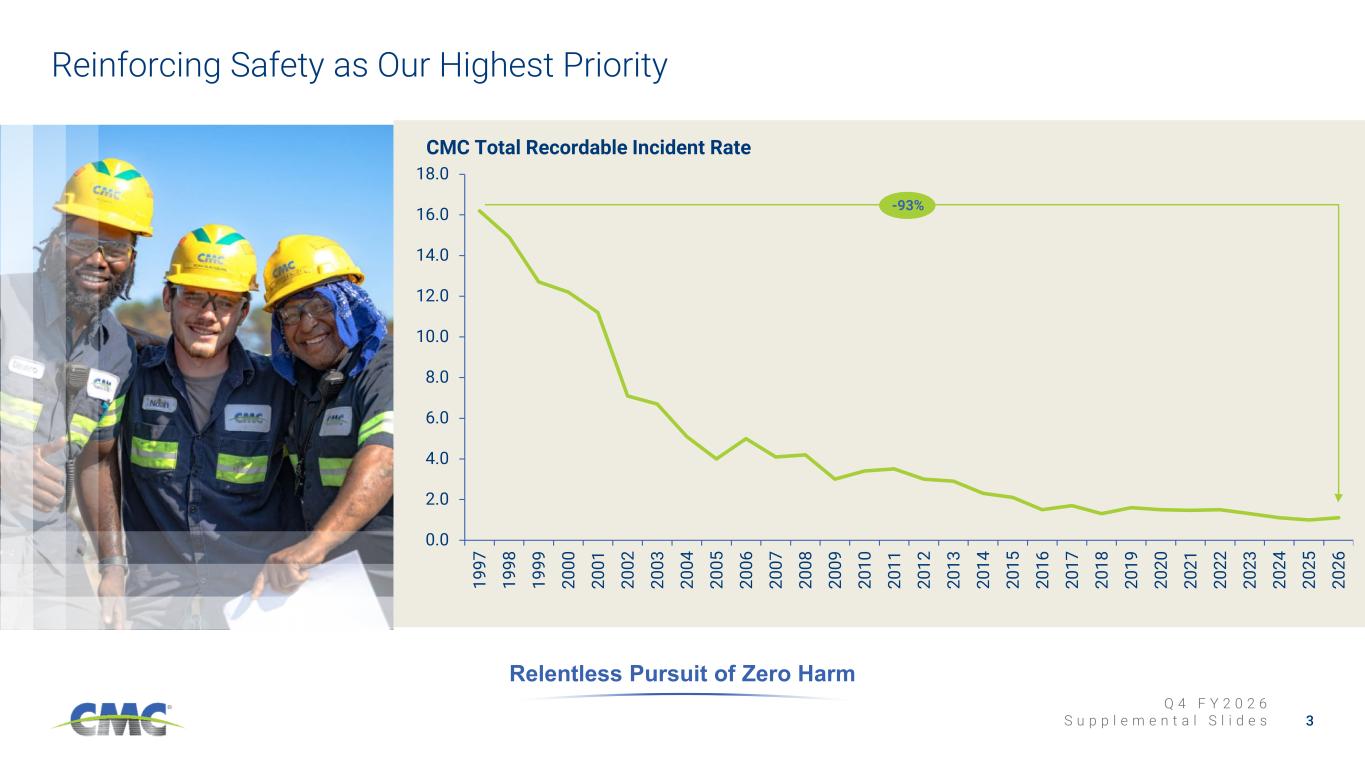
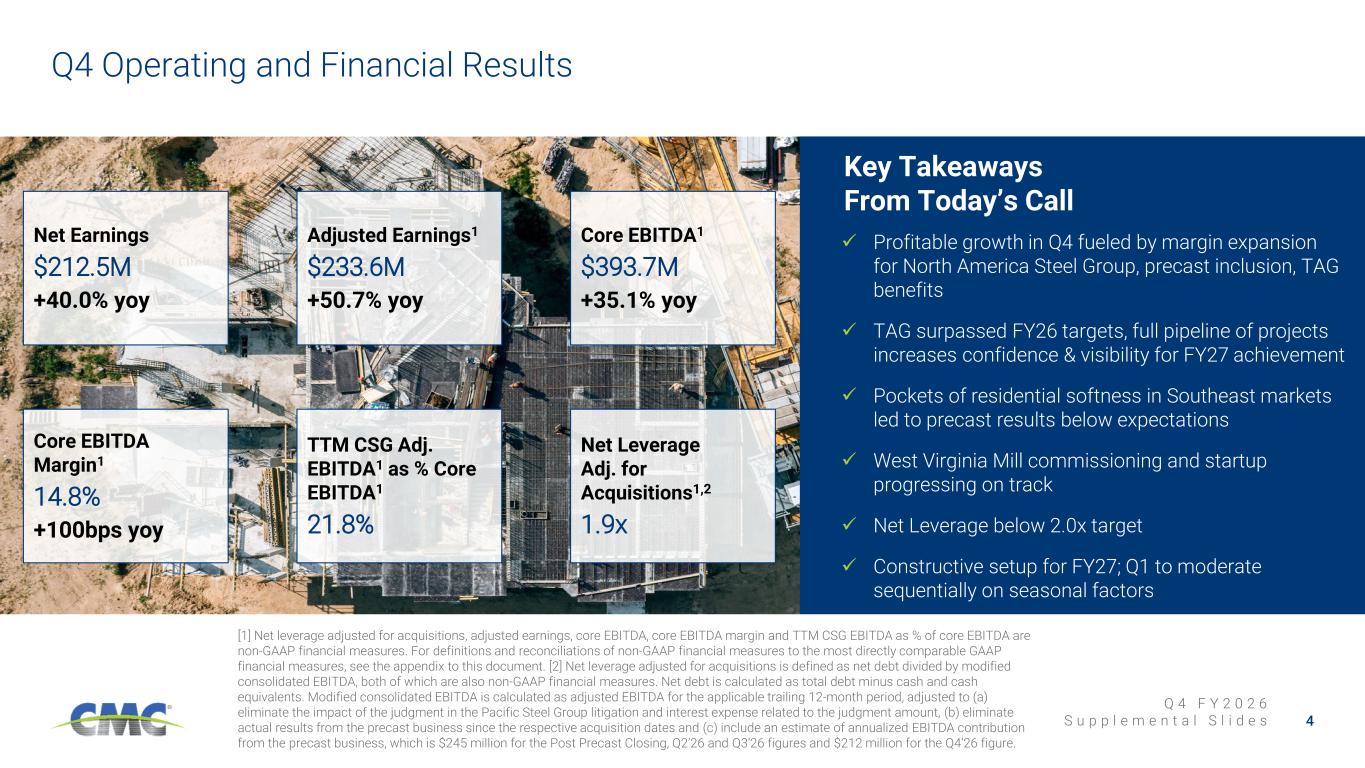
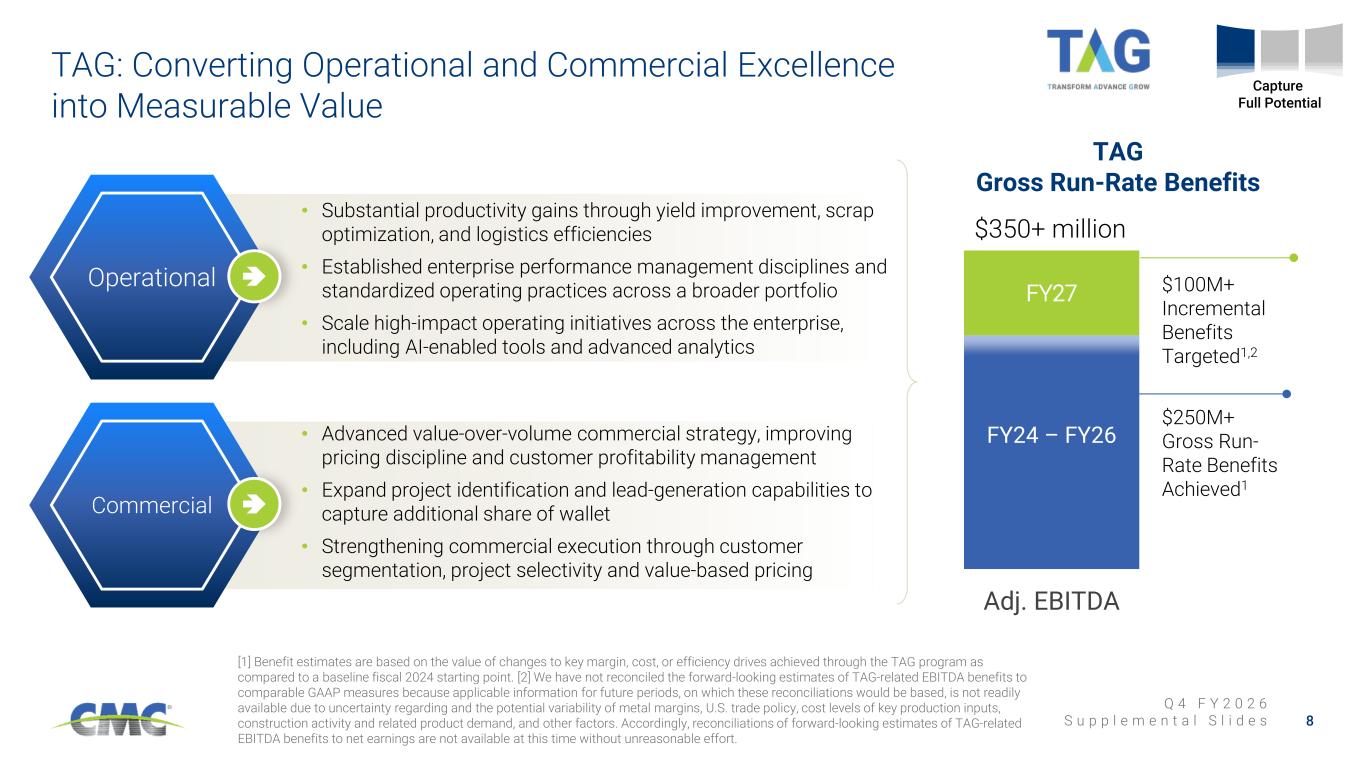
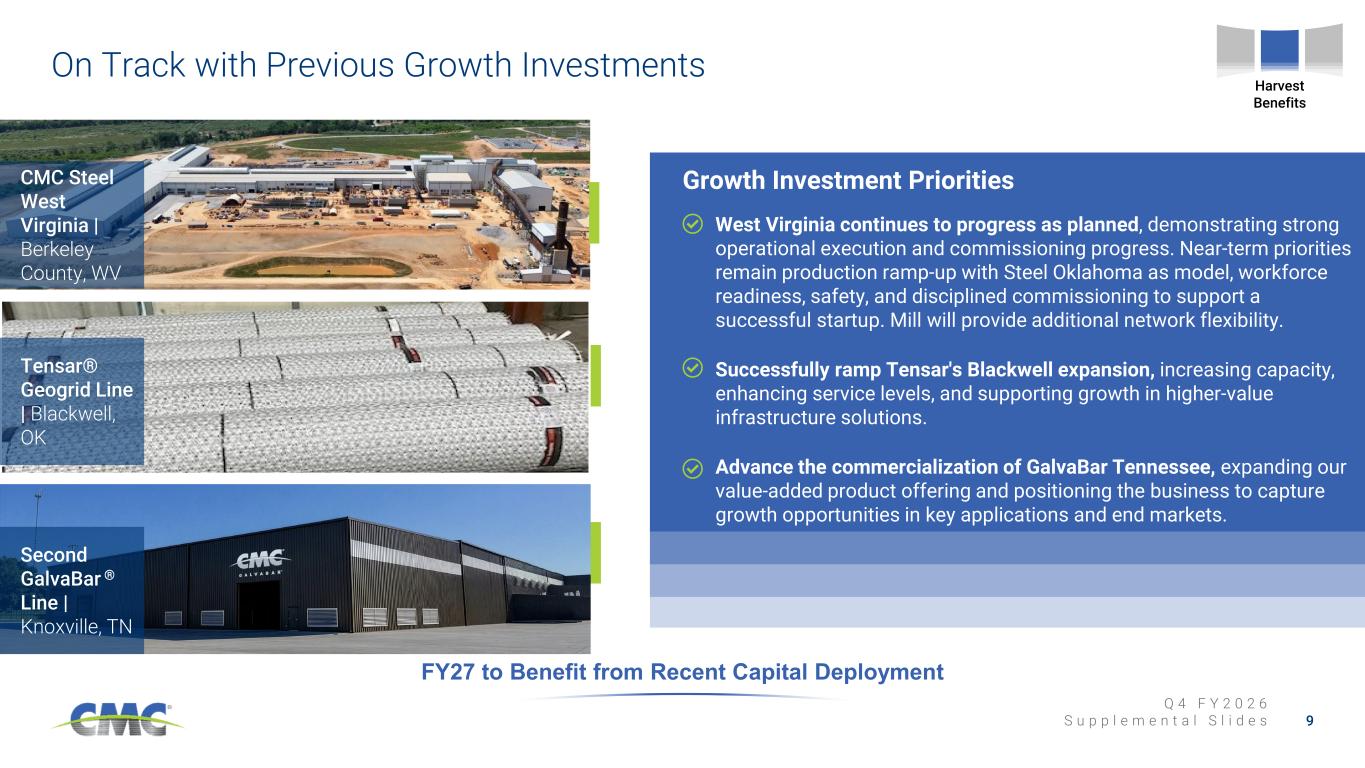
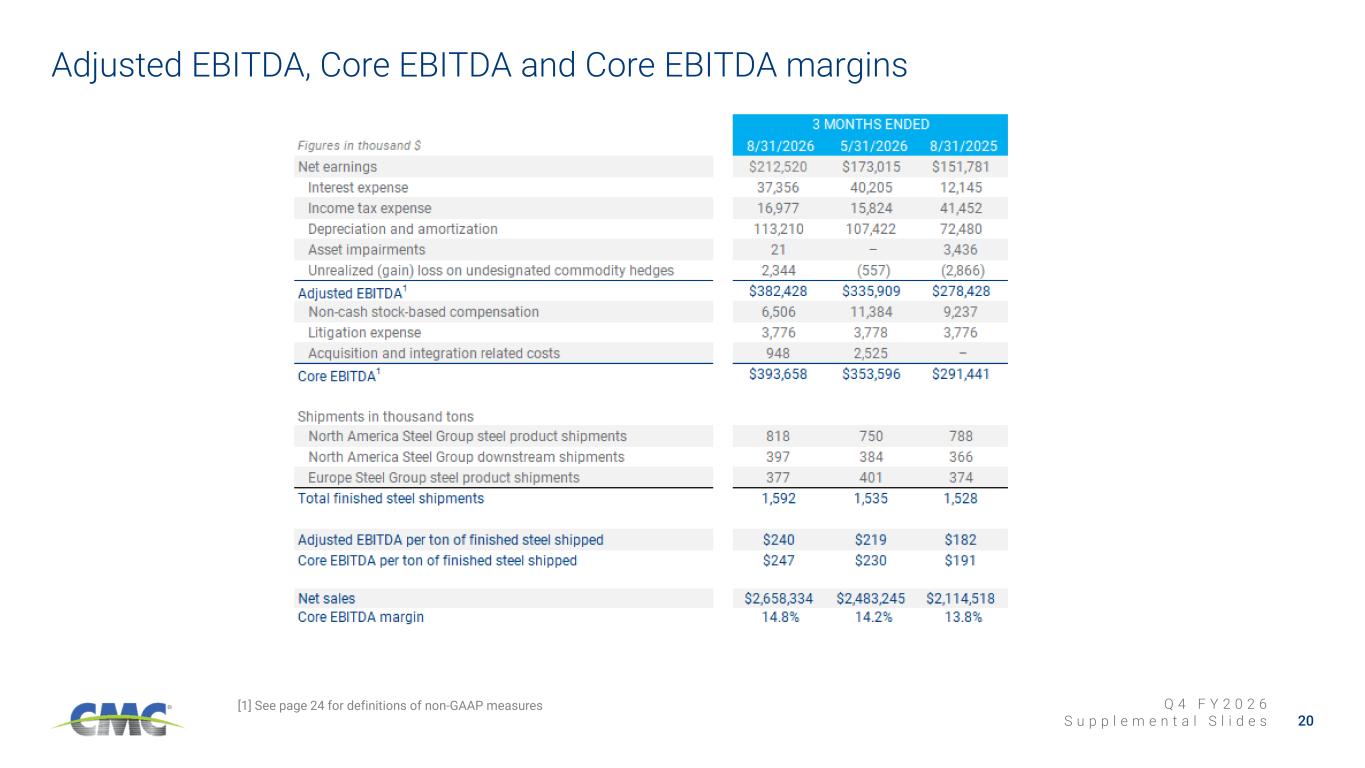
Thank you, Andy, and good morning to everyone joining us for today's call. We will discuss many accomplishments today, but none is more important than safety. I want to thank our employees for their continued focus and commitment to our most important company value. Our total recordable incident rate for fiscal 2026 remained near a historic low point and better than industry averages. During the year, we put significant effort into embedding CMC's safety-first culture across our newly acquired precast operations and strengthening safety performance throughout the organization. While we're proud of that progress, our standard is higher. Our goal is zero harm, and we will be relentless in striving for it. Now, stepping back, fiscal 2026 was a defining year for CMC. We made significant progress executing the strategy we laid out at our investor day, strengthening the quality and durability of our earnings profile, expanding margins, reducing leverage, enhancing free cash flow generation, and positioning the company for sustained shareholder value creation. For the full year, core EBITDA increased to approximately $1.4 billion, up from $837 million for fiscal 2025, while core EBITDA margin expanded 380 basis points to 14.5%. These results reflect meaningful progress across each of our strategic priorities, including the execution of our Transform, Advance, and Grow program, the advancement of key growth investments, and the ongoing successful integration of our precast acquisitions. Just as importantly, we have strengthened our balance sheet. Since completing our precast acquisitions, we have reduced leverage as adjusted for acquisitions to below our target range, providing greater financial flexibility to invest in growth while returning capital to shareholders. Our momentum carried into the fourth quarter with core EBITDA increasing 35.1% year-over-year to approximately $394 million, while core EBITDA margin expanded to 14.8%. Results in the quarter were driven by strong North American steel group performance, where execution against strategic priorities has created clear value for our business. Segment margins increased 220 basis points sequentially, driven by strong tag contributions, including operational and commercial excellence initiatives. We are also seeing that as the market and our customers pursue larger and more complex projects in energy, industrial reshoring, data center, and institutional sectors, CMC's scale, capabilities, and network are increasingly making CMC a preferred partner. Our downstream expertise, with its customized solutions and customer-focused approach, has us positioned to win in this increasingly complex environment. Downstream product volumes grew 8.5% year-on-year in the fourth quarter, with expanding margins reflecting this dynamic. At the same time, our Arizona 2 micromill is enhancing our merchant production capabilities to support growth and demand. Shipments for merchant bar increase 27.5% year-over-year, demonstrating the capabilities of the Arizona 2 plant and the flexibility it provides to optimize product mix to capitalize on strong market conditions and balance supply with demand. For our construction solutions group, fourth quarter results were below our expectations, due primarily to our precast business with residential softness in certain southeastern markets. Notably, we have seen the same regional softness in our fabrication book, though it is not visible externally given the geographic diversification of our fab footprint. As residential activity moderated, lower volumes and regional margin mix headwinds weighed on adjusted EBITDA performance. Precast generated adjusted EBITDA of $57.1 million during the quarter, and excluding the purchase accounting impact, has contributed roughly $150 million of adjusted EBITDA since our acquisition. The leading indicators for the business remain positive. The demand environment, especially in non-residential and infrastructure, remains healthy, with strong bidding activity in key markets like Atlanta picking up in recent months. Bookings were up year over year and increased 12.6% sequentially. Backlog levels are up roughly 3% versus the prior year and 4% versus Q3, while average backlog pricing has also trended higher. These factors position the business for solid performance in the year ahead. Strategically, as we close 2026 and look ahead to fiscal 2027, we are highly confident in our direction and in the three powerful drivers of value creation we laid out at our investor day. First, we will continue capturing the full potential of our business through TAG. Second, we will begin harvesting returns from significant growth capital deployed over the last several years. And third, we will continue reshaping our portfolio as a leading provider of early-stage construction solutions. Together, these initiatives, which are within our control, will power a stronger CMC, both operationally and financially. We have made significant progress in fiscal 2026 as TAG continued to evolve from a program into a core operating system for CMC. Across the enterprise, we realized meaningful productivity gains through yield improvements, scrap optimization, logistics efficiencies, manufacturing excellence initiatives, and an increasing focus on commercial excellence. Looking ahead, the opportunity set remains substantial with a full pipeline of initiatives that will drive additional earnings growth and margin expansion. We exited fiscal 2026 with more than $250 million of gross run rate benefits achieved and a clear line of sight to an additional $100 million of run rate benefits by the end of fiscal 2027. We view TAG as a durable source of margin expansion and an increasingly important competitive advantage for CMC. Turning to growth investments, fiscal 2027 will mark an important transition. For several years, we have invested significant capital to strengthen and modernize our asset base. Nearly $1.5 billion of capital has been deployed to modernize and complete our coast-to-coast mill network, both improving our competitiveness and providing network flexibility. As we enter fiscal 2027, those investments increasingly shift from consuming capital to generating returns. At Steel West Virginia, commissioning and startup activities continue to progress well. The team is executing a disciplined commissioning process, keeping its focus on safely increasing production, developing the workforce, and realizing the full potential of the mill. As production increases, Steel West Virginia will strengthen the flexibility of our whole network, enabling us to flex and optimize production costs and product mix to better serve customer demand for different products across our footprint. Before moving on, I'd like to recognize the team leading the construction and commissioning of our West Virginia Micromill. Their efforts have been outstanding and reflect the disciplined approach to capital deployment and project execution that defines CMC. At Tensar, the new geogrid line in Blackwell, Oklahoma, is well into its startup and will increase geogrid production capacity, enhance service levels, and fuel growth in higher-value non-residential and infrastructure applications. We are equally encouraged by the construction progress at Galvabar, Tennessee, where we expect first production of our Galvabar corrosion-resistant product beginning this November. The facility is expected to more than double our Galvabar production capacity, expanding our presence in this attractive, higher-margin market segment. Beyond our organic growth investments, we are reshaping our portfolio and diversifying our earnings profile, most recently with our precast platform investments. Turning to our precast business, integration activities remain on track and synergy capture is meeting or exceeding expectations. A great example of this is where, through best practice sharing across our network, we have implemented several new operational practices that will improve our safety performance and eliminate millions of dollars of waste from our supply chain. To date, we have substantially completed the functional integration of the platform, creating a strong foundation to drive value creation. Utilizing a TAG approach and mindset, we are advancing a broad range of operational excellence and commercial excellence initiatives and have identified further opportunities across operations, procurement, footprint optimization, and commercial execution that will enhance growth over time. Precast plays a critical role in strengthening CMC's position in early-stage construction solutions. The business enhances our portfolio with leading positions in attractive growth markets and in-demand infrastructure applications. It brings compelling financial characteristics, stronger, more durable margins, lower capital intensity, and attractive free cash flow generation. Precast also expands our growth runway through both organic opportunities and acquisition opportunities in a highly fragmented industry. With sound execution, we expect Precast to play a vital role in building a stronger CMC. Let's shift from our three value creation levers to the current operating environment. Regarding demand for early-stage construction products, the direction of travel remains unchanged. We see constructive conditions for all of our product categories across the majority of the markets we serve. Beginning with infrastructure, demand remains elevated. Significant federal and state funding continues to support a multi-year pipeline of projects, and with a substantial portion of available funding yet to be spent, we have strong visibility into future activity. Non-residential construction demand varies by market, but remains a source of strength for CMC. Activity related to areas like data centers, power generation, utility infrastructure, semiconductor manufacturing, and institutional markets is solid. And the Dodge Momentum Index remains near record levels, suggesting a robust and extensive project pipeline. Many of these nonresidential projects are larger, more complex, and increasingly requiring diverse solutions. As noted earlier, this plays directly to CMC's strengths. Our vertically integrated network, downstream capabilities, and broad early-stage construction portfolio are differentiators and position us to meet the complexity and scale of these megaproject opportunities better than ever before. While residential remains mostly muted, particularly in new single-family construction, we remain optimistic for this market over the long term, where the housing shortage in the U.S. will be a meaningful source of multi-year demand. On the steel supply side, our low-cost and flexible North American steel network is well-positioned to win in this environment. The domestic rebar market remains highly consolidated, and the import landscape has materially improved compared to just a few years ago. Existing Section 232 measures have proven both effective and durable, while recently finalized trade cases against unfairly traded imports have effectively removed hundreds of thousands of tons from the market. Importantly, rebar imports are beginning to show signs of moderation as arbitrage opportunities diminish. Notably, South Korean imports decreased in September as we have been expecting and the imports from other sources continue at a fraction of prior year levels. Meanwhile, we continue to see heightened focus across the industry on trade enforcement and ensuring that imported material competes on a level playing field. Taken together, we believe these dynamics support a more rational and sustainable competitive environment where CMC can reap the benefits from its investments made and more fully capture the value we bring to the market. Now, before providing our outlook, I'll ask Paul to go through the quarter in more detail.
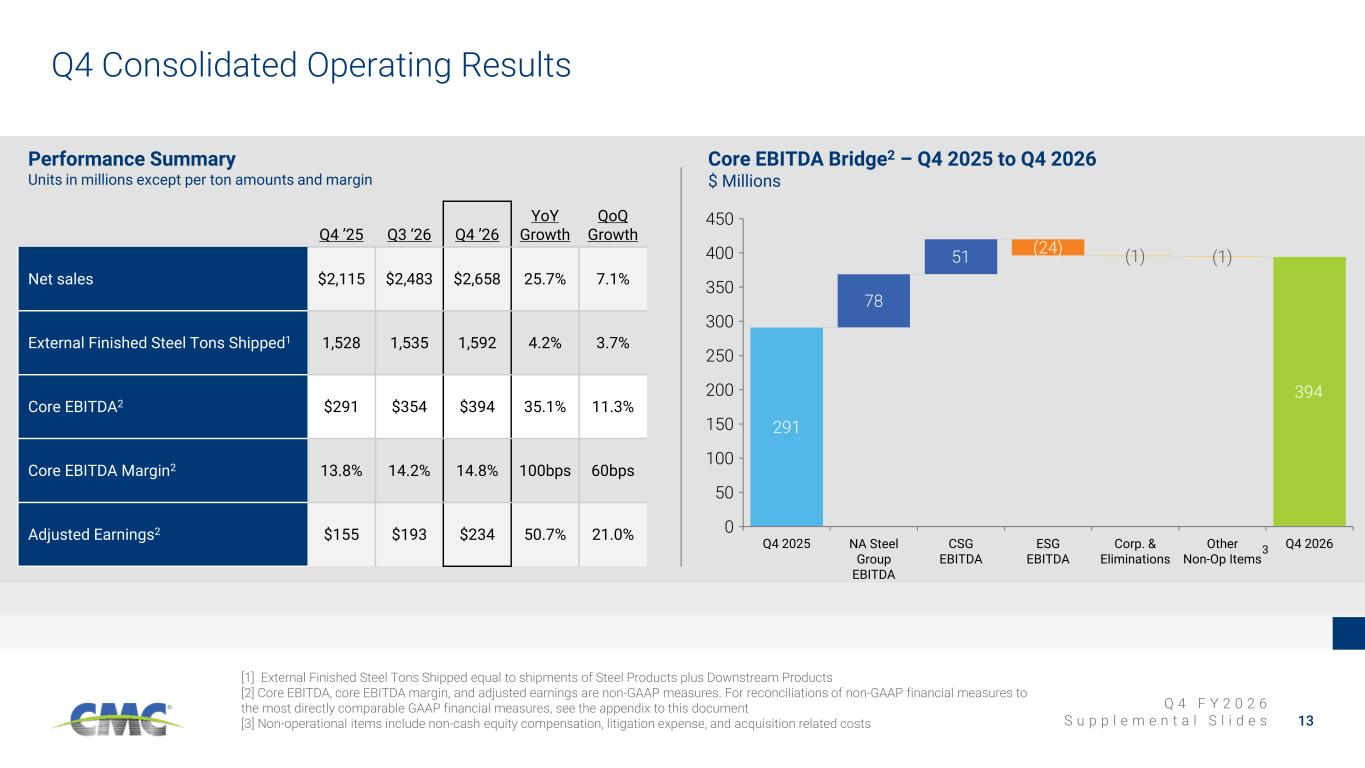
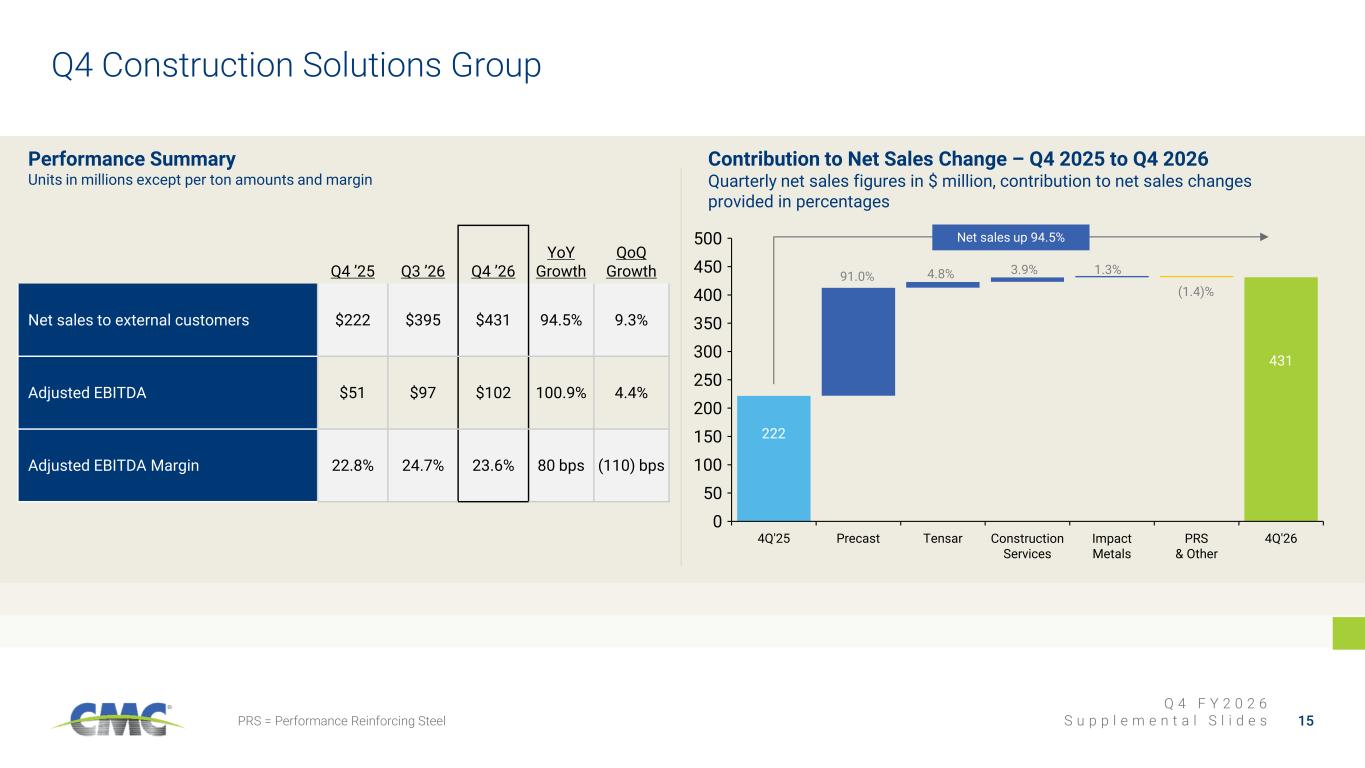
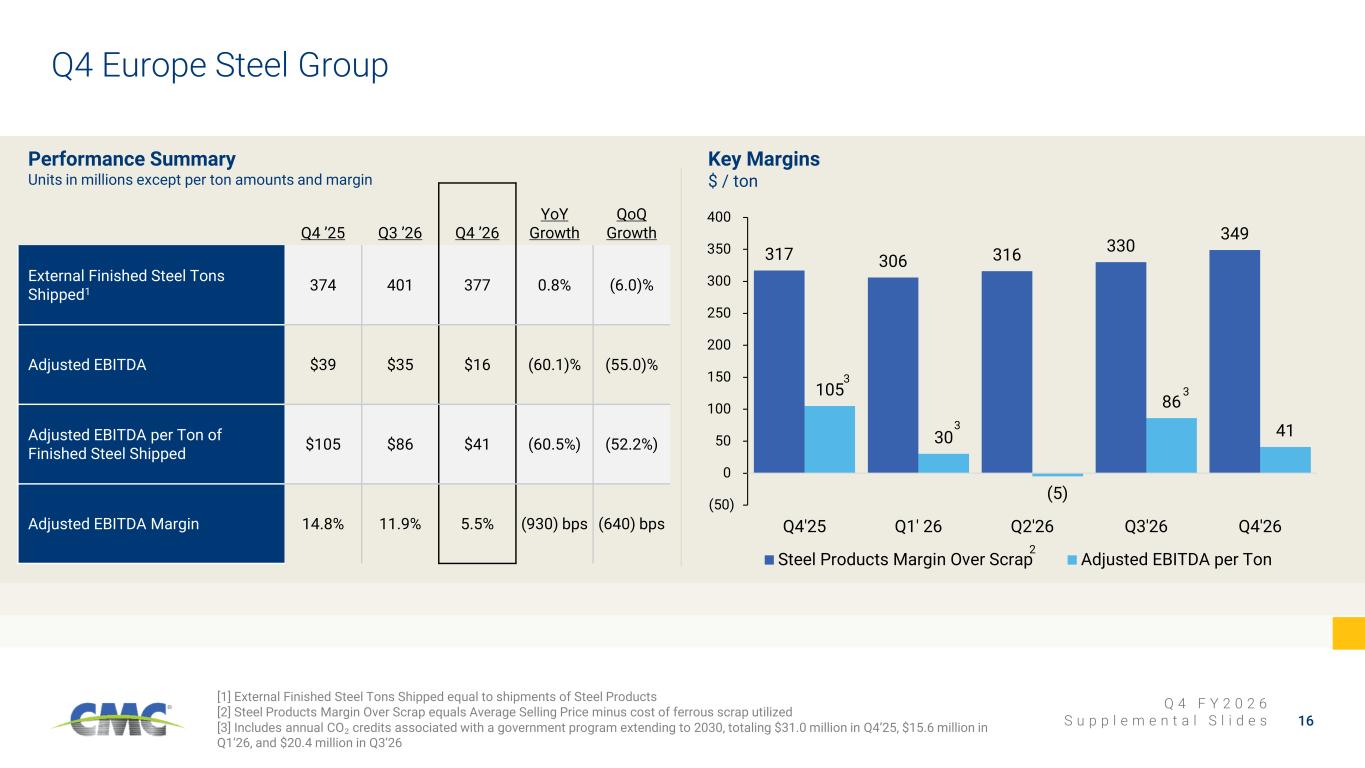
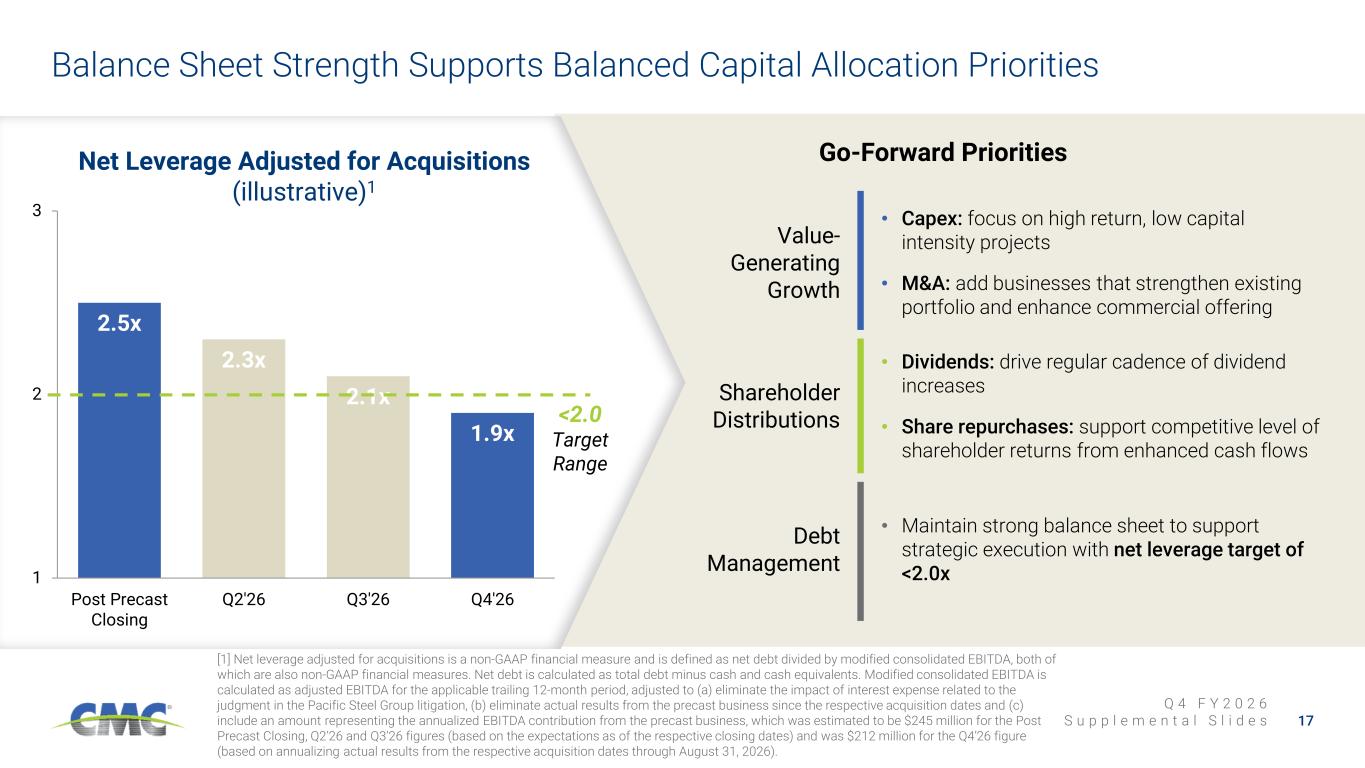
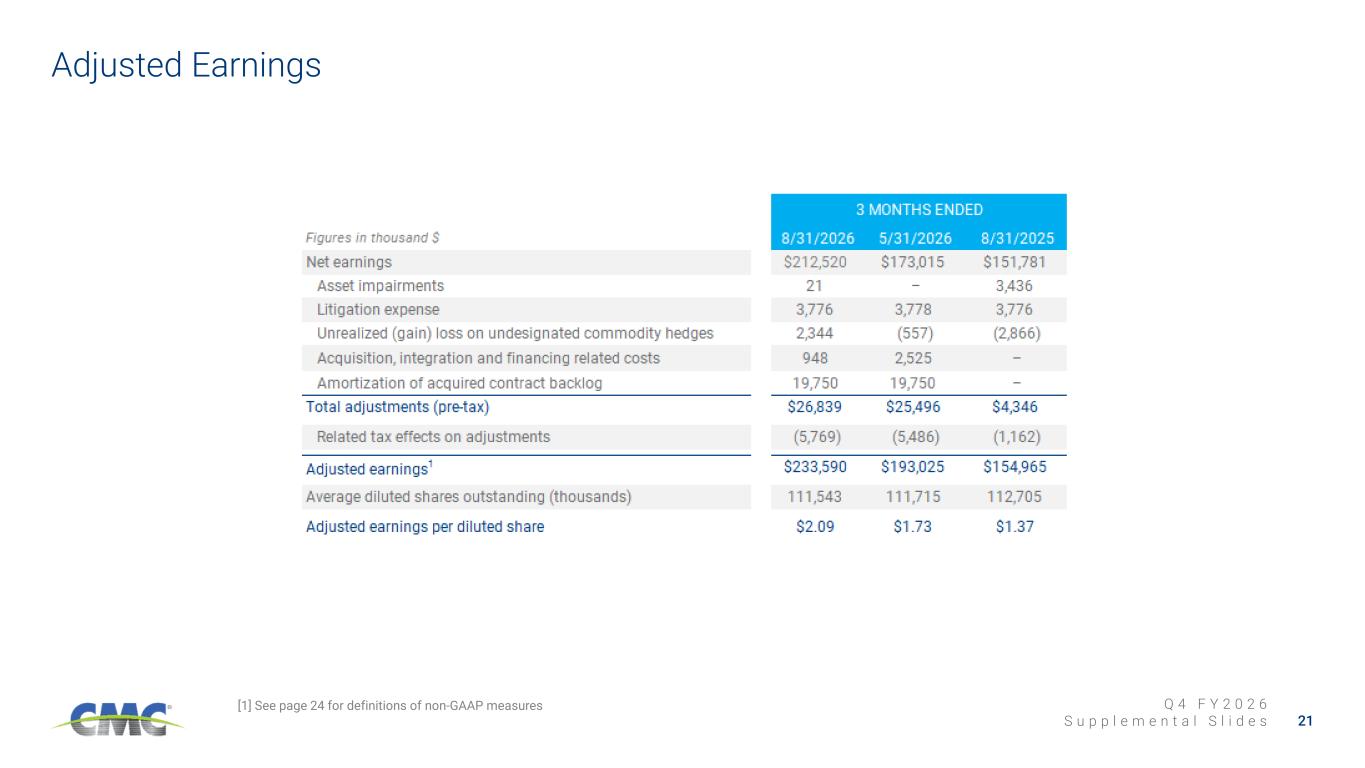
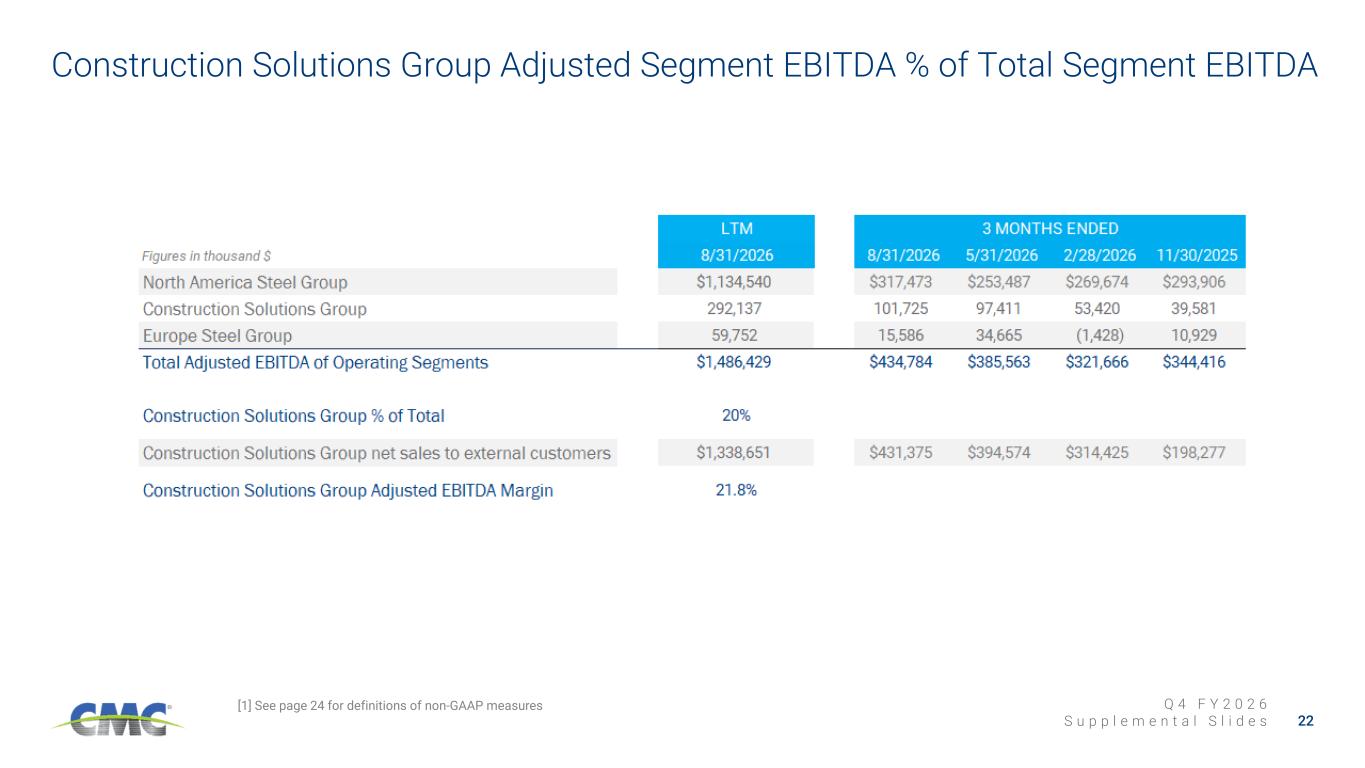
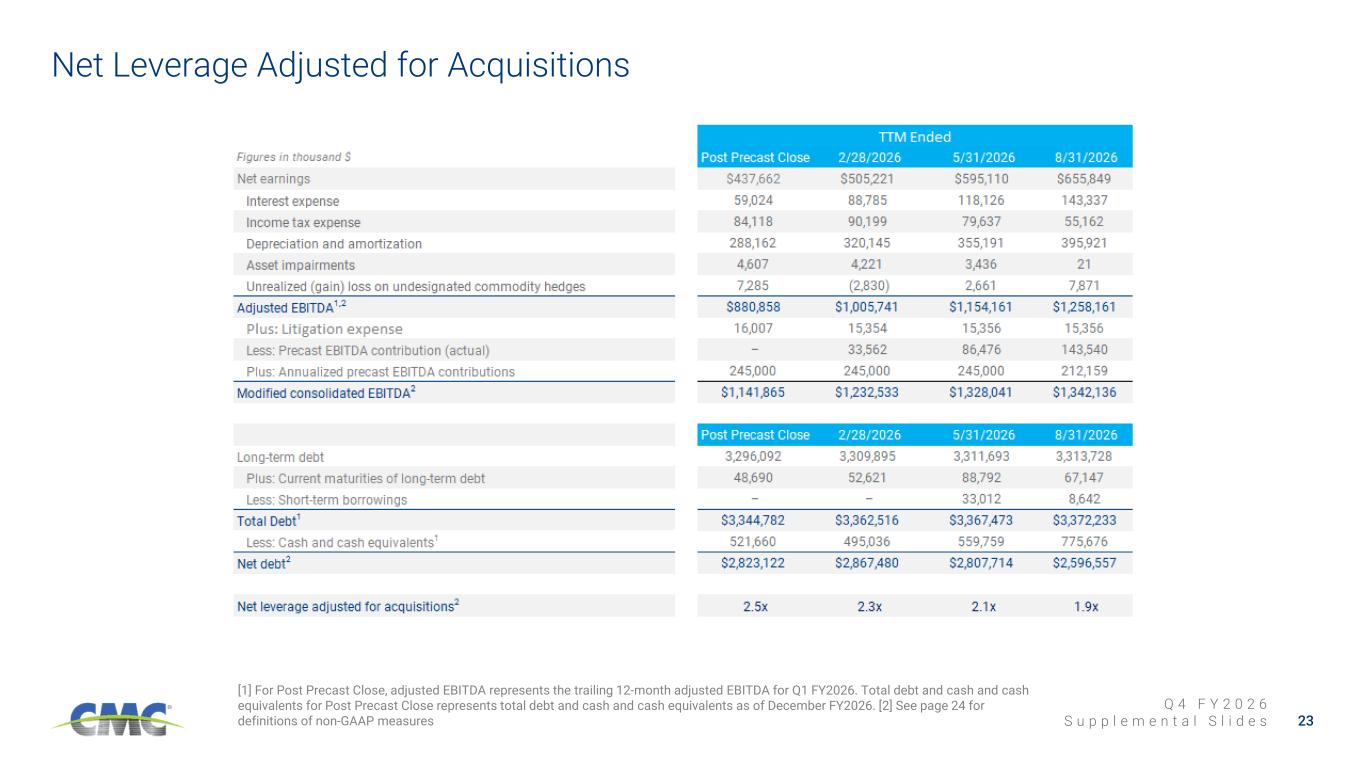
Thank you, Peter. I'll pick up on slide 13. Briefly, at the consolidated level, CMC reported fourth quarter net earnings of approximately $213 million, or $1.91 per diluted share. Similar to the third quarter, we incurred approximately $26.8 million of pre-tax expenses excluded from adjusted earnings, including $19.8 million of non-cash amortization related to acquired backlog. Adjusted earnings increased 21% sequentially. Core EBITDA margin remains an important indicator of the progress we are making. The benefits of our portfolio diversification strategy and TAG initiatives are becoming increasingly evident in this metric. In the fourth quarter, core EBITDA margin increased 100 basis points year-over-year and 60 basis points sequentially, capping a very strong fiscal year and underscoring the enhanced earnings power of the business. Within the North American Steel Group, adjusted EBITDA increased 25.2% sequentially to $317 million, driven by TAG benefits, metal margin expansion, and growth in merchant bar shipments. Metal margin increased $42 per ton sequentially to $652 by a $32 per ton increase in average selling price. The improvement in average selling price benefited from a richer product mix, including higher merchant bar volumes, which currently carry a meaningful premium to rebar prices. Meanwhile, scrap costs decline $10 per ton sequentially. Regarding scrap, we expect a relatively stable environment with some upward pressure in the near term correlated to the higher diesel costs we're incurring. Shipments increased 7.1% sequentially with strong growth across merchant products as well as downstream and rebar volumes. Our downstream backlog increased 15.5% year-over-year and 5% sequentially, demonstrating the value of our differentiated capabilities, particularly on large, more complex projects. America Steel Group adjusted EBITDA margin expanded to 16.4%, an increase of 220 basis points sequentially and 160 basis points compared to the same period of the prior year. Production Solutions Group net sales increased 94.5% year over year. Adjusted EBITDA more than doubled, and adjusted EBITDA margin expanded 80 basis points. Beside pre-caps, which Peter discussed earlier, Tensar delivered results that were largely consistent with both the prior quarter and the year-ago period, capping a strong fiscal 2026, in which profitability increased approximately 50%. This performance reflects solid commercial execution and healthy activity levels across its core end markets. construction services and impact metals also delivered strong year-on-year revenue and EBITDA growth during the quarter performance reinforcing steel results were lower due to an unplanned outage at our Galva bar facility that affected shipments during the period the outage is now resolved and customer demand remains robust with bookings backlog and pricing trends continuing to support a positive outlook for the business. In Europe, adjusted EBITDA comparisons were affected by CO2 credits received in prior periods. We received credits totaling $30.7 million in the fourth quarter of fiscal 2025 and $20.4 million in the third quarter of fiscal 2026, while the current quarter did not benefit from any credits. Excluding these impacts, underlying business fundamentals in Poland continue to improve. Metal margin expanded $32 per ton year over year supported by strengthening steel prices. Average selling prices increased $44 per ton versus the prior year and $15 per ton sequentially in the fourth quarter, offsetting a portion of this benefit with energy costs increasing approximately $10 per ton in the quarter. We anticipate energy costs to remain elevated in the first quarter and could potentially increase by a further $10 to $15 per ton. Market conditions in Europe are becoming increasingly constructive. The implementation of the CBAM and enhancements to the tariff rate quota framework are helping create a more favorable trade environment. Combined with gradually improving demand fundamentals, these developments reinforce our confidence in a continued recovery toward mid-cycle profitability over time. Lastly, a few comments on the balance sheet and capital allocation and key modeling considerations for fiscal 2027. Starting with the balance sheet, in less than a year, we have successfully reduced net leverage adjusted for acquisitions to below our target of two times. At 1.9 times, this represents significant progress from post-close levels and position us to pursue our long-term balanced capital deployment priorities of growth and shareholder returns. We expect the balance sheet to strengthen further in fiscal 2027, supported by improving cash flow as capital expenditures moderate. In fiscal 26, total capital spend was approximately $580 million. For fiscal 27, we anticipate capital expenditures to decline by nearly $200 million to roughly $400 million as we cycle past the elevated investment levels associated primarily with the West Virginia MicroMill Project. Roughly a quarter of our anticipated 2027 spend is associated with growth capex that we expect will further decrease in 2028. As a result, free cash flow and free cash flow conversion is expected to improve in fiscal 27 and again in fiscal 28. This increased financial flexibility creates opportunity to further enhance shareholder returns and reinforces a topic we first discussed at Investor Day. At that time, we announced a significantly expanded share repurchase authorization which currently has approximately 700 million remaining since then our conviction has only strengthened with our strong cash generating capabilities and the opportunity we see in the current share price we intend to accelerate our pace of activity under the program this action reflects our confidence in CMC's outlook and our conviction that investing in our own shares represents a compelling value creation opportunity. Lastly, as you think about your fiscal 2027 models, there are two items worth noting. First, we have just over one quarter remaining of the acquired backlog amortization. This will amount to approximately $20 million in the first quarter and roughly $2 million in the second quarter. Second, CMC will continue to benefit from meaningful cash tax savings associated with the 48C program, bonus depreciation related to our West Virginia mill investment, and accelerated depreciation on assets acquired through the precast acquisitions. As a result, we do not anticipate paying significant U.S. federal cash taxes through much of fiscal 2027. For modeling purposes, we expect our effective tax rate to be approximately 24% for fiscal 2027. With that, I'll hand it back to Peter for our outlook.
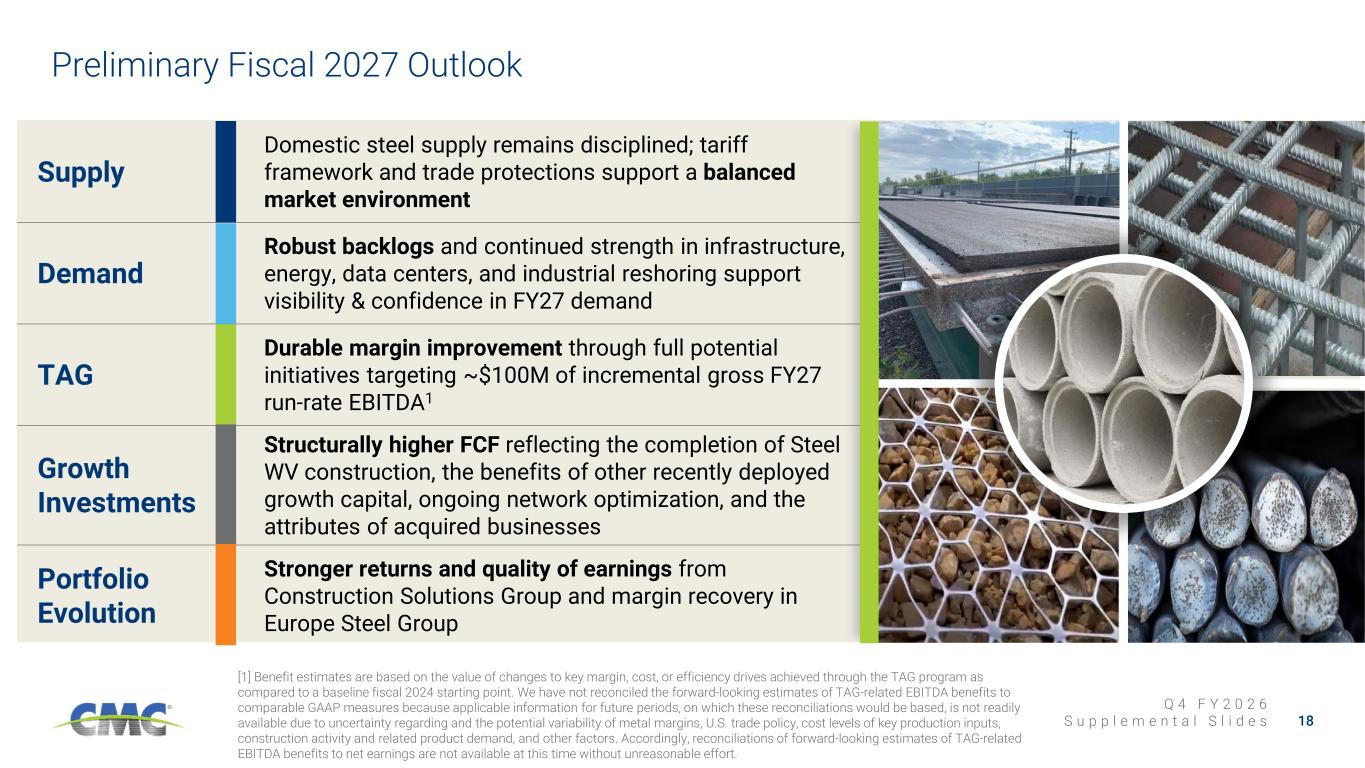
Peter? Thanks, Paul. As we look ahead to fiscal 2027, we are encouraged by both the external environment and the opportunities within our control. Domestic steel supply remains disciplined. Demand for early-stage construction products is supported by strong backlogs at attractive prices, and our value creation initiatives continue to gain momentum. TAG remains a significant source of earnings growth. Our recent growth investments are transitioning from capital deployment to return generation, and our evolving portfolio is enhancing both the quality and the durability of our earnings. Together, these factors support our confidence that fiscal 2027 will be another solid year for CMC. Specifically for the first quarter, we continue to expect healthy operating performance across the portfolio, though normal seasonal factors and costs will impact results sequentially. Within our North American Steel Group, improved pricing is expected to largely offset higher scrap costs, startup expenses, and a slight seasonal decline in shipments, resulting in adjusted EBITDA that is expected to be nearly flat in comparison to the fourth quarter. Within our construction solutions group, adjusted EBITDA is expected to be down sequentially, reflecting typical seasonal trends impacting the end market activity in this segment. In Europe, adjusted EBITDA is expected to meaningfully increase sequentially, benefiting from the improving operating conditions and a CO2 credit. All in all, we remain confident in the operating environment, animated by our priorities, and above all, eager to deliver on the financial and strategic opportunities ahead of us in fiscal 2027. With that, I'll ask the operator to provide instructions before fielding your questions. Thank you very much.
Operator
We will now begin the question and answer session. To ask a question you may press star then 1 on your telephone keypad. If you are using a speakerphone please pick up your handset before pressing the keys. To withdraw your question please press star then 2. At this time we will pause momentarily to assemble our roster. The first question today comes from Samuel McKinney with KeyBank Capital Markets. Please go ahead.
Hey, good morning, Peter and Paul. Hey, after a relatively soft third quarter you said was challenged by weather, the fourth quarter precast EBITDA number came in, about $20 million short of the number you intimated on the last call. Just given the residential market challenges, is annual run rate EBITDA around that $240 million, $250 million still the right way to be thinking about this business before you make any more acquisitions?
Hey, Sam, thank you very much for the question. We believe it is, and we think that it's a good target for this year. When we look at the backlogs in the business, when we look at the progress we've had on integration and, you know, kind of overall momentum, we feel like we can achieve that. We will have some near-term, near-term, and by near-term I'm talking Q1, we will have some seasonal weakness, and that seasonal weakness probably leads to a Q1 that's going to be down mid to high single digits from where it is in Q4. But, you know, overall we remain very positive on this business. I think one thing that's interesting about this is that as residential has declined, it's been filled in by a strong slug of non-res and infrastructure. And so, again, that's what's supporting our backlog and giving us a lot of confidence in this. And pricing remains very strong in the business. We continue to see pricing rising across the portfolio. So I guess all in all, we remain very confident, and we see this as a continuing strong contributor to our portfolio.
Okay. And then you did mention it, that South Korean long product imports finally took a big step down in September. How do you think about the sustainability of these trends, and do you expect any sort of government action now that South Korea has also made itself a meaningful importer of flat products this year?
Yeah. Yeah. Well, I won't speak to flat products, but I'll, you know, kind of keep my comments on the products that impact our business. Yes, we did see this significant decrease. We expected it to be a little sooner, but it did happen. And I think the reality is that when you kind of stack up the costs in the current environment of getting rebar to the U.S. from South Korea, it's not competitive with where our pricing is, even with the current price increases that we've just recently put in place. And so I think economics are taking care of themselves. It's taking care of the issue for us for the short term. As I've said in prior calls and engagements and at the investor day, where we see that someone is violating our trade laws, we are not going to be shy about going after them. But right now, I think, you know, we're going to monitor the situation and we're comfortable with where things stand. I think it's also a further note that if you look at the countries against whom we are against, which we filed these anti-dumping and countervailing duty cases, they have effectively kind of gone away from the import market, right? So we're not seeing any material imports from any of those countries, which I think kind of goes to support the point that I made at the Investor Day and I've made on calls before this that this is durable supply management that we're working on. And, again, I'll just remind the audience and you, I know you know this, but those anti-dumping and countervailing duty cases and the duties that come from them, they have a duration of at least five years and generally ten.
I appreciate it. Thanks, guys.
Operator
Thank you, Sam. The next question is from Satish Kazinathan with Bank of America. Please go ahead.
Yeah, hi. Thank you. Good morning, Peter and Paul. Congrats on a strong finish to the year. Yeah, my first question is on the guidance for the first quarter. Can you maybe walk us through some of the moving parts, especially like how much CO2 credits do you expect in EU and what is the magnitude of startup cost you're assuming for the West Virginia mill in Q1?
Yeah, Fatish, you know, as we look at Europe, I think we mentioned really two factors. The CO2 credit, we are expecting at this stage, you know, somewhere between 10 and 15 million of of co2 credits offsetting that in in Europe will be the higher energy costs that I cited we've seen those so far throughout the the quarter around 10 to 15 dollars a ton and so that will erode a little bit into the into the earnings of the business so those are the two drivers of the the Europe space space overall expect as we said a meaningful increase in overall results but guided by those two factors and then on the startup cost for West Virginia mill sorry yes and startup costs where as Peter said we're making good progress on the on the commissioning space we anticipate that in the first quarter we'll probably incur extra three to five million dollars of incremental cost so what we've incurred lot in the fourth quarter was in the nine ten million range so it's it's just a slight uptick from from that as we as we start the the operation up thank you maybe maybe one
follow-up on the West Virginia mail so can you maybe give some additional color on how you see the cadence of ramp ups so when do you expect the first commercial shipments, and then are you still on track for maybe 250,000 to 300,000 tons of volumes from the mill that you previously guided to?
Yeah, I think so. Again, remember on this, we did have some construction weather delays, but we are kind of making great progress on the hot commissioning at this point. We have rolled our first billet, and we are progressing with the startup, I think it's fair to say that we expect that we're, you know, kind of a 12-month period, and we should be break-even after about six months. I think the, you know, when we look at the overall project, we're super pleased with the fact that we've been able to bring it in kind of effectively on time and effectively on budget, and I think that's a testament to the, as I said in the prepared remarks, the great job that the team's done and the capital discipline that we have as a company.
Overall, to your question of the volume, Satish, I think it'll be a little less than what you indicated, just given that the commissioning is ongoing and really we'll expect to start the true startup activities. near the end of the first quarter. So we'll probably be a little under 200,000 tons of production in the current year.
Operator
Thank you. The next question is from Bill Peterson with J.P. Morgan. Please go ahead.
Yeah, hi. Thanks for taking the questions. And, again, a really strong finish to the fiscal year. I wanted to come back to precast if I could. So I guess if you took the quarterly numbers and annualized it, you were ahead of, let's say, where you were or what you had talked about at the time of acquisition in terms of sales, but actually behind in terms of EBITDA. So I'm just trying to get a better sense of what's going on. Maybe you can characterize it relative to the markets you're operating in. It sounds like it's primarily residential, but also it sounds like your pricing is fine, but is there some cost pressures to call out? Is there some mix-related areas to call out, especially on the profitability side?
Yeah, great question, Bill. And we'll try to fill in some of the detail here. So as we said in the prepared remarks, this is really about weakness in residential and in the southeast. And it's really about volume weakness in that region in residential. And what I think is interesting to note is that the volumes are actually, if we look at the CP&P portfolio, volumes are up and actually almost offsetting all of the volume decline in the southeast. So what that leads to is that you'll remember when we announced these transactions that there was a pretty sharp discrepancy between the margins on the Foley portfolio and the margins on the CP&P portfolio. Again, this is one of the opportunities in CP&P that we saw is to bring those margins up, but as we're working through the integration, we haven't completed that yet. And so losing volumes in the southeast was kind of painful. It just magnified the EBITDA impact of the lost volume. As I said, the price is not the issue. The price has been going up. We have quarter over quarter price increases and year over year price increases. So, you know, it's very disappointing. It's kind of not how we would have written the script. But what I want to be categorically clear about is that we are not overly concerned. As the residential has slowed, the non-residential and the infrastructure have filled in the backlog. Our margins, in spite of that volume loss, remained at 30%, which is, again, this is, remember, we're on the front end of an acquisition, so we've got some of the integration costs before we get the benefits of integration. And a lot of the business indicators, I think, point us to confidence here. So bookings, as we noted, up 12.5% in fourth quarter and have continued to rise in the month of September. Pricing, again, as I noted, up backlog, up 4% year over year, 3% in the fourth quarter with growth in September. And the other thing I would say is that the integration is, you know, So as proceeded in a really nice way, I would say we are, if anything, ahead of plan. Our synergy, as we look at the business more, we see more opportunities to do things with it that are going to lead to, you know, kind of higher growth synergies. So on balance, this is a, you know, yes, there's some softness in the market, but one other final point that maybe I'll leave you with is that the residential portion of our portfolio is running at about 50% to 60% of kind of what a normal environment would be. So we feel like we've taken much, if not all, of the pain on the residential side. So I'm sorry that's a long explanation, but there's a lot to get in there.
No, no, that was a good insight. I appreciate that. Very helpful. So my next question is on North American steel. You commented about MBQ, the mix is rich. It looks like shipments are at least at a five-year high. So I'm trying to get a sense of is there further opportunities to ship more of the mix to MBQ and I guess how to take that into account as we look at this fiscal year in terms of the cadence of rebar versus MBQ, especially with West Virginia rampant, which is rebar. So does that mean more AV2 goes to MBQ, you know, things like that?
Yeah, no, great question. And we see there's a nice opportunity in MBQ. And remember, you know, one of the things that we've talked about over time is the fact that, you know, the portfolio that we have gives us latitude not only to control supply-demand by producing fewer rebar tons but also by producing other products. And this is a perfect example of what we're able to do here with the demand on merchant, which is really kind of a broad-based response to overall strength in the economy. And so we have been shipping materially more merchant bar. And as we start West Virginia, what that will do is it will free up South Carolina, for example, to produce more merchant products. So as we said in the investor day, we believe that, you know, as a starting objective, we think there could be more over time, but as a starting objective, we can get up to a million tons of merchant shipments, and that would imply about 150,000 to 200,000 tons of incremental merchant shipments. So, again, it's a nice margin opportunity in the current environment, and it's a nice way to keep the rebar market tighter.
Just one thing to add to Peter's comment. You know, when we disclose merchant bar and other, that's got our merchant bar and the wire rod principally that we produce at our Florida facility. So there's about 150,000 tons of wire rod that we're shipping on an annualized basis, So that supplements to the million-tons target for merchant bar that we have.
Perfect. Thanks again for all the details and colors.
Operator
Thank you, Bill. The next question is from Tim the Tanners with Wells Fargo. Please go ahead.
Wanted to touch base on the recent move up in October for, number one, heavy melt scrap.
It looks like $27.50. since um it does that get fully passed through with the recent increase in rebar prices that you announced and you know any any thoughts on the timing impact there into the november quarter yeah so uh thank you timna for the question um it it will and uh we feel confident that uh as we go into the november quarter you're going to see a um kind of a gradually improving top line from a asp perspective and gradually improving metal margin so we will we believe will outpace the move in scrap as it filters through our portfolio okay that's helpful and then secondly i wanted to
shift over to europe and i know you talked about some recovery there from low levels a couple moving parts of course you talked about better demand but also you know several favorable trade policies like what do you see in there in terms of how much of that is volume driven and how much of that might be because of better demand and how much of that might be of the tariff actions what I'd say is that the demand is good and it's been good in Poland right so we've said that on several prior calls the challenge has been really on the supply side and that's where we've been optimistic about the impact of some of these trade policies
what we've seen however is that so and just kind of rewinding the clock to the beginning of the year you had CBAM but then kind of when in front of CBAM everyone imported a lot of steel into Poland so we had this two to three month period where we had to kind of deal with that and then the markets started to tighten up, and we saw pricing and margins improve, so felt pretty good about that. And then the safeguards, which took effect in July, same impact happened, where people are kind of bringing material into Poland or into Europe in advance of that. And so we're kind of working our way through that, but we are optimistic that we are on the way to seeing an improving environment. It would be great if we could see some general improvement in the European economies. The fact that the German economy has not improved the way we expected it to is maybe a little cautionary note. But we are optimistic that we can get this business back to $100 million or our, quote unquote, through the cycle number.
And Timna, just to add a little color, You know, it really is a margin growth that we're looking for to get us to that 100 million level. You know, within TAG, a good portion of that, both in North America and in Europe, is commercial excellence. There's a strong commercial excellence process going on in Europe to really be selective around the volumes that we want to sell that drive the greatest margins for the business. So this is about us realizing a margin enhancement as opposed to a volume growth.
Okay. Great color. I'll hand it over. Thank you.
Operator
Thank you, Timna. The next question is from Nick Cash with Goldman Sachs. Please go ahead.
Hi, yes. Thank you guys for taking my question. Just stepping back to the analyst day for a second, can you help us bridge, I guess, you know, the 26 core EBIT of, call it, you know, $1.4 billion versus the 29 target of $1.65 to $1.8 billion. And can you also remind us, I guess, how much was West Virginia, precast, TAG, and other? And does the precast weakness that you're currently seeing in the mix shift change that mix at all?
Yeah, thanks, Nick. Great question. You know, we believe that we are, I think, demonstrating the capabilities of the business in the fourth quarter aligned to the targets that we have for 2029. The mass of the organic growth projects, whether that be West Virginia, whether that be through the merchant bar expansion that Peter said, whether it be the Galvabar line or the GeoGrid line that we're constructing. All of that is close to $200 million of incremental EBITDA that we've talked about there. We've got the ability or the strength in Arizona to continue to enhance the contributions. We've got the growth in the precast business, obviously from where it was in 2026, the full year impact, but also the growth that we anticipate in that business, as well as the mid-teens growth in the rest of the construction solutions group. So we think the $1.4 billion that we earned in the fourth quarter, recognizing that, you know, the scenario we laid out was a 25% tariff environment, but we're well on our way with all of that growth opportunities to achieve that or, in today's environment, far exceed the low end of the range based on the way we're performing now in the markets that we're seeing.
And, Nick, can I just jump in on that to say, you know, you asked the question about does the precast softness change at all, and I want to categorically say it does not. If anything, as I said earlier, we have more conviction in pre-Caston, and by 2029, we're confident that we're going to get to where we thought we could get to.
That's extremely helpful. Thanks for the color, and I'll pass it on.
Operator
Thank you. The next question is from Richard Garchit-Arena with Barclays. Please go ahead.
Thanks for taking my question. I believe on the prepared remarks that you mentioned that CapEx for fiscal 27 would be $400 million, with 25% of that being growth CapEx. I was wondering if you could provide some color in terms of what are the key growth projects that you're going to be working on this year, particularly in the CSG and pre-castings, and then how should we think about that impacting potential growth in fiscal 28 and beyond?
Yeah, thanks, Richard. The vast majority of the the hundred million growth is West Virginia there's there's a few payments related to performance targets that need to be made and we expect to make those in in 27 so that's that's well over half of this spend and then the spend on the geo grid line and in the Galva bar line both those will well all three of those will be in startup mode in in 2027 so their EBIT contribution will be limited as far as the long-term capabilities of those plants. We expect the Galvobar facility to begin commissioning late in calendar 26 and the geo grid line is continuing to be in the startup and commissioning time now. So that one's most likely to contribute in in 20 uh 27 as peter said you know we expect west virginia to to ramp up nicely and within six months of the uh the the startup uh being break even from an evita perspective so into q3 uh for for us on that one and we expect you know just to put a bow on that again as we think about maintenance.
We've talked about maintenance in the past as $275,000. So going forward, if you think about kind of $50-ish million of growth investments, that's the type of range we would be in for, you know, kind of ongoing CapEx. And again, I think that one of the things that's really important that we're trying to do across the company is look for opportunities to invest in projects that make our operations more efficient and generate kind of high returns from that so you'll see that's where we'll devote most of the growth to as we've said before we're not building a new steel mill anything like that it will all be investments in efficiency right and maybe just stick in the capital allocation so you know congrats on getting leverage down below your target level you know as you move forward obviously capex coming down as well.
How should we think about share repurchases? Is that going to be the bulk of the target? Or are you looking to keep some, you know, dry powder for M&A? How should we think about that?
Yeah, I mean, I think, you know, look, we are definitely going to keep some dry powder for M&A. If we think about, we have built a, you know, kind of pretty active M&A dialogue across the priority areas uh we don't have anything that's uh significant to to do right now so um so but we're you know that works fine because we've got a lot of work to still do on integration and optimizing the precast platform uh but again returns to shareholders are an important piece and as we you heard what uh paul said in in his prepared remarks about uh increasing our share repurchase, and I think looking at our free cash flow and seeing the strength of it and also looking at the share price, and it looks like it's a very compelling investment at this price, it seemed like it made sense to accelerate the share repurchase. We announced an authorization or we increased our authorization to about $700 million. We increased it by $600 million, but to get to about a $700 million total authorization We said we intended to do that over three years. What we're saying today is we're going to pull that forward. We'll see how that progresses, but I think you should expect a meaningful increase in the amount of shares that we're buying.
Operator
Great. Thank you.
Operator
The next question is from Tristan Gresser with BNP Paribas. Please go ahead.
Yes, hi. Thank you for taking my questions. The first one is on North America. If we put everything together, West Virginia, the product mix you just mentioned as well, and I don't know if there's some leftover from Arizona, too, for fiscal 2027, but are you able to share a percentage volume increase you have in mind for the fiscal year for the division, and if there's any difference between steel products or downstream products?
Well, I guess what I'd start with is demand, right? And so far this year, we've seen demand growing year to date. I think it's over 4%. And so the good news is that we have the capability to flex our production to meet increased demand. And, yes, there is additional capability in Arizona, And there's obviously additional capability in West Virginia. But, again, you know, I want to come back to remind everyone that our objective is to kind of keep supply and demand in balance. And the flexibility of our network, given it's a high variable cost network, allows us to do that. So I think we'll have to see how the market grows. but assuming that it continues at this pace, something of that order could be what we'd expect. I don't know, Paul, if you would add anything.
You know, I think what we're particularly proud about, because I think if you look, as Peter said, you know, the market is up 4% to 5% in terms of rebar consumption. our downstream business in which we have executed and demonstrated strong, strong commercial discipline in terms of really only looking to take on margin accretive work for the business, and yet we're up 7% on a year-over-year basis. That speaks to the capabilities and the ability for us to do these large mega jobs that are really sustaining the construction activity right now. And those are projects that are not just being done in 2026, but will be multi-year in length. And it gives us confidence as we look forward that those capabilities will be rewarded in terms of lower risk to the contractors, lower risk to the project owners of contracting with CMC and continue to fuel a real sense of opportunity for us to grow margins and continue a strong downstream pull.
All right. No, that's very clear. And the second question is on Europe, a bit of the same question to start with on the volume outlook if you expect to continue to gain market share and what we can expect for the year. And also just trying to understand a bit the margin development. You sound pretty constructive, but when I look at rebar prices, and maybe I should look at Polish rebar prices and just general European prices, but they've been pretty flat over the past couple of months and energy costs are through the roof. And other, you know, long steel producers in the regions have been forced to shut down. so what you're doing differently can you remind us how you procure your electricity natural gas and and maybe some your hedging strategy you have in place or maybe there's something different it's just about mix or something else that makes you a bit more resilient well thanks Tristan so I'm going to start and then Paul can walk you through what we're doing in terms of energy procurement But in terms of volumes, you know, we've said demand is good.
And we've been running at, I would say, a pretty high rate of utilization in our Polish operation recently. And I would say we expect demand to be, you know, kind of stable, maybe modestly better in that marketplace. Pricing, you're right, has been, well, we saw, as I said earlier, we saw in the wake of CBAM, we saw a nice rise in pricing to the tune of $100 a ton. But then we saw, obviously, scrap kind of went up along with it. And with the safeguards coming in and the pre-buy there, you've seen us give some of that, a little bit of that back. So we are still optimistic, though, that as the inventory pre-buy related to the safeguards filters through, that you're going to see margins expand in that market. And, again, expand gradually in that market. We're not expecting any sea change, so to speak. But maybe, Paul, you can talk about the energy side.
Yeah, on the cost side, you know, earlier I spoke of the focus the team is doing on commercial aspects of TAG. Operationally, the team has done a phenomenal job of, you know, right-sizing and, you know, driving costs to where it needs to be from a competitive perspective in the tight market that exists in Europe. And, you know, one of those areas that the team has always been focused on is electricity consumption, but also having the foresight to enter into longer-term energy contracts. And so we have around 50% of our electricity head through long-term purchase agreements. These were entered into prior to the Ukraine war, prior to energy costs taking off in Europe. and so really competitively situate the mill in a positive environment. So combination of a strong hedging process through those agreements as well as a focus on consumption, that drives a significant competitive advantage and hence why we're able to withstand the costs where they are. As I said, we do anticipate energy costs continuing to rise, but expect to continue to be a strong position economically from a margin perspective with those increases taken into consideration.
And, Tristan, the last thing I would just say is just remember as you kind of think forward the next couple quarters, We're coming into the difficult part of the year in terms of, you know, kind of the ultimate demand, right? So there's going to be likely some seasonality to the numbers over the next couple quarters.
All right. No, that's very clear. One quick follow-up. This inventory overhang you mentioned, would you see that clearing up already before year-end, or it's going to take a bit much longer than that?
Again, you know, if we think about it, I would say what we saw in CBAM, it took longer than what we expected. I would say to the tune of probably, I think we might see the same here.
So by the end of the calendar year, we would expect the benefits really of CBAM and the tariff rate quota to start being realized in a more meaningful way.
Operator
This concludes our question and answer session. I would like to turn the conference back over to Peter and Matt for any closing remarks.
Well, thank you for the thoughtful questions and for joining us today. Every CMC employee should be proud of what we have accomplished in fiscal 2026 and even more excited about the opportunities ahead. Enabled by their efforts and our collective performance and a clear vision, we believe fiscal 2027 will be another great year for CMC. To our shareholders, we thank you for your support and we look forward to continuing the conversation over the weeks and months ahead. Have a great day.
Operator
The conference is now concluded. Thank you for attending today's presentation. You may now disconnect.