Bank of America
Third Quarter 2026 Earnings Announcement
October 14, 2026
Third Quarter 2026 Earnings Announcement
October 14, 2026
Participants
Presenters
Brian Moynihan – Bank of America, Chair and CEO
Alastair Borthwick – Bank of America, Executive Vice President and CFO
Lee McEntire – Bank of America, Investor Relations & Local Markets Organization Executive
Participants
Ben Gerlinger - Citigroup
Chris McGratty - Keefe, Bruyette, & Woods
David Chiaverini - Jefferies
Erika Najarian - UBS
Gerard Cassidy - RBC Capital Markets
Glenn Schorr - Evercore ISI
Jim Mitchell – Seaport Global
John McDonald - Truist Securities
Ken Usdin - Autonomous
Manan Gosalia - Morgan Stanley
Matt O’Connor - Deutsche Bank
Mike Mayo - Wells Fargo
Steven Chubak - Wolfe Research
Scott Siefers - TD Cowen
Vivek Juneja - JP Morgan
Presentation
Lee McEntire
Good morning, everyone, and thanks for joining us to talk through our third quarter results. I'm joined by
Brian Moynihan, our Chair and CEO, and Alastair Borthwick, our CFO. As always, the earnings release and
presentation are posted on the Investor Relations section of bankofamerica.com, and will reference those
materials during the call.
Before we begin, a quick reminder, during the call, we may make forward-looking statements and refer to
non-GAAP financial measures. These reflect management's current views and are subject to risks and
uncertainties. They are outlined along with the relevant GAAP reconciliations in our earnings materials and
SEC filings on our website.
With that, I'll turn it over to you, Brian.
Brian Moynihan
Good morning and thank you for joining us today. Our third quarter results show the importance of a
diversified company. The businesses closest to customers, wealth clients, and commercial clients, the Main
Street businesses showed continued strength, higher loans and deposits, strong wealth management flows,
higher NII, and better credit drove solid earnings, while the sales and trading revenue and investment
banking revenue were lower.
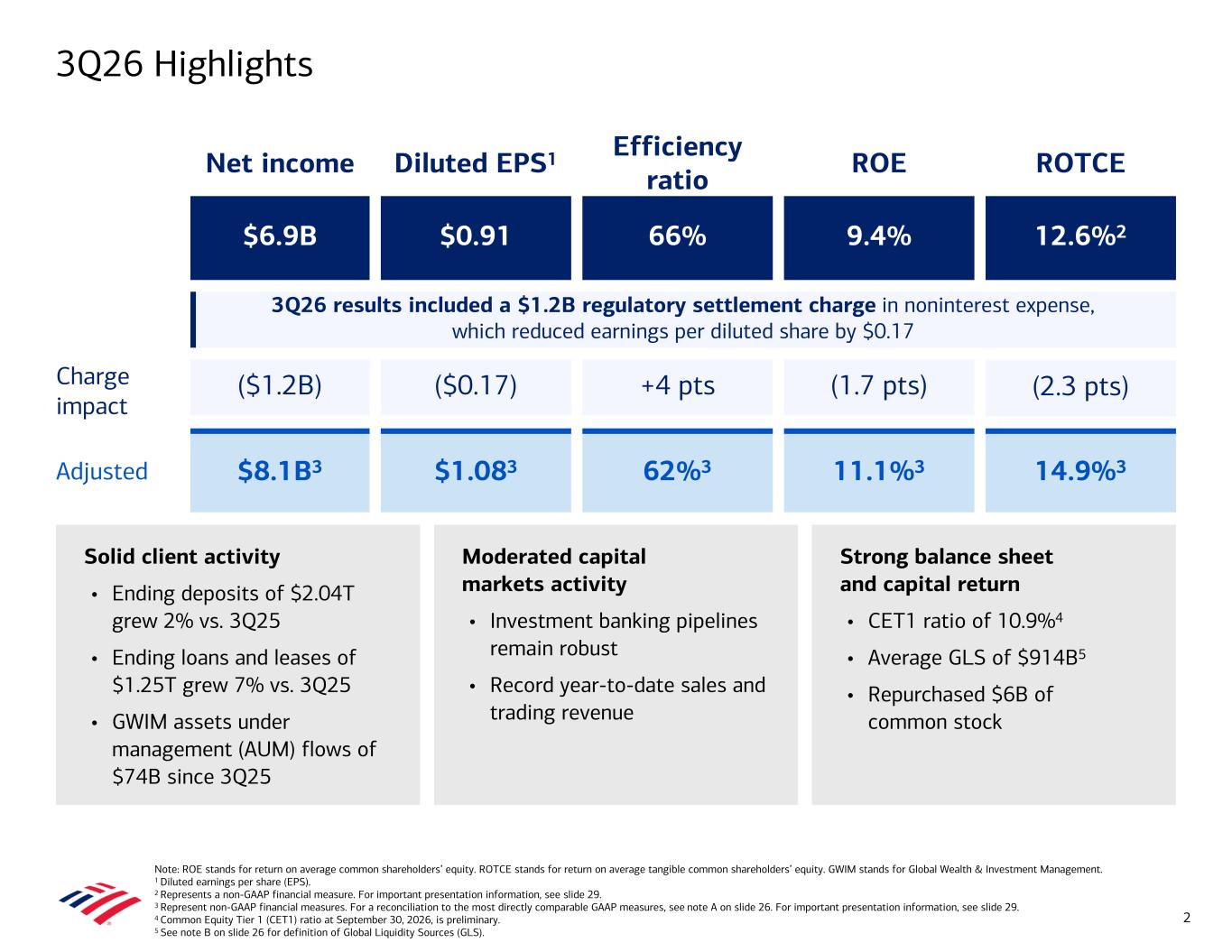
We reported net income of $6.9 billion after tax and earnings per share of $0.91. On Slide 2, we've adjusted
those results to take into account the non-tax deductible regulatory settlement charge of $1.2 billion, which
is a $0.17 per share impact.
1
Third Quarter 2026 Earnings Announcement
October 14, 2026
Three points to understand about the settlement. First, we understand the seriousness of compliance, and
we are responsible for getting it right. We have invested – second, we've invested billions of dollars in
technology and dedicated thousands of employees to combat financial crime. The team is far along with and
committed to completing the work required to be addressed by the regulators. Third, we have committed
the resources, and the ongoing cost of remediation is embedded in our company's expense base.
Excluding the regulatory settlement charge, our net income was $8.1 billion or approximately $1.08 per
share, up from last year. Our leadership across our businesses and products and geographies allows us to
meet more of each client's needs, deepen relationships, and drive growth across our company. The
connectivity between business units is strong and continues to be a competitive advantage. Now when we
think about our results, it starts with the health and activity of our clients, which brings us to Slide 3.
We believe that at Bank of America, our clearest economic signal comes from the daily activity of the 70
million clients and thousands of businesses that bank with us. And the message has been consistent.
Consumers continue to spend with year-to-date money moving up 5% from 2025, and you can see that on
Slide 3, and that's similar to what it was for the third quarter and similar to what has shown up so far in
early October. Our business clients invested and hired selectively, supported solid growth in jobs and wages
across various income levels in our customer base. Wealth clients remain engaged and continue to seek
advice, while commercial clients use more of our lending, treasury and payments capabilities. Payment
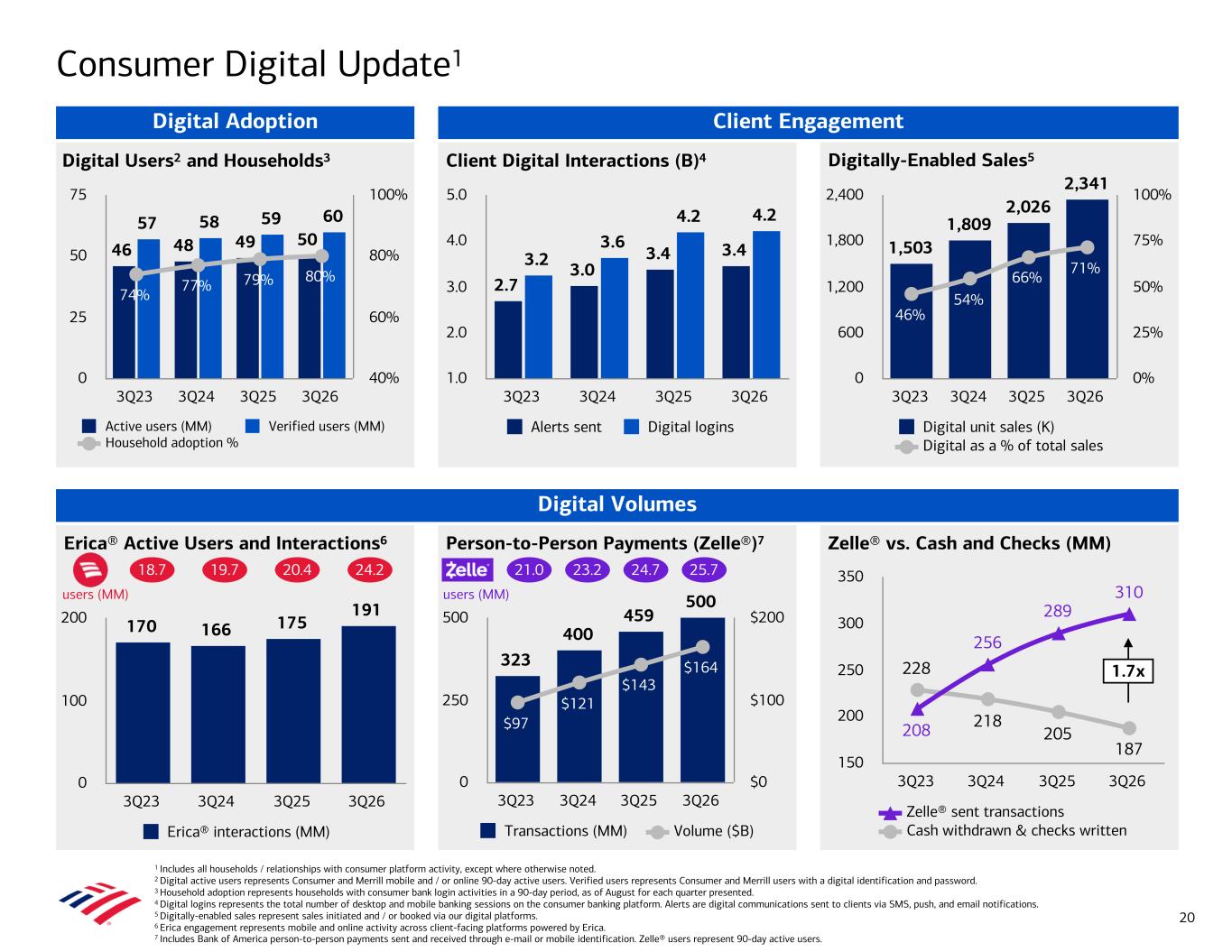
volumes, digital activity, loan demand, and wealth flows all remained healthy. And you can see the digital
activity in the slides in the appendix as we always put in our results.
The economic uncertainty that prevails and the geopolitical instability are always present, but what our
clients are actually doing is continuing to point to a resilient and growing economy in the United States.
That activity has produced organic growth across our company, coupled with great credit quality, and we
show that on Slide 4.
Slide 4 shows the continued organic growth for the quarter. In quarter 3, once again, we grew through both
client acquisition and doing more with our current client customers. We added another 200,000 in the
quarter of net new core consumer checking accounts. We now have 39 million checking account customers.
It's been nearly 8 straight years of quarterly progress and growth. That's quite a flywheel. We opened more
than 1 million new card accounts, and importantly, we grew our card balances nearly 5%, consistent with our
medium-term goals disclosed at Investor Day. The focus on investment in that card product is producing
results. Our wealth clients generated approximately $41 billion of flows during the quarter. We continue to
add affluent and high net worth relationships across global wealth and consumer investments. Across those
businesses, clients entrust us with more than $5.7 trillion of their family's balances.
Commercial loans grew across every single segment from Small Business to Business Banking, the Global
Commercial Bank, and the Global Corporate and Investment Banking. That's from small businesses to largest
companies in the world. Our treasury services (i.e., cash management) relationships also expanded. This
bodes well for our loan growth that we'll talk about later but also shows you the strength in the economy as
these commercial customers continue to be active. Growth that you see on this page reflects the
investments in our people, our technology, our capabilities in digital, and our physical network. These deep
relationships support earnings, balance sheet growth, and long-term shareholder value.
With that overview, let me turn it over to Alastair for more detail on the quarter.
Alastair Borthwick
Thanks, Brian. I'll start with a few other income statement highlights on Slide 5. And as Brian said,
momentum continued in our core banking businesses. Consumer Banking, Wealth Management, and Global
Banking's commercial businesses drove most of the revenue and earnings growth, while Markets and
Investment Banking revenue declined from prior periods. Equities delivered a record third quarter, and
reduced client activity and changing market conditions, including a major shift in interest rates, significantly
affected our leading FICC micro businesses, including credit mortgages and municipals, and those declines
more than offset growth elsewhere in trading.
2
Third Quarter 2026 Earnings Announcement
October 14, 2026
Revenue was approximately $30 billion, up around 3% year-over-year, and an 8% increase in NII and 17%
growth in asset management fees more than offset lower Investment Banking and Sales & Trading revenue.
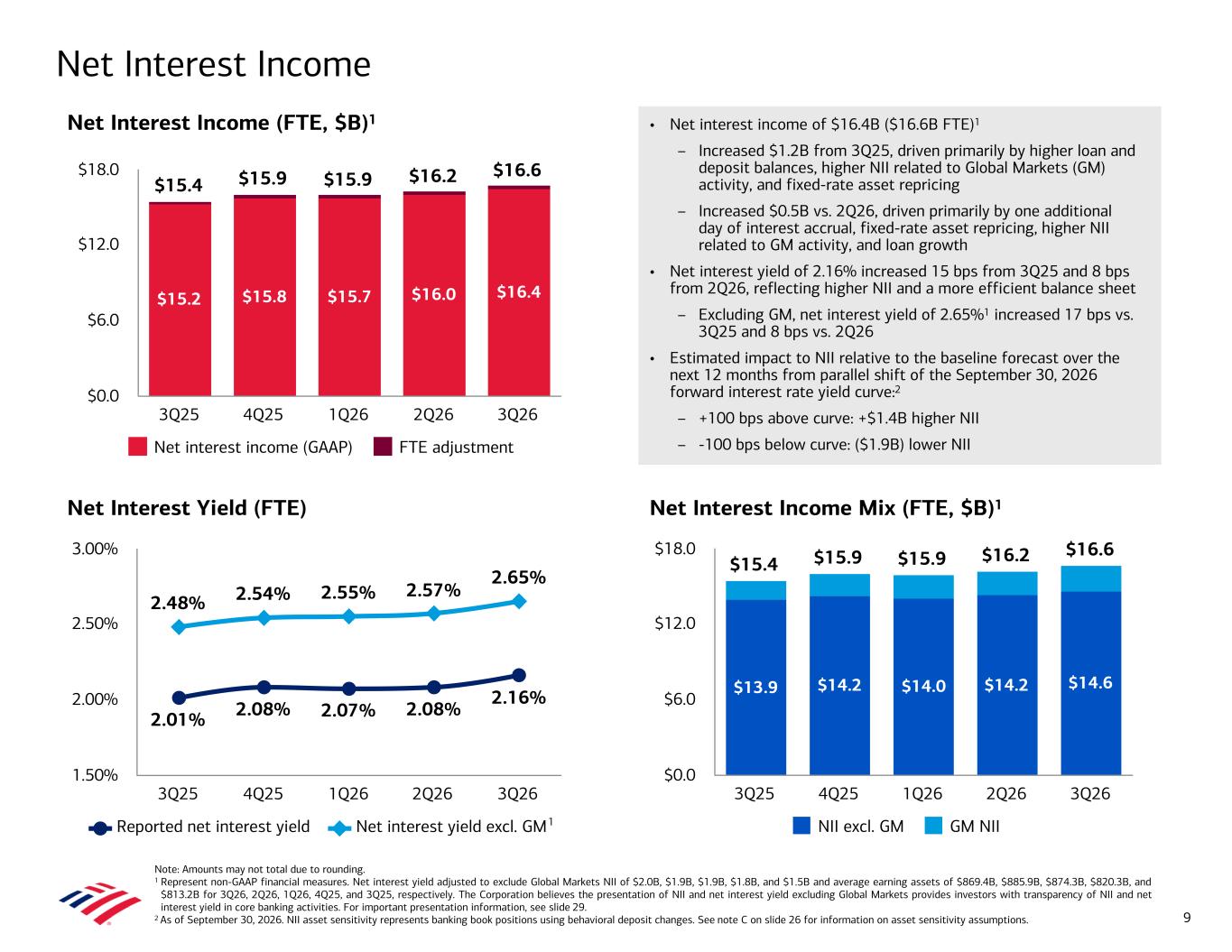
NII reached $16.6 billion on an FTE basis, up 8% year-over-year, and was up $450 million from the second
quarter. Net interest yield of 2.16% improved 15 basis points year-over-year and 8 basis points from the
prior quarter, moving us closer to the 2.3% medium-term target we outlined at Investor Day. Credit quality
improved, capital and liquidity remains strong and earnings remain solid.
So, let's turn to the balance sheet on Slide 6, where you can see we remain strong and became more
efficient as evidenced by the improvement in our net interest yield. Total assets were $3.4 trillion; that was
down 2% from Q2. Ending deposits increased $14 billion from Q2 and remained above $2 trillion. Quarter
end loans rose $34 billion to $1.25 trillion, and we funded that growth by reducing securities balances, while
lower Markets assets and higher deposits allowed us to reduce short-term wholesale funding, thereby
continuing to improve the net interest yield. Loans have now grown for 10 consecutive quarters, reflecting
continued activity across both commercial and consumer clients.
Global liquidity sources remained strong at $914 billion and capital stayed well above regulatory minimums.
CET1 was 10.9%, down roughly 35 basis points from Q2, primarily reflecting higher funded and unfunded
loans and a $3 billion reduction in CET1 capital. Capital distributions exceeded net income due to the
regulatory settlement charge, and we also had a $1.8 billion portion of AOCI of AFS securities that impacted
CET1 from higher rates.
Our hedging continued to limit the AOCI effect of higher long-term rates on much of the AFS securities
portfolio, and a little less than half of the total Q3 AOCI decline related to cash flow hedges and did not
affect CET1. Despite the AOCI impact, tangible common equity ratio, or TCE ratio was stable with the
second quarter. We returned $8.3 billion to shareholders this quarter through dividends and share
repurchases. And this combination of balance sheet strength and capital generation continues to support
clients and shareholders.
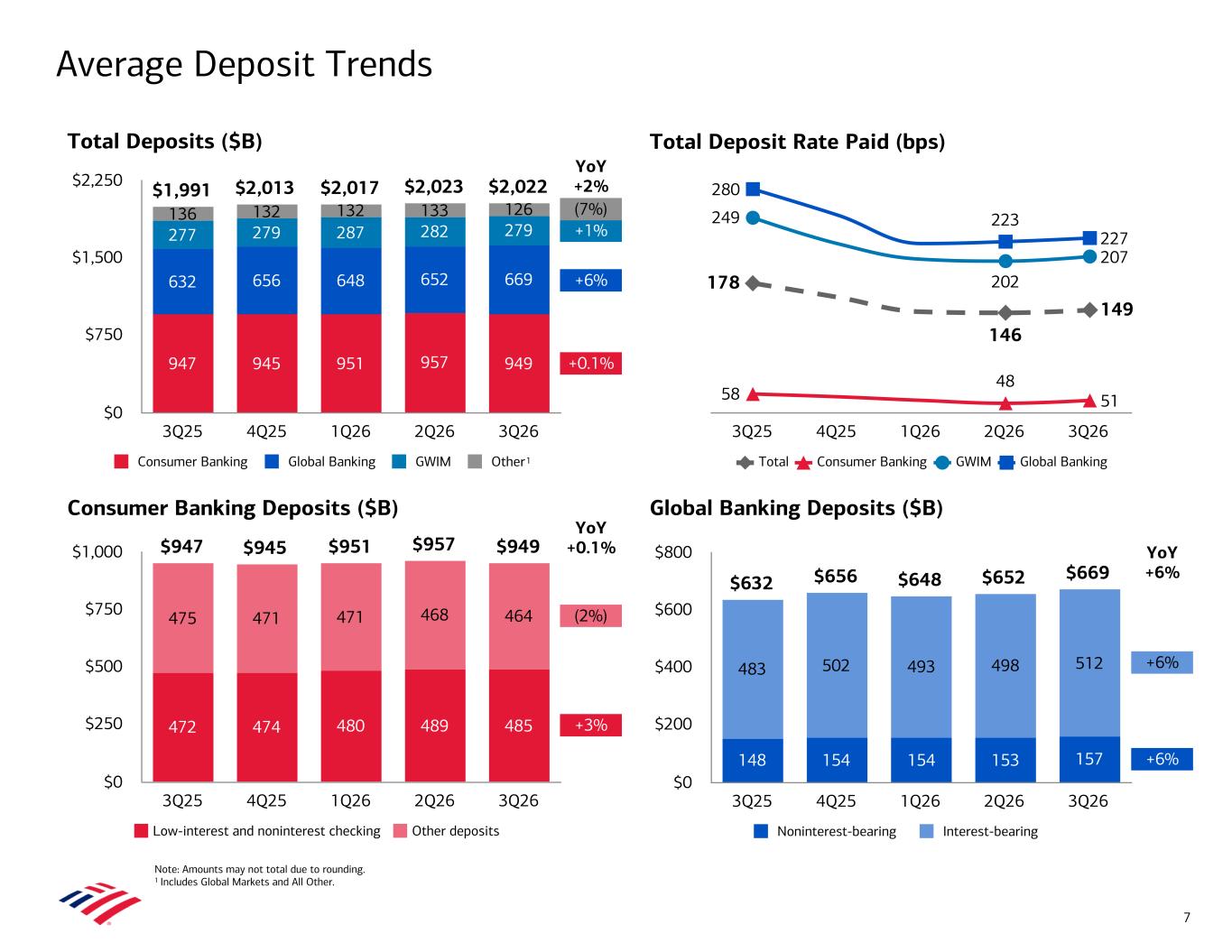
Let's turn to deposits on Slide 7, where you can see the – they're at $2 trillion now, up $31 billion from the
third quarter of 2025 despite our intentional runoff of $11 billion of higher cost deposits recorded in All
Other. Global Banking deposits grew 6% and Consumer deposits increased modestly with low-interest and
noninterest-bearing balances up nearly 3%. GWIM deposits remained stable and well-priced. Our deposit
mix remained attractive with noninterest-bearing deposits accounting for more than 75% of year-over-year
deposit growth. We also remain disciplined on pricing with the total deposit rate rising just 3 basis points to
1.49%. Our focus on operating deposits and our low loan-to-deposit ratio allow us to compete on
capabilities rather than price. Clients value the safety and convenience we provide, and a significant share
of balances remains in relationship-based operating accounts and other low-cost funding. Our deposit
franchise remains an important competitive advantage for us and continues to fund healthy client activity.
Let's turn to the loan trends Brian mentioned on Slide 8, and here, we show average loans up approximately
6% year-over-year, led by broad-based gains in commercial. Wealth-related lending also remains strong, and
card balance growth continued to improve. Commercial loans increased 8% year-over-year with growth
across every line of business with Small Business up 2%, Business Banking up 9%, Global Commercial up
6%, Global Corporate up 10%, and GWIM custom lending was up 22%. Within that performance, Global
Banking international commercial loans grew 15%. And further, we saw broad-based middle market growth
across the Commercial Banking segment in key sectors, including real estate, sports, technology, health
care, and biopharmaceuticals. In Consumer, card balances grew nearly 5% and while higher consumer real
estate balances and small business growth were more than offset by lower auto balances. Securities-based
lending and wealth management grew 21%. Importantly, the growth remains consistent with our
underwriting standards and credit discipline. It also supported another strong quarter for net interest
income, which we show on Slide 9.
3
Third Quarter 2026 Earnings Announcement
October 14, 2026
As I noted earlier, both net interest income of $16.6 billion, and the net interest yield were up strongly from
both Q2 and a year ago. Fixed-rate asset repricing and Global Markets activity both remain contributors. And
commercial loans, card balances, and deposits have increasingly been the ones driving the growth.
Looking forward, we expect NII to improve sequentially in Q4 and again through 2027 based on anticipated
modest loan and deposit growth and continued fixed-rate asset repricing. This outlook also assumes three
25 basis point rate increases through June of 2027, so in December '26 and March and June of next year. At
Investor Day last year, we shared an expectation we would deliver 5% to 7% NII growth in the medium term.
And during the course of 2026, we've raised that guidance first to 7% and then more recently to 8%. We
still expect to hit that full-year revised NII growth guidance of approximately 8%. And for 2027, we currently
expect full-year growth of NII to be 8% or more higher than 2026, and again, higher than our original 5% to
7% range. Banking book remains asset-sensitive. On a dynamic deposit basis, 100 basis point parallel shift
above the forward curve would be expected to increase NII by $1.4 billion over the following 12 months, and
that's a touch higher than the second quarter.
Let me turn to Slide 10, we see expense. We reported expense of $19.7 billion, and that included the $1.2
billion regulatory settlement charge. Excluding that charge, adjusted expense was a little more than $18.5
billion, down nearly $100 million from Q2 and up slightly less than 7% from a year ago. The year-over-year
increase reflected higher revenue-related costs in asset management and equities, including incentive
compensation in wealth management and brokerage, clearing, and exchange costs in equities, respectively.
We also invested in technology modernization, AI, client acquisition, marketing, and franchise growth. At the
same time, productivity continues to improve as evidenced by our headcount. Even as we add headcount in
our sales forces, our headcount was down nearly 3,500 from a year ago as we automate processes and
simplify work across the company. This means we don't need to hire quite as many people to refill roles. We
remain focused on investing where we see the best long-term returns, while we continue to improve the
productivity of the organization. And we expect to return to operating leverage in Q4.
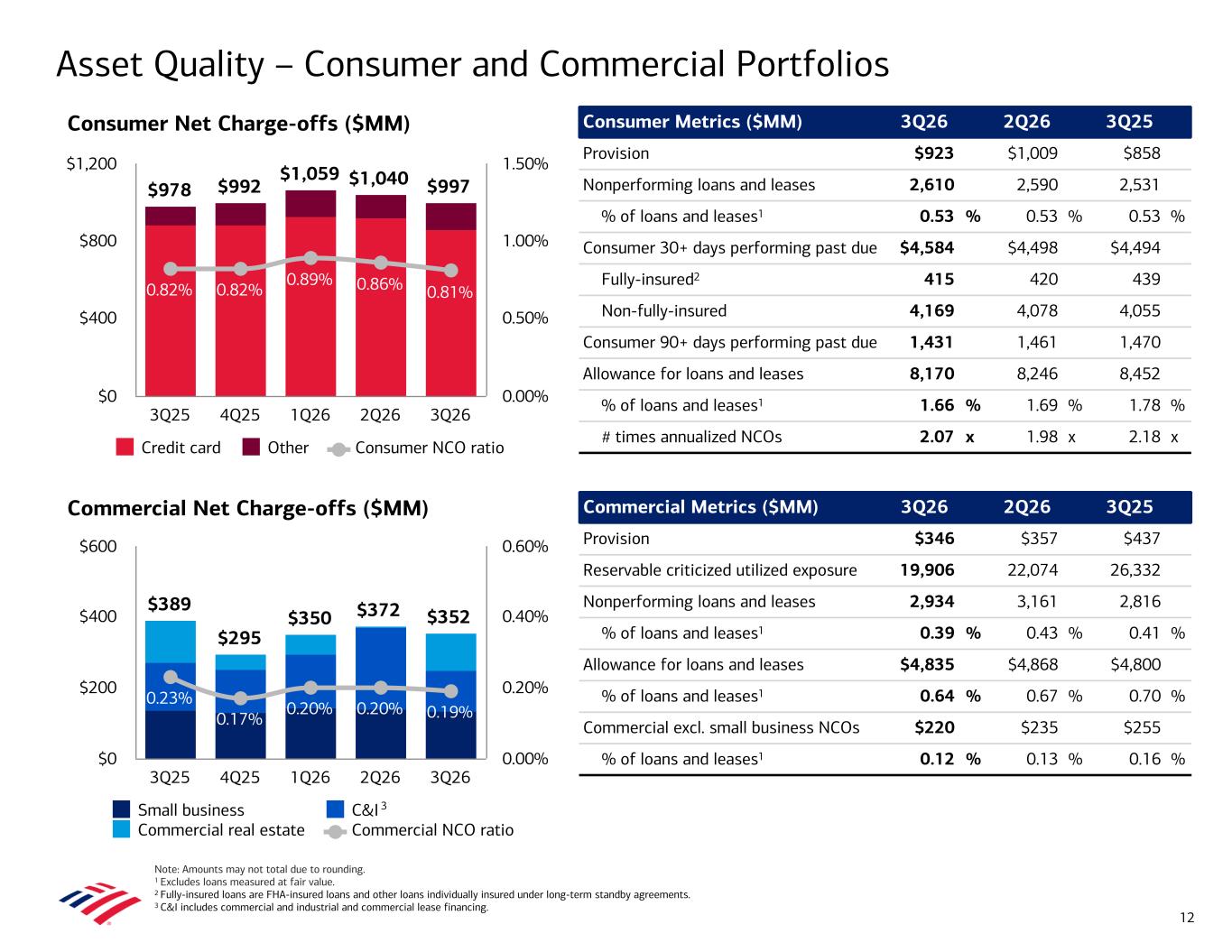
From expense, let's move to credit quality on Slides 11 and 12. And here, you can see the credit quality
remains stable and, in fact, improved modestly once again this quarter. Provision expense was
approximately $1.3 billion, lower than Q2, and the net charge-off ratio improved to 44 basis points.
Consumer credit improved in line with expectations. The 3.22% card loss rate improved from Q2 and along
with delinquencies declined for the sixth consecutive quarter on a year-over-year basis. Commercial
criticized assets declined to their lowest level on a rate basis since 4Q19, and nonperforming loans also fell
from Q2. Together, these trends continue to point to a healthy consumer and commercial client base and
credit quality.
With that credit backdrop, let's now turn to each business, beginning with Consumer Banking on Slide 13.
Consumer delivered another solid quarter, combining the organic client growth and disciplined execution
with continued investment in the franchise. Revenue rose about 4% to $11.6 billion, and net income
increased about 2% to $3.5 billion. Year-to-date results remain robust with revenue up 5% and net income
up 10%. Year-over-year expense comparisons are tougher, because we increased marketing beginning in the
fourth quarter of 2025, ahead of new sponsorships and the relaunch of BofA Rewards with spending steady
for the past 4 quarters. We opened 14 financial centers this quarter and plan to open about another 20 or
more by year-end.
Since its May relaunch, BofA Rewards has enrolled nearly 6 million clients, deepening engagement across
banking, cards, and investments. And as a result of these investments, we've seen continued account
openings and noninterest-bearing deposit growth, higher new card originations and card balance growth,
and higher digital engagement and client satisfaction. The business produced a 50% efficiency ratio and a
31% return on allocated capital.
And in Consumer, it's our deposit franchise that remains a key strength with average deposits of about
$949 billion, marking a sixth consecutive quarter of year-over-year growth. Noninterest-bearing deposits
grew more than 4% while 59% of balances remained in checking accounts and 92% of those relationships
4
Third Quarter 2026 Earnings Announcement
October 14, 2026
were primary accounts. Consumer investment assets reached $664 billion, up 14%, supported by market
gains and about $18 billion of net flows over the past year. Digital adoption reached new highs with over 50
million active users. 80% of consumer households are digitally active and digital channels generated 71% of
sales. Erica, Zelle, and AI-enabled tools are helping clients and helping employees to complete more activity
faster and more consistently. That mix of relationship growth, digital engagement, and disciplined execution
continues to strengthen Consumer Banking.
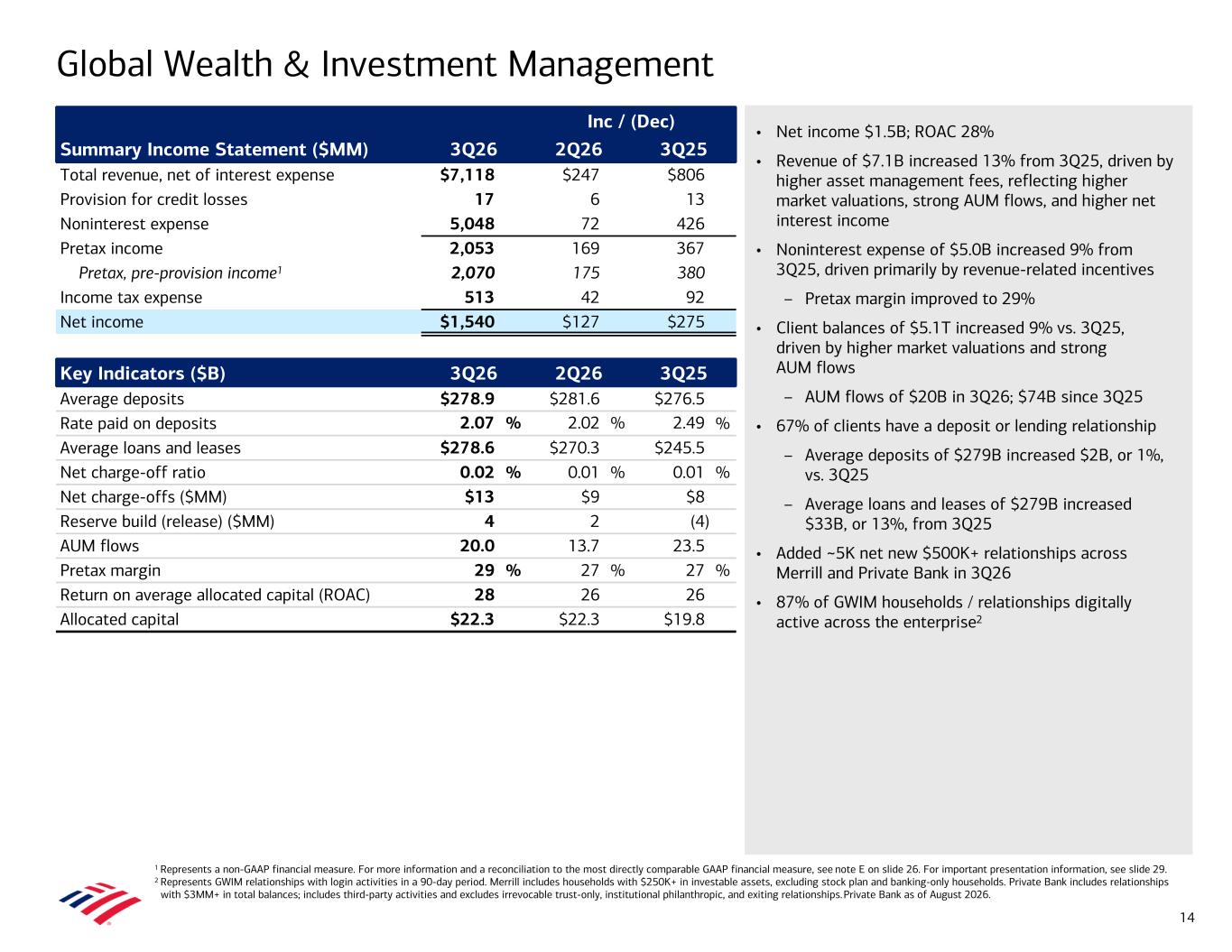
Turning to Wealth Management now on Slide 14. This business continued to improve profitability through
strong client flows, positive operating leverage, and higher margins. Revenue rose about 13% to $7.1 billion,
and net income increased 22% to more than $1.5 billion. Pretax margin approached 29%, return on
allocated capital reached about 28%, and operating leverage was strongly positive as client activity and
market levels lifted asset management fees and NII.
Client balances climbed above $5 trillion for the first time, up 9%, while AUM rose 12% to about $2.4
trillion. Quarterly net client flows were about $38 billion, including approximately $20 billion of AUM flows,
bringing four-quarter AUM flows to about $74 billion. Growth was broad-based. Merrill added about 4,200
net new households with at least $500,000 in assets, up 17%, and the Private Bank added 470 net new
relationships with at least $3 million under management. These results reflect strong demand for advice,
and our ability to attract clients and experienced advisors to the platform. Banking relationships also
deepened as now 67% of Merrill clients have banking relationships with us. Ending loans rose about 12% to
more than $280 billion, led by securities-based lending, custom lending, and mortgages. Private Bank
lending has now grown for 12 consecutive quarters as clients use more of our investment and banking
capabilities. Advisor productivity, disciplined pricing, digital engagement, and AI tools continue to expand
our capacity to deliver personalized advice at scale. And that sustained organic growth leads us to Global
Banking on Slide 15.
Global Banking segment benefited from strong loan and deposit growth and treasury activity, which helped
offset softer investment banking results. Year-to-date, the Commercial Bank added more than 300 new
companies and logos. And in September, we launched a Gen AI tool designed to make prospecting and
onboarding even more efficient. Revenue of $6.2 billion was relatively flat year-over-year, and net income
was just under $2 billion, down modestly year-over-year. However, strong pipelines and the broader year-todate performance put this quarter's investment banking results in context. Year-to-date, Global Banking
revenue is up 5%. Net income is up 7% and the total company investment banking fees are up 16%. Return
on allocated capital was 15%, and balance sheet growth reflected the continued client momentum. Average
deposits rose 6% year-over-year to $669 billion. Average loans increased 8% to $419 billion and ending
loans came in at $428 billion. Growth was broad-based across commercial and corporate clients. Treasury
Services revenue increased 10% as we helped clients manage liquidity, payments, and working capital while
creating more opportunities across lending, investment banking, and global markets.
Total company investment banking fees, excluding self-led transactions, were about $1.8 billion. Fees
declined from a strong year-ago period, driven by lower advisory and debt underwriting fees. Looking
forward, our pipelines remained healthy. We continue to invest in bankers, technology and AI tools in an
effort to improve research, preparation, and opportunity identification. That broad client activity also
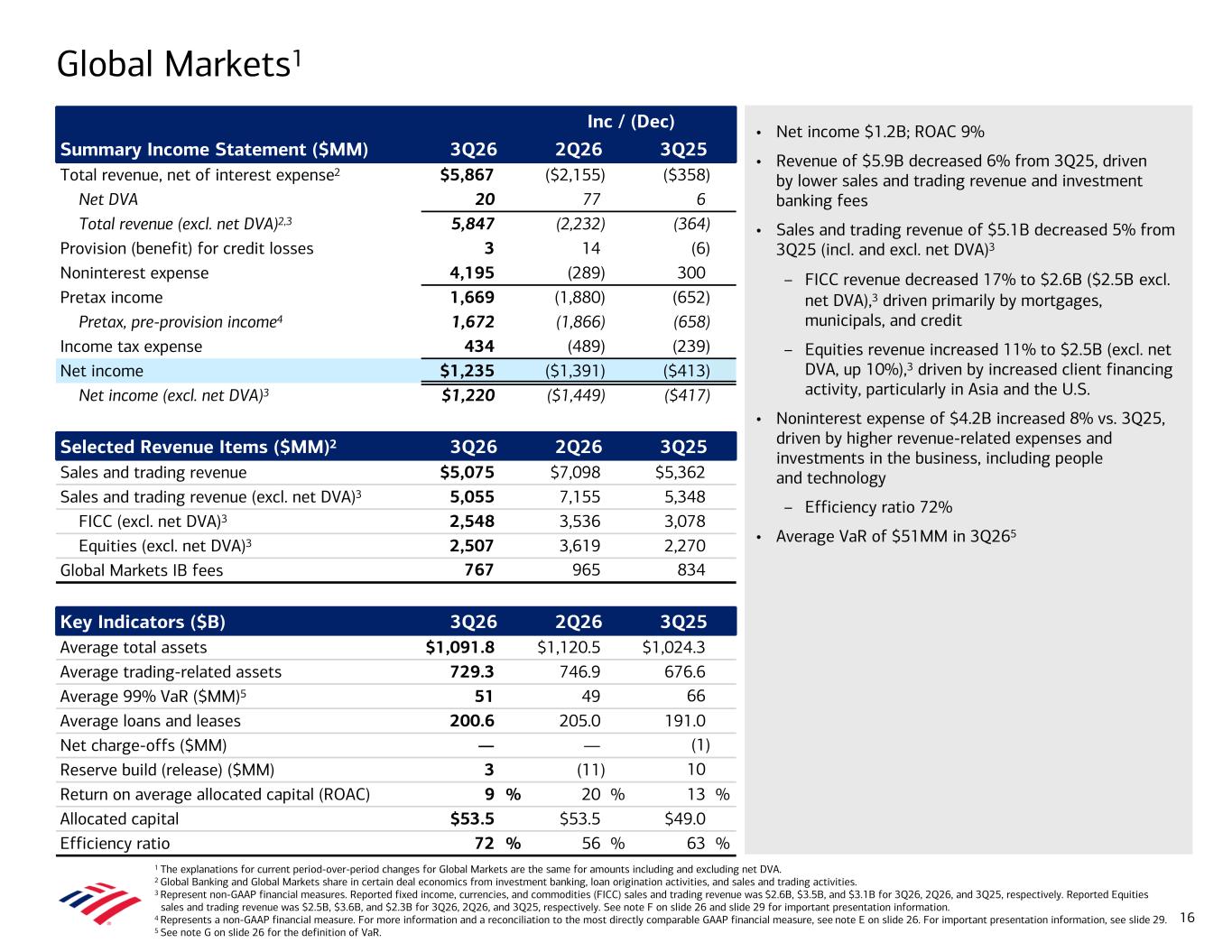
supports Global Markets, which we cover on Slide 16.
And here, you can see solid results despite a tough comparison in our FICC credit businesses with slower
trading activity this year. Excluding DVA, revenue was $5.8 billion, and net income was $1.2 billion, both
down from Q3 2025. Even so, the year-to-date performance remains a record for the firm, with revenue up
11% and net income up 14%. Sales and trading revenue, excluding DVA, was $5.1 billion, down 5% yearover-year. It was a record third quarter for Equities, and it was a record third quarter for International
revenue. Equities revenue rose 10% to $2.5 billion, led by prime financing and strong client activity. The
results reflect our investments in talent, technology and financing capabilities over time. FICC revenue was
$2.5 billion, down 17%. FX and commodities benefited from increased client activity, lifting our macro
5
Third Quarter 2026 Earnings Announcement
October 14, 2026
businesses 4%. And that strength was more than offset by lower activity in mortgages, municipals, and
credit following a strong year-ago period.
The expense increase may seem counterintuitive given the revenue decline, but it reflects higher transaction
costs tied to the equities growth particularly in prime financing and in Asia, reflecting our continued longterm investment and expansion. Average loans rose 5%, demonstrating stronger financing relationships and
connectivity across Markets, Global Banking, and Wealth Management.
With the business segments’ results covered, let's finish with All Other and some closing thoughts on Slide
17. All Other reported a loss of $1.4 billion, and that obviously includes the $1.2 billion regulatory
settlement charge, which is not tax deductible. Excluding the regulatory settlement charge, All Other shows
a loss of $153 million, compared with a loss of $103 million a year ago. The overall effective tax rate was
23%. And excluding the regulatory settlement charge, the adjusted effective tax rate was closer to 20%.
Let me close then with some key takeaways from the quarter. Customers continue to spend, supporting a
resilient U.S. economy, while wealth clients brought in assets to us and relied on us for advice. Business
clients kept spending, borrowing, investing, and growing. And institutional clients remain active globally,
even though at a slower pace. Those trends were evident across the company and drove another solid
quarter. Our pipelines and our client conversations reflect the same confidence we have in the economy
even as clients keep a close eye on geopolitical uncertainty. Our balance sheet and capital remains strong,
and we continue to invest in technology and develop AI capabilities to support long-term growth.
This quarter demonstrates the strength of our franchise and the value of our diversified business model.
With that, I'll say thank you, and we'll stop now to take your questions.
Q&A
Operator
Our first question comes from Chris McGratty with KBW.
Chris McGratty
Brian or Alastair, on the capital outlook, you talked about modest balance sheet growth. I'm wondering if you
could dig into your assumptions between growth of the balance sheet and returning of capital, balancing the
CET1 and the TCE ratio?
Alastair Borthwick
Sure. Well, first, I'd say if you look at the course of the year, we've obviously supported all of the client
growth that we've seen with the capital that we generate. And if we look at where we stand today, we've
obviously got a considerable amount of flexibility on capital. Just recognizing that we're at 10.9% CET1 and
a reg minimum at 10.0%. We also generate substantial capital. So if you look at this quarter, for example,
Chris, we supported $34 billion of loan growth. We obviously had a regulatory penalty. We saw rates go up
85 basis points. We paid an increased dividend, and we bought back $6 billion in shares. So, we've got a lot
of flexibility with the earnings that we generate to balance exactly what we've been doing through the
course of this year and over the course of time. Always our priority is going to be support the clients and
the growth. We know we have to support the regulatory minimum and the dividend. And then whatever is
left, we're going to return to shareholders. So, no change.
Chris McGratty
Okay. Great. And then on the operating leverage comment, Q4 I heard you there. But could we revisit 2027?
You gave us a pretty good NII update. I think the guide at Investor Day was 200 to 300 basis points. Any
changes on how you're feeling about that going into next year?
6
Third Quarter 2026 Earnings Announcement
October 14, 2026
Alastair Borthwick
No, no change there. We've obviously had a very good first half. Q3 was slower. And we're back on creating
operating leverage in Q4. I think as we get into Q4, Chris, I will likely provide guidance for next year, but it's
not going to change from the 200-300 basis points based on what we see, it could be higher, but we'll see
as we get closer.
Operator
We'll move on now to David Chiaverini with Jefferies
David Chiaverini
I wanted to touch on the NII guide of 8% plus looking out to next year. I was curious on the drivers behind
the improvement. Is it all rate driven or anything else driving that improvement?
Alastair Borthwick
No, it's not all rates. Rates are obviously a small component of that. But same drivers as this year really,
David. We've seen a little more normal deposit growth this year, and particularly where we've seen it is in
noninterest-bearing. So, if you look at the noninterest-bearing in Consumer or you look at the noninterestbearing in Global Banking, that's returned to something a little more normal. We'd always thought deposit
growth should be in kind of the 4% to 5% range in a normal-type economy. And that's kind of where the
noninterest-bearing is now over the course of the last year over year. So that's number one. Number two,
the pricing rotation is slowing. So, we've seen, for example, Consumer’s flattened out. It's now grown 6
quarters in a row, Wealth Management, same thing. The loan growth has kind of averaged $20 billion a
quarter over the course of time. We don't see that slowing at this point in time. And then we've talked about
we benefit from fixed-rate asset repricing, most notably in the auto loan and the residential mortgage
portfolios, but also in our mortgage-backed securities and our cash flow swaps. And if any, in the last
quarter, just increased both floating-rate yields and fixed-rate yields.
So there – do rates help us as we look into 2027? Yes. But it's the core underlying growth in deposits and
loans that help us. And then I think that we have to recognize, in '27, if rates go up, we would expect Global
Markets – it's liability sensitive. It's entirely possible that Global Markets will go down. But remember, we
continue to add loans in Global Markets, and we continue to invest in Global Markets. So that will offset that
just a little bit. The gains in banking are going to more than offset that. That's the core part. The core
banking book is going to be stronger in 2027 than '26.
Brian Moynihan
Yes. To be precise, the 8% includes effectively a drag on Markets because it hasn't been growing for the last
couple of quarters, it's been relatively flat. So it's an all-in number overcoming that, just to be clear.
David Chiaverini
Great. And on the consent order, are there any constraints? Or does this impede business operations in any
way as we look forward?
Alastair Borthwick
Just repeat your question one more time. I'm sorry. I was writing a note to myself. Go ahead.
David Chiaverini
Sure. Just on the consent order. Are there any constraints on the business? Does it impede your normal
business operations at all?
Alastair Borthwick
No, there's no asset cap here. So no, there's nothing there. And then in terms of – it won't crowd out
anything either because we've invested the technology, and we've invested the people that we feel like we
need to get the work done. So that's in the run rate. We've made the decisions we need to. We've added the
resources we feel like we need. So, it should not impact our clients in any way.
7
Third Quarter 2026 Earnings Announcement
October 14, 2026
Operator
We'll move next to Manan Gosalia with Morgan Stanley.
Manan Gosalia
On the consumer side, you noted that consumers continue to spend and consumers are healthy. But maybe
you can give us some more color on what you're seeing there with short-end rates moving higher, higherfor-longer gas prices? Are you seeing any signs of pressure? And are there any changes that you're making
at the margin in terms of where you're leaning in or leaning out?
Brian Moynihan
So I think you're – let's separate 2 things. One, on the credit quality, our underwriting standards are
consistent. The 5% growth in credit cards is with the same underwriting standards, and you can see the
stats very strong. The charge-offs there, 3% and some change. So yes, we feel very good about that. Any
other consumer loan quality metrics are – continue to be strong and improved. So, in terms of seeing any
stress on the consumer, absolutely not in terms of credit quality. Then if you go to the balance in our
accounts, they're growing. And when you look at the paychecks, the direct deposits coming from employers
to our consumers, we see those growing across the 3 segments of income we have (low, medium and high),
and we see the low have picked up. So that all bodes well.
When you go to actually what their activity is, as we said on the slide, is 5% more spending this year than
last year. And yes, gas spending is up 20-odd percent. That – when you look at the credit and debit card
spending only, that does crowd out as you look at some of the underlying data, you can see the gas
spending and the inside store spending is still growing in the convenience stores, but not quite at the rate
that it was. So it crowds out a little bit, but frankly, for the – it's really different stories for different types of
people in the overall positioning. The rest of the spending is very strong at the 5% and on entertainment
and other categories that you see there.
Manan Gosalia
Got it. And then if you could give us some more color on the positive operating leverage for next year. What
are the key drivers? Clearly, you're dropping more of the NII growth to the bottom line. So that's certainly a
positive. But if you could talk about some of the levers that you have on the expense side? And if you could
clarify that the 200 to 300 basis points is on the adjusted expense number for 2026, excluding the
settlement charge.
Alastair Borthwick
Well, I think that's the best way to look at it, because we wouldn't view that as being repeated. We view that
as a one time. It's not a core operating expense. So I think you've got to adjust for that. But yes, we still feel
like 200 to 300 basis points is generally speaking, the right kind of a zone. We put that out for Investor Day
through the medium term. We'll get into what we want to guide for 2027 when we get into the fourth
quarter. But you've identified first thing, which is NII growth, a lot of it drops straight to the bottom line,
and that's really important. That's a very powerful driver for our company. And then, obviously, we've got
some terrific opportunities to continue to grow the fee businesses as we have consistently invested there.
So we've got a good opportunity across the board, we feel like whether it's Wealth, Global Banking, and
Global Markets to keep driving the fee side. So that we feel good about.
And then on the expense, we've got a pretty good track record of headcount management all the way
through this year. So if you look at what we've done in terms of what's the main driver of expense for any
business, 60% to 70% of it is headcount. We've done a nice job of managing headcount with discipline all
year. We're going to maintain that management discipline into next year that allows us to create the
operating leverage that we're talking about.
Final thing I'll just say is, we obviously benefit a great deal from the fact that we've got a Consumer
Business, a Wealth Business, Small Business, medium-sized business, large businesses, and investors. And
the interconnectedness of those, the flows of business that go between them is another thing we've
8
Third Quarter 2026 Earnings Announcement
October 14, 2026
highlighted at Investor Day presentation and afterwards. And another area of additional growth for us that
we continue to explore.
Operator
We'll move on now to Ben Gerlinger with Citi.
Ben Gerlinger
Just wanted to double check. So, you have the full-year NII, and next year is also strong. And then you also
say that noninterest-bearing deposit growth has been healthy. So, are you kind of assuming that noninterest
bearing cost growth continues to be healthy despite the 3 additional hikes your forward expectations
include? And if so, can you also unpack some of the deposit betas you might be assuming in next year's NII?
Alastair Borthwick
Yes. So first, with respect to noninterest bearing, yes, we're assuming low single digits for deposit growth
broadly. And we're anticipating that we can continue to grow noninterest-bearing deposits as we have done
over the course of the past year. Remember whether rates go up by 25 basis points or not, at some point,
noninterest-bearing deposits are impacted more by inflation and GDP. So we ought to see continued growth
in noninterest-bearing deposits through the course of time. A lot of the rotation of rates took place when
rates went from 25 basis points to 4.5%. We've been in that environment now for 3 or 4 years. There's been
a lot of time for consumers and wealthy clients to sort of settle into that environment. So yes, we anticipate
continued growth in our deposits.
In terms of deposit betas, obviously, we came from 4.5% down to 3.75% – 3.5%. Now we’re retracing
steps, I would anticipate it will look the same going back up as it did coming down. The areas to watch
continue to be, obviously, in Consumer, it's about CD pricing. In Wealth, we tend to pass along pricing with
interest rate hikes and cuts. And the same thing is true in Global Banking. When the Fed raises rates, we're
typically passing that through to our clients. So, there'll be no change in our perspective on the way back up
as there was originally nor in the way that we think about it on the way down. So, no change there.
Operator
We'll move next to John McDonald with Truist Securities.
John McDonald
Brian, I was hoping you could give a little perspective in terms of the OCC and FinCEN orders. Like how it
gets to this point? Is it kind of a misunderstanding of what regulators are asking for or disagreement on
how to address the issues they're asking for in your processes? Just some perspective on how it comes
about, and your lessons learned or takeaways that we should have from this?
Brian Moynihan
Look, at the end of the day, I think we have agreed to call this a settlement and move forward, and so we
are doing it. So, I think at the end of the day, we understand what they need us to do. We're deep in the
process of remediating. Just for example, this quarter, a couple hundred million dollars plus in remediation
costs for that effort. So, it's been substantial in thousands of employees. So, we have a clear understanding
of what we need to do. We're doing it. We'll complete it. And it is the focus of management to get it cleaned
up.
Beyond that, there's not a lot to talk about in terms of our processes and our capabilities, but we're busy
working away and have been for the last several months and quarters. This settlement resolves the penalty
that was in the 2024 cease-and-desist order, and that was what took time is to kind of get the negotiations
around all that, but the work started with pace back then. And it's something we build up and are going to
do. And as we move forward, we'll get more efficient at it. And it will improve in the operating dynamics.
9
Third Quarter 2026 Earnings Announcement
October 14, 2026
John McDonald
Okay. And then Alastair, that was helpful context on the levers you pulled for capital management this
quarter. Just want to clarify, as you look ahead what metrics you're going to be managing to and kind of
which is governing I think you're going to triangulate maybe? Is it CET1 of 11-ish percent and then also
triangulating to TCE of 6-ish percent?
Alastair Borthwick
Well, first thing we're going to do is wait for the final rules because we're anticipating those coming out in
Q4. That will be important in terms of just clarifying exactly how and what we're calculating. I think it will
also be helpful in terms of clarifying what the transition period looks like, John. So we just have to consider
that as we see that later this quarter. And then the reason that we look at both CET1 and tangible common
equity is because we have a series of different constituencies, and we have to manage all of them. So it's
important for us just to keep an eye on all of these various metrics. And we're balancing at any given time,
capital, liquidity, earnings as we make our decisions.
But I'll go back to this point. We've got a lot of flexibility on capital right now. You saw what we could do in
Q3. We generate a lot of capital. That gives us a lot of flexibility going forward. And our priorities remain
the same.
Operator
We'll now move on to Jim Mitchell with Seaport Global Securities.
Jim Mitchell
Alastair, just on just thoughts, I appreciate the 2027 commentary on NII. And just it sounds like and I just
wanted to confirm that it sounds like Markets-related NII could be down from 2026 levels, which would
imply that ex-markets NII should be north of 8%. I just wanted to confirm that. And then when I think about
your commentary around operating leverage in the past that if that flows to the bottom line, that, all else
equal, does tend to push you towards the higher end of the operating leverage range. Not trying to put
words in your mouth, but just trying to think through those puts and takes.
Alastair Borthwick
I agree with both broadly. I think both statements are probably true. The first one in terms of – yes, we'd
anticipate Global Markets in an environment where if rates go up another 3 hikes that's liability sensitive it
is, but we just have to recognize we continue to add balance sheet there over time. So, it just gets bigger,
which tends to help NII. And then also, we're adding loans. So that matters also.
In terms of Global Banking and the banking book broadly, yes, that would imply then that would grow faster
than 8%. So, I think you're right. And then second, yes, we intend to drop as much of this to the bottom line
as we possibly can, and that tends to be very good for operating leverage. But again, I don't want to get
drawn into that right this second, because we want to look at that as we go through the fourth quarter.
Then I think we'll give guidance next year. But the point is, we're not coming off of our Investor Day
expectations. And if you look at operating leverage over the course of the past couple of years, we've
tended to do better year after year. We're positioned well for next year.
Jim Mitchell
Okay. Yes. Great. And then maybe just on FICC trading, you noted kind of higher rates hurt the micro
businesses. Now is that mostly negative marks or was it the slowdown of volume because just trying to see
if this pressure could linger? Or could we see a snapback if rates stabilize?
Alastair Borthwick
Yes. So generally speaking, we tend to benefit a lot from the fact that we're really big in credit, mortgages,
and munis. Those are great leading franchises for us. It just happens when rates go up 85 basis points in a
quarter, that tends not to be good for those businesses. Clients tend to slow their activity. It's not good for
asset prices. So it's largely a client activity thing. We haven't seen the same kind of performance in –
10
Third Quarter 2026 Earnings Announcement
October 14, 2026
meaning we haven't seen rates behave the same way in Q4. So we're moving on to the fourth quarter,
having gone through the third, and we retain leadership in those big businesses of ours.
Operator
We'll move on to Mike Mayo with Wells Fargo Securities.
Mike Mayo
In this period of AI and AI deployment, where can that take you guys? I see revenues per employee year-todate are up 10%. And you would think with all of the tools at your disposal that you'd be able to take that
much higher. So, I know I've asked this question before, but AI is moving so quickly. And I think the banks
have to keep up so much that I thought I'd ask it again.
Brian Moynihan
So if you Mike, I think – so one, just to set the stage, if you look year-over-year, the total expense base was
up $1.2 billion, and the head count was down 3,000 round numbers. In the $1.2 billion, $450-or-so million of
that is wealth management incentives with revenue growth. About $300 million of it is in the Markets
business, the BC&E, and that leaves say, $400 million left, of which a couple of hundred million plus in the
third quarter were 2 things: remediation for the AML and remediation for the Mythos implementation. So,
there wasn't – the overall expense growth absent that was a couple of hundred million dollars, maybe $300
million on a base of, call it, $17 billion and change last year. So you think about that, how do we maintain
that kind of 1%, 2% expense growth with all the investments we're making. We've opened 5 branches in
Milwaukee this month and things like that, more headcount, client-facing. And that's by engineering, both
through engineering process through AI application, et cetera. So, you see it already in the numbers, and we
expect to continue going forward, and we expect that the Mythos remediation costs run down, because we
added 1,000 extra staff to work on that, not in the headcount but in consultants. You expect the orders get
implemented. But what continues to recur will be that leverage you get from – on the core expense base.
So AI has helped us. We're about 130 different projects implemented. All of them have a payback in the very
detailed projects. None of them are huge contributors. Overall, the benefits are 2x to 3x, over time, of the
expense you're giving out. We expect that number to go from the $250 million, $300 million this year to
$700 million next year in terms of projects we put in the pipeline, and a key one of those is the
development of technology, which is $4 billion and change a year, we're 10% more efficient. So next year,
we get 10% more work for the same cost. And so, we're going to continue to invest in driving the growth in
the franchise, and AI is a major part of that, say, $300 million going to $700 million, headcount down by
3,000 or 1.5% year-over-year, managers down by about 5% in that, and production teammates that are
doing the client-facing work are actually up year-over-year.
So we feel very good about the operating dynamics. And even the expense base we see grew in the third
quarter, you can point to the things that are purely capital markets, revenue-related items, and/or things
that will disappear over time from the expense base and be replaced by expense that does more for us.
Mike Mayo
All right. And then just a separate question. Brian, this is, I think, the 17th year of you being CEO. And I just
was wondering about your thoughts on a successor. How much longer do you plan on remaining CEO? What
qualities do you look for in a successor? And for a successor, would you look outside the firm? And why not,
right?
Brian Moynihan
It's the Board's decision ultimately. Our job as management is to tee up the talent in this company, which
there's a lot. We work on it all the time, because I could get hit by a truck tomorrow, too, Mike. So – but this
company’s success is due to the 209,000 people out there working every day, and there’ll be a great leader
for it next, and the Board will make the decision when the time is there. But we feel very good about the
team we have and the leadership we have in the company. You will be the first to know, Mike, when I decide
that.
11
Third Quarter 2026 Earnings Announcement
October 14, 2026
Operator
We'll move on to Ken Usdin with Autonomous Research.
Ken Usdin
Big picture question on the balance sheet. Alastair, last quarter you talked about working on balance sheet
efficiency. And it seems like the last couple of quarters, you've done what you said in terms of really taking
down the wholesale funding part of the balance sheet with an offset in NIM. I'm just wondering if there are
any offsets to that in terms of either how much you can make in trading as a result of that? Does it change
your intermediation potential? And any other thoughts you have about kind of like where the average
earning assets goes from here in a totality perspective?
Alastair Borthwick
Yes. So those are obviously two different decisions. The Markets business we're going to support with the
balance sheet and the capital that they need to drive profitable growth. They've done an excellent job over
the course of the past 3 or 4 years of growing and improving returns. Q2, I think, was a great example. It
was a really extraordinary opportunity. We took advantage of that. We gave more capital because the
returns were terrific in Q2. In Q3, the returns aren't quite the same. We don't have the same client activity
going on. So Markets, we're going to keep investing in. We're going to keep giving balance sheet. We're
going to keep supporting the clients because it's an important growth opportunity for us.
Second question is more just how do you manage short-term wholesale funding and the direction of travel
for us is down. Generally speaking, deposit growth plus pay downs of securities as they come due is there to
support loan growth. And every time that deposits plus pay downs is greater than loans, it allows us to just
pay down a little bit of short-term wholesale funding. So look, most of the NIM improvement is coming
from repricings and profitable deposit and loan growth over time and a little bit of it is short-term
wholesale funding, but the two things are separate. They're not linked in any way.
Ken Usdin
Okay. And if I could come back... Go ahead, Brian.
Brian Moynihan
I was just going to add to that, think about a 15-basis points improvement from 2.00% to 2.15%. So that's
15 basis points on 2% improvement in the – on a $3 trillion balance sheet. That's the efficiency of Alastair
describing coming through. So you're replacing low-yielding securities with much higher-yielding
commercial loans and consumer loans. You also end up with deposit growth with 5% noninterest-bearing
and overall a couple of percent. So your mix is even improving there. And to your colleague's question a
while back, because your zero-rate deposits and low-interest savings and checking are 0 in any environment
for rate growth, and the deposit balances keep growing irrespective of the higher rate environment. So that
dynamic is really why we see this march to -- from 2.15% towards 2.30% really just taking place as we look
out over the next several quarters here.
That's a really important dynamic because if you go back to the 6% TCE ratio, that gives you a chance to
really push the returns on a relative size that gets you the 16%, et cetera. So that's what we've been
working at, is that efficiency balance sheet because of the dynamics we are in as liquidity, we pushed the
size up, and now we're bringing it back down. The Markets business has a balance sheet they need to run
the business. They can have more if they put it to work with good returns. As Alastair said, completely
unrelated to that efficiency we can get with the rest of the balance sheet.
Ken Usdin
Okay. Understood. And then just coming back to the third quarter market results, as you mentioned, Alastair,
just that there weren't as many opportunities. One of the peers yesterday talked about that fourth quarter
could still be down meaningfully for them sequentially just based on what normal seasonality is. So I know
this might not have been like the typical quarter, but can you just help provide any perspective on what you
12
Third Quarter 2026 Earnings Announcement
October 14, 2026
think versus the $5.1 billion in the third quarter? What your overall view of markets might be for the fourth
quarter, just given what happened in the third and what normal seasonality might do in the fourth?
Alastair Borthwick
Yes. So we tend not to guide for any quarter in Markets, recognizing that it's very, very challenging to
forecast that business in particular. Third quarter, as I mentioned, we were obviously hurt by our mix. We
have strength in credit and mortgage and munis. So, you'd sort of think if that was an extreme bear market
for a quarter that moderates – which it has done through the first couple of weeks – we wouldn't see the
same impact in the fourth quarter. Fourth quarter obviously has seasonality, but those two may offset one
another. And at the end of the day, the Markets business has done a really nice job of 18 or 17 quarters in a
row of year-over-year growth. So, they're looking forward to the fourth quarter. We're looking forward to the
fourth quarter. I think there'll probably be less seasonality this year than in prior years just based off of the
way third quarter turned out. But we don't predict because we're not great at predicting Global Markets
performance in any quarter.
Operator
We'll move on now to Matt O'Connor with Deutsche Bank.
Matt O'Connor
It seems like the loan growth accelerated towards the end of the quarter, both based on the H.8 data that
we can all see and then also your spot loan growth was a lot stronger than average. Anything to read into
that beyond just kind of quarter end noise?
Brian Moynihan
No, I don't think there is. The H.8 data bounces around, as you can see. And we have things like lending to
warehouse mortgage lenders that go up and come down. But if you look at it sort of -- get away from that
kind of volatility, the really core aspects, being middle market grew across the board in most of its
segments and the Business Banking franchise, which the team's done a good job – Sharon Miller and team
have done a good job getting to grow again, it's balanced. Small Business grows, the credit card group,
those are – they may come in ebbs and flows, but generally, they’re stick to your ribs type growth. And so
that sets us up nice for next quarter. The business come in and out of more of the high-end businesses
because the loan – a bridge loan gets taken out or the warehouse and stuff. So most of that volatility is
around that and the core businesses it just keeps coming out is each month, which is terrific.
Matt O'Connor
Okay. And then a bigger picture question. As we think about this rising rate environment and the deposit
betas, I feel like a lot of banks are assuming it's similar to what we saw a few years ago when rates went
up. But I also feel like the loan and deposit environment is totally different because last environment, when
rates are going up, loans are paying down, and everybody had excess deposits. And now loan growth is quite
solid. And I think most people are expecting it to continue, and everyone wants to fund it with deposits. So I
guess the long-winded question is, isn't there a risk that deposit pricing picks up more than maybe you and
others have assumed just because of more loan growth and therefore, deposit competition?
Brian Moynihan
I think Alastair mentioned earlier, we have $2 trillion in deposits and $1.2 trillion in loans. So, there is a lot
of room to grow loans without thinking about needing to raise money to fund them. And within that, we
have that really all sitting in cash, short-term securities. And then held to maturity portfolio is running off.
So each day, week, month, we have $9 billion a quarter, $36 billion a year just out of the mortgage payoffs,
which are holding constant. And so there's plenty of cash to fund up the loan balance. You look year-overyear, you can see that in the balance sheet growth. So there's a lot of room in us. We are far different from
most people because we're $2 trillion and $1.2 trillion. That loan-to-deposit ratio is far less. And so, as
Alastair said, we ran off high-rate funding. We placed CDs from our clients' money in other people so that
13
Third Quarter 2026 Earnings Announcement
October 14, 2026
we take our clients' money who want higher rates, and we give it to banks who pay them higher rates
because they need the funding. So it's just not something we need to reach for.
And I think leave aside rates down a little bit, up a little bit, the nominal rate environment, if you think about
it across the last few years, we're growing deposits from a low of $1.8 trillion, I think after post-pandemic,
we have $1.85 trillion, something like that, up $2 trillion plus. The pricing discipline has remained. And if you
look at the page on deposits slide, Slide 7, you see it's 149 basis points in an environment which is 3.5%,
4% around you. So this is core money and movement in core transactional accounts for consumers, small
businesses, wealthy clients that is growing and very stable. So we don't see the dynamic because we have a
lot of room to grow loans without having any pressure to raise funds for them. We have a lot of runoff of
fixed-rate assets that can help fund that. And on top of that, the deposits grow and they're very advantaged.
So 149 basis points against the current rate environment is a pretty good place to be. And then on top of
that, what's different from us than most, if not all, competitors is the efficiency on the consumer side
relative to that deposit base. So that cost of deposits. That gives us a chance to make money on a
consumer that is very strong.
Operator
We'll move on now to Erika Najarian with UBS.
Erika Najarian
I just want to apologize in advance. I have 3 questions. I'm going to ask short questions, but I think it's
important given the stock opened down 8%. Number one, just a clarification question on NII ex markets.
Alastair, given your comments on market NII being down, I would essentially assume that core NII would be
up around 10% year-over-year in 2027, in line with what JPMorgan said yesterday. Is that about the right
geography?
Alastair Borthwick
Well, look, we don't guide. I was asked to – we don't guide the two differently and independently for a
variety of different reasons. I was asked the question earlier, do you think Global Markets could be down
next year with respect to 3 or 4 rate hikes, one that just happened and three to come? The answer to that is
yes because it's liability sensitive. But again, I'm just reminding people they continue to add loans and we're
likely to just continue adding balance sheet. So Markets piece, yes, may be down. So that 8% is including
Markets. So that would tell you that the number is likely higher for the core banking book. But we don't
break it out because things move around and they go between and we manage it for the entire company. So
I think directionally, that's how you should think about it. And we may provide more guidance around what
the exact number looks like as we get into Q4, we're probably not going to break it out between the two.
Erika Najarian
And the second question is down 7% implies, I think, to the market that this is more than just the results
that there's sort of a confidence issue perhaps deepened by the consent order. I guess, a compound
question, and I apologize. One, are there any incremental expenses that we should expect coming out of the
third-party review that needs to happen? I appreciate that this has been an issue since the cease-and-desist
order sit in December 2024. And given that expenses have come in higher than expected, what would give
you – how would you instill confidence in investors that you could do the high-end of 300 basis points of
operating leverage next year, much less 200 to 300 basis points?
Alastair Borthwick
Okay. So look, on the expense, I think we tried to be as clear as we possibly can. We've ramped up
significantly the people required to handle the consent order work. We've been working on that for some
time now. We've also tried to be clear that we've ramped up the technology spend required. So we feel like
that is in the run rate.
And just remember, Erika, we started the year with 3,000 more heads than we have currently, just to give
some idea. So, we've been able to do that within all going on underneath the surface by repositioning
14
Third Quarter 2026 Earnings Announcement
October 14, 2026
people with the productivity gains we've seen. So the expense side, I think, still holds together there. The
operating leverage we've said we intend to deliver 200 to 300 basis points through the medium term. We
haven't changed from that. And I think as we get into Q4, I'll give you a better sense for what that looks like
in 2027.
Erika Najarian
And finally, on the capital. On January 1, 2027, you're set to step up in G-SIB surcharge, which would raise
your minimum to 10.50%. As we think about your shareholders have enjoyed about $6 billion in buybacks
per quarter, and it's been supportive of the stock. As we think about the intersection of strong capital
generation sort of a TCE constraint at 6% and that GSIB surcharge step-up with the potential for reform to
be finalized, how should we think about how your – is it business as usual in buybacks over the near term
close to that $6 billion number? Or are we waiting for the finalization of GSIB to see whether or not the –
they'll treat your G-SIB surcharge calculation only prospectively or retroactively to prevent that step-up?
Alastair Borthwick
All right. So, there's a lot to unpack there. We don't guide on share buyback for lots of different reasons. It's
definitely business as usual in terms of how we think about that equation with one exception. We need to
wait for the final rules. So, I know we're all desperate for the final rules. I'm desperate for the final rules, but
we don't have them yet. We need to understand first, what are the rules? How is it going to work? And then
we need to understand the transition period. I think in your question, there's an assumption that the current,
which will soon be the old rules, prevail around where capital might go. That may be the case, that may not
be the case. We have to wait, and we have to see.
That having been said, if you look at this quarter, again, what did we manage to do? Well, we're looking at
both tangible common equity and CET1. We've got plenty of flexibility on the CET1 number because we're
90 basis points above the regulatory minimum. And in tangible common equity, just think about it, this
quarter, rates went up 85 basis points. We dealt with a regulatory penalty at the end of the quarter. We
added $34 billion of loans to support our clients, paid the dividend and bought back $6 billion shares. That
gives you a sense for just how capital generative this company is every quarter. So I don't – none of that
changes, Erika. We just have to see how the quarter develops. We have to wait for the final rules.
Operator
We'll move on now to Scott Siefers with TD Cowen Securities.
Scott Siefers
I know you've touched on the IB outlook, at least a bit. I was hoping – maybe just a little more – it's been
such a strong year in the aggregate, but I think we're all fixated on this more recent pause in activity. Can
you sort of speak to either what you all are discussing internally or with clients regarding anything that
would kind of help distinguish between what's just hopefully a temporary pause and as we all adjust to
higher rates and something that might prove potentially more lasting?
Alastair Borthwick
Well, the starting point is just to remind ourselves that after 9 months, our investment banking fees are up
16% year-to-date. So, the activity level, generally speaking, is pretty good. Is the second quarter a little
softer than – sorry, is the third a little softer than the second? Yes, a little. There's a move in interest rates
of the magnitude that we saw impact transactional activity from our clients. Yes, that does happen. And
obviously, there's a period in volatility like that, where buyers and sellers just need to readjust valuations
and expectations. So that always happens. But if you look at our businesses generally, we can see from the
loan growth activity across the commercial side that the capex cycle continues. We know from the
investment banking pipelines that they remain strong, and our team added more in the way of pipeline in
the quarter.
So it feels to us like clients all around the world are active. We've got a good U.S. economy supported by the
consumer and by the AI capex. And there's underneath that, a lot of capital requirement from these AI
15
Third Quarter 2026 Earnings Announcement
October 14, 2026
companies and the whole environment that surrounds them. We've been a very active participant in that. So,
we remain optimistic on investment banking. We've got a world-leading franchise in capital markets. I think
we were third in announced M&A in the third quarter. So that tends to mean good things going forward. So,
we're pretty constructive and we'll see how the fourth quarter develops.
Operator
We'll move next to Steven Chubak with Wolfe Research.
Steven Chubak
Maybe to start, Brian, I was hoping you could address some of the recent concerns on Muse or agentic AI as
potentially driving more yield-seeking behavior, the potential risk of flight for more idle consumer deposits?
And whether you can create barriers that actually explicitly precluded agentic access, which could potentially
help dampen the pace of sorting activity while also providing some additional layers of security to your
customers as well.
Brian Moynihan
I think those are two different questions. One is we're working with various agent providers and others to –
likely worked with some of the aggregators to make sure that the customers in control of the decision, the
human remains in the loop before money is moved out of their account and items like that. So that's safety
and security. Look, we have a – the banking system has been the source of transactional accounts for
people forever and that safety and security people have knowing they can make a payment. It will go
through the system. It will be credited to the person they're making the payment for. They can receive
payments. They have access 24/7. They can send money out Zelle payments, et cetera, all of the time.
They can do wires right from their phone. But it's all safe and secure in the environment. And I think that's
the key. And so what we and the industry and others are working on is with these providers are saying, "Hey,
make sure that the human stays in control because what you don't want is a lot of decayed transactions for
lack of better terms. So that's completely separate from the question.
The question of people optimizing deposits comes down to what a customer puts money with a bank for.
And today, a customer can get a money market fund rate of 4% plus. Today, the customer can get a rate
from us of 4% in their money market funds, et cetera, either off-balance sheet or on-balance sheet based
on what they want to do. And so what – while their checking balances continue to grow, that's their
transactional money that they're in motion, they're making all their payments with, they have to keep that
account active, but – and so optimizing that with the penalty being transactions not going through, being
not paid and/or overdraft penalties and/or other types of issues is not the optimization.
They've already optimized their cash that they put with us for investment purposes. And we got $280 billion
of deposits for our Wealth Management customers, all of whom have a lot of money by definition. And if
they want to seek higher rates, they can put it in their account structure, and our advisors would do it for
them into the market. Into cash there, and there's a lot of cash in their investment accounts. So I don't see
where the agent is going to change that dynamic and the risk of it making adjustments at times when it
doesn't know what the consumer is doing tomorrow or the consumers written a check or the consumer has
done other things, I think it will settle out. So we're not worried about it. We have a great company. Our
Erica and others are capable of helping consumers on agentic basis. We believe strongly the human in the
loop because humans control their money and should control their money, and it'll work through. But the
environment of higher-rate available funds for deposits in our company, whether it's humans or general
humans or wealthy humans or commercial clients, it has been there, has always been there. And frankly,
since the money market started 40 years ago, there's always been an off-balance sheet alternative, for
example, and you see what happens. So we're very confident in our deposit prospects. And we're very
confident in the application of our technology is actually will be what the customer really wants because we
are talking to them all the time about that.
16
Third Quarter 2026 Earnings Announcement
October 14, 2026
Steven Chubak
If I could just squeeze one quick clarifying question. There's been lots of discussion around the market's
performance. There's also been a lot of focus on having to manage to multiple constituencies on capital.
There was a lot of speculation intra-quarter that efforts to match to a 6% TCE may have weighed on market
performance in 3Q as evidenced by the balance sheet contraction in the segment. I was hoping you could
speak to that linkage of how managing to a 6% TCE target informs your willingness to deploy more balance
sheet in the markets business or frankly, at the other areas there are just more leverage versus RWA
intensive?
Brian Moynihan
It has no bearing at all. The simple proof of that is year-over-year, the Market's balance sheet is up and the
revenue is down. And so they're not – so the return opportunity is there because of customer activity when
you're a fixed income both in the capital markets area, which leads to trading plus and the support for our
investing clients area, if your fixed income dominated and rates go up and the client steps back, that's why
the balance sheet wasn't needed. They're up significantly in the second quarter, and they gave you some of
that back, but there's no constraint on their growth. If they can get the returns, and that's what Alastair said
earlier. So, the point is that we support that business. It's up several hundred billion dollars over the last few
years, and we expect it to continue to grow, but they've got to get the returns as they're growing. And when
customers stopped cold like they did the last quarter, that happens. It's irrelevant to the overall capital
company because you can see the tangible common equity ratio was flat quarter-to-quarter and the
market's contribution to that flatness was – and that's with an extra $1.2 billion hit in the markets change
was relatively minimal in the scheme of $3.5 trillion of assets.
Operator
We'll move on now to Vivek Juneja with JPMorgan.
Vivek Juneja
I want to follow up on two questions. Let me start with the first one. Brian and Alastair, one was the
question that was just asked on the TCE ratio. How firm is that 6%? How much are you willing to let that go
down and under what environments?
Brian Moynihan
It may drift down with outsized growth in the quarter. But it's not like 6% perfect and 5.99% is not, it's
much more flexible around that. But the real thing we talked about, Vivek, earlier in the call in multiple cases
is there's lots of metrics around capital. We're waiting for the new capital rules. Alastair said that multiple
times to ensure what happens there, and its interface between the two that you've got to work through. But
the reality is, on the TCE, there's lots of optimization with a lot of excess capacity to lend $800 billion worth
and a lot of that not needed for liquidity and a runoff of the securities portfolio that can even within that
$800 billion can be repositioned. We've got lots of room to grow within the balance sheet and push the
efficiency of balance sheet up. And so that metric will not constrain our ability to continue the consistent
buyback principles of dividends, business growth and all the current earnings goes back. And then secondly,
how we run the company and grow the various businesses have calls for capital.
Vivek Juneja
Let me just turn to the second one that I want to follow up on. As Erika mentioned earlier, there was a
confidence issue, which is reflecting your stock down over 7% this morning. Brian, what can – it's obviously
a surprise when you talked on the January 2025 call, you talked about how the – everything was already in
the run rate for fixing this issue, the AML issue. Yet clearly, you've had a huge charge this morning. It's more
– it's not that you can't absorb a bit to, but obviously, it's a reputational and confidence issue. If you – what
should we think about? How should we get confidence that this is really in the run rate? Is there a timeline
that you can give us some – that we should look to would give us some update on how far you've had a
17
Third Quarter 2026 Earnings Announcement
October 14, 2026
deliverable that was due and it is meeting requirements. What is that next timeline so we know that it's
actually now truly behind us as opposed to the risk of more charges or more expenses.
Brian Moynihan
We just resolved the timely aspect of that, which is in the order. And we have – if you look at the cost
across all the quarters, basically $18.5 billion-ish is the last 3 quarters, $18.6 billion, down $18.5 billion and
we're telling this relatively flat. So it's in the run rate, it's thousands of people. We’re repositioning people
from other units as we get the efficiencies to this and then that will let the head count drain down. And so
it's in the run rate, you can see, and I just gave some statistics to one of your colleagues.
So we're very confident that we're on the course. The key was to get agreement to what the resolution was
and that we have. We went back and forth on a little bit earlier in the year, now it's clarity as to exactly what
the metrics, et cetera, they want to see. We file a lot of SARs, et cetera, and we just had to be clear about
what the metrics they were looking for under a new regime that modified the programs and we're all set.
Operator
We'll move on now to Glenn Schorr with Evercore ISI.
Glenn Schorr
Follow-up on the fixed income markets front. I do think you have a great corporate munis and mortgage
business and the rate move was weird in the quarter. I get all that. So my question is, have you been
pushing to build rates, currencies, and commodities to be as big and broad as the other – as the micro
franchises, just so you don't have this imbalance from time to time that will always happen in markets?
Alastair Borthwick
Well, I should have said that earlier, Glenn, I mean I feel like that's been a core discussion that we've sort of
laid out over the course of the past 2 or 3 years. If you date back a while ago, Jimmy first started talking
about we want to fill the gaps in our franchise. And when we talk about investing in people and technology
and balance sheet, what we're trying to do is take the strengths that we have, use those, continue to add.
And then we want to invest in some other pieces. So we happen to have a bigger fixed income shop than we
do equities. We can continue to invest in the equities business. As you point out, we feel like we can
continue to do more with clients around the world in rates and foreign exchange and commodities. So this
is one of the reasons that we stood up at Investor Day and said we see growth in all of our lines of business
because this is an important contributor to us, and we've got pretty good growth opportunities in those
areas. So yes, is the answer. We've known that for a while. We continue to invest there, and I think you
should expect to see us continue to grow.
Operator
We'll move on now to Gerard Cassidy of RBC Capital Markets.
Gerard Cassidy
Can you guys share with us – I know this is in your credit area, asset quality, I think it's Slide 12. Can you
show us the reservable criticized utilized exposure about $19.9 billion, down 25% year-over-year. Can you
share with us the trends that drove that number lower? I know, Alastair, you talked about the consumer
credits in great shape. We all see that. But what's driving these numbers this way? And do you think those
trends continue into 2027?
Alastair Borthwick
Well, this is our commercial metrics. So it just takes into impact the lending we've done across the
commercial loan categories. And we've got pretty broad-based improvement. I'd say one of the bigger areas
of improvement over the course of the past year has been commercial real estate office. We're at the very
tail end of that now. The reservable criticized, I think, down 50% or 60% in that one area. So that's been an
important contributor. But when you're talking about a decline like this, i.e., an improvement like this in
reservable criticized, it's obviously broad-based, it's helped a great deal that the consumer is so strong and
18
Third Quarter 2026 Earnings Announcement
October 14, 2026
that the economy is strong. So that is just another piece of that evidence, Gerard, that the economy is in a
good place at this point.
In terms of 2027, I'd say this reservable criticized number is pretty low relative to even pre-COVID numbers.
I think this is the lowest we've had since COVID. So can it improve? Yes. But if you look at the charge-offs
today in commercial, they're really, really low at $220 million for the quarter. So can they go a lot lower? I
mean, maybe a little lower, but I think we feel good about 2027. We don't necessarily see any change right
now to the underlying credit quality, but it's a really low number at this point.
Gerard Cassidy
Very good. And then as a follow-up, I know this is not necessarily an easy question to answer. But clearly,
the economy, and we're all benefiting from the boom in AI and capital expenditures. We all see about the
hyperscalers, what they're spending. Have you guys been able to get your arms or frame out what kind of
indirect exposure Bank of America might have to the food service companies that are going out to these
sites that are being built or the lodging owners that are housing people that are building new sites. Is there
any secondary derivative analysis that you guys can do so that when the AI boom slows down, those
businesses probably will be impacted at some point. Any thoughts on that?
Brian Moynihan
I think, Gerard, you're kind of – the last part of your question kind of hit the point, which is, if a chunk of
growth and the question of how big it is you can get different economists and different people would argue
going on this year is due to AI activity, and that were to slow down, that would slow down sort of what is
apparent AI, but also could have ripple effects through construction, staffing, and all the things you labeled.
So I think – but that would be a general economic move. And I think right now, the nominal economy
growing 5%-plus with inflation down to 2% plus by our team, there's a lot of nominal activity and that
would slow down. The question then would be, would inflation slow down and other things around it? And
how much – any day, how much unemployment it would cause which would be the ripple effects for the
economy. If you think about new claims for unemployment, the last 4 weeks, I think averaged 190,000
something, which is lower nominally than prior to the pandemic, which was less people working in the
United States. So people are employed, we can see that. They can see them getting more money.
And so the question would be what would be the effect. And we always are looking about every individual
customer in terms of where the revenues come from in the commercial underwriting. Do they have a
concentration of customers that they're beholden to? And if those change, how does that affect them as
part of the underwriting? What's in other words, the strength of the cash flows, the diversity of cash flows,
et cetera? So let's take into account. And you know our credit quality is something in the commercial side
and the consumer side, both, but especially commercial side that is very durable through COVID, through
other ups and downs. Commercial real estate, remember, if you – 2 years ago, you all thought we were
going to eat a lot of commercial real estate. Didn't turn out to be true because the underlying underwriting
we do is strong, and you should expect that, that's going on through all our portfolios in a given day.
Operator
Thank you. At this time, there are no further questions in queue. I will now turn the meeting over to Brian
Moynihan.
Brian Moynihan
So, I want to thank all of you. Just as you think about themes for the quarter. The key is we've resolved the
government discussion in the AML area. That penalty’s paid in the third quarter, the expenses are in the run
rate. Secondly, the markets activity because of our strong business mix towards fixed income hit us. We still
made a lot of money trading this quarter. We made it very few days for low revenues. So we feel very good
about it. As we look forward, as Alastair said, we expect that we may not see quite a seasonal drop we've
seen in past practices. But the key for Bank of America is diversity in businesses.
19
Third Quarter 2026 Earnings Announcement
October 14, 2026
So on a normalized basis, we're an $8 billion plus, $3.5 billion in the consumer business, $2 billion in the
commercial lending business, $1.5 billion in the Wealth Management business, all of which had strong
growth in revenue, strong growth in organic activity, great credit quality, and you see that in the overall
growth in deposits, loans, and importantly, the net interest income and the confidence we have going
forward of both the projected growth in the net interest yield. Thank you, and we continue to drive this
company for the benefit of our clients and you.
Operator
Thank you. This brings us to the end of today's meeting. We appreciate your time and participation. You may
now disconnect.
Disclaimer
Certain statements contained in this document constitute “forward-looking” statements within the meaning of the
Private Securities Litigation Reform Act of 1995. Forward-looking statements reflect management’s current beliefs
and expectations, are not guarantees of future results or performance and involve certain known and unknown
uncertainties and assumptions that are difficult to predict and are often beyond the control of Bank of America.
Actual outcomes and results may differ materially from those expressed in, or implied by, forward-looking
statements. You should not place undue reliance on any forward-looking statement and should consider the risks and
uncertainties discussed in our most recent Annual Report on Form 10-K and subsequent Securities and Exchange
Commission (SEC) filings, available on the Bank of America and SEC websites.
Terms of Use
20