Operator
Thank you for standing by. My name is JL and I will be your conference operator today. At this time, I would like to welcome everyone to the DELEC U.S. second quarter earnings call. All lines have been placed on mute to prevent any background noise. After the speaker's remarks, there will be a question and answer session. If you would like to ask a question during this time, simply press star followed by the number 1 on your telephone keypad. If you would like to withdraw your question, simply press star 1 again. I would now like to turn the conference over to Robert Wright, Deputy Chief Financial Officer. You may begin.
Good morning, and welcome to the DELEC U.S. Second Quarter Earnings Conference Call. Participants joining me on today's call will include Avigal Sourik, President and CEO, Joseph Israel, EVP Operations, and Mark Hobbs, EVP and Chief Financial Officer. Today's presentation material can be found on the Investor Relations section of the DELEC U.S. Slide two contains our safe harbor statement regarding forward-looking comments. Any forward-looking information shared during today's call will involve risks and uncertainties that may cause actual results to differ materially from today's comments. Factors that could cause actual results to differ are included here as well as within our SEC filings. The company assumes no obligation to update any forward-looking statements. I will now turn the call over to Avigal for opening remarks. Avigal? Thank you, Robert.
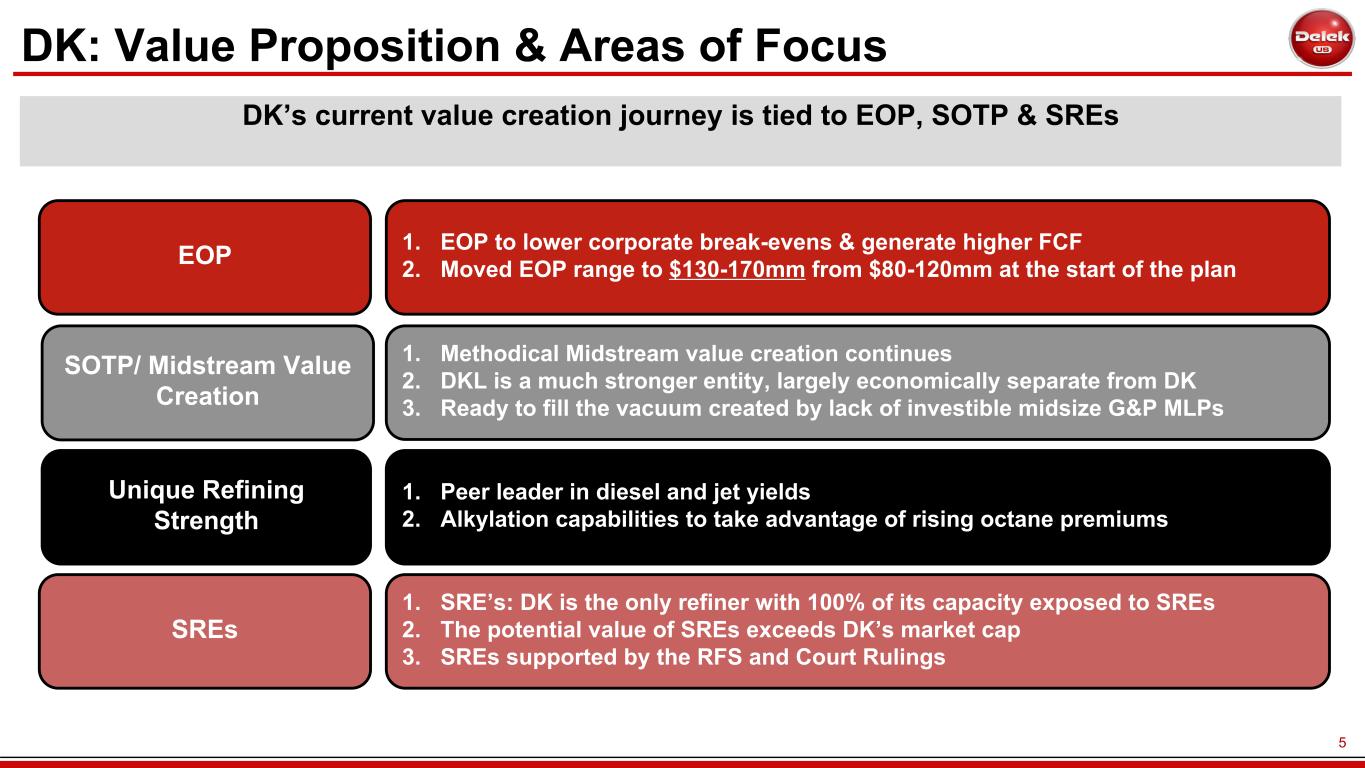
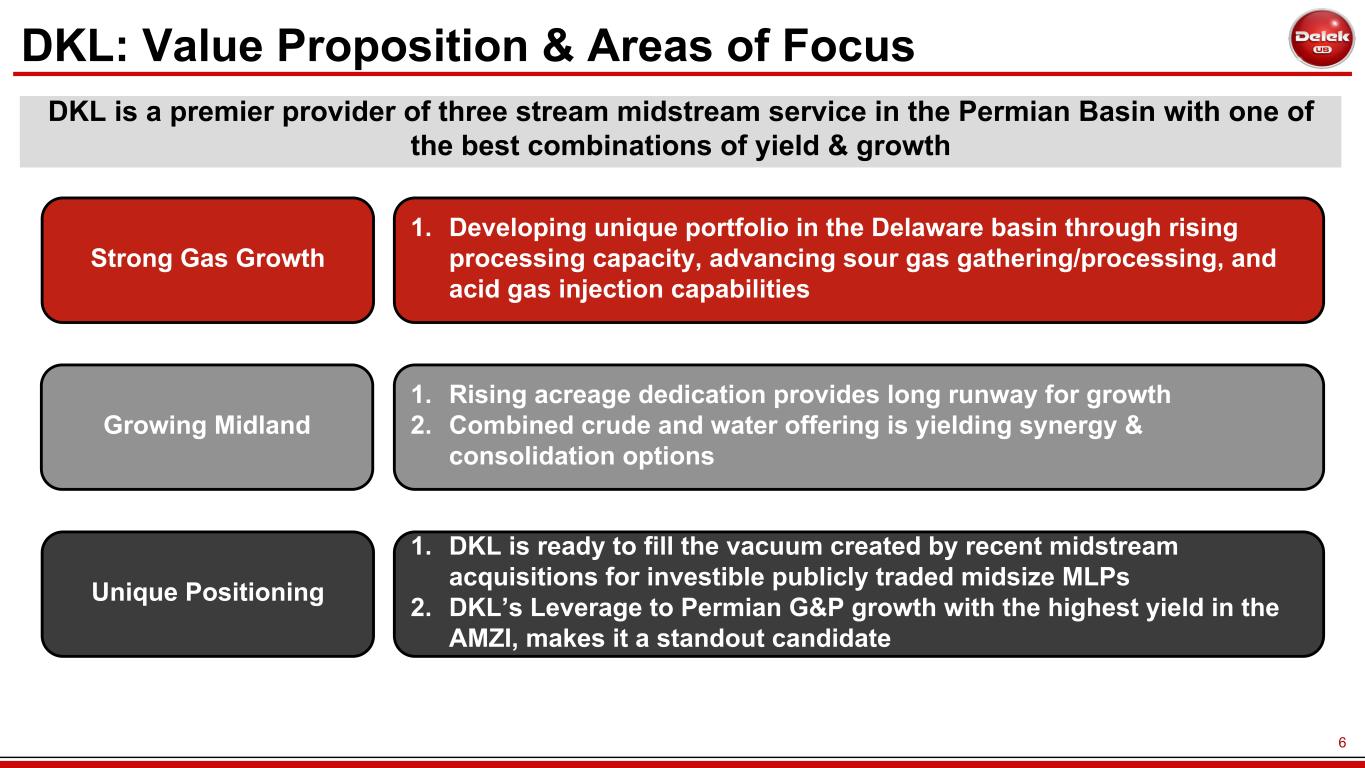
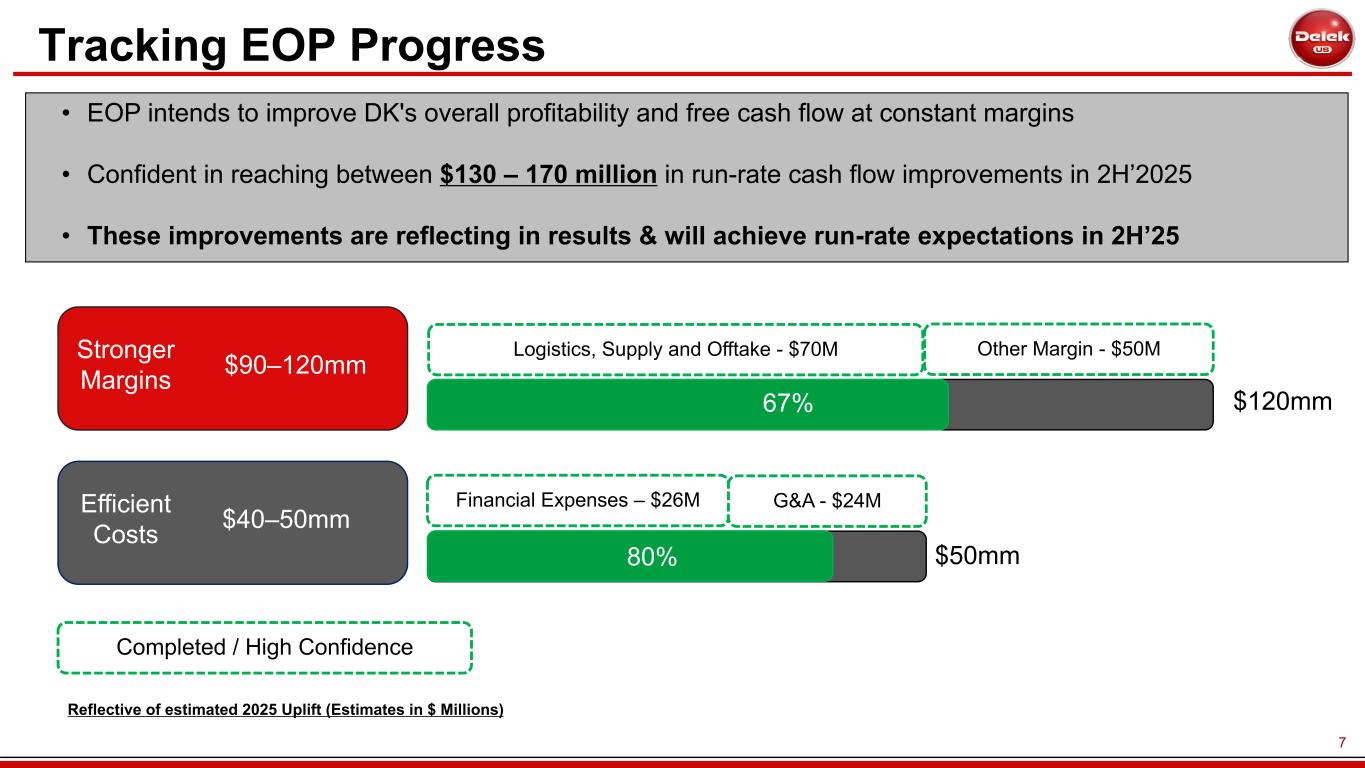
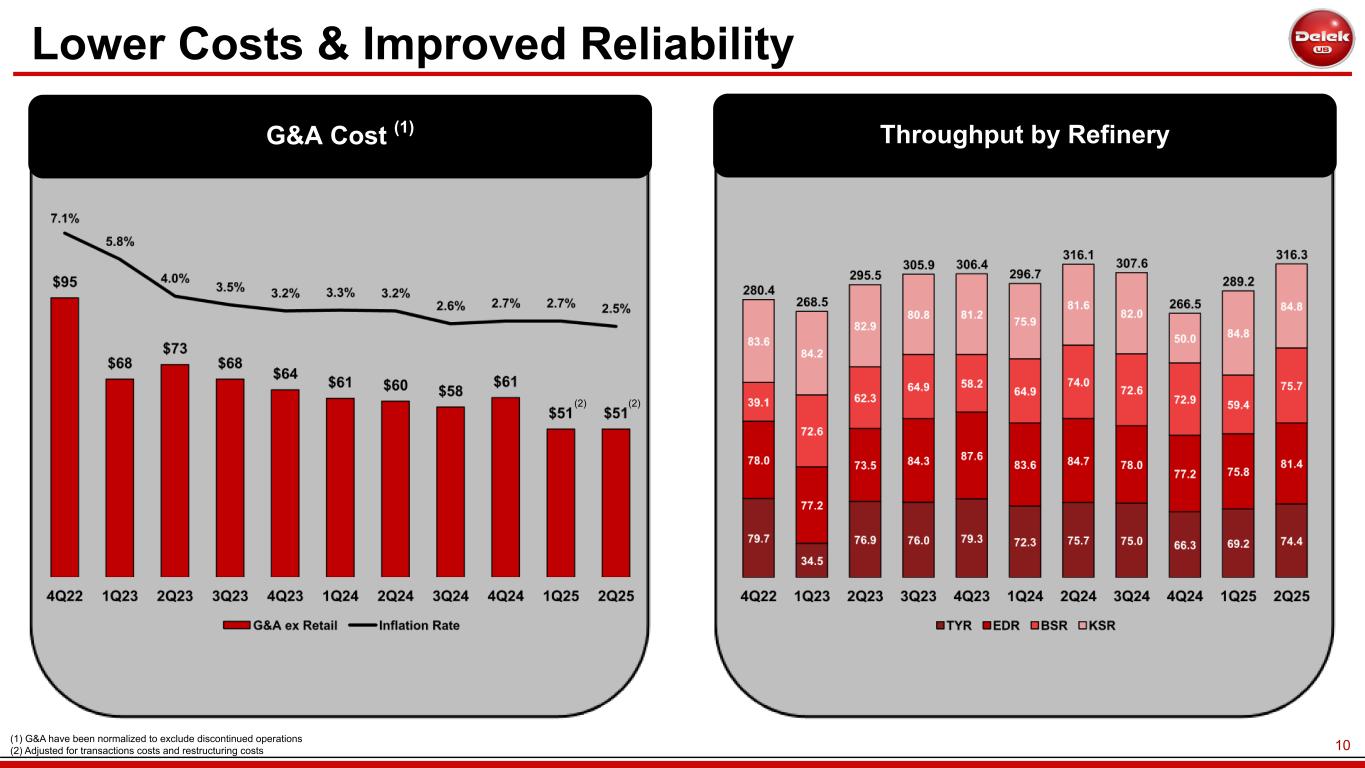
Good morning and thanks for joining us today. Dele continued on its transformational journey during the second quarter by making progress on several key strategic initiatives. We have made excellent progress on our enterprise optimization plan. Given the progress we have made so far, we are increasing our guidance on EOP to $130 million to $170 million on a run rate basis. Some of the part effort also continues to progress well. During the quarter, we completed our intercompany agreement, worked on raising liquidity at DKL, and made great progress in increasing the economic separation between DK and DKL. As I always do, I will give an update on our key long-term priorities in more detail. First, self-reliable operations. We have made further progress in improving the operations throughout our company and reported record throughput in the quarter. The Big Spring refinery had a strong quarter with a strong overall throughput and operational performance. We have continued to make reliability investments that will serve us well in the future. Tyler, Eldorado, and KSR also had strong operations during the quarter. Eldorado has showed additional benefit from EOP improvements. With most of our capital projects complete in the first half of the year, we look forward to capture the advantage of our operational EOP and strategic progress during the remainder of the year and beyond. Now, I would like to discuss the progress we have made on our EOP efforts. As a reminder, we started EOP with an aim to improve DK cash flow by $80 to $120 million starting the second half of 2025. with focus on improving overall free cash flow generation through the cycle. The basis of this EOP improvement was further cost reduction, but more importantly, by making structural changes in the way we run our company. These structural changes are tied to our cost base, the way we run our refineries, the way we buy our crude and the way we sell our products. During the quarter, we estimate approximately $30 million of this EOP cash flow improvement has flowed through our P&L. As you can see, we have already achieved our prior target of $120 million of run rate EOP benefits one quarter ahead of schedule. Today, we are further increasing our range of EOP improvements to $130 to $170 million on a run rate basis starting the second half of this year. I am extremely proud of the team for adapting a culture of continuous improvement. While there is still more work ahead, I like the direction we are heading. We also continue to make progress towards some of the part goals. With the commissioning of DKL Libby 2 plant and the completion of intercompany agreements, we are making great progress in making DK and DKL economically independent. During the quarter, we increased the financial liquidity at DKL for a very successful high-end offering. both our intercompany agreements and the latest high yield offering with over 1 billion of liquidity at dkl this financial flexibility will allow dkl to continue on its growth journey and complete the economic separation from decay as i've highlighted in the past dkl has a strong runway of growth in both midland and dollar basins dkl is making great progress in developing its sour gas gathering and acid gas injection capabilities. These capabilities will provide D.K.L. the ability to fully capitalize on all of its growth opportunities in the Delaware basin. D.K.L. is also having a lot of success increasing its crude gathering business both in the Midland and Delaware basin. During the third quarter, we see a material increase in volumes in both Midland and Dalloyer systems. DELAC Logistics is on track to meet its 2025 EBITDA guidance of $480 to $520 million. We continue to work on additional steps to unlock the value of approximately $400 million in third-party EBITDA at DKL, such that it's fully reflected in DK share price and DKL unit price. We'll complete the DKL sum of the parts in a methodical manner that will create value for both DK shareholders and DKL unit holders. The final piece of our strategy is being a shareholder friendly and having a strong balance During the quarter, we pay approximately $16 million in dividends and bought back approximately $13 million of our shares. Our strong balance sheet, improved reliability, and confidence in EOP has allowed us to continue the counter-technical buyback in 2025. We remain committed to a disciplined and balanced approach to capital allocation. Now, I would like to make a comment about small refinery exemptions. As you know, SRE Partitions are an important focus area for DELEC as our pending Partitions are worth more than our current market cap. The Supreme Court and the District Circuit Court have made it clear that the EPA must thoughtfully address this problem. We believe the EPA understands the issues small refiners like DELEC face in the absence of clear policy around SRE. As a reminder, since 2019, while our SRE petitions have been pending, DELEC has remained in full compliance. We are confident in a favorable outcome on our petitions based upon the principles laid in the RFS law, ruling from the DC Circuit Court, and the EPA understanding of the issues involved. In closing, I would like to thank our entire team for their hard work and dedication. We are optimistic about decay trajectory in the second half of 2025 and beyond, with a strong momentum and promising opportunities on the horizon. I will now turn the call over to Joseph, who will provide additional color on our operations. Thank you, Afegan.
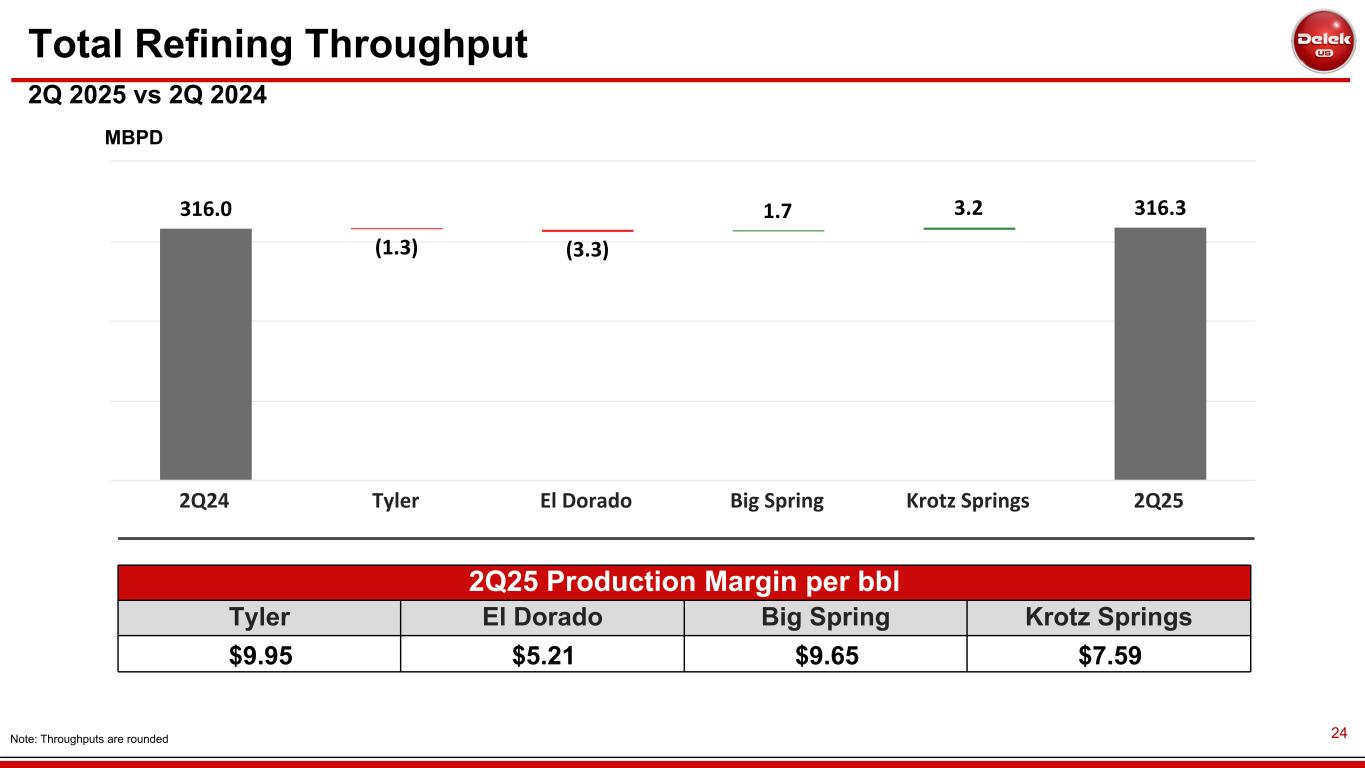
Second quarter operations performance was strong from safety, reliability, and optimization standpoint. Starting with reliability, record throughput results were set in big spring, cross springs, and for the entire system. With regards to optimization, our refining teams have been successful in the ballmaking, improving liquid yield recovery, maximizing production value, and optimizing sulfur and benzene balances. Process efficiency improvement is well reflected in our numbers. Our realized refining margins increased by $0.96 per barrel compared to the second quarter of 2024, despite an $0.18 per barrel decline in the benchmark net margin. Our commercial team has reworked contracts and optimized our new logistics to expand market optionality. Overall, we made good progress operationally, and we are well-positioned to meet or exceed our EUP goals. Starting with Tyler, total throughput in the second quarter was 74,000 barrels per day. Our production margin was $9.95 per barrel, and operating expenses were $4.58 per barrel. For the third quarter, our estimated total throughput in Tyler is in the 73,000 to 77,000 barrels per day range. In El Dorado, total throughput in the second quarter was approximately 81,000 barrels per day. Our production margin was $5.21 per barrel, and operating expenses were $4.38 per barrel. The Eldorado system is one of our top operational EOP priorities. In the second quarter, our estimated EOP impact on gross margin is $1.45 per barrel, which is in line with our approximately $2 per barrel run rate target. Planned throughput for the third quarter is in the 79 to 83,000 barrels per day range. In Big Spring, total throughput in the second quarter was approximately 76,000 barrels per day, reflecting our pogos with people, process, and equipment. Our production margin was $9.65 per barrel, and operating expenses were $6.67 per barrel. In the third quarter, the estimated throughput is in the 69 to 72,000 barrels per day range. In CrowdSprings, we continue to demonstrate improved capacity capabilities since the major turnaround. Total throughput in the second quarter was approximately 85,000 barrels per day. Our production margin was $7.59 per barrel, and operating expenses in the quarter were $5.13 per barrel. Our planned throughput for the third quarter is in the 81 to 85,000 barrels per day range. Our implied system throughput target for the third quarter is in the 302 to 317,000 barrels per day range. Moving on to the commercial front, in the second quarter, supply and marketing contributed a gain of $26 million. dollars. Of that, approximately $19 million was generated by wholesale marketing. Asphalt contributed a gain of approximately $200,000. Both were positively impacted by seasonal trends and structural EOP improvements in our business. Approximately $7 million gain was attributed to In summary, we delivered strong performance in the second quarter, driven by operational excellence and strategic execution. We are well positioned to further enhance efficiency while upholding our commitment to safe and reliable operations. Mark will now address the financial variance.
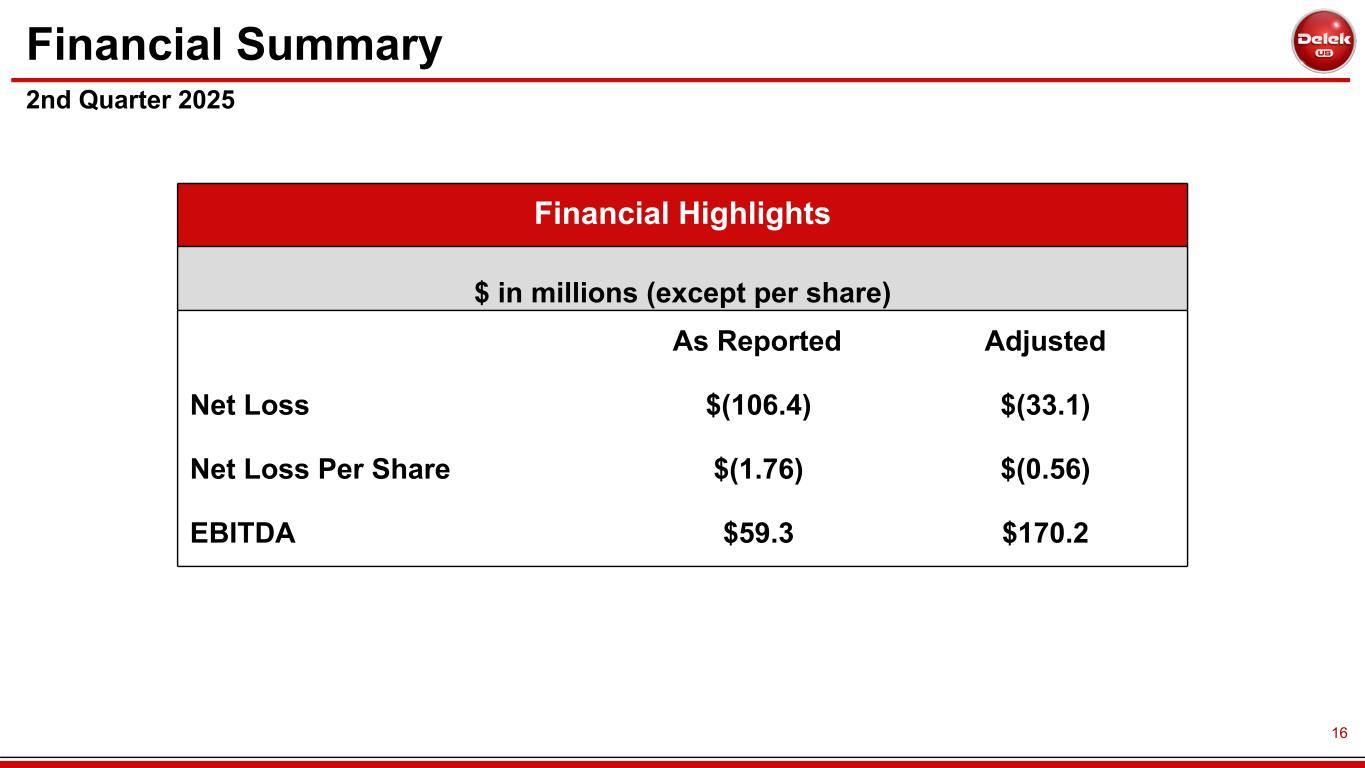
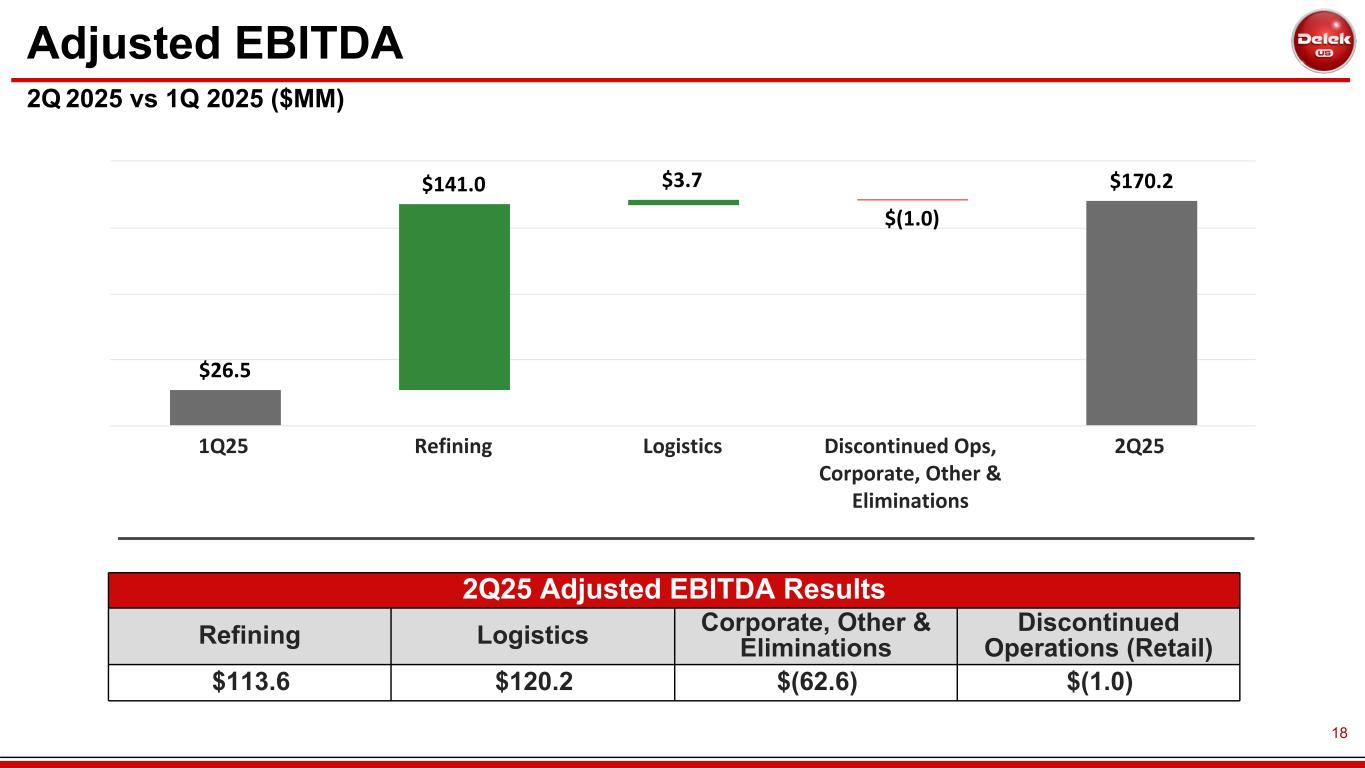
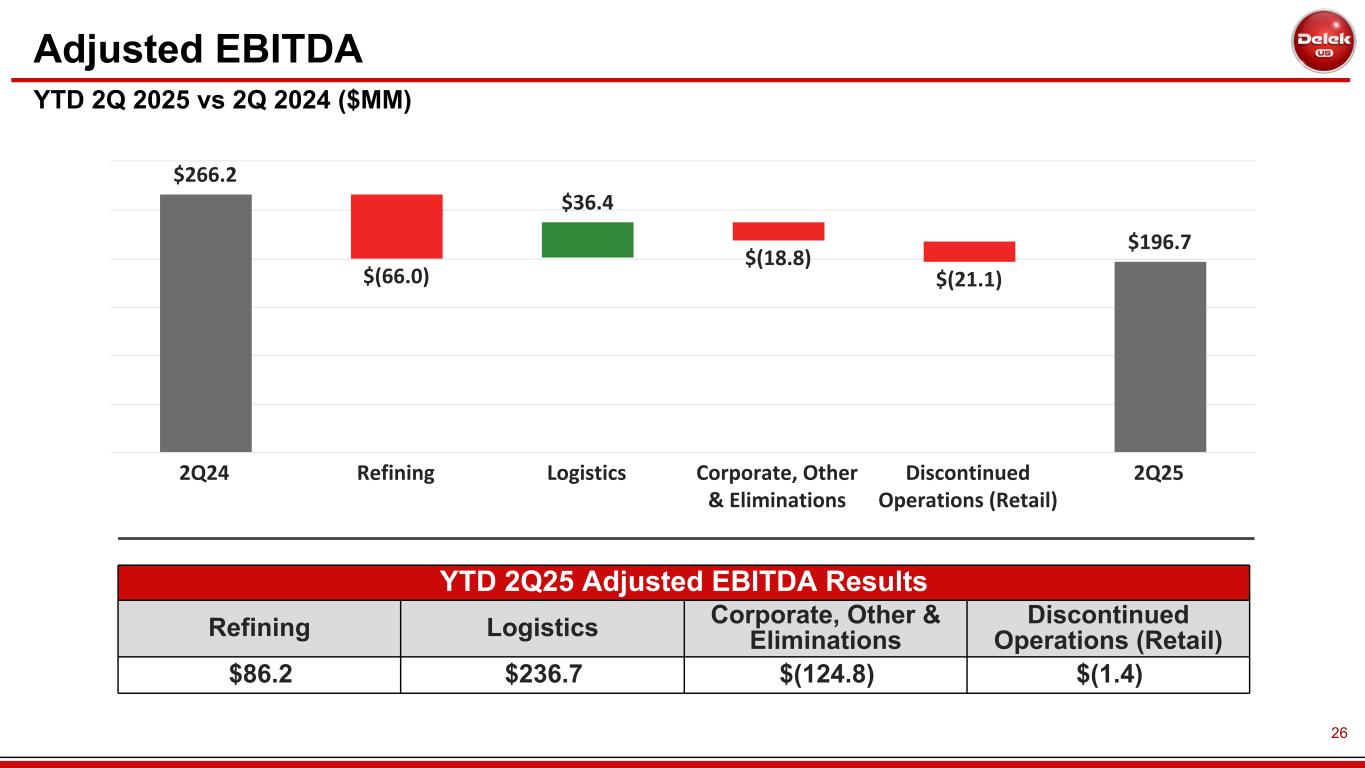
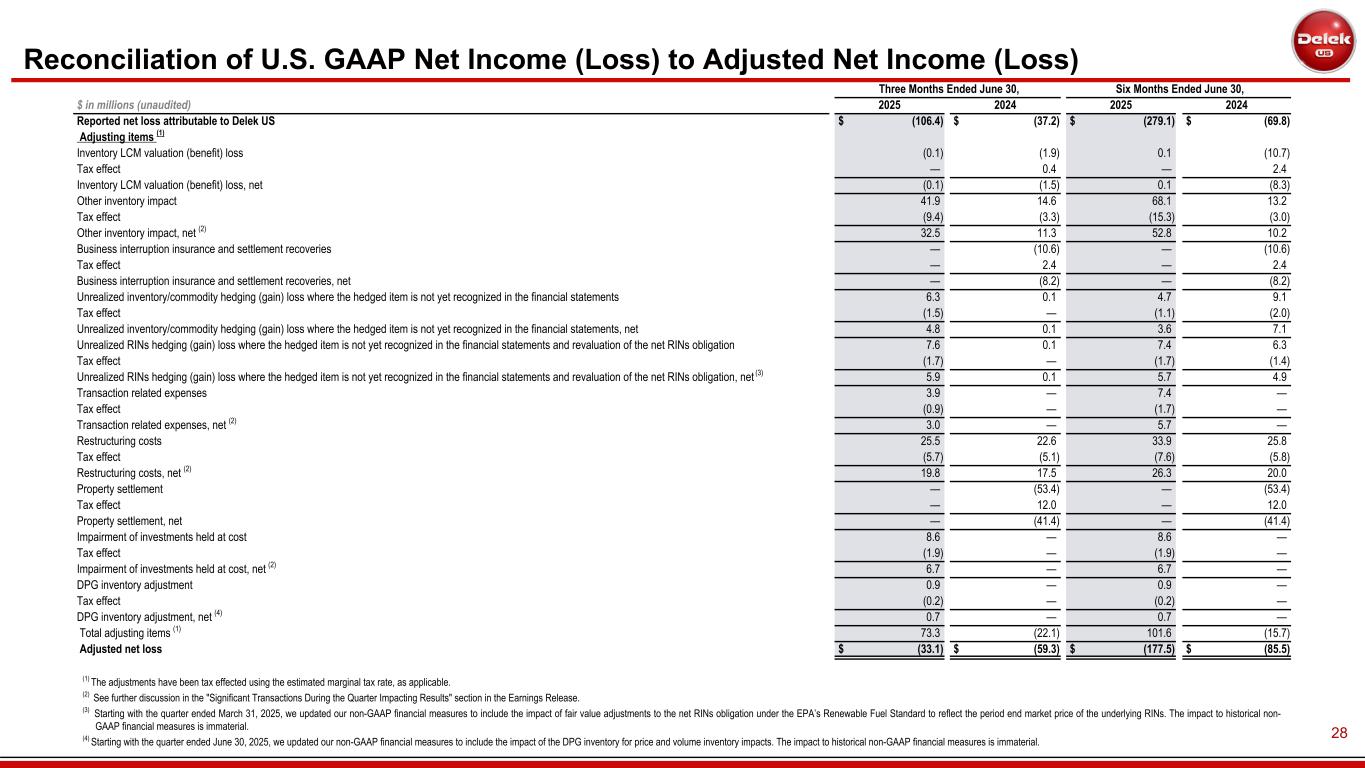
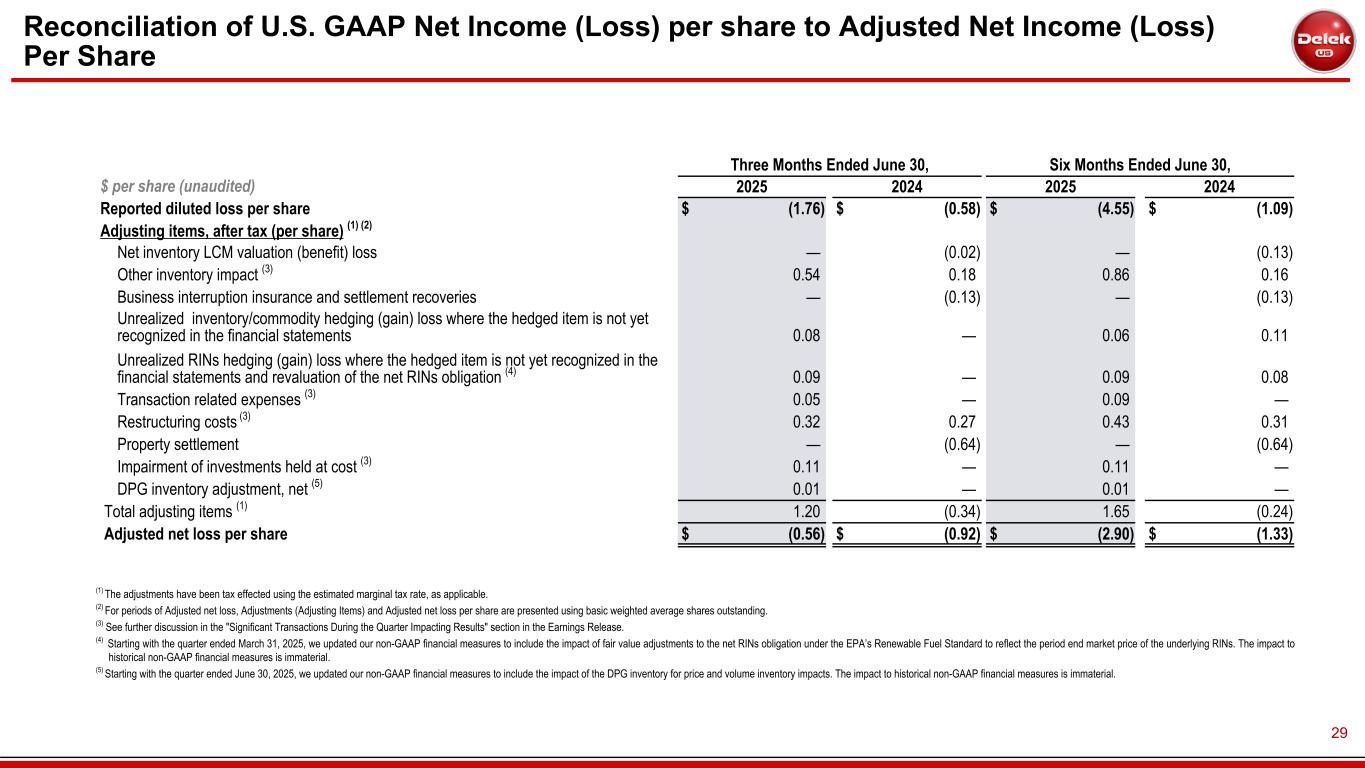
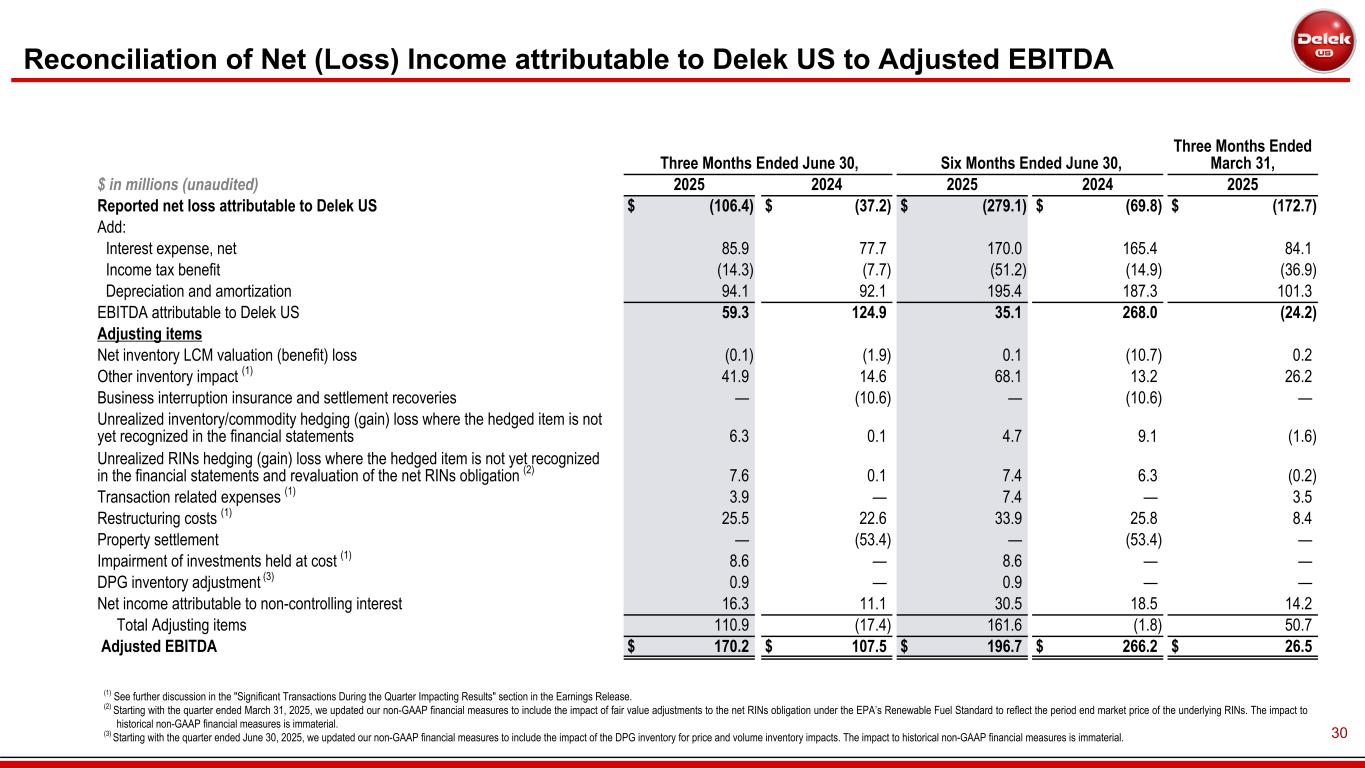
Thank you, Joseph. Referring to slide 16, for the second quarter, DELEC had a net loss of $106 million, or negative $1.76 per share. Adjusted net loss was $33 million, or negative $0.56 per share, and adjusted EBITDA was $170.2 On slide 18, the waterfall of adjusted EBITDA from the first quarter of 2025 to the second quarter, shows that there were two main drivers for the increase in EBITDA. First, a $141 million increase in refining was primarily driven by a higher margin environment in the second quarter relative to the first quarter, along with sequentially higher throughputs. Second, in the logistics segment, we continue to have another strong quarter, delivering approximately $120 million in adjusted EBITDA, about a $4 million increase over our previous record of quarterly adjusted EBITDA achieved in the first quarter. These improvements were mitigated by slightly higher cost in the corporate segment of $1 million compared to the prior period. Moving to slide 19 to discuss cash flow. Cash flow provided by operations was $51 million. This includes our net loss for the period, in addition to an inflow of approximately $51 million of timing-related working capital movements, which includes the impact of our inventory intermediation agreement, as well as an outflow of $30 million of restructuring and other one-time charges. Investing activities of $163 million includes approximately $115 million for growth projects, primarily at DKL. Financing activities of $103 million reflects $13 million in share repurchases, approximately $16 million in dividend payments, and approximately $22 million in DKL distribution payments to public unit holders on slide 20 we show our actual progress under the 2025 capital program second quarter capital expenditures were 164 million dollars approximately 119 million dollars of this spin was in the logistics segment this includes the 115 million dollars in growth capital at dkl of which 48 million dollars was associated with completing the Libby II gas plant. Primarily, all of the remaining capital spend during the quarter was in the refining segment, addressing planned sustaining capital initiatives. Our DK refining and corporate capital spending outlook for 2025 remains consistent with prior guidance. Our net debt position is broken out between Delic and Delic Logistics on slide 21. Excluding Delic Logistics, we spent approximately $74 million on cash return to shareholders and capital expenditures in the second quarter, while our DELIC standalone net debt remained relatively flat around $275 million at the end of the quarter. Moving now to slide 22 where we cover third quarter outlook items. In addition to the guidance Joseph provided, for the third quarter of 2025, we expect operating expenses to be between $210 and $225 million. Our operating expense guidance for the third quarter incorporates both higher expected throughput across our refining segment, as well as increased operating expenses associated with the ramp-up of our new Livy-2 plant at DKL. GNA to be between $52 and $57 million. DNA is expected to be between $100 and $110 million, and net interest expense to be between $85 and $95 million. With that, we will now open the call for questions.
Operator
Thank you. The floor is now open for questions. If you have dialed in and would like to ask a question, please press star 1 on your telephone keypad to raise your hand and join the queue. If you would like to withdraw your question, simply press star 1 again. If you're called upon to ask a question and are listening via loudspeaker on your device, please pick up your handset and ensure that your phone is not on mute when asking your question. And we do request for today's session that you please limit yourself to one question and one follow-up. Your first question comes from the line of Doug Liggett of Wolf Research. Your line is open.
Hi, it's Luke Hanley, Charles Slayer, all in for Doug Legas this morning. He's getting us at the talk. So our first question is going to start with the SRE. You guys are definitely expressing confidence around what looks to be a favorable outcome. I want to know if your confidence is kind of picked up and increases as we get closer to a final decision. And along with that, should you be granted the exemption? I guess I was trying to form or understand what do you see as the best use of proceeds How could that allow D.K. to improve structurally on an operational level?
Yeah, absolutely, Doug, thank you for the question. Listen, we are very optimistic about the small refinery exemption. The law is in our side, the DC Circuit Court is in our side. We are the only public refiners that all of our assets can apply to small refinery exemption. We stay in full compliance during the last six years that our petition are pending. And as you can easily calculate, it's bigger than our market cap. So it's very clear around the economical harm that we're having because of that pending, lingering issue. EPA understand the issue, and we are confident in favorite outcome.
With one comment about the last part of your question about what is the positive. i'm not going to comment around it but i'm sure the api understand that it cannot compensate someone that stay in compliance and we were in compliance so i hope that that comment makes a lot of sense to you thank you and uh my follow-up is going to be around the eop of course we kind of talked about this last quarter where it looks like there was some definitely opportunity to revise to the upside and that that definitely can tend to be the cases in this quarter so my question is i mean i guess i'll ask again is there any continued room uh to the outside and some opportunities there uh what were the drivers that uh you guys were able to identify that moved the guide forward and last part of that question is where do you see sustaining capital for a finance now uh at the should you uh be able to execute on this target of between 130 and 170 Yeah, Doug, that's a very nice of you to ask that question because we are extremely proud of the EOP focus and the momentum we have here in our shop.
EOP is not a project, it's a lifestyle. And when I'm saying it's a lifestyle, we have a weekly meeting about that, we have a T3 project, we are auditing that internal audit, external audit, and have accounting look over that. So it's a very tight process that allows everyone to take a part and contributing for that. The whole essence of EOP is free cash flow and below mid-cycle and reduce our break-even. And we are very proud of that. As you probably saw on our press release and also on my prepared remark, we increased the guidance of EOP from 120 prior to this call to 100%.
130 to 170 and the reason that we were one quarter ahead of time and we see more projects coming in in the queues for the DOP so we are extremely optimistic and see a lot of value in it if we do you want to mean yeah thanks Abigail so all I would say on EOP as we call this mention it's a free cash flow improvement you know exercise for the company if you look at the second quarter 30 million dollars flow to our financials and that you know allows us to have a 120 million dollar run rate and i just want to remind everybody that we started with the 80 to 120 million dollar guidance now to your specific question around where is this improvement or higher confidence in and a higher rate is coming from so if you if you remember the 120 million dollars had two components to it one was cost and the other one was margin and our confidence in our margin improvement is increasing and that is where most of the increase has come from so if you look at the 150 million dollars at the midpoint of the enhanced increased guidance that we have provided today thank you your next question comes from line of alexa petrick of goldman sachs your line is open hey good morning team and thank you for taking our question i wanted to ask there's been great progress in eop uh free cash flow generation how do we then think about the allocation of that
cash. Can you remind us of your strategy there, how you're balancing between capital returns and balance sheet efforts?
Yeah, absolutely, Alexa. Thank you for that question. We are very consistent with our capital allocation program. You can see that, first of all, we said that we're going to maintain dividend toward the cycle. We can definitely check that box very nicely. Then we said that we have a balanced approach between balance sheet and the buyback. We have done that as well. So we are very consistent and confident around those abilities. We have done buyback in Q1 counter-technical. We've done buyback Q2. We have done buyback Q3. As we see, you can see in the last 12 months, we have more of around $150 million of total return to shareholder, and we are number one versus in our peers around return to investors in terms of capital return to investors. So we are very proud and consistent about the way we look at capital, and we plan to maintain it. So thank you for that question.
Okay, great. Thank you. And then maybe just as a follow-up, I know it's a bit early, but how's Q3 shaping up? What demand trends are you seeing? What's your view for crew differentials going forward?
Any thoughts around the quarter ahead would be great yeah absolutely we just seen a doe and i think like 50 54 minutes ago and we see a still a positive trend in terms of diesel diesel it's in five years low and we see a decent demand on diesel and gasoline gasoline had a draw of 1.2 You saw that as well. So in terms of inventory, we're in a good shape. In terms of supply, we've seen more closer than we actually expected, even in the last couple of weeks, shaking out to around 900 during 2025, which balanced the opening that we have seen, but doesn't compensate for increasing demand. So when we are putting all of that together, we see a pretty structural, constructive market ahead of us in the short term and also in the midterm all the way probably until the end of the decade we do not see the demand of gasoline and diesel coming off as people first field mohit you want to chime in yeah because i just want to add alexa if you look at where pad 2 specific inventories are we've seen pad display inventories are way below their five-year averages which is a very relevant metric for us.
And if you look at the utilization in FAD2, it's been very, very high. So despite very high utilization, we see inventories remaining low, and we expect demand to pick up as the ag season starts. And, you know, you would also see some turnarounds going forward. So as far as FAD2-specific inventories are concerned, I think the outlook remains very optimistic, especially on the diesel side.
Operator
Your next question comes from the line of Matthew Blair of PTH. Your line is open.
Thank you, and good morning. You mentioned some of the positive drivers in supply and marketing in Q2. I think the wholesale side in particular was quite strong. Would you talk about how supply and marketing is trending so far in the third quarter, and do you think a positive EBITDA contribution is likely in Q3?
Thank you, Matt. Thank you for that question. Obviously, the line of supply and marketing, it's part of the EOP effort. We have improved that with better logistics around it. We got to gain market access to a new market, and we made a long-term contract that allowed us to, over time, make that line better and better.
So we're obviously enjoying that. we have some seasonal uh helping us in q2 and we are extremely optimistic about the way the market are positioning and i don't know if you want to chime in and give some more color specifically no i think abigail you're right uh and matt if you look at our overall commercial strategy uh dkts or our what we call dk trading and supply which is the line item that you're talking about our commercial strategy is flowing through but during the quarter as you know q2 and Q3 are also seasonally stronger. So, you know, we did get some help from the market, but Avigal rightly described our strategy as far as our commercial operations are concerned. As we have said in the past, this has three components to it. First is wholesale, second is asphalt, and third is supply. And we are making sure all three businesses, the ones that we can control, the parts of these three businesses that we can control, are doing better through contract renegotiations to improve markets to enhanced market access and and and through our refineries making new products that we can sell in these markets through this refined uh and enhanced market access and these results are showing through and and we we look forward to continue uh doing improving this business and going forward that's good and then just on the some of the parts monetization you know slide 12 lists some various avenues and options for you what do you think are are like the more
likely options and what are the less likely options and then as far as timing do you think investors can can expect or hope for a economic separation of dkl by the end of 2025 or is this looking more likely you know 2026 or even later thank you yeah so that's another a great great question for us.
We are working on steps of some of the parts as we speak. So we are not standing still even for one second and more to come. And I will leave it to that. With that said, we can just take one step back and say what we did in the last 12 months. The last 12 months we saw retail allow us to maintain strong balance sheet and to do counter cyclical buyback. On the midstream side, making DKL economically independent grew the EBITDA from below $400 million to $500 million of EBITDA 2025 guidance midpoint, increased third-party business from 40% to 80%, which is a huge achievement. I don't think that many companies like us have done that in the past. While we are doing all of that, we reduce our ownership from 79 to the low 60, but increase the distribution DK gets. So that's another thing we are very, very proud of. In the end of the day, we see that there is not many midsize, midstream companies left, which give a lot of merit for DKL. and we see the opportunities flowing to us as we speak. On the intrinsic value, another very important point to watch is what is the intrinsic value of the assets in DKL. We have just seen the medallion system sold in a very good multiply. It's a sister system to our DPG that what we mentioned, we see volume going up in the prepared remarks. And we have just seen last week, Northwind sold for also a very nice multiplier as well, and that's a sister system to our DGG. So going forward, we've said many, many times in the past, the four outlets that we have to complete some of the part. We are doing that as we speak, and more to come. Thank you for that question.
Operator
Your next question comes from the line of Joel H. of Morgan Stanley. Your line is open.
Hey, good morning, and thanks for taking my questions. So I wanted to ask a couple on the refining side. At Big Spring, you mentioned it had record throughput, and capture rates also look like they're pretty strong there as well. Could you talk to what you're seeing from that asset post the turnaround in the first quarter? And then as part of that, could you also talk to the path to achieving the, I think it was 550 per barrel OPEX goal at that refinery?
Yeah, absolutely. So thank you for the question. I'm extremely proud of the Big Spring progress we have done, throughput and margin, and I will let Joseph, that is very close to it, take the credit here.
Yeah, Vickspring has been on a very positive journey, as you all know. We focused first on risk mitigation and reliability with very good results. Going from 23 to 2024, to remind you, throughput increased by 10%, and the favorable trends continue in 25 with a record high throughput here in the second quarter. So safe and reliable operations really allow us to focus now on process efficiency and commercial optimization, and to be more specific, maximizing a liquid yield recovery and product value. In Big Spring, we're really mainly going after the high-octane, Arizona specs type of gasoline and improving asphalt grades. We also optimize the benzene and sulfur balances. All of that is very visible in our gross margin improvement.
So considering the leadership team capabilities and execution thus far, we are very bullish about the plan for the outlook great thanks that's helpful and then shifting to El Dorado it had nice step up quarter quarter in capture rates from a throughput part in perspective it still still lag some of the of the other refineries within the system could you expand a bit on slide 9 which shows margin improvements and then between logistics cost improvements and product yield where are you in that improvement process and is there more to go there It's very similar to the Big Springs story as far as EOP and structural improvements.
It's all about liquid yield recovery and product value. In Eldorado, we are going after the jet fuel, which is a new product over there, high octane gasoline component after replacing a couple of units, a catalyst, and really premium asphalt is a big deal for Eldorado. So we're expecting the strength to continue, and we liken the outlook of the plant.
Operator
Your next question comes from the line of Jean-Ann Salisbury of Bank of America. Your line is open.
Hi, good morning. I wanted to ask about the net crack metric that I think is new here and how it's constructed, and if that's a metric that you'll continue to track yourselves against.
Yeah, absolutely. Mohit, you want to take it?
Yeah, Jean-Ann, thanks for the question. So the way we define a net crack, and we can obviously talk offline as well, but, you know, the way we define a net crack is, you know, take Gulf Coast 532 on a WTI basis, and we take out RBO, and we take out, you know, backwardation, the CMA impact on it, and we also take out mill and cushion to get to a net margin number, which is the right way to look at our business because we are a completely inland refiner, and we run mostly TI exposed groups.
Thank you. And then I kind of wanted to go back to a comment that was made earlier, but do you think that the recent sale of Northwind is a good read across to your assets, especially the AGI capability that you're building? And I guess on that, do you think that once you have the AGI capability up and running, that's kind of what it takes to make it attractive for sale?
Yeah, so as we said many times in the past, all options are on the table, and we are very much committed to make sure that our unit holder and shareholder get the full value of what they have. Obviously, we are working very hard in order to complete all of that and maximizing the value over there, but that's just show the investor the full potential in our asset. So it's having always your neighbor selling a high price. It's a good thing if you are living next door, and we were very happy about it. Mohit, you want to chime in?
Yeah, Gina, and I know that you understand the midstream business well, so I'll just say this, that as far as Northwind is concerned, Northwind is primarily a treating operation. We have a much more comprehensive operation in our DKL, which includes gathering, treating, processing. So we have a much more comprehensive full suite product over there as far as gas is concerned. So we think it's a very good benchmark, but we also have a better business.
Operator
Your next question comes from the line of Jason Gableman of TD Catwin. Your line is open.
Yeah, good morning. Thanks for taking my questions. I wanted to first go back to the EOP program, and I'm just trying to understand a couple things. One, how much was actually reflected in 2Q results? I know you kind of referenced the run rate exiting the quarter, but wondering how much on a growth basis was kind of realized in 2Q. And then, And how should we think about the amount of the margin capture uplift that's captured in the supply line versus the site unit margins that you reference? Or should we think about that kind of moving back and forth depending on how the environment shapes up?
Yeah. Thank you. That's a very nice question of view. Obviously, EOP, we said it very clearly in order to make it easier for everyone. the 30 million dollar benchmark and we're very proud of the progress we are doing as you well know jason that pretty much agnostic to market the 30 million dollar we outlined we obviously add a one slide to make it easier for everyone to calculate on a similar market environment you can easily see that in our in our presentation so that's even make it easier to calculate how a how that flows through and that's a very very simple way on a very similar market environment to see the improvement on the capture rate and on trading on the trading and supply and obviously
the other part of the business other part of the business very easy to see is the gna you see that we are in the low 50s versus the low 60s in q2 of 2024 i think that answer most of the question but if you have anything uh mohi do you want to chime in so please yeah i think i'll just reiterate what he said so jason uh for the second quarter 30 million dollars were actually included in our financials so the entire 30 million dollars flowed through it uh second quarter financials and as joseph mentioned 10 million dollars off that was at el dorado and rest was distributed between our dkts the trading and supply line item and the cost
improvements that we have made okay yep got it that's that's clear and then my follow-up is hopefully a quick one just on financing cash flows which were a benefit in the quarter you referenced a number of outflows from that bucket but wondering what contributed to the net inflow from the financing cash flow line item yeah so Jason in reality what the story here is very simple EOP is all about improving free cash flow.
And that's a very, very important part in our equation. And I will let Mark chime in.
Yeah, yeah. Thanks. Thanks, Avagol. You know, Jason, I want to step back and talk about just because you're focusing in on kind of EOP and kind of where you can see that in our results. And so I want to be very clear that, as Avagol mentioned, that we're seeing this already show up in our results. I'm going to be pretty specific around this. And so despite a slightly lower margin environment versus the second quarter of last year, our EBITDA has increased to over $170 million this quarter versus only $107 million last quarter. And our cash flow from operation was approximately $100 million higher than what we generated in the second quarter of last year. And keep in mind that of the $164 million of CapEx in the second quarter, about $115 million of that was growth CapEx, you know, largely a DKL for high return projects like Libby 2, which will benefit us going forward. And so, and as Abigail mentioned in his prepared remarks, you know, this year, our CapEx in 2025 is very much first half weighted. And so as we go through the year with lower CapEx and even more EOP benefits coming through, you know, we feel very good about, you know, how we're positioned, you know, as we move through the remainder of the year. And as you talk about the financing on the cash flow statement, keep in mind, we've done some things to improve our balance sheet on a consolidated basis. We had a successful high yield offering at DKL, which allowed us to pay down our revolver because we made the gravity acquisition. We've been investing $100 million in the Libby II gas plant thus far in the first half of the year and so you know added critical liquidity you know to the balance sheet by doing a very successful you know oversubscribed high yield offering at a very good rate and it was you know an eight-year piece of paper so we're very happy with that that concludes our Q&A session I'll now turn the conference back over to Avigal Sobek for closing remarks yeah so I want to thank my friends around the table our board of directors our investors and And most importantly, our employees that make our company unique and the greatest it is.
And we'll talk again in the next quarter.
Operator
This concludes today's conference call. You may know this can...