Operator
Thank you for standing by. My name is Jael, and I'll be a conference operator today. I'd now like to pass the call off to Robert. Please go ahead.
Good morning, and welcome to the Delic U.S. Third Quarter Earnings Conference Call. Participants joining me on today's call will include Abigail Sorek, President and CEO, Joseph Israel, EVP Operations, and Mark Hobbs, EVP Chief Financial Officer. Today's presentation material can be found on the Investor Relations section of the Delic U.S. website. Slide 2 contains our Safe Harbor Statement regarding forward-looking information. Any forward-looking information shared during today's call will include risks and uncertainties that may cause actual results to differ materially from today's comments. Factors that could cause actual results to differ are included here as well as within our SEC filings. The company assumes no obligation to update any forward-looking information. I will now turn the call over to Abigail for opening remarks. Abigail?
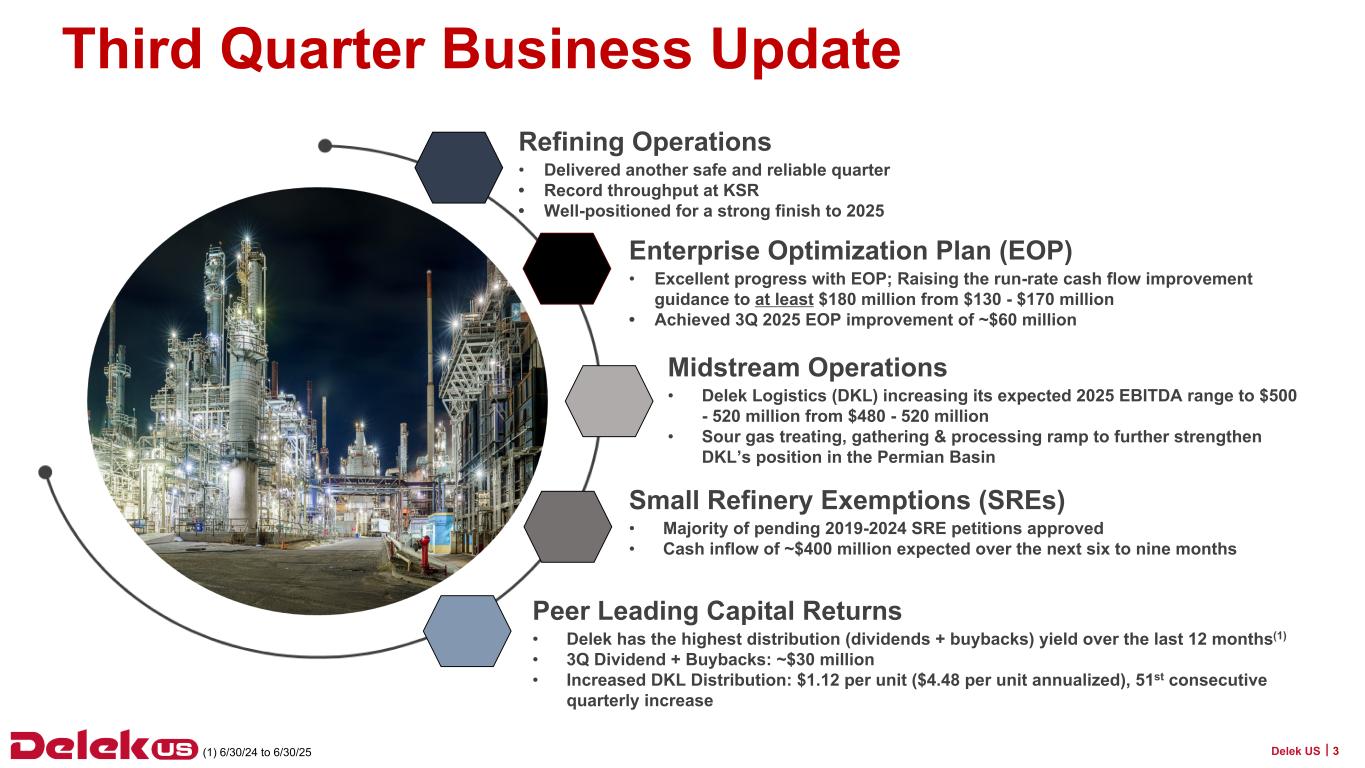
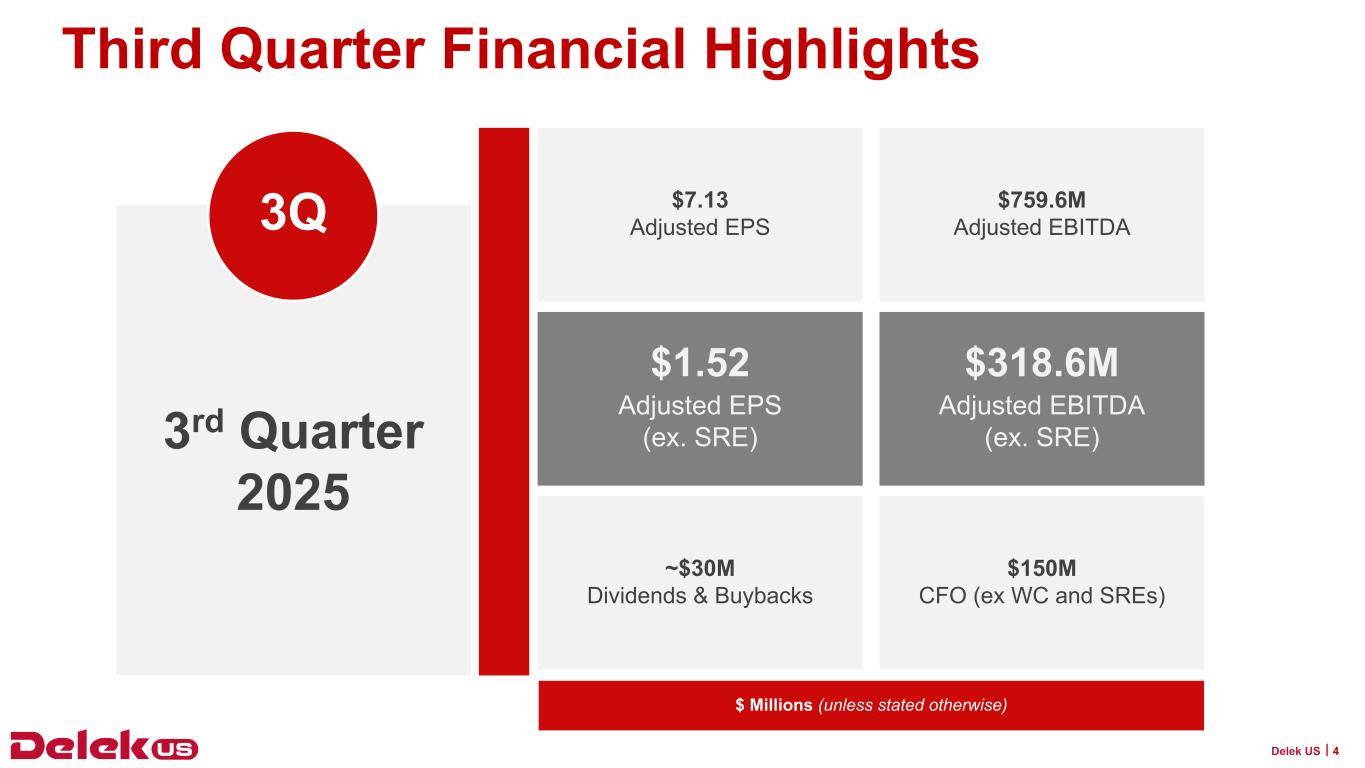
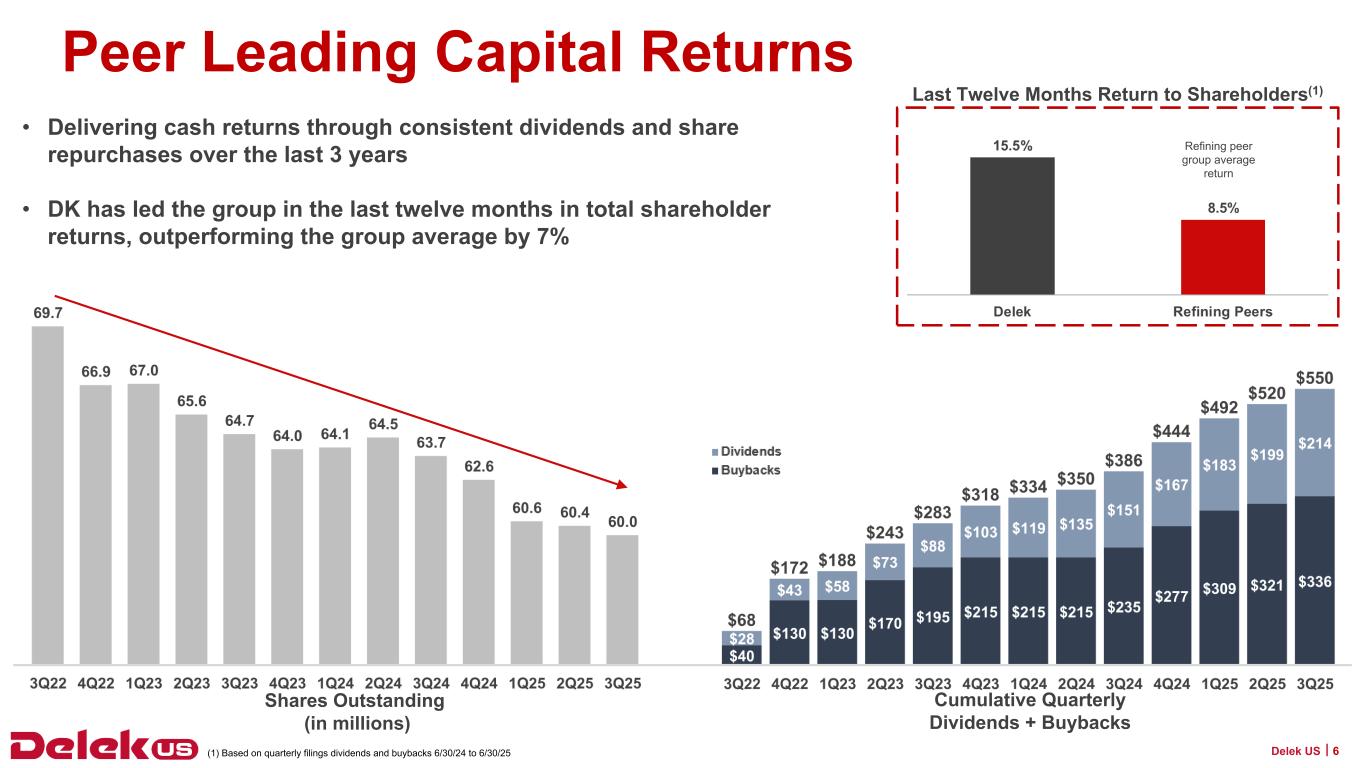
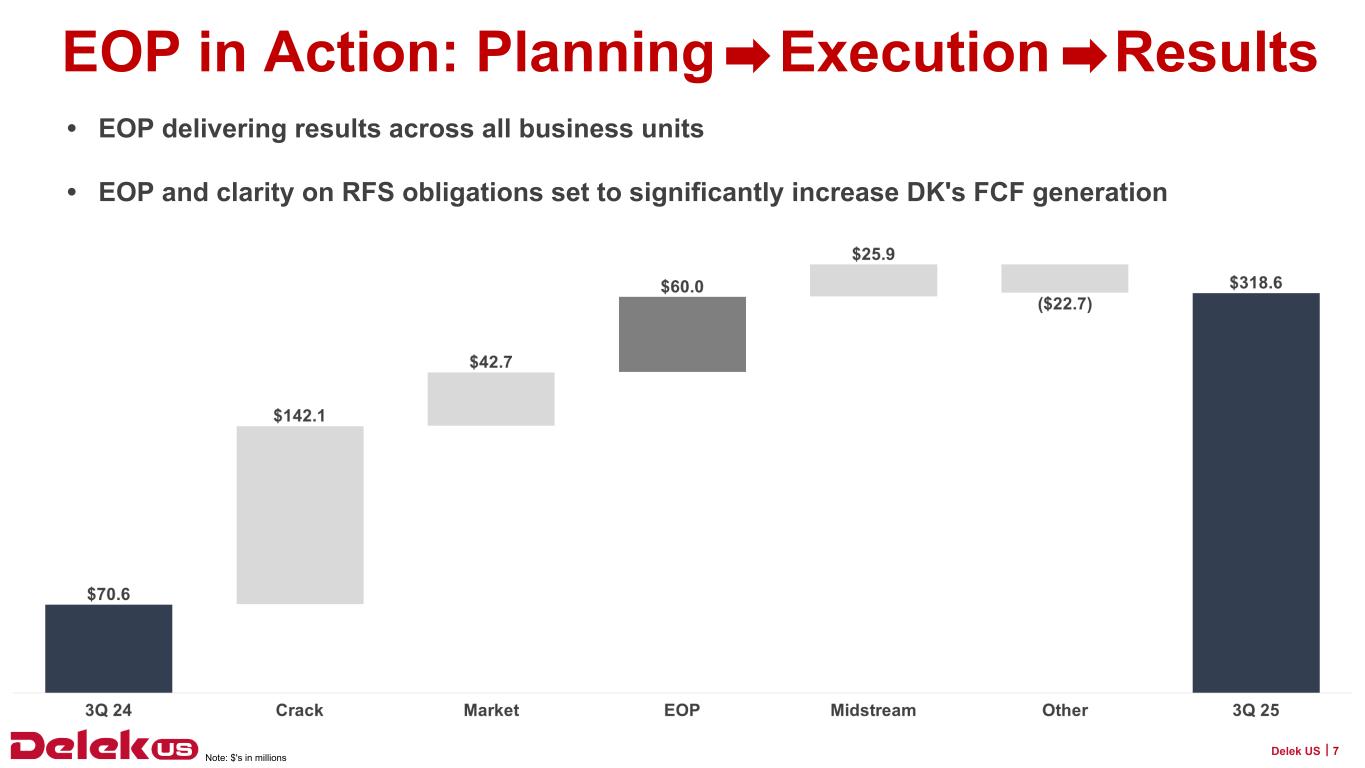
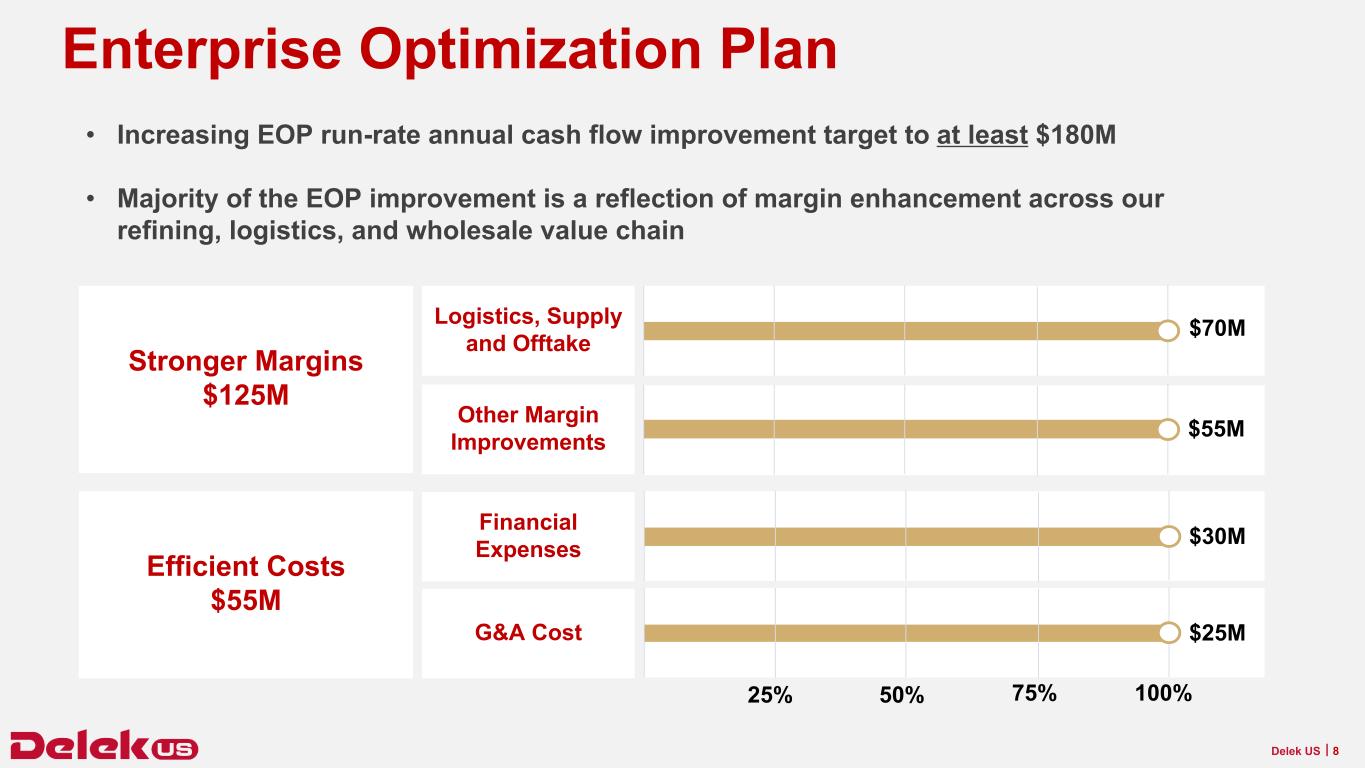
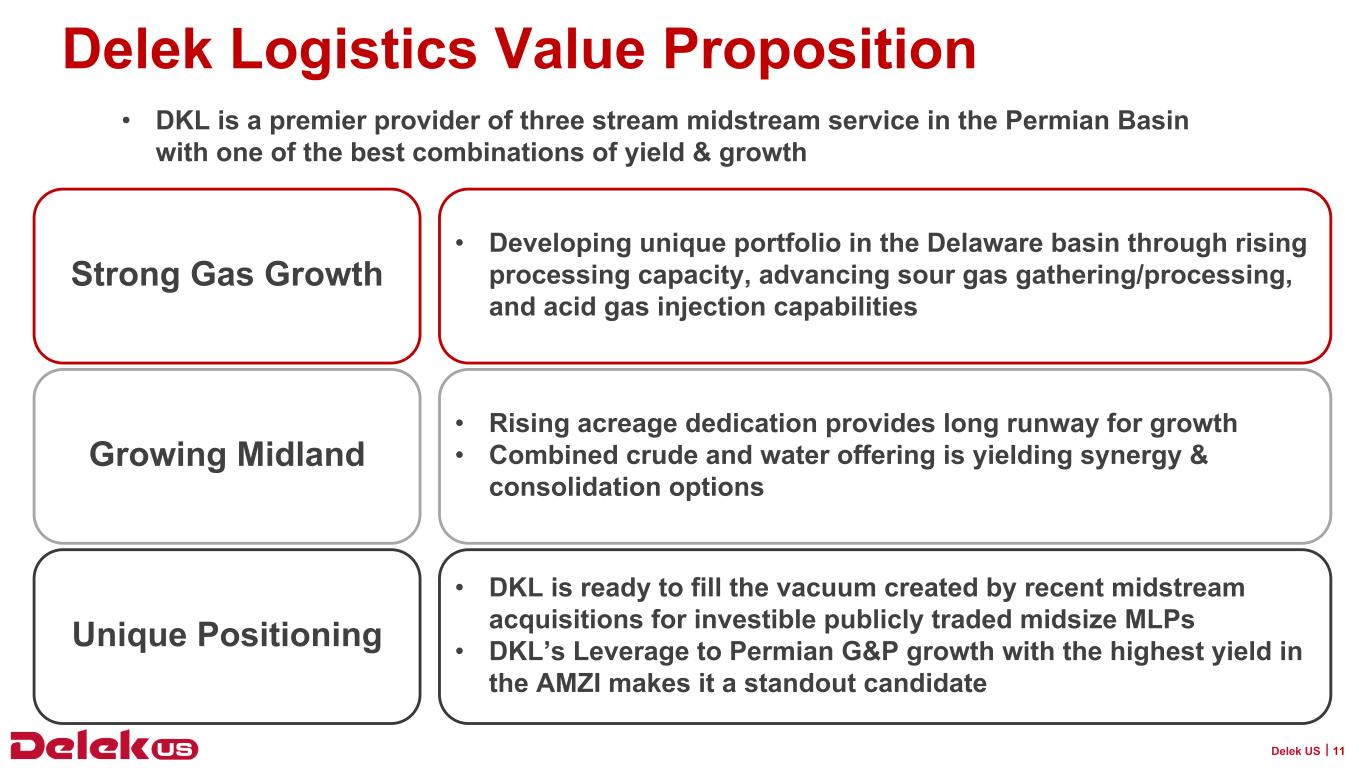
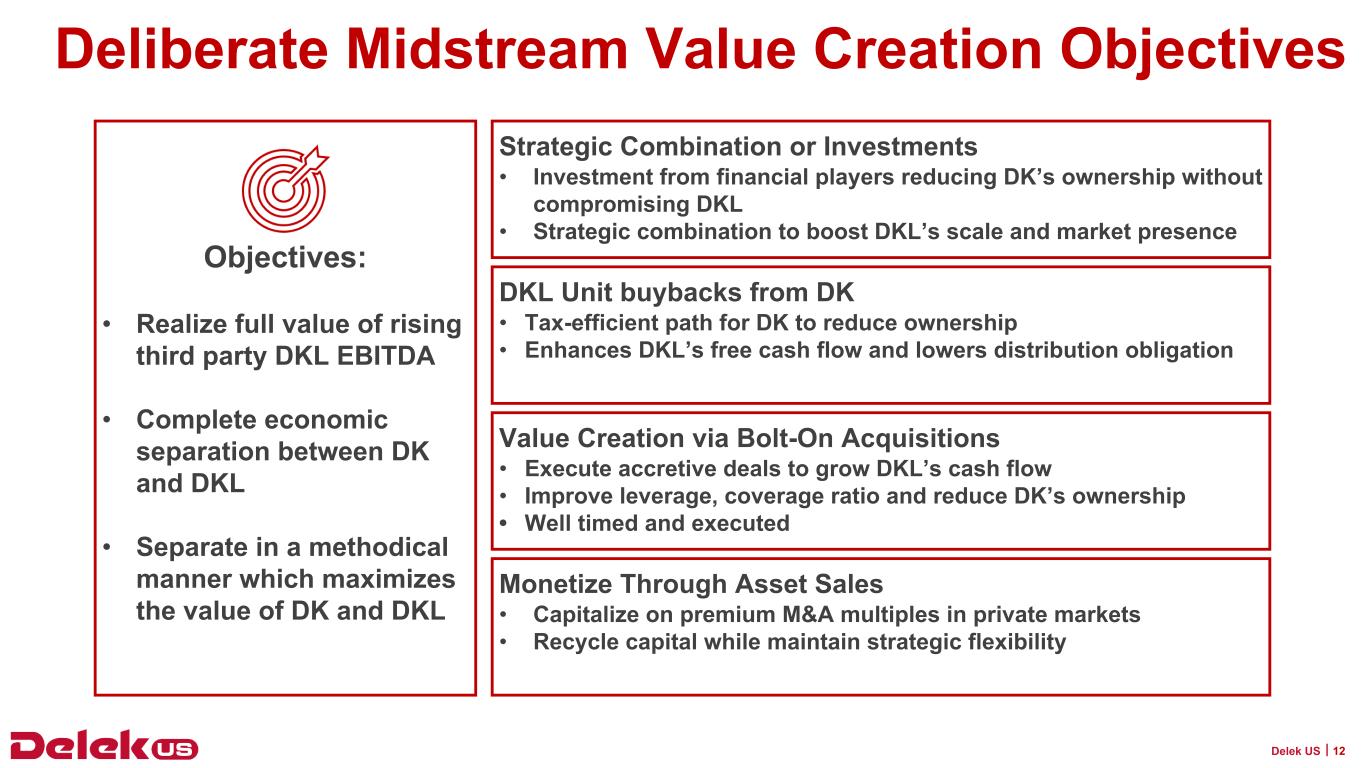
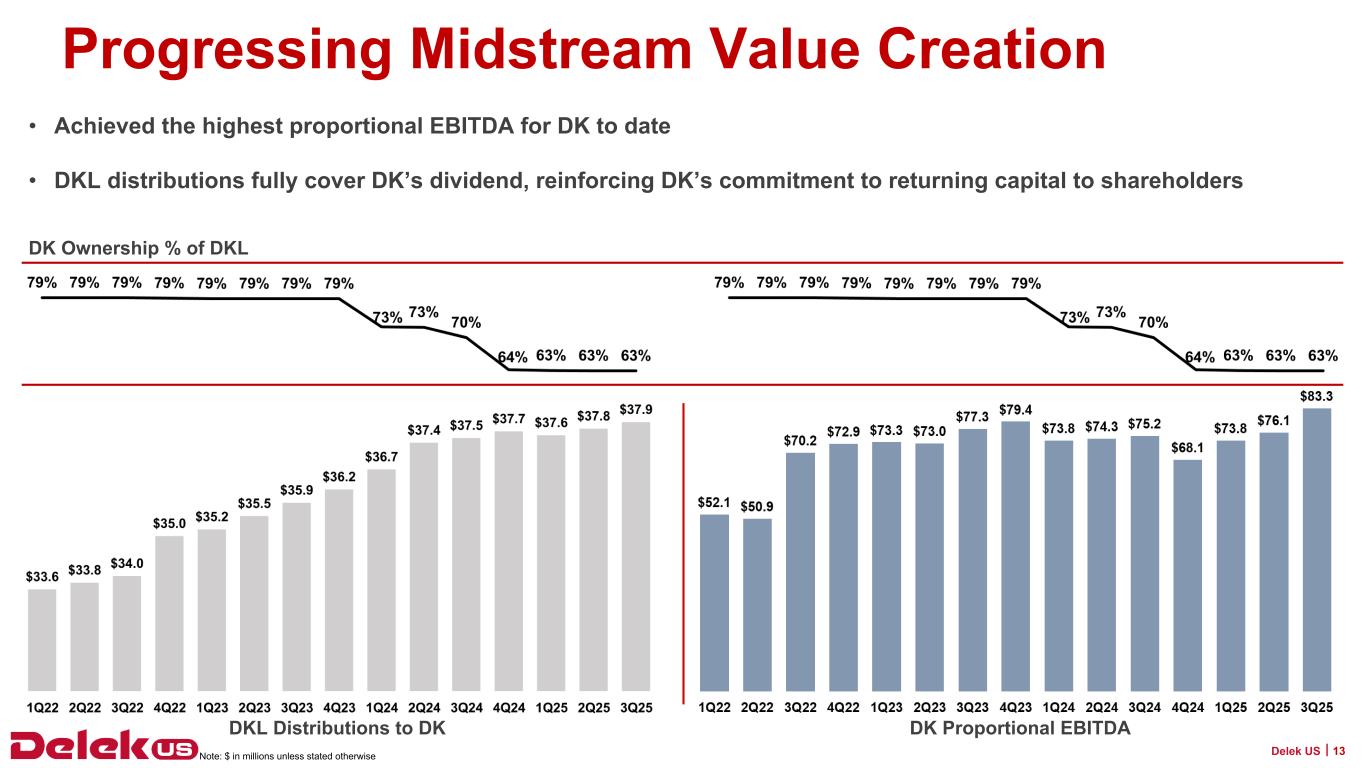
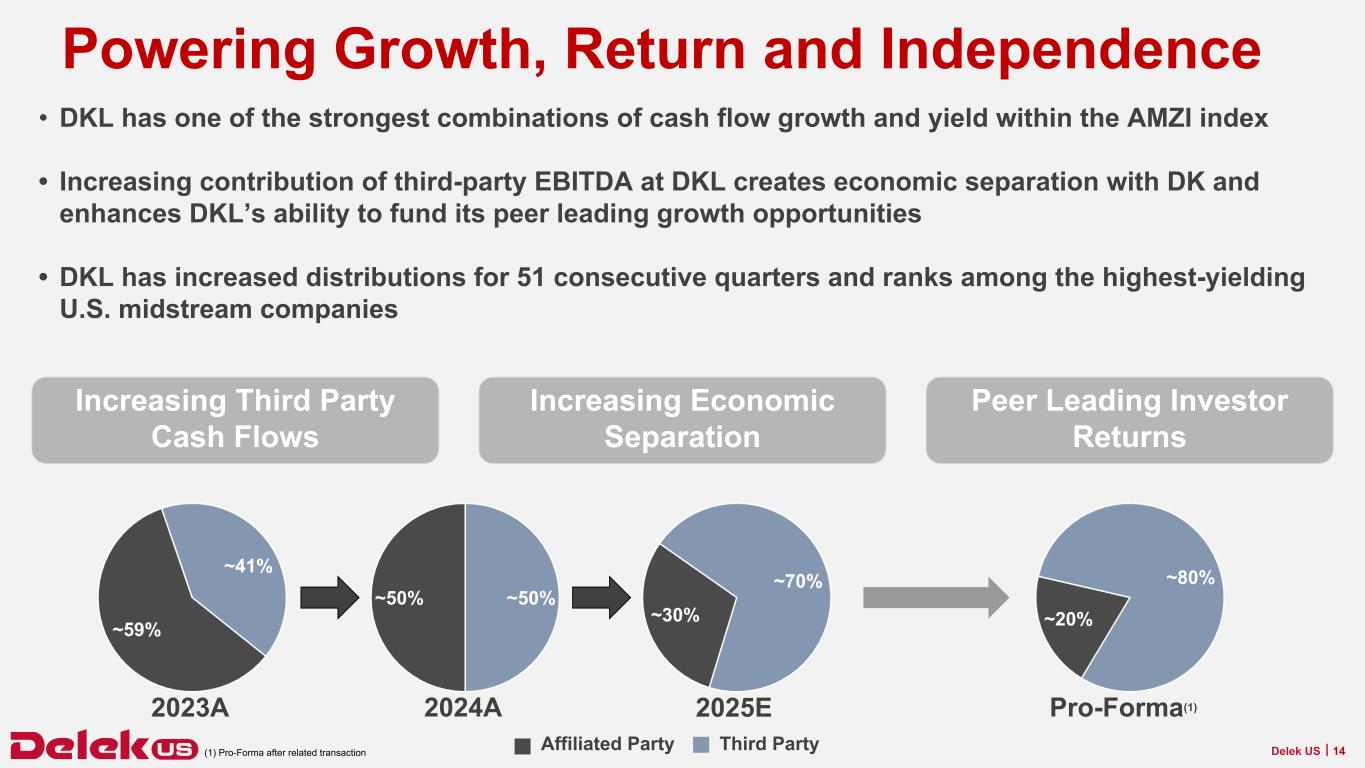
Thank you Robert. Good morning and thank you for joining us today. In the third quarter, excluding SREs, DELEC reported strong adjusted EPS of $1.52 and adjusted EBDA of approximately $319 million. This results a reflection of DELEC's strong momentum. We had excellent contribution from our enterprise optimization plan with a notable progress from all business units. As a result, we are again increasing our EOP guidance to at least $180 million on an annual run rate basis. During the third quarter, EPA approved several of our pending 2019-2024 SRE petitions. And we expect to receive proceeds of approximately $400 million for monetization of the granted RINs. We are also encouraged by the guidance EPA has issued about SREs for future RBO. From everything we see today, we continue to expect appropriate action on SREs in the future. Some of the part efforts also continue to progress well. DKL continues to make progress in improving its premier position in the permanent basin. As a result of the strong progress DKL has made this year, we are increasing DKL full-year EBITDA guidance to between $500 and $520 billion. As I always do, I will now give an update on our key long-term priorities in more detail. First, safe and reliable operations. We had a strong operational quarter in our refining system. KSR had a record throughput quarter, and it's continuing its strong momentum since its turnaround last year. Congratulations, Kroos, Tyler, Eldorado, and Big Spence also had a strong operation. Now, I would like to discuss our EOP progress. As a reminder, we started EOP with an aim to improve DK cash flow by $80 to $120 million on a run rate basis, starting in the second half of 2025. The structural changes we're making in the way we ran our company are delivering meaningful results across all business units. In the third quarter, supply and marketing had a strong contribution driven by structural improvement in our wholesale business. We are very proud of the way the commercial team is looking in the entire wholesale value chain to serve our customers. During the third quarter, we estimated approximately $60 million of EOP contribution to our P&L. Based upon these strong results, we are once again increasing our target of an annual run rate EOP improvement from the midpoint of $150 million to at least $180 million. I'm proud of how EOP has became a cornerstone of DELE continuous improvement culture, and I'm confident EOP will remain a core strength well into DELE's future. As I mentioned before, during the third quarter, the EPA cleared the backlog of pending SRE petition from 2019 to 2024. We see this announcement as a critical part of the current administration and EPA energy policy. This SRE announcement has three important implications for our business. First, for the grant years of 2023 and 2024, we have followed a proactive strategy to monetize the granted grants. We expect to receive approximately $400 million in proceeds from this monetization over the next six to nine months. We intend to prudently use this cash flow in line with our consistent capital allocation framework. For years 2019 to 2022, while we appreciate EPA granting our petition, EPA remedy is invalid and encouraged the strategy followed by our peers who chose not to comply. We are making effort to get full value from these grants in line with the intention of the RFS law. I'm confident EPL will continue its methodical approach to SRE grants, furthering energy dominance and supporting high-paying jobs in the heart of rural America. I'm also proud of the progress DKL is making. With commissioning of DKL Libby 2 plan and the completion of intercompany agreements, we are making great progress in making DK and DKL economically independent. We are working in an industry-leading comprehensive sour gas solution, including gathering, treatment, acid gas injection, and processing along with providing market access for residue gas and NGLs. This capability will provide DKL the ability to fully capitalize on all of its growth opportunities in the Delaware Basin and maintain its best-in-class EBITDA growth and distribution yield. Based on the progress Delec Logistics has made, we are increasing DKL full year 2025 EBITDA guidance to between $500 and $520 million. This final piece of our strategy is being shareholder-friendly and having a strong balance sheet. During the quarter, we paid approximately $15 million in dividend and bought back approximately $15 million of our shares. Our strong balance sheet, improved reliability, and confidence in EOP has enabled us to continue counter-technical buyback in 2025. I'm proud to say that over the last 12 months, DELEC had the highest total return yield, buyback plus dividend, among all of its refining peers. We remain committed to a disciplined and balanced approach to capital allocation and look forward to continue rewarding our shareholders. In closing, thank you to our team for their dedication. We are optimistic about finishing 2025 strong and building on this momentum into the future. Now, I will turn the call over to Joseph, who will provide additional color on our operations.
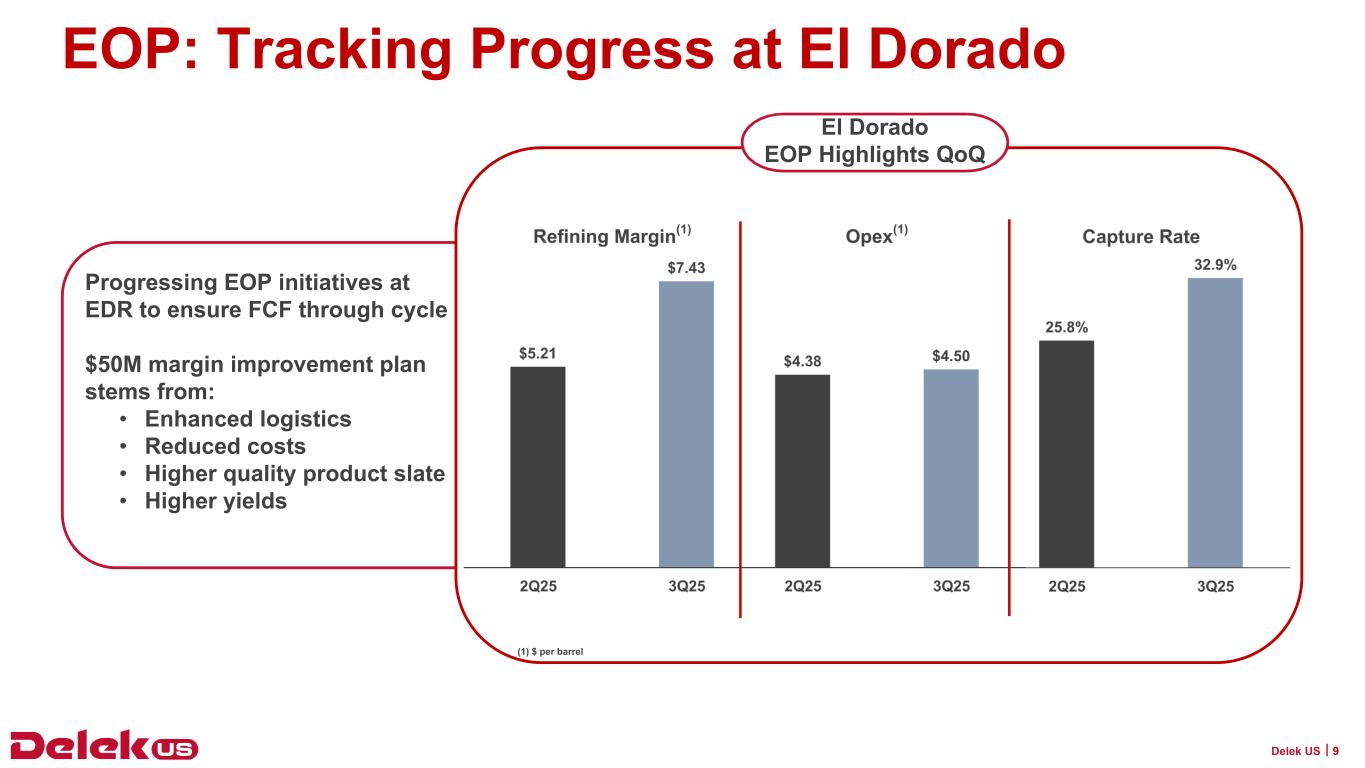
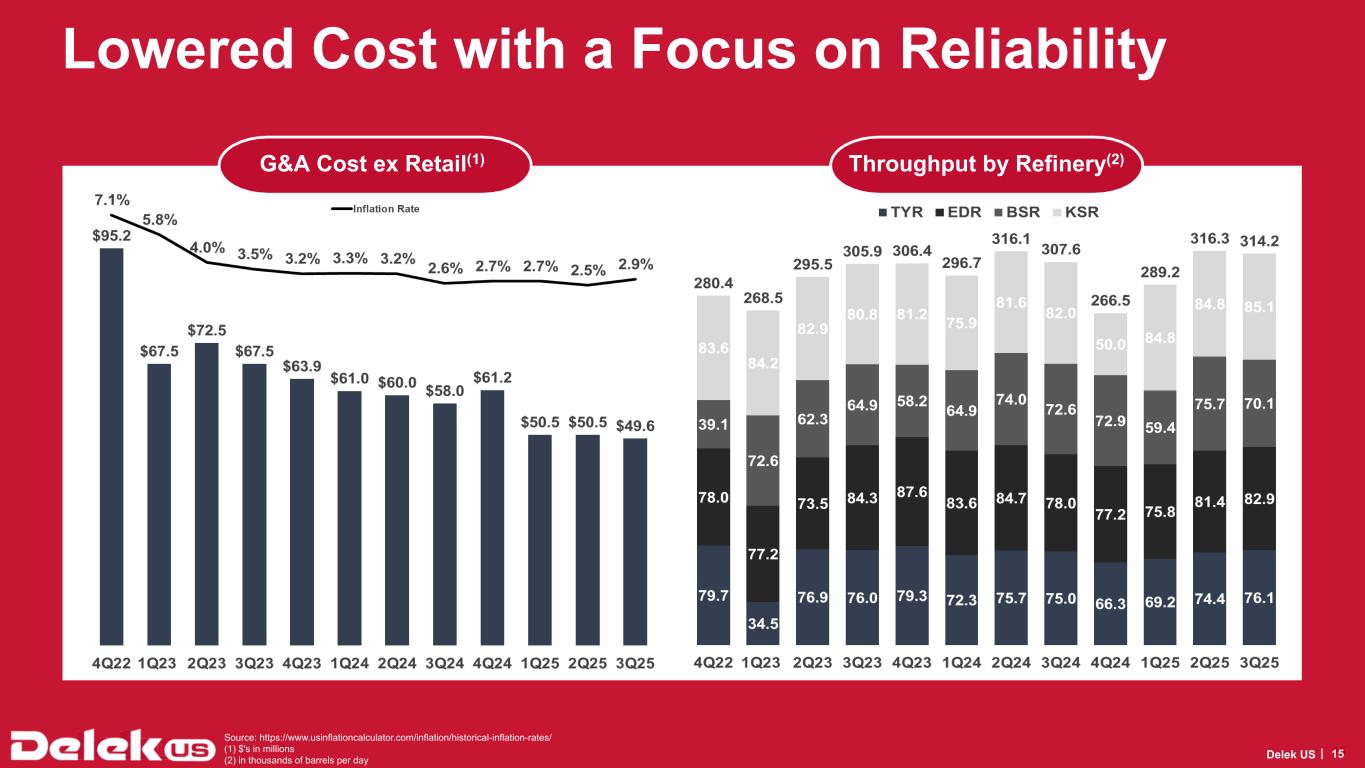
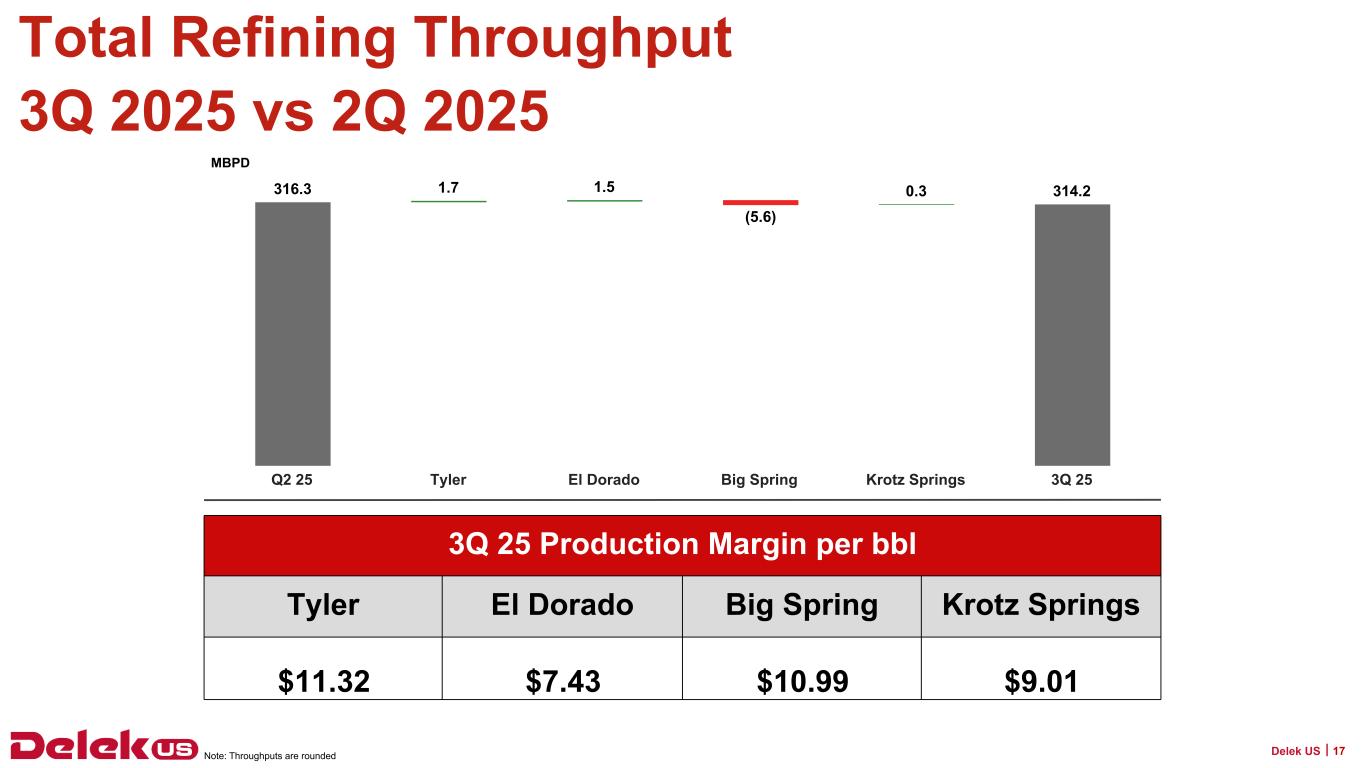
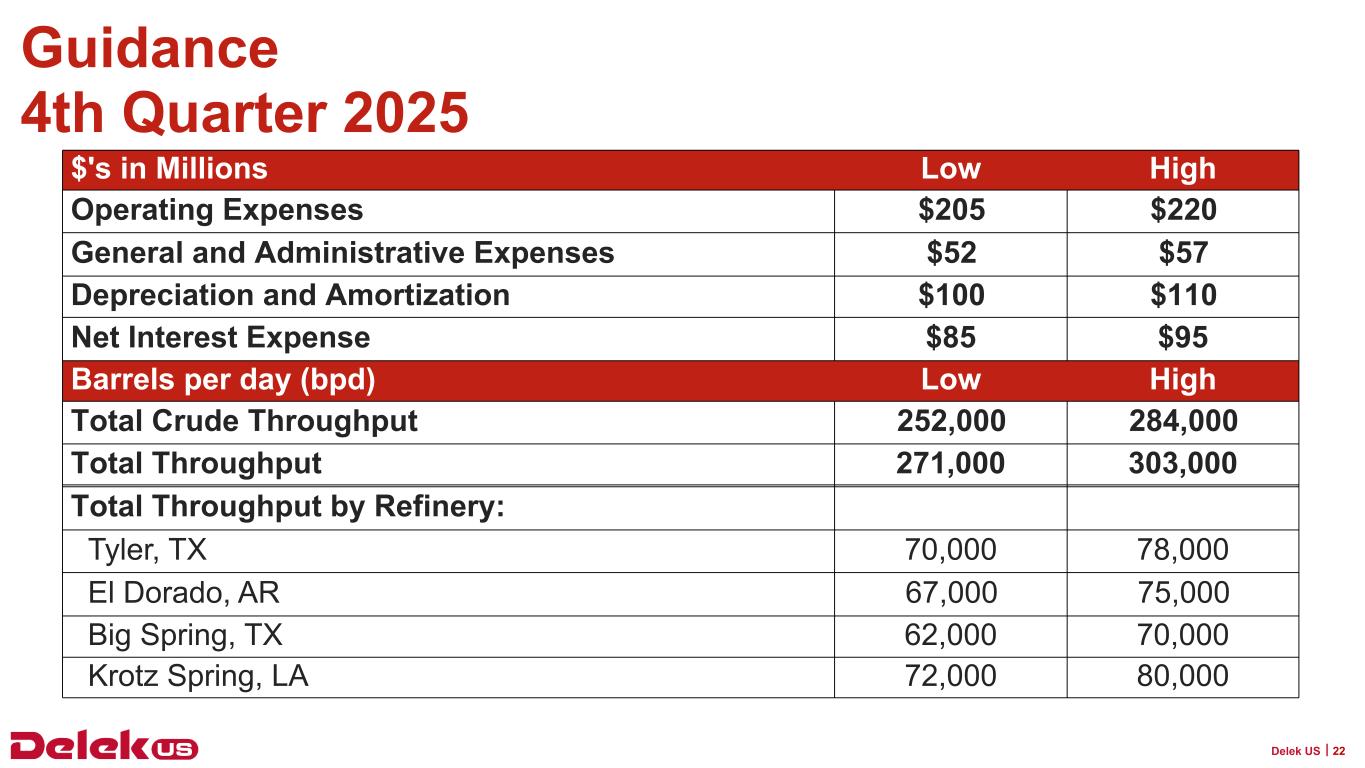
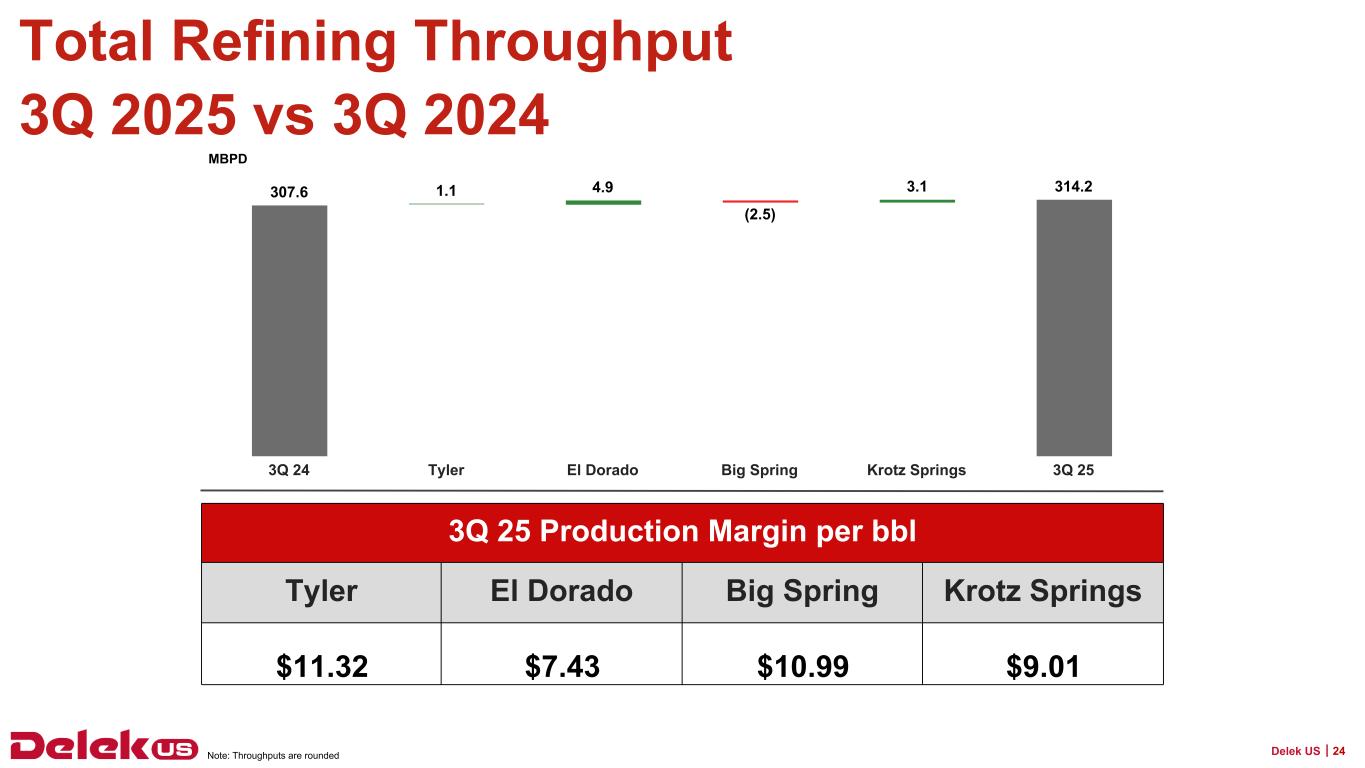
Thank you, Avigal. Operations reliability in the third quarter was consistent with our guidance, with a third consecutive record high throughput set in CrowdSprings. Our refining system continues to implement EOP initiatives at all sites. We have been successful in the bottlenecking, improving liquid yield recovery, maximizing production value, and optimizing sulfur and benzene balances. At the same time, the commercial team has reworked contracts and optimized our new logistics to expand market optionality. Starting with Tyler, total throughput in the third quarter was 76,000 barrels per day. Our production margin was $11.32 per barrel, and operating expenses were $4.93 per barrel. For the fourth quarter, our estimated total throughput in Tyler is in the 70 to 78 thousand barrels per day range in el dorado total throughput in the third quarter was approximately 83 000 barrels per day our production margin was seven dollars and 43 cents per barrel and operating expenses were four dollars and fifty cents per barrel eop implementation is well reflected in our margin realization as we continue to trend toward our $2 per barrel of incremental capture in our El Duedo system. Our planned throughput for the fourth quarter is in the 67,000 to 75,000 barrels per day range, considering seasonal trends. In Big Spring, total throughput in the third quarter was approximately 70,000 barrels per day. Our production margin was $10.99 per barrel, and operating expenses were $7.20 per barrel. In the fourth quarter, the estimated throughput is in the 62 to 70,000 barrels per day range. In Crott Springs, total throughput in the third quarter was approximately 85,000 barrels per day. Our production margin was $9.01 per barrel, and operating expenses in the quarter were $5.35 per barrel. Our planned throughput for the fourth quarter is in the 72,000 to 80,000 barrels per day range. Our implied system throughput targets for the fourth quarter is in the 271 to 303,000 barrels per day range. Distillate outlook for the fourth quarter is strong, as we are pushing our 42% distillate capability system accordingly. Moving on to the commercial front, excluding SREs, supply and marketing contributed approximately $130 million in the quarter. Of that, approximately $70 million was generated by wholesale marketing. Asphalt contributed a gain of approximately $6 million, with the remaining contribution coming from supply. In summary, the third quarter marked another successful execution of our operating plans. The focus on the fundamentals has allowed us to focus on capture improvements through EOP. Mark will now address the financial variance.
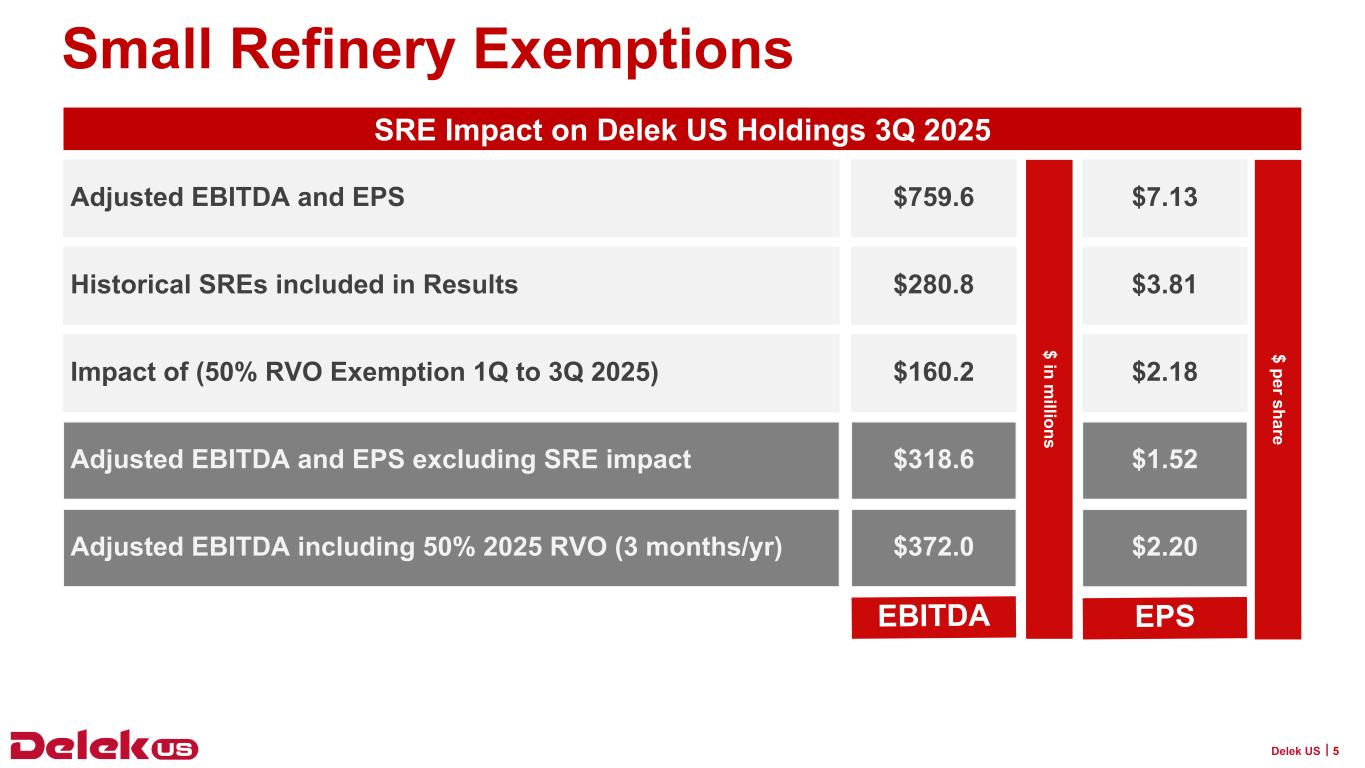
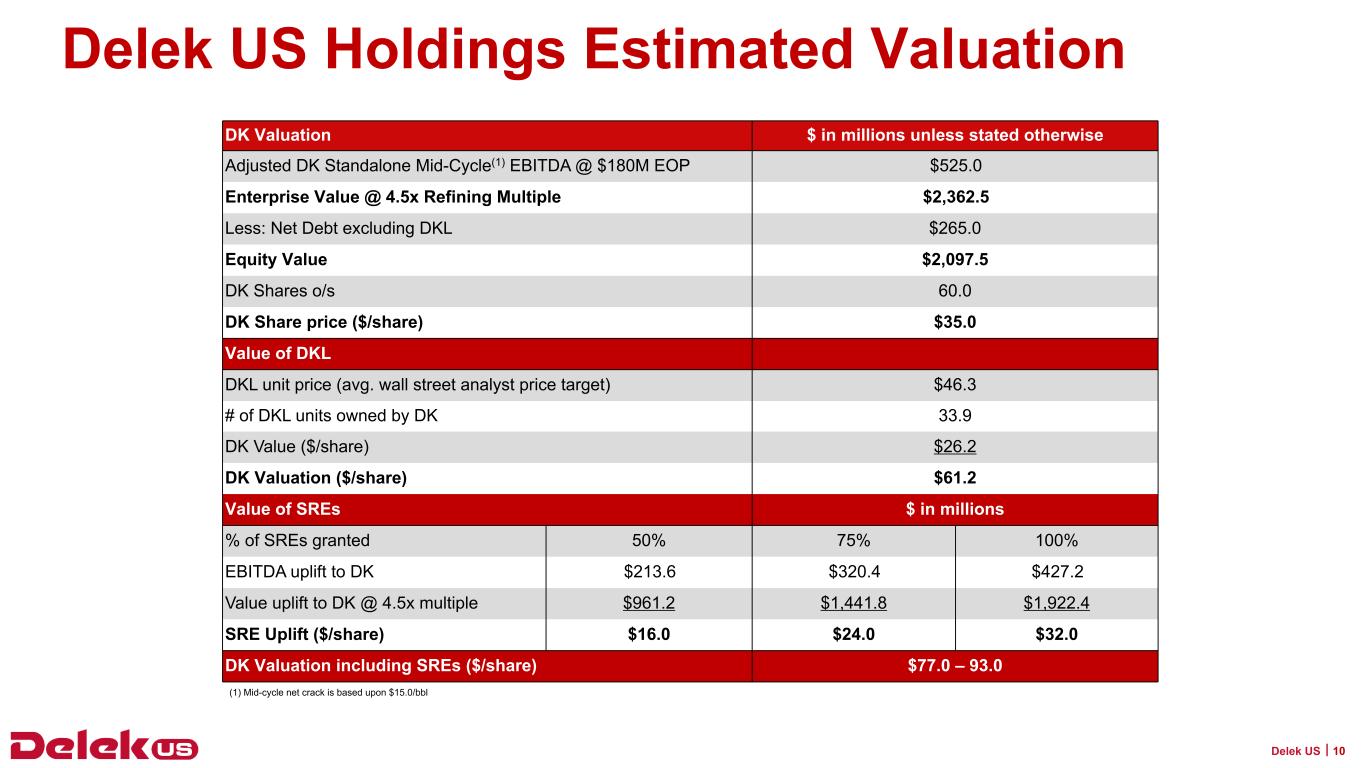
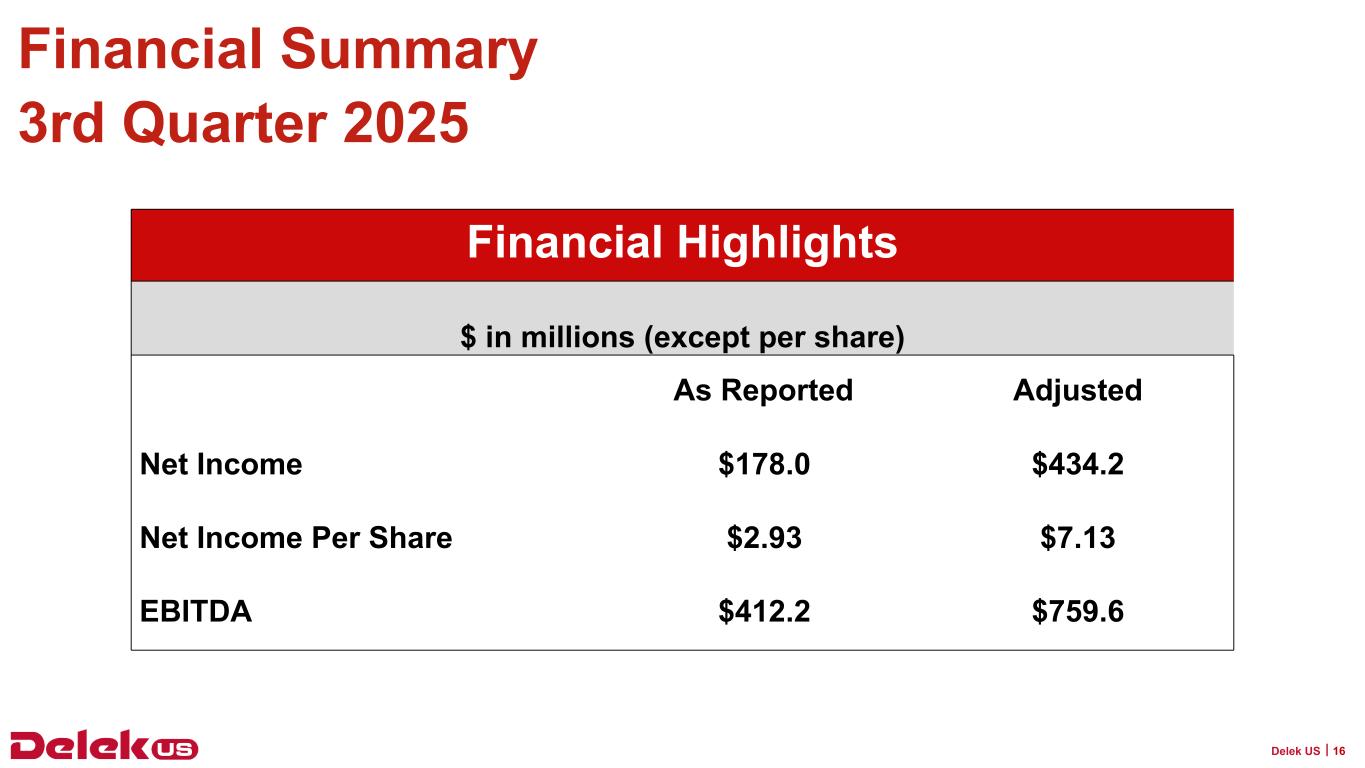
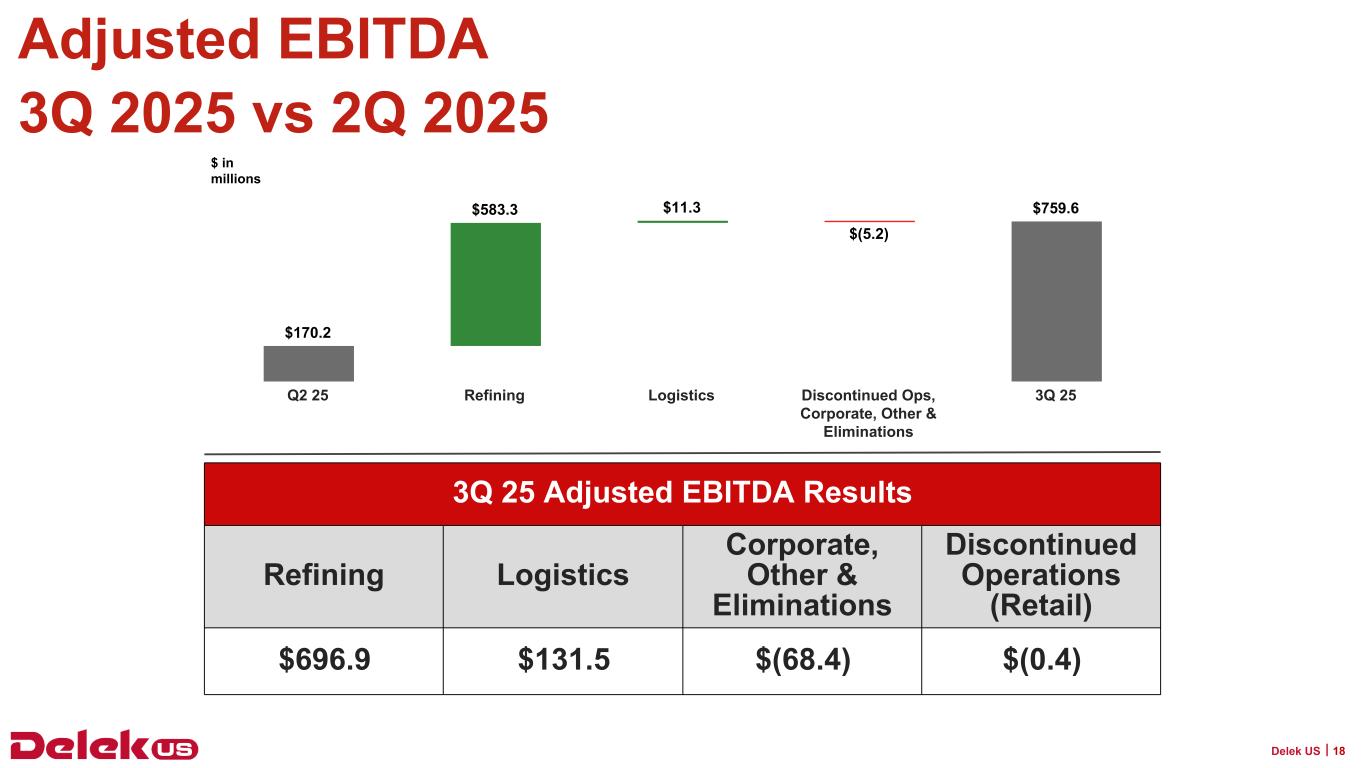
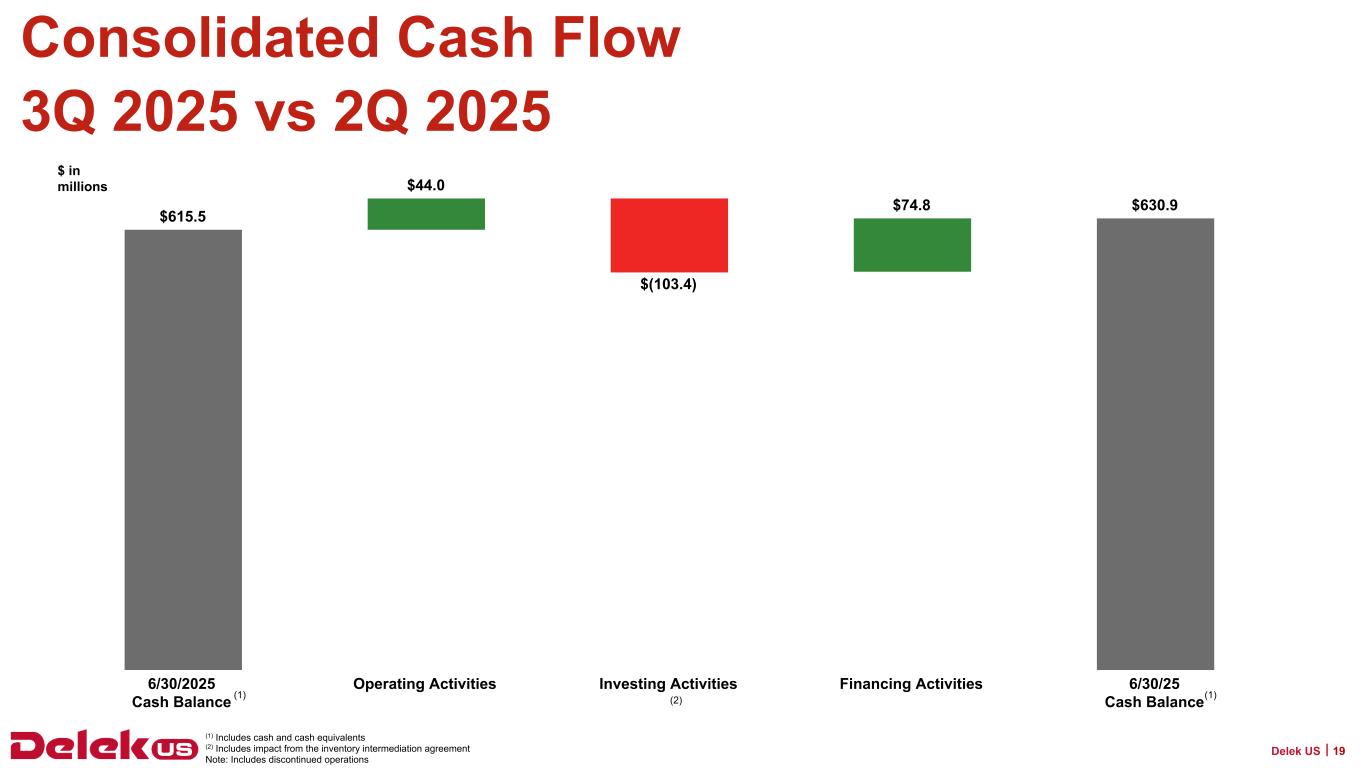
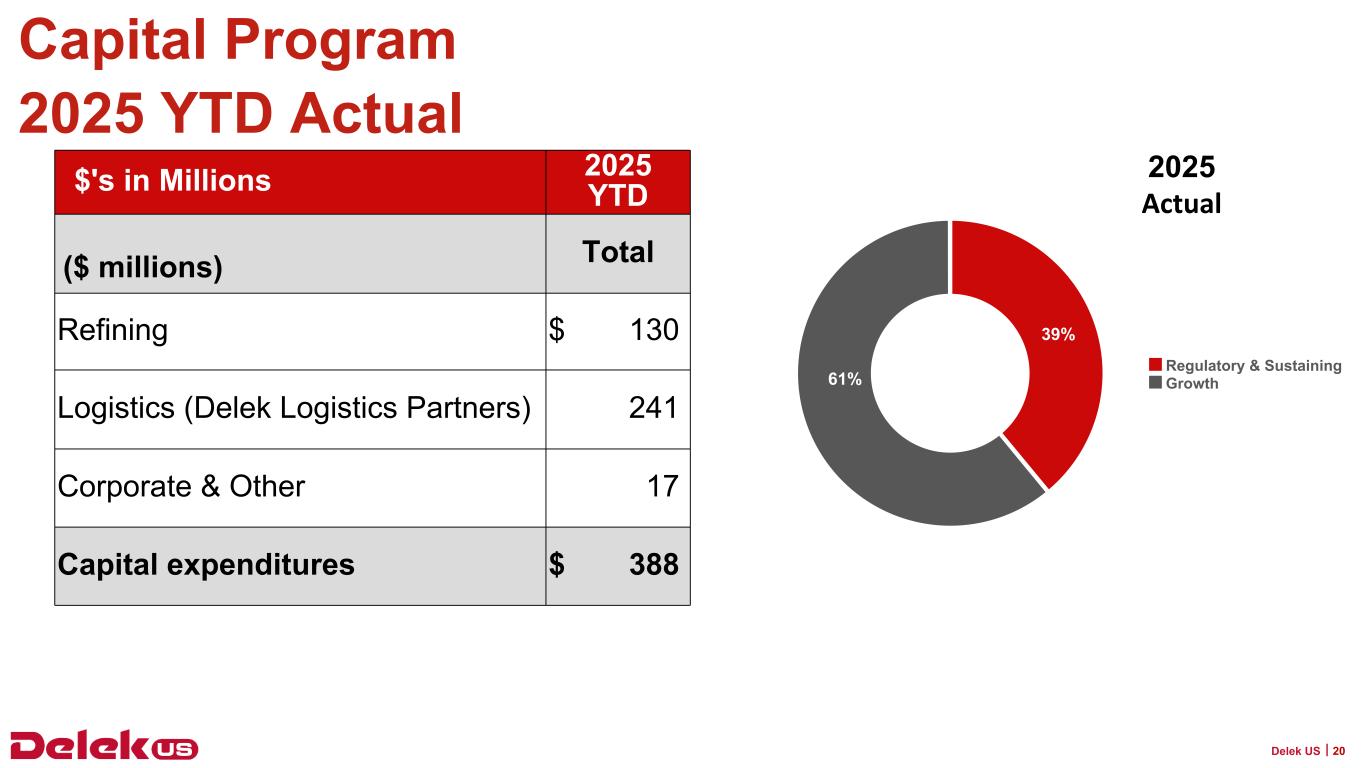
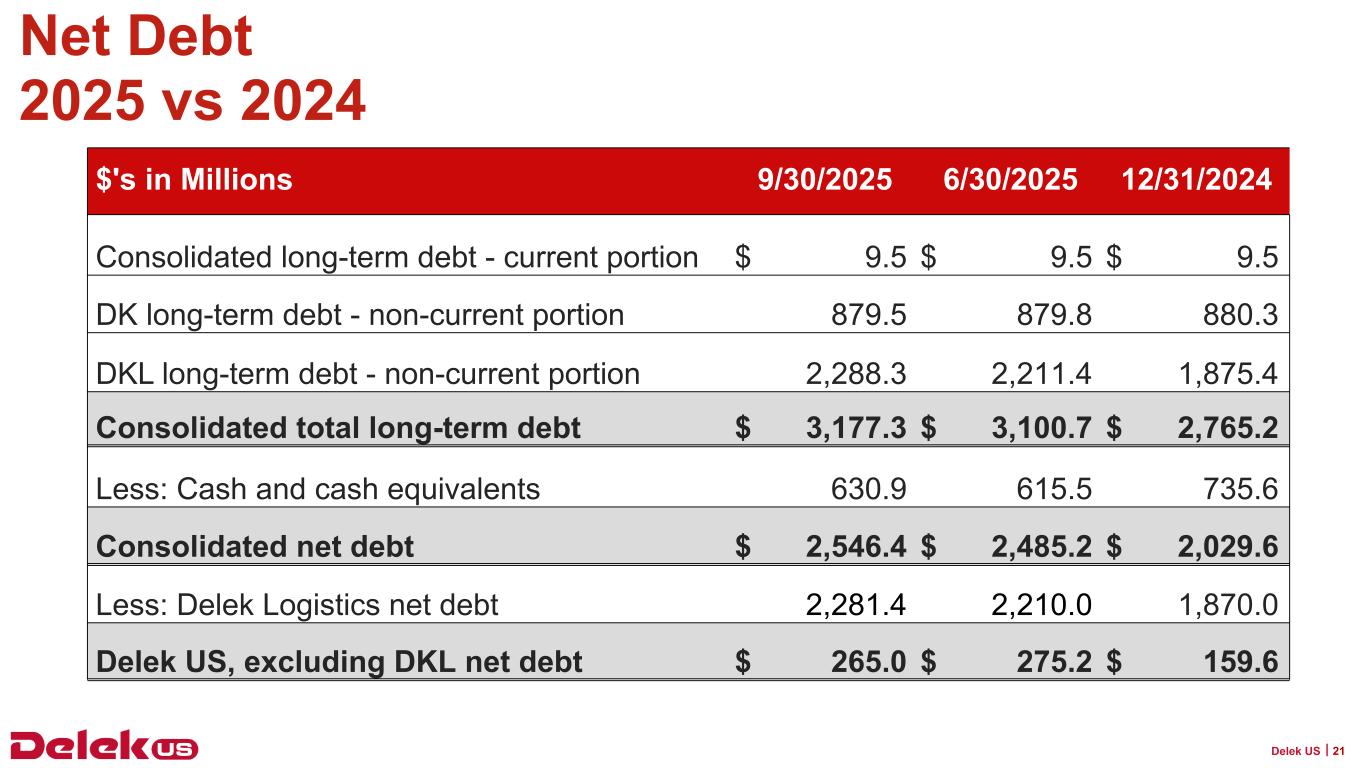
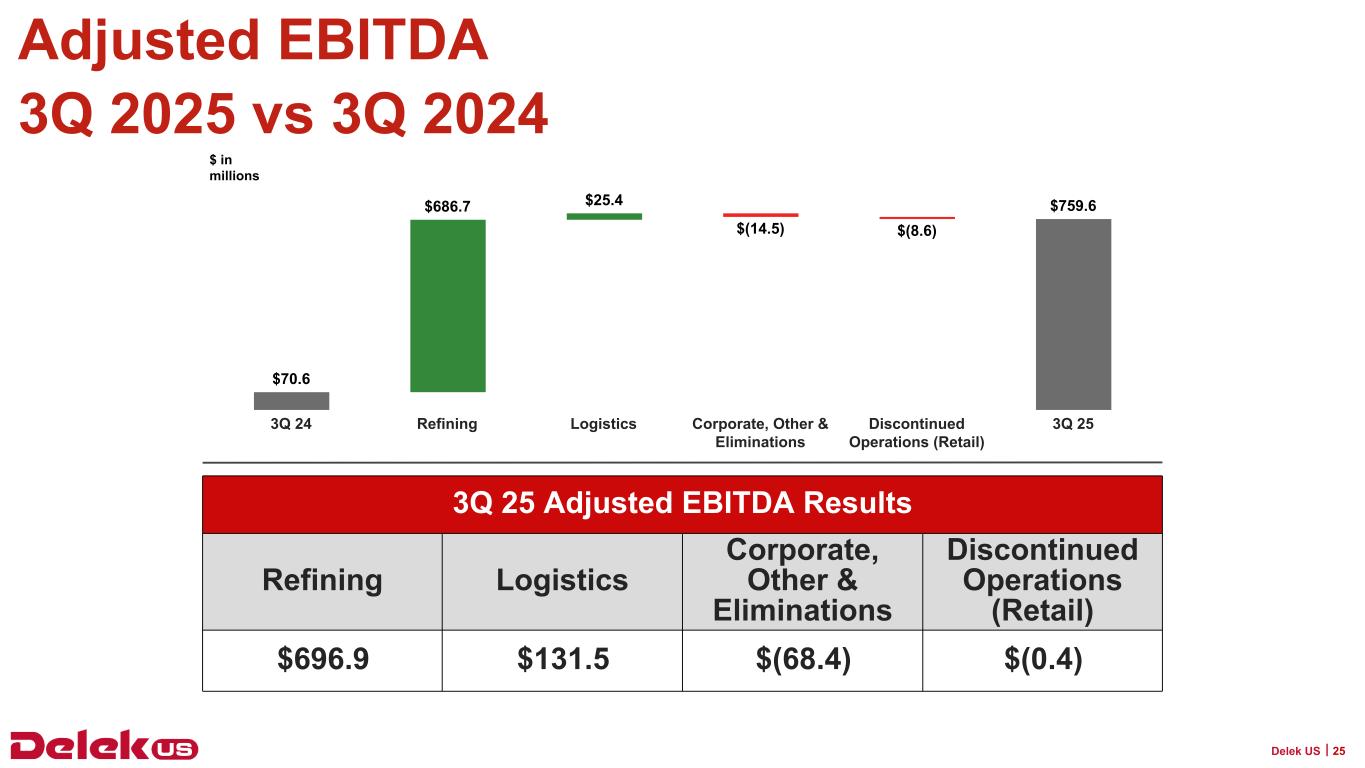
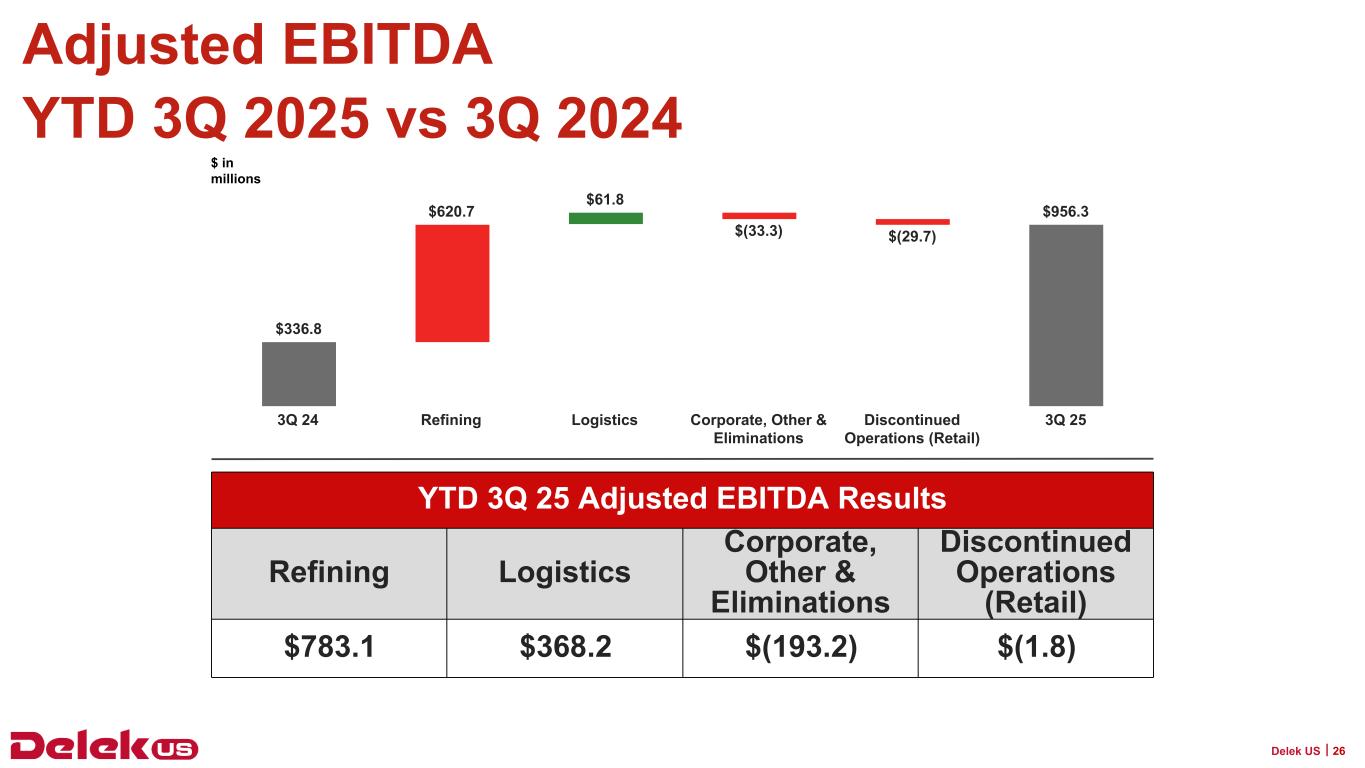
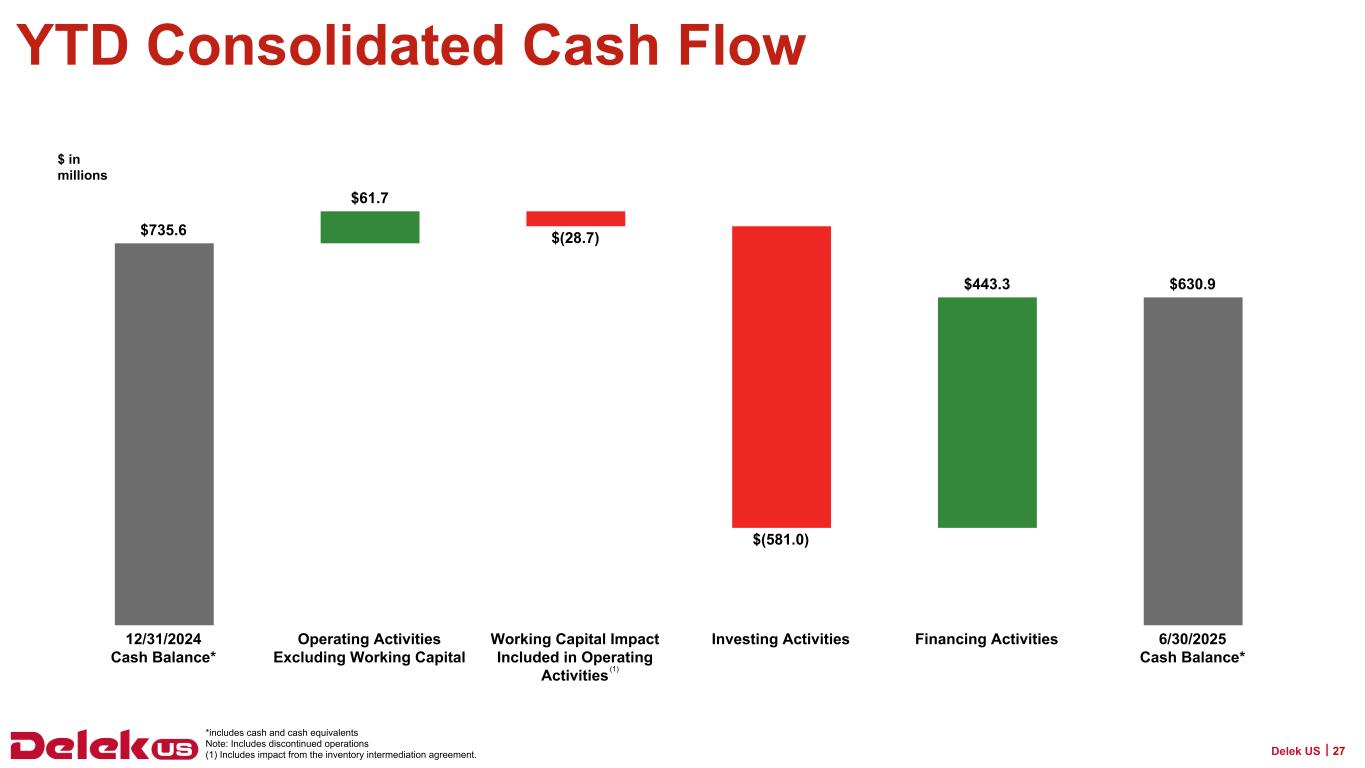
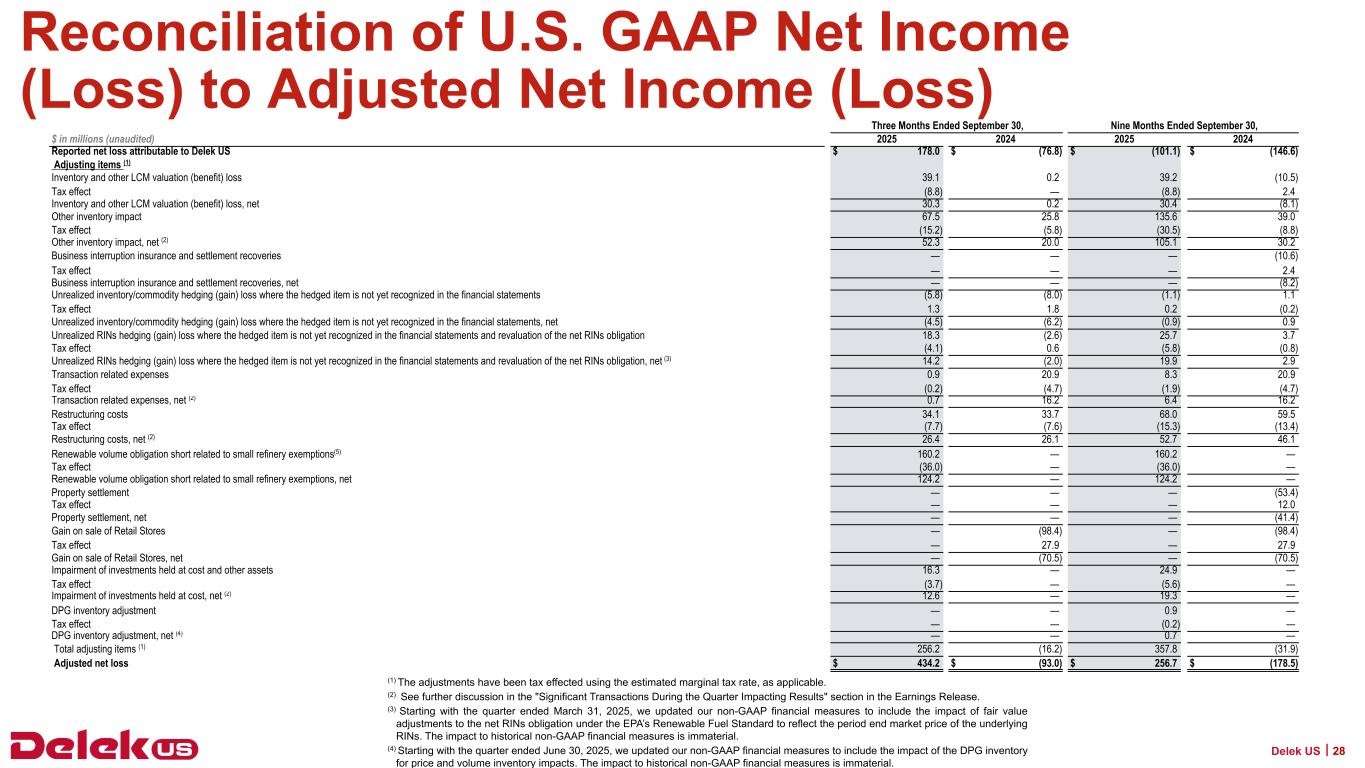
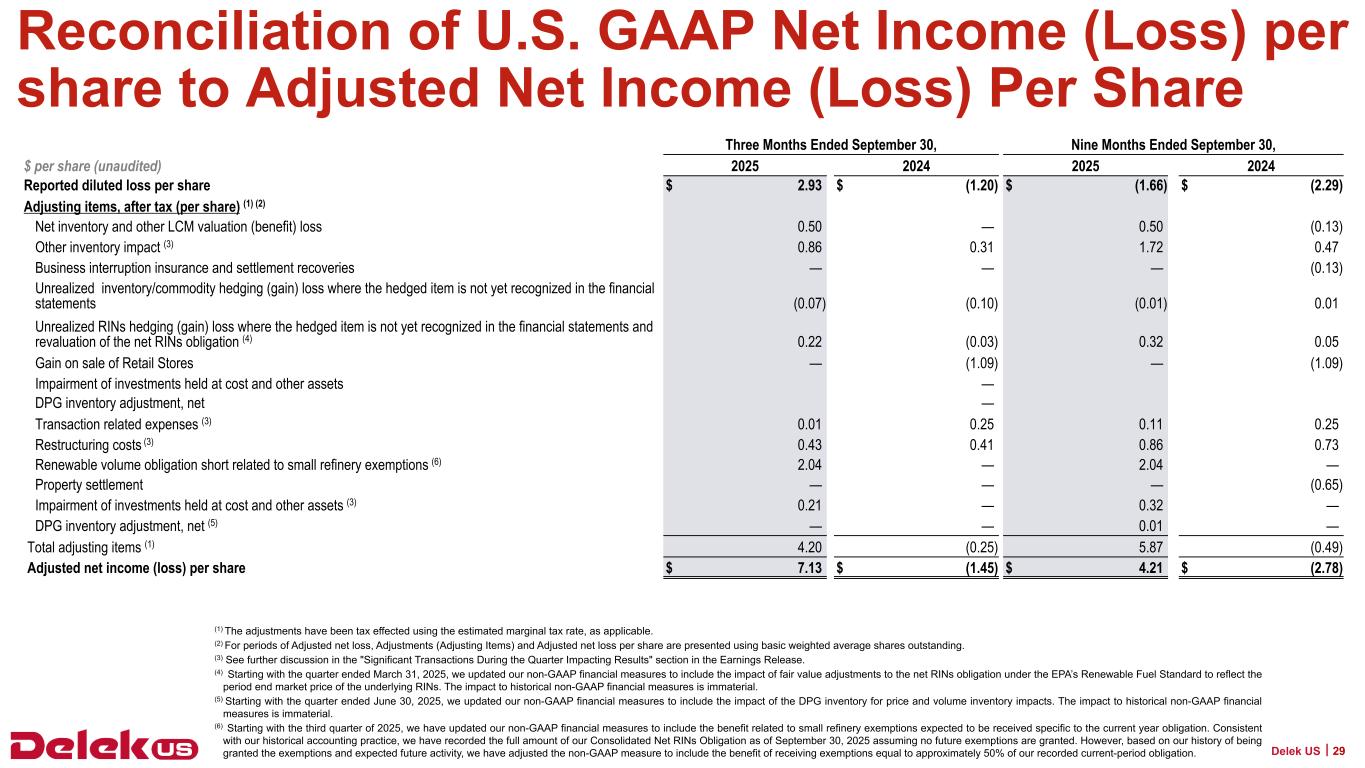
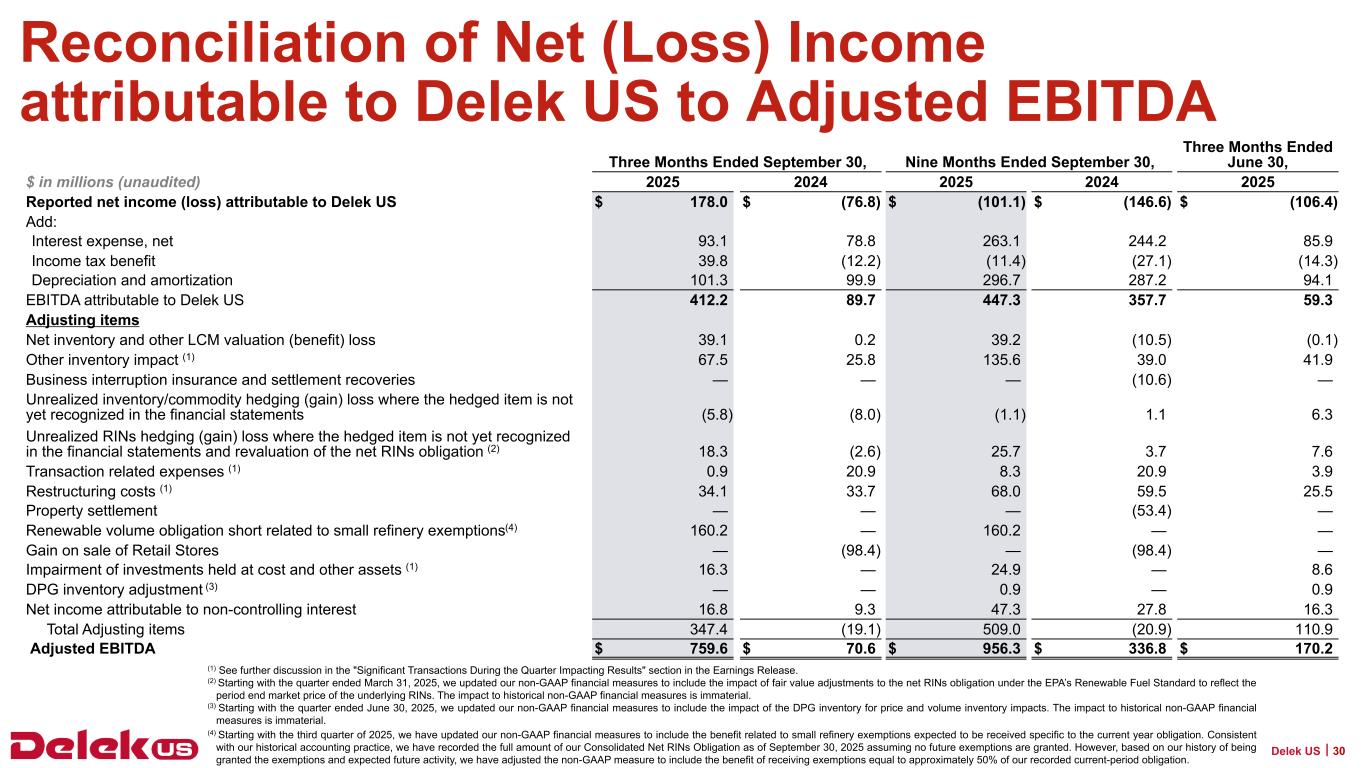
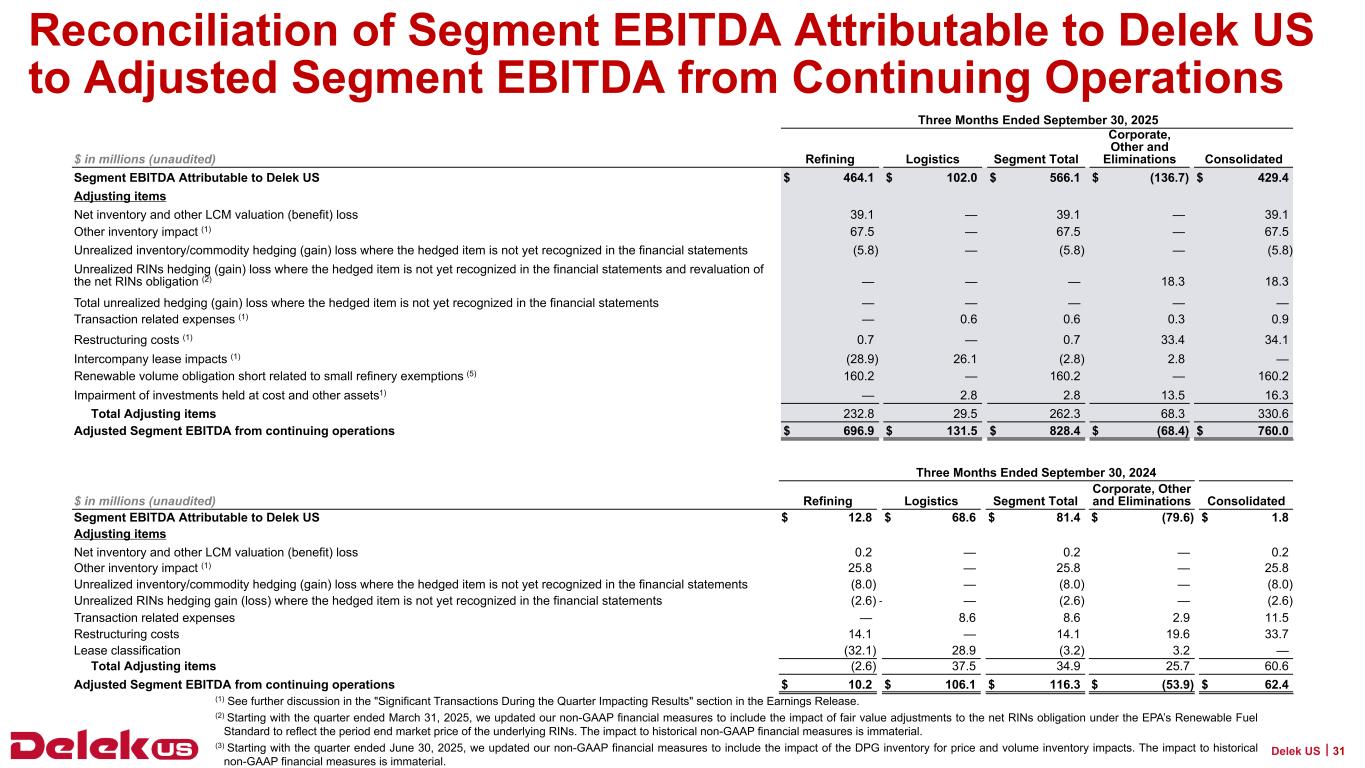
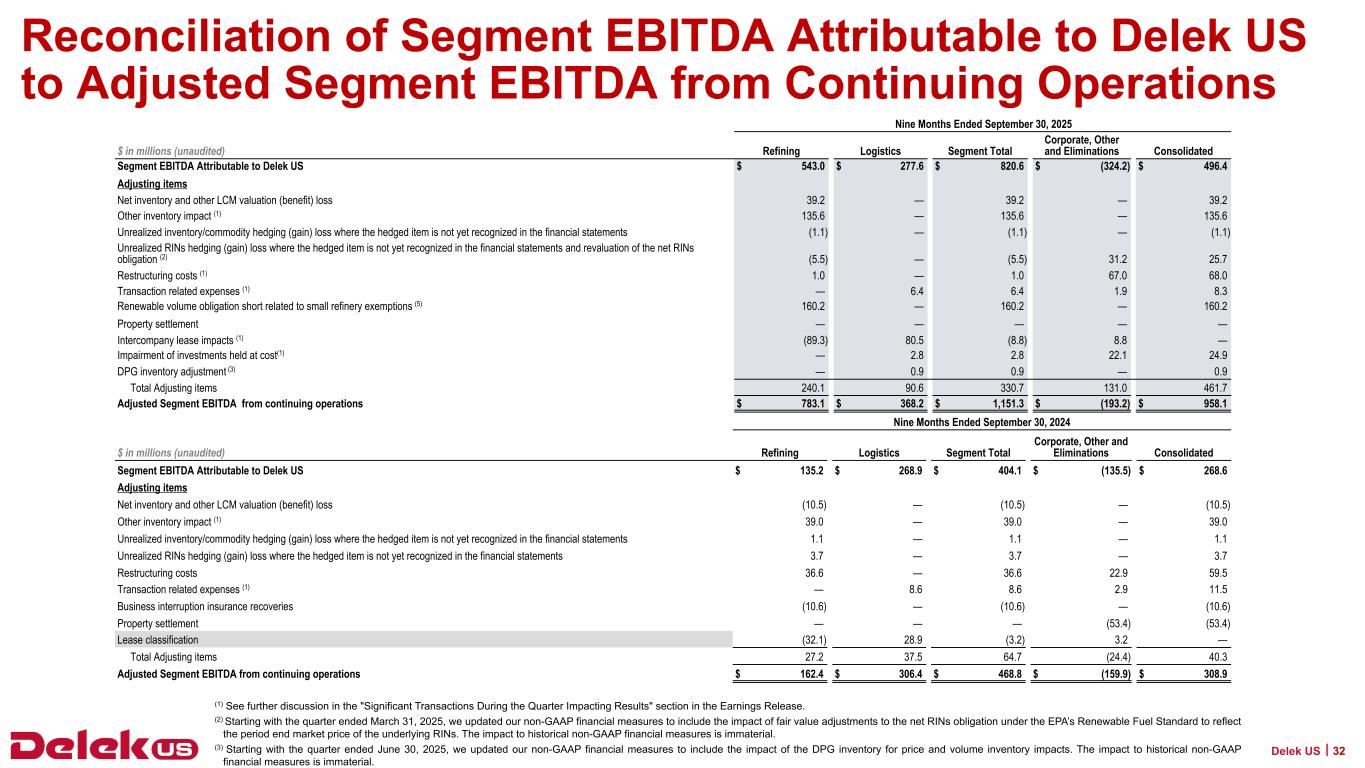
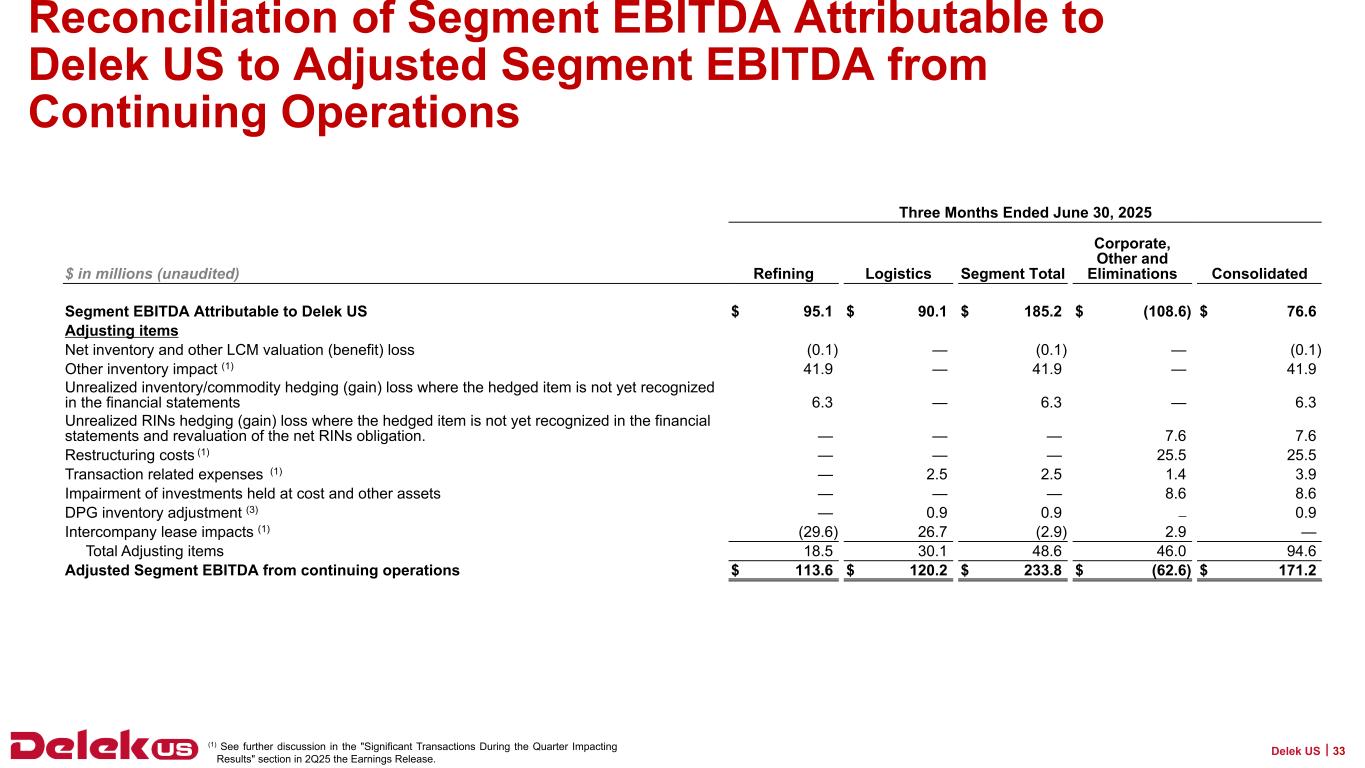
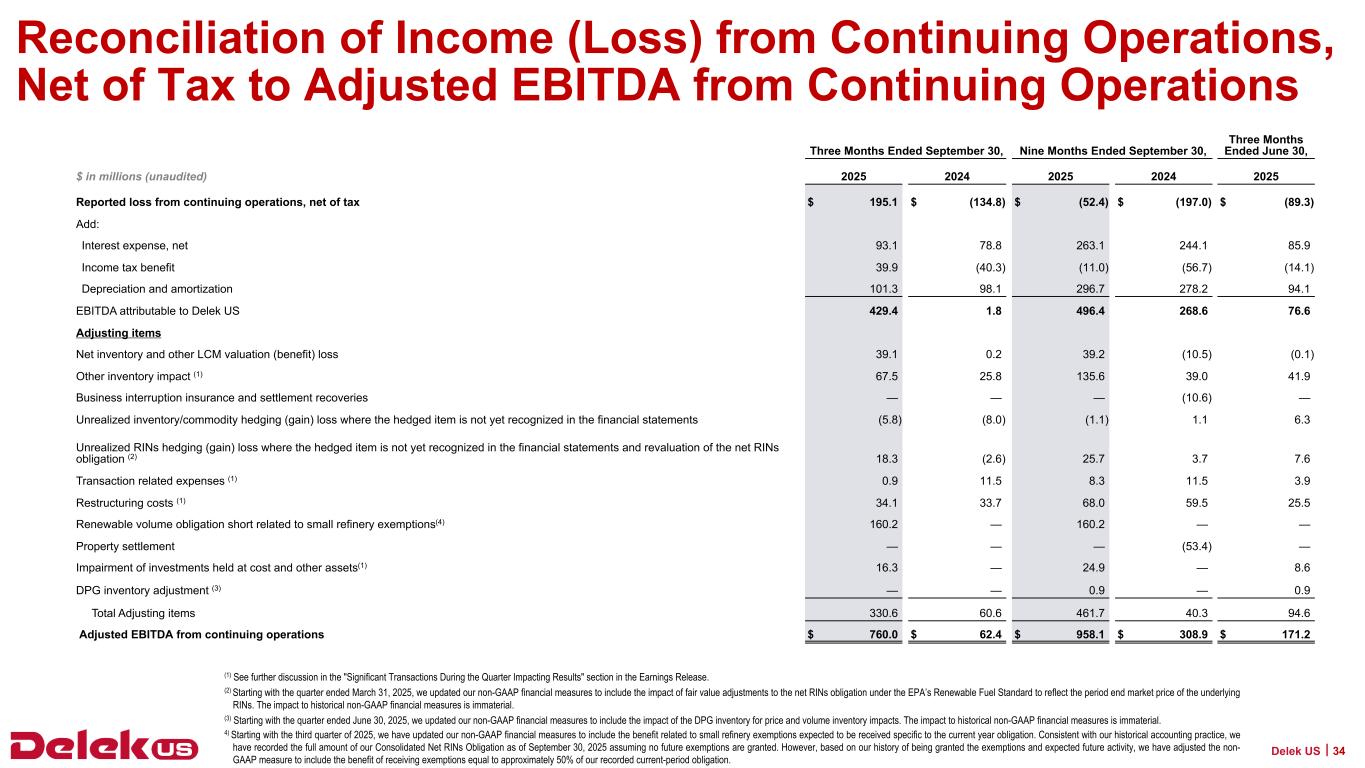
Thank you, Joseph. Referring to slide 5, we show the breakout of adjusted EBITDA and adjusted EPS, approximately $319 million and $1.52 per share, respectively, excluding SREs. This breakout removes the impact of historical SREs of $281 million and the impact of 50% RVO exemption recognition for the first nine months of 2025 of approximately $160 million. Moving to slide 16, for the third quarter, DELIC had net income of $178 million, or $2.93 per share. Adjusted net income was $434 million, or $7.13 per share, and adjusted EBITDA was approximately $760 million. On slide 18, the waterfall of adjusted EBITDA from the second quarter of 2025 to the third quarter shows that there were three main drivers for the increase and EBITDA. First, a $583 million increase in refining reflects improved refining margins, as well as an increase of $281 million due to our recognition of historical SREs, the $160 million impact of our 50% RVO exemption recognition, and improvement in our overall business that continues to be positively impacted by our EOP initiatives. Second, in the logistics segment, we continue to have another strong quarter, delivering approximately $132 million in adjusted EBITDA, about an $11 million increase over our previous record of quarterly adjusted EBITDA achieved in the second quarter. These improvements were mitigated by slightly higher cost in the corporate segment of $5.2 million compared to the prior period. Moving to slide 19 to discuss cash flow. Cash flow provided by operations was $44 million. This includes our net income for the period, adjusted for non-cash items, and a net outflow related to changes in working capital of $106 million. The working capital movements include the timing impact related to SREs granted in the third quarter, as we expect monetization of the grants to occur over the next six to nine months. When adjusting for working capital, cash flow from operations was $150 million. This was an improvement of $202 million when compared to the third quarter of last year. Investing activities of $103 million includes approximately $44 million for growth projects primarily at DKL. Financing activities of $75 million includes $15 million in share repurchases, approximately $15 million in dividend payments, and approximately $22 million in DKL distribution payments to public unit holders. On slide 20, we show our actual progress under the 2025 capital program. Third quarter capital expenditures were $91 million. Approximately $50 million of this spend was in the logistics segment, where we had $44 million in growth capital at DKL, primarily related to our crude and natural gas GMP initiatives. All of the remaining capital spend during the quarter was in the refining segment, addressing planned sustaining capital initiatives. Our net debt position is broken out between DELEC and DELEC Logistics on slide 21. Excluding DELEC Logistics, we spent approximately $71 million on cash return to shareholders and capital expenditures in the third quarter, while our DELEC standalone net debt decreased slightly to $265 million at the end of the quarter. Moving now to slide 22, where we cover fourth quarter outlook items. In addition to the guidance Joseph provided, for the fourth quarter of 2025, we expect operating expenses to be between $205 and $220 million. Our guidance for the fourth quarter incorporates increased operating expenses associated with the ramp-up of our new Libby 2 plant at DKL. GNA to be between $52 and $57 million. DNA is expected to be between $100 and $110 million, and net interest expense to be between $85 and $95 million. With that, we will now open the call for questions.
Operator
Thank you. The floor is now open for questions. If you have dialed in and would like to ask a question, please press star one on your telephone keypad to raise your hand and join the queue. If you would like to withdraw your question, simply press star one again. If you are called upon to ask a question and are listening via loudspeaker on your device, please pick up your handset and ensure that your phone is not on mute when asking your question. And we do request for today's session that you please limit yourself to one question and one follow-up. One moment for your first question. Your first question comes from a line of Doug Leggett of Wolf Research. Your line is open.
Thank you. Good morning, everyone. Hopefully, I'll make this relatively easy. I've got two questions related to the SREs. Obviously, tremendous update from you guys this morning. But my question is on the refining throughput guidance, because you've given an RVO risk number, it looks like, for 2025. But it looks like all four of your refineries are basically going to be at or below the SRE thresholds. My question is, if that's the case, why should we not risk the RVO at 100%? In other words, you get 100% of the number. And then I guess how should we think about that going forward? That's my first question. My second question is really more, is kind of hypothetical, I guess, because we've got Trump PPA currently. So presumably because you've gained the SREs under the Trump administration, the minimum we should probably assume is you get the Trump PPA duration, which I guess is four years. My question is, what is your view on whether the rulemaking, the legal case and so on, could transcend administrations? In other words, this becomes a perpetual SRE exemption for DELEC. Thanks, guys.
Thank you for the great question. And I will start with your permission, obviously, with giving a bit of overview on SRE and looking that on the big picture. And then we'll finish the technical part of the question, if you're okay with it. So, listen, we said it very clear on our financials that we have $200 million impact on Q3 earnings, And we also, I said on my prepared remark that we have $400 million of cash coming at us in the next six to nine months. And I want to make another point very, very clear, right? We're going to use this cash prudently, in line with our overall capital allocation guidance we gave many times, so we are not going to deviate from that. So I want to take a moment or two to talk about the 2019 and 2022 rings. While we really appreciate EPA clearing the backlog, obviously, EPA remedy is invalid. We all understand it, right? It's very clear. But we believe that relief and eligibility are not this questionary item. That's a very, very two words that I just, very important two words I just said. And we are committed and confident to give to our shareholders and company full value of those pending petitions from 2019 to 2022. Both the court and the law are behind us and we're going to follow through and make it happen. We have seen the precedence in the past around it. and we are confident we'll get it as well. Our throughput is completely normal with regular seasonal, so we can check that box, and I will let Mohit finish.
Yeah, thanks, Doug. Thanks for the question. As far as the 50% piece is concerned for 2025, that is not our expectation. Our expectation is 100% of our refining capacity qualifies for SREs, and we expect to get 100% of SREs for 2025 as we go forward. If you look at your other question about sustainability of these SREs beyond the current administration, we believe we are a country of law where the law is followed and the law is clearly on our side. The courts, their decision is on our side and we are very optimistic that this will transcend beyond the current administration.
That's very clear, guys. Thanks very much indeed.
Operator
Thank you. Your next question comes from the line of Manav Gupta of UBS. Your line is open.
Congrats on a great quarter, guys. I just have a quick clarification question. The 688.6 reported in total adjusted refining margin for the quarter, does it include the SRE benefits or does that exclude it? And on similar lines of slide 17, the margins that you have reported, gross margin, it doesn't look like they have any SRE benefits, but could you clarify, because some of your peers are reporting these gross margins with the benefits included, so if you could clarify on those things.
Yeah, it's easy. 688 include, and the margins that we reported do not include. So it's very, very easy to answer. I don't know, Mohit, or Mark, if you have any.
Manav, I'll just make one more point. So, you know, the reported gross margins for the refineries actually also have the RBO obligation in it. So, you know, the RBO obligation that we have flows through our gross margin. So they are post that obligation. That's what we are reporting.
Perfect. Thank you so much, Mohit. And one quick question more. I understand it's more on the midstream side. But look, Permian sour gas opportunity just continues to expand. You guys were there before many others. and help us understand what it means for, obviously, your midstream business and then, obviously, how BK benefits just because DKL benefits from this growing Permian sour gas opportunity.
Yeah, Manav, thank you for the great question. And the sour gas opportunity in the Delaware Basin is something that we are all very excited of. We see that opportunity. We were ahead of the curve with the 3B acquisition and also ahead of the curve with the 2Water acquisition. You see the multiply today, nothing that you can buy those assets today. Reuven, here next to me, is going to extend the discussion about the sour gas. That's a very big deal for us, and we were on the right timing with the right permits, and we are very happy about that.
Thank you, Abigail. The construction and the startup of Libby 2 has been above our expectation, on time, on budget. But originally, and based on producer's forecast, when we started Libby 2, we anticipated to fill the plant with sweet gas. But the landscape has changed, and producer needs solution and rapid solution for sour As a result, we accelerated our sour programs to provide solution in a more rapid timeline. We have very, very high confidence in not only filling up Libby 2 with sour gas, but But because of the full sweet sour gas, crude, and water solution that we provide, we will need to expand processing capacity earlier than our previous expectation around sour.
Operator
Thank you. Your next question comes from the line of Vikram Bagri of Citi. Your line is open.
Good morning, everyone. I wanted to ask about SRE cash. When does it hit the balance sheet?
I was wondering if you've done the rinse sales with deferred delivery already or you're going to sell rings in open market and liquidity will be there yeah so if you can thank you for joining us today we'll stick to the answer we gave in the prepared remark that we expect to see the cash in the six to nine months and we leave the technical of trading outside of this call and we are very happy about the improving of the position and very optimistic about sri in general and we'll leave it to that thanks and as a follow-up you raised the guidance it has been this multiple times, the EOP cash savings guidance.
Can you talk about what the drivers of the most recent increase were, what initiatives you've taken, if there has been any change in underlying assumptions that drove the increase, or you've seen opportunities and where those opportunities are?
Yeah, thank you for asking that question. That's really something I'm very proud and love to talk about. I have a lot of energy around the topic. Listen, first of all, Well, EOP, it's not a project, it's a lifestyle. And it's a lifestyle across the organization. And we see how well it runs across our company and how confident we are with that, right? It's not just cost, it's cost and margin. We've seen a very nice improvement in margin this quarter. And we have 73 initiatives we are running on a weekly and a daily basis to make that happen. It's very clear in our earnings, very clear in our EBITDA, very clear in our cash flow. So all of that screen very, very well for us. Majority of those projects are a margin, but they are not related for the most part for market condition. So that's another point of strength in our program. As you said correctly, this is the fourth time we are increasing the guidance. We started from a midpoint of 100, and now we are saying over 180. and that's going very well for us. So more to come. I do want to make another important comment. We started Q4 very well, and we see more upside on that going into this quarter. Thank you.
Operator
Your next question comes from the line of Alexa Petrick of Goldman Sachs. Your line is open.
Good morning, team, and thank you for taking our question. We wanted to ask, it looks like the wholesale side was particularly strong this quarter, I think you mentioned some structural improvements, and we know it's also been part of the EOP initiative. So can you unpack that a little, talk about some of the progress there?
Yeah, absolutely. The bottom line is that's a big portion of the EOP progress we are doing, and I will let Mohit that was very close to that answer the rest of it.
Yeah, I think wholesale is a great enterprise optimization plan story, and we have been improving the business in three phases. The first phase started with our refining operations, and we started producing a lot of different kinds of products that we can sell in the market. We improved our logistics to get access to different kinds of markets, and that has helped our wholesale business over the last 12 months or so. In the second phase, we started renegotiating our contracts. So these contracts have been renegotiated, and they're getting us the full value that our products deserve based upon the markets that we serve. And the last phase, the phase three in which we are, hopefully it's not the last phase, but the phase three in which we are, we are exiting some of the markets, which are not as profitable for us, and we are entering new markets, which are more profitable for And a combination of this strength is shown in our numbers. And as Avigal mentioned, that this strength has continued in the fourth quarter, and we expect to keep delivering these results on a go-forward basis.
Okay, that's great. And just to follow up, recognize we're still early into 4Q, but we're seeing cracks hold in pretty well. Anything we should keep in mind quarter over quarter on captures or what are you seeing through your refiners?
Yeah, absolutely. So we are focusing on what we can control and what we can control is EOP. And as I said earlier, a few minutes ago, Q4 on an EOP basis started very well for us.
And we are very optimistic about how Q4 is shaking out. why don't you finish yeah and Alexa Joseph mentioned in his prepared remarks as well that distillate is a big piece of what we produce we have a very high distillate yield distillate cracks are showing strength so we are very optimistic about how the fourth quarter is panning out your next question comes from line of Paul Chang sorry your next question doesn't line a Paul Chang of Squashy Bank your line is open hey guys good morning morning for a ago the third quarter i mean wholesale at 17 minutes and the supply at say 50 to 60 minutes um can you help
us to understand that how much is related to your eop and how much is being given to you from the market in other words that uh what if they are called repeatable within that those two numbers That's the first question.
Okay. So I think we have a slide on that on our deck that emphasizes, remember, around $40 million or so for market condition and the rest you can allocate to EOP. And as I said earlier, Paul, and you probably heard it loud and clear, that Q4 looks very good from EOP standpoint. And the $60 million of EOP is something that we are very proud of.
So, Eric, let me make sure I understand. So, out of that 120 million debt on the other supply and the wholesale, 40 million is from the EOP and then, say, 80 million is from the market?
Yeah. So, Paul, you got those numbers wrong. Let me just try to clarify it for you very quickly. The $40 million is the market impact. And as I said in the last answer to the last question, wholesale is the one which is driving it. We are seeing a lot of structural strength in the business. We have seen the strength continue in the fourth quarter, and we have clearly highlighted what the market impact was. There's obviously seasonality in it because, you know, second quarter and third quarter are stronger than the fourth quarter, first quarter. But we have seen fourth quarter strength continued from the third quarter this year. And as far as the specific division is concerned, I can take that offline with you post the call.
Okay, that's great. And just curious, with the SLD, is that going to impact how you run El Dorado and College Spring? i suppose that you want you probably want to keep your crew throughput for those two facilities to be below 75 even when the margin is very high is that how you're going to run it or that you're going to look at them somewhat differently because if the margin is really good it may better off that for you not to get the sre and still get the better margin so want to understand that how's the decision-making tree is going to look like?
Yeah, Paul, thanks for that question. I'll try to answer this question as well. So, you know, we've seen, you've seen our history. We have stayed in full compliance with the law and we intend to stay in full compliance with our 2025 rinse obligation, RV obligations as well.
As far as the throughputs are concerned, our throughput guidance is very clear and is based upon you know the usual fourth quarter seasonality that we experience and your last question comes from line of Jason Gabelman of TD Cowan your line is open thanks for taking my question I just wanted to go back to the supply and trading results because I guess it's still kind of not completely clear how much is structural in nature and historically you've talked about some of the wholesale and supply strength related to Group 3 pricing over the Gulf Coast. So how much of the 3Q result and going forward is sensitive to that spread versus other improvements that you've made?
Jason, thanks for that question. So as I mentioned in the previous answer, our whole idea of enterprise optimization plan is to reduce our dependence upon, you know, things like that. The one that you just described, like, you know, dependence, excessive dependence upon Group 3 market or any specific market. Once you reduce that dependence, you know, these changes become extremely structural, and that is what we are seeing. So the $70 million that you saw, you know, obviously it has helped from the seasonal benefit as far as wholesale is concerned, but as far as structural part is concerned, we are very, very confident, and that's why we are seeing the strength continue in the fourth quarter. And as far as, you know, if you have more questions in terms of divisions and you know how much is flowing through the numbers, I can take that with you offline as well.
Okay, thanks. And sorry, I may have missed this earlier because I didn't completely hear the question, but in terms of the monetization of that $400 million, can you talk about kind of upside and downside risks to hitting that 400 million number? Thanks.
No, I think 400 is a good number to model. And we leave it to that. Obviously, we're going to keep, as I said in my prepared remarks, we're going to keep the capital allocation policy. We have a very strict dividend toward the cycle, balanced approach to a dividend, to buyback and balance sheet. And, you know, and I think the market knows by now that we had a very, very good quarter a very very good year in terms of return to investors we are very proud of being the first one among all of our peers and we are very committed to keep rewarding our shareholders all right i'll leave it there thanks that concludes our q a session i will now turn the conference back over to avigal for closing remarks thank you i want to thank my colleagues around table for a great quarter i want to thank our board of director of trusting on us i want to take to our investors in this call of keeping up with the story and enjoy the fruits of it and I want to a mainly thanks our entire employees or that makes this company as good as as good as it is we'll talk again in the next quarter thank you this concludes today's conference call you may now disconnect