Ellie
Head of Investor Relations
Good day, everyone, and welcome to Enterprise Financial Services Corp's first quarter 2026 earnings conference call. Please note that this call is being recorded. After the speaker's prepared remarks, there will be a question and answer session. If you would like to ask a question during that time, please press star and then one on your telephone keypad. Thank you. I'd now like to hand the call over to Jim Lally, President and CEO. Please go ahead.
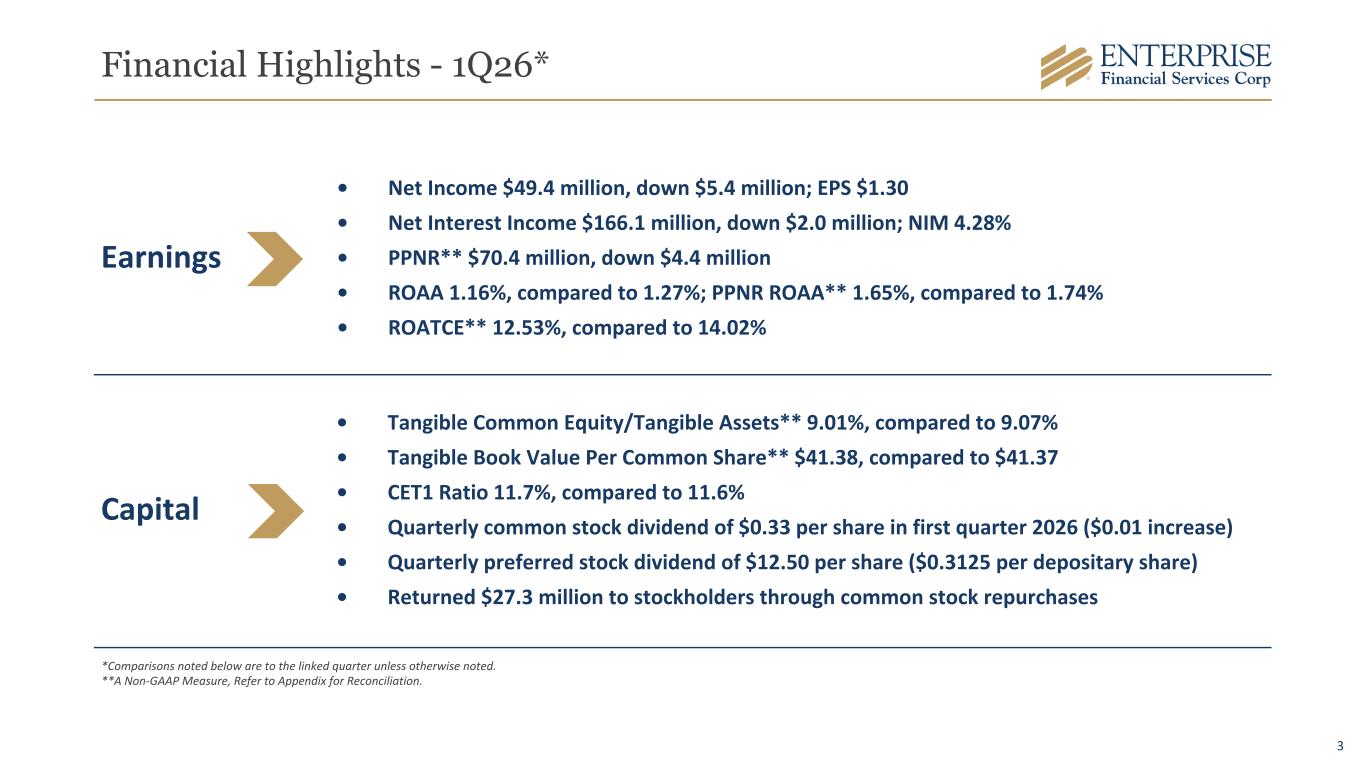
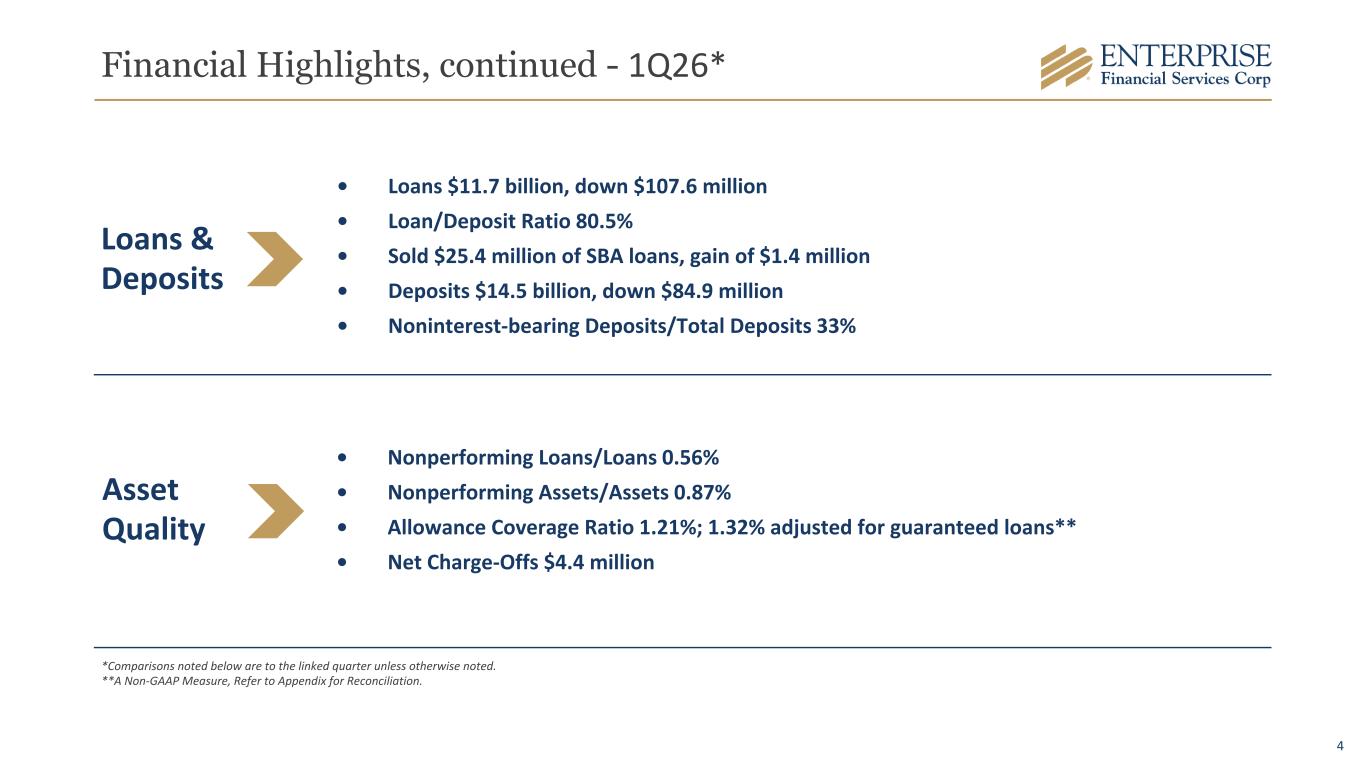
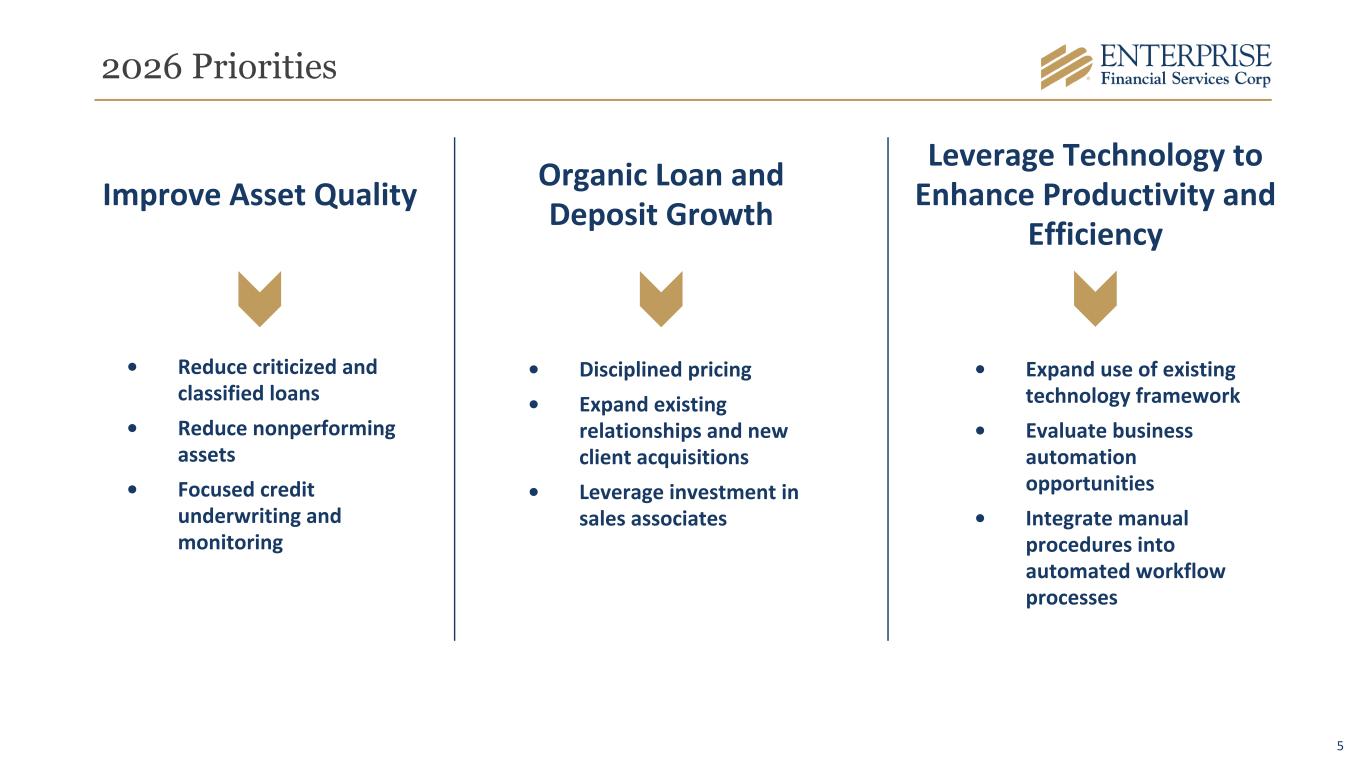
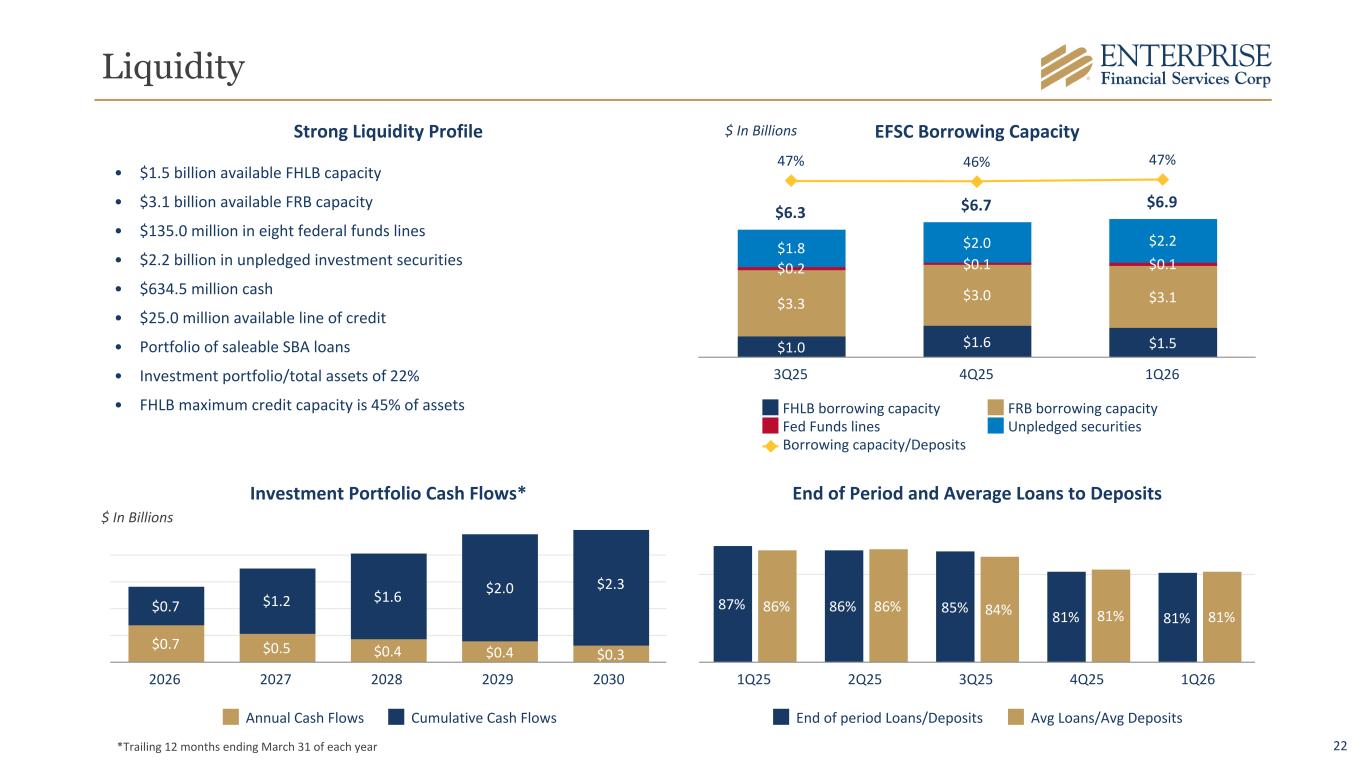
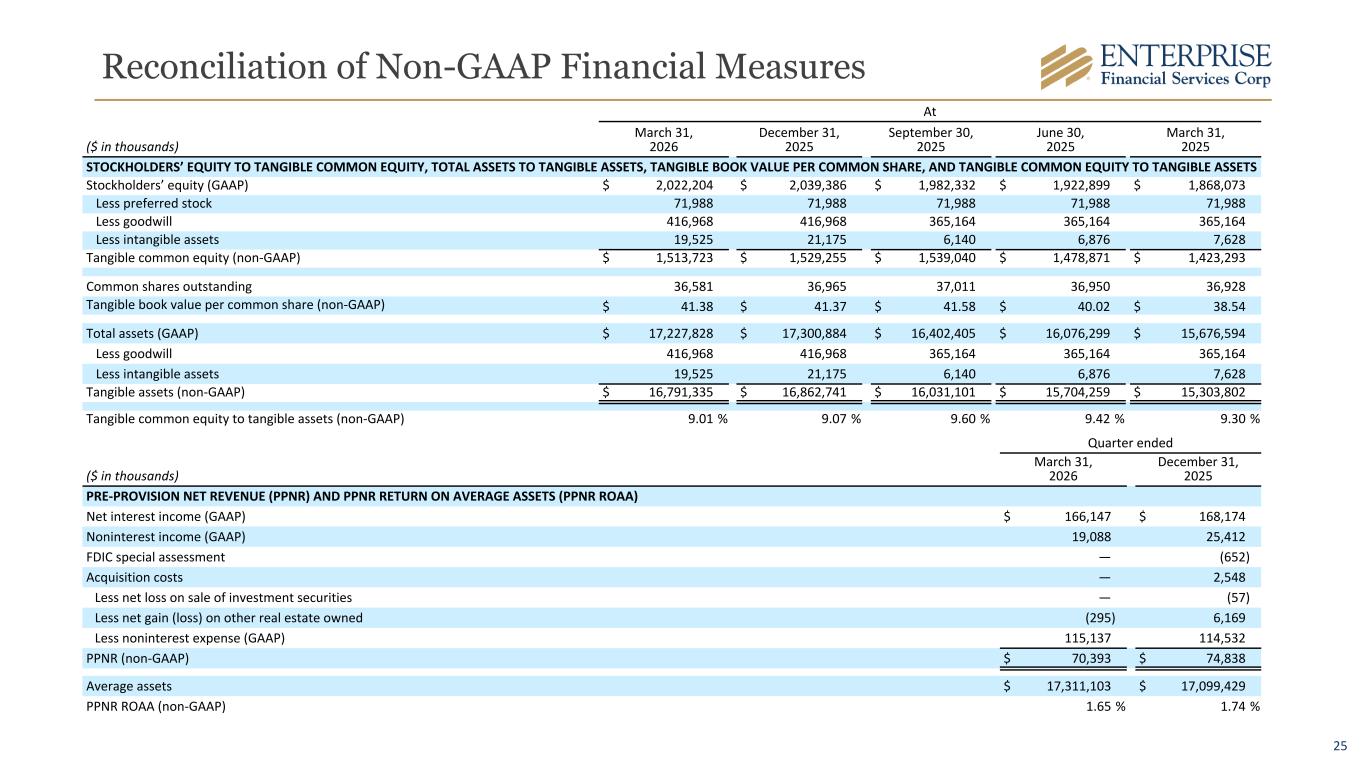
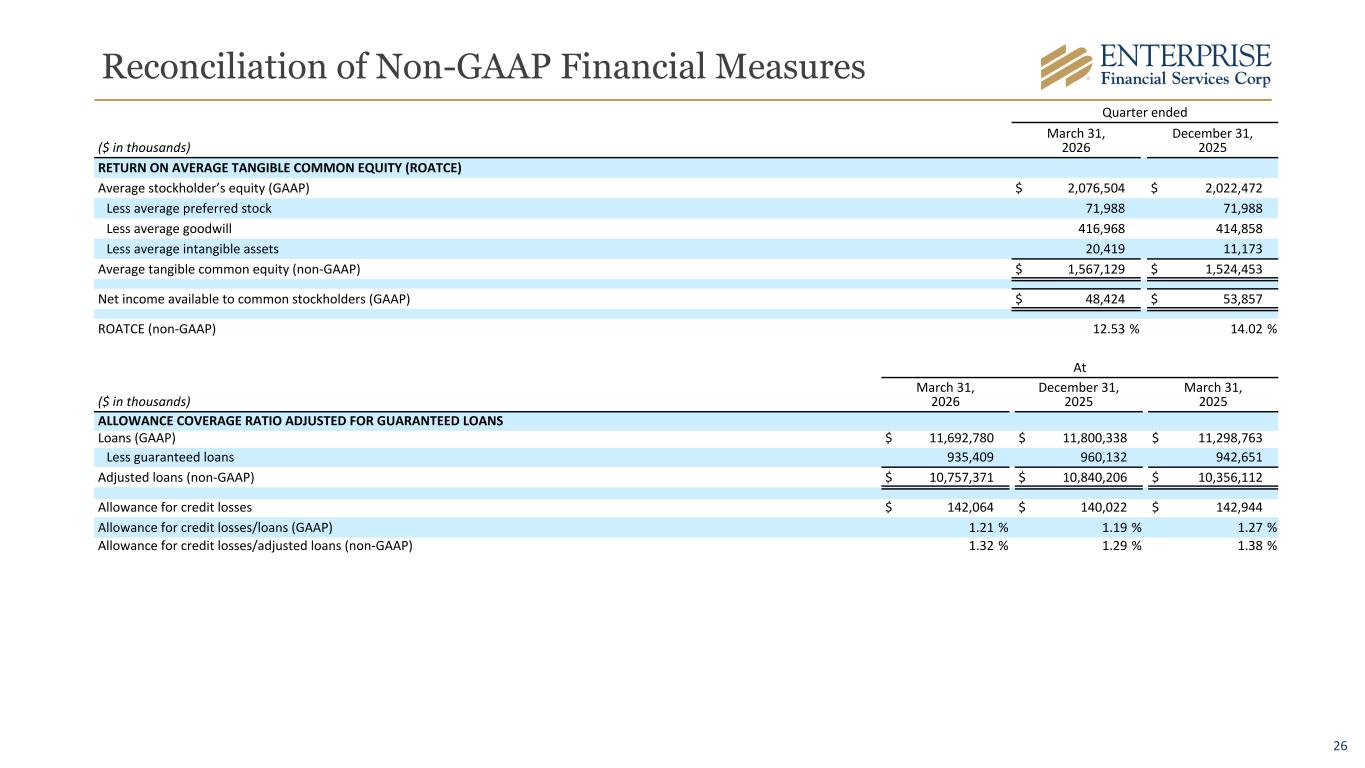
Thank you all very much for joining us this morning and welcome to our 2026 first quarter earnings call. Joining me this morning is Keane Turner, EFSC's Chief Financial Officer and Chief Operating Officer, and Doug Bauke, Chief Banking Officer of Enterprise Bank and Trust. Before we begin, I would like to remind everybody on the call that a copy of the release and accompanying presentation can be found on our website. The presentation and earnings release were furnished on SEC Form 8K yesterday. Please refer to slide two of the presentation titled Forward Looking Statements. and our most recent 10-K for reasons why actual results may vary from any forward-looking statements that we make today. Our financial scorecard begins on slide 3. The solid financial performance that we've generated over the past several years continued into the first quarter of 2026. For the quarter, we earned $1.30 for diluted share compared to a seasonally strong $1.45 in the late quarter and $1.31 in the first quarter of 2025. This level of performance produced a return on assets of 1.16% and a pre-provision ROAA of 1.65%. I would characterize our performance of the quarter as solid and unplanned. Net interest income was relatively stable when compared to the link quarter at $166 million while net interest margin expanded two basis points to 4.28%. This reflects both better seasonal performance in our deposit balances and net interest margin expansion resulting from our relationship-oriented business model where our clients receive value-added service from our teams in return for a few extra basis points when it comes to loan and deposit pricing. Our well-positioned balance sheet continues to be the strength of our company as it provides for great flexibility with respect to capital planning. Capital levels at quarter end remain stable and strong with total stockholders' equity at $2 billion and a tangible common equity tangible assets ratio of 9%. At this level of TCE, we were able to produce a return on tangible common equity of 12.53%. Our strong return profile allowed our tangible book value per share to remain level at $41.38, despite the fact that we utilized approximately $27 million of capital to repurchase 483,000 shares at an average price of $56.13. In addition to this, Given the strength of our earnings and our confidence in our continued execution, we increased the dividend by one cent per share for the second quarter of 2026 to 34 cents per share. Turning to slide four, you will see that loans dip slightly in the quarter. Three things led to this slight decrease. The first is that several significant closings that we expected to see in Q1 have slid into the second quarter and have closed or will close in the coming weeks. The second reason for this decline was a $100 million paydown in our low-income housing tax credit portfolio. These paydowns happen annually and are the proceeds from successful sales that occurred in the fourth quarter of 2025. Another positive from these payoffs is the fact that the majority of these loans were made in 2021 and 2022, and the fixed rates earned on these loans are lower than what we can earn on this cash in our investment portfolio today. The final contributor was the sale of $25 million of SBA loans in the quarter, which produced a gain of $1.4 million. Doug will provide much more color on the performance of our markets and businesses in his comments. Our diversified deposit base continues to be a differentiator for us. We did experience a typical first quarter deposit outflows due to our heavy concentration of commercial-oriented accounts. we've worked extremely hard to blunt this trend through growth or national deposit verticals as well as through market and business diversification within both the commercial bank and our more granular business banking and consumer relationships the composition of deposits also remained stable as our percentage of dda to total deposits remained at 33 these trends were aided by a continued reduction in the overall cost of deposits to 1.52 percent, a 12 basis points drop in the quarter and 31 basis points when compared to the first quarter of 2025. It was on our 2025 first quarter earnings call that we first spoke of the seven Southern California loans that ultimately landed in OREO. Our contention a year ago was that we would favorably work through these loans without a loss. Today, I'm pleased to report that we continue to make progress on this and currently have four of these properties under contract representing total oreo balances of 46 million dollars with great progress on the other three properties being made i would expect to report positive further progress in the remaining quarters of 2026. additionally the remainder of the portfolio continues to perform as expected he will make additional comments about asset quality and provision expense in his comments Turning to slide five, you will see our priorities for 2026. We made significant strides in asset quality improvement during the quarter, and I'm confident that this will continue throughout 2026, highlighted by the expected sale of the seven Southern California properties that are currently in OREO. I'm still bullish on overall mid-single-digit balance sheet growth for the year. Our ability to produce well-priced, diversified deposits has been proven over the last several years, and I have a great degree of confidence that this will continue throughout 2026. However, the longer that uncertainty is the byproduct of the conflict in Iran, borrowers' sentiments may be cautious, which could impact future loan growth. Over the last few weeks, I have had the opportunity to visit with many clients representing a diverse array of businesses and industries. They continue to perform well, but their confidence to make large investments in capital expenditures or to think about any type of strategic hires or M&A is truly day-to-day. Like I've stated on previous calls, entrepreneurs need to be able to see 90 to 120 days into the future to confidently make these strategic decisions, and the recent volatility in the current environment could have an impact. Obviously, a quick resolution or stabilization of the current state changes this immediately. Finally, like many of our clients, we too are focused on efficiency gains through automation and expansion of our existing technology framework. This is a daily opportunity for our company, and we are excited about the progress we are making. Overall, I'm very pleased with our results for the first quarter of 2026. We are positioned extremely well for just about any environment. We have wonderful markets, a growing diversified deposit base, and an extremely strong balance sheet. We have used these tools to grow tangible book value per share over 10% annually for the last 14 years and are in great shape to accomplish this again in 2026. With that, I would like to turn the call over to Doug Bauke.
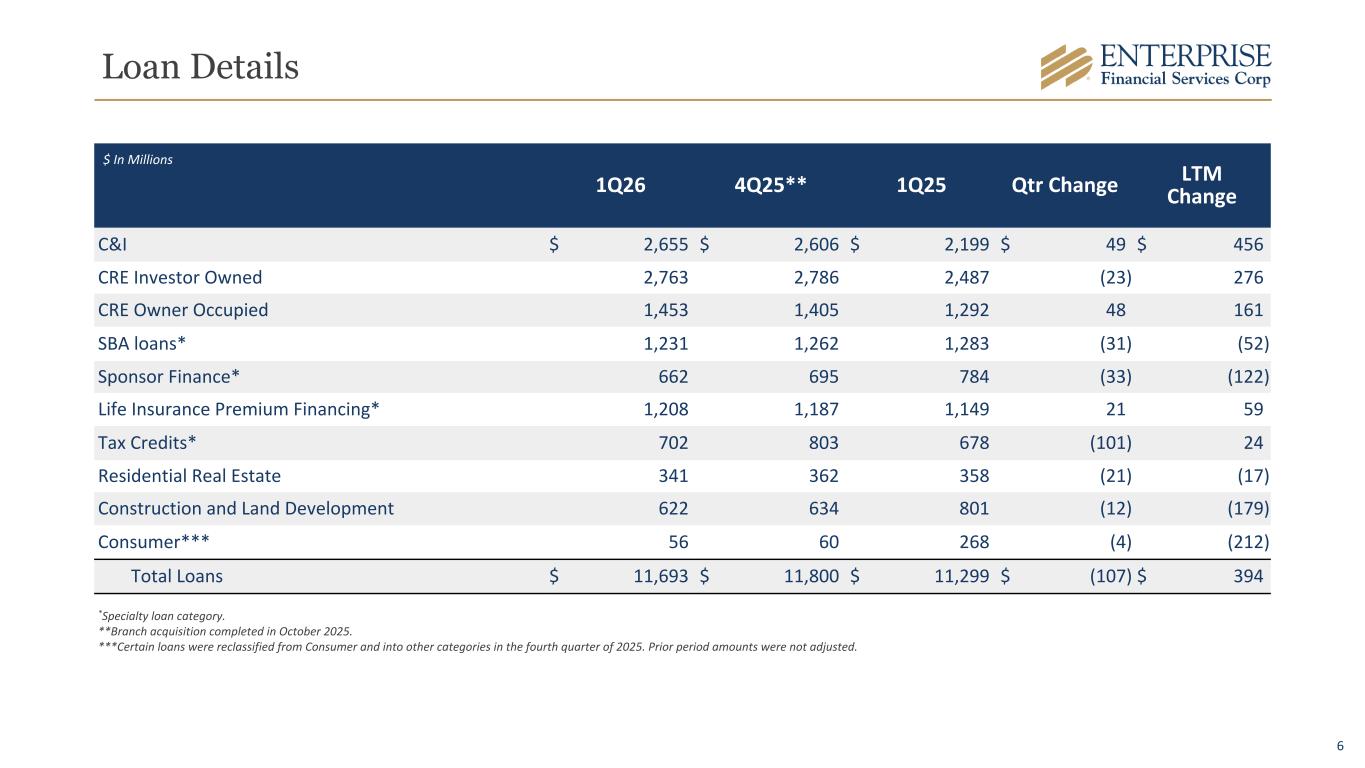
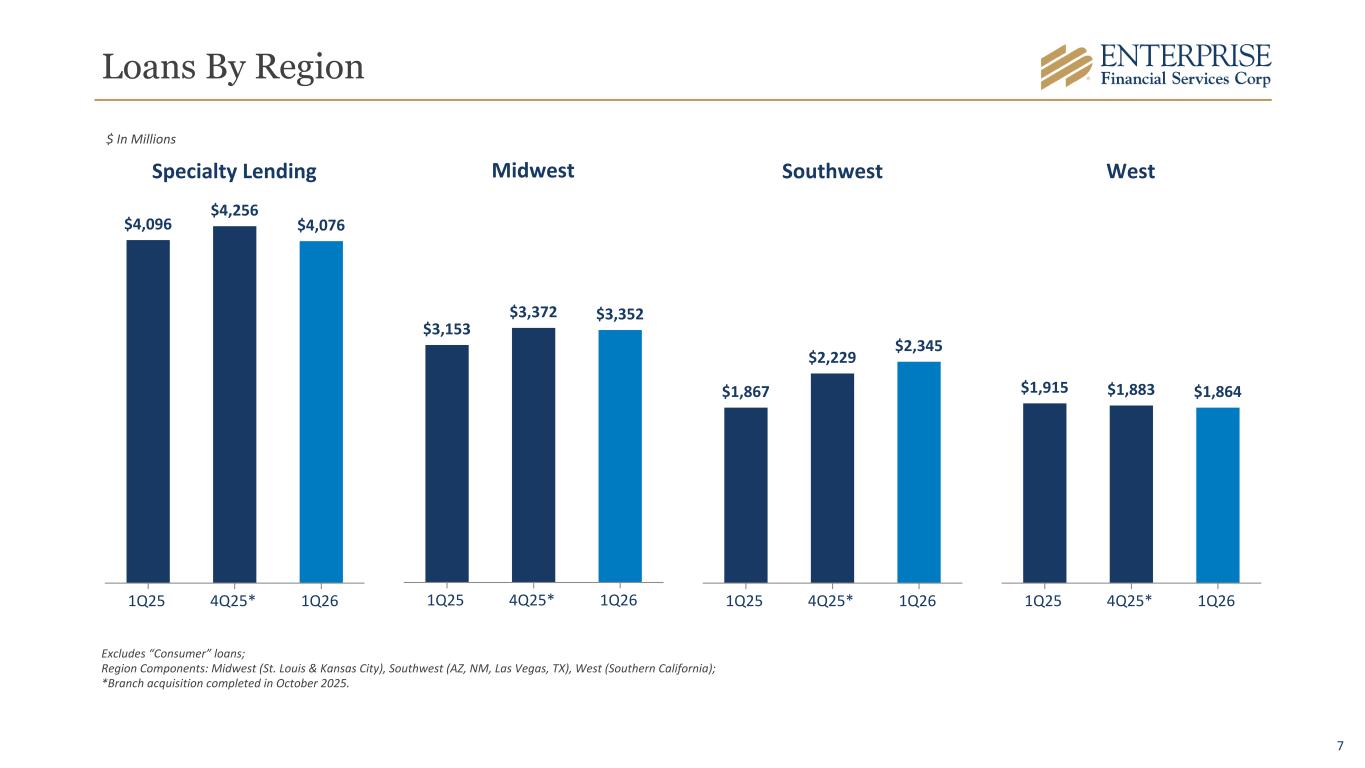
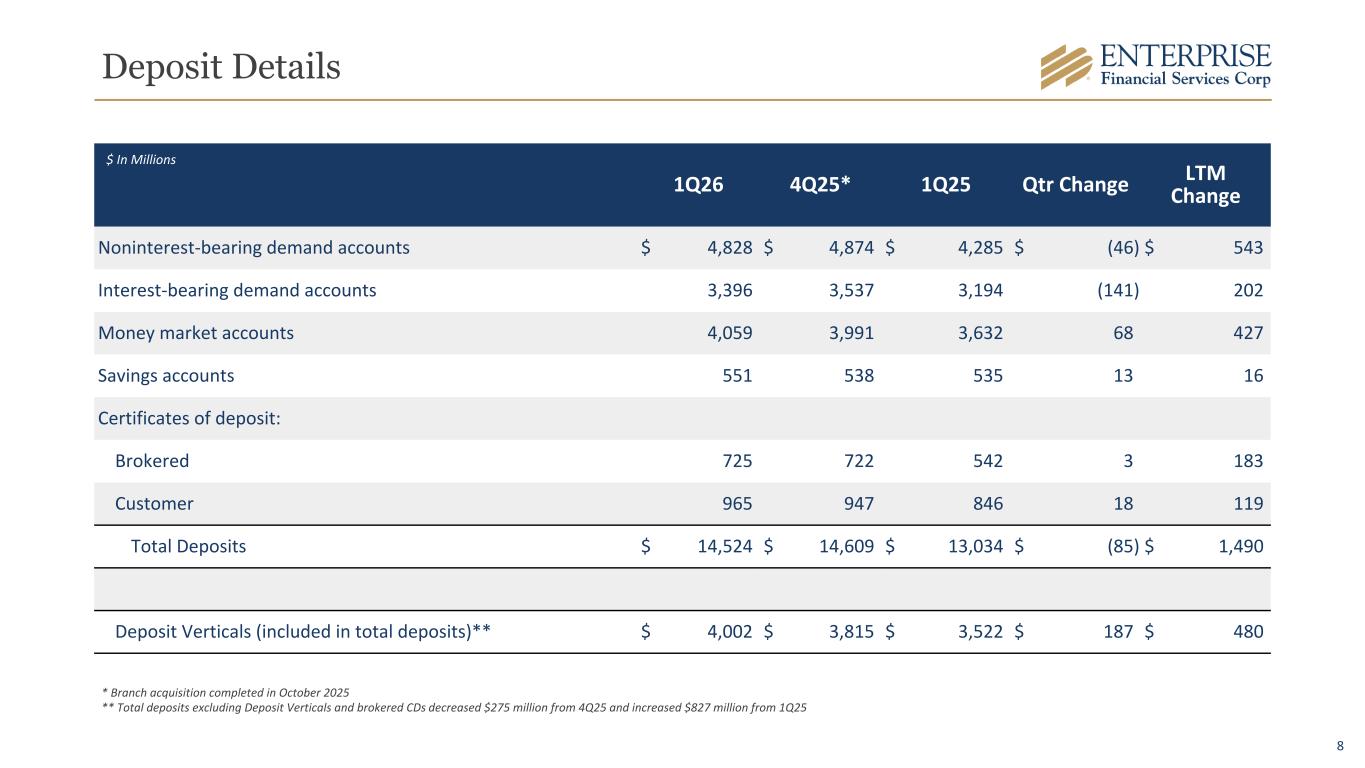
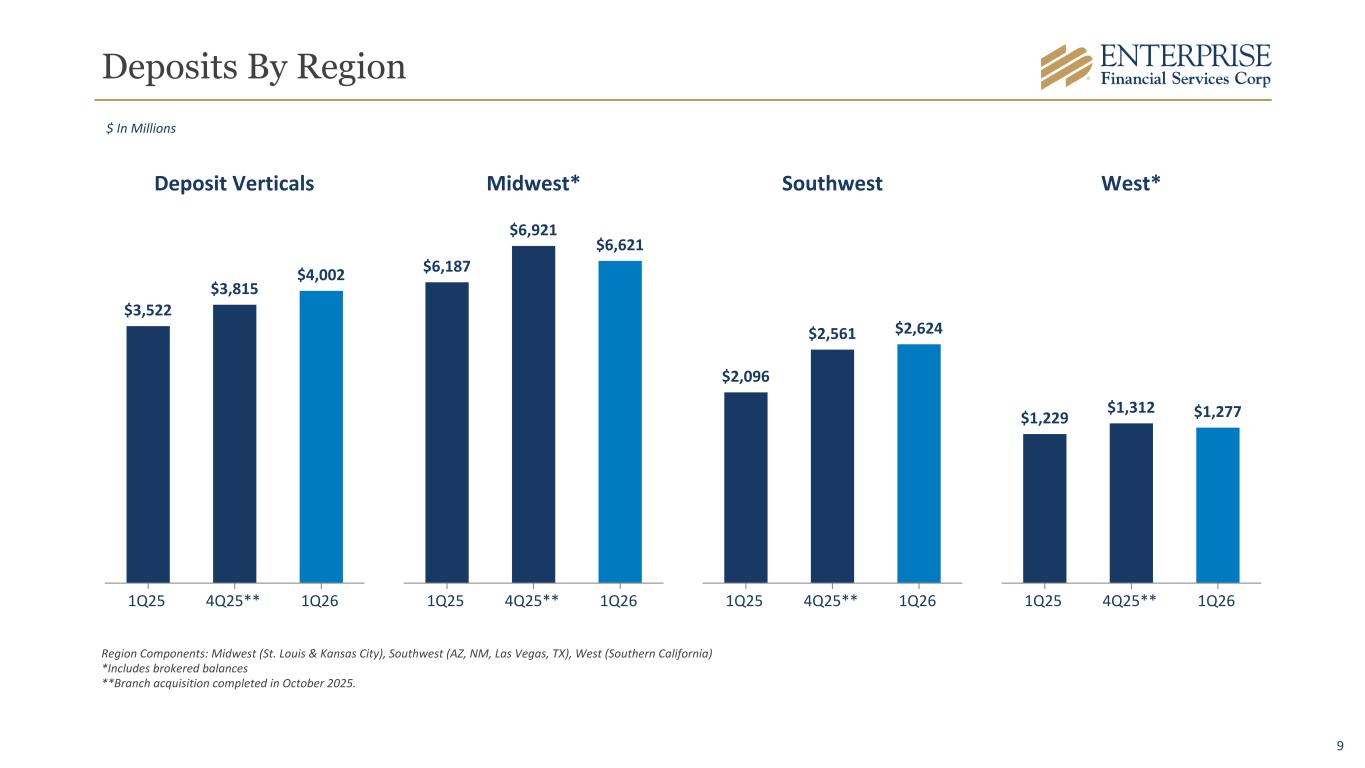
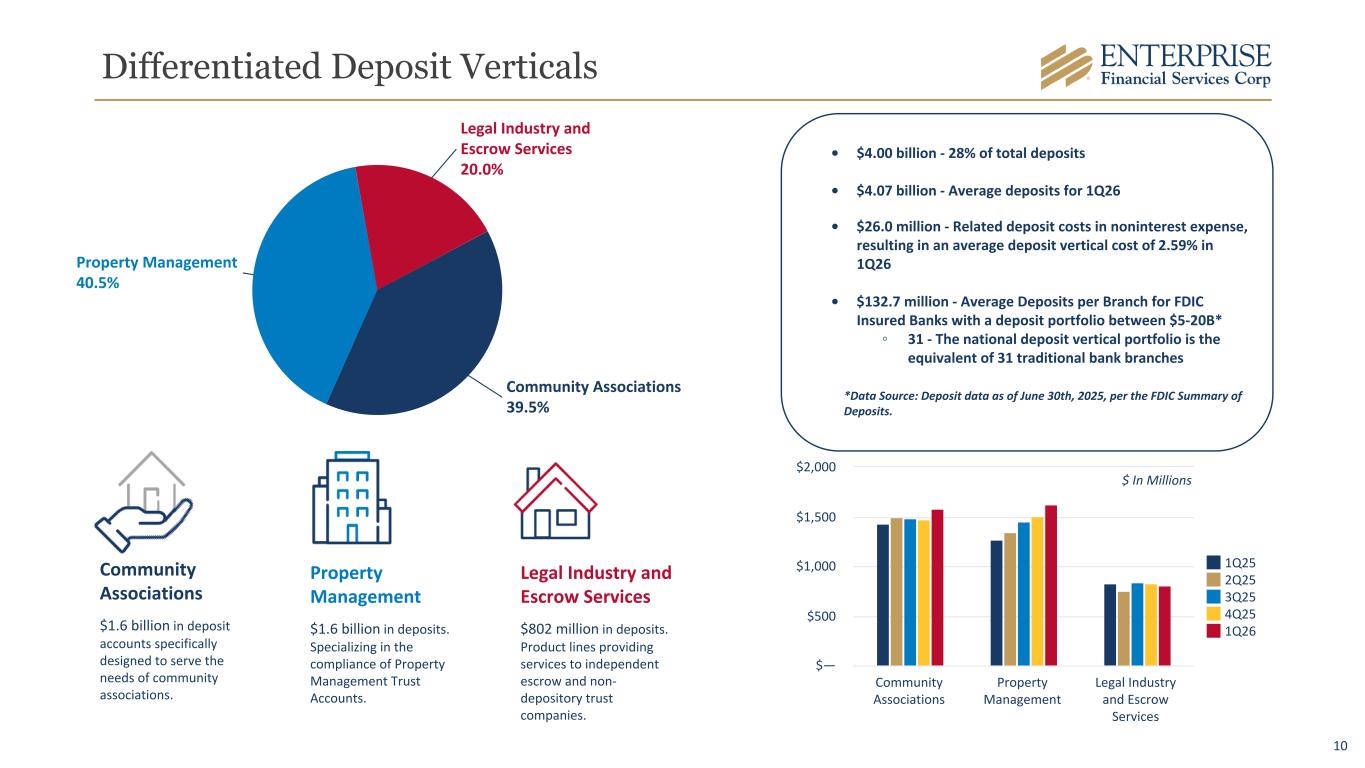
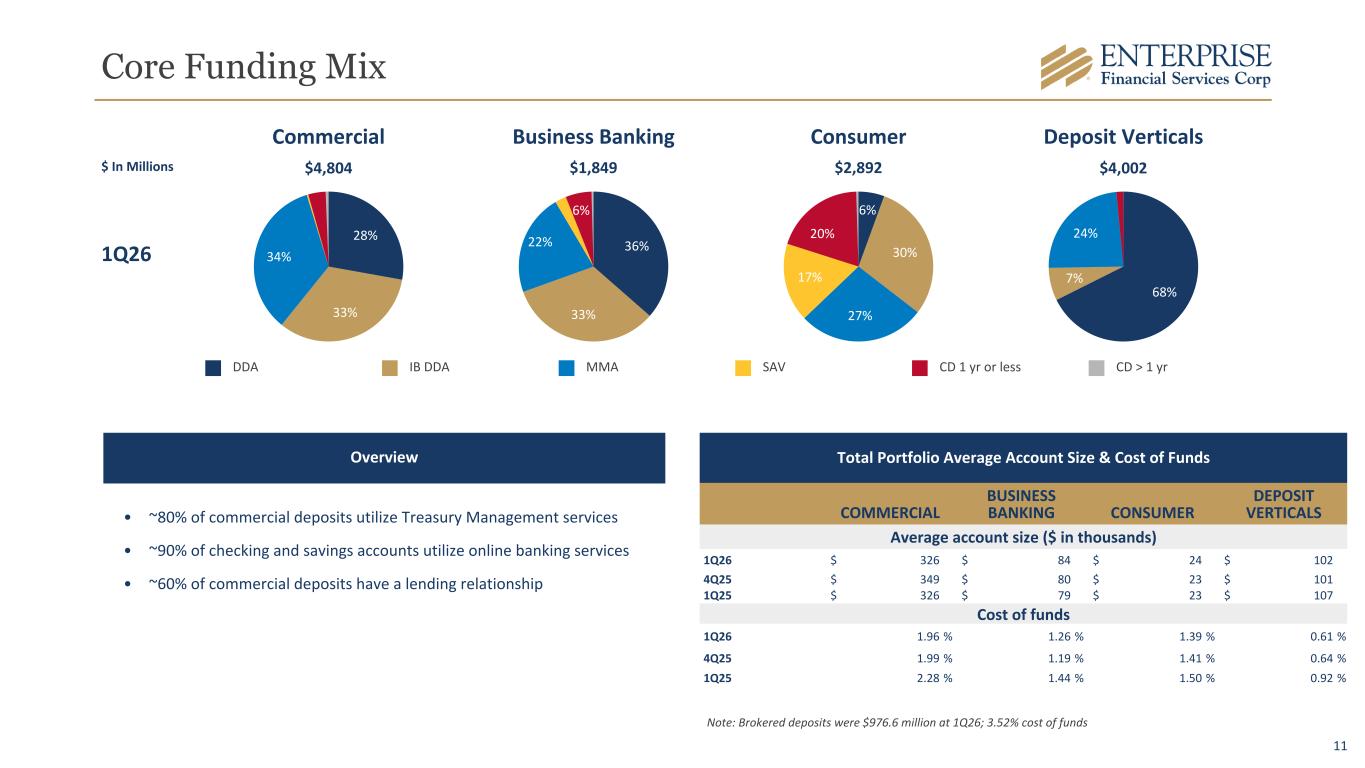
Thank you, Jim, and good morning, everyone. Turning to slide six, you'll see the breakdown of our loan portfolio by asset class. Successful attraction and onboarding of new clients across our footprint drove $97 million in Q1 loan growth in our core C&I and owner-occupied real estate portfolios and $21 million in loan growth from our life insurance premium finance division. Those advancements, however, were largely offset by the anticipated $101 million reduction in our low-income housing tax credit portfolio via the successful completion of affordable housing projects and sale of state tax credits. The weighted average fixed coupon on the $101 million in tax credit loans paid off in the quarter was 3.29%, providing us the opportunity for redeployment of that capital at higher earning yields in the current environment. Furthermore, as Jim mentioned, we executed on the sale of $25 million of SBA guaranteed loans in the quarter. The sponsor finance portfolio declined $33 million in the quarter as payoffs from the sale of sponsor-owned portfolio companies exceeded new originations. Overall, I'm pleased with the mix and breadth of our loan funding pipeline, and I remain cautiously optimistic about our ability to achieve our loan growth objectives for the year. The elevated geopolitical risks, Iran conflict, and market complexities may, however, result in our organic growth being more uneven over the next couple of quarters. Slide 7 demonstrates the continued strong diversity of our loan portfolio across our geographic markets and specialty business lines. The specialty lending portfolio at just over $4 billion, inclusive of tax credit lending, sponsor finance, SBA, and life insurance premium finance, has remained relatively flat year over year. However, our core geographic markets in the Midwest and Southwest have delivered 6% and 25% year-over-year growth rates, respectively, which includes loans acquired in the branch acquisition that closed in the fourth quarter. In the West region, our investments in new talent in 2025 in Southern California are showing positive momentum. Leveraging market disruption, we are experiencing a growing pipeline of quality CRE and CNI holistic relationship opportunities that will translate to solid organic growth during the year. Turning to deposits on slides 8 and 9, reductions in the quarter within the core geographic portfolio reflect anticipated seasonal outflows and client balances of $272 million, mainly associated with distributions, bonuses, and tax payments. A material portion of this reduction was offset by continued growth within the national deposit verticals, which grew by $187 million, or roughly 20% annualized in Q1. On a year-over-year basis, total client deposits, excluding brokered funds, are up 10%. The national deposit verticals profiled on slide 10 continue to provide differentiated and attractive sources of funding, while also diversifying our overall deposit base and somewhat softening the seasonality of our other channels. With over $4 billion in deposits across our property management, community association, and legal and escrow businesses, the average earnings credit is an attractive 2.59%, considering no incremental expenses in branches or branch personnel. Lastly, slide 11 profiles the mix of our core deposit base, which continues to be well-diversified and highly relationship-oriented. With just over 33% of these accounts being non-interest-bearing and 80% of them using some form of treasury management or online banking, they offer operational stability and a solid base from which to expand other fee-generating revenue streams, including card and merchant services. Now, I'll turn the call over to Keane Turner for his comments.
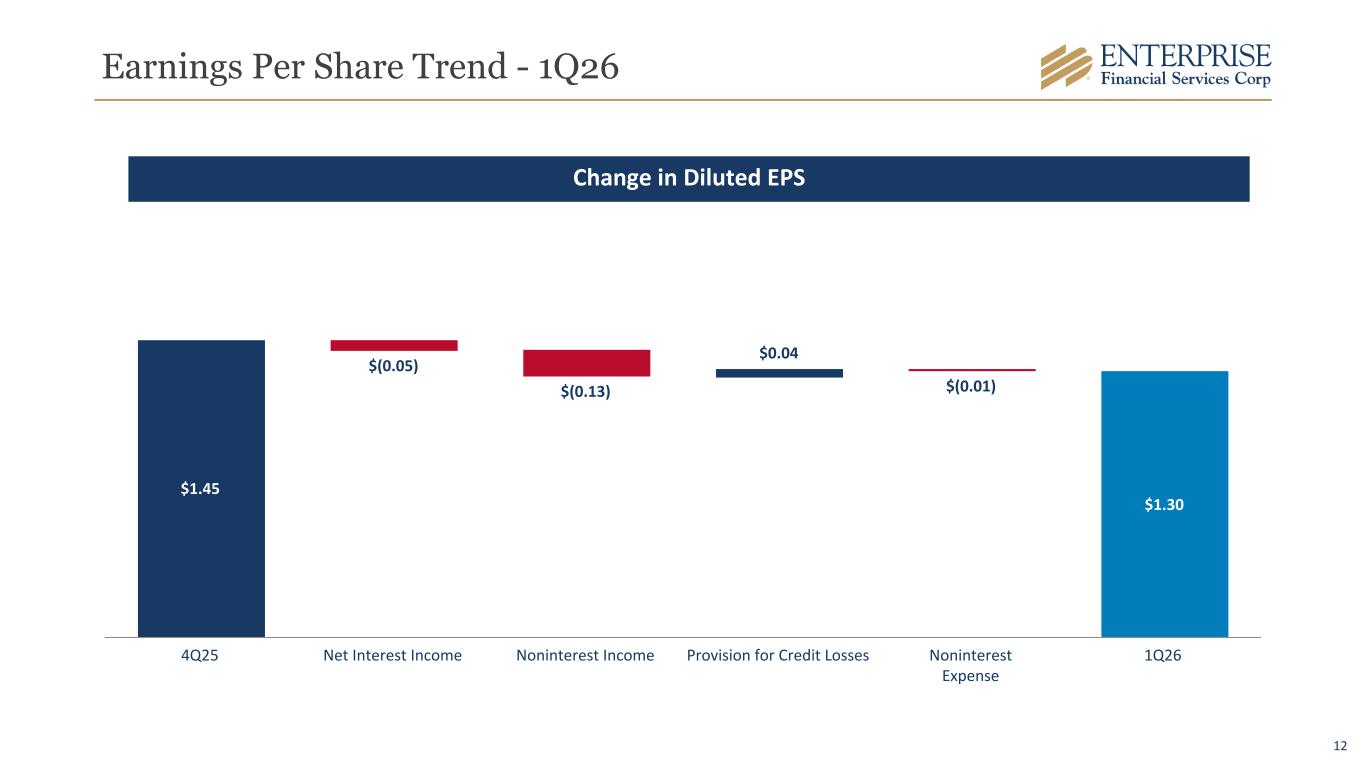
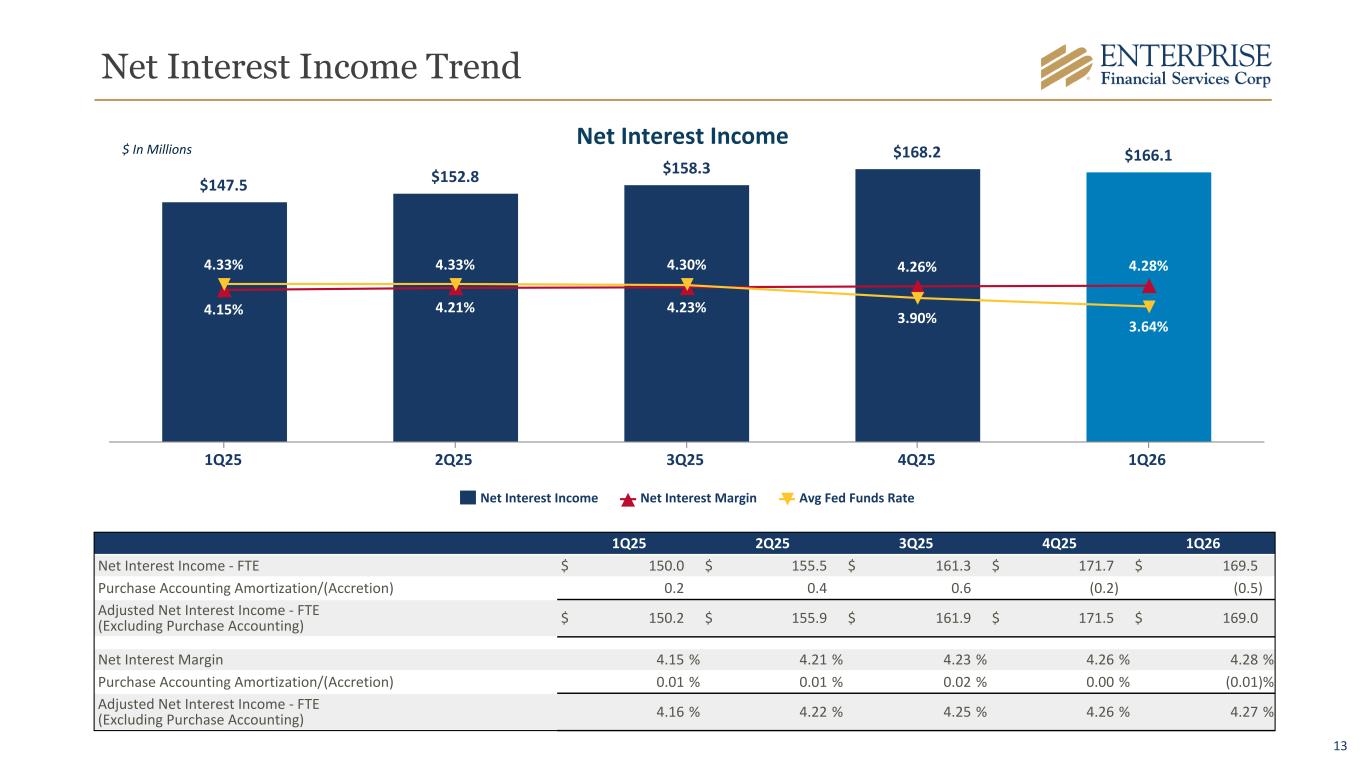
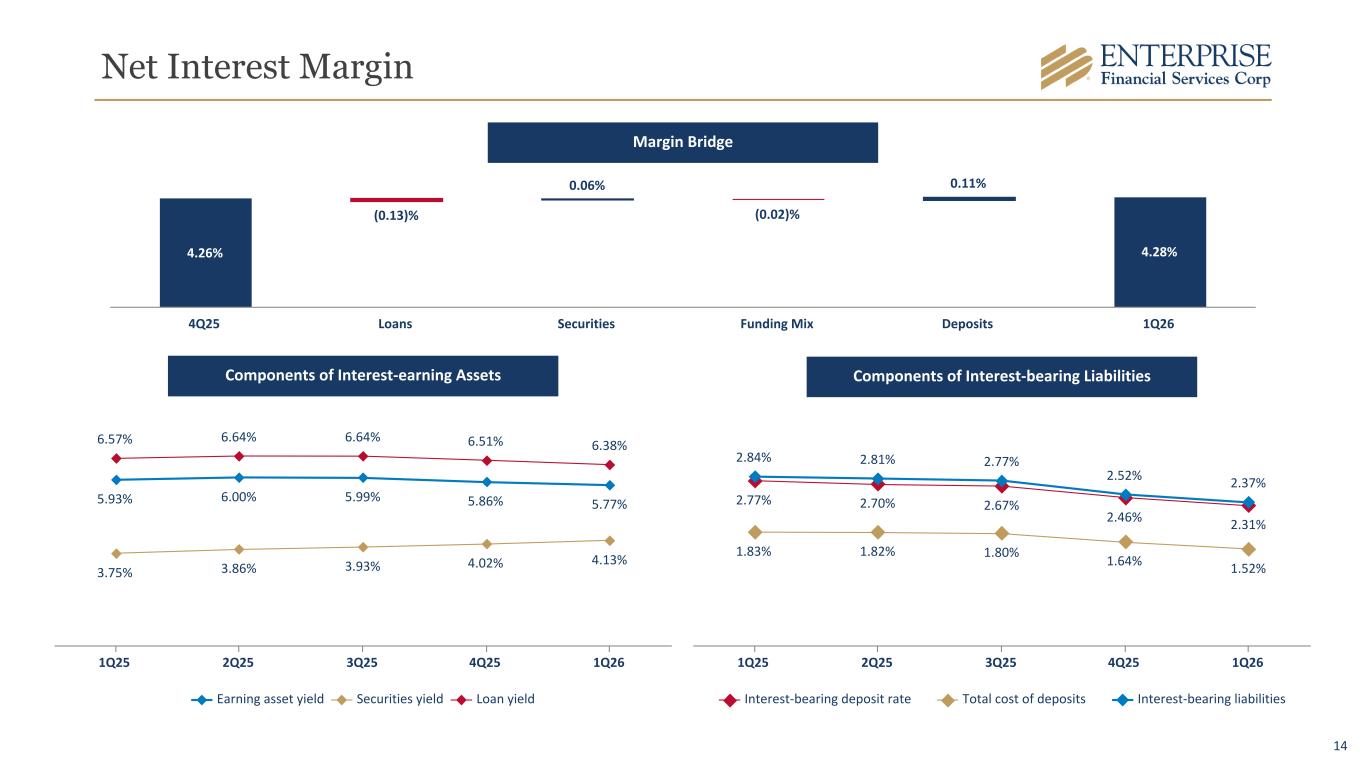
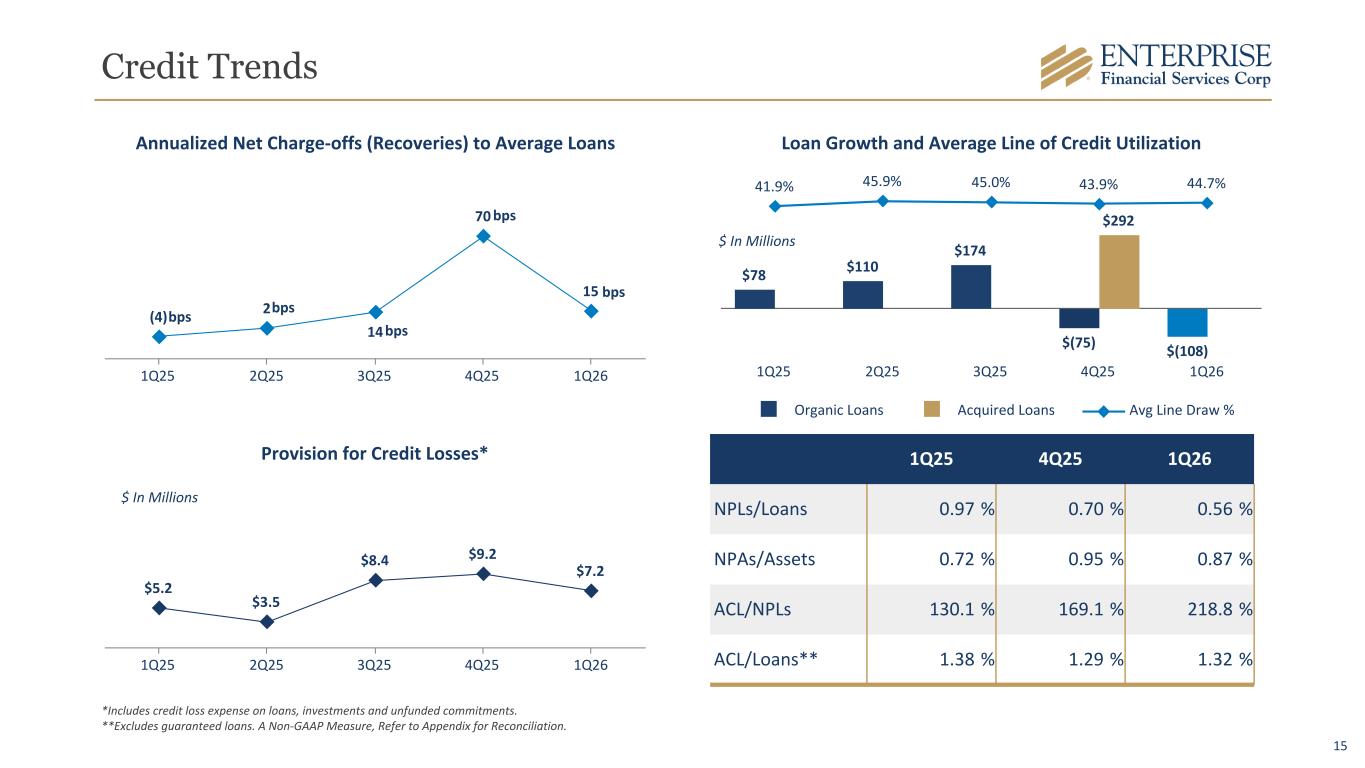
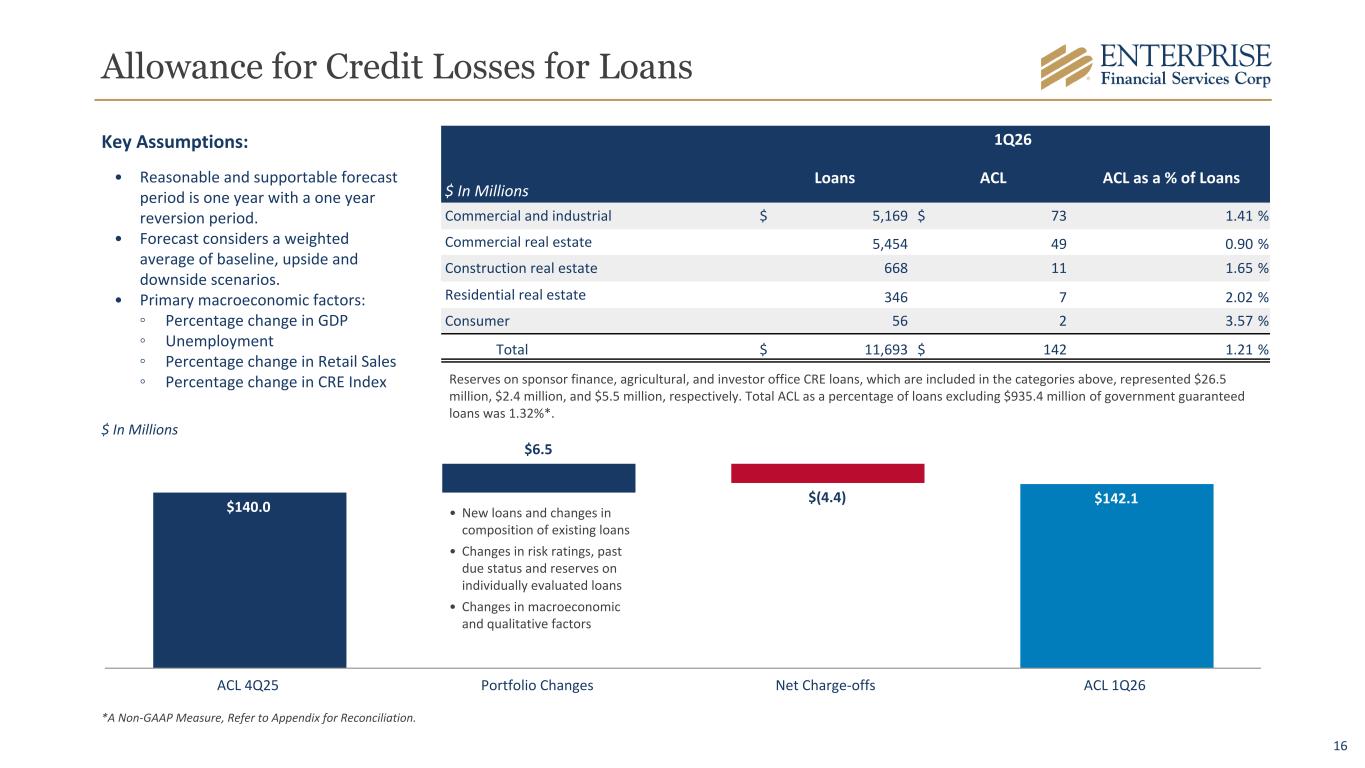
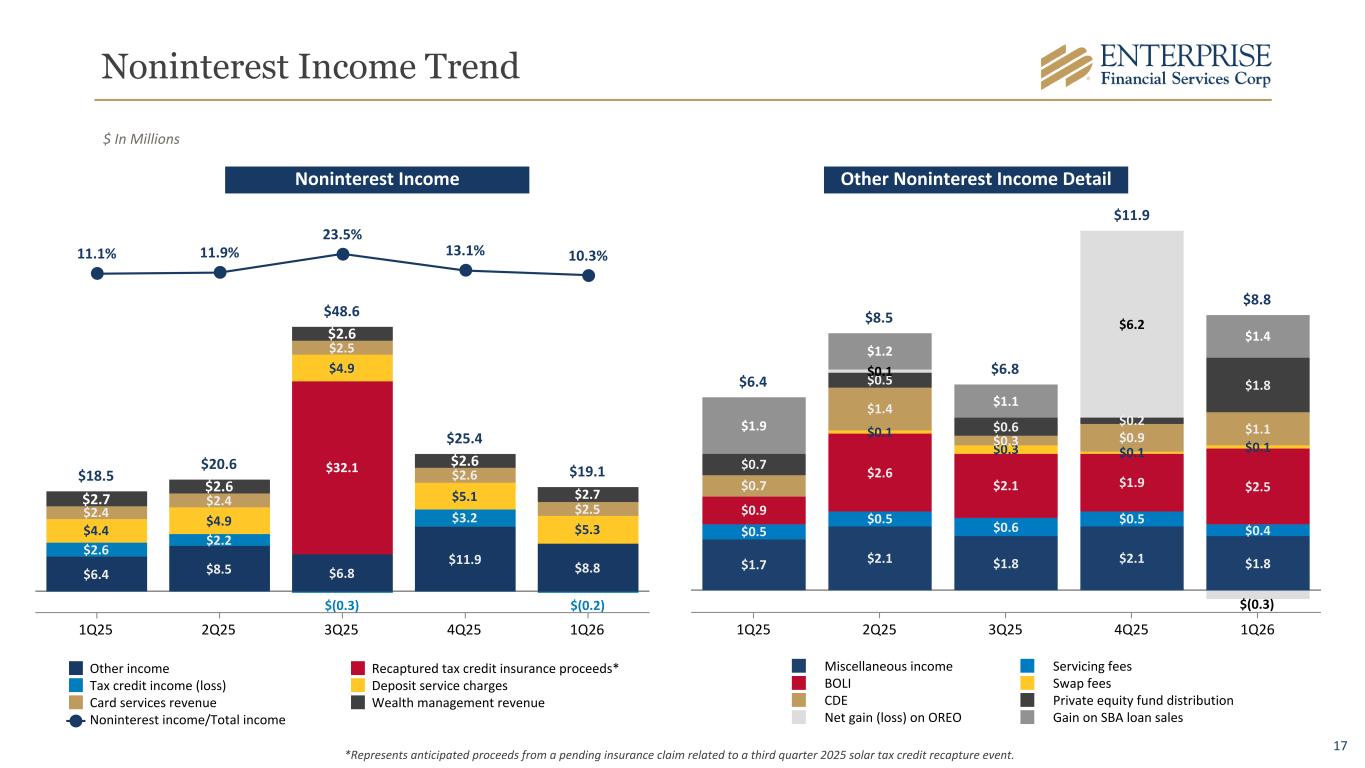
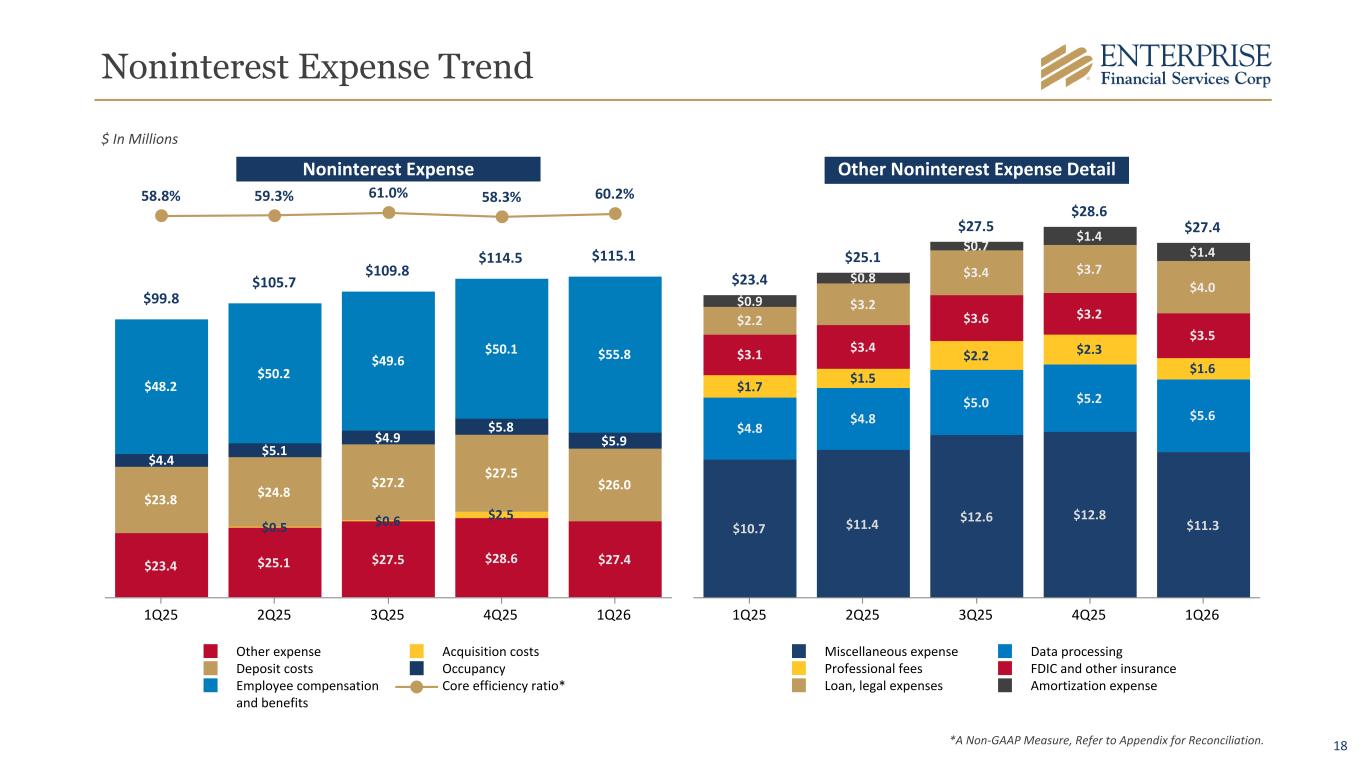
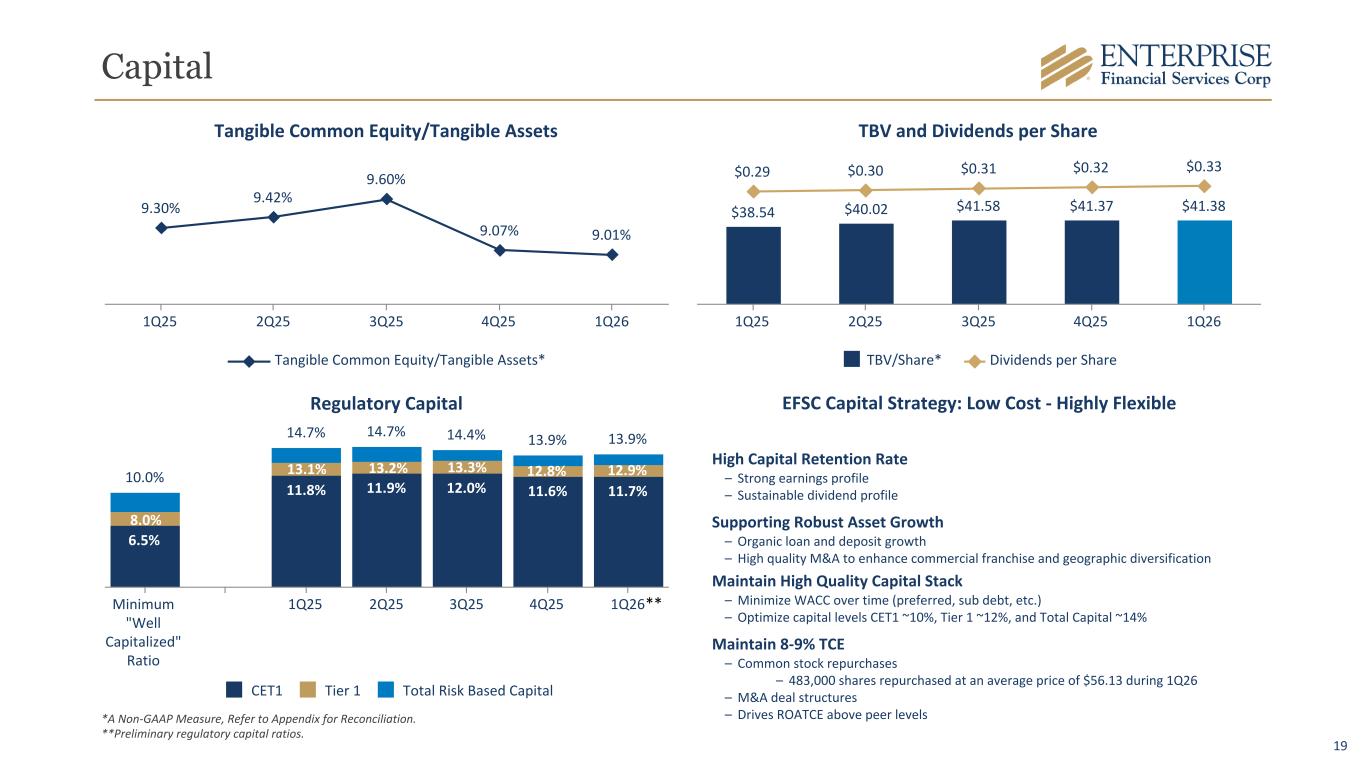
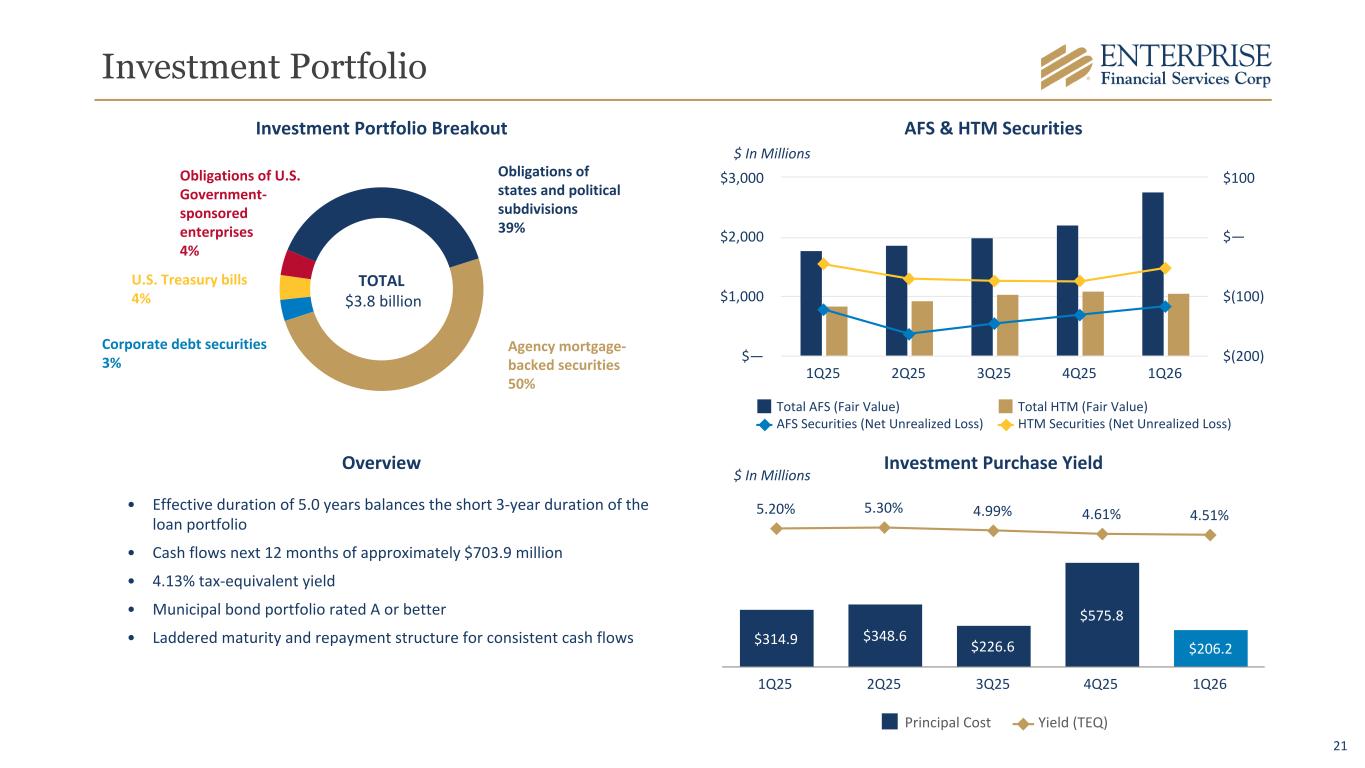
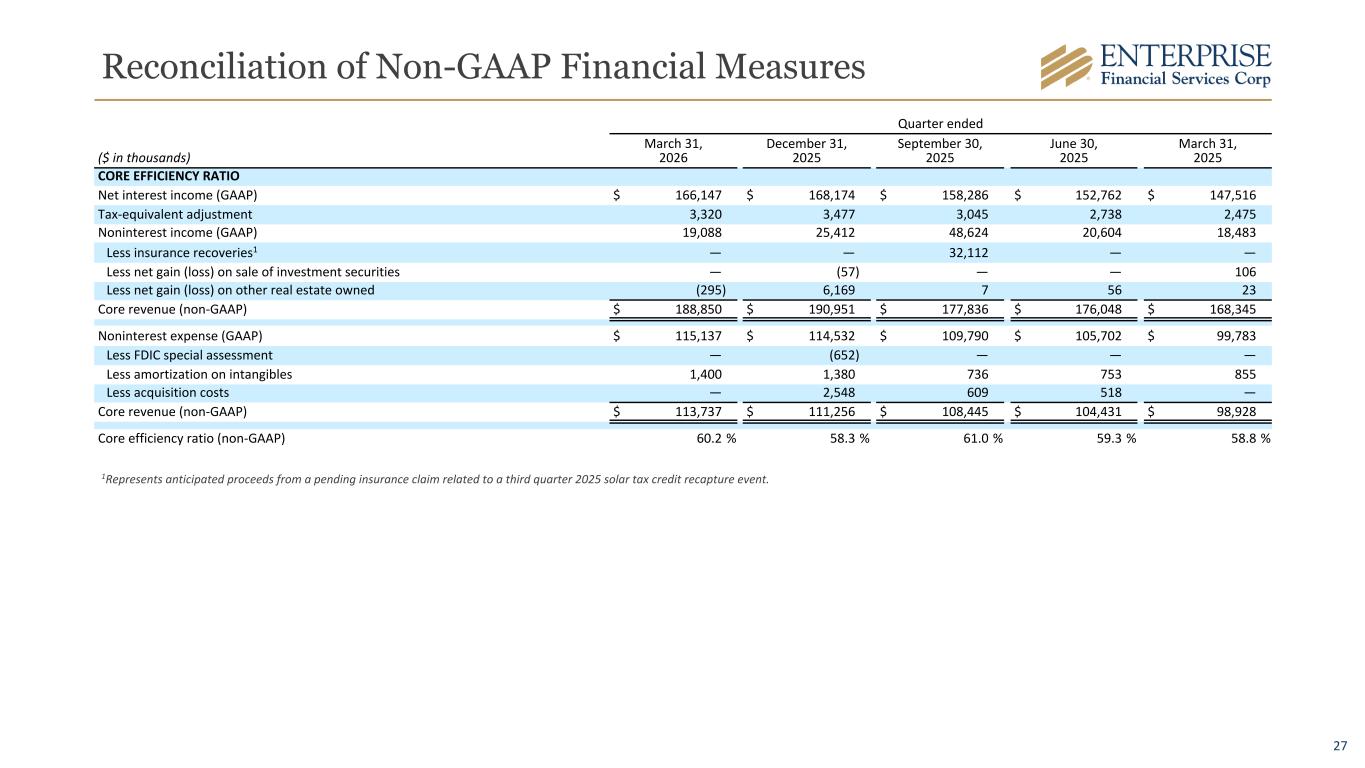
Thanks, Doug, and good morning, everyone. Turning to slide 12, we reported earnings per share of $1.30 in the first quarter on net income of $49 million. Excluding certain non-recurring items, earnings per share on an adjusted basis was $1.31 compared to adjusted earnings per share of $1.36 in the linked quarter. Pre-provisioned earnings were $70 million, a decline of $4 million from the linked quarter. The $0.05 decrease in adjusted earnings per share and the $4 million decrease in pre-provisioned earnings was primarily due to lower tax credit income and the impact of two fewer days on net interest income. The decline in tax credit income was expected as it is typically highest in the fourth quarter of the year. The provision for credit losses decreased from the linked quarter due to the decline in both net charge-off and total loans. The primary driver of the provision this quarter was a qualitative factor that was added to recognize the potential impact on credit losses from the conflict in Iran. The increase in non-interest expense in the period was mainly due to typical seasonal increase in compensation and benefits, and to a lesser extent, the first full quarter of run rate expenses from the branch acquisition that closed last October. These increases were partially offset by a decline in one-time acquisition costs related to the acquisition. Turning to slide 13, and with more details to follow on slide 14, net interest income for the first quarter was $166 million, a decrease of $2 million from the fourth quarter, which was largely attributable to fewer days in the first quarter. Interest income declined $7 million from the prior period. The largest contributor was an $8 million decrease in loan interest as our yields fell 13 basis points on variable rate resets amid Fed easing, along with a $17 million decline in average loan balances. This was partially offset by $1.9 million of additional earnings in the investment portfolio, with average balances higher by $159 million and an 11 basis point improvement in the securities yield. The rate on loans booked in the quarter was 6.58%, and the average tax equivalent purchase yield on investments was 4.51%, both of which are additive to their respective portfolios. Interest expense declined $5 million compared to the linked quarter as a result of lower funding costs. Interest expense on deposits decreased by $5.5 million as average interest-bearing balances declined $89 million, and the rate on interest-bearing deposits moved 15 basis points lower. This was partially offset by higher interest expense on customer repo accounts due to seasonally higher balances. Our net interest margin for the first quarter was 4.28%, an increase of two basis points in the quarter. Our cost of interest-bearing liabilities declined 15 basis points, led by lower rates on non-maturity deposits and borrowings, which more than offset the nine basis point reduction in yield on earning assets. Net interest income remains slightly asset sensitive, primarily in parallel interest rate simulations, with each quarter point cut in rates reducing net interest income $1 to $2 million per quarter, or a couple of basis points of net interest margin. Including deposit-related non-interest expense in this analysis, we modeled that we are effectively neutral to modestly liability sensitive as we continue to have success growing the related deposit balances. We anticipate the recent steepening of the yield curve will favorably impact pricing on fixed rate loans and the reinvestment of cash flows in the investment portfolio. With the Fed seemingly on hold, we expect our net interest margin to remain in the low to mid 4.2%. As we execute on our growth plans for 2026 and remain committed to discipline pricing on both loans and deposits, we look for net interest margin to be stable in this range with consistent growth in net interest income over the next few quarters. Slide 15 reflects our credit trends. Net charge-offs totaled $4.4 million in the first quarter compared to $20.7 million in the link quarter. We made progress in the quarter reducing non-performing assets with the full repayment of two loans and total principal repayments of $21 million on non-accrual loans. We also foreclosed on the last property related to our largest non-performing relationship and are actively working out these properties. As Jim noted, four of the seven properties in this relationship are under contract, and we expect contracts for the other three properties in the near future. Net charge-off totaled 15 basis points of average loans compared to 21 basis points for 2025. The provision for credit losses was $7.2 million in the period compared to $9.2 million in the linked quarter. The provision in the quarter was mainly due to net charge-offs and a qualitative adjustment to the allowance for potential impact of the Iran conflict. While we have not seen a direct impact on credit quality from the conflict that started at the end of February, we have recognize the impact that oil prices and market uncertainty can have on economic factors used to forecast losses in the loan portfolio. Slide 16 shows the allowance for credit losses. The ratio of allowance to total loans increased to 1.21 percent compared to 1.19 percent at the end of 2025. When adjusting for government guaranteed loans, the ratio increases to 1.32 percent of total loans, which shows the strength of our reserve coverage. On slide 17, first quarter non-interest income was $19.1 million. This was a $6.3 million reduction compared to the linked quarter. The decrease was primarily due to other real estate owned gains and seasonally strong tax credit income during the fourth quarter of 2025. The first quarter included two mitigants from higher income from private equity fund distributions and a gain on the sale of guaranteed SBA loans. Turning to slide 18, first quarter non-interest expense of $115 million was relatively comparable to the linked quarter as it included a full quarter of operating expenses related to the branch acquisition that closed in the fourth quarter. Non-interest expense in the fourth quarter included $2.5 million of one-time branch acquisition costs and a reversal of accrued FDIC special assessments. Excluding the impact of these non-recurring items, non-interest expenses were $2.5 million higher than the linked quarter, which includes the first full quarter run rate of expenses from the acquisition. First quarter non-interest expense included seasonal impacts in compensation and benefits. Deposit costs were lower than the link quarter by $1.5 million, which was largely driven by the expiration of certain allowances that were not utilized. Other expenses decreased from the link quarter primarily due to a recovery of a credit card loss event that was incurred in the fourth quarter. The core efficiency ratio was 60.2% for the quarter compared to 58.3% in the link quarter. Our capital metrics are shown on slide 19, tangible book value per share of $41.38 was relatively stable with the linked quarter. Strong first quarter earnings effectively offset the fair value reduction from the impact of higher interest rates on our available for sale securities portfolio. We continue to proactively manage excess capital, repurchasing 483,000 shares of common stock for approximately $27 million. At an average price of $56.13 per share, this was an attractive multiple of tangible book value. Our tangible common equity ratio was 9%, stable with the linked quarter. The quarterly dividend was increased by 1 cent to $0.34 per share for the second quarter of 2026, continuing our record of increasing the dividend nine consecutive quarters. This was a strong start to the year, the 1.2% return on average assets and a 13% return on average tangible common equity. We're well positioned with a strong earnings profile, balance sheet, and capital position to support further organic growth across our markets. I appreciate your attention today and we'll now open the line for questions.
Ellie
Head of Investor Relations
We are now opening the floor for question and answer session. If you'd like to ask a question, please press star followed by one on your telephone keypad. That star followed by one on your telephone keypad. Our first question comes from the line of Jeff Rawls of DA Davidson. Your line is now open.
Thanks. Good morning. Good morning, Jeff. I'll tread lightly on the credit side. I know it's been an exercise in patience, but just to kind of go along the four properties that are under contract i guess if you could if you could touch on potential timing for sale and then i you know as we recall i think those were pretty attractive the real estate was really never questioned on the valuation it's just a fight to get to them um and i guess so that the question that second piece is any anticipated gains with with those sales yeah i'll i'll take that one jeff jeff so So three of the four should transact yet here in the second quarter, and the fourth one later this year.
And as it relates to the contracts we have in hand, they support how we've identified them in our financial statements. Okay, and gains or losses a little early to kind of – It is early, but we feel confident about how we recognize things in the fourth quarter of last year and how things should settle out.
And on the other three properties, you sounded optimistic on those as well. Any sort of differences in those, or it's just sort of, again, it's timing of the contracts and potential sales? There's nothing, I guess, different from the four versus the three still to maybe be dealt with?
It's timing. It's timing. You remember, one, we had to wait a little while to get our hands on, which we have now. I've identified several different potential buyers. So now it's a bit of a, you know, let them fight that out to get the best outcome we can.
Thank you. And then hopping over to the margin, Keen, you know, I think our prior conversations were more of a margin to step down toward, you know, to 420. I think as the rate environment has altered and sounds like you've got some pretty good earning asset repricing opportunities within the book, but you pointed to the yield curve as well. Just want to check on the low to mid 420. What kind of the timeline of that? Is that just through the end of the year? And I don't know if you've talked about your positioning there thereafter. Any additional color on the margin?
Yeah, Jeff, margin in March was a little bit of a step down from what we reported. I would say today's run rate, and I think we see it holding stable through the end of the year. I think we had a little bit of balance sheet contraction here in the first quarter. And then with the shorter days, you get a little bit of a false positive in terms of margin popping. But we feel good about, you know, day count in our favor now, you know, really how the shape of the curve and where intermediate term rates are for reinvestment, both on the loan and securities portfolio. And I think any amount of growth from a loan perspective that we can get and overall balance sheet growth, which we anticipate will happen here starting in the second quarter. I think we feel really, really good and optimistic, and I think we see margin being reasonably stable for that time frame. So, you know, we're positioned to defend it if necessary. We've been able to reprice deposits extremely well when the short end of the curve has come down. I think we continue to feel good about that if that's the case. But right now it's status quo, and what I would say is historically status quo is good for us because it allows us to just go play offense, you know, bring clients on, expand the balance sheet, and not have to worry about doing as much repricing activity when that arises.
Got it. Yeah, and I heard your message of a stable margin, but consistent NII growth is probably more important. Appreciate it. I'll step back. Thanks, Jeff.
Ellie
Head of Investor Relations
Your next question comes from the line of Damon Del Monte of KBW. Your line is now open.
Hey, good morning, guys. Hope everybody's doing well. Keane, just looking for a little commentary around the outlook for expenses over the coming quarters here in 26. Do you expect much growth off of first quarter's level? And just any insight in there would be great.
Yeah, I think the first quarter is always seasonally heavy on compensation. compensation, we do expect that to alleviate slightly, albeit we will have a full run rate in the second quarter of merit that occurred in March. You know, day count also moves against us there a little bit. So I think there's a little relief there sequentially on the comp piece. And then, you know, we did have a benefit on the deposit expense line item. So that we expect perspective with day count and that reversal. Growth and other items we can get will accrue to our benefit, but I think the sequential change in expenses will be paid for in net interest income, and then maybe some other items. So that's sort of how I'm thinking about the expenses here, moving into the 2Q and beyond.
Got it. Okay. So a step up from this quarter is $115.1 million, but then that's kind of offset by NII growth?
Yeah, that's essentially how I'm thinking about it. I think this is like a very base kind of earnings quarter, you know, positive progress here, more days, more growth, you know, maybe some more contribution from some of the episodic fee items, things like that.
Got it. Okay, great. And then could you help us think a little bit about the provision going forward? Nice to see the NPLs come down this quarter. I'm assuming you're still making progress on the remaining ones and you're going to have some loan growth. So is the provision kind of going to be driven by similar level of net charge-offs of this quarter and kind of maintaining the loan loss reserve in that, you know, north of 120 basis points?
Yeah, I think charge-off-wise, charge-offs are sort of on, from a basis point perspective, what we'd think about on a recurring basis. And then, you know, we took the opportunity with some of the uncertainty that's around the economic forecast, but really wasn't in the base yet to provide some additional reserves for that. I think, again, back to my comments, I think that positions us well, both with some of the progress we're making on credit, as well as just data, whether it was absorbed into what we're thinking here, and then to the extent that we have growth and charge-offs, that'll be in a spot.
Got it. Okay, great. And then I guess just one more quick one on capital, in your view on capital management. You know, things are going well, strong capital levels, bought back some stock this quarter. Can we assume that you guys will remain, you know, active in the market, given the current levels of stock price?
Yeah, David, this is Jim. Absolutely, we'll continue evaluating the merits of further repurchases and our other levers with respect to dividends. We'll continue to evaluate, but really it's about growth. And, you know, as it relates to M&A, it still remains a low priority for us, and that repurchases and growth is the priorities for capital.
Got it. Great. Thanks for all the color and commentary. Thank you.
Ellie
Head of Investor Relations
Your next question comes from the line of Nathan Race and Piper Sandler. Your line is now open.
Good good morning thanks for taking the questions uh maybe for tumor doug curious if you can just comment on what you're seeing from a pricing perspective on new new loan production on a blended basis and if you're seeing kind of new loan production and kind of incremental deposit growth being margin accretive and relative to the overall loan portfolio yield as well yeah nathan good morning it's doug here uh thanks for the question listen we are clearly seeing competitive pressures kind of squeezing spreads and credit across all of the footprints today you know we look at loan yields i think at the end of q1 yields were 6.2 6.3 percent somewhere in that range and given the current environment right we think we can continue to originate credit and that load a mid six percent range um and as we talked about you know just some redeployment of capital from payoffs in the LIHTC portfolio that provides us some real advantage there of really 200 to 300 basis points of additional margin on that $100 million portfolio that paid off. So, you know, it's tough out there, right? But our team does a good job to price both to win and yet to work to protect our margin with every basis point that we can.
Okay, got it. That's helpful. And then just the expectation that, you know, um you know loan growth in that mid single digit range for this year is going to be funded by a deposit gathering or maybe can you just comment on kind of you know excess liquidity that you have coming off the bond portfolio and just kind of other sources of funds to loan growth yeah i think we expect to keep the the securities portfolio at a similar proportion so i think our expectation is that we'll continue to grow it over the course of the year um that means that we're going to outfund loan growth with bank and the specialty.
And, you know, that's our plan. I think that's the thing we're probably most confident about is our ability to grow deposits. We like the environment for deployment, whether that's into securities or loans. And I think you heard from Doug, we'll continue to be disciplined on the loan side, both on credit and pricing. And I think we think that sets up for a good, you know, performance in 2026 and beyond. So that's the playbook we've been running for the last few years.
And I think that's the playbook for okay great maybe one last one for jim you know just curious if you can comment on any uh i mean a appetite these days you know obviously you guys have a nice organic trajectory in front of you and you know some nice earnings tailwinds um over the balance of this year but you know just curious if you know there's any um opportunities on the m a front that are interesting for you guys these days or is just kind of focus on organic growth buying back the stock uh just given where the currency is today and they were laser focused on this executing the plan you know we've got some work to do relative to growth and and certainly we have to
execute on the plans relative to sales of these these assets that we have and what-have-you but it's a low priority you know and we just got to keep focused on making sure that the plan we put forth is executed perfectly, and that's where our Fort Dennard Associates are focused on today and tomorrow and into the future.
Sounds good. I appreciate all the color. Thanks, guys.
Ellie
Head of Investor Relations
If you'd like to ask a question, please press star followed by one on your telephone keypad. Again, that's star followed by one on your telephone keypad. We will pause for a brief moment to wait for the questions to come in. We don't have any further questions in the conference line. I would now like to hand a call back to Jim Lally, President and CEO, for closing remarks.
Thank you, Ellie, and thank you all for joining us this morning and for your continued interest in our company. We look forward to talking to you at the end of the second quarter, if not sooner. Have a great day.
Ellie
Head of Investor Relations
Thank you for attending today's call. You may now disconnect.