Operator
Good morning, ladies and gentlemen, and welcome to the Energizer Holdings Inc. Second Quarter 2025 Results Conference Call. At this time, all lines are in listen mode and following the presentation, we will conduct a question-and-answer session. This call is being recorded on Tuesday, May 6th, 2025. I would now like to turn the conference call over to Mr. Mark LaVigne. Please go ahead.
Speaker 1
Good morning. And welcome to Energizer's second quarter fiscal 2025 conference call. Joining me today are Mark LaVigne, President and Chief Executive Officer; and John Drabik, Executive Vice President and Chief Financial Officer. A replay of this call will be available on the Investor Relations' section of our website, energizerholdings.com. In addition, a slide deck providing detailed financial results for the quarter is also posted on our website. During the call, we will make forward-looking statements about the company's future business and financial performance, among other matters. These statements are based on management's current expectations and are subject to risks and uncertainties, which may cause actual results to differ materially from these statements. We do not undertake to update these forward-looking statements. Other factors that could cause actual results to differ materially from these statements are included in reports we file with the SEC. We also refer to our presentation to non-GAAP financial measures. A reconciliation of non-GAAP financial measures to comparable GAAP measures is shown in our press release issued earlier today, which is available on our website. Information concerning our categories and estimated market share discussed on this call relates to the categories where we compete and is based on Energizer's internal data, data from industry analysis and estimates we believe to be reasonable. The battery category information includes both brick-and-mortar and e-commerce retail sales. Unless otherwise noted, all comments regarding the quarter and year pertain to Energizer's fiscal year and all comparisons to prior year relate to the same period in fiscal 2024. With that, I would like to turn the call over to Mark.
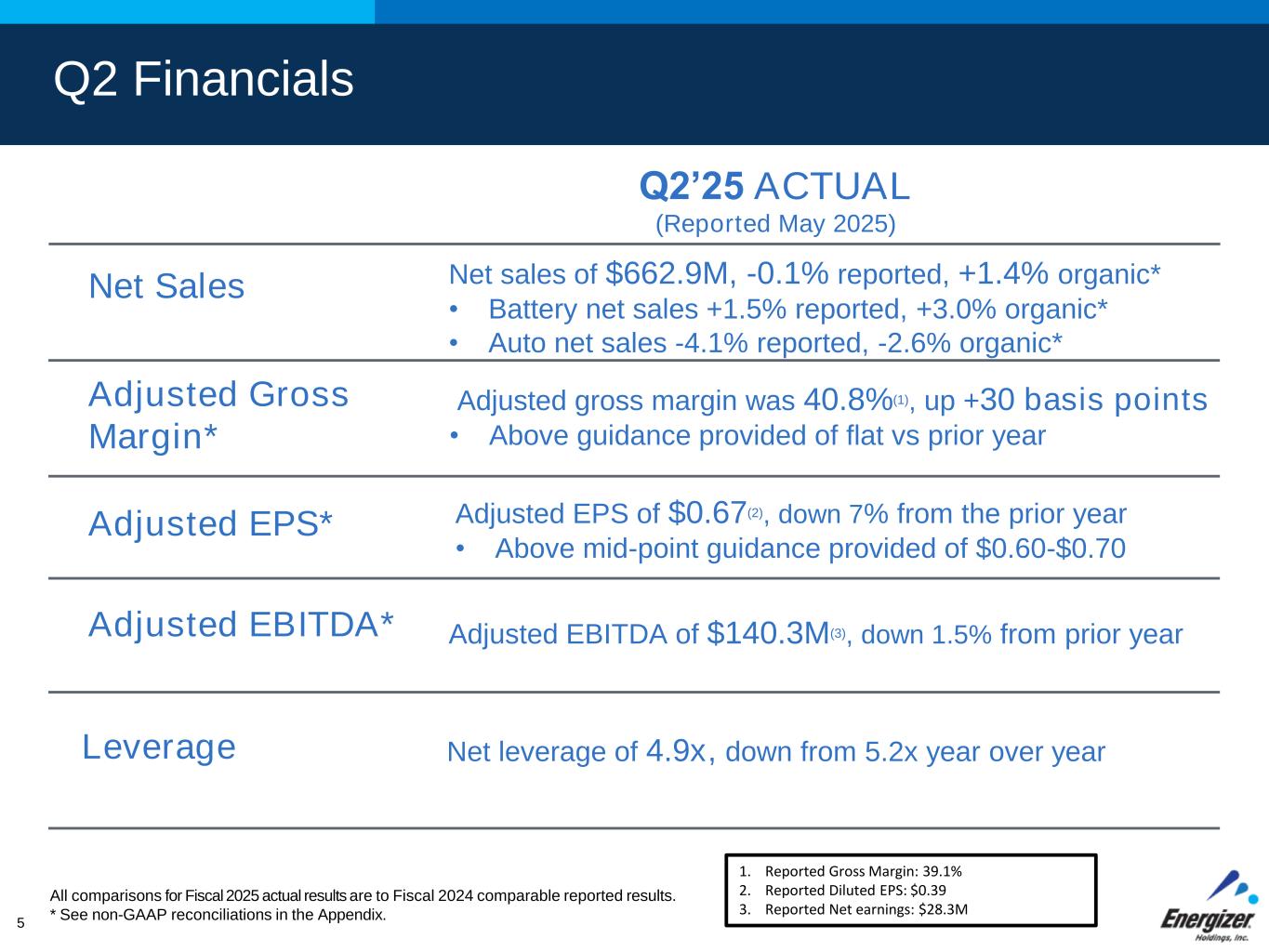
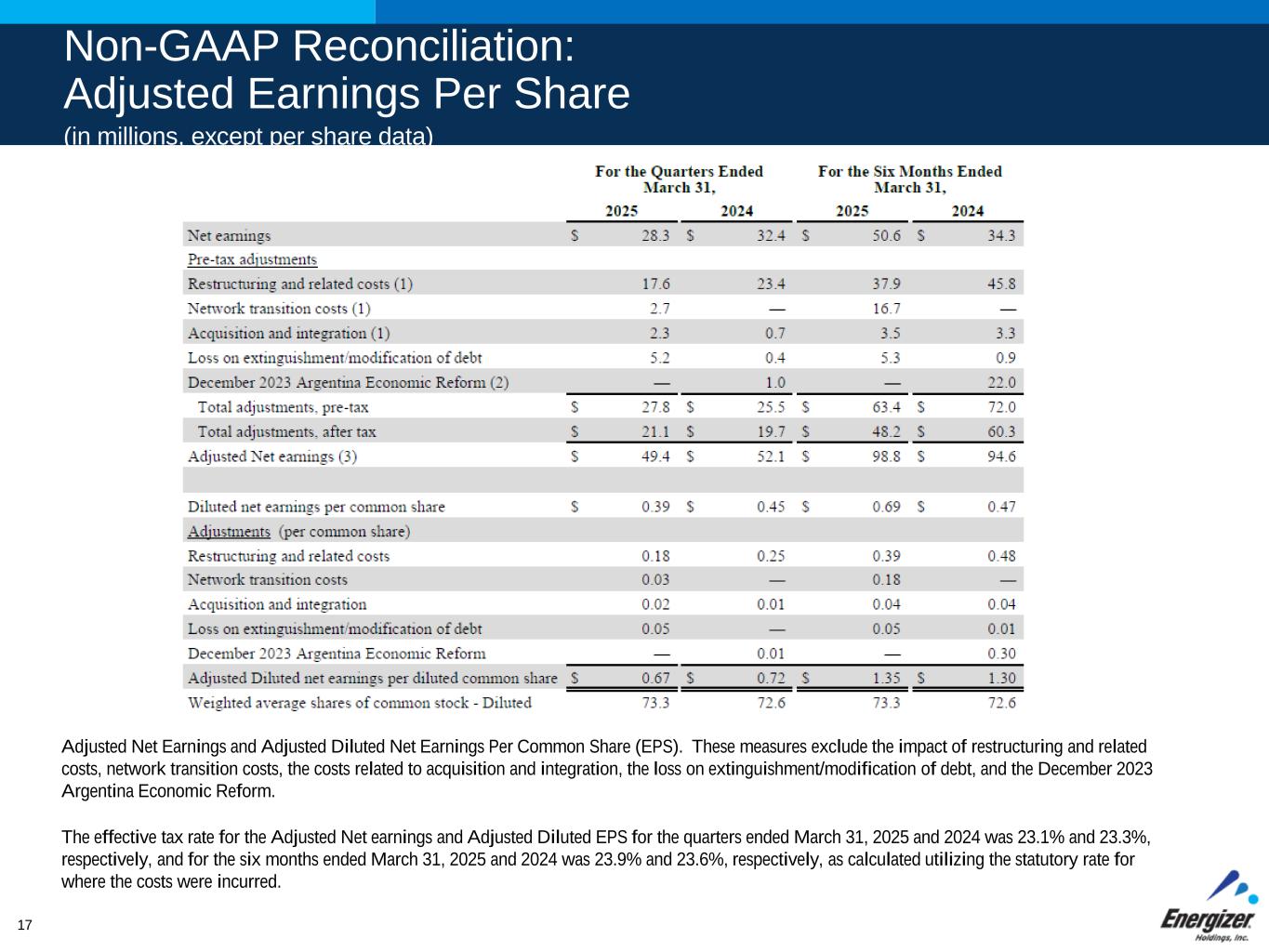
Good morning, everyone, and thank you for joining us for our second quarter earnings call. John and I are going to first talk through the details of our Q2, and then we will spend the bulk of the time on the impact of the changing macro environment and how we are responding to it. Q2 was a solid quarter for us and largely consistent with our expectations. We saw growth continue for the fourth consecutive quarter with organic sales up nearly 1.5%. We also expanded gross margins and delivered adjusted earnings per share of $0.67 at the upper end of our guided range. We are proud of our performance in the quarter, which was bolstered by many of the investments we have made in the past several years. Those decisions have not only contributed to our year-over-year results, but they are playing a critical role in helping us to navigate the current volatility. More on that in a moment. As we take a closer look at each of our businesses, recall the areas we have highlighted previously; distribution, innovation, digital commerce, pricing and revenue management, and market expansion. Each of these areas has contributed and will continue to contribute to our fiscal 2025 results. These focus areas come together on shelf or online as we strive to meet consumers where they are. Our battery business had a particularly strong performance, growing 3% organically in the quarter. Our distribution footprint in the US and international markets continues to grow across both brick-and-mortar retail and digital commerce. In Auto Care, we saw strong growth within our appearance and air freshener businesses, behind innovation distribution gains and market expansion. Our appearance business delivered 5.5% organic growth, largely driven by the launch of our new Podium Series product line, which is now on the shelf in over 15,000 stores in both the US and internationally. Overall, our auto business declined roughly 2.5% organically in the quarter, with a decline entirely driven by a shift in the timing of our refrigerant shipments from the second quarter into April. Those are just the highlights of a solid second quarter. Now let me hand it to John to provide more details on Q2, before we then turn to an update on the impacts of tariffs and how we are leveraging our world-class supply chain to manage the changing landscape. We will then finish with a view on the remainder of fiscal 2025.
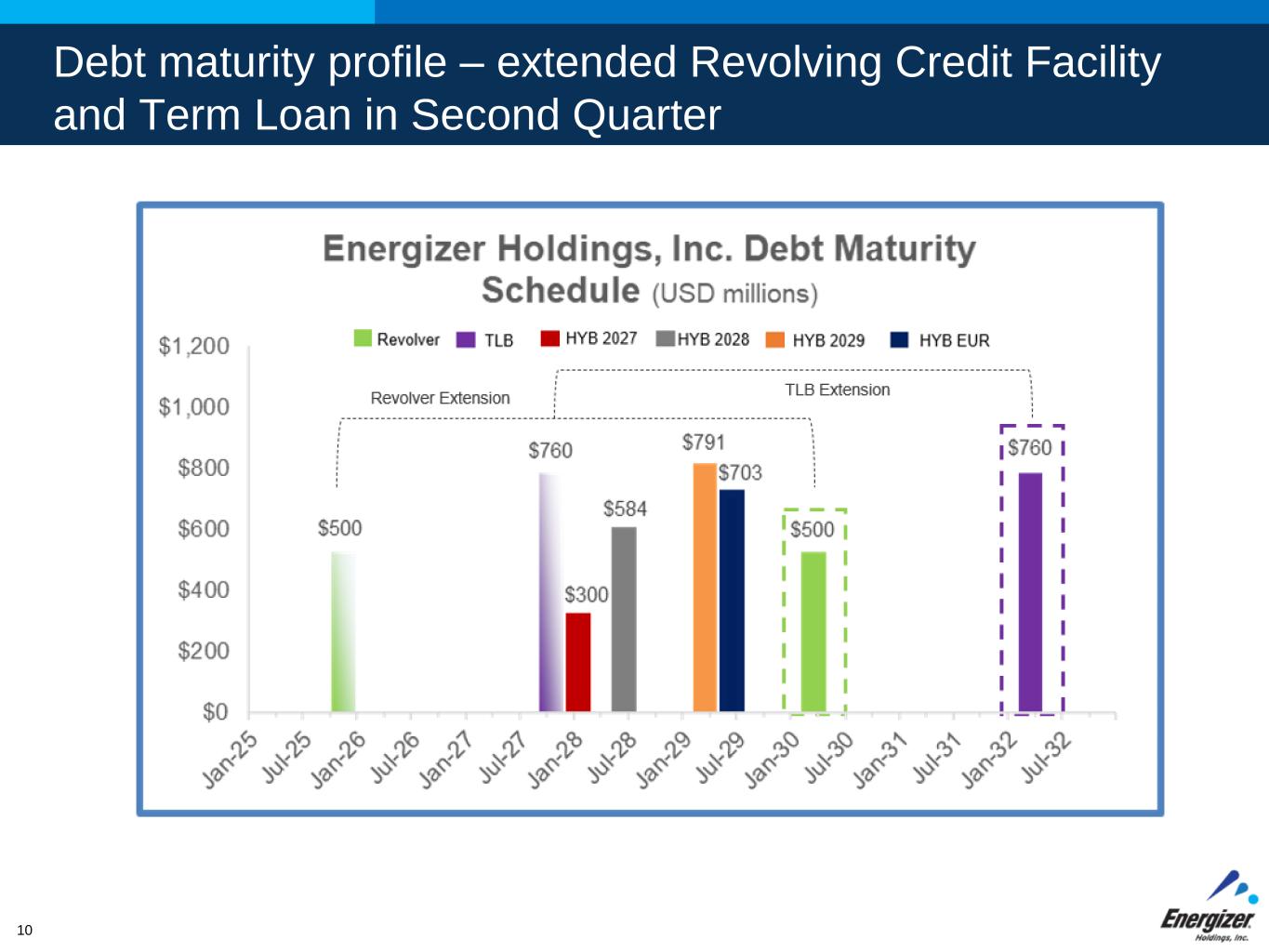
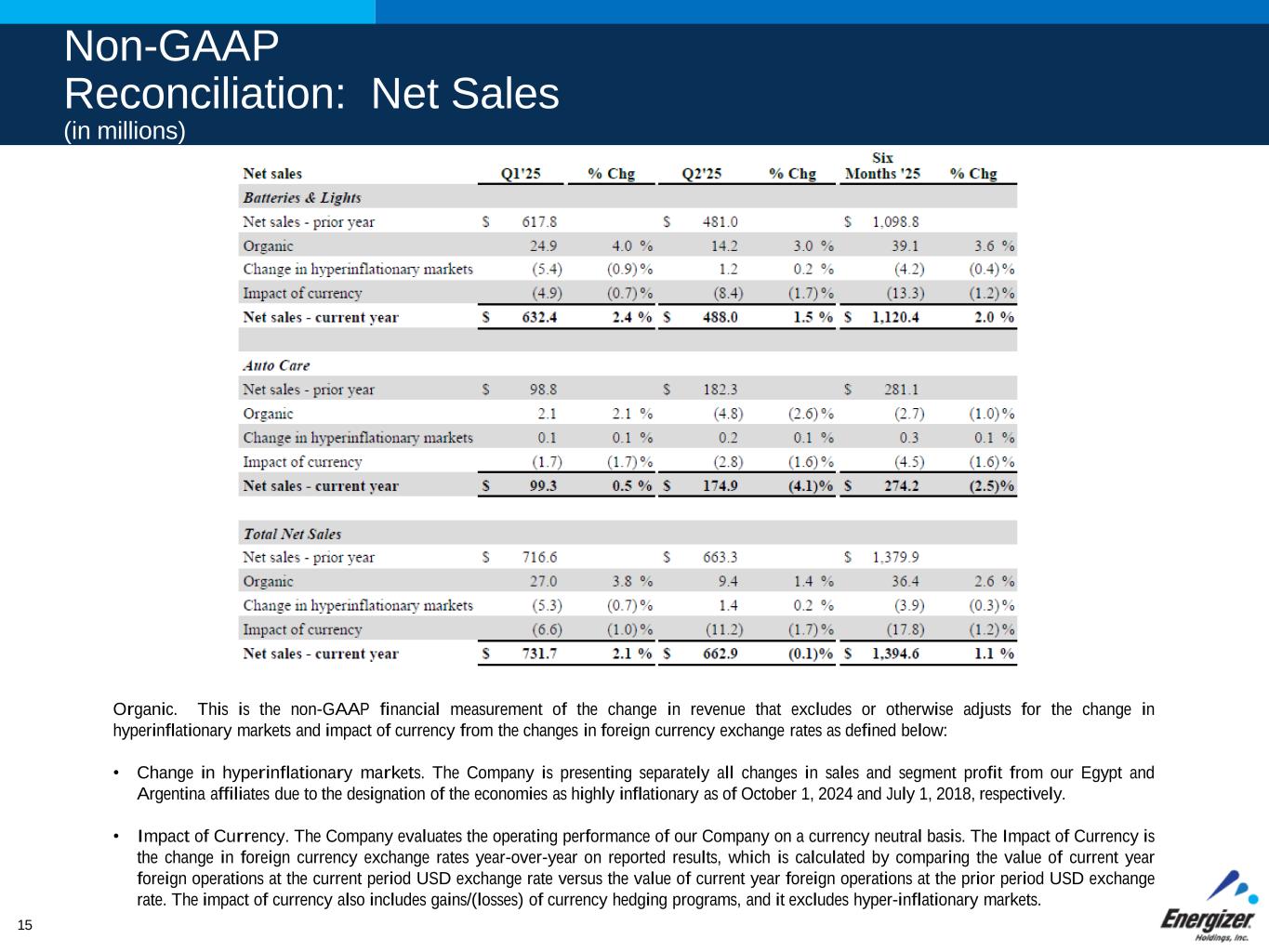
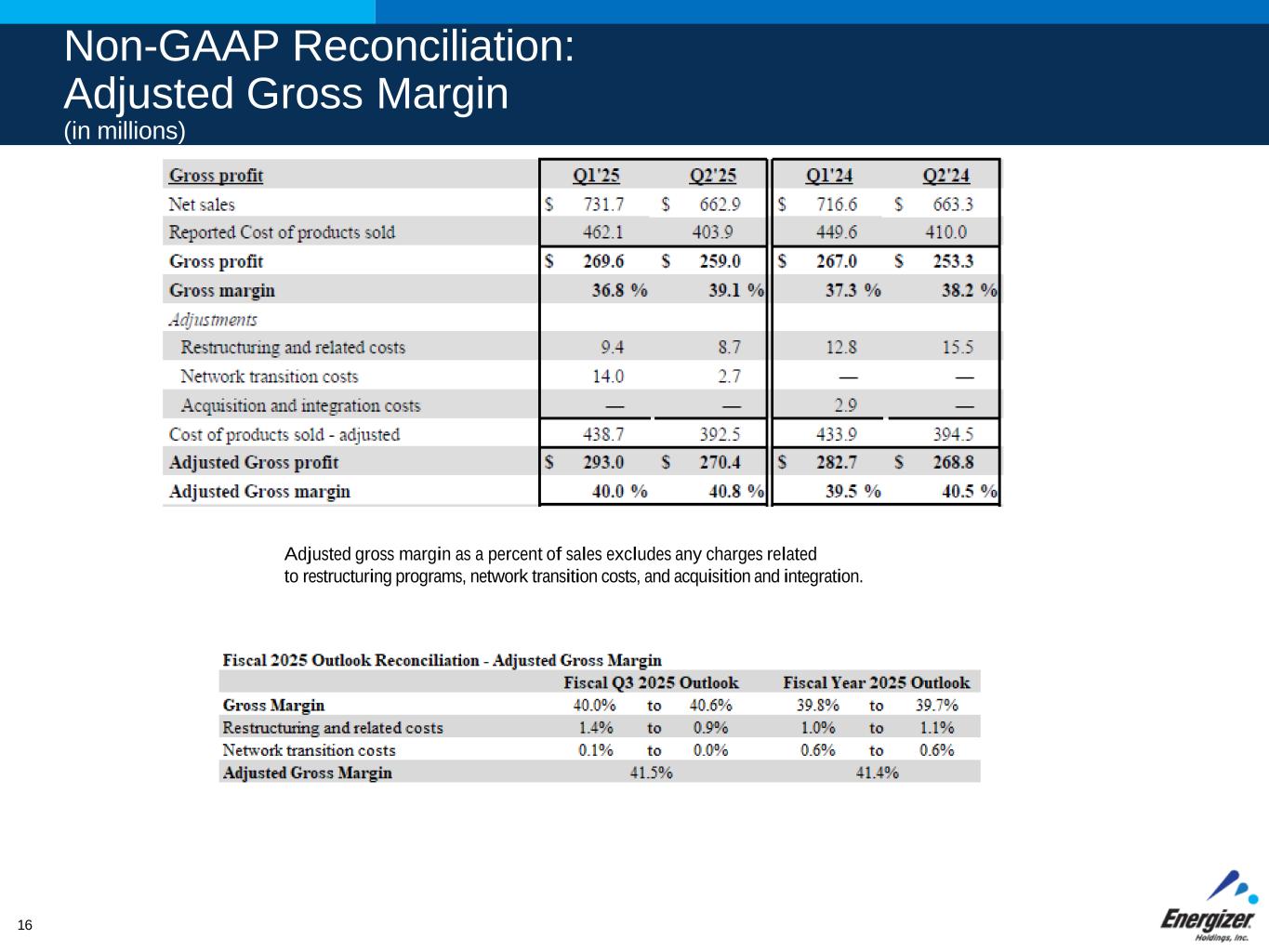
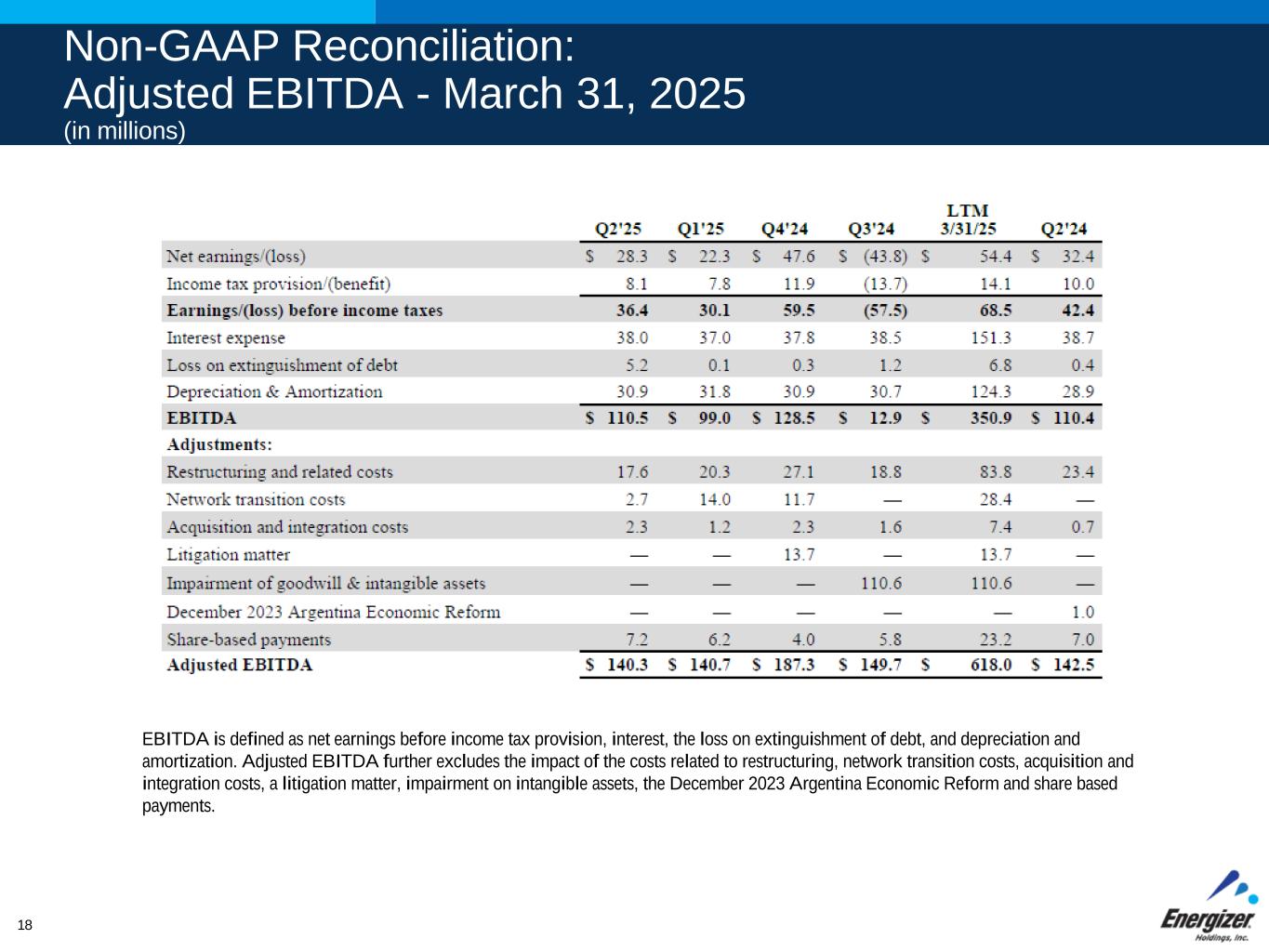
Thanks, Mark and good morning, everyone. The second quarter of reported net sales were flat while organic revenue increased 1.4%. Our fourth consecutive quarter of organic growth was driven by a strong performance in batteries, partially offset by a decline in Auto Care. Batteries continue to benefit from significant distribution wins in the US, as well as strong international results, which combine to deliver organic growth globally. The launch of our Podium Series is also progressing nicely and in position for a strong performance during the summer season. However, in the current quarter, auto results were weighed down by a shift in timing of shipments within our refrigerants business, which have now largely shifted into April. Adjusted gross margin increased 30 basis points to 40.8%, primarily driven by an incremental $16 million of project momentum savings in the quarter. Adjusted SG&A was 18.8% of net sales, an increase of $10.6 million in the quarter. The year-over-year dollar increase was primarily driven by planned spending in our digital transformation and growth initiatives, as well as increased legal fees partially offset by project momentum savings of approximately $4 million. A&P as a percent of sales was 3.1%, roughly flat versus the prior year. Interest expense was $38 million, an improvement from the prior year due to lower average debt outstanding. We delivered adjusted EBITDA and adjusted earnings per share of $140.3 million, $0.67 per share with adjusted earnings per share at the upper end of our previously provided outlook. During the quarter, we also refinanced our $500 million revolving credit facility now maturing in March 2030, and opportunistically extended the maturity of our Term Loan B, now maturing in March 2032. Importantly, we refinanced these facilities at roughly the same rates while extending the maturities of both facilities by more than four years and the weighted average maturity of our total debt portfolio by more than one year. Our nearest maturity is now $300 million of notes maturing at the end of 2027. Our free cash flow declined $44.1 million year-over-year, primarily driven by investments in incremental inventory to support our plastic-free packaging launch in the US and incremental inventory to mitigate tariff exposures as well as capital expenditures to support our plastic-free packaging and digital transformation initiatives. Now I'll turn it back over to Mark to take us through what we're seeing in the macro environment and the impact on our categories and consumers.
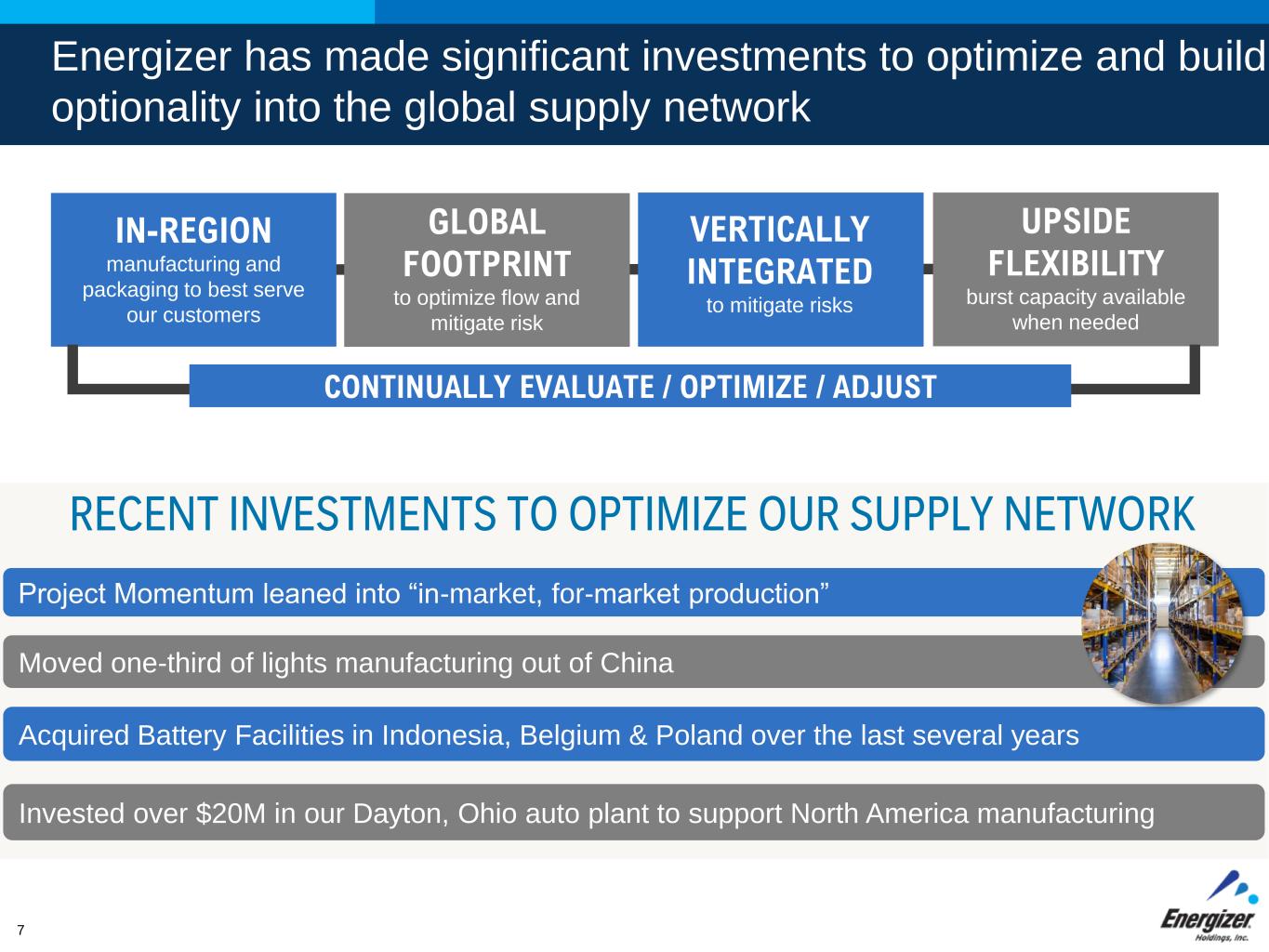
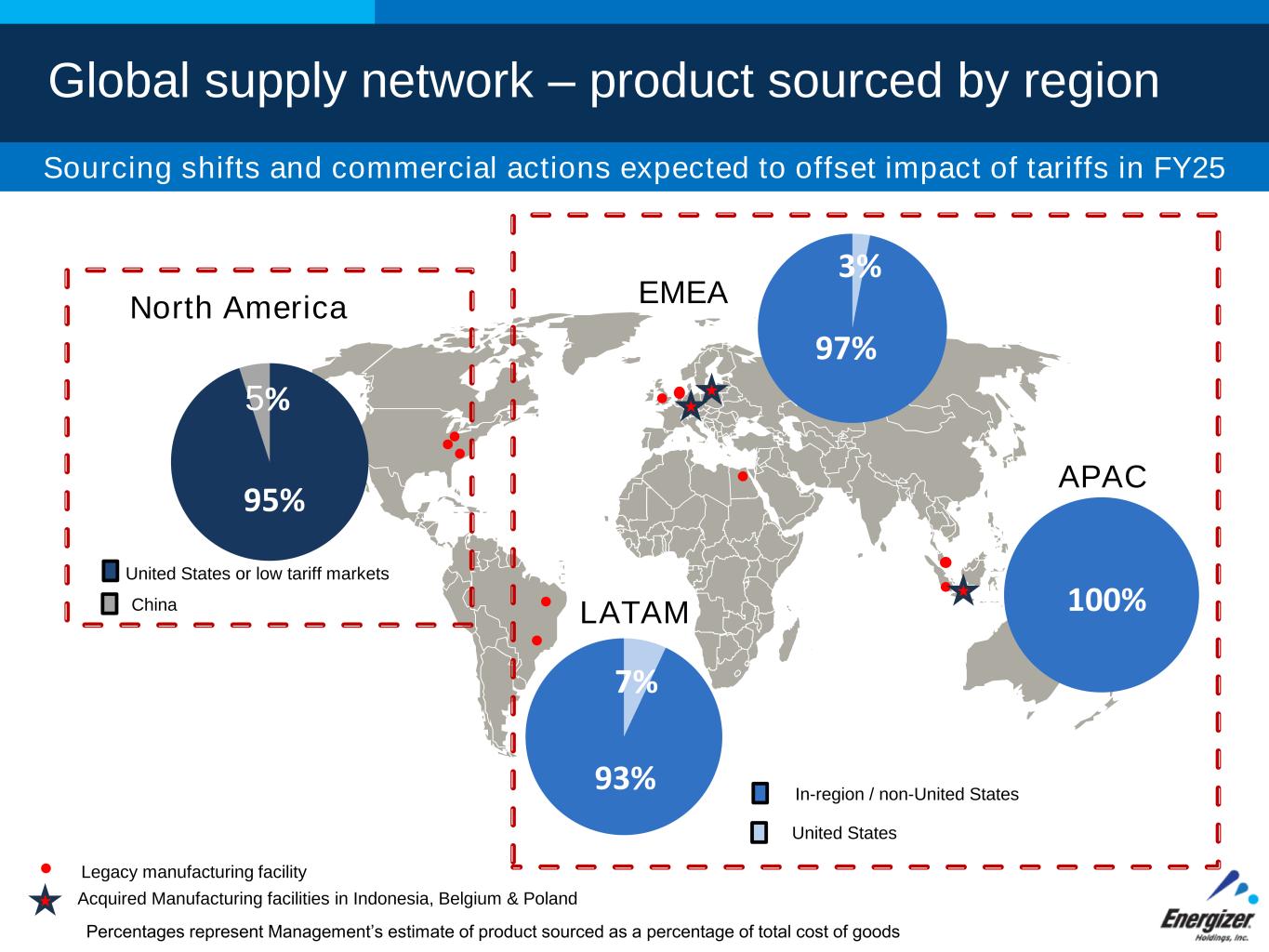
Thanks, John. Again on performance, we are very proud of, despite ending the quarter in a more challenging environment relative to where we began. As we look ahead, the uncertainty around tariffs and the impact on the consumer create challenges for the balance of the year. Let's first talk about tariffs. Work we have done over the last 2.5 years to transform our supply chain positions us well to mitigate the impact from tariffs much more quickly than we would have been able to previously. As a baseline, imports from China to the US typically represent less than 5% of our consolidated cost of goods. And as John and I will cover, we have a clear path to further reduce our exposure during the next 12 months. Let's take a step back and revisit the changes we've made to provide more context on why we are confident in our ability to withstand the volatility that has become more and more common. You will recall that as we exited the COVID pandemic, we identified a substantial pipeline of initiatives to rebuild gross margins, improve working capital efficiency and invest for long-term growth. As part of that undertaking, we identified areas where we could improve cost, resiliency and agility. Many of these initiatives were captured within Project Momentum, which you have heard a lot about since we announced it in November 2022. The intent of the program was clearly designed to improve earnings growth and enhance free cash flow. But we were mindful that the changes to our network needed to also enhance our ability to absorb future shocks to the global supply chain. As Project Momentum got started, we took a clean sheet approach to our manufacturing and distribution network, with an emphasis on in-region, for-region production, ultimately to drive improved cost, agility and resiliency. In addition to the work on our existing network, we made several strategic acquisitions over the last few years, which included manufacturing locations in Indonesia, Belgium, and our latest plant acquisition in Poland last week. The results have transformed how we bring products to market and are particularly relevant today. For markets outside of the US, we currently source approximately 97% of our cost of goods from either in-region or non-US production facilities. In the US, products sourced from China for US consumption represent less than 5% of consolidated cost of goods. The remaining 95% are sourced mostly within the US, with the remainder from low-tariff countries. The significant investments behind our digital transformation have also been a key enabler; in addition to greatly improving data visibility and analytics, it has allowed us to streamline processes and overall workflow and has resulted in a more efficient and responsive organization, which is so critical in this environment. Progress we have made over the last several years has been tremendous. Even with that, we are not immune to the impact from the proposed tariffs. We remain focused on managing those items that are directly within our control. A critical area is ensuring that we stay close to the consumer and understand how they are reacting against this backdrop. Recently, there has been a notable shift in consumer sentiment, which has driven an increased emphasis on value and heightened caution in their spending. In terms of the impact on our categories, let's start with battery. On a global basis, we expect the battery category to deliver low-single-digit growth over the long-term. However, weakened consumer confidence and persistent inflation across the store may pressure volumes in the short-term. In Auto Care, we expect consumer caution to have a mixed impact in the short term as some consumers move into our categories and away from do-it-for-me while others prioritize their spending in other categories which may be less discretionary for them. When we pull all of these together, tariffs, consumer confidence, and overall demand, we have tempered our outlook over the remainder of the year, which John will cover now.
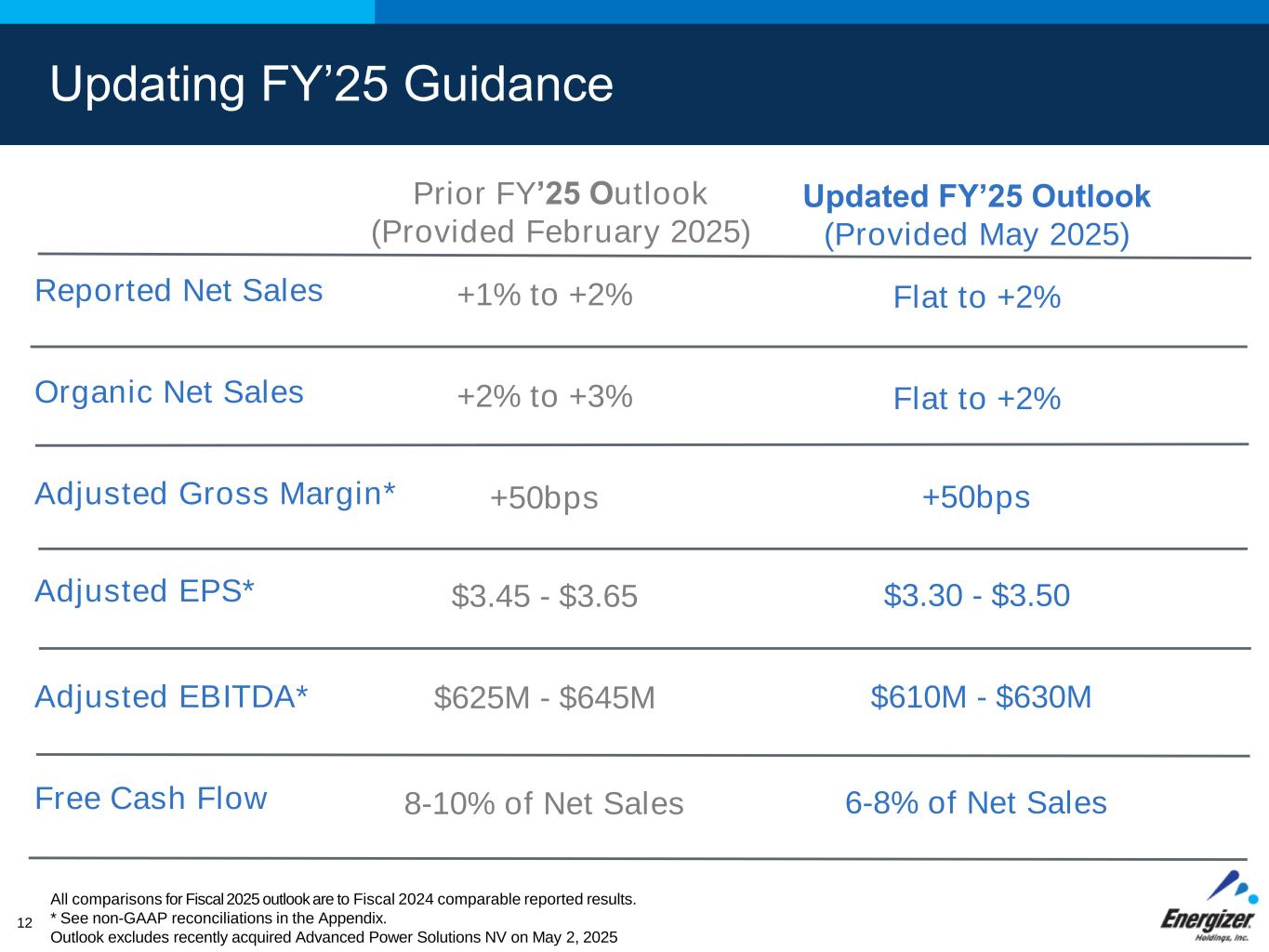
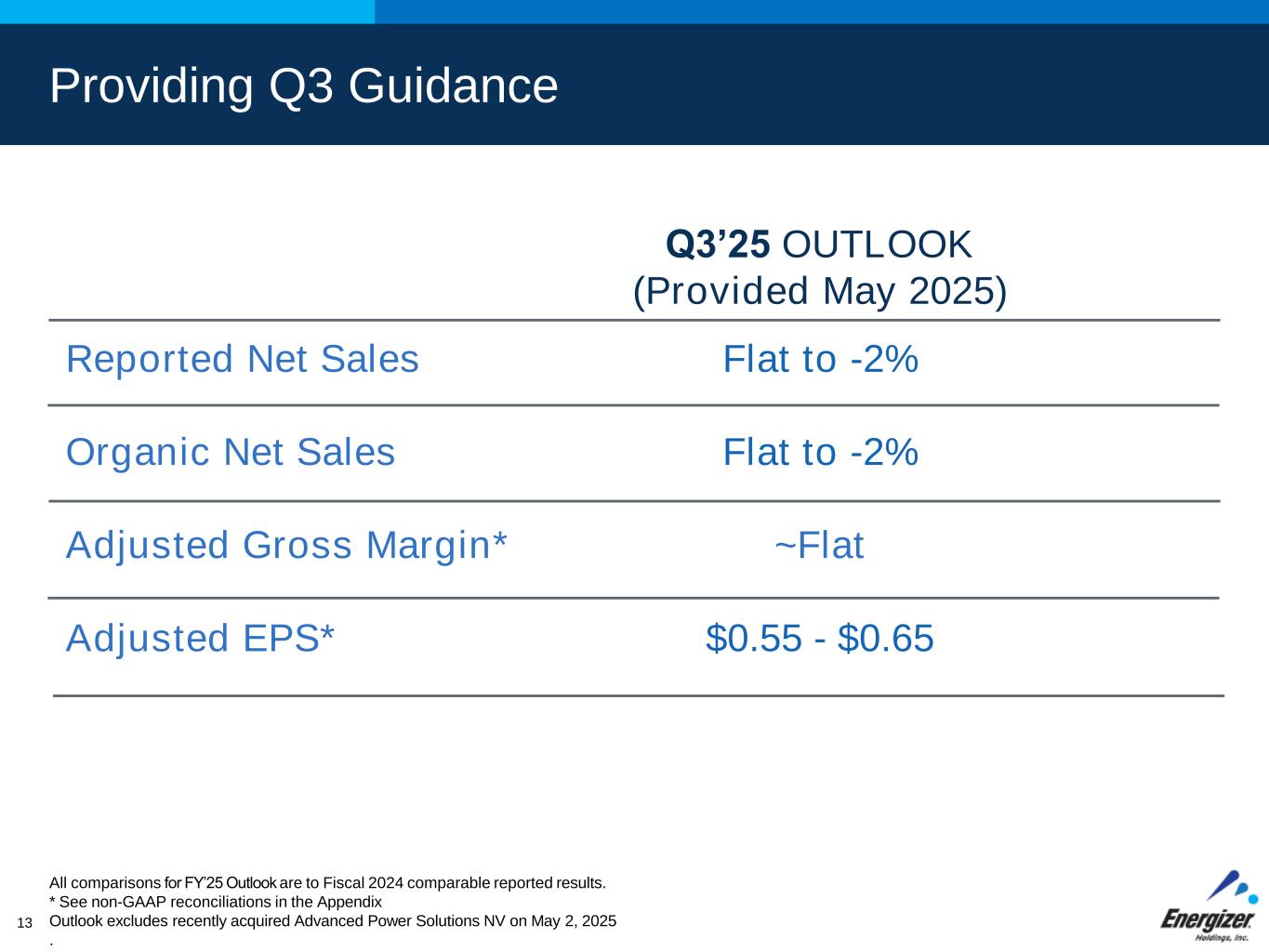
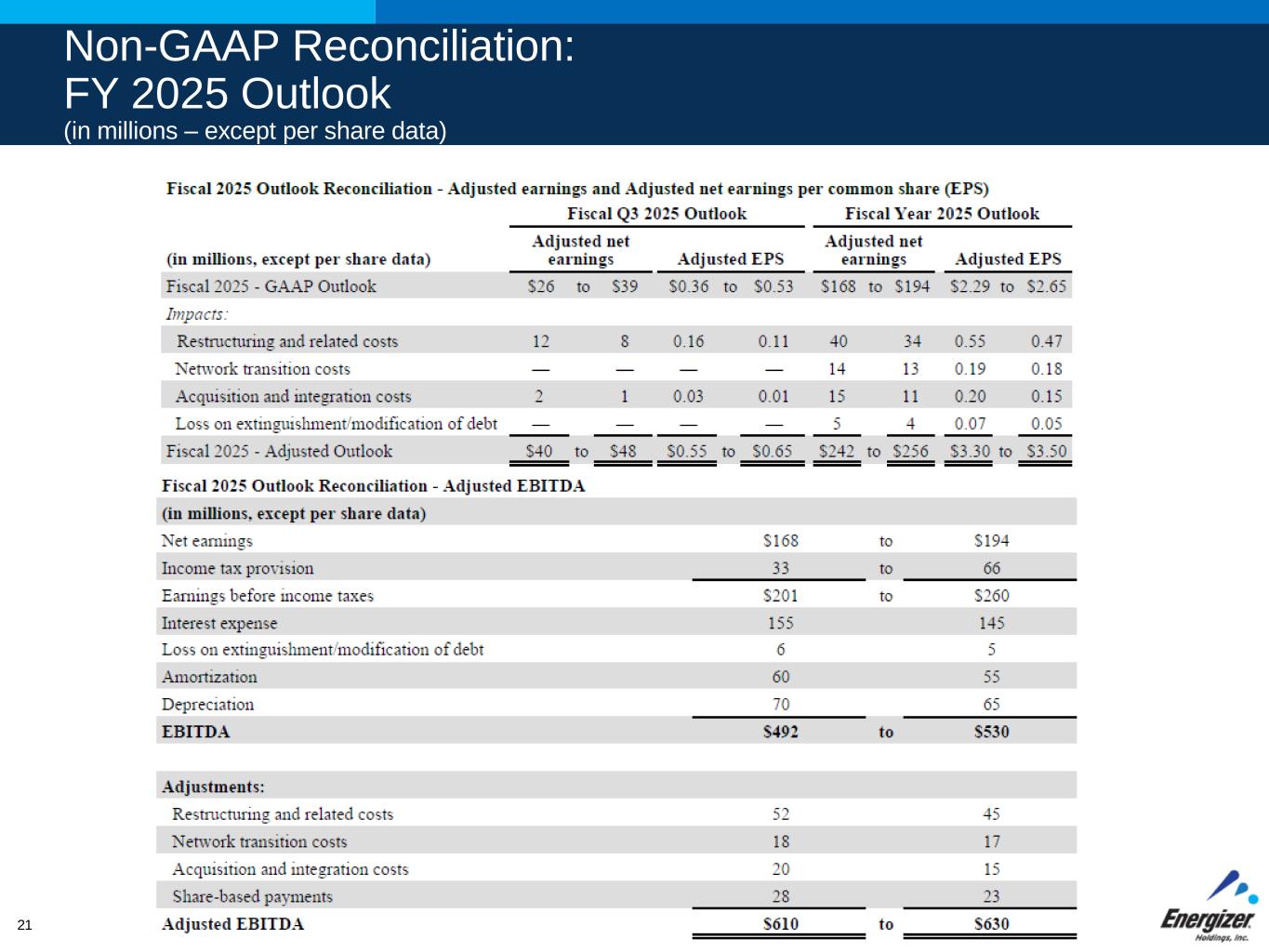
Thanks Mark. Let me start with some details around tariff impacts. In an admittedly very fluid environment, we did want to share some directional impacts these tariffs would have on our business and how we are working to address them. But let me first address fiscal year 2025. We have already taken a number of steps, including sourcing shifts and pricing, and do not expect tariffs to have a direct impact on our P&L this year. Now moving to our exposures over a longer period of time, assuming tariffs announced this year remain in their current form, let me walk through our gross unmitigated exposures. Roughly 5% of our cost of goods are exposed to tariffs levied on China at an incremental 145% rate. And approximately 10% to 15% of our cost of goods are exposed to the rest of the world reciprocal tariffs. We have some exposure to the steel and aluminum tariffs announced this year as well. All in, this represents an incremental total headwind of roughly $150 million, of which 85% is attributable to the China tariffs. It's important to remember this is unmitigated. We are already working on solutions to minimize the ongoing impact and believe over the next 12 months, we can reduce the amount of our China-sourced product by close to half through alternative sourcing partners and a mix of our own internal supply. And based on the flexibility of our redesigned supply chain, we have the ability to rebalance our network and minimize the impact of tariffs related to all other countries. We've also already taken a round of pricing related to the initial round of tariffs, including for steel and aluminum. And as we gain more insights and certainty, we will assess additional commercial actions, including product offerings and additional pricing. By minimizing our China exposure, rebalancing our internal supply network, and targeted commercial actions, we have a line of sight to offset the impacts of tariffs over the next 12 months. Looking to the balance of this year, while we are very encouraged with our year-to-date results, we know the recent volatility is negatively impacting consumer sentiment. Based on the most recent economic indicators, consumers are beginning to pull back on spending and becoming more value conscious with their dollars. Based on this demand environment, we now expect the following results in the back half of fiscal 2025. For the third quarter, we expect reported and organic net sales in the range of flat to down 2%. Gross margin is expected to be roughly flat versus the prior year. Despite the expected slowdown in consumer spending and the related impact on our revenue, we intend to continue to invest in A&P behind our Podium launch during the quarter, resulting in adjusted EPS in the range of $0.55 to $0.65 per share. For the full year, we expect reported and organic net sales in the range of flat to up 2%; gross margin to be a 50 basis points and in line with prior guidance. Adjusted and adjusted EPS in ranges of $610 million to $630 million and $3.30 to $3.50 per share both reflecting positive growth at the midpoints versus prior year results. Our current outlook for earnings excludes any impacts from the recently acquired APS business in Europe. For the remainder of 2025, we expect the results of this business to have a modestly dilutive impact for our consolidated gross margins and neutral to earnings per share. We have also made incremental investments in inventory this year as we work on various tariff mitigation strategies, as well as planned additional investments in working capital related to our recently announced European battery acquisition. Based on these additional uses of cash, we now expect free cash flow in the range of 6% to 8% of net sales and debt paydown of roughly $100 million for the full year. In closing, we delivered a strong second quarter, but we entered the third quarter facing an uncertain macro environment and consumer. The organization has rallied around these macro challenges, and we have built a strategic advantage through our investments in our network, which will enable us to perform at a high level in a dynamic environment. I am highly confident we are executing the right strategies to deliver on our long-term financial algorithm. With that, let's open the call for questions.
Operator
Thank you. Ladies and gentlemen, we'll now begin the question-and-answer session. And your first question comes from Peter Grom from UBS. Please go ahead.
Speaker 4
Thanks, operator. Good morning, everyone. So I just wanted to follow up on the tariff commentary. I know you just ran through that and all that color was incredibly helpful, but just given the many moving pieces, can we maybe just run through the mitigation impacts again? And then I guess what I'm really trying to understand and I recognize the situation is fluid it's really early to be talking about fiscal 2026, but I was hoping to get some color in terms of how we should be thinking about how we should be modeling with a $150 million gross number versus the expectation that you anticipate to mitigate that headwind over the next 12 months? Thanks.
Morning, Peter. I just apologize for the late start today. We had some technological issues. I just want to make sure we're coming through clearly to you, Peter, in the call. You're hearing us okay?
Speaker 4
You sound great guys.
Okay. Well, it's a great question, Peter. It's obviously probably the most timely question given the environment. We want to provide as much clarity as we can. I think what we want to do is it's important to separate and understand the impact of the different tranches of tariffs and the impact that they may have. I think from a headline standpoint, Peter, I'm going to turn it over to John to walk through the details but from a 2025 standpoint, we have mitigated the impact of tariffs on 2025, so we've solved the impact there. I think as we look ahead to 2026, we are in the process of mitigating that exposure. It will take time, but we have line of sight over the next 12 months to mitigate all impact from tariffs over that period of time. And John can walk through some of the details about how we're thinking about it.
Yeah. Thanks, Mark. Good morning, Peter. So I gave a gross tariff number of $150 million on the prepared remarks, and I want to break that down into a couple of buckets. The first one are tariffs in place already. And then the second group are tariffs that are announced, but not yet active. So the tariffs that are already in place include the steel and aluminum tariffs that we've talked about and then the China IEPA. And then as Mark said, we've effectively neutralized the direct impacts of these tariffs. That was through sourcing shifts, pricing, and then inventory that we have on hand, which is offsetting any impact that we would have to 2025, and that's going to carry forward for us as well. Now we'll turn to the tariffs that have been announced but aren't yet in place, which are really the reciprocal tariffs. So you've got China, which is the 125% incremental tariff and then rest of world tariffs, which are currently 10%. So starting with China, I think Mark mentioned that this represents only about 5% of our consolidated COGS. That really is the overwhelming majority of the absolute tariff exposure. So whether or not those incremental 125 rates for China go into effect, we already have plans in place to reduce the underlying China exposure through sourcing from something like 5% to 2% to 3%. So we'll cut that in half relatively quickly over the next 12 months. And then the rest of the world tariffs, which are about 10% to 15% of our consolidated cost of goods. These are exposed to the 10% reciprocal rest of world tariff, and we're actively working to minimize those by sourcing changes, rerouting our network, and then commercial actions that we will continue to take. So we've addressed and offset the tariffs already in place. And then we have concrete plans today to address about 60% to 70% of the tariffs announced but not yet implemented. And that's going to happen over the next 12 months. So we're confident for the remainder of the 30% to 40% that we'll continue to look at additional supply chain actions and commercial actions to take care of those. And so we think that over the course of the next year, ultimately, we'll be able to offset the entire exposure. Now to your point about 2026, we're continuing to work through how that will look, and we'll give guidance in a couple of quarters, but it will be a transitional year where we start incurring some of these larger tariffs in the next month, and those will go into inventory and then they'll start coming back out into our P&L. So we'll give a better color of what the total impact of 2026 will be in a couple of quarters, but we think we can minimize the gross number by at least half, if not more.
Speaker 4
Great. Thanks so much. That was super helpful. I'll pass it on.
Operator
Thank you. And your next question comes from Bill Chappell from Truist Securities. Please go ahead.
Speaker 5
Thanks. Good morning.
Speaker 5
I know there are tariffs which make the outlook unclear. I appreciate the mitigation efforts that have been made for you specifically. What are you hearing or what is your assessment of the devices that use batteries? I'm considering that many washing machines are manufactured in China, and they will face significant tariffs when entering the US, but to my knowledge, washing machines do not use batteries. Have you evaluated the device market and its potential impacts, and incorporated that into your forecast? I understand consumers are cautious right now, but how do you anticipate the situation will change if prices for those devices increase by 30% or 50%? I'm trying to understand how this factor affects your projections for the latter half of the year.
We consider all these factors as we look ahead, and we recognize that devices are likely to get more expensive. Devices that have previously used our batteries will continue to do so, but we anticipate that consumers will respond to higher prices. Our recent experiences during COVID showed a surge in device purchases that was followed by a pause, and consumers have just started to replenish their devices again. We are in touch with our OEM partners and are aware of their perspectives. As John mentioned, some tariffs are already in effect while others are not, and we will need to see how that unfolds. This uncertainty in the consumer environment is partly why we have adopted a cautious approach in adjusting our revenue outlook. We expect consumers to reduce spending, which will affect device ownership and subsequently impact our replenishment as well.
Speaker 5
Just to clarify, you're assuming that the situation is expected to worsen, with higher prices in the second half of the year. Is that the correct way to interpret it?
Speaker 5
Okay. Regarding Auto Care, in the past, when new car sales have declined, it has benefited Auto Care as people invest more in maintaining their existing used vehicles. Is that the perspective you're taking for this summer, or is it too soon to make that determination?
Well, what I would say is there's headwinds and tailwinds that emerge in difficult economic times with consumers on Auto Care. I mean first, some of our categories are more discretionary for consumers. And so they will opt out of those purchases in favor of other categories, which are less discretionary for those consumers. However, to your point, people are going to hold on to their cars longer and the age of the fleet is going to continue to increase in age. They will also migrate from do-it-for-me to do-it-yourself, which helps create a tailwind within the Auto Care category. So there's pushes and takes on balance. We do expect some impact to consumers as they pull back and become more cautious. But there are some natural offsets which occur as well. And again, all of that has been taken into account as we provided our forward look.
Yes, maybe just to add for that for some more color. Bill, we're expecting low single-digit increases in auto in the third quarter. So we're still relatively bullish on our auto business going into the busy season. And that's behind Podium. And you saw the shift of the refrigerants from Q2 to Q3, so that should boost the quarter a little bit.
And Bill, as a reminder, the Podium Series is a super premium offering, which, again, those consumers tend to be more immune to the pricing impact than others, and we've launched that product in a timely place right now from a consumer standpoint as they may migrate into the do-it-yourself as opposed to do-it-for-me.
Speaker 5
So again, just to clarify, your lower top line guidance is auto and battery? Or is it primarily battery and just a slight modification to auto?
Yes. It's more battery auto. I mean they're both down a little bit, but autos still positive in the third quarter.
Speaker 5
Got it. Thanks so much.
Operator
Thank you. And your next question comes from Lauren Lieberman from Barclays. Please go ahead.
Speaker 6
Hey, thanks. Good morning. I was curious if you could talk a little bit about any retailer destocking that you have seen? You haven't mentioned it yet, but I would think that that's something that could well be a headwind for 3Q. So if you can just talk about your think destocking wise? Thanks.
Sure, Lauren. I think as you've seen some of the recent scanner trends that have come out, and you've seen some softening in the consumer, including in the battery category. Naturally, that will cause a slight uptick in inventory on hand with retailers. I wouldn't say it's significant or meaningful. It's just a natural effect of some softer POS sales. We think that will mitigate over time as retailers moderate the replenishment orders, and we have taken that into account in sort of our 3Q and 4Q forecast.
Speaker 6
Okay. Got it. So this is, in part, this adjustment to the back half is not just weakening or the risk of weakening consumer. It's retail orders catching up with consumer takeaway that you've already seen in the first half?
Speaker 6
Okay, great. Thanks so much.
Operator
Thank you. And your next question comes from Rob Ottenstein. Please go ahead.
Speaker 7
Great. Thank you very much. I've got two questions, but let me start off with one and then we'll go to the next. So first, when we go out and kind of do our trade visits and you look at batteries and you look at the back you know what we find is Duracell batteries made in China a lot of private label, made in Vietnam, private label made in China and so. You know this is a multi-dimensional situation right? And can you help us think through how you're looking at the impact on competitors what competitors may do with their supply chains? And you know what that overall impact will be on competitive dynamics on one level and the other just how you know retailers may start to change how they think about competitors and private label right because if you think this is all going to continue for some time, you may decide to switch which suppliers you want to work with based on your perceptions of the suppliers' supply chains. So love to kind of get that dimension of the whole tariff situation if you can. Thank you.
Good morning, Rob. Let me start with the competitive set. I think the way to think about this is our main competitors, great competitor. I don't think we may have different input headwinds or production headwinds. I would say, based on the way we think about it we think we're largely in the same place as our main competitor and there's not necessarily a discernible advantage for us in that space. I think if you flip a private label, the way to provide some dimension to this is if you think about the private label portion of the category in the US, call it roughly 20% of the category, about 50% of that is manufactured in the US or in sort of I'll call them low-tariff countries including Vietnam. The other 50% of that 20% is manufactured in China. So to your point, is there an opportunity? There could be; it's certainly one that our teams are chasing. We don't want to necessarily get into the private label business. We've said our philosophy on private label is we're going to engage in private label to the extent it can advantage our brands and certainly we have a stable of value brands that can help add to the offerings that any retailer may have and may be able to provide an augment to the private label in the form of value brand in their store.
Speaker 7
Right. So wouldn't it make commercial sense to redouble those efforts with Rayovac and saying look let us come in with a Rayovac and phase out your private label and we'll give you that value tier or develop some other strategy whether it's kind of a joint sort of Rayovac back private brand or some kind of twist for the retailers, but kind of use this situation as an opportunity to deepen your relationship with retailers and gain incremental shelf space?
Love the way you're thinking. I can assure you we're having the same conversations internally as well.
Speaker 7
All right. I don't want to take up too much time on the call since I have several other questions, so I'll pass it on and we can follow up later. Thank you.
Operator
Thank you. And your next question comes from Andrea from JPMorgan. Please go ahead.
Speaker 8
Thank you, and good morning everyone. So I wanted to just see if you can comment on the exit rate of the quarter on the underlying consumption rate vis-à-vis what we're seeing in the category perhaps you know step back and talk about the category in the U.S. and then as you see the exit rate? And then related to what you just discussed about Private label and Rayovac, I was wondering because your price mix was down about 50 bits in the second quarter and that includes trade promotions. So if you can talk about how the consumer has been behaving in terms of your higher price tiers against Rayovac and against like even entry level or even packs like. Think about it and you have obviously one customer on club and think about like how you've been able to move channels as the consumers and meet the consumers where they are. Thank you.
Thanks, Andrea. A lot of questions in there. Let me see if I can hit them and then you can follow up on anyone that I may miss. I mean, let's just talk category from a battery standpoint. Globally what we saw through February was the category volume was roughly it grew about 1%, 1.5% through February. In the U.S. through the end of March, volume was flat but what you've seen in the latest 13-week data end of April is that you've seen some volume declines over that time period. So you've seen some sequential softening in the category from a volume standpoint, overall promotion levels to your point I mean you're seeing stable promotions. In fact, it's down year over year in terms of the percentage with a price reduction. It's above a little bit above historical levels but nothing concerning from an overly promotional environment. You are seeing depth really flat year over year but below historical averages. So there's a little there's a few puts and takes there, but I would say relatively benign and healthy promotional environment. We do have the broad offering. I mean the benefit of our business is we are in distribution in every channel so as consumers migrate in search of value we are there to meet them. We have different pack sizes. We have different brands we have different offerings that we can meet them in terms of whatever value orientation that they may have. In terms of the value and volume that can probably give you the way we're looking at it from a Q34 split.
I can't. Let me just wrap up on Q2 though just to give a little bit more. So the actual pricing on battery was relatively flat. Of the 50 basis points down it was more investments and promotions that we did on auto as we came into the season. So that was more of the driver of the down 50. So battery was actually the point. Relatively flat looking forward as we think about maybe just to map out Q3 and Q4 and give a little more color, we expect to be flat to down 2% in the third quarter. That's really low single-digit declines in battery. We're going to offset those partially with low single-digit increases in auto, which is going to continue to benefit from the podium launch in those shifting refrigerant sales. Also on a reported basis, the currency, the dollar has weakened as we know, so that should leave our full-year reported currency impact relatively neutral. We've kind of gone up and down and we're back to neutral for the full year. We expect gross margin to be roughly flat and then we're calling for EPS of $0.55 to $0.65 and that's really the expectation that we're going to continue investing in A&P in the third quarter behind our podium launch and that's in spite of some of the expected consumer headwinds that we're seeing in the near term. As we go maybe just to give a little bit of color on the fourth quarter, since we're kind of changing our outlook a bit here. We expect strong performance it's the full impact of pricing. So we talked about the pricing that we're going to take to offset tariffs. That's going to hit in full in the fourth quarter and we should see that. We also took some pricing for innovation, and that's all going to be realized in the fourth quarter that's going to benefit margins and then we don't expect to spend nearly as much on podium in the fourth quarter as we did in the third quarter so we'll see kind of a lift from that and that really should result in some nice earnings for us as we finish out the year.
Anything we missed, Andrea?
Speaker 8
No, this is perfect. Thank you so much for hitting all the other questions. I'll pass it on.
Operator
Thank you. Your next question comes from William Reuter from Bank of America. Please go ahead.
Speaker 9
Hi, I have a couple of questions. I may have confused myself, but in your response to the question about fiscal year 2026, I thought you mentioned that you would be able to offset everything by the end of that period. However, in your last statement, you said that you could offset the gross impact by at least half, if not more. Could you please clarify that?
Yeah. We will have taken the actions necessary to offset the tariffs. We will start incurring those tariffs at the end of May, the incremental new ones that have been announced but haven't been put in place. So we're going to see those dollars being spent throughout the summer and into the fall. We're taking actions currently to get out of these tariffs, and we think in the next 12 months we will be able to offset most of them, if not all. And so there will be a P&L impact through the course of 2026. It's going to be dependent on rates and volumes and a lot of other things, so it's hard to give an exact number. What I would say is that gross $150 million number will be cut by half as we look at 2026. We just don't know exactly where we're going to fall, and then we can take commercial actions and other things to offset in addition.
Speaker 9
I get it. Thank you. Sorry for being dense. The second question your free cash flow guidance is down a little bit for the year. Do you still expect to repay $150 million to $200 million of debt or is that expectation lowering?
Yeah. We're going to shoot for $100 million, so we think we invested around $100 million in inventory for a couple of reasons. We knew we were going to invest in incremental inventory for plastic-free packaging because we're making that transition in North America this year. We've also invested in some additional inventory to try to mitigate some of the tariff exposure. So we expect some of these to start coming out in the third quarter. They should bolster us in the back half of the year, but it's still incremental to what we had planned coming in. So we're shooting for a 6% to 8% free cash flow. And I think we're going to go for $100 million of debt paydown, which will happen in the third and fourth quarters.
Speaker 9
Got it. And then just lastly for me. From a competitive perspective, the de minimis that's being repealed or likely being repealed. Do you think that this will have any positive impact on the company? Do you believe that there have been batteries that have been shipped to the US and sold through TM or other retailers that haven't been subject to tariffs?
Yes. I think the best way to think about this is from an overall standpoint, we think our production network, we think our sourcing optionality, and our distribution footprint provides us an advantage in this environment. It takes time to work through some of the sort of changes as well as the distribution changes that may come as a result of these tariffs. But I think we need to work through that and see where we land before we sort of call any benefit or detriment going forward.
Speaker 9
Okay. That's all for me. I'll pass to others. Thank you.
Operator
Thank you. And your final question comes from Carla Casella from JPMorgan. Please go ahead.
Speaker 10
Hi. One follow-up on Bill's question is about the debt paydown. Do you have a long-term leverage target?
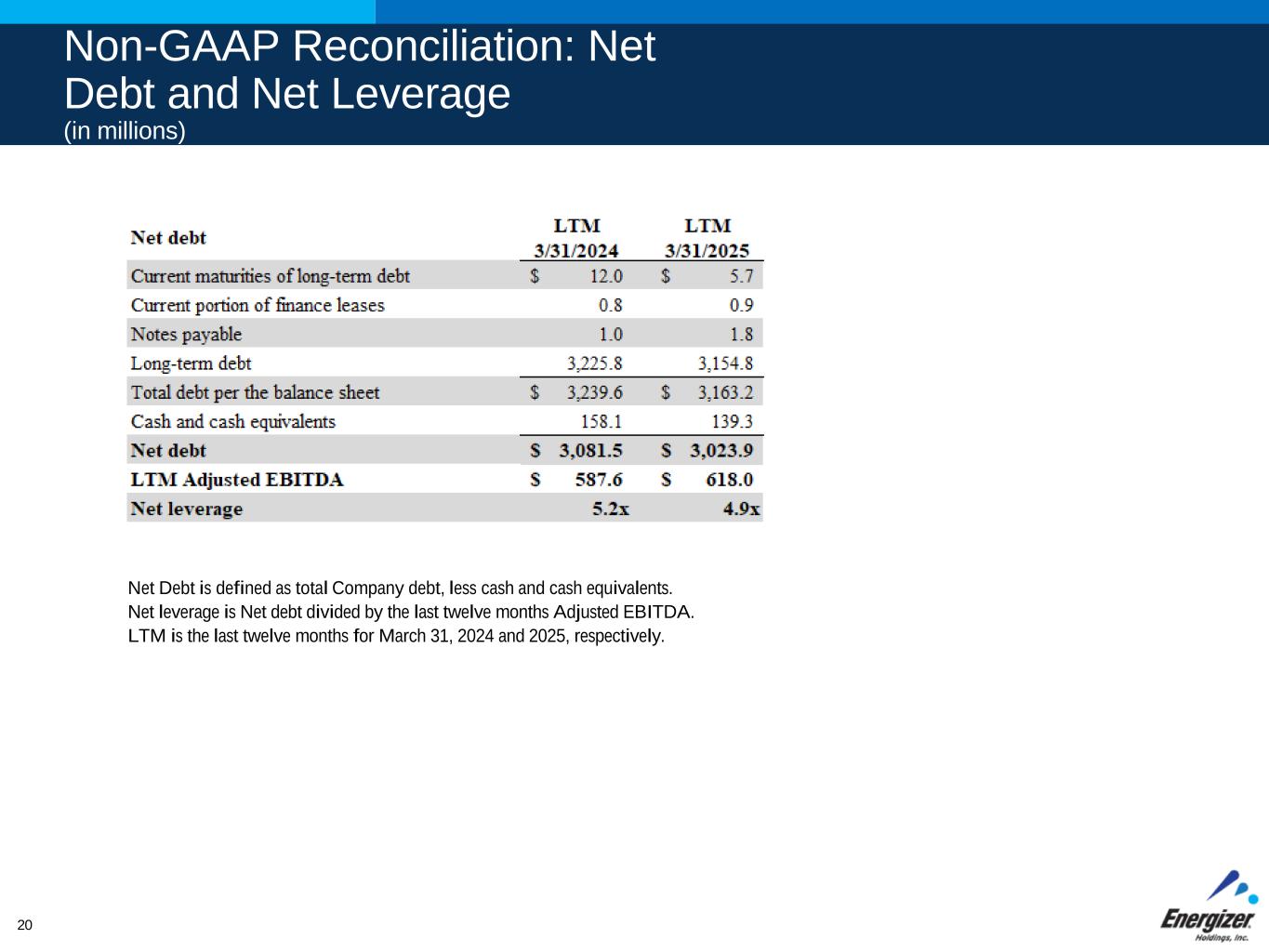
What I would say is we're aiming to reach a debt level of four times and below, and paying down debt continues to be our top priority. We will keep focusing on this goal. Our first target is to get to 4.5, and we'll keep working on paying down our debt to achieve that.
Speaker 10
Okay. Great. And then on your raw materials, does your basket of raw materials change dramatically with your move to the plastic-free packaging?
No, not dramatically. I mean the majority of our materials are still the same on the battery side, would be steel, zinc, manganese, all those things. With the packaging, it will just be a different mix of it. There might be a little bit more cardboard, but not a huge change.
The bulk of the cost is in the battery.
Yes, the bulk of the cost is in the battery. So it's not that big a change.
Speaker 10
Okay. Great. And then just when you talked about bringing some of your sourcing in-house, as you derisk from China, is that bringing into your own facilities worldwide? Or is it into other third-party facilities?
We will evaluate all options, including bringing sourcing in-house and exploring partnerships in various regions globally. This process is a significant sourcing effort aimed at ensuring we can meet global demand in the most cost-effective manner. We will strategically combine both internal and external sourcing partners to achieve optimized costs for our retailers.
Speaker 10
Okay. Great. Thanks so much.
Operator
Thank you. And there are no further questions at this time. Mr. LaVigne, you may continue.
Thanks for everyone joining us today. Everyone, have a great rest of the day. Thanks for your interest in Energizer.
Operator
Ladies and gentlemen, this concludes your conference call for today. We thank you very much for participating and ask that you may disconnect. Have a great day.