Operator
Hello and thank you for standing by. My name is Mel and I will be your conference operator for today. At this time, I would like to welcome everyone to the Harmony Biosciences First Quarter 2026 Financial Results. All lines have been placed on mute to prevent any background noise. After the speaker's remarks, there will be a question and answer session. If you would like to ask a question during this time, simply press star followed by the number 1 on your telephone keypad. If you would like to withdraw your question, press star 1 again. Thank you. I would now like to turn the call over to Brennan Doyle, Head of Investor Relations. Sir, please go ahead.
Thank you, Operator. Good morning, everyone, and thank you for joining us today as we review Harmony Bioscience's first quarter 2026 financial results and provide a business update. Before we start, I encourage everyone to go to the Investor section of our website to find the materials that accompany our discussions today, including a reconciliation of our GAAP financial measures. Our speakers on today's call are Dr. Jeffrey Dano, President and CEO, Adam Zesky, Chief Commercial Officer, Dr. Kumar Badur, Chief Medical and Scientific Officer, Glenn Rayson, Chief Financial Officer, and Peter Anastasiou, Chief Operating Officer. As a reminder, we will be making forward-looking statements today, which are based on our current expectations and beliefs. These statements are subject to certain risks and uncertainties. Our actual results may differ materially, and we undertake no obligation to update these statements, even if our circumstances change. We encourage you to consult the risk factors referenced in our SEC filings for additional details. I would now like to turn the call over to our CEO, Dr. Jeffrey Dano.
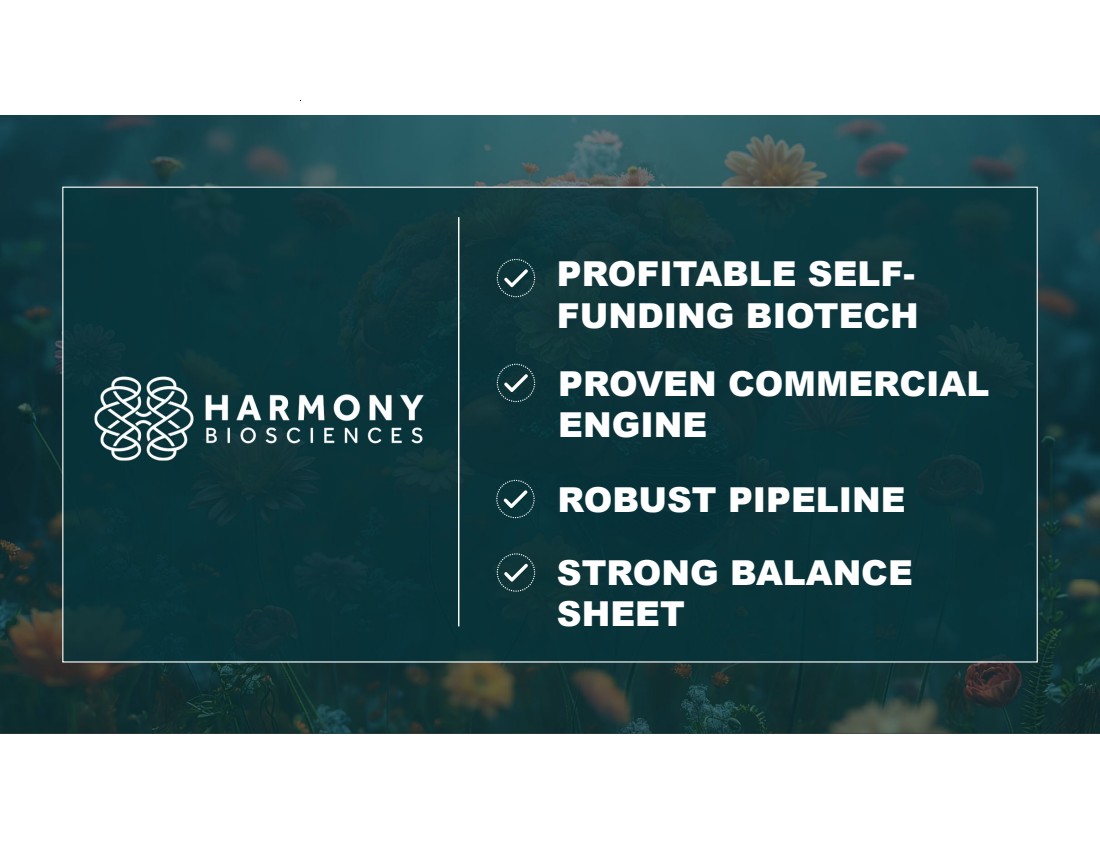
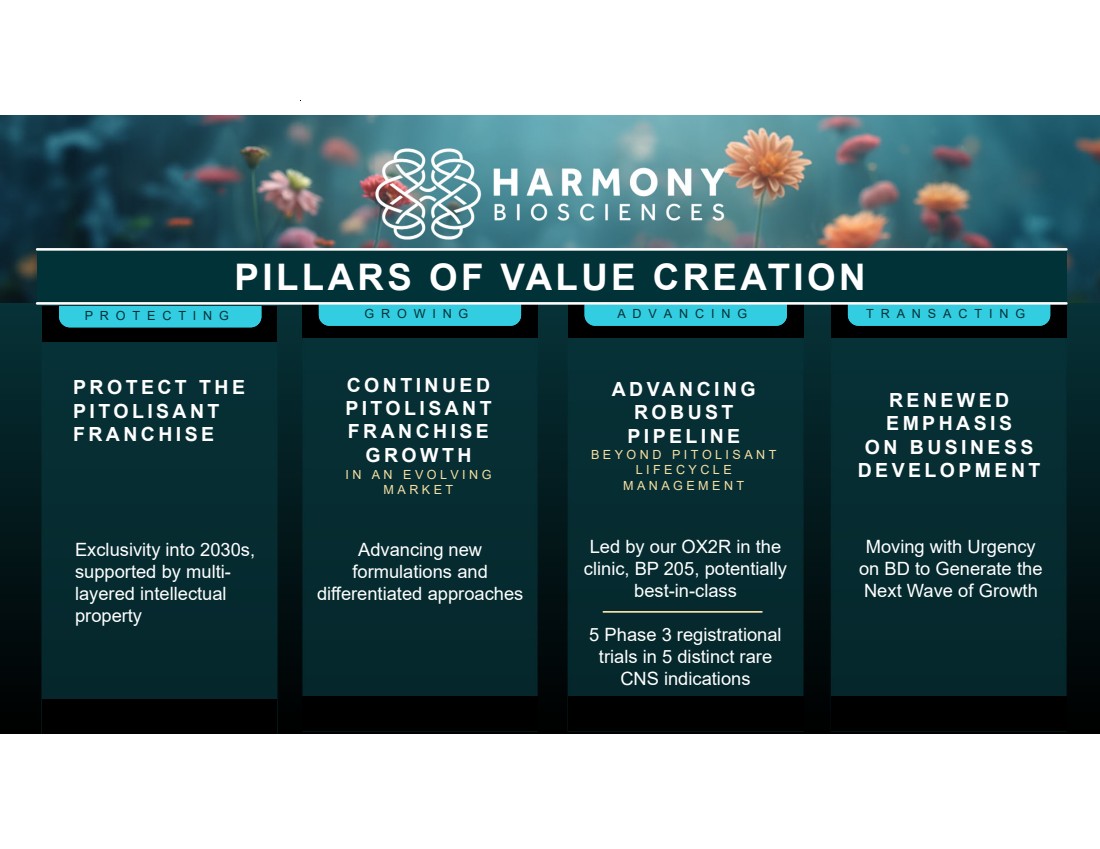
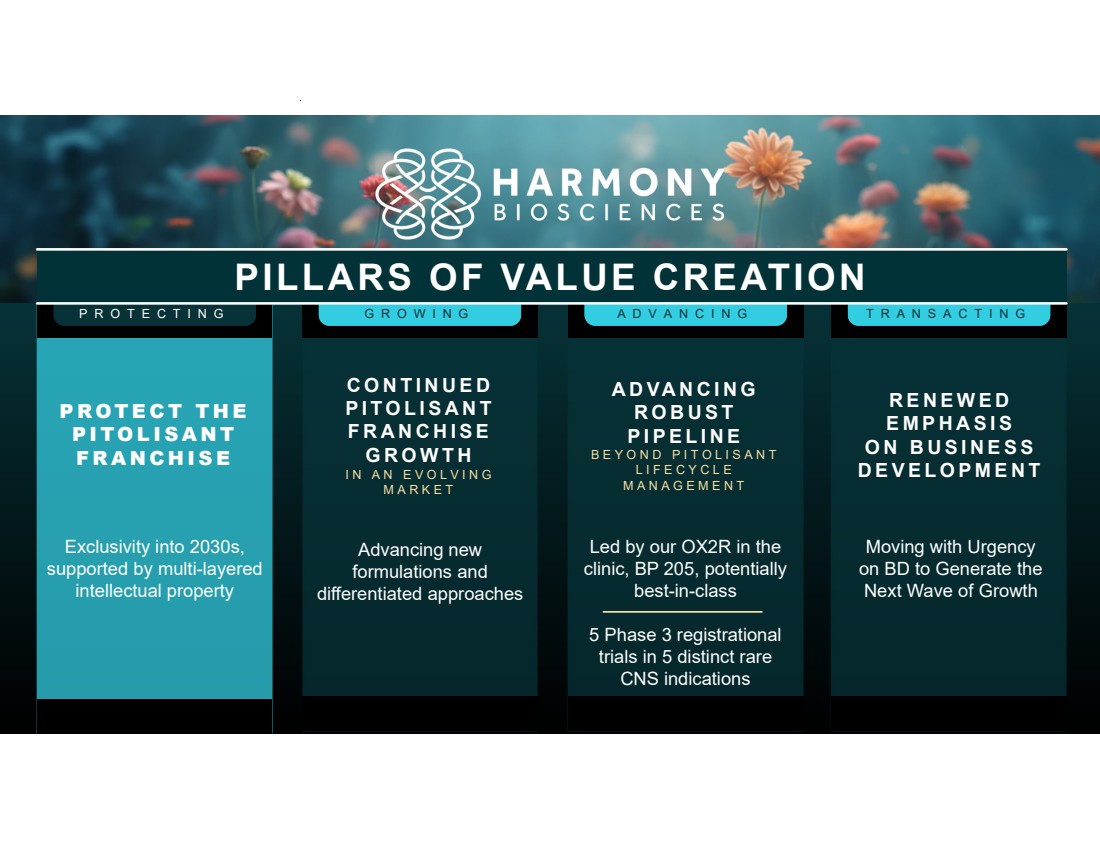
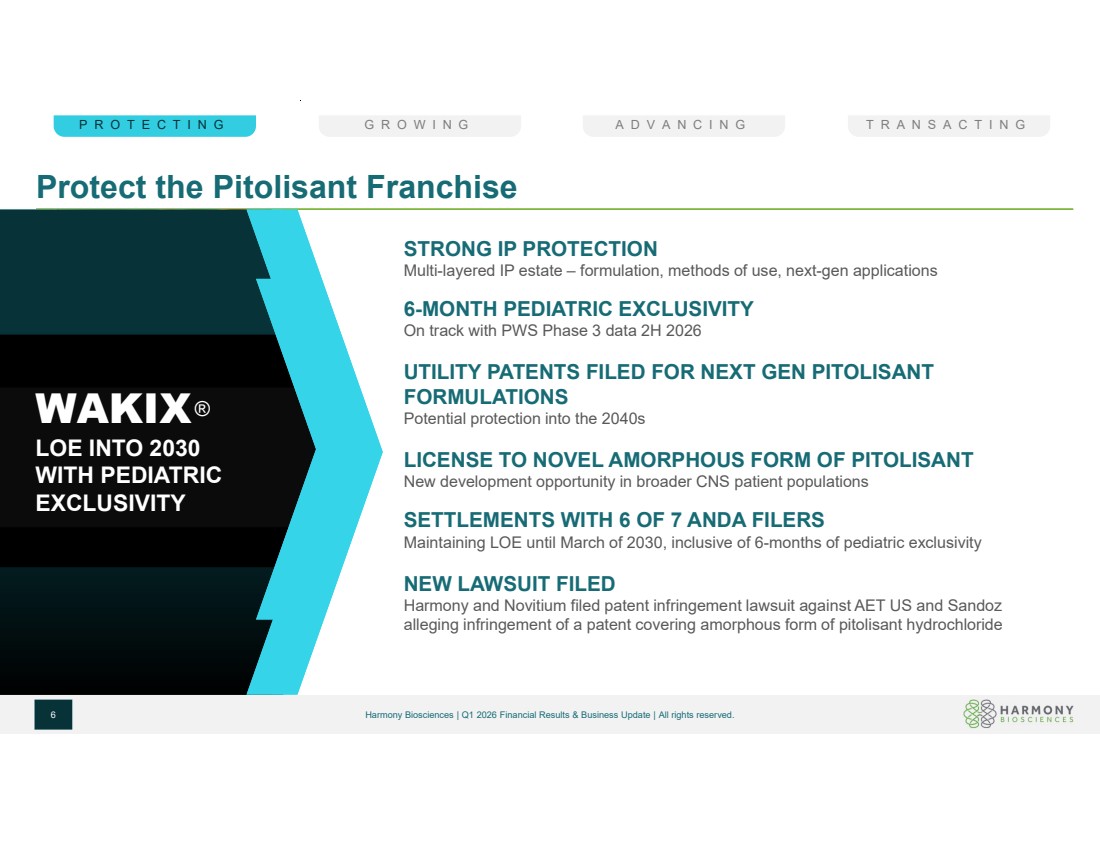
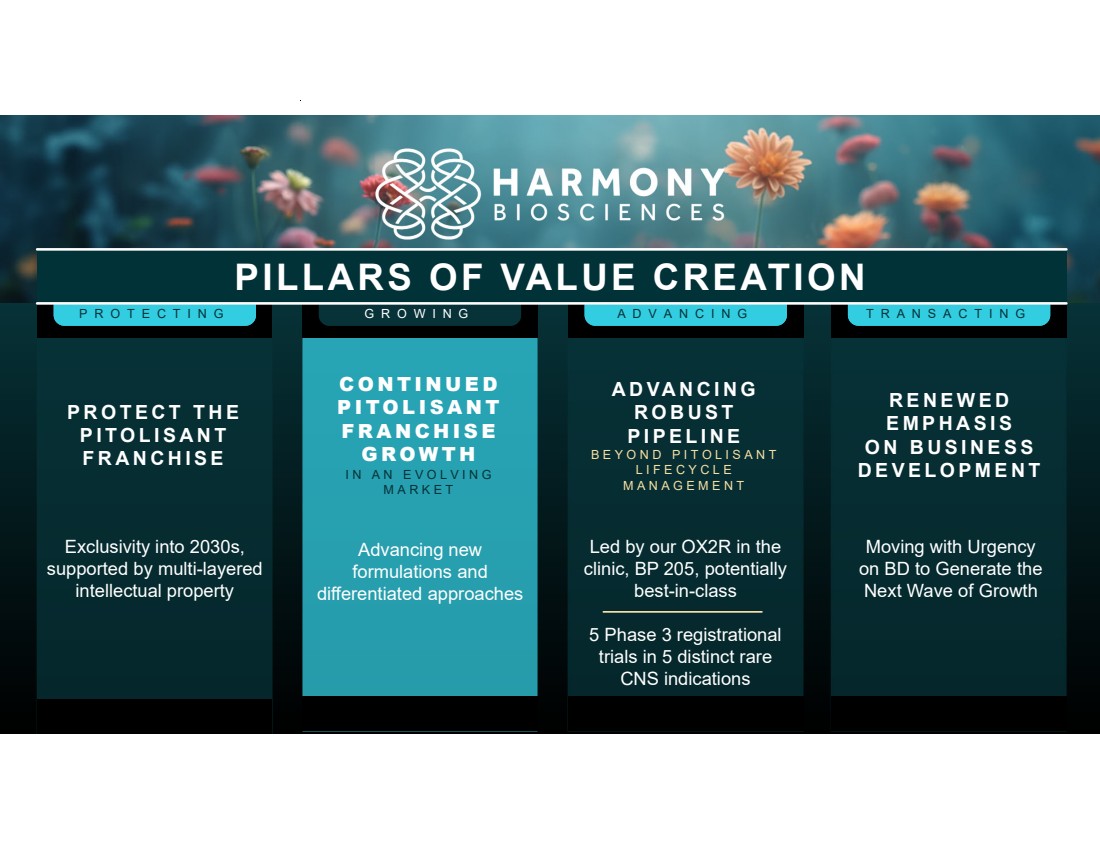
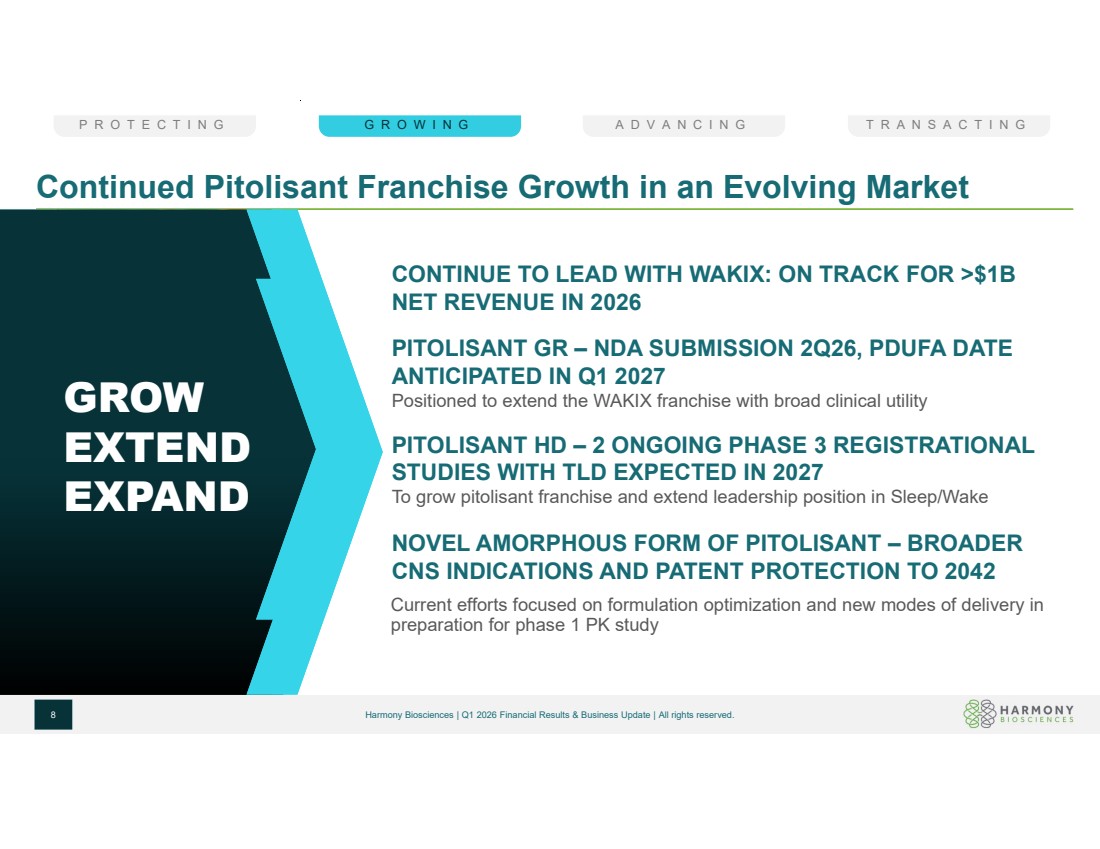
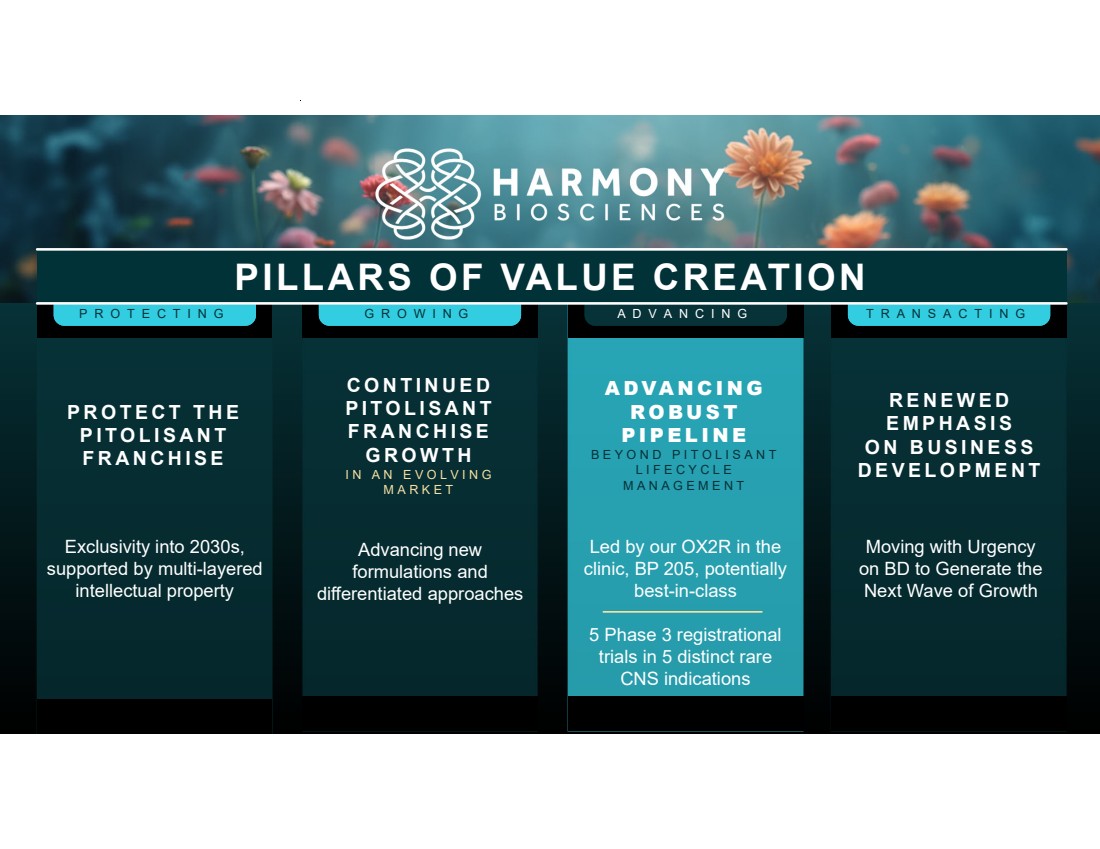
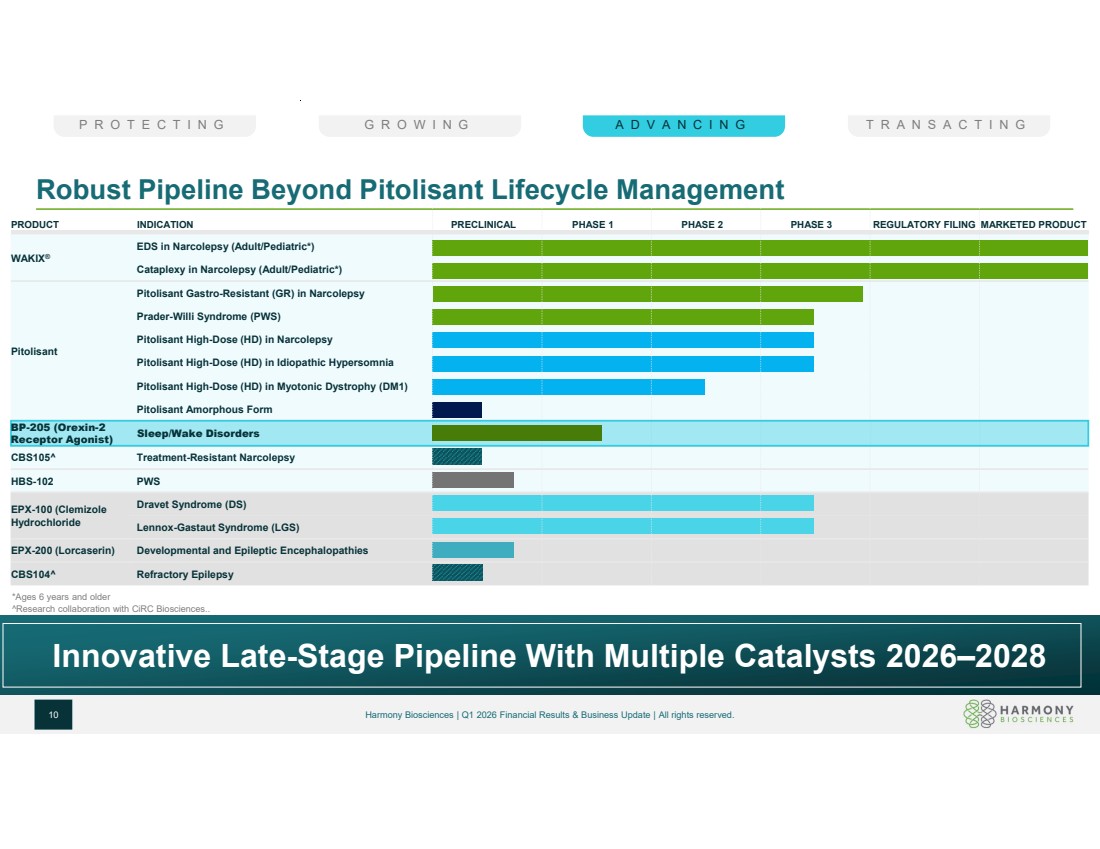
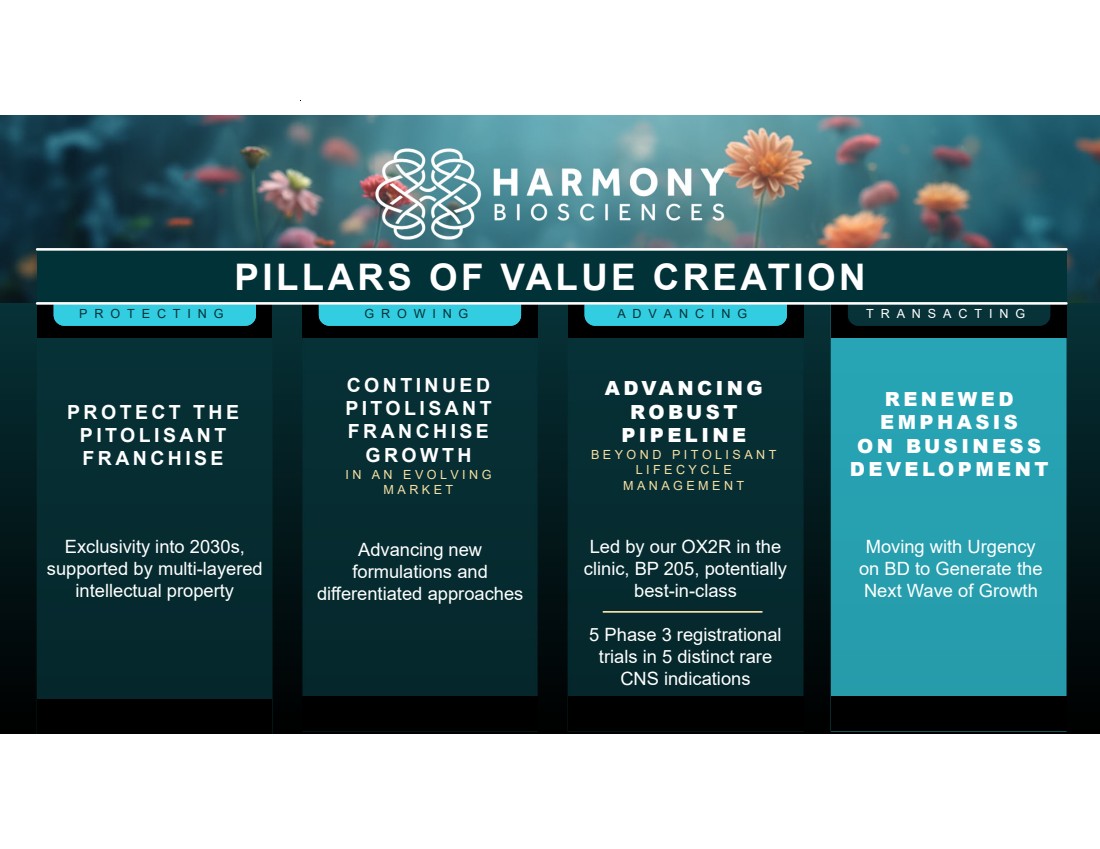
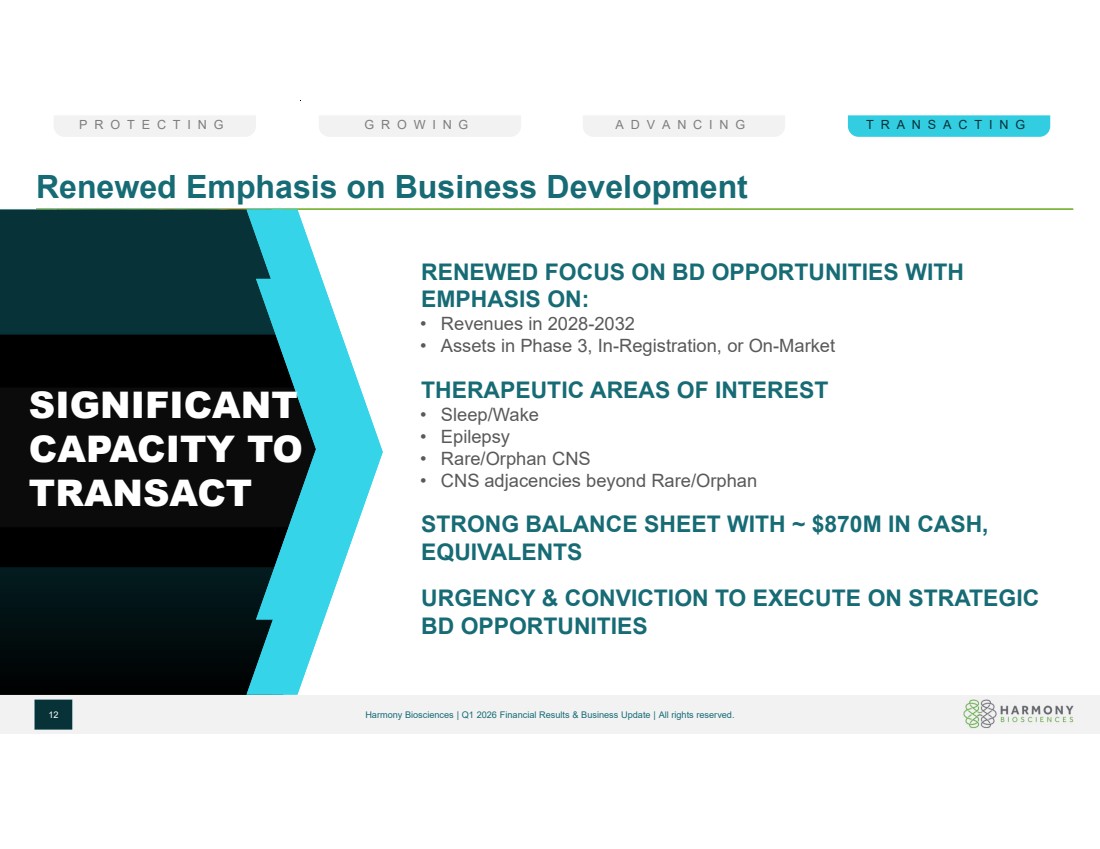
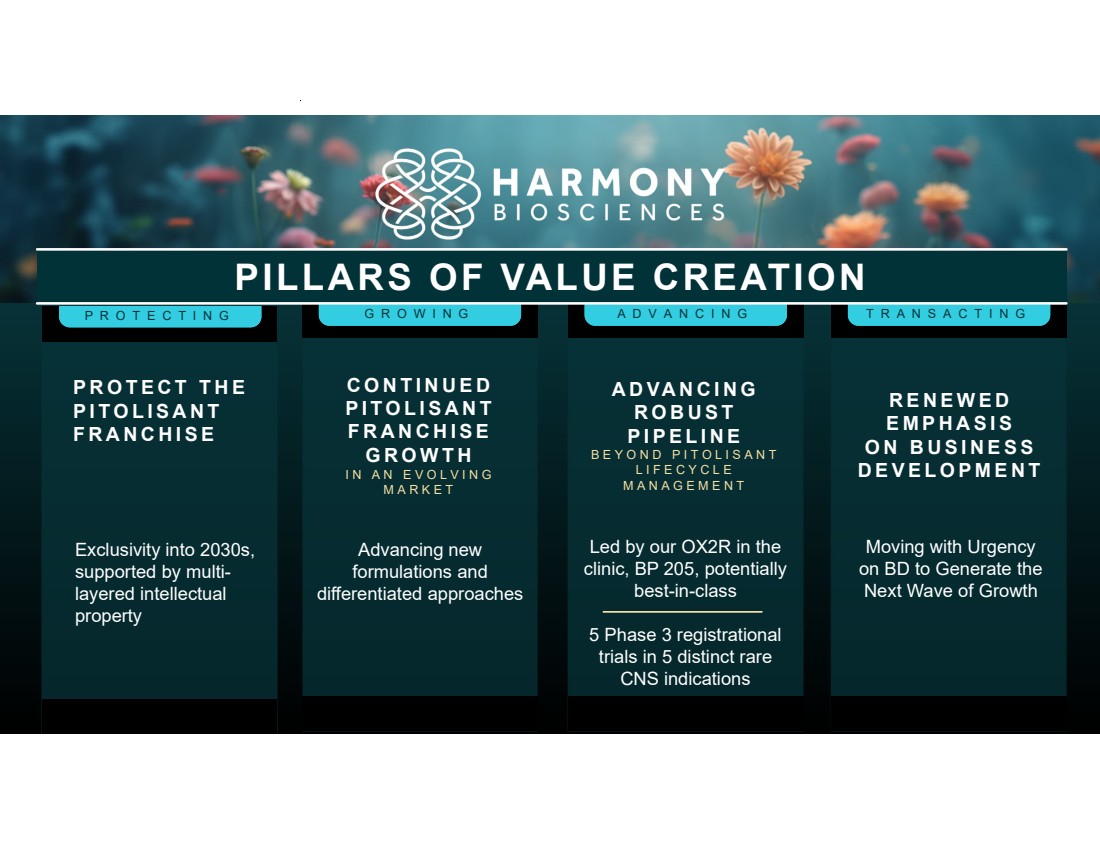
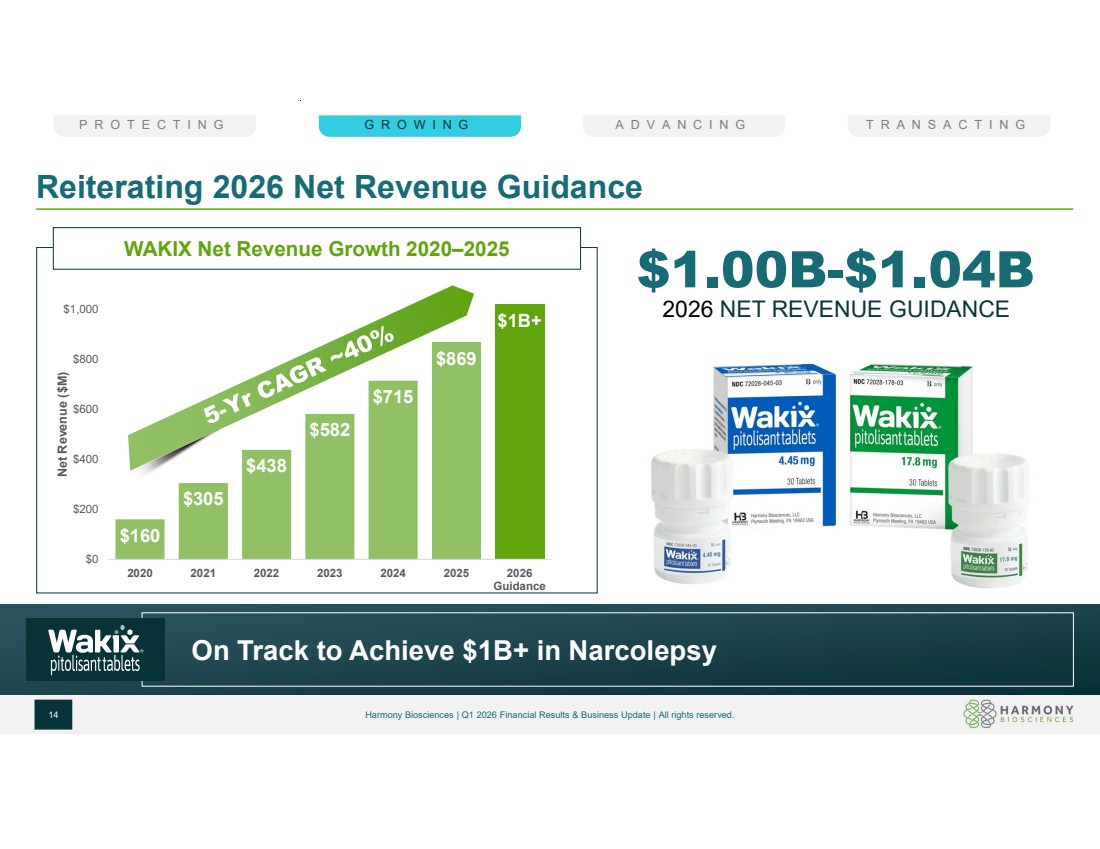
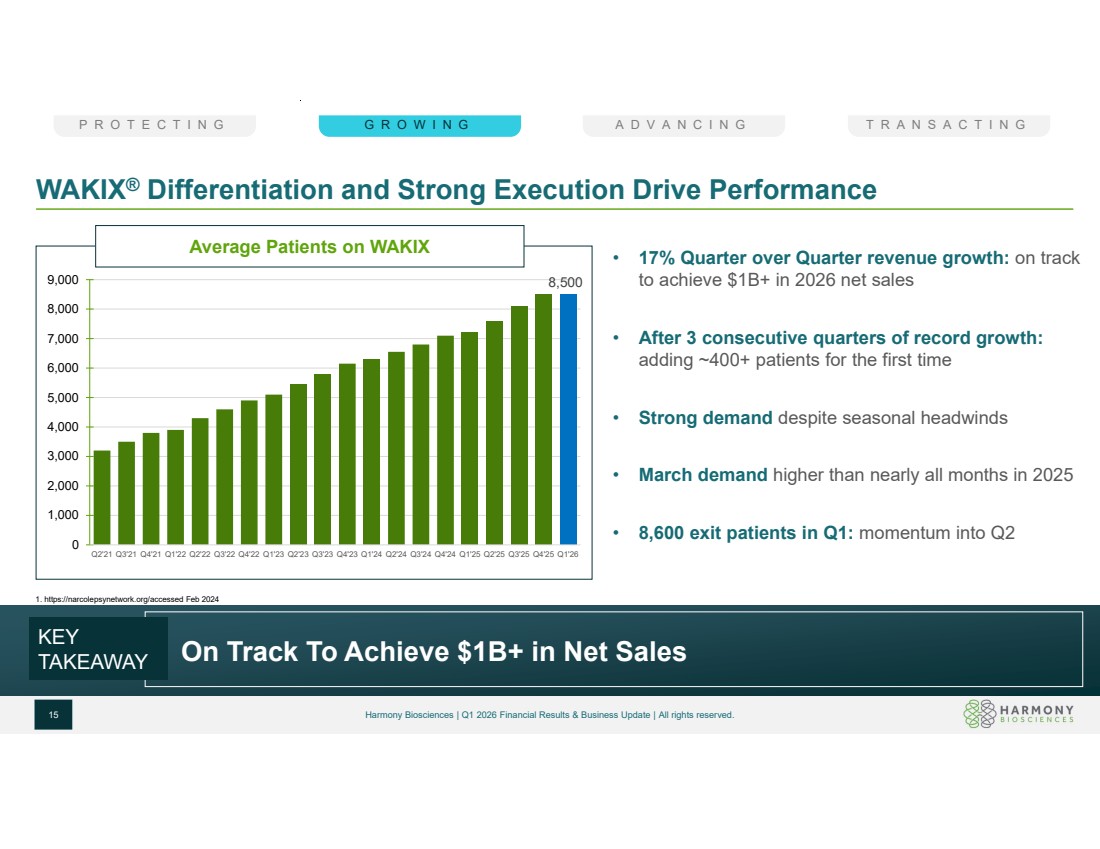
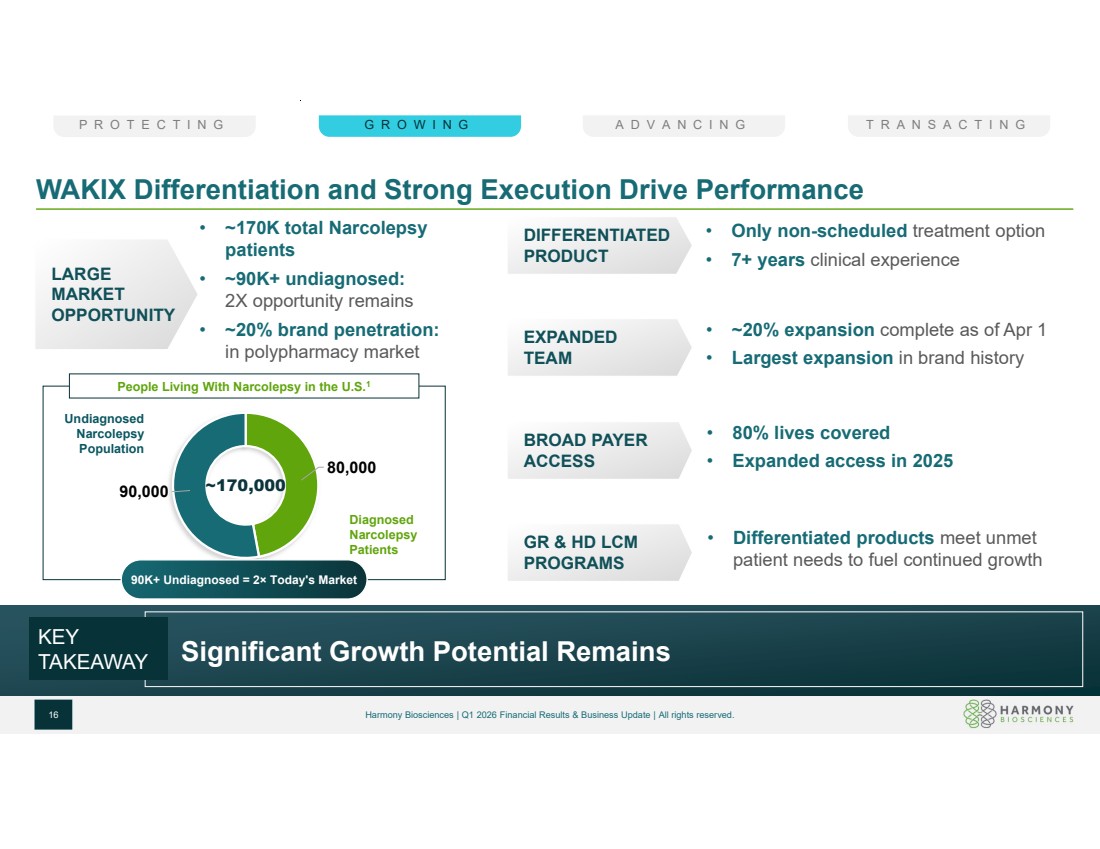
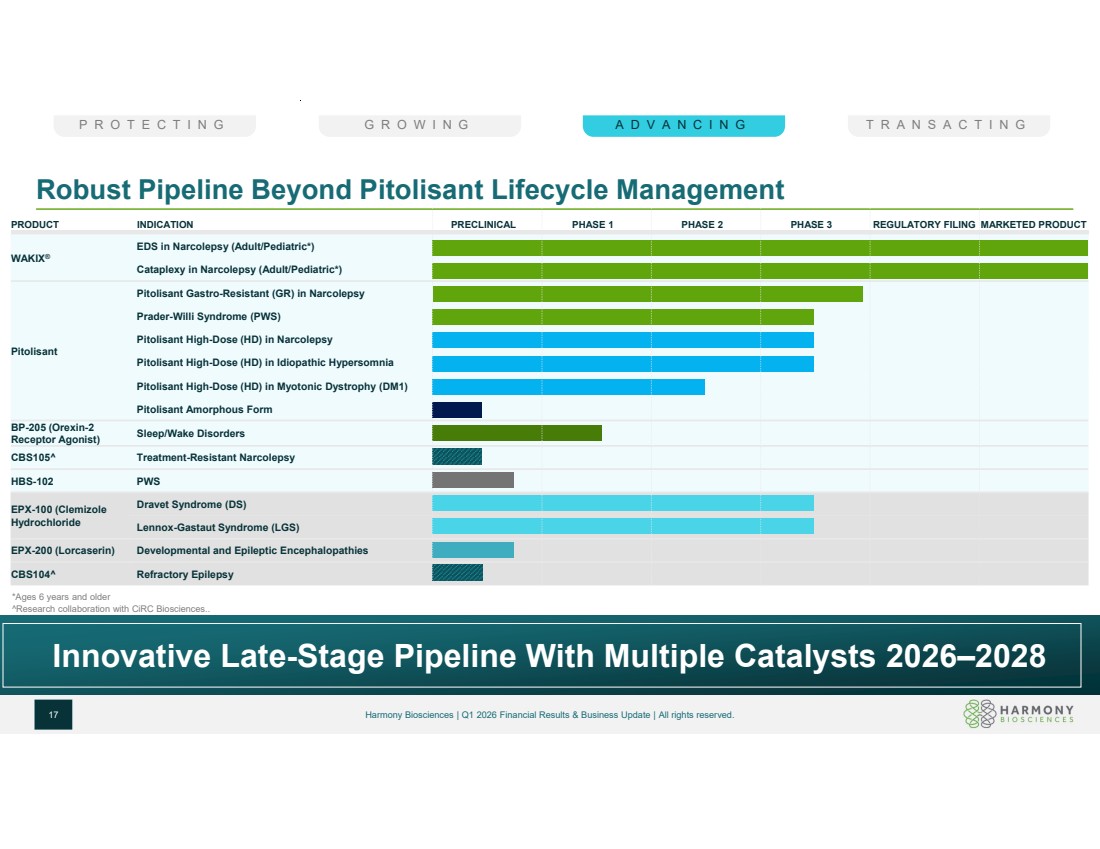
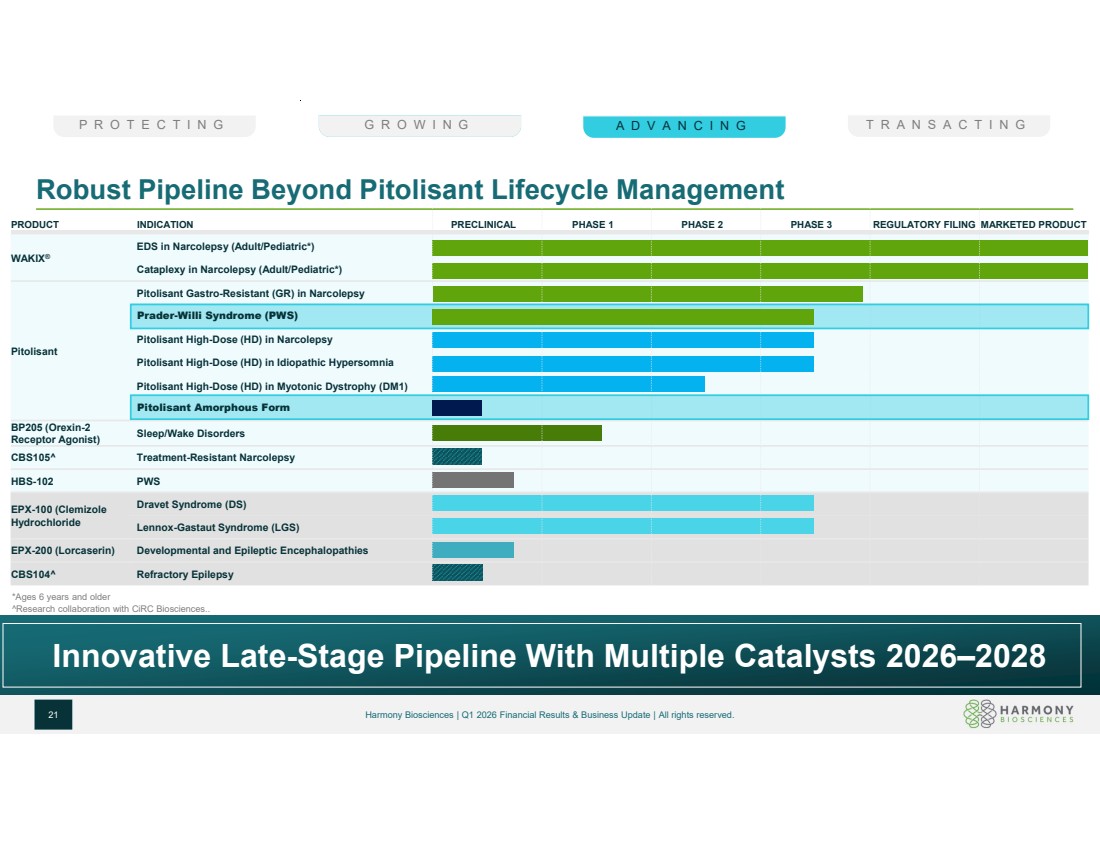
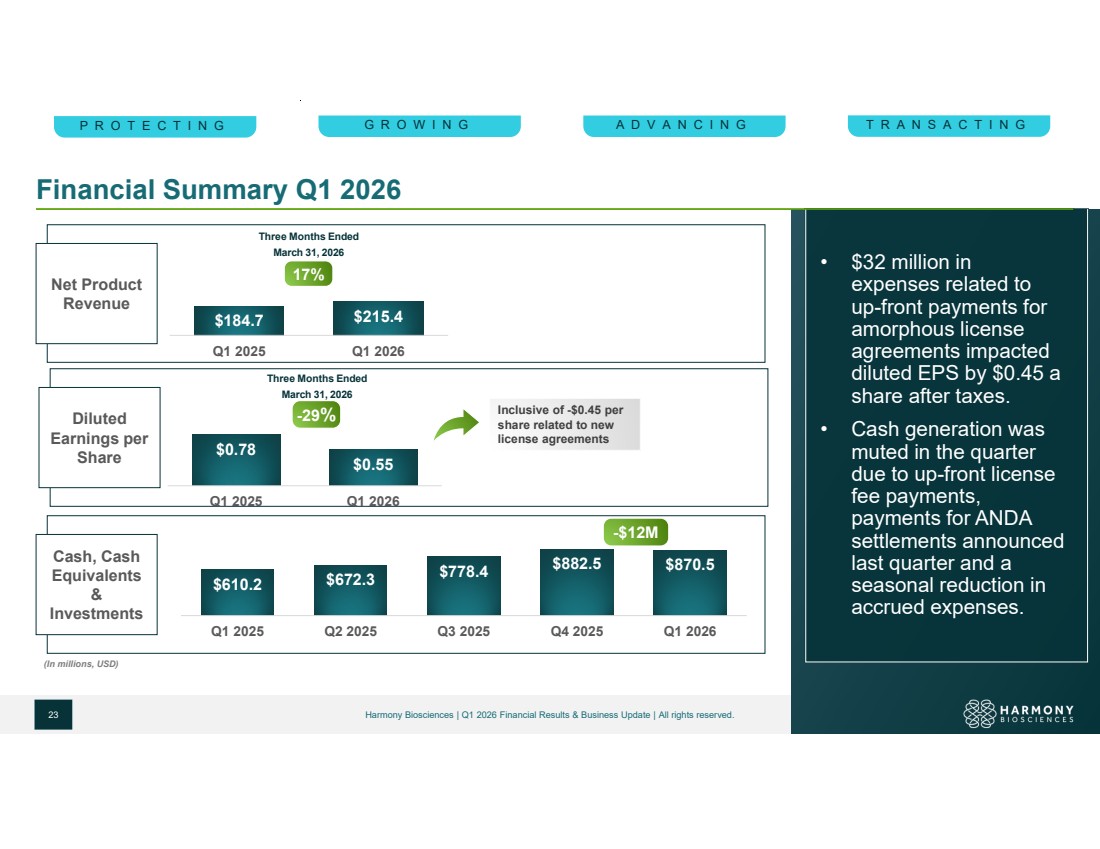
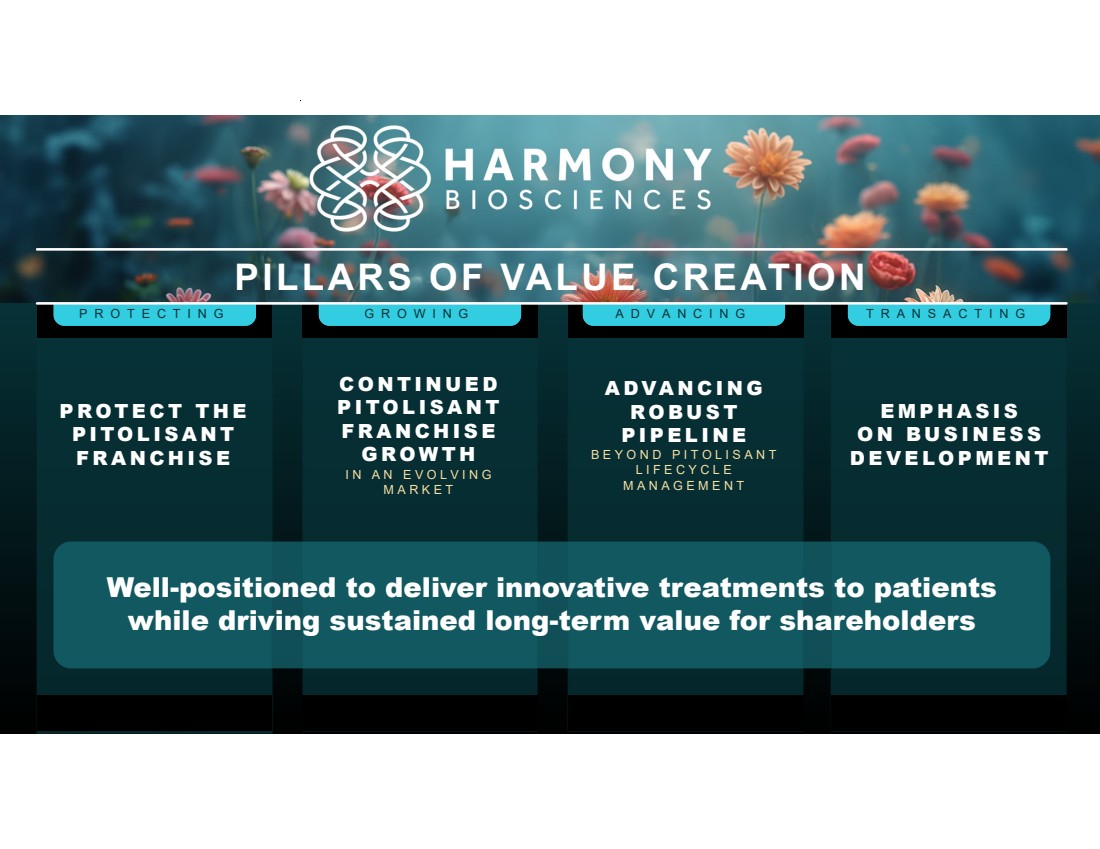
Thank you, Brennan. Good morning, everyone, and thank you for joining our call today. I want to start by highlighting what we have built at Harmony. We are a profitable, self-funding biotech company that continues to operate from a position of strength. We have an exceptionally strong commercial engine, which continues to drive WACIX growth now in year seven on the market. We have recently solidified our IP position around the Patollison franchise through a multi-layered approach. We have a robust pipeline centered around BP-205, our potential best-in-class Erexin-2 agonist, and we have a very strong balance sheet with the capacity and conviction to execute on meaningful business development opportunities. With this solid foundation in place, we are now turning our focus on four key pillars of value creation for shareholders. In support of this next phase of growth, we have brought in two new members to our management team who further strengthen our ability to execute as we scale. First, I am pleased to welcome our new Chief Financial Officer, Glenn Rison. Glenn is a seasoned biopharmaceutical executive with extensive experience across publicly traded and privately held companies, guiding them through key growth inflection points. With his experience as a sell-side analyst, investor, and biotech CFO, Glenn brings a strong track record of success in strategic planning, capital markets, and fundraising. Next, welcome to Peter Anastasio, our new Chief Operating Officer, who brings more than 30 years of experience in the industry and comes into this role after having served on Harmony's Board of Directors, where he contributed strategic insights across the business during a period of continued growth and operational evolution. Most recently, Peter served as Chief Executive Officer of Capsida Biotherapeutics and previously held multiple leadership roles at Lundbeck, including President of U.S. and Canadian Operations and U.S. Chief Commercial Officer for its Psychiatry and Neurology franchises. I am excited to welcome both Glenn and Peter to the Harmony team. Their combined experience meaningfully strengthens our leadership bench and positions us well to execute on our four strategic pillars of value creation, which I will now walk you The first pillar is to protect the Patulsan franchise into the 2030s. We are committed to protecting the Patolescent franchise through a multi-pronged strategy that is based on strong intellectual property protection and exclusivity. Patolescent's IP estate is multi-layered, covering different formulations, methods of use, and next-generation applications, which support WACIX exclusivity into 2030, inclusive of six months of pediatric exclusivity. with potential IP protection of the franchise into the 2040s via additional issued patents and pending patent applications. In January, we also acquired an exclusive license from Novidium for certain IP, including their issued patents out to 2042, covering an amorphous form of patollicin hydrochloride, which provides us with new development opportunities. With regard to the ANDA litigation and the trial that took place in February, we have settled with six of the seven ANDA filers, maintaining LOE until March of 2030, inclusive of six months of pediatric exclusivity. During the trial in February, AET, the one remaining ANDA filer who has not settled, stated that their product contains an amorphous form of ptollicin hydrochloride, rather than a crystalline form covered by our 197 polymorph patent. After learning that, Harmony, along with Novidium, recently filed a patent infringement lawsuit against AET Pharma US and Sandoz, alleging infringement of a patent covering an amorphous form of ptollicin hydrochloride. This suit is a new action, different from the legal proceeding of the ANDA litigation trial that took place in February, which is ongoing, and is being presided over by the same judge. Based on this legal activity, we remain confident in the strength of our IP estate and continue to vigorously protect it through this multi-pronged strategy. Second, we are dedicated to the continued growth of the Patolicent franchise in an evolving market. In Q1, we delivered $215.4 million in net product revenue, up 17% from $184.7 million in the same period last year. This performance reflects continued strong demand, offset by market access headwinds observed every Q1, following three of the strongest consecutive quarters in Harmony's history. The average number of patients in Q1 was approximately 8,500, and we exited the quarter with approximately 8,600 average patients on WACIX. These patient numbers are in a market of 80,000 diagnosed patients with narcolepsy, showing the significant market opportunity that remains to support continued growth of WACIX and the Patolicin franchise. Based on this, we are reiterating our full-year net revenue guidance of $1 billion to $1.04 billion. In addition to the continued growth of WACIX in the market, our NextGen Patolescent Formulation Programs are advancing. Patolescent GR remains on track for NDA submission this quarter with a target PDUFA date in Q1 2027 and is positioned to extend the WACIX franchise and our leadership in narcolepsy. Patolicin HD is enrolling in two ongoing Phase III registrational trials, one in narcolepsy and one in idiopathic hypersomnia, or IH, designed to expand the franchise with differentiated We have also initiated a new development effort with the amorphous form of patolicin that we licensed from Novidium. This gives us an opportunity to pursue broader CNS indications, and Kumar will share more color on this new opportunity later in the call. Our third pillar of value creation is driving value from our robust pipeline, led by BP205, our potential best-in-class or Rexin-2 agonist. We do not believe our current valuation reflects the strength of our pipeline. especially related to our highly potent and selective Erexin-2 receptor agonist, BP-205. This program is on track for top-line data readout from our Phase I clinical PK single ascending dose study the middle of this year. Built on a novel chemical scaffold with strong preclinical PK safety, efficacy, and tox data, BP-205's potential product profile could position it as a highly competitive Erexin 2 agonist, not just in narcolepsy and other central disorders of hypersomnolence, but also for broader indications outside of sleep-wake that are not due to Erexin deficiency, for which potency matters. Overall, our robust late-stage pipeline consists of five ongoing Phase III registrational trials across five distinct CNS indications, including the two Phase III registrational trials with EPX100 in the rare developmental and epileptic encephalopathies. Kumar will provide more detail on BP-205 and our other pipeline programs during his R&D update. And our fourth value-creating pillar is a renewed emphasis on business development. We are focused on opportunities with revenue potential in the 2028 to 2032 timeframe, prioritizing assets that are in Phase 3 development, in registration, or on market, and we are maintaining our therapeutic areas of interest that include sleep-wake, epilepsy, rare-orphan CNS disorders, and CNS adjacencies beyond rare diseases. With about $870 million on the balance sheet, we are moving with urgency to deploy our capital and have clear conviction to execute on strategic business development opportunities. In summary, I have outlined four pillars of value creation that we believe matter most to investors and will serve as the framework by which our performance will be measured. Next, the team will share with you the highlights of how we are executing on each of these strategic pillars. With that, I'll turn the call over to Adam Zewski, our Chief Commercial Officer, for an update on our commercial performance.
Adam? Thank you, Jeff, and good morning, everyone. We're off to a strong start in the first quarter, with Wacix delivering $215.4 million in net sales, representing 17% year-over-year growth, now in its seventh year on the market, which is in line with the growth required to achieve full-year guidance of between $1 and $1.04 billion. Wacix achieved approximately 8,500 average patients in the first quarter, Q1 typically has lighter patient additions due to seasonal dynamics, the entire industry experiences every year. This year we saw slightly higher market access headwinds than previous years, with a higher level of plan changes, plan switching by consumers, and higher premium increases, which can delay patient starts. That said, we're coming off our strongest ever three consecutive quarters of patient ads. First quarter demand was actually higher than the first quarter in 2025 and was in line with our recent performance and expectations. In March, we saw a higher level of new prescriptions than all but two months in 2025, and we exited the quarter with 8,600 patients on WACIX. The driving force behind this continued performance is clear. WACIX owns a unique and highly differentiated position as the only non-scheduled treatment option for narcolepsi in patients. After seven-plus years of clinical experience, healthcare providers are deeply aware of WACIX. They believe in its combination of efficacy, safety and tolerability, and low drug-drug interactions, as well as its broad payer coverage, making it a familiar go-to option for any patient with narcolepsi and in any combination with other therapies in a highly polypharmacy market. and this will continue to remain true as the market continues to evolve. We've now also completed our field team expansion, which has expanded our presence by roughly 20% across field sales, remote sales, and field reimbursement. This represents the largest expansion and increase in investment in the history of the brand. All of those positions have been hired and are in place as of April 1. In Q2, we will launch a new online portal, easing the process to prescribe WACIX for healthcare providers and office staff, and we will execute significant changes to our reimbursement support process, helping patients to secure a WACIX expense faster and with higher success rates. Looking to the future, we're excited about our two lifecycle management strategies to extend and expand the Patolis and Franchise. Patolicin GR will build on the strength of Wacix safety and tolerability profile and allow patients to gain faster results by starting at a therapeutic dose. Patolicin HD, or high dose, will bring a totally new optimized formulation to the market with up to two times the approved dose of Wacix, all of the benefits of the GR formulation, and differentiated labeling regarding fatigue in narcolepsy and sleep inertia in IH. We're also excited about our erection compound as we see an opportunity remains for Harmony to deliver an erection that delivers on the promise of efficacy with a better safety and tolerability profile once daily dosing and indications across NT1, NT2, and IH. To summarize, we're on track to achieve $1 billion plus in net sales this year, And we're excited about our pipeline with multiple assets that will extend our leadership and sleep-wake for at least the next decade. I'd like to now turn the call over to our Chief Medical and Scientific Officer, Kumar Badur, to discuss the advancements in our clinical development programs. Kumar?
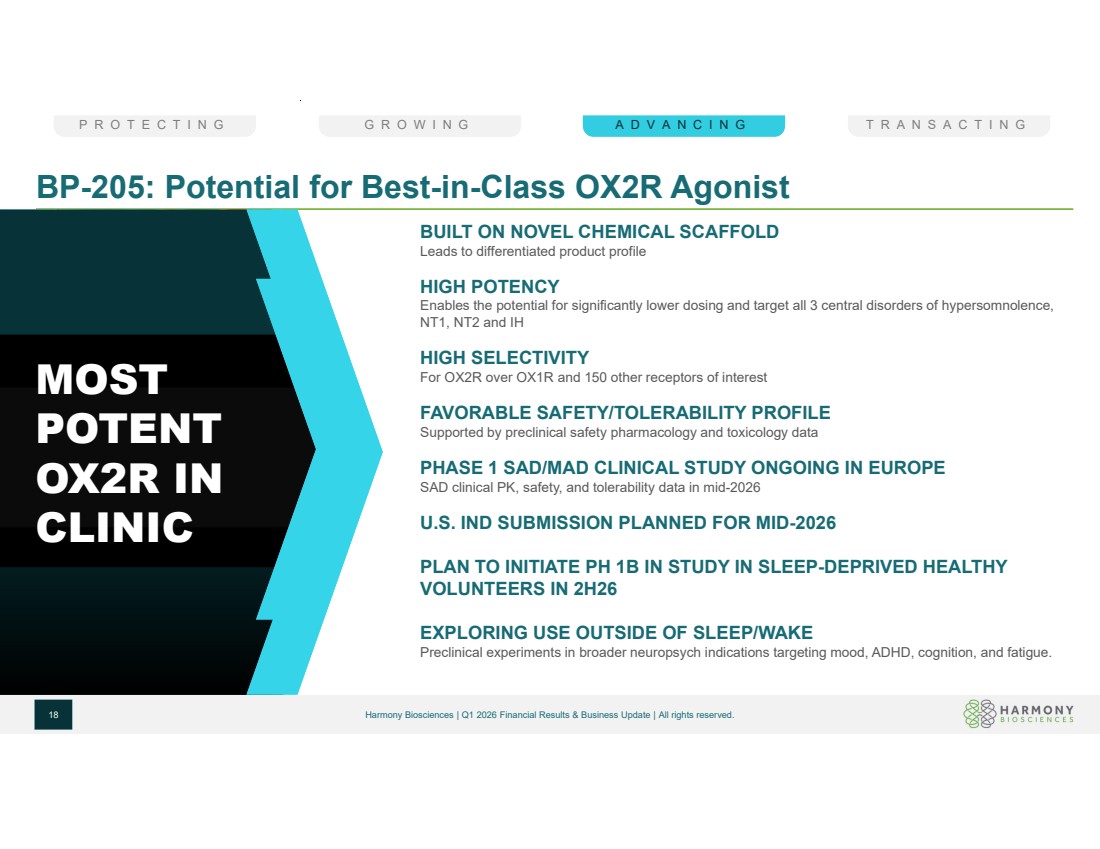
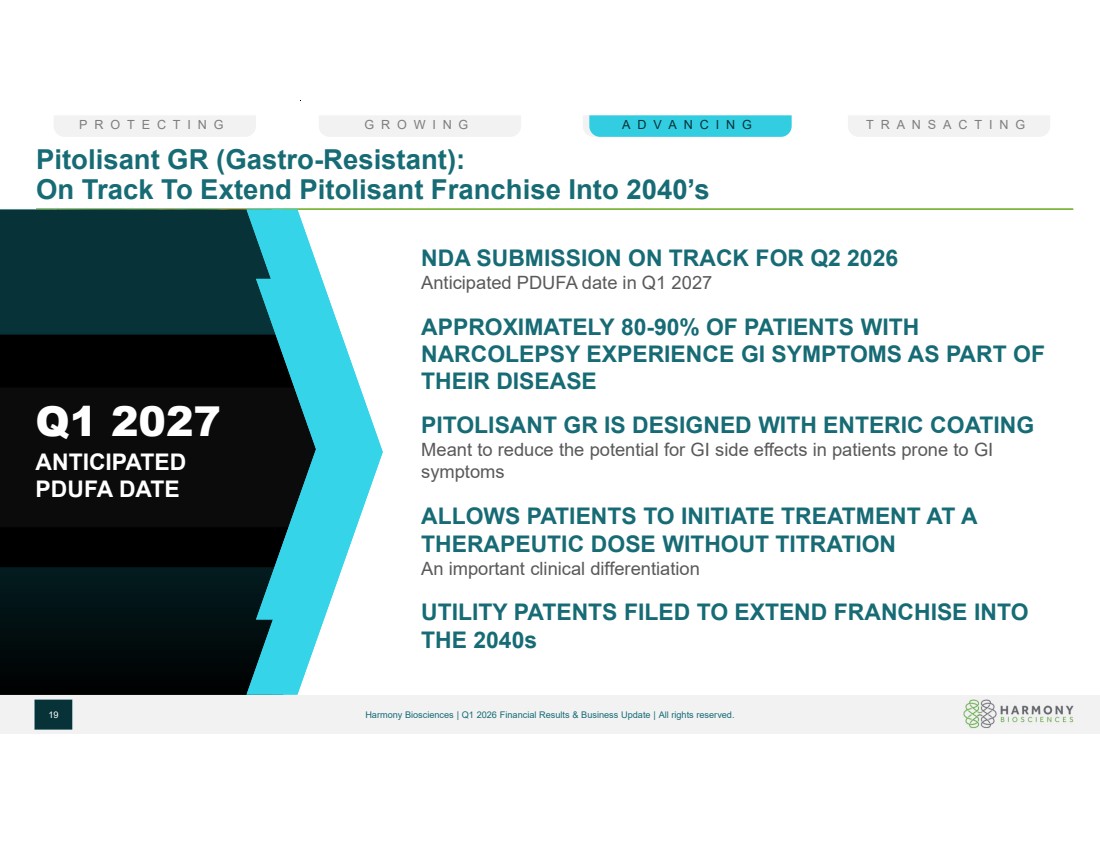
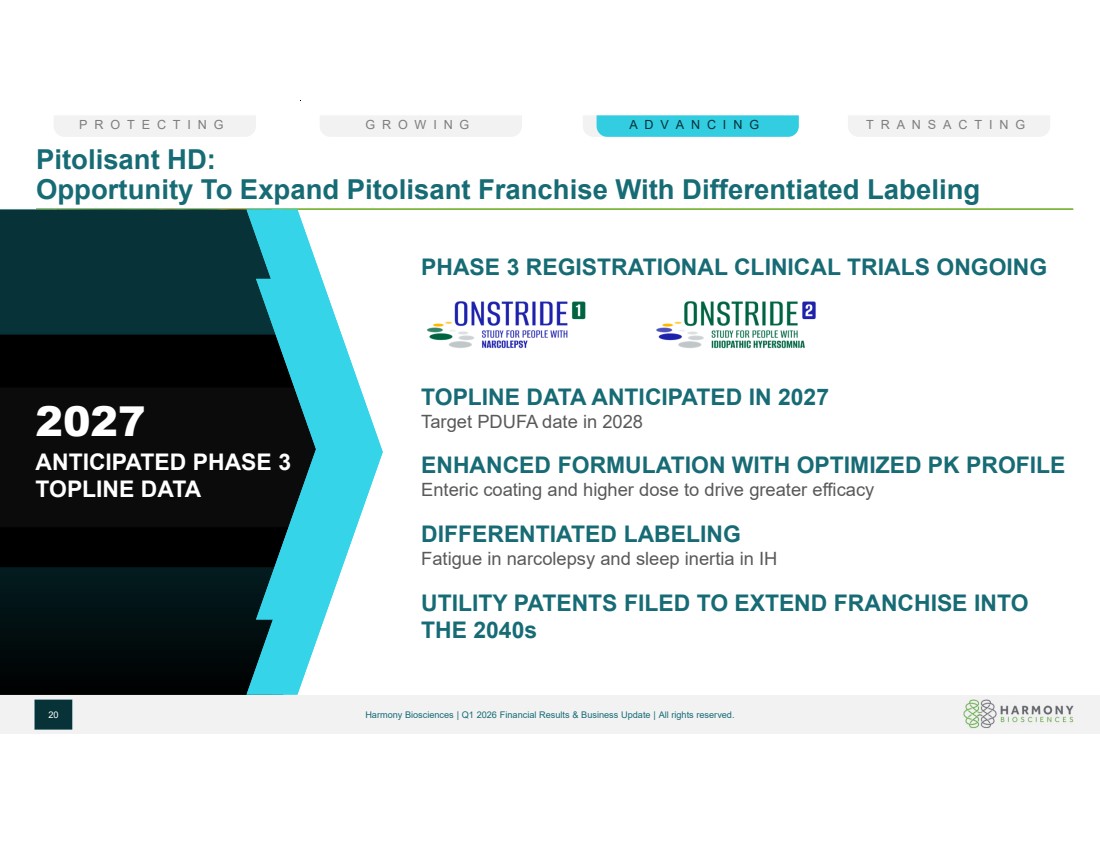
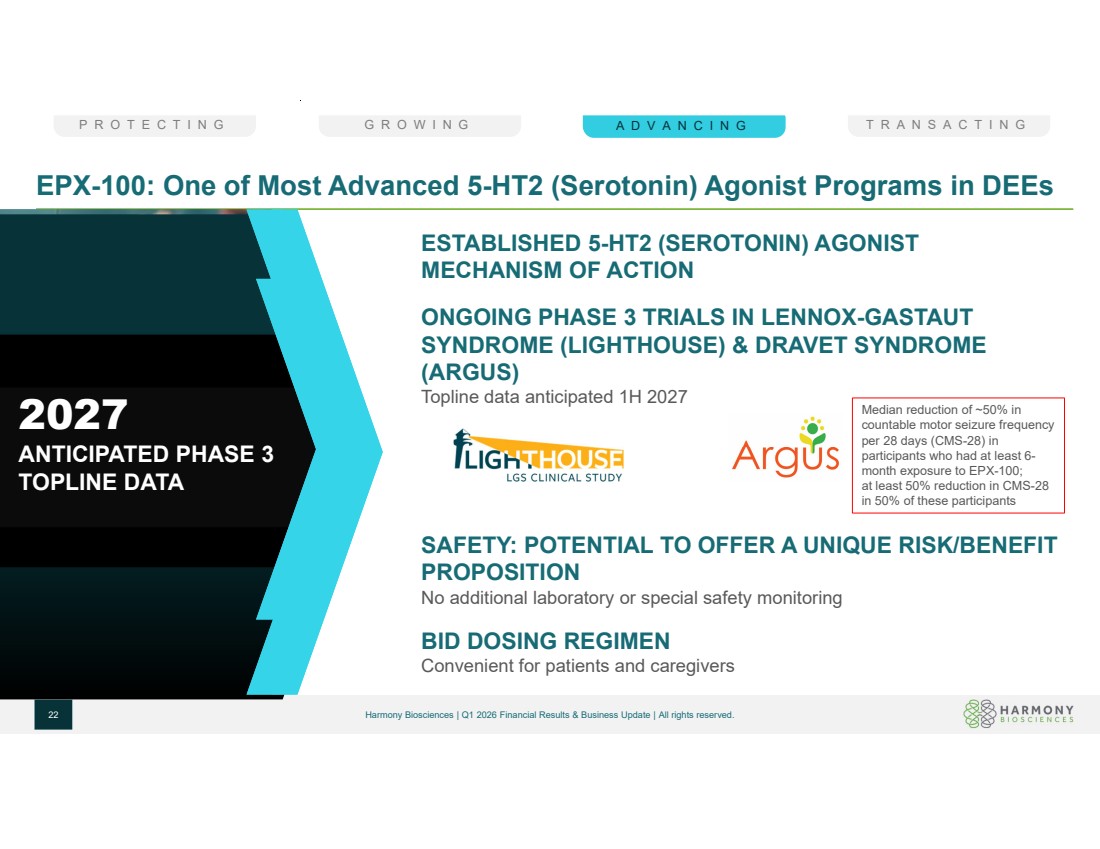
Thank you, Adams. Good morning, everyone, and thank you for joining us today. Q1-2026 was a quarter of continued progress across our pipeline. We have five ongoing phase three registrational clinical trials across five distinct CNS indications, and I will walk you through the key updates. As Jeff noted, RxM is one of the most exciting areas in sleep-wake and broader neuroscience I would like to start with the progress we are making with our Oryxin-2 receptor agonist, BP205, an asset we believe has meaningful potential that is not yet reflected in how our pipeline is being viewed today. BP205, with its unique clinical scaffolding, has demonstrated compelling preclinical potency, selectivity, safety, and a potential for once a day dosing, all supportive of a potential best-in-class orexin-2 receptor agonist. It is the most potent orexin-2 receptor agonist in clinical development and demonstrated weight promoting asset at the lowest dose tested in the transgenic mouse model for narcolepsy. The high-potency gives the flexibility to use low doses and treat all three central disorders of hypopromyalin, that is NT1, NT2, and IH with the same compound. BP205 also has high selectivity for Oryxin-2 receptors over Oryxin-1 receptors and 150 other receptors of interest. We continue to dose healthy volunteers in our Phase I SAD MAG-PK study in Europe, and we remain on track for Phase I SAD-PK data in mid-2026. We are also on track for U.S. IND submission in mid-2026 and commence sleep-deprived healthy volunteer study in the second half of this year. As we make progress with our lead asset, BP-205, targeting central disorders of hypersalmolens, we are also working on preclinical experiments in broader neuropsych indications targeting mood, ADHD, cognition, and fatigue. Now, moving to pitolocent and the life cycle opportunities, beginning with pitolocent G-option. We remain on track for NDA submission in Q2-2026 under target BUDUFA date in Q1-2027. About 80 to 90 percent of patients with narcolepsy have GI symptoms related to the pathophysiology of narcolepsy itself. Pitocin-GR is designed with enteric coating meant to reduce the potential for GI side effects in patients prone to GI symptoms. Pitolocin G-OPS demonstrated bioequivalence to WACIX in our Tuvotel-BE study, and it also allows patients to start at a therapeutic dose range of 17.8 milligrams without titration, an important clinical differentiation. Pitolocin HD continues to advance in two phase three registrational time, Onstride 1 in Norcalus 3 and Onstride 2 in idiopathic hypersomnia. We anticipate top line data in 2027 and a top date in 2028. These programs are pursuing differentiated labels, fatigue in Norcalus 3 and sleep inertia in IH, addressing symptoms for which there are currently no approved treatments. Both Pitolocent Geo and Pitolocent HD have utility patents filed until 2044. We are also optimistic about the novel amorphous form of Pitolocent we recently licensed from Novitium supported by an issued patent through 2042. We believe this could enable new modes of delivery and broaden Pitolocent's potential in larger CNS indications. We are currently optimizing formulation with the goal of commencing a Phase I PK study. On pediatric exclusivity for VAKEX, the top line data from the Phase III Tempo study in Prader-Willi syndrome is anticipated in second half of 2026, a key requirement for achieving pediatric exclusivity, which gives us additional six-month regulatory exclusivity at the back end of the longest path in for VAKEX. Moving to our epilepsy science side, EPX100 continues to advance in two global phase three registration programs, the AURGUS study in Trouvet syndrome and the Lighthouse study in Lennox-Gistauk syndrome. We recently presented on-course safety and effectiveness data at the AAN meeting from the open-label extension study in Trouvet syndrome that showed clinically meaningful reduction in species and a favorable safety and tolerability profile. We now have five actively enrolling patients in India and China in addition to North America and Europe to accelerate recruitment. We anticipate top-line data in sub-trap of 2027 and a target in 2028. Finally, on behalf of Harmony, I would like to thank all the patients and their families who are participating in our clinical trials, as well as the clinical investigators and site personnel for their dedication and commitment in helping us advance our development programs. I now turn the call over to the newest member of our team, CFO Glenn Rysen, for an update on our financial performance.
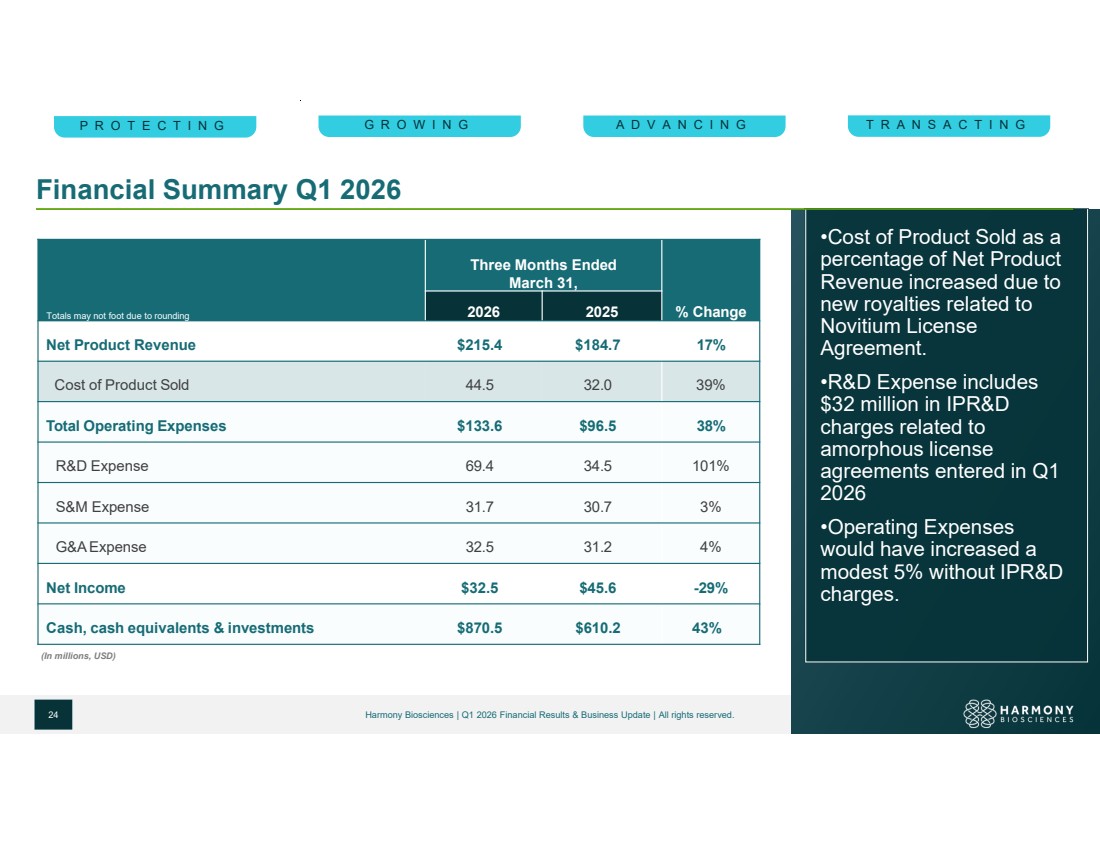
Thank you, Kumar, and good morning, everyone. I'm delighted to join this organization and help contribute to the growth and significant value creation. And I should mention that I was drawn to Harmony by the strength of its commercial foundation and self-funding financial model that positions us to build and grow from a place of strength. This morning we issued our first quarter 2026 earnings release and filed a thank you where you find the details of our financial and operating results. We delivered solid financial results that reflect the continued underlying demand for WACIX in our disciplined approach to managing expenses across the business. For the first quarter of 2026, we reported net revenues of $215.4 million, compared to $184.7 million in the prior year quarter, representing 17% growth. Performance in the quarter reflects the strong underlying demand for WACIX, partially offset by the seasonal market access headwinds the industry sees at the start of every year. Cost of goods or products sold was 20.7% of net sales in comparison with 17.3% one year ago. This year-over-year increase in cost of products sold as a percentage of net revenue was almost entirely driven by new royalties related to the Novidium License Agreement, providing new development opportunities in broader CNS indications. We reported total operating expenses for the first quarter of $133.6 million compared to $96.5 million in the same quarter in 2025. The growth in expenses reflects continued investment in R&D and ongoing investments in the commercialization of weight fixings and narcolepsy. These operating expenses also include the costs associated with upfront licensing fees of $32 million, or $0.45 per share on a fully tax basis related to the amorphous license agreements. Without these costs, operating expenses were up around 5%. Gap net income for the first quarter of 2026 was $32.5 million, or $0.55 per share. This compares with $45.6 million, or $0.78 per share. Of course, that includes $0.45 in costs related to the in-license of the amorphous form of patollicin and new development opportunities. We ended the first quarter with $870.5 million in cash and cash equivalents. Cash flow generation in the quarter was muted by the licensing fees and a large reduction in accrued expenses and a modest reduction of debt. We ended the quarter with $160 million in debt. Cash flow generation will re-accelerate in the coming quarters. That said, it's our intent to deploy cash into business development with the objectives of enhancing revenues in the 2028 to 2032 timeframe, consistent with our four key pillars of value creation for shareholders. And with that, I'd like to turn the call over to Jeff for his closing remarks.
Thank you, Glenn. And again, welcome to the team. In closing, I have shared with you our four pillars of value creation that we feel matter most to investors and will serve as the framework by which our performance will be measured. First, protect the Patulsan franchise into the 2030s. Second, continued growth of the Patulsan franchise in an evolving market. Third, drive value from our robust pipeline centered around BP-205, our potential best-in-class Erexin-2 agonists. And last, a renewed emphasis on business development with our goal to transact. We believe when we execute on these four strategic pillars, we will be well positioned to bring innovative treatments to patients with unmet medical needs, while driving sustained long-term value for our shareholders. Thank you for your attention. I will now turn the call back over to the operator for Q&A. Operator?
Operator
Thank you. At this time, I would like to remind everyone, in order to ask a question, press star then the number one on your telephone keypad. Again, that will be star one on your telephone keypad. We will pause for just a moment to compile the Q&A roster. We have the first question comes from the line of David Amselm of Piper Sanders. Your line is now open. You may ask your question.
Hey, thanks. So, I have a few questions on BP205. Just give us a roadmap on how to think about data milestones as we move through 27, particularly in healthy sleep-deprived volunteers. And then secondly, why not just move right into actual narcolepsy 1 and narcolepsy 2 and IH patients in a phase 1B, just given that it's become a pretty crowded landscape just as a way to expedite development. I wanted to get your thought process there. And then lastly, with other indications, mood, ADHD, cognition, fatigue, as you alluded to, can you talk about early stage work that you're going to be doing over the next 12 to 18 months that could help you decide what paths to take in terms of the non-sleep break indications. Thanks.
Good morning, David. Thank you for your question. With regards to BP-205, first let me frame overall, you know, our excitement around, you know, the potential opportunity we have, you know, with our orexin-2 agonists. And it's really based on, you know, as you've heard us say, the novel chemical scaffold and really the highest potency of any Erexin-2 agonist in the clinic. With that, it gives sort of the differentiated features with a product profile likely to be best in class. With regards to timing of the development program and other indications, first, the issue with indications outside sleep-wake and central disorders of hypersomnolence, The opportunity there is that those are not based on a state of erecting deficiency. In those conditions, potency matters, where we think we would have a significant opportunity, not just with BP-205, but other compounds that we're working on with our partner, BioPergé. So now I'll ask Kumar to sort of provide, you know, what the timeline looks like on the current development program.
Thank you, Jeff. Good morning, David. You asked several questions, so let me try and answer one by one. In terms of data milestones, we are on track to receive single ascending dose clinical PK data in the middle of this year. We also continue to dose patients in multiple ascending dose study, the food effect study, things like that that are important before we go to the later clinical stage of development. In terms of your question, why not go straight into clinical proof of concept rather than sleep-deprived healthy volunteer study? Great question, David. One thing to remember is BP205 is the most potent OREXN receptor agonist in clinical development. So it's good to get a nice bracket around the dose range before we go into clinical proof of concept studies. and also another thing to remember is this is not going to add to the timeline this is done in parallel with the multiple ascending dose study and the data we need that before we go into clinical proof-of-concept studies. You also talked about the other indication since we are very excited about the profile of BB205. Most important OREX receptor agonist and Jeff alluded to some extent in his response, it's very important that potency translates into efficacy, and we saw that in our preclinical animal models, and in other indications, it becomes all the more important because we'll be depending on some of the downstream effects of the orexide receptor agonists in conditions like mood, fatigue, cognition, ADHD. We are conducting several preclinical experiments right now, and as the data becomes available, we'll be able to disclose. Hope that answers all of your questions. Thanks, David.
Yeah, and David, final comment on that. I think as I've discussed with the team, given the potential value of this class of compounds, it's our intent to invest in this program with regard to where we are now, additional compounds, and look at the broad opportunity with not just BP-205, but other compounds that we're working on. Thanks, David.
Operator
Thank you. Again, if anyone would like to ask a question, please press star 1 on your telephone keypad, and we kindly ask each participant to limit their question to one question and one follow-up. Next question comes from the line of Ami Fadiyev from NIDAM. Your line is now open.
Good morning. Thanks for taking my question. Maybe one main question and a follow-up. You gave some sense about the litigation versus AET standards, and there seem to be two trials here. Can you talk about kind of what we can expect in terms of next steps with regards to how the litigation might proceed over the course of the next couple of months? And then a follow-up on the orexin question from earlier. With the sort of higher potency that you've highlighted, how do you see it being differentiated in the sleep-wake area relative to the other orexins that are in development? And then can you elaborate a little bit more on the other indications? Do you see that, you know, other indications such as ADHD mode, fatigue, et cetera, being ones where you would study it as a combination treatment with other acids, or do you see it being developed both as a monotherapy and then also explore other combinations?
Morning, Ami. Let me address your first question, and then I'll have Kumar address the follow-up on BP205. So I want to take a minute or two to provide clarity with regards to the IP situation and around the WCAG and Patolis and IP estate. Before I provide some detail, I first want to be clear about our position. We believe in the strength of our IP, and we continue to vigorously protect it. And it's based on a multi-pronged strategy with Patolis and IP estate, which is also multi-layered. So with regard to some of the detail to provide clarity. So recall, we settled with six of the seven antifilers. AET was the one remaining party who went to trial in February. That legal process continues. It's currently in post-trial briefs. and that part of the process will be completed towards the end of May. So during the trial in February, AET and Sandoz stated that the product will contain an amorphous form of a Tulsan hydrochloride rather than a crystalline form, which is covered by our 197 polymorph patent. And they did that in an effort to work around that IP. So we believe that AET and Sandoz infringe our 197 patent, and during the trial, they also admitted to the facts that they infringed the 920 amorphous patent that we licensed from Novidium. Based on that, when we learned of that at the trial, that is when Harmony and Novidium recently filed the patent infringement lawsuit against AET Sandoz. alleging infringement of the 920 patent covering an amorphous form of the tollicin hydrochloride. So that suit is a new and separate action, different from the legal proceedings of the Andal litigation that took place in February which is ongoing. And that new suit is also being presided over by the same judge. That is a new legal proceeding which is just getting started. So Based on this multi-pronged strategy, the different factors that I just mentioned, we remain confident in the strength of the IP estate, again, which is multi-layered with multiple components, enabling exclusivity into 2030, inclusive of six months of pediatric exclusivity. Kumar, over to you.
Thank you, Jeff. Good morning, Gami. So in terms of potency, you may have heard me talk about it many, many times in the past as well, why potency matters with RxN2 receptor agonists. It matters because it gives us the ability or the flexibility to use low doses to target all three central disorders of hypersomalens. how it could potentially manifest itself in a clinical setting well with low doses will be able to avoid the off-target AES that's number one the number two is having a high potent drug as we know the doses required for NT2 and IH are relatively larger based on the data that we have so it provides us an opportunity to use the same compound to treat all three central disorders of hypersomnolens, NT1, NT2, and IH, rather than use different compounds or go to high doses, which may actually result in some AAs. In terms of the combination, that's a great question on me. There is a scientific rationale to potentially realize synergistic effects by combining pitolescent, which is a histaminergic drug with an orexin agonist, because the neurocircuitry is such that orexin acts at a higher level, and the neuronal connections between the orexinergic neurons and histaminergic neurons in tubular mammillary nucleus is very well established. So this is something that we are very interested in and we are looking into.
Operator
Thank you. We have the next question comes from the line of Greg Sivanavik from Missoula. Your line is now open. You may ask your question.
Okay, thank you for taking my questions. I've got two. My first, if we could just talk about the WACIX ramp right now. My apologies, I'm a bit late on the call. I know that you're reiterating the guidance for this year and that you added 100 net patients. Should we expect the balance of the year to pretty much reflect what we've seen in the past in terms of second quarter, third quarter, and fourth quarter dynamics, or is there anything this year as the product matures that we need to be aware of? And then just secondly, going back to the ongoing litigations that are ongoing, I was curious if you could provide a sense of in terms of the timing of when you decided to sue on the second lawsuit on the potential Novidium IP that you licensed in. I was curious as to why you chose to sue when you did versus perhaps waiting for the outcome of the original A&D litigation on a view that, at least based on our work, I think there's still a potential chance that you would win. So, thanks for my questions.
Good morning, Greg. With regards to WCAG's performance, let me just sort of frame and then over to Adam for more commentary. So I think we're off to a strong start, you know, with good, strong demand that continues for the WACIX franchise. And as well as through the quarter, we saw good momentum, you know, coming out of the first quarter, exiting with about 8,600 average patients. So with that, you know, we're on track to achieve full-year guidance of over a billion dollars. And I think Adam can provide more color on, you know, the continued growth of the WACIX franchise.
Thanks, Jeff, and good morning, Greg. Thanks for the question. So, in the first quarter, we achieved $215.4 million in net sales. That represents about 17% growth year-over-year, and that is exactly the growth level that we need to achieve in order to hit our full-year guidance of $1 billion to $1.04 billion for the full year. Greg, as you know, and we've talked about this before, we typically see seasonal headwinds in the first quarter as we start the year related to market access and payer changes, and we saw that again this year, no surprise. So plan changes, consumer switching plans, increases in premiums, you know, these are factors that can delay some patient starts as we start the new calendar year, and we saw that again this year. That said, underlying demand remains very strong. You know, we're just coming off three consecutive quarters of record growth, and we saw the same level of demand in terms of new prescriptions and new patient starts consistent with that recent performance. And actually, first quarter demand this year was even higher than it was a year ago. And in March, we saw the highest demand that we've seen in all but two months in 2025. So the momentum is there. To answer your question directly, yes, we would expect the remainder of the year to play out similarly as we've seen really in the last six years in terms of WCAG's performance and that this first quarter is just down to the typical start of the year market access headwinds. Thanks for the question.
And Greg, with regards to the second question on the timing of our lawsuit with Novidium with regards to the amorphous patent, I want to take the opportunity to welcome Peter and Nasta CU to the Harmony team. our Chief Operating Officer, who is working very closely with me on all the matters related to IP and ANDA litigation. Peter?
Yeah. Hello, everyone. It's a pleasure to be on the call with you. I look forward to meeting those of you I don't know in the very near future. To answer your question in terms of timing, first, let me just say we agree with you that we believe we will prevail in the ANDA case. And so this filing of this lawsuit in no way reflects any other belief than that. It's in an effort to make sure that we're asserting our full rights. So we believe that evidence was introduced that there is infringement on our polymorph patent, and we believe that our method of use patent is absolutely valid. Having said that, during that trial, AET and Sandoz also introduced very clear evidence that they are violating the amorphous patent, the 920 amorphous patent that we licensed from Novidium. So when you asked about timing, it was after those facts were entered into evidence in the trial that we, along with our partner, Novidium, decided that we were going to fully assert our rights to defend the IP for patolicent. And as Jeff has said many times, this is a multi-layered approach. And so that's why we filed suit in April. And again, these are two different cases with two different time courses. And we believe that we will prevail in both cases and that's why we have strong confidence in our exclusivity going into 2030 inclusive of the six-month exclusivity. Thank you, Peter. Thanks, Greg.
Operator
Thank you. Next question, we have the line of Pete Sabrofoulos from Cantor Fitzgerald. Your line is now open. You may ask your question.
Good morning, Jeff and team. Congrats to Glenn and Peter on joining the team and thank you for taking our questions. You know, can you touch on EPX 100 for Dravet? The clinical data disclosed at AAN. Can you comment on baseline seizure rates and baseline anti-seizure med use? Sort of how do they compare to the real-world patients and patients enrolled in other Dravet clinical trials? And with interim OLE efficacy data and safety data in hand, you know, what's your view on the emerging benefit-risk profile, how competitive do you believe the profile is, and where do you see it fitting into the current landscape? Thank you.
Good morning, Pete. Thanks for your question. Two more.
Yeah. Good morning, Pete. EPX100 clinical data that was presented at the recent AAN meeting, that's encore data that we had already presented at the AAS meeting in December last year. Just to refresh, the data is from the open label extension part of the ARGUS study, the phase three pivotal registration study in Drouvet syndrome. What the data showed is that in patients who had at least six months of exposure to EPX100, we saw a median reduction of 50% in seizures as measured by CMS28. And we also saw 50% of patients experiencing 50% reduction in seizures. Both of these measures are considered clinically meaningful. Now, the other side of the coin is safety and tolerability, which is extremely important in this patient population, given many of these patients are on four to six anti-seizure medications and still have residual seizures. And that's exactly how EPX100 was used in this study as adjunctive therapy. And on average, patients were on about four different anti-seizure medications. It doesn't require any special monitoring, which is very important. No echocardiograms, for example. The lab values were really fine, so there is no need to monitor liver function tests, as is often the case with some of the anti-seizure medications. And more importantly, the tolerability, because a lot of these medicines do cause nausea, vomiting, abdominal cramps, diarrhea in patients up to 20 to 30 percent in some instances. What we saw with EPX100, the only AEF note was actually diarrhea in about 2% of the patients. So the combination of clinically meaningful efficacy, favorable safety and tolerability profile as an adjunctive therapy in a patient population known for refractory seizures positions EPX100 very well from a clinician, from a prescribing algorithm perspective.
I hope I answered all of your questions.
Operator
Thanks so much. Thank you. Thank you. Next question comes from the line of Patrick Treacher from HC Wainwright. Your line is now open. You may answer your question. Thanks.
Good morning. I was hoping to get a little bit more detail on the CD strategy just in terms of sort of the size and the disease areas that you would be most interested in, particularly as we We think about, you know, TNS adjacencies beyond rare disease. And then separately, as we approach the BP205 data in the middle of this year, I'm wondering if you can tell us what specific PK parameters and tolerability bar would validate, you know, the best-in-class claim.
Good morning, Patrick. Thank you for your questions. Let me first address the question around our BD strategies and turn it over to Kumar for second question. So I first want to, with regards to the Renew emphasis on business development, just take a minute on the strategy and our thinking there. So it's important to note, I think we have a renewed organizational commitment to Transact with regards to business development. And this is from the management team to our board, and then obviously the two members of the management team, Peter and Glenn, that bring very relevant experience, doing deals, and really strengthens the overall ability for us to move this forward and execute on this key priority. Obviously, it's one of BD and the renewed emphasis is one of our four key pillars of value creation as we see the urgency and conviction to deploy our capital, put it to work to generate sustained value. So I want to ask Glenn to comment on thoughts on capacity, where we are there, and Peter, with regards to what's the strategic focus of what we are considering.
Glenn? Yeah, I mean, capacity, we actually have quite a bit, given our cash balance and our ability to borrow as well. And obviously, not preferred, but we can always use stocks. So we have quite a bit of capacity. And size deals, I think, are not a limiting factor.
And with regards to strategic focus, it's really an evolution. It's an evolution of our strategy. It's a refinement. It's not a major pivot sort of in the road. And, Peter, if you want to sort of highlight what we're thinking in that area.
Yeah, absolutely. So there's a number of criteria that we're looking at. But I also want to say we're also willing to be opportunistic and keep an open mind to other opportunities as well. But in terms of the areas of focus, it is, of course, revenue potential, especially near-term revenue potential, especially in the 20 to 32 timeframe. So that implies something that's in the phase three or registrational phase or even on market, quite frankly. And then, you know, we're big believers that the types of things we should look at are things that are related to our core competencies. And we feel we have many core competencies, but clearly in the sleep-wake space, we've demonstrated a lot of success and will continue to demonstrate success in that space. Also, because narcolepsy is in the rare orphan CNS space, we believe that capability can be applied there. We've also been building an epilepsy presence, and so that's an area of focus for us in a variety of different epilepsies. and then certainly other things that are adjacencies to all of those within the CNS space that we believe we could leverage our core competencies. And we are agnostic to deal type. We're looking at M&A. We're looking at licensing. We're looking at collaborations. So we have kind of a broad aperture in the way we're thinking about accessing and sourcing some of these deals. And then I will also say while our focus is very heavily on near-term revenue, We are also in parallel looking at bolt-on opportunities that fit nicely within our current construct. And so that hopefully gives you some color. And I'll also just end by saying we have a really strong BD team and really strong capabilities that we plan to mobilize and put into action with this renewed focus and commitment from not just this management team, but also the board.
Yeah, thanks, Peter. Thanks, Glenn. And in addition to the strong business development team, we also have a very strong commercial engine. So, you know, any of these potential bolt-ons or on-market opportunities, we've always wanted to utilize that commercial engine and put it to work in terms of generating, you know, more retina. Patrick, I said Kumar to BP205.
Good morning, Patrick. Great question on the broader CNS indications. All the central disorders of hypersondalins are the logical, natural choice. for arexin-2 receptor agonists. We are also excited at the potential for arexin-2 receptor agonists in broader CNS indications. And to a large extent, Lili's acquisition of centers have validated the potential for this class of compounds. We are looking at mood disorders, cognition, fatigue, and ADHD in a preclinical setting. In terms of your question regarding what kind of SAD clinical PK data we would like to see, as we have mentioned earlier, BB205 has demonstrated a potential best-in-class use in the preclinical setting. High potency, great selectivity, favorable preclinical safety pharmacology and toxicology and potential for once-a-day dosing. So in the clinical PK setting, we'll be looking at TMAX, CMAX, AUC, half-life, safety and tolerability to the extent we can infer based on a single-dose study. Thank you.
Operator
Thank you. Next question comes from the line of Corinne Johnson of Goldman Sachs. Your line is now open. You may ask your question.
Good morning and thank you. Maybe as you look at business development, you've been highlighting the importance of relatively near-term revenues, But I'm curious where are the paths to earnings accretion factors in for deals that you might consider. And then separately, could you just expand a little bit on the newest patolisent formulation and the types of delivery models that that formulation could enable?
Good morning, Corinne. Thanks for your question.
In terms of earnings accretion, I think what you should – it's hard to answer that one. What I will represent is obviously you have to be looking at returns in invested capital that are quite substantial, which would obviously have to be loaded into teams. So that would be the main criteria over time. So we wouldn't be just doing a deal for the purpose of growth. We obviously have to have financial returns. Hope that answers your question. Thanks, Glenn.
And, Karim, with regards to the new amorphous form of patollicin, and so that was part of the value of the Novidium license, and we saw, you know, really an opportunity. We always talked about adjacencies beyond orphan rare with, obviously, this very strong product, you know, this differentiated, you know, molecule wick that's being very successful in the market in narcolepsy and opportunities to go broad. So with that, you know, we saw new form and potential new formulations, new modes of delivery to develop, you know, with the Novidium license, the amorphous form. And Kumar, additional thoughts on, you know, directionally where we're headed there.
Yeah, thanks, Jeff. Karim, to answer your question, good morning, by the way, the physiochemical properties of our amorphous formulation could potentially lend itself to a different mode of oral delivery, resulting in a PK profile that may be more favorable to some of the indications that we plan to target within the broader CNS space. that's all I can say at this stage of development right now we are optimizing the formulation towards the phase one PK study thanks thanks Karen thank you next question comes from the line of David Hong from Deutsche Bank your line
is now open you may now ask your question hey this is Sam on for David thanks for taking the question just a quick one on the the apex run can you help us to think about the trajectory for OpEx for the rest of the year, given the slight uptick in cost of products sold from the Novidium license and the step-up in R&D from the amorphous formulation license as well?
Yeah. So, in terms of gross markets, obviously, they're going to be impacted by the Novidium contract. And then we obviously also have step-up royalties related to Peugeot, but nothing abnormal beyond that. You're gross to net changing there. With respect to R&D, we would, in fact, expect a ramp-up in R&D expense as we move forward on these trials and accelerate these trials, and then with respect to the rest of the P&L, I would not see a substantial actually increase in run rates in terms of .
Operator
Thank you. We have the next question comes from the line of Soyun-Shin of UBS. Your line is now open.
Good morning. Thank you for taking the question. In one queue, it seems like you saw more friction than usual in terms of access, which may have led to the softness in the patient's numbers. I'm curious if you saw any changes in the discontinuation rate. And as a follow-up on the orexin agonist program, so now there are several orexin agonists that are either approaching approval or in late-stage trials in narcolepsy and IH. So for BP205, although it has the most potency among the competitive orexin compounds based on preclinical data, it seems like the sleep-wake space may be very crowded with an number of orex and agonists by the time 205 launches. So just curious here, instead of going head-to-head in those core indications, could it make more sense to just prioritize other indication first where you might have a clearer differentiation or even a first-in-class opportunity? Thank you.
Yeah, thanks for your question. With regards to the Q1 dynamics that Adam shared, thoughts on that, as well as in terms of the commercial perspective on the continued opportunity with BP205?
Okay, sure. Thanks, Jeff. Yeah, so in 1Q, we typically see these market access-related headwinds. But to be clear, you know, our coverage has not changed. We enjoy very broad coverage, over 80% of lives in the U.S. And actually, that coverage was strengthened in 2025 with some improvements in some of our key payer accounts. So that remains the same. What happens is as consumers enter the new calendar year, sometimes they've got to go through co-pay resets. They've got to reestablish coverage or prior authorization. Sometimes they switch plans. And that dynamic can simply just delay some of the patient starts, which is going to affect your average patients for the quarter. That's something that we see every year. It's really no surprise. And I think you asked specifically around DC rate and persistency. The, you know, persistency on Wakex has remained very, very steady for many years, and we have not seen any meaningful change in that dynamic for a very long time. So it's really just these delays and patient starts as we start the new calendar year. And then from an orexin standpoint, kind of a commercial perspective around BP-205, I think we're excited that there still is an opportunity to deliver an orexin that can deliver on the promise of orexin-level efficacy, but potentially with a better safety and tolerability profile and once-a-day dosing across all three domains, NT1, NT2, NIH, with a single compound. That's really where we're excited and where we're focused. Thanks, Jeff.
Sure. Thanks, Adam. And a final comment on BP205 and the question. It's not sort of either-or. We see this opportunity in terms of the development program, you know, both looking at central disorders of hypersomalance with BP-205, as well as the broader program, you know, that we are working on, in addition to some of the broader CNS indications, as Kumar alluded to earlier. So, not either-or, we will look to invest in this significant opportunity across the Erexin-2 agonist program.
Operator
Thank you. We have the next question comes from the line of Jason Gerberi of Bank of America. Your line is now open.
Hey, guys. Thanks for taking my questions.
Just a question and a follow-up just on the WACIX IP situation.
So if AET does get a non-infringement decision in the second half, just wondering about thinking about scenarios and what actually are barriers to an at-risk launch in second half 27. And then as a follow-up, just can you talk a little bit about the diligence that you did just to ensure that the, I guess, this arrangement survives any FTC scrutiny? If you can describe a little bit of the history of the license with Novichum versus the settlement agreement that you reached with them during ANDA litigation.
Yeah, so first on your question with regard to AET and various scenarios, Just as a reminder, the 30-month stay ends in February, and so we would expect February of 27, to be clear. So we would expect that the judge will issue her ruling on the ANDA case somewhere around And then, of course, there's appeal opportunities that both parties have for adverse outcomes for either party. So fully expect that there would be appeals. certainly we would appeal if there was an issue there but then also please keep in mind that this second trial just started and it could take 24 to 30 months in and of itself plus an appeals process and so that kind of gives you a sense of the timelines and in our view in almost every scenario we end up with exclusivity that gets us into 2030, again, inclusive of the six-month exclusivity. And so hopefully that gives you some sense of the timelines and the impact. And again, we're going to vigorously defend and use every right that we have to defend our multi-layer IP strategy, and that's what we're putting in place.
Thanks, Peter. And Jason, I would just add that in terms of AET and an at-risk launch, we really can't comment on other parties and what their decisions would be in that regard. And with regards to your question about the antitrust aspect, we obviously always consider that very closely. But most important to remember, when we saw the NVIDIA license and the amorphous form, the original opportunity we saw was a bona fide development program, which we've already initiated. And that was the opportunity when we did that license in January before what we learned at trial in February. And we continue to pursue that business and development opportunity with the NVIDIA Nemorphic license.
If I may just add to Jeff's point just on the at-risk launch, Of course, there are legal remedies that we have access to that we would fully implement in that city, how vigorously we are defending our intellectual property, and we would use every tool available.
Operator
Thank you. That will conclude our question and answer session. I will now turn the call back over to Dr. Jeff Dano, CEO, for closing remarks.
Thank you, operator, and thanks everyone for your interest in Harmony Biosciences, and have a great rest of your day.
Operator
Thank you, ladies and gentlemen. That concludes today's call. Thank you all for joining. You may now disconnect.