Operator
Good morning and welcome to Nucor's third quarter's 2025 earnings call. All lines have been placed on mute to prevent any background noise and today's call is being recorded. After the speaker's prepared remarks, I'll provide instructions to callers wishing to ask any questions. At this time, I'd like to introduce Chris Jacoby, Director of Investor Relations. You may begin your call.
Thank you and good morning, everyone. I'm excited to join you this morning as the newest member of the Nucor IR team and welcome you to our third quarter earnings review and business update. Leading our call today is Leon Topalian, Chair, President, and CEO, along with Steve Laxton, Executive Vice President and CFO. Other members of the Nucor executive team are also here with us today and may participate during the Q&A portion of the call. Yesterday, we posted our third quarter earnings release and investor presentation to Nucor's IR website. We encourage you to access these materials as we will cover portions of them during the call. Today's discussion will include the use of non-GAAP financial measures and forward-looking information within the meaning of securities laws. Actual results may be different than forward-looking statements and involve risks outlined in our safe harbor statement and disclosed in Nucor's SEC filings. The appendix of today's presentation includes supplemental information and disclosures along with a reconciliation of non-GAAP financial measures. With that, let's turn the call over to Leon.
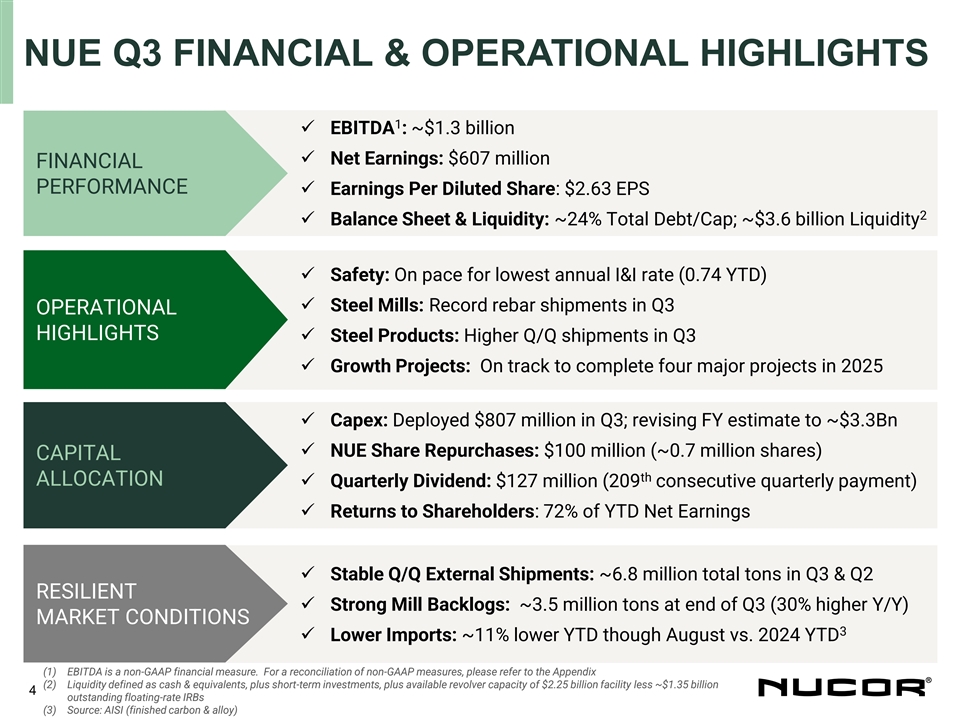
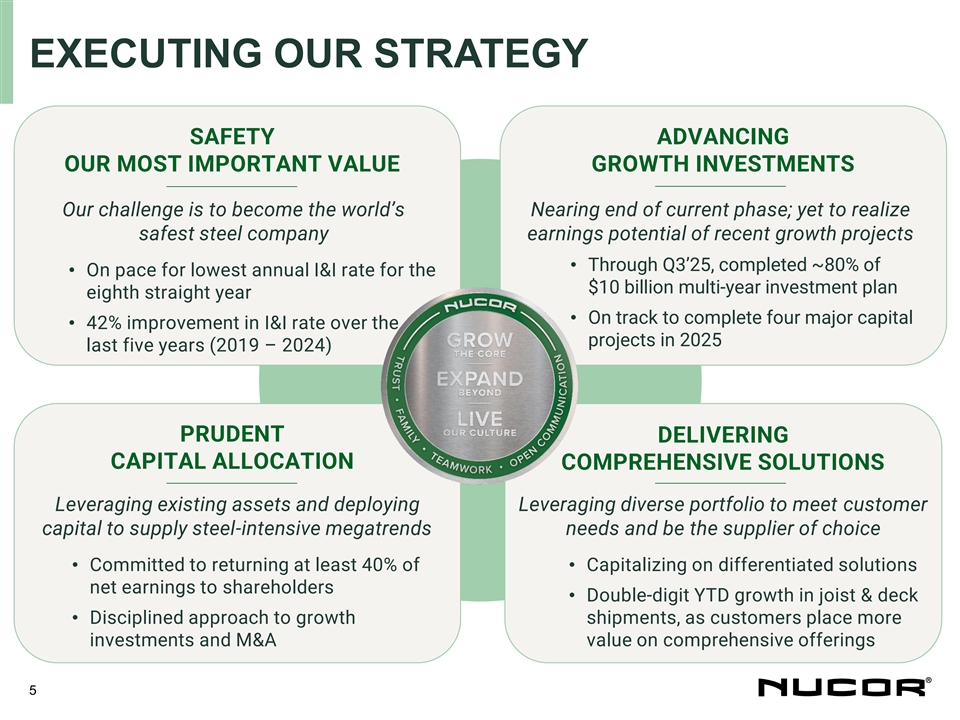
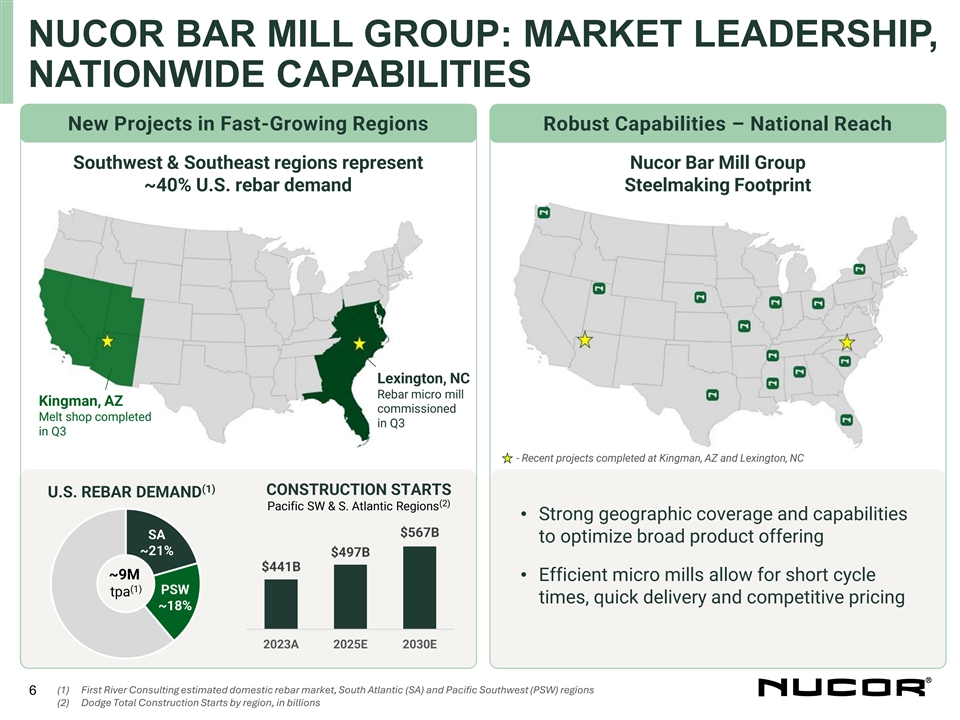
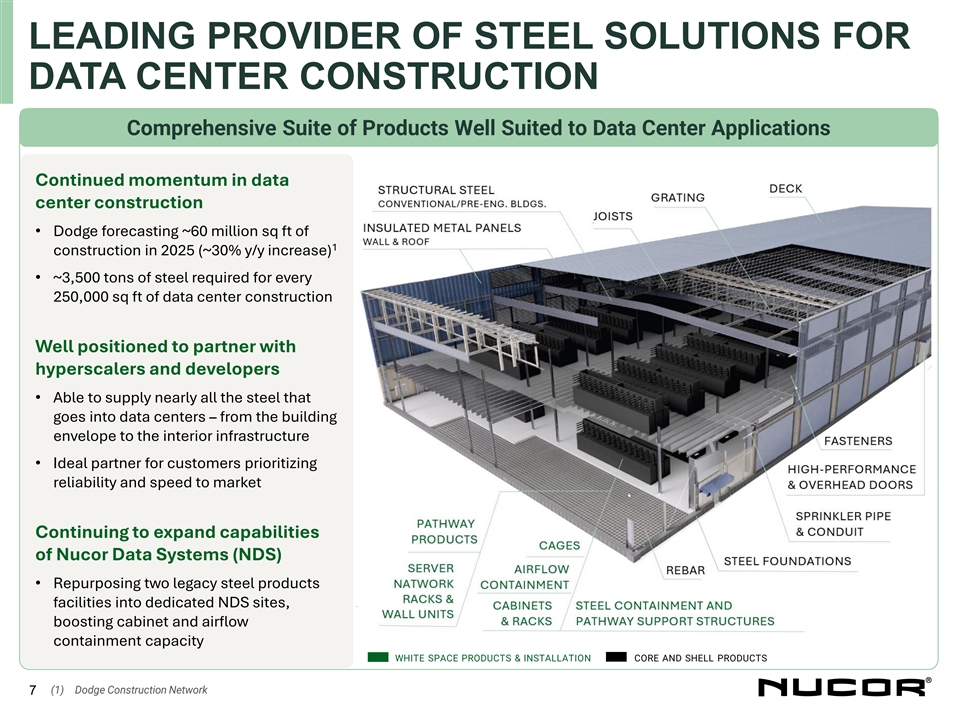
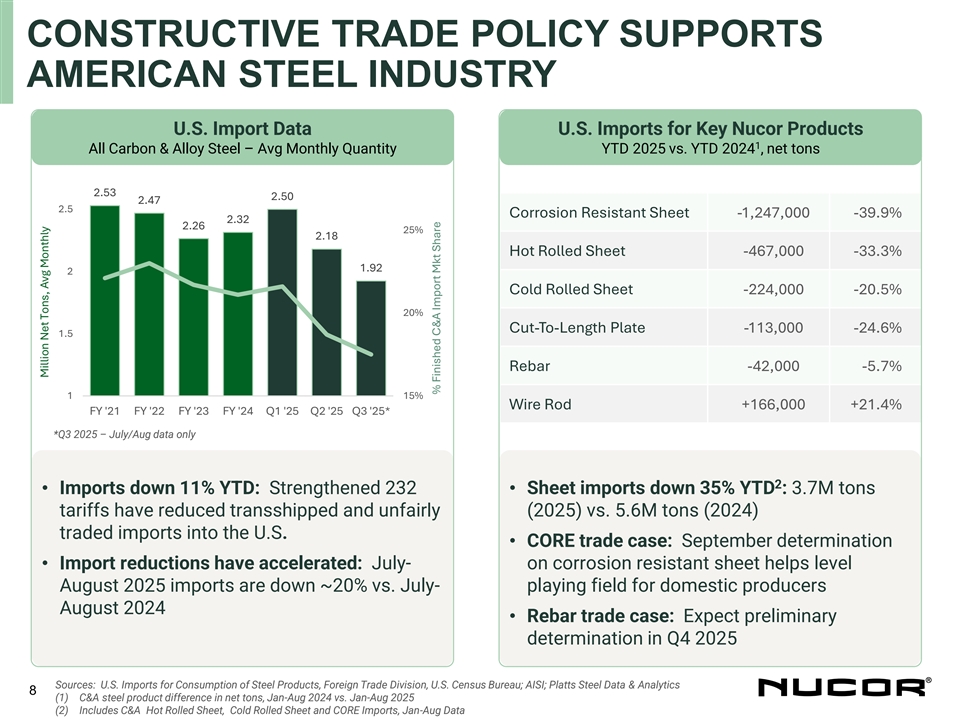
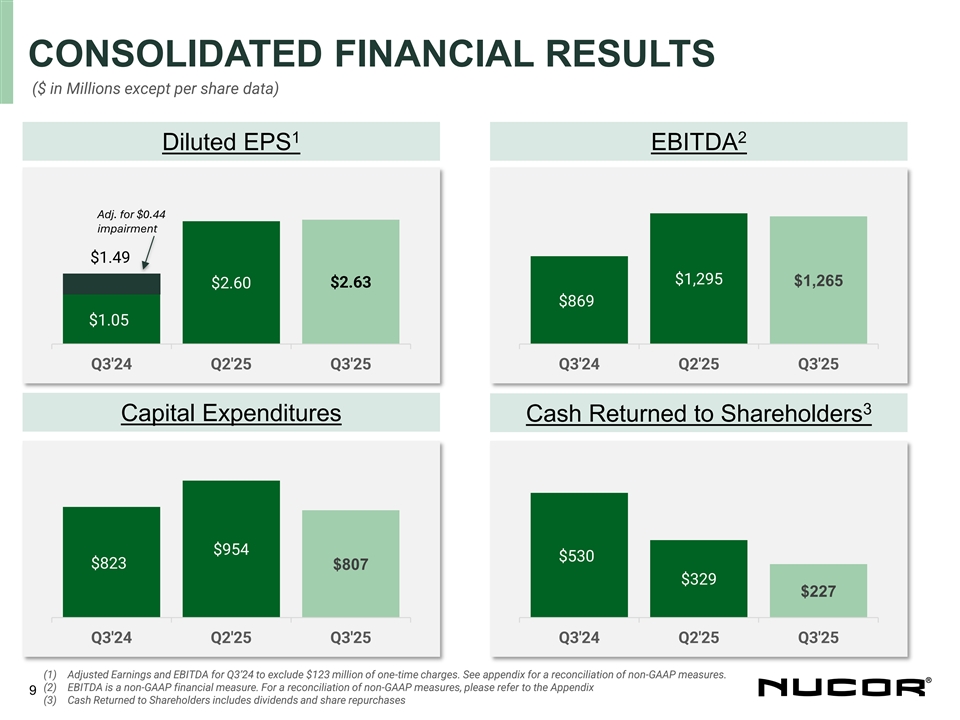
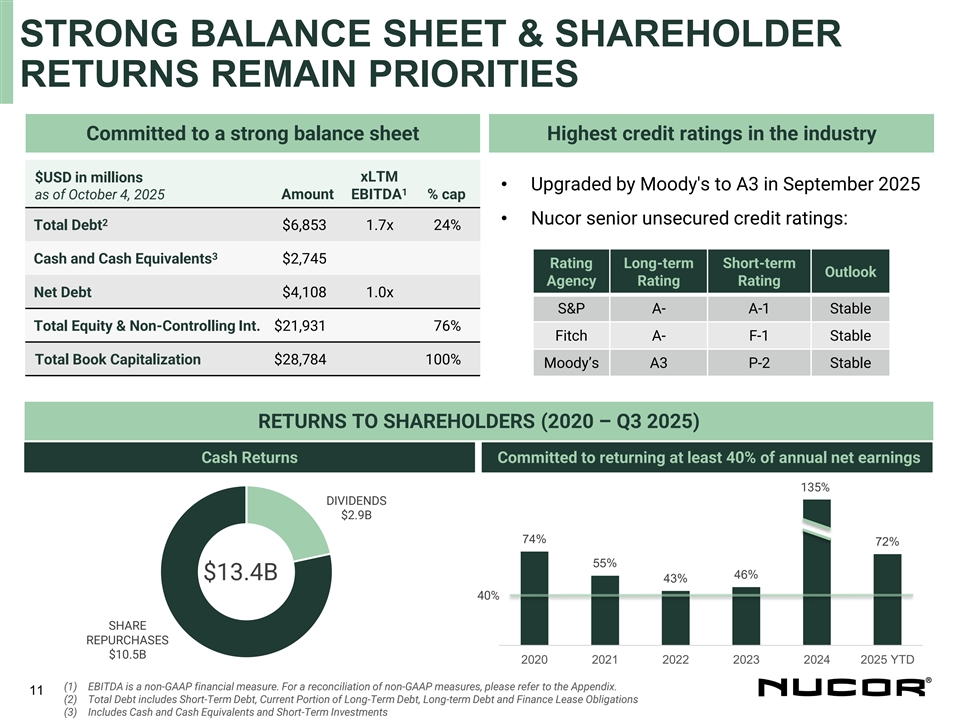
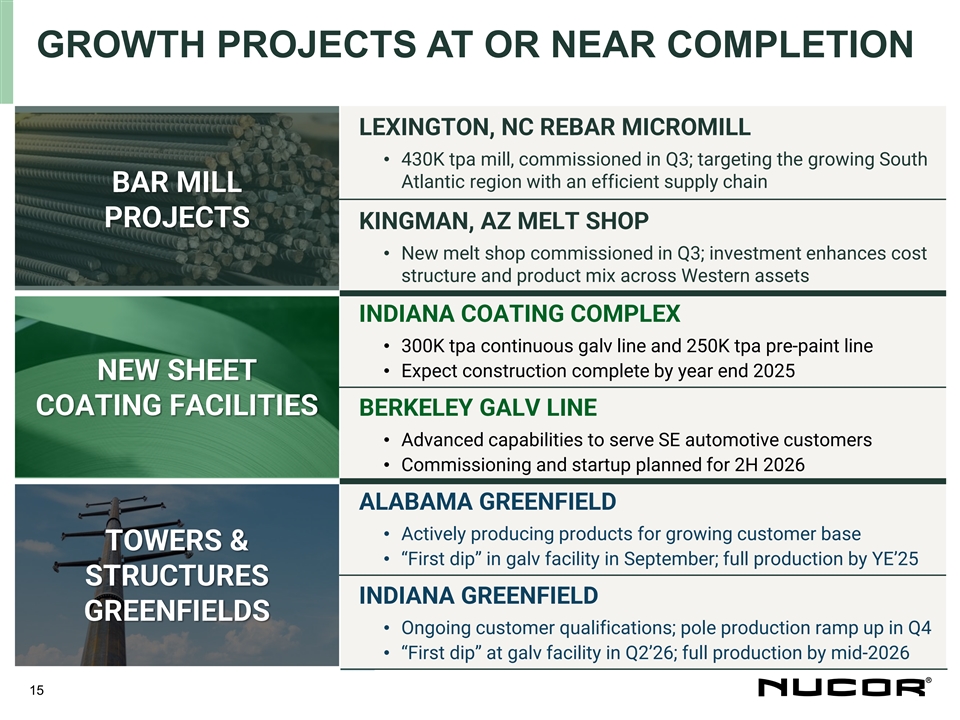
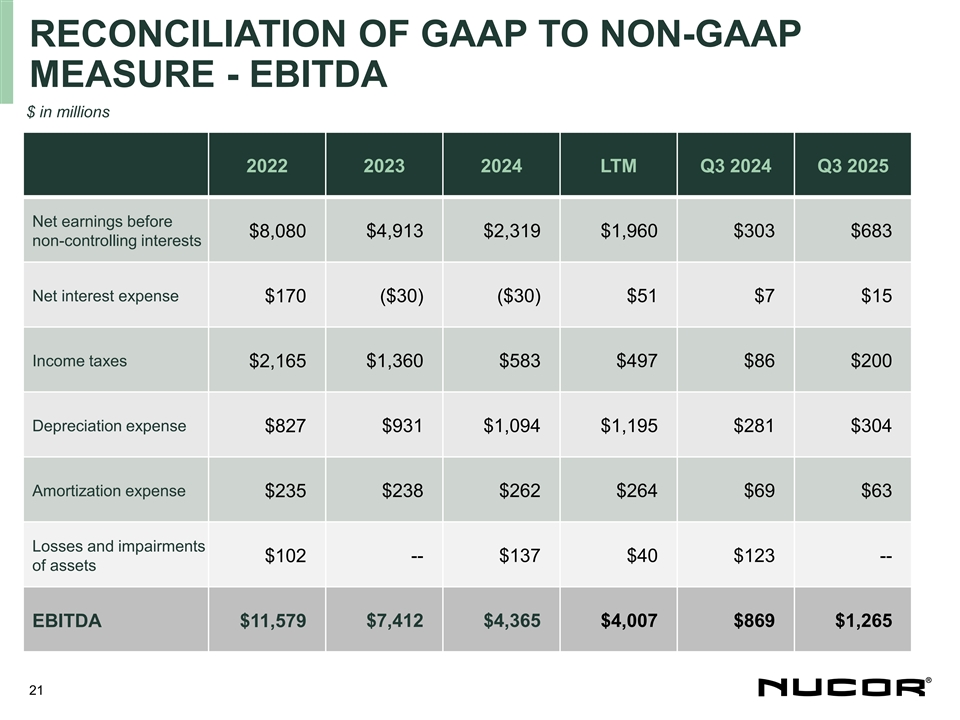
Thanks, Chris. I want to begin by thanking our 33,000 Nucor teammates for their continued commitment to safety. Our team has been lowering our injury and illness rate every year since 2017, and we are on track to do it again in 2025. This level of performance would be impressive at any point, but to do it through a period of significant growth is an amazing accomplishment. Congratulations to the entire Nucor team, and let's make the last two months of 2025 the safest in Nucor's history. Turning to Nucor's third quarter financial performance, we generated EBITDA of approximately $1.3 billion and earned $2.63 of EPS. These results exceeded our third quarter guidance, driven by stronger-than-expected shipments from our steel mills and favorable corporate adjustments. Steve will provide more details during his financial update. We remain committed to prudent capital management on behalf of our shareholders, balancing long-term growth with meaningful shareholder returns, while maintaining our industry-leading credit profile. During the third quarter, we reinvested $807 million into the company, with a majority of this capital related to growth projects that are nearing completion. We've also returned approximately $230 million to Nucor shareholders through dividends and share buybacks, bringing our year-to-date returns to nearly $1 billion or 72% of net earnings. We also saw our long-term credit ratings upgraded to A3 by Moody's. Following the Moody's upgrade, we are now rated A-minus or A3 by all three rating agencies, making us the only major North American steel producer to hold that distinction. Creating value for our stakeholders requires a relentless focus on execution, and I'm proud of the work our team has done to advance our long-term mission to grow the core, expand beyond, and live our culture. We are in the final phase of our multi-year capital investment campaign and will complete four major projects by the end of this year. Recent milestones include the commissioning of two bar mill projects and the commencement of pole production and galvanizing operations at our Alabama Towers and Structures facility. Our two new sheet coating facilities at Crawfordsville and Berkeley County remain on track, and the team in Crawfordsville recently processed the first coil through the new galvanizing line. And construction of our new sheet mill in West Virginia is two-thirds complete and remains on schedule to begin ramping up by the end of next year. Even as we invest to grow our capabilities, we remain focused on leveraging our existing asset base to generate attractive returns for our shareholders. For example, in Steel Products, we've taken steps to repurpose two existing Steel Products facilities to support our faster-growing Nucor data systems businesses. And within the steel mills, we have recently decided to no longer pursue a new rebar micro mill project in the Pacific Northwest region. With the recent investments we've made in the bar group, we can serve the western U.S. and Canadian markets from our current footprint with superior cost and supply chain advantages. We will continue to monitor market developments to ensure the best use of our shareholder capital. As I've said in the past, our growth strategy is not about growing our capacity. It's about providing more capabilities for our shareholders, customers, and team. The investments we're making now to grow our core steelmaking capabilities and expand into downstream steel-adjacent businesses will better position Nucor to offer comprehensive, integrated solutions unmatched by any of our competitors. And by optimizing our full portfolio to operate as one team, we make it easier for our customers to buy, build, and succeed. Let me now take a few minutes to highlight a couple of the areas where Nucor is improving its position as a supplier, employer, and investment of choice within the steel industry. One of these is Nucor's Bar Mill Group. As many of you know, Nucor entered the steelmaking business in 1969 when we began operating our first bar mill in Darlington, South Carolina. Over the following five decades, we have harnessed the inherent advantages of scrap-based steelmaking and Nucor's performance-driven culture to grow our bar mill group into the nationwide powerhouse that it is. The bar mill team has delivered strong results in 2025, fueled by increased demand in the non-res construction markets and infrastructure markets. With our broad geographic coverage and capabilities, Nucor is well positioned to optimize both product mix and volume regionally. In fact, the team has set quarterly rebar shipment records twice so far this year, first in Q1 and then again in Q3. We also began ramping production in the third quarter at our new melt shop in Kingman, Arizona, and our new rebar micro mill in Lexington, North Carolina. Both facilities are strategically located in high-growth regions with reliable access to local scrap supply, enhancing our existing footprint in the western and southeast markets. We will continue ramping up operations over the coming months, with both projects on track to be EBITDA positive by the first quarter of 2026. While we build our leadership in steelmaking, we are also positioning Nucor as a key supplier to high growth markets like data center construction. The Dodge Construction Network is forecasting 60 million square feet of data center construction in 2025, a 30% increase over 24. And the state of Virginia alone has seen 54 new data center permit applications in the first nine months of the year, underscoring the sector's momentum and long-term growth potential. With our comprehensive portfolio of products, Nucor is uniquely equipped to partner with leading developers and hyperscalers who increasingly value speed and certainty of execution. We now supply over 95% of all steel products that go into a data center, from the building envelope to the interior infrastructure. For example, we're the only provider capable of supplying steel for both conventional structures and pre-engineered buildings at scale. Inside of data centers, we're accelerating growth in our new core data systems businesses, implementing domestic production of server cabinets and increasing capacity for hot aisle containment and data center support structures. This unlocks powerful cross-selling opportunities for our diverse product portfolio, creating better outcomes for customers and driving shareholder value. Turning to trade policy, we've seen meaningful federal action this year supporting the American steel industry. Section 232 measures and ongoing trade enforcement are curbing imports, with finished steel imports down nearly 11 percent year-to-date through August. Since the broader Section 232 tariffs were implemented, we have seen larger month-over-month reductions in imports and expect the trend to continue. While imports have decreased since the comprehensive 50% steel tariffs went into effect, they continue to be a necessary tool to counteract the massive amounts of overcapacity that persist in the global steel sector. We believe that tariffs must stay in place, with no exceptions or loopholes, until there are fundamental changes in the global steel industry. Ongoing trade cases continue to provide another important defense against unfairly traded imports. In September, the ITC Commission ruled that American steel producers were materially injured by imports of corrosion-resistant steel from 10 countries. Nucor is pleased with a decision which clears the way for the Department of Commerce to issue final anti-dumping and countervailing duty orders in the coming weeks. We are also following the Commerce Department's investigations into rebar imports from four countries and expect to see the preliminary determination later this quarter. Overall, we are encouraged by the administration's actions to help level the playing field for the American steel industry. And as North America's largest and most capable steel products company, Nucor is well positioned to create value for our customers and shareholders. With that, let me turn it over to Steve, who will share additional details about our third quarter financial performance.
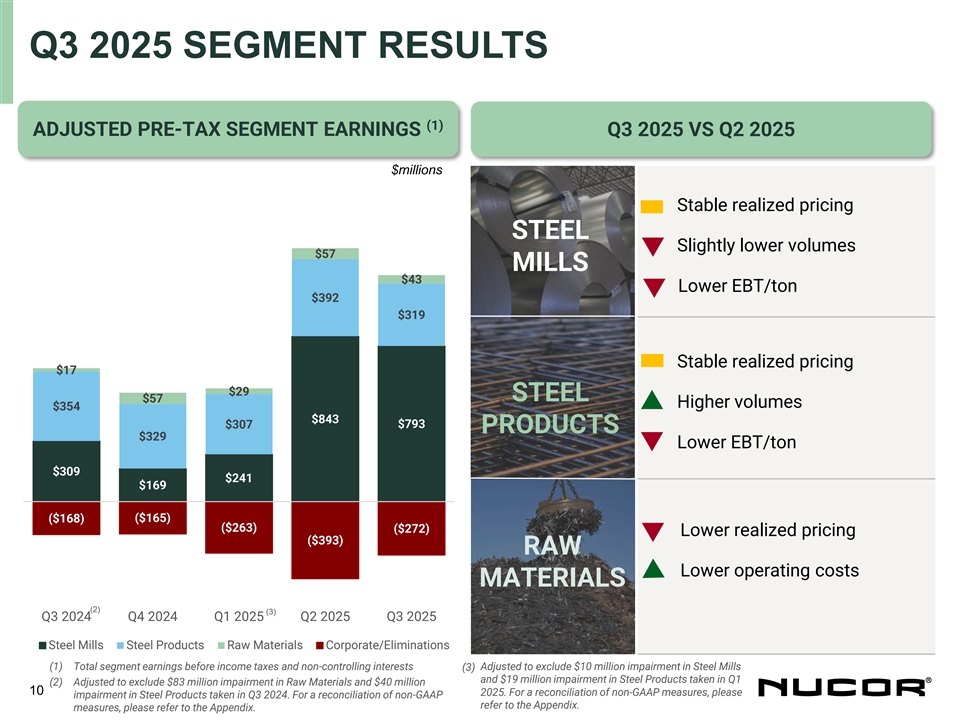
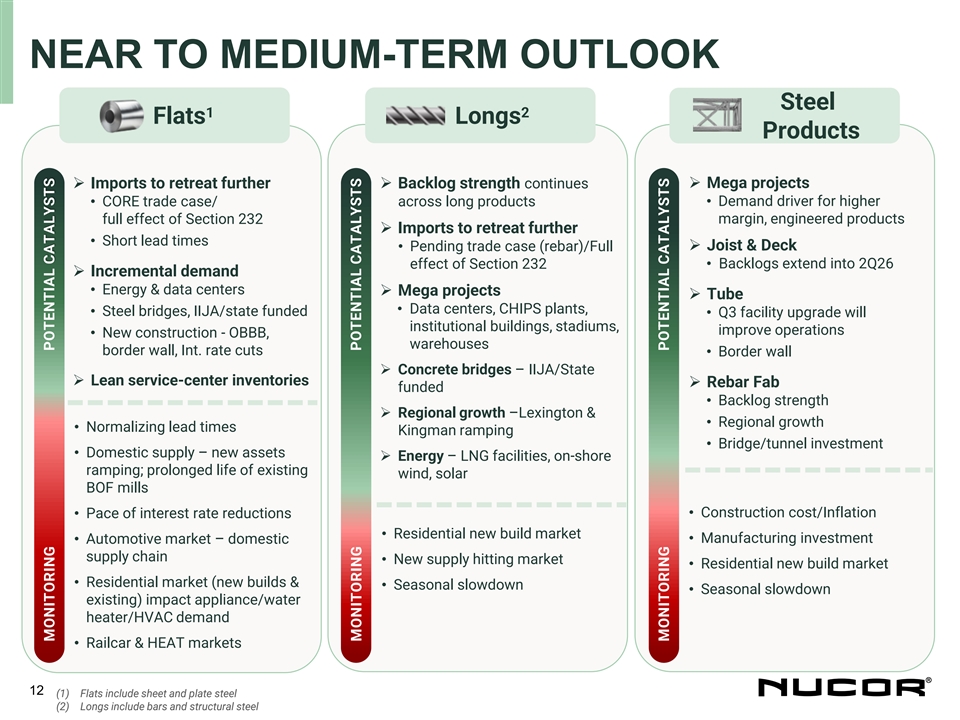
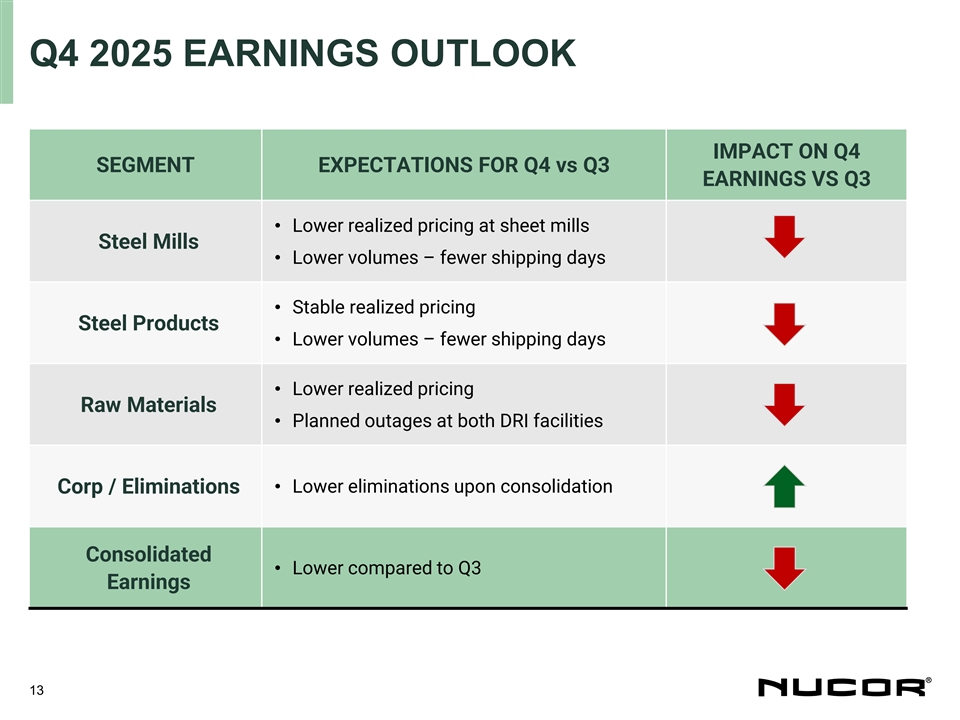
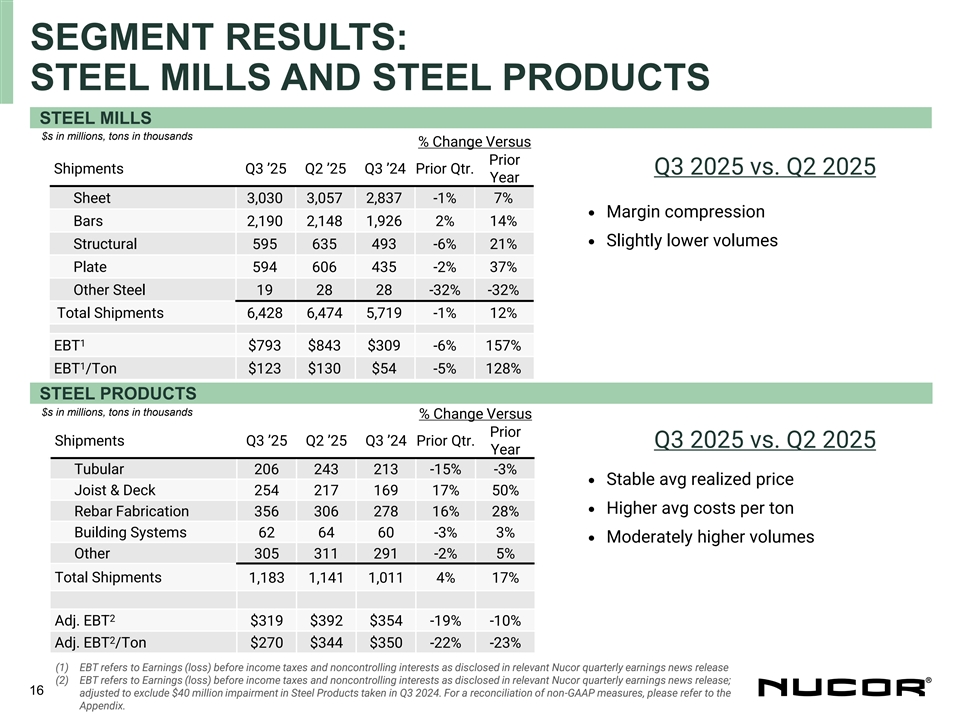
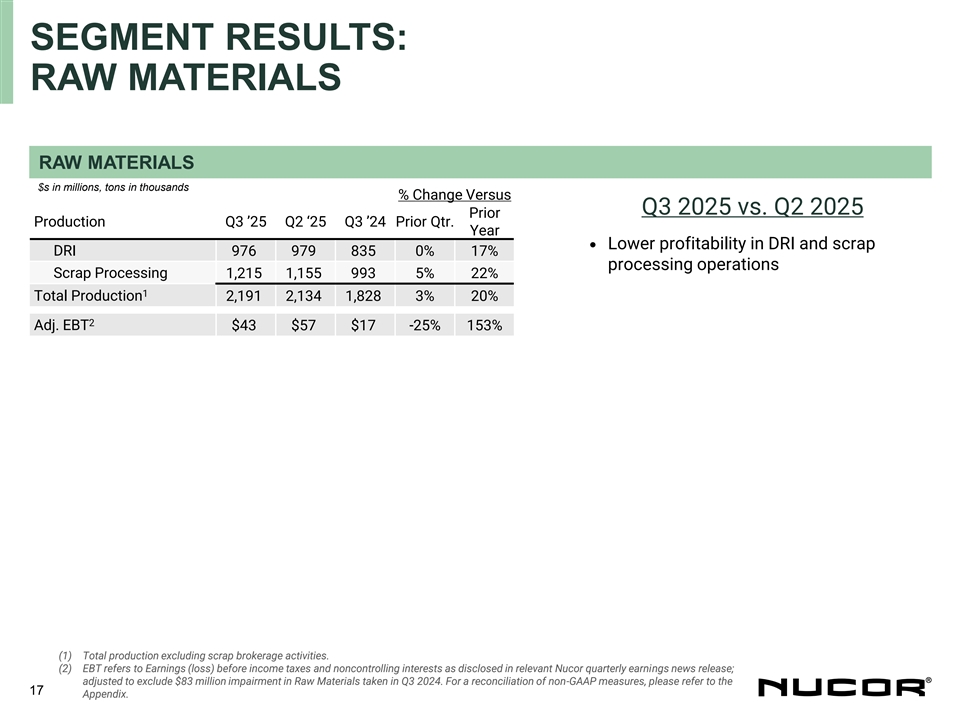
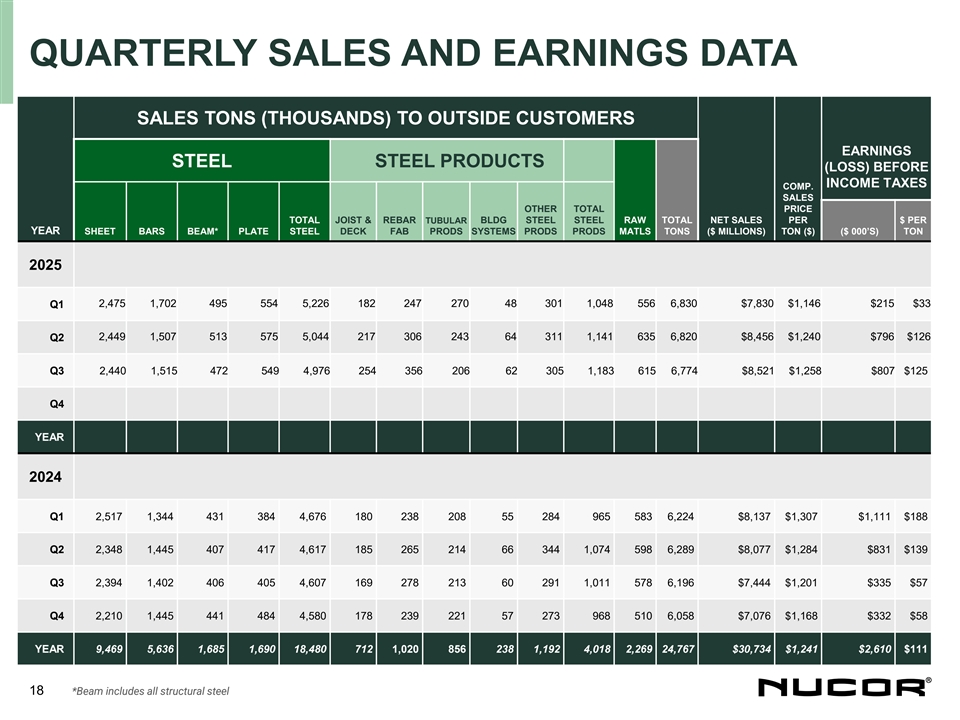
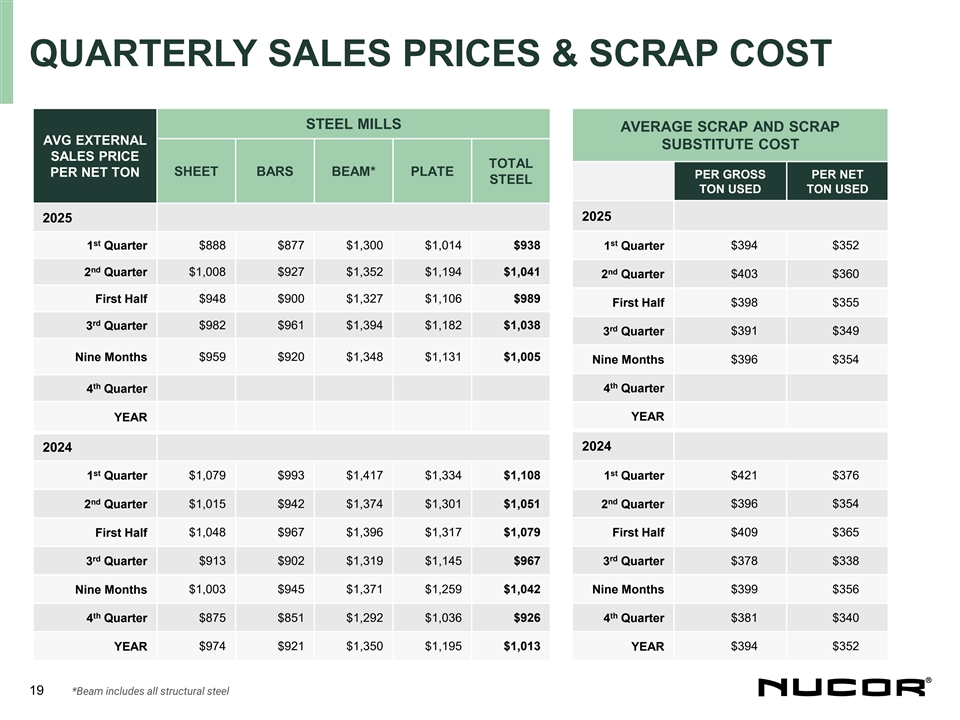
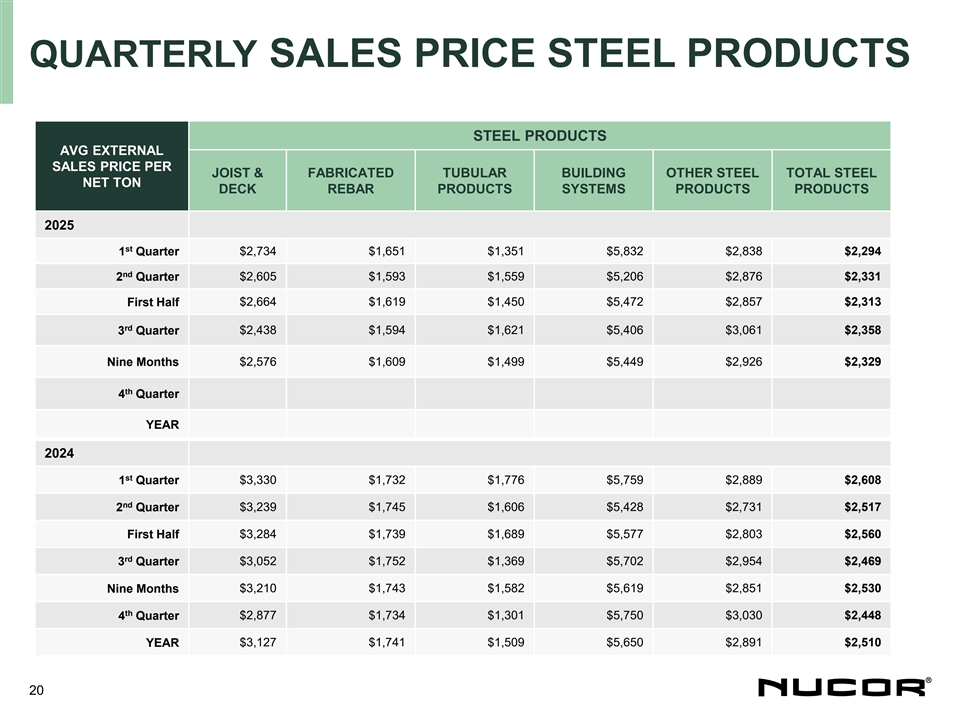
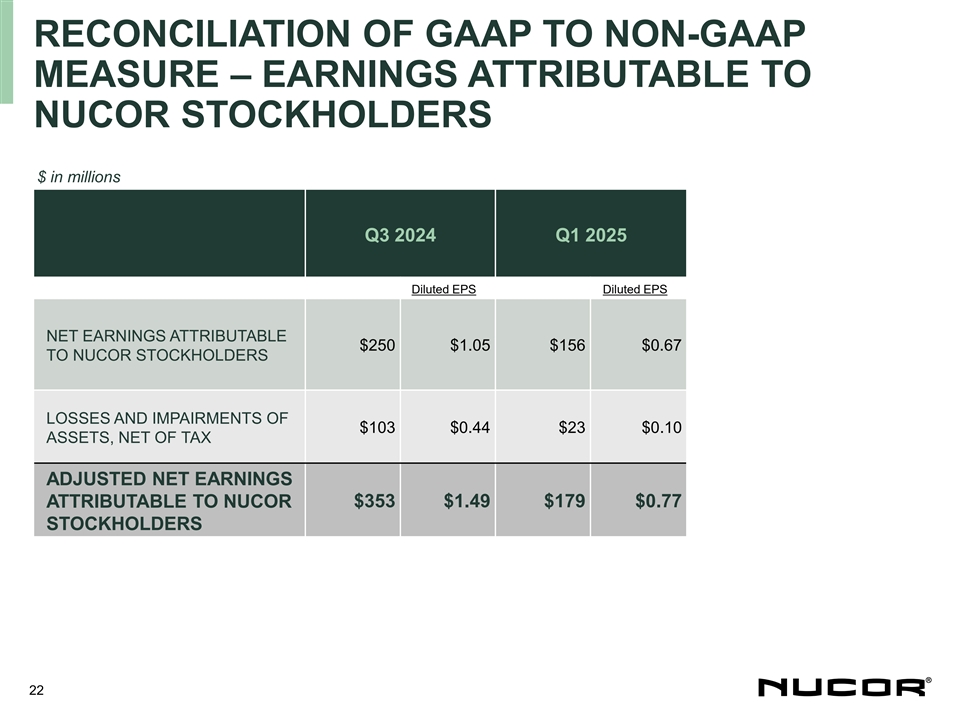
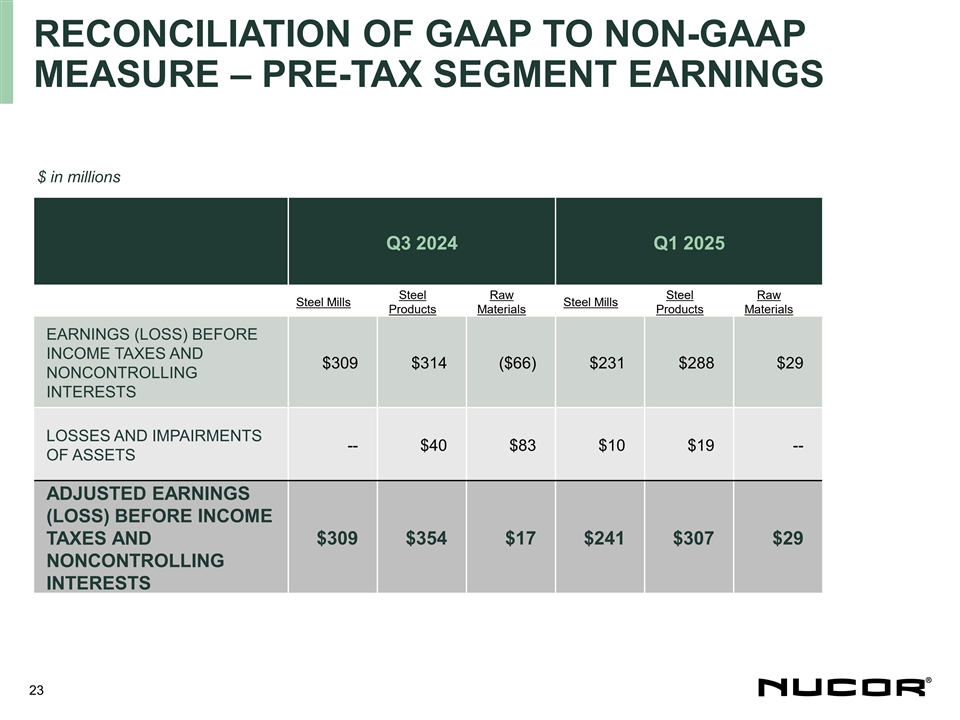
Steve? Thank you, Leon, and thank you all for joining us on the call this morning. For the third quarter, Nucor generated net earnings of $607 million, or $2.63 per share. Earnings were in line with the second quarter's adjusted earnings per share of $2.60 and above adjusted earnings per share of $1.49 for the third quarter of last year. Year-to-date, Nucor's adjusted net earnings are approximately $1.4 billion, or $5.98 a share. Earnings for the third quarter exceeded the midpoint of our guidance range by approximately 50 cents. The guidance beat was driven by two main factors, better-than-expected shipments and lower pre-operating and startup cost. Our steel mill segment realized higher-than-expected shipments in sheet, bar, and structural. In September, our Berkeley division set an all-time production record, and as Leon mentioned earlier, the bar group achieved another quarterly record for rebar shipments. The steel mills group also saw stronger-than-expected shipment levels from several mills coming out of the third quarter plant outages. Additionally, the steel product segment exceeded volume expectations, contributing further to overall outperformance. Several of our newer operations progressed through startup activities more rapidly than anticipated, resulting in lower-than-expected preoperating and startup costs. Preoperating and startup costs for the third quarter were $103 million. Favorable corporate and administrative impacts also contributed to the outperformance. These included lower inventory eliminations due primarily to lower than expected inventories in our downstream steel product segment, as well as lower overall corporate and administrative costs. Turning to the segment-level results for the third quarter, the steel mill segment generated $793 million of pre-tax earnings, a decrease of 6% from the prior quarter. We saw improved results across our bar and structural steel groups, but lower profitability in sheet and plate more than offset the gains in longs. We continue to see strong demand for long products and more subdued but stable demand for flats. That said, we are gaining market share and are encouraged by the recent operating performance of our steel mills. Sheet shipments nearly matched our record volumes set in the prior quarter, with sheet backlog tons of 13% year over year, and our bar products backlog at the end of the third quarter was 35% higher than the same time last year. Turning to steel products, we generated pre-tax earnings of $319 million, down from $392 million in the second quarter. Despite the sequential decline, volumes held up better than expected, with external shipments increasing 4% quarter over quarter. However, operating profit was impacted by less favorable product mix, higher substrate pricing, and planned outage cost. Our steel products backlog has moderated alongside typical seasonal ordering trends, but ended the third quarter 14% higher year over year. The backlog extends well into the second quarter of 2026 for some of our more custom-engineered product lines. Quoting activity remains robust, and we believe this reflects business confidence among our customers servicing the construction and infrastructure markets, as well as their confidence in Nucor as a reliable provider of high-quality solutions. Turning to the raw materials segment, we realized pre-tax earnings of approximately $43 million compared to $57 million for the prior quarter. The primary driver of the sequential decline was lower pricing, partially offset by lower operating costs. Moving to the balance sheet, Nucor continues to have a differentiated position of strength and flexibility in our industry. An example of this was on display in the past quarter, as evidenced by our recent ratings upgrade by Moody's, and we remain committed to maintaining a strong investment-grade credit profile. We ended the third quarter with a total debt-to-capital ratio of approximately 24 percent and cash of approximately $2.7 billion. We generated $1.3 billion in operating cash flow during the quarter, a testament to Nucor's cash-generating operating model. Capital expenditures totaled $807 million for the quarter, bringing our year-to-date total to $2.6 billion. We now expect full-year CapEx to be $3.3 billion for 2025, as some project spending was pulled forward from 2026. We will provide more detail on our CapEx budget for 2026 on our year-end earnings call in January, but we expect overall expenditures to decline by more than a half a billion dollars compared with 2025. The cornerstone of Nucor's capital allocation framework is providing meaningful cash returns to shareholders. During the second quarter we returned 227 million dollars to shareholders in the form of dividends and share repurchases. Through the end of the third quarter we've returned nearly one billion dollars representing 72 percent of Nucor's year-to-date net earnings. During the same period, we repurchased approximately 4.8 million shares at a weighted average price of approximately $126 per share. Turning to our near-to-medium term demand outlook, I'd like to take a closer look at the distinct demand drivers shaping our flats, longs, and steel products markets. While we're seeing varying levels of demand across these products, we expect each will continue to benefit from further declines in imports as the effects of tariffs and trade cases are realized. Beginning with our flat products, we expect strong demand from energy, data centers, and advanced manufacturing. At the same time, we're monitoring softer conditions in areas like residential construction, consumer durables, heavy equipment, and agricultural machinery. Additionally, new domestic supply is still being absorbed in the market. Turning to long products, our bar and structural mills continue to benefit from a number of demand drivers underpinning a more constructive near-term outlook, though we remain mindful of typical seasonal purchasing trends. Infrastructure spending remains elevated. The American Road and Transportation Builders Association reports that bridge and tunnel contract awards are up nearly 20% year-over-year, and 60% of total funds allocated to the IIJA highway projects remain unspent. As Leon mentioned, data centers and energy infrastructure needed to power them will continue to drive pronounced demand for Nucor's long products. We also see good demand from institutional construction, stadiums, warehouses, and chip facilities. In addition, we expect to capitalize on a strong regional demand and gain market share as our North Carolina micro mill and new melt shop in Arizona ramp up. Finally, in our steel product segment, many of our business lines are benefiting from pockets of strength and non-residential construction. As the market leader in custom-engineered building products like joist and deck, metal buildings, and insulated metal panels, we're seeing strong customer interest in our capabilities, particularly from those prioritizing speed, quality, and certainty of execution. We also expect healthy demand for our rebar fabrication business and incremental demand for tubular products. That said, we're closely monitoring the impact of evolving trade policy, higher construction costs, and persistent softness among residential construction activity. Turning to our fourth quarter outlook, we expect Nucor's consolidated earnings to be lower than the third quarter. We expect lower total volumes across all operating segments due to a combination of factors including seasonal effects, new course fiscal quarter containing five less shipping days, and two scheduled outages at our DRI facilities during the fourth quarter. We anticipate a decline in realized pricing within our steel mill segment, primarily driven by sheet. In contrast, pricing in our steel product segment is expected to remain stable. Looking ahead to 2026, we expect stable domestic steel demand. With the broadest range of capabilities in the North American steel market, Nucor is confident in our ability to create value for our customers and shareholders as we capture a healthy share of that demand. And with that, we'd like to hear from you and answer any questions you may have. Operator, please open up the line for questions. Thank you very much.
Operator
We'd now open the lines for the Q&A. If you'd like to ask a question, please signal now by pressing star followed by one on your telephone keypad. And if you'd like to remove yourself a line of questioning, please star followed by two. As a reminder to raise a question, we'll be star followed by one now. Our first question comes from Alex Hacking from Citi. Alex, your line is not open.
Yeah, morning, and thanks for the call. Congrats on the strong results. It seems like new core shipments are growing faster than the industry, and you referenced they're gaining share. Could you maybe give more color or the kind of specific products where you're gaining share, any change in strategy that's led to you gaining share?
Yeah, thanks, Alex. And look, let me begin, Alex, with our most important value, and that is the value of safety. You know, we're on track for a historic eighth year in a row of lowering our I&I rates and creating the safest year in the history of our company. And so I just wanted to take a moment and thank the 33,000 team members that execute that incredible value each and every day across 40 states, 300 locations in multiple countries. So, again, we begin there. But specifically to address your question, Alex, yeah, we continue to stay very focused. And being the market leader means that we've got to do things to stay out in front. And so as we think about how we've restructured and positioned the plate group is a great example of that, where Brandenburg's continued to ramp up. And as you heard Steve mention earlier in his prepared remarks, the preoperating startup costs reduction means that Brandenburg is ramping up faster than we had anticipated. They're doing a great job. You'll hear more about that in a few moments, I'm sure, as we get into plate later in the call. But, you know, plate is another, you know, a broad example where we're focused on that. Long products is another where Nucor is going to continue to look for the opportunities to grow in bar and beans in that segment. But ultimately, you know, what I think the strategy that you've seen playing out over the last few years is really wrapped around our commercial and construction solutions group that are looking to attach these major developers, major hyperscalers that are looking for speed and a capability set that Nucor now has in bringing that to the market. So we're getting a ton of pull-through effect in our product groups from the upstream mills, from sheet, plate, bar, engineered bar, all the way through the downstream adjacent segments. So we're seeing, I think, a lot of that play out, which is increasing our market share and, again, a capability set. You heard me say in my prepared remarks as well, Alex. You think about how white-hot the data center trend is today. With our Southwest data products acquisition, with our racking group, with the insulated metal panels, as well as the breadth of the steel products that we make, we are now capable of making 95% of all steel components within the framework, building, and hot aisle contained within that data center. So, again, it offers a very unique solution set for, again, these developers and hyperscalers.
Thanks, Leon. I guess just to follow up on that point on the data centers, are there specific products that Nucor is selling that are particularly exposed to data centers? I mean, I know that Joyston deck shipments are up over 20% like this year versus last year. Are they an obvious beneficiary from this? Thanks.
Yeah, Alex, it's really the gambit. So insulated metal panels, joys grading decking fasteners uh sprinkler conduit the foundations the rebar and the foundations the civil side the the sheeting on the outside of the building the overhead doors from chi rytec and and so really it's it's the full purview but john any anything you did else would you add to that yeah alex on the on the joist and deck side we're definitely feeling the benefits of the data center build out, as well as e-commerce.
And we're just well positioned with these end-use markets because of our industry-leading capabilities, the breadth of our product offering, our nationwide coverage. Right now, our Joist and Deck backlogs are about 25% higher than what they were a year ago at this time.
They extend well into 2026, and we're optimistic about what the next year is going to bring thank you thanks alex thank you very much our next question comes from bill peterson from jp morgan bill your line's not open yeah congrats on the quarter thanks for taking my questions um maybe to follow up on this data center opportunity but maybe to contextualize relative to what i think is a larger market much larger larger now which is warehouses. I guess based off of your backlog, how should we think about square foot growth beyond 2025, maybe from a market perspective as well as your own opportunity? And is there a way you can, I guess, help quantify or provide any anecdotes on how you're gaining share in the market with Southwest data products compared to industry growth averages? Just trying to get more context on this opportunity relative to larger ones such as warehouses.
Yeah, Bill, let me start with the, to your point, the larger segment, which is the warehousing. Look, that, you know, is probably flat year over year and expected to be about the same in 26. And so, again, that peaked, I don't know, 21, 22, where we saw massive outs from Amazon, you know, others that were, you know, building as fast as they could come. So the shift has come in the last, you know, 12, 18 months into the data center side. But, again, with that, the energy infrastructure is a big piece of that, that Nucor's, again, tying into. Southwest Data Products enables us to do things in that hot aisle that we weren't able to do prior.
But Nucor now has a Nucor warehouse and data systems group that kind of provides that overarching solution set for, again, these major developers. and john maybe unpack that just a little bit further and how we how we use that go to market with that yeah bill when you when you think about a data center and it's on our slide seven in our presentation all of the different products supplies into that market and we're we're the only company that can supply all of those products many of our competitors can supply one of them we have the ability to supply all and we work directly with a lot of these companies to guarantee their the surety of their supply to meet their deliveries to get these facilities operational on time it's a big advantage that we have uh with with that entire course in addition to that having run redundancy in our portfolio we made mention we've converted a couple of facilities over the last several months to help the build out of these data centers because we see that market being so hot moving into the coming years.
Hey, Bill, this is Steve. I'd like to just add, you know, one thing that's implicit in the question is that you and Alex both have the ability of Nucor's overall portfolio. And so as you see different markets get strong, Nucor has excelled over the years at winning in a variety of different ways.
And right now, you're focused in on data centers, and we can capture, as John and Leon described, the unprecedented – we're unparalleled with anyone in the space and the ability to – it's not lost on us and shouldn't be on you that Nucor has won at various times when different markets have been strong because of the product diversity and the flexibility that we have. and so yeah no i appreciate that uh that color but i guess maybe just to follow up but maybe i missed or didn't hear it but you said data center flat for 26 is there a sense for how we should think about the data center growth next year and then uh yeah all right thanks yeah sorry bill no
warehouse traditional warehouse would be flat data centers are up double-digit growth for the next five to six years is what, you know, every major category we're looking at is tracking. So I think in my prepared comments that I opened with, the forecast is for 60 million square feet of capacity in 2026. So it's an incredibly fast-growing segment. So not flat on the data center side.
My second question, so scrap costs was down, but conversion costs were uh i guess can you speak to what contributed to the latter is this related to the new new mill ramps or is there something else there and i guess more importantly how should we think about this trend uh into the fourth quarter thanks bill this is uh this is dave smusky so although our cost quarter over quarter or up cost year over year down five percent um but specifically the items affecting the quarter over quarter quarter results are uh slap costs for csi some of our consumables was up such as refractory and labor was slightly up due to some significant plant
outages in the quarter okay thanks for that congrats congrats again on the quarter thanks bill thank you very much as a reminder if you would like to raise a question please signal now by pressing staff number one on your telephone keypad our next question comes from lawson window from bank of america wilson your line is not open thank you very much operator good morning leon good morning steve appreciate the update today um could i ask about the uh guide which i mean you in the guidance for q4 you pointed to uh lower volumes just because of uh fewer shipping days i mean that all makes sense but you also suggested there was some lower realized cheap pricing factored in uh yet Yesterday, Nucor's CST was $10 higher. Was that factored in? I mean, we also saw a competitor raise their pricing by $50 yesterday. How should we think about the movement we've just seen very recently in that?
Yeah, well, I appreciate the question. And most of Nucor's sheet deliveries are based on contracts. So while you see the moves today, what I would tell you is you're seeing the typical seasonality and a softer Q2 flow through the order book, which is our projection for Q4, to see lower realized pricing. But again, with the current price increases in that group, we anticipate Q1 will certainly realize those higher pricing. So it takes some time, right, to flow through that. But on the positive side, there's two factors I'd point out in terms of, you know, how quickly that I can move through. One is, you know, the service center inventory side of things is pretty very, well, seasonally low in terms of that overall picture, but also internally to Nucor, we're not sitting on high volumes of inventory at our mills, so it's going to enable us a much faster realization of that pricing you just mentioned. So, again, those two factors, we'll see that move through the order books into the balance sheet for Q1.
Fantastic. Thank you, Leon. And can I ask on acquisition opportunities? When you look at the relevant acquisition set for Nucor, how would you characterize that in terms of product and region or segment, upstream versus downstream? Appreciate any thoughts.
Yeah, well, here's how I would tell you. Our mission statement is very simple, right? Eight words that we launched in January 1st of 2020. It's to grow the core, expand beyond, and live our culture. The core is just that, the core steelmaking capabilities. You're seeing that with the startups of Lexington's, MicroMill in North Carolina, the Melt Shop in Kingman, Arizona, the ramping up and then pre-startup at Crawford Zills Galtline, Berkeley next year, the startup of our first towers and structures facility in alabama the next two that will be next year and then that will ultimately culminate with a startup of the largest investment in new course history in mason county west virginia with the most state-of-the-art sheet mill that's going to offer a capability set uh unparalleled in in our industry and so we're going to have the breadth of capabilities to uh provide our customers the steel they need today as well as what they're going to need for tomorrow. So that's the core. As we think about Expand Beyond, it sits in the CHI and RITEC, Southwest Data Products, our summit, which is the first acquisition in the towers and structures we made, the insulated metal panels group that continues to bring a really differentiated product mix to the Nucor offering. So as we look to the future now, again, we don't anticipate building any more greenfield facilities, at least in the near term, that capital is now going to get deployed in the adjacent spaces. Well, again, right, more, we'll leave you that ambiguous. If we think a little bit more about, well, where's that going to go? It's going to go in the megatrends that we're seeing in the U.S. economy, like towers and structures, like energy, energy infrastructure, you know, the data center community. So what are the things that we're not providing or don't provide today that again hit a few boxes right so as we look for targets it's going to be like-minded culturally that fits who we are it's going to be a converter model that we we bring in terms of our competencies to that acquisition three it's going to be low capital intensity and four we're going to look for well four and five high margins and fifth a sort of counter cyclical to the traditional cyclicality of steel. So we want something that isn't as affected by the true steel cycles that we see over, again, the last 60 years that we've been in this business. And again, CHI, RideTech, IMP all provide a much more stable earnings platform, growth throughout all the sectors in highs and lows in both the financial crisis, COVID and whatnot, their return profiles are incredibly stable. And so, again, ultimately, our goal is to stabilize Nucor's overall earnings to provide higher highs and higher lows.
That's very helpful. Thank you, Leon. Thanks for having me.
Operator
Thank you very much. Our next question comes from Tina Tanitz from Wells Fargo. Tina, your line is not open.
Yeah, hey, good morning. I wanted to ask about my home state is Washington and what's happening in Seattle. so i saw the announcement of not replacing the existing mill can you just elaborate on that decision does that you said you could supply it from other mills but with imports to the west coast uh down i'm assuming like is there enough supply on the west coast can you supply it from kingman and are you just not replacing the existing mill or are you just not shutting it down thanks um yeah look uh that you kind of answered the question within that question as well timna so Thank you for it.
We have a great relationship with the city of Seattle and our team out there does an amazing job, you know, connecting with our community, being in that community and welcoming that committee with open arms and how we take care of our safety, the environmental, the sustainability side. So they do a really, really nice job. But it is, you know, as we step back and look at, you know, our prudent capital allocation, where are our dollars best spent? And where's the best returns on those dollars going to be with the investment of the melt shop in Kingman, Arizona, our Utah facility and the breadth and exposure of our Seattle mill? We are adequately covered for the western side of the United States as well as western Canada. So, again, as we step back to really evaluate that, we feel really good about where the mill is and its capability set in Seattle. But couple that with the addition of Kingman's Melt Shop, and we think we've got a very adequate coverage there. So we're going to use those dollars elsewhere to think about growth. and again how do we not just meet our cost of capital but double our cost of capital how do we make sure that we're generating eva for our shareholders for the long term and that's where that's where we're going to put that and again if we don't have that home as you've seen over the course of the years and following us timna this year we're at 72 return of our net earnings back to our shareholders and dividends and or share buybacks and that will continue Great.
That's my next question. But just to clarify, the Seattle mill keeps operating, you're just not replacing it with a micro mill, is that right?
Okay, super. So along the lines of the shareholder returns, your third quarter buybacks at $100 million is the smallest you've had, I think, since 2020 when you didn't have any buybacks, is that correct? And if so, is that a statement of anything?
Do you have other uses of capital, any anything you can elaborate on there yeah i'll let steve answer that but i would remind you of the 13 billion dollars that we've returned back to our shareholders over the last five years but i think you're you're accurate but steve yeah hey tim no you're you're correct that is the lowest quarterly um return we've had but we remain committed to giving back at least 40 of our earnings every every uh every every year we don't necessarily do that every quarter and so over the course of the year, we're well ahead of that mark. And as Leon alluded to, over the last five years, we've given back around 60%, just under 60% of their earnings. So we've continued that discipline of balancing investment with our capital and growing the company while we also maintain strong liquidity and a strong balance, improve that, even getting the upgrade from Moody's this past September and give meaningful return. So those three elements remain in place, and that's not going to change. I wouldn't get too focused in on the quarterly number. I'd just remind you that we remain very mindful and intentional about management of those three.
Okay. Well, I appreciate it, and that's clear. Thank you again. Thanks, Emma.
Operator
Thank you very much. As a reminder, if you would like to raise a question on today's call, please signal now by pressing star followed by one on your telephone keypad. Our next question comes from Phil Gibbs from KeyBank. Phil, your line's not open.
Just wondering if you could give us the state of the West Virginia sheet investment in terms of where you are in the spending and your expected startup timeframe.
Yeah, certainly, Phil. I'll ask Noah Hanners, our EVP of our sheet group, to give you a more detailed update.
Yeah, thanks for the question, Phil. It gives me a good opportunity to congratulate, recognize the team on the progress there. I'd tell you, we're at about 75% on the build. And in terms of capital spending, we're about to that same point now. Most of the 25% we have remaining remains in the labor category. So if you go there today, it looks like a steel mill. And I'll tell you, we have the world's best steelmaking team. And you see the foundation of it starting there with that team in West Virginia. We have done an awesome job. That West Virginia team has done an awesome job of bringing in some of the most talented people from across our sheet group and from across Nucor to lead that project. We've done a great job of hiring and experience. And, you know, I get often asked about, like, how do you feel about this investment? And we could not be more excited because we're taking this awesome team and we're giving them the world's best equipment. Like, they're going to have assets on the market. And then we are turning them loose in a region where we've been underserved, but where we have really strong customer demand. And when you stack those things up, we're going to be extremely successful with that investment, and we're excited about what the future brings for West Virginia.
Thank you. And then just a question for Steve on the tax side. Is there a distinct difference between your cash tax rate and your book tax rate for 25 and 26, given the recent changes in tax legislation?
Not necessarily, because of the way that legislation was written. It accelerates spend. It's already been started. feel for that the deferred tax you know benefits the cash flow benefits this year in 25 will be around 100 million dollars and when you um and when you look out into 26 that gets um you know it'll be smaller because of the nature of the bill so the the one big beautiful bill had it does accelerate some of the r d credits a little bit that's where in terms of the capital spending maybe not as pronounced as you might expect given the dollars thanks for the clarification steve
Operator
Thank you very much. Our next question comes from Katja Jenski from BMO Capital. Katja, your line's not open.
Thank you for taking my question. Starting on the startup costs, given that you have a couple of projects now that are ramping up, how should we think about these costs over the next few quarters?
Hey, Katja. This is Steve. We would expect over the next quarter them to be in line to the third quarter. And, you know, give or take, they're going to be in that range into the first quarter as well. So call it $100 million to $110 million a quarter going forward for the next couple of quarters.
And then I think some of the margin compression in the mill segment was tied to the slabs you purchased for the TSI operations. If I'm not mistaking, that mostly comes from Brazil. Is that correct? And if so, why not use more of the material produced internally?
Gotcha. This is Noah. I'll take that. Yes, mostly from Brazil. And we have been mostly slab served there this year. But we have a team that looks at the decision about whether to supply with internal substrates, so coils from our own mills like Gallatin or Crawford's Oil, or to buy slab. Most of this year, it's made the most economic sense to buy slab and roll it there through a hot mill. But there have been months where we've supplied a lot more coil. And I would tell you, over the course of this year, we've leaned into more of our own internal substrate. So that team will continue to look at what makes the most economic sense, and we'll go that way.
Okay. Thank you. Thank you.
Operator
Thank you very much. Our next question comes from Andrew Jones from UBS. Andrew, your line's not open.
Thank you. Hey, Leon. Hi, Steve. I've got a couple of questions on price hikes. And first of all, the MBQ aborted hikes from some of your peers. It sounds from the commentary like you didn't support it. Curious on reasons there. And then secondly, on plate, I'm curious how you're seeing the market at the moment. Obviously, we've had some relief on the import side, or we should have done. It doesn't seem like the Canada carve-out is coming anytime soon. So I'm curious how you're sort of thinking about pricing and the state of the market in the coming months in play, given that sort of tighter supply side. Thanks.
Okay, Andrew, we'll start off with the bar group. i'll ask randy to just give you an update on your questions there then we'll kick it to brad on on plate yeah uh andy thank you for the question um certainly we're not going to comment on specific pricing actions but what i can tell you is that the momentum across our bar products it remains very strong we're seeing robust robust order entry across all regions and key end markets uh and it's kind of been mentioned you know it's driven by infrastructure projects chip plants warehouses and data centers and that that strength is being amplified by the continued growth of our downstream businesses newport rebar fab volcraft and so forth so it's also worth noting we have implemented and realized meaningful price increases in merchant bar throughout 2025 supported by our multi-year high backlogs and extended lead time so all of that gives us confidence as we move through q4 and into 2026 that the market market is strong and ready for us to continue yeah and i'm happy to comment on the plate side uh it's been pretty good um you know edc based on the last data we got is trending up around 15 percent year over year and we're starting to see the impact of tariffs on imports right imports were pretty um we're up a little
bit in the beginning of the year but have come down pretty significantly over the last couple months similar pockets of strength in in plate that you heard from from randy and leon and steve around energy both traditional and renewable infrastructure uh our bridge business has been very strong this year and then on the non-res construction side um as we sit today our backlog is 58 percent higher at the end of q3 than we ended q3 of last year so we're pretty optimistic about where about where the play market's going.
Brad, why don't you touch on just the military applications and great development at Brandenburg as well.
Yeah, quick, quick Brandenburg update. You know, team continues to make significant progress at the mill. We announced last quarter that we achieved even positive results. We achieved that again in Q3. I'd mentioned some some weekly or monthly records from last quarter but honestly the the team has already shattered those records so far here in into Q4 and then on the product development side we've had some pretty notable achievements one being X70 API grade for line pipe we've achieved qualifications and certifications there and captured a very large order for Q4 and into Q1 and then on the military side we're really encouraged by the early stage military armor trial in plate between our three plate mills really is going to allow us to become the premier plate supplier to the U.S. military and then finally you know Brandenburg's capabilities I know we've mentioned on prior calls that we're seeing opportunities with existing customers and we're really seeing that play out the capabilities of Brandenburg are allowing us to sell deeper with our current customer base And we're seeing that in our total plate volumes, where we've shipped nearly as much plate through the first three quarters this year as we did for all of last year.
Does that cover the question, Chad, Andrew?
Yeah, just one follow-up on the military side. I'm curious whether export markets like obviously Europe with the sort of potential doubling, trebling of defense spending, is that a market you're focused on, given I guess with these higher quality grades? It's more of a global market than the U.S. one. Is that a target for Google?
Yeah, thanks for the question. Certainly it's an opportunity. You know, again, Brandenburg's capability set is unique in the world market. There's only so few folks that can produce the qualities and size ranges and gauges that Brandenburg can. So, you know, defense spending increases not just here in the U.S., but across the world. We're well positioned to take advantage of that.
Operator
Thank you. Thank you. Thank you very much. Our next question comes from Tristan Greaser from BMP Paribas. Tristan, your line is now open.
Yes, hi. Thanks for taking my questions. The first one is just on your prepared remarks. You mentioned stable demand outlook for next year. But in your presentation, it seems you have a lot of structural tailwinds, especially on non-resi and infra. So I'm just trying to understand what could be the pockets of weakness for next year that would offset that growth and that stable demand outlook, if you could split that between longs and flats, that would be helpful as well.
Yeah, Tristan, I'll touch on a couple of things that, you know, we expect to be, I guess, relatively tepid next year, but it is factored into our comments about next year being, you know, stable, and it could be up a couple percent, but again, it's factored in with some softer markets like um heavy equipment and ag right we don't see that coming back we think the tariff impact of of that has gotten um you know into those heavy equipment suppliers and agriculture we think residential construction um is again probably not going to be great interest rates will certainly help that and we'll see what the fed does over the next um you know 70 or 80 days as we you know finish out 2025 um and then autos is probably another one that's not a huge um you know market for us today again about five or six percent but uh one that we think we can continue to grow in because again we're increasing our capability sets and uh but again i think those are probably three areas that we we see either flat or down and then 26.
All right, that's clear. And maybe just following up on that, I mean, ConsenSys has external shipments for the steel mills, I think, below 21 million ton for next year. Obviously, you have all those gross projects coming online and wrapping up at different paces.
So could you help us understand a little bit the moving pieces into volumes for next year and what sort of utilization rates for the new project do you expect and do you feel consensus is uh is conservative or pretty well calibrated at this point okay well okay look i'm i appreciate the question and i i will be careful on how much detail we get into uh for obvious reasons tristan but look i'm an incredibly optimistic guy we're sitting on the eighth safest year in the history of nuclear we've returned a billion dollars through the first nine months of the year. We're ramping up two of our projects today that we expect in Lexington, North Carolina, and in Kansas, Arizona, that we expect to be profitable in Q1 of 26. We've been upgraded by Moody's to A3. We started up the first of three towers and structures facility in Alabama. The other two next year continue to grow our capabilities and now make 95 percent of the data centers that steel that's in data centers it's required, starting up Crawfordsville's galvanizing line and Berkeley's galvanizing line, culminating in West Virginia's startup next year. The tsunami of earnings power that's going to be brought to Nucor's balance sheet is significant. And so I couldn't be more optimistic about our future. And do I think there's upside in our forecast? Absolutely. But look, there's other external factors that we all weigh.
But again, the investments Nucor's made are for the long term, not the quarter to quarter that's the 10 12 15 20 year cycles and again i think we are as well positioned today as we have ever been in our history all right um all right no that's that's fair and maybe just a last one on steel products uh is it fair to expect higher asp uh into 2026 have you seen uh you know rebar uh prices going up and joy stendek you mentioned good momentum And if you could also, I think, expand beyond what's supposed to do for 50 million of EBITDA for this year. Do you think it's achievable? And lastly, if you could just remind us the timing and EBITDA contribution of the two new tower projects, that would be also really helpful.
Yeah, I'll start with the last. And if I forget the first, either Steve can help me remember or you can, Tristan. but if we start with the the last question you asked about the other two towers facilities indiana is expected to be up and running mid-year of next year and then utah facilities should be end of 26 so again by the end of next year we will uh rival some of the largest players in that space with a capability set that is truly differentiated tristan it's um you know these facilities that are being built aren't um they're fully automated they are using the latest technologies that you can imagine that are making these the design uh window for those from a cost in technology standpoint incredibly advantageous you know the the product segment though is also another area and i'll let john comment here um a little bit but it's another area for us that we are incredibly optimistic about. If you think about the last three, four, five years of the products group, they've generated somewhere between 30 and 40 percent of Nucor's overall net earnings. We have seen, you know, in the cyclical market that we're in as a steel company, the products group has reached a new high, and we've seen the low, and we're already climbing out. Our backlogs are up 25 to 30 percent year over year. We're seeing pricing stabilized and moving up in most of the segments within that group. And so, again, do I think there's a lot of upside as we head into the new year and some tailwinds that could make that better? Yeah, I absolutely believe that's to be the case.
Yeah, Tristan, this is John. On the pricing side, look, the market's going to dictate what pricing is. The one that we always get the question around is choice and deck pricing. And as we mentioned last quarter, we're expecting the trend and this is coming to reality where our order entry is on joyson deck is matching our backlog pricing that's been the case for about the last nine months we're seeing seeing a lot of stability there and just echoing what what leon said the margins are much stronger than what they were all right thank you and just on the 450 million uh the target for expand beyond yeah
Yeah, truth in mind, that's a bit of a build out of Greenfield to our long-term and we're Thank you.
Operator
Thank you very much. We currently have no further questions, so I just like to hand back to Liam for any further Well, thank you for joining us for today's call and for your questions.
Nucor is continuing to execute on our strategy to grow our core steel-making capabilities while expanding into downstream steel-adjacent businesses. I'd like to thank our team for delivering solid financial performance and for your unwavering commitment to become the world's safest steel company. Thank you to our customers for allowing us to serve you and to our shareholders for investing your valuable capital with us. Have a great day.
Operator
As we conclude today's call, we'd like to thank everyone for joining. You may have disconnected your lines.