Operator
Good morning and welcome to Nucor's fourth quarter 2025 earnings call. All lines have been placed on mute to prevent any background noise and today's call is being recorded. After the speaker's prepared remarks, I will provide instructions for callers wishing to ask questions. I would now like to introduce Chris Jacoby, Director of Investor Relations.
You may begin your call. Thank you and good morning everyone. Welcome to Nucor's fourth quarter earnings review and business update. Leading our call today is Leon Depalian, chair and CEO, along with Steve Laxton, president, COO, and CFO. Other members of Nucor's executive team are also here with us today and may participate during the Q&A portion of the call. Yesterday, we posted our fourth quarter earnings release and investor presentation to Nucor's IR website. We encourage you to access these materials as we will cover portions of them during the call. Today's discussion will include the use of non-GAAP financial measures and forward-looking information within the meaning of securities laws. Actual results may be different than forward-looking statements and involve risks outlined in our safe harbor statement and disclosed in Nucor's SEC filings. The appendix of today's presentation includes supplemental information and disclosures, along with a reconciliation of non-GAAP financial measures. So, with that, let's turn the call over to Leon. Thanks, Chris, and welcome, everyone.
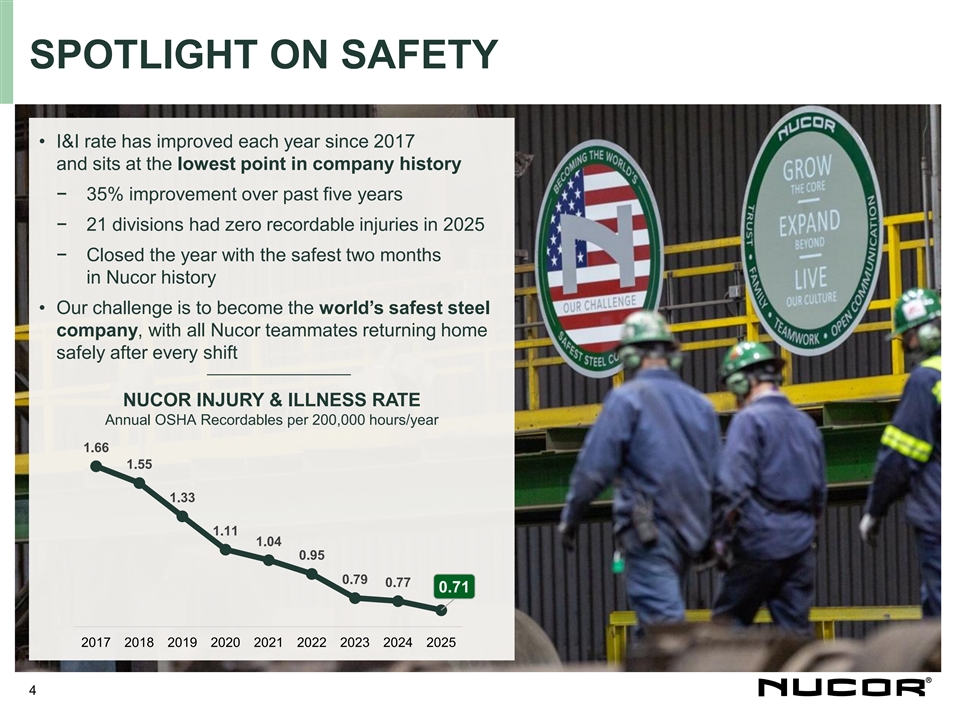
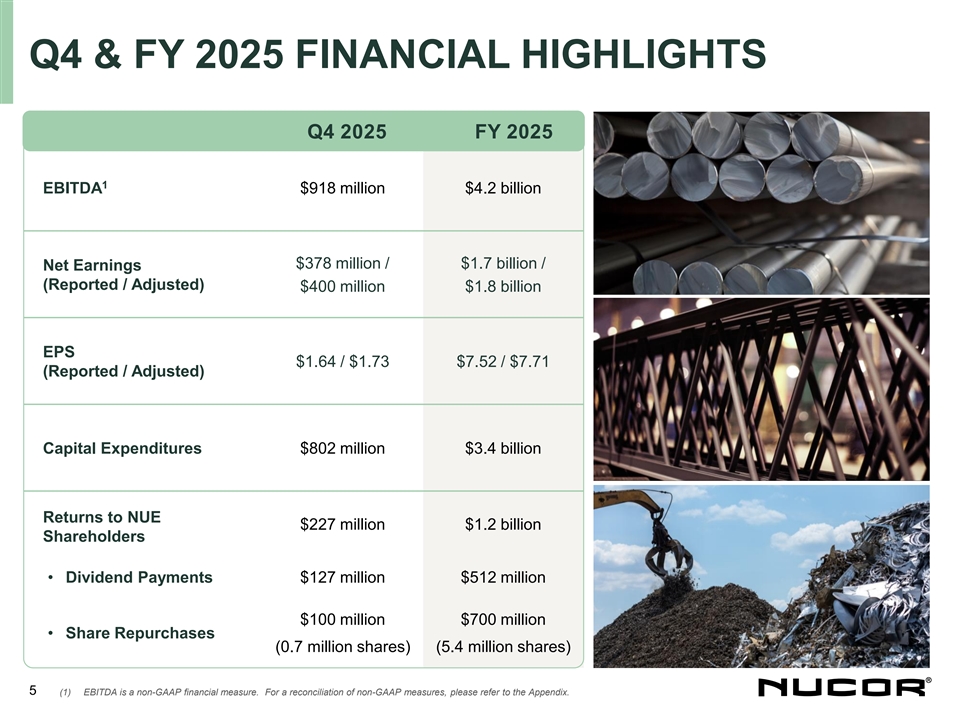
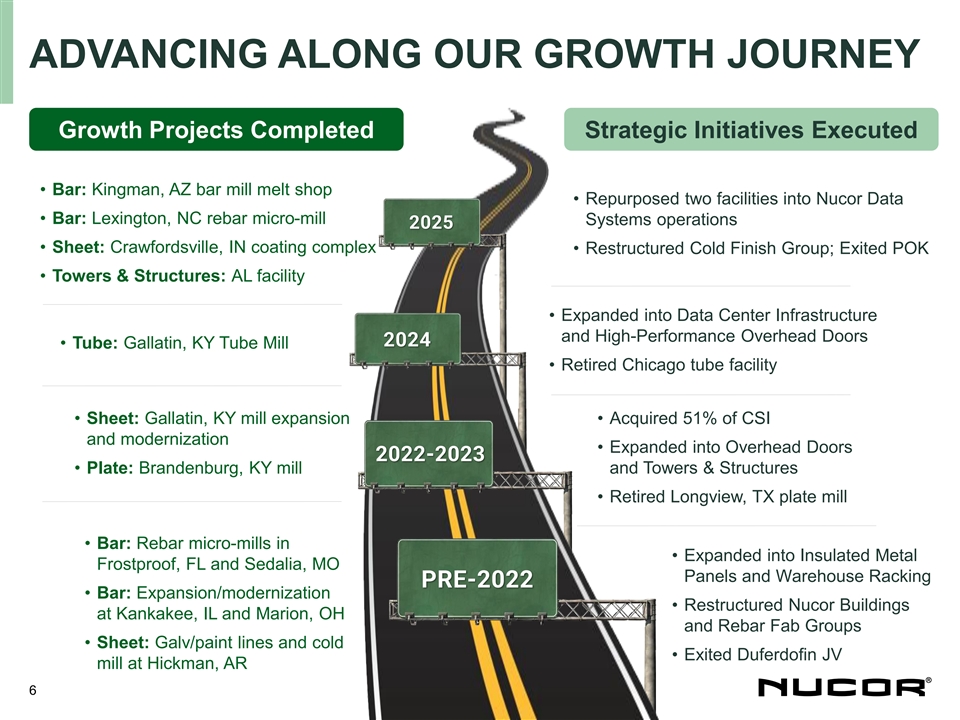
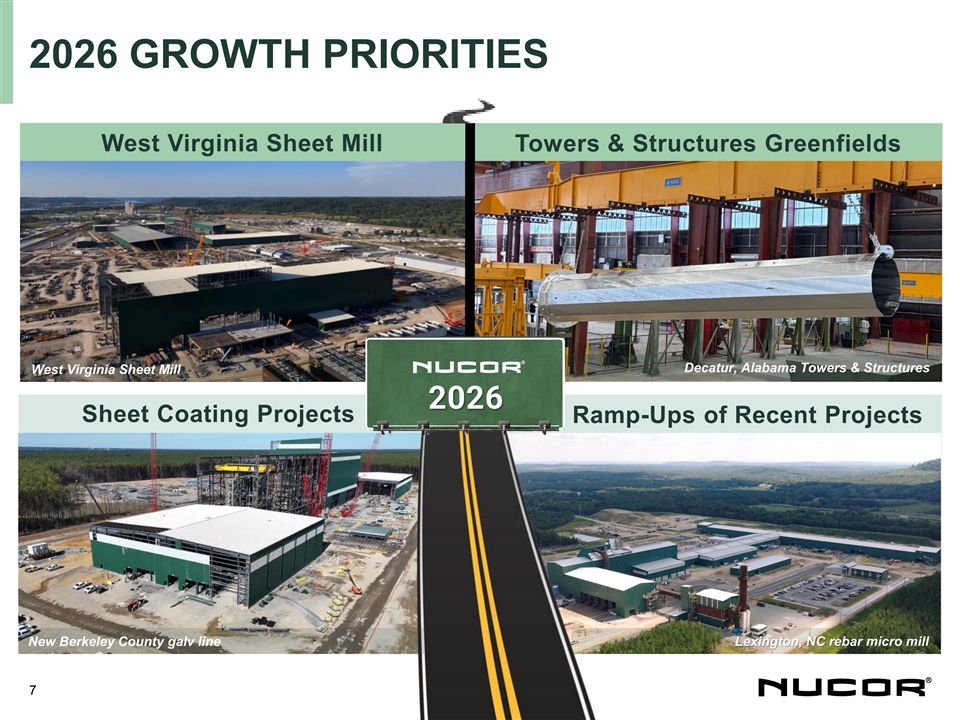
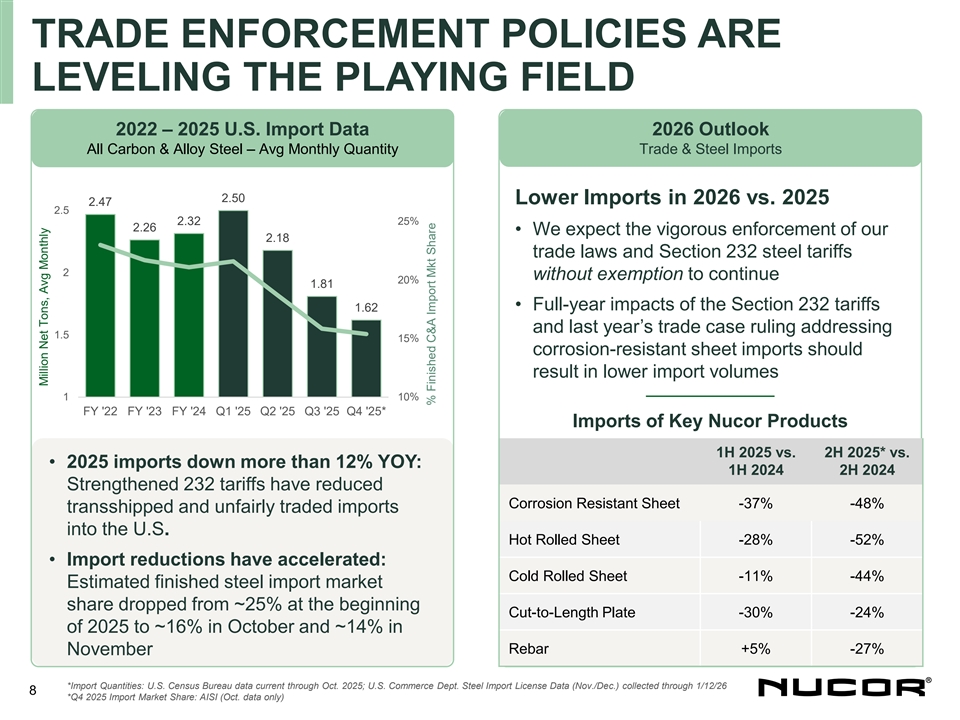
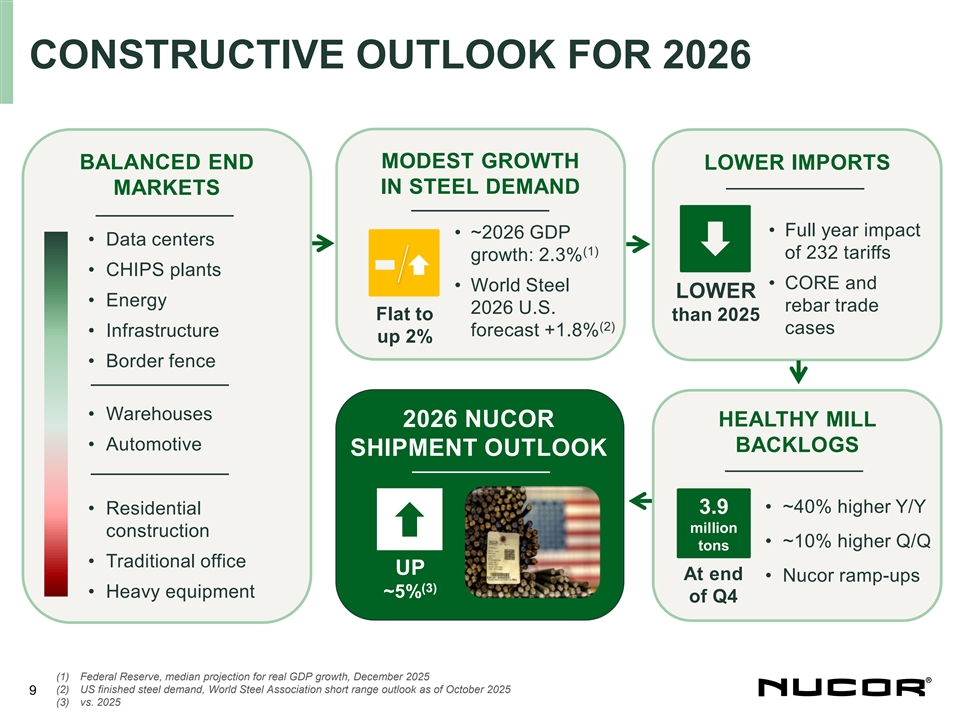
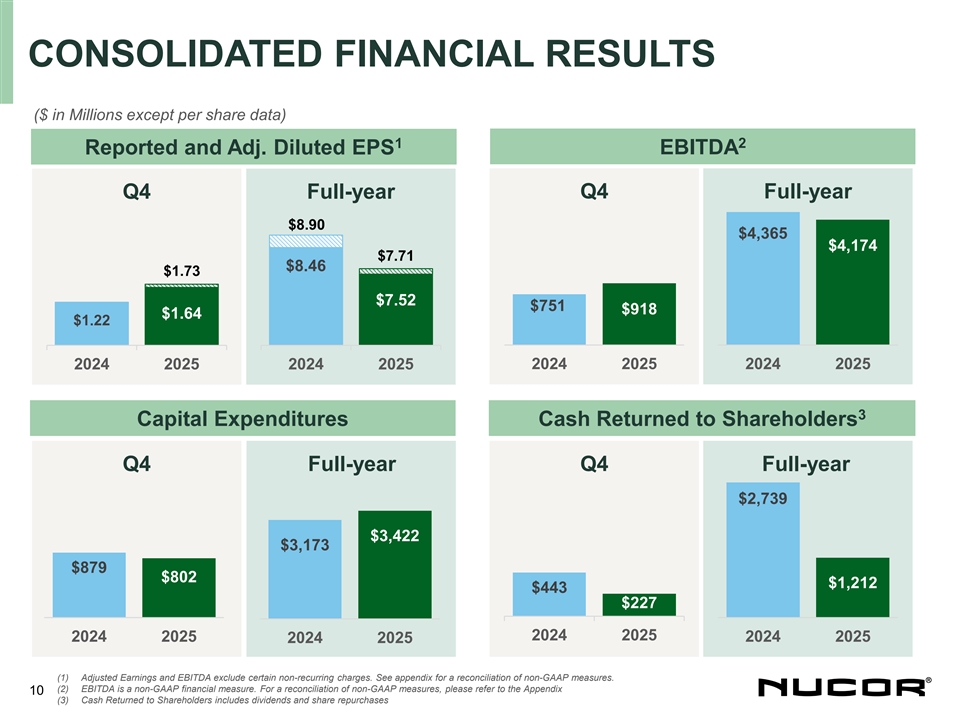
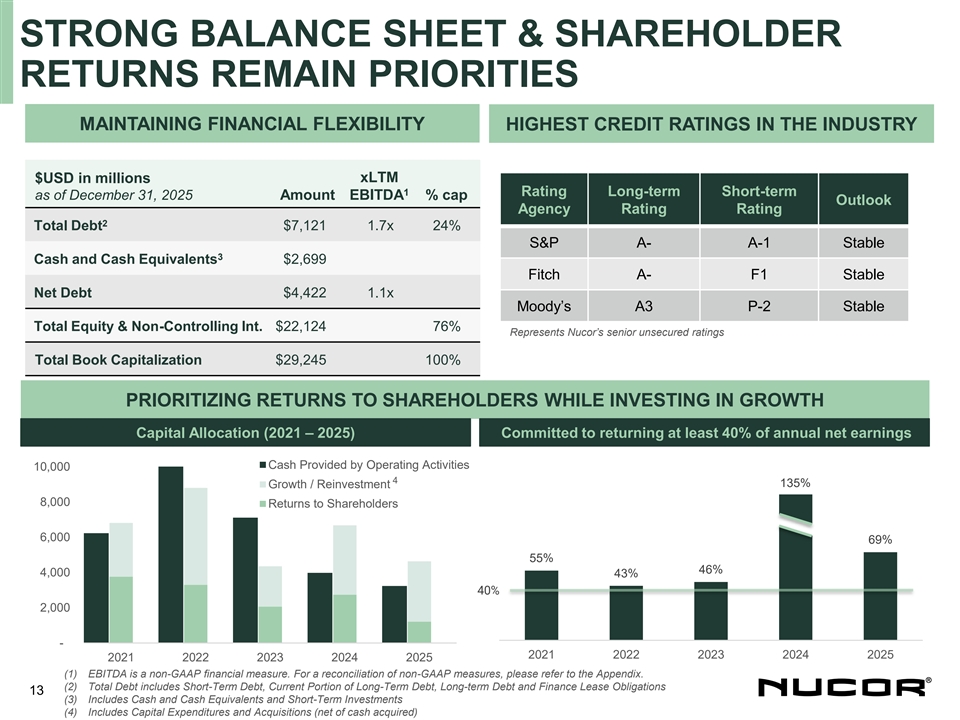
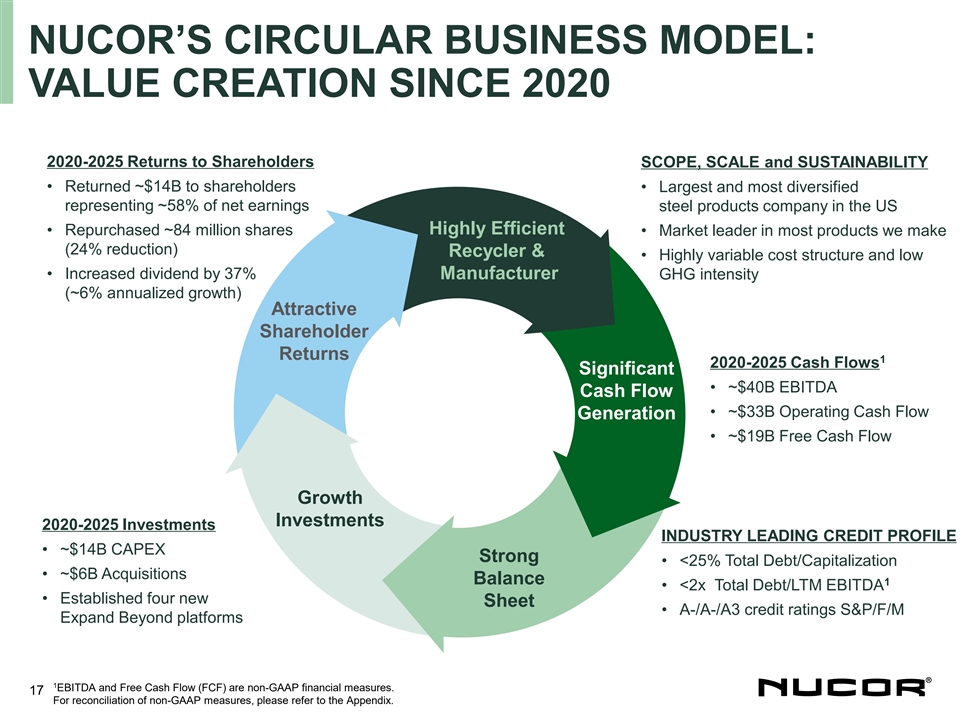
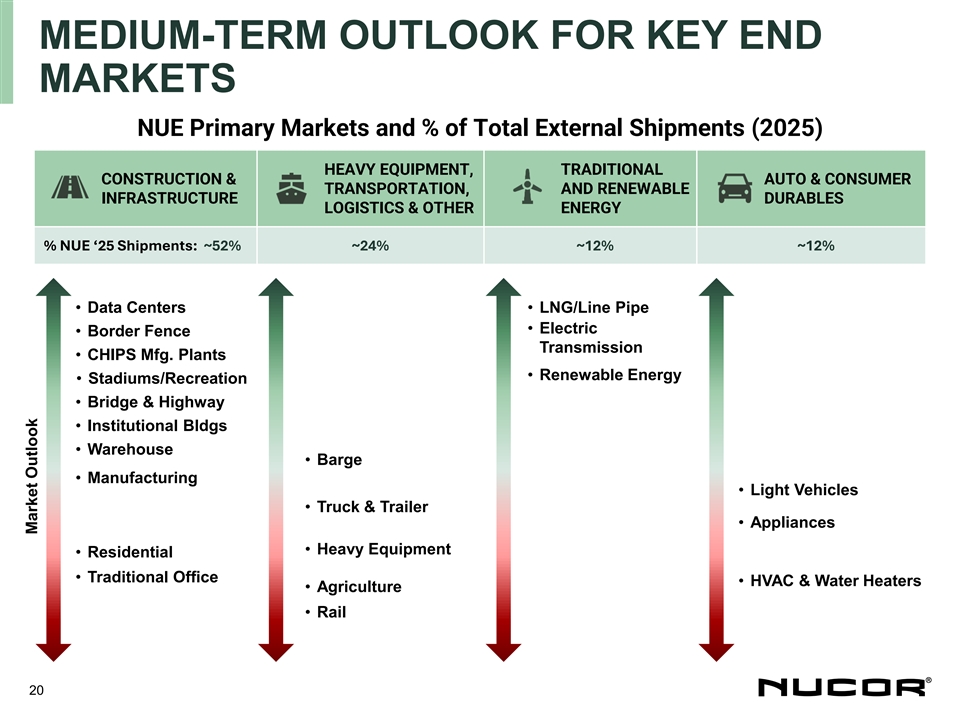
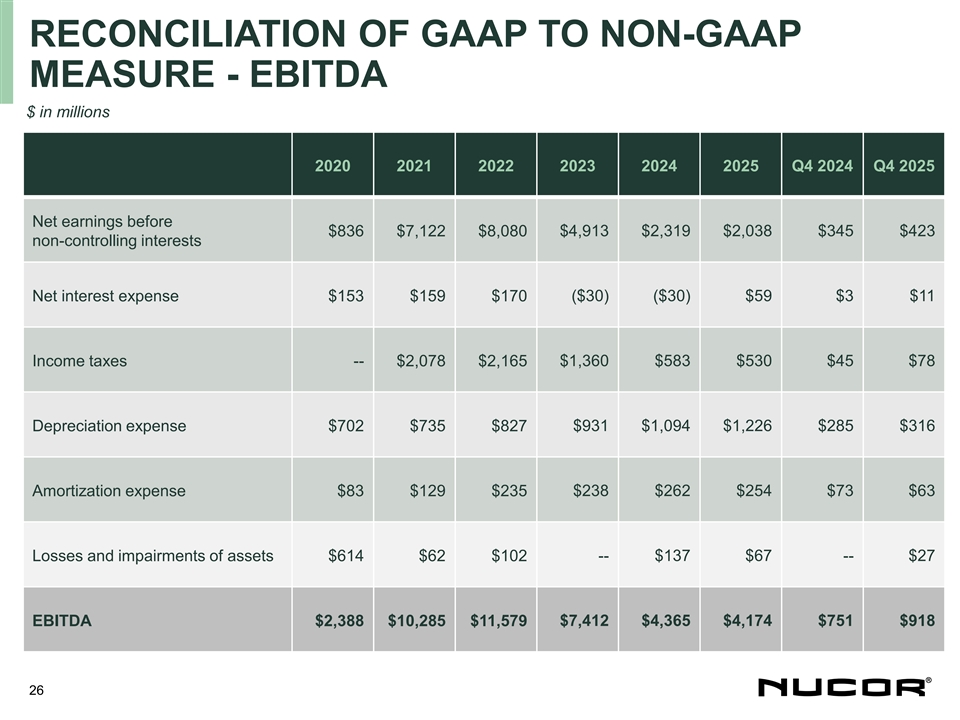
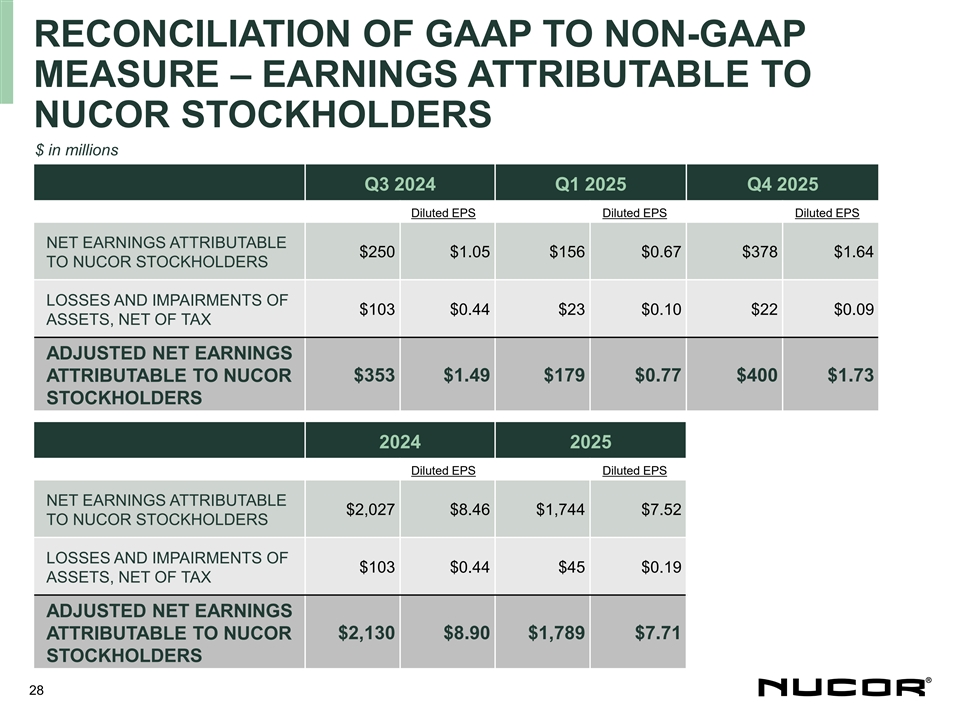
For as long as I've been Nucor's CEO, we have opened our earnings calls by recognizing our safety performance and i am pleased to continue that tradition again in 2025 our team achieved the lowest injury and illness rate in our history marking the eighth consecutive year of improvement and we finished the year with incredible momentum as the final two months of the year were the safest two months we have ever recorded these milestones have occurred during a period of significant growth and transformation for nucor and i am extremely proud of how our team continues to prioritize safety in everything we do. However, as we pursue our goal of becoming the world's safest steel company, our safety journey will not be complete until we operate injury-free every day. Before I comment on our results, I would like to briefly address the management changes we announced at the end of last year. Effective January 1st, Steve Laxton was promoted to President and Chief Operating Officer. Throughout his 23 years at Nucor, Steve has demonstrated strong leadership and has played an important role in shaping our growth strategy. In this expanded role, he will have an even greater impact on the company's future. Steve will also continue to serve as CFO until a successor is named. Congratulations, Steve. I would also like to acknowledge the many contributions of Dave Somosky. Dave has served as our Chief Operating officer since 2021 and will retire in june after more than 30 years at nucor over that time dave has been a trusted leader and his deep operational expertise and strong commitment to advancing our safety culture have made a lasting impact on the company he will be missed by all of us when he begins a well-deserved retirement in june on behalf of our teammates across nucor we wish Dave and his family all the best. Turning to our financial performance, we delivered adjusted earnings of $1.73 per share in the fourth quarter and $7.71 per share for the full year. EBITDA totaled $918 million for the quarter and approximately $4.2 billion for the year. We remain committed to balancing long-term growth with meaningful shareholder returns while maintaining the strongest credit profile in our industry for 2025 we reinvested 3.4 billion dollars into the company with the majority of that capital going to projects that were completed in 2025 or will be completed later this year returned 1.2 billion dollars to shareholders through dividends and share buybacks representing approximately 70 percent of net earnings and finished the year with $2.7 billion in cash, providing ample liquidity to support the business and finance our growth objectives. We begin 2026 with real momentum built on years of hard work, disciplined investment, and a relentless commitment to grow the core, expand beyond, and live our culture. Since 2019, we have strengthened our steel mill segment through 15 major projects across our sheet bar and plate groups. These investments have enhanced our capabilities while shifting our product mix toward higher margin products that address growing customer needs in key markets. We have also expanded our steel products portfolio by delivering more comprehensive customer solutions and adding steel adjacent businesses supported by strong secular demand trends the progress we made in 2025 marked a meaningful inflection point as a number of projects transitioned from the construction phase to the ramp-up phase major projects completed include our new rebar micro mill in lexington north carolina a new melt shop at our bar mill in kingman arizona a new new core towers and structures facility in Alabama, and new galvanizing and pre-paint lines at our Crawfordsville sheet mill in Indiana. All of these projects are on track to be fully ramped up and operating at positive EBITDA run rates within the year. Our growth strategy has never been about simply getting bigger. It's about generating more value for our customers, shareholders, and teammates. Even as we've executed on these growth projects, we've also taken deliberate steps to realign our asset base and improve our cost structure by restructuring operations and repurposing facilities to better serve fast-growing end markets for example we converted two existing steel products facilities to support our Nucor data systems business as it supplies the rapidly expanding data center market this demonstrates a core strength of Nucor with the broadest range of capabilities in the north american steel industry we are uniquely positioned to capitalize on new opportunities wherever they emerge turning to 2026 several remaining projects will reach completion this year and our teams are focused on bringing them online safely on time and on budget within the sheet group we're on schedule to complete construction of our new mill in west virginia by year-end. Once online, this mill will begin supplying some of the cleanest and most advanced sheet steel in North America, serving automotive, construction, and industrial customers. We will also start up the new galvanizing line at our Berkeley County mill, with commissioning planned for mid-2026. Within towers and structures, construction continues on our Greenfield Utility Pole Production Facility in Indiana, which is expected to begin full operations in the second quarter our third greenfield project in utah remains on track for completion in 2027 when these facilities are fully online we will operate four highly automated state-of-the-art production sites with national coverage in the high growth utility transmission tower market since 2020 we have invested approximately 20 billion dollars through capex and acquisitions to grow our core steel making capabilities and expand into downstream businesses while returning nearly 14 billion dollars of capital to shareholders and improving our credit profile. With the majority of our recent investments largely complete, I'm confident it sets up Nucor to enter its next phase of growth from a position of strength focused on disciplined capital allocation while driving long-term value for our shareholders. Moving to trade policy, vigorous enforcement of our trade remedy laws and the full reinstatement of the Section 232 steel tariffs without exemptions last year have helped drive down steel imports. Foreign import share of the U.S. finished steel market has dropped from approximately 25 percent at this time last year to 16 percent in October and an estimated 14 percent in November. We expect imports will continue to trend at or below those levels in 2026 as the market absorbs the full impact of the Section 232 tariffs and recent trade case determinations. During 2025, the Department of Commerce and the International Trade Commission made important rulings regarding unfairly traded imports of corrosion-resistant steel and rebar. Together, the Section 232 tariffs and product-specific trade cases provide vital defenses against countries that seek to dump their steel into the U.S. market. We appreciate the efforts the federal government took in 2025 to level the playing field for the American steel industry. Looking ahead, trade policy will remain a priority for our industry. The formal USMCA review beginning in July offers the opportunity to drive additional steel demand in North America, crack down on efforts to transship steel through Mexico and Canada, and address steel subsidies provided by the Canadian government. We must also continue to implement common sense policies like Buy America that incentivize the use of american-made steel for infrastructure shipbuilding and defense turning to our expectations for 2026 we continue to see strength in many of our primary end markets including infrastructure data centers and energy in an energy infrastructure we are also seeing healthy demand related to advanced manufacturing in the border fence while those markets remain strong we have yet to see much improvement from interest rate sensitive markets like automotive and residential construction in total we expect domestic steel demand to be slightly up relative to 2025 and as i mentioned earlier we expect the full impact of the section 232 tariffs and recent trade determinations will lower levels of imported steel in 2026 against this supply and demand backdrop we enter the year with historically strong backlogs up nearly 40 percent year over year in the steel mill segment and 15 percent in steel products within that our structural group really stands out the team set a record in the first quarter of 2025 and the structural backlog we are carrying into this year is more than 15 above that reflecting sustained demand across key non-residential and infrastructure markets. For the full year, we currently expect Nucor steel mill shipments to increase approximately 5% compared to 2025. With that, I will turn the call over to Steve to provide additional details on our fourth quarter and full-year performance, as well as our outlook for the first quarter. Steve.
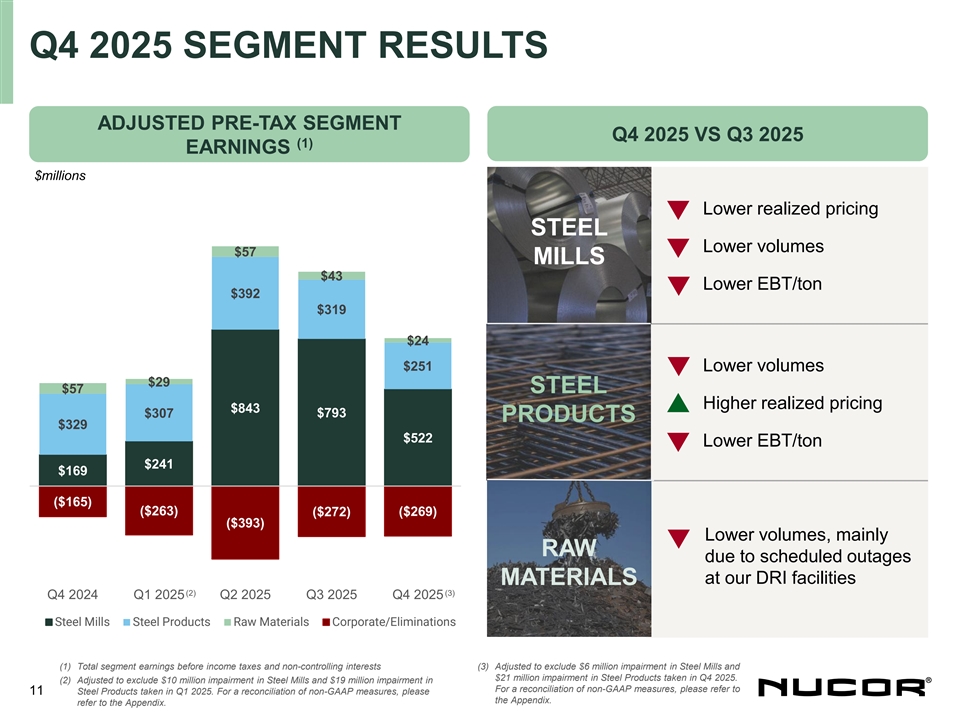
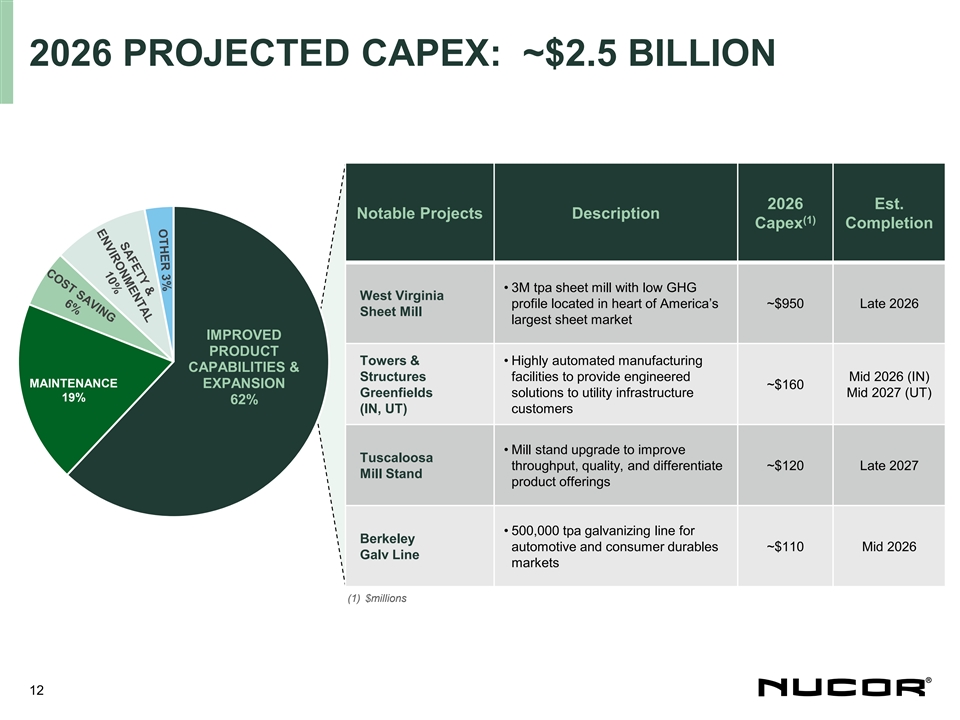
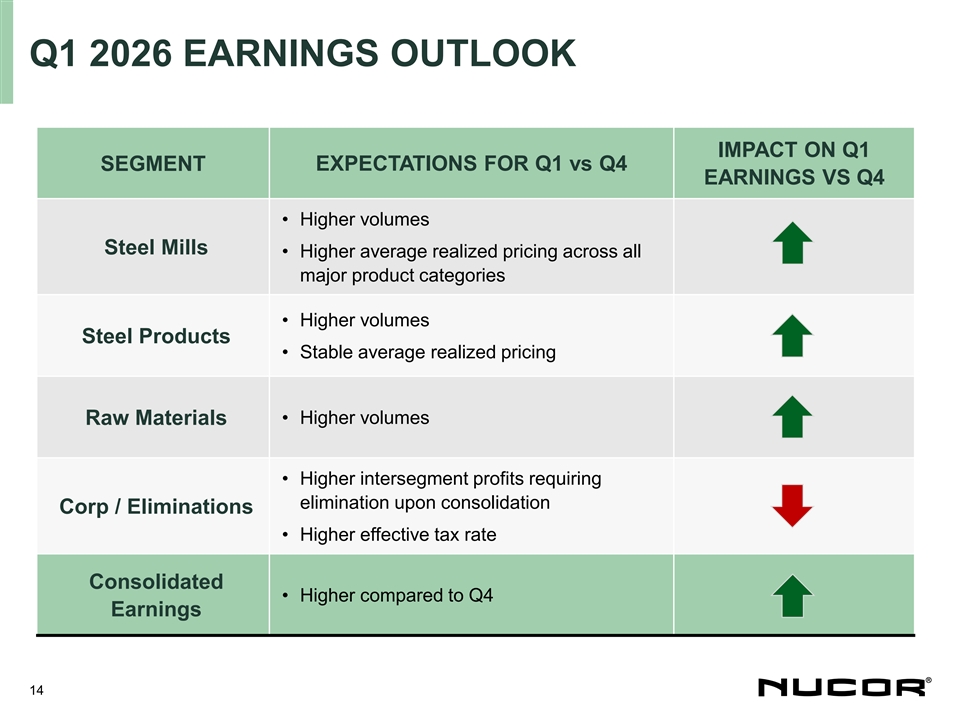
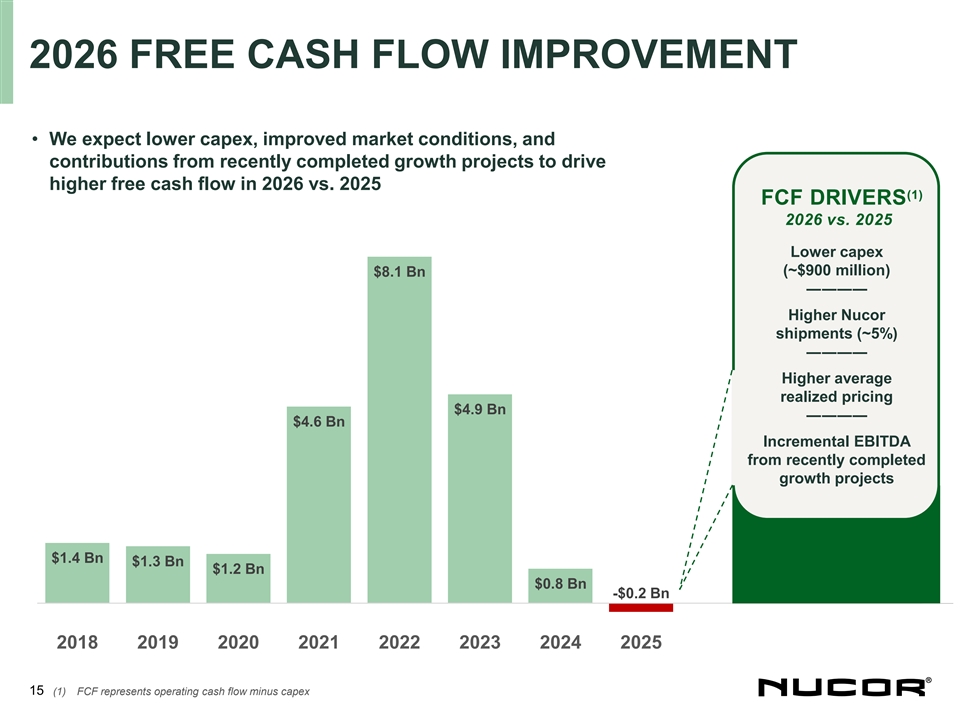
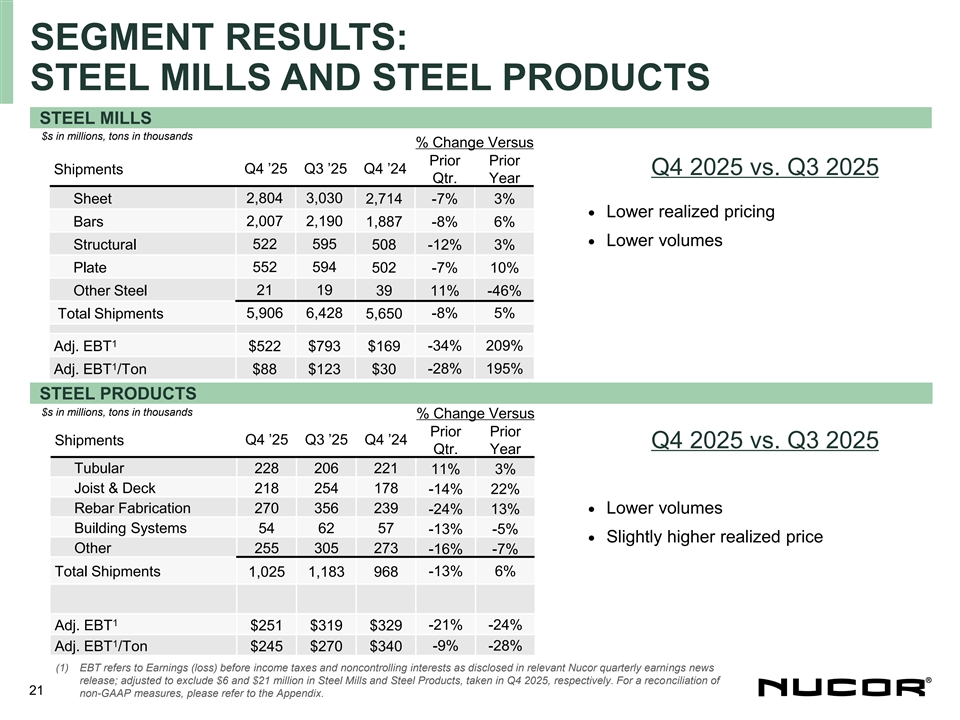
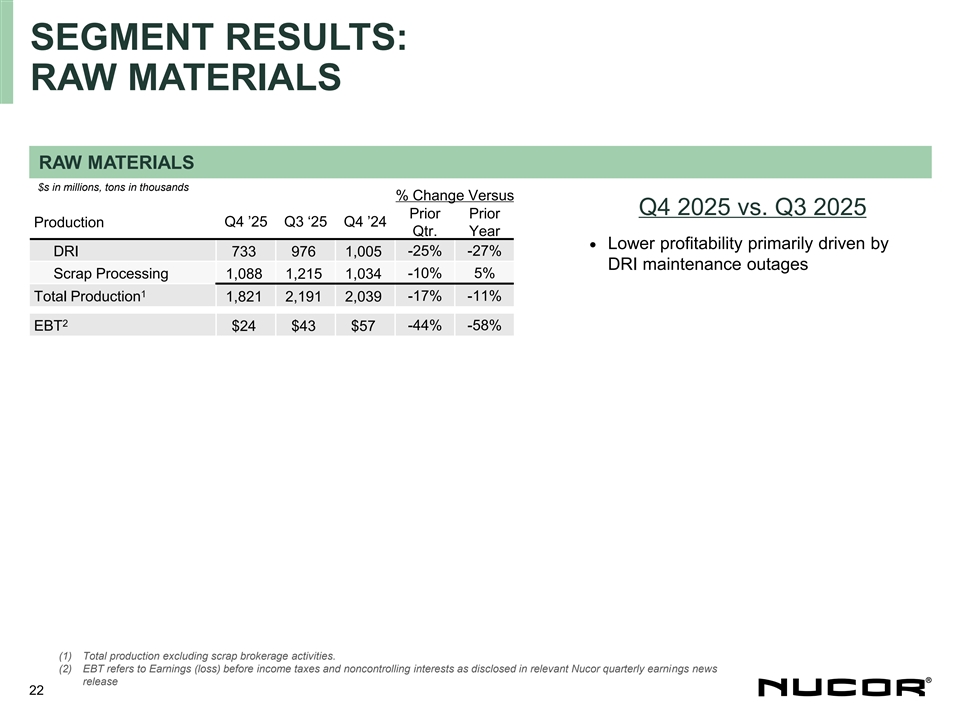
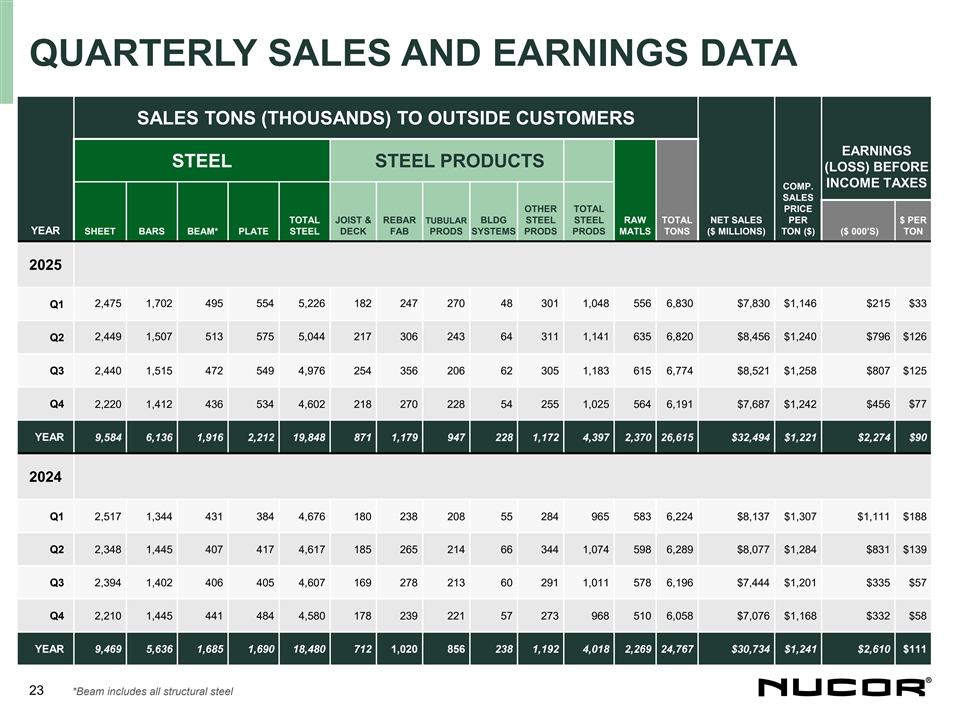
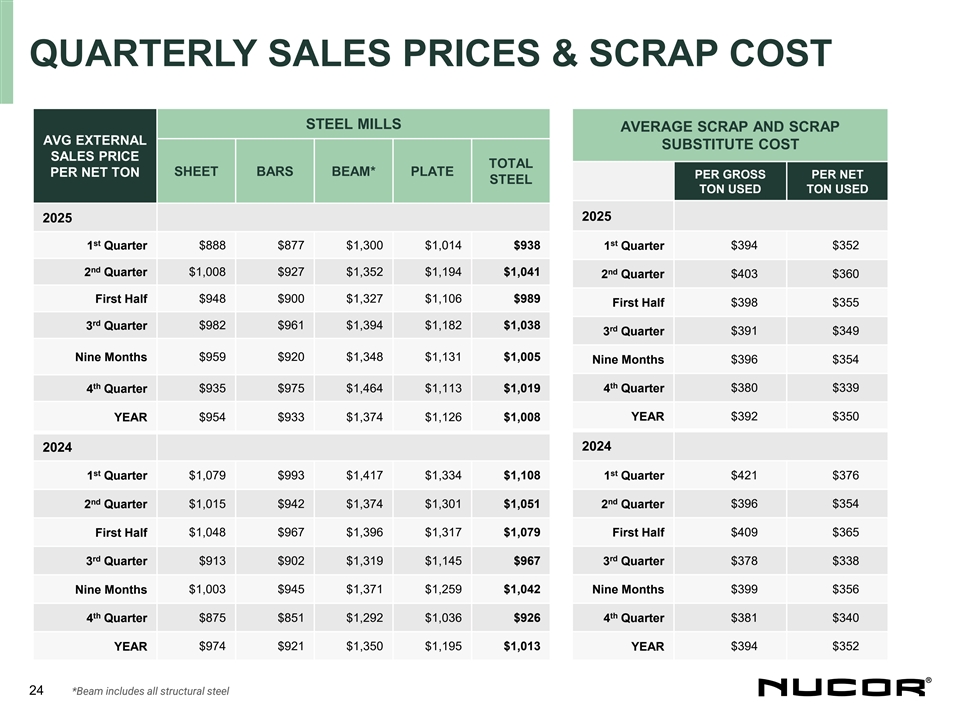
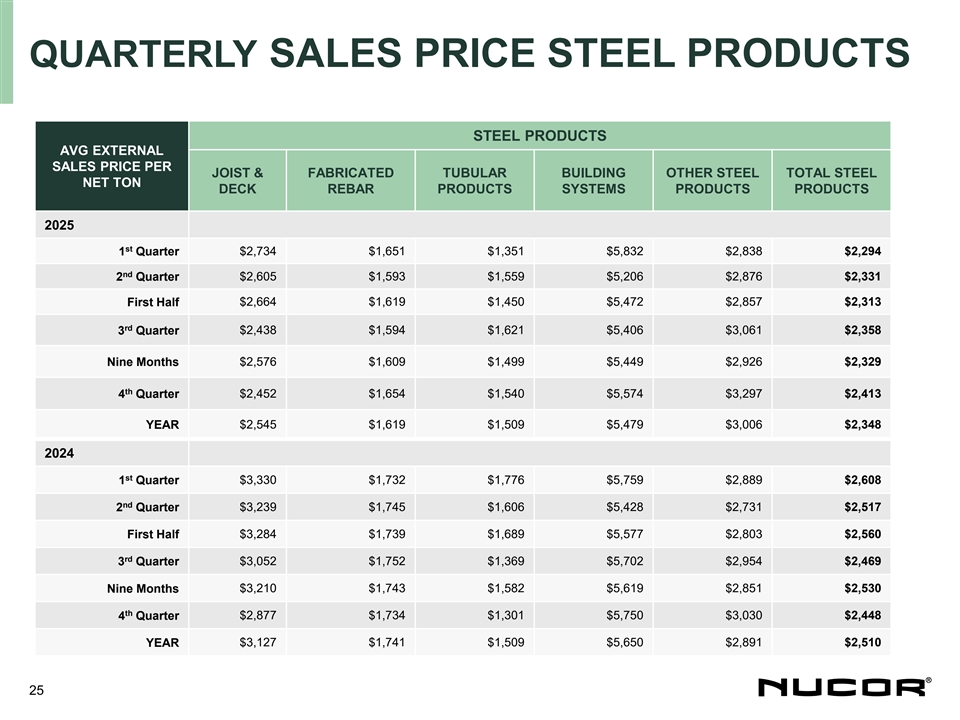
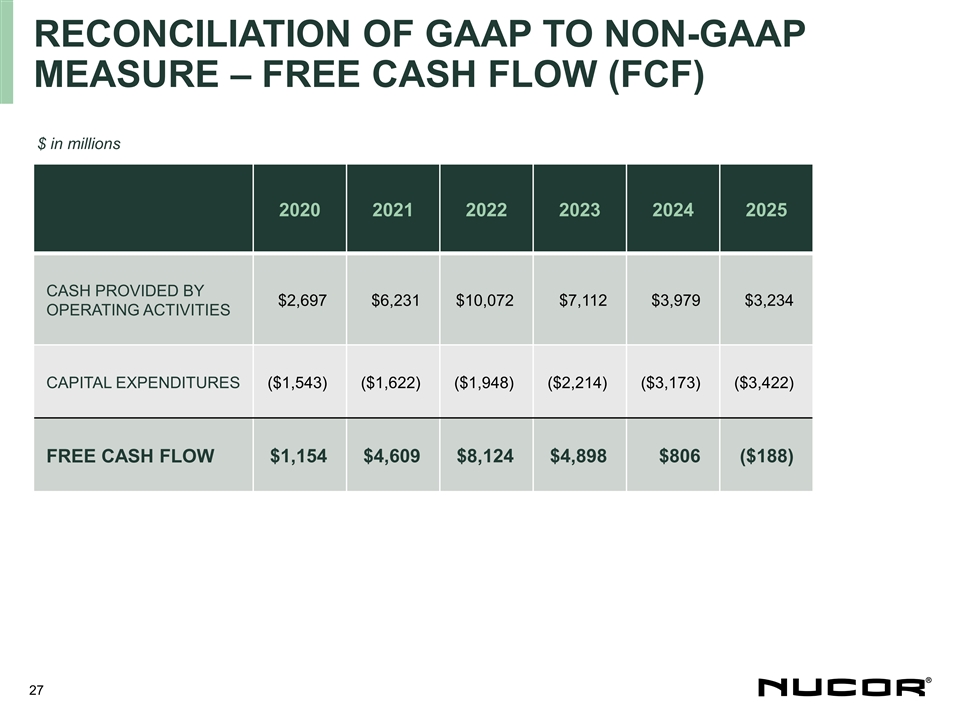
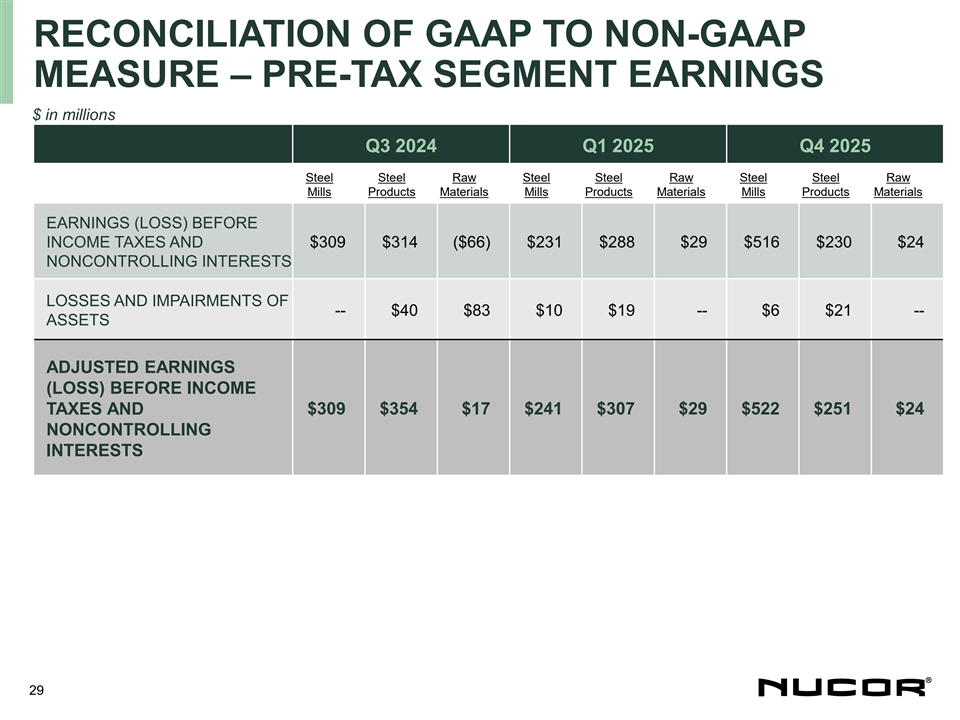
Thank you, Leon, and thank you all for joining us on the call this morning. During the fourth quarter, Nucor generated adjusted net earnings of $400 million, or $1.73, per share. For the full year, adjusted net earnings were approximately $1.8 billion, or $7.71, per share. As noted in our earnings news release, adjusted fourth quarter earnings exclude $27 million, or $0.09, per share, of charges related to one-time non-cash asset impairments primarily related to discontinued operations that were recognized during the period. Full-year results also exclude approximately $23 million, or $0.10 per share, of after-tax charges incurred in the first quarter, primarily related to closing or repurposing facilities in the steel product segment and ceasing production of wire rod at our Connecticut bar mills turning to the segment level results for the fourth quarter the steel mill segment generated 516 million dollars of pre-tax earnings down roughly 35 from the prior quarter shipment volumes declined eight percent reflecting seasonal effects fewer shipping days in new course fiscal fourth quarter and the impact of both planned and unplanned outages. While average realized pricing improved in our bar and structural groups, those gains were more than offset by lower pricing in our sheet and plate groups. This decline was expected as lagging sheet prices from the fall flowed through in the quarter. Sheet prices began to rise in November and December, with most of that benefit expected to be realized in the first quarter. Turning to steel products, we generated pre-tax earnings of $230 million, down from $319 million in the third quarter. Consistent with our steel mill segment, volumes declined sequentially across the steel products portfolio. Our rebar fabrication business accounted for roughly half of the quarter-over-quarter volume decline in line with its typical seasonal volume trend. Turning to our raw material segment, we generated pre-tax earnings of approximately $24 million compared to $43 million for the prior quarter, primarily reflecting the impact of two scheduled outages at our DRI facilities. As we continue to advance our long-term multi-year growth strategy, 2025 CapEx totaled approximately $3.4 billion. With several major projects reaching completion this past year, we will see a meaningful step down in capital spending for 2026. Our current estimate for 2026 CapEx is approximately $2.5 billion. Growth-oriented investments will represent roughly two-thirds of our planned spending, with our West Virginia sheet mill remaining the largest single-use of capital. Our growth efforts are also having a pronounced near-term impact on profitability. For 2025, pre-operating and startup costs totaled $496 million. Looking ahead, we expect these costs to remain elevated in 2026 as several projects move beyond the startup phase, offset by higher expenses associated with others, particularly bringing West Virginia online. Nucor remains committed to a balanced capital allocation framework anchored by three principles, maintaining a strong balance sheet, investing for value-creating growth, and making meaningful direct returns to shareholders. In the past three years alone, Nucor has invested over $9.5 billion through capital spending and acquisitions. During that same period, Nucor returned over $6 billion to shareholders in dividends and share repurchases, an amount equal to roughly 73 percent of Nucor's net earnings during that time frame. Even with these historically sizable investments and returns, we have preserved low leverage and substantial liquidity, supporting our industry-leading A-minus and A3 credit ratings from all three major rating agencies. It is worth noting that in December, our board approved an increase in the quarterly dividend to 56 cents per share, extending our record of paying and increasing our regular quarterly dividend for 53 consecutive years. Turning to our first quarter outlook, we expect higher consolidated earnings with improved results across all three operating segments. Shipment volumes should increase in each segment, supported by a healthy demand environment, typical positive seasonal trends, and fewer outages relative to the fourth quarter. The steel mill segment is expected to drive the largest portion of the sequential earnings growth due to higher volumes and higher realized pricing. All product groups within this segment should see improved results with our sheet business contributing the most to the overall increase. In the steel product segment we expect higher volumes and stable pricing and in our raw material segment earnings are expected to improve modestly following the successful completion of planned DRI outages in the prior quarter. These gains will be partially offset by higher profit eliminations upon consolidation. Before we take questions, I'd like to spend a minute on what has long been both a source and evidence of Nucor's resilient and sustainable business model, our ability to generate free cash flow across a wide range of market conditions. Last year, Nucor had negative free cash flow, something that is very rare in our company's history. But this event was not a surprise. It was a measured and intentional result that was the product of advancing our aggressive growth initiatives and strategy. We prudently positioned the company with ample liquidity ahead of these expected results to afford the ability to maintain our growth and return commitments. With lower capital spending, incrementally EBITDA from recently completed capital projects and improved market conditions as a backdrop, we expect Nucor to generate meaningfully higher free cash flow in the year ahead. We enter 2026 with healthy, favorably priced backlogs, supporting both higher shipments and better margins across most of our product lines, and we remain confident that with the broadest range of capabilities and solutions in the North American market, our driven and dedicated team is exceptionally well positioned to create value for our customers and shareholders. And with that, we'd like to hear from you and answer any questions you may have. Operator, please open the line for questions. Thank you. To ask a question,
Operator
please press star followed by one on your telephone keypad now. If you change your mind, please press star followed by two. When preparing to ask your question, please ensure your device is unmuted locally. Our first question comes from Lawson Winder from Bank of America. Lawson, your line is now open. Please go ahead.
Thank you, Operator. Good morning, Leon and Steve and Steve and Dave. I would say congratulations on your new adventures going forward. If I could ask about CapEx and look out to 2027, and by the way, thank you for the detailed guidance on 2026 CapEx. As we think of how falling CAPEX might help support Nucor's unfolding free cash flow inflection, could you just speak to your current view on CAPEX for 2027, and in particular maybe address, you know, one would be the $950 million for West Virginia in 2026, and how that might be expected to follow on in 2027 with some additional CAPEX. And then the breakdown in 2026, CapEx suggests non-expansionary and non-improvement CapEx of about $950 million. I think we've talked about $600 million in the past. What is the latest thinking of sort of ongoing non-expansionary CapEx to kind of keep the business running? And thank you very much.
Well, I'll kick us off and then ask Steve to provide a little bit of color as we think about CapEx flowing into 2027. but i do want to begin where you started in thanking dave and steve both for their commitment dave's 30 years with our our company and uh again he and i started our careers together building nucor berkeley in the mid 90s and uh we appreciate everything you've done and on behalf of our 33 000 team members dave thank you excellent um and in what gloss and the other thing i'll i'll also just mention briefly is you know eight straight years of um safety performance that our team continues to just exemplify the value of safety and what it means to accept a challenge of becoming the world's safest deal company. It is something that gives me tremendous pride in all of us in Charlotte as they execute each and every day across all of our product groups. So these startups, the enhancements, the build outs, the new lines and greenfield operations, it's an incredibly exciting time for Nucor that positions us well for the long term. And as again, we move to the future, we do see a day in time where Nucor will go an entire year without a single injury to any of our team members. So we're going to continue to focus on that as our primary value as we drive all of our business results. And again, thanking our team for that. Finally, the last comment i'll make you know specific to you know the capex look when when we began this journey in 2020 it was to to make sure new core remained a growth company we've invested heavily we've taken meaningful steps but against that backdrop lawson one of the wonderful things then and now is we didn't have to pivot we didn't have to change tact of where the company was headed or the direction or in fact we were coming off some of the best years we've ever achieved as a company when we added the expand beyond portion of our growth strategy and it remains the same today that we can be incredibly prudent and disciplined with how we think about spending our valuable shareholder capital to grow this company meaningful um again the the culmination of west virginia that we'll start up later this year will um really absorb the majority of that capex as we move into uh into 2027 but steve maybe provide some some additional details yeah yeah
sure uh lawson just to kind of follow up on what leon said there um west virginia will be uh done at the end of this year and that team's doing a fantastic job moving that project forward busy as you could imagine it's a big project and um um you you know in the past we have guided figures make what we would call maintenance capital but included in maintenance capital I would put safety environmental compliance and a certain amount of efficiency projects that are smaller in nature that don't necessarily add new capabilities to this I would guide you to figure closer to 800 million a year now for that for that just because of the inflation that we've seen in the last several years post-COVID and just the size of our company, we're larger now. So as you think about, you know, modeling out things beyond 27 and beyond, I'd guide you more toward an $800 million figure plus whatever projects are going on. Fantastic. And I guess
just a follow-up would be on those potential expansionary projects. It feels like, you know, you're quite satisfied with the long product business at this point with the step back from a potential Pacific Northwest expansion, are there areas of the business that you might be able to highlight today as places where you actually might consider some expansionary capital
beyond 26? Yeah, look, Lawson, I think, you know, without getting very specific and, you know, completely not answering your question, I would just guide you to the things that you've seen and how we've looked for growth. And it's coming through the megatrends in our economy, things like data centers, energy, energy infrastructure, obviously the ability for us to pivot very quickly and handle the increase in the border wall has been a nice boom for our businesses across Nucor. But, and finally the towers and structures segments of our growth that we are tremendously excited about. Every one of those continues to provide a platform for additional growth. For example, in data centers today, Nucor supplies about 95% of the overall steel demand required for the entirety of a data center. And so, again, we look for, okay, what's the next step? How can we continue to maximize our capability set and continue to enhance the growth profile for our shareholders? So we're looking for things that aren't high capex. we're looking for businesses that might be counter cyclical to the steel industry and trends that we've been a part of for six decades. And then lastly, you know, I think in the core side, it's how do we continue to invest for the long term that moves us up the value chain and higher value products. And again, you're seeing that in our galvanizing lines in Crawfordsville at New Corp Berkeley, the two galvanizing lines at West Virginia's building. So again, we're thinking about how do we continue to grow and enhance our differentiated position that we have to supply our customers with products that they're going to need today and down the road.
Operator
Thank you very much. Thank you. Our next question will be from Tim Natanas from Wells Bogger. Your line is now, Orson. Please go ahead. Yeah, hey, good morning. Hope everyone's doing well.
I wanted to take a step back and recall your November 2022 investor day where you talked about through the cycle EBITDA 6.7 billion. And if you could just refresh us on where we stand relative to that number, what it might take to get there, considering the projects that you have. I know that number was assuming they were complete, but should we assume that that could be the run rate in 2027 as you finalize some of these projects, or any updated thoughts there, please?
Yeah, a couple thoughts. First, thank you for referencing that. For me, it was my first investor day as CEO, and again, Steve, and his new role as chief operating officer as well as CFO, at least for a short time until we announced his successor. or you know look we're thinking hard about when the next investor day is tim then again to provide an update against that backdrop but look it's um it's something we spent a lot of time thinking through the investments we're making at that at that time so look to answer your question broadly yeah i think you're you're thinking about it the right way as we culminate the west virginia startup and then bring that to its full ramp uh capabilities at the same time i would tell you look i'm an optimist. And I believe in the long-term growth strategy Nucor's had, but I also think we've reached a time in our economy where we've seen import levels, for example, I've never seen in my 30 years at Nucor. So we're poised today to capitalize on those trends as well as the opportunities. And again, I know your background and obviously how well you understand sheet. The material decrease in the import levels on sheet alone are 4 million tons of consumption. that the domestic supply chain gets to now contribute. It is a meaningful number. And so, again, I don't know what the next administration brings, but certainly as we look to 26 and, you know, in the short-term horizon, may we see import levels staying or maybe even slightly coming down some more. So, Steve, anything you'd add on the, you know, the investor day or the EBITDA that we projected at that point?
No, not really. I think what I would be a little bit clear on, I think I heard you ask about, is that good guidance for 20, hesitate to say that's guidance for 27. The investor day materials, which you're familiar with, but others on the call may not be, was a mid-cycle guidance around after all projects at that time were completed, including West Virginia and the others. and just so I back off of that being a specific guide toward 27 all the points Leon made are solid and can be baked into your thinking around 27 but with respect to the ramp up of West Virginia that's a big complex mill it's not going to be at its run rate of EBIT in 27 among other okay appreciate that color
along the lines of what Leon was talking about with the loss of imports it does make sense that the domestic mills can take share can you just give us some thoughts on the spare capacity uh across your operations and and what you might be able to do incrementally uh to take
share from imports thanks again yeah look again i think overall we're in a great position you know we're roughly about 85 utilization across our sheet mills uh that gives us you know opportunity to contribute into the spot market and as well as think about the long-term. So again, with an import level overall, ADC about 15%, it creates some unique opportunities that we have the room. We have the capability set in our mills and again, really creates a wonderful time for a ramp up of a new facility in West Virginia. And so we see more opportunities there as well. I think the Northeast and Midwest corridors provide some unique geographic opportunities for Nucor. And again, I think from a cost position, that mill is going to provide a significant value for our shareholders.
Operator
Thank you. Thank you. Our next question comes from Bill Peterson from JPMorgan. Bill, your line is now open. Please go ahead.
Good morning. Thanks for taking the questions. And again, congrats to Steve and Dave here. I wanted to follow up on the last question, you know, you discussed shipments or your shipments are projected to increase by 5%, implying a higher share of U.S. market demand. You know, I think you talked that there's some uplift. You can see a neutralization message sheet, but I guess should demand support, is there upside to that 5% expectation? And what would drive that? Would that be more, you know, in your view sheet, plate, or I guess bar, considering that you have Lexington and Kingman coming online?
well yeah bill look at do i think it's sustainable 100 if you look at our backlogs again they're up 40 year over year in the steel group um you know 15 or 16 percent of our products group in many of our product groups today they are record-setting backlogs i think maybe the uh our earnings call uh in q3 and four i i actually shared some volumes in our structural backlogs and again in my opening comments they are record backlogs and they are historic backlogs for what we've seen and it's a market and an end-use customer in our non-res in industrial sectors that we know incredibly well so when i'm talking to our customers and our customers customers the demand picture is robust and it's very optimistic for 2026. We believe that the 5% is not only an achievable number, but the demand profile is going to create some uplift for virtually every product group. Finally, I tell you that as you look at commodity across the board, to supply and demand environment, it's not tariffs or a single thing that's driving pricing. But the pricing that Nucor has realized that we're announcing Q4 hits almost every product group, sheet, plate, bar, beam, and many of the product group segments themselves that are all seeing that stick. So, look, I think we're entering what should be a better year in 2026. We're very optimistic. And again, the timing of our startups in several of the expand businesses and core are coming at a perfect time in a demand environment that's peaking in energy infrastructure, non-res, border fence, energy infrastructure, towers and structures. And yeah, I think positions Nucor incredibly well.
Thanks for that, Rian. And I wanted to follow up on your comments around trade policy with your expectations that the tariffs are going to continue without exemptions. So is that kind of a statement on 2026? I guess are you expecting that to be durable beyond? I'm also trying to get a sense for the risk of lower tariff rates and or quotas. Maybe these are on the table for the upcoming USMCA negotiations. And maybe, you know, what is Nucor lobbying for or positioning for? I guess bottom line is are you supportive of lower rates for Mexico and Canada if they have equally high steel tariffs you know to other regions in order basically in order to mitigate transcriptments any sort of you know specifics on on your expectations around trade policy would be helpful.
Yeah Bill I'll tell Sean I didn't look let me begin with the end in mind what Nucor is most in favor of is banning illegally dumped subsidized imported steel to come in and ravage the shores of the U.S. economy, period, full stop. How we do that, how that's affected, obviously it matters greatly. And if you had asked me, and you did a year ago, hey, did I think our trade agreement with USMCA as we reinstituted or Trump reinstituted the 232 tariffs would be resolved very quickly, I would have told you absolutely I believe that would have been resolved very quickly. But here we are a year later, still that not done. And again, July, the renegotiations come up. But the reality is, I can't tell you, does that end up with a trilateral agreement, a bilateral agreement? And again, the one-offs on what this current administration is going to do. What I can tell you is what we've seen out of commerce and USTR is a very supportive trade environment that's pro-America and pro-US manufacturing. So what would we like to see ultimately? Man, strengthen the rules of origin, continued enforcement of the 232 policies that are already on the books, the enforcement of them. That's why we've been such staunch supporters of the playing field act 2.0 and still think that needs to pass but look i think as we look to uh the second half of president trump's administration you will see a continuation of those pro-america first trade policies and remedies thanks again ma'am thank you our next question
Operator
comes from phil gibbs from key bank your line is now open phil please go ahead hey good morning
good morning phil on west virginia specifically can you just update all of us on some of the the new products and you know and market capabilities that that mill may give you relative to the you know current uh fleet of assets that you have right now on the sheet side just to kind of go back over the you know the investment case and and why you're making why you're making the move here, and yeah, that's effectively the question. Just kind of want a refresher in terms of what it brings you, because I know it's a different mill relative to
what you currently have. Yeah, look, Phil, I appreciate the question. I'll kick it off and then ask Noah Hanners to actually give you the specifics of that capability, because it's going to be very unique for Nucor. But if we step back to the macro question you asked about why, look, it's the right opportunity. If you look at Nucor's market share in the largest sheet consuming region of the US, it's about 15 or 16%. So we have a huge opportunity to grow in that space against what we believe is some competitors that we have ample opportunity to continue to provide a better differentiated value proposition in that market. So the geography of West Virginia, coupled with the state and the Mason County, West Virginia, The people of that state fuels what we believe is going to be an unprecedented growth for us and a capability set unlike anything Nucor has brought to bear in the market. So we couldn't be more excited about the geographic, the technical, and, again, the people side of the state of West Virginia. They've been an amazing group to work with. We couldn't be prouder of the team we've hired, the work that's being done there. But, you know, I want to touch on some of the capability sets of the mill.
Yeah, maybe just add a little bit more detail to Leon's excitement there. One, we feel great about the strategy to get into higher value-added products. And specifically at West Virginia, that's about a third of that production going into the automotive market. And some of those grades, the quality of the production there will be into exposed automotive, an area where EAF production really hasn't played broadly before in the U.S. And we're really excited about the capability to get there, mostly because of the demand we hear from customers. We've recently got qualified on exposed automotive through another route to our mills, and that'll really open the door for us to expand our business into the highest quality automotive production. The other point I'd highlight is into consumer durables. We haven't had great market share there with especially items like appliances, and Leon hit the regionality of this, but we see some pretty substantial growth in demand through some reshoring projects that are being built in that region. So probably those are the two areas that I'd highlight for you. A million tons of galvanizing is going to play really well with that. We're going to have the capabilities to match what is really robust growth in demand for us.
Thank you so much. And do you have any carryover capex from these major projects like West Virginia into 2027? Steve, I know you talked about $800 million maintenance plus whatever growth you have, and you always have some sort of growth element. but anything left on west virginia or these other major projects uh in 27 yeah they'll be
they'll be a small amount still um that's very normal for us to have for years we'll update you more on the outlook in you know 27 as we get toward the end of 26. i'd love it if uh if that team beats every time and we don't do that but that's that's been that's been the historic
path and then if i could sneak one more in just on uh kind of just a modeling question high level question uh just because i don't have it in my model you you guys have an idea what mill utilizations were for nucor in general in 2025 yeah we do you know as i think about our major
product groups you know somewhere in that 82 84 range is uh about the right utilization so
Operator
thank you so much thank you thank you our next question comes from katya jantic from BMO Capital Markets. Your line is now open. Please go ahead.
Hi. Thank you for taking my questions. I think earlier you talked about beyond the current project pipeline, you would be looking at growth opportunities that would be less capital intensive. In the future, could you provide a little more color on what the annual annual growth CAPEX could potentially be in a more normalized environment without these major projects?
Well, Patrick, yeah, I appreciate the question, and I'll probably have you back into the numbers because we're not going to exactly tell you the exact amount of dollars. What I would tell you is this. We are committed to a long-term investment credit rating. We're committed to returning at least 40% of our net earnings back to our shareholders in dividends and share repurchases. And quite frankly, beyond that, I want to use the rest 60% for growth, period, full stop. So I want us to be using the money that Nucor is generating to continue to fuel our growth for the next 10, 12, 15, 20 years and beyond. And so that's how you can be thinking about it. You know, again, we provided some details in the 2022 investor day that we had. And so, again, if you think of a through cycle EBITDA of $7 billion, okay, everything that didn't go back to our shareholders is then going to be used for growth. So, again, our M&A teams are working hard and we're really looking really hard this year at, okay, how do we invest that? How do we grow, continue to grow new core in meaningful ways? and I think you're going to see a shift from heavy core investments to heavy adjacencies or what we call the expand beyond investments over the next several years. Maybe just to follow up to
your comment about M&A, can you talk a little bit more, I know you said adjacencies, are there specific products or how should we think about these type of businesses?
Yeah, Katia, you know, again, I shared a little bit earlier, but we've been fairly open with our investment filters and strategy in M&A, and particularly adjacencies, that they're going to have some steel centricity. There's going to be some connection to Nucor, you know, gaining and using and having the opportunity to have synergies. So something that's going to connect us to, for example, like CHI with the overhead door businesses and Ritech. Man, what a wonderful adder where they've been a huge player in the residential space, a little less so in the commercial. Well, again, that's where we play in the commercial side. so our teams and our buildings group, our nuclear warehouse systems groups, to be able to use and combine forces to be able to provide that, the hyperscalers and co-locators in the data center, it provides a wonderful platform for us to continue to grow Nucor and as well that business footprint. So when you think about the mega trends in the U.S. today, energy, energy infrastructure, data centers, tower structures, those are the areas you can be looking and expect a Nucor searching really hard for those companies that would be additive in where we see synergies and value in creating EVA for our shareholders. Perfect, thank you. Thanks.
Operator
Thank you. Our next question comes from Andrew Jones from UBS. Andrew, you may begin. Your line
is now open. Hi, gents. First of the time. Just a few questions. First of all, on pricing. I'm just curious how you're looking at your pricing policy now, given obviously we have on import parity, your traditional imports are probably getting sort of close to 1,000 on HRC, I would guess. I guess if you're talking about like East Asia, they can probably land HRC in the US at you know closer to 800 so given that gap is now growing to import parity versus say some of these east asian countries like what stops those volumes starting to tick up in the coming months and do you see that as a material risk and does that hold you back from potentially lifting prices much further from here how do you think about that in the context of changing trade flows and i've got a second question if you answer that first thanks
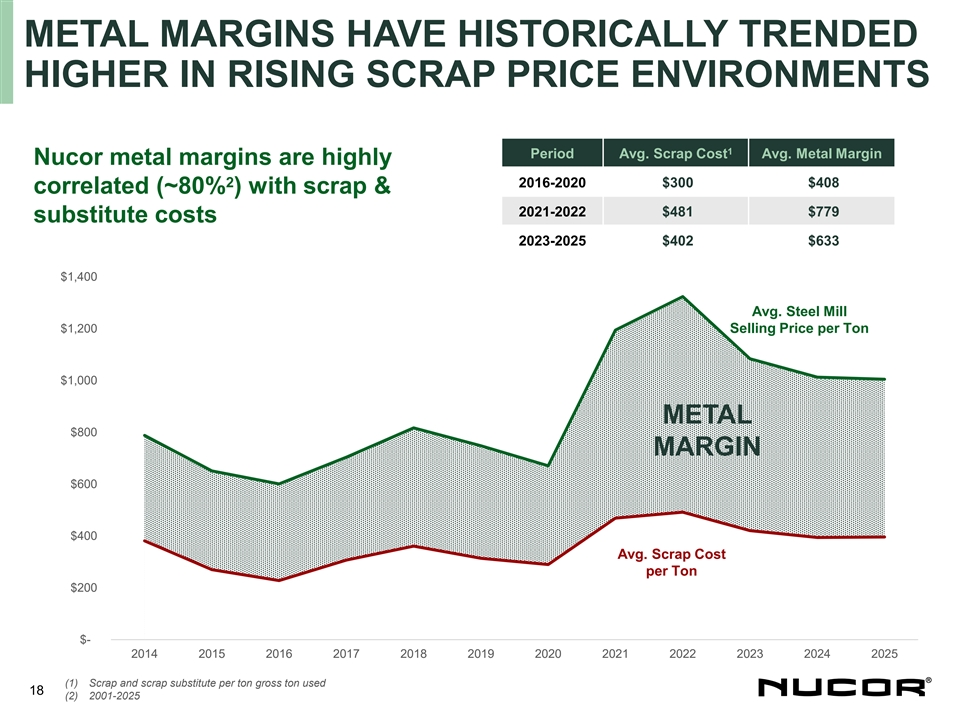
Yeah, Andrew, I want to make sure I'm getting at the heart of your question. I think I understood what it is, but, you know, Steve, if I miss parts of that or jump in. But, look, you know, we had similar questions back in 21 and 22 when the U.S. economy was so hot and the, you know, world pricing was less, right? We saw spreads of HRC that were, you know, $200, $300 a ton or in some cases in short points greater than that. and you know what's sustainable and are you taking advantage look we are a commodity driven business who values our shareholders and our customers a great deal it is that that that bedrock that ultimately dictates pricing not our wishes it is what the demand profiles and and supply chain is looking like in the U.S. and what I would tell you is that the separation today in the U.S. from the world market is for good reason. Look at the demand profile against the backdrop of a really healthy and robust economy outside of just steel. You're seeing growth, reshoring investments, nuclear energy, like just a number of facets that are creating this. So it's not a false narrative that, you know, it's the only reason pricing is up because President Trump put in place tariffs. That's not it at all. Shoot, it wasn't five, six months ago we saw HRC at $800 a ton. So it's not that. It's a much broader economic picture of strength of the U.S. and why every foreign investment wants to come and build here. It's why you saw, and now what was, you know, a U.S. company, now a Japanese company in U.S. steel. It's not an American company today. It is a Japanese-owned company, and you're going to see continued investments from foreign companies that are looking to capitalize and come to the U.S. because of that strength. And so, you know, the forecasted patch on pricing, look, I'm not going to try to predict. What I would tell you is, based on what we're sharing with you, our historic backlogs, volumes, the demand, the robustness that we see in this economy, again, I think 26 is shaping up to be a very, very solid year for Nucor.
Okay, that's clear. And then just on the capex, I mean you sort of talked about it a bit already, but I guess the guide for 26 was lower than what the street had in. And if there isn't substantial overspill into 27, it looks like, you know, the cost of some of those projects have come down despite obviously all the tariff risks. I mean, what do you attribute that to? were you building in a lot of contingency that hasn't come to pass or like what's um what's
what's changed and andrew this is steve um in in many regards it's the you have to look at 25 coupled with 26 so if you're only looking at 26 it looks like maybe relative to what your estimate would have been that our forecast is lower but we also uh we ended up spending 3.4 billion which was a little bit more than you know a year ago on this call we would have guided you closer to three for the spin so our teams did an outstanding job advancing those projects and we you know as leon mentioned in his opening comments we brought a number of projects online this year so um kudos to our team they covered a lot of ground we uh you know they're almost arbitrarily there's a year end stuck in there but under the under the course of time when you look at both of those two numbers together it's in line so it's not that there's been a reduction in cost it's really just
timing difference between the two periods okay that's clear and just finally on the um m a front and obviously your peers are pretty active from the perspective of your market share and do you think that m a would be possible for you on the actual upstream steel side of the market given and how large you are relative to others, obviously with imports going down. I mean, do you have scope or interest in expanding in the upstream side or is it mainly just focused on some of those downstream areas you've alluded to?
Yeah, Andrew, look, we are the largest steel producer in the Western hemisphere. So yes, every M&A opportunity in our pipeline holds interest. And so where we think we can grow and do and move, we will absolutely do so. but make no mistake Nucor is a steel company at its heart and we will continue to grow through adjacencies and expand beyond but it's the capabilities through our steel that fuel and fund all of that growth and so yeah as those opportunities emerge you can bet Nucor's looking hard and evaluating part of how we think about growth in the the core businesses
Operator
okay that's clear thank you very much thank you thank you our next question comes from tristan gruesa from bnp paribas tristan your line is now open please go ahead yes hi thank you for
taking my questions the the first one is on the incremental ebitda from the the completed project could you give us a sense of how much those projects contributed in 2025 and what do you expect in terms of the EBITDA contribution for 2026?
Yeah. Hey, Tristan. So if you just took…are you talking about…just…I want to clarify, just…if you're talking about the projects that came online last year, there's four major projects that came online. When you put those along with continued progress at brandenburg the delta in the evita is about 500 million dollars between just those four projects and in progress at brandenburg so um so it's a meaningful uplift in in uh in 2026's outlook for us um just from you know just from those recently completed completed projects okay sorry just to
to clarify you you expect a 500 million additional contribution for those projects plus brandenburg in 2026 versus 2025?
They keep it between all these projects together, correct.
Okay, no, got it. And second question, could you provide us a bit of an update on the plate market? You referenced Brandenburg. It would be good to know what's the situation today. But also on plate, I think we've seen some pricing hike announcement in December, January, but when I look at spot prices, they've not moved too much. So, are you facing some resistance? Can you discuss a bit the demand environment and also keen to get some sort of update on the rebar market and where do you see the ramp up at Lexington? That'd be great. Thank you.
Okay, Tristan, yeah, Brad Ford will kick us off on plate, and then maybe, Randy, why don't you touch on the startup in Lexington?
Yeah, thanks for the question. the overall um overall we're pretty excited about where we're at on plate entering 26. um you know as we touched on a few times on this call backlogs are strong backlogs and plate are up 40 percent from this time last year and we're coming off a pretty good year in terms of overall domestic consumption which is up 15 year over year and really the best since we've seen since 2019. Obviously, couple that with an import picture where imports ended 20% down on cut-to-length plate for 25, and a lot of that was in the second half of the year as the market kind of worked through higher levels of imports from earlier in the year. So, all told, we feel pretty strong going into 26. Strength in certain end-use markets, specifically energy, line pipe transmission, wind are pretty strong. Non-res construction continues to be robust. I know Leon's referenced our structural backlog. And then infrastructure, and specifically bridge, continues to be robust. So strong demand picture, low import levels, and strong backlogs. We feel pretty confident going into 26.
Tristan, just to give you an update on Lexington first, I certainly want to thank our Lexington and Kingman teams for their continued focus on safely and successfully ramping up these new investments. We are extremely encouraged by those operations. They're ramping up, developing, and how that team is executing on those projects. We continue to hit more and more milestones. each week we're setting and breaking production records on a regular basis so this is an absolutely fantastic time to be bringing these investments up we have currently sitting with record backlog on that side of the of the business so we remain confident that both quite frankly our Lexington and King operations will be even a positive by the end of the first quarter and we would expect both also to be fully ramped by the end of the year all right
that's uh that's very clear thank you thanks tristan thank you we currently have no further
Operator
questions and i would like to hand back to leon tapalyan chair and ceo for any closing remarks
well thank you for joining us for today's call we feel very good about the position we're heading into 2026 and look forward to the opportunities we have before us thank you to our team for the safety operational and financial performance you delivered in 2025 and thank you to our customers for choosing to do business with Nucor each and every day and thank you finally to our shareholders for investing your valuable shareholder capital with us have a great day thank you this now
Operator
concludes today's call thank you all for joining you may now disconnect your line