Operator
Thank you for joining us. My name is Tina, and I will be your conference operator today. I would like to welcome everyone to the ProPetro Holdings Third Quarter 2025 Conference Call. It is now my pleasure to turn the call over to Matt Augustine, Vice President of Finance and Investor Relations. Please proceed.
Thank you, and good morning. We appreciate your participation in today's call. With me are Chief Executive Officer, Sam Sledge; Chief Financial Officer, Caleb Weatherl; President and Chief Operating Officer, Adam Munoz; and President of PROPWR, Travis Simmering. This morning, we released our earnings results for the third quarter of 2025. Please note that any comments we make on today's call regarding projections or our expectations for future events are forward-looking statements covered by the Private Securities Litigation Reform Act. Forward-looking statements are subject to several risks and uncertainties, many of which are beyond our control. These risks and uncertainties can cause actual results to differ materially from our current expectations. We advise listeners to review our earnings release and risk factors discussed in our filings with the SEC. Also, during today's call, we will reference certain non-GAAP financial measures. Reconciliations of these non-GAAP measures to the most directly comparable GAAP measures are included in our earnings release. Finally, after our prepared remarks, we will hold a question-and-answer session. With that, I would like to turn the call over to Sam.
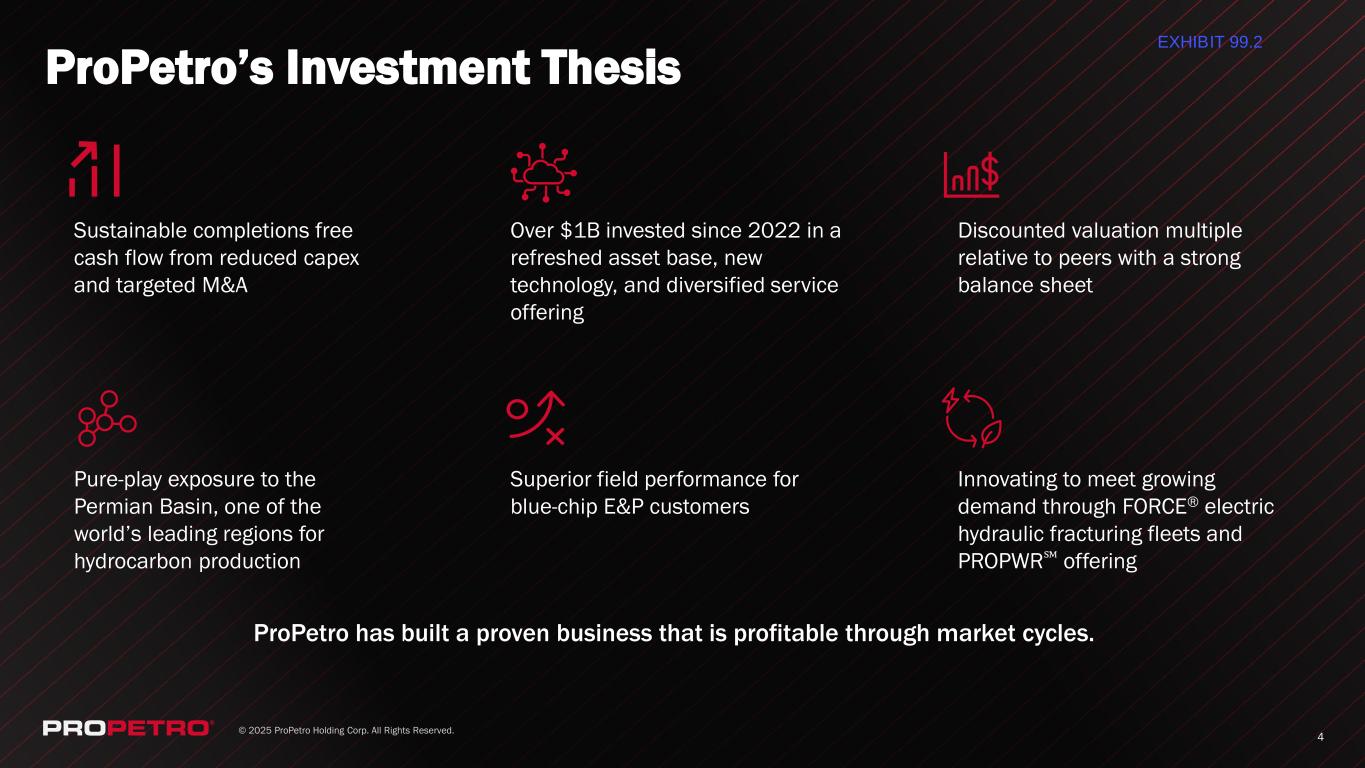
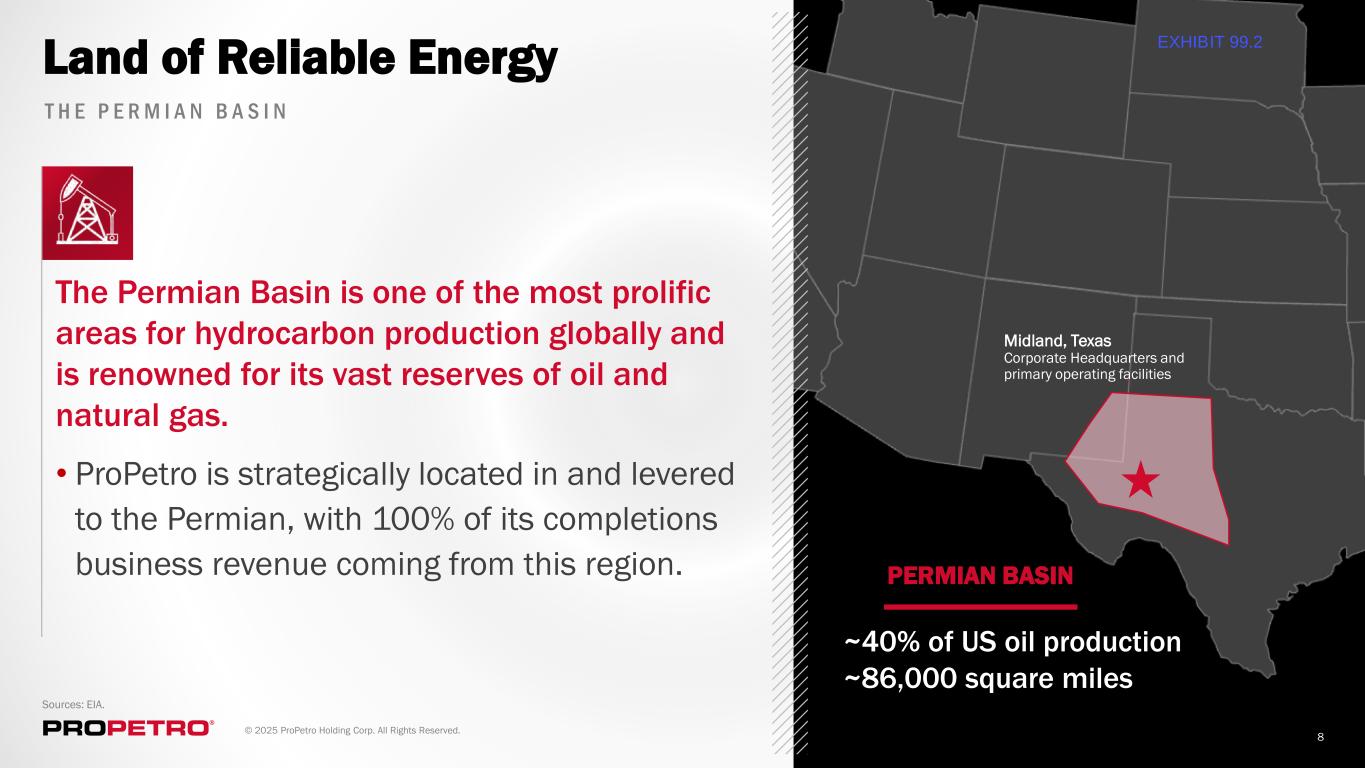
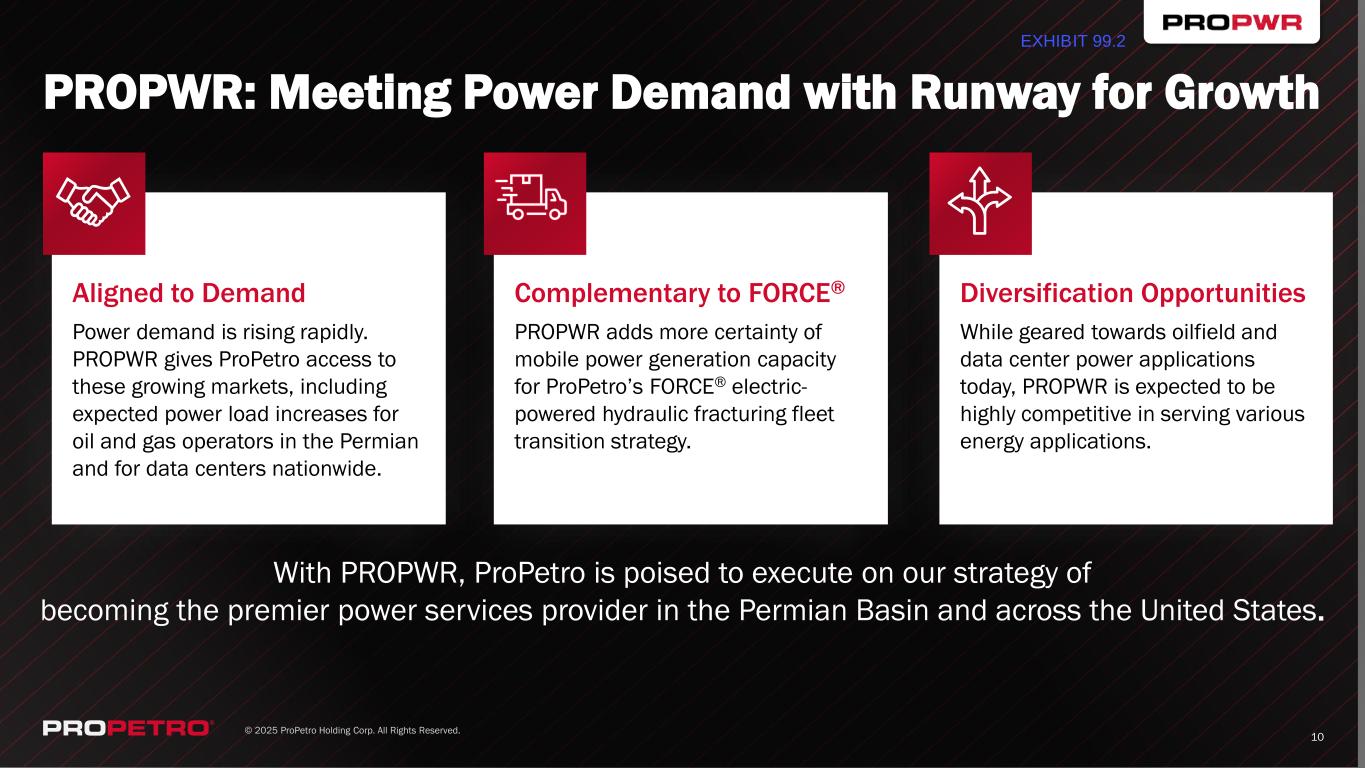
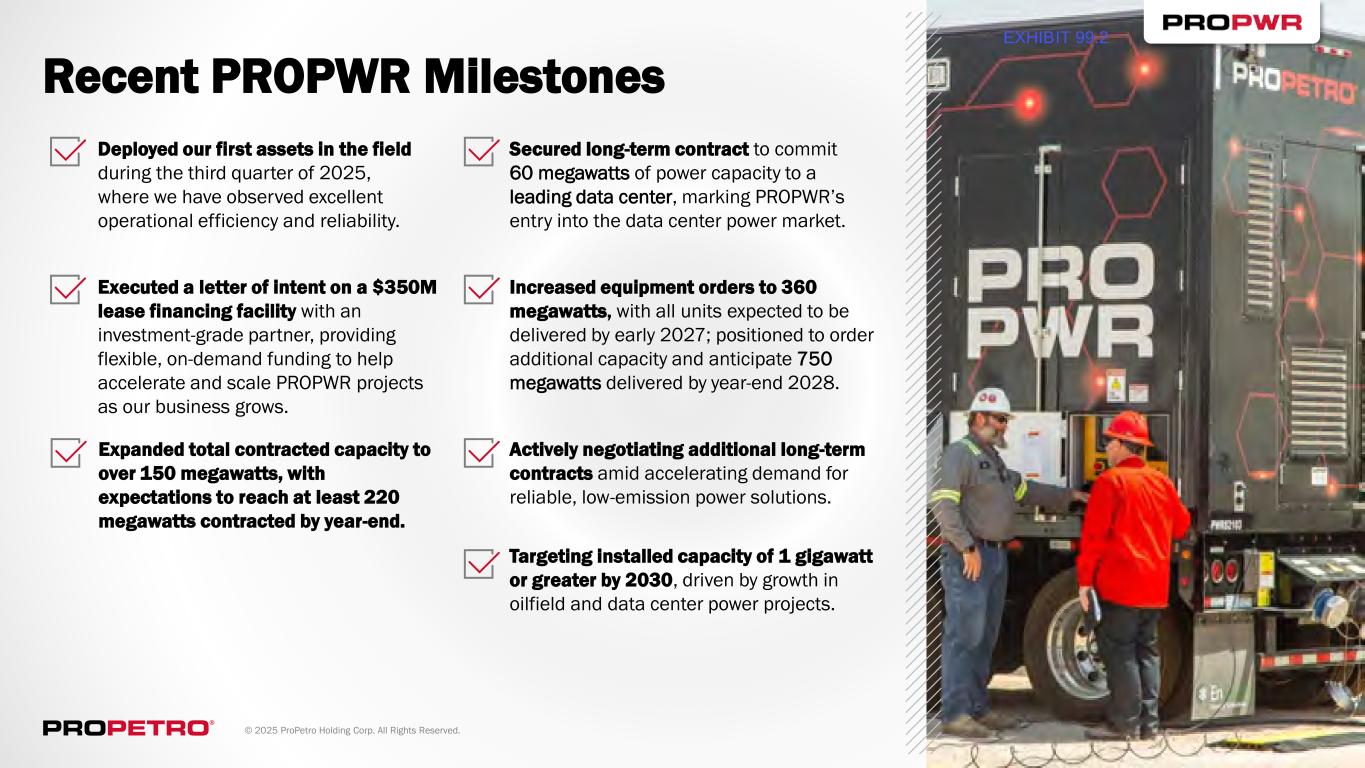
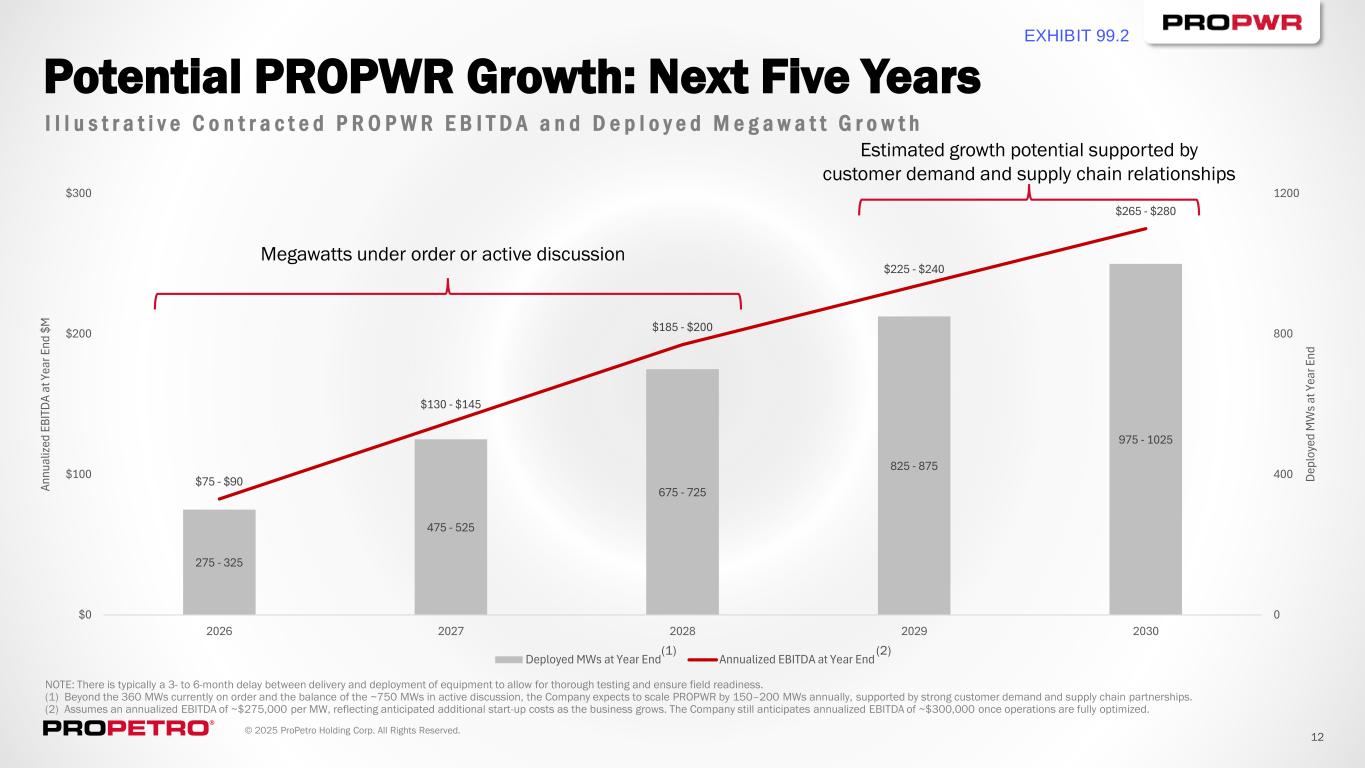
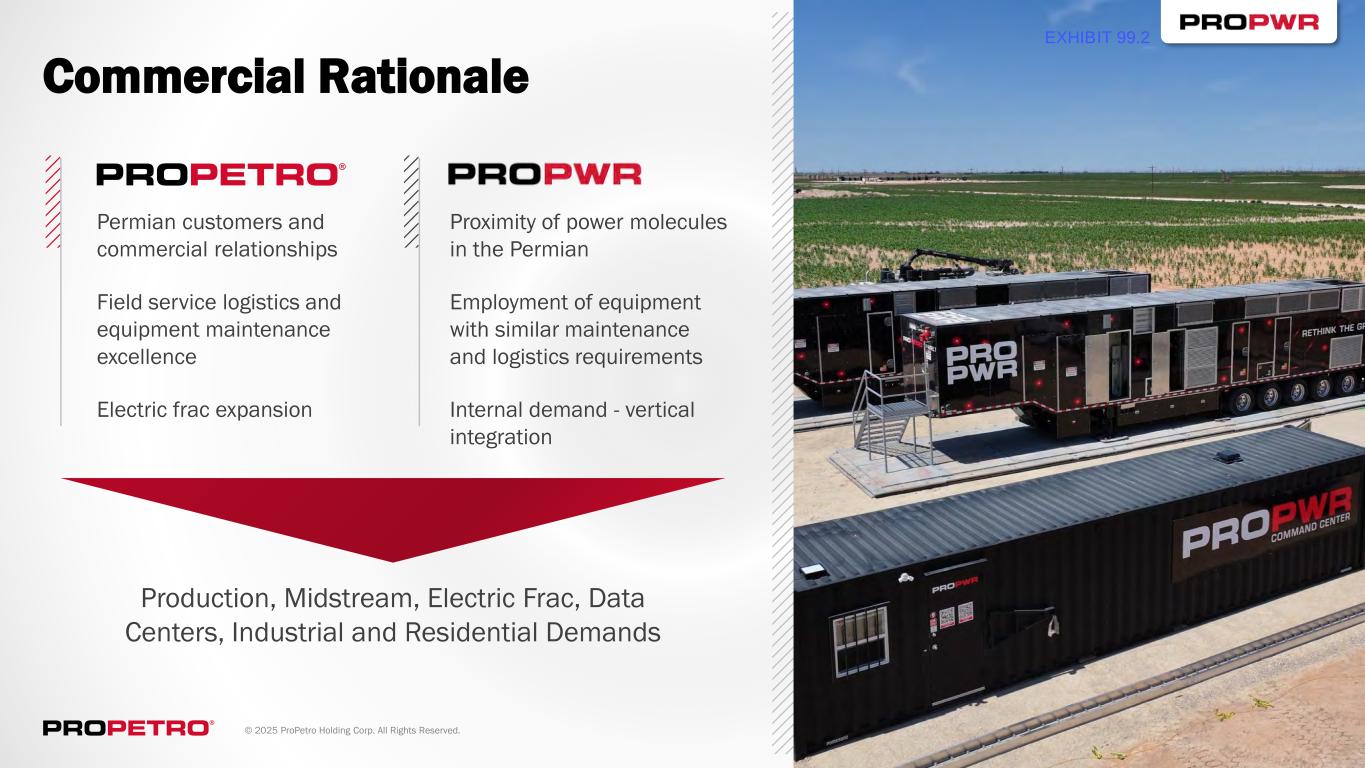
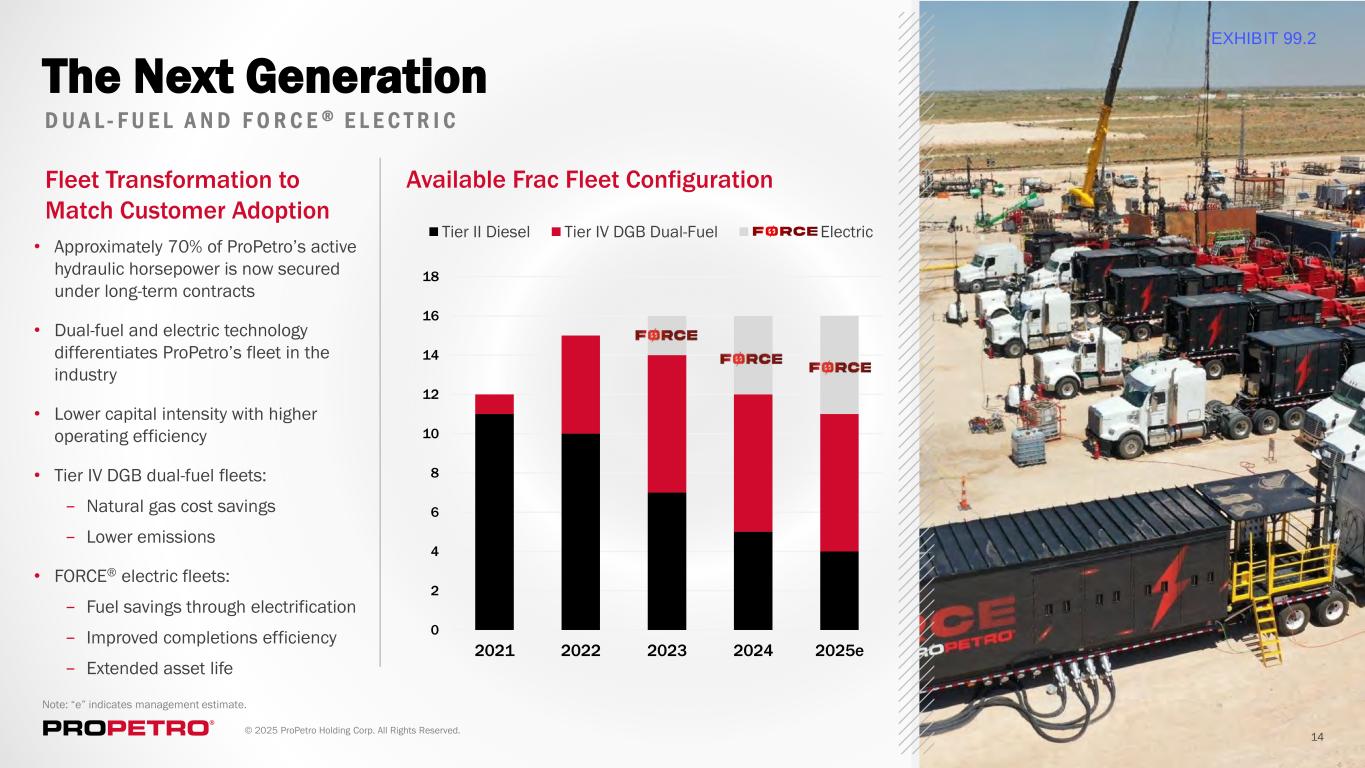
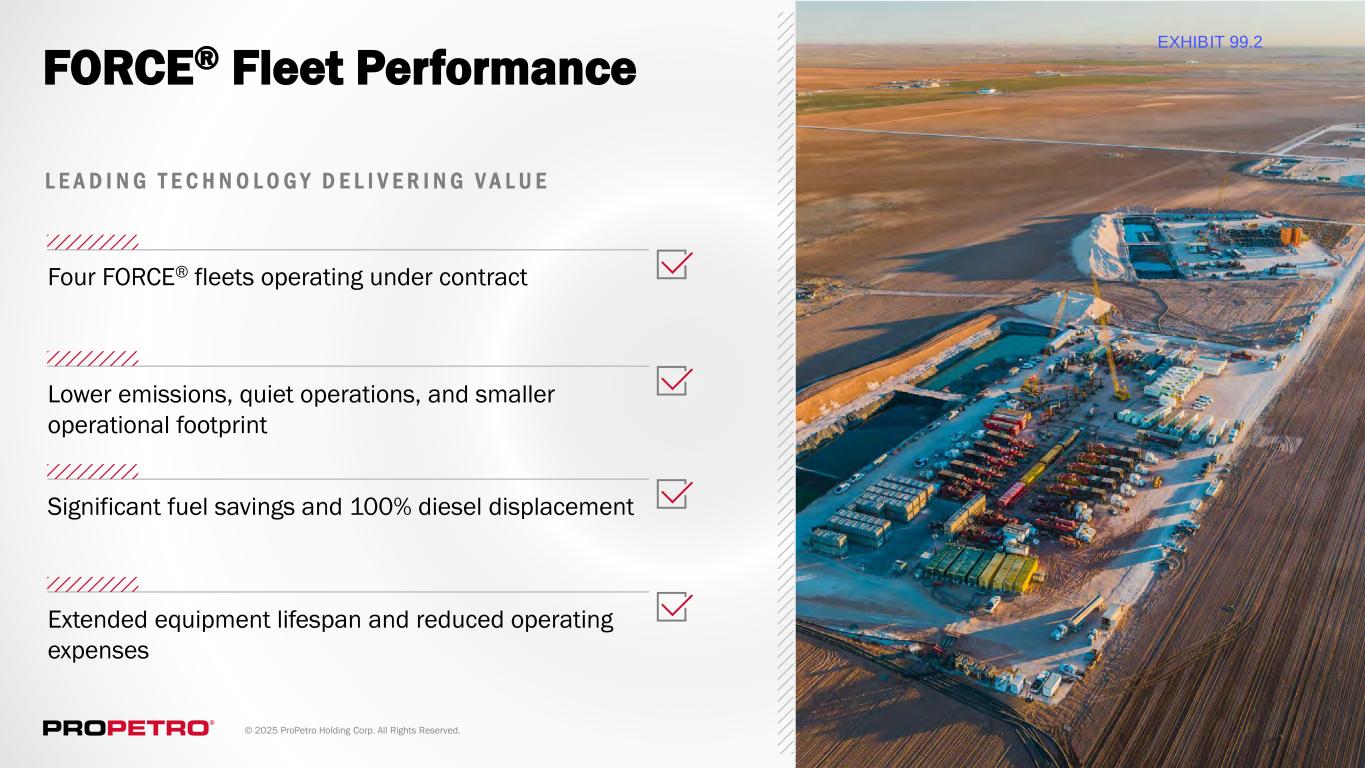
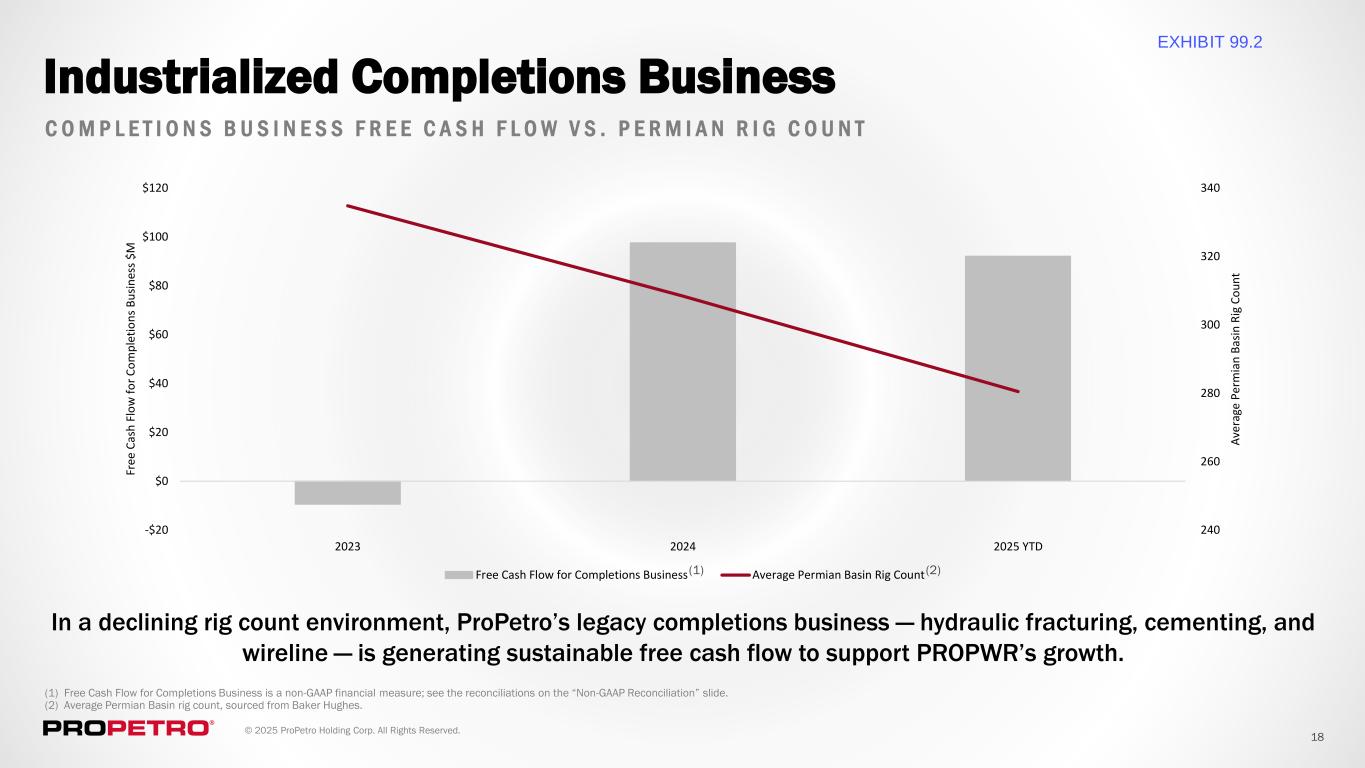
Thanks, Matt. Good morning, everyone. Thanks for joining us today. In the third quarter, ProPetro once again demonstrated resilience despite continued uncertainty in the broader energy markets, driven by tariffs and rising OPEC+ production. Our operational and financial results proved that the strategy we put in place is working. Our focus on capital-light assets and investments in our company's industrialized operating model helped us achieve another quarter of free cash flow generation in our completions business in an industry that has experienced stagnation. To put this into perspective, we still believe that approximately 70 full-time frac fleets are currently operating in the Permian as compared to approximately 90 to 100 fleets at the beginning of this year. This demonstrates the depressed activity levels in the completions market in the Permian Basin and is also indicative of a larger slowdown across energy markets. However, we are proud of the efforts we've made to implement a system focused on reactive cost reductions and flexible capital expenditures that allow our legacy completions business to generate sustainable free cash flow even during challenging periods like this. With sustainable cash flow, ProPetro is able to support and help fuel growth in our PROPWR segment. As we stated last quarter, we expect the challenging operating environment to continue into at least the first half of next year as impacts from tariffs and OPEC+ production increases drive further uncertainty across the energy markets. That being said, we believe that ProPetro is in a great position to continue to navigate the market as we execute on our plans and ensure we remain disciplined in our approach. We've built and continue to reinforce the foundation of our business by making strategic capital-light investments in the future of ProPetro with PROPWR and our FORCE electric fleets, both taking priority. We're controlling what we can control and have rigorously analyzed our costs across the business and taking decisive action to implement reductions where needed. We've also implemented measures to help us react quickly to any significant changes in activity levels as we continue to serve our first-class customers. All these measures have put ProPetro in a position of strength in the Permian, led and operated by our first-class team. We believe that even if the market further weakens, we'll continue our strong performance. As you are all aware, pricing discipline has softened at the lower end of the market, particularly among subscale frac providers. Fortunately, these operators now represent a much smaller portion of the market than in previous cycles. While we did have opportunities to keep virtually all of our fleets active, we proactively chose to idle certain fleets rather than run our fleets at subeconomic levels, preserving them for favorable market conditions in the future. The smaller and less disciplined companies are struggling to sustain returns at these undisciplined prices, which over time favors the well-capitalized providers like ProPetro that have next-generation assets and industry-leading efficiencies. We are well-positioned for this reality with a strong balance sheet, deep relationships with first-class customers, and a culture anchored in safety and performance. I firmly believe that market cycles present valuable opportunities, and we are committed to emerging from this period even stronger in a completions market that will be healthier and more balanced from a supply and demand perspective due to accelerated attrition among lower-tier competitors. Before I dive into an overview of our results for the quarter, I want to discuss the strategic actions we're taking to support resilient financials. Recently, we secured an additional contract for 1 frac fleet, increasing our total to 7 contracted fleets, which includes 2 large simul-frac fleets. Approximately 75% of our fleet now consists of next-generation gas burning equipment. Of our active hydraulic horsepower, approximately 70% is committed under long-term contracts. Over time, we plan to continue to allocate capital to our FORCE electric equipment, given its high demand, successful contracts, commercial leverage, which we expect will further derisk future earnings. That said, before ordering additional FORCE equipment, we need additional visibility into customer demand and growth to justify those investments. On the PROPWR front, we're very excited about the significant progress we've made over the past several months, including the deployment of our first assets in the field where we have observed excellent operational efficiency and reliability. Furthermore, as announced earlier this week, we secured a long-term contract to commit approximately 60 megawatts to support a hyperscaler data center in the Midwest region of the United States, marking our entry into the data center power market. This builds on our previously announced inaugural contract last quarter, which committed 80 megawatts over a 10-year term to a distributed oilfield microgrid installation. Additionally, during the quarter, we signed another infield power contract to support production operations for a Permian E&P customer. We are also in advanced negotiations and deployment planning for a long-term 70-megawatt agreement with a large Permian E&P operator that is expected to include asset deployments before year-end and will support a turnkey distributed microgrid installation. In total, we now have over 150 megawatts contracted with expectations to reach at least 220 megawatts contracted by the end of the year. While we are pleased with both our current contracts and those nearing completion, we're even more optimistic about future growth. Given the accelerating demand for power, our active commercial pipeline, and the expansion and extension opportunities available with our existing customers, we believe we are poised to deepen existing relationships, expand our reach to new partners, and drive substantial long-term growth. To support our expanding commercial pipeline, we placed orders for an additional 140 megawatts of equipment, bringing our total delivered or on-order capacity to 360 megawatts. We expect all of these units to be delivered by early 2027, with contracts expected to be in place ahead of delivery. Thanks to our strong relationships with supply chain partners, we are well-positioned to order additional capacity and anticipate 750 megawatts delivered by year-end 2028. Notably, we have also included additional 5-year growth guidance for PROPWR in our updated investor presentation deck. We currently estimate that the total cost of this equipment, including the balance of plant, will average approximately $1.1 million per megawatt. To help fund this growth, we've executed a letter of intent for a $350 million leasing facility with an investment-grade partner experienced in power generation financing. In today's challenging completions market, access to external capital is critical for scaling our power business. We will utilize this facility judiciously, drawing funds only as necessary to accelerate or expand projects. With long-term take-or-pay contracts, durable assets, and robust expected returns, we believe PROPWR is well-positioned to leverage debt effectively in a disciplined as-needed manner to pursue its growth objectives. This is still just the beginning for PROPWR. Our momentum in securing customer commitments continues, and we are actively negotiating additional long-term contracts. The demand for reliable, low-emission power solutions is accelerating, and we believe we are well-positioned to capture this opportunity. Looking ahead, we intend to grow in our oilfield power projects while also seeking to further expand in the data center arena given the significant build-out underway in that sector. We see clear potential not just to grow but to multiply our installed capacity with expectations of 1 gigawatt or greater by 2030. Caleb will discuss our financial results in more detail in just a moment, but I wanted to highlight that despite the activity headwinds I've discussed, which led ProPetro to idle three fleets from the second quarter, our team responded quickly and continued to set the standard for operational excellence and efficiency. We've taken a disciplined and aggressive approach to cost controls, particularly regarding maintenance capital spending, which was a key factor sustaining free cash flow. While we had to take steps to rationalize operating expense given lower activity levels, pricing remained relatively stable as we continue to be disciplined on price. Running our fleets at subeconomic levels would damage our ability to ensure we are best prepared to capitalize on future opportunities as market conditions improve and rapid deployment is needed. Therefore, we will remain disciplined. Going forward, and as I mentioned briefly above, near-term demand visibility in the completions market remains limited, and we expect the challenging operating environment to persist into 2026. That said, we like what we are seeing for our current active fleets and expect to maintain 10 to 11 active fleets in the fourth quarter with normal holiday seasonality effects. However, the company anticipates a sequential improvement in the PROPWR segment, which should help offset holiday impacts and bolster margins. Looking ahead and under current market conditions, the company expects to sustain at least this level of frac activity into 2026. Fortunately, ProPetro is in a great position with a strong balance sheet, a refreshed next-generation asset base, and first-class customers. We're excited to continue investing in PROPWR, our key growth engine, which is set to make a significant impact starting in 2026. Our achievements are a direct result of our unwavering dedication and support of our outstanding team. With that, I'll turn it over to Caleb.
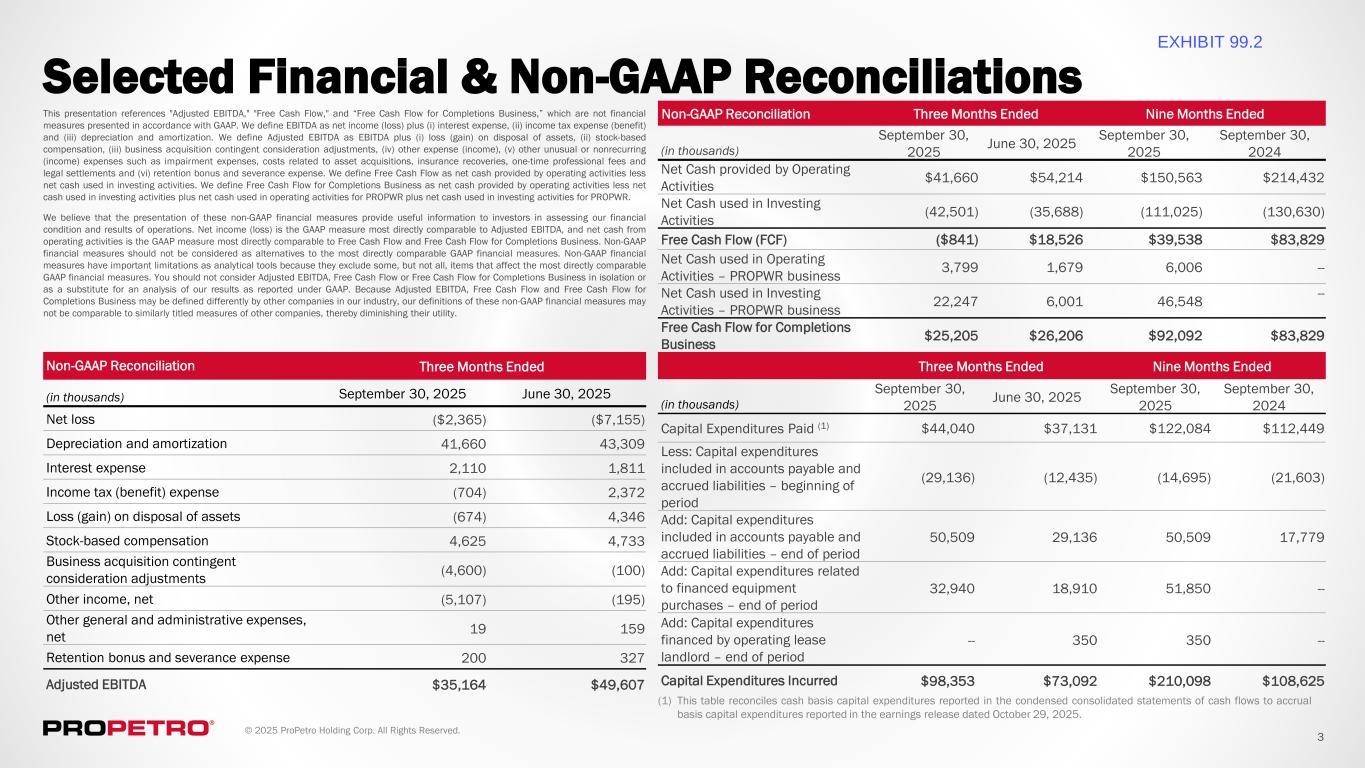
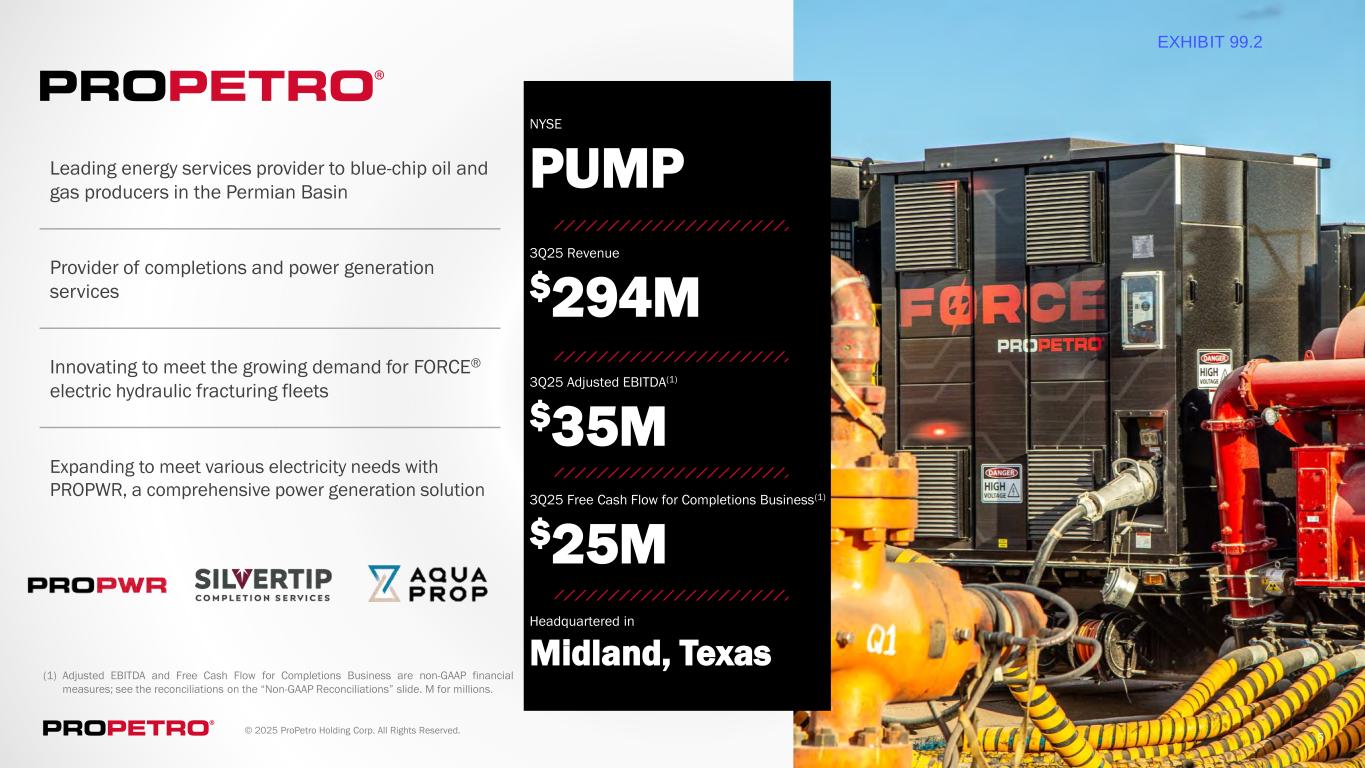
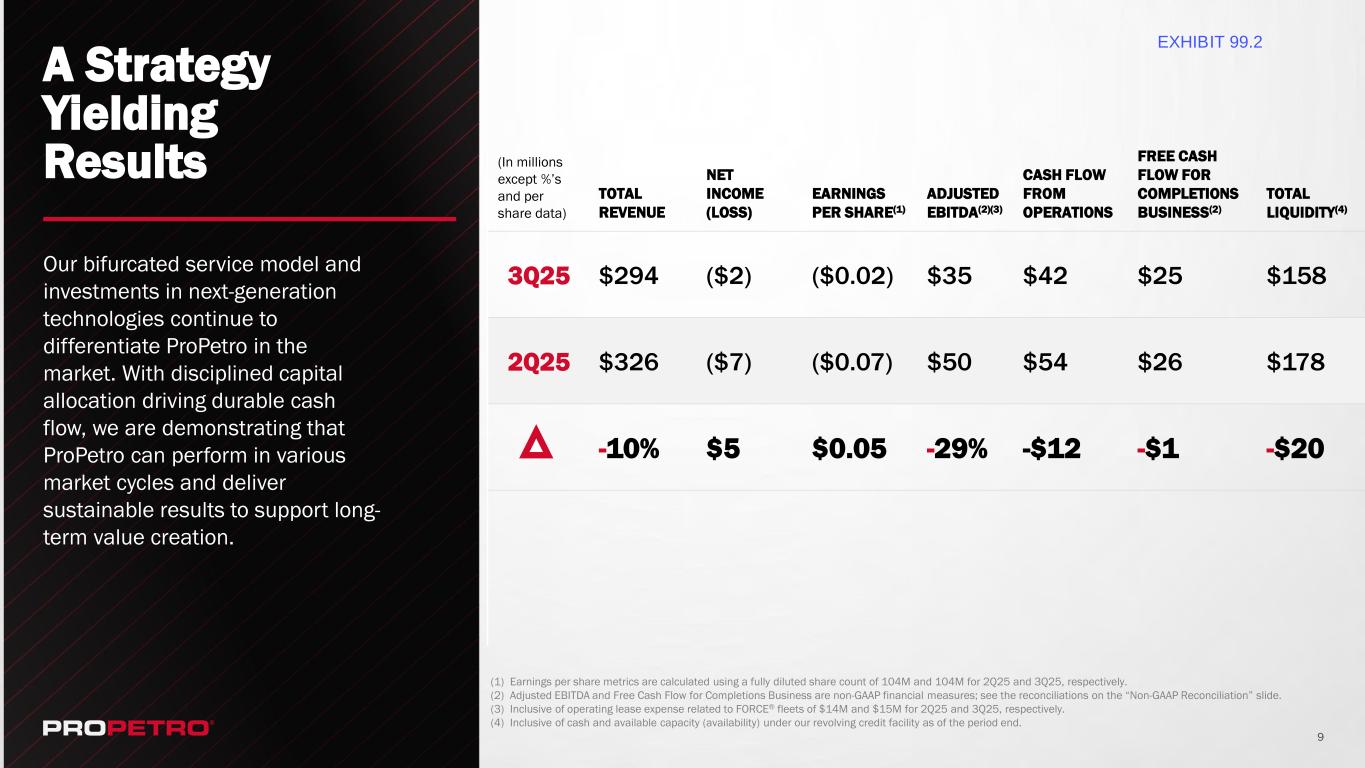
Thanks, Sam, and good morning, everyone. As Sam mentioned, the third quarter again demonstrated the industrialized and resilient nature of ProPetro. We're proud of the work we did to generate free cash flow in our Completions segment and the significant progress made in our PROPWR business, including securing a letter of intent for a flexible financing agreement that will help enable future growth in our PROPWR business. Through the quarter, we took targeted actions to optimize costs from legacy completions operations. This has helped us navigate a challenging market dynamics and positions ProPetro for success in this part of the cycle. Looking at the income statement, financial performance across the third quarter was buoyant despite overall activity levels decreasing from the second quarter. This strength is an indicator of our differentiated service offering, our strong customer base, focus on the Permian, operational excellence, and ability to quickly remove costs from the business. ProPetro generated total revenue of $294 million, a decrease of 10% as compared to the prior quarter. Net loss totaled $2 million or $0.02 loss per diluted share compared to a net loss of $7 million or $0.07 loss per diluted share for the second quarter of 2025. Adjusted EBITDA totaled $35 million, was 12% of revenue and decreased 29% compared to the prior quarter. This includes the lease expense related to our electric fleets of $15 million. Net cash provided by operating activities and net cash used in investing activities, as shown on the statement of cash flows, were $42 million and $43 million, respectively. Free cash flow for our completions business was $25 million. As Sam mentioned, our legacy completions business continues to generate sustainable free cash flow. Although activity and related revenue declined from the second to third quarter, we effectively optimized our completions CapEx, primarily because our completions business is expected to remain in maintenance mode for the foreseeable future with very disciplined allocation to growth CapEx. This demonstrates what we have consistently communicated over the past several years. Even in today's challenging market environment, we operate with the consistency and reliability expected of a mature industrialized enterprise. During the third quarter, capital expenditures paid were $44 million, and capital expenditures incurred were $98 million, including approximately $20 million primarily supporting maintenance in the company's completions business and approximately $79 million supporting its PROPWR orders. During the quarter, some of the PROPWR spending was accelerated as our supply chain partners have consistently delivered equipment efficiently and on time or ahead of schedule, allowing us to meet customer demand sooner than expected. Notably, the difference between incurred and paid capital expenditures is primarily comprised of PROPWR-related CapEx that has been financed and paid directly by the financing partner and unpaid CapEx included in accounts payable and accrued liabilities. We will continue to evaluate the market and scale CapEx as activity demands. But as we sit here right now, the company anticipates full-year 2025 capital expenditures incurred to be between $270 million and $290 million, down from the $270 million to $310 million range highlighted in the company's second-quarter earnings report. Of this, the completions business is now expected to account for $80 million to $100 million, a reduction from last quarter's guidance given the realized decline in completions activity and the ongoing cost optimization efforts. Additionally, the company now expects to incur approximately $190 million in 2025 for its PROPWR business due to accelerated delivery schedules and down payments to support additional orders. In 2026, capital expenditures for PROPWR are projected to be between $200 million and $250 million, depending on further accelerated delivery schedules and additional orders. This outlook is based on the current 360 megawatts of PROPWR equipment on order with plans to reach a total of 750 megawatts delivered by year-end 2028. While these PROPWR capital expenditure estimates reflect the total cost of the equipment, they do not account for the impact of financing arrangements, which are expected to reduce the near-term actual cash outflows or cash CapEx required from the company. Cash and liquidity continue to remain healthy. As of September 30, 2025, total cash was $67 million, and borrowings under the ABL credit facility were $45 million. Total liquidity at the end of the third quarter of 2025 was $158 million, including cash and $91 million of available capacity under the ABL credit facility. Lastly, we'll continue to take a disciplined approach when it comes to deploying capital as we look to remain flexible and dynamic, providing us with the ability to pivot between our key priorities and allocate capital to the highest return opportunity. Regarding the $350 million lease financing facility we have agreed to terms on via a letter of intent, I want to again reiterate that this facility is designed to maximize our financial flexibility, enabling us to draw funds only as needed to accelerate or scale PROPWR projects. We intend to be highly disciplined in how we utilize this facility, ensuring we preserve a healthy balance sheet while also supporting our continued growth in PROPWR. We expect that effective use of this facility will accelerate returns for shareholders and help us achieve our long-term growth objectives more rapidly. Sam, back over to you.
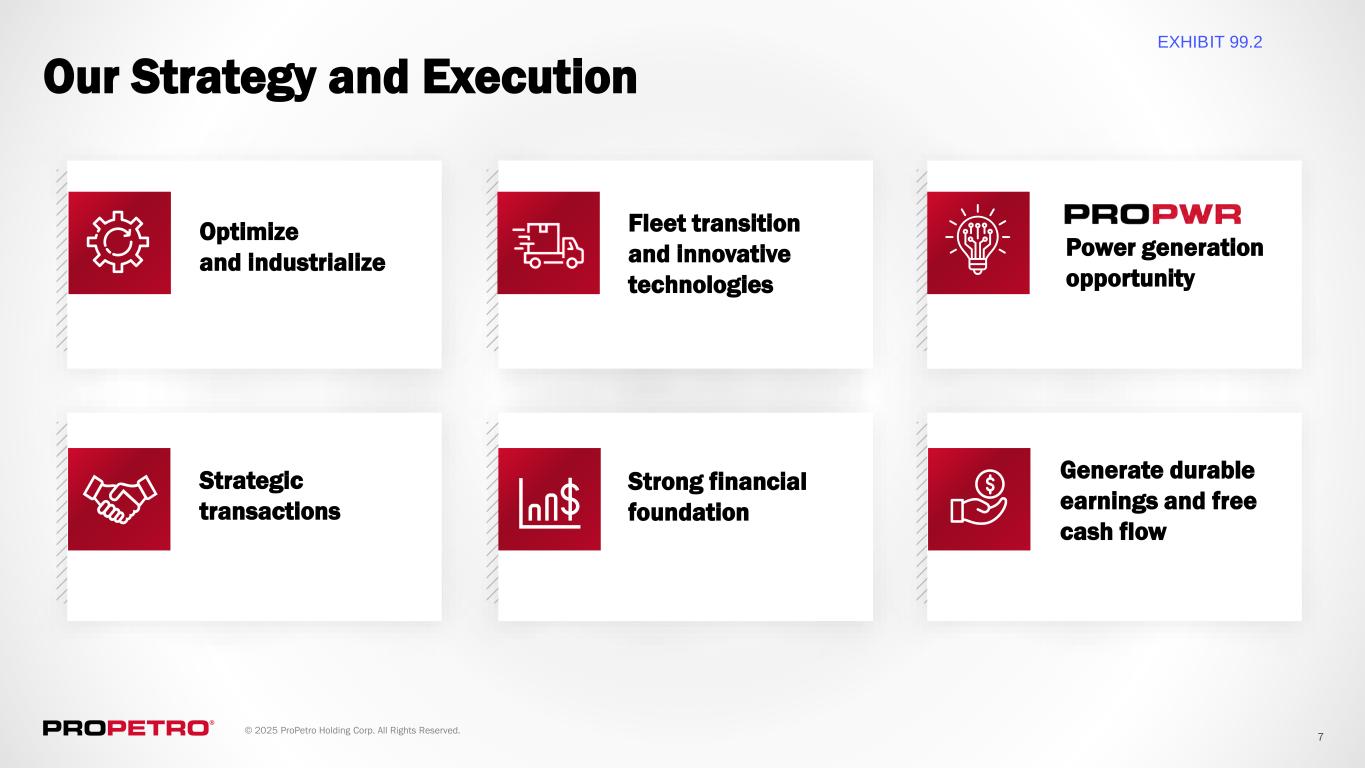
Thanks, Caleb. The work we've done and the investments we've made over the past few years have reshaped ProPetro. Today, we are a dynamic company, well-positioned not just to survive but to thrive. Resiliency is at the core of our business as demonstrated by our ability to successfully navigate market cycles throughout the company's 20-year history while continually evolving into the modern organization we are today. While we did report lower revenue this quarter, we also demonstrated our nimbleness in reacting to market conditions, successfully maintaining strong free cash flow in our completions business. We've proven that our business is sustainable through cycles as our legacy completions business helps fuel the growth of PROPWR. As demand for power generation continues to ramp, ProPetro will continue to benefit. We're already seeing strong commercial wins, capitalizing on existing demand by ordering more generation capacity and positioning the business for future success by obtaining flexible financing that will enable future growth. We will continue to execute on our strategy that has allowed us to proactively respond to changing market conditions in a decisive and effective way. The benefits of this approach are evident in our recent results. Despite the challenges currently facing our industry, we remain confident in our strategy and the future of ProPetro. We have positioned ourselves for success through several key strengths, including our best-in-class team, whose dedication and exceptional effort set us apart each and every day. I want to thank them for their performance we delivered this quarter, as they give me and the entirety of our leadership team the confidence to continue pursuing our strategy. Operator, we'd now like to open the call to questions.
Operator
Our first question comes from the line of Derek Podhaizer with Piper Sandler.
Speaker 4
The 60 megawatts, just hoping that you can expand on some of the details for us. Maybe first, what type of power solution you're deploying here? I know you have a mix of reciprocating turbines and batteries. And then just thinking about that 60 megawatts as your starting point, how do we think about this contract expanding over time, both in capacity and duration? Just thinking about the other comps that are out there that we've heard that are up in that 1-to-2-gigawatt range.
Hi, Derek, it's Sam. I just want to make sure we get your question right. I think we missed the first part of your question, but we caught most of the tail end. But is it correct, you're focused on the announcement we made Monday around the data center?
Speaker 4
Yes. Yes, the 60-megawatt data center announcement, the type of kit that you're bringing there. I know you have reciprocating turbines and batteries in your portfolio. And then as far as scaling that over time into some of the deal comps that we've seen out there in that 1-to-2-gigawatt range.
Speaker 5
Derek, this is Travis. So as far as the technology goes, we did mention that it's reciprocating engines and battery energy storage systems for this project. That was actually driven by a customer request. We feel really confident in both turbines and reciprocating devices for these types of deployments. And we feel that the battery energy storage systems provide a differentiator for us, which I think is proven out by the customer selecting us for this contract. As far as how this fits into the data center market, we feel like this is just the start for us. This site will have more capacity at it. There will be more sites like this. This is just how the PROPWR technology and our experience fits into the overall site. So, we're excited to see how we can grow with these existing partners in both term and capacity.
And Derek, I'll just add something to that, maybe more kind of high level and fundamental. We've learned and definitely I've learned being mostly or totally an oilfield service person in my entire career that, one, this data center space is very, very quickly evolving. And I think things are changing and moving and flavors are changing very quickly. Also, secondly, there's a lot of different ways to play this data center space. And we presume there will continue to be more layers of opportunity moving forward. We're super excited for this to be our first entrance into this arena with first-class counterparties on the other side. So, it's pretty exciting and more to come.
Speaker 4
That's very helpful. Second question, I just wanted maybe some more details around future funding structures. Obviously, you've just implemented that $350 million facility, that brings you with the $1.1 million that implies over 300 megawatts there, and that takes care of your initial, the next phase of that 140. But when you start targeting 750 megawatts and then going over 1 gigawatt, obviously, we're going to need some more capital here. Can you just help us understand between some of these long-duration contracts, whether those are ESAs or PPAs? We've seen some peer financing, whether it's converts or maybe some like high-yield debt offerings. Just help us understand that the liquidity runway and the funding gaps that you have and how you might be able to fill that with future sources of capital.
Yes. Great question. I'll make a comment, and Caleb will probably want to opine further on it. But I think the first thing we want to do is prioritize the use of our own organic free cash flow in our business. So, I think that's funding mechanism number one. Even in a weak completions market, we still had our completions business spit off $25 million of free cash flow in the third quarter, and we're able to use that money to fund growth initiatives. And then there becomes a point where this business becomes of such significance and kind of compounds on itself where it starts to fund a lot more of its own growth. And I think that happens pretty quickly, maybe even into the back part of next year. And we also have a lot of other options of which you mentioned some, Caleb, I don't know if you want to say anything about any of that.
Yes. Derek, this is Caleb. The thing about the leasing facility, keep in mind is that it's flexible and that we only draw on it as needed, unlike a bond where you immediately have all the cash upfront. And so, like Sam mentioned, even in this challenging market with the significant free cash flow that our completions business generated, we're going to fund as much of the CapEx out of cash flow as we can. It's also important to recognize that PROPWR can support more leverage than a traditional oilfield services business. Like Sam mentioned, we're securing long-term take-or-pay contracts in this business, which is really more like contract compression than traditional frac, and those contract compression businesses can support more leverage. Also, I think putting this lease facility in place just solidifies our ability to fund the CapEx if needed. It doesn't take any other funding options off the table. It only ensures a funding option that we know is attractive with an investment-grade partner that has a deep history and knowledge in the space.
Yes, I think we're going to continually seek flexibility and low cost of capital. What we are doing currently aligns well with those goals given our business's current state. If we can achieve the growth trajectory we've discussed today, the business will evolve. The cost of capital could change, and the resources available to us at that time will be quite different. Therefore, we are likely to adapt our funding approach as the business expands and develops in the future.
Operator
The next question comes from the line of Eddie Kim with Barclays.
Speaker 6
Just wanted to circle back on the 60-megawatt data center contract. I don't believe there was a contract term or duration disclosed with that. Would you be able to talk about, is it similar, longer, shorter than the 10-year contract you signed for the 80 megawatts for the Permian microgrid? And just taking a step back, I mean, how are you thinking about term in this environment? Would you actually prefer shorter-term in anticipation of pricing potentially moving higher over the next several years? Or would you prefer as longer-term as the customer is willing to offer? Just any thoughts there would be great.
Speaker 5
Eddie, this is Travis again. So, we did say it's a long-term contract. That's all we're really going to say for competitive reasons on the 60-megawatt contract that we signed. As far as long term versus short term, we evaluate each one of the deals on a kind of case-by-case basis. I think it's a fair point to discuss higher pricing that could happen in the future. But if we see strong partners that are willing to sign up at return thresholds, we're comfortable with, then we're going to sign a long-term deal. And so, we're really excited about having the optionality to be able to look at maybe shorter-term deals with higher margin, but also these long-term partnerships that we can really put sustainable contracts on the books for a long time.
Speaker 6
Understood. My follow-up is regarding the cost of the equipment. You mentioned that the total cost of your equipment, including the balance of plant, is expected to average about $1.1 million per megawatt. I assume that the data center contract you mentioned includes battery storage solutions, which I doubt are part of the Permian microgrid. Could you elaborate on the cost difference between the equipment for data centers and that for Permian microgrids?
Yes. I don't think there's a huge delta between the 2. I mean the battery systems are kind of baked into our economics around that 60-megawatts and the CapEx at $1.1 million as an average throughout kind of our portfolio of equipment. So, we've done really a great job, and I'm super proud of what we've done on the supply chain side so far, building out strong partnerships on the OEM side and the packaging side to be able to do what I think is near best-in-class on a cost of capital for this equipment.
Operator
Next question comes from the line of Scott Gruber with Citigroup.
Speaker 7
Sam, great to see the penetration into the data center market. As you step back and kind of look at the opportunity set, how do you think about the deployment of all your megawatts you're talking about here, whether it's the end of '28 or '30, how do you think about those being spread across oilfield contracts, data center contracts or other end markets by the time you kind of get out toward the end of the growth period? Just kind of talk us through how you envision the spread.
Sure. Great question. I think that's something that we're talking about quite a bit as we dedicate or allocate resources and internal energy and attention. If you look at the kind of 220 megawatts or a little bit more than that, that we talked about being contracted by year-end, 60 of that being data center and the balance being oil and gas, I think maybe in the immediate near-term, that kind of distribution might stay pretty similar. But over time, as you've seen with other announcements and other things going on in the data center space, those are probably a bit more chunky in nature to the larger side. So that could change that ratio very quickly as we kind of continue to pursue more of these data center contracts. Is that 50-50? Is it 60-40, one way or the other? Or is it 80-20 one way or the other? I think right now, it's tough to say. I can tell you, which has already kind of been mentioned a couple of times here in our scripted remarks in our Q&A, we're in pursuit of what we believe the best return is, coupled with what we think continues to help us produce long-term opportunities and stability in our business. And as evidenced by what we've already accomplished in the oil and gas space with our inaugural contract being 80 megawatts in 10 years, it's hard to get even deals like that in certain data center applications. So, it's all about the economics and what projects and relationships help us build kind of compounding relationships into the future. So hard to give you straight numbers, but it will be a balance of both. We're building a team that can help us attack kind of both of those categories and we're excited to be a player in both spaces in a really big way.
Speaker 7
And are the economics that you're seeing across the different verticals pretty similar? I mean, obviously, the term you've gotten in the oilfield has been great and kind of matched what we're hearing on the data center side. But can you talk to us about paybacks and other terms and conditions? Just kind of how do you view the economics of oilfield versus data center as we start to see more contracts flow here?
Yes. Right now, we're seeing economics being pretty similar. The equipment footprint that we have in both areas is very similar. And so, the way we're deploying might be slightly different based on technology. But in most cases, it's relatively similar. And so therefore, the return that we're looking at on both sides based on the contract term is about the same.
Operator
Our next question comes from the line of Stephen Gengaro with Stifel.
Speaker 8
I have a follow-up to Scott's question. When considering the cost of power for your frac operations, are you worried about the possibility of losing power to other bidders, like data centers that might pay more for it? How do you manage that situation, and what effects do you foresee on the frac business?
Yes, that's a good question, and we've considered it. As of now, we feel confident about our current position, particularly with our existing electric fleets, their power sources, and the commercial agreements in place. The returns for our power providers and for us are promising in that area, aligning with my earlier comment about seeking the best economic return. This situation isn't exclusive to us; power providers in the frac space are facing similar circumstances. While the long-term outlook remains uncertain, we feel quite secure in our current standing. Additionally, as Travis has pointed out regarding equipment, not all frac equipment is suitable for data center operations and vice versa, which contributes to maintaining the current dynamics.
Speaker 8
When considering the current situation in the power generation business, I find it challenging to reconcile the strong demand growth with the tight supply chain. How do you view the differentiation you offer to customers between fracking and power generation, given your experience in both areas?
I don't know if I understand your question, like how are we different in those two service lines.
Speaker 8
I guess which product line do you think is ultimately more differentiated and where you can bring an advantage to your customers?
My quick answer is both. It comes down to a focus on the customer. We've always aimed to build and grow our business with a strong emphasis on understanding customer needs. The opposite approach would be to create whatever we think is appealing and force it into the market, which is not our strategy. We believe running our business logically and thoughtfully is somewhat unique. As we encounter competitors in both areas, we learn that it's not only about operational uniqueness and ensuring high-quality, safe service for customers. It's also essential to engage in conversations with them when they want adjustments. This approach is central to being a successful service company. Understanding our role and our relationship with customers is vital, and both aspects benefit us. Additionally, our commercial approach to customers is crucial. We listen, keep an open mind, and offer tailored solutions that have substantially benefited both us and our clients in both lines of business. This focus is already showing results in the power business, where our approach is often seen as unique. We're proud of that. I suggest you ask several E&P operators in the Permian what sets us apart, but we see those as the two main differentiators. I’m not sure if anyone else wants to add to that.
Speaker 5
The only thing I'd add on the power side is I think what's unique in this sector is the requirement of having the technology expertise and flexible assets to be able to compete in various sectors. And so, we've done a really good job building out a really strong engineering team to support technologies like battery energy storage systems, which might be unique in the oilfield, but actually, we've got some experience with that. We're going to use those on both production applications as well as data center applications to reach high efficiencies and help manage the technology side of it. So, I think that's something a little bit unique. But as far as the customer approach and the service excellence at its core, I think that differentiation on both sides is there for sure.
Operator
Our next question comes from the line of John Daniel with Daniel Energy Partners.
Speaker 9
I guess I'll show my age and comfort zone and stick to the oil service business. But first, a clarification on fleet count. I'm going back to the basics here. When you're reporting your average fleet count, are you counting the simul-frac fleet as 1 or is that 2 fleets?
Yes. We're still just counting that as 1.
Speaker 9
And then your EBITDA margins in frac were about 17% in Q3. And I'm assuming there is a noticeable gap between, say, your contracted FORCE fleets versus the other fleets. And I guess, first, is that a fair assessment? And if it is, at what point would you look to maybe park those lowest 1 or 2 fleets that are not contracted?
I believe your assessment regarding the difference between contracted and non-contracted is correct. You are hinting at when we would decide to park more fleets. We managed that very well in Q3, as shown by the three fleets we removed from operation. We could easily be fully utilized today, which is evident. However, we opted not to because the lower end of the market appears unsustainable. We prefer to let others operate in that area while we preserve our equipment for better conditions and pricing. Our strong balance sheet and stability, along with our position in the Permian, enable us to do this, and we are grateful for that. Additionally, focusing primarily on the Tier 2 diesel aspect of our fleet, which has become a smaller portion of our operations, we noted that currently 75% of our fleet is gas-burning and next-generation technology. This allows us to evaluate the diesel equipment differently and ensure that we remain competitive while servicing top-tier customers and improving the economics of our operations.
Speaker 9
I've got two more. They're both quick, I promise. This one is for Caleb. If activity levels stay where they are, 10 to call it maybe 12 fleets, what is your preliminary guess on CapEx for the OFS businesses in '26? Are you willing to give some sort of a range?
Yes. So, we're not providing official 2026 guidance at this time, but I'll make the high-level comment that we're in maintenance mode in the completions business. And we've worked to industrialize our business. We mentioned several times over the past year that we're not expecting massive growth CapEx cycles in the frac business as we've just worked to create steadiness and consistency in that business. So high-level, I'd just say maintenance mode, but I don't want to get too much beyond that.
Speaker 9
Fair enough. Final question. And hopefully, one day becomes a trend. But according to my always write stock quote app on my phone, it shows in the first 13 minutes of trading, you guys are up about 28%, 29%, which I'm guessing. So, congratulations, if that's right. But I'm guessing that's a function of your comments on power. So, when you see this type of reaction, and the price. How will that impact your views on maybe tactical consolidation in OFS if the market go to ticker power? What does that make you think about for strategy on the OFS side? That's it for me.
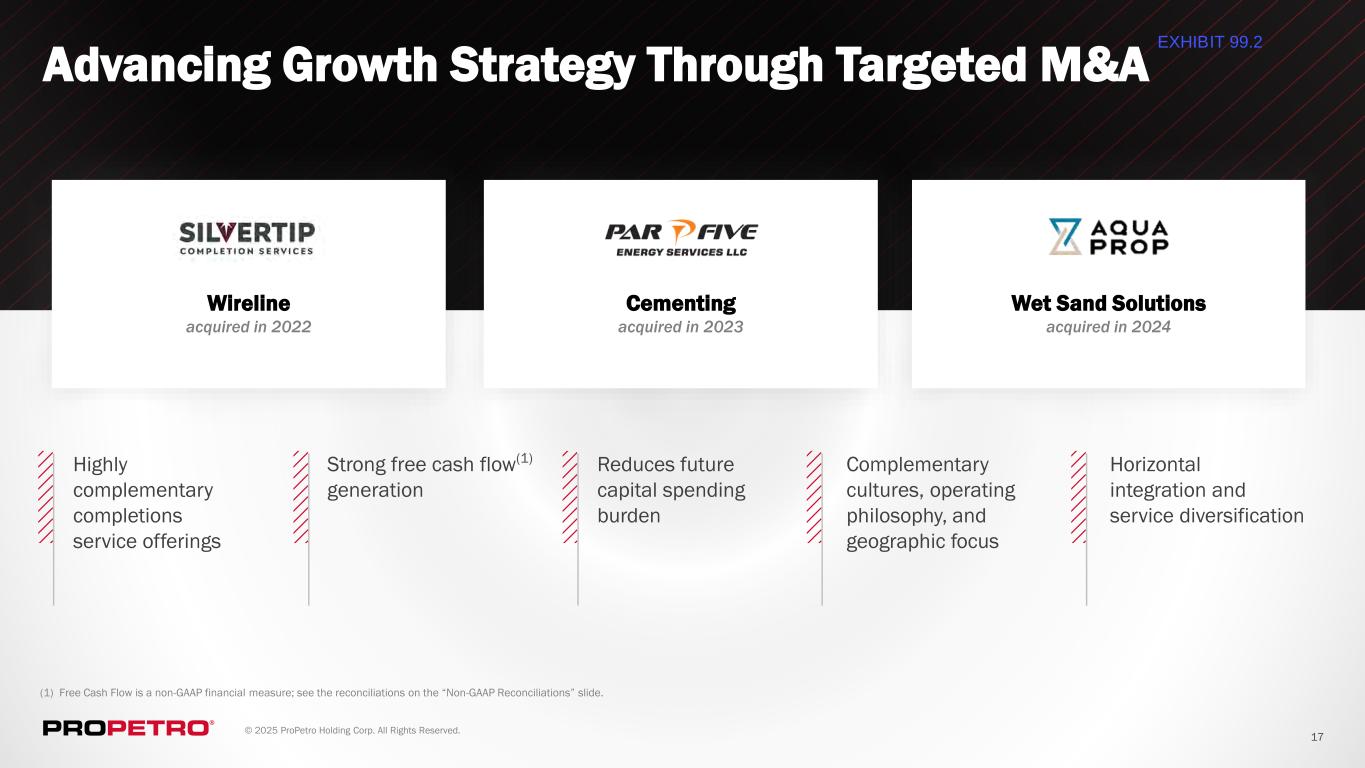
Yes. I'll just say high-level and to reiterate some things we've said over the last couple of years. M&A is a part of our overall strategy. We've done that mostly via what I'd call horizontal integration with things like wireline, wet sand, a little bit of growth with the cementing acquisition over the last few years here. We've been very pleased with all of those. We've used a mix of equity and cash to do those deals. So yes, I mean, I think a higher stock price is better than a lower stock price. That said, I think we're most interested in just doing the next right thing. Kind of to tie that back to the comment I made earlier about. What are the competitive pressures and the size of the business and the margins in our business. And at any given point in time, what's the opportunity set in the circumstances. We know what those things are today. What are those things a month or 6 months, or 5 years from now is a little bit harder to say. But I think we kind of stay true to our main strategy of trying to be a high-quality, cost-effective service company in all the service lines that we're in and to add to that in a disciplined manner that allows us to remain as competitive as possible with the top-tier customers here in the Permian Basin and possibly in other places. So, if our equity strengthens and some of those opportunities present themselves, and that's helps us do things to increase the competitiveness of our business, then we're open-minded, but we don't have anything on the table right now that we're depending on an equity price to help us with. I think we've got a solid, sturdy business that we're just trying to make the next right decision with.
Speaker 9
Fair enough. I was thinking about the fact that most of your capital expenditures for next year will focus on maintenance on the OFS side based on what you know today. It seems like the market is more interested in power, as evidenced by the questions that you and others have faced this earnings season. Anyway, congratulations, and thank you very much.
Yes, John, just one last thing before we go to the next question on the line. And you know this well, John, but attrition continues, especially in the completions business and the pressure pumping business, where it is, in fact, the most equipment-intensive service line in oilfield services. So, there's consolidation happening via attrition every day. So, I think staying power, high-quality services, high-quality customers, and kind of the structure of the business as we have it today on the completion side is, in fact, playing in consolidation without even playing in M&A. So that, I think, is tailwinds long-term. You've written about that. We've talked about that, but I just want to make sure everybody understands that consolidation via attrition on the bottom end of the market is significant and will play a part in the supply and demand balance moving forward.
Operator
Our next question comes from the line of Jeff LeBlanc with TPH.
Speaker 10
I just had two. On the first one, I was just curious if you could talk about the equipment mix moving forward, given that you've been more technology-agnostic than your peers. As you continue to move in the data center market, do you anticipate moving to larger turbines? Or are you comfortable with the current fleet mix or equipment mix you have right now?
Speaker 5
Jeff, this is Travis. So, we're comfortable with where we're at right now. We're likely going to do more of the same but are always looking at new technologies. The door is always open to look at larger power blocks, more efficient power blocks. And as we enter into different sectors within the data center space, we are certainly excited to use the team that we have to evaluate these technologies and come up with what we think is the lowest cost, most efficient solution for those types of projects.
Speaker 10
And then on the data center opportunity specifically, do you see a greater opportunity in prime power applications? Or do you also see applications for bridge and backup?
Speaker 5
Yes. We're only participating in prime power type applications. We've built our team and our operational structure to support prime power, and that's really difficult to make work economically as a backup provider. So those are really the only opportunities we're looking at. That's what we do in the oilfield. That's what we're going to do in the data center space. So, we're really a prime power player.
Operator
We have no further questions in the queue. I will now turn the call back over to Sam Sledge, Chief Executive Officer, for closing remarks.
Thanks, everyone, for joining us on today's call. Before we finish the call, I'd like to just reiterate a couple of simple things. As it pertains to our power business, I think we're super proud to show the progress we've made in really less than a year since launching the business. Last December, we hired a team, announced the launch of the business. We quickly then started to acquire assets and obtain contracts. And as noted in our materials, we're already in the field generating revenue. It's been just a top-to-bottom across the board win, all of which has been supported by an existing platform and completions business that's providing operational support and free cash flow to fund that business. So, a huge team effort, but real wins, not just blue sky. So, all of that, I think, has been supported and founded by the entrepreneurial spirit that exists inside the company today. It's been a little bit tough to show that entrepreneurial spirit the last few years, but with the opportunities that we see today and moving forward, we think that that's going to shine through here at ProPetro. Thanks again for joining us on today's call, and we look forward to talking to you soon.
Operator
Thank you again for joining us today. This does conclude today's conference call. You may now disconnect.