Operator
Good morning, and welcome to the Regions Financial Corporation's quarterly earnings call. My name is Chris, and I'll be your operator for today's call. I would like to remind everyone that all participant phone lines have been placed on listen only. At the end of the call, there will be a question and answer session. If you wish to ask a question, please press star 1 on your telephone keypad. A confirmation tone will indicate your lines in the question queue. I will now turn the call over to Dana Nolan to begin.
Thank you, Chris. Welcome to Regents third quarter earnings call. John and David will provide high-level commentary regarding our results. Earnings documents which include our forward-looking statement disclaimer and non-GAAP reconciliations are available in the investor relations section of our website. These disclosures cover our presentation materials, today's prepared remarks, and Q&A. I will now turn the call over to John.
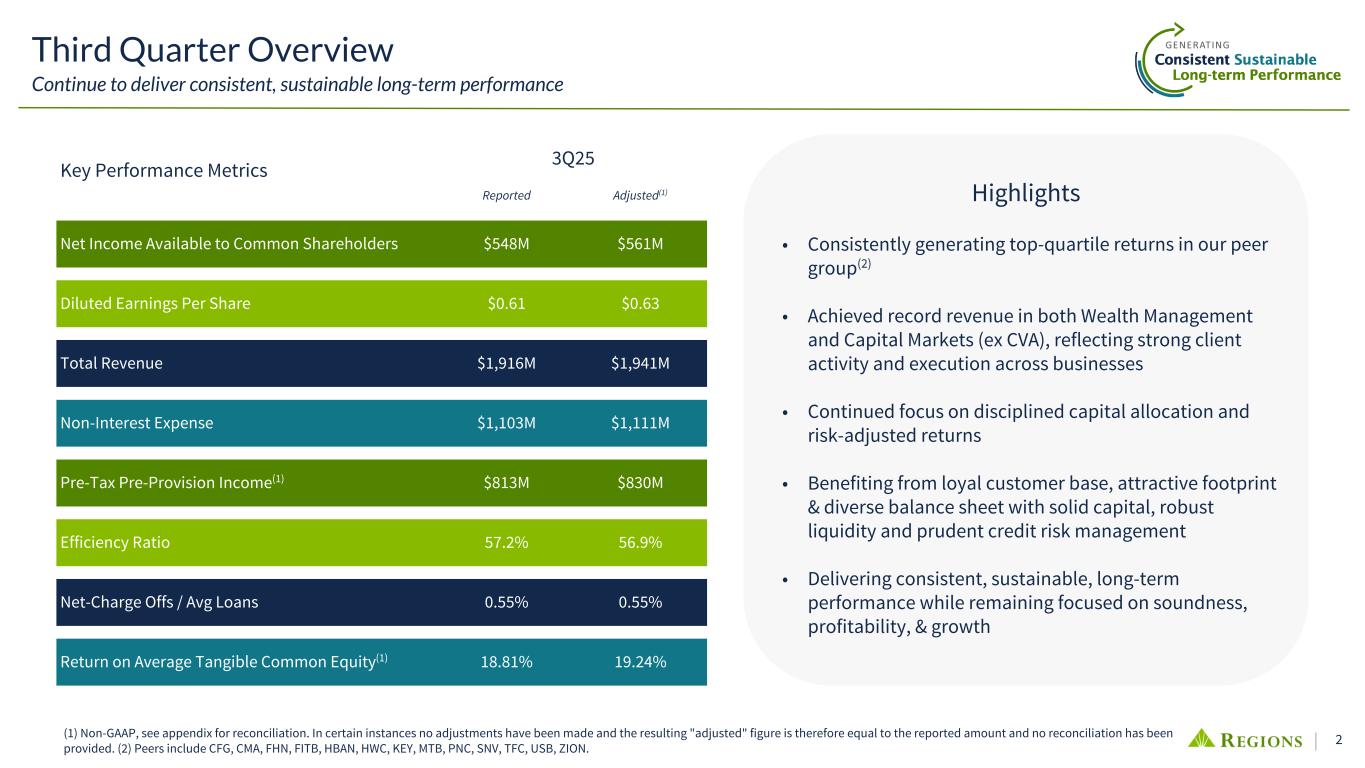
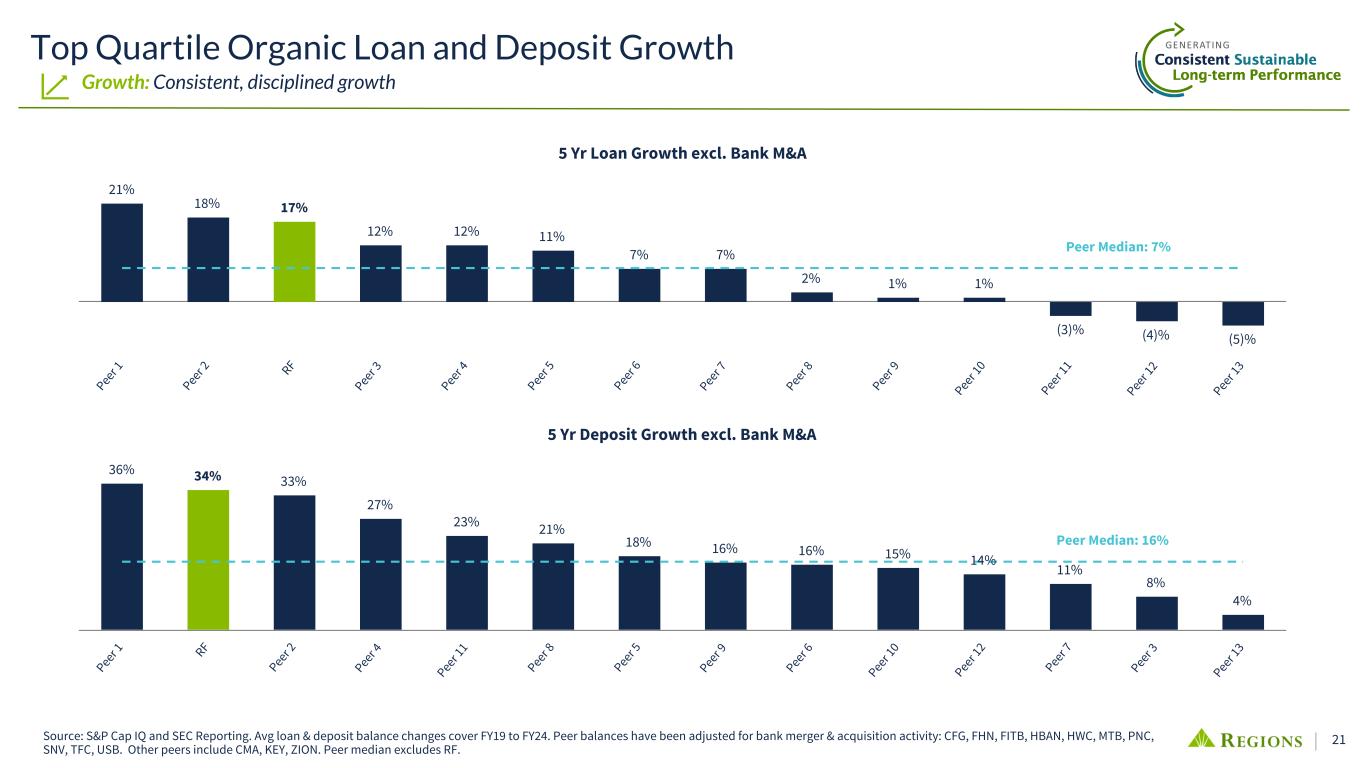
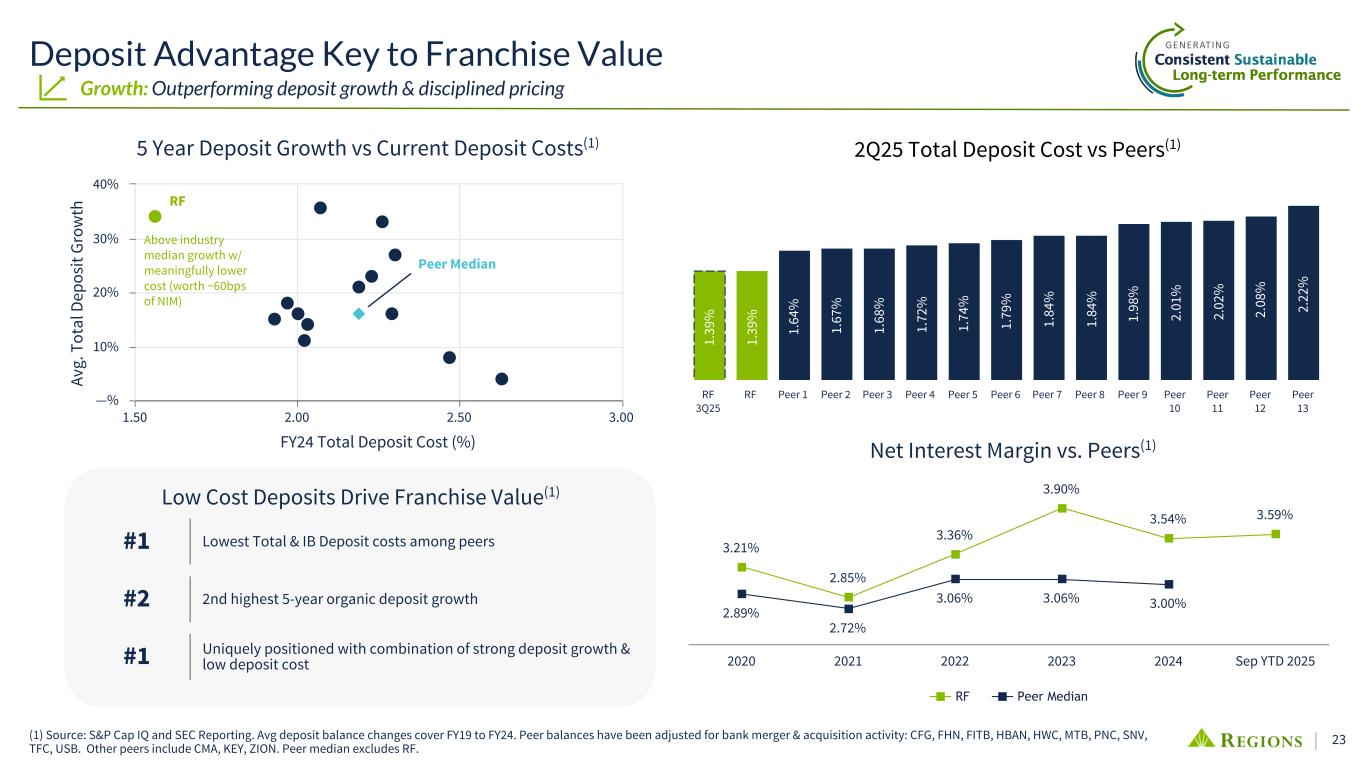
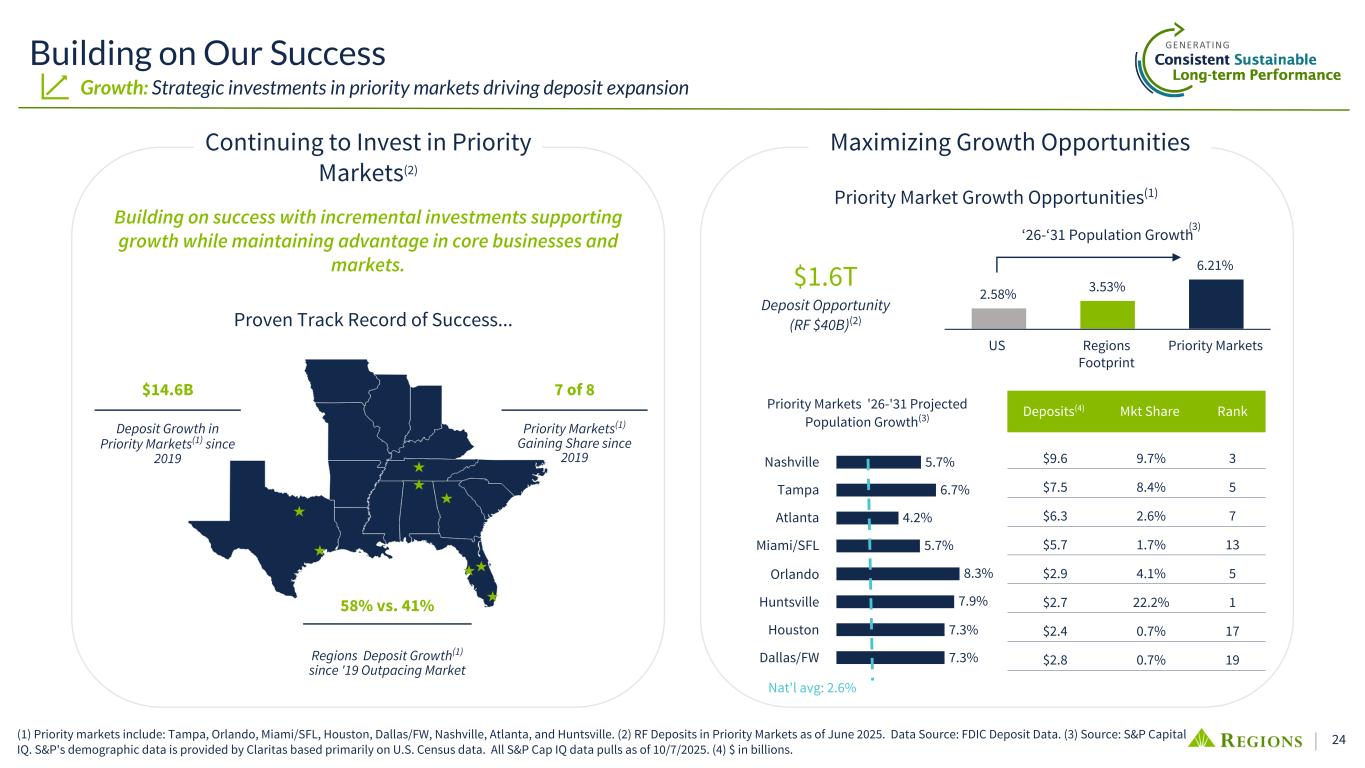
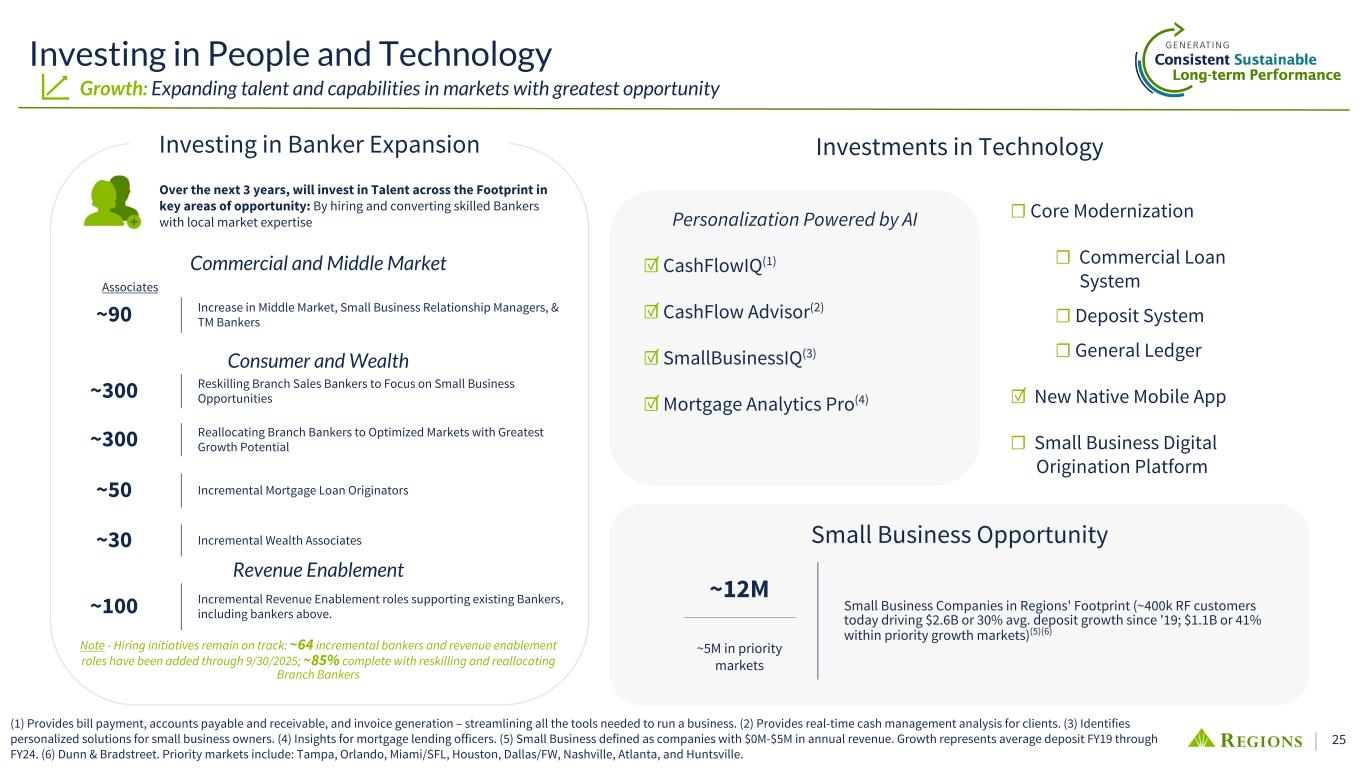
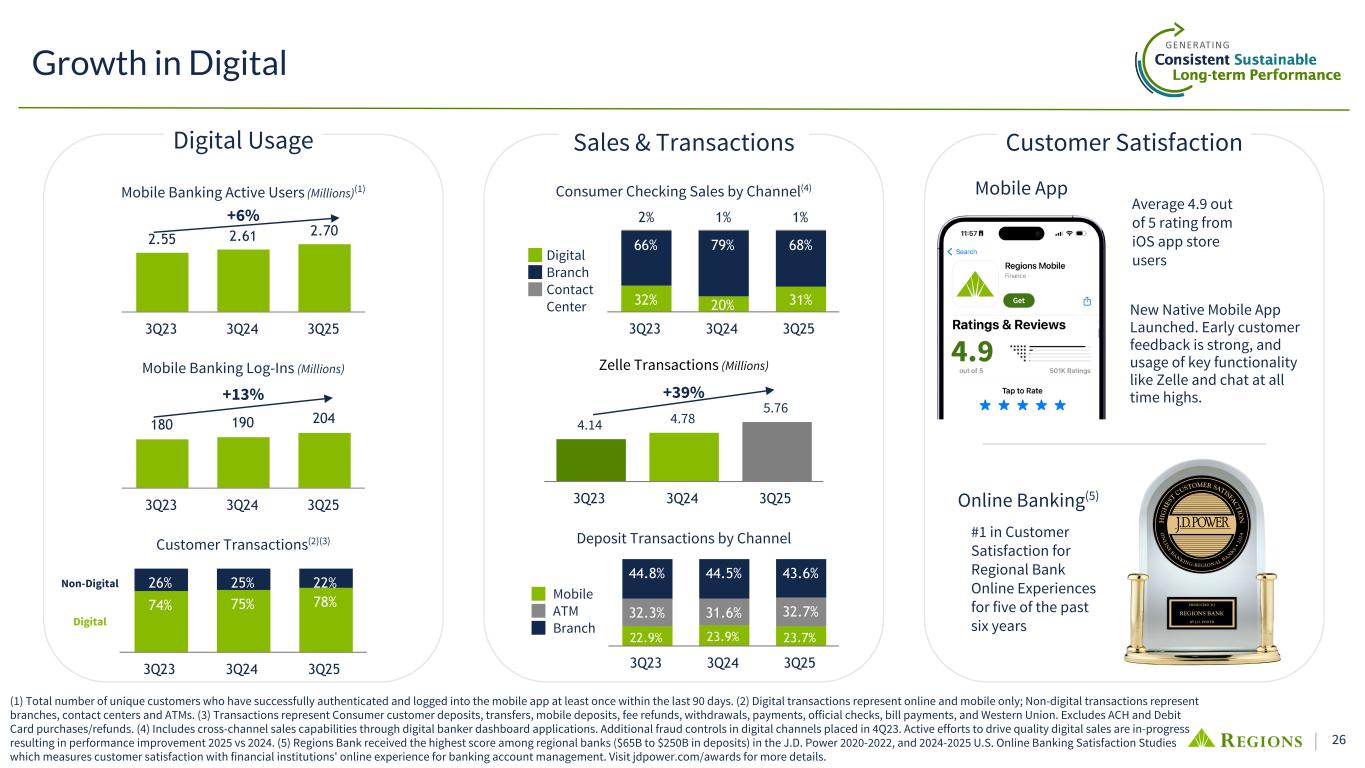
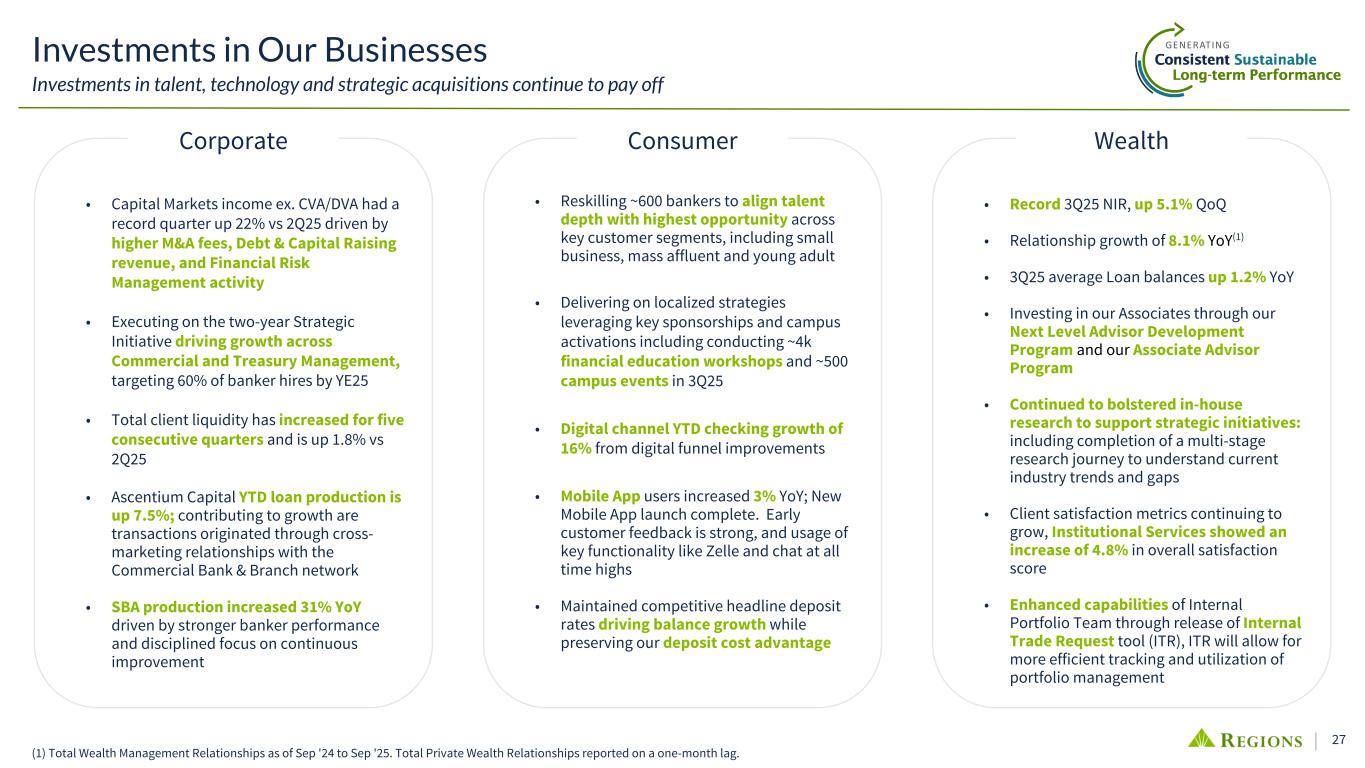
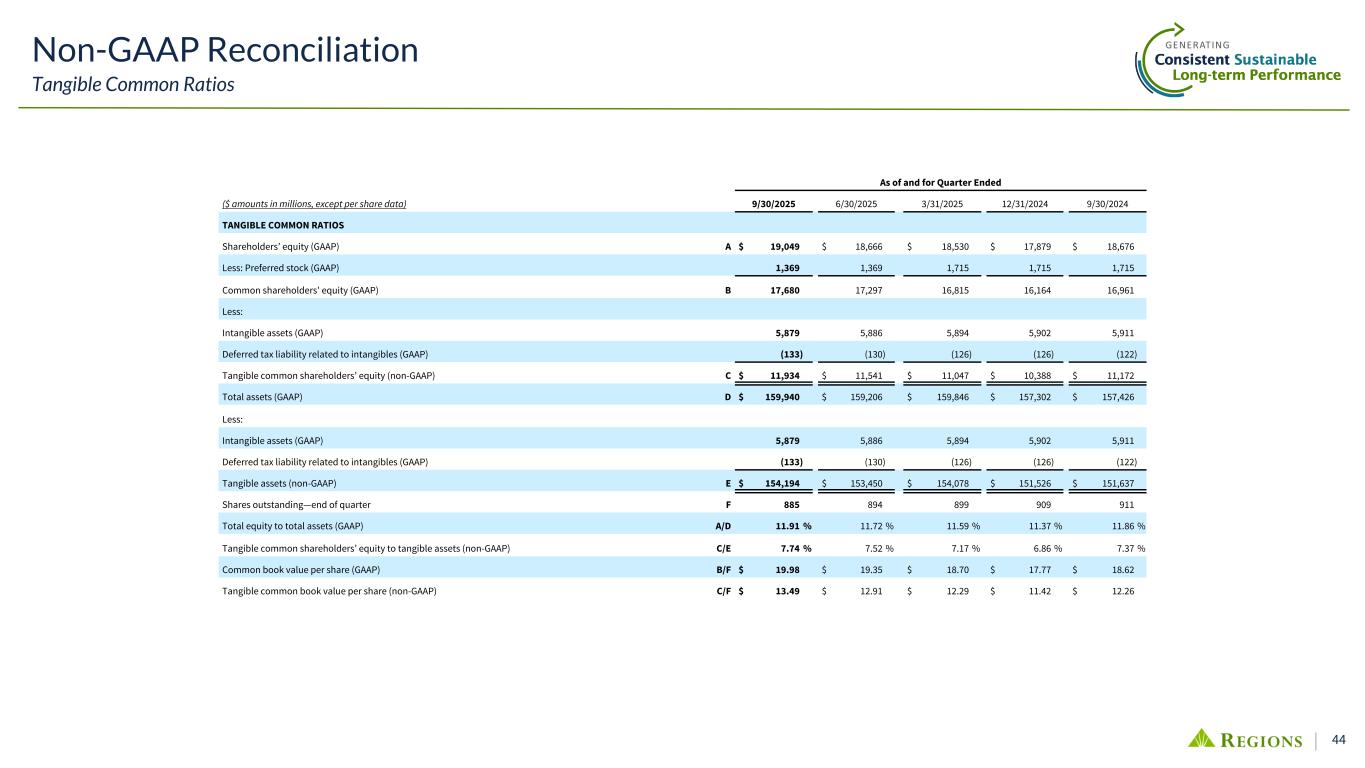
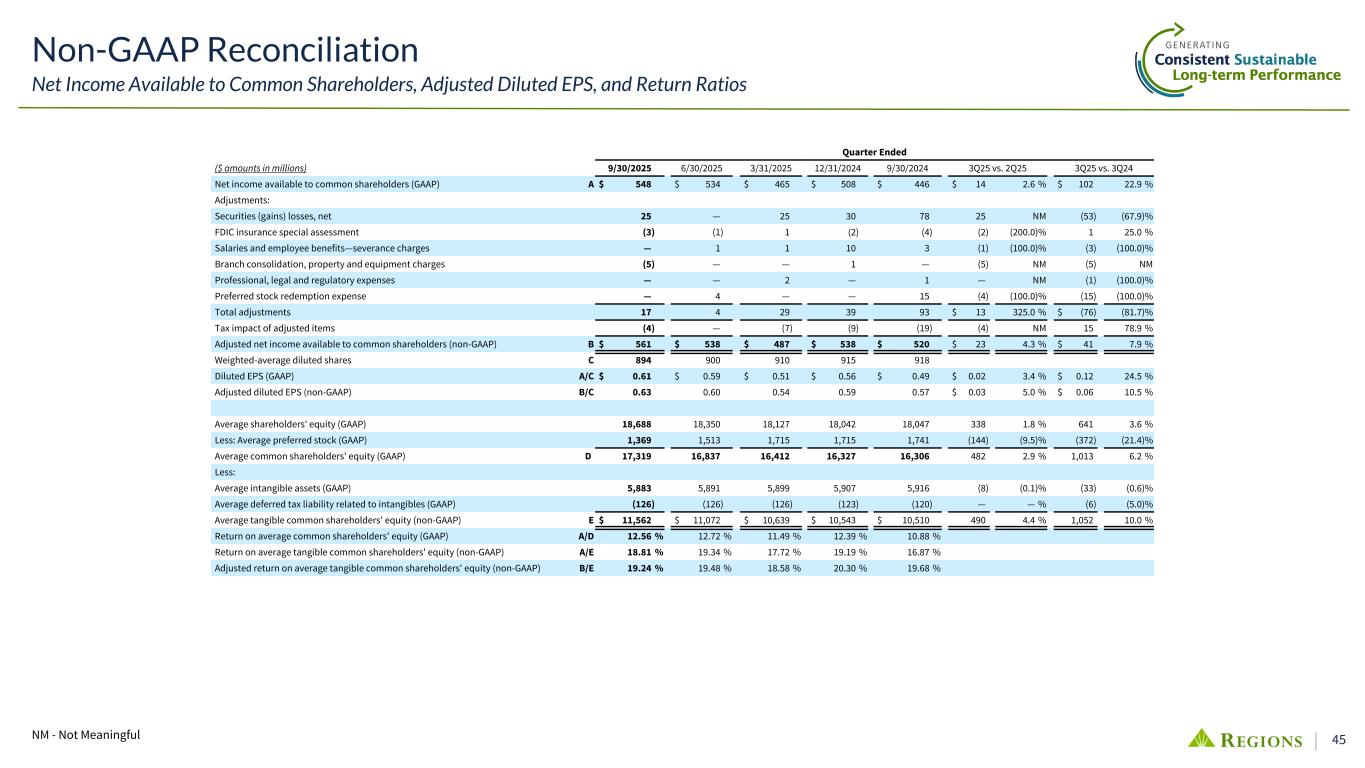
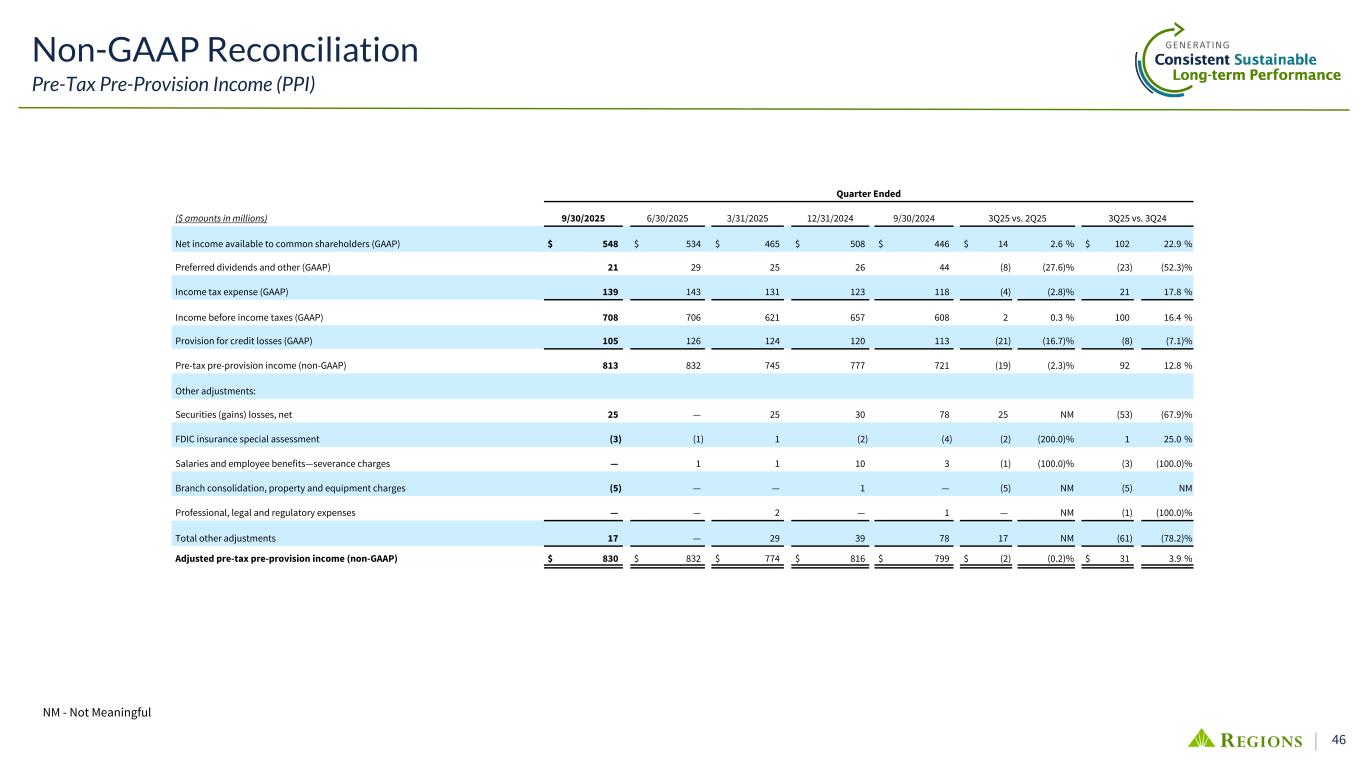
Thank you, Dana, and good morning, everyone. We appreciate you joining our call today. Earlier this morning, we reported strong quarterly earnings of $548 million, resulting in earnings per share of 61 cents. On an adjusted basis, earnings were $561 million, or 63 cents per share. We delivered adjusted pre-tax pre-provision income of $830 million. dollars a four percent increase year over year and we generated a strong return on tangible common equity of 19 percent of our third quarter performance as we continue to enjoy the benefits of the investments we've made across our businesses and the successful execution of our strategic plans reflecting the strong benefits of our footprint the recently released FDIC deposit data indicates that we generated top quartile deposit growth and above peer median change in market share over the measurement period. And we did this while maintaining the lowest deposit cost amongst our peers. This momentum carried into the third quarter as we grew total average deposits as well as accounts across consumer checking, small business, and wealth management we also grew average loans modestly during the quarter as corporate client sentiment has continued to improve year-over-year pipelines are almost doubled and we're also experiencing nice increases in production and year-to-date loan commitments have increased approximately two billion dollars however we still face some headwinds from our portfolio shaping efforts in certain areas of higher risk leveraged lending. This type of portfolio shaping is consistent with our long-standing focus on soundness and appropriate risk-adjusted returns. In addition, we saw a meaningful increase in loans refinanced off our balance sheet through the debt capital markets during the quarter. Importantly, with improving macro conditions along with an expected pickup in line utilization, we believe we're well-positioned to generate stronger loan growth as we move into 2026 our consumers also remain healthy debit and credit spend continue to increase versus the prior year and payment rates on our consumer credit card remain above pre-pandemic levels importantly consumer credit quality remains strong exceeding our expectations asset quality metrics remain relatively stable near historic lows Shifting to fees, we delivered another strong quarter in terms of non-interest revenue. Wealth management continues to be a good story for us, generating another quarter of record fee income. And capital markets, excluding CBA, also reached a record high during the quarter. M&A activity continues to pick up, along with commercial swaps, syndications, and debt underwriting. Additionally, treasury management continues to grow at a nice pace year over year. We see continued opportunity to grow clients through both new relationships and within our existing customer base. We continue to make good progress on investments to modernize our core technology platforms. We're planning to upgrade our commercial loan system to a new cloud platform in the first half of 2026. We'll begin running pilots on our new cloud-based deposit system beginning in late 2026 with full conversion anticipated in 2027. Once completed, we expect to be one of the first regional banks in the country on a truly modern core platform. We're also having success in our efforts to recruit and hire quality bankers across our priority markets and we remain on track with our target banker additions in our branch banker reskilling and reallocation efforts wrapping up we're proud of our third quarter results the investments we're making to modernize our core systems and add talent and priority markets are progressing well further enhancing our ability to serve customers evolving needs and positioning us to capitalize on growth opportunities. Our associates' commitment and strong execution have been instrumental in driving these results. We expect this momentum will continue into 2026 and beyond, creating sustained value for our shareholders. With that, I'll hand it over to David to provide some highlights for the quarter.
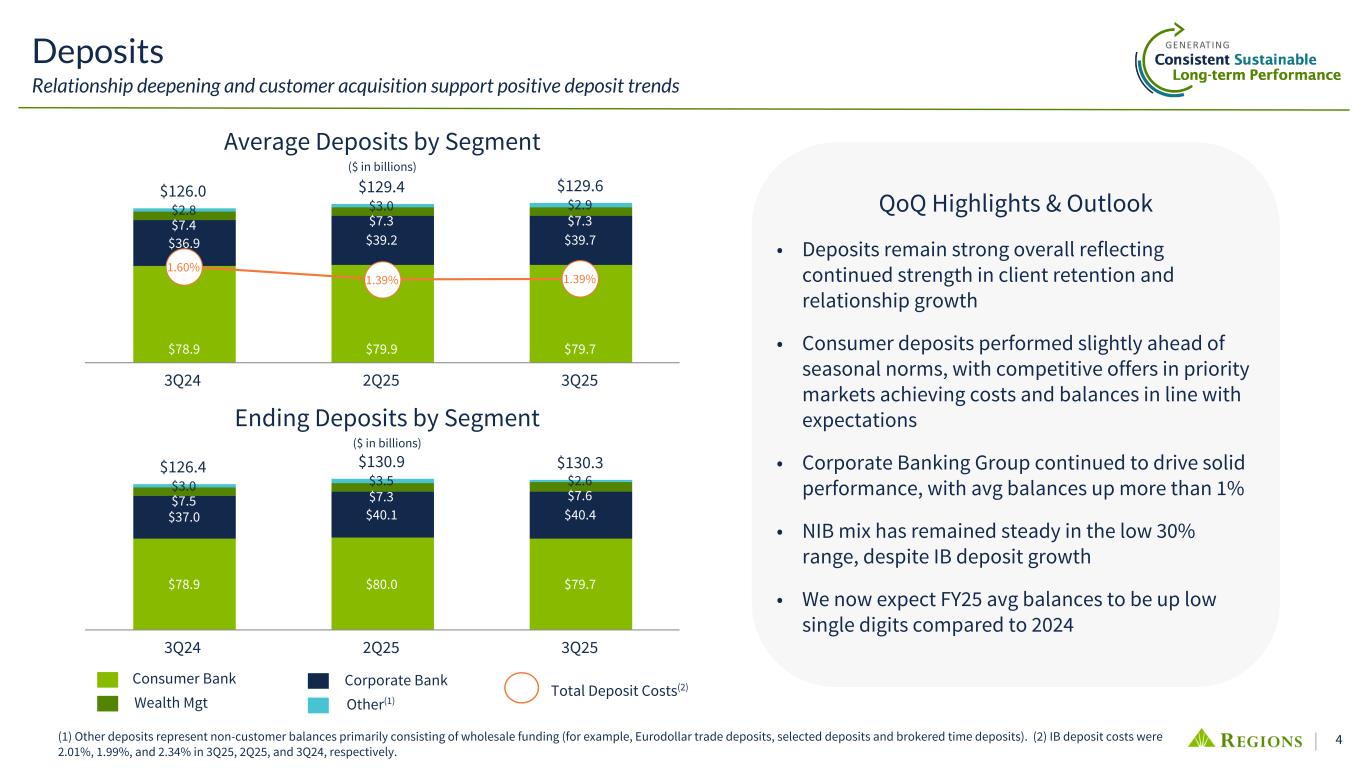
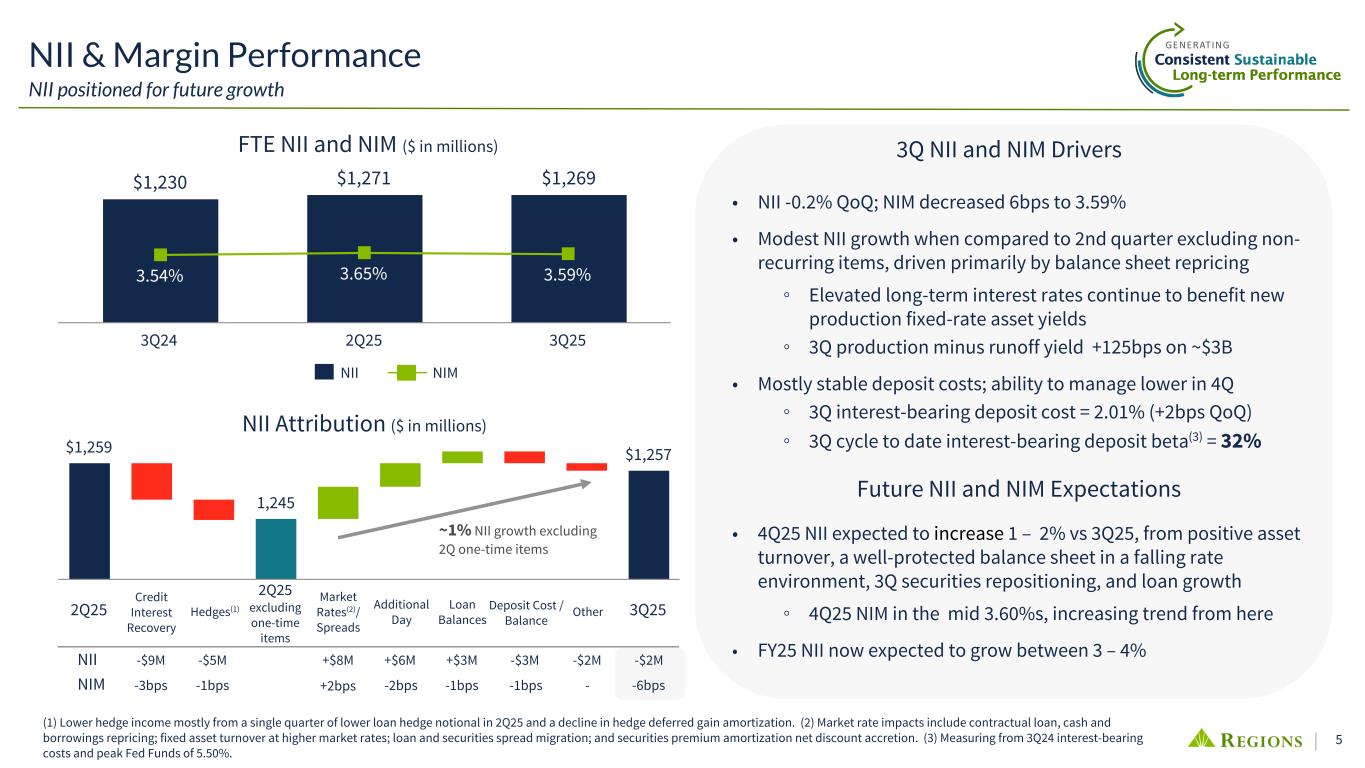
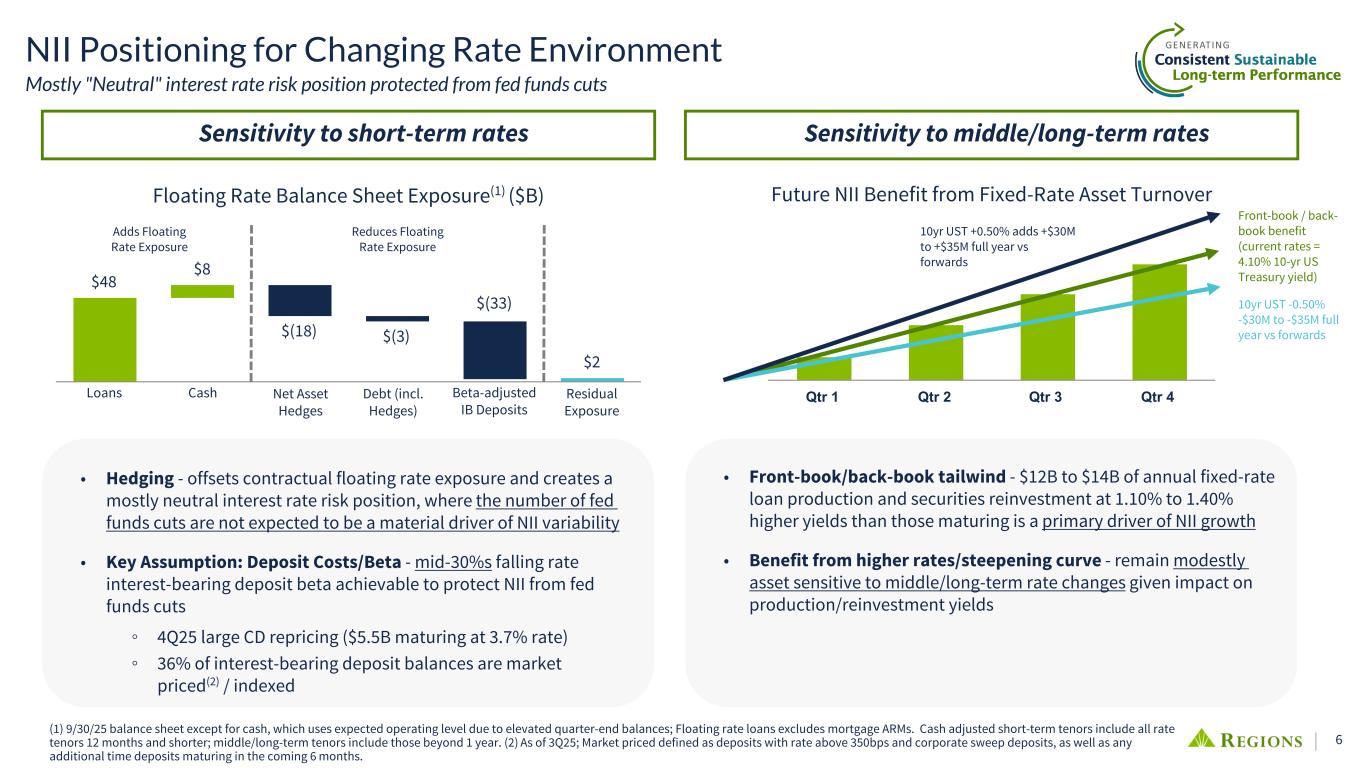
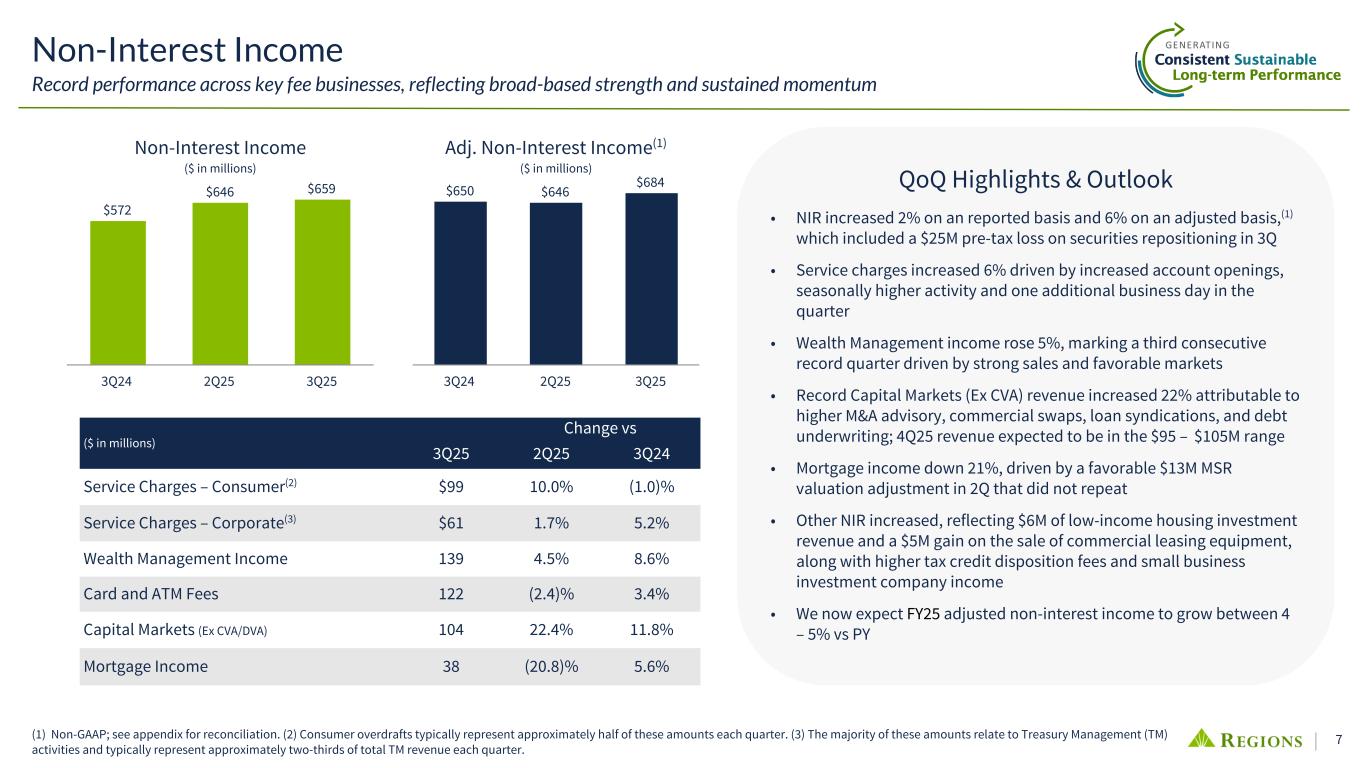
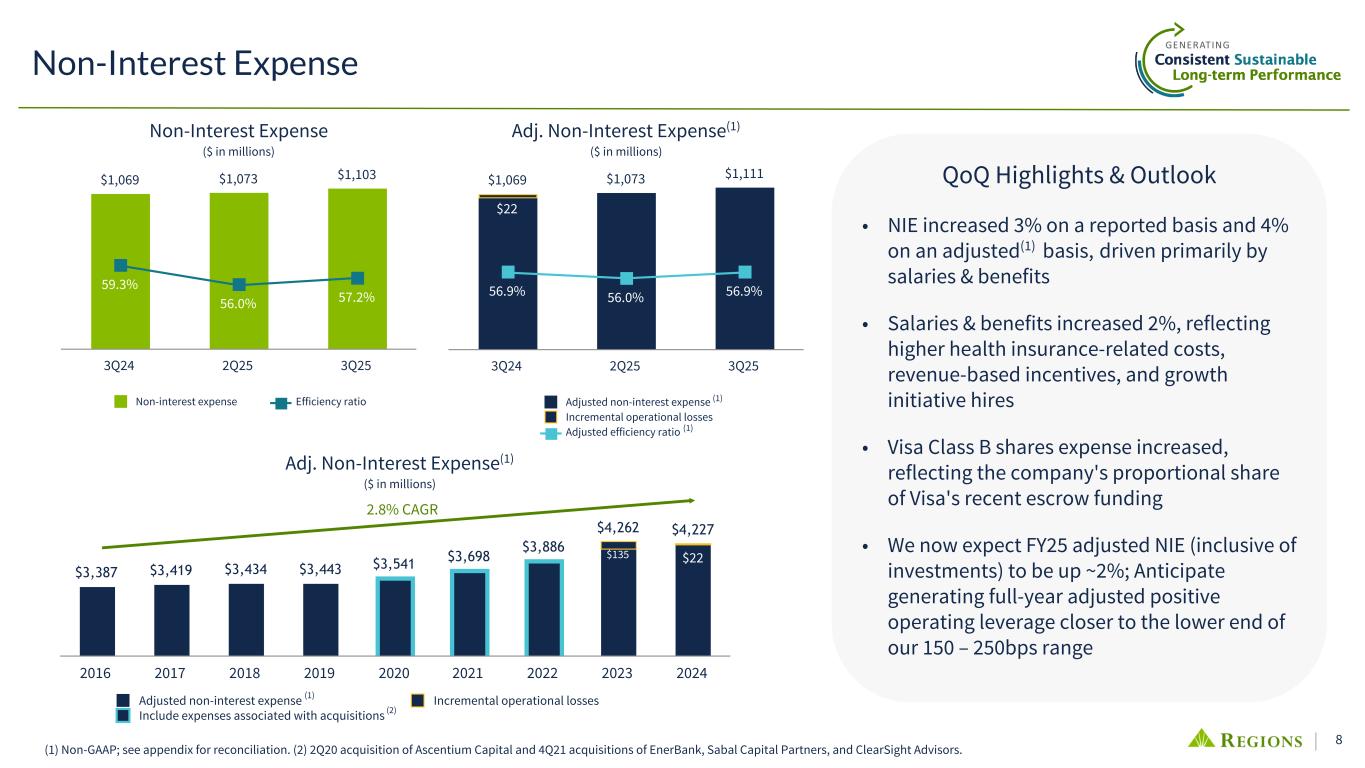
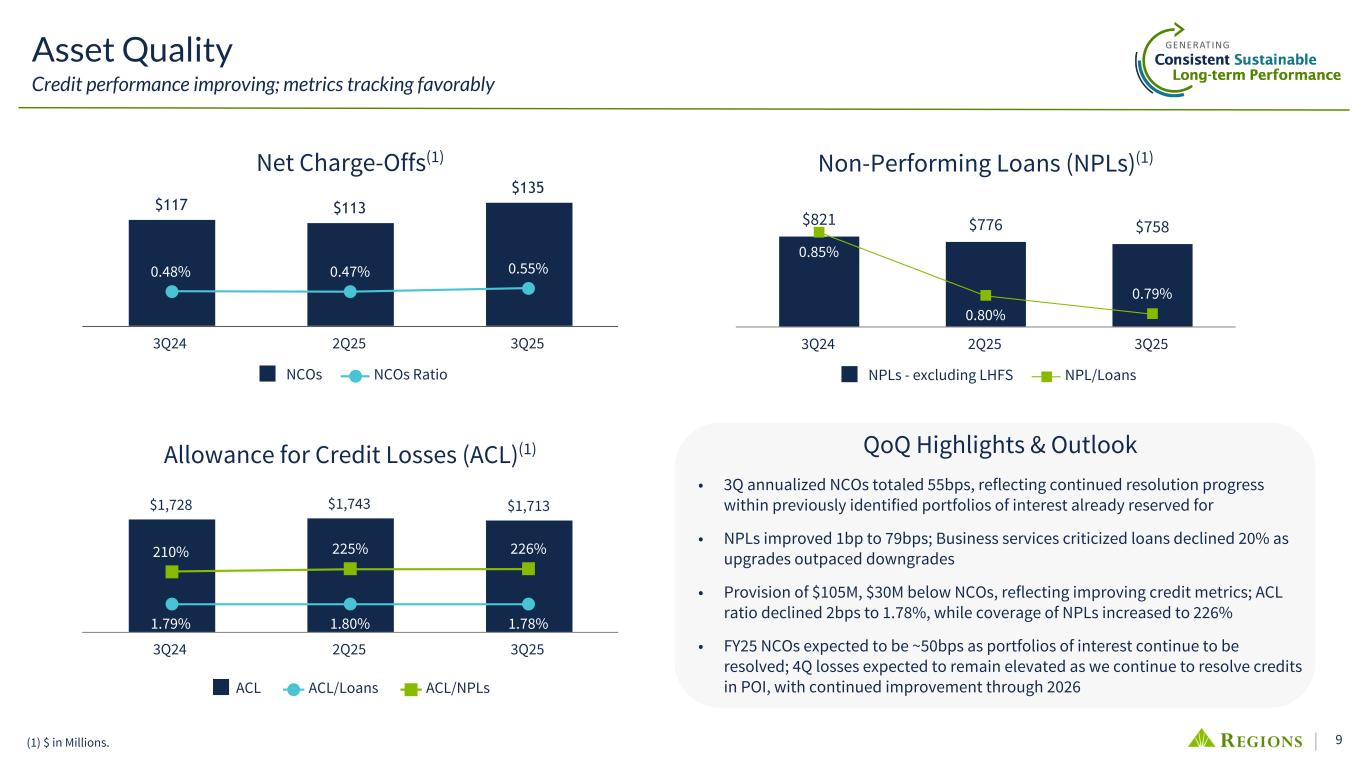
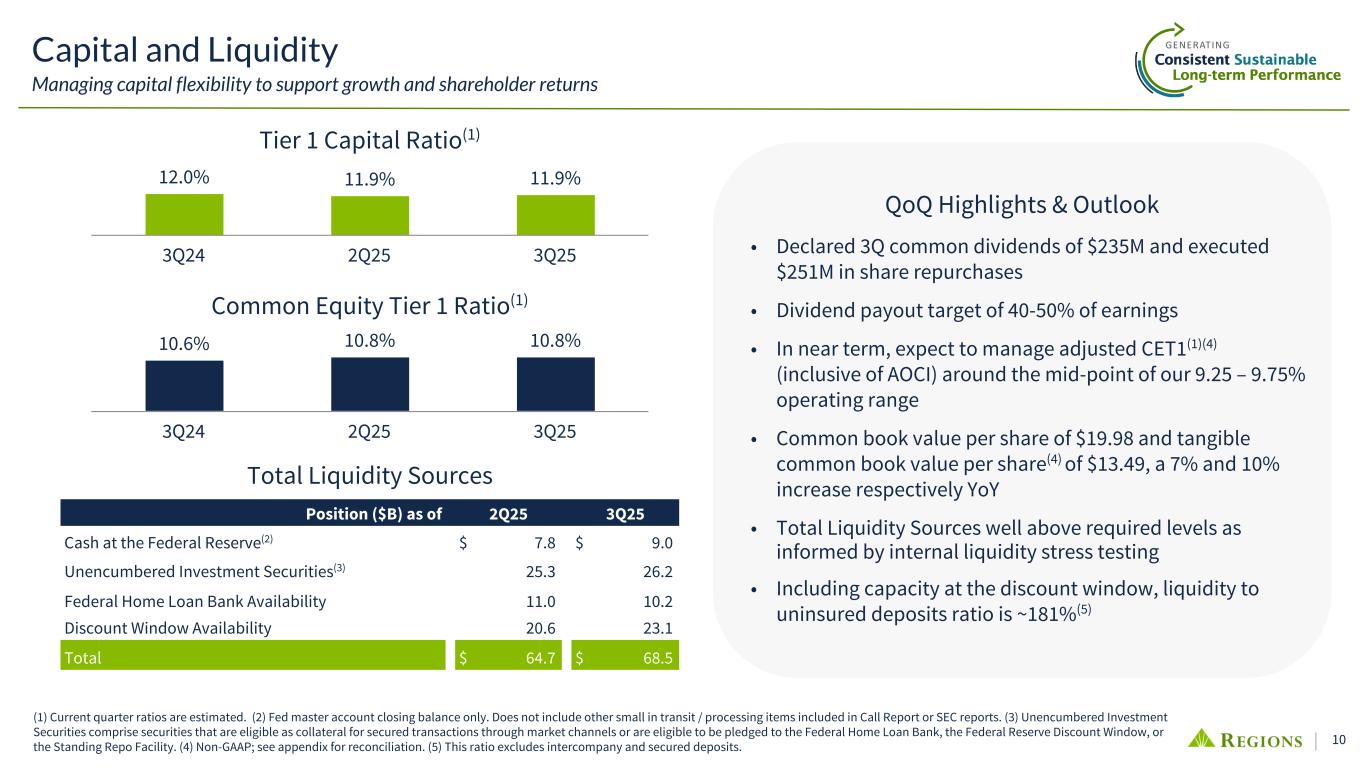
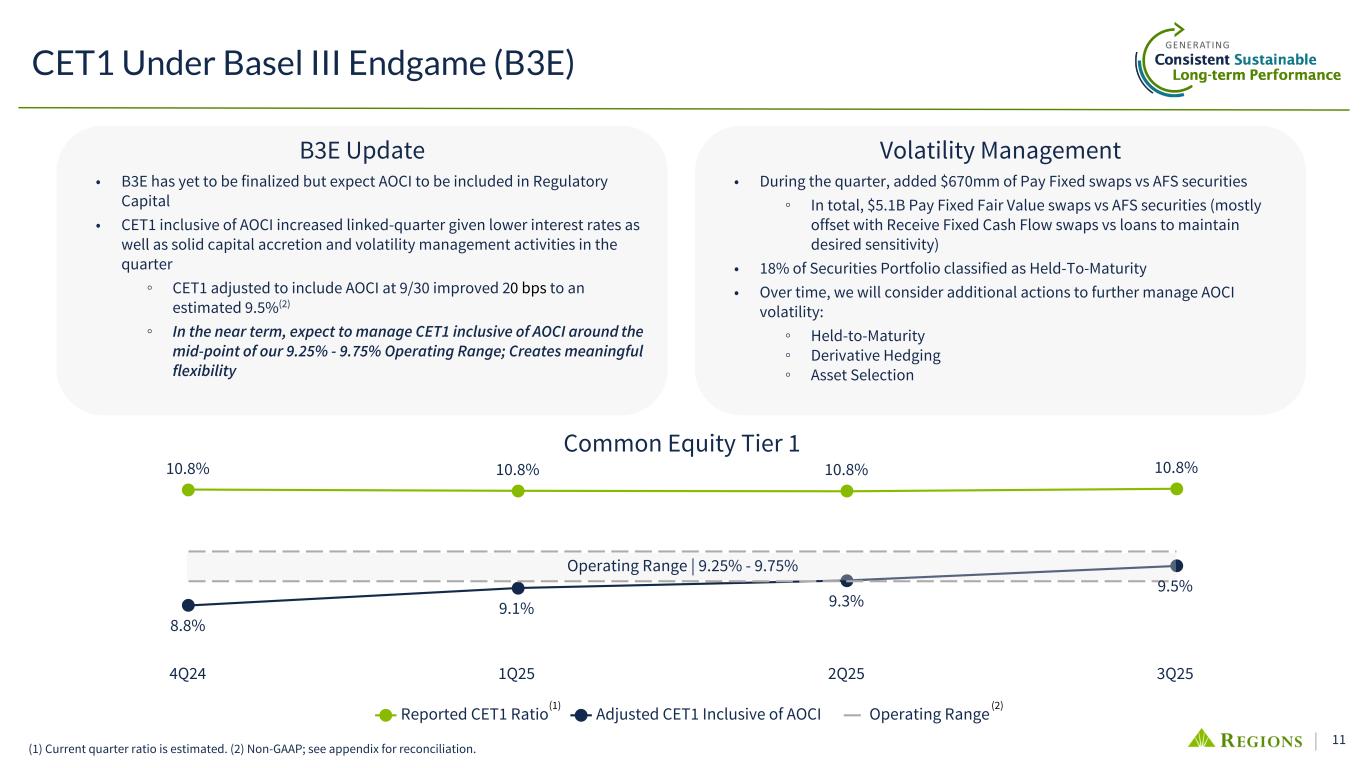
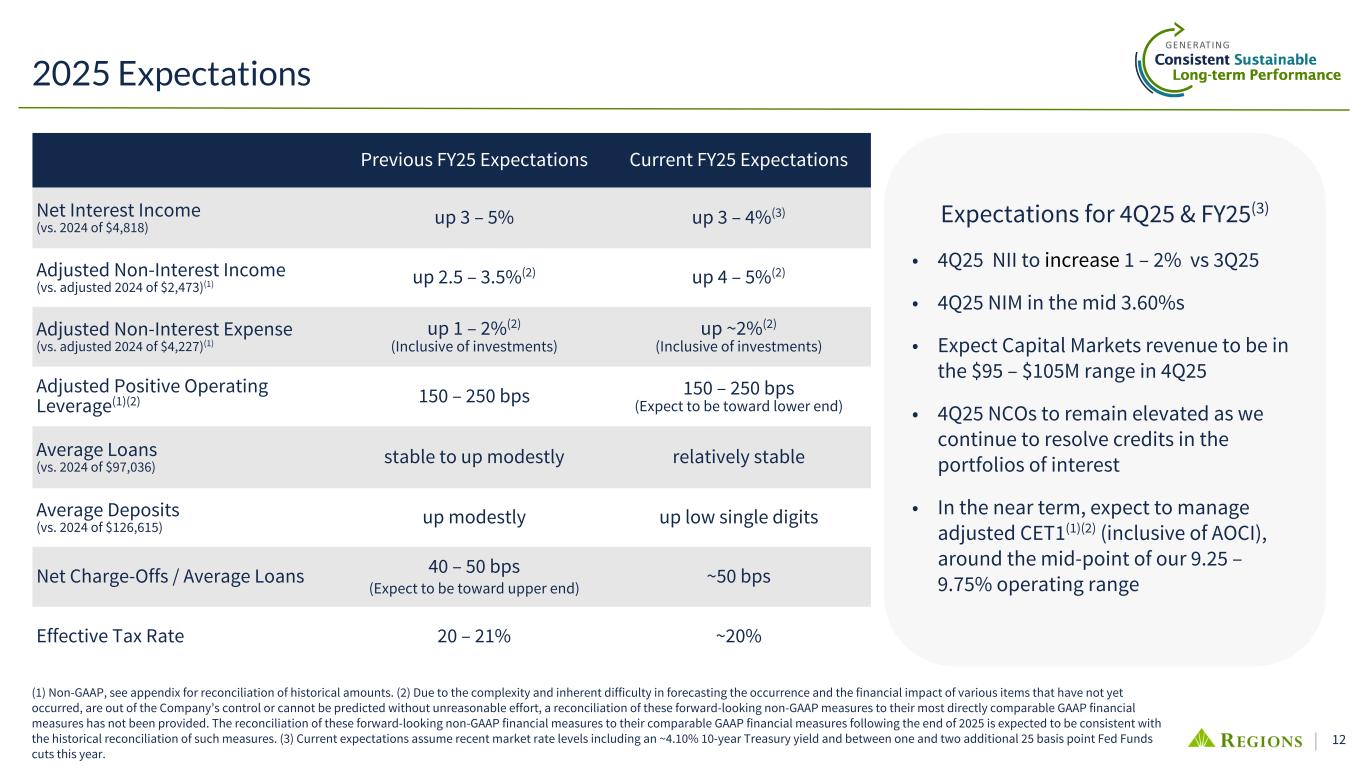
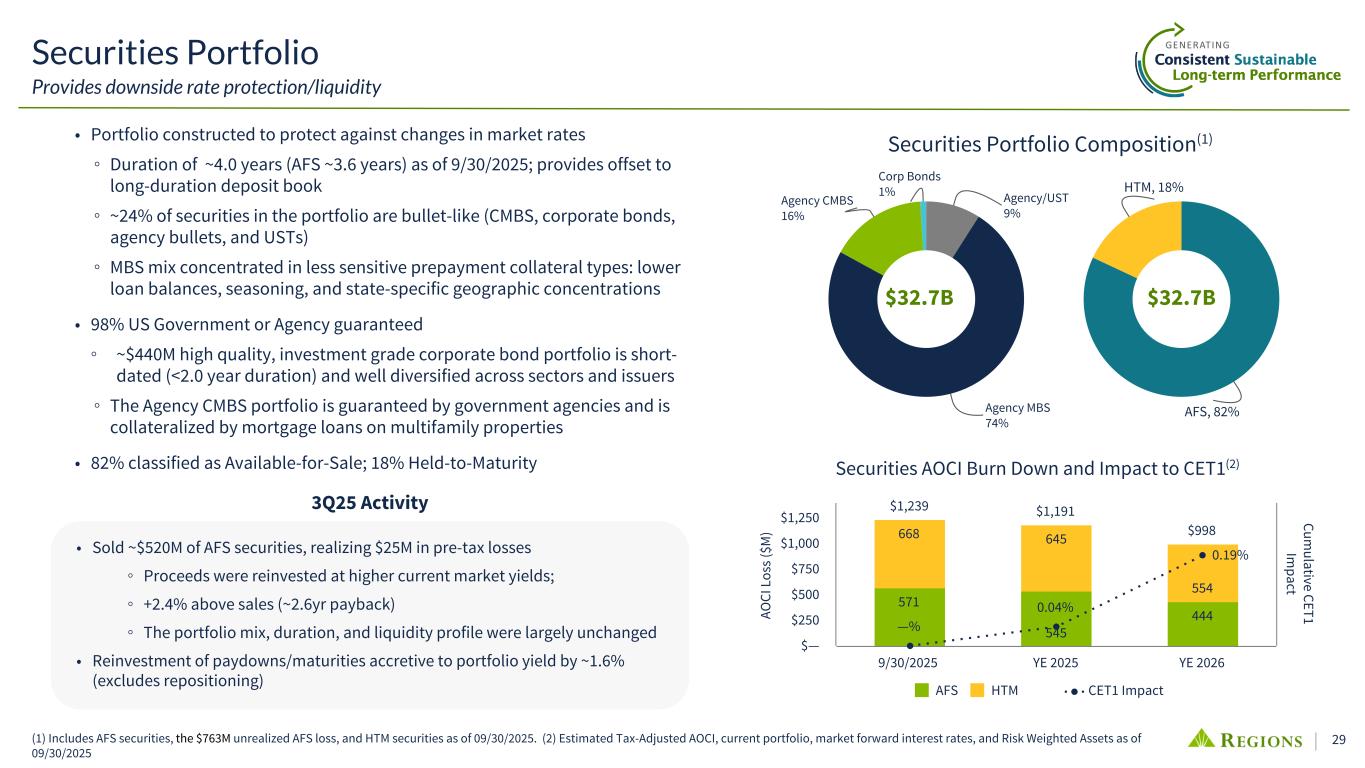
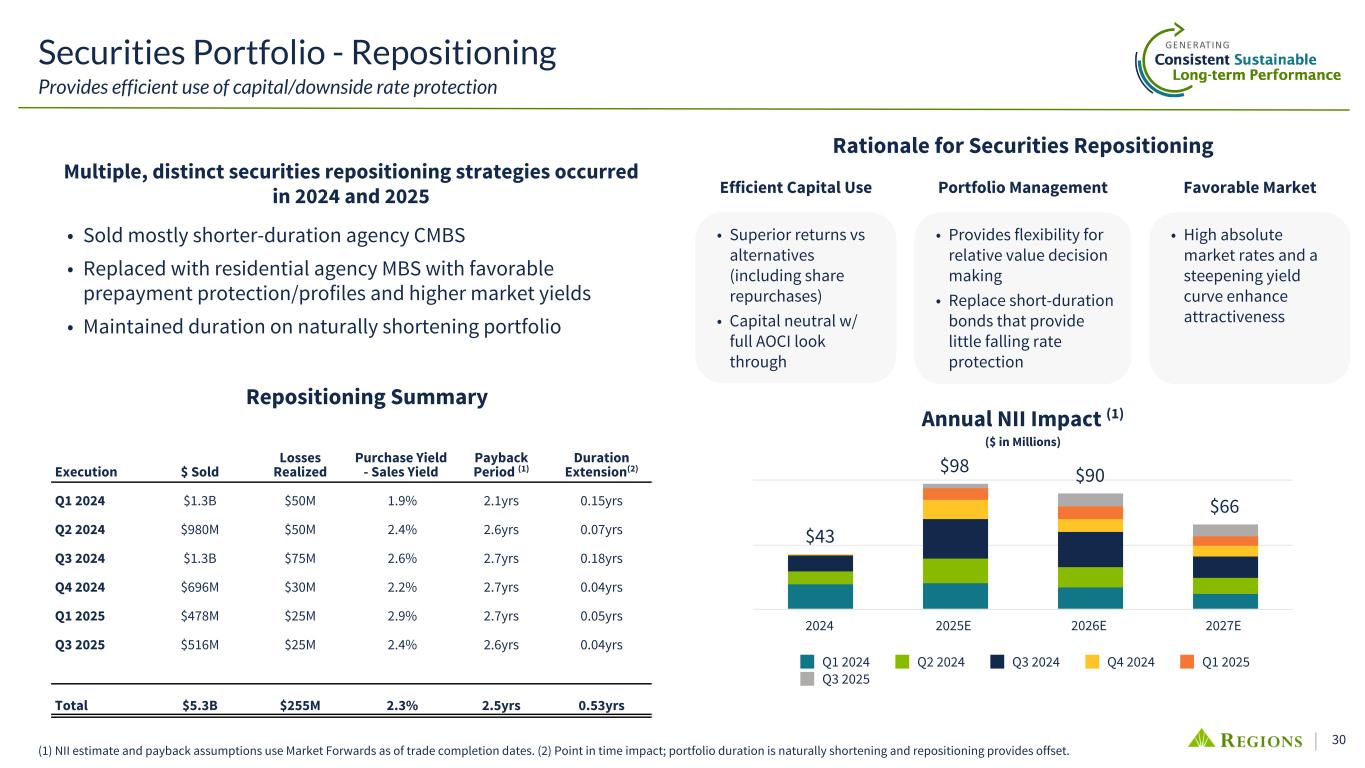
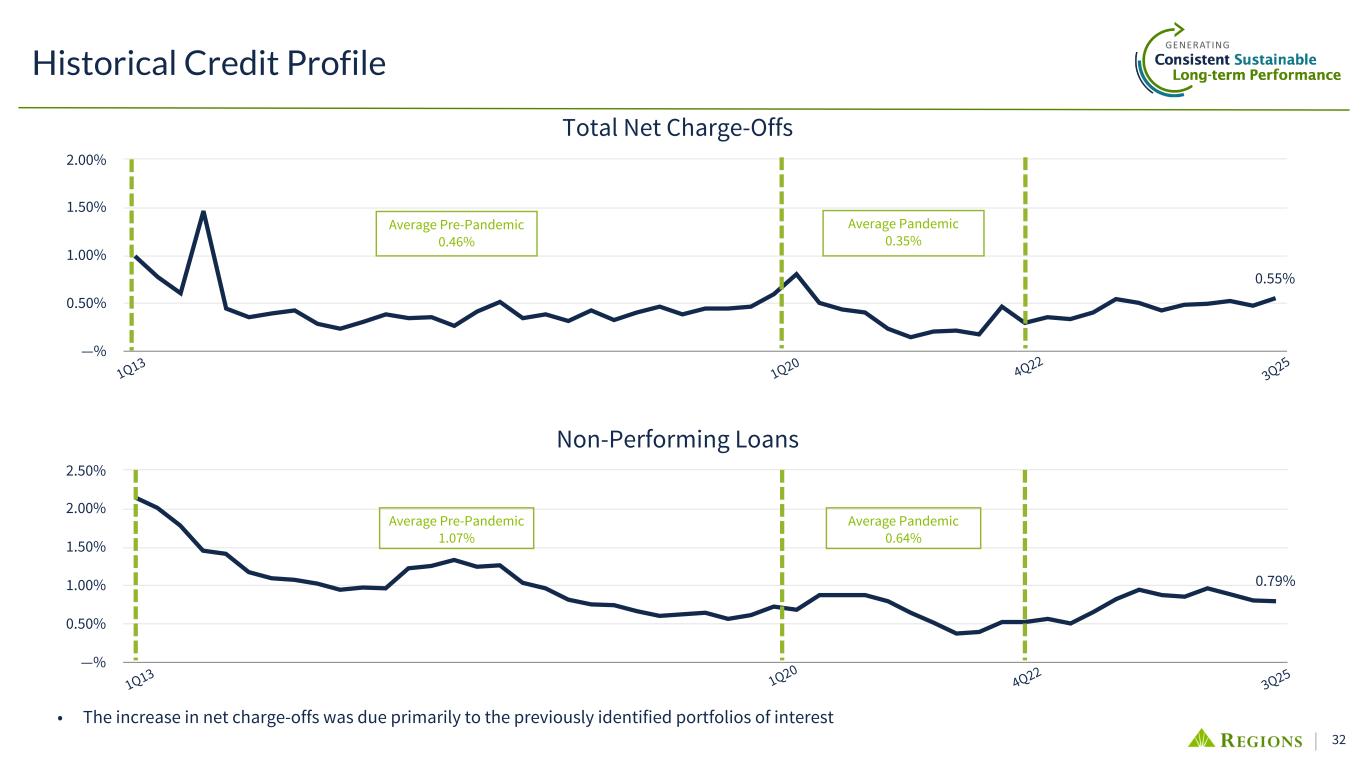
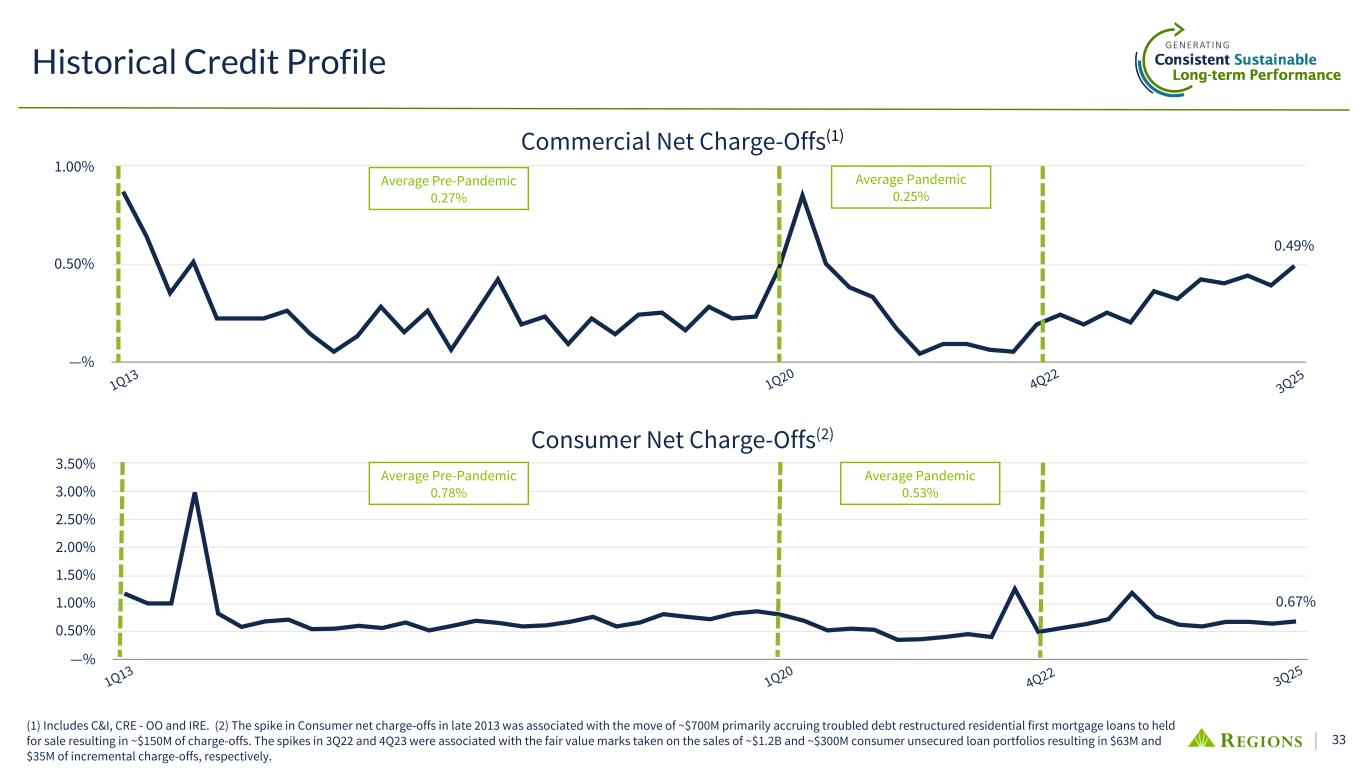
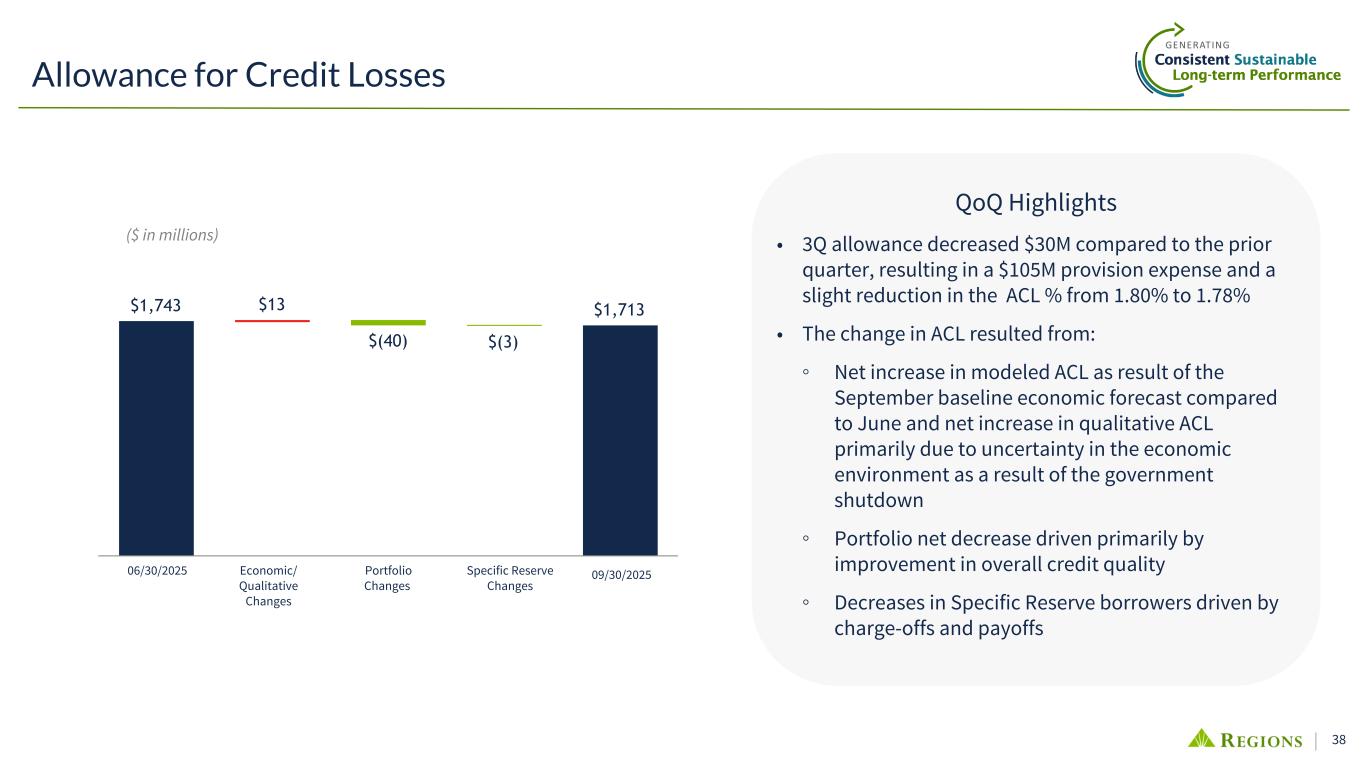
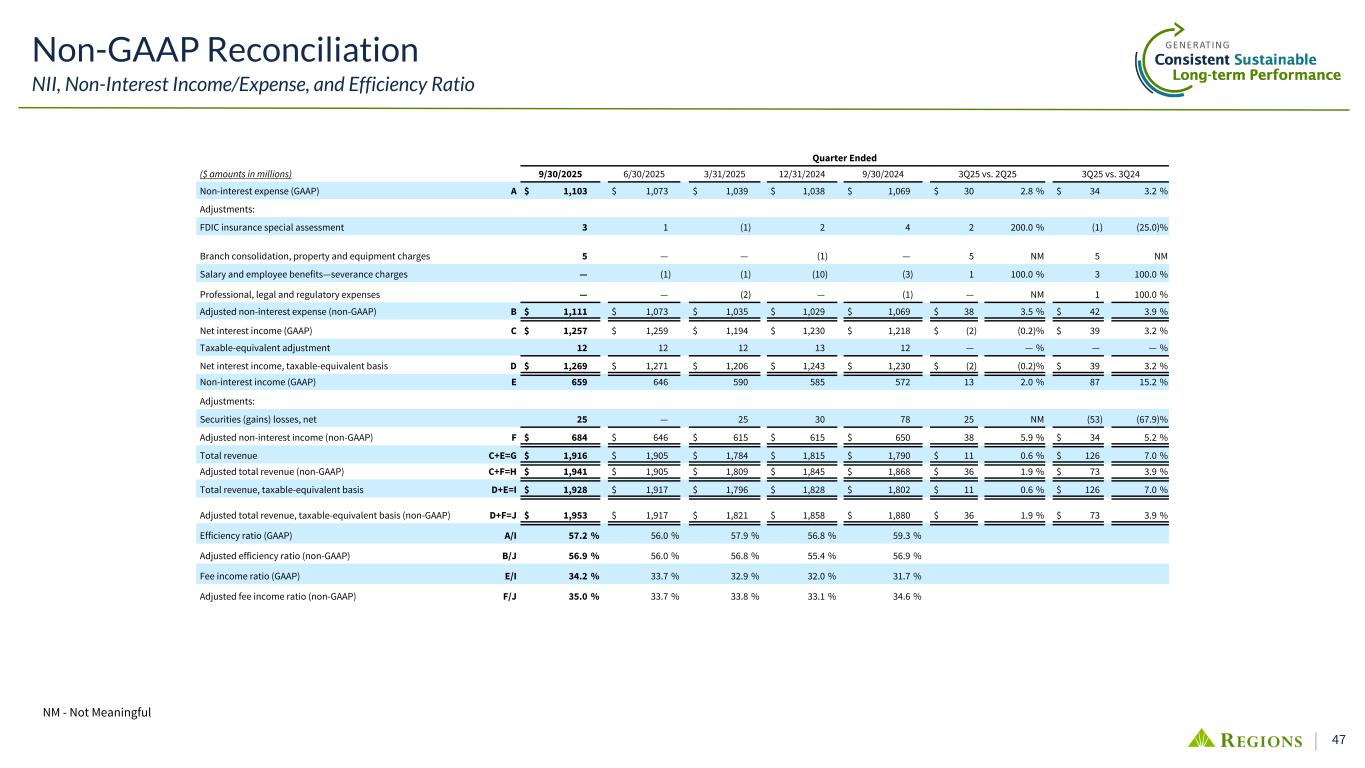
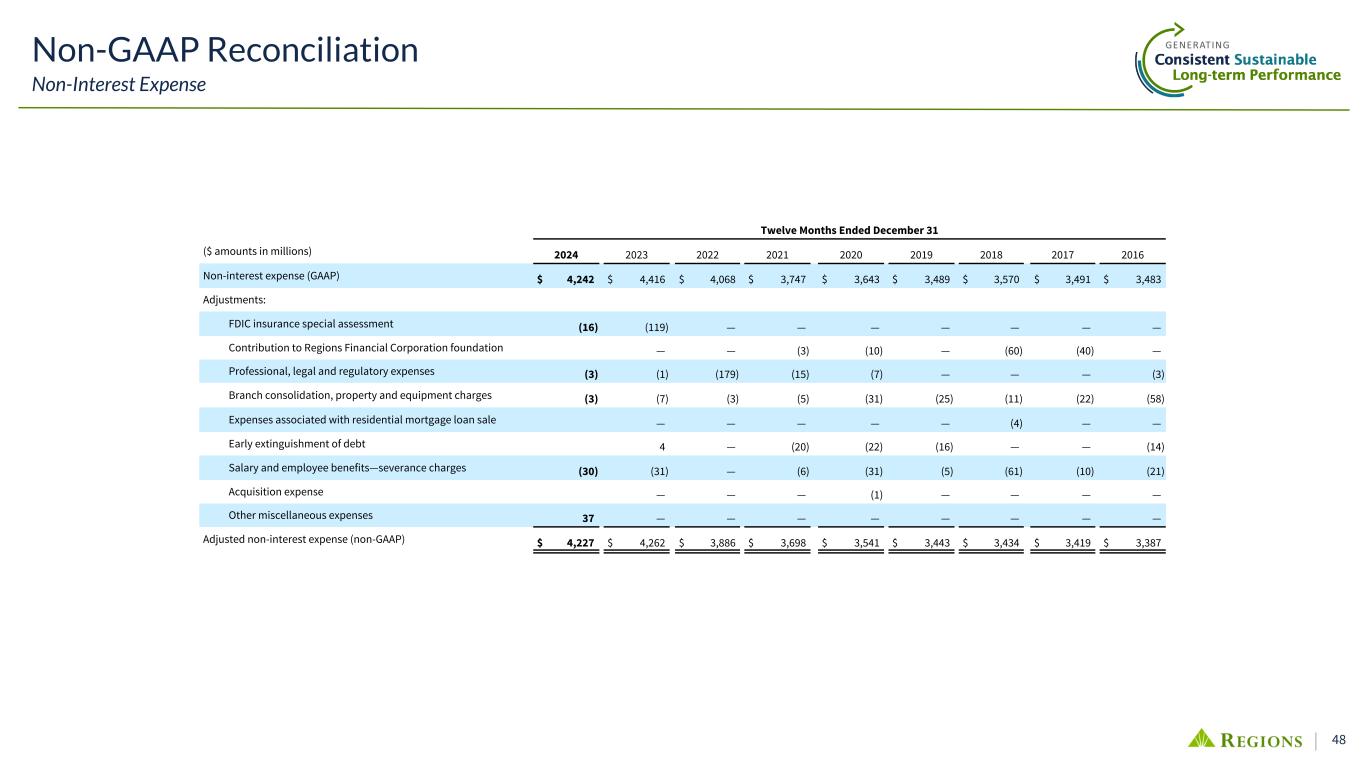
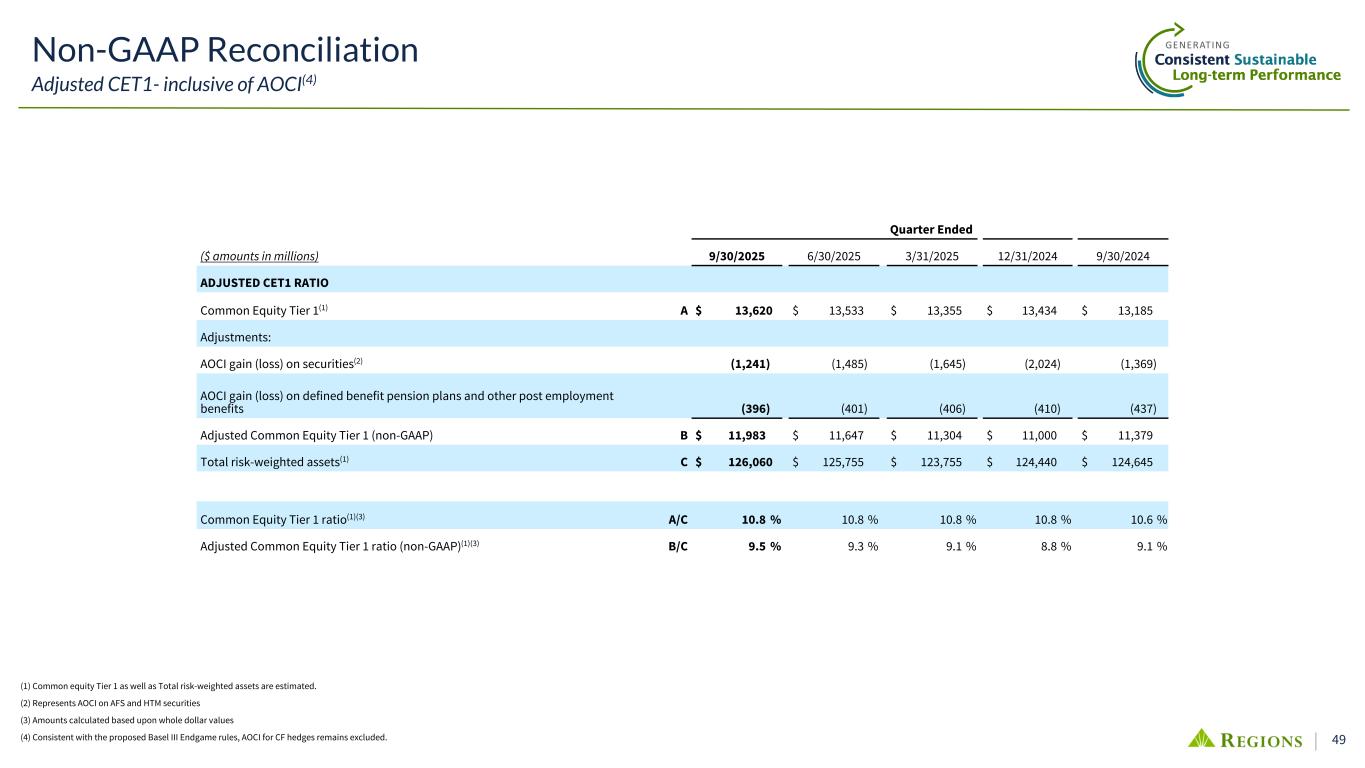
Thank you, John. Let's start with the balance sheet. Average loans grew 1% while ending declined 1%. Within the corporate bank, areas experiencing growth during the quarter include public sectors, commercial, durable goods manufacturing, and utilities within C&I, along with a modest increase in CRE. Our ongoing portfolio shaping efforts that John mentioned, year to date, we have exited approximately $900 million in targeted loans. and estimate we have another $300 million of these loans to work through over the remainder of the year. While we are also very experienced in our capital markets business, that does come with additional headwinds to loan growth where we saw approximately $700 million in loan balances refinanced into the debt capital markets. Average and ending consumer loans remained relatively stable as growth in credit card and home equity was offset by modest decline. In fact, full year 2025 average loans to remain relatively stable versus 2024 deposits remain strong overall roughly flat quarter over quarter typical seasonal trends and retention have been solid across core and priority markets priority markets performed well with the majority experiencing average balance increases with a notable increase in average balances across money market and non-interest bearing checking the overall share of non interest bearing deposit remained within our expected low 30 bank continued a five-quarter trend of growing total client managed liquidity on and off balance sheet reflecting strong client retention and acquisition favorable business profitability and healthy liquid balance sheets combined with our bankers efforts have helped us capture available opportunities. As a result, we are increasing our expectations for full-year average deposit balances. We now expect average deposits to be up low single digits versus the prior year. Let's shift to net interest income. Net interest income was relatively stable link quarter. After adjusting for elevated income in the second quarter associated with a large credit related interest recovery and fluctuations in hedge-related income, net interest income grew modestly, benefitting primarily from new fixed-rate asset originations and reinvestments in today's elevated rate environment. Interest-bearing deposit costs increased two basis points in the third quarter, due in part to growth in market rate, coupled with a muted quarter for CD maturities, as previously discussed. The absolute level of deposit cost continues to highlight region's competitive funding advantage and its benefit through cycles. The net interest margin declined six basis points. In addition to the non-recurring items from second quarter, the margin was negatively impacted by day count, as well as elevated cash levels that were slightly above our long-term. Looking ahead, we expect the net interest margin to rebound into the mid-360s in the fourth quarter, providing positive momentum into 2026. Growth in net interest income and margin are expected to resume from fixed rate asset turnover, additional securities repositioning performed late in the third quarter, prudent funding cost management, including lower deposit pricing, and modest loan growth. The strength of our balance sheet positioning is evident as expectations shift to a declining Fed Funds environment. We believe net interest income remains well protected from lower short-term interest rates with a neutral position when combining our floating rate product and ability to manage deposit. To remain relatively neutral to changes in Fed Funds, we target a mid-30s interest-bearing deposit beta. We remain confident in our ability to achieve the beta target through the repricing of our market price and index deposits. Additionally, we have the opportunity to further reduce CD rates as maturities escalate in the fourth quarter. Tactics to reduce deposit costs are well underway and we expect a meaningful decline in the fourth quarter. We now expect full year 2025 net interest income to grow between 3 and 4%. Let's take a look at fee revenue performance during the quarter, which is a really good story for us. Adjusted non-interest income increased 6% link quarter as we achieved growth in several categories. Service charges increased 6%, driven by increased account openings, seasonally higher activity, and one additional business day in the quarter. Capital markets income, excluding CBA, increased 22% compared to the prior quarter, representing a new record. The increase was driven by higher M&A advisory activity, commercial swap sales, and debt underwriting activity. Fourth quarter, we currently expect to be in the $95 to $105 million range. Wealth Management delivered a third consecutive quarter of record-setting income, driven primarily by elevated sales activity and favorable market conditions. With respect to full year 2025, we now expect adjusted non-interest income to grow between 4% and 5% versus 2024. Let's move on to non-interest expense. interest expense increased four powers and benefits increased two percent reflecting higher than anticipated health insurance related costs higher revenue based incentives and growth initiative related hires year to date higher than anticipated health insurance related costs as well as market value adjustments on employee benefit assets have pressured our full year expense we now expect full year 2025 adjusted non-interest expense to beat up approximately two percent and we expect to generate full year adjusted positive operating leverage at the lower end of the 150 to 250 basis point range regarding asset quality annualized net charge-offs as a percentage of average loans increased eight basis points to 55 basis points and reflect solid progress made on resolutions within certain previously identified portfolios of interest, which were already reserved for. Business services criticized loans improved significantly during the quarter, decreasing almost $1 billion, or 20%, while non-performing loans decreased 2%, with the NPL ratio declining one basis point to 79 basis points. As a result of the significant improvement in business services criticized loans and the overall decline in MPLs, as well as the solid progress made on resolutions within certain stress portfolios, the allowance for credit losses decreased $30 million during the resulting allowance for credit loss ratio was reduced two basis points to 1.78%, while the allowance as a percentage of MPLs actually increased to 226%. We now expect 50 basis points. We expect losses to remain elevated in the fourth quarter as we continue to resolve credits in the portfolios of interest. Importantly, we have reserved for the remaining anticipated losses associated with these portfolios. Let's turn to capital and liquidity. With an estimated common equity tier one ratio of 10.8%, $250 million dollars in share repurchases and paying 235 million dollars in common dividends during when adjusted to include aoc i common equity tier one increased from 9.3 percent to an estimated 9.5 percent quarter over quarter attributable to strong capital generation and a reduction in long-term interest rates expect to manage common equity tier one inclusive of aoc i at this approximate level going forward, which should provide meaningful capital flexibility to meet proposed and evolving regulatory changes to continue to increase the dividend and repurchase shares commensurate with earnings. We're pleased with our quarterly performance, particularly given the evolving market dynamics, and we believe we are well positioned regardless of market conditions. This covers our prepared remarks and will now move to the Q&A portion.
Operator
Thank you. We will now be conducting a question and answer session. If you would like to ask a question, please press star 1 on your telephone keypad. A confirmation tone will indicate your line is in the question queue. You may press star 2 if you would like to remove your question from the queue. Please hold while we compile the Q&A roster. Thank you. Our first question comes from a line of 10 used in with Autonomous Research.
Please proceed with your question hey good morning everybody um so i just wanted to level set and just make sure we were very clear with everybody that it was um the stuff you had set aside david that you ended up with that was stuff you've been talking about for a long long time and it looks like underneath that once those are resolved um just can you just give a good an update for and how you're seeing um that any other portfolios that you're you're watching um obviously given the you know the tone that that we're talking about this week across the group.
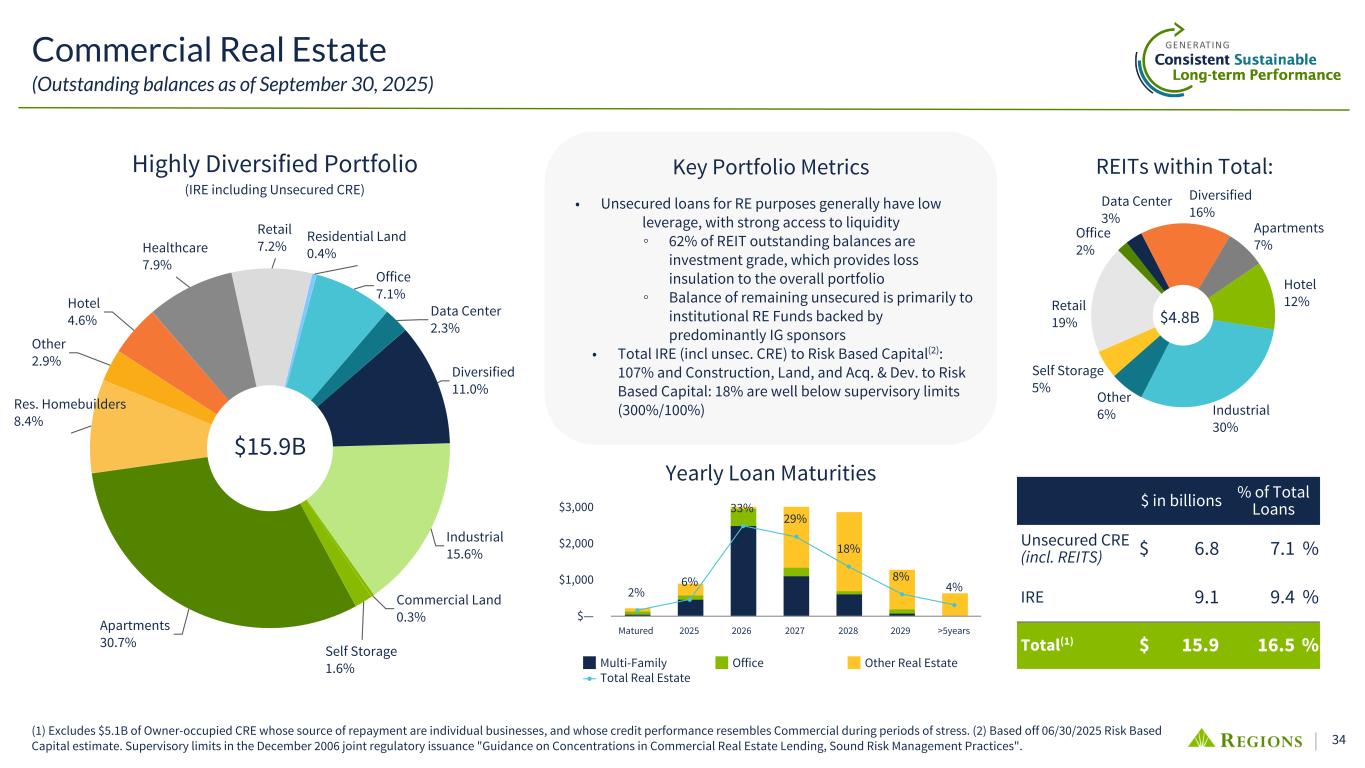
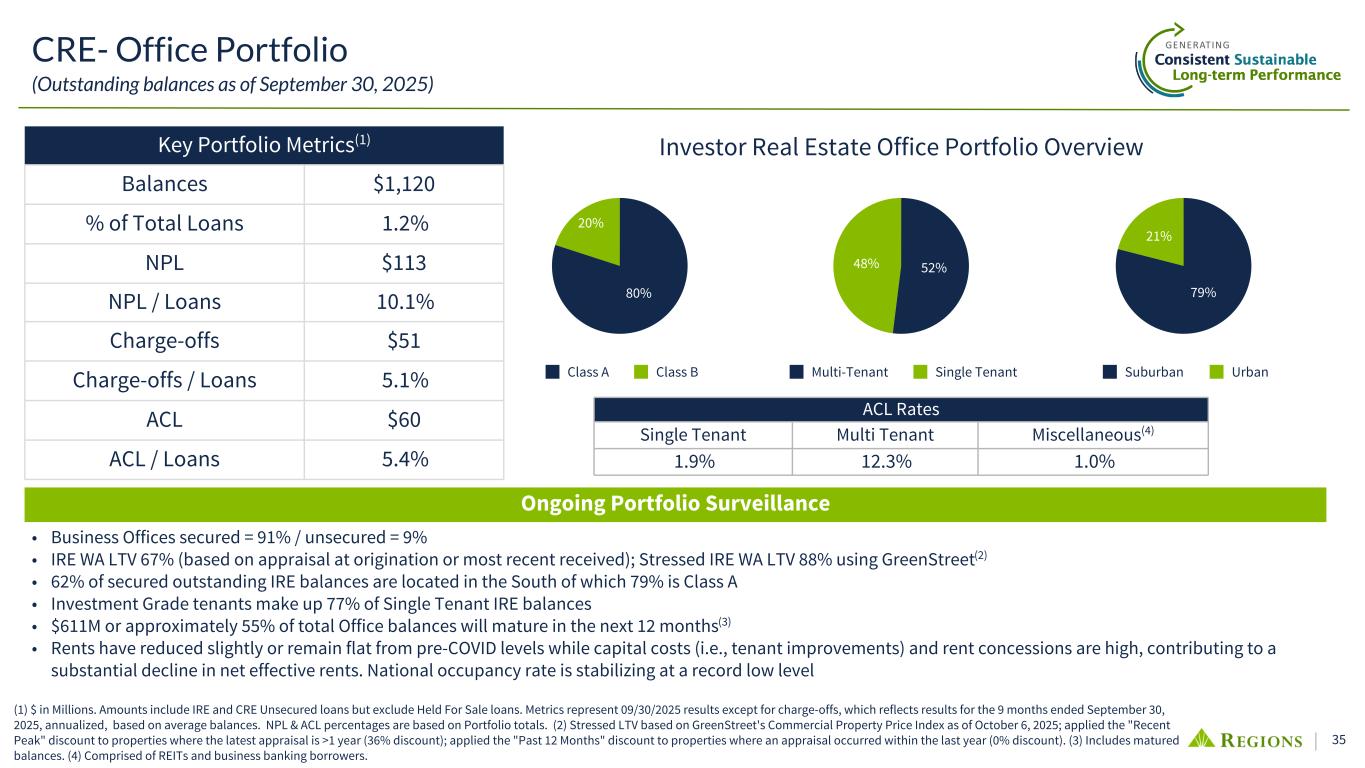
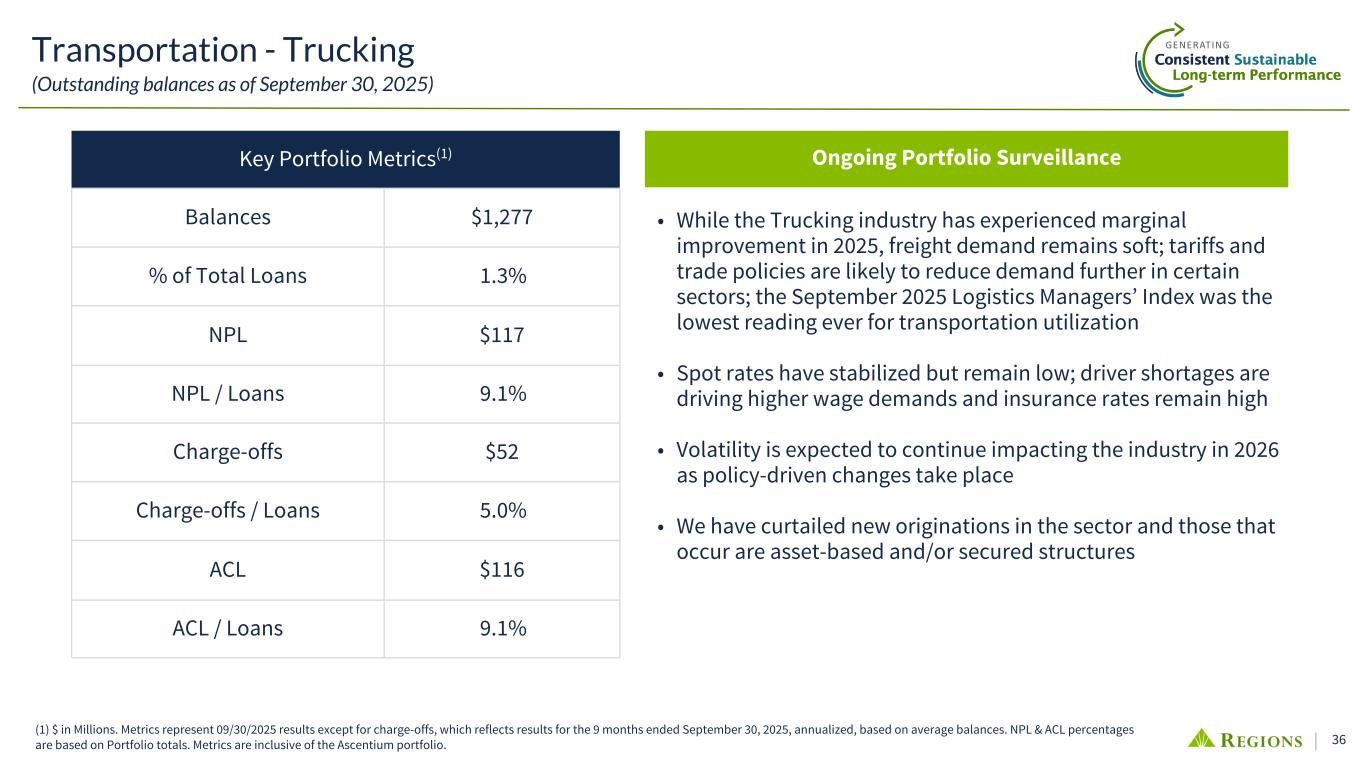
Yeah, again, this is John. I would say we've identified office and transportation as portfolios of interest for quite some time and the charge-offs, predominantly the charge-offs you saw in the third quarter related to office. We expect to resolve some additional credit exposures, either an office of transportation in the fourth quarter, which is why we're guiding to continued somewhat elevated charge-offs, but still feel good about long-term, our guidance of 40 to 50 basis points. Significantly, if you look at just credit quality overall, we had over $900 million in reductions, almost a billion dollars in reductions in classified loans during the quarter. Some portion of that was a result of upgrades, and in fact, we saw more upgrades than downgrades for the first time in a number of quarters, significantly more upgrades and downgrades, I would say. And importantly, we had significant payoffs in the portfolio during the quarter as well, which resulted in the pay downs. And that improvement was across a variety of categories. It was in office. It was in transportation. Some of that was the result of the resolution of some of the problems that we have. We also saw improvement in technology in that portfolio and generally in multifamily where the biggest amount of improvement was seen in the portfolio. So good trends, non-performing loans down modestly. We would expect that trend to continue as we resolve matters in the fourth quarter and potentially in the first. The only other area that we're seeing maybe a little elevated risk is in telecommunications. where we've had some exposures related to just the changing dynamics in the television and media industry. Again, nothing that we would say is overly significant, but if we're watching another portfolio, that would likely be it. I feel good about our exposures to non-depository financial institutions. Almost 40% of our exposure is in our REIT portfolio, which is a legacy business, something we've been involved in for quite some time. It's a relationship business, generates significant deposits and capital markets fee income for us. It's very low leverage and has performed really well. Very good credit quality, as demonstrated over a long period of time. The balance of our NDFI business is pretty well distributed. There are no significant concentrations of any kind. The business is managed by bankers with a good deal of experience and in many cases also involves our asset-based lending group we call Regents Business Capital, which is trained and routinely monitors customer accounts, asset quality, et cetera, And so we feel really good about our NDFI exposure. Very limited, not a lot of private, not a lot of direct private equity exposure, I would say.
Appreciate all that, caller. So one more point on that loan point you made that there has been some, you know, continued, like you said, paydowns in a bunch of the portfolios. So how close are we to getting to what you would anticipate to be the bottom, just looking at, you know, a bunch of the ending period balances and also just noting that C&I was a little bit lower this quarter probably in part to what you were just speaking to. Thanks.
Yeah I think in David's prepared comments he said we would expect another 300 plus or minus million dollars in in paydowns related to exit portfolios. The good news is that pipelines are up 100 percent year over year. They are growing significantly. Production's up a little less than 20 percent year over year, so we feel good about what we're seeing. Unfortunately, line utilization's down 70-plus basis points, so we still have a lot of liquidity. That's reflected, the customers do, and that's reflected by the deposit growth we've seen in our corporate banking business. And until customers use some of that liquidity, excess liquidity, probably not going to see a real increase in line utilization, but we're prepared for it. And we continue to grow new relationships, to grow existing relationships, and that's I think demonstrated in the increase in commitments we're seeing and in pipeline activity. So we're optimistic about the 2026 and what we will see based upon the experience we're having today.
And, Ken, just to be clear, the $300 million we think will get dealt with this year so that we start 26 and we're ready to go and grow.
Operator
Our next question comes from the line of Scott Seifers with Piper Sandler. Please proceed with your question.
Good morning, guys. morning. Thanks for taking the question. I guess I want to follow up just a little, just so I make sure that I understand kind of what's being reduced. When you make the comments about portfolio shaping, do those indeed align with what you would characterize as sort of portfolios of interest on the credit side? In other words, the stuff that you're charging off, is that also the stuff where we're getting those balance reductions, or are those like mutually exclusive?
No, it would be a combination of both. I think you're seeing balance reductions in some categories where we had identified credits as having some weakness, so they weren't necessarily in our portfolios of interest. An example that would be maybe multifamily where it was a portfolio we were observing, but we did not feel there was any risk of loss in that portfolio as absorption rates have improved as projects have stabilized and moved from construction to lease up or lease up to stabilization we've been able to upgrade those that those credits and that's had a positive impact on the multi-family portfolio on the other hand we did have some charge-offs in apartment and in transportation which in part led to some of the reductions that we experienced But the big change was leverage lending portfolio.
That $900 million year-to-date is where that predominantly came from.
Okay. Wonderful. Thank you for that clarification. And I guess regardless, it sounds like we're getting to a point where you enter next year kind of free and clear anyway. But nonetheless, I appreciate that. And then, John, just a broader strategic question. You've been pretty clear that you all would rather focus internally than engage in M&A. Just curious if your thoughts have changed now that you have a smaller competitor in your footprint getting much larger and then one of your Category 4 competitors making its way into Category 3 with a deal of its own. Any change now that the ground is shifting a little in your thinking at all?
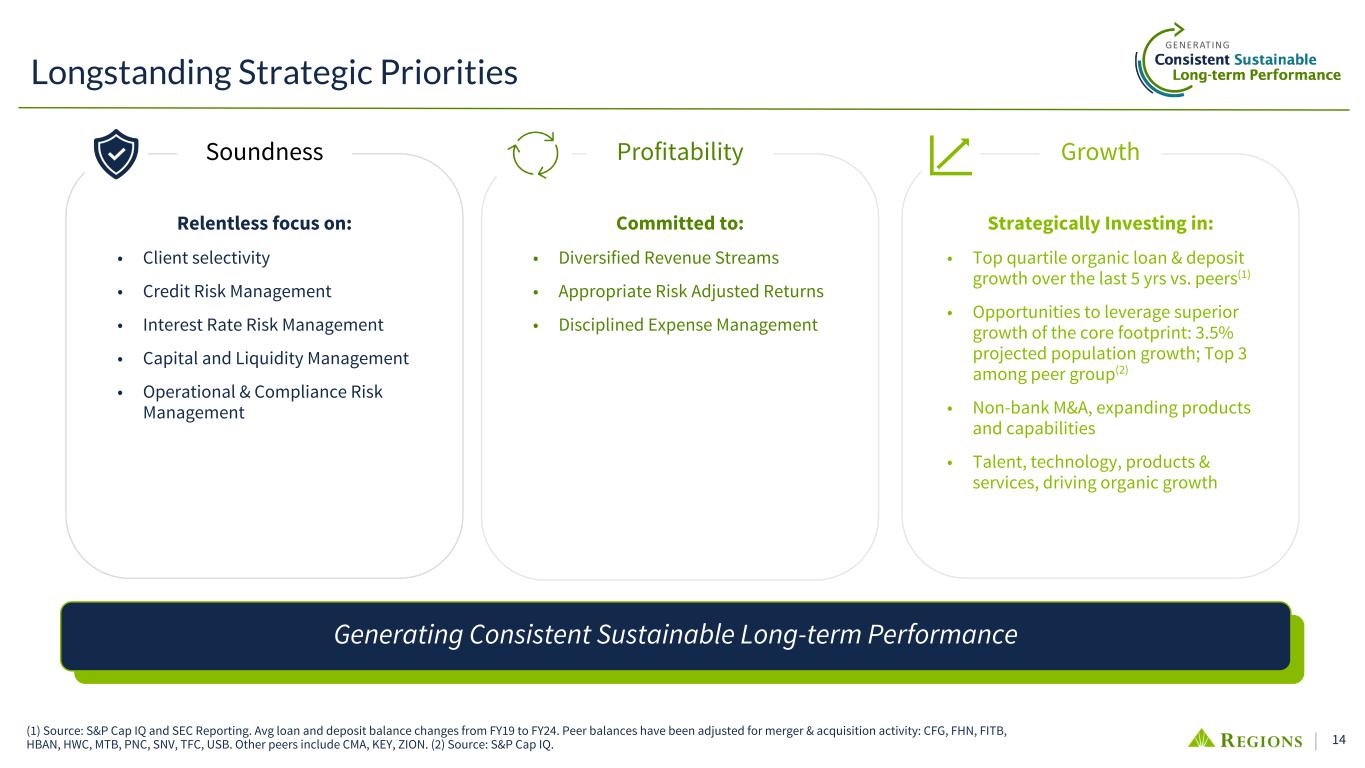
No, our position hasn't changed. Let's say we have great confidence in our strategic plan. we've been focused on executing it over the last seven eight years and we it's produced all the good results for our shareholders we have we think really great bankers we're in really good markets our opportunity is to continue to grow from the presence that we have we're certainly aware of all that's going on in the marketplace we continue to follow the activity and and we challenge ourselves from time to time about whether or not we ought to be more interested in depository m a but today we we continue to believe that it is it's disruptive that it takes your focus off what off executing your business on a day-to-day basis and so i would say that we are completely focused on the execution of our strategic plan and and we'll continue to uh to maintain that position recognize that we're always going to do what's in the best interest of our business and for our shareholders, and today we think that's executing our plan.
Understood. Okay, perfect. Thank you all very much.
Operator
Our next question comes from the line of Stephen Alexapoulos with CD Cowan. Please proceed with your question.
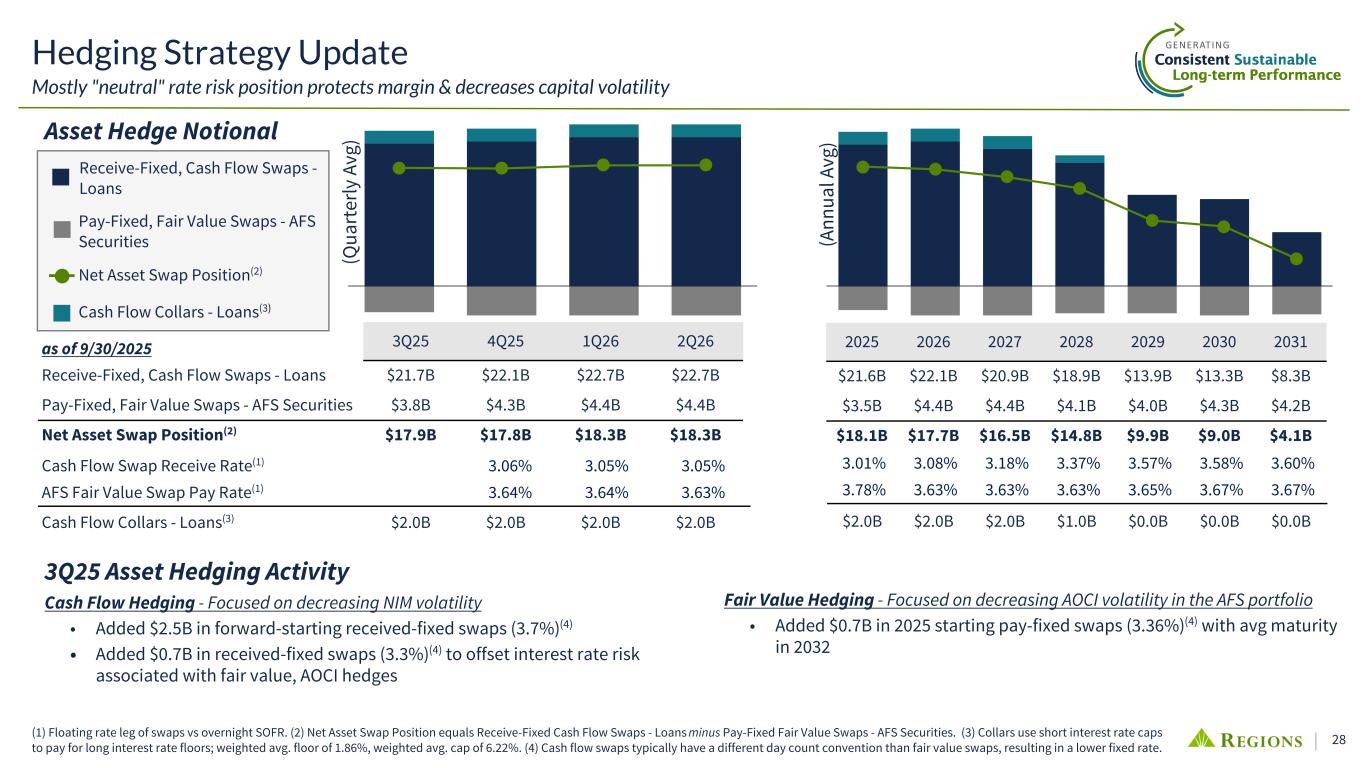
Hey, good morning, everybody. Morning. I want to start on the margin first so you're guiding to a mid 360s in the fourth quarter to give you one of the highest margins in the industry and I'm looking at slide six which says you're mostly neutral to rate so does that mean that if the Fed is cutting rates you can hold the NIM steady from that but continue to see NIM expansion from this mid 360 level given the success at turnover you're calling out on the same slide yeah so this David so the right now the front book back book benefits about 125 basis points if you average out loans and securities that is down from the second quarter because primarily the
10-year coming down but we still see some benefit there our beauty of our hedging portfolio is to protect us as rates come down so we we still have negative carry in our derivative portfolio or hedging portfolio, it gets less negative as rates come down. So that's why we have confidence that we've been able to have a pretty resilient net interest margin, regardless of what rate environment that we have. We clearly had a higher margin last quarter. We've tried to provide and remind everybody what we said on the call last time. We had some one-timers that boosted that about three three to four basis points that did not repeat. So we put on page five to try to help walk that forward. But, yeah, we have pretty good confidence that we're going to grow one to two percent in that interest income, and if you look at kind of where we think earning assets will be, that should produce a margin in, you know, getting close to the mid-360s.
Okay. That's helpful. And then on the positive operating leverage, I know you're saying it's going to be the lower end of the 150 to 250 range, and you're taking the adjusted expense outlook up to the upper end of the 1 to 2% range. The question is, should we assume that the increase in the expense outlook is sticking here, just giving inflationary impacts, that as we look forward, there's more of a tailwind to expenses, which is going to restrict your ability to drive up more material positive operating leverage?
Well, if you look at, so we do not adjust our HR asset number. That was about 12 million dollars. We tried to show you if there's 12 million in NIR and there's 12 million in NIE, they offset. But when you're looking at percentage change for positive operating leverage, which is the percentage change in revenue less a percentage change in expense, it affects you there. We can't undo what's happened. And so all it is a recognition of where we are through nine months. We have really good expense controls. We feel good about where our expenses will be in the fourth quarter, and we're giving you the guide for the fourth quarter, assuming our HR asset thing is zero, because we don't know what's going to happen with the market could go up or down. So in some regards, we'd like to adjust for that, but that's frowned upon. So what we do is we show you both sides so that you can do your own math. And that's all this is. There's no runaway inflation. There's no cost that we can't deal with appropriately. And, listen, we're going to have, you know, approximately 2% increase in cost for the year is pretty good. And nice to operate and leverage. So we feel good about our expectations for the fourth year.
Okie dokie. Thanks for taking my questions.
Operator
Our next question comes from the line of John Pancary with Evercore. Please proceed with your questions.
Hey, John. So back to the charge-offs and the resolutions that you're working through, just for a little bit more color there, is this more a function of a more proactive posture by regions to address some of these lingering and previously identified issues?
Or is it more a function of borrower progression, that they're now at the point where you can quantify the lost content and and uh and then um address them yeah typically john it's the latter i mean you just work on something until you can't work on it anymore or until the borrower doesn't have any capacity to continue to support the the loan or the borrower makes some decision that potentially is adverse to potential collection of the credit then we we're in a position to resolve of it each case is different and timing has a lot to do with with recognition of loss in this case
we just had a number of things come together in the quarter okay got it thanks john and then secondly also i'm a related to this i guess um back to the portfolio shaping efforts around the exit portfolios if i could maybe ask scott's question another way um how much of the rationale now in these portfolio shaping actions is rates, is driven by the rate environment and the backdrop versus the credit risk dynamic?
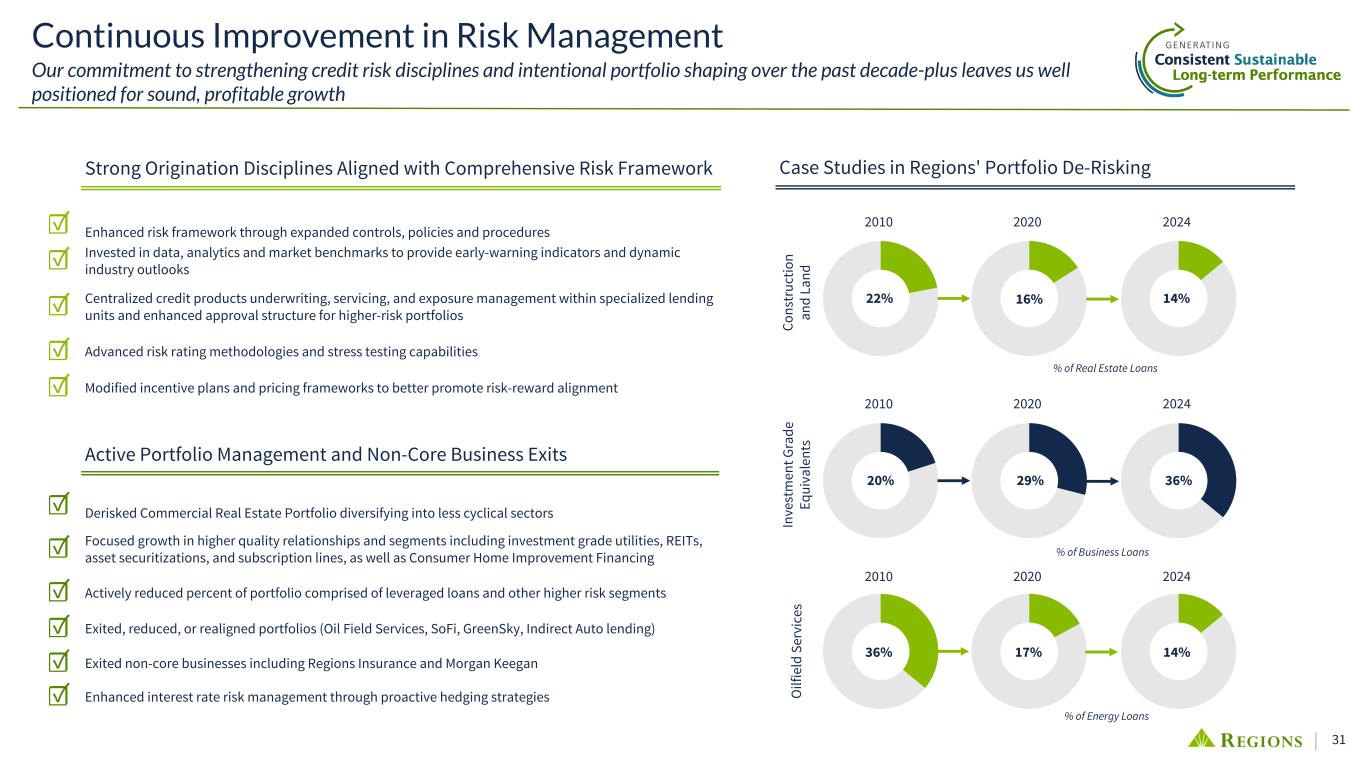
I would say it's driven both by our credit risk appetite and returns. We have, going back to 2015, really focused on capital allocation. I think that's been one of the hallmarks of our success and the execution of our plan. And so we're aligning our credit risk appetite with expected returns in portfolios. And we will occasionally originate a credit believing that we have the opportunity to expand a relationship. As we look back on that, we conclude after two or three years that we were wrong. There wasn't a path to expand a relationship, and so we choose to exit. But there are also situations where we just look at the overall profile of a portfolio or relationship and decide that the credit risk is more than we want to take. And so much of what we've been executing is part of a leverage portfolio that was primarily based on enterprise value lending and assumptions. And we just don't believe that's a place where we want to be at this point. And so we've chosen to exit a number of those relationships.
Got it. And if I could just ask one more related to that, what's the risk or the potential that you slide the remaining $300 million that you're working through? What's still a potential that it could continue to increase even after that and be more of a growth headwind or anything as you look at it?
Well, that's what we've identified. And we have an ongoing rigor around looking at relationships and portfolios. So today, that's our best advice and guidance. We don't anticipate any significant additional reductions. But I would say that one of the things that we feel really good about is, again, the rigor and the process around continuing to think about capital allocation and returns on that capital. So 6 to 12 months from now, we might identify something else that we decide we want to trade out of. All the while, we're improving returns on the capital that our shareholders are giving us to deploy into our business. So, again, we think if you look at our track record, it's served us awfully well.
And, John, I'll add, sometimes a customer's business model will change after we've provided credit to them, And that business model change is not consistent with our expectations and our original underwriting and return expectations change, and we'll exit as a result of that. And so we have constantly been portfolio shaping. This particular year, it was just a little bit larger than it has been. And so to John's point, you'll see it in 26, but today we don't anticipate it being at the level that you've seen in 25.
Got it. That makes sense. All right, David. Thank you. Thanks, Sean. Yep. Thank you.
Operator
Our next question comes from the line of Dave Rochester with Cantor Fitzgerald. Please proceed with your question.
Hey, good morning, guys. On loan growth, I know you've had some investors point out that loan growth has been kind of hard to come by at regions over the last year or two, but you lay out a really solid case here for some acceleration next year with all the aspects you mentioned. Plus, you have the banker expansion and the re-skilling going on, and you're far along that plan there. So it seems like you might be pretty well positioned to grow maybe even faster than GDP in the group next year once you kick out that $300 million. Is that the thinking at this point? Is that within the realm of possibility?
Yeah, I think we've consistently said our expectations would be to grow our loan portfolio consistent with GDP. in our markets plus a little bit. Now, we have real GDP right now low at around 2%. That's baked in, and we'll give you guidance in terms of what our expectation will be for loan growth later. But you're framing that up kind of consistent with what we've been saying.
Sounds good. Maybe just switching to credit real quick, your comments earlier on the telecom book. How big is that exposure that you're looking at within that segment right now that you're maybe a little bit more concerned about?
Total is about $700 million. So not, you know, relatively speaking, not significant.
Yep. And then one last one on credit. Obviously great to see the reduction in criticized loans. It was a pretty meaningful move lower. You guys have done a lot of work on that front on de-risking in the portfolio. I know you talked about NPAs continuing to decline. Are you looking at maybe more steeper declines over the next few quarters, just given everything you're seeing and all the work you've done?
I think you can assume that, although I'm reluctant to give too much guidance there because, again, the timing of when we resolve credits has a lot to do with ultimately what the level of NPAs are.
But you can assume if criticized loans came down by almost a billion dollars, the trajectory is positive.
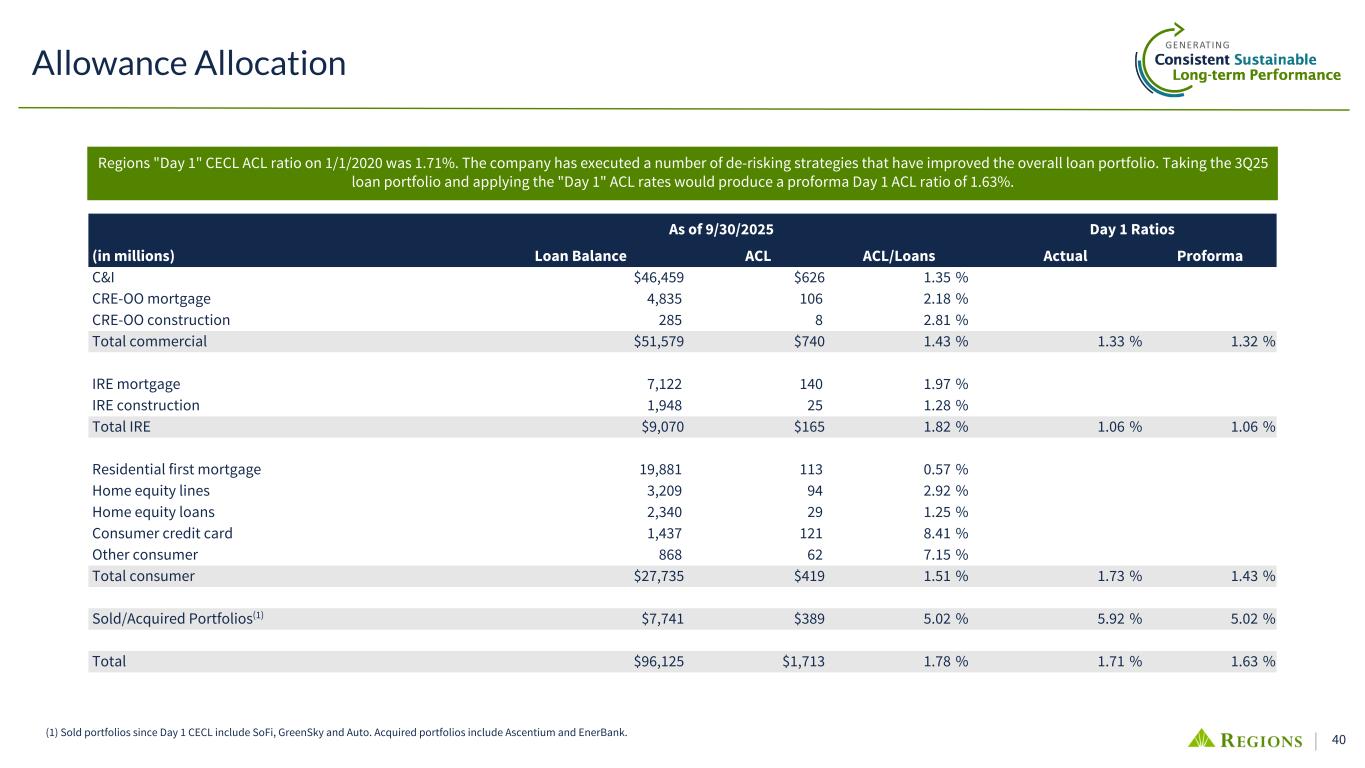
And as a result, our 1.78% loan allowance ratio should, over time, as we work through the charge-offs, which we have reserves for, you would see our reserve trickle down closer to that 2019 kind of day one CECL of 163. I think we show that on one of our pages on our deck. I think it's page four.
Sounds good. Thank you very much. Thank you.
Operator
Our next question comes from the line of Gerard Cassidy with RBC. Please proceed with your question.
Morning, Gerard. Morning, Jimmy. Hey, guys. You guys don't have a dog in this fight, So I'm asking this more from a theoretical point of view. These issues we're seeing with some of your peers in the regional bank space on fraud, can you share with us from your experience? When fraud happens, is it driven more because the people that are running the organizations are crooks, or is it more that the underlying fundamentals really deteriorate, and the first action they may take is to kind of cover it up with fraud, which then eventually leads to a bad outcome? Do you guys have a sense from just your experience when you go back a number of decades how this kind of develops?
Gerard, first of all, I certainly don't want to speak for, and I know you didn't ask this question, but for any other institutions. I'll just speak about my own experience. But over 40 now, I think three years in the banking industry, most of that as a commercial banker, I think it's both. You know, occasionally you will get in business with someone that is a crook from the get-go. In other cases, the business deteriorates, the owner or the sponsor doesn't know what else to do. They think, just like anybody that embezzles, typically they think they're going to pay it back. And I think it's true of people that get involved with fraud and double-pledging assets and those kinds of things. They think they can resolve the matter over time, and ultimately they can't. So my experience has been both. That's why we focus so intensely on client selectivity, knowing who we're banking and doing business almost exclusively in our footprint, because that's the best way to know who you're banking, to observe on a regular basis how your customer is doing, and to ensure you're on top of what's going on with the exposures.
Very good. Very helpful. And then coming back to your earlier comments, John, about your deposits and I think deposit market share from the FDIC data, there's always been a concern that the big trillionaire banks are going to take advantage of deposits from the regional banks. Obviously, you're not seeing that. Can you share with us the strategies you're using that you have seen your success in deposit growth and maybe align some of the fears that some investors have that regional banks are not going to be that competitive against these trillionaire banks?
Yeah, thank you for the question. You know, we've been in a lot of the markets that we're in for 150, 160, 170-plus years. We're the hometown bank in so many places. We have a well-known brand, well-known bankers. We believe in our people and think they do a great job. We continue to make investments in technology to ensure that we are providing customers with access to banking any way they want to bank. We continue to focus on how we use the data that we have and the technology that we offer to provide personalized, unique ideas and solutions to help customers. I think all those things, Gerard, are really, really important. Combine that with our focus on customer service and the great job our bankers do building brand loyalty, we're continuing to grow consumer checking accounts across our footprint. And that's a challenging aspect of what we do. We are a relationship bank, and we live that. And I think it, as a result, we feel good about our ability to continue to compete with the larger banks. There are lots of smaller banks who are coming into our markets as well. And then non-banks. I think we're in a good position. We're going to continue to leverage our brand, leverage our footprint. And we believe we can continue to be very competitive and grow.
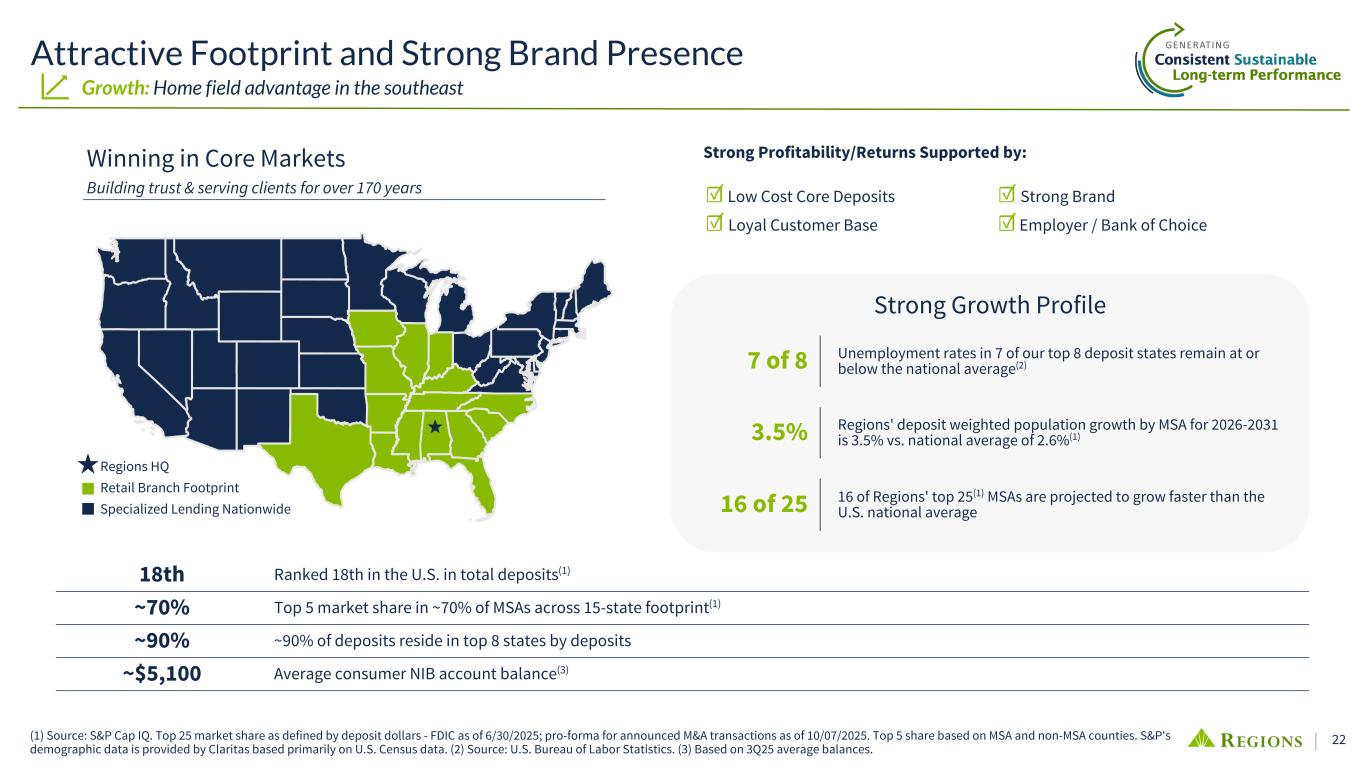
Gerard, I'll add one thing. I get a lot of questions about branches, and we clearly have more branches on a relative basis than almost anybody. And the reason for that is we're in a lot of towns inside of our poor states that we operate in. When we see people moving into the southeast, for instance, it depends on where they're going. They're coming to the larger major metros, and so we'll compete for deposits based on services John just mentioned. But we aren't seeing that type of competition move in in the smaller towns. It's just cost prohibitive. I don't think people would do that. We've been in these little markets for a long, long time. And when you're in these small markets, you have to have a physical point of presence, which is why we have as many branches that we do. So we can continue to compete. Two-thirds of our deposits are consumer non-interest-bearing deposits that are based on how we serve our customers. And if we continue to do a good job there, we get a high promoter score and a lot of loyalty from that customer base.
Very good. Thank you, gentlemen.
Operator
Our next question comes from the line of Ibrahim Poonawalla with Bank of America. Please proceed with your question.
Hey, morning, David. I just wanted to follow up. When we think about just the expense growth this year, 2% means you have best-in-class ROE. Just remind us, you started this, I think, a year ago in terms of just the investment spend. And to what level do you think you could see investment spend pick up, be it branches? You obviously have a big technology conversion coming up. And kind of how are you thinking about growth versus the ROE, Matt, whether better growth for a slightly lower ROE would be okay? Just would love your thought process there.
Well, to your point, we continue to make investments in our technology initiative. That's kind of in our runner-ready. We don't expect that to change materially year on year. We have made investments in bankers, and we will continue to do so in particular. in those eight priority markets that we have listed. It's important for us, it's a great question because it's a good challenge in terms of how much money can we invest today without having too much negative impact on our return. The return on tangible common equity is critically important to us. John mentioned it, 2015, we became fixated on capital allocation because we think having an appropriate return correlates real tightly to your share price, and that's what shareholders want you to do. That being said, we want to grow, too. So we're trying to be balanced in terms of how much investment we make while keeping the returns relatively high. And so we have begun to invest in our network and in marketing and things of that nature to change a little bit of the growth trajectory. You should see us grow things like small business relationships, which will come with deposits, not really as much in loans, but deposits, which is the fuel for how we really make money going forward. So as loan growth picks up, we want the good core, low-cost funding to be right there with it. And that's why we started making the investments, like you said, about a year ago, and we'll continue that into 2026.
Got it. Thanks for that. And then just one on capital, and you have the slide 11 where you talk about just the Basel endgame. As you look forward on changes on the regulatory and the supervisory front, anything in particular that would help you in terms of how you're running the business or the balance sheet? And could that cause any changes, even at the margin, on the capital liquidity growth?
Well, you know, things like the long-term debt thing, we hope, is gone. That's to prevent us from having to issue more expensive long-term debt, so that's positive. The Basel III, where it was going until right at the very end when it kind of got pushed off, was going in a way that was reasonably helpful to us. RWAs were going to come down a little bit as the gold plating was removed. And that being said, the AOCI component, there's a chance it doesn't cover a Category 4 like us. We've given you the numbers, assuming it's in there, but it may not be. We also have to consider rating agencies. That's important, too, and they're trying to figure it out as well. We've seen other larger institutions talk about capital targets that are real close to where we are, and we're trying to figure out what the new regime is going to be. We think we're in a good spot, and we have a lot of optionality with capital because we're already there at 9.5% with AOC. And, you know, could there be some incremental benefit? There could be, but we're not counting on that. You know, if it works to our favor, then we'll take advantage of it as we see it.
Operator
Our next question comes from the line of Chris McGrady with KBW. Please receive with your question.
Good morning, Chris. Good morning. Hey, good morning. Going back to the deposit beta, I think it was the mid-30s comment, it feels conservative to me. I guess maybe interested in your view there. Is it an element of conservatism, or is it an element of protecting your market, some of the larger banks coming in?
What we're trying to do is tell you what our guidance is based on, and our guidance is based on that 35% beta. Clearly, we're higher than that going up, and we would expect over time that we would get the 43% beta that we had back. But that will take some time, and we don't want to commit to that because we don't want to be time-based. We feel fairly confident we can have a 35% beta, and with that, has a nice continued growth and a resulting margin as a result of it. So we have a chance to outperform on that front. We're a little – we're at 32, 33 right now. We have a big CD maturity quarter coming up in the fourth quarter, which gives us confidence on that 1% to 2% NII growth and margin growth. and we expect that to result in a cumulative beta pushing on 35% at that time. If we get a little bit more, then everybody will be happier.
Understood. Perfect. And for my follow-up, I think you were pretty clear about your capital priorities. If and when the situation changes and inorganic growth becomes more likely, is that a situation where you think you would have to communicate that change to the market before, or do you kind of think what you said publicly is sufficient?
Well, I think we always want to keep our options open, but as I said earlier, M&A is not part of our strategic plan today. We feel really confident in our strategic plan. We have to run the business for the benefit of the business and the shareholders. Things change. I don't know how we necessarily signal that any more than providing the perspective that I just have.
Operator
Our next question comes from the line of Betsy Grasick with Morgan Stanley. Please proceed with your question.
So I had two quick questions. One is on the CD rolls that are coming in the coming quarter. Can you give us a sense as to the NIM impact there or basis point impact in deposits?
Well, it's $5.5 billion. It really just depends on what happens with rates there. and that's a big driver of our improvement from 359 to the mid-360s. We also have some back-book opportunities to change as we go through time. So we're trying to shortcut the math for you and tell you that's the driver of probably the single biggest, well, that and the front-book, back-book of repricing. Those are the two big drivers of getting to the mid-360s.
All right, thanks. And then separately, how should we think about the NIM NII outlook in an environment where the Fed is cutting slowly 25 bps a meeting versus more rapidly, call it 50 bps a meeting for a little bit?
Well, when you go rapidly, it takes time to reprice things so that that will hurt your NIM in the short term and you'll catch up later. If it goes slow enough where you can reprice appropriately, then that helps you maintain a little more stable net interest margin. And that's the beauty of what we've done because we can change our pricing. We have our hedge portfolio that's protecting us. So as rates continue to come down, that negative carry that we have today will dissipate or decline, helping us support net interest income and the resulting margin. And that's why we have a fairly stable margin in just about any interest rate environment, especially if the Fed moves at a moderated pace. It's the quick pace up and down that poses risk to a given quarter's net interest income and margin because you just can't go reprice time deposits immediately. It takes time to work through.
Operator
All right, great. Thank you. Your final question comes from the line of Christopher Sparr with Wells Fargo. Please proceed with your question.
Good morning. Hi. Thanks for taking the call. So I just want to think about the salary and comp outlook as we kind of exit the fourth quarter. So if you look at average headcount for the year, it's pretty much flat. It's kind of creeped up a little bit on the end-of-period basis, but average is about flat. and yet comp for the full year or year to date is up four percent so you know how do you kind of take that into account for as we kind of exit fourth quarter and how does that kind of relate to some of your investments and and maybe some of the the tech benefits that you expect over time with all the investments you already made thank you yeah so we don't see a huge change in and In headcount, we are making investments in client-facing people in all of our businesses.
We are looking to have savings on headcount through natural attrition by leveraging technology and process improvement. We've been reasonably effective at that. We have an opportunity, I think, to move that up quite a bit. We talk about artificial intelligence and things of that nature, I think, can be helpful. We are in the formative stage of that, so how much we can change, we're not going to go there just yet. But we don't see any big change in salaries and benefits. We generally start with about a 2.5% to 3% banked-in salary increase kind of across the board. Some are higher, some are lower. That's generally how it's been working, and we don't see that changing for 2020. at this point. Do you want to make sure that you know that that HR asset valuation, which is offset in NIR, is in that salary and benefit line item? So when you're calculating your averages, you need to take that out because that can skew the numbers a little bit too.
Thank you. Well, thank you. I'll appreciate your interest in our company and hope you have a good weekend.
Operator
This concludes today's teleconference. You may disconnect your lines at this time.