Operator
Good afternoon. Thank you for attending the Texas Capital Bank Shares Q3 2025 earnings call. My name is Matt, and I'll be the moderator for today's call. All lines be muted during the presentation portion of the call for an opportunity for questions and answers at the end. If you would like to ask a question, please press star 1 on your telephone keypad. I'd like to pass the conference over to our host, Jocelyn Kukulka, Head of Investor Relations. Jocelyn, please go ahead.
Good morning, and thank you for joining us for TCBI's third quarter 2025 earnings conference call. I'm Jocelyn Kokolka, Head of Investor Relations. Before we begin, please be aware this call will include forward-looking statements that are based on our current expectations of future results or events. Forward-looking statements are subject to both known and unknown risks and uncertainties that could cause actual results to differ materially from these statements. Our forward-looking statements are as of the date of this call and we do not assume any obligation to update or revise them. Today's presentation will include certain non-GAAP measures, including but not limited to adjusted operating metrics, adjusted earnings per share, and return on invested capital. For a reconciliation of these and other non-GAAP measures to the corresponding GAAP measures, please refer to our earnings press release and our website. Statements made on this call should be considered together with the cautionary statements and other information contained in today's earnings release, our most recent annual report on Form 10-K, and subsequent filings with the SEC. We will refer to slides during today's presentation, which can be found along with the press release in the Investor Relations section of our website at TexasCapital.com. Our speakers for the call today are Rob Holmes, Chairman, President, and CEO, Matt Scurlock, CFO. At the conclusion of our prepared remarks, our operator will open up the call for Q&A. I'll now turn over the call to Rob for his opening remarks.
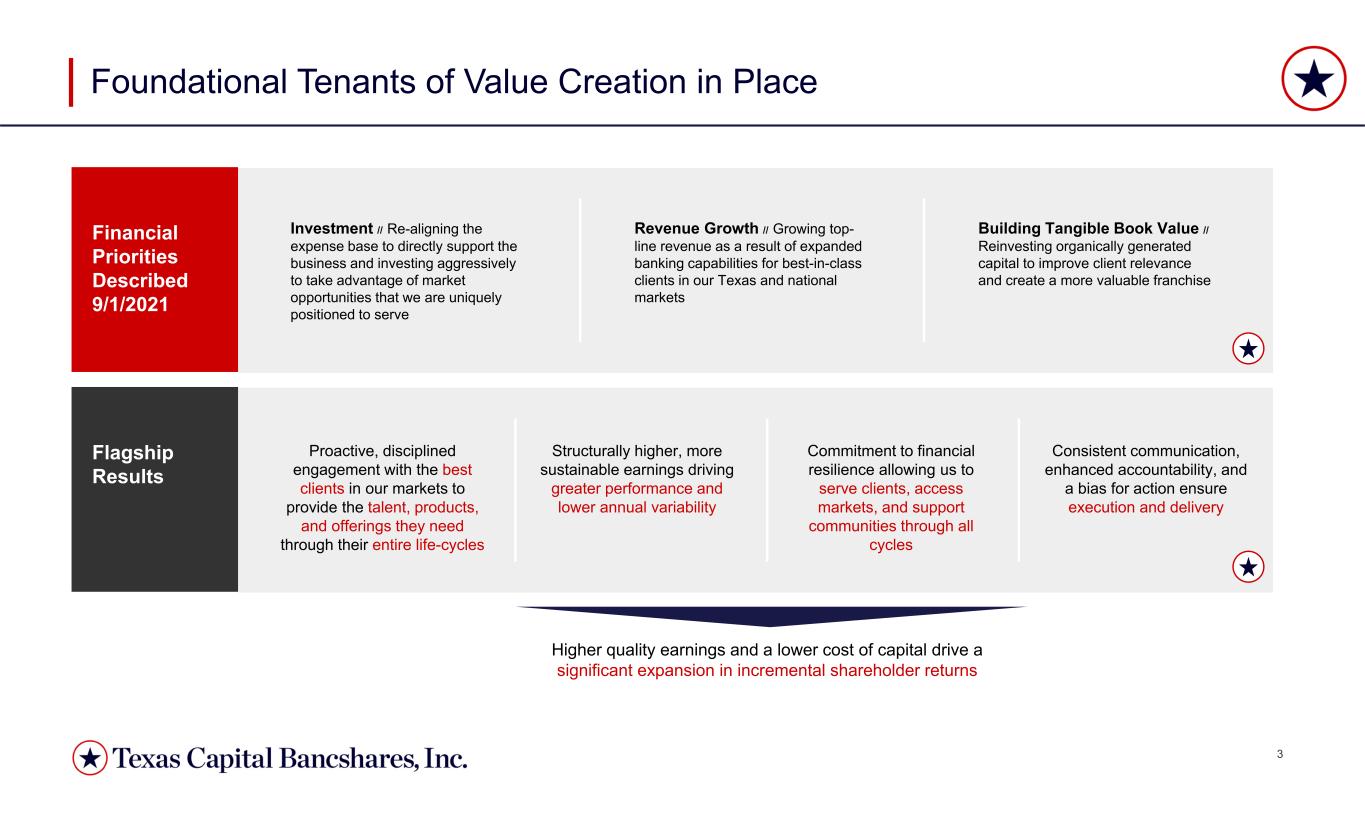
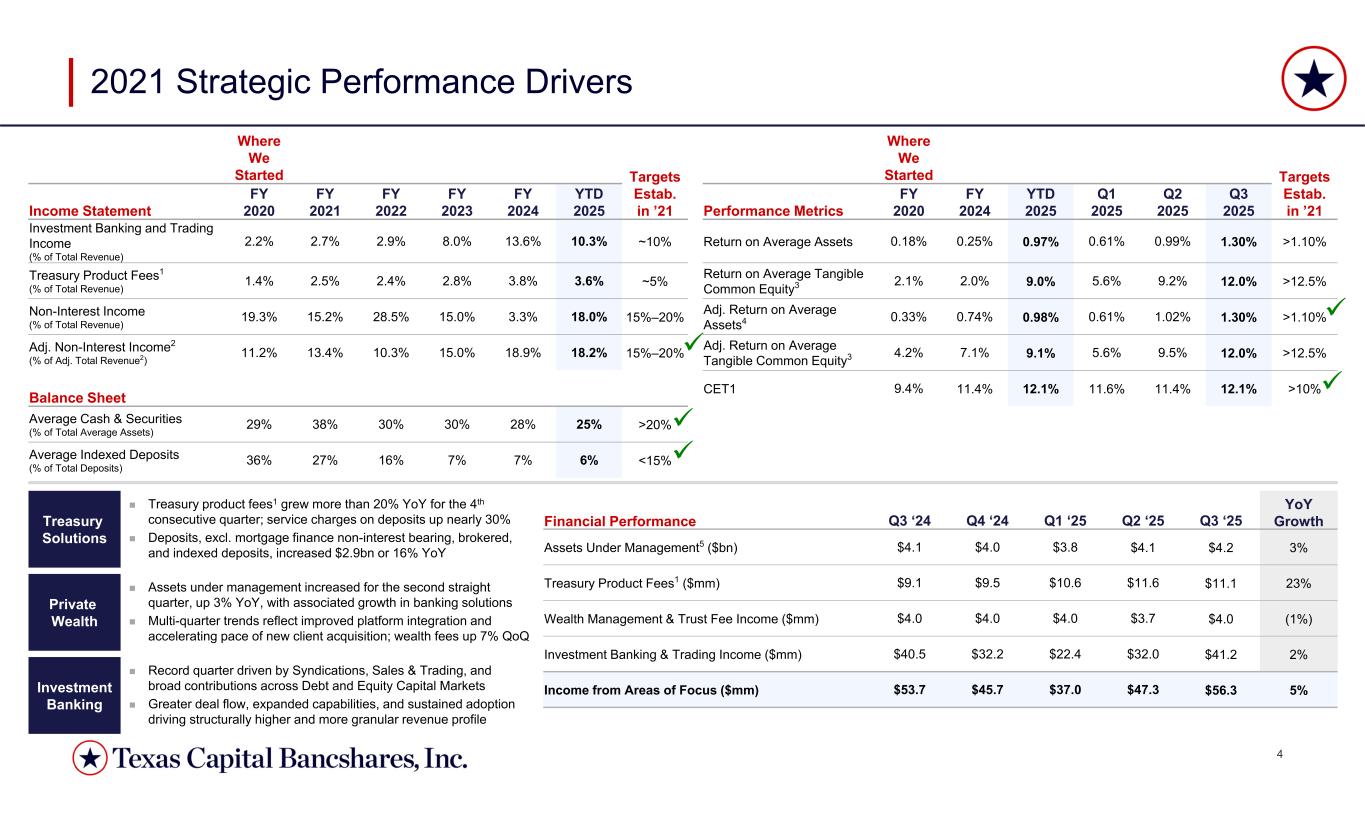
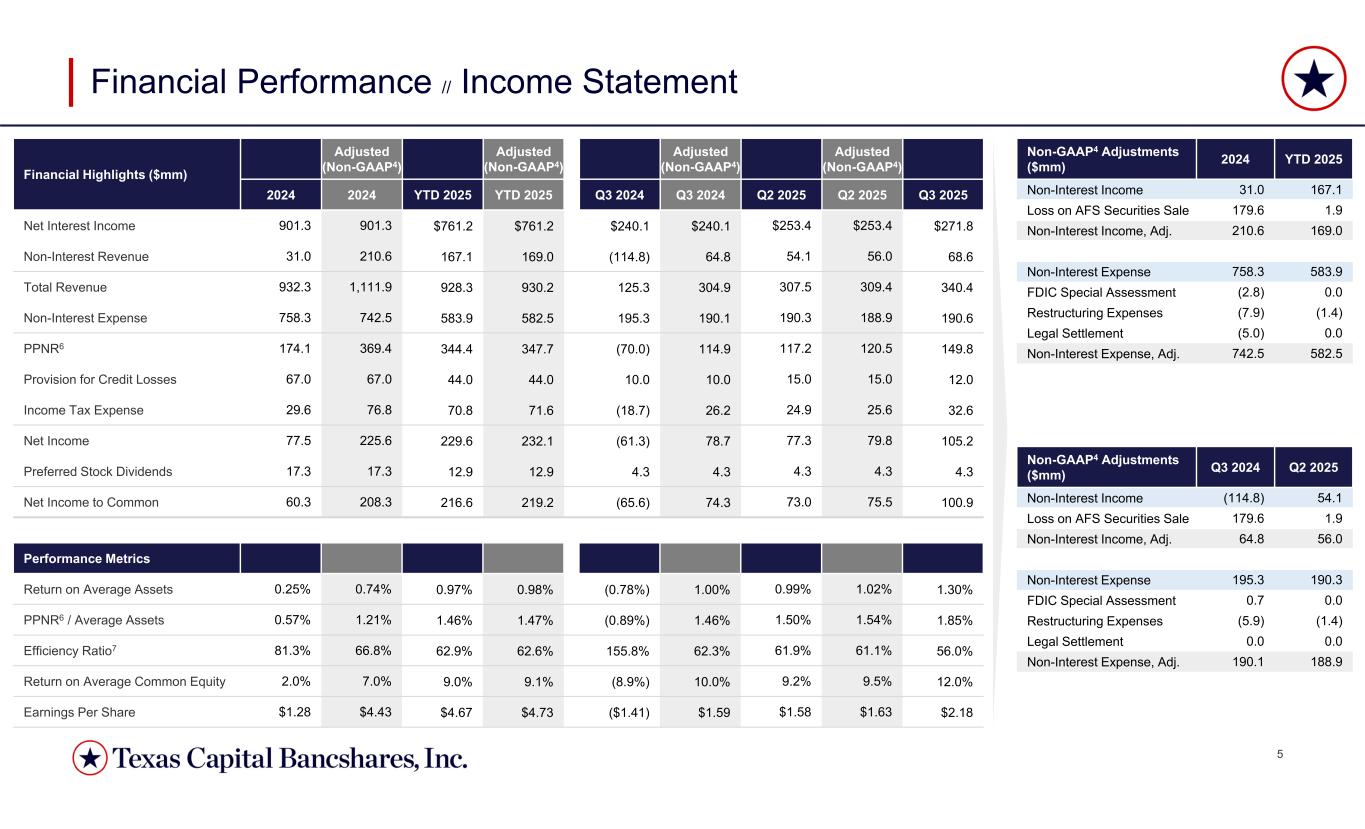
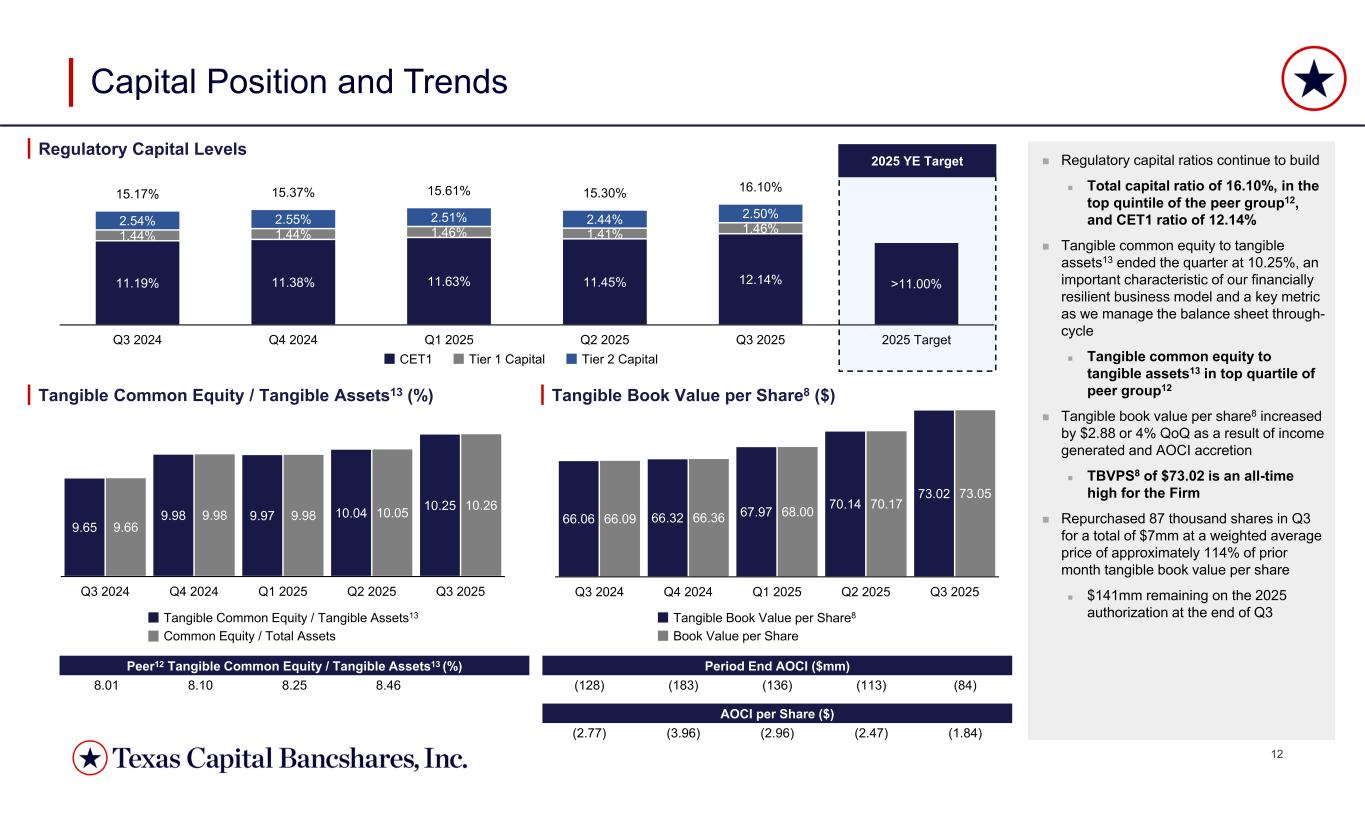
In September of 2021, we announced a detailed and historically ambitious four-year plan to transform Texas Capital into Texas's first full-service financial services firm, worthy of banking the best clients in our markets. We set the time that the magnitude and timeline associated with this wholesale rebuilding of the firm was the result of an immense opportunity to create something of unique and durable value. And that achievement of our vision would be defined by a series of specific and important measures of strategic and financial successes. Despite the many expected and unforeseen challenges, we've been steadfast in our strategic objectives, transparent with necessary improvements to our business model, and unwavering in our commitment to deliver a differentiated offering for our clients and result for our shareholders. Thanks to the resolute work of our team, I am incredibly pleased to report third-quarter results which confirm delivery of the remaining goal described at the beginning of our transformation in September of 2021. Achievement of a 1.3% return on average assets, well above the communicated target of 1.1%. These results mark an important milestone and are a financial acknowledgement of the continued intensity in which we deliver distinctive value to our clients through our wholly differentiated and increasingly scalable platform. When we began this transformation in 2021, we noted specifically the material gaps in our balance sheet and business model that require resolution to facilitate consistently high-quality client outcomes, acceptable risk-adjusted returns, and ultimately enhanced franchise value. A critical early component of earning the right to bank the best clients in our markets was moving away from the legacy approach of relying on leverage to deliver financial performance and instead building a platform characterized by its resilience to market and rate cycles. Since that September 2021 announcement, we've added 247 basis points of tangible common equity, the most of any bank in the country with over $20 billion in assets, and finished the third quarter with tangible common equity to tangible assets of 10.25 percent, an all-time high for the firm. This exceptionally strong capital position, coupled with liquid assets of 24 percent, continues to allow for a consistent and proactive market-facing posture as we are now distinctly capable of supporting the diverse and broad needs of our clients in any operating environment. Prior to our transformation, existing operational silos resulted in limited scalability and disjoined market coverage. After developing well-defined and disciplined organizational routines early in the transformation, the extensive investments made across the franchise to deliver a higher-quality operating model is facilitating the intended results. Our now cohesive platform enabled the entire company to effectively contribute to a third quarter that was the best in the firm's history, featuring record revenue of $340 million, record pre-provision net revenue of $150 million, record net income to common of $101 million, record earnings per share of $2.18, cents, and record tangible book value per share of $73.02. As we also described in 2021, the foundation of our transformation is the deliberate evolution of our Treasury Solutions platform. The firm is no longer overly reliant on disconnected, high-cost, high-beta national deposit verticals. Index deposits now comprise only 6% of average total deposits and are down nearly $10 billion from 2020. This dramatic rebuilding of our funding base is in large part attributable to our best-in-class payments offering, which enables us to successfully compete for, win, and serve as the primary operating relationship for the best clients in our markets. Our firm now provides faster, more seamless client onboarding than the major money center banks and ongoing frictionless client journeys that match or exceed theirs with high touch local service and local decisioning this sustained focus resulted in an industry leading 91 increase in treasury product fees over the past four years the strength of our balance sheet breadth of our product offerings and quality of our talent now ensure our clients never outgrow the services we can provide for them. Historically, our relatively low client relevance was in part a result of a narrow product offering, leading to over-dependence on loan growth to drive earnings. We now approach the market based on our clients' needs, not our own, with tailored offerings for each stage of their life cycles and double the number of client-facing professionals providing advice, not just capital. This cultural and structural shift is driving material success with targeted clients and prospects of all sizes. The firm is now a top five Texas-based originator of SBA loans, evidencing our commitment and ability to effectively serve small businesses. We now have industry-specific coverage aligned with businesses that comprise 100% of the addressable Texas economy. And we built the first full-service investment bank in the state, achieving one of the most successful launches in history. This unique and sustainable competitive positioning results in over 90% of the new clients choosing Texas Capital for additional products and services alongside traditional bank debt, signaling our increasing relevance and supporting the largest organic non-interest income growth rate of any bank of the country with more than $20 billion in assets over the last four years. Strong execution across each area we noted for improvement is supported by a highly disciplined and analytically rigorous capital allocation process focused solely on driving long-term shareholder value. We have and continue to bias capital towards franchise and creative client segments, evidenced by our commercial loan growth when excluding PPP loans and the divestiture of the premium finance sub of $5.3 billion, or nearly 80% since 2020. And in times of market dislocation, we repurchased 12% of shares outstanding at a weighted average price of $59 per share. Taken together, we accomplished the most successful bank transformation in the last 20 years and are increasingly the first call for the premier clients at each of the markets we serve. Intentional decisions along the journey have positioned us to deliver attractive, through-cycle, shareholder returns with both higher quality earnings and a lower cost of capital as we continue to scale high-value businesses through increased client adoption, improved client journeys, and realized operational efficiencies. All timeless objectives we intend to remain focused on and consistent with creating lasting value. None of this would be possible without the incredible commitment, creativity, and professionalism demonstrated by the Texas Capitol employees. Your belief in a long-term vision of the firm, perseverance in the face of, at times, intense skepticism, and continued dedication to driving positive outcomes for our clients is the leading force behind the transformation. It is truly remarkable to see the talent on this platform and the culture we are defining with our actions every day. I look forward to continuing to partner with each of you as we never stop working to build something special for our clients who deserve nothing less. Thank you for your continued interest in and support of our firm. I'll turn it over to Matt for details on the financial results.
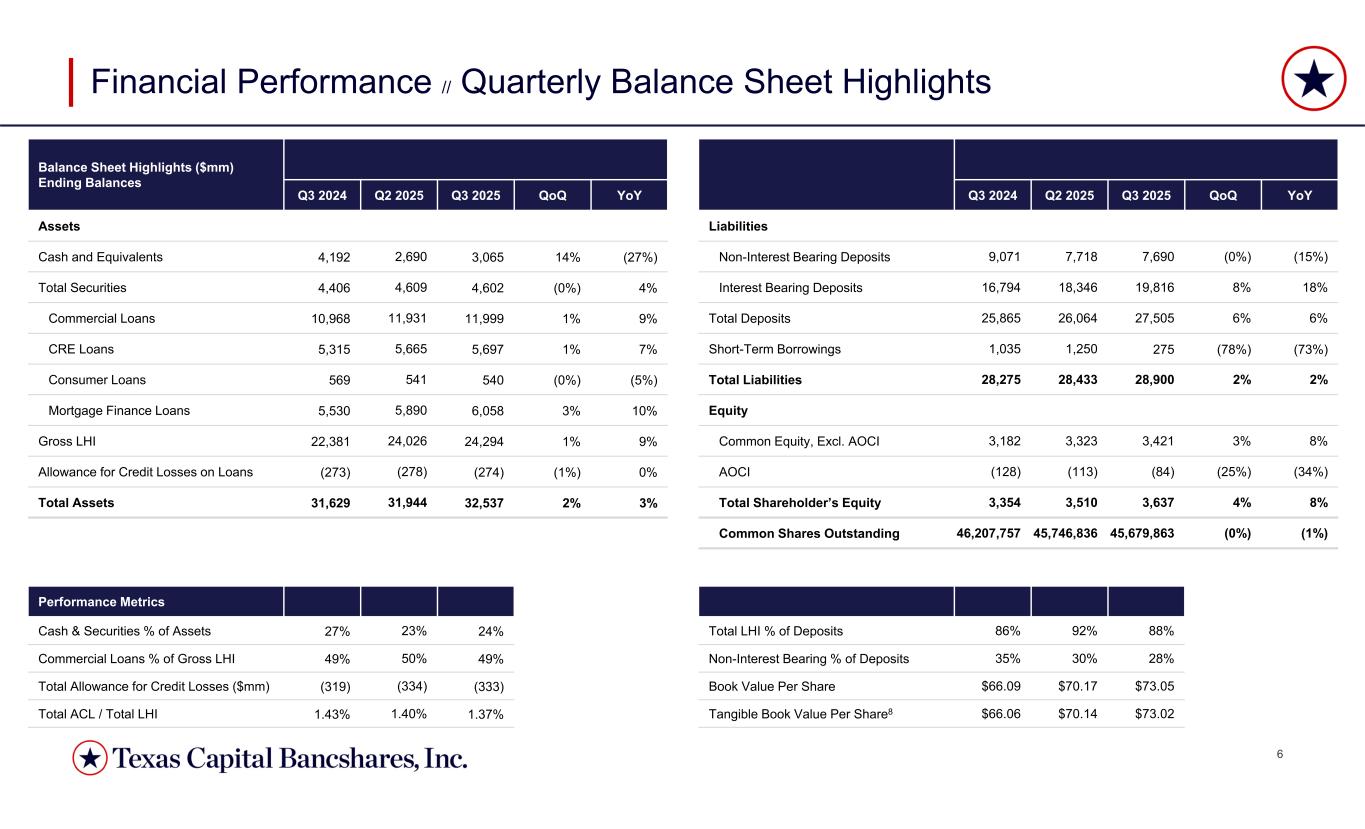
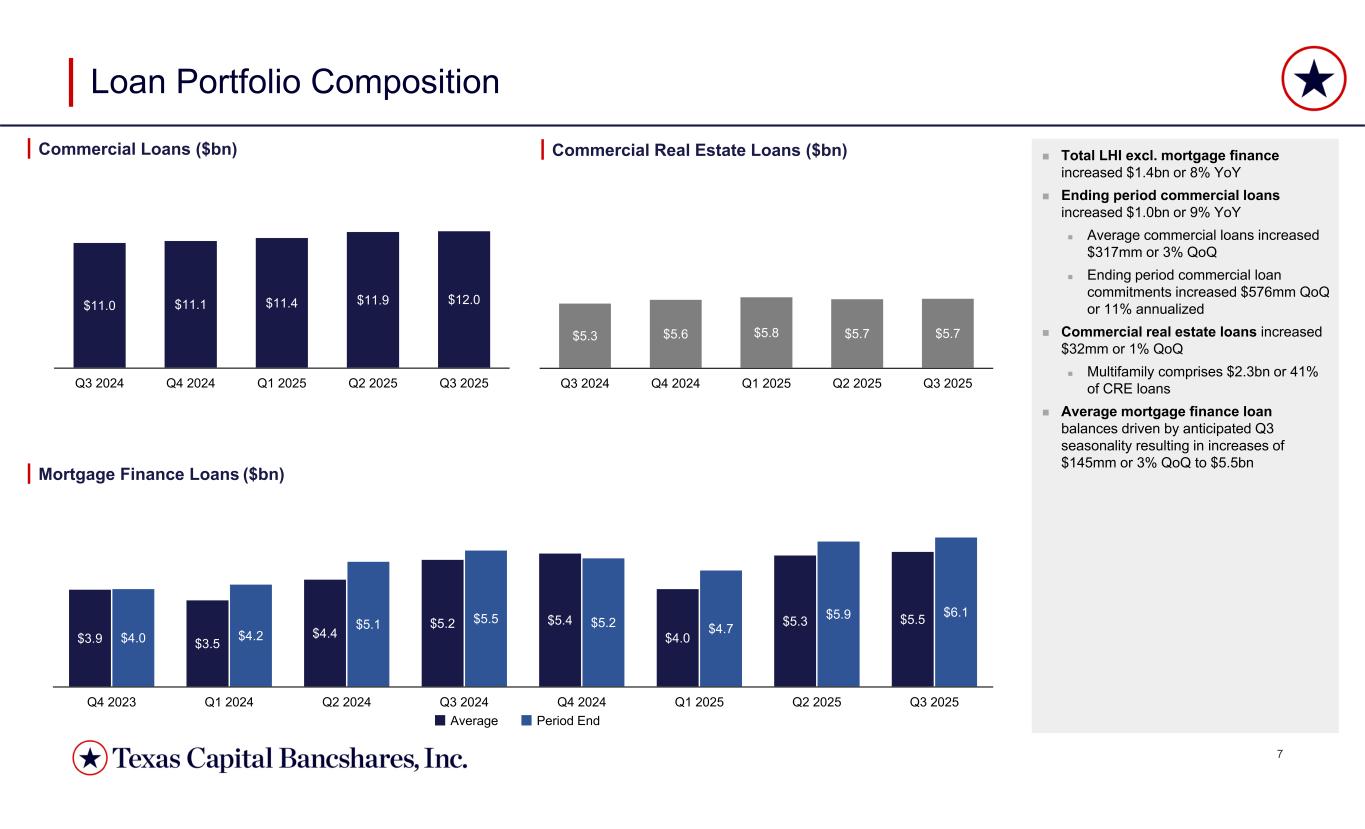
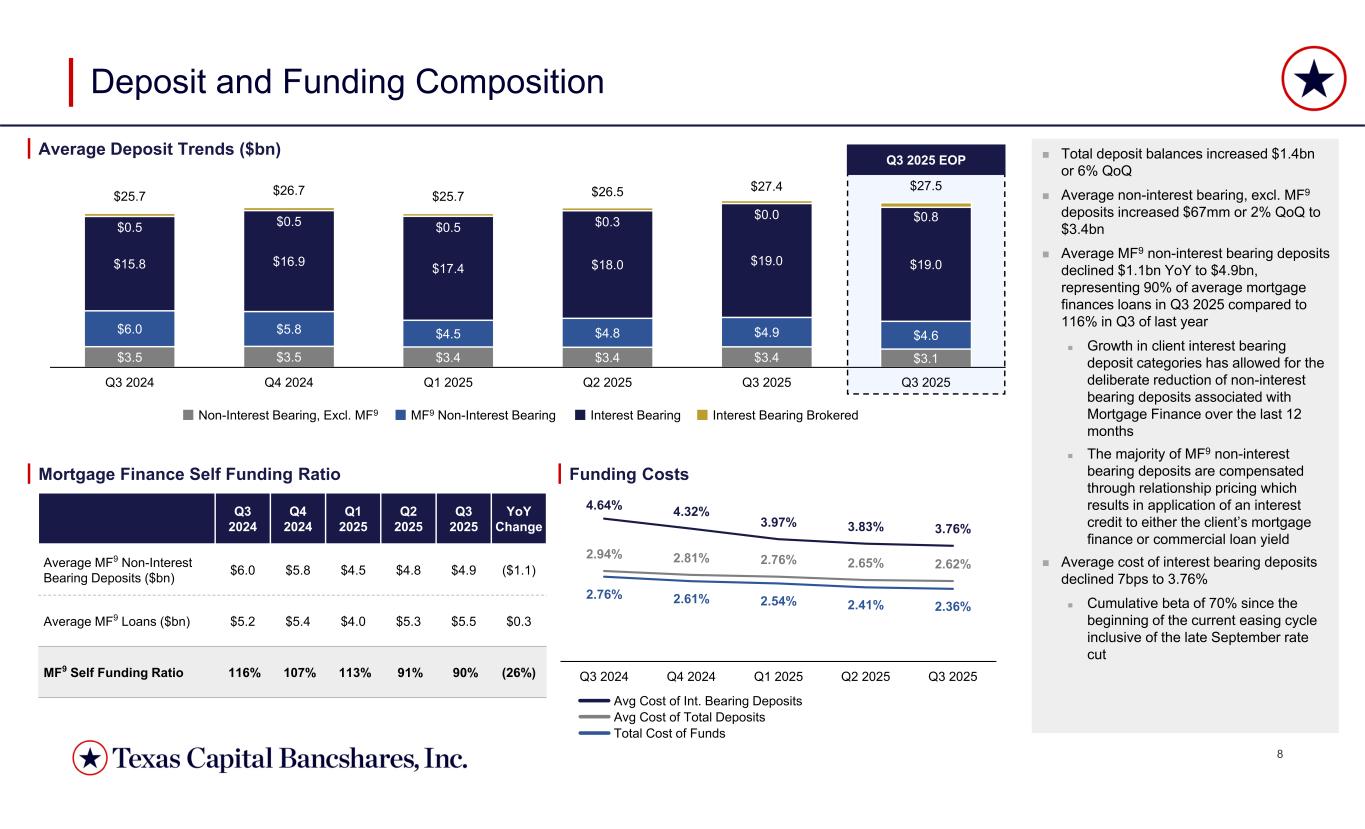
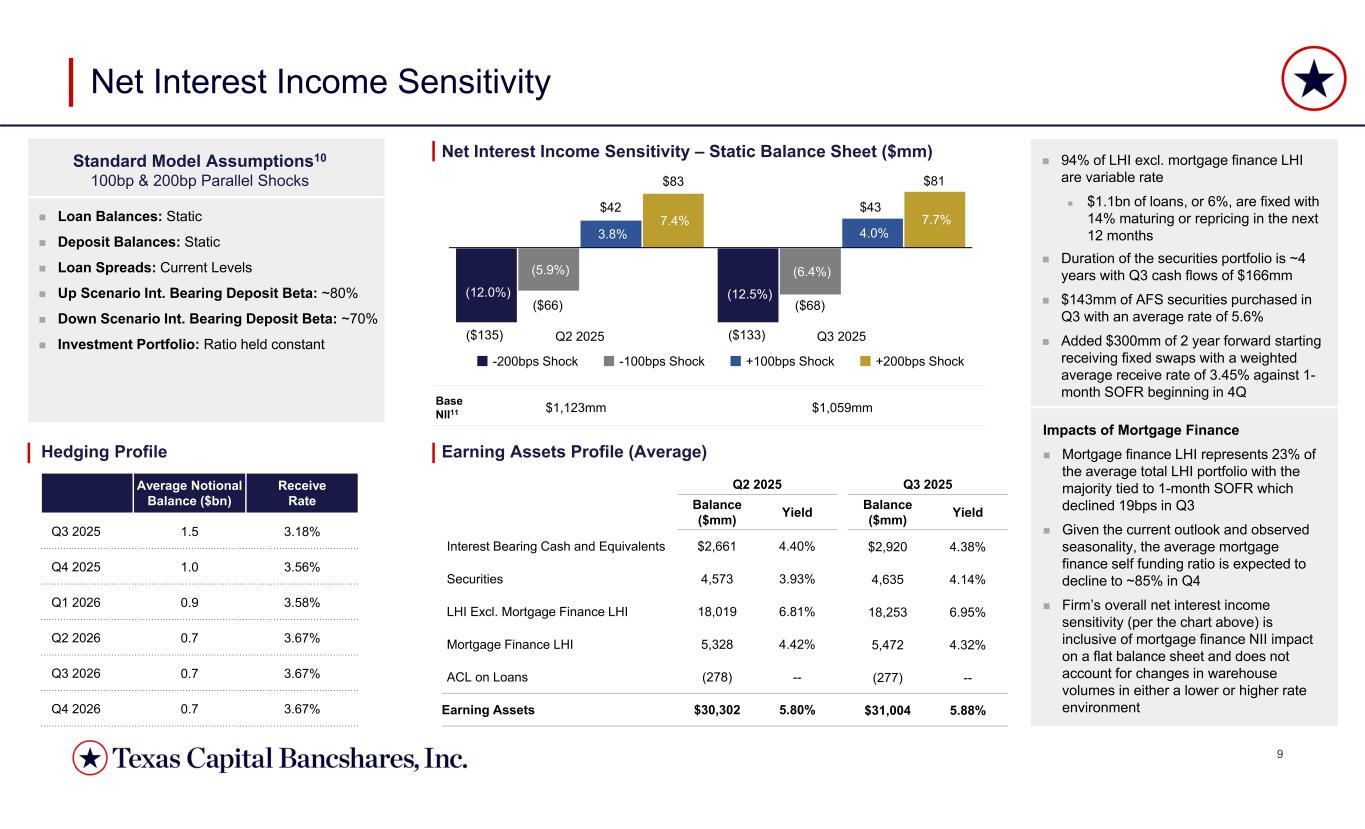
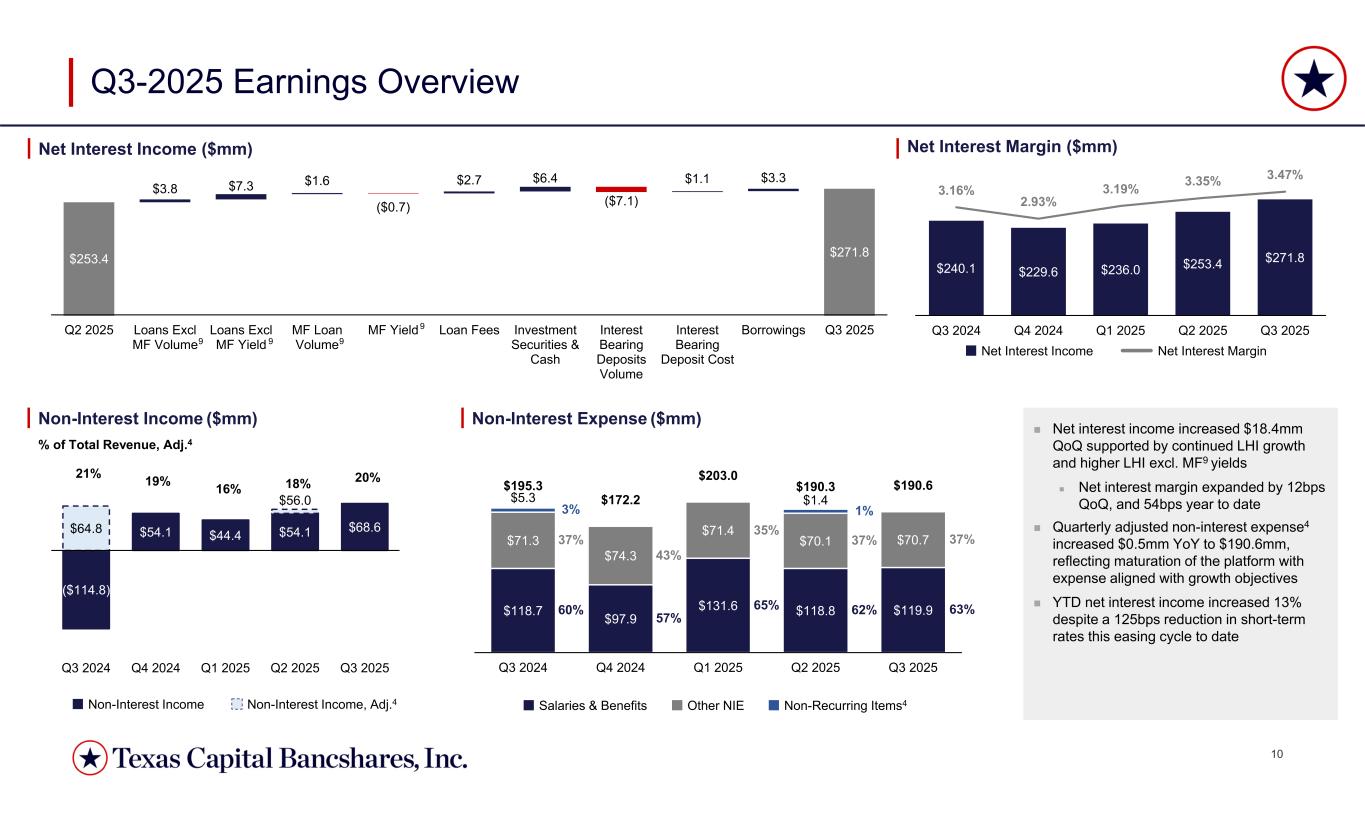
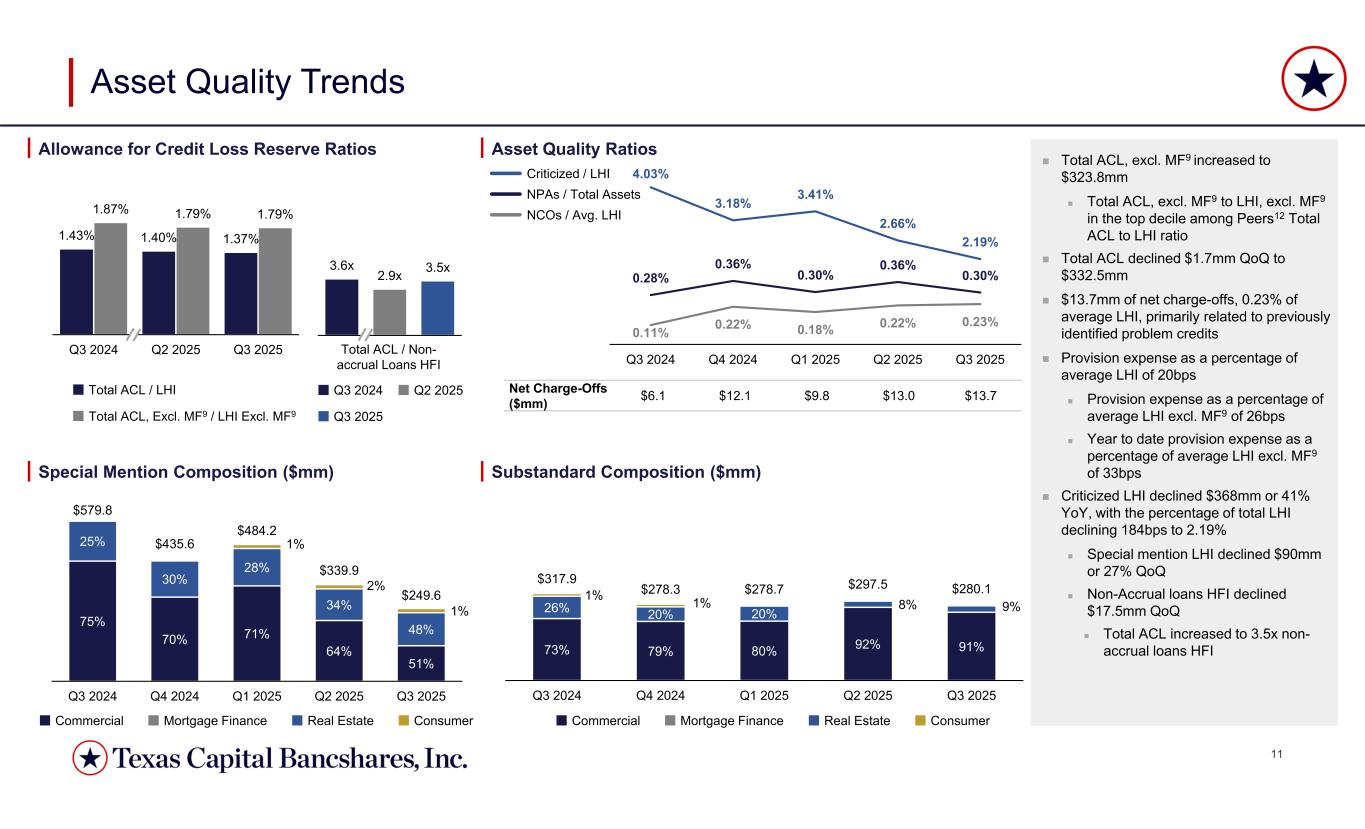
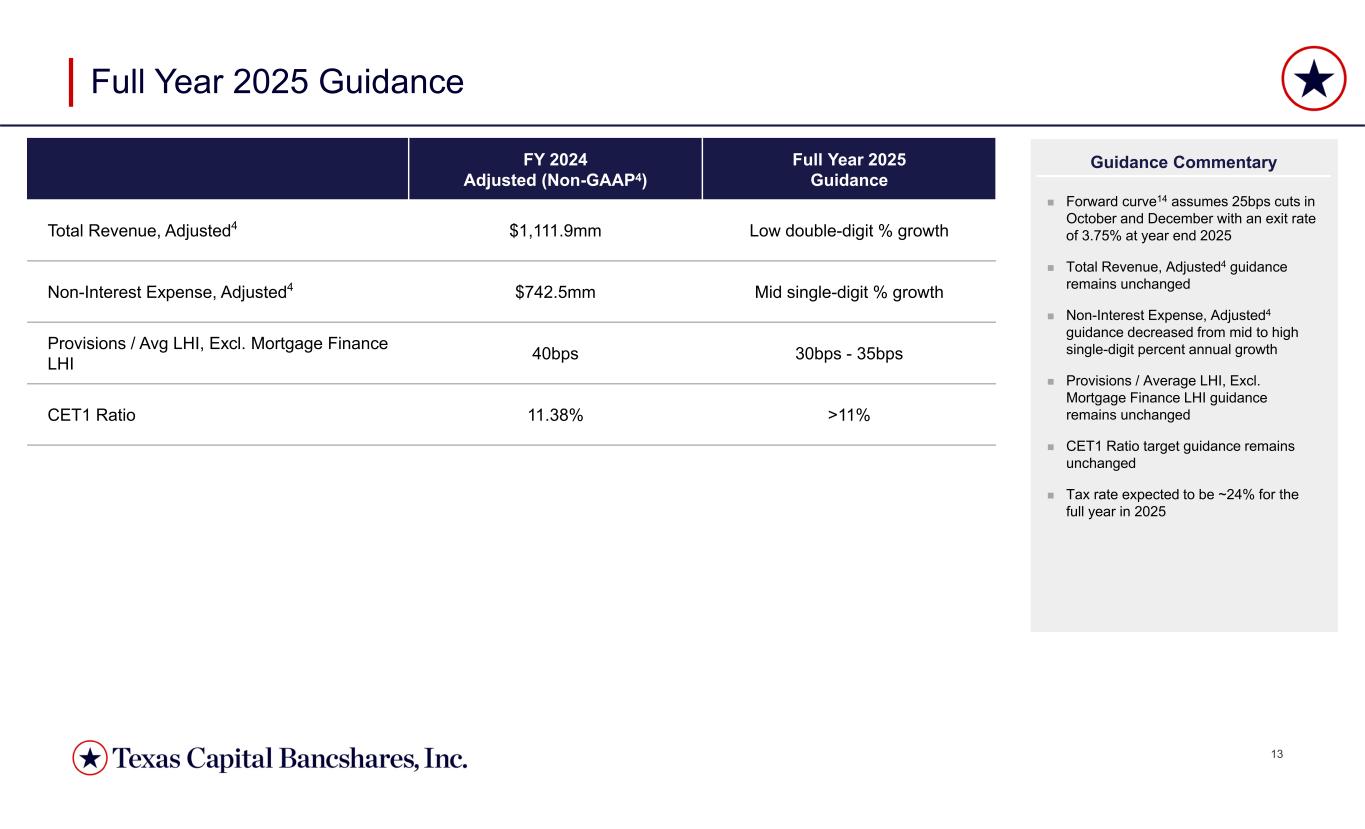
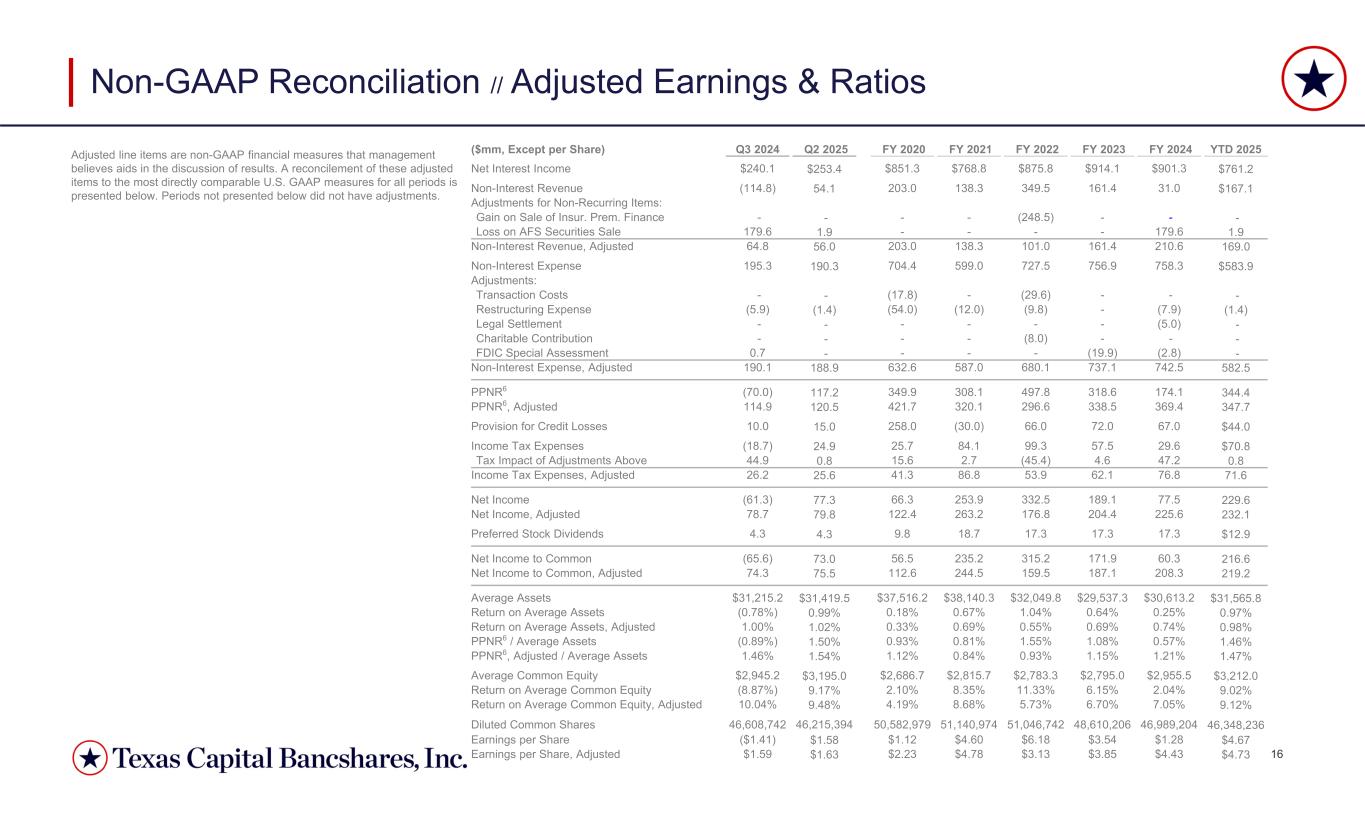
Thanks, Rob. Good afternoon. Third quarter total revenue increased $35.4 million, or 12%, relative to Q3 adjusted total revenue last year, supported by 13% growth in net interest income and 6% growth in fee-based revenue. Lean quarter adjusted total revenue increased 10%, or $31 million, as continued balance sheet momentum resulted in an $18.4 million increase in net interest income. Broad contributions across investment banking drove a $12.6 million improvement in adjusted non-interest revenue. Total non-interest expense increased just $1.7 million compared to adjusted non-interest expense in Q2. As previously realized, structural efficiencies continue to enable repositioning of the expense base in support of defined capability build. Taken together, year-over-year adjusted pre-provision net revenue increased 30% or $34.9 million to $149.8 million, an all-time record for the firm. This quarter's provision expense of $12 million resulted from modest growth in gross LHI, $13.7 million of net charge-offs, and our continued view of the uncertain economic environment, which remains decidedly more conservative than consensus expectations, partially offset by the notable multi-quarter improvement in portfolio credit quality. The firm's allowance for credit loss finished the quarter at $333 million, or 1.79% of LHI, when excluding the impact of mortgage finance allowance and related loan balances, which is the highest level relative to criticized loans since 2014. As Rob noted, our record quarterly net income to common of $100.9 million represents a 36% increase compared to adjusted net income to common in Q3 of last year. This continued financial progress coupled with a consistently disciplined multi-year share repurchase approach contributed to a 37% increase in quarterly earnings per share compared to adjusted earnings per share from a year ago. The firm continues to operate from a position of financial strength, with balance sheet metrics remaining exceptionally strong. Focused routines on target client acquisition are delivering risk appropriate and return accretive loan portfolio expansion, with ending period growth LHI balances excluding mortgage finance growing approximately $100 million during the quarter, and total commitments excluding mortgage finance up $577 million, or 8.2% annualized. Average commercial loan balances increased 3% or $317 million during the quarter, featuring broad contributions across areas of industry and geographic coverage, with ending period balances up approximately $1 billion or 9% year-over-year. As expected, real estate loans were flat quarter-over-quarter, including payoffs and paydowns of criticized assets. Despite a modest increase in real estate clients' new business volume, our expectation remains that payoffs will outpace originations over the duration of the year, resulting in lower fourth quarter ending balances. As anticipated, average mortgage finance loans increased 3% linked quarter to $5.5 billion as seasonal home buying activity hits its annual high during the third quarter, with ending period balances of $6.1 billion reflecting initial pull-through from the late quarter reduction in mortgage rates. We continue to expect full-year average balances to increase approximately 10%, which is predicated on a $1.9 trillion origination market. As noted on previous calls, sustained success winning high-quality deposit relationships continues to allow for the select reduction of higher-cost deposits where we are unable to earn an adequate return on the aggregate relationship. These trends are evidenced in part by our sustained ability to effectively grow client interest-bearing deposits, which when excluding multi-year contraction index deposits, are up $3.3 billion, or 22% year-over-year, while also effectively managing deposit betas, which are 70% cycle-to-date accounting for the late September rate cut. This impact is also observed in the structural reduction in the ratio of average mortgage finance deposits to average mortgage finance loans, which we made at 90% this quarter, down significantly from 116% in Q3 of last year, the result of which continues to positively affect margin while also improving liquidity value. We expect this ratio to decline to roughly 85% during the fourth quarter as loan volumes come off their seasonal peak and deposit balances predictably decline with remittance of property tax and insurance payments. Our modeled earnings at risk were relatively flat quarter over quarter, with current and prospective balance sheet positioning continuing to reflect a business model that is intentionally more resilient to changes in market rates. This is most readily depicted by our 13% increase in year-to-date net interest income, 12% increase in year-to-date adjusted total revenue, and 31 basis point increase in quarterly net interest margin, despite short-term rates being approximately 100 basis points lower over the first nine months of this year. We continue to effectively manage duration against this backdrop. as previously executed swaps that have matured over the last few quarters were only partially replaced with both additional securities and new forward-starting received fixed swaps. During the third quarter, approximately $1.5 billion in swaps matured at roughly 2.95% receive rate, while another $250 matured on October 1st at 3.25%. Based on purchases made earlier in the year through early October, a series of received fixed SOFR swaps have recently or will become active. $200 million became active on August 1st at a blended receive rate of 3.94%. $100 million became effective September 1st at a rate of 3.76%. $200 million became effective October 1st at a blended rate of 3.58%. $100 million becomes effective on November 1st at 3.55%. And another $100 million becomes effective December 1st at a receive rate of 3.32%. We do still anticipate future interest rate derivative or securities actions over the remainder of the year. as we look to augment potential rates fall earnings generation at materially better terms than available during our deliberate pause through the mid part of last year. Net interest margin expanded 12 basis points this quarter to 3.47%, supported by increased loan yields, growth in loans, and previously noted improvements in deposit pricing. The total allowance for credit loss, including off-balance sheet reserves of $333 million, remains near our all-time high, which when excluding the impact of mortgage finance allowance and related loan balances was flat link quarter at 1.79% of total LHI and the top decile among the peer group. Ending period reserves as a multiple of non-accrual loans increased to 3.5 times, benefiting from steady allowance levels and a $17.5 million reduction in previously identified problem credits. Positive grade migration trends continued across the portfolio, with total criticized loans down $108 million, or 17%, late quarter, and $368 million, or 41%, year-over-year. Criticized loans to total LHI finished the quarter at 2.19%, the lowest level since 2022, with watchlist loans also declining to multi-year lows. Despite continued notable portfolio improvements, we remain focused on proactively assessing the credit impact of a wide range of macroeconomic and portfolio-specific scenarios. Intended is regular assessment of loans to non-depository financial institutions, which 80% are loans to mortgage credit intermediaries within our well-described and long-held mortgage finance business. This is in part characterized by short dwell times, robust monitoring, and direct collateral access. The remaining portion, which equates to 8% of our total September 30th loan balances, is comprised of high-quality asset managers or finance companies covered within our designated industry verticals, with which we often have direct operating relationships supported by multiple product touchpoints, heavily structured credit agreements, and utilization of in-house field examiners when applicable. As of September 30th, 99.7% of these credits were rated in our past category, with only $23 million in special mention. Consistent with prior quarters, capital levels remain at or near the top of the industry. Total regulatory capital remains exceptionally strong relative to both the peer group and our internally assessed risk profile. CET1 finished the quarter at 12.14%, a 69 basis point increase from prior quarter, with strong capital generation again augmented by a reduction in risk weightings associated with enhanced credit structures in the mortgage finance portfolio. By quarter end, approximately 54% of the mortgage finance loan portfolio had migrated to the enhanced credit structures, bringing the blended risk weighting to 62%. Our continued client dialogue suggests that another 10% to 15% of funded mortgage loan balances could migrate into the structure over the next two quarters, further improving both our credit positioning and return on allocated capital. Turning to our full-year 2025 outlook, we're reaffirming our revenue guidance of low double-digit percent growth, reflecting confidence in the durability of our diversified earnings platform and ability to drive consistent client engagement across a range of market conditions. Importantly, our guidance is unchanged despite now including two 25 basis point rate cuts over the remainder of the year, one in October and one in December, with the forward curve assuming an exit rate of 3.75% at year end. Given continued success effectively matching our expense base with stated firm-wide priorities, we are decreasing our non-interest expense outlook to mid-single-digit percent growth from mid to high single percent growth previously communicated. This reduction is driven by sustained realization of structural efficiencies, partially offset by continued platform build-out, including modest growth in non-s salaries and benefits-related expense associated with putting new capabilities into the market. The full-year provision outlook remains 30 to 35 basis points of loan help for investment excluding mortgage finance, which should enable the preservation of industry-leading coverage ratios while effectively supporting our client's growth needs. Taken together, this outlook suggests continued earnings momentum on the back of what was clearly a historic quarter for our firm. Operator, we'd now like to open up a call for questions. Thank you.
Operator
If you would like to ask a question, please press star followed by one on your telephone keypad. If for any reason you would like to remove that question, please press star followed by two. Again, to ask a question, press star one.
Operator
As a reminder, if you're using a speakerphone, please remember to pick up your handset before asking your question we will pause here briefly as questions are registered first questions from the line of michael rose with raymond james good afternoon everyone thanks for uh taking my questions um just trying to start with uh if i could take anything apart in this quarter um it seems like maybe the the longest we went through quarter the period and was a little bit lower on the health for investment side than the average I just wanted to see if there were any paydowns because it does look like you guys had pretty nice growth and commitments. I think they were up 11% or so Q&Q. So I know you guys don't like to talk about long growth per se, but it would take maybe something a little bit better to think about at least the fourth quarter. So we'd just love to hear kind of the puts and takes and any sort of forward outlook you might have.
Yeah, you bet, Michael. Well, you broke up a little bit, so if you have a follow-on, feel free to go ahead and ask. I think at this point, our track record suggests we are uniquely differentiated for our clients. And our focus is squarely on providing the right solution for them, not on where it ultimately shows up in our future. So with that backdrop, we were highly active this quarter in terms of capital distribution with really strong client acquisition trends across the entirety of the platform. So as you noted, for those clients that are best served in the bank markets, we continue to be an industry leader. The C&I commitments this quarter increased by $576 million, or 11% annualized, up 12.6%, $2.4 billion year-over-year. According to middle market league tables, Q3 rearranged access to more syndicated bank debt than anyone in the country other than J.T. Morgan. So we noted in the prepared remarks that full-year client growth continues to be broad-based across corporate, middle market, and business banking. We spent really the last four years trying to ensure we have a platform and solution set that's tailored for each stage of our client's life cycle. For clients whose capital needs were best met outside of the bank markets, we delivered highly successful debt capital markets transactions in high yield, term loan B, and private credit this quarter, with, importantly, an increased volume of repeat clients, which supports a more granular, repeatable, and we certainly think higher quality fee base. And then finally, after clearing the first trade on the last day of the last quarter, equity capital markets business participated in a series of IPOs this quarter, which provides yet another capability for clients looking to access capital. So as we think about our ability to support clients, when you combine record high capital levels for the firm, which in most cases is industry leading, and then improve capabilities across the firm, that should drive really strong revenue growth in terms of related with finding capital for our clients, whether our balance sheet's the best spot for it or not.
Operator
I really appreciate the caller. That's really helpful, Matt. Maybe just as my follow-up, just as we do think about that investment banking and trading line item, obviously really good results. I know you guys have kind of talked about, you know, $50 million a quarter run rate at some point. Can you just update, you know, maybe some expectations there? And then would you expect any near-term headwinds maybe from the government shutdown?
Yeah, I'll talk about the outlook, Michael, and that Raphael had talked about the investment banking business in general. So obviously the Q3 feeds were on the high end of the guide, which resulted from the fourth consecutive quarter for us in TS reporting a year-over-year growth in excess of 20%. We did have a record investment banking quarter that, despite some meaningfully-sized transactions, it was really characterized by the volume of client interactions, the breadth of the capabilities that they chose to utilize, and then, as I mentioned, the increased granularity and repeatability of those fees. We're narrowing the full-year fee income guide to $230 to $235 million with expectations for fourth quarter non-interest income of $60 to $65 on the back of $35 to $40 again in the investment banking business.
I don't really have anything to add, Matt, other than it is a much healthier earnings in the investment bank. As Matt mentioned, it's much broader in terms of product and clients. It's much more granular, and it's much more repeatable. And now the whole platform is working in unison, debt, equity, M&A, sales, trading, rates, FX, all of it. And most clients use more than one of those products at a time. So we're really, really encouraged about the business, really happy with the team we have on the platform. And I think they've proved it to be a highly valuable client accretive practice. I mean, I don't know of a de novo investment bank that's grown as fast as we have, become profitable as quickly as we did across the entirety of the platform. So, from sales and trading, doing close to $300 billion of notional trades to date, it may have crossed it today, as a matter of fact. We'll see. So, we're really excited about the quality of our needs.
Operator
I appreciate all the comments, guys. I'll step back.
Operator
Thank you for your question. Next question is from the line of Woody Lay with KBW.
Hey, thanks for taking my questions.
Wanted to start on NII. I appreciate the comment about how, you know, despite 125 basis point reduction in short-term rate, you were able to increase NII 13% year-to-date. So, in light of the September cut and kind of expected additional cuts from here. How do you think about your ability to continue to grow NII with that backdrop?
Yeah, the other stats that we quoted related to that year-to-date performance, whether we're revenue and PPNR up 12% in third-point reduction in short-term rates. So, I think for us, that experience suggests it's really less about the absolute level of rates, and it's more about the timing. So, as you know, it does take us a quarter or two for the balance sheet to fully reprice after a series of cuts with implied forwards and therefore our guidance suggesting that's going to occur again in October and December. So against that backdrop, we think about 4Q net interest income as $255 to $260 with net interest margin around 3.3%. As you know, our variable loan portfolio will absorb those changes in rates before we can effectively reprice the deposits. We continue to really please at the ability to increasingly compete in the deposit and deposit space based on the value that we add and not just price. So we noted in the prepared remarks that cycle-to-date beta 70 percent included those September cuts which after repricing the deposit base over the last few weeks should get current levels back to about that 80 percent interest-bearing deposit beta that we experienced through Q2. Also consistent with previous quarters the guide contemplates only 60 percent interest-bearing deposit beta across the next two cuts, which reflects at least our expectation for increased liquidity costs as folks look to more aggressively extend credit, and then sustained composition of average commercial non-interest sparing at about 13% of total deposits.
I would just add that we were before highly commoditized as a bank, and now people bank with us for a lot more reasons than price of liabilities or capital, which allows us to demand more. And I think it's a direct reflection in the quality of product, service, and advice that we deliver to our clients.
Got it. That's a helpful color. And next, I wanted to move to credit. Dating back to 2021, it's been a remarkable transformation. It's easy for us to see from an earning standpoint, a capital standpoint, because we can see the numbers. But I know that there's been a credit transformation as well. And it seems like Sometimes the market unfairly punishes you based on, you know, some of the legacy that predates y'all's leadership. So I'd love to just hear about the credit transformation dating back to 2021.
Thanks. We'll kind of take it, then you take the specifics. Look, I think this quarter criticized loans down $368 million or 41% that Matt discussed is on par with strategy, right? we're really, really aggressive when it comes to client solutioning, and we're very, very conservative as it relates to risk. Whether it's credit risk, operating risk, market risk, whatever risk you want to contemplate, we think client selection is the number one mitigant, and I think that client selection, if you're banking the right clients, they do the right things even when there's a problem. And most of the time, more often than not, versus adverse client selection, you're not having those problems. And I think that really manifested itself here recently with a lot of banks being caught without collateral or without the proper underwriting and diligence by their teams. And as you know, that did not happen here. So I'm really pleased with the intensity of the risk platform, how they proactively manage the loan book, but also our bankers. Our bankers are very focused on client selection as their ways to risk just as much as they are on Treasury or other parts of the platform. So I think it's foundational to what we've built and goes along with being well capitalized.
Yeah, the only thing I would depicting portfolio health and coverage today are certainly as strong as they've been since we started the transformation, but in a lot of cases, as strong as they've been in over a decade. Roth generally demands constant monitoring for folio or scenario. We today really see no systemic or industry-specific themes in the credit book. Most of...
All right, well, thanks for all the color and I'll hop back in the queue. Thanks, Woody.
Operator
Thank you for your question. Next question is from the line of Matt Olney with Stevens. Your line is open.
Hey, thanks for taking the question, guys. First off, great to see all the green check marks on slide four, great execution. As far as capital, I think the presentation notes that the risk rate assets at the bank now in the top quintile of the peer group and that TC ratio in the top quartile. I think from our side, we're trying to weigh if this capital could be a deployment opportunity in the next few years for you, or do you feel like having this excess capital gives you a competitive advantage as you add new customers, which could suggest you want to continue to maintain these capital ratios, you know, close to current levels.
Thanks, Matt. You know, I appreciate the question. I think it's more than fair. And if I repeat myself from previous calls, forgive me. But as you know, we have a very disciplined capital menu that we follow literally every day. And the first is invest in organic growth with new clients. And there's an abundance of demand in the new organic growth with new and deepening clients. Then there's investing in the platform, products and services. I would argue we've built the most broad relevant product platform in banking in the last 10 years with all of our capabilities. We've done a pretty good job with that, getting a return. Then you move on to not in the conventional capital menu, but I look at bond repositioning and loan portfolio acquisition that we did the third quarter of last year. And then we move to distribution policy. We're not going to do a dividend, but we bought back 12% of the company at an average price of $59 per share below book value, all below book value. And then you get to M&A, which is we sold a company for three and a half billion dollars, which really was the foundational component that made this turnaround possible. So I think, and by the way, we did that before other banks tried and failed. So I think we've proved to be really good stewards of capital, including the expense capital. We took out $270 million of NIE and put that back plus more in rebuilding the platform that's achieving these returns. So the last thing on that capital menu would be whole bank M&A. And until you get to profitability, that was read on the menu. We look at it. We study it. We focus on it. We're ready for it. But it was read on the capital menu. Now maybe it's yellow because we have the earnings, but we need the currency. We're super focused on tangible book value per share. That's paramount to us. That's gone up 40% since the beginning of the transformation. I think the average bank's 30% or 31%. So while doing a transformation, we outperformed, and I would just hope that we get the benefit of the doubt that we can outperform going forward, and we'll be good stewards and be highly sensitive to red, yellow, and change of book value.
Okay. Thanks for the commentary.
But Matt, let me add one quick thing because you mentioned it. It is absolutely a benefit go-to-market with clients. You cannot deny it. I have the CEO of one of the fastest growing companies, a specific industry here today at lunch with me. and we talked about that and they do we were on the cover of their debt deal they do treasury with us they do their corporate card with us and um and we talked about how well capitalized we were and how comfortable they were with us because of that so it is undoubtedly a competitive position in the market okay got it thanks thanks for the commentary and then i guess just following up on that some of your commentary rob on on the m&a front as you think about kind of what's uh what
you're building and then what you prefer to build organically versus acquire, are there certain businesses that kind of lend itself more towards M&A, for example, depository versus investment banking or wealth management? I guess, what would the M&A focus be if and when that comes to pass?
I think you should assume that we look at everything out of discipline, fintech, depository, well, you name it. We also recognize that our best return would be realizing the revenue and cost synergies of the transformation. I mean, we have so many costs that we don't have to add to to realize revenues and earnings and return already embedded in the platform. Matt just talked about our new equities business. You know, we don't have a return on that yet. Our new corporate card, 16th largest transaction volume card in the country, and we don't have a return on that yet. But they're awesome. I mean, they're doing so well, and we fully expect to get a super return in the near term. So we have a lot of revenue and expense synergies that we can realize lives without doing M&A.
Operator
Thank you, guys.
Operator
Thank you for your question. Next question is from the line of Brett Rabbitohm with Hope of D Group. Your line's now open.
Hey, good afternoon. Thanks for taking my question. I wanted to ask about the expense guide. You know, you obviously trimmed it a little bit for the full year and obviously for 4Q relative to maybe prior expectations, but it does suggest kind of mid-single digit, does suggest a little growth in the fourth quarter. can you maybe talk about the fourth quarter in terms of expenses and then just as you guys think about it the build I know you're really efficient at this point but the build that might happen in 26 with additional initiatives thanks let me take that Brett we do expect non-interest expense about 195 million if it's moving to the low 120s and then other non-interest expense drifts above 70
million due to higher occupancy, marketing costs, and ways into market. That puts you at about 778 million for the full year, which is right on top of the now revised lower expense. It's probably too early to talk about expectations for 2026, but to Rob's commentary of effectively positioning the expense case against the most productive sources directly aligned with the strategic.
Okay, that's helpful. And then the other question I had was, you know, just given the solid improvement and criticized assets um i thought it was interesting rob you kind of sounded like during your prepared comments that maybe you're a little more cautious or conservative relative to the macro environment expectations you know any any color on that and what what that might mean and how you're thinking about to go forward no i i think that that's if you ask anybody that works here or knows me, I am highly paranoid.
And so we are always looking at downside scenarios, doing tabletop exercises, trying to understand. I mean, like, as you know, we've talked about before, we were doing tabletops on tariffs, you know, six months before Trump was elected because he was talking about it during his campaign. We didn't even know if he'd be elected. So we try to look around corners best we can we don't always get it right we're not perfect but that's why we focus so much on it so it's nothing more than a conservative posture and stance that is kind of how we run the business okay great that's helpful thanks for all the color you bet thank you thank you for your question next question is from the line of ben gerlinger with city who wants that open all right good afternoon um with respect with respect to the mortgage finance i know Quarter to quarter, it's going to have volatilities with the home selling season and quickly levels and all that.
But for the past couple of years, you guys have made tremendous strides on both sides of that silo, I guess you could say, of the business. When you think about just the yield, we think full year. So in cashless peak to trough, what would be an appropriate yield or what you guys might think for next year?
Yeah, too early, Ben, on next year guide. i think you're safe from the fourth quarter which is where we're giving guidance today to think about mortgage finance at about three eight and that's with an 87 self-funding ratio right no i got you okay that's fair so it seems like you guys obviously can oscillate but i would assume probably four plus yeah as you know as you know then we alluded to it in the discussion on and i had a couple of months for the flow through to you so if you think about right The third quarter yield is $4.32 down to a $3.80 in a seasonally slow quarter. That's about as punitive of impact to the mortgage finance yield as you can see. Yet we're still talking about an aggregate NIM of $3.30, an NII of $2.55 to $2.60, which gets back to some of the earlier commentary on the improved new profile despite what's happening.
Okay, fair enough. And then with the kind of core loan yield, it was up 14 bps in a quarter. Was that – so is something idiosyncratic in there, or is it just kind of hedging and new production being added?
It was primarily new production. There was about a $3 million pickup that flowed into loan yield. But that's been honestly steadily building for the last year or so as our transaction volumes increase. So, again, if we think about 50 basis points coming out between now in the end of the year that could push that LHI yield inclusive mortgage finance down to college six or so we totally gave prepared remarks yeah I got to read the transcript on that one that was that was too much but I appreciate all the color thank you guys we can't say it again thank you for your question the next question is from the line of Janet Lee with TD Securities hello is there a mortgage finance self-funding ratio I appreciate
Hi, I appreciate the table that you guys included there. It looks like that 85% self-funding ratio for the fourth quarter has to do with some seasonality factors. If I were to look into just over an intermediate term, is there a structural opportunity to reduce that further as you get more client deposits, or is this 85%-ish level the right level for you guys?
Great question. Janet, I'll hit that question specifically. I mean, that's how funding ratio peaked at 148%. The impact on this quarter's margin of those 12 basis points. So it's been incredibly impactful for us to effectively drive relevance with primarily depositors in the commercial bank, which has enabled us to lessen reliance on those mortgage fees. I think we've said maybe for the past three or four calls, we're going to continue to focus a lot of resource, a lot of investment on continuing to expand the treasury and deposit wallet with commercial clients. And to the extent that we continue to grow that at 3 billion or 20 plus percent year over year, it'll give us opportunities to lessen reliance on those mortgage finance deposits. So it's absolutely a trend that we hope to continue. It both improves the margin, the data profile, as well as importantly, it's a lot on internally.
And our relevance to our clients. I mean, quarterly treasury fees have grown 91% since the beginning of the transformation. So we're pretty good at it. What I would just say is the mortgage business remains very, very important to the firm. But it's wholly different than it was when we started. So think of it as an industry vertical, not just a place to lend money. We're doing whole loan trading, TBA, spec pool trading. We're doing hedging. We're doing some of our largest treasury service operating accounts are with mortgage clients. If you look at it as a segment or sector like healthcare or TMT or energy, it's a very profitable, very good business. We're bringing down the RWA in the business. We're increasing the margin of business, and our diversity of revenue coming from that segment is very broad. So it's way more than just the yield in the warehouse, even though that's still a big part of the income statement.
Got it. Thanks for the color. And just on your commentary on expenses, this line around reflecting maturation of the platform, Should I, maybe I'm reading into this too much, but does that mean that you have enough people and businesses in place without you needing to, you know, hire a lot more talent into your company as you have in the past few years? Or how should I interpret that commentary?
I think you should look at doing a transformation with the expense discipline we've had over the last four years and last year keeping NIE flat while dramatically improving the earnings base of the franchise and know we'll do it in a very careful way. But are we looking to add talent to the platform? Absolutely. Do we need to add the operating risk and controls and the accounting and the compliance and everything behind that talent? No, we don't. That's there. So the incremental headcount that we add now is very small on the margin versus what we were doing before. Before we would have to add talent, we had to build a whole infrastructure behind that talent from the front to the middle to the back office. And I think that's what most people missed. Now we're through that process. Now the incremental headcount that we add to the front office, not middle and back, we're focused on front. We're excited about adding, and our clients are looking for us to add it, and we'll do it in a very disciplined way.
Operator
Thank you for your question. Next question is from the line of Anthony Ellion with J.P. Morgan. Your line is now open.
Matt, can you go over the maturities of CDs in 4Q, what rates they're maturing at, and the posted rates you've seen recently? 25 million matures in 4q that's clear and then rob slide four it's clear all the progress you've made the company's made over the past several years including achieving your roa target and 3q so i'm wondering what happens now right is it just purely about execution some incremental hires should we expect new targets at some point to get announced thank you uh great question look
I think it was – I don't think a lot of public companies give four-year guidance, and we recognize in the middle of a transformation and a wholesale change, literally touching the entirety of the platform, how important that was for a number of reasons. One, for you all to have something to anchor on our progress. Two, to earn credibility, et cetera. So this was never the end, the 1-1. Quite the contrary. This is a milestone. We're really excited about the future. I don't know. I don't contemplate giving long-term guidance again, but we'll see. Certainly, I think we've been the most transparent management team in banking since we started this. If you go back and look at my September 1, 2021 call, it will continue to be very, very transparent. But I think that realizing the revenue and cost synergies that we discussed in the markets that we are with the capital we have and the talent on the platform and our investment in technology and ops is just super exciting. And that alone will keep us really, really busy for a long time. The demand by new clients and current clients on the platform is quite extraordinary.
Thank you for your question. next question is from the line of john arstrom with rbc your line is now open okay thanks good afternoon hi john hey uh congrats on hitting achieve exceeding the 1-1 hurdle i think that's notable um thank you just rob on the client selection yeah you're welcome um on the client selection topic are you seeing anything from any kind of market disruption from the recent texas consolidation? There have been a lot of bank deals. I'm not sure if those banks have your clients, but are there more clients in motion right now?
That's a great question. So we are so front-footed and in market that we were already calling on all the prospects of clients that may be at a competitor bank anyway. So when we hear of an announcement of a transaction and we look at which clients we're calling on in terms of prospects. And we focus like, hey, there may be a disruption in the market. You should be doing something different. Usually we shouldn't be doing something different. We're already calling on those clients and prospects and frankly winning those clients and prospects. And some of those banks that sold, not really interested in those prospects. So because, you know, we just, I don't want to be negative at all whatsoever, but But we're caught on all the high-quality clients and prospects in our markets already. Now, I will say on disruption in the markets that we've been in the past, we've gotten a lot of great talent, like a lot of great talent from banks that have been acquired.
The commitment question came up earlier in the call, up 11% annualized. What does that signal to you? Do you feel like demand for credit is accelerating? I mean, is this increase from existing clients or new clients or something else?
I would say it's more timing than signaling anything else. You know, again, we're not concerned about when high-quality clients and prospects borrow, but to be there when. So I think it's more of a timing thing than anything else. John?
We mentioned in the comment important, which is why we've made such a point on the call to emphasize the repeatability and increasingly granular nature obviously signals a lot of client receptivity and adoption, but also suggests continued growth in those categories alongside a continuing higher floor.
That sounds good. I appreciate the granularity comment. I'll leave it there.
Thanks, John. Thanks, John. thank you for your question there are no additional questions waiting at this time so i'll pass the call back to rom holmes chairman and ceo for any closing remarks i just i don't usually do this but i'll do it this time i want to thank all the employees listening for all their dedication and focus it's been a long four years and i hope you're very very proud thanks all that That concludes the call.
Operator
Thank you for joining me. Now disconnect your lines.