Operator
Ladies and gentlemen, thank you for standing by. Welcome to the Acadian Asset Management Inc. Earnings Conference call and webcast for the second quarter 2025. During the call, all participants will be in a listen-only mode. After the presentation, we will conduct a question and answer session. To be added to the queue, please press the star followed by one at any time during the call. If you need to reach an operator, please press the star followed by zero. Please note that this call is being recorded today, Thursday, July 31st, 2025 at 11 a.m. Eastern Time. I would now like to turn the meeting over to Melody Wong, SVP Director of Finance and Investor Relations. Please go ahead, Melody.
Good morning and welcome to Acadian Asset Management Inc.'s conference call to discuss our results for the second quarter ended June 30th, 2025. Before we begin the presentation, please note that we may make forward-looking statements about our business and financial performance. Each forward-looking statement is subject to risks and uncertainties that could cause actual results to differ materially from those projected. Additional information regarding this risk and uncertainties appears in our SEC filings, including the Form 8-K filed today containing the earnings release, our 2024 Form 10-K, and our Form 10-Q for the first quarter of 2025. Any forward-looking statements that we make on this call are based on assumptions as of today, and we undertake no obligation to update them as a result of new information of future events. We may also reference certain non-GAAP financial measures. Information about any non-GAAP measures referenced, including a reconciliation of those measures to GAAP measures, can be found on our website, along with the slides that we will use as part of today's discussion. Finally, nothing herein shall be deemed as an offer or solicitation to buy any investment product. Kelly Yang, our President and Chief Executive Officer, will lead the call. And now, I'm pleased to turn the call over to Kelly.
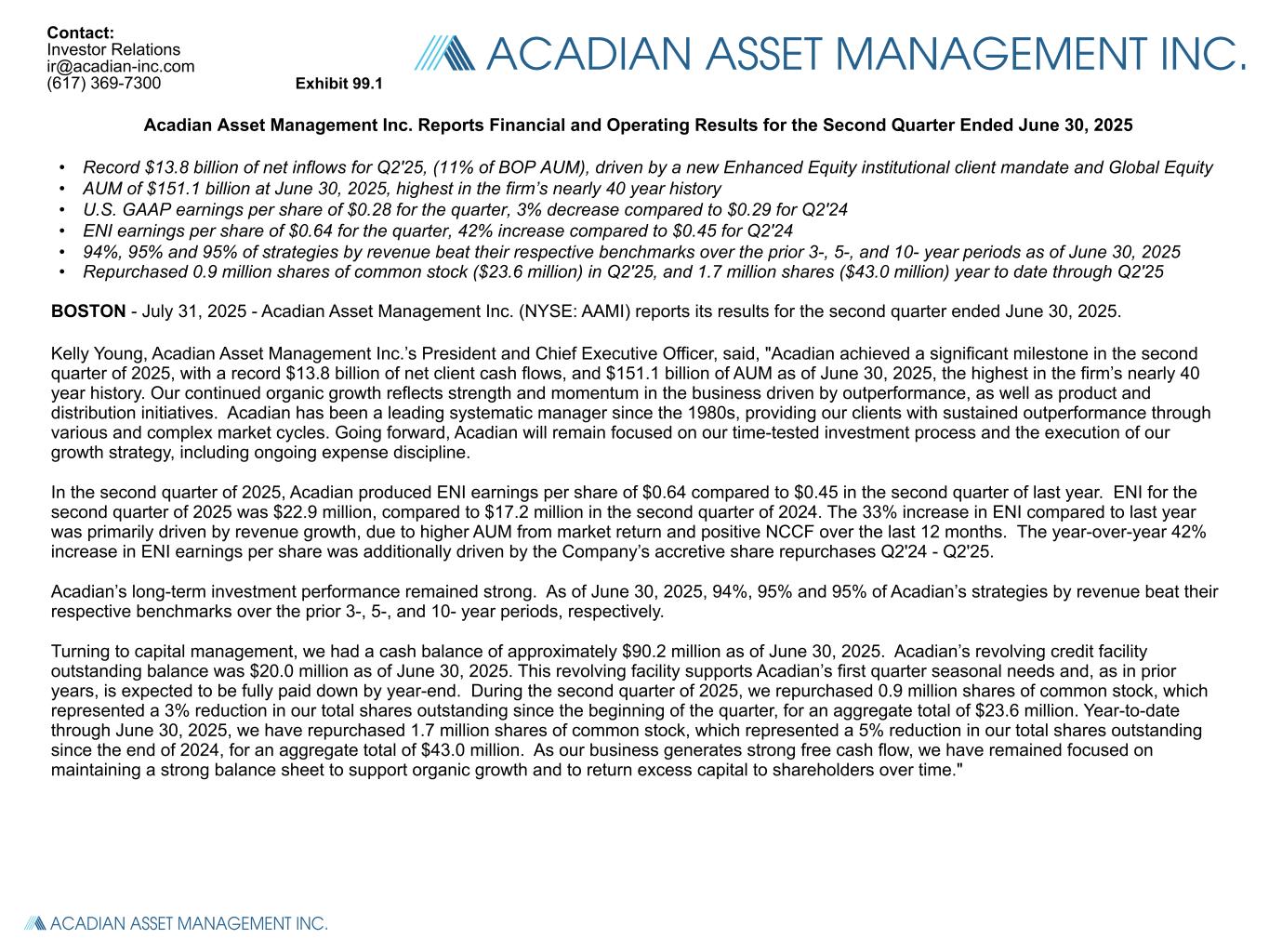
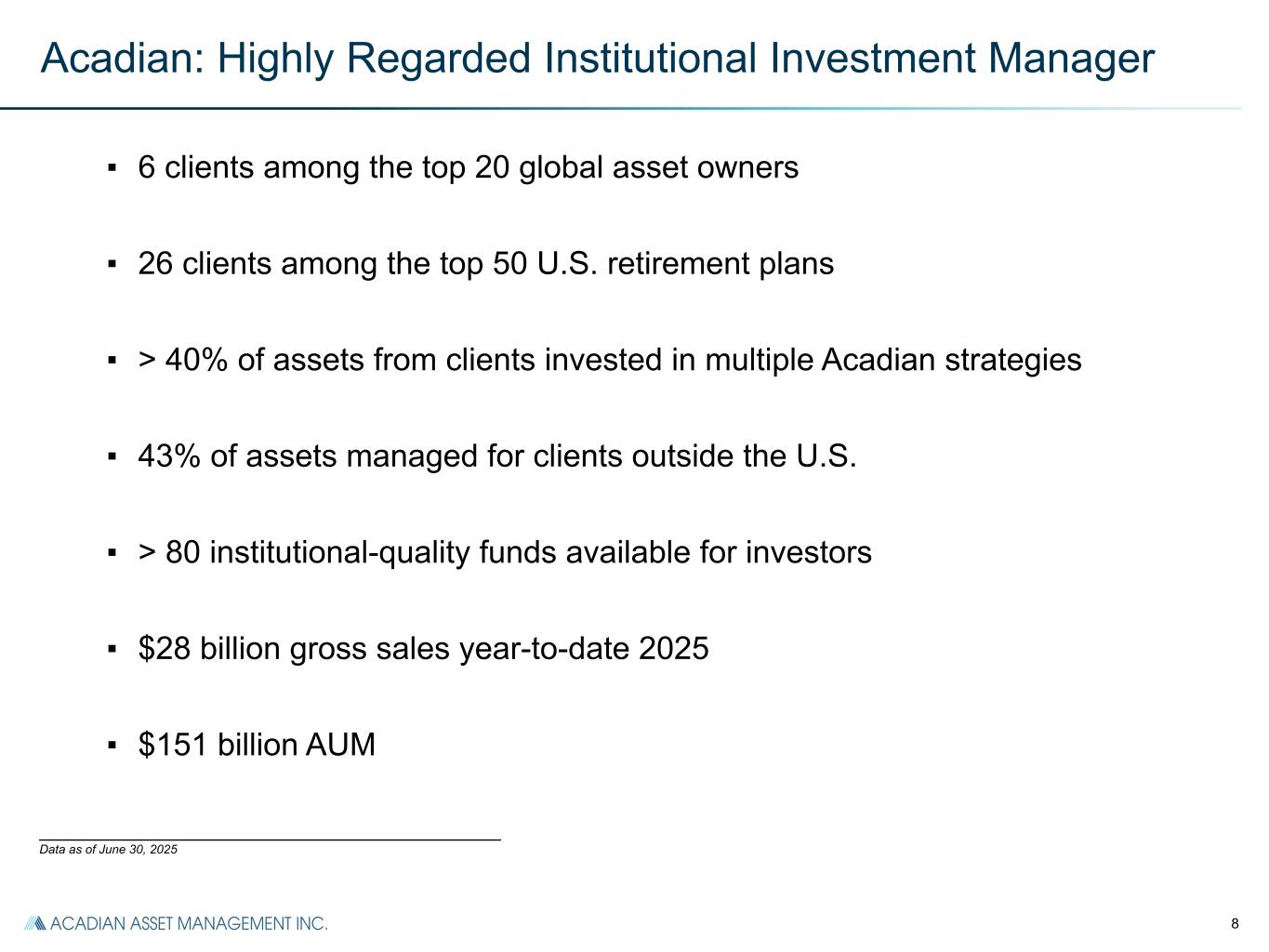
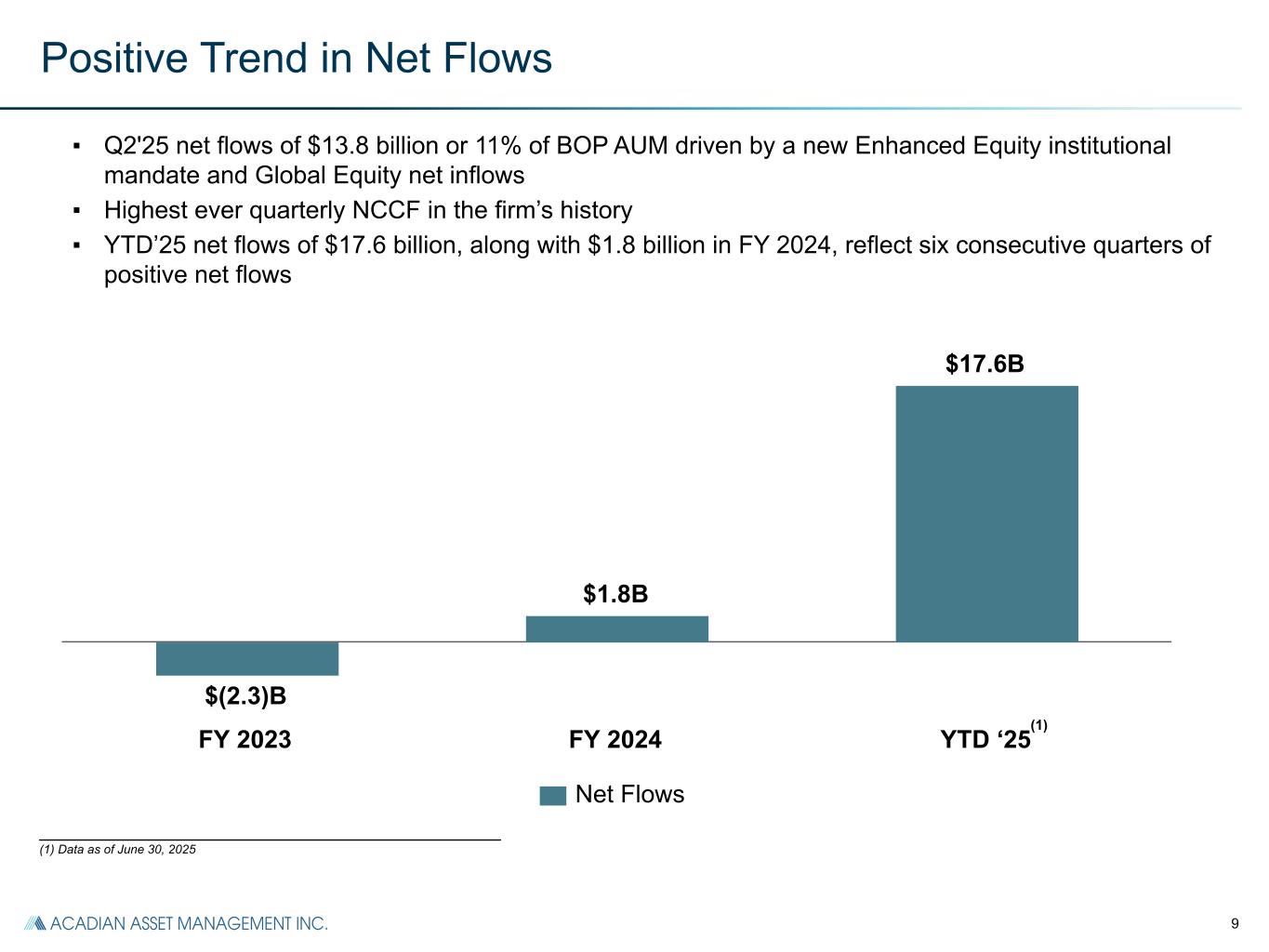
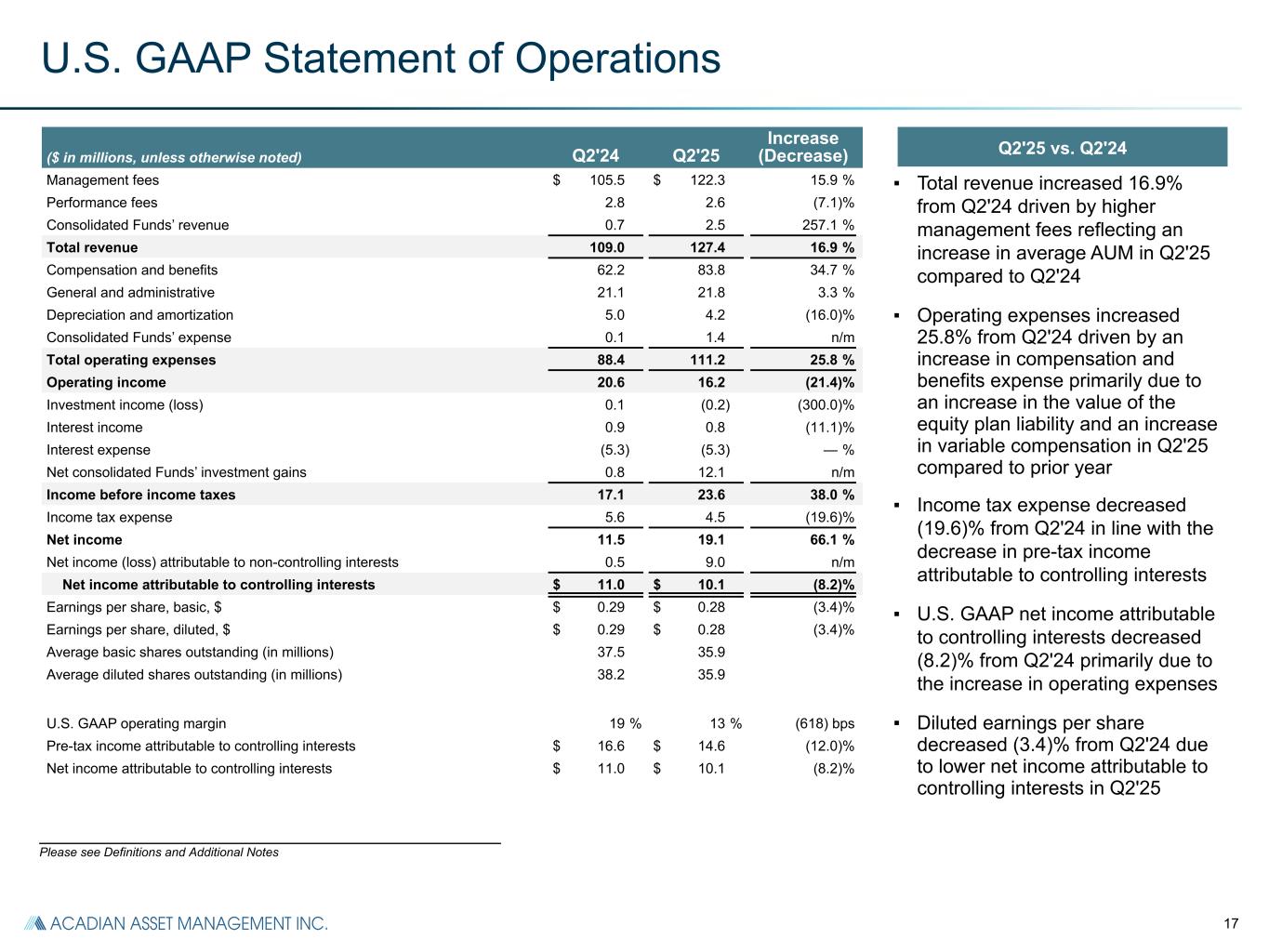
Thanks, Melody. Good morning, everyone, and thank you for taking the time to join us today. At the beginning of 2025, when I delivered AAMI's inaugural earnings presentation, we laid out an organic growth strategy for acadian based on targeted product and distribution initiatives since then our team has been executing that growth strategy and i'm excited to share our q2 2025 results with you as we've achieved certain milestones during this quarter acadian is the only pure play publicly traded systematic manager founded in 1986 acadian has pioneered systematic investing and we continue to lead in the space through constant innovation. We have delivered sustained outperformance across various investment strategies and through numerous market cycles. We manage $151.1 billion of AUM and Akaden is a pure systematic manager applying data and cutting edge technology to the evaluation of global stocks and corporate bonds. 95% of our strategies by revenue are outperforming benchmarks over five-year periods with 4.5 percent annualized excess return our competitive edge comes from the convergence of talented people rich data and powerful tools we have a 120 person investment team with over 100 advanced analytical degrees we're implementing product and distribution initiatives to drive sustainable growth slide four showcases acadian q2 2025 strong performance our u.s gap net income attributable to controlling interest was down eight percent and eps was down three percent compared to prior year due to an increase in non-cash expense related to higher employee equity plan revaluations our eni diluted eps of 64 cents was up 42 percent and adjusted EBITDA up 22%, both driven by significant revenue growth. We delivered $13.8 billion of positive net client cash flow in Q2 of 2025, 11% of beginning period AUM, the highest in the firm's history. And AUM surged to $151.1 billion as of June 30th, 2025, the highest in Acadian's history and a major milestone for the company. Acadian's investment performance track record remains strong despite continued market volatility. We have five major implementations which comprise the majority of our assets. As of June 30th, 2025, global equity, emerging markets equity, non-US equity, small cap equity, and enhanced equity have 100% of assets outperforming benchmarks across 3-, 5-, and 10-year periods. In Q2 2025, global equity markets were strong, though still volatile. The quarter had a turbulent start with a large sell-off in equities, but as volatility subsided, equity markets around the globe saw sharp recovery. Higher returns in European and emerging markets were partly driven by dollar weakening and investments outside of the US, which provided significant diversification benefits for our clients' portfolios. Our disciplined systematic investment process has generated meaningful long-term alpha for our clients. Our revenue-weighted five-year annualized return in excessive benchmark was 4.5% as of the end of Q2 on a consolidated firm-wide basis. Our asset-weighted five-year annualised return in excess of benchmark was 3.6% as of the end of the quarter. By revenue weight, more than 94% of Acadian strategies outperformed their respective benchmarks across three, five, and 10-year periods as of June 30, 2025. And by asset weight, more than 92% of Acadian strategies outperformed their respective benchmarks across three five and ten year periods next i would like to focus on acadians extensive global distribution platform which helped us achieve strong growth sales and will be a major driver of growth in the years ahead for many years acadians had a strong global presence with four offices in boston london sydney and singapore we've continued to expand our client and distribution team, with over 90 experienced professionals serving more than 1,000 client accounts in 40 countries. The team has established strong, deep relationships with many institutional clients, and our average relationship length with the top 50 clients was over 10 years. We work with over 40 investment consultants across market segments and geographies, leading to a diverse client base invested across multiple strategies. We had $28 billion of gross sales in the first half of 2025, already surpassing our previous record annual sales of $21 billion in 2024. In tandem with expanding our distribution capabilities, Acadian's business and product development team have been focused on increasing our strategy and vehicle offerings in high demand and growing areas, where Acadian's systematic approach is particularly well suited. current pipeline remains robust. The success of Acadian as a highly regarded institutional investment manager is testament of our proven investment process as well as Acadian's world class investment and distribution teams. We have six clients among the top 20 global asset owners and 26 clients among the top 50 US retirement plans. More than 40% of our assets are from clients invested in multiple acadian strategies our client base is diverse with 43 percent of assets managed for clients outside of the us we offer 80 plus institutional quality funds for investors we achieved 28 billion dollars of gross sales in the first half of 2025 and reached 151 billion of AUM as of June 30, 2025. The next slide highlights a positive trend in Acadian's net flows, showing a significant increase from the 1.8 billion in the full year of 2024 to 17.6 billion in the year to date 2025. We realised positive net flows of 13.8 billion in Q2 2025 which is 11% of beginning period AUM driven by a new enhanced equity mandate and global equity net inflows the highest quarterly NCCF in Acadian's history with two positive quarterly net flows in 2025 totaling 17.6 billion along with 1.8 billion in the full year 2024 we've now generated six consecutive quarters of positive net flows I'm now going to turn the call over to our CFO, Scott Hines, to provide you with some more detail on our financial performance this quarter and an update on capital allocation.
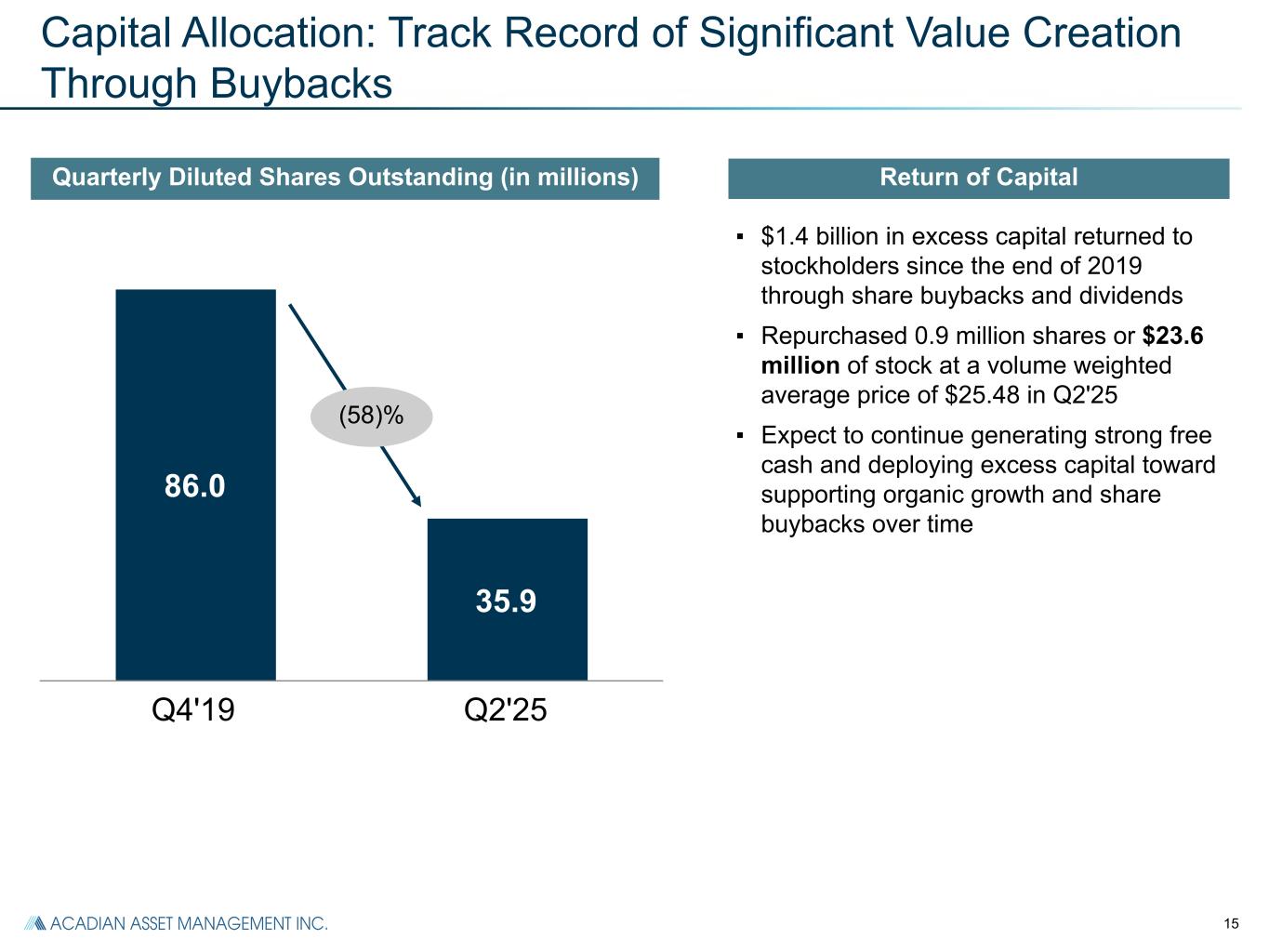
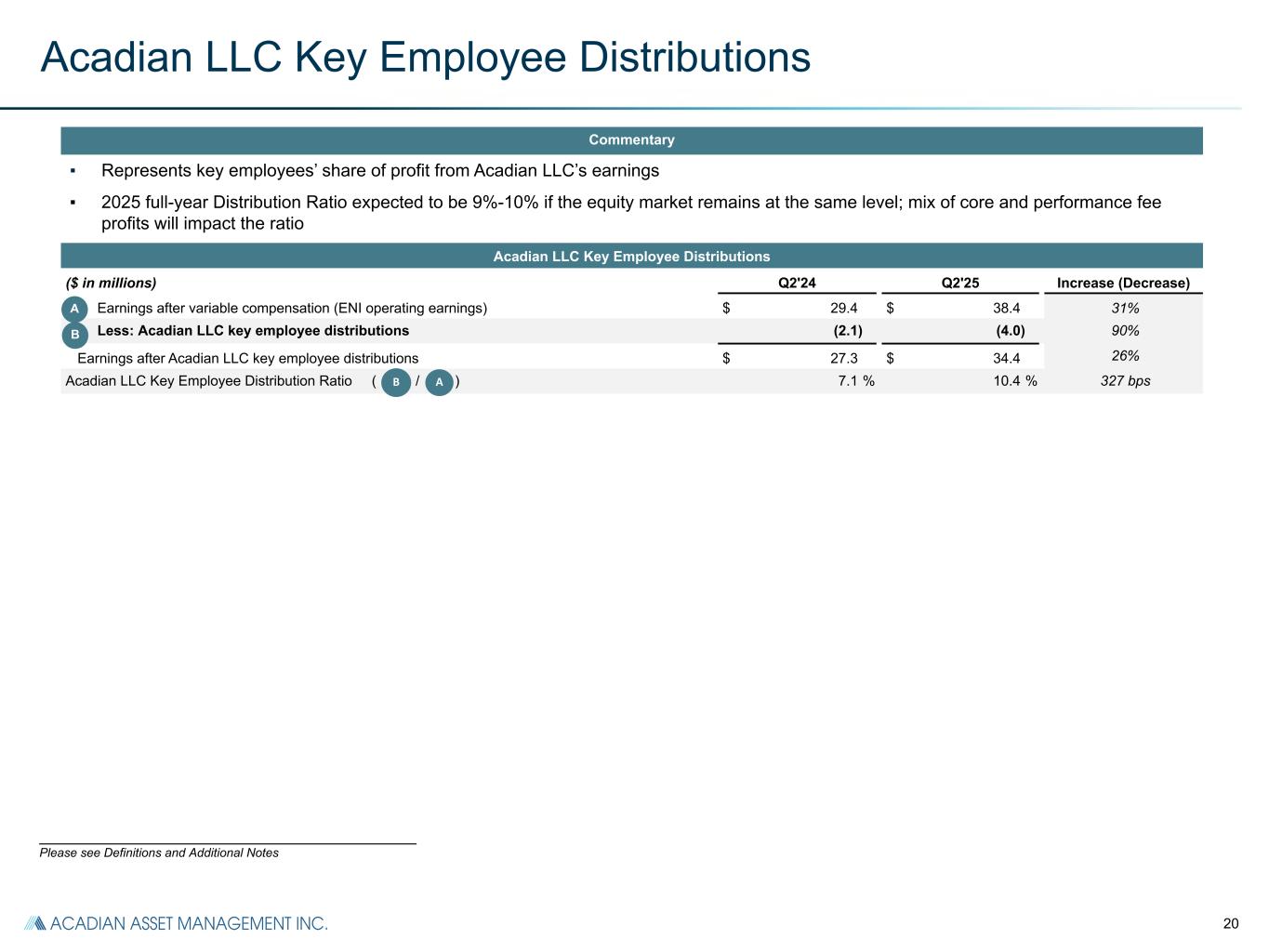
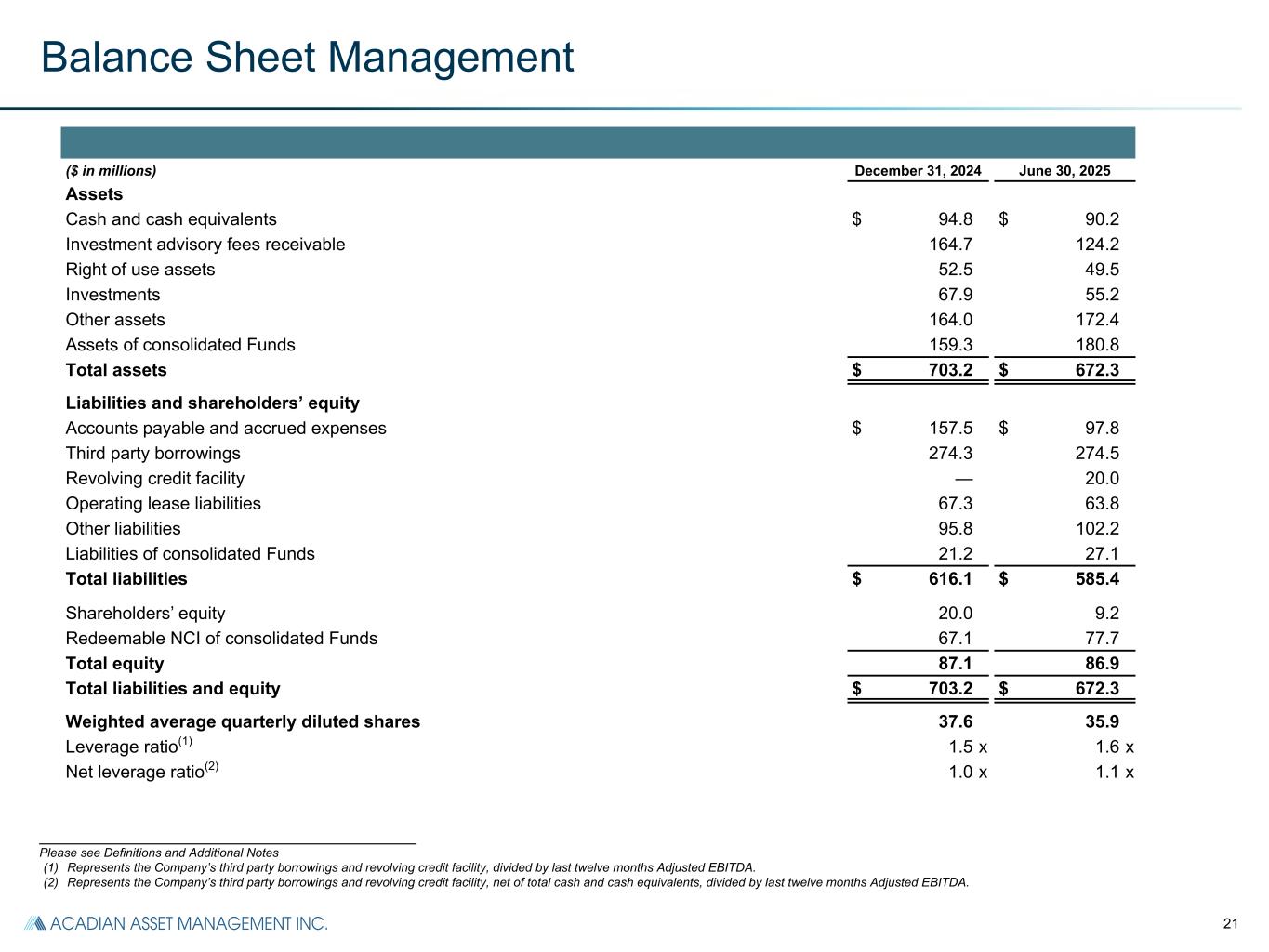
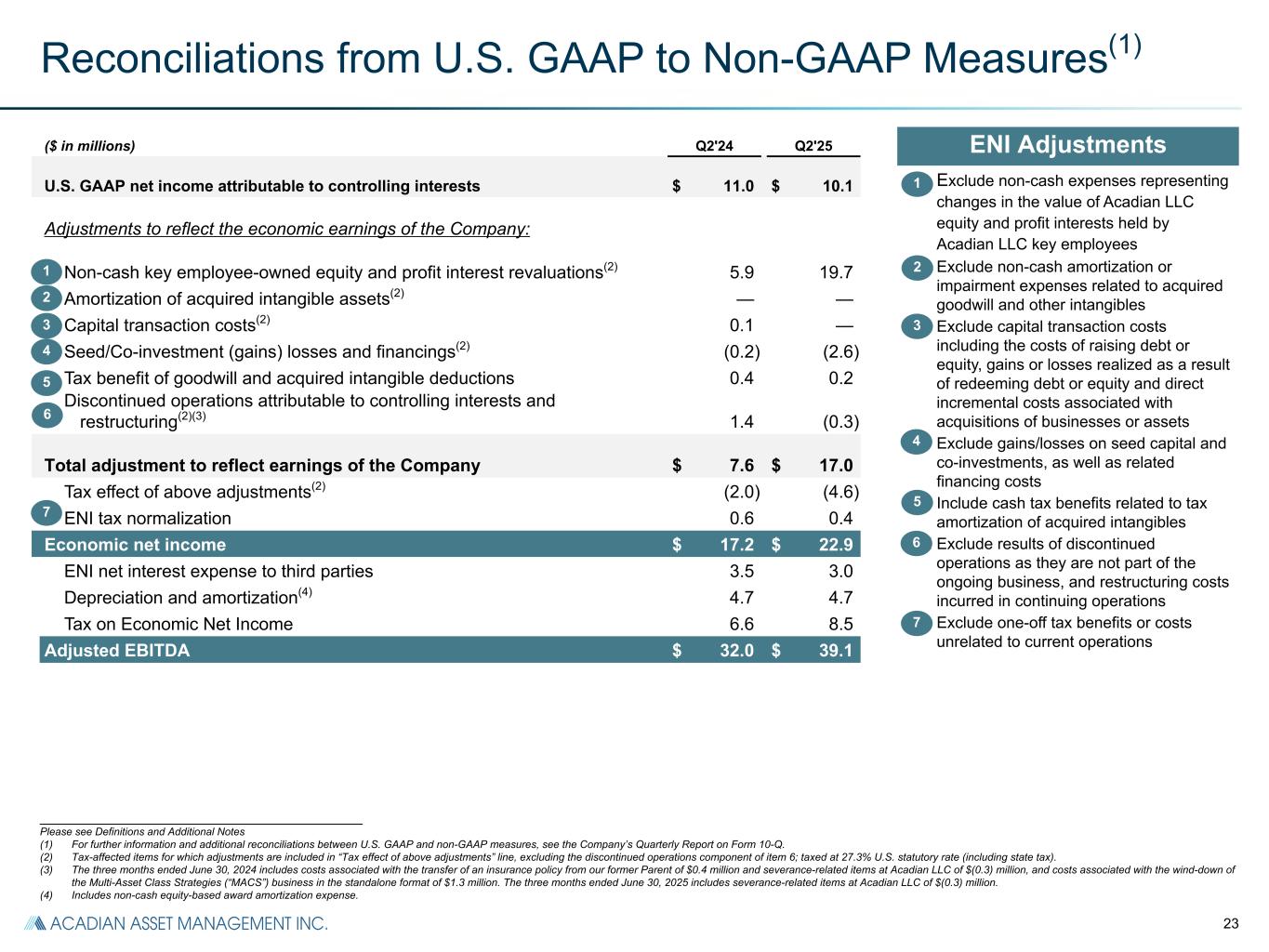
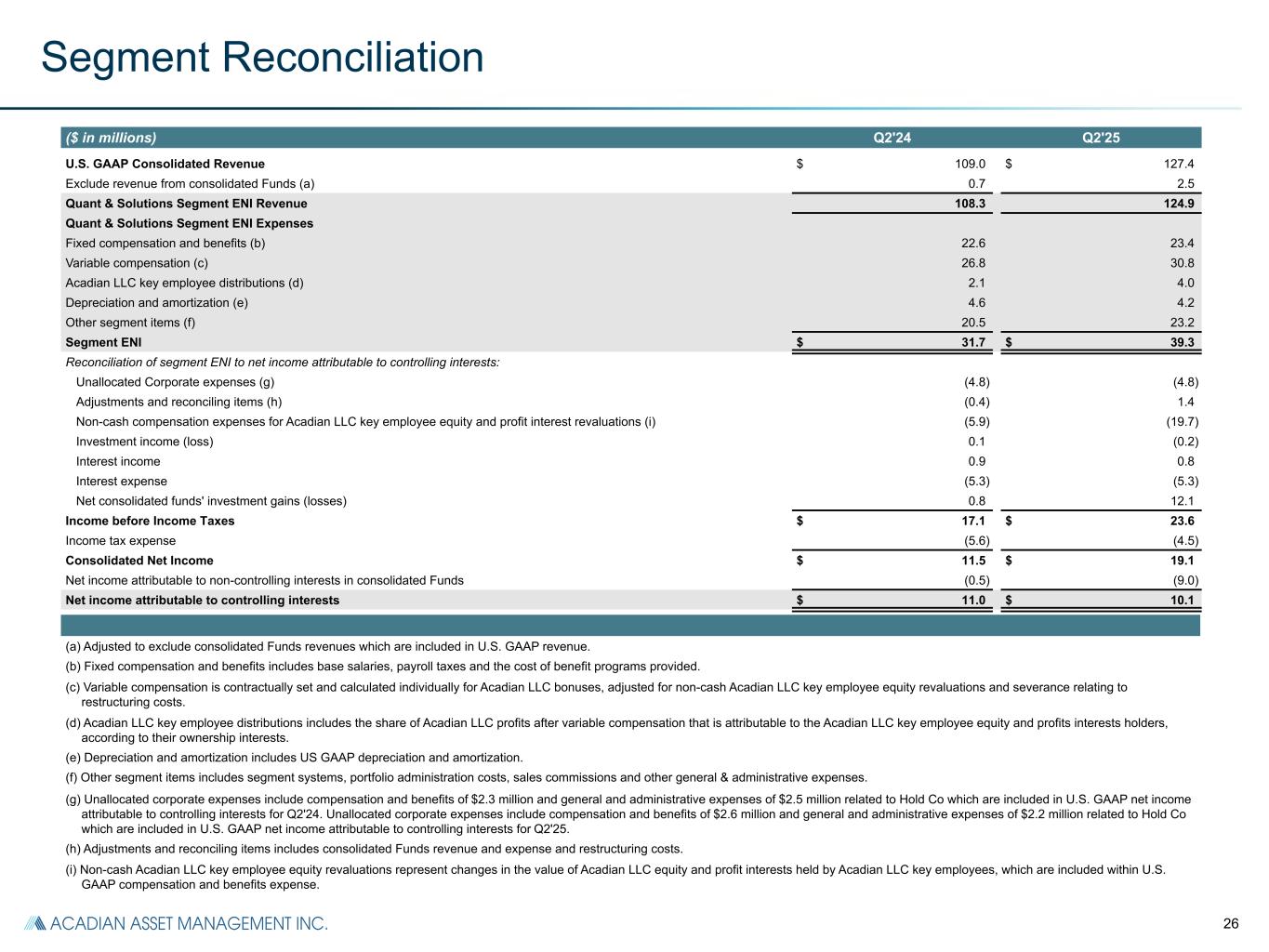
Thanks, Kelly. Turning to slide 11, our key gap in E&I performance metrics are summarized here. As previously noted, we manage the business using E&I metrics, which better reflect our underlying operating performance. You can find complete gap to E&I reconciliations in the appendix. Let me now turn to our core business results. Starting on slide 12, Q225 E&I revenue of $124.9 million increased from Q224 by 15%, primarily due to management fee growth. Management fees increased 16% from Q224, reflecting a 20% increase in average AUM driven by strong positive NCCF and market appreciation. Moving to slide 13, in Q225, our ENI operating margin expanded 360 basis points to 30.7% from 27.1% in Q224, driven by increased ENI management fees. Our Q2-25 operating expense ratio fell 420 basis points to 44.6 for the period from 48.8% in Q2-24, reflecting the impact of improved operating leverage. Our Q2-25 variable compensation ratio decreased to 45.4% in Q2-25 from 48.2 in Q2-24. We now expect that for fiscal year 2025, our operating expense ratio will be approximately 45% to 47% if equity markets remain at Q2 24N levels. The full year variable compensation ratio is now expected to be approximately 43% to 47%. Turning to slide 14 on capital management, consistent with our disciplined approach to maximizing shareholder value, we continue to orient our strong free cash flow toward organic growth initiatives and then returning capital to shareholders. A robust balance sheet also provides flexibility to optimize our capital structure and enhance returns. At the end of the second quarter of 2025, we had $90.2 million in cash and $95.2 million in seed investments. Debt includes an outstanding balance on a revolving credit facility of $20 million, reflecting draws to support first quarter seasonal bonus payments, and that is expected to be fully paid down by year end. Our debt to adjusted EBITDA ratio was 1.6 times as of June 30th, 2025, while our net leverage ratio was 1.1 times. AAMI's board declared an interim dividend of a penny per share to be paid on September 26th, 2025 to shareholders of record as of the close of business on September 12th, 2025. Moving to slide 15, we have a track record of creating significant value through share buybacks in recent years. Outstanding diluted shares have decreased 58% from 86 million shares in Q419 to 35.9 million in Q225. Over the same period, $1.4 billion in excess capital was returned to stockholders through share buybacks and dividends. During the second quarter of 2025, we repurchased 0.9 million shares or $23.6 million of stock at a volume-weighted average price of $25.48. We expect to continue generating strong free cash flow and deploying excess capital over time that maximizes shareholder value. I'll now turn the call back over to Kelly.
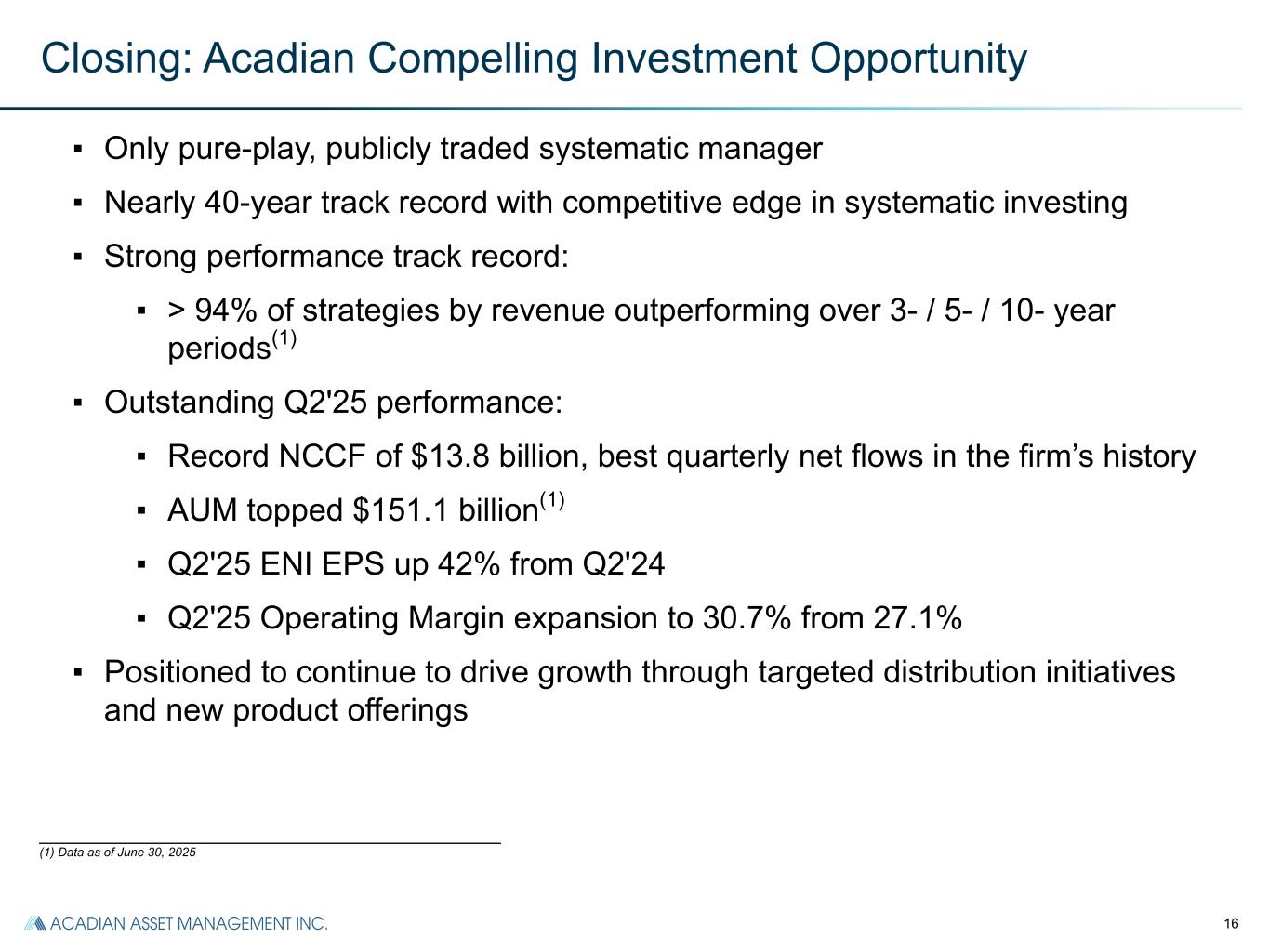
Before going into Q&A, I'd like to recap the key points covered in this presentation. we're the only pure play publicly traded systematic manager we have a nearly 40 year track record with competitive edge in systematic investing our investment performance track record remains strong with more than 94 of strategies by revenue outperforming over three five and ten year periods we delivered outstanding performance in q2 of 25 with record mccf of 13.8 billion the best quarterly net flows in the firm's history record aum of 151.1 billion as of the end of q2 Q2.25 ENI EPS up 42% from Q2 of 2024, and Q2.25 operating margin expansion to 30.7% from 27.1%. We will continue to drive growth through targeted distribution initiatives and new product offerings. Acadian is well positioned to generate value for shareholders. Our team's focus, talent, and hard work have been instrumental in achieving these milestones. And I look forward to building on this momentum and driving further growth and innovation. And this concludes my prepared remarks.
Operator
At this time, those with questions should lift their phone receiver and press star followed by the number one on their telephone keypad. To cancel a question, press star one again. Please hold for a brief moment while we compile the Q&A roster. Your first question comes from the line of Kenneth Lee with RBC Capital Markets. You may go ahead.
Hey, good morning. Thanks for taking my question. I'm wondering if you could provide a little bit more color as to the composition of the institutional pipeline as it stands right now. I think in the past you've talked about enhanced equity as well as equity extension being pretty foundational.
Morning, Ken. Nice to speak to you again. Yeah, the pipeline continues to look very robust. As you know, Sid, you know, enhanced and extensions have both been very key features of the pipeline and of funding's year to date. But again, it looks very robust, I'd say, across different strategies, different domiciles, but certainly with enhanced and extensions being key themes alongside, you know, our core strategies and core equity offerings. So I'd say the department is not just robust, but diversified. And, you know, the three dimensions that we think about being very important to the business are by strategy, by channel and by client geography. You know, as you will have seen from our record NCCF in Q2 and a very strong NCCF in Q1, We've obviously been able to move those awarded mandates to funding through the first part of this year. But the team is continuing to replenish the pipeline as those accounts are funding. And I'm very pleased with the velocity with which we've been able to do that. So, again, continues to be very robust and very broad. But with, as you say, those enhanced and extensions product initiatives certainly being sort of front and center over the last couple of quarters.
Great. Very helpful there. And just one follow-up, if I may, in terms of capital management, any updated outlook around capital returns in terms of repurchases for the remainder of the year? And then somewhat relatedly, what are any thoughts around excess cash position at this Hey, Ken.
It's Scott. Good to hear you again. Look, what I'd say is, you know, we're very much remaining committed to returning excess capital to shareholders over time, right? And our track record, including this quarter, you know, reflect that. You know, having said that, you know, we're obviously forward-looking, and we want to ensure we're building the most durable and resilient balance sheet that we can, one that, you know, supports the business through a range of environments. So, as always, we'll be thoughtful and balanced in how we're deploying capital, you know, quarter to quarter. does that make sense yep that that makes sense that makes sense great well uh very helpful and thanks again thank you your next question comes from the line of michael cipras with morgan stanley you may go ahead hey good morning thanks for taking the question and congratulations on the strong quarter.
Maybe just starting out on the strong flows, $13.8 billion, significant record for you guys. I think you mentioned a number of strategies that helped contribute. I was hoping maybe you could unpack the composition with a little more detail in terms of maybe how much came from each of the major strategies that contributed. Was it from a single client or two maybe help unpack the breadth that you're seeing from the number of clients that participated or that drove a lot of that activity. And then if you could just maybe update us on some of the range of new product initiatives that you guys have in mind that we could see come to the market in the next 12, 24 months. Thanks.
Morning, Michael. It's nice to speak to you again. Yeah, a 2Q positive NCCF, I think, reflects uh the success in particular of our enhanced equity product initiative um there was also a lot of uh particular interest in our core product offerings particularly our global core offering uh in the second quarter i think you know we're continuing to see demand for enhanced equity strategies given they offer this you know attractive risk adjusted return profile that i know we've talked about in the past and i think it satisfies you know broad investor need for lower fee and more consistent return characteristics. So certainly, you know, the majority of our gross sales for Q2 were driven by enhanced type mandates. But as I say, noting, you know, strong interest in global core as well in Q2. The new account, we did have one particularly large account that was, I'd say, outsized by historic standards that was, you know, certainly one of the larger drivers of that 13.8 billion NCCF number. What's nice to see about that mandate is it continues to diversify our client base, not just by product type, but also by client domicile, shifting our non-US domicile clients' percentage of AUM from 37% in Q1 to 43% at the end of Q2. So certainly a larger account that funded this quarter. But I think it also underscores, you know, what we've seen for a long time and that I noticed in my prepared remarks that, you know, we continue to see some of the largest and most sophisticated investors globally continuing to put their trust in occasion in terms of managing in terms of managing their assets. So Q2 NCCF was extraordinary. You know, we wouldn't necessarily anticipate that same level of net sales in future quarters. But as I know, the pipeline remains very strong across all of those dimensions, strategy, channel and geography. But certainly, I'd say, you know, enhanced was, you know, continues to be the dominant theme in Q2 in the way that it was in Q1. And perhaps maybe I'll just comment, as you noted, on the product initiatives. Again, we remain very focused on the initiatives that we laid out at the beginning of this year. Enhanced is obviously one of those core blocks, as well as extensions and credit. I think those initiatives, alongside a very strong core offering, provide a really robust lineup of strategies that we believe cater for our clients' needs today. So very much going to be continuing to execute on those initiatives that we laid out at the beginning of the year.
And, Mike, Scott, I'll just jump in real quick here. I think in regard to the product initiatives already announced, one thing I'd add and something we're very focused on is the scalability of the business, right? So, everything that Kelly's talked about, I think as we've talked to you on prior occasions about, the seed investments largely are in place, the infrastructure is largely in place. So, we're beginning to feel that. You saw it some this quarter and the expansion in our operating margin and the decline in the operating expense ratio. So we're managing that very carefully, and we're optimistic in this regard going forward as the franchise continues to scale up.
I guess as a follow-up question, and that's probably a good starting point just around operating leverage and just how to think about that. I know it's probably too early for 26 guidance, but just curious as you look out over the next couple of years, where can this margin profile, do you think, get to? Is there some sort of upper ceiling? How do you think about, as you're winning more business and customers, the need for investments in the platform? How do you think about that pace of expense growth to help drive and support the growth of the top line and the overall business and what that means for the bottom line margin?
Yeah, I appreciate it, Mike. What I'd say is this. Again, we're optimistic. We're very focused on this. We're very focused on continuing to drive operating leverage in the business. We're optimistic about our ability to continue to do so. As you said, this is an area on a 2026 basis that we're going to provide guidance now. What I would point you to, particularly if you look at that E&I operating expense ratio, which to me is one of the best measures of the pure scalability, right? That's the operating expenses divided by the management fees, right, and more stable in that regard. You know, in recent years, the company's printed something, you know, in around 50 percent, whereas, you know, this year, and you'll see it, you know, in the deck as we laid out, you know, we're thinking that we could land something closer to 45 to 47 percent this year. So, material progress in that regard. So, I don't know that we are prepared yet to range-bound this, but as I said, we are narrowly focused on this and optimistic.
Operator
Your final question comes from the line of John Dunn with Evercore ISI. You may go ahead.
Hi. So you guys kind of talked about that investment strategy side, but as you evolve the business, are there any new channels of vehicles you might look to try to tap into? And more broadly, any just new tax you'd look to take on the distribution side?
Yeah, hi, John. Nice to speak to you again. um you know as i said i think in terms of uh in terms of sort of our existing product initiatives i do think we have you know as a very broad range that suited not just to our more you know traditional institutional um traditional institutional business but you know we have seen um a pickup of real interest in a very focused area for us around around wealth and sub-advisory so again i do think that the areas like enhanced like our extension strategies could play particularly well in that sort of space. We also have had a real focus on expanding our vehicle offering and making sure that our vehicles are suitable not just for US and non-US clients, but by particular client types. So, for example, understanding the dynamics of the move from defined benefit to defined contribution and being able to offer CITs for those types of retiree clients. So, again, I think we feel very comfortable where we are today. We have very selectively, I would say, added some distribution resources through the first part of this year, bolstering what I think was already a very, very strong team. So I think to Scott's earlier point, from a scalability standpoint, we feel very comfortable with the product range and the team that we have in place today. And again, think that it suits that for our more sort of traditional core business, as well as some of these newer channels.
Got it. And then maybe could you just talk a little bit about the kind of push and pull on the fee rate from what's been inflowing and what's been outflowing and just maybe the outlook for the fee rate in the second half?
No, John, I appreciate the question. I mean, look, I think, as you know, there's a lot of forces at work here, many of which are external, including, you know, just broader market moves and client demand. So, you know, the fee rate, we're obviously paying attention to that. We're sensitive to it, but any given quarter, you know, is largely an output, and it's very dynamic, right? I think as Kelly suggested, and as you know, you know, we had a relatively large enhanced win, you know, this quarter, and that's begun to be felt. The future, as we stare at the pipeline, you know, it can be a lumpy business, and there's certain pieces there that we're staring at, that for all intents and purposes have a higher fee rate that might be implied by the current quarter, and there certain other wins that might be just a little bit lower. So this is something that is dynamic and that moves around a bit. What we are focused on, you know, as a management team is what we can control in this regard. And as Kelly just suggested, you know, at the first part of your question, it's that focus on making sure we've got the right product initiatives, that we're meeting, you know, the right client demands, and that feels good right now, and that we're continuing to maintain that expense discipline that I spoke about earlier.
Got it. Thank you. And congrats, Scott, on your first call as CFO.
Operator
This concludes our question and answer session. I would like to turn the conference call back over to Kelly Young.
Thank you, everyone, for joining us, and I hope you all have a great day.