Good afternoon, and thank you for joining Airbnb's Earnings Conference Call for the second quarter of 2025. As a reminder, this conference call is being recorded and will be available for replay from the Investor Relations section of Airbnb's website following this call. I will now hand the call over to Angela Yang, Director of Investor Relations. Please go ahead.
Good afternoon, and welcome to Airbnb's second quarter of 2025 Earnings Call. Thank you for joining us today. On the call today, we have Airbnb's co-founder and CEO, Brian Chesky, and our Chief Financial Officer, Ellie Mertz. Earlier today, we issued a shareholder letter with our financial results and commentary for our second quarter of 2025. These items were also posted on the Investor Relations section of Airbnb's website. During the call, we'll make brief opening remarks and then spend the remainder of time on Q&A. Before I turn it over to Brian, I would like to remind everyone that we will be making forward-looking statements on the call that involve a number of risks and uncertainties. Actual results may differ materially from those expressed or implied in the forward-looking statements due to a variety of factors. These factors are described under forward-looking statements in our shareholder letter and in our most recent filings with the Securities and Exchange Commission. We urge you to consider these factors and remind you that we undertake no obligation to update information contained on this call to reflect subsequent events or circumstances. You should be aware that these statements should be considered estimates only are not a guarantee of future performance. Also, during this call, we will discuss some non-GAAP financial measures. We've provided reconciliation to the most directly comparable GAAP financial measures in the shareholder letter posted to our Investor Relations website. These non-GAAP measures are not intended to be a substitute for our GAAP results. With that, I'll pass the call to Brian.
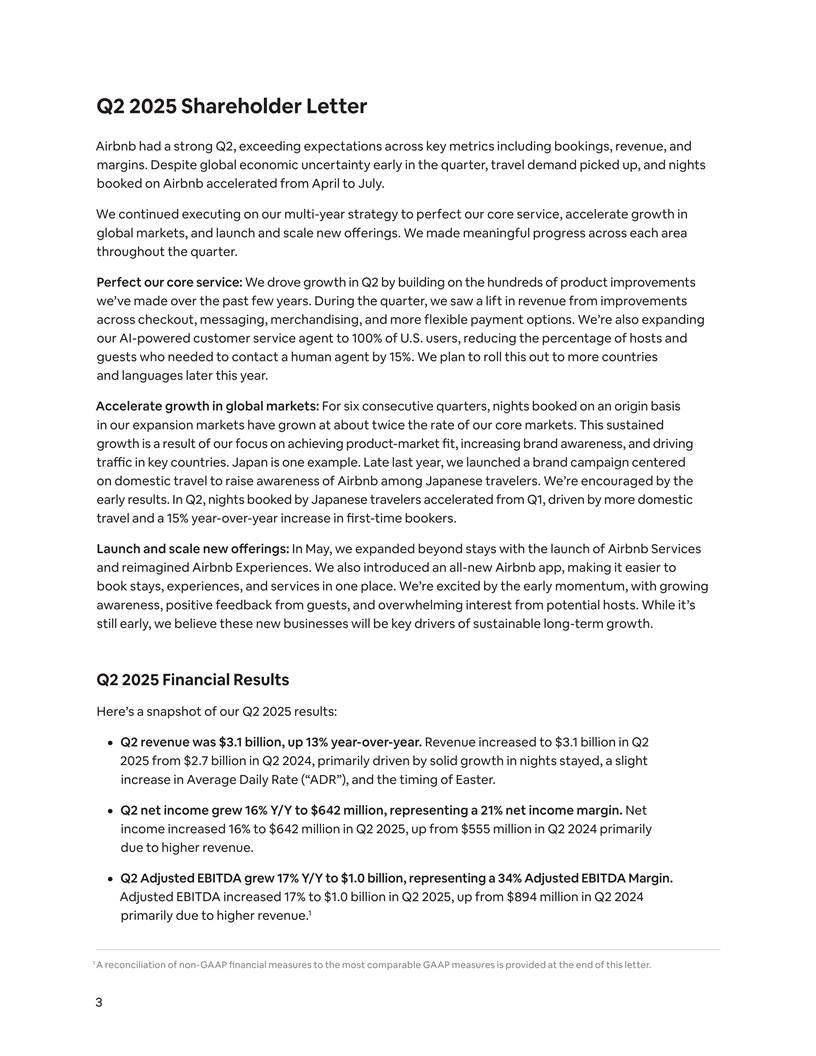
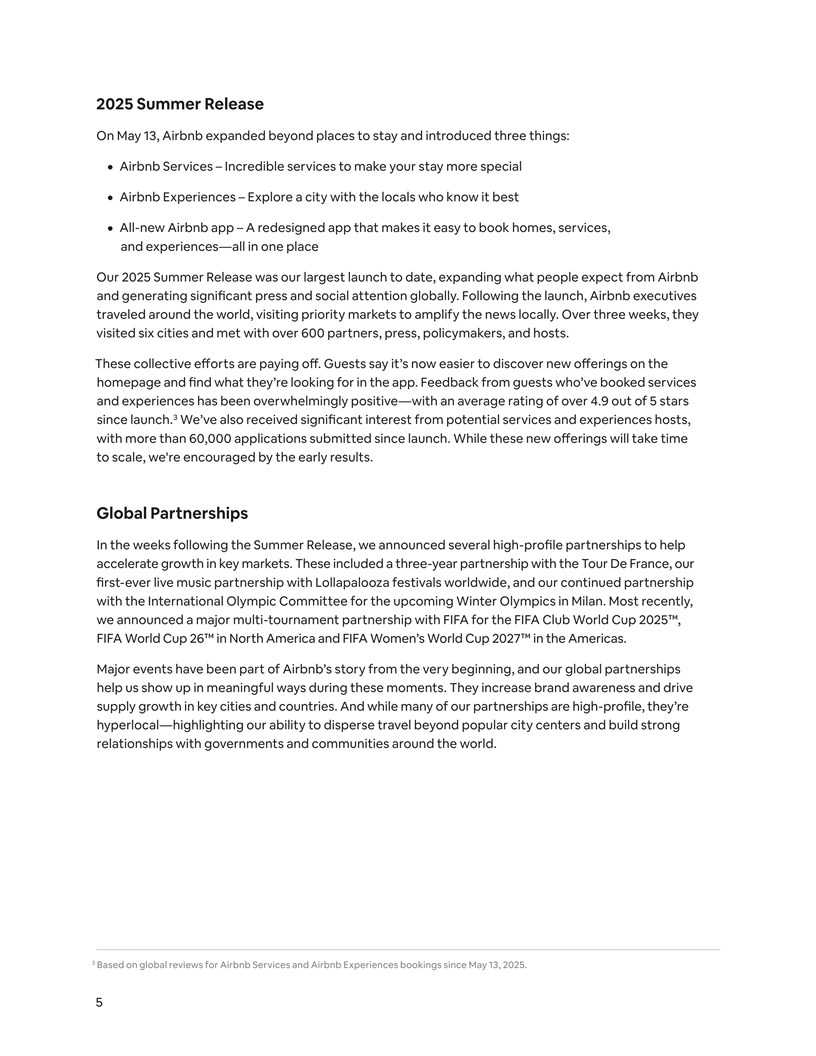
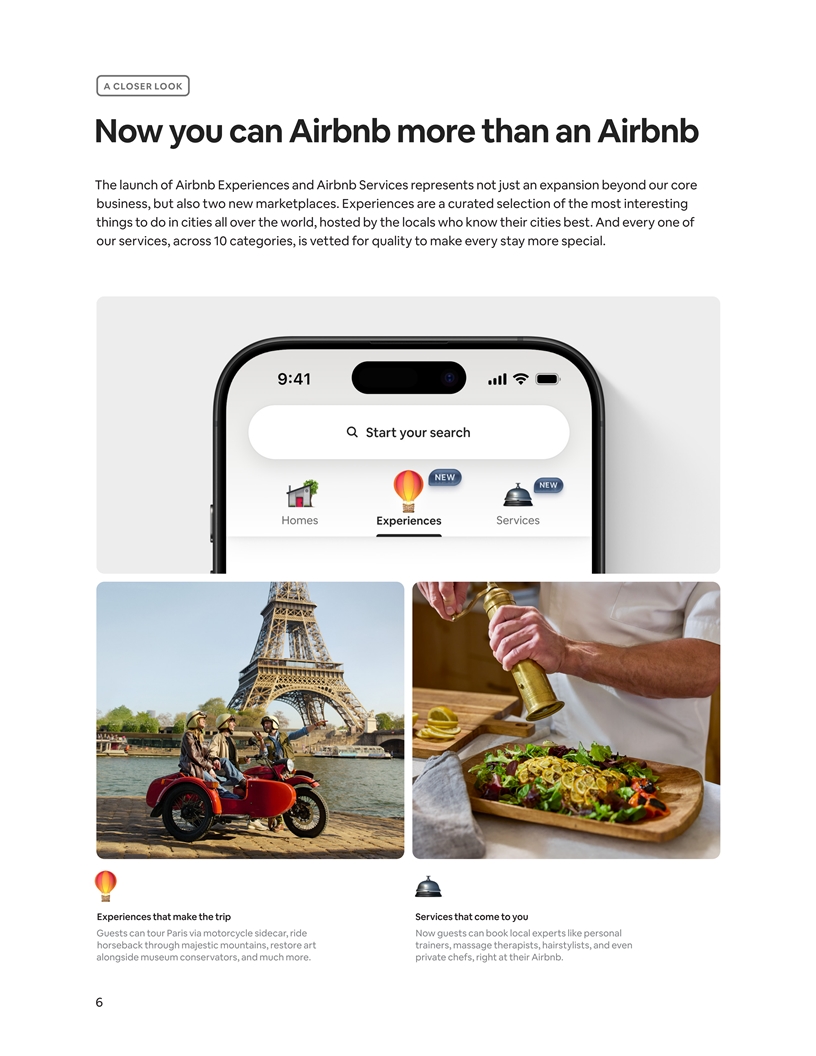
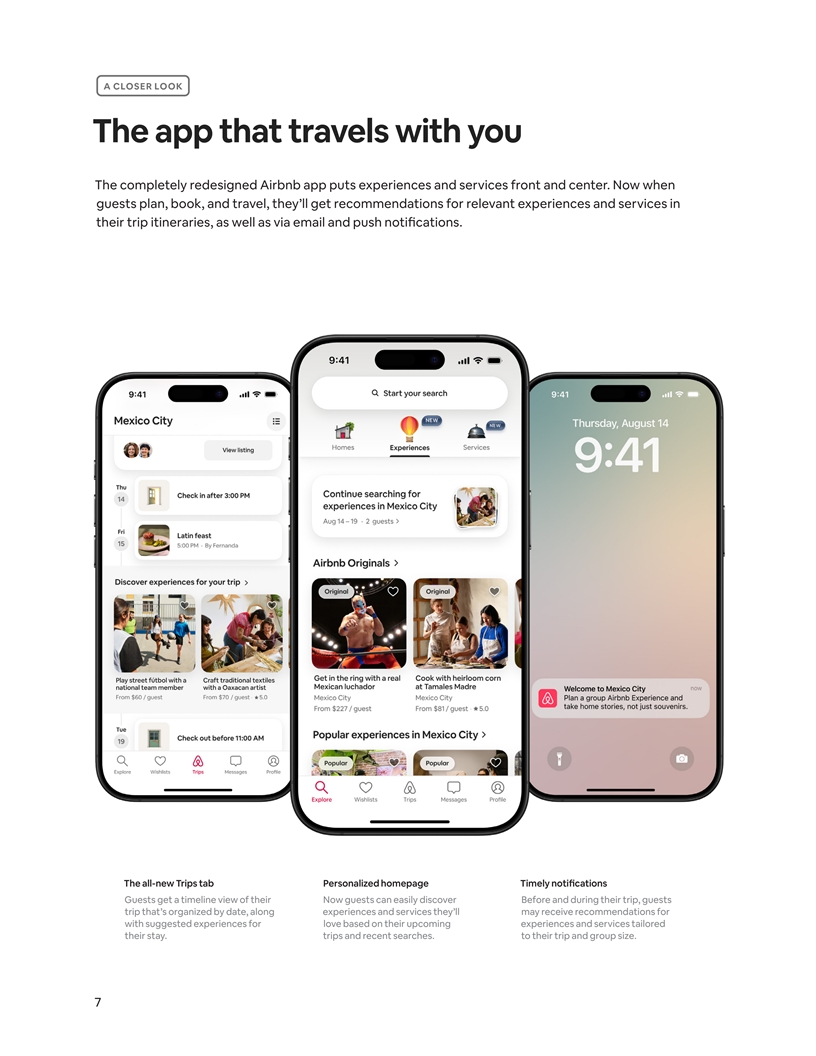
All right. Thanks, Angela, and good afternoon, everyone. Thanks for joining. Airbnb had a strong Q2. We exceeded expectations across key metrics, including bookings, revenue, and margins. And while the quarter started with some global economic uncertainty, travel demand picked up. A nice book that Airbnb accelerated from April to July. We also made meaningful progress across our three strategic priorities. First, we continued to perfect our core service. In Q2, we made improvements to checkout, messaging, merchandising, and more flexible payment options, all of which helped us increase revenue. We also expand our new AI customer service agent in the U.S., reducing the percentage of hosting guests who need to contact a human agent by 15%. Second, we accelerated growth in global markets. Knights booked on an origin basis and our expansion markets have now grown at twice the rate of our core markets for six consecutive quarters. And what this shows is that we're achieving product market fit, increasing brand awareness, and driving traffic in key countries outside the United States. So take Japan, for example. Late last year, we launched a brand campaign to raise awareness among Japanese travelers. You might wanna take a trip within Japan. And the early results are really encouraging. In Q2, Japanese travelers booked more nights on Airbnb than they did in Q1. driven by more domestic travel and a 15% year-over-year increase in first-time bookers. We also announced several major partnerships to help accelerate growth in key markets, including a three-year partnership with the Tour de France, a Global Live partnership, Music Partnership with Lollapalooza, and our continued partnership with IOC for the upcoming Winter Olympics in Milan. And we just announced a three-year partnership with FIFA and the World Cup, which is the largest event in the world. Large events have been a part of Airbnb's story from the very beginning. They help us build brand awareness and grow supply and key markets. And while many of these partnerships are high profile, the events themselves are often very local. And that's what makes them so powerful. They highlight our ability to disperse travel beyond popular city centers and help strengthen relationships with local governments and communities. finally our third strategic priority is expand our business beyond stays in the q2 we did that in a big way as part of our 2025 summer release in may we launched airbnb services and completely reimagined airbnb experiences we also introduced an all new app making easier to book home services and experiences all in one place now this was our biggest launch to date and it generated more than 13,000 press stories and nearly 660 million social media impressions. After the launch, I traveled around the world to amplify the news and key markets. And over the next three weeks, I visited six countries and met with over 600 members of the press, policymakers, Airbnb partners, and Airbnb hosts. And so far, the response to our summer release has been great. Guests say it's easier to discover new offerings on our homepage and find what they're looking for. And when they In the book of service experience, the feedback has been incredibly positive. The average guest rating for a service and experience since launch is 4.93 stars out of 5 stars. Now, for context, this outperforms the already impressive 4.8 average rating for home during the same period. And we're also seeing strong interest from potential hosts. Since launch, over 60,000 people have submitted applications to host a service or experience. We are really excited by the momentum. It's still early, but we believe that services experiences can become sizable businesses for Airbnb. Now, with that, I'll turn it over to Ellie for a financial update.
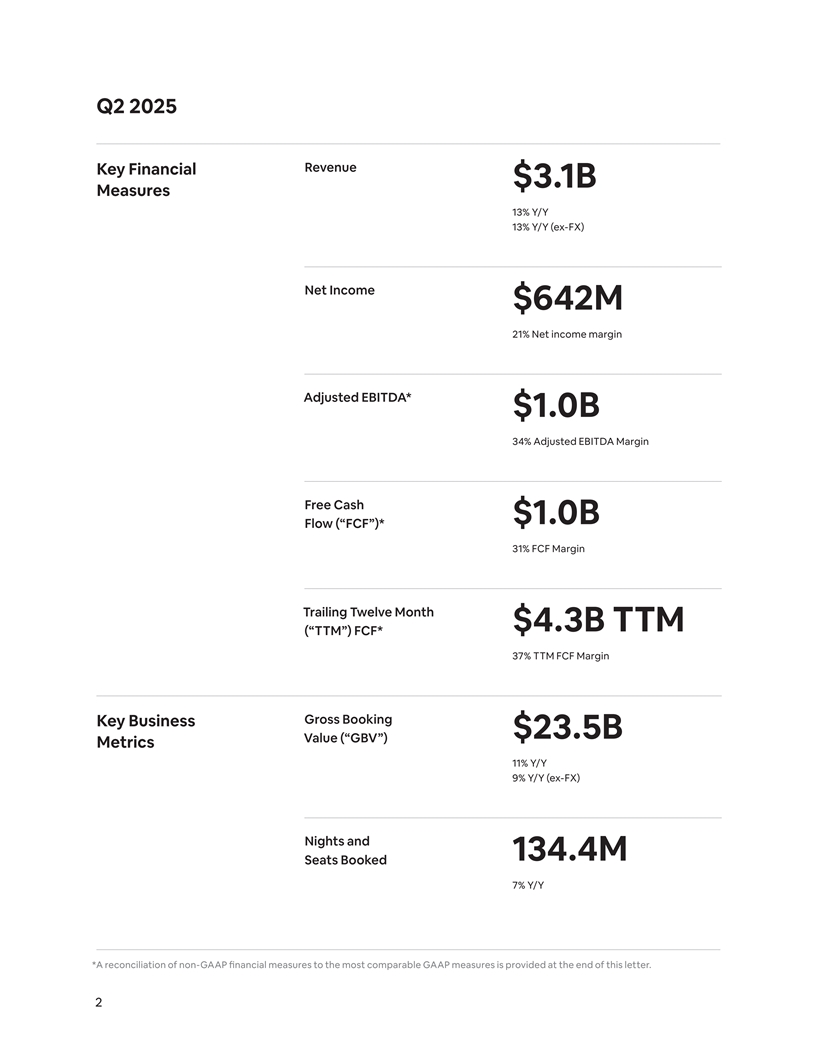
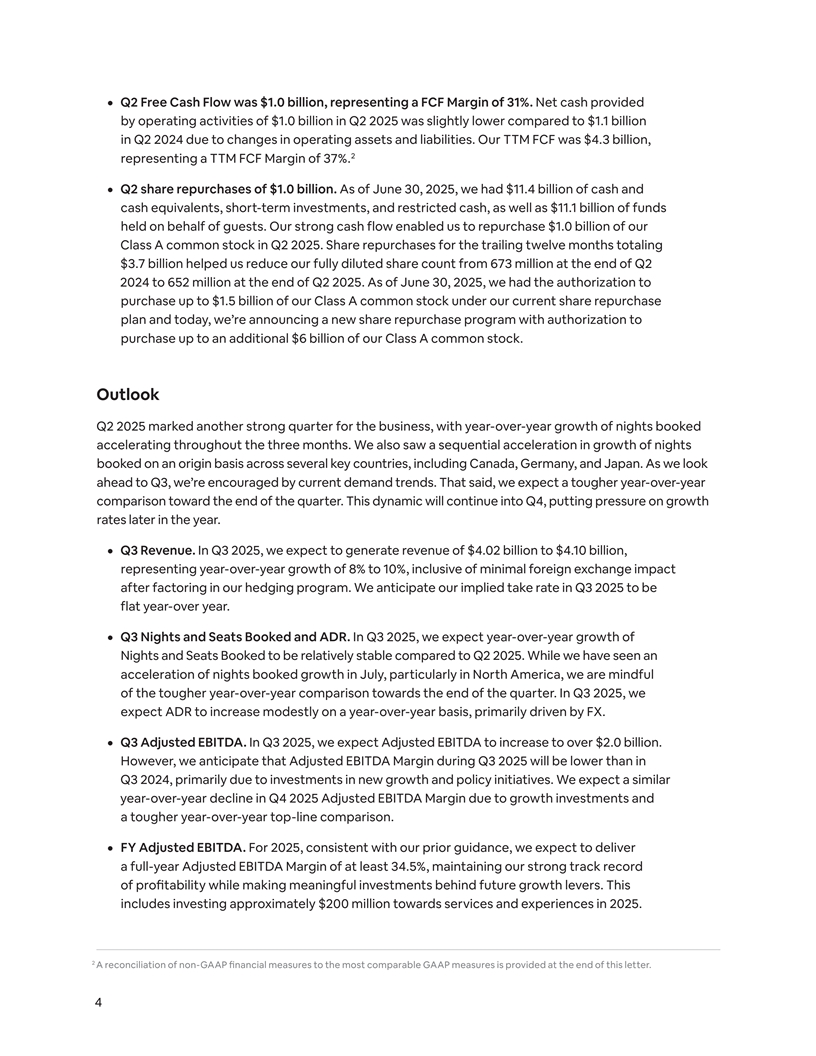
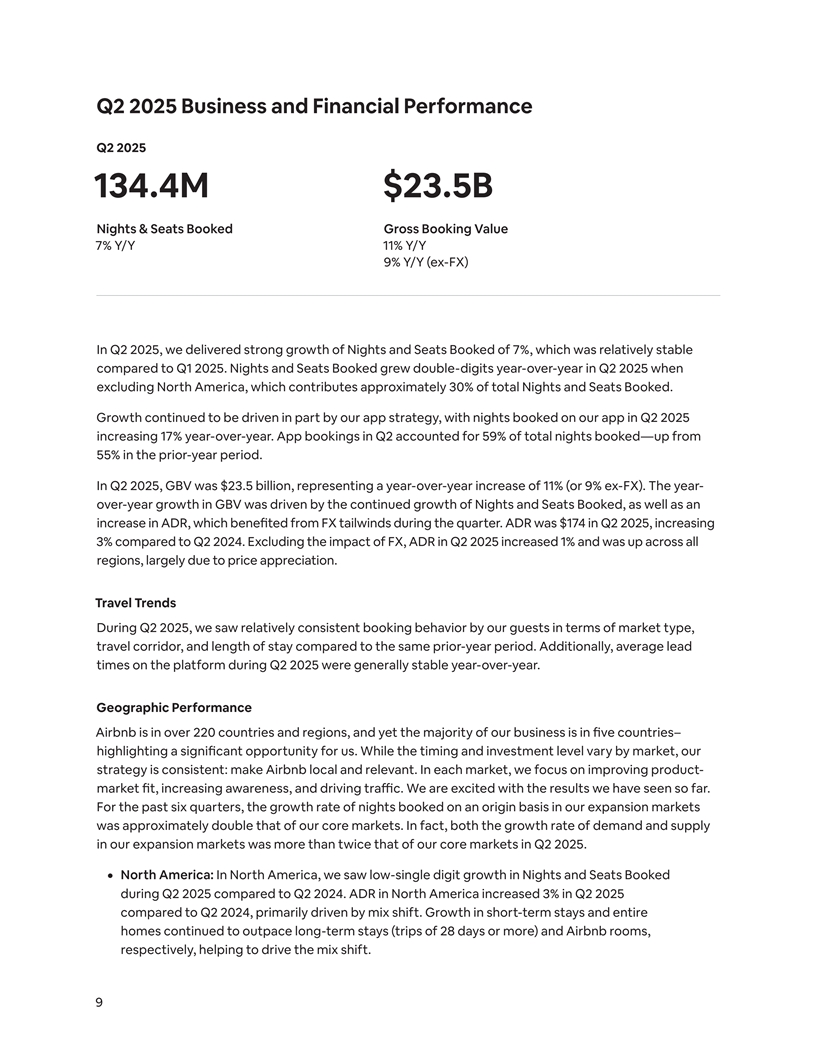
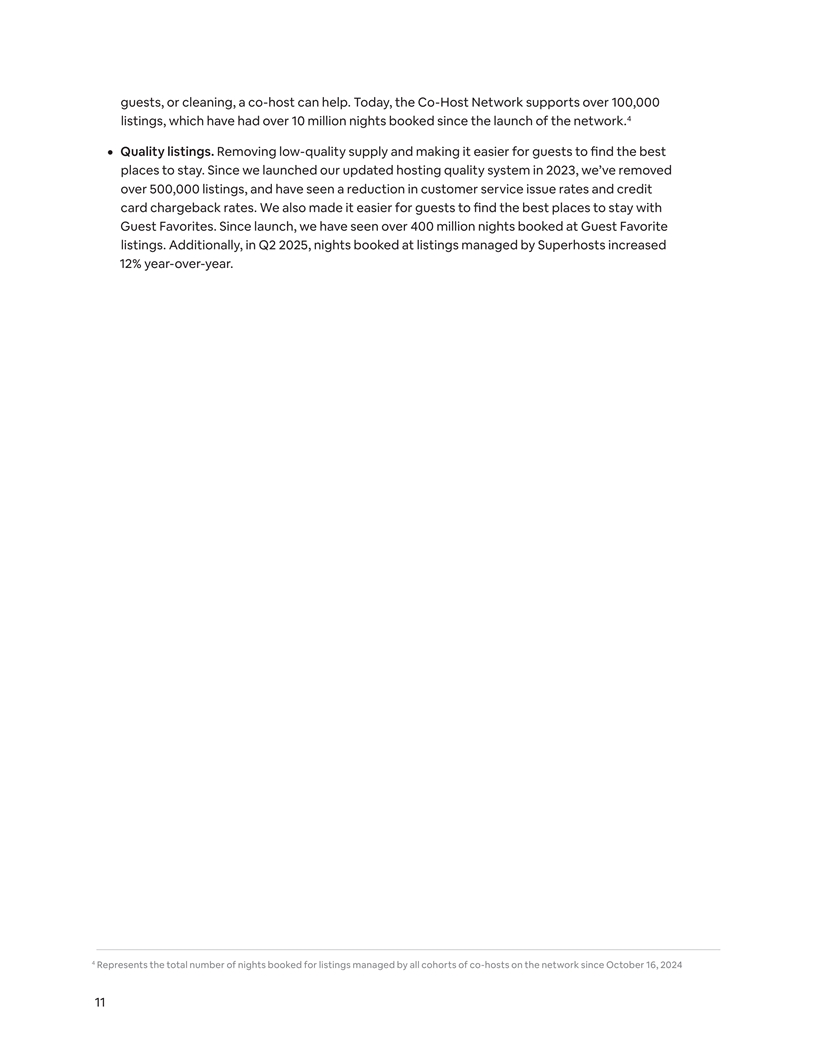
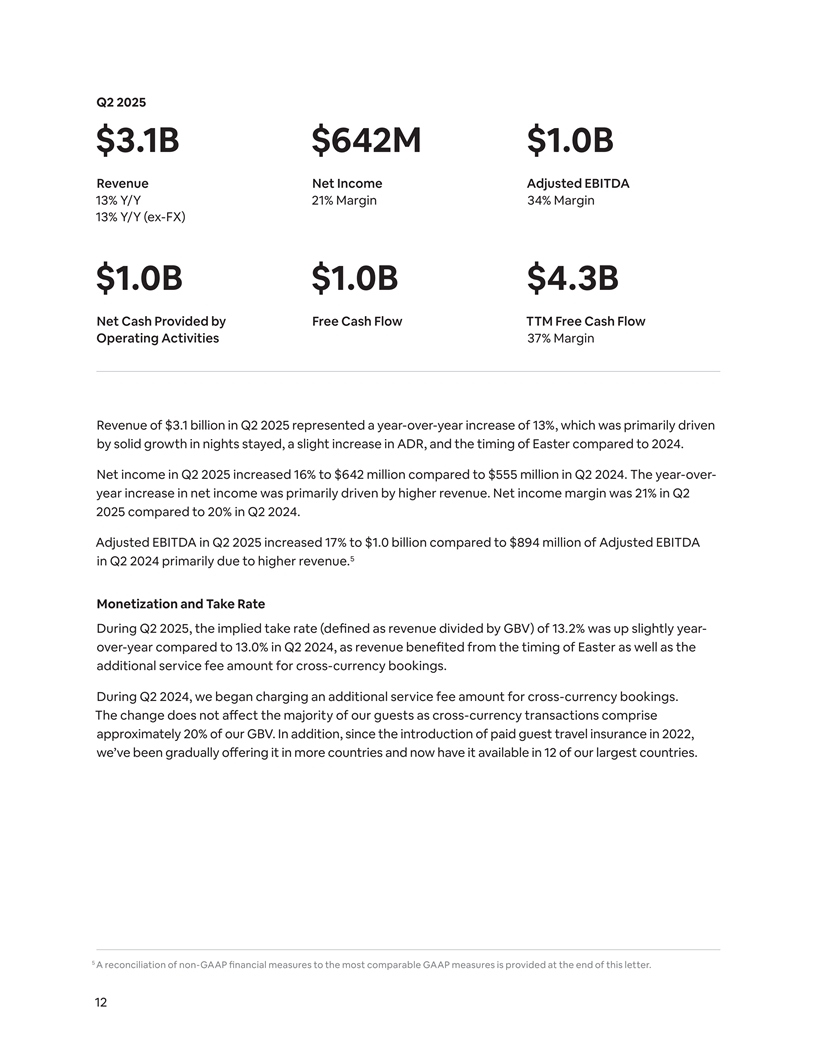
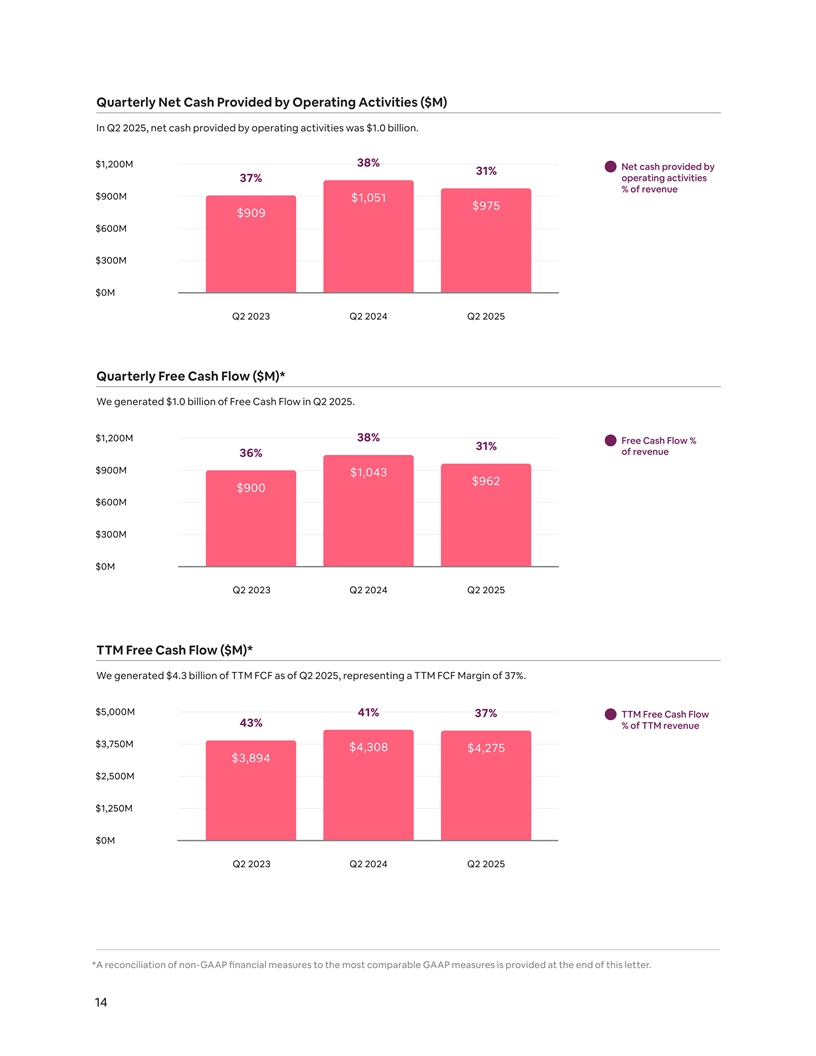
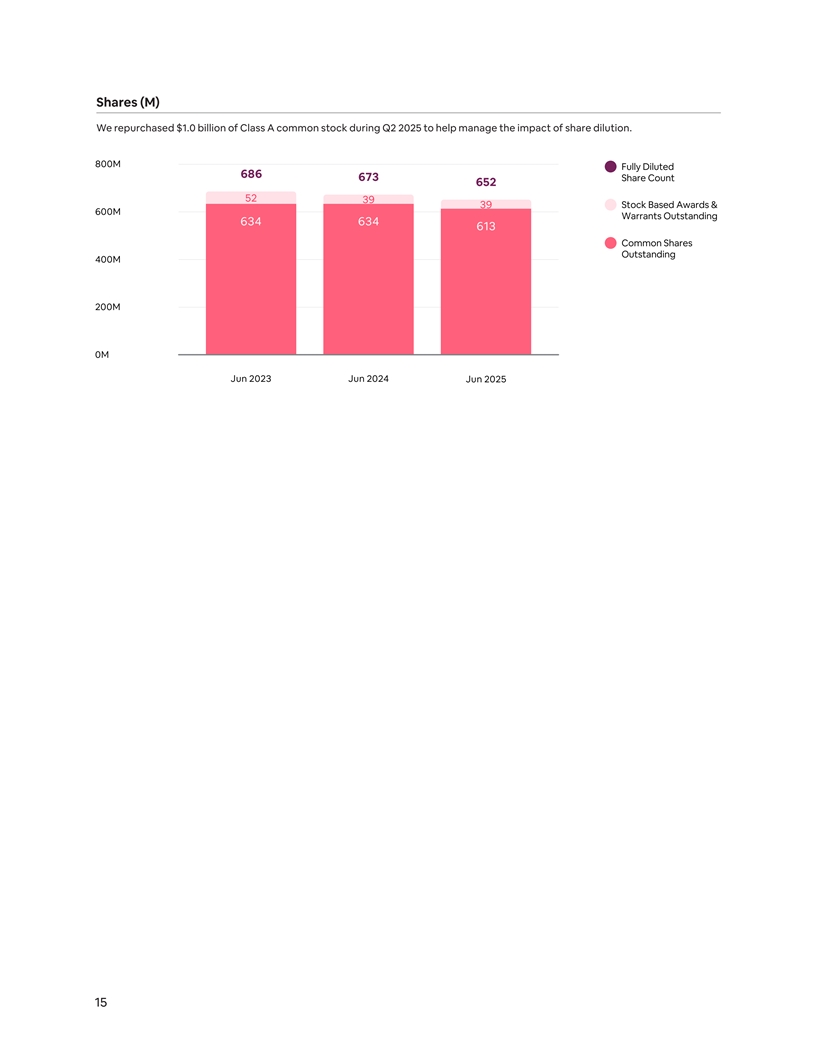
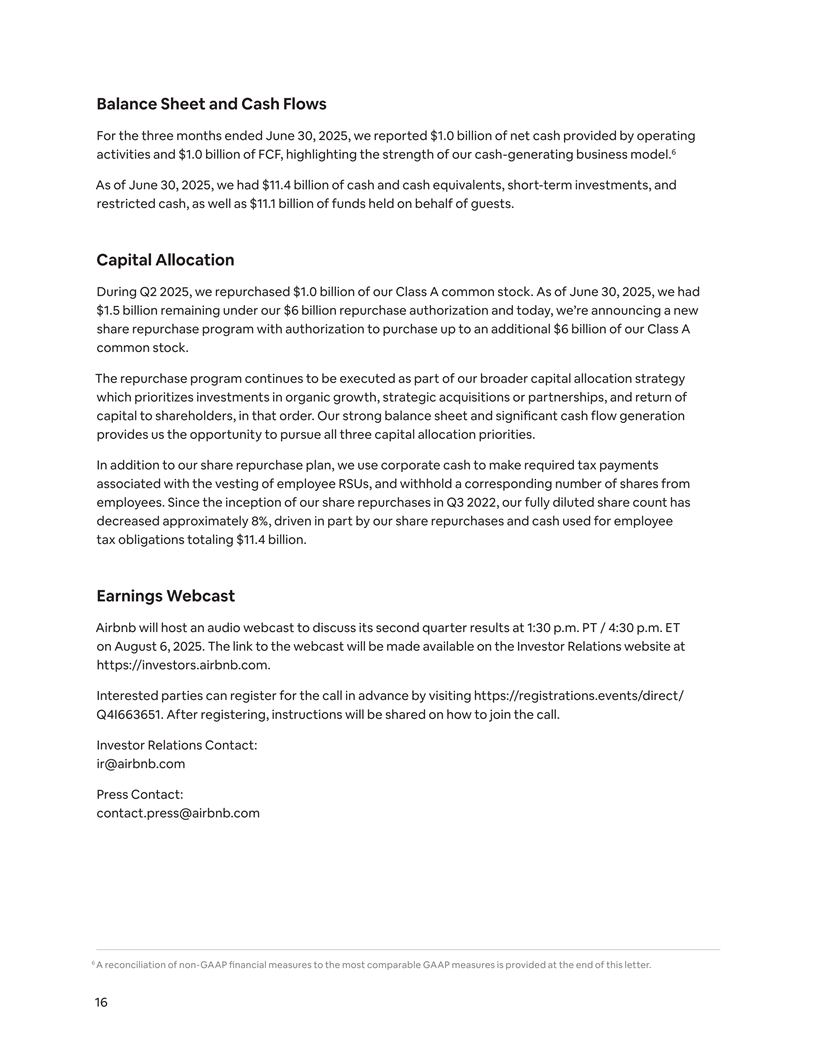
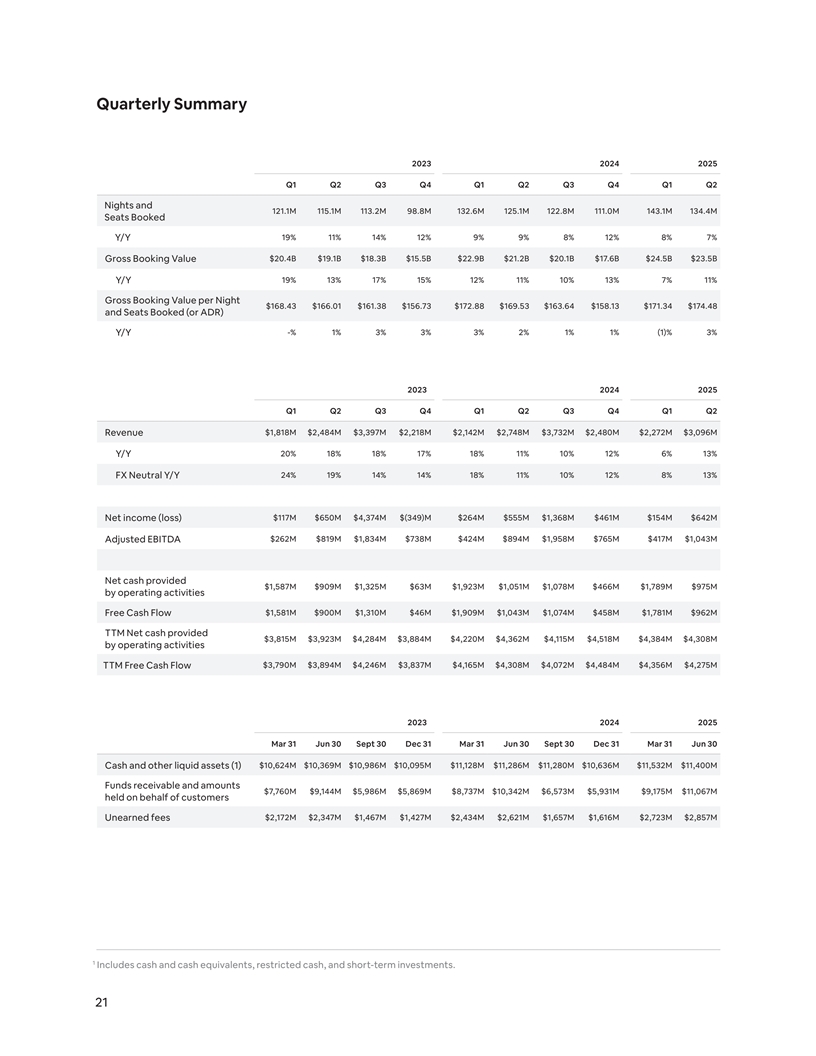
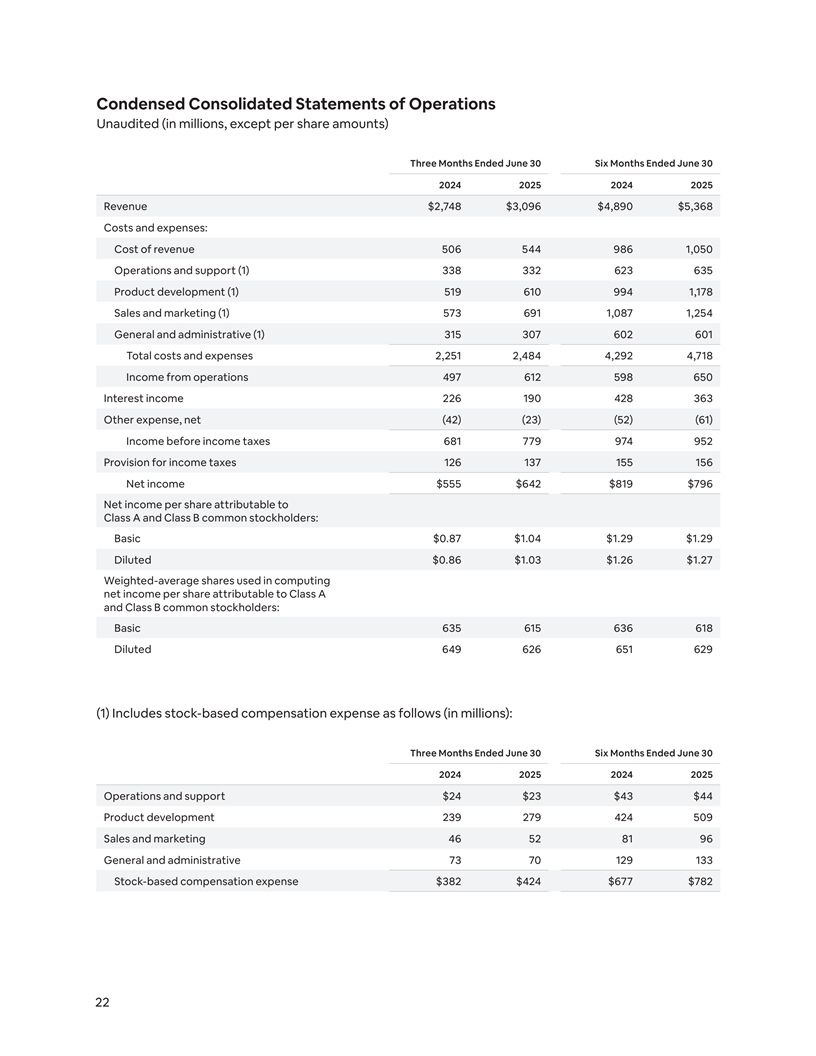
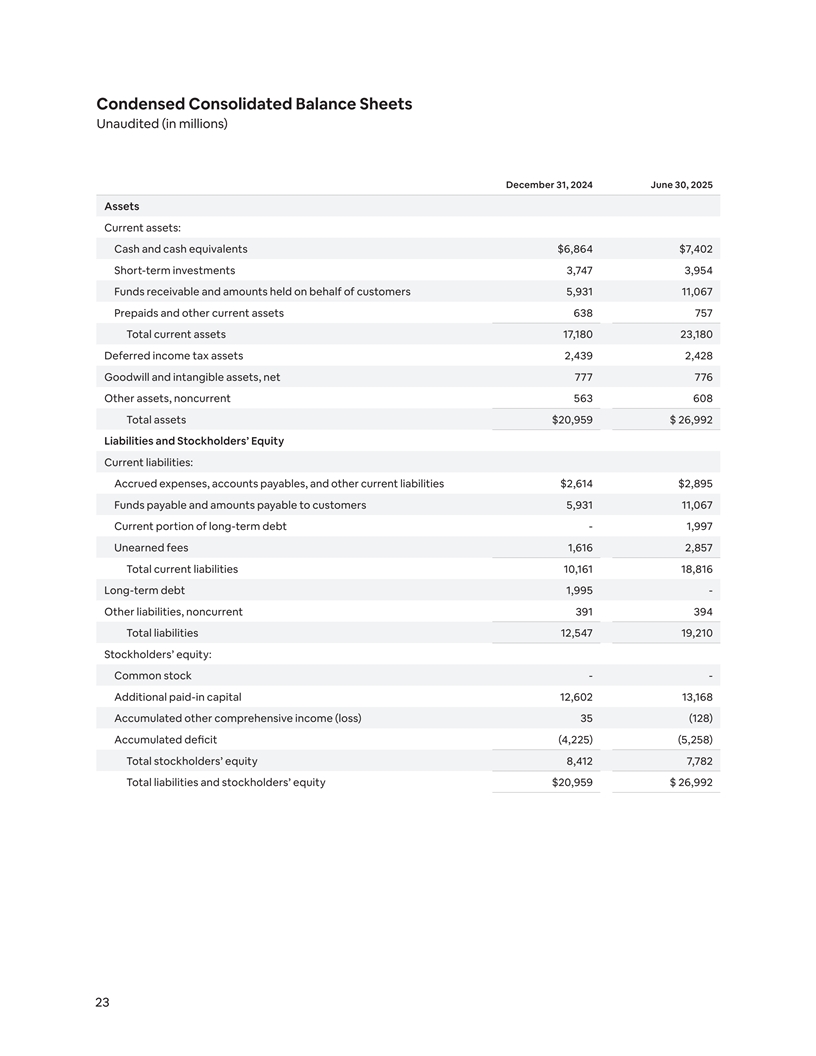
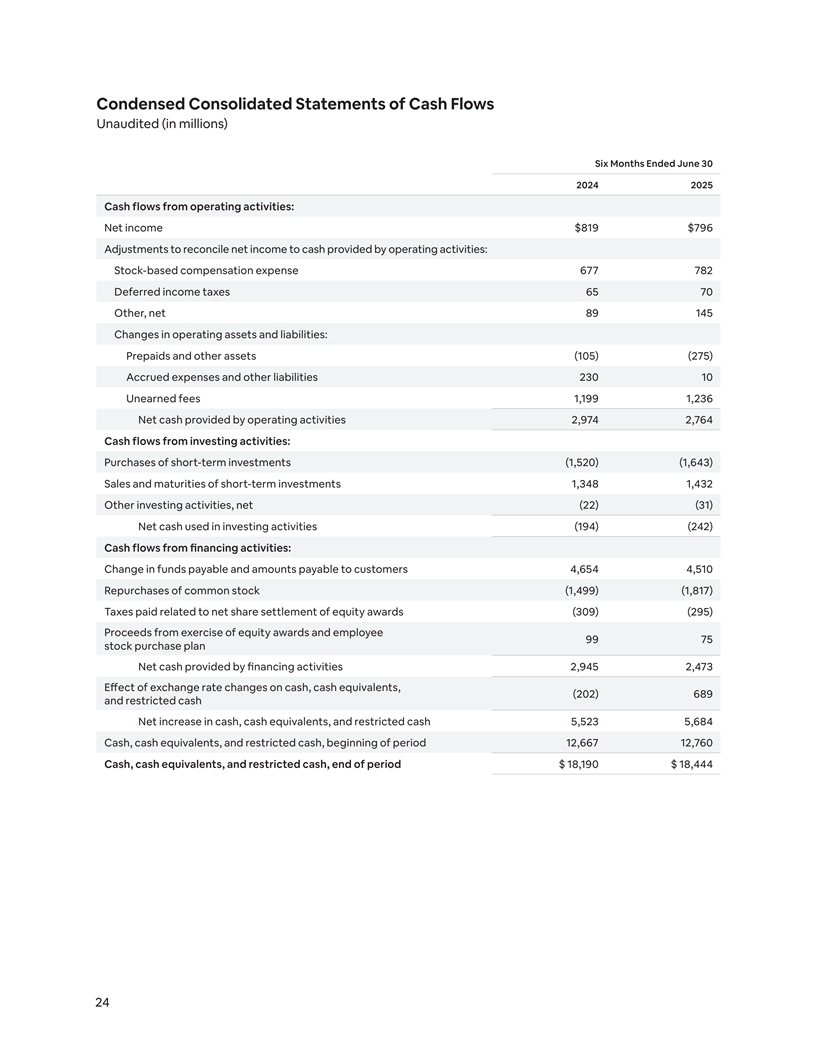
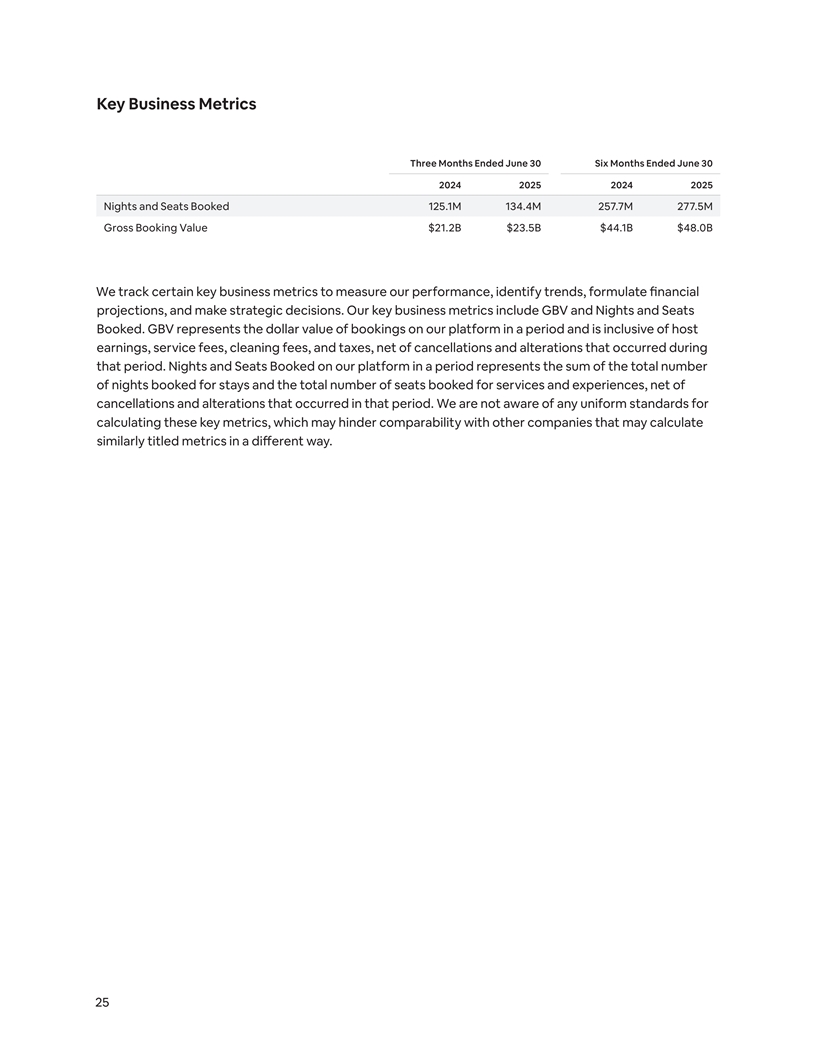
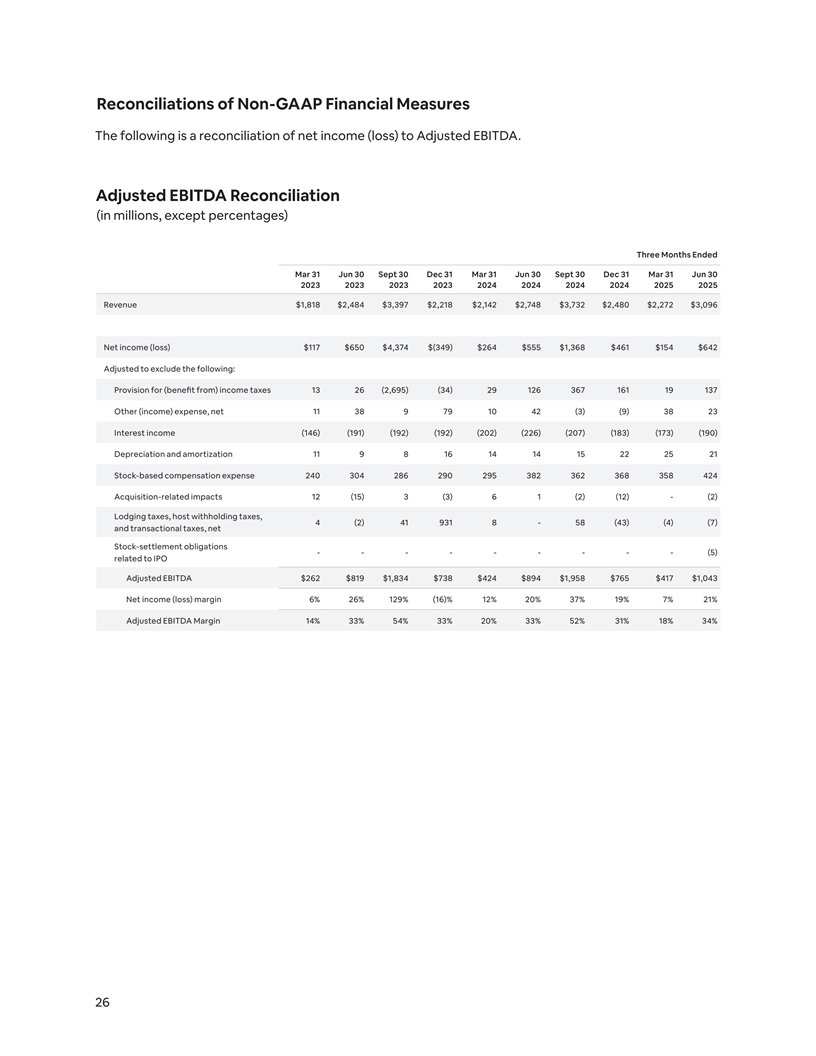
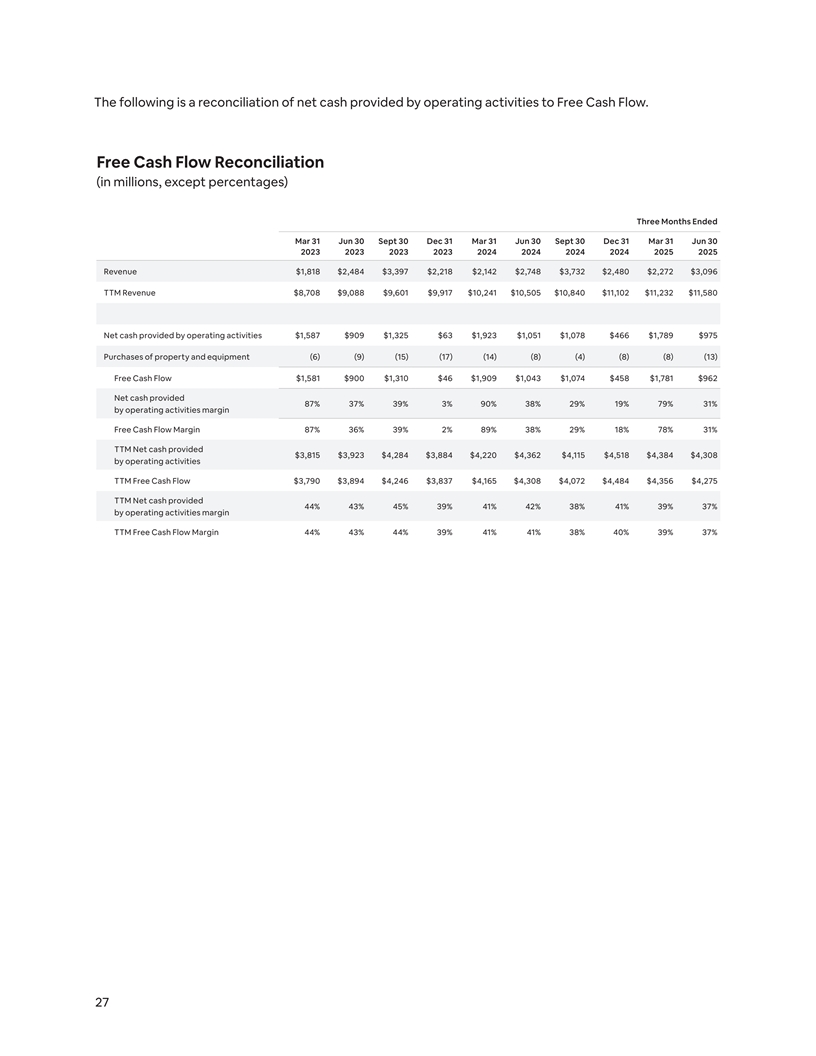
Thanks, Brian, and good afternoon, everyone. I'll start with a review of our Q2 financial results, and then I'll walk through our outlook for Q3. As Brian mentioned, Q2 marked another strong quarter for us. We had 134 million nights and seats booked of 7% year-over-year. We also saw an acceleration in year-over-year nights and seats booked with growth rates for May and June, both outpacing Q1. Looking at the growth rates by region, Latin America grew in the high teens, Asia Pacific grew in the mid teens, EMEA in the middle single digits, middle single digits, and North America in the low single digits. It is worth highlighting that nights and seats booked is a new metric that now includes the number of nights booked for stays, as well as the total number of seats booked for both services and experiences. Now turning to our Q2 financials, revenue for the quarter was $3.1 billion, up 13% year-over-year. In terms of profitability, we generated $1 billion of adjusted EBITDA, representing a 34% margin, up from 32.5% last year. And finally, net income of $642 million and EPS of $1.03 grew 16% and 20%, respectively. Next, I'll turn to our balance sheet and cash flow. We continue to generate significant cash in Q2, delivering $1 billion of free cash flow. Over the past 12 months, we've generated $4.3 billion, representing a free cash flow margin of 37%. At the end of Q2, we had $11.4 billion of corporate cash and investments, as well as $11.1 billion of funds held on behalf of guests. Our strong balance sheet allowed us to repurchase $1 billion of our common stock during the quarter, and we ended Q2 with $1.5 billion remaining on our repurchase authorization. And today, we're announcing a new share repurchase program with authorization to purchase up to an additional $6 billion of our Class A common stock. Now, since introducing our share repurchase program in 2022, we've reduced our fully diluted share count by 8%. Now, let me shift to our Q3 and full year 2025 outlook. As we look to Q3, we're encouraged by current demand trends, specifically the acceleration of nights booked from April through July. We've seen this momentum globally with especially strong growth in the U.S. That said, we do expect year-over-year comparisons to get tougher toward the end of the quarter and that this dynamic will continue into Q4, putting pressure on growth rates later in the year. Specifically for Q3, we expect to generate $4.02 billion to $4.1 billion, representing year-over-year growth of 8 to 10 percent. This includes minimal impact for foreign exchange after factoring in our hedges. We expect nights and seats booked to grow at a similar rate to Q2 2025 and for ADR to increase modestly year-over-year, primarily driven by FX. On profitability, we expect adjusted EBITDA in Q3 to exceed 2 billion, and we anticipate that adjusted EBITDA margin will be lower than in Q3 2024, primarily due to investments in new growth and policy initiatives. And we expect a similar year-over-year decline of adjusted EBITDA margin in Q4 2025 due to growth investments and a tougher year-over-year top-line comparison. For the full year, we continue to expect an adjusted EBITDA margin of at least 34.5%. This includes approximately $200 million of investment towards new businesses in 2025. While we don't expect meaningful revenue from our new businesses in the near term, we expect, or excuse me, we believe the opportunity is significant and are building with a multi-year view. To wrap up, our Q2 results reflect strong execution across our strategic priorities, perfecting the core, accelerating growth in global markets, and expanding beyond the core. We are acting with urgency and focus to drive growth of our core business and to scale services and experiences. And with our strong financial position, we are well-equipped to invest in the future in order to create long-term value for our investors. With that, I will open it up to Q&A.
We will now begin the question and answer session. If you'd like to ask a question, press star, then the number one on your telephone keypad. We ask that you please limit your questions to one. Our first question will come from the line of Mark Mahaney with Evercore ISI. Please go ahead.
Okay, thanks. I think I'll just like to ask about Airbnb experiences um and brian what have you seen so far what do you think would be success in terms of i don't know an attach rate like what's the what do you other other proxies or bogeys out there that you've seen other companies or in other industries with kind of the attach rate to a core offering that you think yeah that's where airbnb should be it seems to me like it's a natural you know cross sell or you know add-on but what's the goal and how long do you think it'll take to get there. Thank you very much.
Hey, Mark. Maybe I'll just zoom out and just talk about experiences and what we've seen so far. We're very, very impressed and satisfied personal awareness of Airbnb experiences. The biggest problem we've had historically, even with attach rates, people didn't know you even had Airbnb experiences. The launch generated over 13,000 articles, 660 million social media impressions. We've also seen increased visibility of our product through our newly redesigned homepage. And guests really love Airbnb experiences. We talked about, obviously, that they're significantly rated more highly than homes on Airbnb. There's a few things. I mean, attach rate, we're absolutely looking at. We don't have any numbers to share as far as what we see for potential attach rate. But we think that attach rate could be significantly higher for the completed reimagined Airbnb experiences than the prior iteration of the product. And the way we're going to do that is, number one, we need to make sure that we have resident supply supply that people really really like so we're making sure that we have great listings this includes airbnb originals um that are the very best experience on airbnb the next thing we want to do is make sure we have significantly greater entry points for the product so we've really integrated experiences into the core flow and the third thing is we're raising awareness about every experiences and we think this not only sells experiences but sells more bookings a couple other things i'll just share about airbnb experiences um you know we've had a huge amount of people wanting to list experiences on Airbnb, submit applications. And the other thing I'll just point out, Airbnb originals. 40% of bookings for Airbnb originals are from locals or people in the kind of local area where the booking occurs. So what we're seeing with Airbnb experiences is even though they're designed for travelers, we also do expect to start to see more local demand. So I think what we're going to see is over the next year, you're going to see us really focusing on honing in on the tax rate in key cities right now like one of the cities we're really focused on is paris it's a really popular corridor for the united states and we're really trying to see what we can do on attach rate in paris and a few other cities like that once we get that attach rate up that will give us a better integration of what's possible globally but i'm very very bullish i think a large percent of travelers on airbnb would love to use airbnb experiences thank you brian our next question comes from the line of richard clark with bernstein please go ahead.
Hi, good afternoon. Thanks for taking my question. Just want to unpick maybe a little bit of the guidance. What is the size of the headwind you're expecting in Q3, maybe from the events, the Paris Olympics? And you talked about that maybe continuing to Q4. So should we expect Q4 to be slower than Q3? And maybe in addition to that, you've called out three of your growth markets are now alive and kicking sort of Brazil, Japan, and Germany. Any thoughts what you think the sort of right midterm growth rate is now for Airbnb, given this sort of success in these newer geographies?
Sure, Richard. Let me talk a little bit about the trends for both Q3 and Q4, and then we can turn to global markets. Just to remind you, the comps that we're referring to from last year, you'll probably recall that at this time last year, we and others were seeing quite depressed bookings in July. And so right now, we're kind of comping a softer period from 2024. But over the course of Q3 last year, we saw a nice acceleration and exited Q3 at a much stronger rate than we entered. And so that's the pattern that we are comping directly right now. It was a couple-point acceleration over the course of the quarter. What I'll also call your attention to is the acceleration that we saw beyond Q3 through the end of Q4. So for our business last year, in Q3, we grew approximately 8% in terms of night's books. That accelerated over four points to over 12% in Q4. And so that's the acceleration that we're referring to in terms of the hard year-over-year So when we look at kind of the history of our data and seasonality on the platform, what we're seeing right now is that 2023 is a bit more of a normalized comp for 25. And so when we look at that year-over-two-year comp specifically to 23, what it implies is that the hard comp that we will face on a year-over-year basis in Q4 could result in a bit of decel from Q3 to Q4 on a year-over-year basis. and we just wanted to highlight that heading into the back half of the year. Your second question was around expansion markets. Obviously, we called out the real success we're having in Brazil, in Japan, in Germany, other places that I would call out that we didn't know in the letter. India is doing quite well. Rest of Latin America also doing quite well. What we've called out for some time with regard to expansion market strategy is that the composition of our business historically has been so concentrated in the core market that it will take a period of aggregated business mix shift for the elevated level of growth in the expansion markets to be a meaningful contributor to the overall consolidated totals. I think the good news is that the success that we have had in these expansion markets has already started to move the needle in terms of diversifying our global business away from North America. I would say just if you look on a year-over-year basis, the acceleration or the strength of growth that we've seen in Latin America has allowed Latin America to take about 200 basis points of business share within Airbnb from North America and therefore contribute more meaningfully to growth. So, you know, the intent of our strategy is to continue to invest in these markets, continue to gain market share in them, and as they grow as a percent of our overall business, the contribution to growth will commensurately grow as well.
Our next question will come from the line of Eric Sheridan with Goldman Sachs. Please go ahead.
Thanks so much for taking the questions. I'm curious about from a marketing perspective, as you continue to sort of reposition or position Airbnb as a brand globally and move into these areas such as services and experiences and new growth markets, what are some of the key learnings about the intensity of marketing spend that's needed to put these dynamics into the market and grow and scale them? And how might sort of the channels of those marketing investments continue to evolve when you think about looking out just beyond 2025 and more of a medium to longer term view about how you bring the platform closer to consumers? Thanks so much.
Yeah, Eric, I can start. We think that probably going forward, the best way to market services and experiences is to actually market the entire offering of Airbnb. So immediately upon the launch, we did launch some Airbnb experiences, specific ads. But this fall, we're going to be launching ads that market home services and experiences, the bundled offering. And we think this is a really, really key principle that only Airbnb offers all of this in one app. And so we don't think that the marketing intensity per se has to increase because we think we can get a lot more for our dollar by marketing all of our offerings. And it makes more sense, right? Airbnb in a sense is these aren't disparate offerings. If you book a home, you're very likely to want a service or experience. So we can market all three. The second thing is channels. So that's just the strategy. We think that the channels for services, experiences, and homes is increasing in the shift of social. Now, why is this going to be the case? Well, one of the things we're noticing, obviously, in the whole world seeing is that a lot of travel is switching from desktop to mobile and from Google search to social media. And so increasingly, people are spending time on social media. And social media is gradually taking over as the number one place for travel search from Google. And travel is becoming more of an inspiration base than a high-intense search-based destination platform. So Airbnb, we think, is really primed for social media. We are probably the most relevant brand for young American travelers. That is the kind of heart and soul of kind of the social media audience. And I think that you're going to see a lot more social media native advertising. So we're shifting a lot of our advertising from TV to social. And the great thing about social is we can target. We know a lot more about the customers. We know if there are Airbnb customers, we can actually, when they watch an ad, we can link it to inventory and get them to go directly to the app. So it's actually, we think, very, very performative. So this is what we're going to be doing with marketing.
Brian, if I could just add one comment to that. In terms of overall marketing intensity, the $200 million that we have highlighted in terms of investments behind experiences and services for 2025, it is not an increase in programmatic marketing. Our overall programmatic marketing for the year is relatively stable from a percent of revenue basis. Instead, the increase in sales and marketing that you see associated with services and experiences is focused in particular on our field operations, our go-to-market activities, and supply acquisition. It is not spending more to effectively advertise multiple brands. Instead, to Brian's point, we are spending behind a single brand.
Our next question comes from the line of John Colatoni with Jeffries. Please go ahead.
Great. Thanks for taking my questions. I wanted to ask one about experiences. I'm curious to get your perspective on the approach you're taking to building inventory and experiences. There's a lot of variability in the quality across the experiences industry. So I'm curious how you're approaching balancing building supply that's consistent with the differentiation of Airbnb's accommodations offering versus building more commoditized supply that's maybe easier to build scale around. Thanks.
Yeah, John, actually, we actually are managing the quality of experience and even more than managing the quality of homes. I think the evidence of that is two things. The input is that we actually um that every single experience on airbnb before it comes on the platform we do not vet every home that would be that every experience on airbnb the result of that is that the average home is got a 4.8 rating the average experience has a greater than 4.93 rating so we think this is working um now as far as scale um we actually think we can do this like quite effectively um we are working with a lot of third-party vendors we built a fairly sophisticated operation um to do vetting um you know we vet um through the first thing we do is we vet their profile make sure everyone's got a verified identity we've got their credentials there's a number of third-party sites we can do use for that and we also make sure they have right certifications and licenses which i think is really really important for all these nations different industries but we think we can be very very efficient with this vetting approach And we ultimately think that this could actually make the market more effective because quality is critical to customer satisfaction and building trust and people really trying something new on Airbnb.
Our next question comes from the line of Jed Kelly with Oppenheimer. Please go ahead.
Hey, great. Thanks for taking my question. Just on overall company strategy, how do you think about potentially implementing a strategy or acquiring a company that potentially could re-accelerate or re-accelerate your revenue, re-accelerate your nights versus building organically? Thank you.
Hey, Jed. We're always open to buying companies. We've purchased a few companies in the past. Our, you know, Hotel Tonight has been, you know, a successful application that we acquired a number of years ago before the pandemic. We've historically primarily focused on building organically, but, you know, we absolutely are open to acquisitions and we are going to be looking at it. And I think that we are now in a better place to consider acquisitions now that we've rebuilt our tech platform from the ground up and we have this new band of strategy where we're focused not just on all aspects of traveling, but also living. And so I think there's absolutely acquisitions on the table that we could be looking at. We always want to make sure that if we do an acquisition, it is one of the most perishable opportunities, that the integration costs don't outweigh the benefit of the revenue that we get. But we are absolutely opportunistic when it comes to acquisitions. I think we're more prepared to do them now than before.
The next question comes from the line of Colin Sebastian with Baird. Please go ahead.
Great. Good afternoon. Thanks for taking the question um brian you touched on this a little bit but curious if you have any more color on the impact or observations on on the way homes or nights are booked from the app following the redesign and and just one point of clarification from the release it sounds like booking lead times are now back to a normal level versus what you were seeing earlier in the quarter ellie if you can just confirm that thank you yeah hey cohen um what we're seeing um with homes is some pretty exciting patterns.
We're seeing a giant uptick in the number of people that are booking a home from the homepage on Airbnb. So this has been a major behavioral change from basically the last 17 years of Airbnb's history. So if you go to most apps, especially OTAs, you open the app and every single person goes essentially to the search box. They type in something in the search box and they enter a date and they get a bunch of search results. And this is how everyone searched for travel over the last 20, 25 years. The holy grail is to get more and more people to be in browse and discovery mode, almost like on Netflix or say DoorDash. DoorDash was very search driven. They're now more of a browse and discovery application. And it's been a really hard not to crack within travel, but we think we've done it because we've seen is that increasingly more and more guests are engaging, not just the service experience from a homepage, but with homes. Now, this is very strategic. Why is this strategic for us? The reason why is if people can engage with our homepage rather than typing in a destination, then we can divert travel more broadly to where we have available supply, thereby increasing conversion rate of our traffic, if this makes sense. So the more intent-based our traffic is, people have a very specific destination, very specific date, and if they're only going based on high intent, you're going to lose people that are either lower intent or people where you might have a home, but it's a little bit outside their search radius or a little bit outside their date that they're looking for. So this is one of the things that we've seen. We've also seen a lot more people engage with the new trip tab. Our trip tab is essentially our itinerary. And we are seeing a lot more engagement on the itinerary. And this itinerary is really important because this is the application that you use when you're on your trip. This is critical because if we can get people to use the application on trip and we can get co-travelers to use it on trip, then what we're really saying is we have this point of sale during the trip to cross sell other things. So, for example, one of the things we've seen with experiences and services is a lot of people like to book service experiences last minute, including people often like to book service experiences when they're on a trip. And so, you know, if we can get more people to open our app during a trip and go to the homepage and browse discover then this goes to um one of the kind of questions to ask earlier about how we cross sell for mark and get more people to book services experiences so there's been many other things that i could call out about the launch but that would be the key thing people are engaged on their app while on trip and they're engaged with their home page this is really really critical to booking more homes but also to cross selling services experiences and i just want to wrap by saying these are two things i don't think otas have cracked i don't think otas have cracked how to get anyone to scroll on their home page i don't think otas have cracked how to get people to use their app during the trip so i think that these are distinctly things that airbnb has started to open the door for our next question oh and i think there was a question ellie colin just your second question was about lead times um the question you know have they normalized compared to earlier in The answer is yes.
As you'll recall, back in April, lead times were heavily compressed. They were down about 7% year-over-year. Over the course of the quarter, as booking confidence rose, bookings accelerated, we saw lead times normalize, and then heading 8-23, they've actually lengthened a little bit compared to last year, which is a great sign in terms of booking confidence and overall guest demand.
Our next question will come from the line at the Justin Post with B of A. Please go ahead.
Great. A couple of questions, but I'm sure you would say there's still a lot of room to grow in the U.S., so maybe help us understand why the growth rate is in the single digits, how supply is growing, and how you might be able to accelerate that. And then on events and experiences, any thoughts on what you're hoping for or targeting for long-term attach rates on a per-trip basis? Thank you.
Yeah, Ellie, don't take it.
Brian, take the acceleration. Yeah, so when we think about the U.S., it is our largest market, but it actually has, we believe, a huge amount of room to grow. In particular, when we look at the U.S., it remains a heavily hotel-dominated market. So when we reference that, you know, one in 10 nights that are stayed outside the home are in an Airbnb, that is actually directionally true for the U.S. and is actually, you know, a lower percentage penetration in terms of short-term rentals than we see in other markets. So I think structurally, the U.S. has a huge area to grow. How are we going to drive incremental growth in the U.S.? It's really consistent with the strategies that we've laid out, in particular around perfecting the core. We know that there are some user gaps in terms of converting more hotel users to Airbnb guests, and those are the gaps that we're working to close. I think one is obviously pricing affordability. we've made some, I would say, great progress there in terms of little price display, better pricing tips, but there's, I would say, a lot more work to do to make sure that we are always, you know, the greatest value and are attracting a wide variety of U.S. demographics. Second, you know, another strategy that we've talked about for some time that we are seeing good results from is targeting specific demos that we are under-penetrated in. The two that we've called out and have made progress against are, one, the U.S. Hispanic population, and second, what we call the heartland states, you know, states in the middle of the country that we have historically had lower levels of penetration. And then I would say, more broadly, there's a series of things coming in terms of increasing usability, exploring more diversity of payment options that we think will be also incrementally accretive to the U.S.
Yeah, maybe I can just add on a little bit. You know, we think we're just scratching, just to kind of fall off of what Ellie said, I think we're just completely scratching the surface of the scale of home sharing in Airbnb. Why do I think this is the case? Well, let's look at supply and let's look at demand. On the supply side, we have around 10 million homes. I think we can have tens of millions more on Airbnb. When you ask people, why don't you put your home in Airbnb? The two most common reasons are, it's too much work, and like, aka, I don't have the time, or I don't want people I don't know in my home. Regarding it's too much work, you know, we found a lot of success with co-hosting. Co-hosting, just to remind you, is a marketplace where we connect the best hosts in Airbnb with people who have homes that don't have time to host. We now have 100,000 listings managed by co-hosts, they've hosted 10 million nights i think this could lead to millions and millions more homes on airbnb it's a very very successful program and we're prepared to scale this in the coming year so this should unlock a lot more supply regarding um people just being nervous about guests being in their home you know we're the only company that has a three million dollar guarantee called air cover that protects you against theft and property damage but we're also investing a lot more in trust and safety you know we have more than 200 million verified identities on airbnb more than almost any other platform of any kind on the internet and we're going to be investing a lot more on airbnb you know i think on a lot of other platforms you don't really know who the guests are oftentimes they don't even have accounts on our platform they're going to have rich profiles they're going to know a lot more about them so i think if we do these two things and then to ellie's point if we focus on getting more homes in our top markets where we're supply constrained we focus on quality reliability and continue to make progress on affordability, then I think we're going to look back and say that we're just scratching the surface of the growth of our core business in the U.S. I think the other thing I'll just say on growth generally is the following. You know, we are looking to re-accelerate the growth of Airbnb. We are not satisfied with a company growing approximately 10% year over year. We want the company to re-accelerate. We think we have a great plan to re-accelerate. The three strategic priorities we have, perfecting our core, expanding global markets, and these new products and services, they're all essentially starting from a small base, but they're going to be scaling, you know, and they're going to all pay off in different times, but we're, we have a lot of bets that are growing. We have services, we have experiences, we have hotels and Airbnb that are starting to We've got about eight countries globally that, you know, obviously Brazil has been a huge success story, but also Japan, we call that in the letter. We started marketing Japan late in December, November, December, we're starting to see real big growth in Japan. And so we're going to see a lot of these areas really pay off, I think, around the same time. And this is why I feel very confident this company can re-accelerate. And I do not think we're coming close to reaching any type of saturation in any market around home sharing. There's a huge amount of homes that aren't listed that could be if you make hosting easier and safer. And I think that, you know, one in nine people, you know, stay or one in 10 people stay in an Airbnb. If that was two in 10, that would double our business.
Our next question comes from the line of Doug Anmuth with J.P. Morgan. Please go ahead.
Thanks for taking the questions. Brian, I have two. There's been a lot of discussion on experiences. I was just hoping you could talk a little bit about the launch of services and just where you're most focused there across supply and building demand or just overall product. And then you talked about the opportunities and partnerships around major events. How did these help in terms of incremental bookings, but then also on brand and product awareness?
Yeah, I mean, on services, services are earlier than experiences, obviously, because experiences existed. We launched in 2016, and we basically reimagined it. Services is essentially 10 different businesses. I mean, every category of services is kind of like a different business. You know, photography is different than chefs. It's different than masseuses. So we essentially launched 10 categories, 10 different businesses and services. we launched them around the world. What we're really focused on doing right now is trying to crack it in a few key markets. Los Angeles, for example, is a market that we've been spending a lot of time on. We think it's a really great market to test services in. And what we're really trying to do is build out the catalog of these services and really increase the attach rate. One of the things I'm really excited about with services is about 10% of bookings for services are actually from locals or people that are nearby. Essentially, locals are people booking them in their own city. And I think there could be a huge opportunity for demand of locals booking services. Think about all the people that would let a chef come to their home that aren't traveling. So people that want a massage to come to their home, they aren't traveling. So I think there's a huge opportunity here. So we're going to be looking at attach rate in key markets and also the amount of locals that are booking as well. What we are seeing is that the satisfaction rate of services is similar to the satisfaction rate of homes from guests and it's higher than uh sorry similar to experiences higher than homes so it's around 4.93 for services versus 4.8 for homes so we're seeing a lot of promising traction but it's incredibly early and it's earlier for services than experiences so we expect this bet to play out over a longer time horizon i do think that services is probably a significantly larger opportunity than experiences because the 10 categories they launched are just the beginning. There are dozens and dozens of categories of experience you can book. Imagine getting to Airbnb and there's a catalog of services, anything you can imagine. I think this could be where we could take this product, but we're going to focus on getting these 10 to work in a few markets.
Our next question comes from the line of Trevor Young with Barley. Oh, sorry. Please go ahead.
Sorry. Sorry. Sorry. I did not answer the question about events. Can I just do that real quick? please go ahead um so yeah yeah sorry about that um with regards the second part of the question about events um you know first of all large events have been part of our history we launched for um you know during a design conference in 2007 then we launched the democratic national convention in 2008 and what we've seen with events is a couple things number one it's a great way to build supply in airbnb we had more than a 50 percent increased amount of homes in paris on airbnb because we hosted um for the olympics we were a sponsor for the olympics and they need housing for events so we think this is really really strategic to getting supply in cities and a lot of people that have no intention to become long-term hosts become hosts just once for an event and what we've seen is events are a great hook to get people that have no intention to becoming long-term hosts to try it and then a bunch of people actually continue hosting because they said, actually, that was a great experience. So events are kind of like a low commitment, high urgency way to get people to try hosting. And what we found is a number of people continue to host. In fact, this is the entire premise of how the company got started. So that's the first thing is a great way to build supply. The second thing is a great way to build relationships with policymakers, regulators, and increase trust in the brand. For example, Italy is a very strategic market for Airbnb. We've certainly had some regulatory challenges in the past in Italy, but Italy, Milan is hosting, Cortino are hosting the Olympics next year. We were able to make a lot of progress with Italian policymakers because we're partnering with them on the Olympics. We're a title sponsor. We're providing housing in Milan. They don't have enough housing. They certainly don't have enough housing in Cortino, so we're able to support them. FIFA World Cup is going to be probably one of the largest, if not the largest event in human history. Think about it. The World Cup is the largest event in the world. This might be the largest World Cup ever. And where are all these people going to stay? So we're now working with cities all over the United States, U.S., Canada, Mexico. And this, I think, has been a gateway to open relations to regulators. The final thing is I think it just increases our trust in our brand by associating to the Olympics, the Tour de France, the World Cup, Lollapalooza. We're connecting Airbnb with some of the most beloved brands and some of the most passionate fan bases and passionate interests. I think Airbnb is such a perfect partner for these events because many of the events couldn't happen in the same scale without Airbnb. Tour de France, for example, there aren't very many hotels along the route, but there are homes. So I think events are just a great part of our strategy, and we're going to continue to do a lot more of them. And they're really part of our roots. So the key question is how do we industrialize this strategy? And this is something that we're going to be continuing to focus on. And maybe the only other thing I'll just say is now that we have homes, services, and experiences, the partners are serving more efficient because we have more things to cross promote.
Our next question comes from the line of Trevor Young with Barclays. Please go ahead.
Great. Thank you. First one on the 200 million investment baked in the full-year EBITDA guide. Was there a change in expected spend there? I think last quarter you said it was $200 to $250 for the new 25 business launches, and now you're saying $200 just for services and experiences. So just wondering, should we interpret that to mean there are no other launches this year, or is there a 50-year mark for something maybe to be announced? And then second question, just on the change in definition on nights and seats booked, Can you just level set how much of that today is actually like experiences and seats versus stays? Is it 1%? Is it essentially zero? Investors always ask, you know, what's kind of the breakout of that mix?
Yeah, so let me comment on the $200 million investment. So at the beginning of the year, we gave a range of $200 to $250 million for our new businesses. We have launched those new businesses. It was the reimagined experiences and services. We're obviously more than halfway through the year. and so we've just refined the estimate in terms of the the total investment there's there's no change to strategy um or you know a incremental business that is that is truly focused on uh experiences and services we wanted to give you an updated number uh now that we have more visibility in terms of nights and seats booked we have not historically broken out um nights books versus experiences books we we are not going to do that uh today what i can tell you is that um The seats booked today are indeed immaterial. The intent, obviously, with the launch and our investments here is to scale those businesses such that they are a material contributor to the total.
Our next question will come from the line of Brian Nowak with Morgan Stanley. Please go ahead.
Thanks for taking my question. I wanted to come back to the U.S. room night growth, and I was also going to end me a little bit. So I guess if we look at the U.S. growth on room nights, excluding services and experiences, Brian, can you just sort of talk us through the one or two key priorities in your mind to sort of accelerate that growth into 26? And the same question on EMEA, you know, I think you're growing slower than even your more scaled competitor in EMEA at this point. How do you think about sort of the keys to driving faster growth in EMEA as you go into 2026?
All right, so I'm sorry, the question was, the first question was about US, a core market.
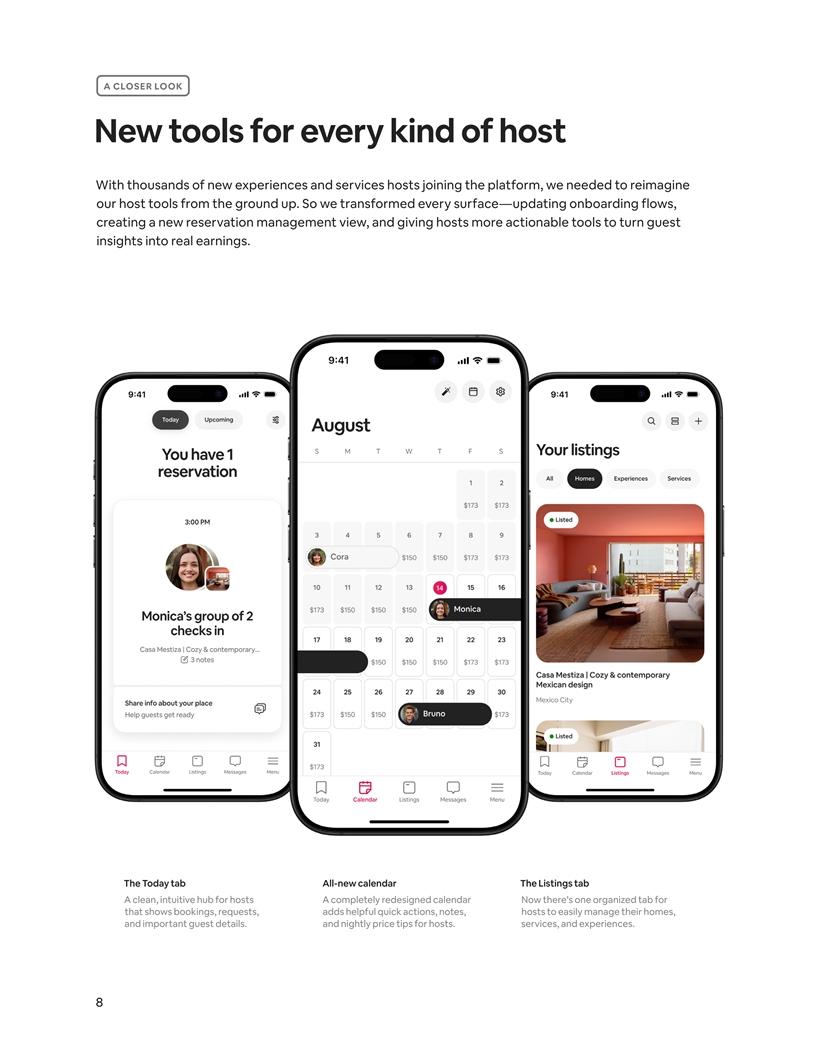
Yeah, yeah, I think that there's really a few pillars. So one that we've seen a lot of traction on is making Airbnb easier to use. We've made hundreds of improvements. We highlighted a bunch of them on the most recent release, and that has led to hundreds of millions of dollars in incremental revenue. So we've made a lot of traction, a lot of progress around making it be easier to use. I think pricing and affordability is the next one. We are seeing a huge opportunity around increasing competitiveness of pricing on Airbnb. You might notice that we've moved to total price display. That's been very successful. We're now exploring different ways to present pricing, moving towards a host-only fee. We're doing a lot around giving hosts more tools to make their listings more competitive. We announced a new calendar on the May launch that has better price suggestions. We're seeing hosts adopt that. When hosts adopt that, they have more competitiveness. When they have more competitiveness, they earn more money. That's accretive to our business. So I think pricing is going to be a huge opportunity for us. And then I think increasing supply. And the way we're going to increase supply is we're not going to be looking at just the overall top line supply globally. We're focusing on our most supply constrained markets and really targeting adding supply in those markets. Additionally, you know, people looking for homes, if we don't get that home, we want to be able to have a place for them to stay. So we're also going to be increasing the onboarding of hotels, especially in supply-constrained top markets as well. So I think these are some of the things you're going to see that are going to absolutely be able to help accelerate growth in the United States.
Our next question comes from the line of Justin Patterson with KeyBank.
Please go ahead. great thank you uh going back to some of the 200 million investment you were talking about but all that sounded like people costs for this year as we head into 2026 how should we think about that uh cost potentially scaling up do you feel like you have the right number of people in place right now to keep stealing experiences and services or is that something that's going to kind of keep adding to to bring on more supply. And then just from the marketing standpoint, you know, we'd love to hear about how you're thinking about using performance marketing a bit more, perhaps search to augment sort of the broader brand campaigns for the overall business. Thank you.
Yeah, so Justin, on that $200 million, yes, indeed it is. A good portion of it is head count split across both product development as well as our field operations team, as well as some investments in terms of vendors helping us curate and onboard the new supply. When we think about scaling the investment over time, I'm not going to give a particular figure for next year, but what you should assume is that we will continue to invest in 26 behind these businesses in order to scale them. Some of the investments this year will carry into next year as fixed headcount that we've brought on to support these businesses. In terms of the second question, Brian, let me know if you want to jump in here. We continue to use performance marketing as a, I would say, surgical topper to the majority of our spend being in brand. We've talked about this quite a bit over time. Our strategy in terms of the marketing channel mix is obviously quite a bit different from others in that we're able to benefit from the strength of our brand and the singularity of our brand to put money in a larger allocation of our marketing spend behind brand versus performance. That being said, we do continue to use performance surgically across the world to get good returns on those incremental nights. And I would say the overall intensity as compared to competitors remains relatively low in that, you know, the metric that we've shared over the years, 90% of our traffic coming from direct and unpaid sources continues to be the state of the business, which allows us obviously to spend a lot less on performance marketing than others.
Our next question comes from the line of Ron Josie with Citi. Please go ahead.
Great. Thanks for taking the question. I wanted to follow back up on the experiences side, Brian, and ask about the merchandising, given the Airbnb knows who's traveling, when you're traveling, the age of the people traveling, et cetera. You talked a little bit about the test and learn of experiences in cities like Paris. So help us understand as you see just applications continue to balloon for experiences, how you can scale the learnings in Paris to better merchandise overall. And then just as a follow-up, you know, we've been talking about loyalty programs for some time and how the goal is for Airbnb to launch one that's differentiated, not just a points program. Any updated thoughts on this would be helpful.
Yeah, absolutely. With experiences, you know, we are doing a lot around testing carousels. If you open the app right now, you go to the experiences tab, you'll see that we merchandise totally differently. These smaller cars, the different carousels, and the carousels are going to get more and more personalized. So as we know more about you, we might know where you're coming from, what kind of price homes you're searching for, which experience you recently viewed. And the basic idea is to show you a high-density amount of experiences that you're very, very interested in potentially booking. And I think also increasing the touch points. So we're going to have the homepage. We're going to open right to the homepage if you're on trip or post-booking on homes. We're going to have other entry points through the trips tab where we're merchandising, highlighting. And we're really just, you know, we're going to be doing a lot around making sure that we can continue to pull hooks in to get people to see the right type of experience on Airbnb. And, you know, we're obviously, if we figure something out in one city, we can immediately roll it out to every city globally that we have the product in. So we think we can do quite a rapid iteration. We have a team in Paris right now. I sent up a team of product development leaders, designers, engineers into the city to really do really, really tight feedback loop and to figure out the kind of supply that people really want. And we're really doing a lot with testing ranking to figure out how to make sure that the right people see the right supply and they'll get. I think that was the first question. The second question was I think around loyalty. I think, you know, a loyalty or membership program is a very, very compelling thing for Airbnb. I mean, number one, one of the great things about our business is we have loyal customers. The vast majority of our customers come back direct to Airbnb, hence why 90% of our traffic is direct or unpaid. It's because the majority of our bookings come for repeat bookers, and we don't have to pay them to come back. So the best loyalty, of course, is to have a product people love. That being said, I do think we're sometimes at a competitive disadvantage vis-a-vis OTAs and hotels, because they have a lot of programs we don't. So I think there's a lot of upside if we were to have a program. If we were to do something, I don't think it would be a traditional points program. I think it would be something much more interesting and novel, but I absolutely think you should see something from us in the future, not imminently, but in the future.
Our next question comes from the line of Steven Ju with UBS. Please go ahead.
Okay, thank you. So, Brian, I wanted to follow up on your commentary on the TRIPS tab, because from a design perspective, since it is an itinerary, the optimist in me wants to believe that Airbnb will be and should be taking a greater role in the aggregated door-to-door travel experience. So, you know, are we wrong to think that the expanded travel agent opportunity here? I mean, I realize that, you know, you just launched experiences, so asking you what's next, you know, probably sounds a little bit demanding, but sort a bigger picture of what the itinerary can evolve into will be interesting. And secondarily, there was a commentary in the letter regarding the new payment methods in Brazil.
Do you think the experience that you've picked up from doing this initial batch of expansion countries will help you speed up the product development and the cadence of updates for you know what must already be the next batch of view market thank you yeah i mean i think i can answer both and maybe i'll start with the second because it's kind of tactical um you know we are massively wrapped um ramping up development of product development pace at airbnb you know we do these typically biannual releases but we are now iterating very very quick even between these releases so you're going to see uh in i think the brazil installment has been a huge example of something that's been really powerful. PayZero upfront has been very, very successful. We have an updated cancellation policy that's rolling out that's going to be successful. We think it's going to be accretive to growth. So we have a real huge amount of momentum around a lot of optimizations. I think we got a great flywheel. With regards to trips tab, the itinerary product development, maybe this is an opportunity to talk a little bit more about the long-term product vision and where we're going. And we couldn't talk about long-term product vision without talking about AI. I haven't been asked about it, but I might as well talk about it because I think you can't do travel planning without AI going forward. We've chosen a very specific way to approach AI. A lot of companies have chosen what I would say is the lower stakes part of travel, which is travel planning and inspiration. For AI, we actually started with the hardest problem, which is customer service. Customer service is the hardest problem because the stakes are high, you need answers quickly and the risk of hallucination is um very very high and you cannot have a high hallucination rate and when people are locked out they want to cancel reservation they need help you need to be accurate and so what we've done is we built a custom model or we've built a custom agent built on 13 different models that have been tuned off of tens of thousands of conversations we've rolled this out throughout the united states in English. And this is reduced, as I mentioned in the opening remarks, 15% of people needing to contact a human agent when they interact instead with this AI agent. We're going to now, over the course of this year, bring this to more languages. And throughout next year, it's going to become more personalized and more agentic. So what this means is that when you reach out to an agent, the AI agent, it will not only tell you how to cancel your reservation, it will know which reservation you want to cancel it can cancel for you and it can be agentic as in it can start to search and help you plan and book your next trip next year we're going to bring ai into travel search so all this brings us back to the question you asked about travel planning over the next couple years i think what you're going to see is airbnb becoming an ai first application and this leads to the bigger question around ai over the last almost three years um since ChatGPT's been out, if you look at the top 50 apps in the App Store, almost none of them are AI apps. The number one app in the App Store, I think, as we speak, is ChatGPT. And if you go through two through 50, maybe only one or two others are AI native applications. So you've got basically AI apps and kind of non-AI native apps. And Airbnb would be a non-AI native application. Over the next couple of years, I believe that every one of those top 50 slots will be AI apps. either startups or incumbents that transform into being AI native apps. And I think at Airbnb, we are going through that process right now of transitioning from a pre-generative AI app to an AI native app. We're starting a customer service. We're bringing into travel planning. So it's really setting the stage.
Our next question will come from the line of Kevin Koppelman with TD Cowan. Please go ahead.
I appreciate it. I wanted to ask, could you give us your first thinking on the, and this is a bit of a follow-up perhaps, on the one to two major product launches that you're thinking about for 2026? Key focus areas is the AI travel search you just mentioned, one of those major product launches. And how are you planning to manage overall company margins next year? Thanks.
This is the opportunity to repeat your question. We've had some audio issues.
Yeah, we just got dropped on the call. So I don't think I was able to finish my answer, but should we just go right to the next question? Okay, sorry. So can you ask the question again? We're really sorry. We both got dropped on the call. Yeah, no worries.
Okay, great. Yeah, so I wanted to ask, and it may be a follow-up to what you were just talking about, your first thinking on the one to two major product launches for 2026 key focus areas is the ai travel search you just mentioned uh one of those major product launches and um how are you planning to manage overall company margins uh next year taking into account the new launches and also the continued investment in experiences and services thanks yeah well you know generally we don't talk about or preview what we're going to launch when, but we are bringing AI more into the app next year, so we can confirm that, but we're not going to be able to preview what will
be and what's launched. So, I'll let Ellie, though, talk about the second part.
Yeah, on margins, I'm not going to guide right now to 26. What you can assume is that we are, one, continuing to invest in our new businesses, and two, continuing to drive efficiencies across the core business. will give you color in upcoming quarters in terms of how that nets out with regard to sequential margins.
Okay, I understood. And maybe just a quick follow-up. When you talked about accelerated development pace, is the new tech stack that you rolled out in May playing a part in that? And are you seeing also benefits to customer conversion rates from what this new tech stack is enabled. Thanks.
I would say yes, absolutely. The new tech stack, we are seeing benefits from that. I would say more broadly, the investments we've made across our infrastructure over the last couple of years has really improved the development environment for our team, allowing them to do more and to do more quickly. Obviously, that is increasingly aided by AI as well. And so we hope to see an increased velocity across our product development roadmap in coming course.
Our next question comes from the line of Ken Gorelski with Wells Fargo. Please go ahead.
Yes, thank you. Two, if I may, please. And you build on some of the other questions. First, Brian, on the AI side, do you anticipate there seems like there's going to need to be a choice made whether to be open to agents and kind of agentic traffic and who will own that relationship versus being more of a closed platform. And given that you have much of your traffic today is direct and that you have a lot of exclusive supply, you probably have your choice in the matter. So I'd love if you could talk a little bit about that. And then second, maybe again, bigger picture on strategy, you're operating against a $90 billion booking space. And it seems to me that as you go into things like experiences and services, it's tough to move the needle. I can understand the ancillary benefits, but it's tough to move the needle. I guess the question is why you don't go really double down on accommodations in the hotel space, at least in your core five markets where 70% or so of your bookings are. Thank you very much.
Yeah, I don't think it's either or. We are doing that. we're going to be going significantly more aggressively into hotels um you know we've we've spent a lot of time looking at um hotels as a business we think it's really compelling and we think that there's going to be a lot more to do with hotels on airbnb our take rate is very very competitive we've spoken with hotels around the world especially independence boutiques in bed and breakfast a huge percent of hotels in europe are independents and one of the things i said is they really want incremental travelers they'd never have another booking channel. They would love to have high-income American young travelers. We're probably the biggest travel brand in the United States. So I think we're really, really compelling. And, you know, when we have, you know, I think homes and accommodations, our homes will be the heart and soul of Airbnb. But that being said, in our top markets, top markets, especially during high season, people often don't find a home. We think hotels would be a great supplement. And so I think there's a huge amount of growth there. Long-term stays, you know, a large percent of our nights booked are for stays a longer 30 days. We think there's a huge market there as well. Gardening back to service experiences, you know, I think each of these could easily be a multi-billion dollar business. And then the holy grail for services is if we could tap into local demand. If we didn't tap into local demand, then it's not an ancillary service. It's a standalone service. And there is no Amazon for services, not to say we will become that, but there's a lot of opportunity there. So it's an and, not an or. What we're trying to do is build a platform, A platform that has homes, services, experiences, hotels, of course, and much more. And we're going to try to be expanding this platform and continue to launch new businesses over and over again. I think the other question was – sorry, what was the other question?
Sorry, my question was on AI, whether – Oh, yeah, sorry, AI is a big traffic.
Yeah, I think we're still kind of feeling out the state. I think the thing I want to caution is I don't think that AI agents, I don't think we should think of chatbots like Google. I don't think we should think of them as the new Google yet. And the reason why is like ChatGPT is an incredibly compelling product, but we also have to remember that the model powering ChatGPT is not proprietary. It's not exclusive to chatubt we airbnb can also use the api and there are other models that we can use so as i said in the coming years you're going to have a situation where these large ai models can take more and more a lot more and more things will start there and people won't often go to one chat bot to do more and more things at the same time you're going to also have startups that are going to be custom built to do a specific application and you're going to have incumbents that make the shift to AI. You know, one of the things we've noticed is it's not enough to just have like the best model. You have to be able to tune the model and build a custom interface for the right application. And I think that's the key. And the models are not proprietary. I mean, every company that makes a model is selling the model or open sourcing the model in addition to using themselves and so i think that the key thing is going to be for us to lead and become the first place for people to book travel on airbnb as far as whether or not we integrate with ai agents i think that's something that we're certainly open to remember that to book an airbnb you need to have an account you need to have a verified identity almost everyone who books uses our messaging platform so i don't think that we're going to be the kind of thing where you just have an agent or operator book your airbnb for you because we're not a commodity but i do think it could potentially be very interesting lead generation for airbnb so i think it could be really interesting but i don't think it's like a commodity like booking a flight i think that's it i think we're over time so yes i'll turn it back to you brian for closing remarks all right well thank you everyone very much um for joining us today i'm incredibly proud of the results and momentum we've built the launch of service experiences really marks just the beginning of new chapter fairbnb and what excites me most is that we are just getting started Good morning, and see you next quarter.
That concludes our call for today.