Operator
Hello, and welcome to the Hamilton Insurance Group Earnings Conference Call. As a reminder, this call is being webcast and will also be available for replay with links on the Hamilton Investor Relations website. I'd now like to turn the call over to Daria Niferatos, Vice President, Investor Relations and Finance. Please go ahead.
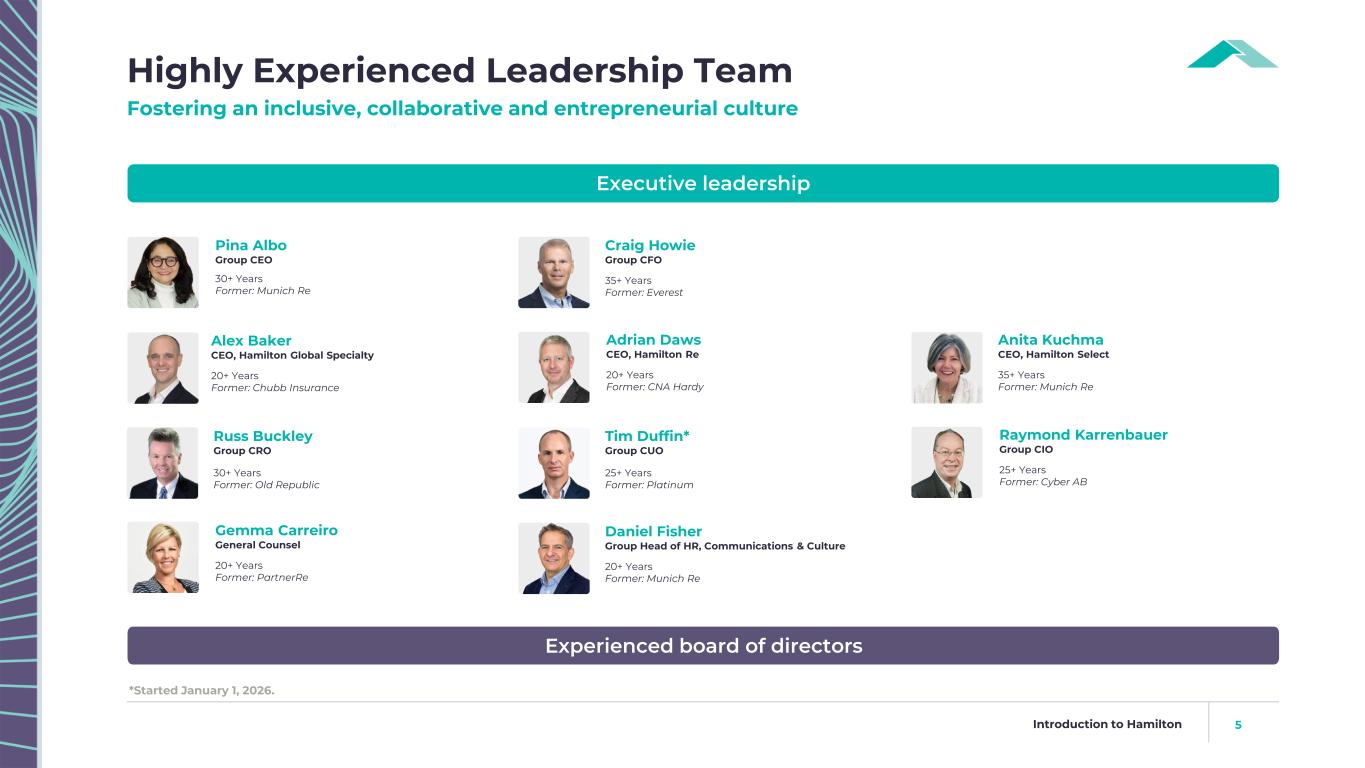
Thanks, Operator. Hi, everyone, and welcome to the Hamilton Insurance Group 4th Quarter 2025 Earnings Conference Call. The Hamilton executives leading today's call are Pina Albo, Group Chief Executive Officer, and Craig Howey, Group Chief Financial Officer. We are also joined by other members of the Hamilton management team. Before we begin, note that Hamilton financial disclosures, including our earnings release, contain important information regarding forward-looking statements.
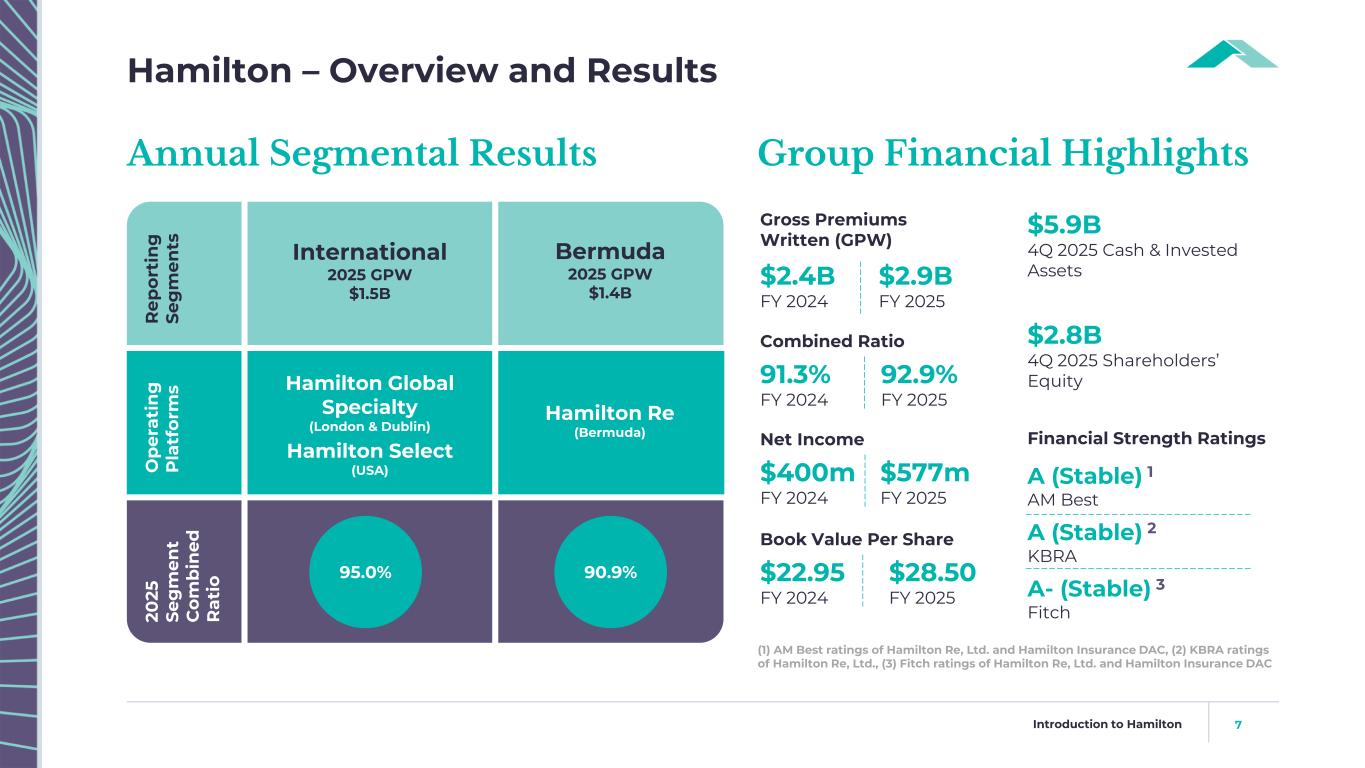
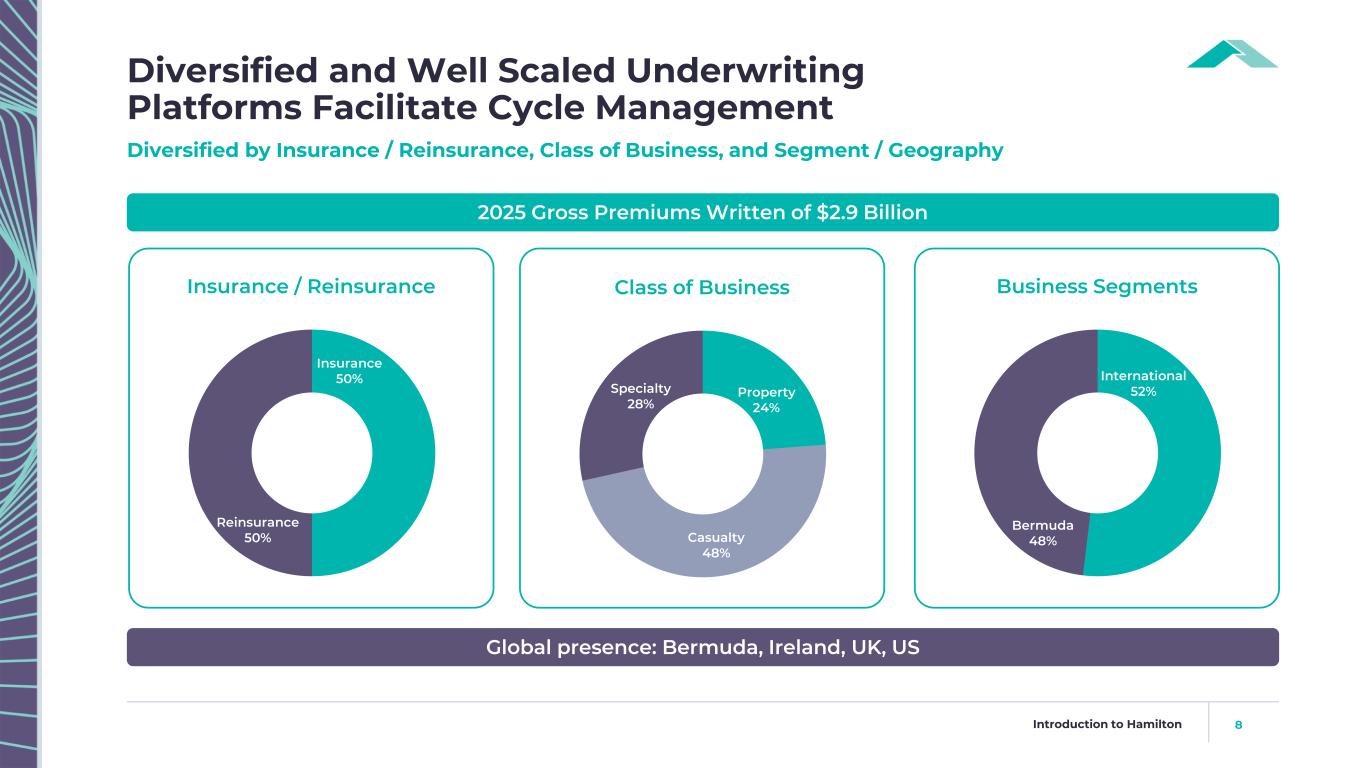
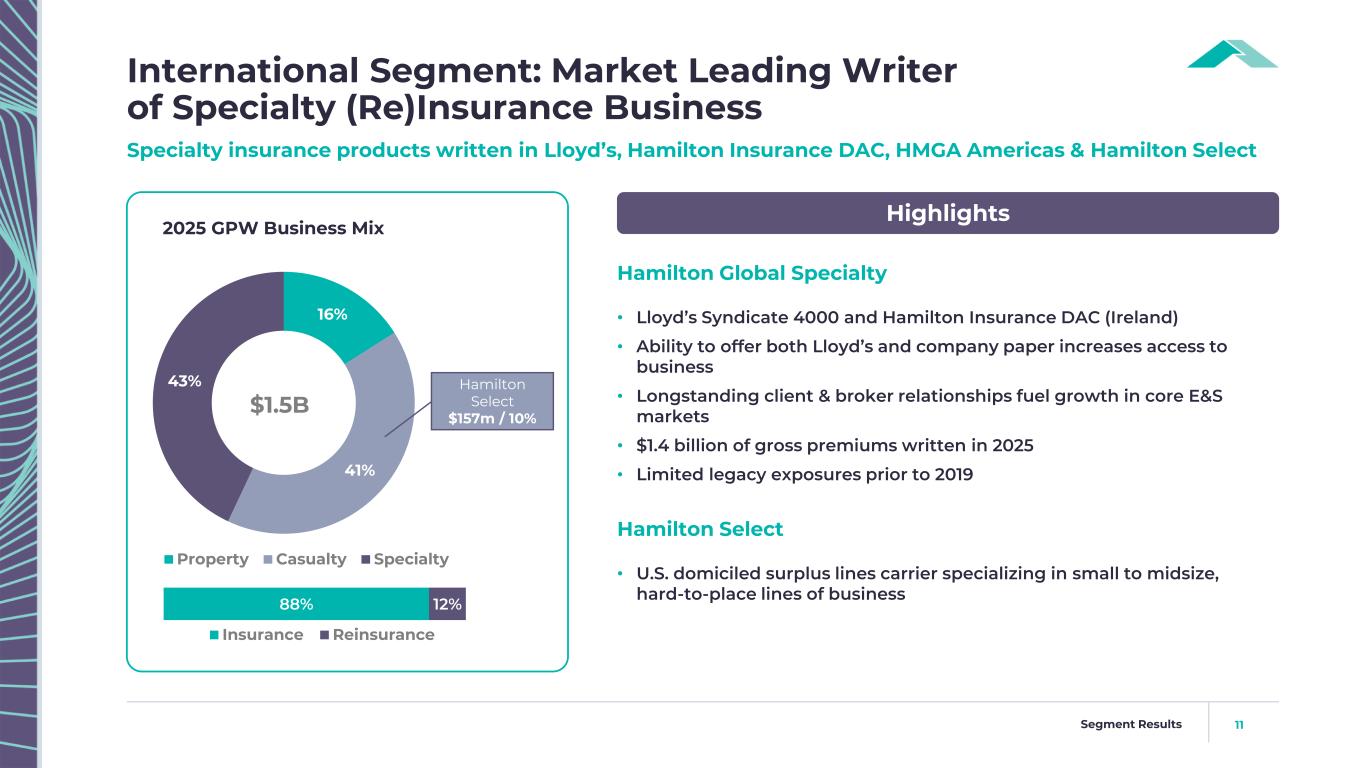
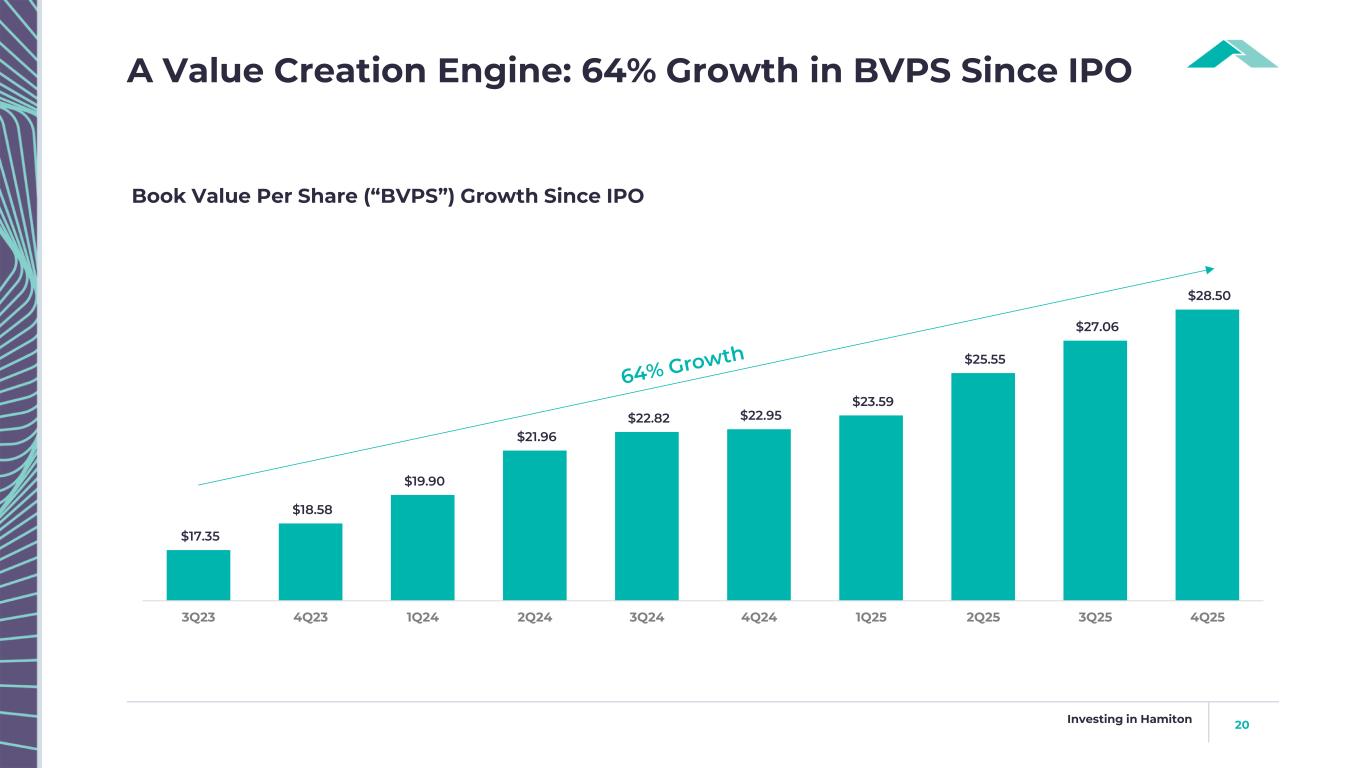
Management comments regarding potential future developments are subject to the risks and uncertainties as detailed. management may also refer to certain non-GAAP financial measures these items are reconciled in our earnings release and financial supplement with that I'll hand it over to Pina thank you Dorian hello everyone and thank you for joining us as we begin today's call I want to take a moment to reflect on how far we've come at Hamilton we've been a public company since November of 2023 and since then, we've delivered consistently strong results, results that allowed tangible book value per share to grow 67% since the IPO. That's a remarkable achievement by anyone's measure. With that intro, and before I share more details on our quarterly results, there are three key drivers I'd like to point to that underpin the sustainability of our performance. First, the Hamilton team, namely our strong operational and underwriting culture. Our underwriters are technical and experienced in cycle management, leaning in when and where rates, terms, and conditions are attractive, and leaning out when and where this is not the case. This approach has allowed us to post another year of record performance in 2025, so kudos to you, Team Hamilton. Second, our success is rooted in relationships, namely those we've built with clients and brokers across our hybrid platform. For reinsurance, our key client strategy, which involves supporting targeted partners across multiple lines, has created broad and resilient trading relationships, allowing us to secure the signings we target even in competitive environments across our insurance platforms our specialized product offering and technical expertise serve as strong differentiators positioning us well with our producers and last but not least our strong capital position our balance sheet remains robust with low debt leverage, prudent reserves, and strong financial strength ratings, all of which support our business and our performance. Now let me move on to our results. In 2025, Hamilton delivered record net income of $577 million, or a return on average equity of 22%. We grew gross premiums written 21% to a record $2.9 billion. We reported a combined ratio of 92.9% and grew tangible book value per share by 25%. Again, these results reflect not only our skilled risk selection, commitment to cycle management, and strong broker and client relationships, but also the overall strength and stability of the organization we've built. After several hard market years, we now find ourselves in a transitioning market, but importantly, one that still provides ample pockets of attractive opportunities for underwriters like ours who are technical, astute, and nimble, a perfect segue to our fourth quarter highlights. we continue to deliver excellent top line growth this quarter with gross premiums written increasing 23 percent in so doing we focused on business where pricing and terms remained compelling and backed away from business which should not meet our return hurdles again the fact that we are nimble and diversified across insurance reinsurance and multiple lines of business allows us to do that let me break down how this approach showed up across our three underwriting platforms starting with Bermuda our Bermuda segment grew 27% this quarter driven by casualty reinsurance which is predominantly written on a quota share basis this business continues to enjoy healthy underlying rate increases which in turn flow through to us our growth this quarter came from a combination of new business written earlier in the year earning in largely general liability and professional lines and expanded participations on renewal business with our targeted key clients as a reminder unlike many of our peers our growth in casualty was recent started from a small base and occurred during a period when underlying rates have been improving considerably turning to the property book we write in Bermuda and evidencing the flip side of cycle management we continued to reduce our participations on large property DNF insurance accounts where competition was strong and consequently pricing did not meet our required thresholds moving to international which houses Hamilton global specialty in Hamilton select gross premiums written through 20% in the quarter starting with Hamilton global specialty gross premiums written were up 21% driven by specialty and casualty classes in lines where we leaned into attractive opportunities for example we grew mergers and acquisitions and marine lines with a particular boost from the recent launch of our new marine cargo offering on the other hand as and similar to what we did in Bermuda, we pared back our writings of large property D&F insurance accounts, which did not meet our return expectations. And finally, Hamilton Select, our US E&F platform, which focused solely on casualty classes in 2025, grew 19% in the quarter. Growth was driven by excess casualty, products and contractors, and small business, where we were able to secure attractive pricing terms and conditions but we wrote less professional liability business as we were not satisfied with the pricing environment now that is cycle management in action let me now turn to the January 1st renewal season overall we entered the renewal period from a position of strength our capital is robust our underwriting discipline unwavering and our relationships with clients and brokers strong consequently this was a constructive renewal for us one where we were able to deploy capital while protecting margins starting with property cat the renewal season was defined by abundant capacity and strong competition particularly on the higher layers as you will have heard from my peers pricing for global property catastrophe business declined at 1 1 but discipline prevailed to keep terms conditions and attachment points largely consistent with post reset levels we focused our capital deployment on well-performing property accounts where risk-adjusted pricing remained attractive we also leveraged cost effective retrocession where we benefited from double-digit rate reductions to maintain adequate margins even as headline rates declined turning to casualty competition on casualty reinsurance was more measured going into 1-1 strong underlying insurance rate increases that flow through to the proportional business we support continues apace and seeding commissions were generally flat. In fact, given the attractiveness of underlying rates, some students chose to retain more of their own business, but we still managed to grow our modest shares on core key clients, a factor that contributed to our growth. As I have said in prior calls, our focus in the casualty area continues to be on those clients who retain a large percentage of their business provide us good data and continue to invest in their in-house claims handling in specialty reinsurance conditions remained favorable for buyers with increased reinsurer appetite and limited growth opportunities overall though the picture varied meaningfully by class our key client cross-class engagement shone through here providing some increased signings and new business opportunities, including in our relatively new credit, bond, and political risk offering. Overall, for 1.1, the good news for us was that we were able to secure our targeted signings in a competitive market where even our clients were looking to retain more of their own business net as I look further into 2026 we expect the market to remain competitive but that pricing across the lines of business that we target to remain largely risk adequate consequently while we are confident in our ability to continue to find attractive opportunities I expect our growth going forward to be more measured than it was in the past in other words in areas where the market gets too competitive we will not chase top line at the expense of the bottom line this disciplined approach will ensure we deliver sustainable results and with that altering the call over to Craig for some more depth into our financials for the quarter and 2025.
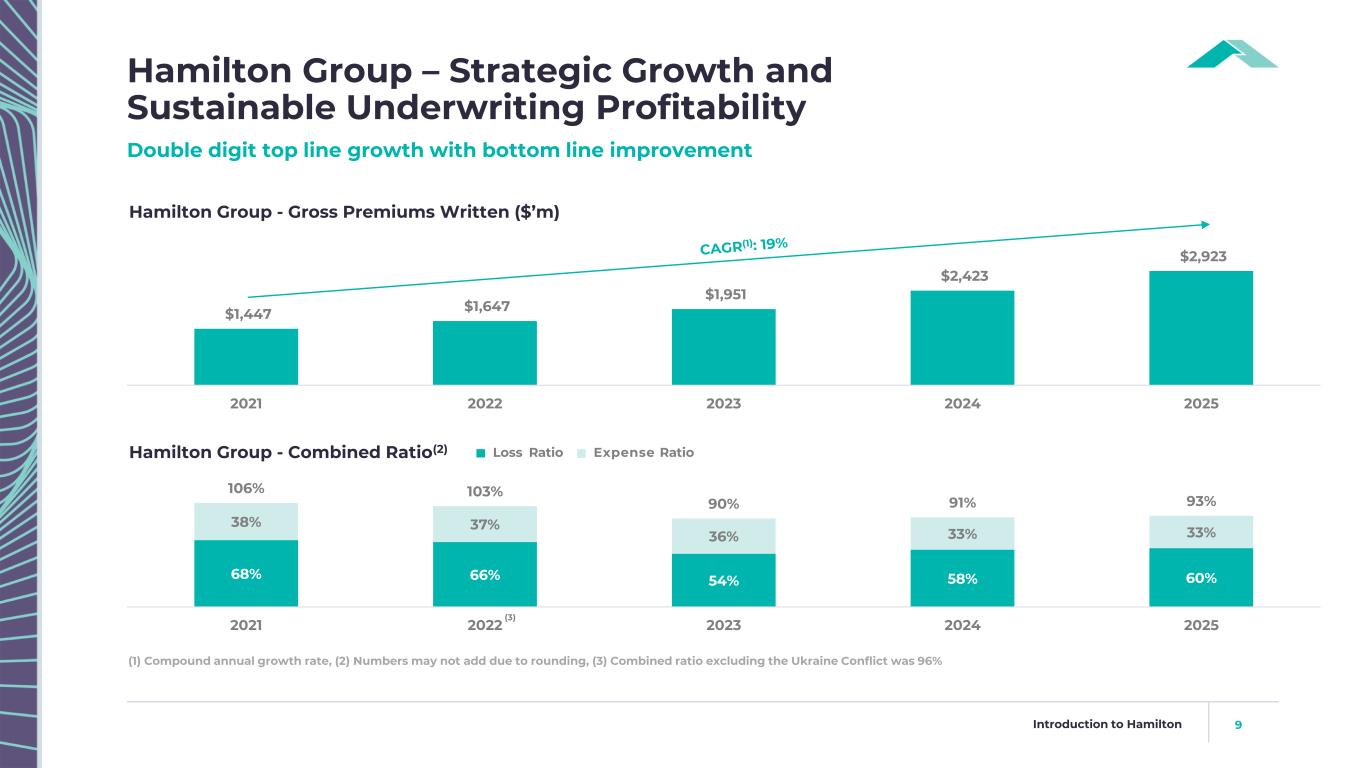
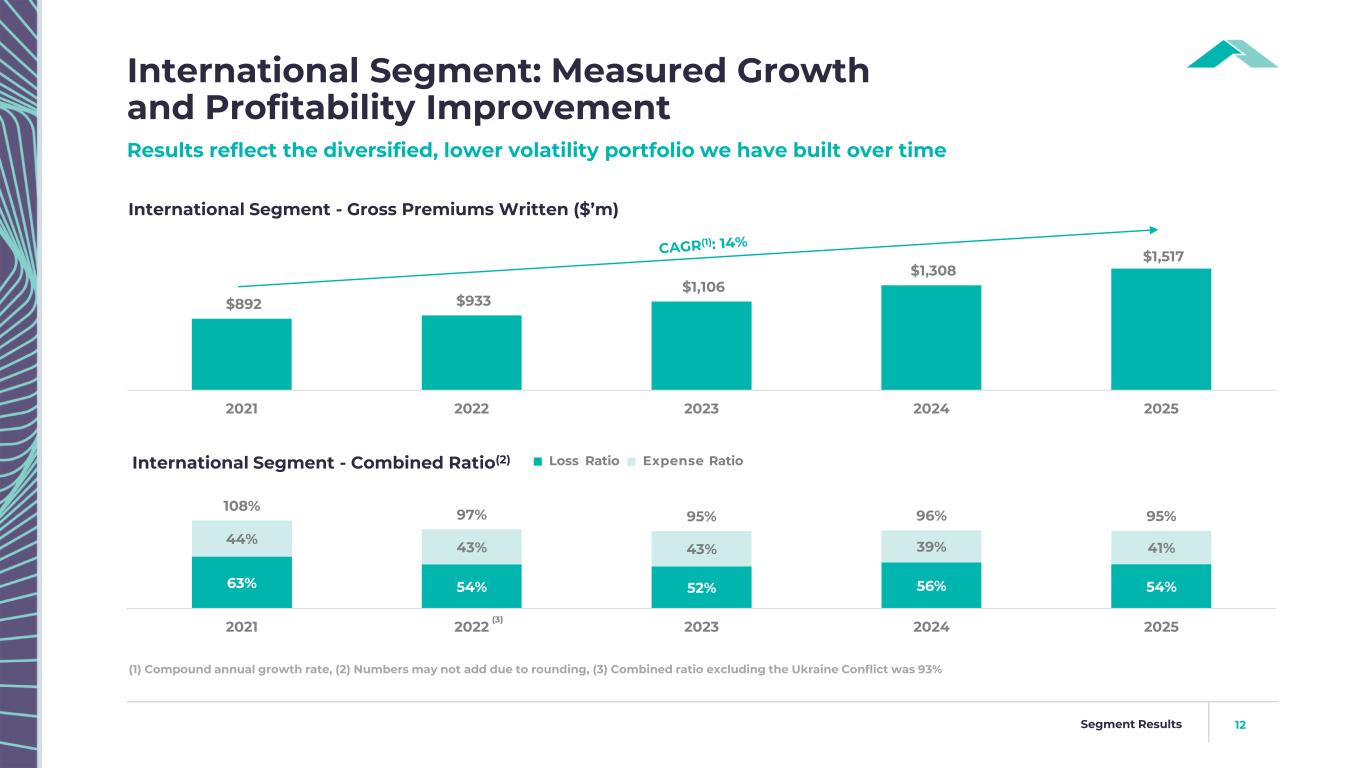
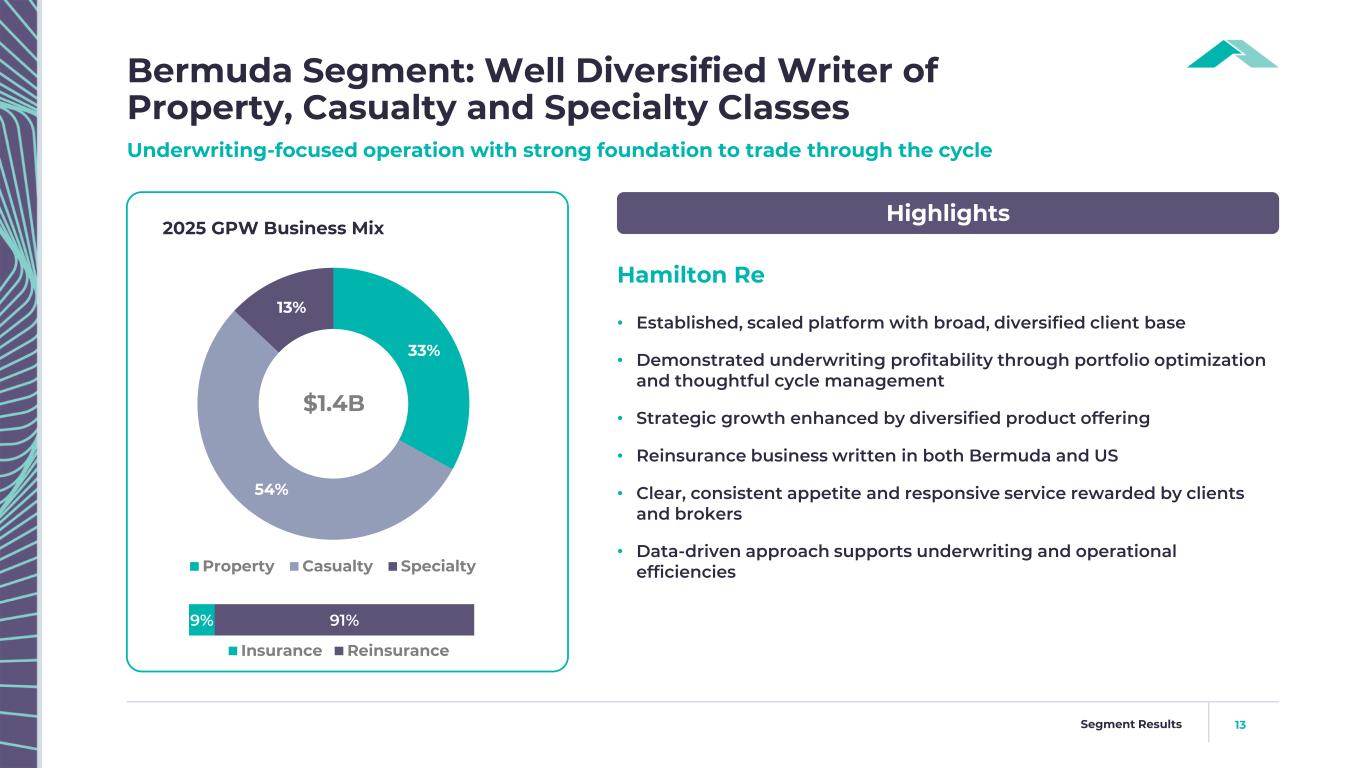
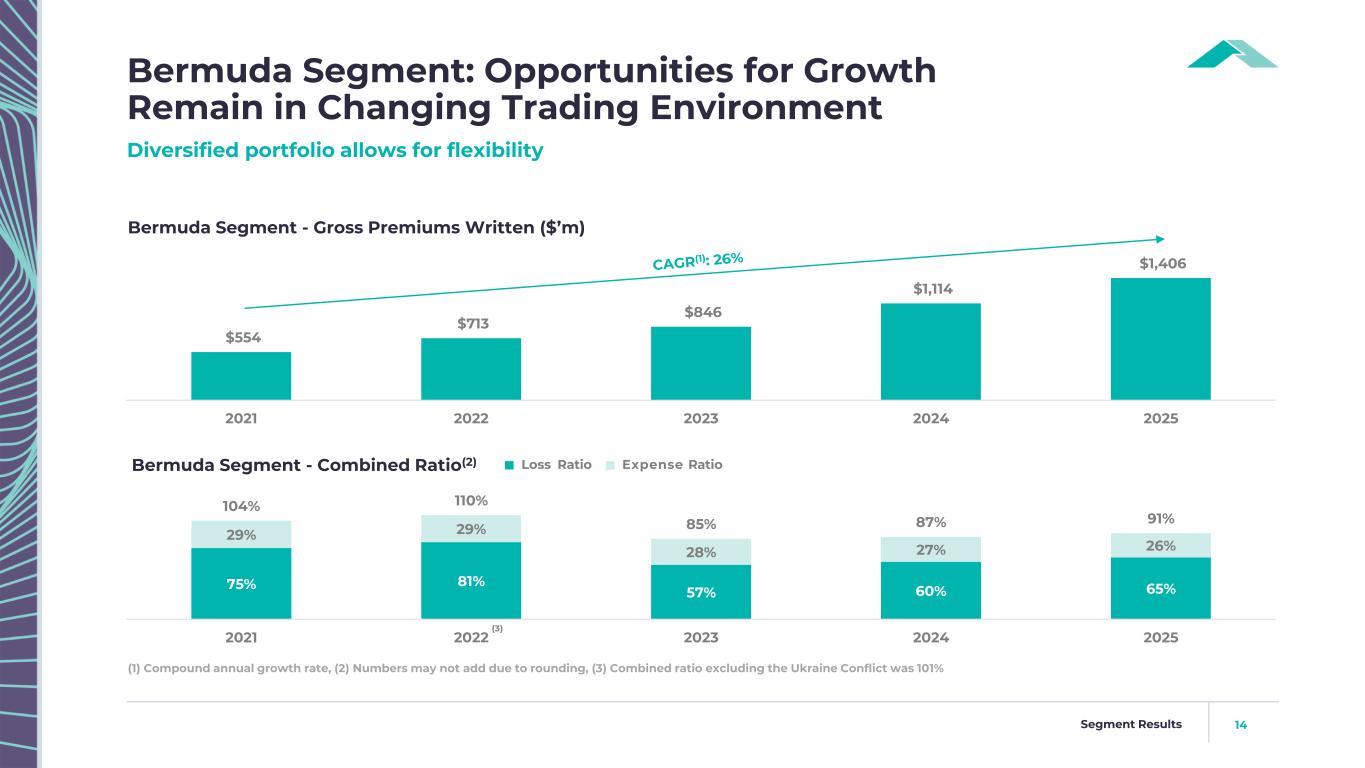
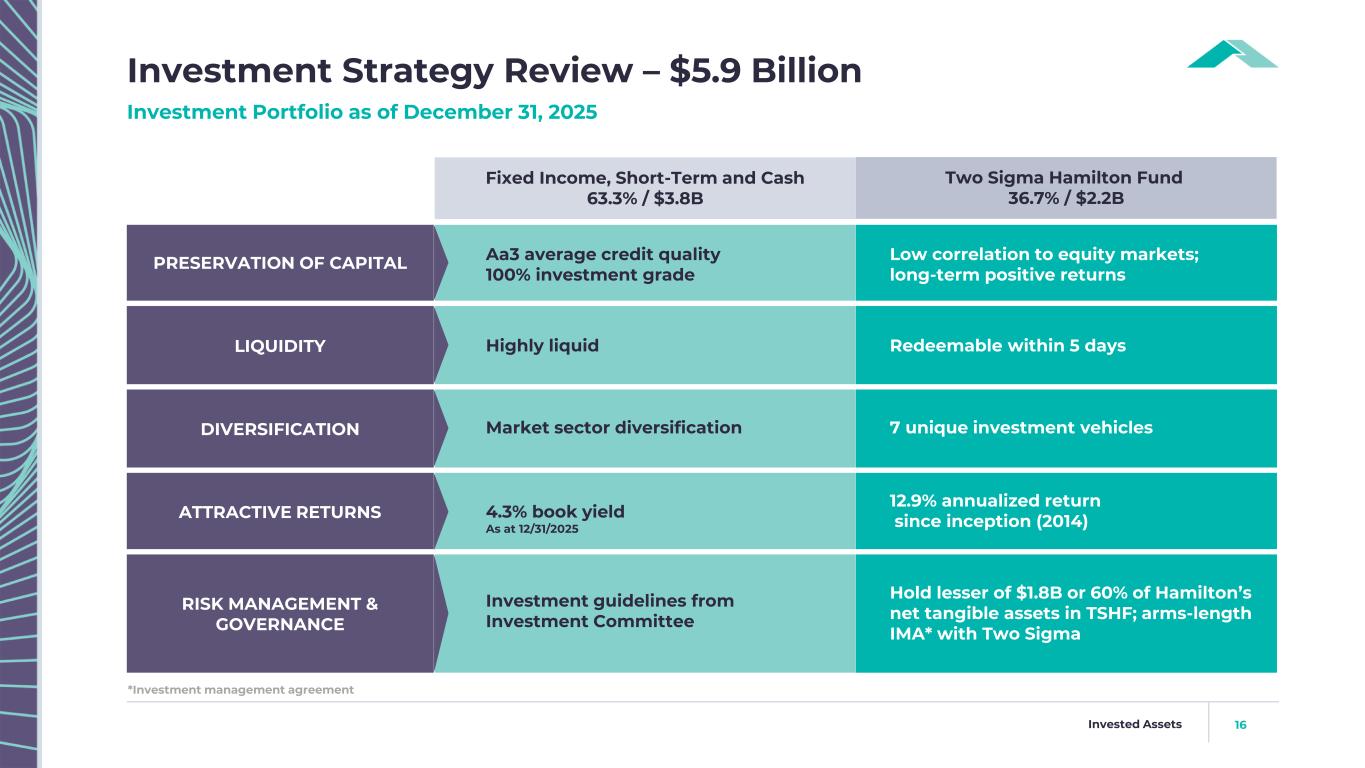
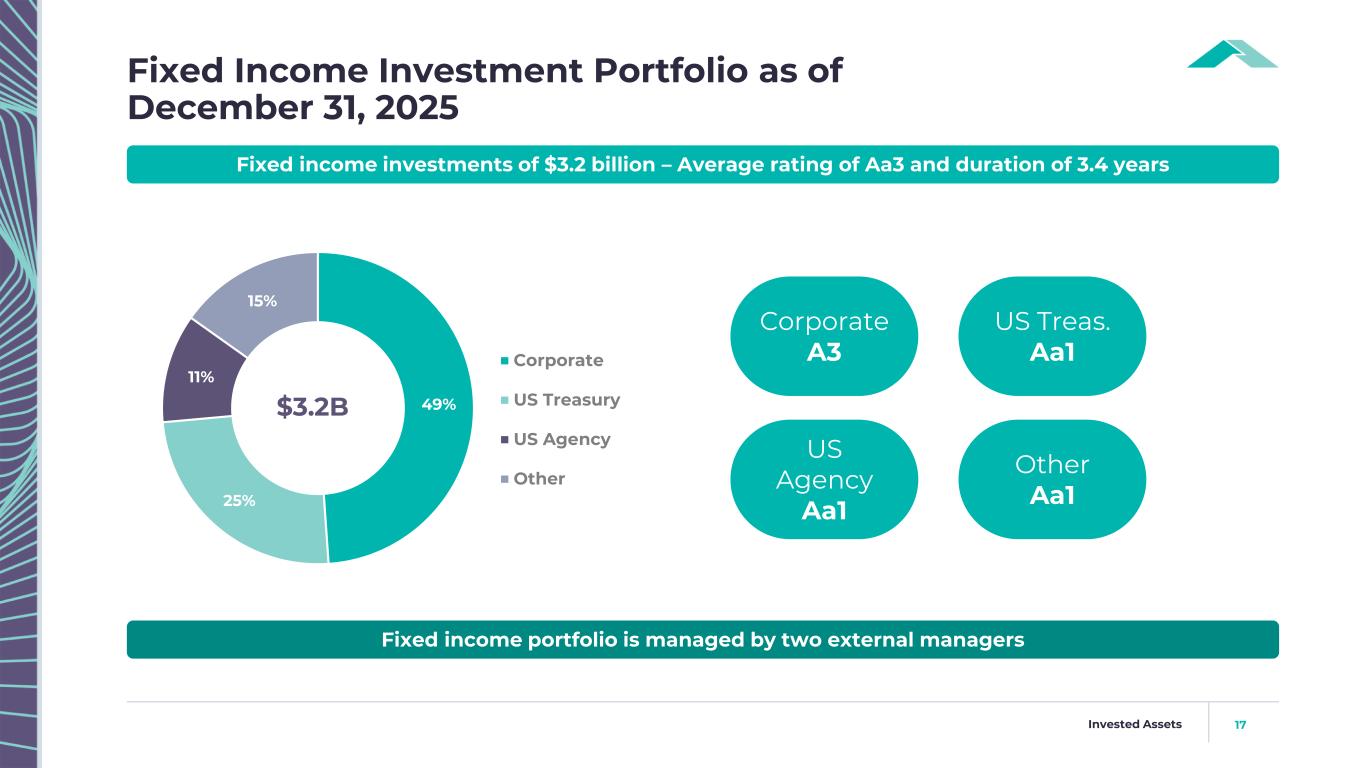
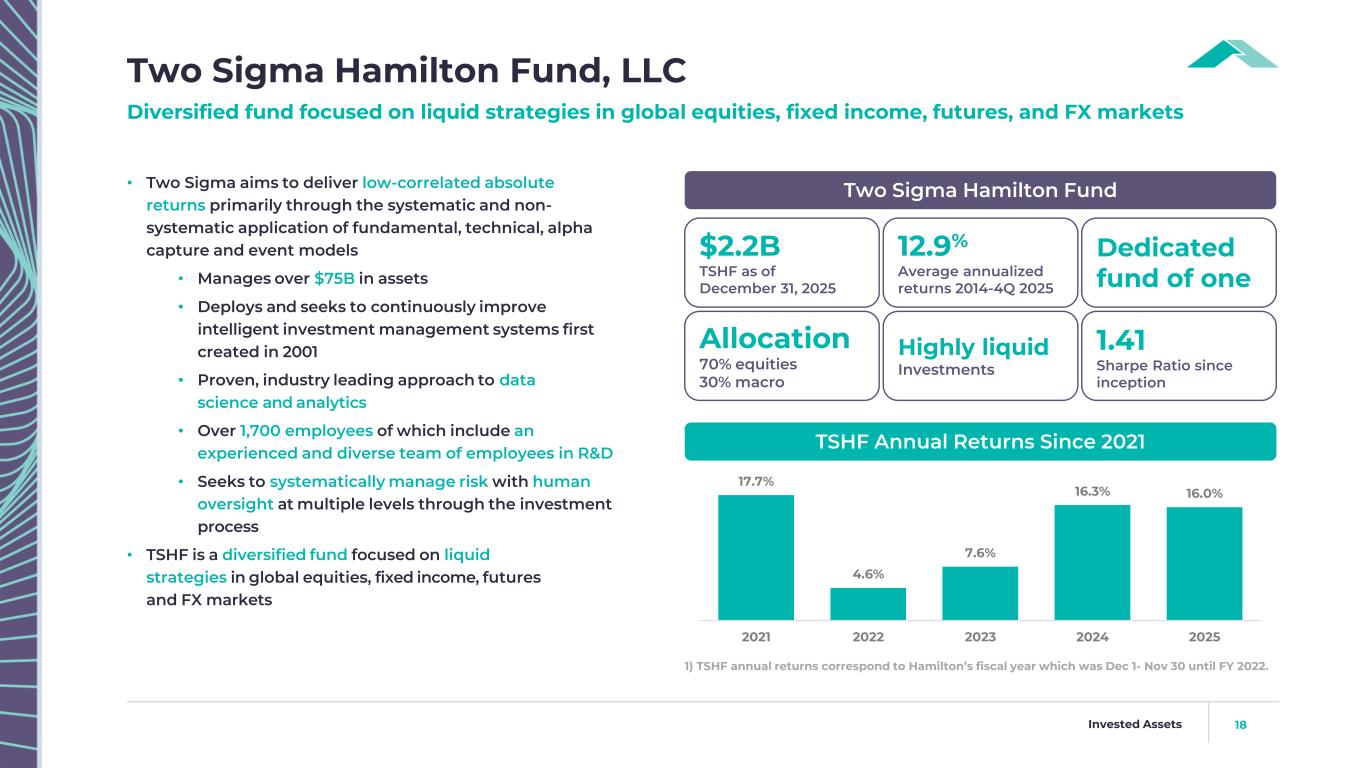
Thank you, Pina, and hello, everyone. In 2025, Hamilton had a very strong year of financial results with record net income of $577 million, 44% above the $400 million of net income in 2024. We had a return on average equity of 22% compared to 18% in the prior year, and we grew book value per share by 24% over the prior year to a record $28.50. For the fourth quarter of 2025, Hamilton reported net income of $172 million equal to $1.69 cents per diluted share producing an annualized return on average equity of 25 percent we had operating income of 168 million dollars equal to one dollar and 65 cents per diluted share producing an annualized operating return on average equity of 25 percent these results include strong underwriting income solid investment returns as well as a tax benefit benefit from the reversal of valuation allowances against some of our deferred tax assets and the Bermuda substance-based tax credit. Without these two tax items, the annualized operating return on average equity would still have been a healthy 18%. I will discuss this more in detail shortly. These quarterly results compare favorably to 2024 fourth quarter net income of $34 million dollars or 32 cents per diluted share an annualized return on average equity of six percent operating income of 87 million dollars or 82 cents per diluted share and an annualized operating return on average equity of 15 percent before i move on to our underwriting results i want to talk through the two tax items one the bermuda substance-based tax credit and two the tax benefit in our income tax line. The Bermuda Tax Credits Act became effective on December 11th. Under this framework, we qualify for the new substance-based tax credit which is designed to reward insurers that demonstrate meaningful local economic activity in Bermuda. As a reminder, this credit enhances the competitive advantage for Hamilton since we're exempt from the Bermuda 15% global minimum tax until the year 2030. The credit is driven by both jobs-based and expense-based components and is applied against the Bermuda Group's tax liability. The program includes a transition schedule allowing recognition of 50% of the credit in 2025, 75% in 2026, and the full 100% benefit for fiscal years beginning in 2027 in 2025 we accrued the full credit in the fourth quarter when the bermuda tax law was passed going forward we will accrue the credit over a 12-month period reporting it quarterly based on qualifying payroll and eligible expenses in our financial statements the credit flows through as a contrary expense to the other underwriting expense and corporate expense line items For 2025, we recorded a Bermuda substance-based tax credit of $20.7 million. In the Bermuda segment, this was a $17.3 million offset to the other underwriting expenses, and in corporate expenses, a $3.4 million offset. For 2026, all things staying about the same, we would expect a Bermuda credit of about 27 million dollars based on the 75 phase in for the year we will also no longer have a value appreciation pool expense in 2026 since the vat program ended in 2025. turning to the tax benefit on our income tax line we recorded a net tax benefit of 28 million dollars arising from the net release of valuation allowances against deferred tax assets in the united kingdom and the United States, jurisdictions which had previously accumulated deferred tax assets due to tax net operating laws carry forwards. This tax benefit came through the income tax line on our income statement. Moving on to underwriting results. For the full year 2025, Hamilton continued to grow its top line at an impressive double-digit rate. our gross premiums written increased to a record 2.9 billion dollars compared to 2.4 billion dollars this time last year an increase of 21 percent each of our platforms hamilton global specialty hamilton select and hamilton read expanded where there were attractive opportunities and pulled back from underperforming lines to maintain margins and drive profitability In terms of underwriting performance, our 2025 year-end combined ratio was 92.9%. Now for some more detail on our quarterweight underwriting figures. Hamilton had underwriting income of $76 million for the fourth quarter compared to underwriting income of $22 million in the fourth quarter last year. the group combined ratio was 87.0 percent compared to 95.4 percent in the fourth quarter of 2024. in the fourth quarter our loss ratio improved to 54.6 percent down 5.5 points from 60.1 percent in the prior period the improvement was driven by meaningfully lower net catastrophe losses which were 9.0 points better than the fourth quarter of 2024. This was partially offset by higher attritional losses of 56.5% compared to 51.2% in the prior period. The increase in attritional was driven by more large losses compared to the same period in 2024 and a change in business mix, including increased casualty reinsurance business. for the full year 2025 the attritional loss ratio was 54.4 compared to 53.1 in 2024 for the same reasons in the fourth quarter of 2025 we had favorable prior year attritional development of 3.1 points driven by property and specialty classes this compares to 1.3 points of favorable development in the fourth quarter last year the expense ratio decreased 2.9 points to 32.4 percent compared to 35.3 percent in the fourth quarter last year the decrease was mainly driven by the bermuda substance-based tax credit and third-party fee income which offsets other underwriting expenses before i turn to segment results i wanted to provide guidance on some items for 2026. Beginning in 2026, we are increasing our catastrophe and headline loss threshold from the current $5 million to $10 million. This revised threshold is at a level that is commensurate with the size of Hamilton now, focusing on events that are truly headline losses. This means the attritional loss ratio will now include all losses of less than $10 million. dollars we would expect the attritional loss ratio to run at about 55 percent in 2026. on expenses we expect our other underwriting expense ratio to continue to decrease incrementally in 2026 and our corporate expenses to run between 45 and 50 million dollars for the year next i'll go through the fourth quarter results by segment let's start with the international segment, which includes our specialty insurance businesses, Hamilton Global Specialty, and Hamilton Select. In the fourth quarter, International had underwriting income of $12 million and a combined ratio of 96.0%, compared to underwriting income of $9 million and a combined ratio of 96.3% in the fourth quarter last year. The decrease in the combined ratio is primarily related to the loss ratio, decreasing 1.7 points partially offset by the expense ratio the current nutritional loss ratio was 5.5 points higher than the prior period due to large loss activity in the quarter while the prior period had no large loss activity the prior year nutritional loss ratio was a favorable 2.3 points this was driven by favorable development in our property and specialty classes the expense ratio increased 1.4 points to 42.0 percent compared to 40.6 percent in the fourth quarter last year the increase was primarily driven by the acquisition cost ratio due to less seating commissions and more profit commissions and a decrease in third-party management fee income other underwriting expenses were down 2.3 points Moving to some full-year figures, in 2025, international grew to $1.5 billion, up from $1.3 billion, an increase of 16%. This was driven by growth across all classes, property, specialty, and casualty. The 2025 year-end combined ratio was 95.0% compared to 95.6% for 2024. The full year 2025 current year attritional loss ratio was 54.0% compared to 53.5% in 2024 due to a change in business mix. Given the revised threshold for our catastrophe and headline large losses, we would expect our international segment to have an attritional loss ratio of around 54.5% in 2026. I will now turn to the Bermuda segment, which houses Hamilton Ray and Hamilton Ray U.S., the entities that predominantly write reinsurance business. In the fourth quarter, Bermuda had underwriting income of $63 million and a combined ratio of 76.4%, compared to underwriting income of $13 million and a combined ratio of 94.3% in the fourth quarter last year. The decrease in the combined ratio was primarily related to lower catastrophe losses and lower expenses in the quarter, partially offset by increase in the current year attritional loss ratio. The Bermuda current year attritional loss ratio increased 5.0 points to 56.7% in the fourth quarter, compared to 51.7% in the fourth quarter last year. This was primarily driven by more large losses in the quarter compared to the same period in 2024 and a change in business mix including an increase in the casualty reinsurance business the bermuda prior nutritional loss ratio was a favorable 4.1 points this was primarily driven by favorable development in our property class the bermuda expense ratio decreased by 8.3 points to 21.2 percent compared to 29.5 percent in the fourth quarter of 2024 driven by a decrease in the other underwriting expense ratio primarily due to the bermuda substance-based tax credit of 17 million dollars an increased third party performance-based fee income partially offset by the acquisition cost ratio due to a change in business mix moving to some four-year figures in 2025 bermuda grew to 1.4 billion dollars up from 1.1 billion dollars an increase of 26 percent the increase was primarily driven by new and existing business in casualty and specialty reinsurance classes the 2025 year-end combined ratio was 90.9 compared to 87.0 percent in 2024 the full year 2025 current year attritional loss ratio was 54.6 compared to 52.7 the increase was due to more large losses and business mix shifting toward casualty rain joints which carries a higher attritional loss ratio given the business next shift and the revised threshold for our catastrophe and headline losses we would expect an attritional loss ratio of about 56 for our bermuda segment in 2026. Now, turning to investment income. Total net investment income for the fourth quarter of 2025 was $98 million, compared to investment income of $36 million in the fourth quarter of 2024. The fixed income portfolio, short-term investments, and cash produced a gain of $42 million in the quarter, compared to a loss of $31 million in the fourth quarter of 2024. As a reminder, this includes the realized and unrealized gains and losses that Hamilton reports through net income as part of our trading investment portfolio. The fixed income portfolio had a return of 1.2% or $38 million and a new money yield of 4.2% on the fixed income investments purchased this quarter. The duration of the portfolio remains at 3.4 years. the average yield to maturity on this portfolio was 4.1 percent compared to 4.7 percent at year end 2024. the average credit quality of the portfolio remains strong at double a3 the two segment hamilton fund produced a 56 million dollar net return for the fourth quarter of 2025 equal to 2.6 percent for the full year of 2025 the fund had a net return of 16.0 percent worth 301 million dollars the two-sicker hamilton fund made up about 37 percent of our total investments including cash investments at december 31st 2025 compared to 39 percent at december 31st 2024. now turning to capital management as you may have noted in our fourth quarter earnings release we announced that hamilton's board of directors has declared a special dividend of two dollars per common share which will result in an aggregate payment of approximately 206 million dollars the decision to pay a special dividend was based on the company's record earnings in 2025 and our excellent capital position this dividend represents an effective way of returning excess capital to our shareholders for the full year of 2025 we also repurchased 93 million dollars worth of shares and an average price of 22.13 per share even with this special dividend we are able to continue repurchasing shares under our current share repurchase authorization which remains in effect with unutilized limit of 178 million dollars both the special dividend and the share repurchases reflect our ongoing commitment for active and effective capital management Next, I have some comments on our strong balance sheet at the end of 2025. Total assets were $9.6 billion at December 31st, 2025, up 23% from $7.8 billion at year-end 2024. Total investments in cash were $5.9 billion at December 31st, an increase of 24% from $4.8 billion at year-end 2024. Shareholders' equity for the group was $2.8 billion at the end of 2025, which was a 21% increase from year-end 2024. Our book value for shale was 28% of December 31st, up 24% from year-end 2024. Thank you. And with that, we'll open up the call for your questions.
Operator
We will now begin the question and answer session. If you would like to ask a question, please press star 1 on your telephone keypad. To withdraw your question, press star 1 again. Please pick up your handset when asking a question. If you are muted locally, please remember to unmute your device. We ask that you limit yourself to one question plus one follow-up, and then rejoin the queue for any further questions. Our first question comes from the line of Christian Justoff with Wells Fargo. Your line is open. Please go ahead.
Good morning and congrats on the strong quarter. My first question is on the underlying loss ratio guide for 2026 to 55% for the full year. If you didn't change the cat definition threshold, what would that look like versus the 54.4 we saw in 2025? And given the definitional change, is there a new catload Hamilton will manage to do for each of the segments?
Hi, Christian. First of all, thanks for the question. So first of all, we did guide to the 55 percent. Part of that increase over the full year 2025, which was 54.4 percent, the majority of that increase is the change in the threshold that we have. The business mix for 2026 will remain about the same. So we would expect the attritional to have remained about the same, but that's the change in our threshold from the $5 million to the $10 million threshold is what's taking that loss pickup to the 55% guidance. As far as catastrophe losses, our catastrophe losses will come down slightly, but they'll still be in the range of about 6% to 7% for our catastrophe losses for the year.
Got it. Oh, that makes sense. And then, can you just give a little bit more color in deciding to deploy a special dividend? I would think, given where your shares are currently, I mean, the gap is closed versus book value, but it's still close to or a little bit below. I guess, why not, like, buy back more of your shares? Is this just a more effective way to get rid of excess capital since it could be an ROE Or how should we kind of, like, think about that? And should we expect maybe a more modest level of buyback since 2026 just given the deployment of this special?
Good question. What I would say to you is we have the flexibility to do both of these things, and after a record year of earnings, we decided to return a portion of our excess capital, a special dividend is an active and an effective way of returning that capital quickly to our shareholders. But we will also be able to continue buying back shares. As you know, we bought back $93 million worth of shares in 2025, and we still have the ability to buy back under our authorization we still have 178 million dollars to be able to do that we have a really strong track record of being good stewards of capital and when we see and have you know strong business opportunities to play that capital there we're going to do that um as you know for example we've been able to do that by growing our premiums at double digit levels every year since 2017 but otherwise we're going to return some of this excess capital to our shareholders and that's what we're doing here with the special dividend as well as the share buybacks, we have the ability to do both.
Got it. Thank you. And if I could just sneak in one more. On the ENS Select platform, the growth is moderating a little bit, but in part that's likely due to a higher base you're growing off. But are you seeing any signs of increased competition on the casualty side from MGH fronting companies or other admitted carriers? We've heard a lot of competition on the property side, but I'm not sure if you're seeing that on the casualty side as Thank you.
I'll take that, Kristen. Thanks for the question. Firstly, I think it's important to note that the growth that we saw on Hamilton Select this quarter and year-to-date isn't completely in line with what our expectations were. We continue to see robust pricing, particularly in the areas where we grew more this year. That was the ones I mentioned, the excess casualty products and contractors and small business. In terms of increased competition, where we're seeing that is on the professional line side, and that's where we wrote less of this business this quarter. Overall, I think if I take a step back and look at Select, again, completely in line with plans, it is an incredibly important growth engine for us, given the strength of the team that we've assembled there and the relationships they have. You'll notice some recent hire recently that we announced that will be launching in the property space and that will concentrate on the smaller to mid-sized property business where we're not seeing the robust competition that we've seen in large account space where we have shed business. I hope that answers your question.
Operator
Your next question comes from the line of Tommy McJoint with KBW. Your line is open. Please go ahead.
Hey, good morning, guys. Thanks for taking the questions. What is the optimal premium leverage that you'd like to manage to, and is that changing as the portfolio mix leans heavier toward casualty growth after a period when property growth is stronger?
Tommy, it's Craig. Greg, our premium leverage hasn't really changed very much. We've been retaining about 80% of the business on a net basis, but over time, your point is valid. As we go into a transition type market, one of the things that we don't want to do is just blindly edge up on the premium leverage for that purpose. You may recall in 2024, you know, we essentially retained more of our business because we had primary proceeds from the IPO that we wanted to put to work, and in 2025, we actually were able to buy a little bit more reinsurance coverage for the overall book because of the quality of business that we had been putting on the books gave us the ability to get lower rates for that reinsurance purchases. So, we've been able to do that, and over time, we've been able to retain that retention rate has stayed right around 80%.
And then maybe a question on the data center opportunity. You know, a lot of carriers have been asked about it, and it's going to be a great need for capital over the coming years. I guess the question is, do you guys have sort of the expertise to play in that niche? Are there little pockets of opportunities there, or is it a great large opportunity? What are you guys doing on the data center side?
I'll take that one. We are certainly seeing some more of that business and we see it as an opportunity and we're taking up some of these opportunities. For example, writing some physical damage only covers where it only covers contents and does not cover business interruption. I think that although this is an opportunity and we will lean in with our expertise that we have in house what we are also a little bit cautious here on you know accumulation a particularly on the large data center so we're monitoring that very closely and when we look at our writings and B also the whole business interruption area again the physical damage cover we're now offering on the insurance side does not include business interruptions so we're looking at this as an opportunity but also looking at it very cautiously with those factors in mind.
Operator
Our next question comes from the line of Daniel Cohen with BMO Capital Markets. Your line is now open. Please go ahead.
Hey, Maureen, thanks for taking my question. First of all, maybe just on reserves, if you could just add a little more color on the years and the classes that the property and specialty favorability came from this quarter, and then maybe just anything on how, you know, casualty reserves moved this quarter and if there's been any change in loss trend there.
Yeah. Hi, Daniel. So, first of all, overall, our reserves were favorable for the quarter. None of that came from casualty. So, overall, casualty was flat for the quarter with no movement. So, this was another year of favorable reserve development for Hamilton, something that that we've been able to achieve each and every year since the inception of the company. But to your point, yes, the favorable development this quarter came from property and specialty, mostly from the property side. What we typically do on the property side is take a look at those reserves that have been in place or have matured over a period of time for over two years, and we take a look at that. and some of those we were able to release in the fourth quarter and throughout the year as well. We actually have a reserve review done by an outside actuary twice a year on our book of business and we consequently take a look at their guidance that they see when they're looking at other at the industry levels as well as other clients so other peers of ours and it gives us an indication of where we stand against what an outside actuary would look at, and we remain above the midpoint of their estimate consistently year after year.
Great. Then on the casualty reinsurance side, you just mentioned preferring clients with good data in-house claims handling. I was just wondering, could you have more color on what differentiates those clients versus maybe some others in the marketplace and whether or not Hamilton's embedding their own conservative margin on top of where their seeds are picking?
Yeah, I'll take that question. So just maybe a little bit of background, again, we started from a very low base when it came to casualty business and in the context of our AMBEST, you know, first positive outlook and then our, you know, upgrade, we had targeted in advance the clients that we wished to support on the casualty side. And these are clients that we knew well already from property and specialty placements that we enjoy with them. And those clients there provide us, you know, robust data so we can see what they're doing in terms of limits management, pricing versus what they're seeing in trends. We look at it with respect to what we're seeing and what we anticipate trending to be. So that already, you know, is one tick. Then we look at how robustly they handle their claims in-house and how quickly they resolve these claims. So, all in all, those are the kinds of clients we target when we look at our reinsurance support. And because we are able to support them broadly across classes, that makes these relationships very resilient.
Thanks. And then, also, I think if I could see more just on the corporate expense line, Corinna, I think you said there's going to be no more value appreciation pool expenses there. So, outside of the tailwind from the Bermuda tax credit, should we expect this line to continue to tick down, or how should we think about that?
Yeah, Dan, certainly that's exactly what you would expect. Certainly the value appreciation pool expired in the second tranche of that pool vested in November of 2025. So, the VAP is no longer there, and the guidance that I've given in the prepared remarks is that you can expect total expenses to be in the range of $25 to $50.
Operator
Your next question comes from the line of Matthew Heimerman with Citi. Your line is now open, please go ahead. Your next question comes from the line of Justin Lee with Barclays. Your line is now open, please go ahead.
Hi, everyone. Thanks for taking the question. The first one I had was just on the Two Sigma Hamilton Fund. I believe in previous quarters you guys gave, and maybe I might have missed it, but I was just wondering if you guys can provide what returns were as a month.
Yeah. Hi, Justin. This is Craig. You know, with respect to us having earlier reporting than we've had in the past, it's not as meaningful now for us to provide that type of guidance anymore. So going forward, we're going to report these results on a quarterly basis with no lag, just like we do with the rest of our portfolio. What I will tell you is that Two Sigma has historically outperformed in a volatile market. And as you know, we've been very fortunate to have the partnership that we have with Two Sigma. We've had a 13% average annualized return every year since the inception of fund in 2014. And the fund has never had a calendar year loss. So, again, going forward, we'll report this on a quarterly basis with the same as the rest of our portfolio.
Thank you. And second one, just more high-level sort of scaling back on sort of the large property side and focusing on areas that are, you know, still getting relatively better pricing versus lost cost. And on the other hand, I'm sort of seeing data points that suggest that maybe on the primary side. The pressures on property may be sort of permeating onto the general liability and other lines of casualty side on the pricing front. So I was wondering if you can kind of help me square sort of these two dynamics and and how you guys are sort of thinking about growth. Understand it's going to be more measured as you said but just a little bit more color there would be helpful.
Sure I'll take that and thank you for the question. Firstly on the property side again you are right where we are seeing the most pricing pressure is on those large insurance accounts of large scheduled accounts and and that's where you have seen us pair back all writings consistent with you know our disciplined approach to underwriting on the middle market and the smaller property accounts we're not seeing that level of pressure of pricing pressure so we're still seeing some attractive opportunities there and that's where we're seeing some growth and that's where our new underwriting offering in Hamilton Select will lean into, so that's on property. On the casualty side, we are still seeing some healthy increases on the insurance side of the equation and that is actually supported by the fact that a lot of our students, and I mentioned that in my prepared marks, seeing these robust pricing increases are keeping more of their business net. They are also confident that that pricing is you know, keeping pace with the trend that we're seeing out there. So we don't see any signs of that casualty pricing abating. And as long as it is in, you know, in that area where it's keeping pace with trend or we feel it is, we will continue to look at that business.
Operator
Our next question comes from the line of David Samar with Citizens. Your line is now open. Please go ahead.
Hi thank you and good morning. On the special dividend what will be the source of funds there? Is that cash already on hand or from the Two Sigma fund or fixed income portfolio or maybe a mix of those?
Hi David this is Craig. Yes it's from available cash on hand as well as the fixed income portfolio.
And then are you going to provide any color on the elevated large losses in both segments from the quarter sure i can do that so uh you know essentially what happened this quarter in in fourth quarter of 2025 is we had more large losses in this quarter than we did in the fourth quarter of 2024 the largest loss that we had this quarter was a satellite loss it impacted both segments for us in our specialty classes class of business um and you know this is exactly the reason why we changed the threshold in our catastrophe and large headline loss is the capture of these truly headline losses you know we wanted to make sure that we gave guidance on the on what that impact would be going forward that's why we gave the guidance you know going forward for the attritional loss ratio but essentially because of these types of losses that come through it was impacting our attritional loss ratio up and down you just based on some of these large losses and we wanted to make sure that we're taking that into account thank you if you would like to ask a question please press star one on your telephone keypad to withdraw your question press star one again please pick up your handset when asking a
Operator
question if you are muted locally please remember to unmute your device our next question comes from the line of Matthew Heimerman with Citi. Your line is now open. Please go ahead.
Hey, good morning, everybody. Apologies for earlier. I guess first question would be, with respect to the Bermuda tax credit and the significant savings or offsets to expenses you're getting there, I'm curious if there's any thoughts around potentially reinvesting some of that that incremental savings on a good board basis, either for new priorities or accelerating existing investments that might already be on your roadmap?
Yeah, thanks, Matt. You know, the credit is really designed to reward insurers that demonstrate meaningful local economic activity in Bermuda. This credit really keeps Bermuda as an attractive place to do business. And there's two components that we're able to take advantage of under this credit, which are jobs-based and expense-based components we're going to continue to invest in our projects our operations and our technology to operate at scale in Bermuda and for a company the size of Hamilton we have a large footprint a significant presence in Bermuda with over 100 people in our office there and we also hold all of our board meetings in Bermuda so while we're not specifically designating these funds to a particular purpose they will serve to reduce our overall operating expenses. And again, this shows up as a contract sense in our other underwriting expenses in the Bermuda segment, as well as in our corporate expenses.
And maybe I'll just add on to that. I think if you look at our history, we have a very strong track record of investing in our underwriting capabilities and in adding new lines of business, whether it's on the reinsurance side over the years, most recently in our credit and bond offering, but also prior to that by adding per risk and proportional and also on the insurance side by adding attractive lines of business, be that in our Hamilton Global Specialty platform or also in Hamilton Select. So, I think you will see that continue in our future.
Thanks for that. I guess the other question would be just can you remind us the guiding principles that you have with respect to technology and underwriting to help us better frame as you invest in new technologies and implement AI and more use cases, just how to frame that.
Sure. I'll take that. And Craig, if you want to add anything, be my guest, but I think you start with the fact that we have, and we're very proud of the fact that we have very robust underwriting tools and underwriting frameworks that are regularly calibrated, you know, for what we're seeing in the market and we calibrate them because we meet very regularly as a team both on the platform side but at the executive level and then across the group to share insights monitor pricing expectations and and all of that gets retooled into our underwriting uh tools if i segue uh from there to uh how we're embracing ai i can say that we are embracing ai i think i've mentioned on a a couple of prior calls that we are already deploying AI in several use places across our platform, both on the underwriting and the claims side. The use cases are predominantly for efficiency purposes, and what that means is it allows us to extract data, populate our underwriting workbenches, you know, summarize some very complex reports. And what that does is it allows us to get to more business more quickly. In Hamilton Select, you will have heard, in addition to this populating of workbenches, we're looking to roll out in the course of 2026 a smart queuing feature which will allow us to triage the risk better. That means not only just getting more hits at bat, but getting more swings at balls we're nowhere going to hit. So, that is how we look at AI. I think the other thing you should know in this context is our guiding principle here is to ensure at the same time as we're embracing AI that we have robust control framework in place to avoid any unintended consequences of this new technology.
Thanks for that. One of the things, just one quick follow-up, one of the things I'm struggling with is one of the benefits clearly is efficiency, productivity, and you mentioned that, and obviously that can take the form of doing more with same or doing the same with last or and many permutations. So I'm curious when you think about the efficiency savings like how concentrated they are to like Bermuda relative to the rest of your platform and I'm kind of asking that in the context of just talking about the tax credits which are supposed to spur investment there and this obviously a lot of things to do more at last. So just just just curious if those are in conflict with the others specifically but more broadly as we think about how you staff and how you invest like how that might look differently around your platform.
Yeah I mean brought we've not yet come up with a number of what terms of savings we're going to achieve in dollar terms from this technology but we are seeing benefits of the technology across all three platforms. In Bermuda, we've been deploying AI technology for a couple of years now, and we're also using it increasingly, again, across our Hamilton Select and Hamilton Global Specialty platforms for our insurance business. Over time, we will continue to see the benefit of this technology, but it's across all three of our platforms.
Operator
Thank you. That will conclude our question and answer session for today.
I'll now turn the call back over to Pina Albo thank you I want to just take a minute to thank everybody here for joining our call today and for engaging with us as you have we are once again incredibly proud of the results we achieved this year and we look forward to speaking to you in the very near future thank you this concludes today's call thank you for attending you may now disconnect