Operator
Hello, everyone, and thank you for joining the Ocean First Financial Corp Q125 earnings call. My name is Marie, and I will be coordinating your call today. During the presentation, you can register a question by pressing star, followed by one on your telephone keypad. And if you change your mind, please press star, followed by two. I will now hand over to your host, Alfred Goon, SVP of Corporate Development and Investor Relations, to begin. Please go ahead.
Thank you, Marie. Good morning and welcome to the Ocean First First Quarter 2025 Earnings Call. I am Alfred Goon, SVP of Corporate Development and Investor Relations. Before we kick off the call, we'd like to remind everyone that our quarterly earnings release and related earnings supplement can be found on the company website OceanFirst.com. Our remarks today may contain forward-looking statements and may refer to non-GAAP financial All participants should refer to our SEC filings, including those found on Forms 8K, 10Q, and and 10-K for a complete discussion of forward-looking statements and any factors that could cause actual results to differ from those statements. Thank you, and I now will turn the call over to Christopher Marr, Chairman and Chief Executive Thank you, Alfred.
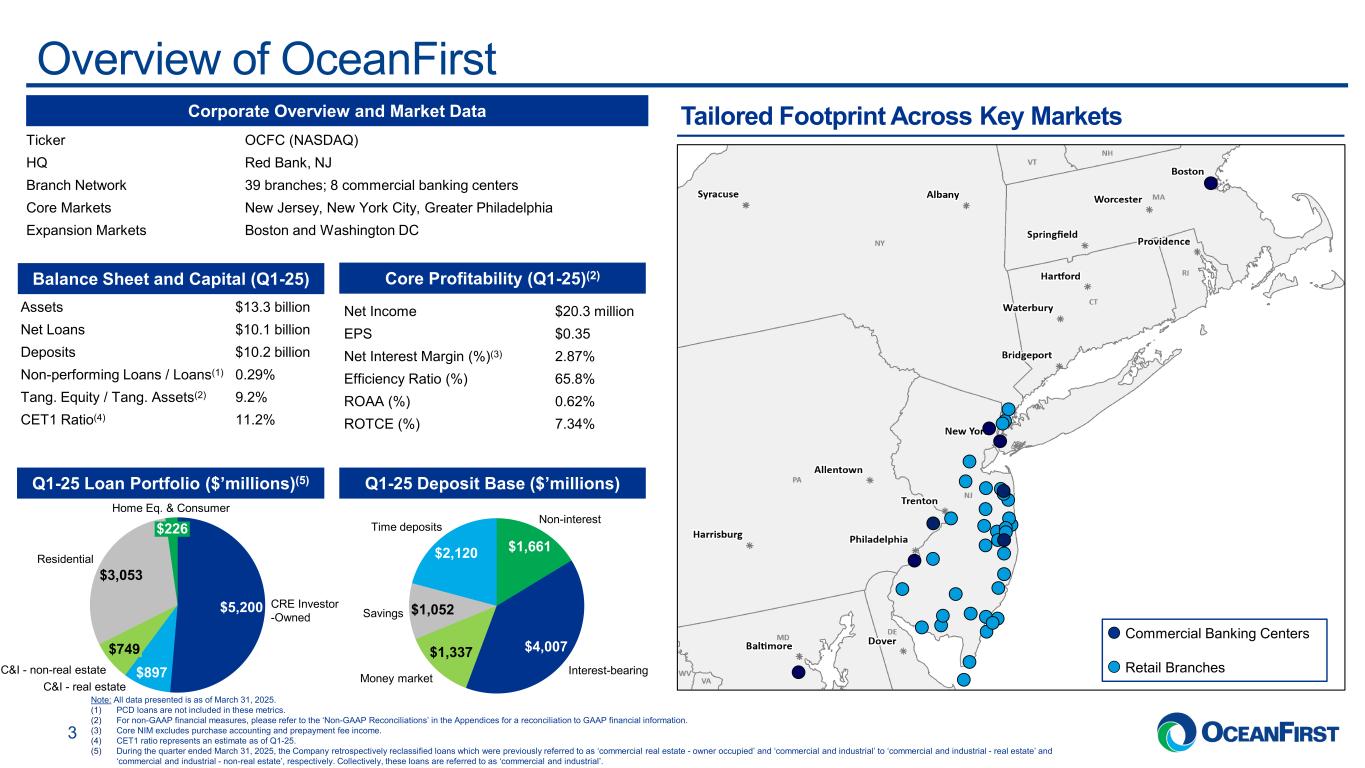
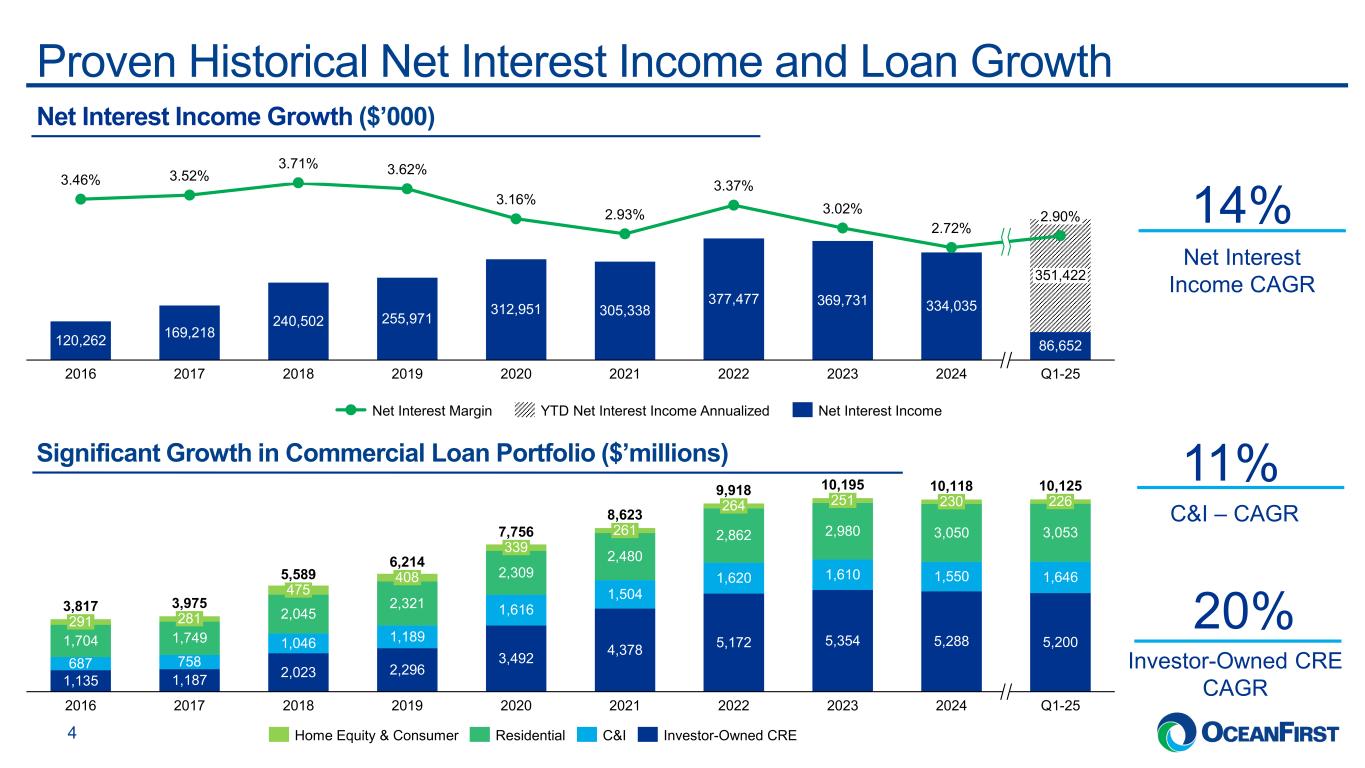
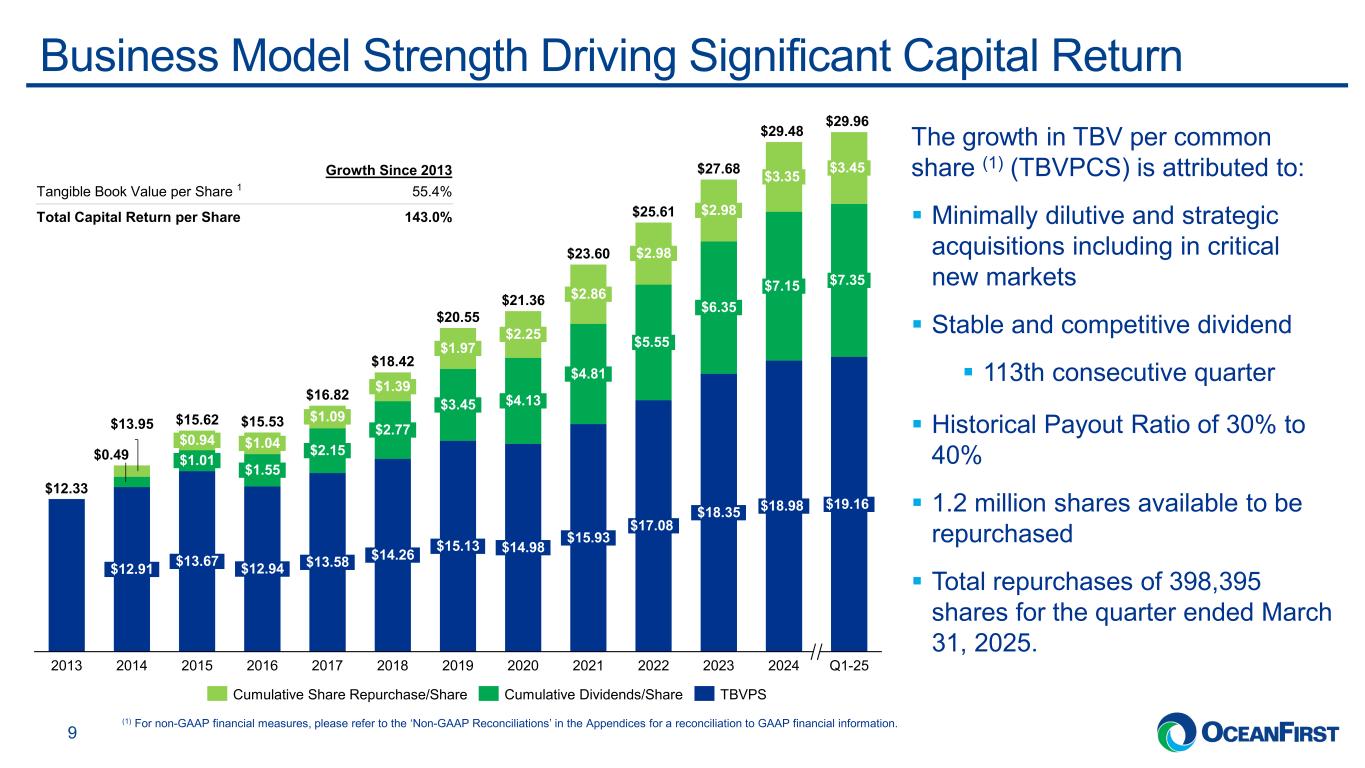
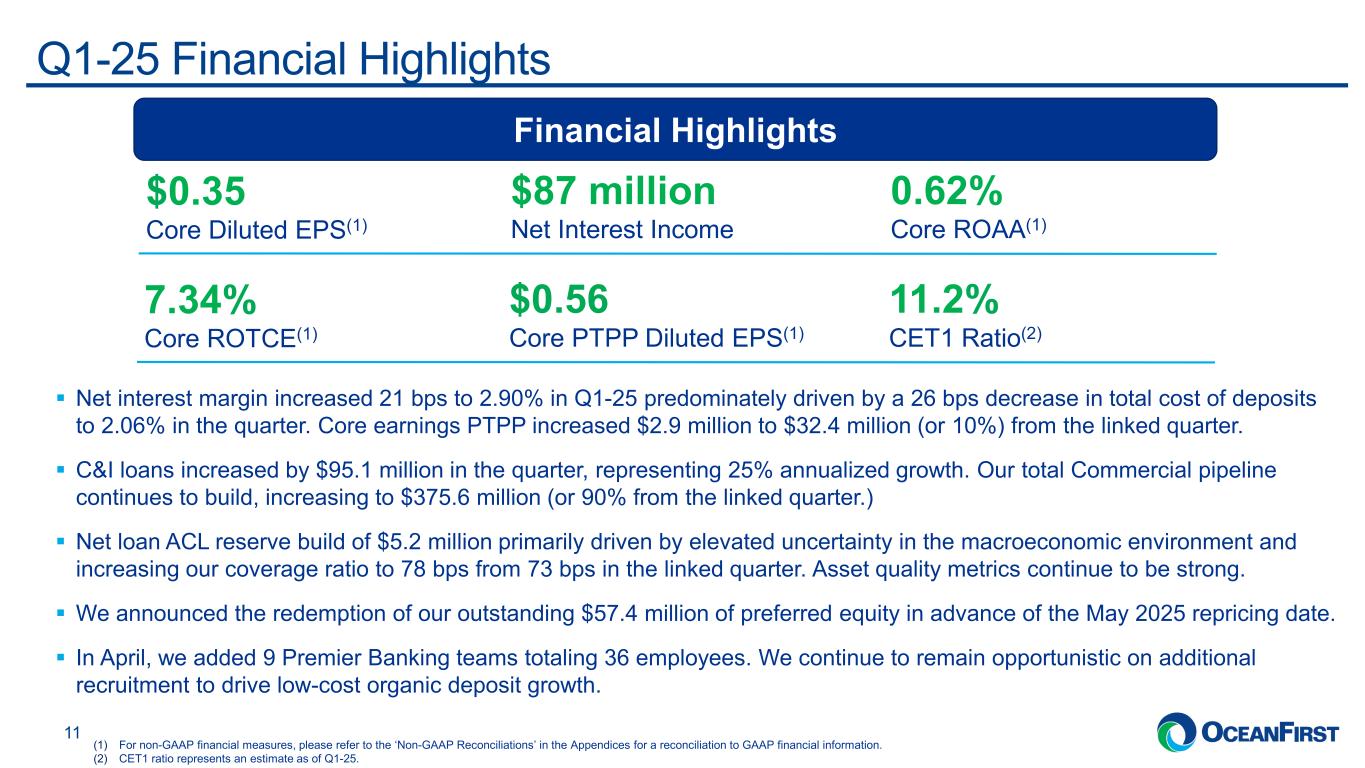
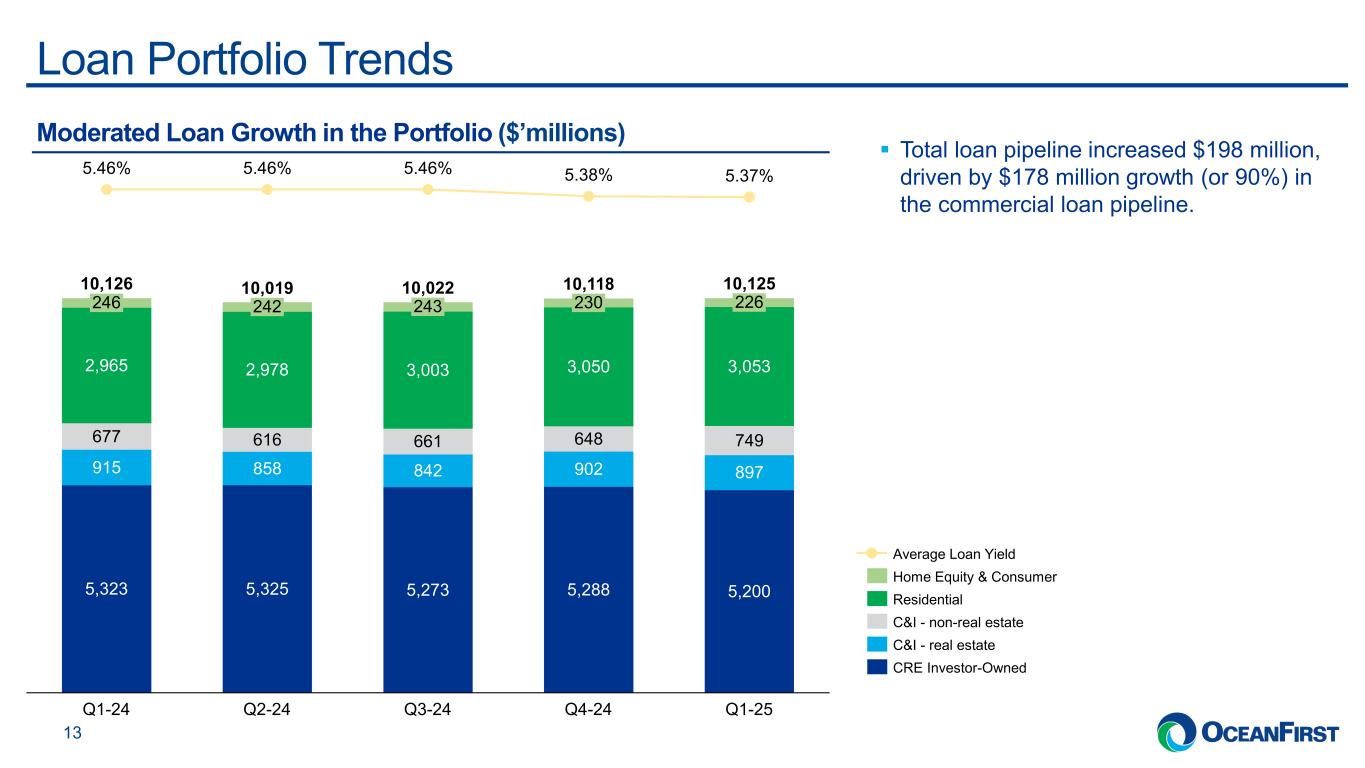
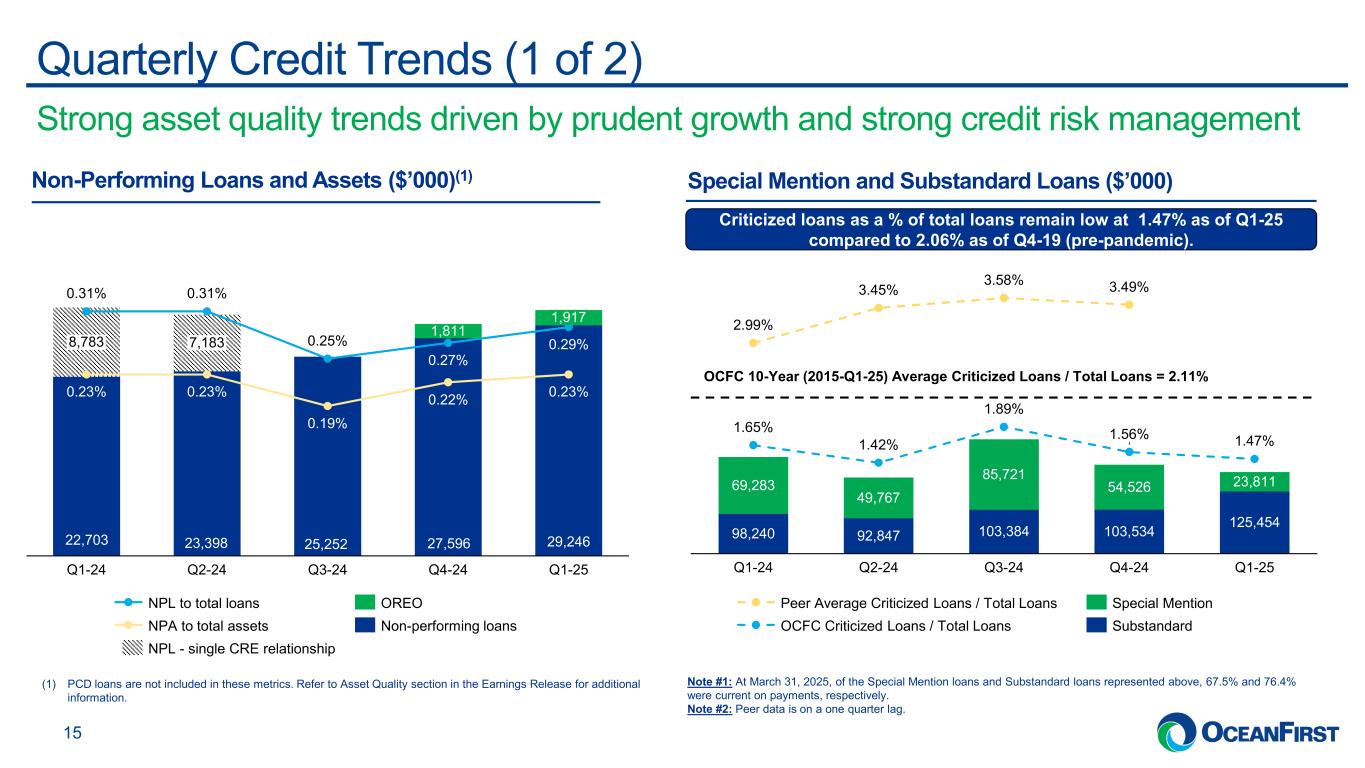
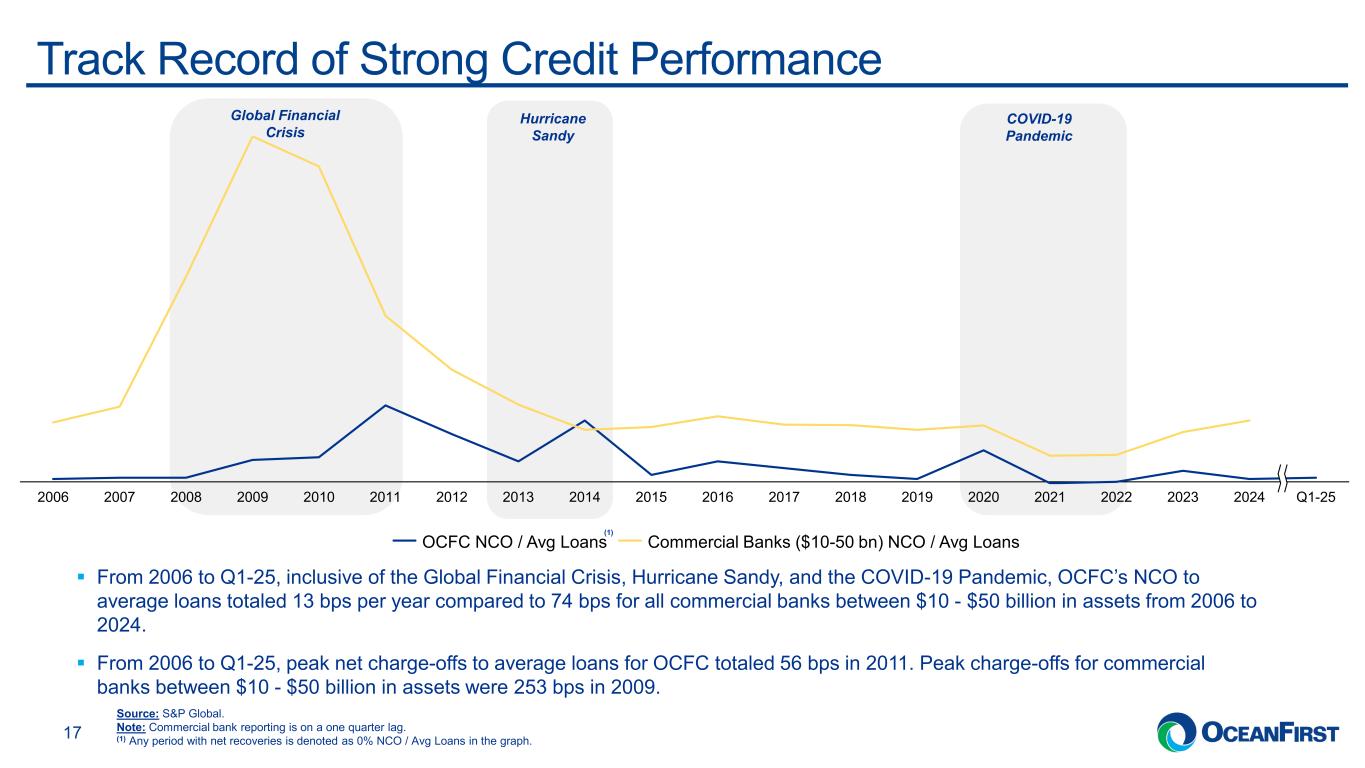
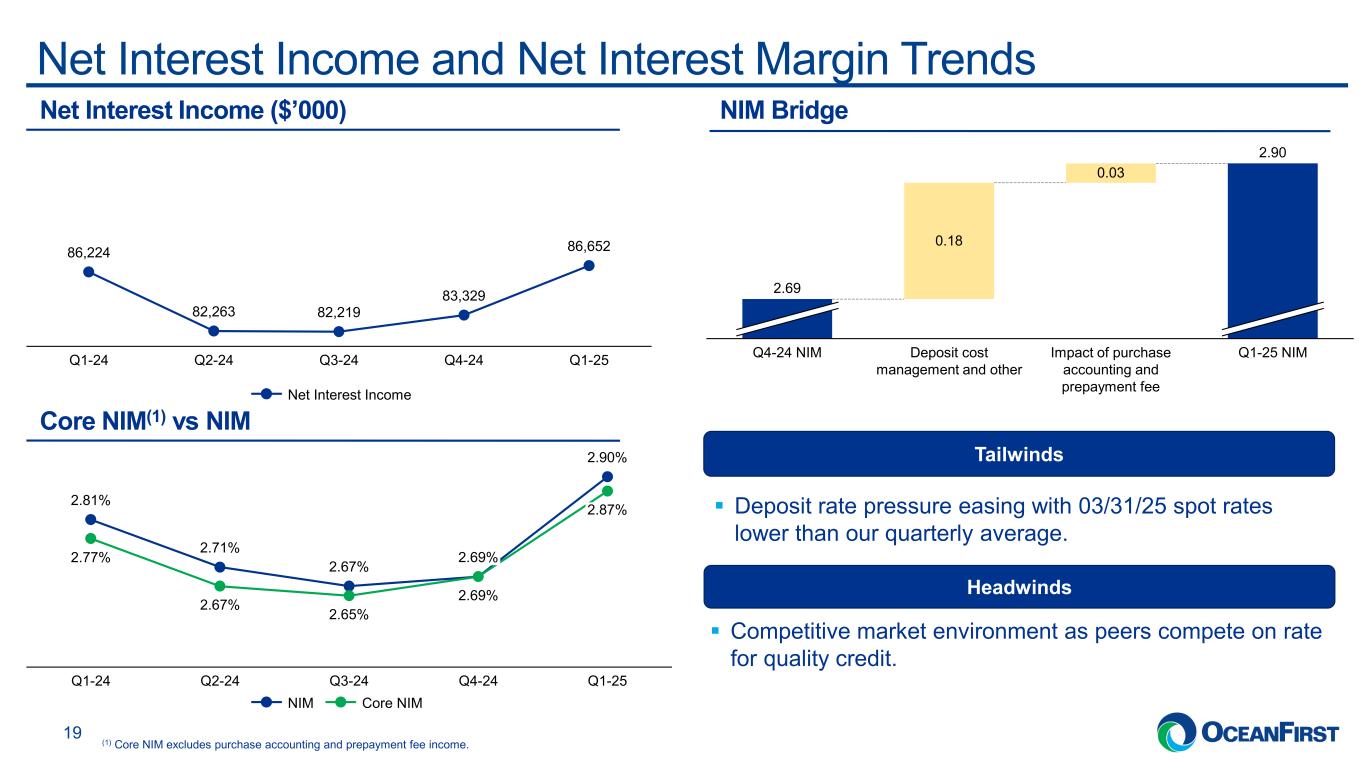
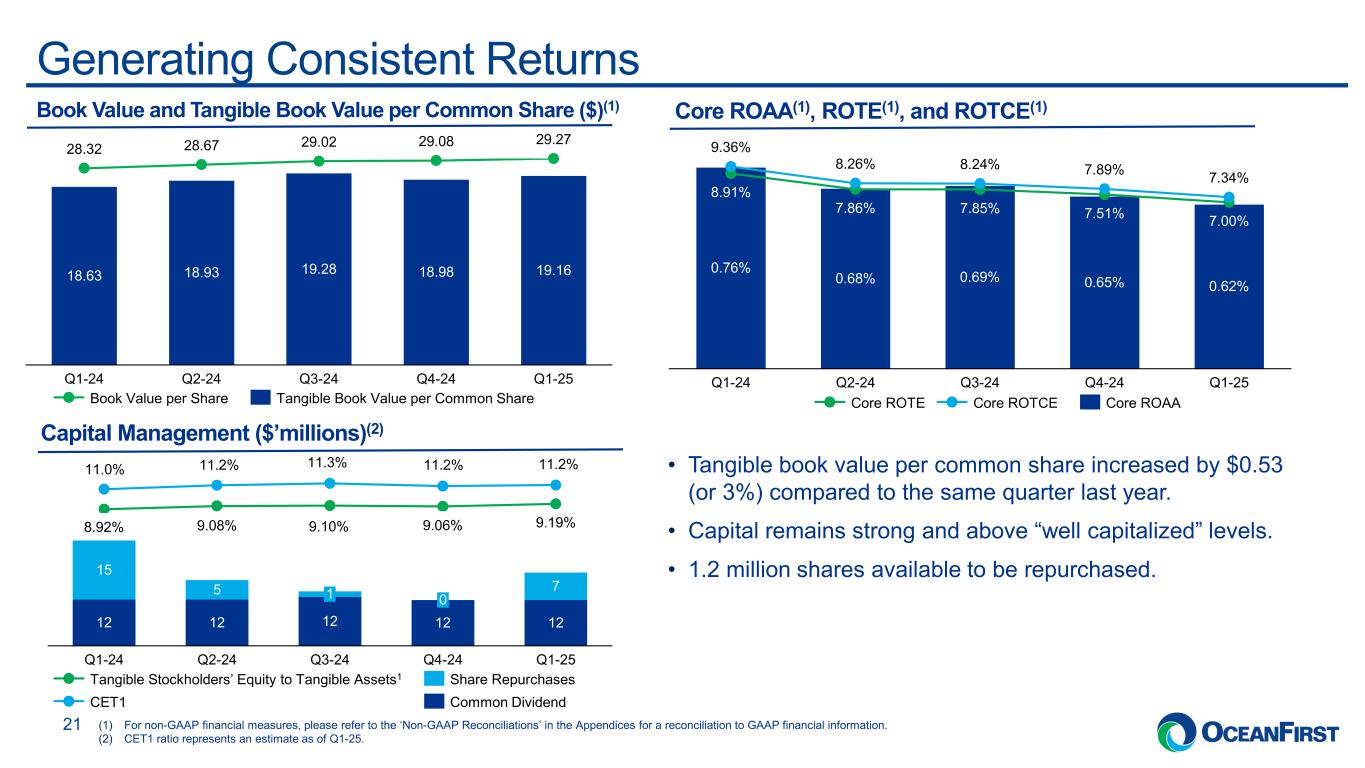
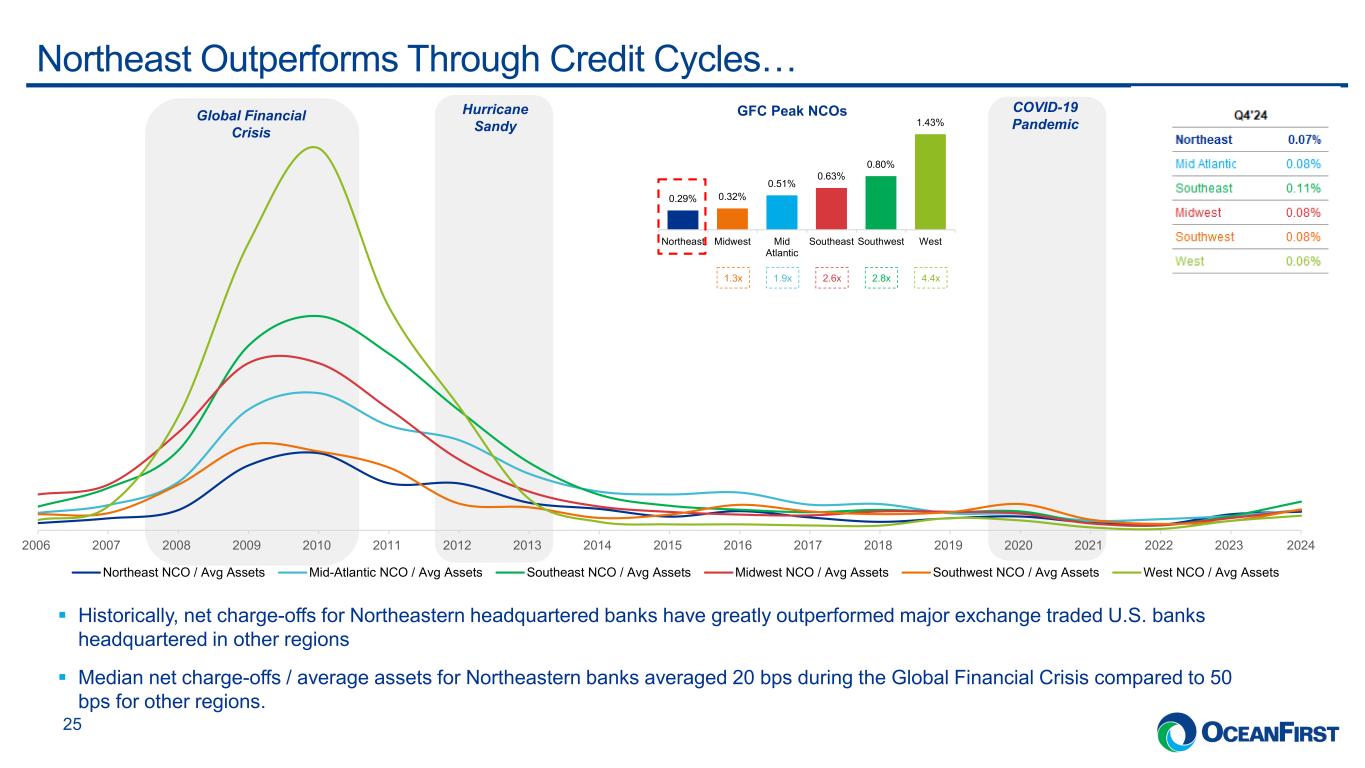
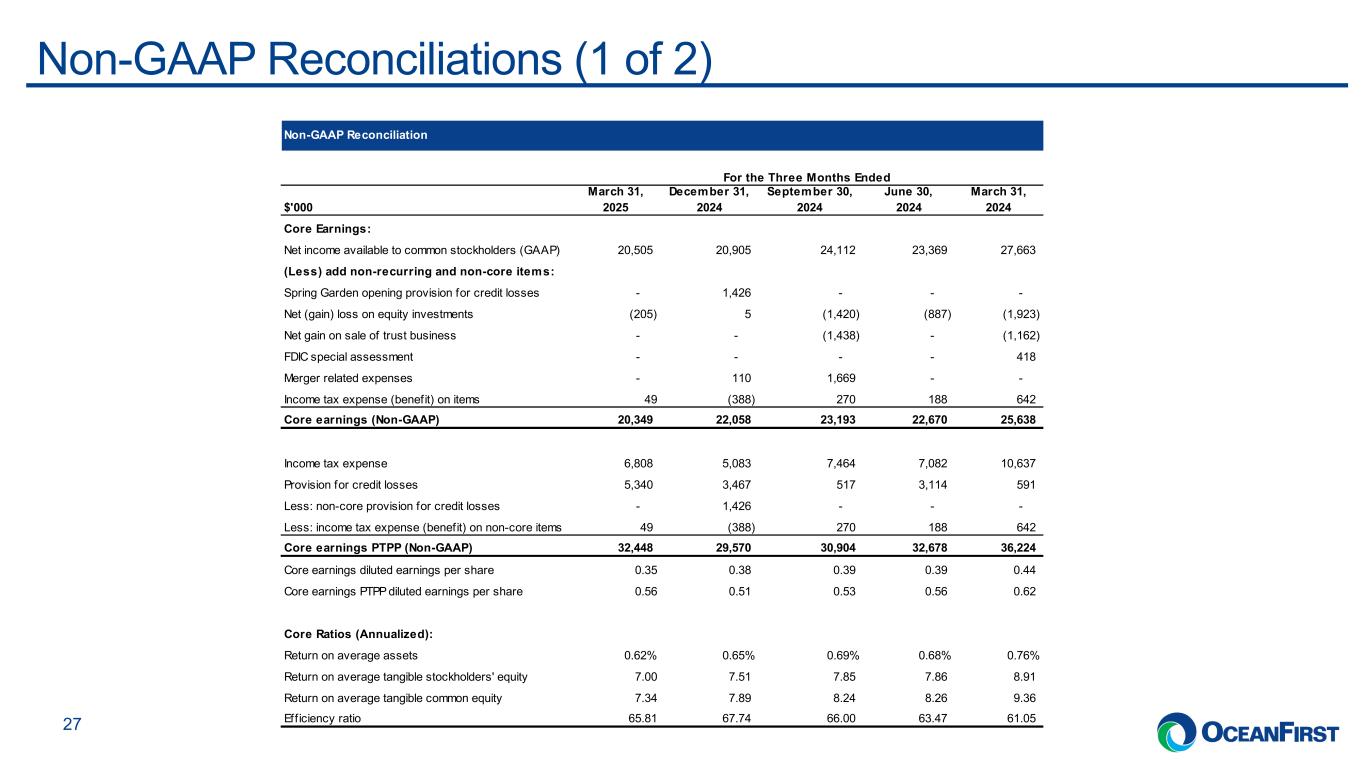
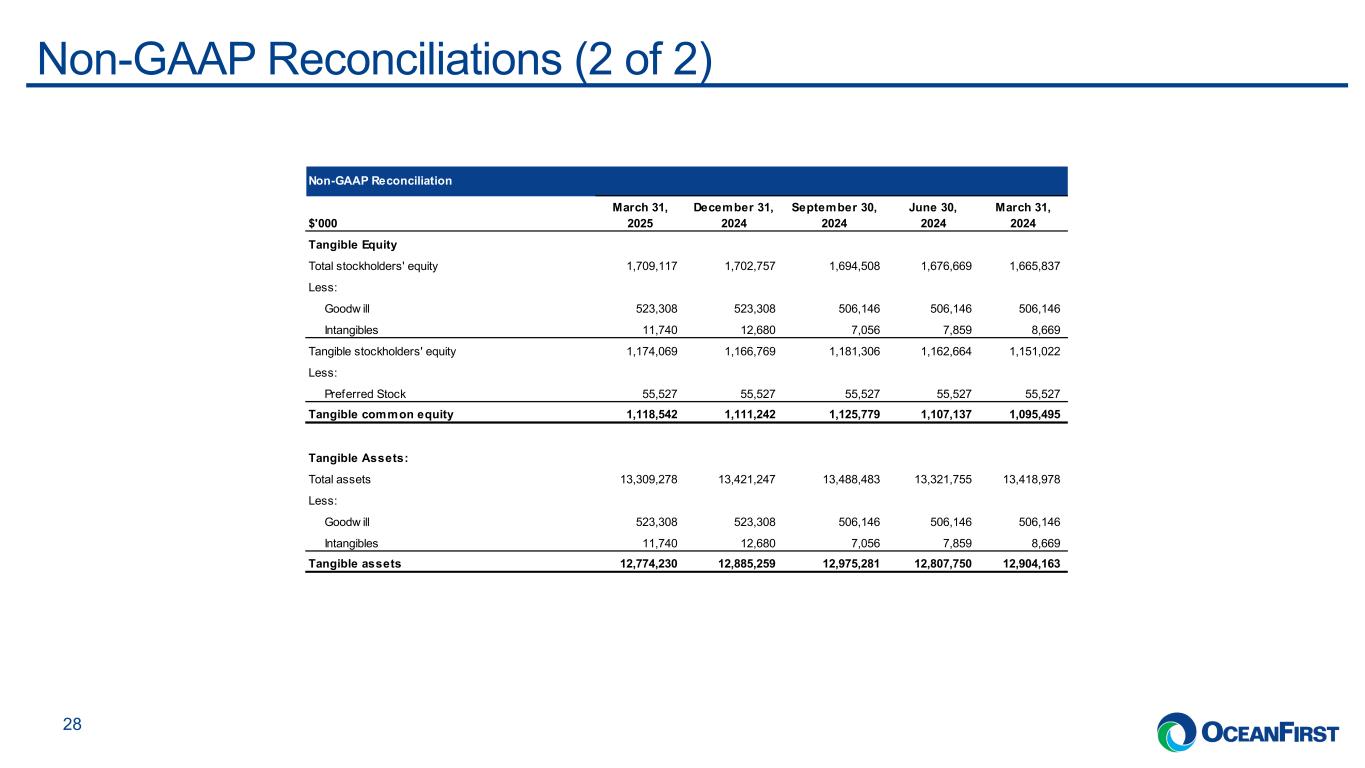
Good morning, and thank you to all who have been able to join our first quarter 2025 earnings conference call. This morning, I'm joined by our President, Joe Lavelle, and our Chief Financial Officer, Pat Barrett. We appreciate your interest in our performance and this opportunity to discuss our results with you. This morning, we'll provide brief remarks about the financial and operating performance for the quarter and some color regarding the outlook for our business. We may refer to the slides filed in connection with the earnings release throughout this call. After our discussion, we look forward to taking your questions. We reported our financial results for the first quarter, which included earnings per share of $0.35 on a fully diluted gap and core basis. We are pleased to report a second consecutive quarter of growth on both net interest income, which grew by more than $3 million for the quarter, and net interest margin, which expanded by 21 basis points. These improvements were largely driven by deposit repricing efforts. Results also included commercial and industrial loan growth of 6%, or 24% annualized, while the total commercial loan pipeline increased to $376 million as of period end. Operating expenses for the quarter were $64 million, modestly lower than the prior quarter. Note that our first quarter operating expenses did not reflect any of the material investments from our recent hiring efforts, which Joe will touch on in a moment. Asset quality remained strong as annualized net charge-offs were just three basis points, while total loans classified as special mention and substandard decreased 5% to $149 million, or 1.5% of total loans. Classified loan levels remain well below our long-term average and are substantially lower than our peer group. The reserve bill for the quarter was primarily driven by an elevated level of uncertainty around macroeconomic conditions. Capital levels remain robust with an estimated common equity Tier 1 capital ratio of 11.2% and tangible book value per share of $19.16. This week, our Board approved the quarterly cash dividend of $0.20 for the common shares. This is the company's 113th consecutive quarterly cash dividend and represents 57% of GAAP earnings. Finally, we're very pleased with our progress in launching the Premier Bank Initiative, which is growing quickly and should drive organic deposit growth and additional margin improvement in the second half of the year. For more color on that initiative and our other businesses, I'll turn the call over to Joe for his comments.
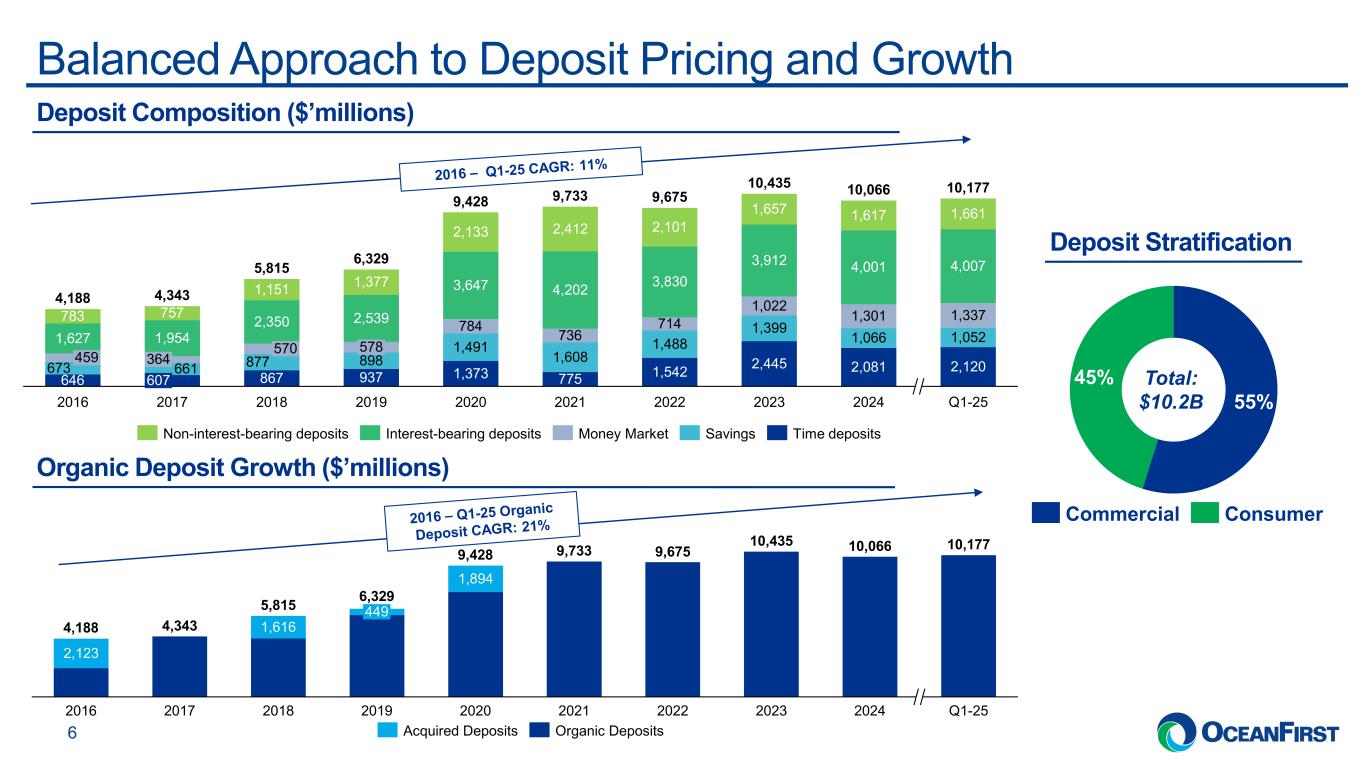
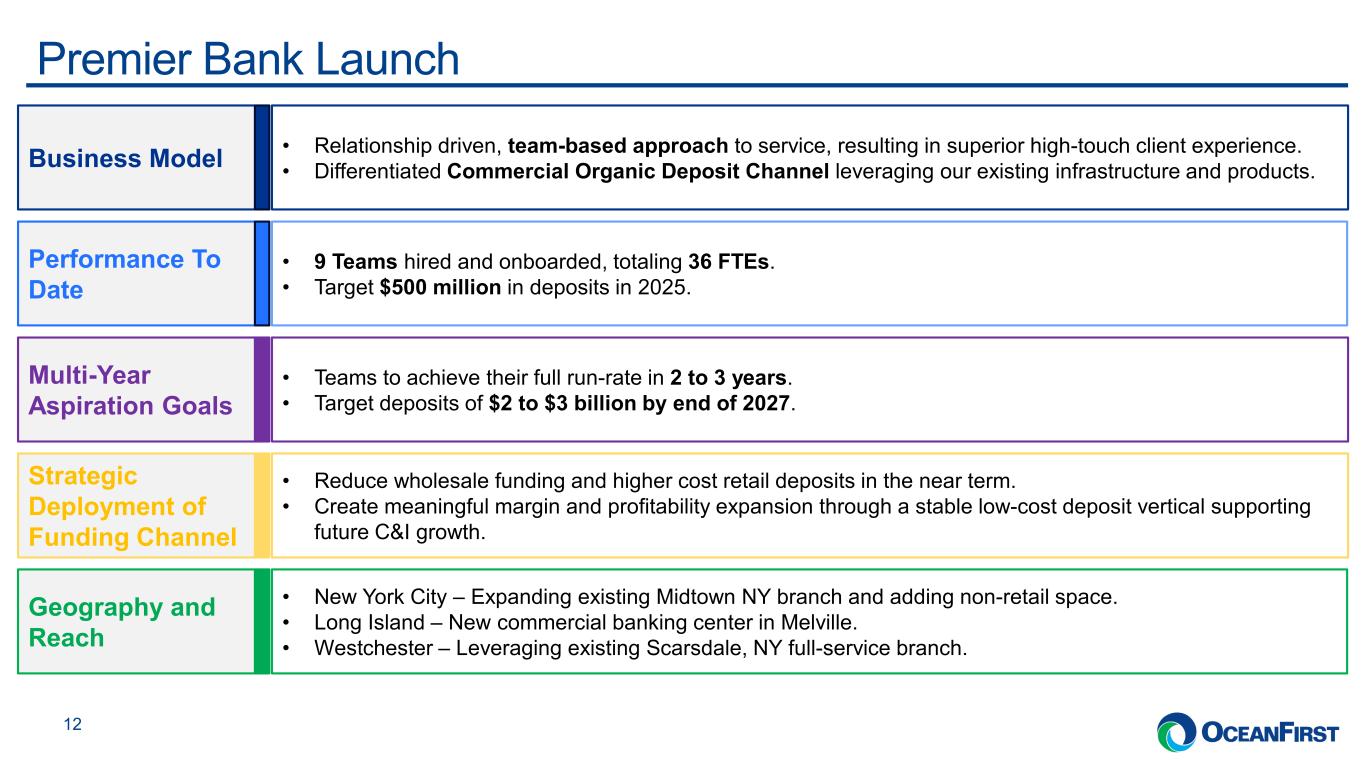
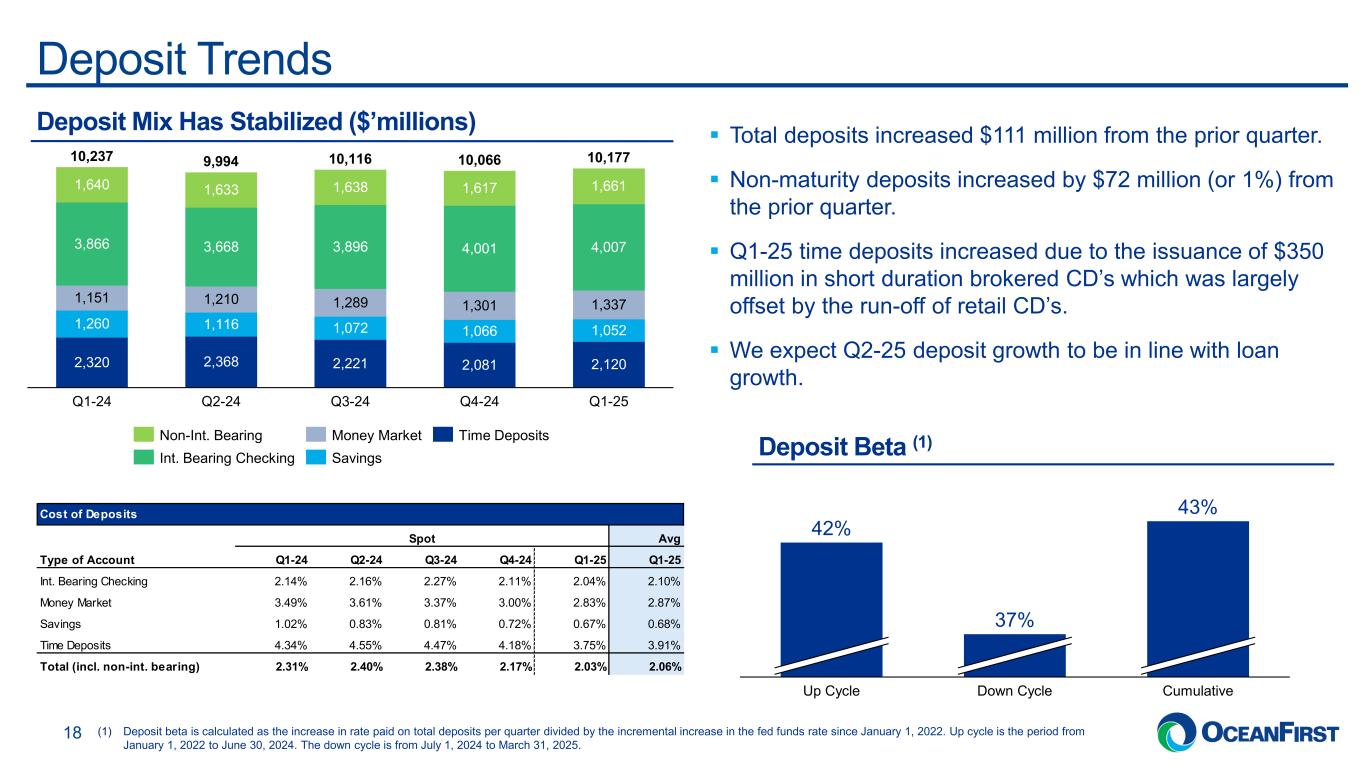
I'll start with the company's loan originations for the quarter, which totaled $417 million, including $135 million of C&I originations. The commercial pipeline is nearly double last quarter, which should help build out C&I and, more broadly, stimulate overall loan growth. It's competitive out there, but as evidenced by the pipeline, the recruitment of commercial bankers over the last 15 months has begun to pay dividends. Turning to our residential division, activity remains impacted by uneven loan demand, with volatility in rates, limited inventory, and seasonally low volumes affecting Q1. We remain cautiously optimistic, and we are cognizant of the potential impact that economic uncertainty may have on rates, affordability, and production. As we turn to the second quarter, we are pleased to announce the onboarding of nine premier banking teams in April. These teams have a proven track record of managing significant customer portfolios, historically consisting of lower-cost, deposit-rich commercial relationships. We are optimistic that these teams will have substantial new client wins for the company throughout the remainder of 2025, although it could take two to three years to achieve their full run rate potential. We have also seen continued success in the hiring of C&I-focused commercial bankers with the addition of six bankers so far this year. These new ads are incremental to the 10 C&I bankers we hired in 2024. As we have done historically, we will continue to identify and hire additional commercial bankers throughout the year when the opportunity arises. Moving to deposits, excluding brokered CDs, balance is decreased by approximately 2% compared to the prior quarter, primarily from a runoff of higher cost time deposits. We anticipate some seasonality in the second quarter, but you'd start to see the portfolio growth with new client wins thereafter. Non-interest income decreased 8% to $11.3 million during the quarter. Excluding non-core and non-recurring items, non-interest income decreased 11%, primarily driven by seasonally lower title fees and service charges. With that, I'll turn the call over to Pat to review the remaining areas for the quarter.
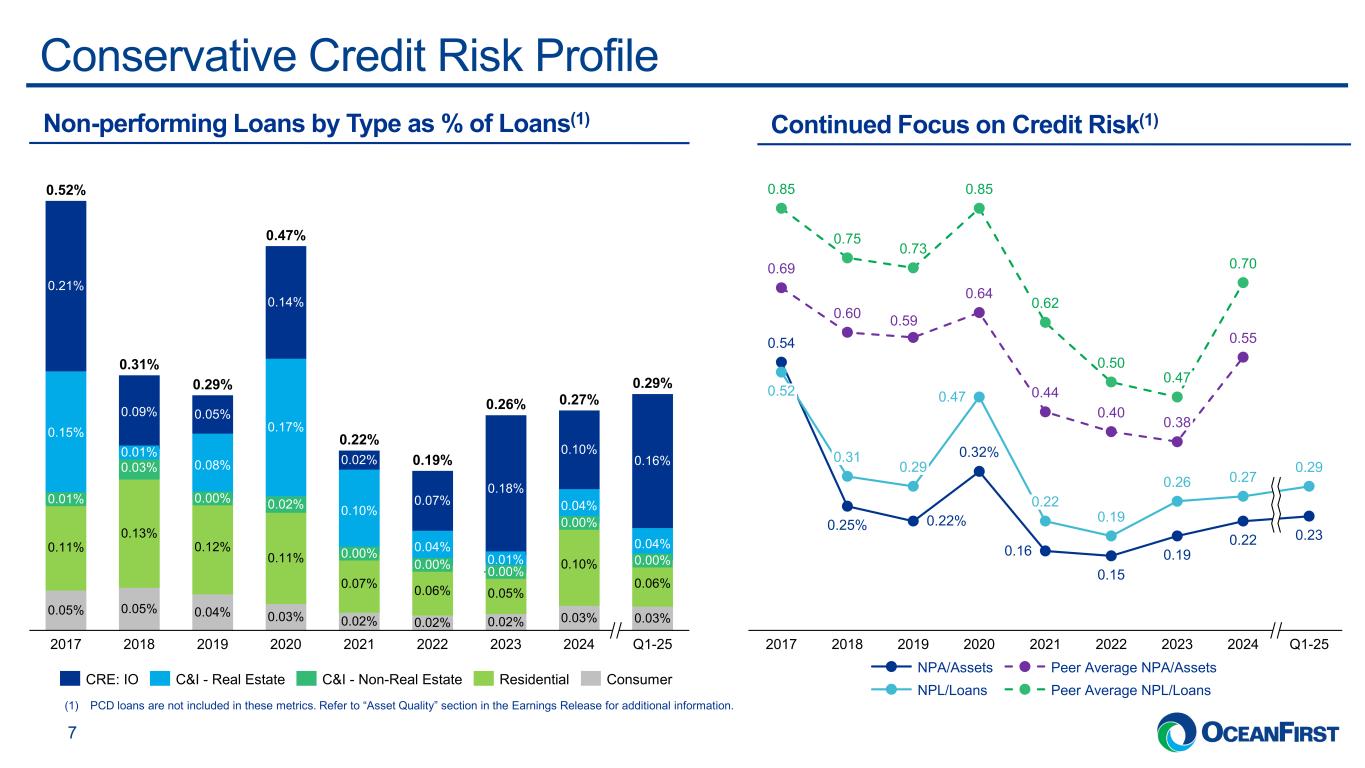
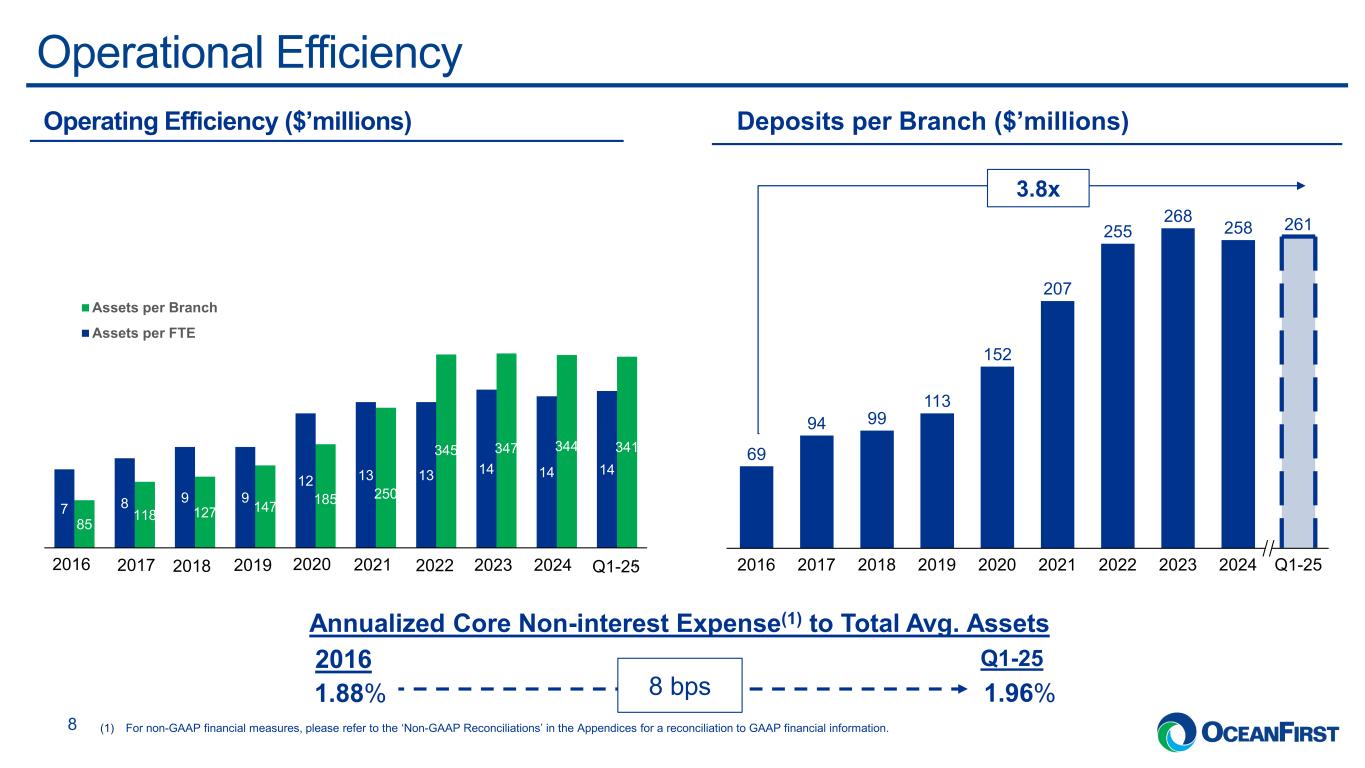
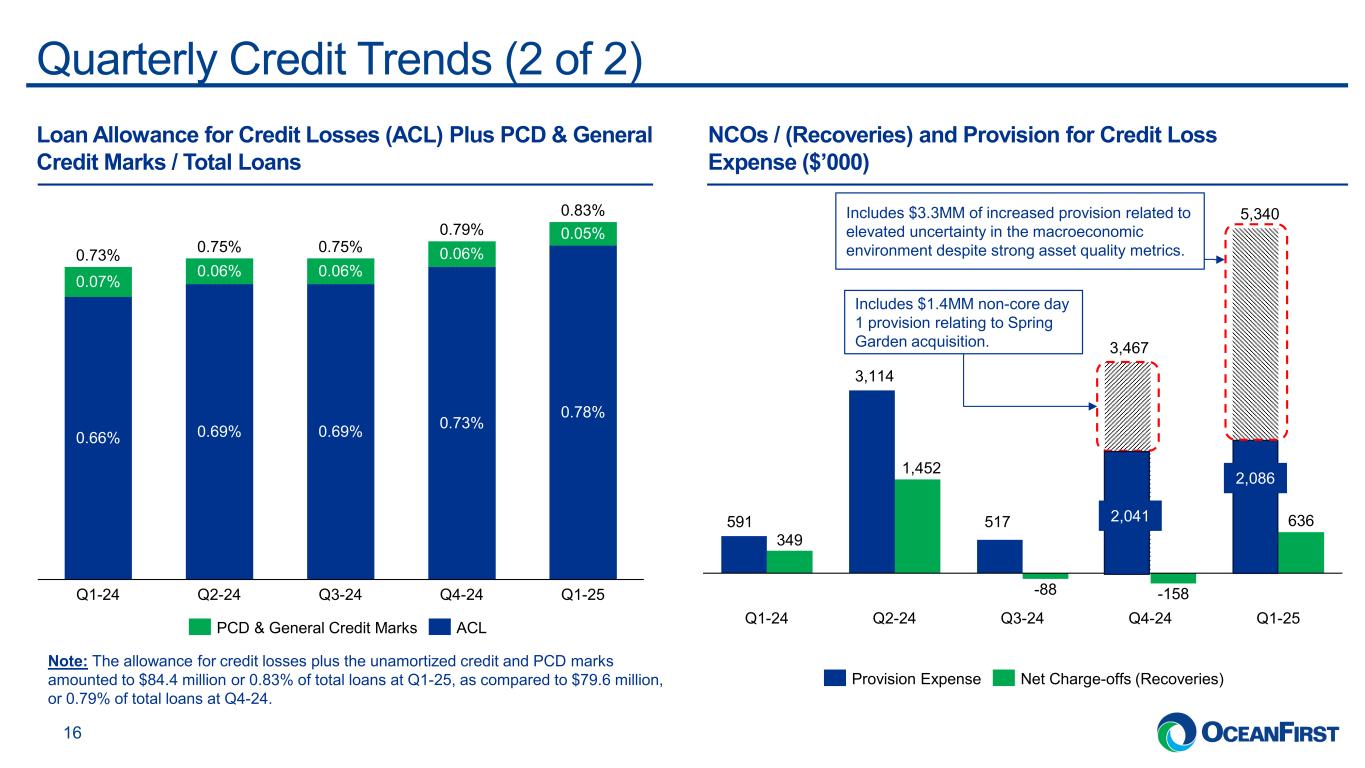
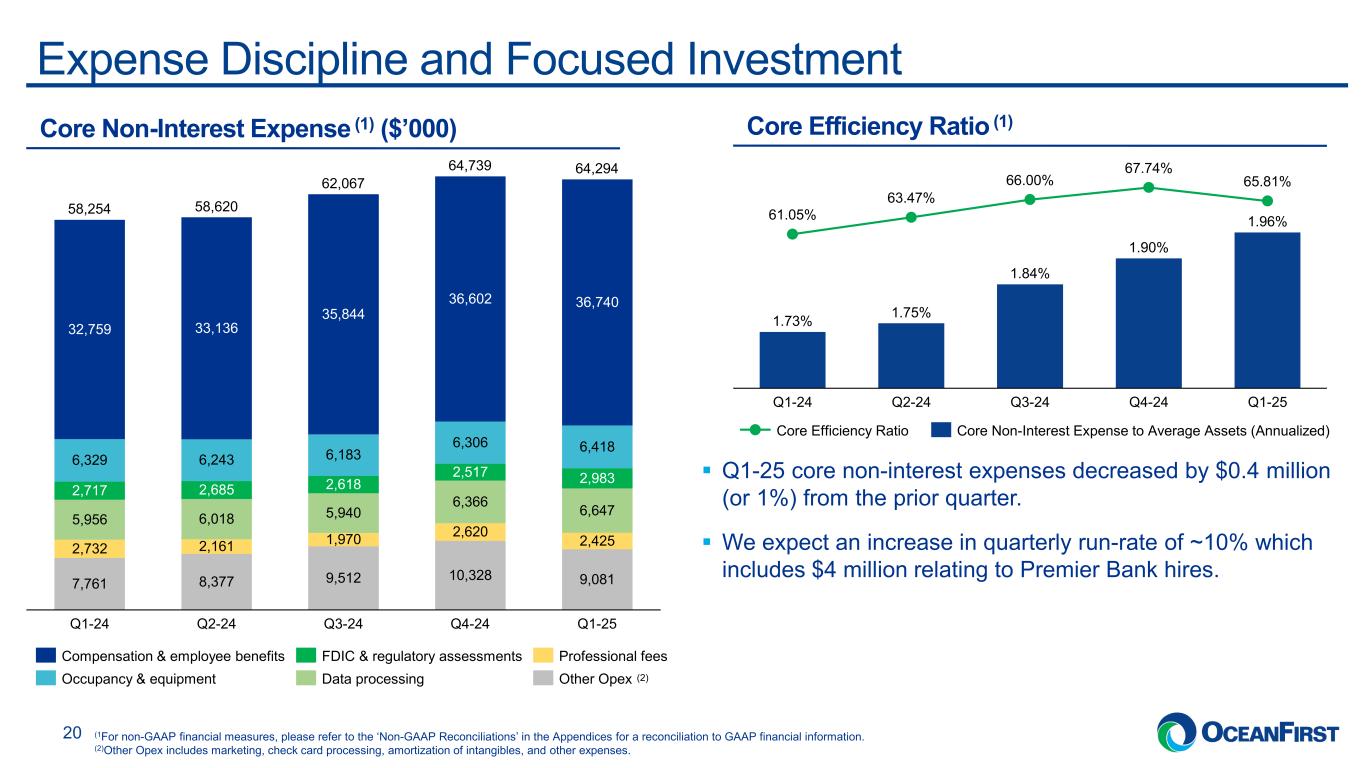
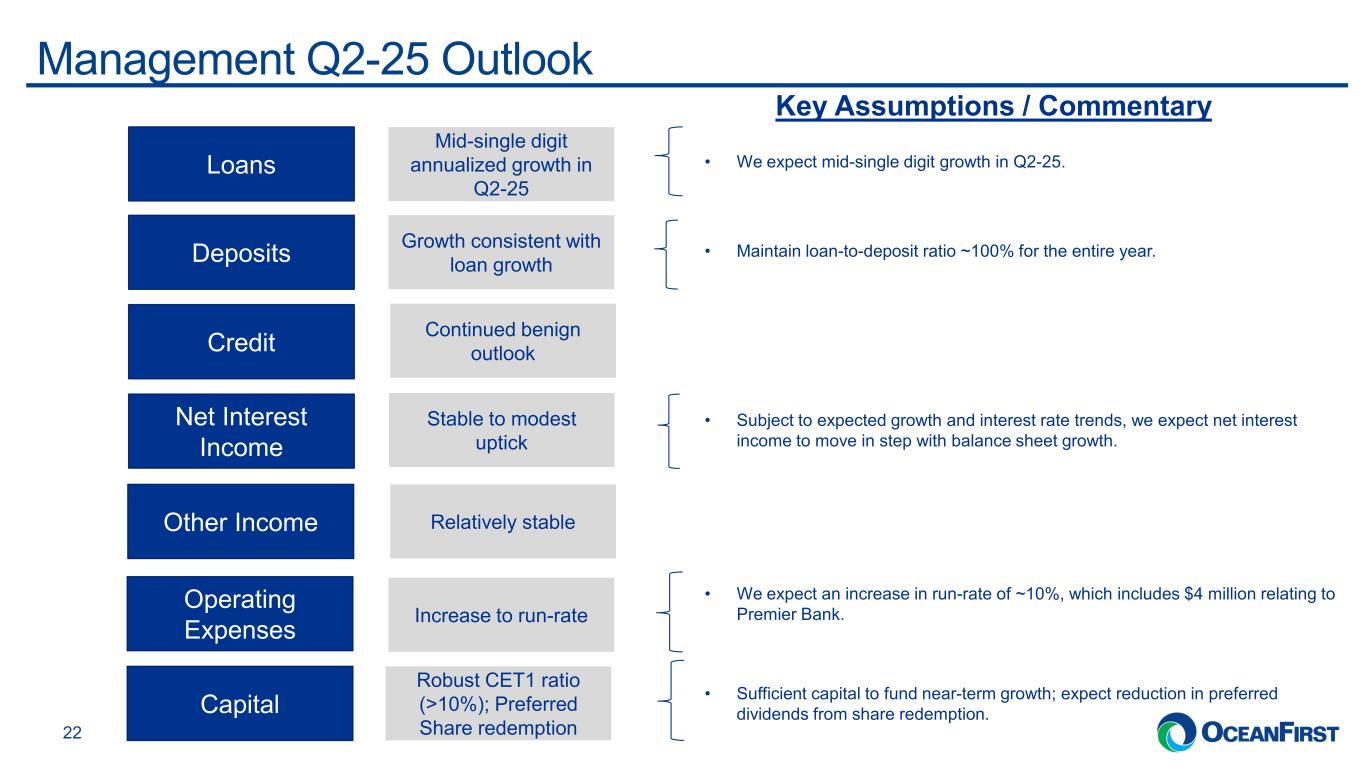
Thanks, Joe. As Chris noted, both net interest income and margin grew in the quarter, with net interest income increasing by nearly 4% and net interest margin expanding by a healthy 21 basis points. Total funding costs, as well as total deposit costs, both declined by 26 basis points, while loan yields remained essentially flat. While we're pleased with our overall reduction in funding costs, we believe the deposit repricing pace may moderate in the near term, but with positive tailwinds expected in the back half of the year as our deposit gathering initiatives begin to ramp up. Asset quality remained very strong, with nonperforming loans at 0.37 percent and loans 30 to 89 days past due at 0.46 percent of total loans. While we saw a modest uptick in substandard, overall criticized and classified loans declined 5%. Overall, credit quality continued to perform in line with our company's strong historical experience and well below peer group averages. Additionally, we continue to monitor our exposures to industries and geographies for any emerging impact from recent political and administrative policy changes, but to date we've seen no signs of weakness across our customer base. Despite this, we felt it was prudent to increase our allowance for credit losses by just over $5 million, reflecting both the heightened levels of macroeconomic uncertainty as well as a modest shift in loan portfolio mix to higher C and I exposures. Non-interest expense decreased $555,000 to $64.3 million during the quarter, driven by seasonally lower title costs, with most other expense categories relatively flat to the prior quarter. Compensation expense was partly impacted by a $1.3 million incentive reduction recognized in the quarter. Looking ahead, we anticipate our quarterly operating expense run rate to increase approximately 10 percent, of which $4 million is attributable to the recent premier banking hires this quarter. As Joe mentioned, we remain opportunistic for additional hires, that could impact the run rate further. Capital levels remain robust and included nearly 400,000 shares repurchased for a total of $6.9 million and a weighted average cost of $17.20 per share. We'll remain opportunistic in repurchasing shares in the near term, but that will be highly dependent on market conditions. And as previously announced, we'll be redeeming in full our $57.4 million of preferred stock on May 15th. Finally, a word on taxes. We expect our effective tax rate, which was 24% in the first quarter, to remain in the 23% to 25% range, absent any changes in policy. At this point, we'll begin the question and answer portion of the call.
Operator
To ask a question, please press star followed by one on your telephone keypad now. If you change your mind, please press star followed by two. When preparing to ask your question, please ensure that your device is unmuted locally. Our first question comes from the line of Frank Schiraldi of Piper Sandler. Please go ahead.
Morning. In terms of the new teams brought over, any specific sectors targeted here that you can share and and then you know I know it's um it's you know uh obviously a lot depends on on rates and so forth but just any thoughts about around the mix that is likely to come over in terms of you know pick up in overall costs or you know percentage non-interest bearing any thoughts on that front frank i'll start with the the sectors the uh the teams have a really robust variety of commercial clients and they range anywhere from those clients that
are deposit rich law firms title companies to more traditional commercial borrowers that have a variety of credit needs so I think we're going to see the full range I don't think there's anything that we target as a specific relative to a vertical that would be either new to us or a concentration Frank, I'd just add on in terms of deposit rate expectations and the weighted average cost of deposits, we obviously hesitate to give you very specific guidance on that, but the portfolios these clients maintain are typically a substantial portion of non-interest that could be 20% plus or minus depending on the team.
And then the remainder of the funds they bring over have a market rate but on the lower end of market, right? These are not the high end of the market. So when you blend those two numbers together, you get a very attractive cost of deposits. But it varies from team to team.
Okay. I appreciate that. And then, you know, you mentioned the opportunity maybe to bring over additional folks. Just curious, you know, given timing of bonuses, the way that works, is that more sort of a 2026 expectation, or is there still opportunity here in coming weeks and months?
Frank, Chris, I think we're at the tail end of the traditional kind of spring recruiting season.
So there may be, you know, a couple more opportunities to bring people over.
But, you know, traditionally that's kind of all wrapped up by mid-May. So a little bit of opportunity out there. But we would probably from that point forward just kind of focus on execution for the remainder of the year.
And if I could just sneak one more. And in terms of the expense increase, you know, 10% on run rate, $4 million related to these premier groups, just anything else to call out in terms of the rest of it? Is it just, you know, the 10% increase? Is it just, you know, general investments, anything to call out there?
As far as the nature of the expense, it's really driven by comp expense increases. We do have some contracts that are renewing, and we will see some inflationary increases, but I would say that those would be kind of in line with a normal kind of 3% increase on average. Then there's some occupancy, because we have to put these people in places that we don't currently have vacant. So there's going to be an increase that you'll see in that line item as well. Gotcha.
I appreciate it. Thanks, Frank.
Operator
We have a question from Tim Switzer of KBW. Please go ahead.
Hey, good morning. Thank you for taking my question. I have a few follow-ups on the Premier Bank. Can you maybe walk us through kind of like the messaging to customers on Premier Bank versus kind of more classic Oceans and what the reception has been so far in people who have joined the Premier Bank?
Yeah, the way we look at it is that we have a variety of service models that are attuned to a variety of different kinds of clients. And, you know, some clients, you know, love dealing with our kind of automation or our call center, and that works really well for them. Other clients, like I would make the comparison like a concierge medicine, right, where you can kind of have a relationship where you have a primary doctor you go to all the time and you really value that relationship. and other folks, you know, buy their healthcare differently. It's no different in banking. So we want to serve the customer the way they want to be served. So Premier Bank appeals to a certain segment, and the rest of our businesses appeal to other segments, and neither one's right or wrong. It's just customer preference.
Okay. How many new customers is this bringing in versus moving, you know, larger legacy customers over into Premier Bank?
So this would be essentially, for the most part, I would imagine, all net new customers to the bank. we're not remapping existing customers I mean of course over time if a customer wanted to be handled in a different way it would certainly be flexible and do whatever they want but the majority of that would be net additions to premier bank okay gotcha and then sorry if I missed this and jumping around calls but can you update us on your plans for refinancing the sub debt if you want to after you've paid off the preferreds sure obviously there's the big thing you already mentioned is the preferred so we wanted to make sure we got rid of that at first, that was the most expensive capital we had. We're in no rush to do anything about the sub debt. It's a little bit more expensive, but it doesn't weigh earnings all that much. We're watching conditions in the market. We'll consider our growth rate and other things over time. So we're in a position to refinance that if things get attractive for us, but we're equally comfortable kind of leaving that out there for a bit of time, depending on market conditions.
And this is Pat. I'd think about it this way. We kind of preserved any tangible book value dilution or erosion by repaying or redeeming the preferreds. So kind of the net impact of that cost avoidance pretty much offsets the increase in the subdebt, which is about a million, million and a half a quarter pre-tax.
Operator
We have a question from Dave Bishop of Haltigou. Please go ahead.
Yeah, good morning, gentlemen. Hey, I'm curious, you know, probably more questions for Joe. The growth in the C&I obviously was very strong this quarter. Just curious, does that represent maybe new sectors or segments and types of customers you're being able to book? And just curious where that growth was geographically. Was it broad-based or was it centered in any specific regions?
Yeah, thanks, Dave. Growth was broad-based, which is good, although we did see some concentrated growth in our government contracting business. That's fairly new to us in the Virginia, Maryland, D.C. metro. But I'd probably just say overall that we're seeing activity from not only the legacy folks, but also the folks that we've put in place over the last year. It typically takes a CNI banker three to six months to get acclimated not only to the way a new bank does business, but also to convince clients that this is the right place for them. And we're starting to see that momentum build. And I think we'll continue to see it. I think this is just the beginning.
What I'd just add, one of the nice things about the GovCon business for us is we don't have a back book. So we're able to be very selective over the credit risk that we choose to take in that world. And, you know, for the remaining companies that are quite strong that have, you know, could be military, cyber contracts, that kind of work, there's very good work to be done there. And it's nice to kind of step into that business at a time where we can be very selective.
Got it. And then, you know, Pat, you noted maybe waning ability to lean on deposit costs. I'm just curious, maybe, I don't know, get the spot rate of average cost of deposits at quarter end, but maybe a near-term outlook where you see maybe deposit cost trending and stuff. Like, there could be some seasonality in the second quarter that may require you to lean on borrowing. So, did I read that right?
I'd say probably. There's not going to be a whole lot of bias one direction or the other at this point. Pretty stable outlook in the near term on costs. We certainly have the capabilities to lean on wholesale, but at this point don't envision needing to do too much of that. And we're hopeful that as the premier banking and additional deposit gathering initiatives continue to build and build steam, that that'll take any pressure off of funding needs.
Operator
We have a question from Christopher Maranak of Jamie Montgomery Spots. Please go ahead.
Hey, thanks. As you execute the new Premier Bank initiative, how much of the customer's kind of wallet do you think you'll get over time? And is that any different as you've kind of gotten closer to the launch compared to what it had been in the past?
Chris, it's Joe. I would tell you that the expectation is that over time we'll get the majority share of the wallet. These are longstanding customer relations, which is something that's really attractive to us. As we talked about earlier, I think you'll see it come over in time. We all know that sometimes when you have existing loans, those take time to mature or reprice. And the same thing goes with operating accounts. It takes a period of time for people to migrate across and run through the activity at the old institution. But I'm a big believer that these teams have significant followings, their full relationships, and they'll be loyal.
Got it. And Joe, is it fair that some of the teams that may be out there that you may not be pursuing as hard because you may not have the same visibility to bring their full wallet over?
Between the big opportunity and kind of how much kind of gets narrowed down into the funnel over time.
You know, Chris, I'd add that we view this not only as a driver of margin in earnings over time, but a franchise value. So the higher quality relationship you have on the deposit side, the more durable those deposits are. You know, we're not interested in putting dollars on just to put dollars on. We're trying to make sure we build a longstanding liability sheet here that creates a lot of franchise value.
Understood, Chris. Thanks for that. But and then just one follow up, I guess, from a credit perspective, does this time of year with new financial statements make any difference to kind of how the risk ratings may play out? You've had obviously good experience here in recent quarters.
It does. I mean, this is, as you point out, this is when we get a ton of tax returns in and things like that, although many of them get put on extension. So you see a lot of them in the fall as well. So, you know, but we've seen no trends that would be concerning. We're always thoughtful that that's a rearview mirror kind of thing and not a windshield kind of thing. But we did conduct a survey of our commercial book just to understand, not just from what we see in our credit work, but what our customers tell us about their tariff exposure. And it was a very limited exposure to the first-order concern about tariffs. In fact, I think only about 8 percent of the commercial book recorded any meaningful exposure at all to tariffs. And then of those folks, the majority, about half of those folks thought they could have a reasonable chance of passing along any cost that came to them. But despite surveys and despite underwriting, we felt that we really couldn't get a perfectly clear view. And that's why you saw the additional reserve bill. That's kind of a just-in-case in an environment that's you know, fairly foggy right now.
Well stated, Chris. Thank you very much for sharing that too. I appreciate it.
Operator
We have a question from Daniel Tamayo of Raymond James. Please go ahead.
Thank you. Good morning, guys.
Yeah, maybe just going back to Premier Bank, you know, kind of longer term goals. You put in there the two to three year ramp and how much you're expecting it on deposits um you know curious if you guys are thinking about you know given you're you're putting on a lot of expenses kind of immediately it's going to impact profitability but you know longer term where this takes the bank um if you have any kind of targets uh from a financial perspective where where you think that might break even relative to to you know where you would have been uh before um if there's a loan to deposit sorry a lot of questions in your loan or deposit, you know, thoughts longer term as well. Thanks.
So, well, we'll try and take those in pieces. So let me talk a little bit about profitability impact. First of all, it's a significant build in expenses. Given our overall expense base, it's not all that significant. And we're being very careful besides the compensation costs to be very deliberate around other costs, you know, things like facilities. Really pleased that the The majority of these bankers are going to be located in Manhattan or Long Island. We had existing branches today in one on 3rd Avenue in Manhattan and one up in Scarsdale that will support those teams. We took a little bit of back office space upstairs from our branch just to make sure that was an efficient kind of leveraging of the full service branch. And we only envision one facility on Long Island for the teams we've hired to date. That'll be a modest facility out in Melville. Depending on the hiring, we might add another modest facility or two, but it's not really going to be a big expense bill. So when you put all that in and you think about the leveraging of the operating environment we have today, it's probably somewhere around the four-quarter mark that you have a little bit of a subsidy to this business. And I want to be very careful. This is a little art and not as much science. That could be, you know, four quarters, it could be five quarters, you know, it's hard to tell exactly. At that point, the margin improvement should have overcome any of the OPEX considerations. And then from there on, it takes maybe another year or so to get fully profitable. but if you think about the numbers we gave you today you're talking about operating expense on the additional customer base as sub 100 basis points could be you know 80 90 basis points so the operating leverage here is quite good as you work your way through it and um there'll be a modest impact to eps for the next four quarters it's not going to be dramatic um and we think we kind of turn that around so you know we felt that a 12 to 18 month payback it's pretty fast to build something that's got durable franchise value. So forgive me if we missed any other part of that question.
No, it was great. I guess the only other question within there, just do you have a target in mind for where you want the loan to deposit ratio to be?
Well, sure. So, you know, we think about each of our businesses, they have very different dynamics around loan to deposit ratio. So the Premier Bank is a very low loan to deposit ratio. It's predominantly deposits, although there's a substantial amount of loans. You know, some of the teams might have a 20% loan-to-deposit ratio. Some might have lower. It's a very nice complement to our C&I business, which has a high loan-to-deposit ratio. Typically, our C&I business doesn't self-fund.
So when you put the two of them together, you get a really powerful combination.
So the premier banking teams, you know, we'll keep you updated on this. I would not be surprised if the loan-to-deposit ratio in there is plus.
And then, I guess, lastly, just to put a finer point on the expense bill, you talked a lot about it. Pat talked about it earlier. So, should we think about the 10% increase, you know, that's off of the what?
First quarter. That's off the kind of first quarter, which is a little bit low.
Okay. Okay, so 10% on the 64.3 in the second quarter, and then any other kind of incremental build that we should expect going forward or kind of how you were thinking about expense growth prior to this announcement is still about, still makes sense.
That's what's big for the folks that we have on board today. If we hire a few more additional bankers, it might come up a little bit, but that's a good news item, and we'd report that in July if that happens. and that may or may not happen.
Danny, this is Pat. I'd use 66 as a run rate because we did have a year-end incentive comp true-up that made our comp expense lower in Q1. So if you add that back in, that should be your base.
So 10% off of 66 million in the second quarter and then assuming no other hires, There's kind of a normal, you know, call it mid-single-digit growth rate off of that. And then if you do have more hirings, then that would be incremental.
Yes, on the incremental for more hirings, I don't think that you'll see a steady increase from that second quarter run rate. I think it'll be relatively stable. So I think we'll see a fair number of annual inflationary increases that will roll through by the middle of the year. And those are all within the 10% guidance we've given you? That wouldn't be on top of that? There's going to be some timing issues. We're kind of in the middle of adding to all of this, so these are not as precise as we would normally have them, but we'll fine-tune that as we kind of move through into the second quarter earnings.
So I guess back of the envelope, that you're going to be kind of maybe $73 million-ish for the rest of the year. It sounds like it's in the ballpark.
A little bit, maybe a little bit lower. 70, 71, probably.
Thanks for all the color. Appreciate it. Thank you.
Operator
We have a question from Matthew Breezy of Defense, Inc. Please go ahead.
Hey, good morning. Good morning, Matt. I was hoping with the premier teams and the anticipated deposit growth, Could you give us some help on how we should think about the overall balance sheet size? You know, with the growth, is it a one-for-one increase, or do you expect reductions in some of your higher-cost funding categories? And if so, kind of just frame for us what you'd like to run off.
You know, our guess is that, and this is a guess at this point, Matt, it's going to depend a little bit on quality loan demand. So, you know, if we get the loan demand we'd like, and the pipelines are pretty good, you You could imagine some balance sheet growth, but it would be a mix of balance sheet growth and remix under the covers that will help us kind of optimize our capital position, leave some capital out there if we want to do things like buybacks. And if we're in a very volatile environment, it's very difficult to give you any longer term guidance around loan growth beyond Q2. If loan growth were to be flatter, that's okay too, because we can just use these deposits to redeem higher-cost deposits and still make margin improvement out of it. So we have nice optionality here, but my guess is that if loan demand stays steady, which is a giant if, think of it as half of it going to deposit remix and half of it going to net balance sheet expansion. I know these teams are going to be metro New York City-based, Long Island-based. any of them have a more national kind of customer focus or national business line focus no you know i'd say just like our existing clients here that we have today we have an occasional client who has a business that may have other facilities in georgia or florida or texas we bank them wherever they are so we've done that uh in many times many cases already um i think you're going to see the same thing just a very small number of clients who may have maybe they have an investment in california or something and we'll follow them uh but the vast majority of this is really uh new york metro centric okay yeah that's what i was looking for and then the last
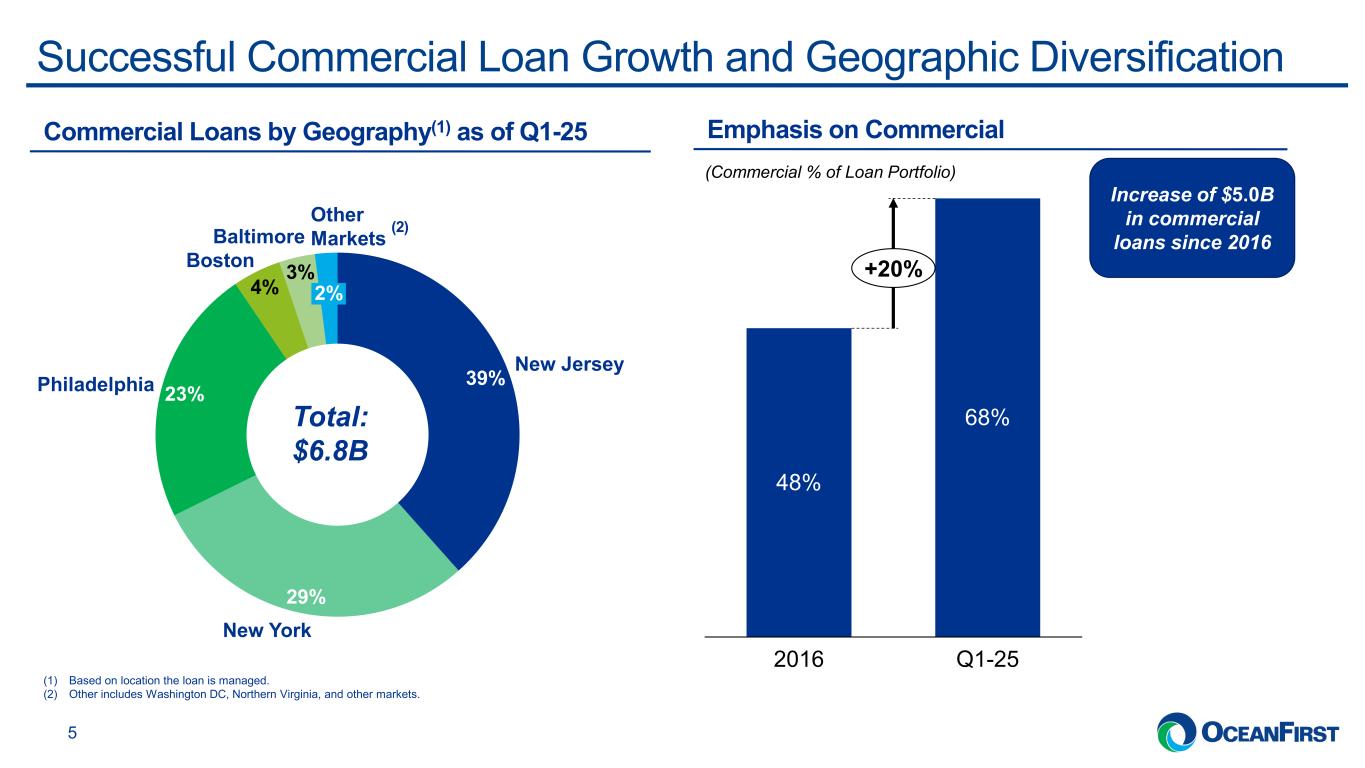
one for me is um you know obviously there's more of a cni focus and commercial real estate has been you know de-emphasized to some extent here could you just update us on you know what your current theory concentration is where you'd like it to be and do you foresee any sort of kind of bulk sales to kind of help get you there? It sounds like the environment from a payoff and competitive standpoint is a bit more friendly today.
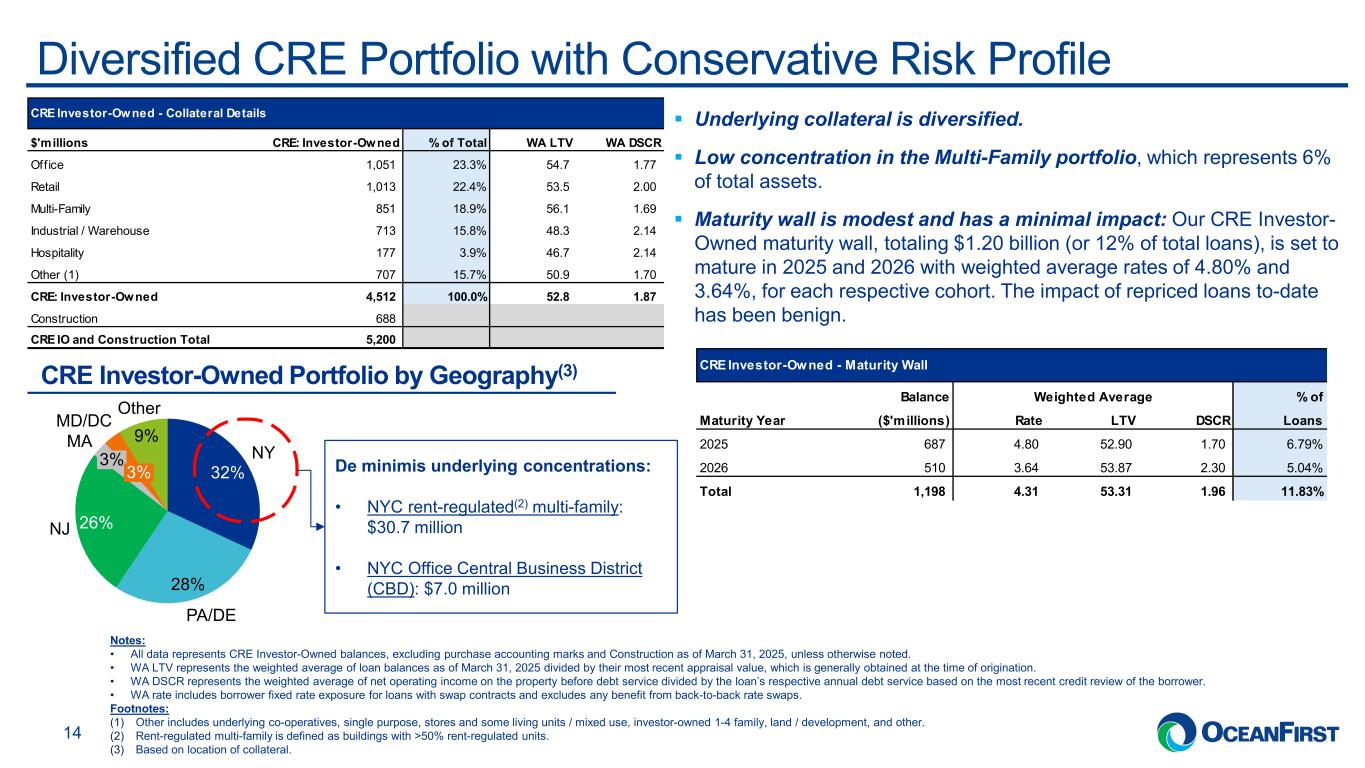
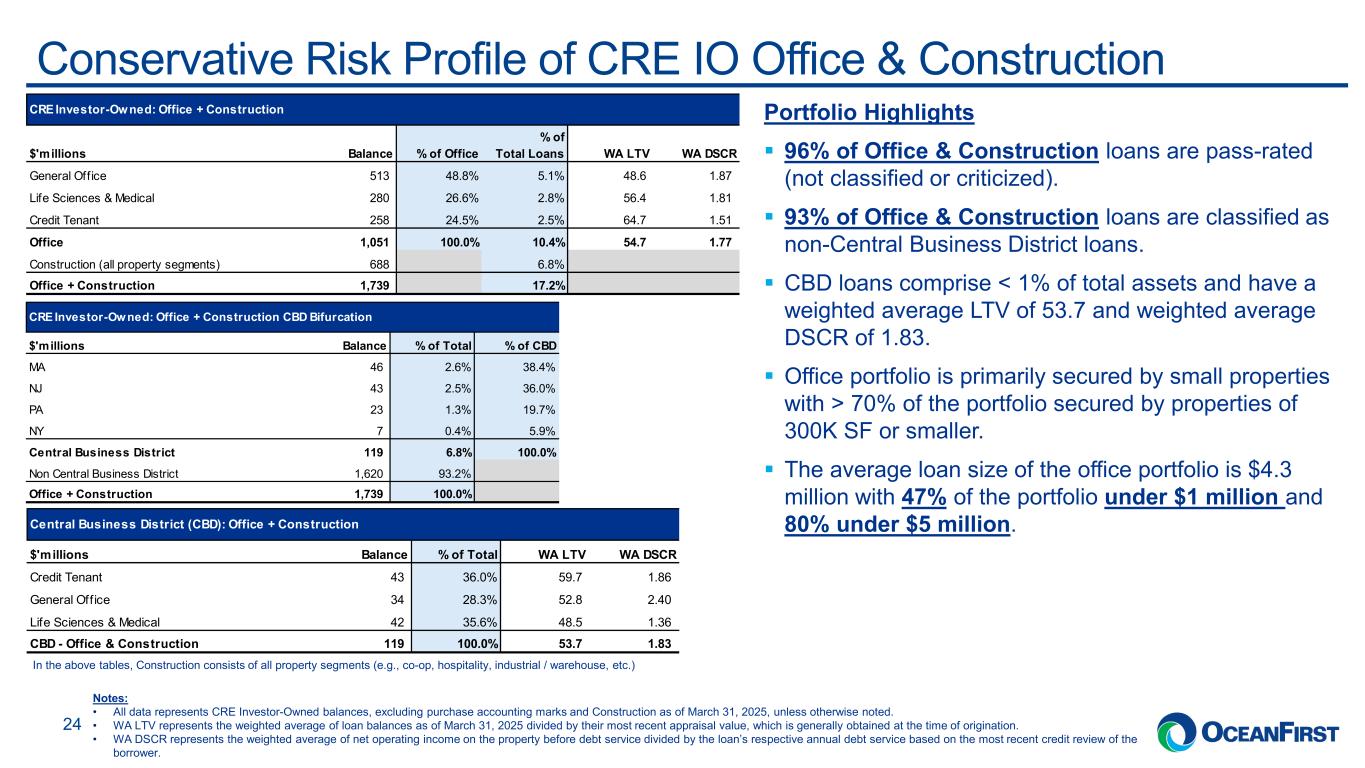
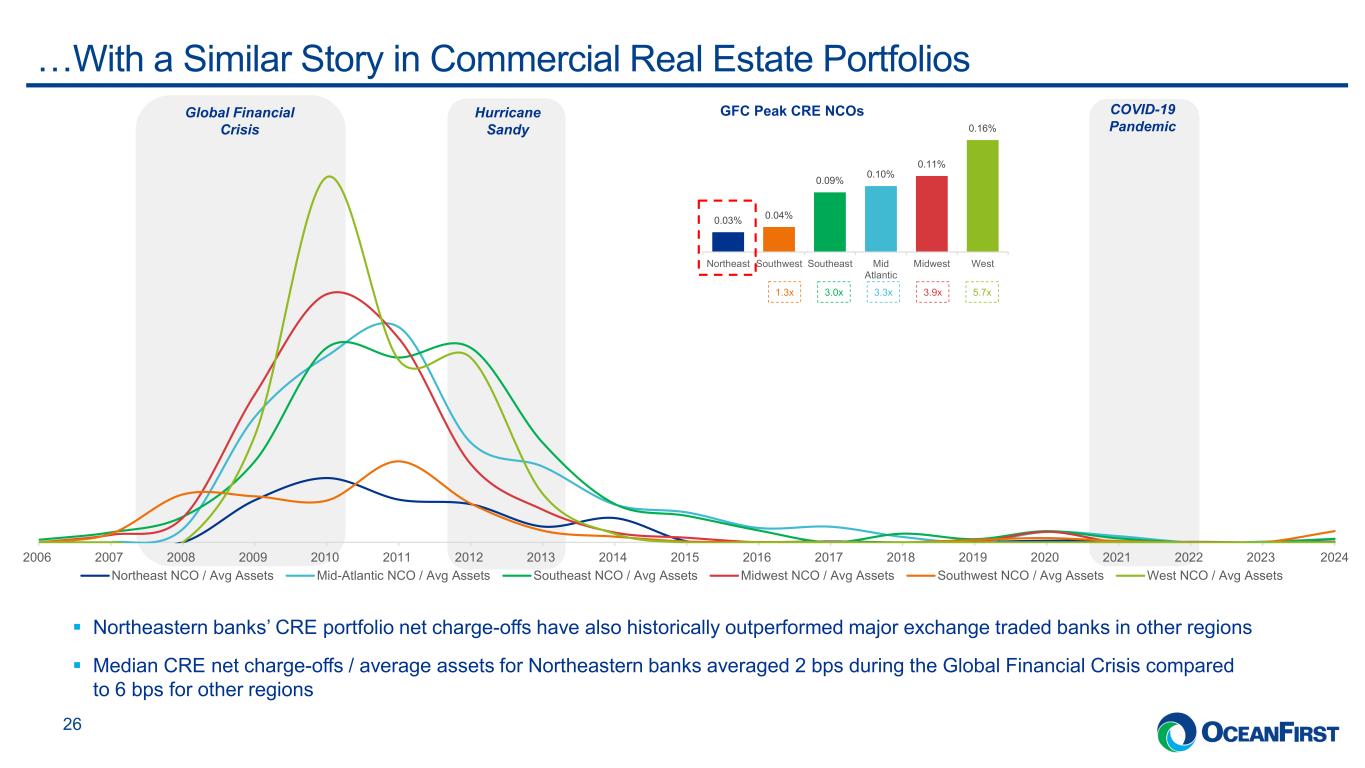
Yeah, I'd say a few things about that, Matt, and then I'll ask Joe to chime in as well. We're very happy with our CRE business. We have allowed it to drift down a bit, so the CRE concentration at the bank level is 416. At the holding company level, it's below 4, it's 393. And interestingly, that's not necessarily because we're trying to drive to a certain number, but you'd be surprised how much competitive pressure there is in the market now for CRE loans and making sure you can get good structures and good pricing. I look at this and say, we're not on any drive to achieve a certain CRE ratio. We've managed it very prudently. You can see that in our credit numbers. You can see that in our minimal exposures. We do not have an exposure for rent-stabilized multifamily. We have a negligible exposure to Central Business District office. All segments are performing really well. So we're happy with it in some ways. I might actually bring that up a little bit over time if we had the opportunity to do it with high-quality loans and good structures. What you're seeing in that concentration drifting down is less quality structures and more competitive pricing. So, Joe, maybe give some description of what you guys have seen in the market because it's kind of puzzling.
So, Matt, I think I just frame it this way. Our CRE folks are out looking for business. We're not holding them back. We're not telling them that we're not interested. Diversity is your friend, so geographic diversity, industry diversity, property type diversity is valuable to us. I think we've made that pretty clear over time. That's one of the reasons the book's managed and done so well. So, I think the comment and what Chris talks about competitively, you know, we're starting to see, even though we're down in this space, I'll use Class B offices as a good example in New York City. There's a lot more activity in Class B after the big run to Class A over the last 24 months. We find it fascinating. I can't pinpoint why there's leasing absorption in this market. It just could be that there's people coming back to offices. It's not something we're chasing. But it is very competitive. We've lost a couple transactions, which are okay for us, people pricing in the fives. It's not our cup of tea, but that's okay. We'll use those dollars and put them elsewhere in C&I or in better price theory.
So to add to that, Matt, you had a question about whether we would kind of de-risk by the sale of loan pools. We do not anticipate doing that. I think that would be pretty unlikely. Exactly. I would direct you to page 14 of our supplement slides. We have a back book of about a billion two rolling this year and next that is rolling off a 4.31 blended rate. We think there's an opportunity to get some earnings momentum out of that. So that's got a 4.31% rate. But if you look at the debt service coverage ratios on that page, the maturity wall for 2025 debt serves at 170 and for 2026 it debt serves at 230. we've been through we've stressed these loans those loans can roll and cover their debt service and we can get paid better on them so you know our bias would be keep the customers roll the loans and improve our margin it could be a significant pickup just from that you know billion to I guess that leads to and this is the last one why not a more positive bias on the NII outlook.
Granted, we're just looking at 2Q for the presentation, but it feels like if there's movement in deposit costs, it should be lower, especially with the new teams. To your point on the repricing on fixed assets, it's positive. If it's not 2Q, when do we start to see that inflection point in the NIM and NII, just from the simple mechanics of repricing the fixed assets and deposits?
So we expect we're going to see additional margin expansion the second half of the year. We're just, as you point out, we're being very conservative about not giving you a specific guide on that. We're, you know, watching what's happening in the markets. You know, we understand Fed policy is going to come into this. You know, if you do wind up seeing Fed cuts during the year, I think we've got a real material opportunity because you start to pile these things on each other, right? Fed cuts help us.
The back book helps us so i think of ourselves at a 290 margin now which has you know virtually no purchase accounting that's kind of a real margin as we go into the back half of the year and into next year you can start to see a glide path to get you back above three percent that's the point at which you know our earnings really start to build nicely but we would hesitate to give you any specific guidance given you know all those kind of open questions so we'll just keep updating you through the year we'll watch it but i think as you point out most of those factors lean to the positive for us i'll leave it there thanks for taking my questions appreciate it okay thanks matt we have a question from manuel navas of da davidson please go ahead hey uh uh good morning what is the current book of business for these new hires at past institutions so it falls right in that range of where we see this upon maturity so if you're thinking somewhere between you know two and three billion dollars today call it two and a half it's pretty close to the book of business that they had at their former places so any new hires just kind of builds that target a little bit higher correct okay yeah and by the way you know you never we've been hiring bankers for long time. They never pull 100% of their former book, but they pull a good percentage of it and then they bring a new book in because that's what they do. And so, you know, I think in a couple of years they'll be able to get back to where they were.
If we get to those targets, you know, that could be 20% plus of your deposits. Would you reevaluate at that point how big this Premier Bank could get. Prior institutions got very large doing this, and you have a key recruiter that could continue this process for years. What are your kind of thoughts for the long-term growth here?
You hit it on the head. This is a long-term investment for us. We're going to keep building this business. The only thing I would add to that, though, is that a fundamental risk control here is not having a concentration of anything. Even if you think about our CRE book, it's spread among five states, no big asset classes. Concentration kills. So we're going to grow the Premier Bank. We think quickly and effectively, we think it's going to be a great opportunity for us, but we're going to grow the rest of the bank too. So we're going to grow our consumer bank, we're going to grow our CNI-led team. You'll probably also see growth in CRE over time. So I think when you add all this stuff together, this just helps propel our growth rate to a higher number. If the environment were less volatile, we might give you more specific guidance about that.
In the premier bank model for the nine keys, are there any differences or improvements on product or cop here versus what they had at prior institutions?
It's interesting to us is we bring bankers over from a variety of institutions. They're typically surprised at the capabilities we have and we've built over the years. When you think about the last few years, one of the big benefits of us trimming our branch network is our ability to invest in technology and back office. So it's really nice to see bankers who come to us from larger banks that are surprised and impressed with our treasury suite. They're surprised and positively with the quality of our information technology. So I think the customer experience is actually a little better, and they love that. So that's probably the most significant thing I would mention. In terms of compensation plans, I think as you build a diversified business, you have a variety of different compensation plans for different businesses and different segments. What we have incorporated into all our compensation plans is some risk management principles, so we don't aggregate too much of an asset or create a volatility around interest rate risk or funding risk or liquidity risk So we've kind of put some tweaks and made things our own But we have a number of different compensation plans that are highly targeted to the businesses that are being run and the premier business that's a there is a extremely close connection between the compensation levels of those bankers and the quality and size of the portfolio they manage very direct correlation shifting over to loan growth for a moment can this mid single digits expectations for the second quarter with continued premier bank progress become a more normalized rate especially with the ramp and the pipeline you've already seen sure and you know one of the advantages of having higher and higher quality deposits is it allows us to be a little bit more aggressive on pricing on the lending side and look it's a tough market out there joe mentioned that it's pretty competitive if you're trying to win new clients you have to have a sharp pencil and um having a you know lower cost deposits actually enables us um to keep that credit discipline that we think is so important uh but win new clients by by doing it with a sharp pencil and a shift in topic a bit is with growth uh potentially picking up during the second into
the second quarter you were able to buy back just under one percent of shares in the first quarter you talked a little bit about buybacks continuing potentially continuing where do you kind of see where do you balance buybacks versus growth um kind of near term i think you know one of the significant things is our having resolved our preferred shares outstanding we've been kind of i wouldn't say hoarding but setting aside capital to be in a good position to do that when they repriced.
With that now resolved and kind of off the table, we've got, you know, different options around capital management. You know, we're thrilled that we bought back 400,000 shares at 90% of tangible book. You know, it's accretive to book, it's accretive to earnings, just a wonderful thing. So we have 1.2 million shares remaining in our authorization. And if conditions stay like this i'd expect to be active in the market and um and we can do both things the great optionality around the mixed shift on deposits means if we don't want to we don't have to build the balance sheet we can just build a more and more profitable bank at this size and then use the capital getting thrown off from that uh to repurchase shares so it's a we have a lot of levers here we really like the position we're in and looking forward to playing it out or retire sub debt right right i appreciate the commentary thank you we currently have no further questions so i will hand back to chris bar chairman and ceo for closing remarks thank you before we close the call we wanted to remind everyone that our annual meeting of stockholders will be held virtually on may 19th at 8 o'clock a.m. Eastern Time. We encourage stockholders of record on March 25, 2024, to review the proxy materials and vote your shares. We appreciate your time today and your continued support of Ocean First Financial Corp. We look forward to speaking with you during our annual stockholders meeting on May 19. Thank you.
Operator
This concludes today's call. Thank you all for joining. You may now disconnect your line.