Operator
Good day and thank you for standing by. Welcome to the Remitly Second Quarter 2026 Earnings Conference Call. At this time, all participants are in a listen-only mode. After the speaker's presentation, there will be a question and answer session. To ask a question during the session, you will need to press star 11 on your telephone. You will then hear an automated message advising your hand is raised. To withdraw your question, please press star 11 again. Please be advised that today's conference is being recorded. I would now like to hand the conference over to your first speaker today, David Beckel, Head of Investor Relations. Please go ahead.
Good afternoon, and thank you for joining us for Remitly's second quarter 2026 earnings call. Joining me on the call today are Sebastian Gunningham, Chief Executive Officer of Remitly, and Vikas Mehta, Chief Financial Officer. Results and additional management commentary are available in the earnings release and presentation slides, which can be found at ir.remitly.com. Please note that this call will be simultaneously webcast on the Investor Relations website. Before we start, I'd like to remind you that we will be making forward-looking statements within the meaning of the federal securities laws, including but not limited to statements regarding Remitly's future financial results and management's expectations and plans. These statements are neither promises nor guarantees and involve risks and uncertainties that may cause actual results to vary materially from those presented here. You should not place undue reliance on any forward-looking statements. Please refer to the earnings release and SEC filings for more information regarding the risk factors that may affect results. Any forward-looking statements made in this conference call, including responses to your questions, are based on current expectations as of today and remotely assumes no obligation to update or revise them, whether as a result of new developments or otherwise, except as required by law. The following presentation contains non-GAAP financial measures. For reconciliation of non-GAAP financial measures to the most directly comparable GAAP metric, please see the earnings press release and the appendix to the earnings presentation, which are available on the IR section of our website. Now, I will turn the call over to Sebastian to begin.
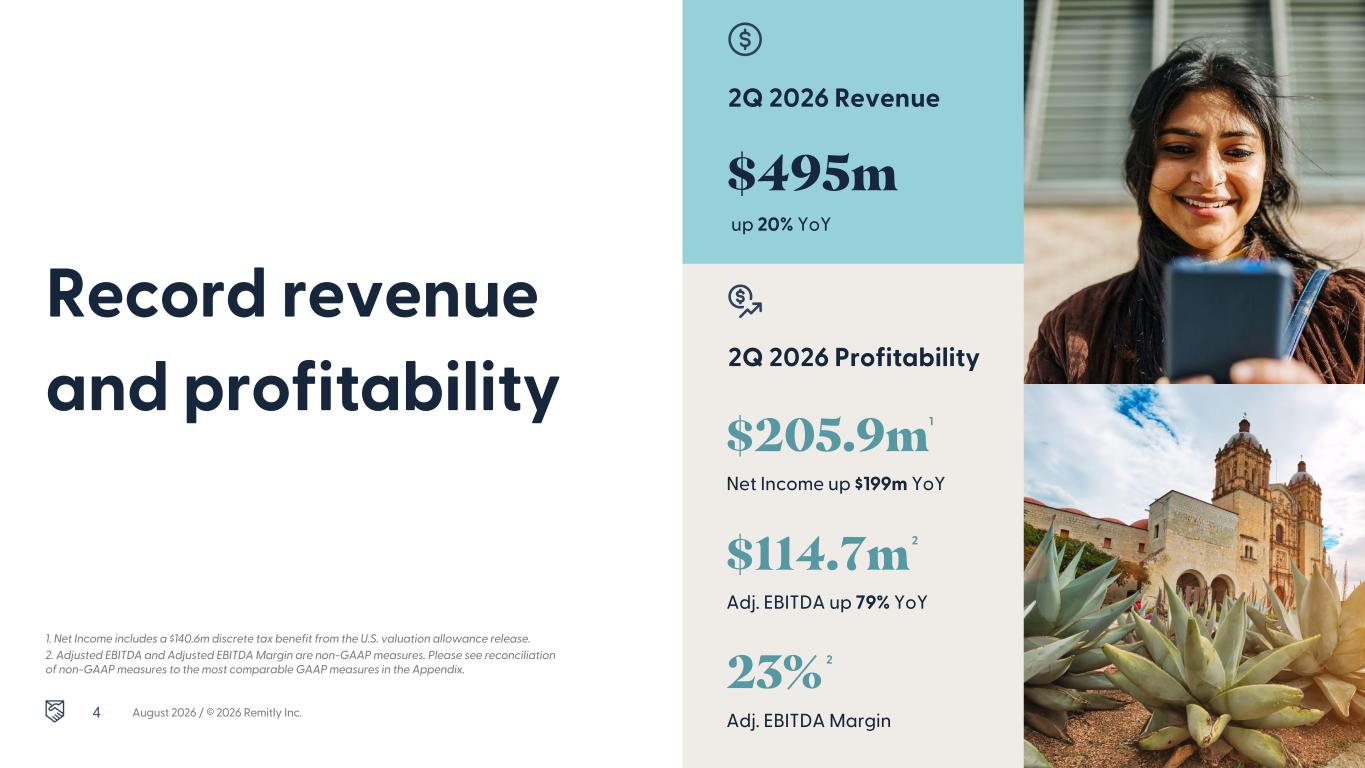
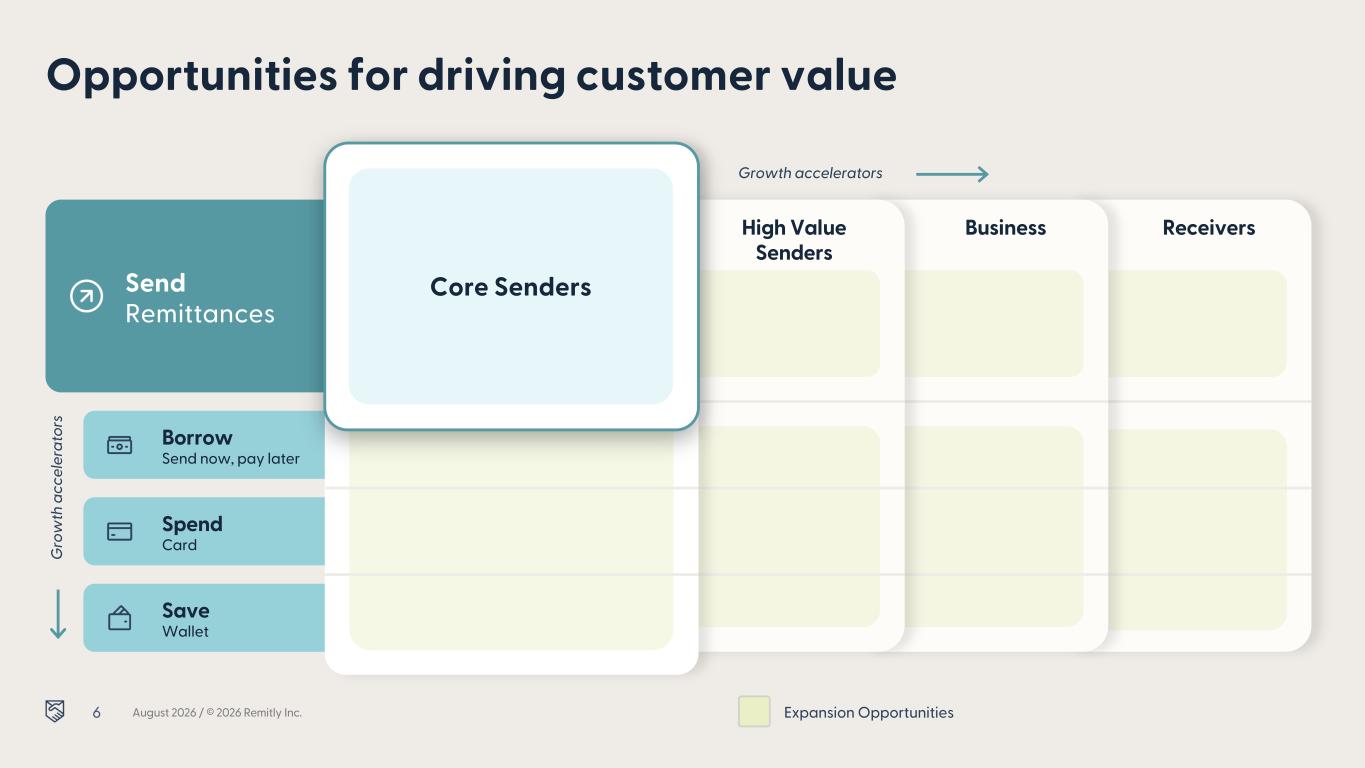
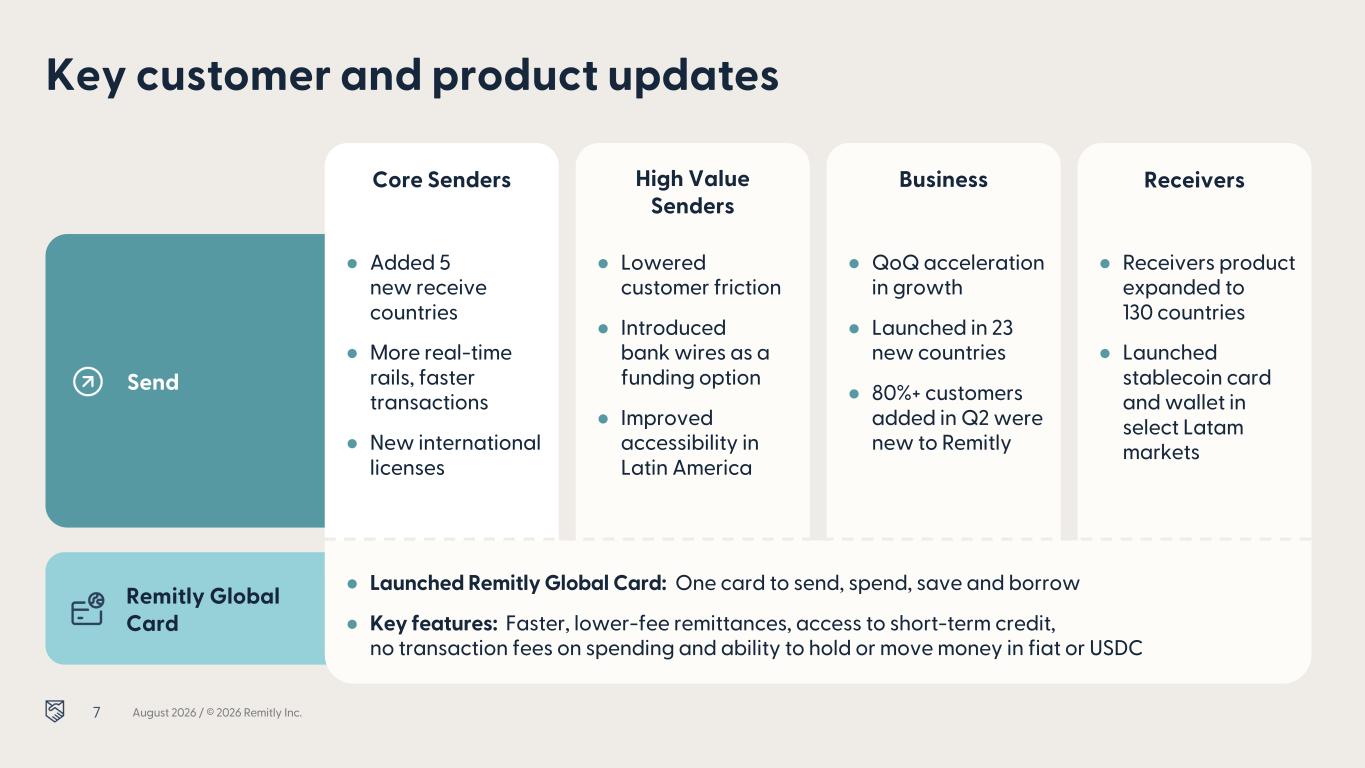
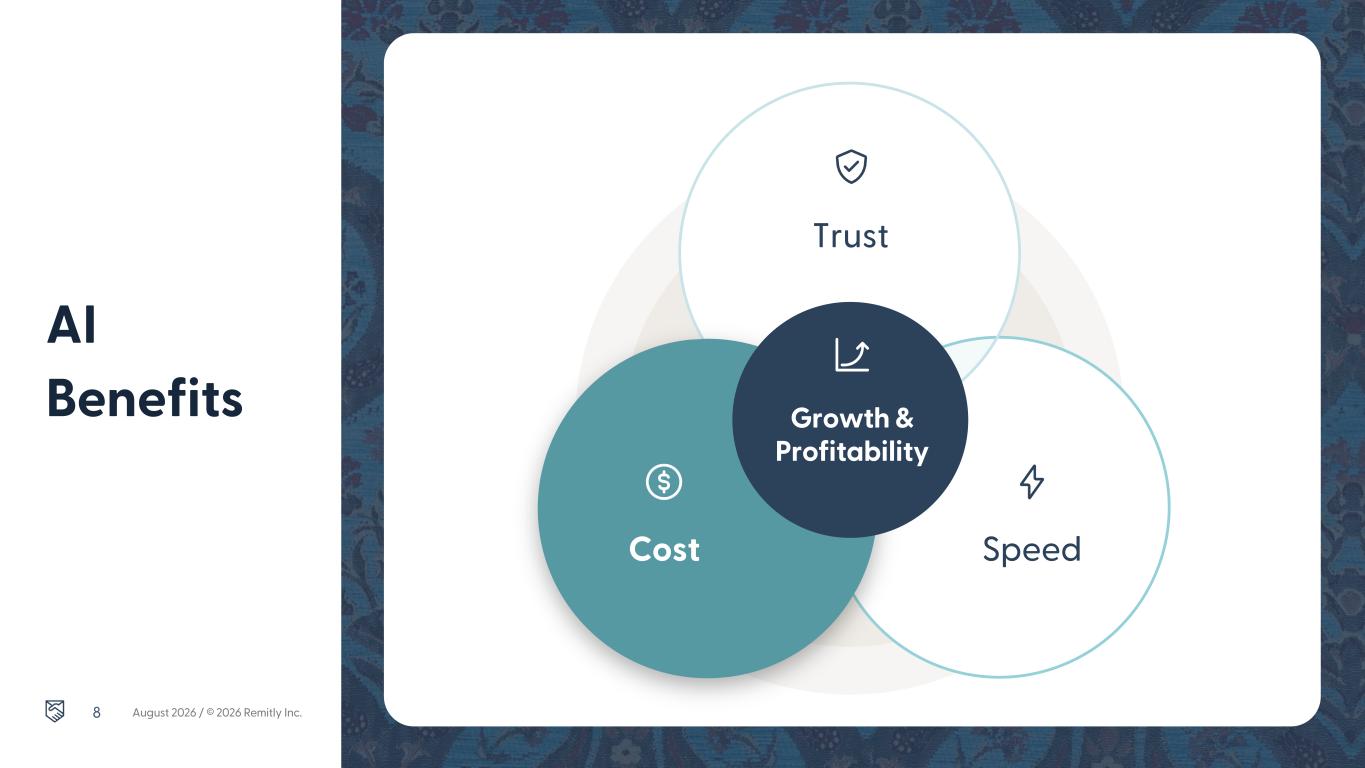
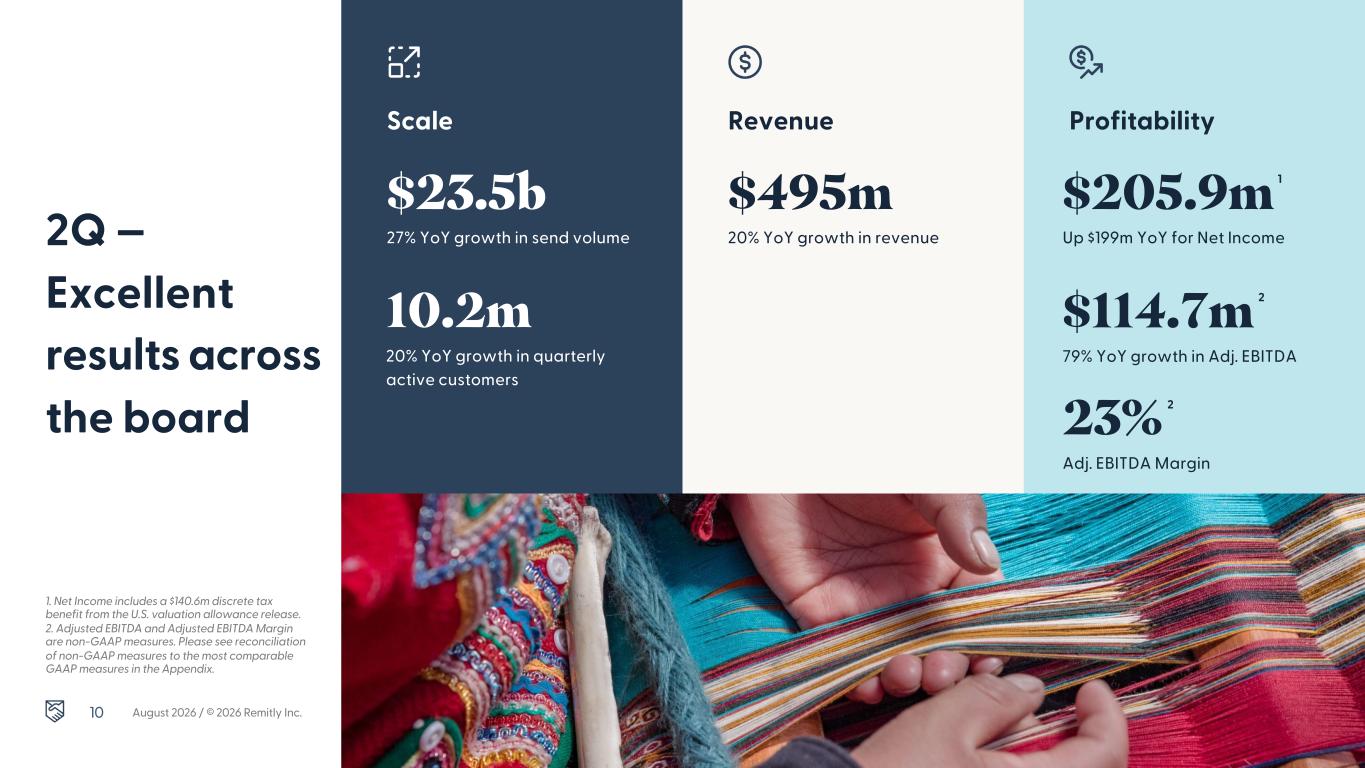
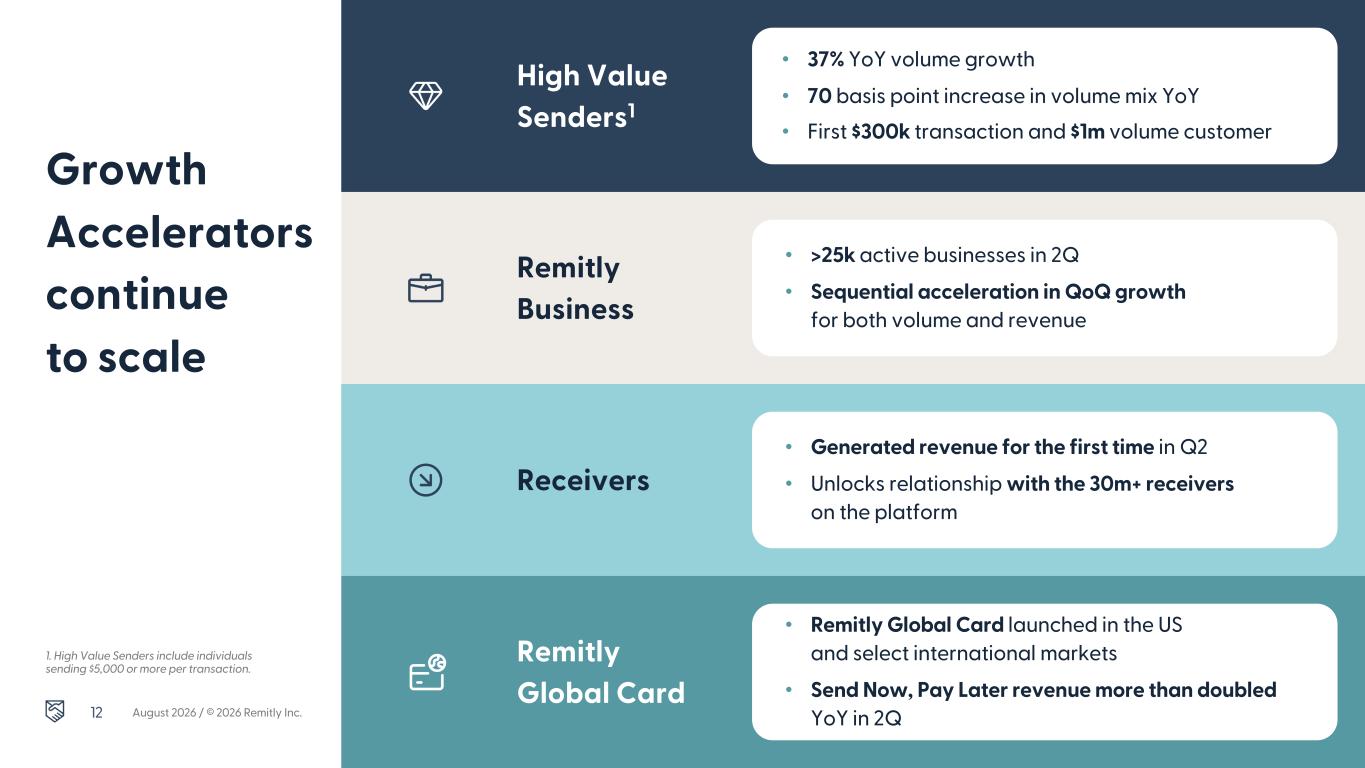
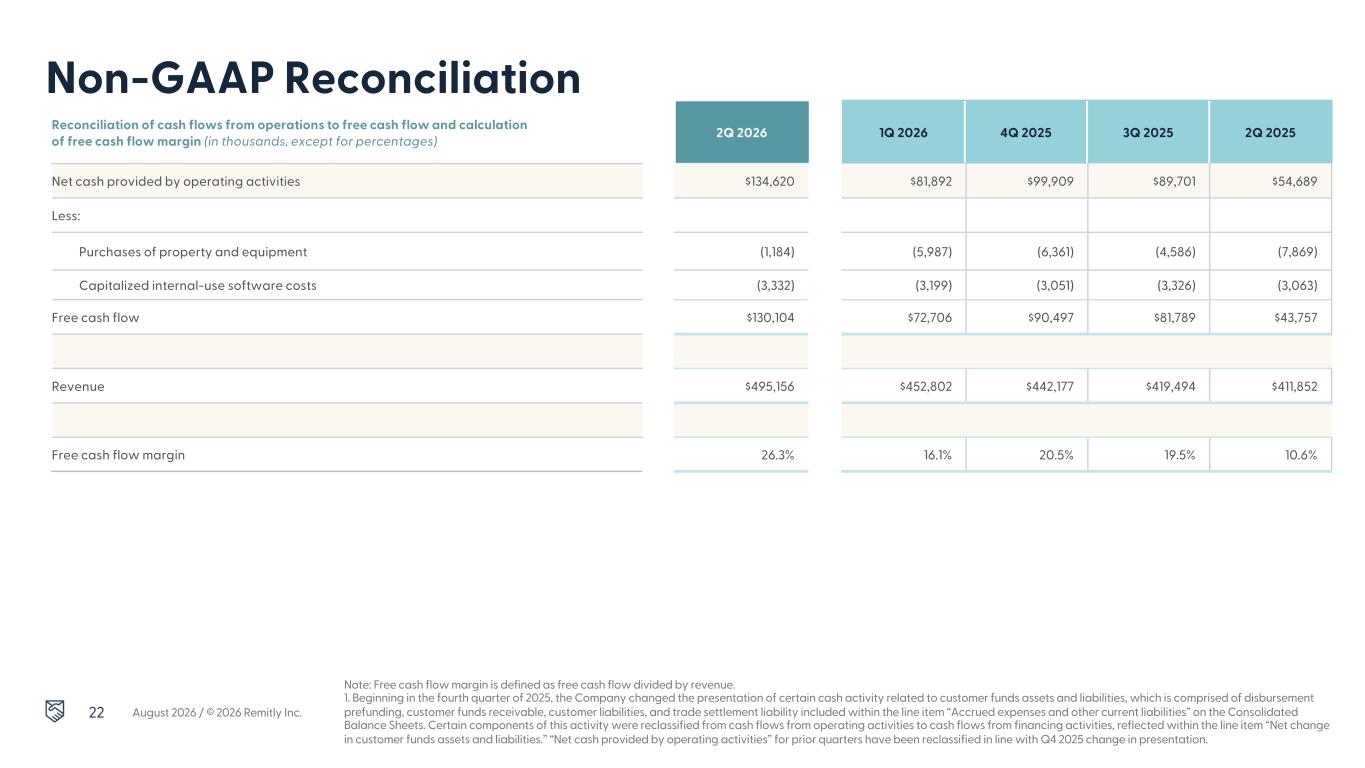
Thank you for joining our second quarter earnings call. My first six months as CEO have been intense, and they've confirmed something I already knew. Remitly matters deeply to its customers. This quarter's results prove it. Record revenue, record adjusted EBITDA, both above the high end of guidance again. We also achieved an important milestone for the company. Over 10 million quarterly active users aided by record new customer additions. That's a direct reflection of the trust and confidence customers place in Remitly and our team's ability to execute. This quarter's strong results reflect three enduring attributes of our business. First, a strategy that works, providing affordable, fast, and trusted money movement for a wide range of global customers. Second, a competitive position that is strong and defensible. We continue to gain share, and the advantages of lower cost, network breadth, and operating scales are compounding. And third, a cost discipline that is structural. The operating leverage in this business is real, and AI is driving genuine productivity gains, which can be redeployed to invest in growth, strengthening our confidence in the top line while we continue to expand adjusted EBITDA margins. Today, I will provide an update on my operating philosophy, discuss our progress across our core business and growth accelerators, and explain how AI is reshaping the economics of our business model and share our latest view on capital allocation. When I joined, I was clear about how I wanted this organization to work. Smaller teams, clearer ownership, customer-first design, AI embedded everywhere, speed as the default. This quarter, we kept building towards that. The result is a flatter, faster-moving company product teams are being consolidated into fewer locations to take advantage of faster speeds to design build and launch features fewer layer fewer layers mean fairer ownership and faster decisions faster decisions mean more products and more products mean more revenue and through this rapid evolution our culture has held our team continues to obsess over building the most affordable, fastest, and most trusted way to move money. They understand every transaction matters to a real family, and I'm proud to confirm what I see every day. Everybody at Remitly cares deeply about our customer-focused mission. Moving on to an update on our business. Last quarter, I introduced a framework for how we think about our opportunities. Call senders, high-value senders, business senders, and receivers against four offerings which are send borrow spend and save everything outside our core send we call growth accelerators this quarter we shipped against all these boxes as we broaden our offerings beyond remittances we build a powerful flywheel driving better loyalty higher volumes and more diversified revenue this quarter's results are evidence that the flywheel is turning I'll now cover key customer and product updates across CoreSend and our growth accelerators. Our global pay-in and pay-out network is our strongest competitive advantage. This quarter, we expanded our network on the dimensions customers care about most, reach, speed, and reliability. We added five countries, New Zealand, Niger, Mali, Angola, and Botswana, bringing the total received geographies to 179. 32 of these countries are now sent and receive enabled. Speed and reliability matter to our customers and are important drivers of retention. This quarter, new real-time pay-in rails, FedNow and real-time payments in the U.S. improved our pay-in funding speeds. And in the second quarter, nearly 70% of Remitly's global-funded transfers were delivered in under 20 seconds, an all-time high. Further, payments and customer onboarding improvements drove record pay-in acceptance and record low defect rates, reinforcing the basics that drive customer trust in the RemitLib platform. Last month, we announced our participation in OpenUSD, a stablecoin consortium, as a founding member. This new stablecoin has the potential to cut pay-in settlement times by up to one day and lets us share in stablecoin wallet economics. Since our last earnings call, we strengthened our regulatory foundation across three important geographies. We received a stored value facilities license from the central bank in the UAE, an electronic money institution license in the UK, and an extension of our EU payments institution license. These licenses open the door to new products designed specifically for customers in these regions. Each of our growth accelerators gained important traction this quarter. Our approach to investing in growth is deliberate. We start small and scale only when we see product market fit and a clear return. Because we'll cover the financials, I will cover the operating highlights. High value senders are those who send 5 000 or more in a single transaction often for property investments or larger transfers to family for them reliability matters most and the economics of earning their loyalties are strong in q2 we lowered friction across a number of dimensions for these customers and added bank wise as a funding option and in latin america a key a key growth region for this customer category, we raised send limits and eliminated unnecessary customer actions. As a result, high value send volume more than doubled in the US-Mexico corridor. Remitly business grew strongly again this quarter with sequential revenue and volume growth both accelerating quarter over quarter. New features like bulk send and the addition of 23 new countries in the European Union are helping broaden our customer base. More than 80 percent of customers added to the business platform this quarter are new to remitly and usage is sticky with the average business customer sending money 10 times a quarter this quarter we grew the receiver product from 6 to 130 countries it's still early but we're optimistic about its potential to drive send revenue and eventually spend and save the bet with receivers is simple. Build direct relationships with receivers and senders will follow. In countries where stable currencies and dependable financial services are scarce, we think we can serve receivers better than anyone. We recently launched a global stablecoin wallet and with debit card, starting our rollout in Latin America, a first of its kind offering, letting receivers get paid hold and spend in usdc longer term we want to be a big part of our receivers financial lives not just where one transaction lands this is a first step last week we launched the remittly global card an all-in-one product for our customers to borrow to spend and to save as easily as they can send money home the remittly global card is the next step in our journey from a remittance company to a broader suite of products our customers need and want the remittly global card combines one-of-a-kind features including our best remittances prices faster and lower fee sends no fee everyday spending a bank account for everyone the ability to hold and move money in fiat currency or usdc instant transfers between remittly global card holders no foreign transaction fees, direct deposit, global ATM access, and a line of credit through the Remitly Global Card membership plan, among other valuable new features for our global customers. The launch of this card marks an important milestone for our company. For millions of people, banking wasn't built for them. This card is. With the Remitly Global Card, we are giving communities who live across borders frictionless access to borrowing, spending, saving, and sending. No paperwork, no bank branch, no waiting. All card members get default access to the lowest cost, fastest remittance options on Remitly. Our customers shouldn't have to shop for the best rate every time they send money home. The Remitly Global Card allows us to more fully address the financial needs of tens of millions of customers who have sent to receive money via Remitly. And our intent is to put the Remitly Global Card in the hands of each and every Remitly customer over time. In the coming quarters, we plan to expand the Remitly Global Card to additional countries, enabling seamless direct payouts for global workers and broader multi-currency holding capabilities for consumers and businesses worldwide finally an update on ai there are three ways ai benefits remotely speed trust cost speed we build and ship faster trust we deliver a better more personal experience and cost we run leaner this quarter all three move forward speed and trust gains are starting to show up in the top line through faster launches and a better customer experience. Cost remains the clearest AI win so far. AI-driven productivity has allowed us to hold headcount below plan as I reoriented the company towards speed and tested our growth bets. I ask every team the same question. Show me the number that proves your function is more self-driving than it was one quarter ago. The answers are getting better. Before I hand the call to Vikas, I want to say a word on capital allocation. This quarter, we generated $130 million in free cash flow. Today, this management team is balancing two things, reinvesting in profitable growth and executing share buybacks within the limits set by our board. We believe this is the right plan and we'll continue to update our shareholders as our thinking evolves. Let me close with this. We delivered an excellent quarter. We're gaining ground with customers in geographies that matter. We're doing it more efficiently than ever. Our products are working for customers. I'm optimistic, not because of a forecast, but because of what I see in the business every day. Thank you.
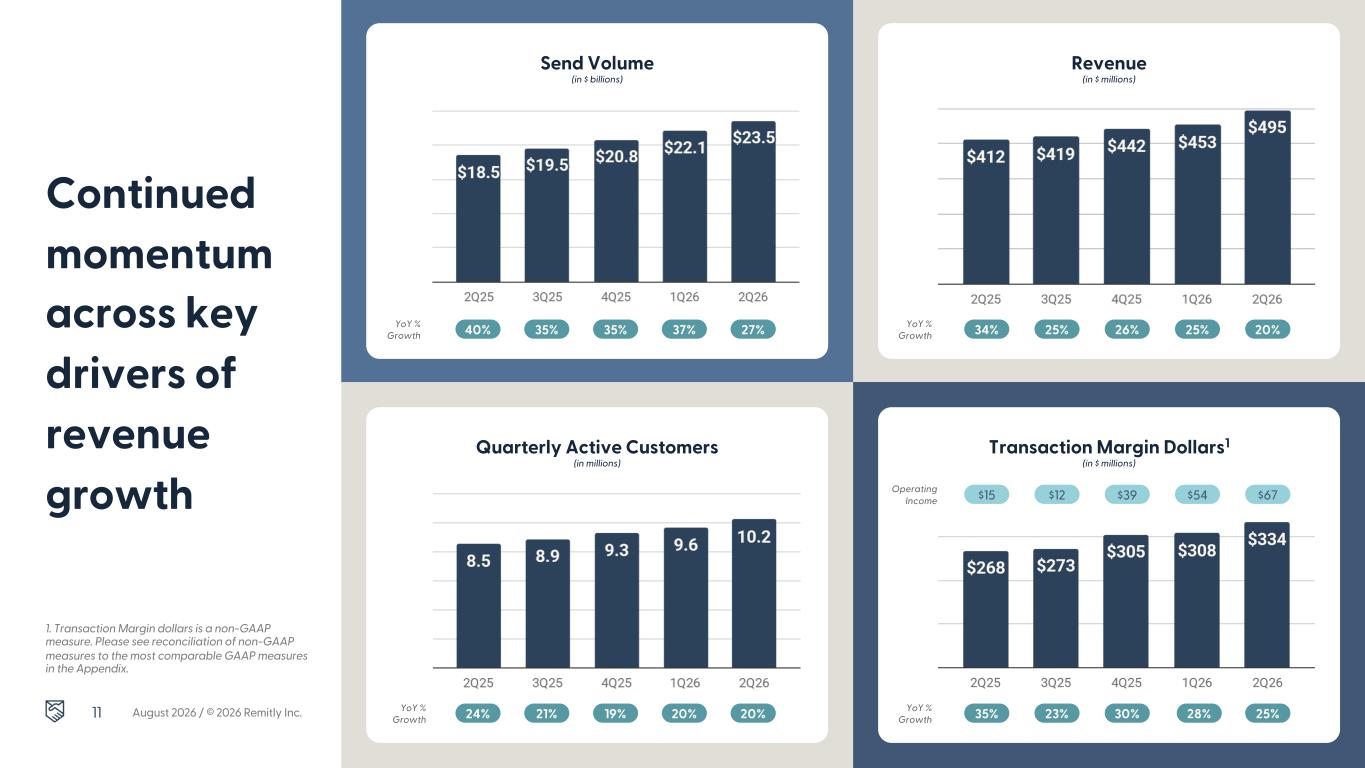
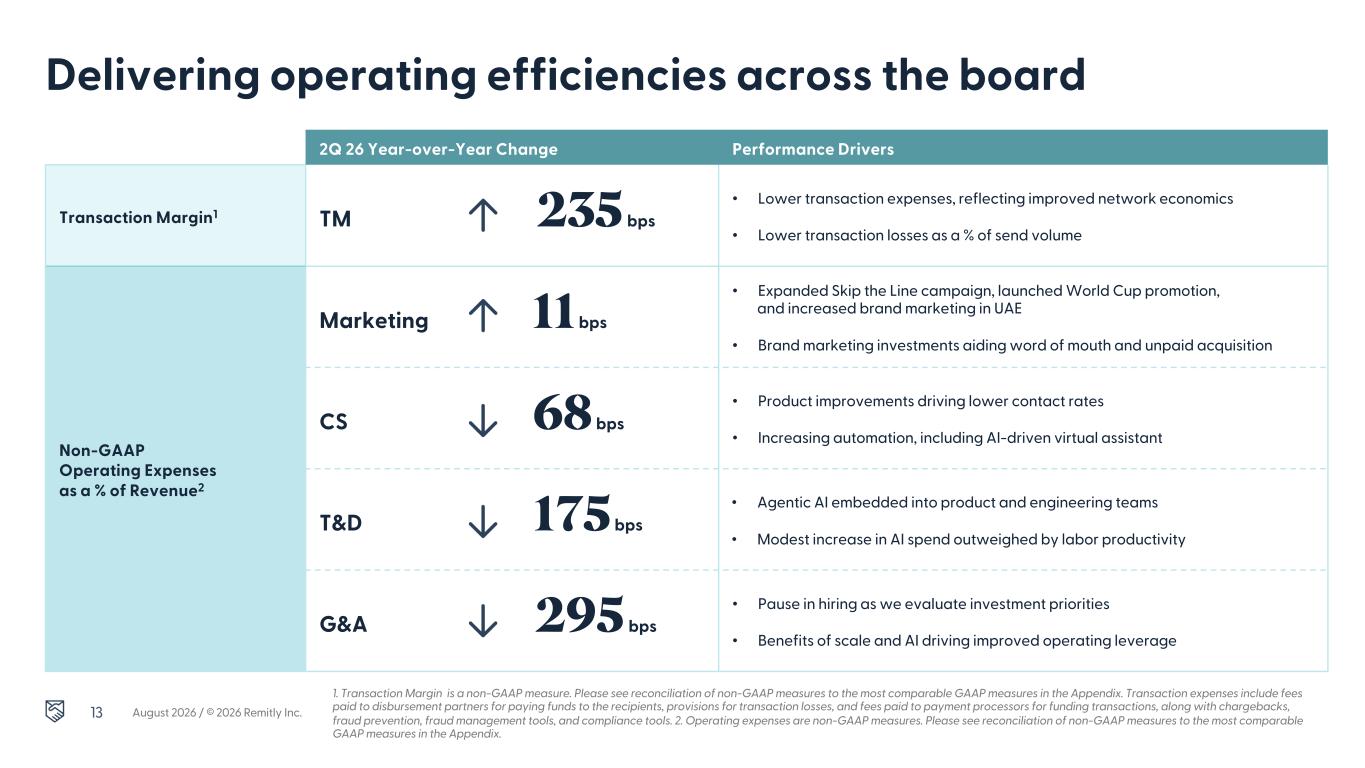
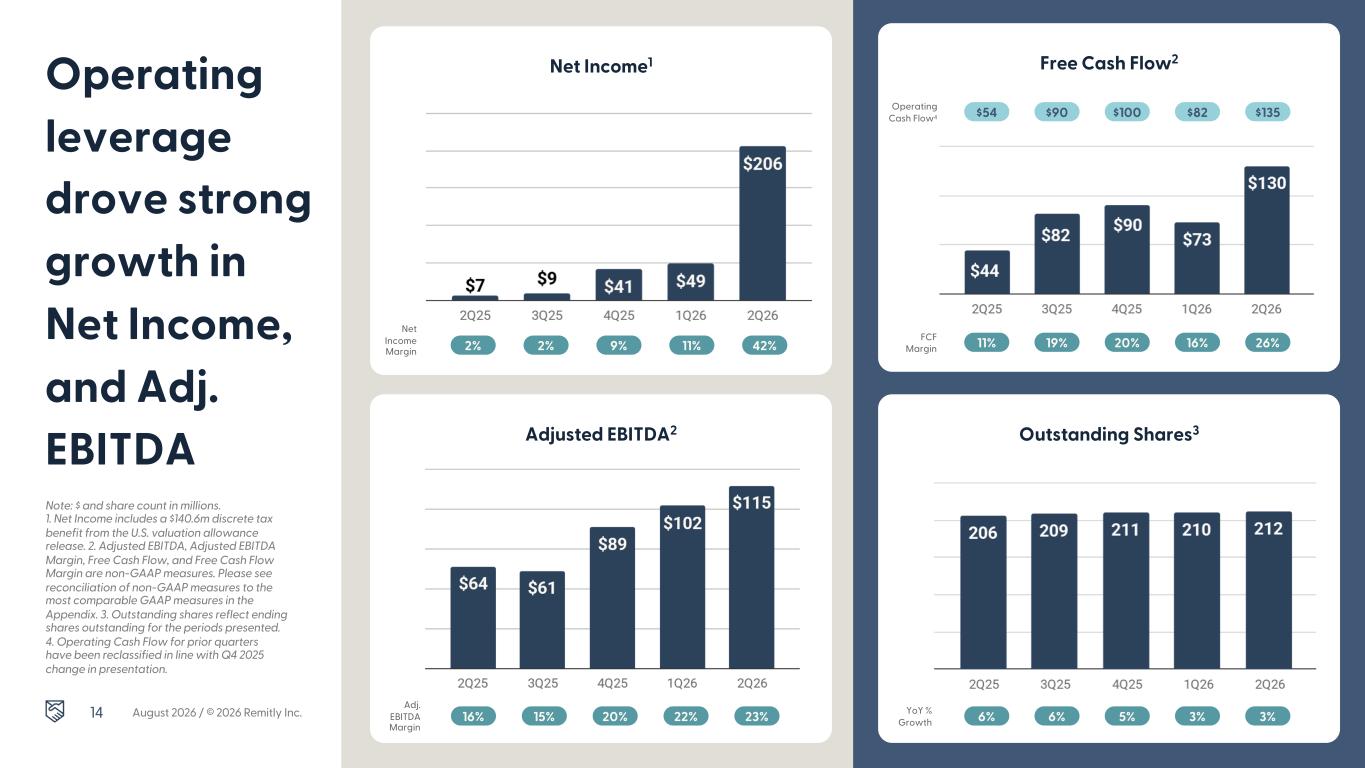
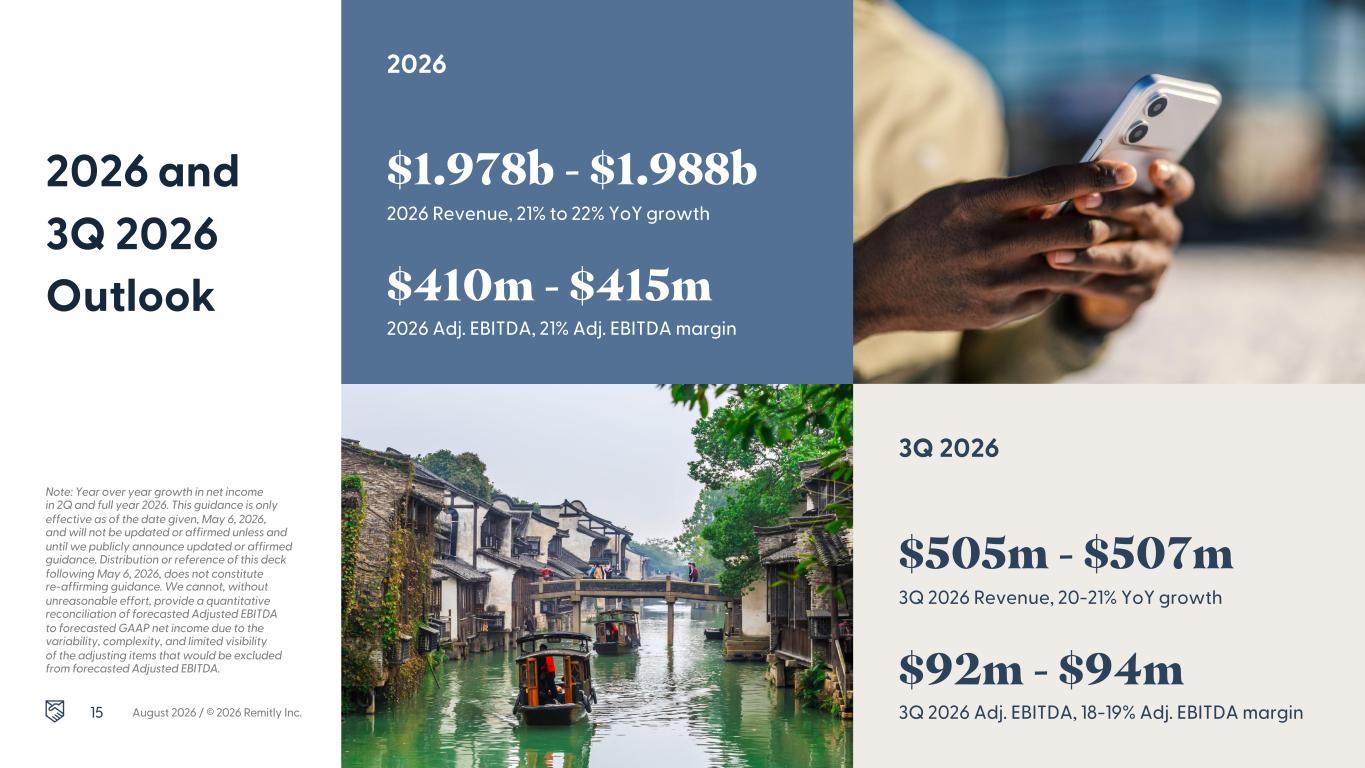
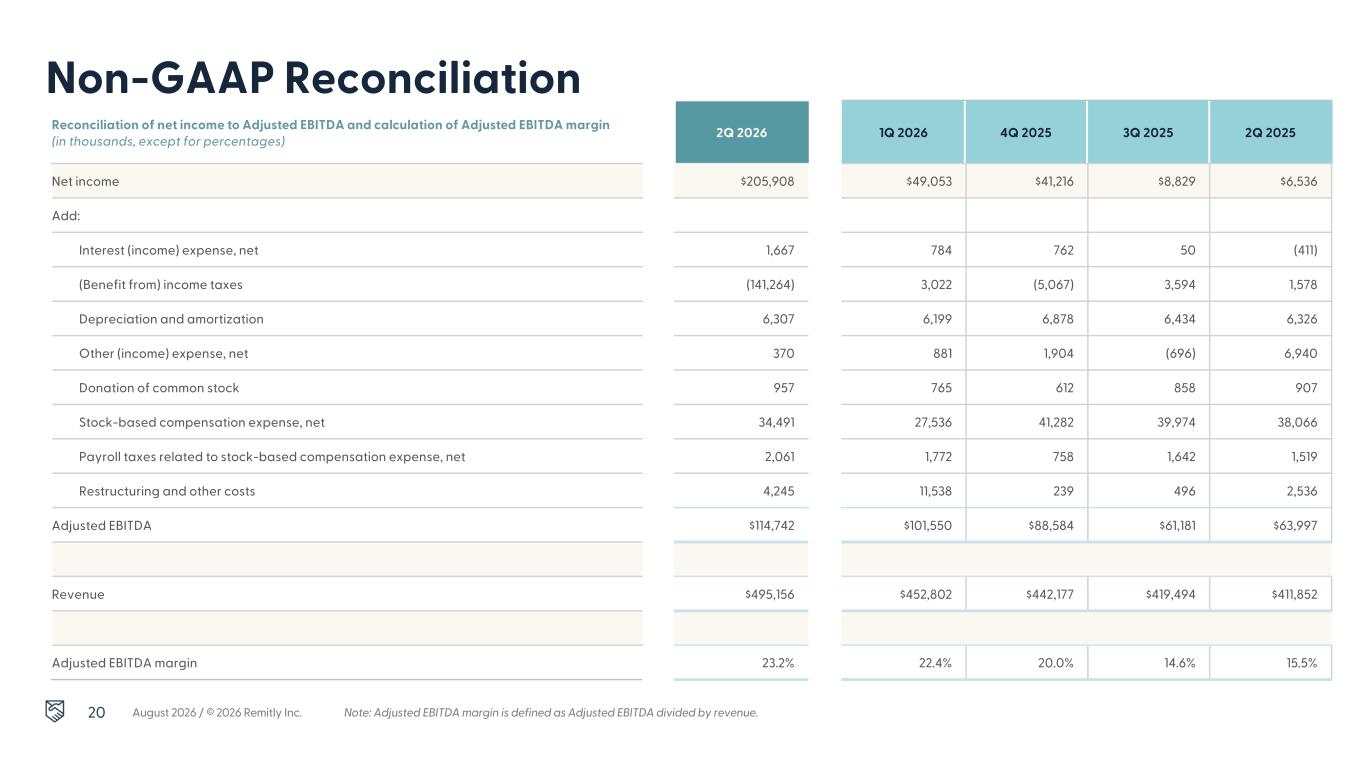
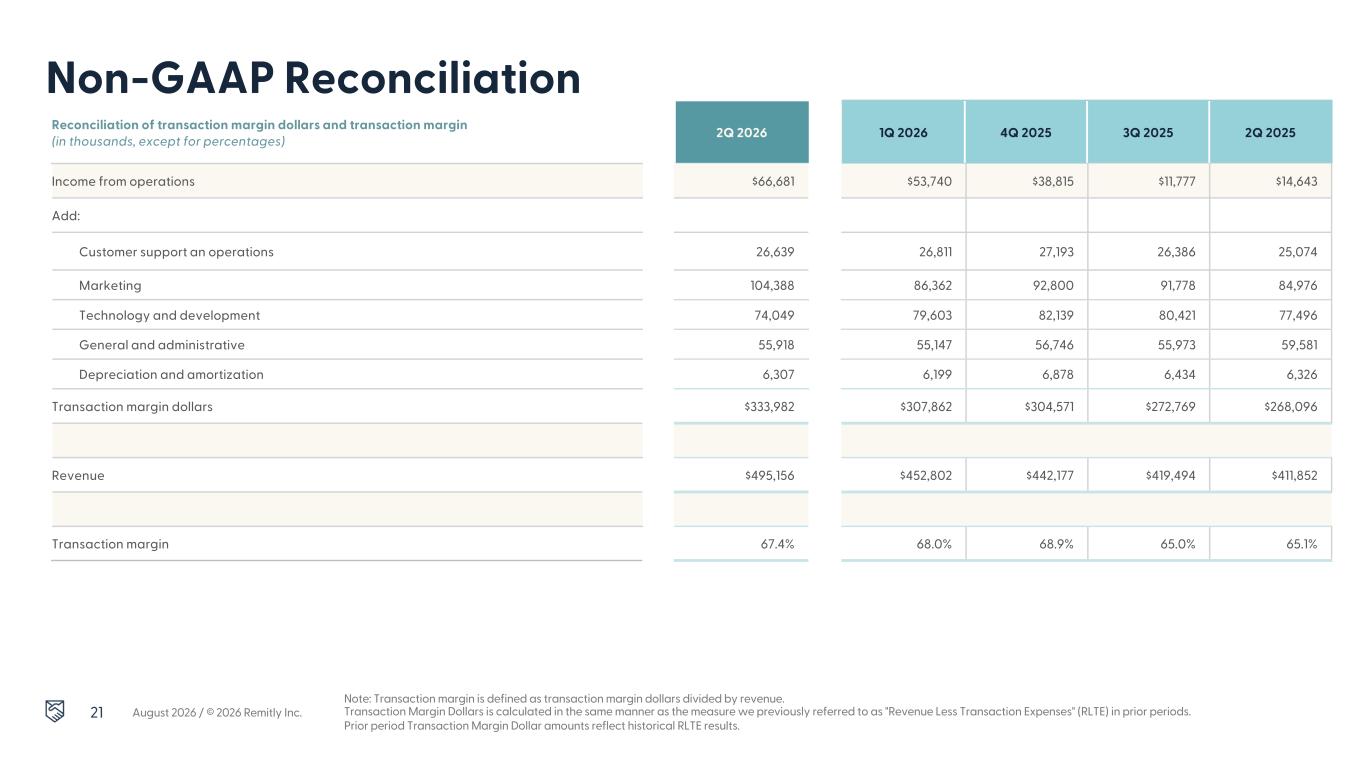
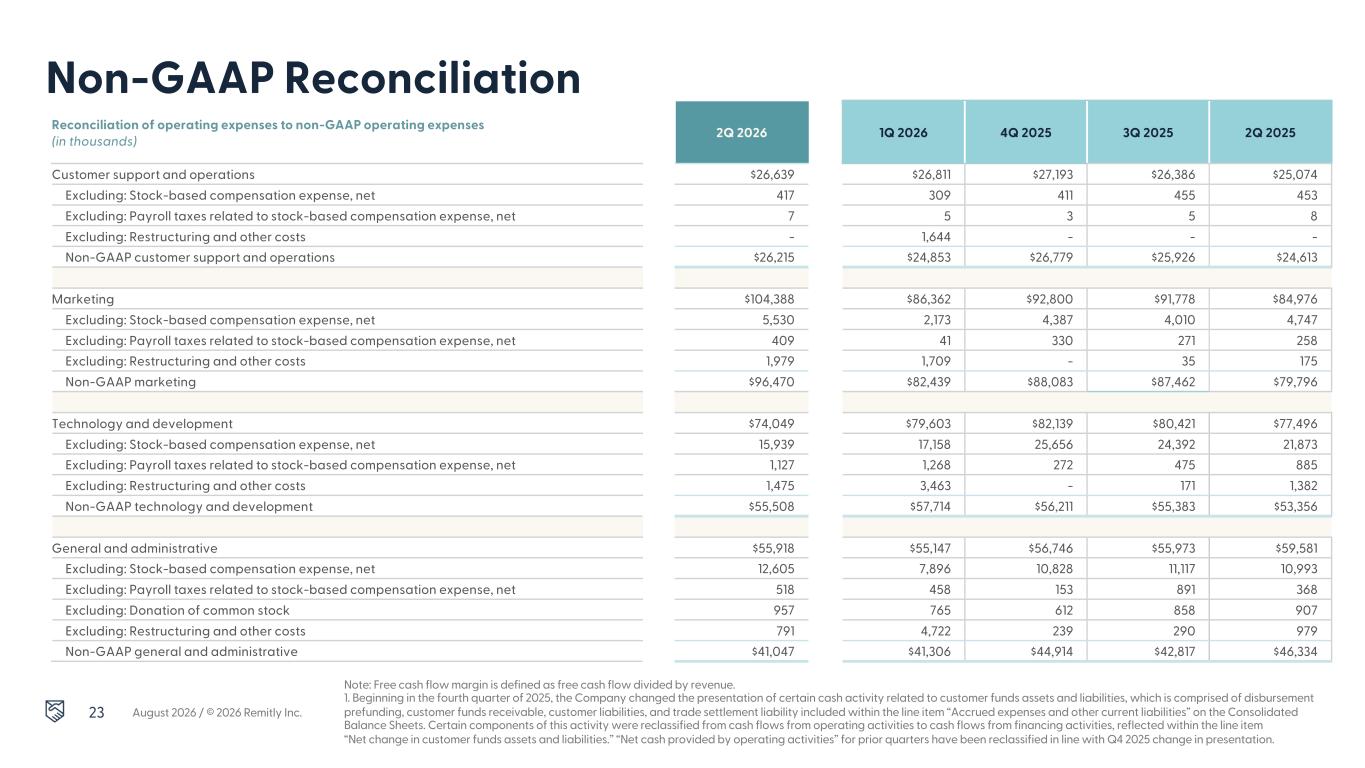
Thank you, Sebastian, and good afternoon, everyone. We delivered another excellent quarter of profitable growth and strong free cash flow, reflecting solid execution and a rigorous attention to cost discipline. Second quarter revenue was $495 million, $11 million above the midpoint of our guidance and up 20% year over year. Adjusted EBITDA was $115 million, dollars, $28 million above the midpoint of our guidance at 23% margin. Let me share an overview of our second quarter results and then provide our outlook for the third quarter of 2026 and our updated guidance for the full year. Strong top-line results this quarter reflected momentum in core SEND and the continued scaling of our growth accelerators. Revenue outperformance this quarter was driven by a number of factors. Regulatory changes in the United States continued to support a shift towards digital remittances, driving another quarter of record new customers acquired. And Mother's Day weekend volumes strongly exceeded expectations. As noted last quarter, the pacing of Q2 growth relative to Q1 was due to a shift in the timing of Ramadan and Easter to earlier in the year. Unpacking revenue growth drivers for Q2, send volume grew 27% to $23.5 billion. Send volume per active customer reached a record $2,300, up 6% year over year, driven by growth in high-value senders and business customers, as well as higher average transaction sizes among core senders. Quarterly active customers grew 20% year-over-year to 10.2 million. This was our first quarter about 10 million QAUs, an important milestone which validates the strength and durability of our business model. Quarterly active customer growth remained strong due to effectiveness of our Skip the Line campaign, which targets customers seeking alternatives to cash-based remittance methods. Our take rate this quarter was 2.11%. Now let me dive deeper into our revenue performance from a geographic and new product perspective. From a spend perspective, U.S. revenue grew 24%, reflecting continued share gains in key geographies. The rest of the world's revenue grew 18% year-over-year. On the receive side, revenue from transactions to regions outside of India, the Philippines, and Mexico once again grew faster than overall revenue growth and comprised over half of our revenue mix. I will now discuss the performance of our growth accelerators. As a reminder, growth accelerators include all customer categories and offerings outside of 4%. Our growth accelerators continue to gain traction and scale and are well on track to comprise around 5% of total revenue in 2026 and exceed 10% of total revenue by 2028. Let me take a few minutes to provide more detail on the performance of each of our primary growth accelerators. Let me start with high-value senders. High-value sender volume grew 37% year-over-year, a 70 basis point increase in mix year-over-year. We achieved a number of milestones with high-value senders this quarter, including our first transaction of $300,000 and our first customer to send more than $1 million in a single quarter. This quarter, we also expanded how customers can fund transfers by adding bank wires. Customers can now wire funds directly to Remitly, which we then deliver instantly through our global network, avoiding the cost and delays of traditional international wire. This gives more customers, particularly high-value senders, a flexible way to fund transactions and is already resonating. Customers using wires send nearly three times more for transactions. This quarter, high-value sender volume growth was softer in June due to fluctuations in the Indian rupee relative to primary send currencies, as well as short-term foreign currency mobilization measures announced by the Reserve Bank of India. We expect trends affecting Indian corridors to normalize over the course of the year. Further, we have a robust pipeline of high-value-centered product enhancements. And in the second half of the year, we are expanding our marketing and targeting efforts for this important customer category. Now, moving on to Remitly business. Remitly business performance continues to exceed our expectations. We ended Q2 with over 25,000 Remitry business users and saw sequential acceleration in quarter-over-quarter growth for both volume and revenue. Growth was supported by the continued reduction in friction associated with onboarding and transaction flows. Shifting to receivers, our receiver offering generated revenue for the first time this quarter, an important inflection point for this business. The receiver product allows us to unlock a direct relationship with more than 30 million receivers on our platform, creating a new flywheel at little to no marketing cost. Finally, our fourth growth accelerator, spend, save, and borrow. We are excited to share an important milestone, the launch of the Remitly Global Card. With this offering, card members can send, spend, save, and get paid money from the same account. The Remitly Global Card is an important strategic offering and enabler of revenue diversification as we extend the value of the Remitly platform further into our customers' financial life. The Remitly Global Card comes with no monthly fees or minimums. Customers can further upgrade to our membership plan, which for $9.99 per month contains valuable benefits including access to an open-end line of credit that customers can use to remit money home before payday and payback over time. We plan to evolve our liquidity offerings, which more than doubled year over year, to a card-focused format over time. The newer card plan format is showing strong early customer uptake with response and conversion rates exceeding prior benchmarks. Lines of credit associated with the Remitly Global Card are funded by a third-party bank partner. As a result, we expect receivables associated with our liquidity products to reduce over time. Turning to our focus on driving profitable growth on slide 13. This quarter, we are replacing the term Revenue Less Transaction Expense, an abbreviation RLTE, with transaction margin, which we believe is a more intuitive description of this metric. Transaction margin is calculated in the same manner as the measure we previously referred to as revenue less transaction expense in prior periods. Transaction margin dollars grew 25% to $334 million, outpacing revenue growth. Transaction margin dollar growth reflects strong customer activity as well as improved partner economics, routing optimization, and economies of scale. Transaction margins were 67%, improving 235 basis points year-over-year. Transaction expenses this quarter were $161 million and as a percentage of revenue were 33%. Excluding provisions for transaction losses, other transaction expenses were $137 million, dollars, improving 51 basis points year-over-year as a percentage of revenue. This reflects improved network economics as well as continued shift in mix towards digital receive volume. We continue to see early benefits from the use of stable coins in our treasury settlement operations, but the impact remains modest in absolute terms. Provision for transaction losses was $24.5 million, or 10.4 basis points as a percentage of send volume. This was better than expected as we continue to benefit from efficiencies afforded by the AI-driven fraud prevention and detection model deployed late last year. With that, let me walk you through the specific non-GAAP expense categories. Marketing investments remain disciplined and growth-focused. We spent $96.5 million on marketing in Q2, up 20.9% year-over-year. As a percentage of revenue, marketing expense was 19.5%, roughly in line with prior year levels. Marketing spend per active customer was $9.46, up 0.9% year-over-year, and in line with our expectations. Marketing consists primarily of advertising and promotions. This quarter's notable brand campaigns included the expansion of our Skip the Line campaign to New U.S. Cities, a World Cup promotion featuring Christo Fernandez of Ted Lasso fame, and additional marketing investment in the UAE. Promotions, including those in Contra revenues, grew 35% year-over-year, reflecting a deliberate focus on driving higher retention and win-back among our back book of customers. Our LTV to CAC ratio was above six times, while our payback period remained under 12 months. Continued efficiencies reflect growth in customer acquisition through unpaid channels and word of mouth. As a reminder, our marketing investments drive returns for many years beyond initial investment due to our growing base of repeat users. Customer support and operations expense was $26.2 million and is a percentage of revenue of 5.3%, improving 68 basis points year-over-year and continuing a multi-year trend of steady operating leverage. Technology and development expense was $55.5 million and as a percentage of revenue was 11.2%, improving 175 basis points year-over-year and reflecting the benefits of embedding agentic AI into our engineering and product team. Despite a modest increase in AI-related spend, the benefits of AI-related labor productivity have outweighed the direct AI spend, a trend we expect will continue. GNA expense was $41 million, declining 11% year-over-year, our first year-over-year decline in GNA ever as a public company. We delivered significant leverage this quarter, 295 basis points as a percentage of revenue year-over-year, reflecting lower-than-expected hiring as we evaluate business priorities, along with a continued rigorous focus on operating discipline. Strong revenue growth combined with operating leverage and cost discipline led to a record level of adjusted EBITDA of $115 million. Adjusted EBITDA outperformance was driven by higher-than-expected revenue, lower-than-expected transaction losses, and lower-than-expected expenses due to the ongoing assessment of business initiatives following Sebastian's arrival. Net income was $206 million, which included $140.6 million release of tax valuation 11. Our north star is growth in free cash flow while managing dilution, and Q2 demonstrated continued progress on both counts. Free cash flow nearly tripled year over year to over $130 million. This was aided by strong operating leverage, favorable working capital, as well as lower property and equipment spending as we lapped the build-out of our new headquarters from last year. Outstanding shares were $212 million, up 3% year-over-year, reflecting our disciplined approach to dilution management and share repurchase activity. Stock-based compensation was lower year-over-year for a second consecutive quarter. It declined 9% year-over-year, coming in at 7% of revenue, which is 228 basis points lower than the second quarter of 2025, due in part to lower-than-planned hiring. For all of 2026, we continue to expect stock-based compensation to increase modestly in absolute terms year-over-year, but decrease as a percentage of revenue. We continue repurchasing shares in Q2, opportunistically buying back $21 million worth of stock, or over 1.1 million shares. Year-to-date, we have repurchased almost 4 million shares. This reflects conviction in our long-term growth opportunities and a view that share repurchases are an attractive use of capital. We'll continue to be disciplined and opportunistic in how we deploy capital toward buybacks. With that, I will move to our outlook. For the third quarter of 2026, we expect revenue of $505 to $507 million, or 20% to 21% growth. We continue to see strong momentum in our core, and we expect the continued shift toward digital remittances, growth in new geographies, and the scaling of our growth accelerators to contribute to total company revenue growth of over 20% in the second half of the year. and increase relative to prior expectations. Breaking down our revenue growth, in Q3, we anticipate send volume growth to exceed revenue growth and revenue growth to modestly exceed quarterly active customer growth. Send volume per active customer is expected to grow in the mid to high single digits range, supported by the continued shift in mix towards high-value senders and businesses. For the full year, we expect revenue between $1.978 and $1.988 billion, a growth rate of 21 to 22 percent, reflecting strong demand in our core and growing levels of contributions from our growth accelerators. As a reminder, we are lapping a particularly strong holiday season in Q4, which drove outsized volume growth in the prior year. Now, let us pivot to profitability and expense guidance. Starting with transaction margins, we expect Q3 transaction margins to be slightly higher than the prior year. Note, transaction loss rate may fluctuate quarter to quarter. We remain disciplined about optimizing customer lifetime value while rigorously managing risk across our platform. For the full year, we continue to expect transaction margins to be broadly in line with the 2025 numbers on a normalized basis. Shifting to marketing, we expect continued marketing efficiencies in the back half of 2026 as we prioritize high ROI marketing opportunities. For Q3, we expect marketing spend for QAU to be slightly higher year-over-year as we extend our Skip the Line campaign and increase brand marketing in the UAE. Please note, marketing expense for QAU faces a tough comparison in Q4 as last year benefited from a focused and intentional approach to holiday period spend. Putting this all together, we expect Q3 Adjusted EBITDA to be between $92 and $94 million, translating to an Adjusted EBITDA margin around 18% to 19%, an expansion of over 350 basis points year-over-year. For the full year, we expect adjusted EBITDA to be between $410 and $415 million, representing an adjusted EBITDA margin of around 21%, an expansion of over 400 basis points year over year. This improved adjusted EBITDA outlook reflects a more favorable outlook for revenue, Sebastian's deliberate assessment of the business in the first half of the year, and our commitment to continued cost discipline, leveraging AI as we invest in growth. As always, we remain rigorously focused on balancing growth and profitability and will continue to look to further leverage the benefits of AI as we invest in top-line growth. Our outlook also assumes normal levels of transaction losses for the remainder of the year. To summarize, in Q2, we delivered another excellent quarter with results that were strong across our key financial metrics. We achieved over 20% revenue growth and over 23% adjusted EBITDA margins. We delivered record GAAP profitability and record free cash flow, underscoring the power and scalability of our business model. With that, Sebastian and I will open up the call for your questions. Operator?
Operator
At this time, we will conduct the question and answer session. As a reminder, to ask a question, you will need to press star 11 on your telephone. and wait for your name to be announced. To withdraw your question, please press star 1-1 again. We kindly ask that you limit yourself to one question. Please stand by while we compile the Q&A roster. Our first question comes from Tencent Wong with J.P. Morgan. Please go ahead.
Thanks so much. Nice results here. Sebastian, I thought given your prepared remarks kind of triggered me to think of asking you about what you're excited about the most amongst some of the things you talked about and where you're leaning in more.
We heard about Global Card, USDC, AI, it sounds like business also outperformed. What's changed in the last 90 days in terms of your excitement and where you're leaning in more? Good question. Thank you. I think I'd say that some of the parts, I think we are hitting on many cylinders right now. I think that some of the parts look really good to us. We're a very diversified business globally. to, as I've said before, you get these puts and takes on different corridors. I really like the rhythm that we're gaining on upgrading the products, the new launches. So it's hard for me to pick one specific piece, TSM, but I would say that today, standing here today, I'm very pleased with the momentum on many pieces of the business. Of course, as you look under the cover, as you look under the hood of the business, there are many pieces that make up the delivery of this money movement, and whether it be on the network side, on the risk side, on the compliance side, there's just a lot of good momentum across the company. So you forced me to pick one piece. I'm avoiding your question and saying I think it's the sum of everything right now.
Operator
So our next question comes from Ramsey Ellison with Cantor Fitzgerald. Please go ahead.
Thank you so much for taking my question this evening. Akas, you mentioned that you'll be expanding your marketing efforts for the high-value senders in the second half. Can you help us think through kind of the cadence and the magnitude of that investment? Is it kind of a gradual ramp through the balance of the year, a more meaningful step up in marketing spend later in the year? How should we think about that from a modeling perspective?
So overall, I would say that we remain very confident in our high-value sender business and the long-term growth potential of that business. As we have shared in the prior few quarters, we are just getting started there, raising the send limits, making product enhancements. In fact, this quarter, you saw some very interesting highlights. We had our first set of 300,000-plus transfers. That's a pretty big milestone compared to where we were 12 months back. And within the same construct, you know, one of our customers sent more than a million dollars in the recent quarter. And that just tells that, you know, the demand is there. Our network is set up for that. And it's just a matter of focus and marketing for us. And once we can be more targeted, we can see a lot of benefits here. We haven't invested a lot in the marketing in the specific high-value center market. And again, we will be very deliberate. We will be gradual and we'll be thoughtful how we increase the marketing. We'll learn from our early marketing campaigns before we expand more in FY27. But overall, I'd say disciplined, but at the same time focused and thoughtful marketing in the HVSA.
Operator
Our next question comes from Chris Kennedy with William Blair. Please go ahead.
Good afternoon. Thanks for taking the question. I think productivity gains from AI is a key for 60% in the quarter. I think that's nearly double kind of what you've historically talked about. Can you just talk about the levers there and what that means going forward and the opportunities to reinvest back in the business?
Yeah, I think we're all on this AI. journey, and I just reflect that I don't, you know, a week doesn't go by that you don't get some kind of wow moment on what you can do inside the company with AI. We, and it varies across, obviously the most obvious ones are some of the fact that you can constrain some of your people growth. But, you know, speed is money, productivity is money, Simplifying the organization is money also. So it slowly compounds. And as you get to, you know, we track almost every piece of our AI usage, you know, down to the individuals, down to the production of code and the use across the company. And we're launching all different agents with different tasks within the company. So I, you know, this is a snapshot in time. You're seeing the benefits. Your question is, is this going to accelerate over time? It's hard to say. I certainly don't see it decelerating. And I think that we can look over the next few years and we're just going to keep learning how this is going to change our company, how it changes the management. So it is a theme. We live it every day. And I think I'm optimistic about the future trajectory on the efficiencies that we can get with AI within Remit.
Yeah, and if I were to add on the expense categories, if you look at, Chris, if you look at all the expense categories, we've got benefits across the board. Whether you think about transaction loss and the AI ML capabilities that we are building, that has definitely, we have seen that over the last couple of quarters. If you go further into customer support, that's a key area of benefit that we have been harvesting. This quarter, specifically, the two standouts were the technology and development spend, which just grew in mid-single digits thanks to the net AI benefits that we were getting in spite of a modest increase in the AI spend. And finally, GNA, that was the biggest one of the first year-over-year decline as we are able to, you know, harness that benefit across all our support functions, whether it's legal, HR, finance, and the platform. So, you know, AI net benefit for us has been a positive, you know, clearly early days, and we will be very mindful and thoughtful here.
Operator
Thank you. Our next question comes from Alex Markgrath with KBCM. Please go ahead.
Hey, everyone. Thanks for taking my question. I wanted to ask about the receiver side monetization. It's obviously a compelling opportunity. I was hoping maybe just to discuss the sort of right to earn wallet share with these folks, the receivers. I'm curious what the sort of wedge or value proposition that's distinct from local or other global peers would be that you'd point to with permitly card and other offerings.
It's very, so thank you for the question. It's very early days. You know, your question is, what earns us the right to offer services to this receiver? It's a very unique transaction when somebody in some part of the world receives money from a sender in Remitly. And so at that point, you know, in all the mechanisms, we know the money, we know the receiver, and so there are many things that we could do to encourage that receiver to either spend the money, we could put the money in USDC, we could put it in cards, we can keep it in accounts, we can offer savings products. So the theory of it is very compelling. And, you know, we have, as we've said, about somewhere in the order of 30 or 40 million receivers around the world. We have not proven that yet. We have a team rapidly iterating. We see some really good signals. We've launched a bunch of products. And then I'd also remind you that I think, you know, there's some large portion of our transactions are pair-to-pair transactions, which is they repeat often. So every month, sender A sends to receiver B, and those two, that pair is connected many times during the year. So you could imagine all kinds of products that we could offer to that pair. So early days, we feel it's one of the investments that we're making. We feel there's an opportunity here. We have not proven it, so we'll keep you updated on how that advances.
Operator
So our next question comes from David Sharp with Citizens Capital Markets. Please go ahead.
Hi, good afternoon. Thanks for taking my questions. You know what? The results are so strong, I guess I'll ask a devil's advocate question just to kind of mix things up a little. And, you know, it relates to the growth accelerators. Did I hear correctly? And I think this dated from the investor day. Maybe it's unchanged. change. Did I hear Vikas that the expectation is 10% of revenue by 2028?
That's correct. More than 10%.
I guess the devil's advocate question is, why isn't that larger?
I mean, it seems like these are tremendous opportunities, particularly on the business side. Obviously, you spend a lot of focus in these presentations highlighting these four distinct categories or silos. I'm just trying to get a sense if, you know, 10% is a reflection of A, conservatism, B, just the core C2C business is so strong sexually that, you know, that by definition kind of weighs down that mix. Am I kind of incorrect thinking that that's a number that two years from now is actually going to end up being higher?
David, first of all, thank you for your optimism. We share that optimism. And what I'd say is that we want to be very thoughtful with the new products to get the product market fit right. We want to test them out in a way that they are really battle-tested. And then once we have that validation, we want to pour marketing and, you know, really drive the acceleration. And rather than putting a very tight type timeframe to it, we look at the bigger price at the end, the total addressable market. And if you look at all of our bets, they are huge and massive. If you take Remitly business, that is bigger than our, you know, core consumer business. If you look at high-value senders, the network remains the same and the upside is massive. If you look at Remitly Global Card and receivers, everything Sebastian said, that, you know, there are so many use cases that they could really unlock and create a massive potential. And I'd say these are, you know, five-year, ten-year bets that could really diversify our business, make it a multi-revenue stream business, and our objective right now is to invest in them in a way that we make them long-term successful rather than trying to get some short or medium-term wins. But at the same time, we feel really confident to get to the 10% plus threshold. We keep updating you, but overall, we feel the focus is really on the long Yeah, I think, you know, well said.
I mean, if you take, we've given this time frame of 2028, but let's take the time frame. I think we'd probably be disappointed over a longer time frame if they weren't much bigger businesses. All the bets we're making are in very large markets. And so the fact that we're still in the bets and growing and excited about it means that we're not going for a 10 percent. you know, what's 10% of, what are we, $2 billion revenue, 10% to, we're going for much bigger opportunities here. So, you know, I think it's a fair question. We will obviously keep updating you. We, all the signals we see, we will kill any business that doesn't, doesn't, you know, be on a trajectory to get really large. We have plenty, plenty of opportunities and plenty of businesses. We have a lot on update right now, so we'll just keep you posted. We're going to stick to the response that Vikas gave for now, but we're working hard to make it a lot bigger.
Operator
Our next question comes from Gus Galla with MCH. Please go ahead.
Hi, Sebastian. Hi, Vikas. Thank you for taking my question. So I think an interesting topic to get into would be you're seeing some, let's say, changes in pricing actions, maybe a little bit of distress from larger legacy peers in North America. I mean, that's really the core business. Can you talk about the opportunity there in terms of the lower cap, right? Because it sounds like pricing being taken back, maybe not a leap to think that digital marketing competition's coming down a little bit. And then if we think about the second half of 26, just on the margin, just I'll squeeze in my question, 19% margin versus a 23% this quarter, plus 50% in the first half, you're getting to a 23% incremental in the back half. I get the incremental investment in HVS, but our math is kind of low double digit of total volume. And you're assuming consistent transaction loss rate. anywhere else in OpEx we should be thinking about our investment. Thanks.
Thank you for your question. I'd say that, you know, if you, I'll answer your second part of the question first, and then move to the first, and Sebastian can add more to that first part as well. If you think about the, you know, EBITDA margin guidance, it is, it's something that we have put a lot of thought into it. And even as you see that, and if you look at the year over year increment. It is 350 dips just in Q3. And if you take the 526 guide, it's a four percentage point increase year over year. So clearly, we are making a lot of progress when it comes to expanding EBITDA margins. If you see the first half of the year, I'd say there has been some, you know, call it specifics over there. First of all, you know, Sebastian joined us in that first quarter and has been evaluating the business initiatives in a rigorous way, and that created a little bit of a pause as we decided which ones we want to go and invest deeper into. In addition to that, revenue outperformance as well as the lower transaction loss that we have seen, which in our assumptions going in the outquarters, we are normalizing that to 11 BIPs. But that creates some, you know, call it added first half benefit for us, which especially in the transaction loss, we are normalizing for second half. Outside of that, you know, we feel there are opportunities in marketing investments that, again, we will be evaluating on a very specific basis. But, you know, that goes to your first part of the question. we see massive opportunity for market share gains. We saw that in the first half with the remittance tax, and we leveraged our skip the line campaign. And we did that in the first quarter, but we saw remarkable benefits, and we decided to extend that in the second quarter, and we shared that with you last quarter. And we're further, you know, taking it forward in the second half of the year. So we share the same thoughts where, you know, we feel the opportunity to grab share is there, and we are going to be front-footed as we look at the second half in FY27.
Yeah, and, you know, we intend to be very aggressive in pursuing this market share. The opportunity is there. You know, there's no – from a customer perspective, there's no magic here. The customer wants sharper pricing, wants to move money faster. and wants a better service, and we're very focused on all three. We're iterating on three. Our pricing is getting sharper. We are moving money faster, and our service is getting better every day. So the result of that is just going to be continued market share gains. And this happens across the world. We have many corridors where we already have a very good market share, but we see opportunity in the larger corridors, in the smaller corridors, and I think that this is a good moment for us to be quite aggressive in pursuing that market.
Operator
I'm showing no further questions at this time. Thank you for your participation in today's conference. This concludes the program. You may now disconnect.