Operator
Good morning and welcome to the United Health Group Second Quarter 2026 Earnings Conference Call. A question and answer session will follow United Health Group's prepared remarks. As a reminder, this call is being recorded. Here is some important introductory information. This call contains forward-looking statements under U.S. federal securities laws. These statements are subject to risks and uncertainties that could cause actual results to differ materially from historical experience or present expectations. A description of some of the risks and uncertainties can be found in the reports we file with the Securities and Exchange Commission, including the cautionary statements included in our current and periodic filing. This call will also reference non-GAAP amounts. A reconciliation of the non-GAAP to GAAP amount is available on the Financial and Earnings Reports section of the company's Investor Relations page at www.unitedhealthgroup.com. Information presented on this call is contained in the earnings release we issued this morning and in our Form 8K dated July 16, 2026, which may be accessed from the Investor Relations page of the company's website. I will now turn the conference over to the Chairman and Chief Executive Officer of UnitedHealth Group, Stephen Hemsley.
Thank you. Good morning, everyone, and thank you for joining us. Our second quarter results in updated full year 2026 outlook demonstrate continuing progress toward delivering more consistent and dependable performance. They are a sign of stronger broad-based performance disciplines taking hold in each of our businesses and a restless desire to drive mission-aligned change across the enterprise and advance our social impact. UnitedHealthcare has improved performance in its Medicare businesses through thoughtful benefit planning and design all while remaining respectful of persistently elevated medical costs. Our Medicaid business is in line with expectations as we continue to work with states on ensuring appropriate rates. Our commercial benefits business, consistent with the broader and more diverse commercial market it serves, continues to experience higher than expected cost trends due to factors Tim Knoll will discuss shortly. At Optum, we're seeing building momentum from Optum Health as the business re-centers back to its integrated, value-based care delivery model. This resulted in another quarter of improved care management and greater operating discipline. OptumRx continues to perform the plan as transparency initiatives we announced earlier this year resonate well in the marketplace. OptumInsight, also on plan, remains on a multi-year path of reinvestment and innovation as we bring modern, intelligent technologies and services to the areas of greatest need in the health system. We believe Optum Insight is exceptionally well positioned to help modernize and simplify the health system as it brings AI-enabled tools and services to market. Across the enterprise, we're focused on serving consumers and care providers in ways that are reliable, affordable, and transparent. That requires us to pay close attention to areas where the system isn't working well enough, areas including care approvals, accuracy of information and speed of response, access and scheduling, digital services, care path navigation, and more. We are committed to making the health system work better for all stakeholders by simplifying processes by being clearer, more consistent, and faster in the experience we offer, and by redesigning and modernizing that experience altogether. AI technology is helping us move faster. We're using it to improve service interactions, reduce administrative burden, and support better decision-making, always in service of improved experiences and outcomes for both patients and care providers. UnitedHealth Group has a long history of evolving to meet the needs of a constantly changing U.S. health system. That evolution today includes a tech-forward view actively and appropriately embracing an AI paradigm for our businesses. A management team with skills and vision to help in building a more advanced health system and an ever-evolving organizational structure and culture aligned to that system. Our operating structure today broadly reflects a set of highly regulated benefit businesses and a complementary set of products and services for patients, care providers, and customers. We will continue to look to build and evolve ahead of the health system itself. We're making solid, early progress both in how we better approach those we serve and in our results. We have much more work ahead and need to continue to get better by focusing on what matters most with solid management and execution disciplines aligned to our mission to better serve people and the health system itself. With that, I'll turn it over to Tim Knowles.
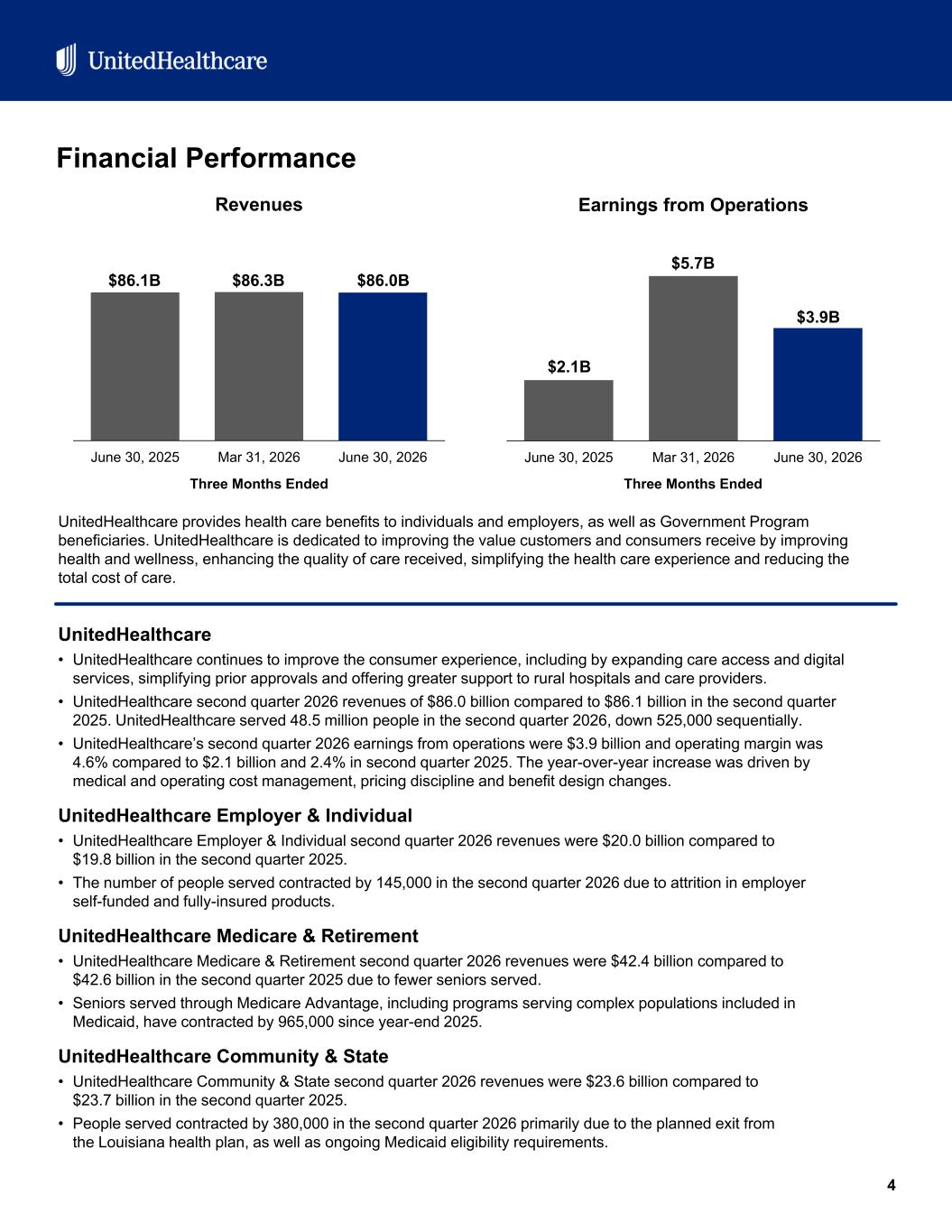
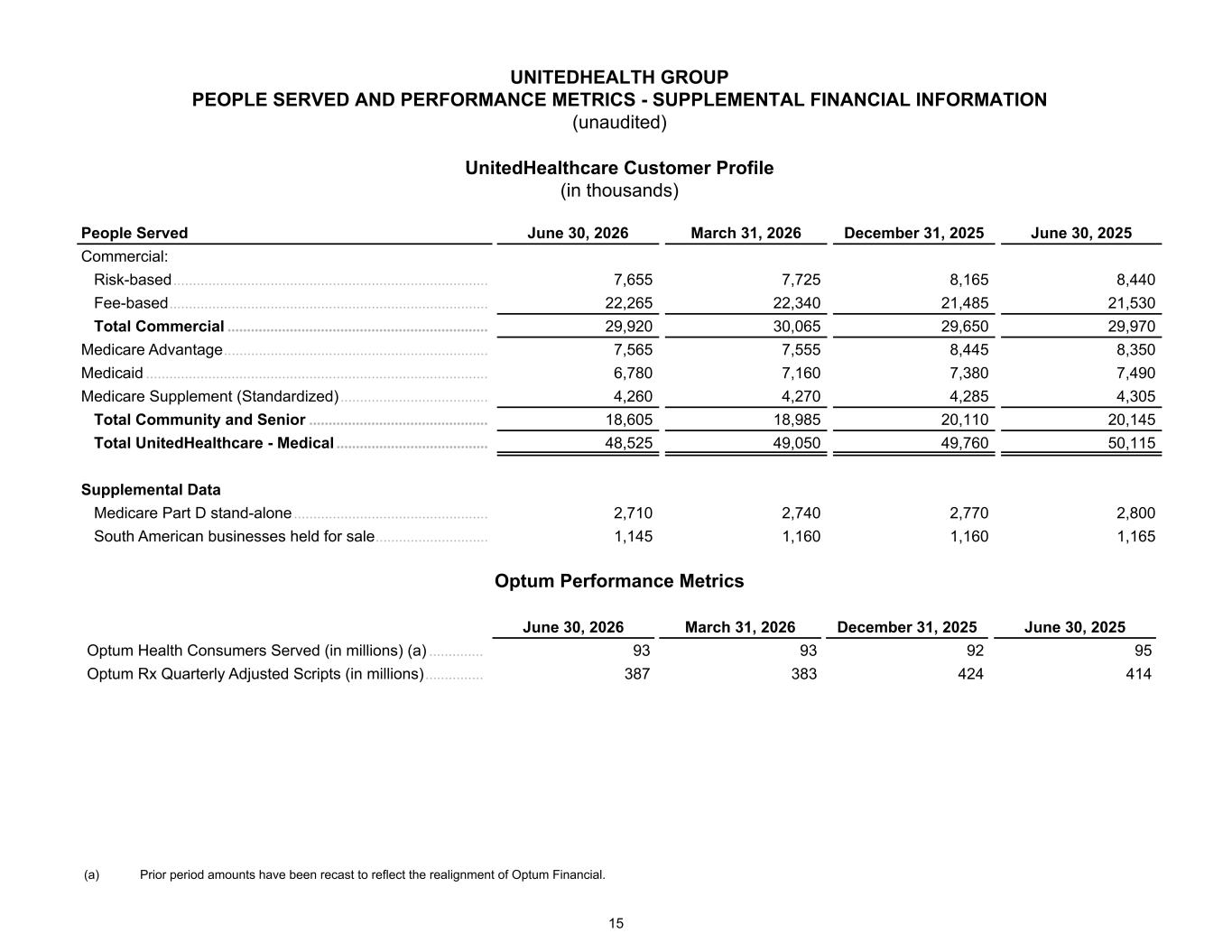
The pricing, benefit design, and market actions we've taken over the past year have been central in supporting our second quarter results and improved full-year outlook. As you have seen, UnitedHealthcare's overall performance in the second quarter exceeded expectations, driven by better results in Medicare Advantage, while commercial benefits remain pressured. I'll start with medical costs. Through the first half of the year, we are seeing divergence within our portfolio. Medical cost trends in Medicare are still running well above historical levels, but below our expectations so far in 2026. A primary reason for trend being below our expectations in Medicare is our own initiatives, including benefit design, care management models, and network curation. Other factors have an influence as well, including prior year development, a more favorable respiratory season, and weather patterns. We expect the 2026 Medicare medical cost trend to come in below our initial estimate of around 10%. Commercial costs are stubbornly high, rising above expectations, which we believe is consistent with what is being experienced across the sector. Turning to the overall performance of our individual benefit offerings, Medicare delivered a strong second quarter. Membership retention was better than previously anticipated. We now expect full-year Medicare Advantage enrollment to decline by approximately $1.1 million and Medicare margins to finish 2026 above 3%. Looking to our 2027 bids, our benefit planning remains disciplined and grounded in the current trend environment. We will continue to support program and margin stability through actions including benefit adjustments and selective changes in market participation. In Medicaid, overall performance during the quarter, including cost trend, was broadly in line with expectations. We are beginning to see early signs of improvement from initiatives including those targeting elevated behavioral health cost trends, but we expect Medicaid margins to remain pressured for 2026. Our focus is on closing the gap between lagging reimbursement rates and underlying medical cost trends while continuing to partner closely with states to support the long-term sustainability of Medicaid benefits and support them in identifying and reducing fraud, waste, and abuse. Within our commercial offerings, as I noted, we are not yet seeing evidence of cost trend moderation. In fact, it is the opposite, with medical cost trends modestly above 11% level we previously saw. The primary drivers are pressure from the independent resolution process under the No Surprises Act, which applies only to commercial plans and more aggressive billing practices among providers, especially higher service and coding intensity and higher costs per encounter that result from the more fee-for-service orientation of commercial plans. At this distance, commercial margin recovery will remain a focus area longer than originally anticipated. Returning to UnitedHealthcare as a whole, we are confident in being able to deliver meaningful earnings growth in 2026 and into 2027 with the reinvestments we are making in the business to build a stronger, more durable foundation for 2027 and beyond. Of equal, if not more importance, we remain intent on modernizing essential healthcare experiences to improve how consumers and care providers experience the health system. For example, in the quarter, we committed to eliminating, by the end of this year, 30% of prior authorization volume, and nearly two-thirds of prior authorization requirements for pediatric care. We continue to take concrete steps to reduce complexity and increase speed by further simplifying prior authorization, increasing consumer-responsive digital experiences, providing greater support to rural hospitals and care providers, offering more consumer-centered product innovation, and much more. AI is both an enabler and accelerant to this effort. We're early in this work, but clearly on the path to improve the healthcare experience and strengthen relationships with our stakeholders, starting with consumers and care providers. And we're confident these efforts will bolster UnitedHealthcare's long-term performance and market position. And now let me hand it to Patrick Conley.
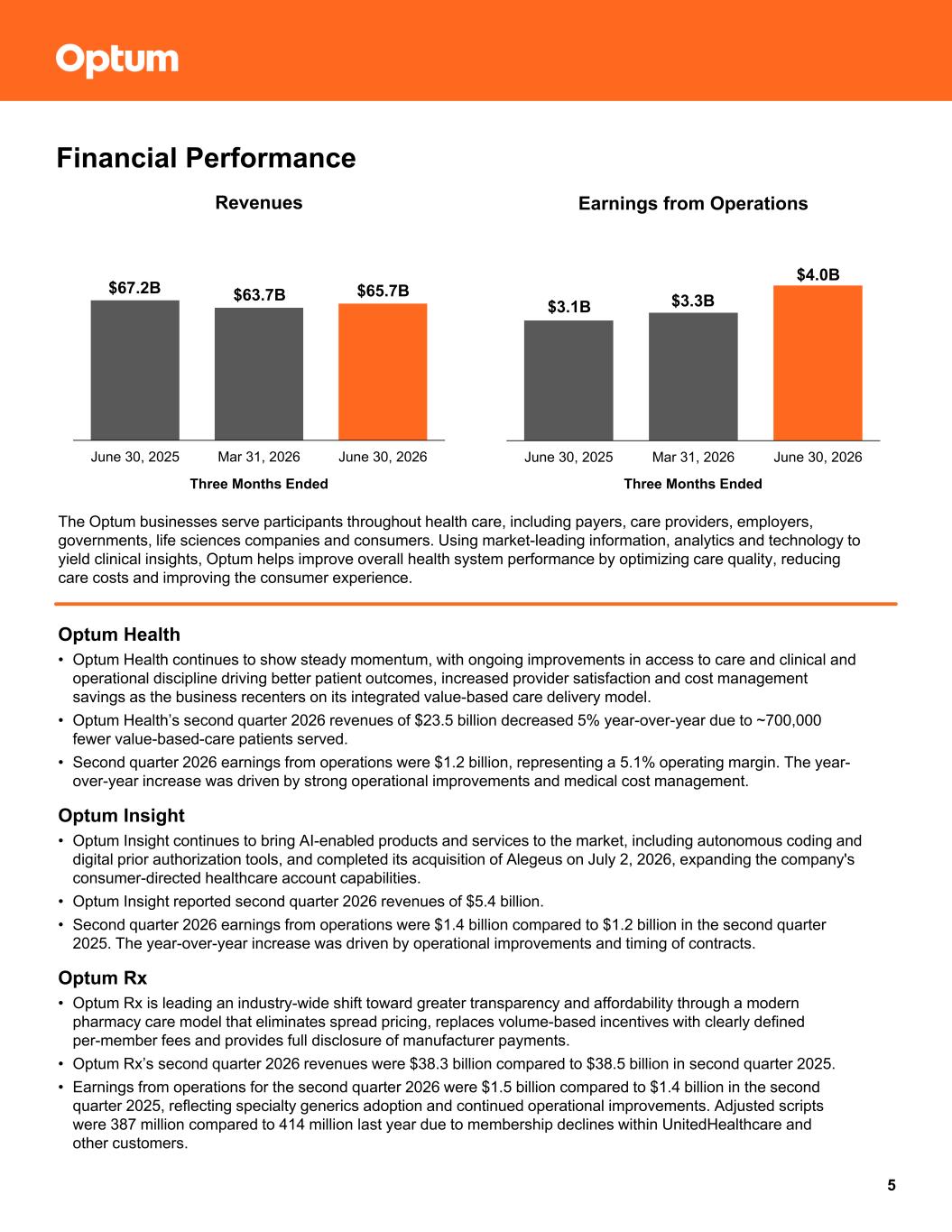
Thanks, Tim. As Steve noted, we are seeing positive momentum across Optum with all three business segments performing in line or ahead of plan. Optum Health is intently focused on improving its clinical care and the 20 million people we care for through primary and specialist. Over the last year, we have made significant changes in how we operate this business locally and nationally and are seeing the initial benefits of integrated value-based patients. On the clinical side, we're advancing approaches that better offer a few examples. Support for patients during key transitions of care has resulted in approximately 10% reduction in hospitalization since implementation late last year in the western and southern region. Home health initiatives to better support patients as they return home, where they can be managed more comfortably and effectively, have reduced readmissions. In pilots, the effort has driven a more than 20% improvement in timely care delivery alongside reductions in acute care utilization and shorter skilled nursing. Expanded access to home-based care capabilities coupled with treat-in-place offerings for patients with complex, on the operational side of OptumHealth, we have established a clearer regional and natural driving consistent technologies to support clinicians in the to 70% to exceed 90%. Collectively, these actions are yielding tangible results. Patient experience in our care delivery sites is up approximately 5%. OptumHealth will build upon this foundation with additional investments in clinical workflow improvements and network performance, more deeply embedding AI and automation to further improve operational performance and clinician experience. Additionally, we entered the 2027 benefit planning season very differently than years past. starting with much earlier proactive collaboration with all our payer to greater care coordination for patients while more appropriate lining plans and initiatives begin to mature and scale with disciplined execution we expect margins to continue to stay turning to OptumRx we have been leading an industry-wide shift towards transparency and fee-based services where we are delivering affordability and that's why we continue to win new customers and retain existing ones with retention rates in the high 90. In May, we announced a new pharmacy care approach based on a monthly per-member fees with full PBM and GPO fee transparency and enhanced consumer tools. Client feedback has been positive and focused on how greater transparency and clinical alignment can address trend challenges, shifting the conversation to affordable health outcomes versus economic. This all builds on our industry-leading commitment last year to pass through 100% of manufacturer rebates to customers by the end of 2027. We are well on our way, as we expect to end 2026 with more than 95% of clients on 100% Moving to Optum Insight, AI-enabled approaches continue to gain traction as more payer and provider customers see differentiated capabilities to drive better performance. The emerging suite of products include solutions such as AI-enabled coding, real-time payer and provider interfaces, and clinical quality and safety supporting real impact for customers. Making healthcare value connect is an AI-driven insights platform integrated into provider workflows and elective client results include a 17% reduction. Bringing this all together, halfway through the year, we have made steady progress in each of our Optum businesses, and we'll continue to find ways to better serve patients.
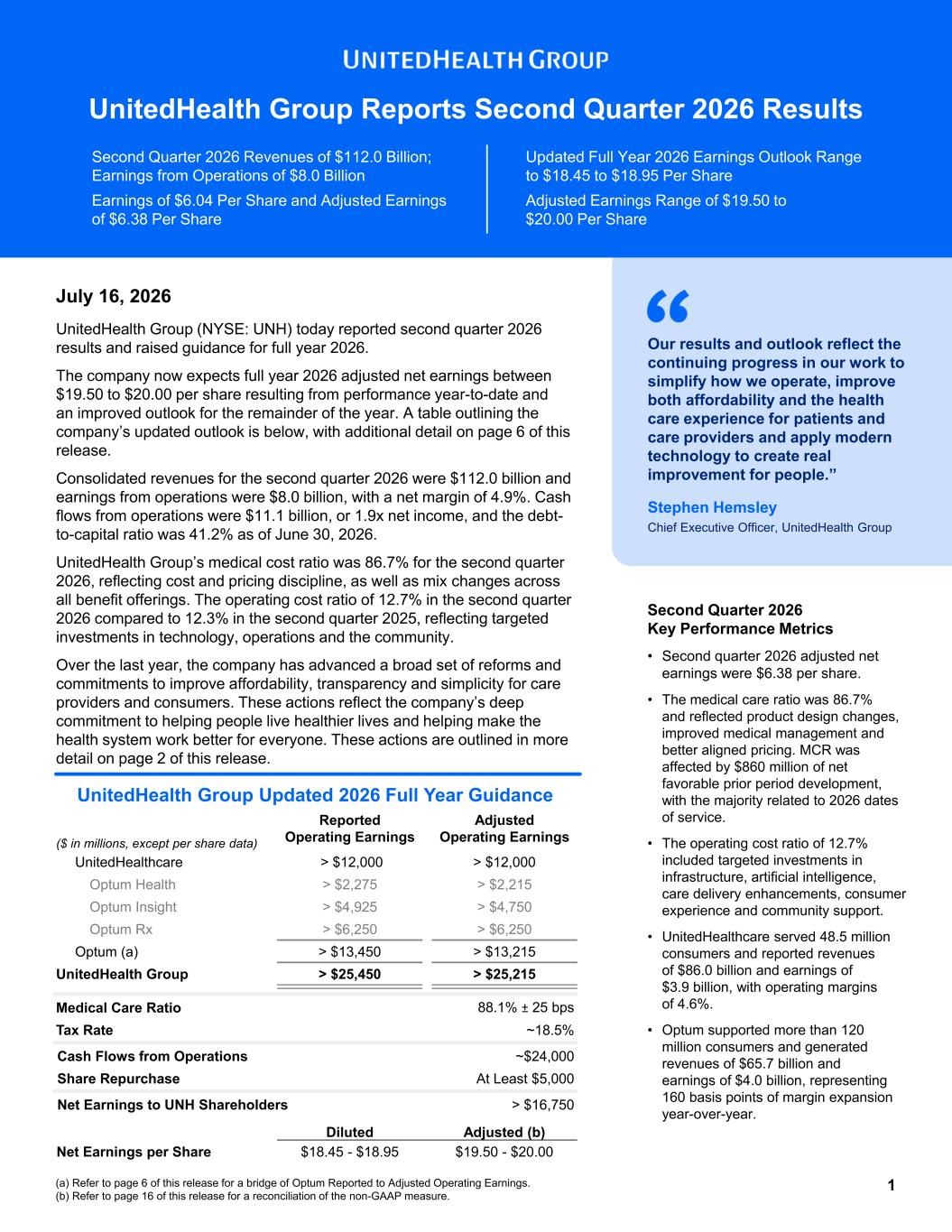
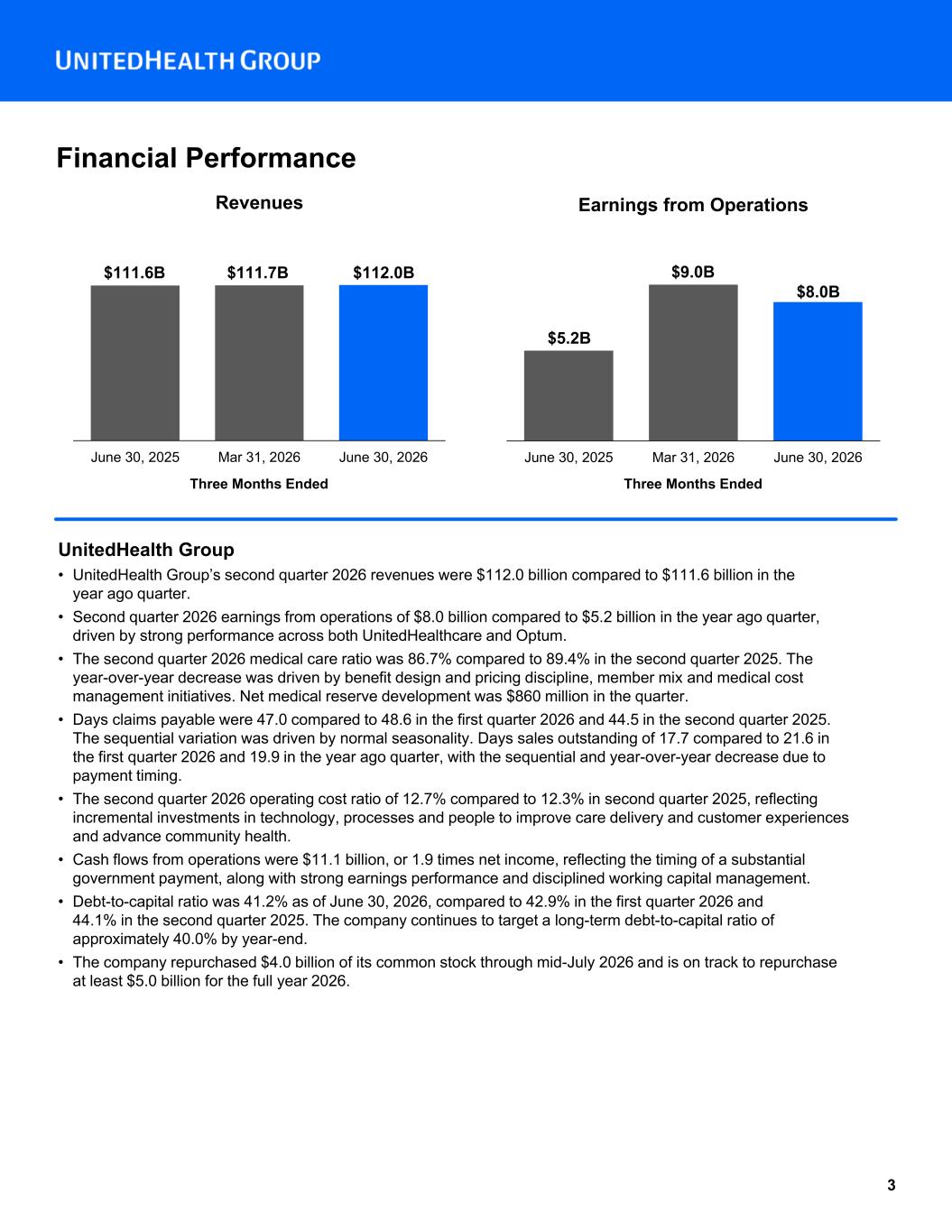
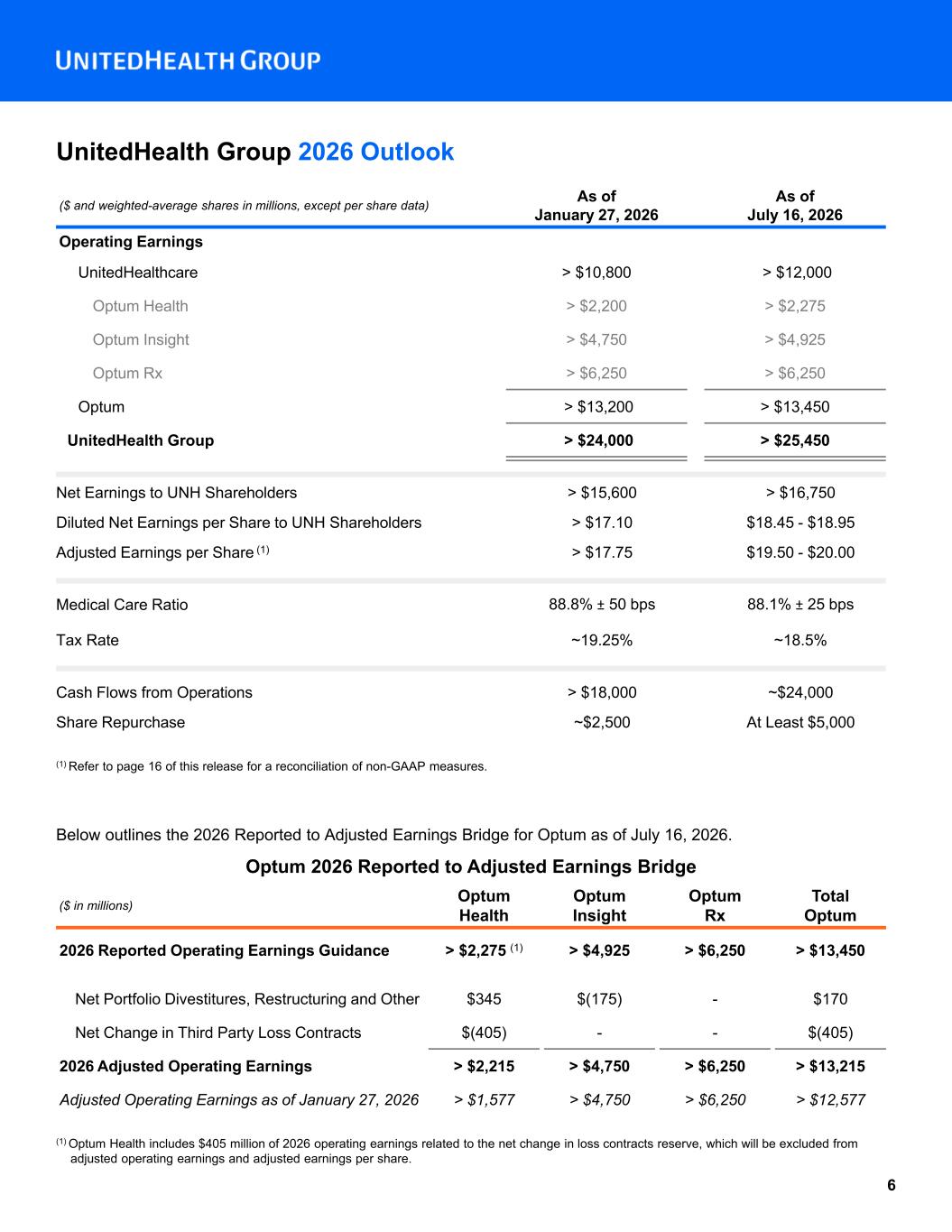
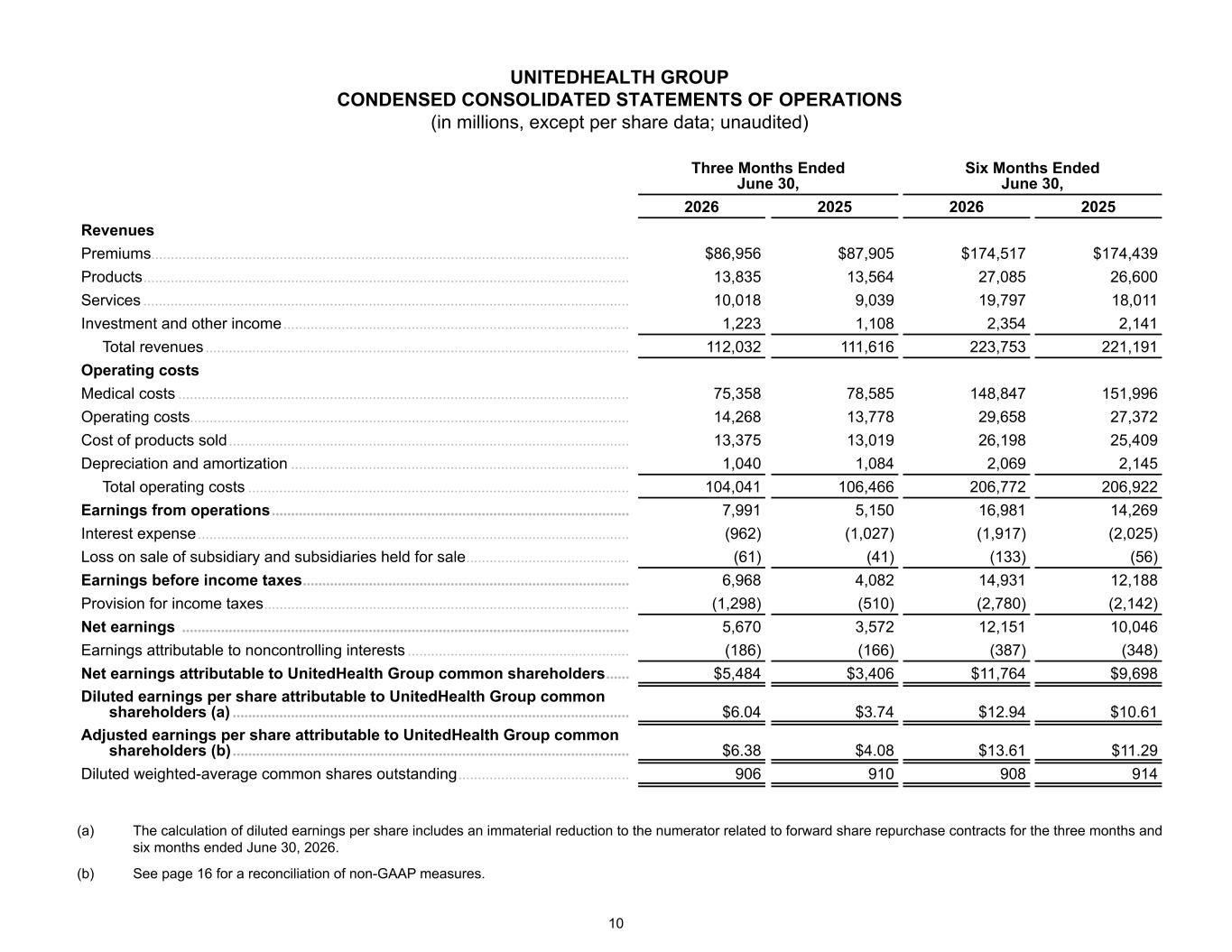
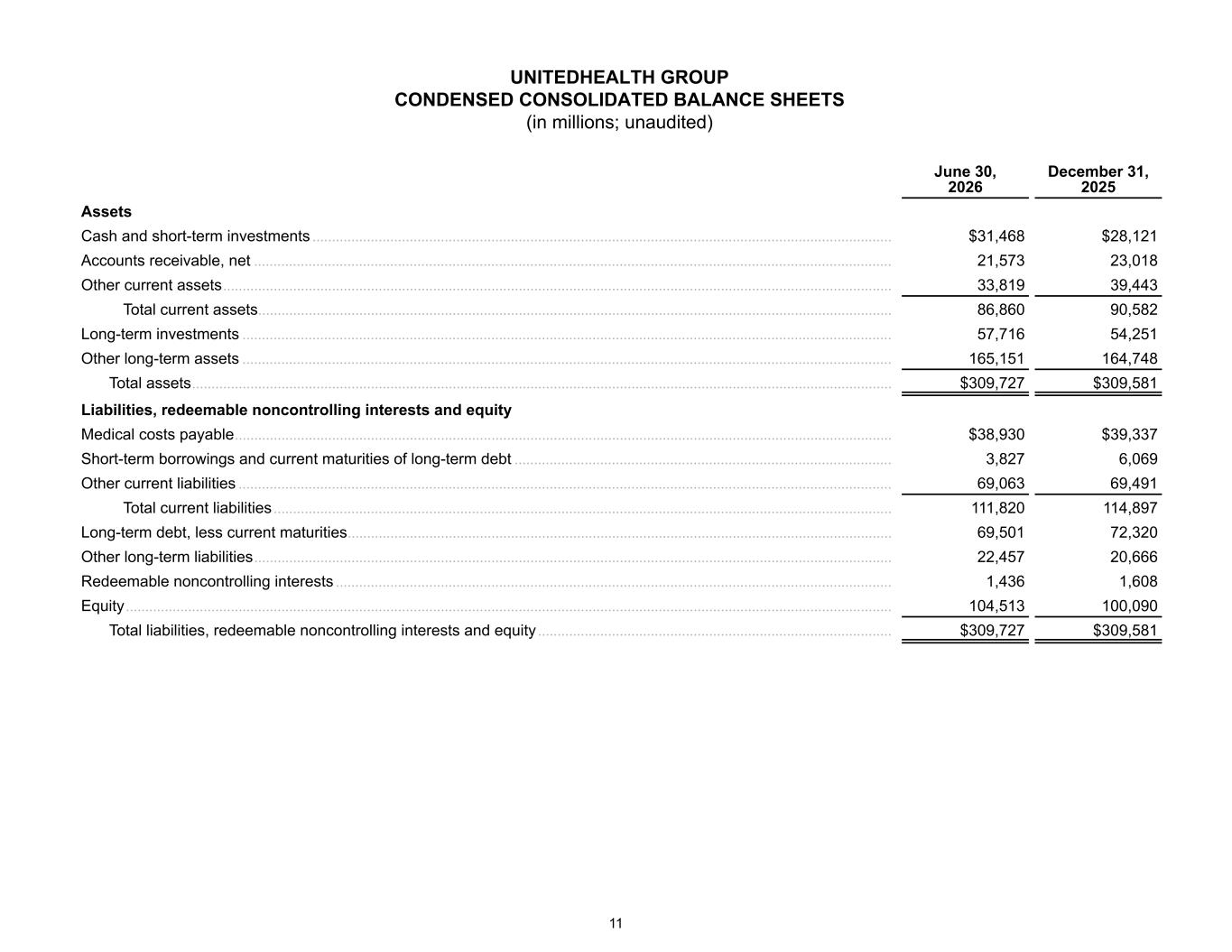
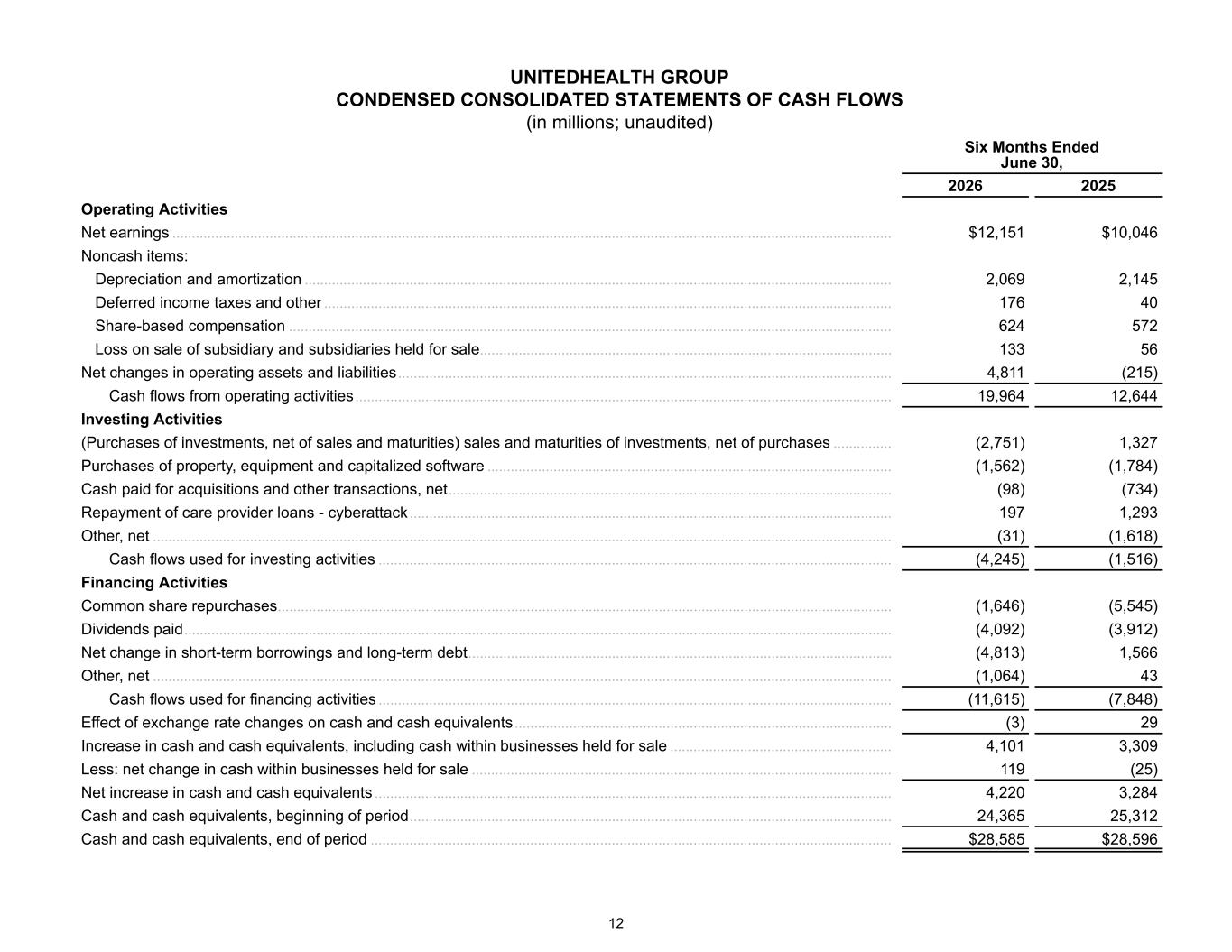
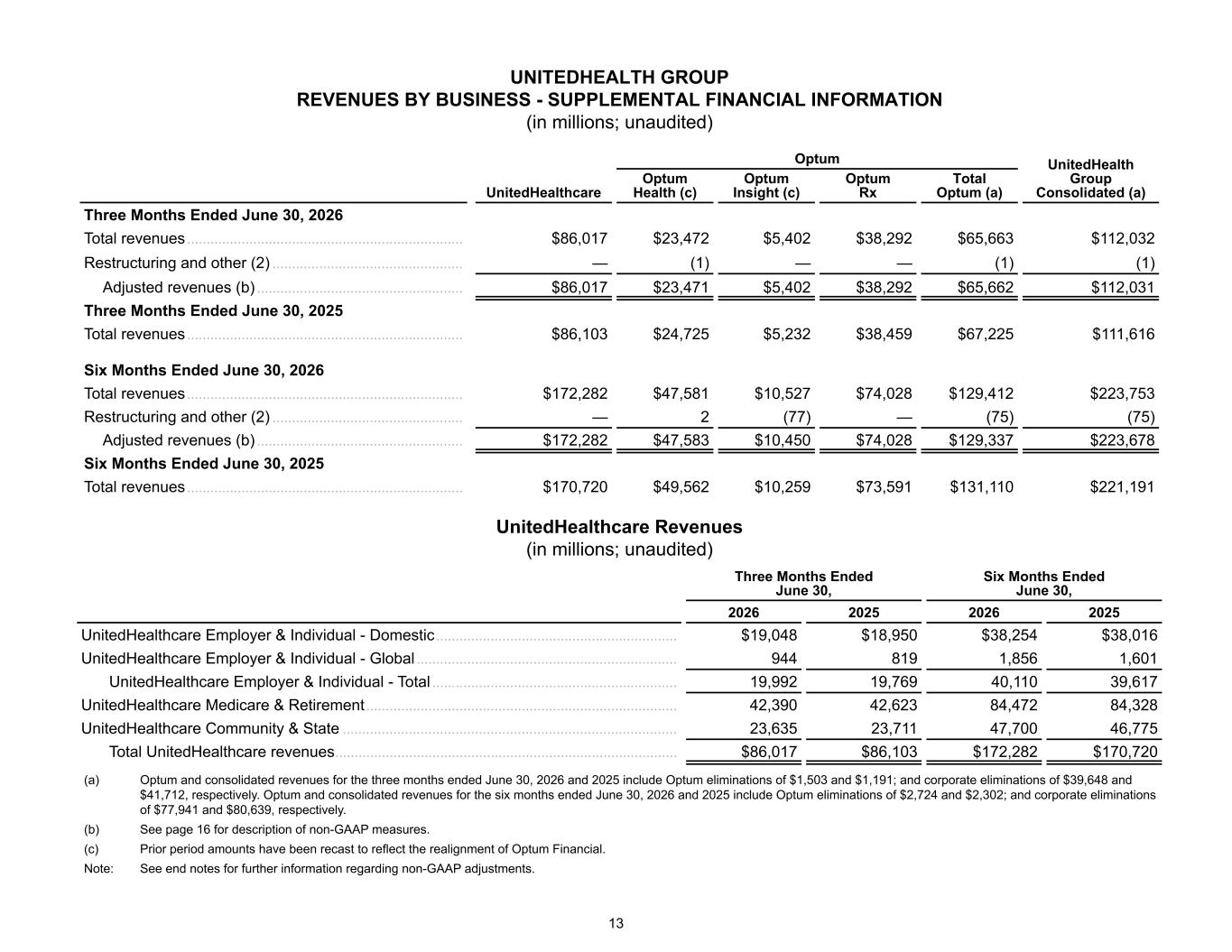
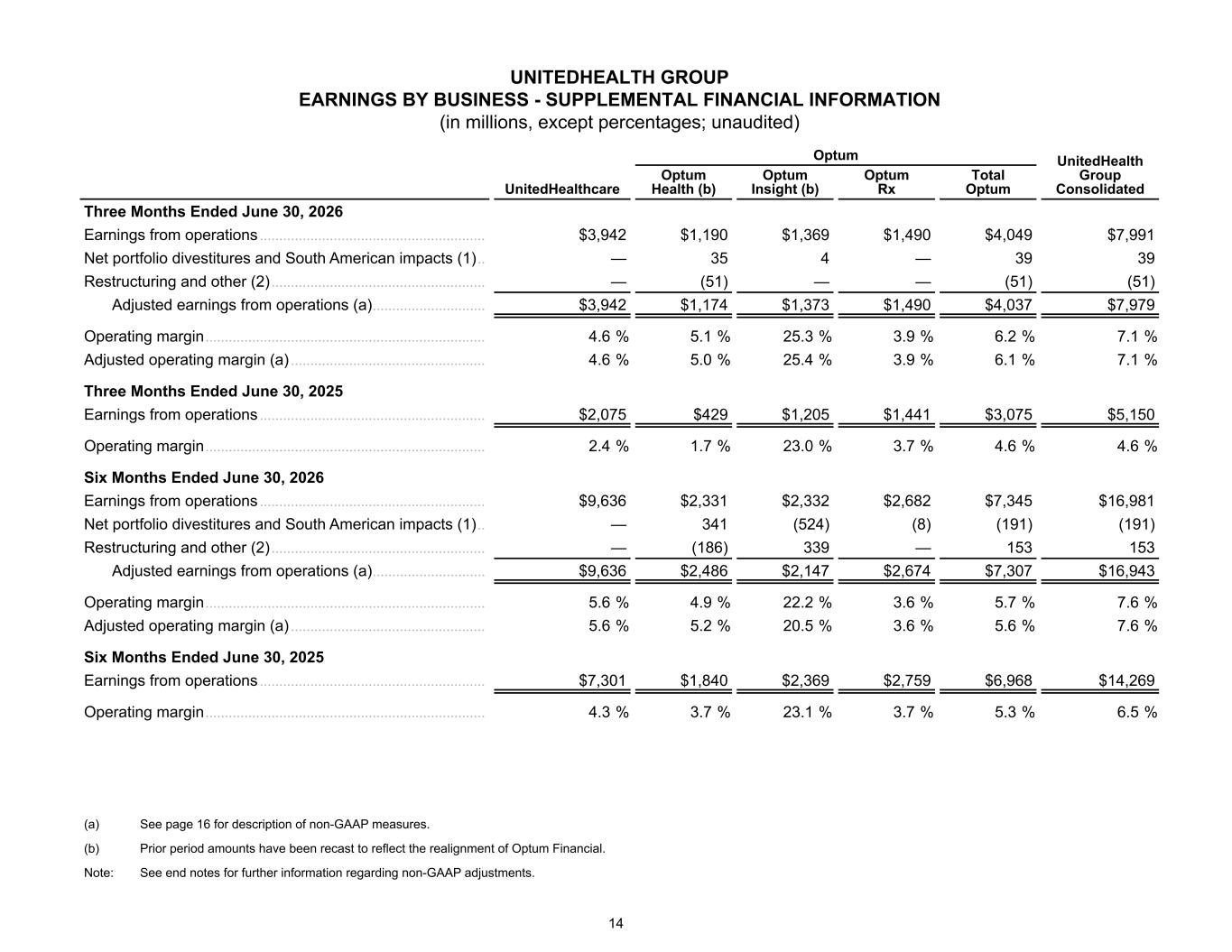
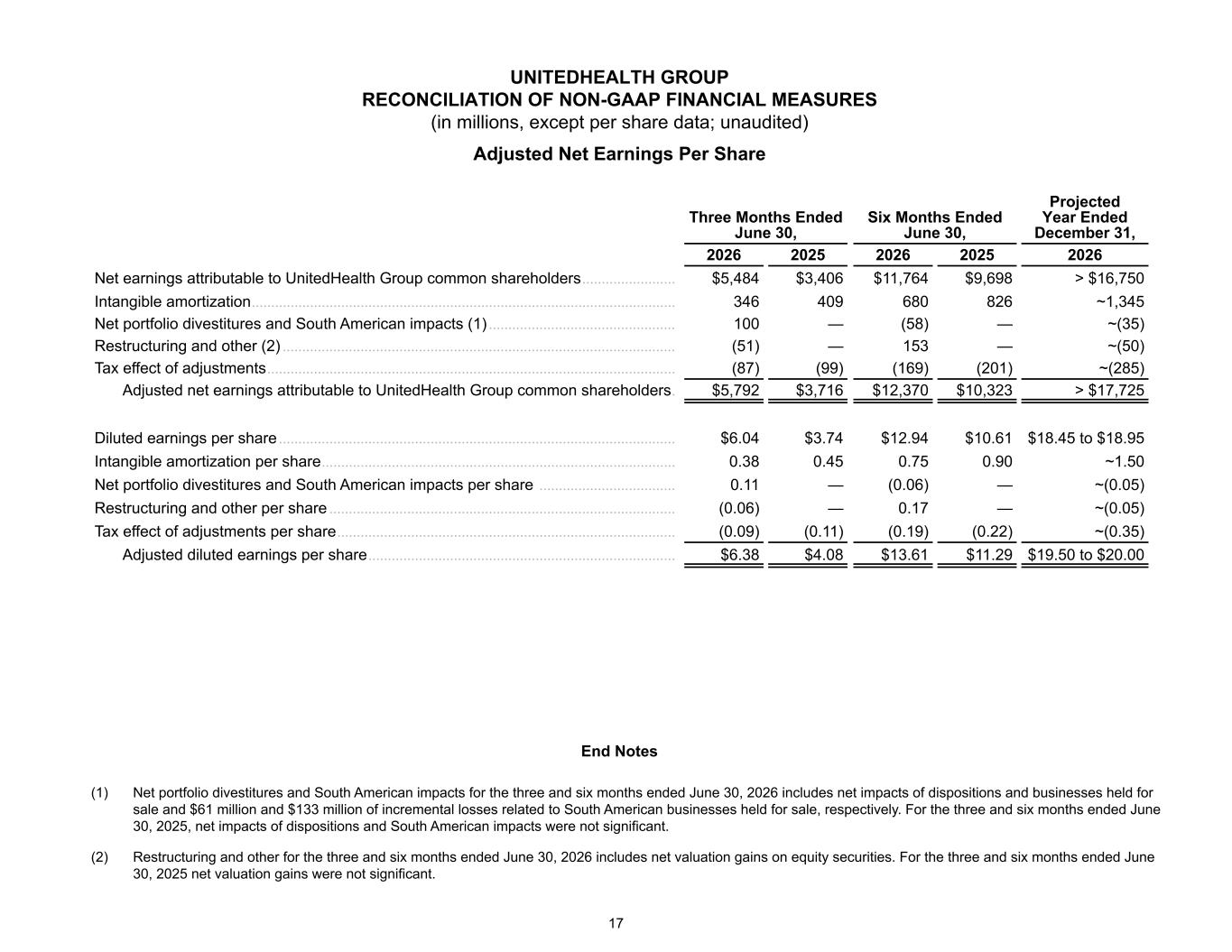
Thank you, Patrick, and good morning, everyone. I will briefly review second quarter results, then discuss expectations for the remainder of the year as we refresh our 2026 guidance. Overall, the quarter and full year outlook reflect improved performance across our businesses with notable improvements in UnitedHealthcare and Optum Health. UnitedHealth Group reported adjusted earnings per share of $6.38, compared to $4.08 in the prior year. Total revenues were $112 billion, largely consistent with the prior year, while operating earnings of $8 billion grew 55% year-over-year. This improvement reflects product and portfolio actions taken over the past 12 months, along with more focused and consistent management disciplines. Turning to medical costs, a reported medical care ratio of 86.7% includes $860 million of net favorable prior-period medical development, the majority of which is in-year development. This compares to 89.4% in 2Q 2025. Days claims payable was 47 days, up approximately 2.5 days from a year ago. The operating cost ratio was 12.7% for the quarter, compared to 12.3% a year ago, as we continue to focus on operating discipline while making targeted investments across technology, AI, care delivery enhancements, customer experience, and advancing healthier communities through the UnitedHealth Foundation. Moving to cash flows and our balance sheet. Operating cash flows in the quarter were approximately $11 billion. are 1.9 times net income, reflecting timing of substantial government payments and strong earnings. This provides capital to strengthen the balance sheet, invest in growth, and return value to shareholders. Through mid-July, we have deployed $4 billion for repurchases of 11.4 million shares. We now expect to complete total share repurchases of at least $5 billion in 2026, compared to initial guidance of $2.5 billion. During the quarter, we returned $2.1 billion to shareholders through our dividend, which our board increased to $9.28 per share on an annualized basis. And lastly, on July 2nd, we successfully closed the previously announced combination with Allegis. Our debt-to-capital ratio was 41.2% at the end of the quarter, compared to 44.1% one year ago and 170 basis points sequential improvement from the first quarter of this year. We remain on track to reduce our debt-to-capital ratio to approximately 40% by the end of 2026. As you saw earlier this morning, we have updated our full year 2026 guidance to reflect performance through the first half of the year and a more mature understanding of expected membership mix and utilization patterns for the remaining six months. We continue to be respectful of medical trend and we believe this refreshed outlook appropriately balances risk and investments with durable run rate earnings. A few areas of this outlook to highlight. We're providing new adjusted earnings per share guidance range of $19.50 to $20 with slightly more earnings in 3Q relative to 4Q. We are increasing the full-year operating earnings outlook for UnitedHealthcare to at least $12 billion and for OptumHealth to at least $2.2 billion. These changes reflect operational improvement underway across the enterprise. We now expect a full-year medical care ratio of 88.1%, plus or minus 25 basis points. We expect the operating cost ratio to come in at the higher end of our previously discussed range as a result of investments in our people, communities, and AI. The overall earnings cadence for the year remains consistent with prior expectations. UnitedHealthcare earnings continue to be weighted approximately 75% to the first half of the Similarly, we expect nearly all of OptumHealth's earnings to be recognized in the first half, with modest profit and 3Q offset by modest losses in the fourth quarter due to the seasonality of the risk-based businesses. In contrast, OptumInsight and OptumRx remain more heavily weighted towards the second half of the year, with each expected to generate approximately 55% of their full-year earnings during the back half as client implementations, growth investments, and normal business seasonality progress through the year. So overall, we're seeing a two-thirds, one-third first half to back half mix. Steve, back to you.
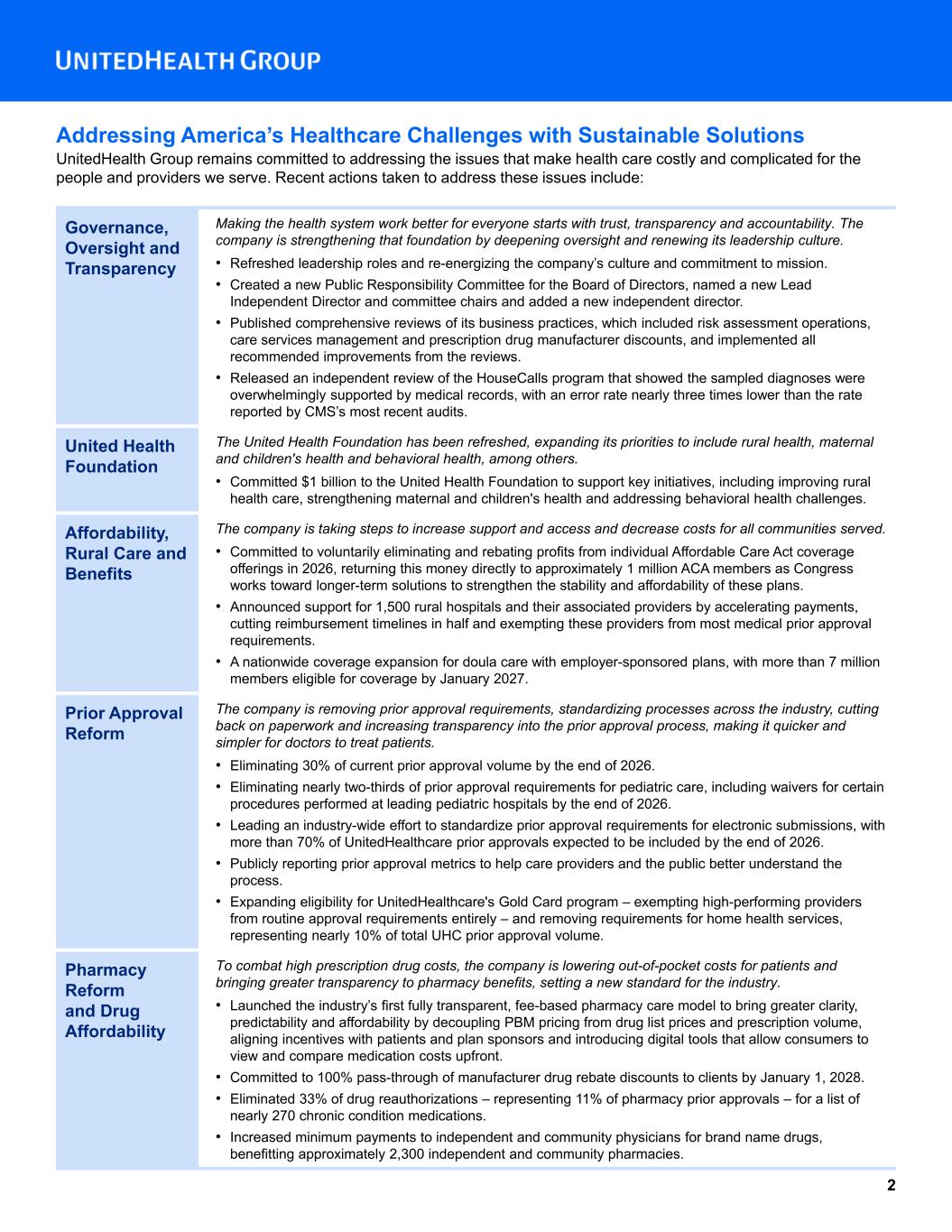
Over the last few quarters, this enterprise has undertaken a broad-based effort to improve how consumers and care providers experience the health system while addressing the chronic cost trends trend issues driving the everyday challenges of access affordability and complexity a press release this morning has a sampling of these initiatives our efforts focus on essential themes affordability transparency modernization simplicity and convenience As the U.S. health system continues to evolve, we will evolve our approaches and our businesses as a scaled and diverse enterprise, driving integrated value-based care anchored in the first principles of the right care, at the right time, and in the right setting, a system where incentives are aligned to those first principles and the better health and the better cost trends that drive. Value-based care approaches are a key component of the effort to make healthcare more affordable by bending the cost trend by better aligning incentives for both consumers and care providers. Artificial intelligence technologies applied in practical ways that help people can be an accelerator to achieving that goal as we use them to literally reimagine our enterprise. You should expect us to continue along that path and pick a momentum as we better fulfill our mission with accountability to you and all stakeholders in the health system. Now we'll go to questions. Thank you, operator.
Operator
The floor is now open for questions. At this time, if you have a question or comment, please press star 1 on your touchtone phone. You may remove yourself from the queue by pressing star 2 on your touchtone phone. We ask you to limit yourself to one question. If you ask multiple questions, we will only be answering the first question so that we can respond to everyone in the queue this morning. And we'll take our first question from Justin Lake with Research.
Good morning. I just wanted to touch on a couple of numbers. First on Medicaid, you talked to minus 1.1 percent, the minus 1.7 percent margin previously. curious. Sounds like you're seeing some improvement there. Maybe you can give us some color on what you expect the year to end up. And then on commercial, can you talk about the magnitude of the cost trend pressure you're seeing here versus that 11 percent expectations and maybe update us on how we should think about commercial margins this year and the trajectory versus the previous assumption? I think you assumed you were going to get back to target in 2027. Thanks.
Sure. Thanks, Justin. Mike, do you want to take the first one? Medicaid?
Thanks, Justin. Yes, our Q2 Medicaid performance was in line with expectations. The first half of the year has benefited from execution on affordability actions, including network curations, payment integrity actions, fraud, waste, and abuse, and identification of operating cost disciplines. Trend remains elevated versus pre-pandemic levels, but stable with continued pressure and specialty pharmacy, home and community-based services, and behavioral health care services. We're also seeing a bit of an increase in trend in inpatient and SNF costs as well for our complex populations. When an aggregate year-to-date rate actions through 7-1 accounting for approximately 80% of our annual revenue, we're within our expected forecast. We continue to work with our state partners on on-cycle and off-cycle rate actions and our inactive conversations for our 9-1 and 10-1 rates. We continue to believe annualized 2026 rate impacts will be in the zone and still lagging elevated medical trend. Overall our 26 margins will be within our previously communicated range as you've indicated negative 1 to negative 1.7% and we expect to get that expectation for the year. Thank you for the question.
Thanks Mike. Dan Keeter do you want to comment on commercial? Yeah thanks Steve.
Hi Justin, thanks for the question. Let me unpack a little bit for you what's going on in commercial business is obviously trend and margin are tied together. I think it's pretty straightforward. First on trend, modestly above 11% that we were expecting as Tim shared. There are multiple drivers. First the ineffective IDR process that's associated with the No Surprises Act is being exploited by select providers and select geographies. It's contributing 50 basis points or so of incremental trend in 2026, now totaling at least 100 basis points of total cost additionally provider coding intensity with office visits emergency departments and selective other care sites being the primary drivers is also contributing incremental trend to last year into our expectations some consistent drivers continue to be pharmacy costs I'd highlight specialty drugs reflecting both higher net costs and growth of newly covered indications anti-inflammatory and GLP ones are part of that mix as you would expect and lastly we're on the on the utilization and care patterns we're not seeing any other areas of meaningful offset or pullback in those categories so now the impact of that trend environment on our margins we came into 26 planning for margin expansion as you highlighted and simply put we're not yielding the full margin expansion for which we planned in 2026 I I see 26 as a delay to that margin recovery trajectory, not a setback. So, the sticky nature of the persistent and elevated trend is extending the time frame for full margin recovery past 2027, as we've previously discussed and you highlighted. We remain on a multi-year journey. We remain confident that that journey will result in a return to our historic margin performance of 7% or greater for the commercial group business. That performance is pacing, and that recovery is built on a few things, improved administrative cost efficiency, AI-enhanced fraud, waste, and abuse efforts, and diligent focus, as always, on medical cost affordability. So, thanks for the question, Justin.
It's an area we're clearly focusing on going forward. Next question, please.
Operator
Our next question comes from A.J. Rice with UBS.
Thanks. Hi, everybody. Obviously, the turnaround from a year ago when you came back, Steve, and restructured the team has progressed very nicely. As you sort of assess here a year into all of this, maybe just broadly, where is the turnaround, you know, pretty much done? Where are there still, in your mind, opportunities, and because I have to ask you a numbers question, And how about the thought of getting back to the 13% to 16% earnings growth trajectory? I know the goal had been to do that by 28. Do you feel like you're going to do, obviously, better than that this year? Do you think you're on a sustainable track now to have that 13% to 16% growth going forward?
Yeah, I would say basically two things in that we'll probably never, we'll remain restless. We are never going to not be in improvement and urgency mode, so I don't kind of approach really changing, and I think everybody is aligned with that, and so we have a great deal of work to do in front of us. This is not just about returning to a growth rate. This is also about making this company perform in levels and in areas and spaces consistent with its mission and to really provide a positive impact to all those we serve and across the health system. So that broader mission is a restless one. It's a journey, and it's not going to stop. The second, in terms of the growth rate, I don't ever believe, I ever didn't believe in the 13 to 16 percent long-term growth rate. We will have moments along the way when we don't perform to our potential, but if you take a look, I think, at this business approach and the challenges in the healthcare system, I think that we can grow in that growth rate particularly recognize that it includes you know productivity gains and use of capital and if anything those things have particularly on the technology side the opportunities there are even more greater than there have been in the past so we continue to continue to be in that mindset of that 13 to 16 percent definitely believe we can perform in that range really never believed otherwise we did obviously have challenges in the last couple years but we are addressing those challenges and returning to form and that's kind of the way we we think of it is that enough for response that's great thanks a lot okay thank you next question please and we'll go next to Stephen Baxter with Wells Fargo.
Yeah, hi, thanks. I wanted to ask about cost trend in the Medicare Advantage business. You bid for 2026 cost trends to be 100 basis points above 2025 level. So I heard you in the prepared mark saying that trend is coming in kind of below where you bid to, but try and understand where you see trends sitting versus 2025, at least in the first half of the year. And then just as we think about what you assumed in the bids that you finalized, you know, a month or so ago. Was that closer to the first half experience for trend or something closer to what you saw in 2025 or expected to see, I guess, going into 2026? Thank you.
Sure. Tim Knoll, can you comment on that?
Good morning, Stephen. Thanks for the question. So I'm going to just start off with just the high level view kind of across UHC and then turn it over to Bobby for a little bit more supplemental detail on Medicare. So to start, trend remains very high across the board within UHC all product lines when you compare to historical levels. As you know, in our benefit planning, pricing, and forecasting, we broadly plan for a continuation of what we saw last year. And as noted in my opening remarks, how this is playing out across the businesses, is a little different when you think about commercial Medicare and Medicaid. Dan highlighted some of the drivers leading us modestly above the 11% we're seeing there. Medicaid, again, largely in line with expectations. And for Medicare, trend is coming in lower than our planning assumptions. However, it's really important to note this does not represent an inflection point in trend. We're continuing at those high levels, but it's coming in lower than our benefit planning assumptions. One other key point before turning over Bobby that I wanted to raise is on our exchange business, our exchange business is coming in better than our planning expectations as well. However, it has no financial impact inside of the quarter or the full year because we've made the pledge to return our profits to consumers for 2026 but that is separate from the commercial trends that we've been talking about of the greater than the 11% that we historically have been guiding to. So with that I'll just turn it over to Bobby for some detail and color on Medicare.
Yeah all right thanks Steven. So maybe to go one click deeper on the Medicare piece. So important to remember how we built up the 2026 medical trend Stephen, I'll maybe frame it in three ways for you. First, we saw elevated levels of core utilization in 2025. We talked a lot about that, and we assumed that that would continue into 2026. That was kind of the foundation. Second, we adjusted for known year-over-year increases in things like the fee schedule, changes, and calendar impacts. And then third, we accommodated for some level of potential unknown risk elements. So we've mentioned tariffs and other things of that nature. Now, there are a few things I'd point to in terms of why trends to date are a bit lower than our original expectations, some positive claims experience, as well as in-year benefit from things like the lighter fluid respiratory season and winter storm impacts that Tim mentioned in the prepared remarks, and we've also not seen the full emergence of material unknown elements at this stage. However, it's also really important to highlight that while medical trends remain high versus the historical levels the improvement we're seeing is also the results of targeted actions that we've taken and we've done that through benefit design product positioning that's resulted in you know a more favorable membership mix we've had network curation activities focused on high quality low-cost opportunities with providers for our membership we've had broad affordability initiatives and then we continue to invest in aligned provider models like value-based care so overall I feel good about our assumptions for 26 where we currently sit first our expectations and yet remain intensely focused on affordability given the still elevated levels of medical trend the first the historical baseline and then your question on 27 you know still probably a little bit too early to talk a lot of specifics there but the highest level we did plan reflective of our current experience with appropriate adjustments then for things like fee schedule updates and other natural year-of-year changes, but foundationally not expecting a meaningful deviation from the still elevated underlying core trends. Thanks for the question.
Thank you. Next question.
Operator
And we'll move to our next question from Kevin Fishbeck with Bank of America.
Great. Thanks. Maybe just kind of following back up on an earlier question about, you know, the growth rates. You know, as we think about 13 to 16 as kind of being, I guess, like a North Star growth rate for you guys. I mean, the outperformance this year was pretty dramatic. And just want to make sure that there's not something that we should be adjusting out of this baseline. Is this a good baseline to be thinking about for 2027 if you kind of assume normal growth from here? Or is there anything we should be thinking about, either whether it was prior period development or outperformance that an MA that gets rebid to next year? How should we be thinking about that?
Yeah, I think the quality of earnings is exceptional. Wayne, maybe you want to comment?
Yeah, good morning, Kevin. Let me start by saying I do think, as Steve highlighted, the earnings are quite durable, and we do think the $19.50 to $20 is the right stepping-off point, albeit it reflects prior period development. We would say as well that, as Steve commented on, the 13% to 16% growth algorithm we personally have never deviated from, and we believe that is the right starting point as you think about our stepping-off point.
Operator
And we'll go next to Lisa Gill with J.P. Morgan.
Thanks very much. Kind of following up on that question, you know, throughout your prepared comments you've talked about investment spending, the SG&A in the quarter. How much of that is potentially one time and where you could see a benefit to that going into 2027? How should I think about the investments that you're making and the benefits that you could see? And again, you know, to your point, Wayne, Is there anything that's one time in nature?
Similar to the PPD, while that benefited us in one direction, we continue to invest in our foundation, which you could argue is one time. We don't believe that's one time, though. I think one of the things that we are targeting as a team is continuing to build that foundation out over time. We are now up to a billion dollars in the foundation, which is a very important part of our commitment to our communities. That being said, Lisa, you know, we have a number of positive momentum items, but the durability of the underlying run rate is strong, and you can see that in our cash flows. So I don't think there's anything you should be carving out in either direction. I think the 1950 to 20 is the right baseline, and I think you should be thinking about the growth algorithm from that point forward. And I think, as you heard, the recovery on commercial is going to be a little bit longer than we had anticipated, but that should be a tailwind that we are reflecting in the future as well, along with many of our other businesses that are still not at the optimal margins.
Operator
And we'll take our next question from Andrew Mock with Barclays.
Hi, good morning. I wanted to follow up on the commercial market comments. The IDR process has been in place for a number of years now, so can you help us understand why costs are accelerating now? Is that a function of win rates, dispute volume, or resolution timing? And is IDR something that you have confidence that you can price for, or are there idiosyncratic considerations that make it harder to incorporate in pricing?
Dan. Hi, Andrew. Dan Keeter again. Thanks for the question. As I said earlier, the IDR process as part of the NSA is ineffective, and we think there's multiple reasons behind it. It has existed for some time, but it continues to accelerate in the volume of disputes, and that has highlighted the deficiencies of the IDR process. Just a couple of things to point to. Upwards of 40% of all claims that enter the IDR process are ineligible for one reason or another. So, as volume is increased, obviously this creates cost and delay for all involved. roughly 60 percent of all arbitration cases are brought by one of just five entities that again is a recent concentration of disputes in a narrow number of of entities that is different than it has been in the years past and then I guess further evidence of the of the weaknesses of the IDR process and some of the things that continue to evolve making it dynamic and why it's changed from what it's been in the past the average payout from arbiters when they side with out-of-network providers is now 11 times what Medicare would pay with some of those decisions ranging up to 30 times what Medicare would pay so these numbers continue to evolve they have accelerated there are of course geographic variations to that as in certain states their process supersedes the federal process for insured business so it's variable across the country but these trends in the aggregate apply to the federal IDR process associated with the NSA so hopefully that's clear evidence it is certainly to employers of
Speaker 0
all sizes that the IDR process is not working certainly not as Congress intended it and it needs to be reformed so those are some of the inside numbers and their accelerations into this year and where we think it needs to go thanks for the question thanks Dan next question please and we'll go next to Anne Hines with Mizzouho Securities great thank you I just want to circle back on Medicare I know you in the original guidance you said trend was ten percent and if you break out the levels I believe that like that elevated core utilization assumption was around seven and a half percent you had just regulatory changes like the doc fix which was like another 1.5 percent and then you had maybe 100 basis points of unknown risk and I think you said that unknown risk is not happening which is probably a tailwind for you but I just want to focus on that first part that seven and a half percent versus 2025 can you give us what that's tracking after the first half of 2026 and I'm not sure if I missed it, but I know your original guidance had 10% cost rent in MA. What does the new guidance assume? Thank you.
Tim, do you want to start?
Thanks for the question, Ann. So you're right, anchoring to the 7.5%, which is what we saw in 2025, how that has restated somewhat favorably. In Bobby's remarks, he did acknowledge that we did have an accommodation for some unknowns with respect to the environment that we saw last year if we plan for 2026 things like tariffs we haven't needed the full accommodation for that in 2026 so far but we're still only about halfway through the year so we're gonna wait to provide a new point estimate around the 2026 trend probably until the next call when we've seen more of the year develop but you know I think the bottom line is that we are seeing trend that's a little lower than what those planning expectations were and then we're also you know feel good about our ability to take actions both in benefit planning and some of the other elements that Bobby talked about to influence that and to manage that and to promote affordability in this key program but we'll more to come on specific point estimates as we paced through the year thank you next question please and we'll go to Lance Wilkes with Bernstein great thanks so much I wanted to talk about optimum health and can you just talk a little about where you're seeing margins for your capitated our value-based care portion of that business sort of a run rate level this year is that a trough or is that up a little from last year and
And then what are the actions you're taking as you're moving forward into the second half in 27 to improve upon that as far as changes in contracting, changes in risk-taking, or footprint? And then in general, how are you refining that model, and are you seeing a different demand for services from maybe the employer segment, other MA managed care companies as Krista?
Thanks for the question, Lance. A couple things in there. First, I'll just start with your first question around just our value-based care kind of risk margins. You know, overall, I think the performance in the first half of the year has been strong and slightly better than we expected. Maybe I'll just kind of provide some drivers of that. The first is, you know, just overall medical. You know, you heard in our prepared remarks us talk about the work we're doing on care management and clinical management. The efforts that we launched in the West that we talked about last quarter, scaling, maturing, and expanding into other regions, those efforts continue to provide meaningful improvement in the business. And, you know, kind of to your question around second half, those things will continue. That was just really one example that's providing about a 10% reduction in inpatient admissions, but there are a handful of other initiatives that we continue to deploy to improve care management and medical performance. Another driver is our operating performance. And again, we talked about that in the prepared remarks, but it's worth noting all the investments we're making to improve, whether it's provider productivity, scheduling enhancements, access to care. You know, we've expanded patient-facing hours by 200,000 hours in the first part of the We, again, expanding access while we're also improving patient satisfaction. Our patient satisfaction is up about 5%. And then we've also increased patient engagement with our high-risk population, about 6%. So a handful of items that, again, I would just say will continue in the second half of the year. So our, you know, value-based care margins performing in line but slightly better than what we would have expected. It's really coming through in our medical performance, in our operating discipline. Those items will continue. I think you also just asked about efforts with our payers and our contracting. So those continue to go very well. I'm most pleased with their commitment to value-based care. I think we are very strategically aligned with our payer partners that value-based care improves quality, it lowers the total cost of care, it improves the experience for our patients, and it improves the experience for our clinicians. So through those commitments, the first half of the year, we've focused on 2027 benefit planning, making sure we're aligned on footprint, on rates, on benefit designs. Our contracting efforts are going really, really well with the vast majority of those addressable for 2027 really complete, but the second half of the year is really going to be focused on some of those post-bid strategies and making sure that we're aligned on how we go to market for 2027.
Thanks so much for the question. thank you Kristen next question please and up next is George Hill with Deutsche Bank yeah good morning and thanks for taking the question I kind of have two quick ones I guess number one is could you talk about the surgical volumes that you guys are seeing in outpatient surgical volumes as that seems to be a trend that has concerned investors across the space but I had a quick follow-up on the Optum Insight business which is where you guys beat at least our expectations pretty handily in the quarter, but guidance didn't kind of increase commensurate with the beat. Would you be interested in comments on cadence as it relates to Optum Health?
So, Krista, you want to take the first?
Yeah, I think, you know, specifically the question on surgical volumes, again, those actually are pacing in line with our expectations. I think just, you know, as I spoke about the operating performance in the business in the last question, you know, the work we're doing around operating discipline, I think, is not just in our risk-based business, but it also applies to our fee-for-service businesses. And again, a reminder, all of our fee-for-service businesses are really pointed towards and operated at higher value sites of care, like ASCs, which are generally about a third of the cost of hospital-based procedures.
And again, inside that ASC business specifically, earnings are growing in line of expectations, volumes are in line, physician recruitment, provider productivity, and really our mix of services is all in line to slightly better than what we would have expected. thank you Cindy thank you George and you're right we at Optum Insight we are slightly ahead of expectations for Q2 but overall we remain on track for our full year guidance Q2 performance was driven by strong operational execution some of that actually due to the early AI investments we made in AI efficiency gains but there's also some client transaction volume that moved earlier into the year from H2 to H1 more than we expected and then we continue to invest even in the back half of this year into new AI products and services where we see early positive momentum from customers. So a combination of all this we remain confident in our full year guidance. Overall Optum Insight remains on a multi-year path of reinvestment and innovation and we're looking forward to the future with excitement. Thank you. Next question please.
And we'll go next to Erin Wright with Morgan Stanley. great thanks so much can you speak a bit more specifically on ai and can some of your ai initiatives actually accelerate or drive upside to the long-term margin targets for instance across optum health in particular are some of that more of the near-term blocking and tackling that you're doing there and just are those benefits from an ai perspective is that i would assume that that builds into 2027 and it's more material in 2028 and beyond or I guess how how should we think about those efforts driving even more upside relative to your long-term targets? Thanks.
Sure well we'll take this one like a we'll take this as a team activity because that actually AI is a very core initiative for us we are really thinking of it in terms of reimagining our entire enterprise virtually everything that we do and we see it basically as the operating infrastructure of the future and so it really is occurring across the spectrum of our businesses and as you are suggesting in your question this is the beginning but it will have compounding effects as we make these investments we continue to get this change driven into our business and it's also a real catalyst and a real opportunity in terms of the Optum Insight business to take everything that we're doing here and bringing commercial versions to the marketplace so maybe I'll start on the United Healthcare side with Tim Noll but then we'll move to Optum and also to talk to maybe Wayne will comment a little bit at the corporate group level so Tim yeah so deployment of AI and other advanced technologies like it are a key and critical focus area across UHC also a big enabler of our modernization agenda
that we're advancing rapidly, you know, it's unlocking a lot of game-changing opportunities to improve consumer and care providers' experiences and make the system operate a lot more efficiently at the same time. And I agree with your kind of commentary on the pacing where we're going to see that accelerate into 2027 and even go deeper in terms of the efficiencies provided kind of across the board into 2028. But as we're focused on this, you would imagine that we obviously have large-scale capital projects that we're deploying, but perhaps more importantly and significantly, we're infusing AI across all of our administrative activities. And a couple of examples just to kind of bring that to light across UnitedHealthcare. First, virtually every provider and consumer interaction uses AI. AI gives us the ability to empower our advocates with predictive insights, real-time data, which all leads to more productive interactions and, importantly, also lends itself to translating some of those experiences into digital experiences that are oftentimes and most times come with better provider and consumer satisfaction as well. also key to our ability to proactively identify members that are in distress and reach out to them with concierge like service models to help them through those moments second area is it's providing step function enhancements in our core operations you know things like very complex claims that we never before thought we would be able to automate we're able to automate those and process those with higher accuracy than we have been able to before, which eliminates costs and also increases turnaround times, which is very important, and a very encouraging element to all this is this is facilitating interoperability with health systems and care providers, and we've seen a really great appetite for health systems to partner with us in these efforts, and it's providing the opportunity on both sides to eliminate latency with some of this real-time information sharing that's now enabled and now going on. That all comes to light in our commitment to process 80% of our prior authorizations in real time by the end of 2027. And in doing so, it creates kind of a touchless environment, which eliminates a lot of the back and forth between health systems, care providers, and health plans, which not only improves experiences, but you can imagine the elimination of the abrasion unlocks a lot of operational efficiencies for both health systems and health plans. And the last area to note is it's giving us the ability to provide better data insights because we're able to, at a more real-time basis, look at data sets far broader than what we've been able to look at in the past. This gives us better understanding around our business performance and also lends itself to things like real-time underwriting across both our commercial and Medicare business. And as we think about our modernization agenda, you know, one of our focus here is to focus on outlier activity and be able to customize our utilization management programs to reduce prior authorizations and other programs for the broad population because we have a lot the ability to more customize on some of those approaches a couple of key reminders though as we think about how we're approaching this in UHC is number one clinicians will always be involved in these processes if services are not authorized that decision will ultimately be made by a clinician and the second thing to note and remind folks of is that our our contact centers are getting far more efficient but they will never be fully automated I'm engaging with the healthcare system that we play of an important role in will always be deeply personal personal we see great opportunity to invest some of the savings that we're getting from these efficiencies and actually enhanced in more concierge service like like models so we're going to always have options for human or interactions on as we approach this so maybe Patrick you want to just comment briefly and then maybe Sandeep a comment because I don't want to spend that much
Yeah, so on Optum, I'd call out AI in a few ways. First, it is a transformational business. Maybe most importantly, though, I'd call out in the modernization frame is we use AI. It delivers better patient experience and results for our customers. So I'll hit on a few examples there because it's really about helping the health system work better for all stakeholders. And I'll let Sandeep call products and services, so the third area. First area I'll call out is administrative efficiency where we're using AI to summarize cases for exams. It makes it 40% faster for that nurse care manager, more efficient. Also allows him or her to spend more time with patients, more time delivering care in the home or whatever the setting may be. Second, in the Optum Insight business, digital prior authorization powered by AI, producing 96% first-passed approval, so now enabling humans, and as Tim said, same on the Optum, it's a UHG principle. We have a human look at that, but 96% from simpler, better, of the providers. The second area I'll call out is clinical support. This is AI supporting humans and clinicians delivering care. We talked about ambient clinical documentation and the uptake of 70% in employed OptumHealth clinicians today going to 90% by year-end. Let me give you a stat on burnout. 90% reduction using AI in the cognitive burnout. When you go visit these clinicians and they talk about how it helps them deliver care better to patients, and then the scheduling, which Krista talked about, we're using AI to make sure that people get timely fashion, proving access using AI. I'll turn it over to Sandeep to hit the products and services, which is a third major area.
Yeah, and really one quick example that probably strings through everything that Tim Noyle and Patrick described is that about a third of our investments this year are going into commercializing all these internal use cases to external products. The prior auth example that Tim described, that Patrick described, has been converted into a digital prior auth product, which we launched about a quarter ago under the Optum Real family of products and year to date it has for external entities to UHG processed about 69,000 prior arts and so it's processed about half a million prior arts and saved 69,000 administrative hours so this is in real life in real time an internal use case which we are investing in giving us internal efficiencies that is being converted into a commercial external product helping improve the system and making it better for everyone thank you and the only thing I'll say at
the group level is every function HR finance legal everything is really being reimagined in an AI context which we think will drive much greater precision greater efficiencies responsiveness we think they're significant opportunities there so thank you for the question next question please and our next question comes from Whit Mayo with Lear Inc partners thanks I just wanted to take your temperature on stars I'm not sure if you can comment on expectations or what you know at this point in time or just any thoughts on the recent industry lawsuits thanks sure a good question Bobby yeah
hey thanks for the question so maybe this is our like I've said before we view quality is absolutely critical and we never take anything for granted with stars we're restless when it comes to seeking opportunities to differentiate but we're always focused on delivering the greatest quality experiences and outcomes for our members you know as you can appreciate as you kind of alluded to given where we sit in the current cycle as well as the ongoing industry activity it wouldn't really be appropriate to speculate on final start your 26 results or what might happen for start year 27 or further into the future you know it's also worth noting the starch program has continued to get more challenging in recent years as evidenced by 2026 industry scores at the lowest level in about a decade so as we navigate through the next few months you our preferred approach is to continue to partner with CMS as we appreciate the challenging situation here to balance many critical priorities and we want to help identify solutions that ensure program stability clarity for industry and of course the best outcome for beneficiaries and we do believe there are solutions that can meet those objectives you know all that said I want to be really clear that we remain fully committed to our quality agenda and we're investing in that more than ever including in the second half of this year and we're going to do that to support our various quality programs and initiatives for our members and our providers thanks for the question thank Thank you. We have time for one more question.
Operator
And our last question will come from Dave Windley with Jeffries.
Great. Good morning. Thanks for squeezing me in. I wanted to ask a question on Optum Health profitability and the progress you're making there. The margins were pretty comparable sequentially, but well ahead of what the market was expecting. I think there was some expectation that margins would seasonally decline through the year. And I wondered if you could comment on what did happen or perhaps what didn't happen in 2Q to allow those margins to hold up. And as part of that, I noticed that the – call it the subtraction in your reported to adjusted margin bridge for the PDR appeared to decline. And I wondered if that had some influence on the margin in the quarter. Sure.
Krista? yeah I'll point to just a couple things that are maybe just different this year you know as as we you know talked in the past the seasonality really nears a risk business so you know the majority vast majority of our earnings are going to be in the first half of the year versus the second but a couple elements that are a little bit different first is just the timing of our restructuring efforts so you know in the fourth quarter we laid out plans to restructure the business we had originally assumed a significant portion of those be complete in the first half of the year and there are a couple of those one in particular that is really shifting into the second half of the year that does create an impact in second half versus first half the second thing I would point to is just investments in the business you know as we're launching new clinical or operational initiatives as we see those success successful we are investing in technology workflow enhancements to make sure that those are actually durable and scaled across the infrastructure so some investments in the second half of the year and then third is just you know I think really being respectful of the trend environment even though we're seeing some of that you know moderate in the first half of the year and medical performing slightly better than we would have expected trends are still well above historical levels and we're being respectful of that Wayne PDR yeah hey Dave thanks for the question on the PDR no it did not impact the durable margins that we're
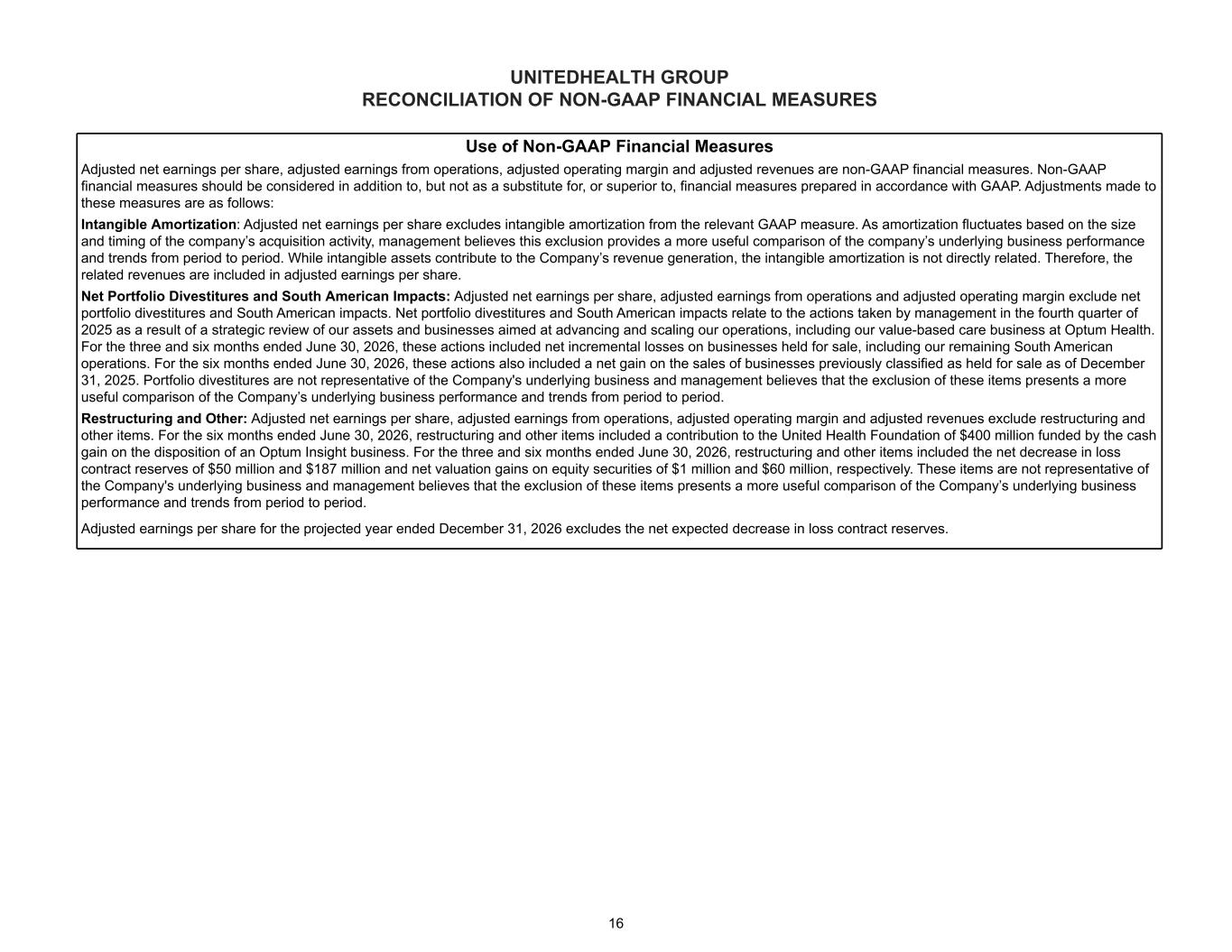
seeing. The one thing I would remind investors to consider is that as we are divesting items that we had in our year-end charge, we'll move the PDR associated with that item along with the benefit that would have been unwound from that. So as we continue to execute on that, you'll see that number kind of slowly, you know, edge downward. But I don't expect it to change. And our goal is to show you what real durable earnings are, which is why we do the adjustment.
Thanks Wayne and thank you all for joining us today. We appreciate your time and your trust in us as we continue to both improve our performance and modernize our company and I can assure you we will stay restless and urgent as we go forward. Thanks for joining us.
Operator
This does conclude today's conference. We thank you for your participation.