Operator
Thank you for standing by and welcome to American Airlines Group's first quarter 2026 Earnings Conference call. At this time, all participants are in a listen-only mode. After the speaker presentation, there will be a question and answer session. To ask a question during the session, you will need to press star 11 on your telephone. To remove yourself from the queue, you may press star 11 again. I would now like to hand the call over to Neal Russell, Vice President, Investor Relations. Please go ahead.
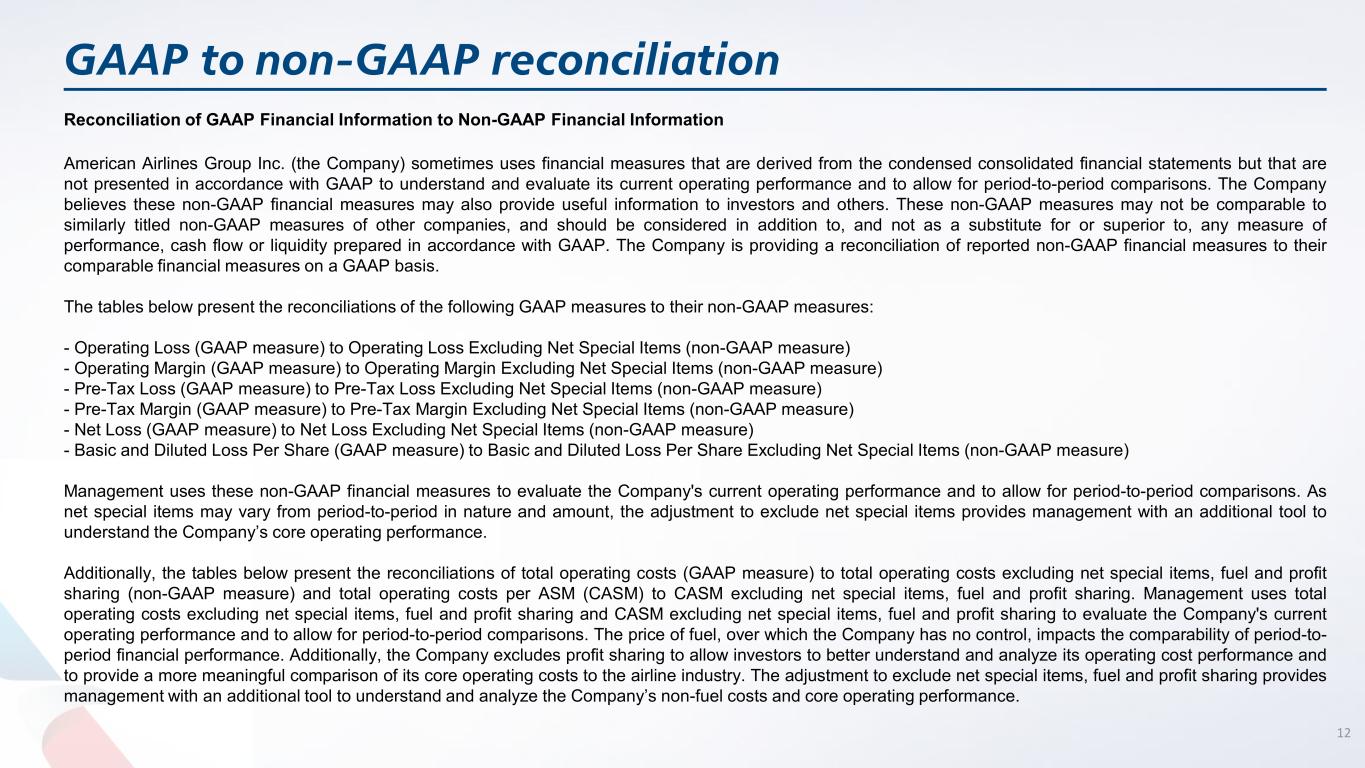
Hey, thanks, Lateef. Good morning, everyone, and welcome to the American Airlines Earnings Conference Call. On the call with prepared remarks, we have our CEO, Robert Isom, and our CFO, Devin May. In addition, we have a number of senior executives in the room this morning for the Q&A session. After our prepared remarks, we will open the call for analyst questions, followed by questions from the media. To get in as many questions as possible, please limit yourself to one question and one follow-up. Before we begin, please note that today's call contains forward-looking statements, including statements concerning future events, costs, forecasts of capacity, and fleet plans. These statements represent our predictions and expectations of future events, but numerous risks and uncertainties could cause actual results to differ from those projected. Information about some of these risks and uncertainties can be found in our earnings press release that was issued earlier this morning, Form 10-K for the year-end of December 31, 2025, and subsequent quarterly reports on Form 10-Q. Unless otherwise specified, all references to earnings per share are on an adjusted and diluted basis. Additionally, we will be discussing certain non-GAAP financial measures, which exclude the impact of unusual items. A reconciliation of those numbers to the GAAP financial measures is included in the earnings press release and investor presentation, each of which can be found in the Investor Relations section of our website. A webcast of this call will be archived on our website. The information we are giving you on the call this morning is as of today's date, and we undertake no obligation to update the information subsequently. Thank you for your interest in American and for joining us this morning. With that, I'll turn the call over to our CEO, Robert Eisen.
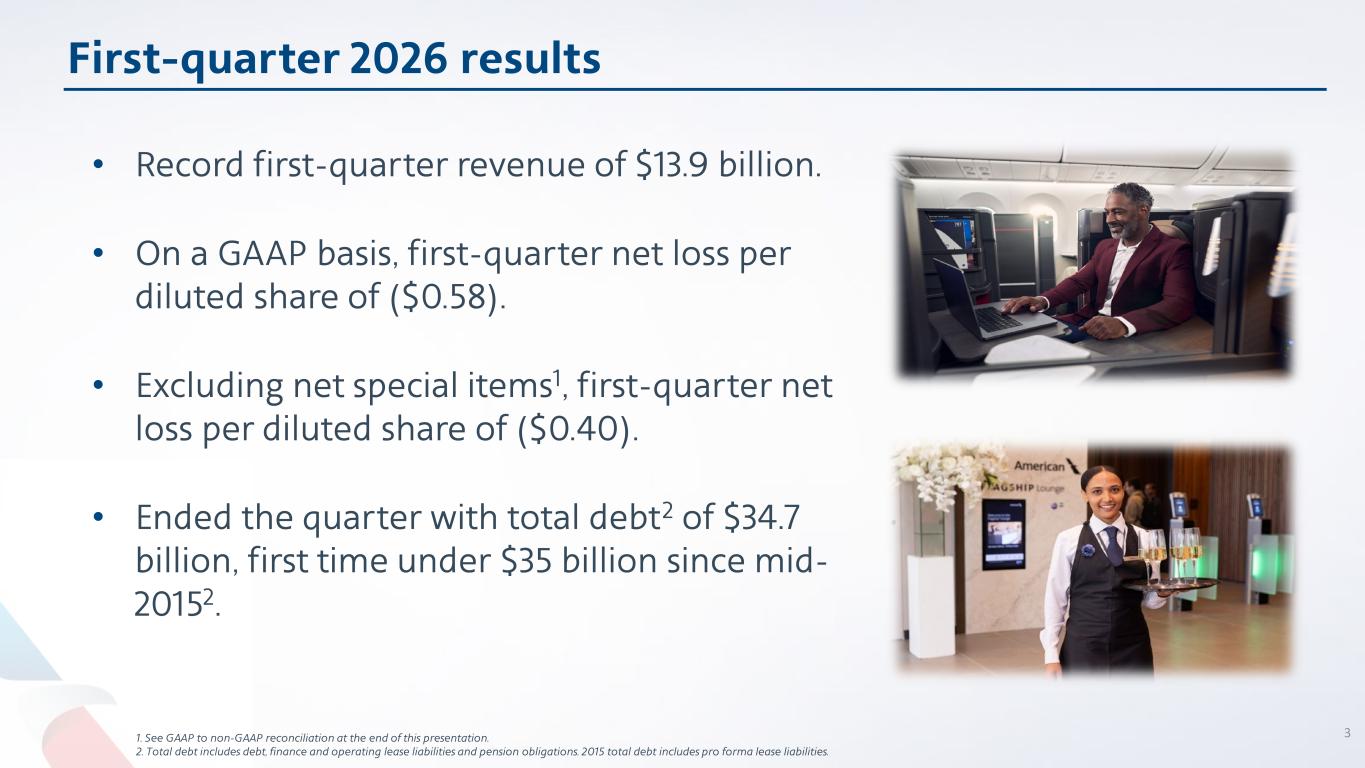
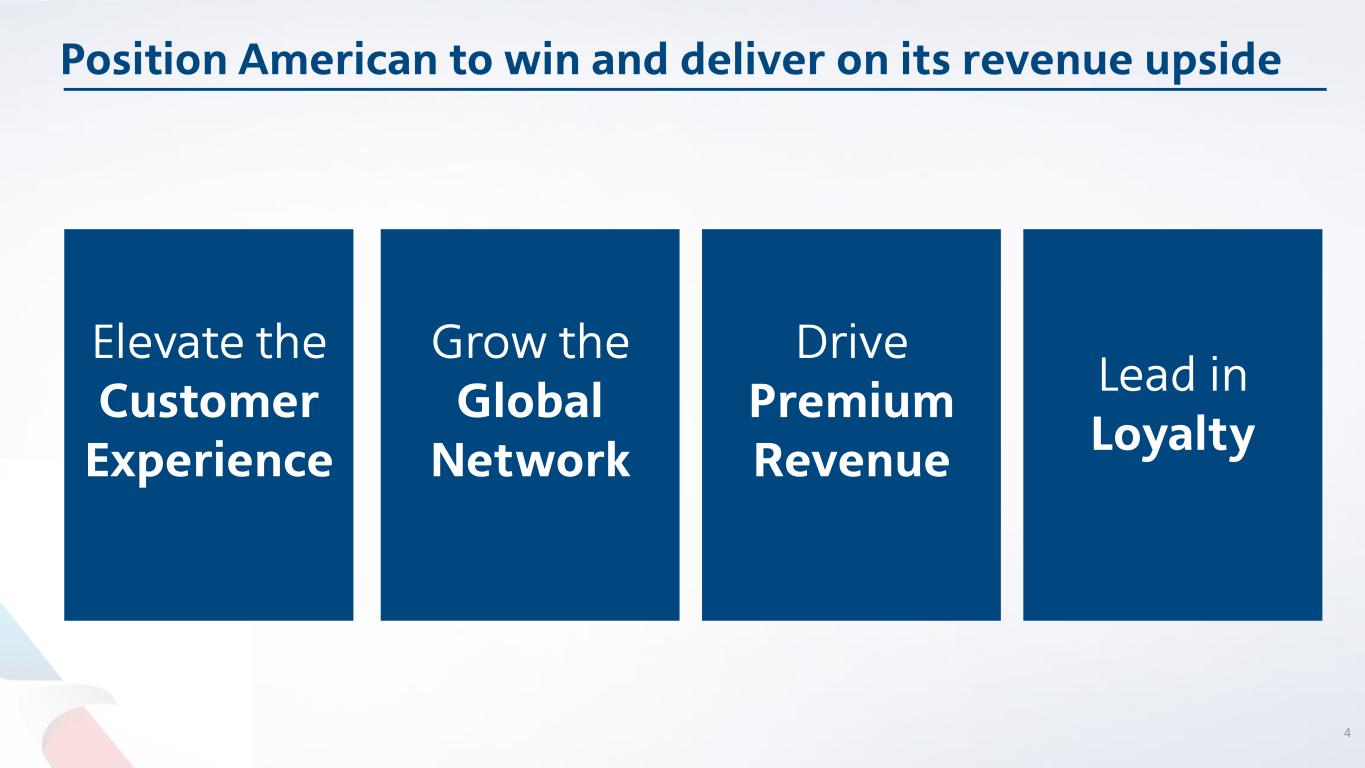
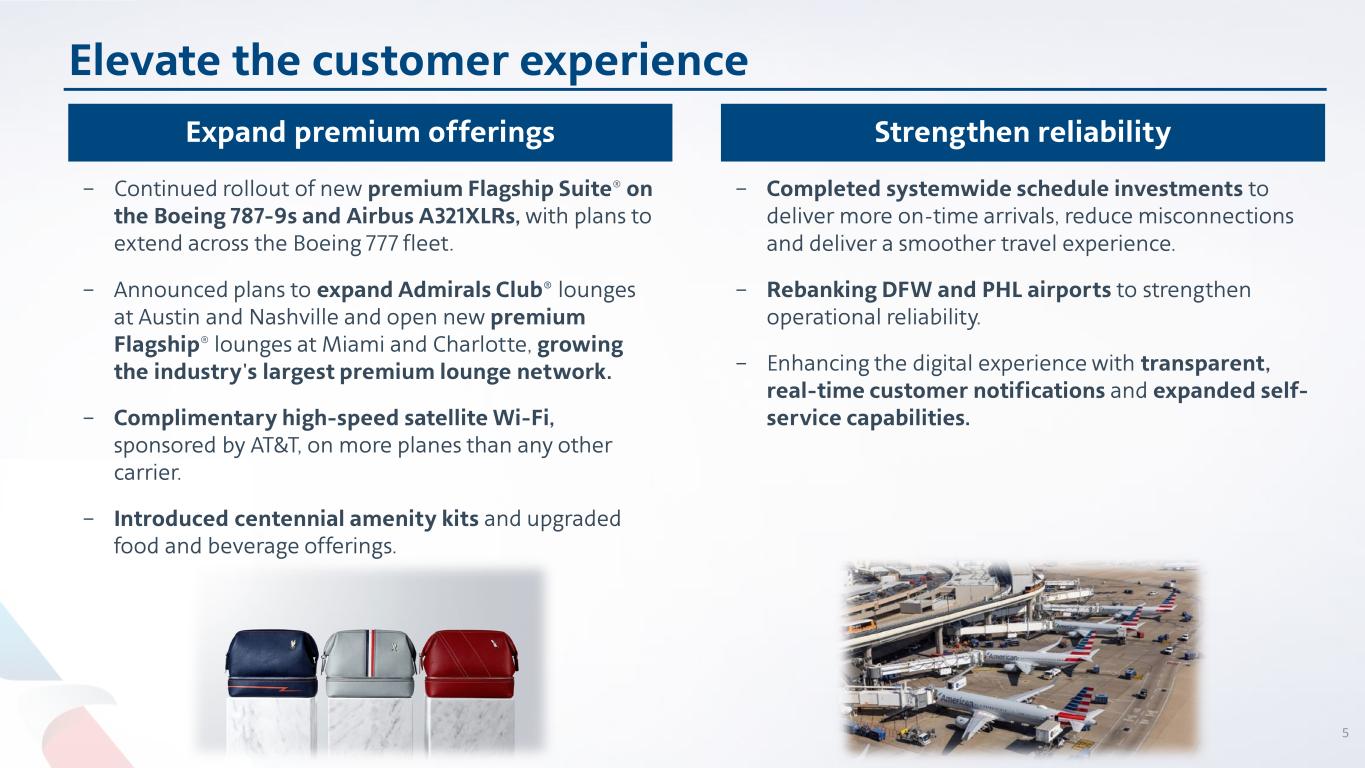
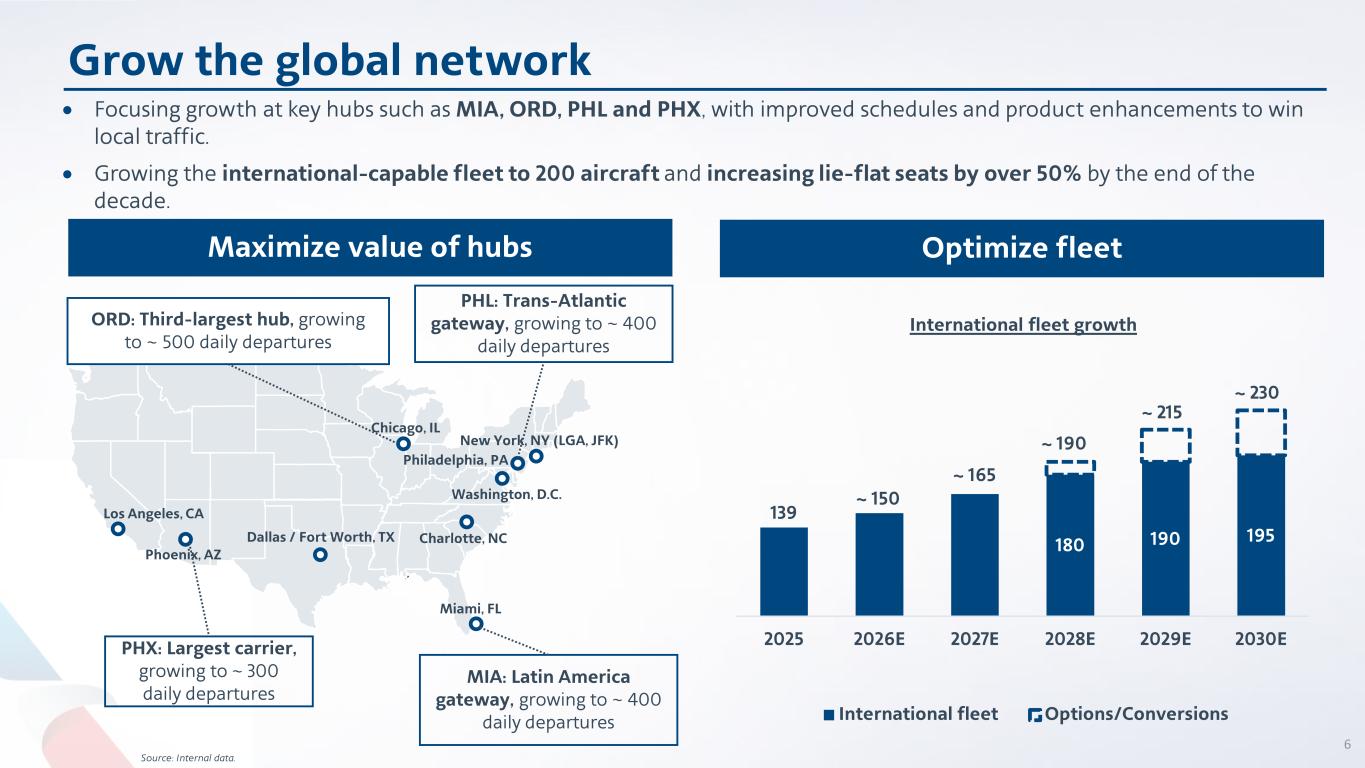
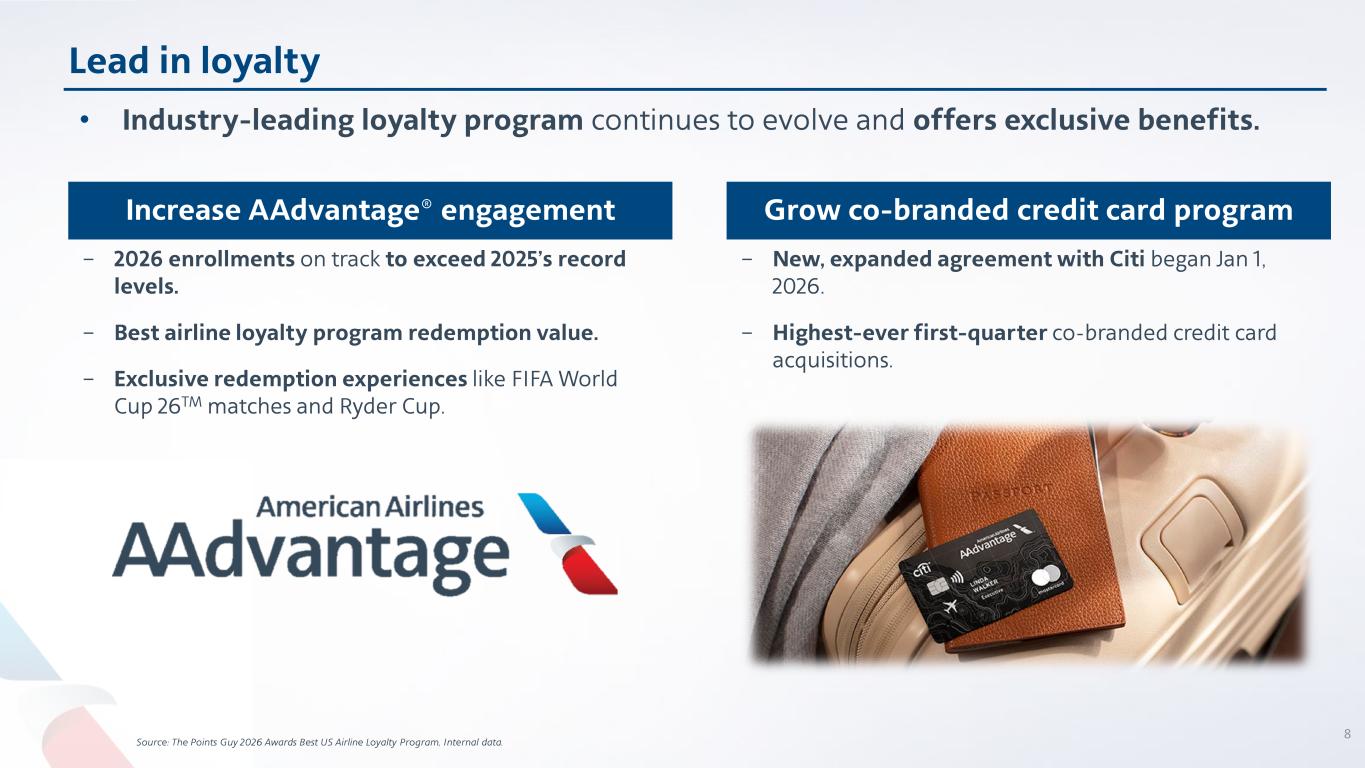
Thanks, Neil, and good morning, everyone. I'd like to start my comments this morning by saying that American continues to make significant progress on our objectives to deliver for our investors. American Airlines is a premium global airline that is positioned to win for the long term. Our focus on delivering on our revenue potential this year is guided by our four pillars. Elevating our customer experience, growing our global network, driving premium revenue, and leading in loyalty. We're seeing the benefits of our multi-year commercial initiatives come through in our revenue performance. Demand for Americans' product continues to grow, and during the quarter, we recorded the nine highest revenue intake weeks in our history. First quarter revenue grew 10.8%, and we expect this demand strength to continue, as we anticipate the second quarter will deliver revenue growth of approximately 15%. The first quarter also included a few challenges, including a $320 million revenue impact from winter storms and a $400 million increase in fuel expense versus the forward curve in January. Even with those headwinds, our pre-tax margin improved approximately two points year over year. I'm proud of how our team has managed the business through these disruptions with a focus on safety and delivering a world-class customer experience. Thank you to the American Airlines team for your resilience and continued commitment to excellence. It's this dedication that makes American the premium global airline that our customers trust. Moving forward, we're working to take the appropriate actions to drive revenue to offset the increases in fuel costs. Assuming the current forward fuel curve, we expect to be profitable in 2026. Devin will provide an update on our second quarter and full-year outlook in a few minutes. But I'd like to quickly summarize the progress that we've made on our four pillars and my perspective on how these initiatives will come to drive American forward. Our first pillar, elevating our customer experience, is centered on delivering a consistent and premium experience across every step of the travel journey. We're increasing the number of premium seats across our fleet through new deliveries and fleet retrofits. In the first quarter, live flat and premium economy seats grew more than twice as fast as main cabin seats. American's flagship suite offers customers a luxurious flying experience, and we're expanding this product across our international capable fleet. The flagship suite has delivered leading net promoter scores since its introduction. We're also investing in the customer experience, both on the ground and in the air. American offers the industry's leading lounge network with new flagship lounges planned for Miami and Charlotte, bringing our total to 10 premium lounges, the most of any airline. We're investing in new and expanded Admiral's Club lounges across our network and have announced 12 new or refreshed lounges over the past year, and there's more to come. We're enhancing our onboard experience through upgraded food and beverage offerings and luxury onboard items, including bedding and duvets, and our Centennial-themed products such as amenity kits and sleepwear. Connectivity in-flight is critical to the customer journey. Today, Advantage members enjoy complimentary high-speed satellite Wi-Fi sponsored by AT&T on more aircraft than any other carrier globally. Finally, reliability and disruption management are among the most important drivers of customer satisfaction. We're making intentional investments in our schedule and technology to deliver more on-time arrivals, fewer missed connections, and a smoother travel experience. Our largest investment started earlier this month in the form of a new 13-bank structure at DFW. We expect the new structure will support an even more reliable operation as approximately one-third of our aircraft touch DFW every day. Since the re-banking, we've seen improvements in customer connection rates and NPS scores. The DFW operation running smoothly is critical to the success of our entire system, and we anticipate this structure will help to enable effective future growth at our largest and most impactful hub. All of this will result in improved customer satisfaction scores and an even more reliable operation. Our second pillar is growing our global network. American is a premium global airline with the most comprehensive North American network in the industry. In 2026, we're prioritizing growth in hubs where we can improve both our local share and hub profitability as we efficiently utilize existing infrastructure, particularly in Philadelphia, Miami, and Phoenix. Later this year, we also expect to add flights at DFW to take advantage of new gate expansions at Terminal A and Terminal C. We'll, of course, adjust our growth rate depending on factors including demand and fuel price. However, our long-term network objectives stay the same. Finally, we're grateful to Secretary Duffy, Administrator Bedford, and their leadership teams for acting swiftly to minimize flight disruptions at Chicago O'Hare during the upcoming summer travel season. We expect to operate 500 flights per day this summer and look forward to continuing to grow local share deepening loyalty and increasing co-brand credit card acquisitions we're excited about our strategic growth opportunities in future years we have hubs in some of the fastest growing economic regions in the country and construction projects are underway to enable growth we expect our operation at dfw to become the largest single airline hub in the world once the new terminal f is operational in 2027. During the quarter, we also announced plans to further invest in Miami by redeveloping Concourse D, which we expect to enhance operations, elevate the customer experience, and improve regional and international travel. And in 2028, upon completion of our investments in Terminals 4 and 5 at LAX, we'll have a significantly expanded operation with the newest facility offering a modern, convenient customer experience. We remain on track to increase our international-capable fleet to approximately 200 aircraft by the end of the decade and plan to continue to grow alongside our joint business and one-world partners. We're launching new service to destinations such as Budapest and Prague, as well as to Caracas and Marcaibo, where American will be the first U.S. airline to reconnect service to Venezuela in seven years. Our third pillar is driving premium revenue. We continue to deepen the relationships we have with our corporate and agency partners and are capturing greater share among high-value customers. Our customer base skews higher end, and our customers have shown that they're willing to spend more for an improved travel experience. We're focused on improving our revenue mix through better segmentation and redefining our fare products. We've already seen the impact of these efforts in our premium cabins, with paid load factors in business and premium economy at the highest levels in our history, up approximately 10 points versus 2019. This reflects both strong demand and improved commercial execution, and it highlights the opportunity we see across the premium segment. We also thank their significant opportunity in upselling in the main cabin. Last year, we began sharpening the differentiation between basic economy and main cabin, and that strategy is working. These targeted changes have led to increased demand for our extra legroom product, Main Cabin Extra. Loyalty is our fourth and final pillar. American invented airline loyalty, and today the Advantage program is the largest airline loyalty program in the world. We offer more value per mile, countless ways to earn and redeem miles, and more engagement opportunities for Advantage members. During the quarter, we redesigned the loyalty experience in our mobile app, enhancing the Advantage activity screen to improve performance, clarity, and engagement. These efforts, combined with the introduction of free Wi-Fi, produced record Advantage enrollments in the first quarter, up 25% year-over-year, led by customers in New York, Chicago, and Los Angeles. Our new co-branded card partnership with Citi plays a critical role in our loyalty strategy and offers our customers the most straightforward and seamless path to status in the industry. This partnership has significant upside as it is designed to drive long-term growth in credit card acquisitions, spend, and member engagement. The first quarter got off to a fast start with card acquisitions setting all-time records while spend on our co-branded cards increased 9% year-over-year. Now, I'll turn the call over to Devin to share more about our first quarter financial results and outlook for the second quarter and full year.
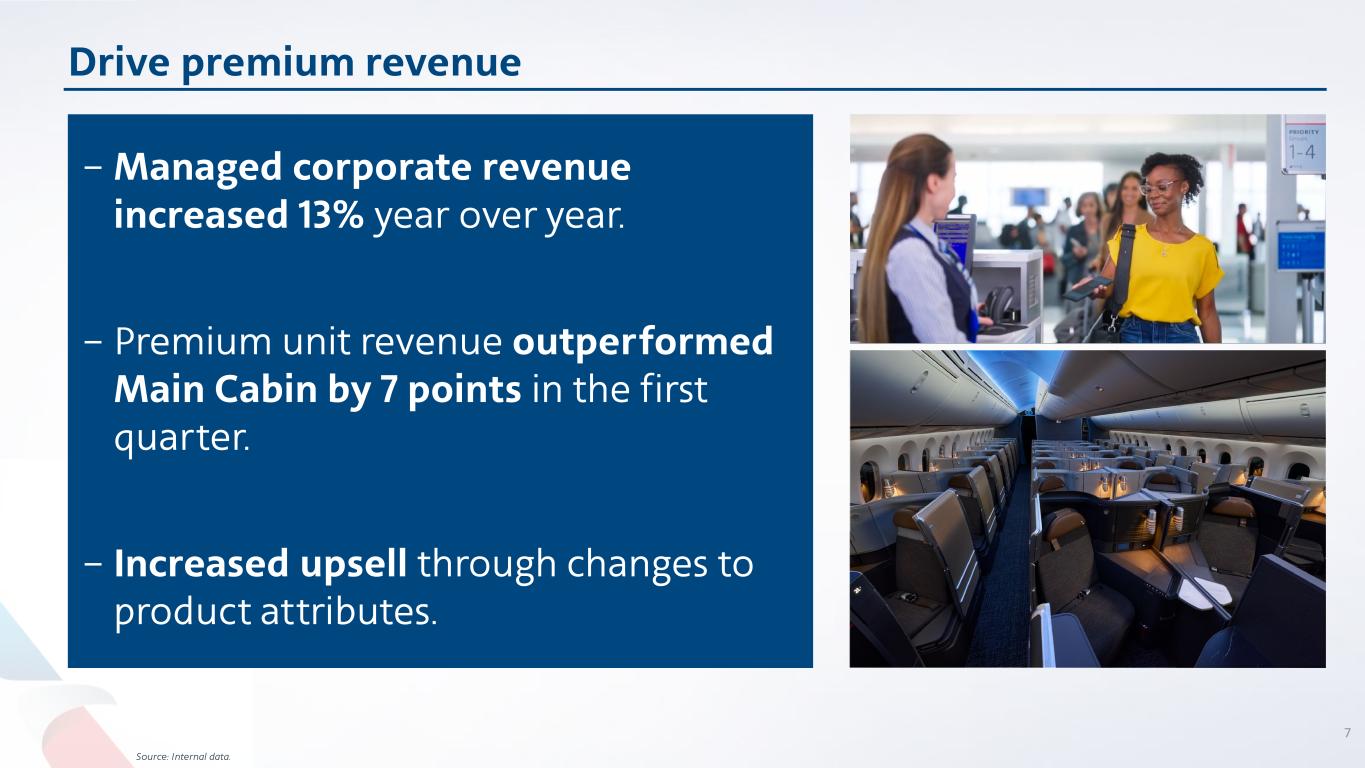
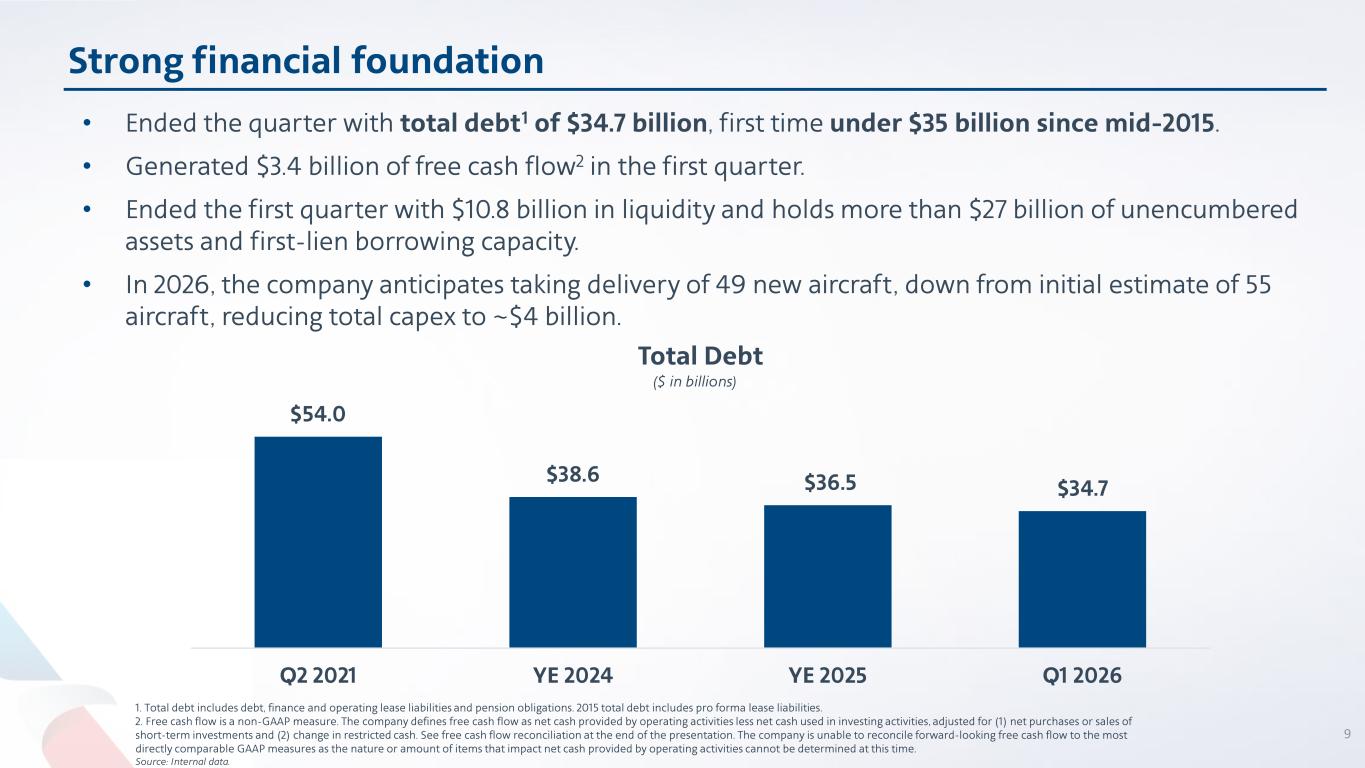
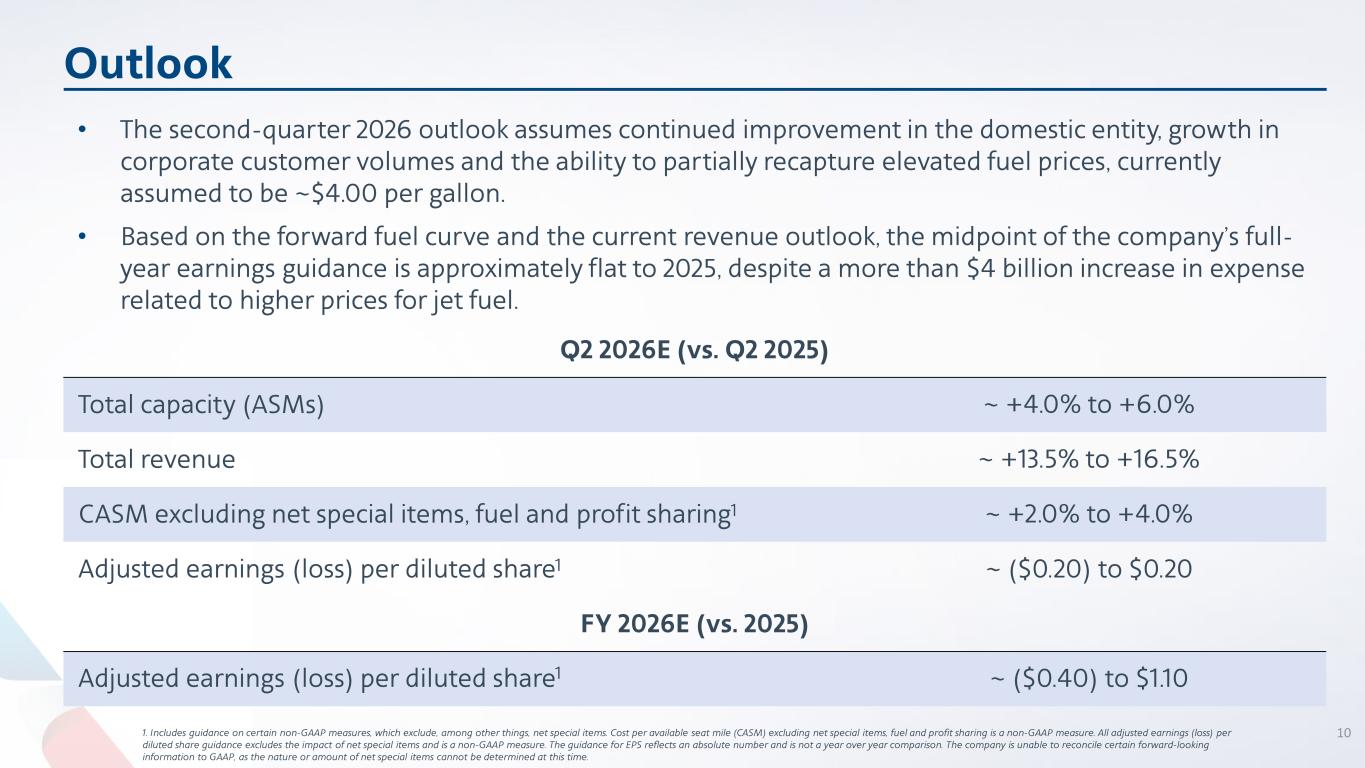
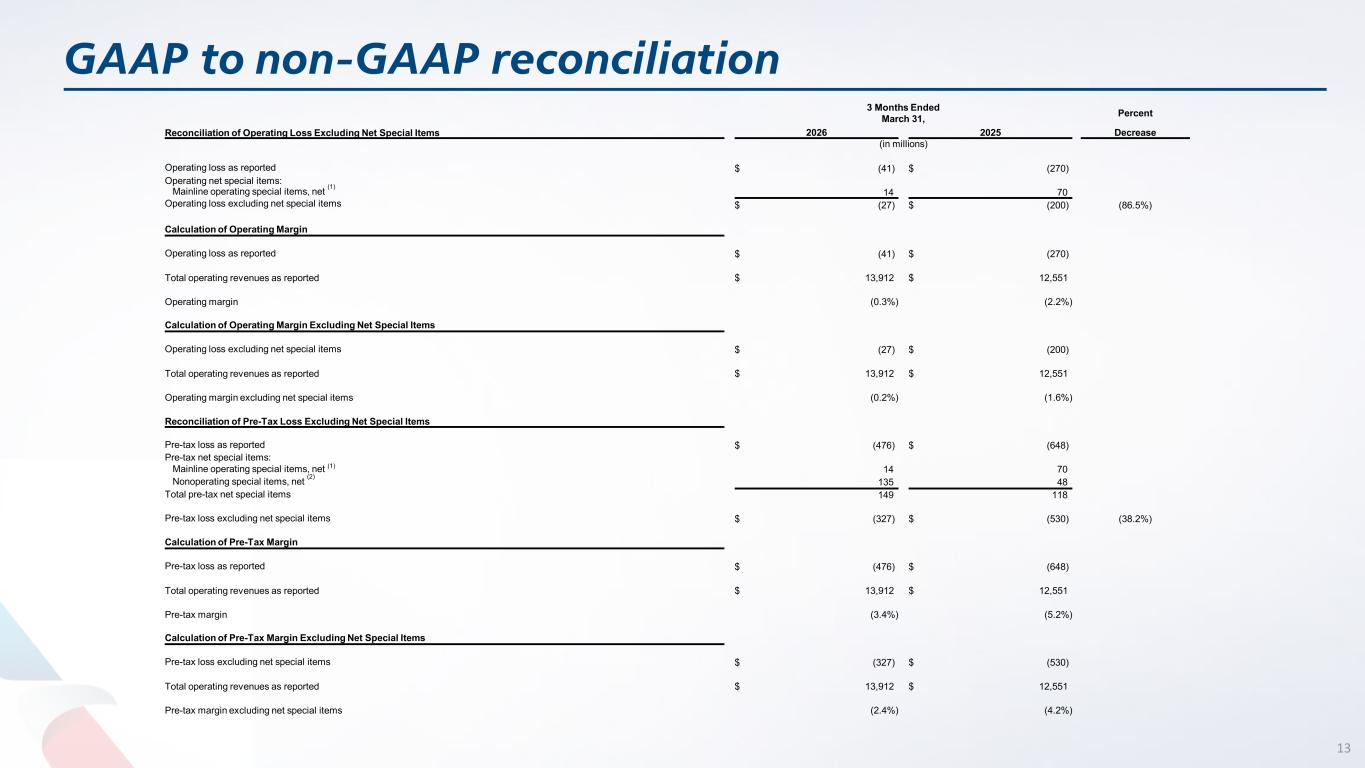
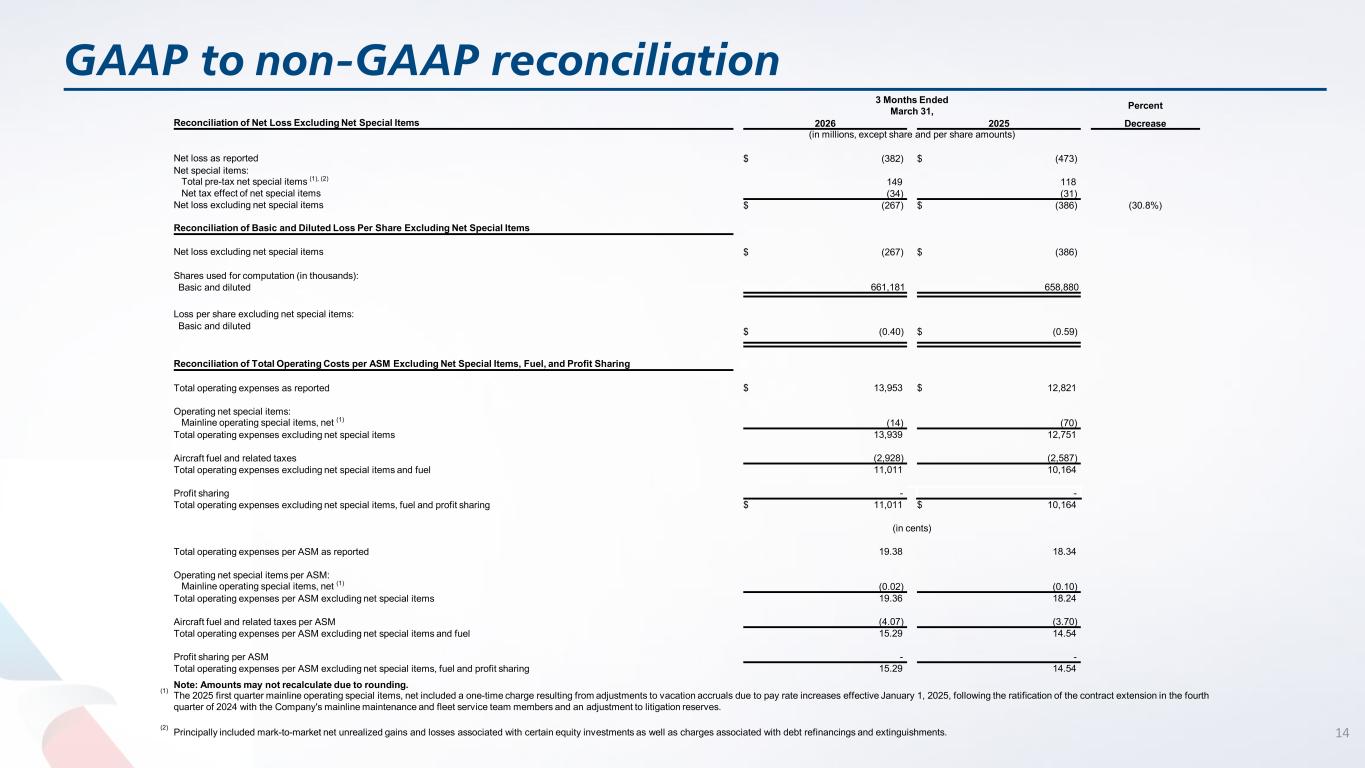
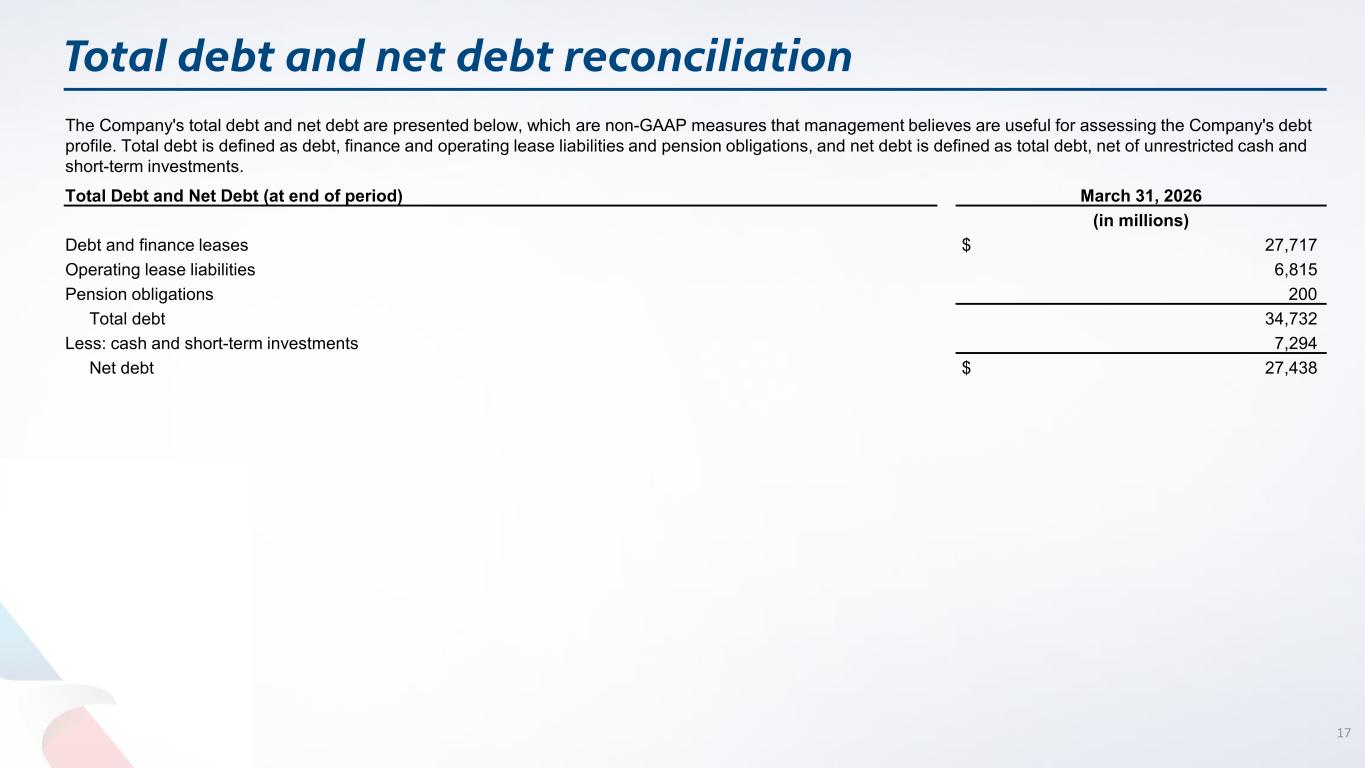
Thank you, Robert. Excluding net special items, American reported a first quarter adjusted loss per diluted share of 40 cents. While the increase in jet fuel prices kept this from being a profitable quarter, we were able to improve our pre-tax margin by nearly two points year over year. Revenue performance in the quarter exceeded our initial expectations. Total revenue grew 10.8% year-over-year, reflecting strong demand for our product and the continued returns of our multi-year commercial initiatives. Premium demand continued to perform well throughout the quarter, with year-over-year premium unit revenue growth seven points higher than main cabin, extending the momentum we saw last year and underscoring the strength of both our premium customer base and the products we offer. At the same time, we saw a meaningful improvement in main cabin revenue performance following the economic uncertainty that affected last year's results. This strength was further supported by continued momentum in managed corporate revenue, which increased 13% year-over-year. Domestic year-over-year PRAZM increased 6.6% in the quarter, and we expect domestic year-over-year performance to accelerate in the second quarter. Our international entities exceeded our initial expectations. Atlantic unit revenue was up 16.7% year-over-year, with London up 25%. Pacific unit revenue increased 7.8% year-over-year. Finally, unit revenue in Latin America was slightly negative, but excluding Mexico, performance was nicely positive in the quarter. Our unit costs, excluding net special items, fuel, and profit sharing, was up 5.2% year-over-year. The severe winter storms lowered our Q1 capacity production, which pressured CASAMX by approximately two points. As we previously discussed, additional cost pressure came from staffing the operation in advance of the upcoming summer season. We are continuing to see the results of our multi-year effort to re-engineer the business and expect over $200 million of incremental savings from these efforts in 2026, bringing our total annual operating savings to approximately a billion dollars since this initiative was launched. This transformation leverages procurement excellence, technology investments, and process improvements to improve the customer and team member experience while driving a more efficient business. Looking ahead to the second quarter, demand across all cabins and entities remains robust we expect domestic unit revenue to grow more than 10 percent in the second quarter internationally we expect all entities to deliver positive unit revenue performance led by continued strength in the atlantic region which we expect to be up high single digits our capacity for the second quarter is about a point below our initial plans as we have suspended flying to tel aviv and doha have reduced planned capacity in chicago and have further decreased some other marginal flying in the face of higher fuel. Further reductions in the very near term don't make economic sense given the current demand environment as we enter our summer peak. But as we move beyond the summer peak, we will be sharp with capacity in light of the current fuel environment. We expect second quarter revenue to be up between 13.5% and 16.5% year over year, driven primarily by continued improvements in the domestic entity, growth in corporate customer volumes, and our ability to recapture elevated fuel costs. Second quarter CASM-X is anticipated to be up two to 4% year-over-year, slightly elevated due to the close-in reductions in capacity. Based on the forward fuel curve from April 20th, we expect a fuel price of approximately $4 per gallon in the quarter. With this second quarter guidance, we expect to deliver adjusted earnings per diluted share of between a loss of 20 cents and a profit of 20 cents. We are also updating our full-year outlooks to reflect our current revenue expectations and the forward fuel curve. The midpoint of the full-year earnings guidance is $0.35 per share, approximately flat to 2025, despite jet fuel prices increasing fuel expense by over $4 billion year-over-year. Turning now to our fleet and capital expenditures, we now expect delivery of 49 new aircraft this year, down from our initial estimate of 55 aircraft, reducing CapEx by nearly $300 million. Our deliveries this year include the 12th Boeing 787-9 aircraft in our premium configuration and the continued expansion of our Airbus A321XLR fleet. Based on these deliveries, we now expect total capital expenditures to be approximately $4 billion. We ended the first quarter with nearly $11 billion in total available liquidity, and we have more than $27 billion in unencumbered assets and first lien borrowing capacity. We continue to make significant progress on our financial priorities, ending the quarter with total debt of $34.7 billion, a reduction of $1.8 billion in the quarter. This is the first time our total debt has been below $35 billion since mid-2015. The improvements we have made on the balance sheet provide significant flexibility as we navigate the current environment and reflect the disciplined approach we've taken to capital allocation. I'll now hand over the call to Robert for closing remarks.
Thanks, Devin. We officially celebrated our 100th anniversary this month, a remarkable milestone that reflects a legacy of innovation, resilience, and caring for people on life's journey. American is positioned to win by delivering sustainable growth and creating long-term value for shareholders, team members, and customers. Our focus remains on executing our commercial initiatives while managing cost efficiently to deliver results and expand our margins. There's tremendous upside ahead for American, from elevating our customer experience and growing our global network to driving premium revenue and leading in loyalty. We're executing on a strategy and initiatives that will drive value and shape our next 100 years as a premium global airline. Operator, please open the line for questions.
Operator
Thank you. As a reminder, to ask a question, you will need to press star 11 on your telephone. To remove yourself from the queue, you'll need to press star 11 again. To allow everyone the opportunity to participate, you will be limited to one question and one follow-up. Please stand by while we compile the Q&A roster. Our first question comes from the line of Katie O'Brien of Goldman Sachs. Your line is open, Katie.
Hey, good morning, everyone. Thanks so much for the time. Maybe just a higher level industry one first. Obviously, I understand that the recent fare increases are driven by the spike in jet fuel, but I think it's interesting that there's been no demand impact as of yet, unless you're seeing something different, which please correct me. But even before the spike in fuel, there was quite a bit of pricing momentum. Do you think something has changed structurally in the industry, whether there's been a shift towards better pricing discipline over the last several months? Is it competition? Are product changes playing a role? I just would love to hear your take.
Hey, Katie, thanks for the question. And I have our chief commercial officer, Nat Pieper, here with me to help out as well. I just start with this. I think that travel is a good deal. If you take a look at pricing today on real terms versus where we were almost a decade ago, we're just catching up to where we were. So I think people realize that. And then on top of that, we've given them good reason to actually want to spend more. There's been a drive to a premium product. American has been a big part of that. And I think that what you're seeing is recognition that travel is still a good deal. There's an experience-based consumer dynamic going on in the industry. And we benefit from that. We've got a great product out there, a great network, and feel really good about demand as we go forward in the future.
Hi, Katie. It's Nat. Thanks for the question. I think the thing that, a couple things that are interesting. Number one, is there a long-term resetting in terms of consumer spending hierarchy? You know, there's a lot, You know, we all remember revenge travel from COVID and, you know, people got tired of buying TVs and wanted to go see the world. And I think some of that has continued and extended. For us, a lot of, you know, we've had nine weeks so far in the first quarter that were company record setting from a revenue intakes perspective prior to any of the hostilities in the Middle East that drove fuel where it is. So there's something going on there from a long-term spending perspective. And then as Robert referenced, we think the American offering is really resonating with consumers as well. The investments we've made in customer experience, our network and focusing on local market share, which are our highest yielding customers, and then lastly on the loyalty side. And then there's also a piece of it with getting the right product into the right hands of the right people at the right price, delivering values to consumers. Part of it's bundling. Part of it is segmenting. And we're making good progress on that. So I think that's a component as well.
That's great. Really helpful. Maybe just for my second question, can you walk us through the assumptions behind your full-year revenue outlook? Is there a fuel recapture expectation there? Are you assuming demand is steady? or improves, where there's ultimately some demand elasticity, just really trying to understand the puts and takes and how they may or may not be different at either end of the per share guidance. Thanks so much for the time.
Sure. Certainly the second quarter revenue estimation for us, plus 15%, is an eye-popping number, and we feel good about it. I'll start with, you know, we've booked 65% of the second quarter, and it obviously is a strong performance based on the trends that we're seeing in our hubs, a lot of the American specific pieces that are in place. We did incorporate, as you would expect, some fuel recapture in the plan. When we built our plan at the outset, we had significant margin expansion due to a lot of American specific improvements that I referenced earlier and as Robert talked about in our four pillars and obviously since we shared that plan fuel has has risen an incremental four billion of fuel expense for american in the year historically airlines recover that additional fuel expense either by increasing revenue or by reducing marginal capacity and we've been encouraged so far by the pace with which revenue has been recaptured and obviously if fuel continues through the third quarter into the fourth quarter we're going to see some some more broad industry capacity reductions but as we've thought we think about it and what we've incorporated in second quarter roughly 40 to 50 percent of fuel recapture and we would expect that to grow through the balance of the year 75 to 85 percent in q3 and then ultimately in q4 if fuel is still at the level with capacity reductions i think our recapture rate would be in the 90s thank you our next question comes from the line of scott group of wolf research please go ahead scott hey thanks good morning so we've seen some more material capacity reductions from
others i think you guys are not you'll i think you'll lead the the industry on capacity growth in q2 how are you thinking about capacity in the back half of the year and that's now that you've got more time to plan for a higher fuel price environment. And just to sort of be clear on sort of the answer to that last question, is there an assumption in the guide that RASM growth accelerates further in the back half of the year, I guess in third quarter, as we get a full quarter of this higher fare environment?
Hey, Scott, it's Devin. I'll just start on the capacity discussion. I think Nat's answer on our expectations for fuel recapture effectively already answer your question on RASM, that we do expect higher yields going forward as we pass through more of the higher fuel expense. But on capacity for the second quarter, we had planned for slightly higher capacity than what we're putting out there right now. So a couple of months ago, we were at about 6% for Q2. Since that time, we've reduced some flying in obvious places like Tel Aviv and Doha. We've also pulled back a little bit domestically with some marginal flying as well as some reductions in Chicago. I just say if you look back at our capacity, we have tended to be very conservative with capacity growth for the past, I don't know, half decade or so. But you just look at the last couple of years. In 2024, we found ourselves in an oversupply environment, and we quickly pulled capacity out in the back half of the year. In 2025, we had a handful of different demand shocks. We did the same thing, and we'll do the same thing here. We're going to keep a close eye on fuel and demand over the next four to six weeks as we are planning for the off-peak period in August, September, and beyond, and we'll make capacity adjustments accordingly.
And then maybe secondly, Robert, I've asked this to some of the others, but I'll ask you as well. Historically, when fuel prices eventually normalize, the industry sort of gives back a bunch of the pricing increases that it's gotten. Is there any reason I think it can be different this time and we can hold on to more of this higher price? Scott, two things.
First off, as Nat alluded to, we'd already seen a lot of traction in our efforts in the first quarter before any run-up in fuel prices. On top of that, I really am confident in the initiatives that we're pursuing, whether it's from a customer experience perspective, our network, the initiatives we have to drive premium revenue and loyalty, those are going to pay off. We're giving people good reason to want to engage with American more fully and to spend. And I do view that as a good sign for us. And I just go back to the first quarter, you know, 10.8% revenue improvement. And that includes, you know, a really, you know, big hit for the worst storms in terms of impact to our operation with Fern and Gianna that we've ever seen in our history. And as we look to the second quarter, as Nat said, a lot of that is on the books. We're anticipating 15% growth. I'm bullish on what that means for our business.
Our next question comes from the line of Brandon Oglinski. of barclays please go ahead brandon hi good morning and thanks for taking the question uh robert i'll probably just pose one question but kind of two parts here for you um it's been about two years now since you guys you know made a pretty sizable pivot and then re-pivoted back on your commercial uh you know business travel strategy so can you tell us where you are in that journey you know i think you guys said you were fully recaptured on share at the end of last year But, you know, what is next on corporate and business strategy at American? And then secondarily, I think you were hinting at this earlier, but how are you thinking incrementally about upselling or, you know, getting incremental rebranded fares on your premium products and maybe within that corporate strategy as well? Thank you.
Thanks, Brandon. I'm going to let Nat help me out with this. but I'll say that, look, we did pivot, and I'm really pleased with what the team has been able to do over the last year. We've fully engaged in the marketplace. We've deployed our sales team everywhere, and they have accomplished the objectives that we set out to achieve. We've recaptured the share that we've lost. We've gained a little bit since then, and we're going to continue to be very active at improving from there. Hi, Brandon.
Just some numbers to back up the evidence that Robert's seeing. Managed corporate revenue for us is up 13% year over year. And our unmanaged business, small and medium enterprises, our advantaged business product is up 28% per year. And obviously, really exceptional yields on both of those products. Further example, our TMC performance is up 11%. thanks to our partnerships with MXGBT, with BCD, and their support of American. I look at all of those results along with the feedback that we're getting. One of the wonderful things when you make a distribution change is that everybody gives you feedback. A lot of it loud. A lot of it maybe you don't want to hear. But over time, as that feedback is moderated and become more productive, we're getting good sense that what we're offering and what we're putting on the shelf is resonating. with our network, with our customer experience, the loyalty program, and delivering value to guests. And so all of those things, yes, we feel good about recovering the share that we had lost, but we see runway there as well. And it's a core part of the Positive American Revenue story that you're seeing and that we see for the rest of the year. Thank you.
Operator
Thank you. Our next question comes from the line of Ravi Shanker of Morgan Stanley. Your question, please, Ravi.
Great. Can you unpack the FAA decision in Chicago a little bit more? How did that compare versus your expectations, and what do you think about the incremental steps from here?
Ravi, thanks for the question. Look, Americans have been serving Chicago for 100 years. Their very first flight flown by Charles Bloomberg included Chicago. and we are going to be in Chicago for another 100 years. So we had flown about 500 flights a day out of Chicago prior to the pandemic and it's taken us some time to build back up to that. We're going to be able to fly 500 flights as a result of the initiatives that have been put in place to address overflying. And so I want to first off give a shout out to the DOT and FAA. Secretary Duffy and Administrator Bedford got in front of what would have been a real issue in Chicago. The Chicago O'Hare would have likely been in a delay program from the very first flight of the day if something hadn't been done. So I'm pleased, first off, that we're going to avoid an issue of having too much flying in Chicago for the airspace and ground capacity. And that's good news, not just for American Airlines. It's good news for the entire industry. So real compliments to the administration, Secretary Duffy and Administrator Bedford for that. And in terms of what, you know, we end up with, again, we're going to fly what we had hoped to fly, 500 departures. That will allow us to continue to build in Chicago with our customers. And our product is resonating. And whether it's local passenger growth, our business passenger growth, advantage enrollments, our co-branded credit card enrollments, all of those are meeting and exceeding our expectations. So no one's going to kick us out of Chicago. You know, that's something that everybody's going to have to get used to, including our biggest competitor. We're going to be roommates, and roommates for a long, long time.
Understood. Very clear. And maybe as a follow-up, Robert, there's been a lot of industry speculation about M&A and such, But can you address that directly, if you can, in addition to what you guys put out over the weekend? But also, I just love your views on what you think is the ideal industry structure over time. I think you put in that press release that you think some things need to change. So what might those things be?
Well, I'll just start out with this. And again, on the heels of the Chicago question, look, we're going to be roommates, and we're not getting married and so i want to stress this that uh the idea of uh the two largest airlines in the world getting together uh that is something that uh we've viewed as being uh anti-competitive and obviously everybody that is weighed in suggests the same thing bad for uh customers uh bad for the industry and then ultimately that's that's that'd be bad for American Airlines. In regard to consolidation in the industry, we're focused on American Airlines. We're focused on delivering on our core initiatives. And part of that is building out our network. We already have the most comprehensive network in North America. That allows us to really pursue opportunities organically, internationally, and then also with our partners, some which are part of one world, others that are part of one world and also joint businesses. All those are accretive to American Airlines and we really look to continue to focusing on all those partnerships, whether those be domestic or international. Now, of course, if there are opportunities from a consolidation perspective or if there's assets that become available in the marketplace, American has a long history of being aggressive. We've got a lot of experience, and whether it is the potential for M&A or, you know, the work that we've done to pioneer partnerships, we're going to be on the forefront of that.
Operator
Thank you. Our next question comes from the line of Jamie Baker of J.P. Morgan. Your line is open, Jamie.
Hey, good morning, everybody. So probably for Nat, you know, this question about yield stickiness when fuel prices recede has, you know, sort of become a conference call staple this season. It came up yesterday on United's call. And I found the commentary there to be interesting. Basically, the suggestion was that historically marketing and government affairs had some degree of influence over pricing decisions. You know, it was not unilaterally left up to revenue management. So that's my question for American First. Do you sort of agree with that broader premise? But more importantly, do you think the industry and or American specifically has evolved to a point where maybe going forward, pricing and revenue management exerts or wields more influence than in the past? Any thoughts there? I realize it's not quite coming in the form of a question, but I'm trying.
Jamie, thanks for the question. I guess I'll start with just praising my colleague, Nate Gatton, who has government affairs responsibility here. I think he has zero appetite at America to dabble in revenue management. I saw the transcript and, frankly, interesting just from a team perspective and kind of the organizational structure that we have here, pretty well aligned. And, you know, revenue management is one of those functions core to the airline, core to the assets and experience that American has. So I think we are emphasizing it tremendously. We are investing resources. We're investing people on top of our very experienced people that are here. And I think as technology evolves, and Jamie, we referenced it a little bit. We call it the Revenue Growth Program within America. But that's kind of a soundbite on really being able to effectively segment and bundle one's products, getting the right product into people's hands at the right price. And I think the capabilities that we have, and really across the industry, are just going to continue to evolve in a positive way at a number of different price points. But ultimately, the goal is to maximize revenue across the enterprise.
Okay, interesting. And second, probably for Robert, you know, the news that you might look to pursue more of an NEA-type relationship with Alaska. And, well, actually, maybe that's not the way to convey it. But my question relates to pilots. My understanding is that the current scope allows for code sharing with international partners, but not the type of Alaska Hawaiian long-haul flying that they've started adding, you know, post-merger. I'm just trying to understand what scope impediments might stand between you and a potentially closer relationship with Alaska. And maybe the answer is not black and white, and I get that as well. Any thoughts there?
Thanks, Jamie. I'll just start with this. We've been working with Alaska for well over a decade, and I remember working with Ben Minacucci to talk about sponsoring them to come into the one-world relationship, which we've successfully executed, And I think it's been a terrific enhancement to Alaska and has enabled One World and their customers, you know, to have greater access to travel, you know, just about anywhere people want to go. We were able to also do great things with the West Coast International Alliance, which has been hugely beneficial, doing things that benefit our consumers, things that, you know, we really couldn't have done on our own. and I feel good about where our relationship is and what happens next. The Alaska team is fiercely independent. They're a very, very successful airline and we, you know, are the same. As we go forward, we'll make sure that anything that we do, you know, complies with, you know, our scope clauses and we're going to make sure that we really take care of our customers and do what's right for both companies and our customers. And I'll leave it at that.
Operator
Thank you. Our next question comes from the line of Connor Cunningham of Milius Research. Please go ahead, Connor.
Hi, everyone. Just maybe a point of clarity before I get into another question. Just on the yield progression throughout the year, I just want to make sure that I understand. Is it that you assume that yields will essentially be flat from here to get to your recapture target by the end of the end, i.e., you don't need additional fair increases to get to that 90-plus percent come fourth quarter?
Yeah, I think that roughly in line, that's right. We don't need enormous increases to hit our targets as it works through because it balances with the recapture assumptions.
Right. So that Shep Fuel forward curve comes down, you're currently exposed to higher fares.
All right, and then, Devin, maybe on the cost side, just, you know, clearly some challenges of 1Q given weather. I think everyone had those problems as well. But, you know, your 2Q guide is actually pretty good, and then it seems like the setup for the second half is also in a pretty good standing. So if you could just give some puts and takes, you know, that you see moving throughout the year just on cost, I think that would be helpful. Well, again, I think it sticks out relative to a lot of what we're hearing so far.
Thank you. Well, it's been a long-term effort on driving efficiencies in the business. You know, it's something we've been at for three years. You don't see it every single year because some of these initiatives are long-term in nature. We've had a handful of new CBAs that have driven some cost pressure, but we're seeing it this year. You know, if it weren't for the storms in the first quarter, our cost performance would have been really nice. Up two to four in the second quarter, you know, feels pretty good. Obviously, it would have been a little bit lower had we flown the entirety of our schedule. The back-after-year, we're set up well. We're going to see pressure in some areas that end up being good pressure, things like selling expense. But our unit cost is going to be dependent on how much capacity we produce. So if we produce a similar amount of capacity to what we're doing here in the second quarter, I would expect unit cost to be in the low single digits. If we pull back on capacity, given the higher fuel, we're going to see some cost pressure there. But we do a nice job getting out of any sort of volume-related costs. We'll continue to do that, and we'll continue to focus on driving an efficient business.
Operator
Thank you. Our next question comes from the line of Tom Fitzgerald of TD Cohen. Your line is open, Tom.
Hi, everyone. Thanks very much for the time. Curious within the loyalty program what geographies you're seeing the strongest performance in terms of sign-ups, And then if that, kind of within that question, if that $1.2 billion of other revenue, if that's kind of a good run rate for that line item moving forward.
Hi, it's Nat. I'll take the first one and then, Devin, the second piece of it. First, just from a resonating perspective, from a volume, as you would expect, it would be in our hubs. But what's exciting about loyalty enrollments is the penetration. Our top three markets are New York, Los Angeles, and Chicago. So places that, you know, incredibly competitive hubs for us, but also for our competitors. So, again, further evidence that the loyalty program, you know, the biggest, the best, and it continues to resonate with guests.
And, yeah, just on the other revenue or the marketing component of it, we did see an increase that's pretty meaningful year over year, quarter over quarter, just versus the fourth quarter was up, you know, something less than 10%. But like we've been saying, as remuneration grows, we expect that line item to grow as well. I would expect less volatility in that line item than what we've had from quarter to quarter in the past. And it's probably going to be somewhere around a billion dollars a quarter for 2026.
Hey, Tom, I just want to underscore one stat. You know, while Chicago, New York, and L.A. lead, overall loyalty growth or loyalty enrollments are up 25%. year over year.
That's all great, Collar. I really appreciate that. And then kind of similar, Bucket, just on the corporate recapture, curious what verticals you're seeing the most momentum in, maybe other places where there's still room to recover versus the last couple years. Thanks again for the time.
Well, the three verticals we've seen the most uptake in are banking, healthcare, and pharma, and industrials, and that's both domestically and internationally. So encouraged by that performance and really across all verticals, I think there's still opportunity there. But those are the big three we're seeing right now.
Operator
Thank you. Our next question comes from the line of Michael Goldie of BMO Capital Markets. Please go ahead, Michael.
Good morning, and thank you for the question. You've rebanked DFW and now Philadelphia. Can you talk about the operational benefits you expect to get from this and what other initiatives you're undertaking on the operations front?
Hey, Michael. Thank you. So one of the biggest parts of our Elevating the Customer Experience initiative is to improve our reliability, the biggest investments we're making. So the rebanking of DFW, it really smooths out the operation throughout the entire day. There's never a period during the day where we come close to exceeding the operational capacity of the hub. And from what we've seen so far is just really strengthening our operational reliability. But then when it's stressed, say, throw a thunderstorm in, which we've had, our ability to recover is so much quicker. Over our centennial celebration, I was out in DFW talking to our team, went to the control center, and asked folks, okay, well, do you sense something's different? And for the most part, people said, you just don't see as many people running from gate to gate. And so it's an improvement in operation. It takes the stress level down considerably for our customers, but also for our team members as well. And then, you know, I know Nat could comment on this. But the good thing that we're seeing as well is that revenue is holding and increasing. Two points to that. One is that we just don't have as many misconnects. Second is that we haven't really extended connect times by that much. And so we really haven't seen people, you know, book away. So we're retaining more revenue. It's a better customer experience. NPS scores are higher. So we're taking that, of course. and those results are very very promising and we've expanded it and will be expanding it to philadelphia and taking a look at at the potential in other parts of our network as well and we'd expect similar results ultimately higher nps scores lower misconnections uh you know greater retention of revenue but that's not all you know we've certainly taken a look at our schedule to make sure that we've buffered appropriately in terms of travel times uh outside of connect times and hubs. And that, I believe, is paying off. And as well, we're making good use of contractual changes that have happened, especially with our flight attendants, where we've increased boarding times. And so all of that has come to fruition. The airline as a whole, regionals, mainline, we're in good shape and ready for the summer. So thanks for the question.
And then as my follow-up, when you think of industry consolidation, which everyone seems to be in agreement on, if M&A is difficult to pass, do you think airlines will increasingly look domestically for partnerships as another avenue? Thank you.
Well, I appreciate the question. The biggest issue out there today is can the largest airlines in the world get together and do something? The answer to that is it's anti-competitive. So whatever happens next, we look to make sure that anything that we do strengthens our network. And in many cases, partnerships are the best way to do that. In other cases, it's just organic growth. And so what you'll see from us this year included in our growth plan is to really strengthen our hub in Phoenix, make sure that Miami is fully built out. We've got a lot of work going on in Chicago, as noted, and Philadelphia as well. It really is the most comprehensive network in North America. and we've been pioneers in terms of building partnerships and relationships and we've got a tremendous amount of experience here with M&A should that ever come about. And so I feel really good about where we stand and as dynamics change and the fortunes of other carriers change, we'll be ready.
Operator
Thank you. Our next question comes from the line of John Godin of Citigroup. Your line is open, John.
Operator
Hey, guys. Thanks for taking my question. This is Max, starting for John. I just wanted to follow up on the fuel pass-through commentary and getting to a recapture rate in the 90s by the end of the year. If we could maybe get a little bit of geographic color, kind of how pass-throughs are evolving internationally versus in the domestic market, maybe a little bit of color would be helpful.
Okay. I'll start, just give you the quick entity run-through around the world and then come back to the other question. I think just first, domestically, 65% of Americans' capacities, as Robert just said, we've got the best network in North America and it's resonating. Unit revenue of 7% in the quarter and we saw it increase sequentially up into March for double digits. And then as mentioned earlier, the second quarter, 65% booked and we're seeing further acceleration as it goes through. In Q1, stellar performance in Philadelphia and LaGuardia as we strategically are shifting to deepen our schedule, improving our service to big markets, and really generating higher yields that way, pleased with the improvement in D.C. as well. And then in the second quarter, DFW, full implementation of the 13-bank structure, and Los Angeles, as that operation straightens out a little bit, we're starting to see traction there as well. In the Atlantic, 15% roughly of our capacity, depending on season. It's our best-performing international entity. Our quarterly RASM, 17%. March was north of 20%. And in the second quarter, as we grow a bit, we'll still see high single digits in unit revenue performance. Heathrow, the stalwart RASM, 25% in the first quarter. Not rocket science, our strategy there. we're putting our best, most premium airplane into the world's most premium market, and we'll continue that through the summer. British Airways is a terrific partner for us in Heathrow, and obviously the IAG group across the transatlantic as well. Rest of Europe remains strong. We've got four new routes coming online here in May, two out of Philadelphia to Prague and Budapest, two out of Dallas to Athens and Zurich, and bookings there look terrific. Latin America, roughly 15 percent. Mixed bag with break-even RASM on the quarter. Short-haul international challenge due to the events in Mexico, but that's starting to turn positive as we get to May and to June bookings. And in the Deep South, that's been strong. Brazil was the stalwart there. And then in 2Q as we grow, Argentina, we'll see better revenue performance in that. And then the other highlight for Latin America, for American, we're excited to restart of Venezuela service next week. We'll be the first U.S. carrier to do that, and it just further enhances our industry-leading Latin American operation out of Miami. Lastly, in the Pacific, roughly 5% of our capacity, 8% unit revenue growth in the first quarter, a little bit higher expectation in the second quarter, and again, the shift of our two big markets. In the first quarter, Oceana performance was great. It'll stay decent in the second quarter, but Japan really becomes us stalwart as we fold into May and into June. And no coincidence, we've got two terrific joint business partners in each of those arenas, Qantas in Australia and Japan Airlines across the Pacific. So a good story around the entities. It's a terrific demand environment both for the domestic and the international.
Operator
Thank you. That was great caller. And kind of as my follow-up, every airline has a bit of a different philosophy guiding its capacity decisions. Can you all help us understand what yours is if the macro situation continues and you revisit second-half capacity growth plans? Are you managing to margin neutrality, an ROIC target, or any other targets kind of got in this decision?
You know, we touched on capacity earlier. I just say we're always going to be sharp on capacity. When we had a supply issue in 2024, we pulled capacity pretty quickly. In 2025, we had different demand shocks. We pulled capacity to get supply more in line with demand as well. This year, we have this fuel increase, and we are going to do what's needed on capacity to make sure that we are passing on as much of that fuel increase to customers as possible. So we'll be watching for the next four to six weeks before we have to make some capacity decisions for August and September, and we'll adjust accordingly.
Operator
Thank you. Ladies and gentlemen, at this time, the Q&A queue is open to media questions. If you have a question, please press star 11 on your telephone. Again, the line is open for media questions. Please press star 11 at this time. Our first question comes from the line of Allison Slider of Wall Street Journal. Your line is open, Allison.
I'm curious what you guys are seeing for World Cup bookings, if those are coming in as you'd hoped, or if there's any kind of concerns about people not wanting to travel to the U.S.
Hi, Allie. No, the World Cup event, actually, we're really excited about that. I personally am super excited. Just any event with a ball and a scoreboard is worth it. But the globalization and what that event really means, thrilled to be the official North American airline of the FIFA World Cup and something we can work on with Qatar Airways as well. We've got the best network in North America to get global fans where they want to go. Huge loyalty benefits for us here as well. and we're really excited to see it. It's a great event because it's not focused geographically on one city like the Olympics, but you get the entire North America region with matches in Canada and Mexico in addition to double-digit cities in the U.S. So really excited about the event and not seeing BookAway at this time.
Operator
Thank you. Our next question comes from the line of Leslie Josephs of CNBC. Leslie, your line is open.
Hi, good morning. My question's about demand. With fares going up, is it that you're seeing the same or a growing number of bookings at a higher rate, or are fewer people booking, but they appear to be willing to pay more to fly? And then my second question is about VFR travel, whether you're seeing any change in that this year. Thanks.
Hey, Leslie. International VFRs. Leslie, thanks. Just in terms of demand, we've always been really sharp in terms of managing our load And we see our loads keeping pace with the capacity adds. And so that would suggest that we're seeing the real benefit in yields right now. And then from a VFR perspective, I don't have a lot of detail on that. But I tell you that, you know, we've held pretty true to where we have been historically. And I just tell you that VFR traffic, I'm really excited about what Nat mentioned with our return to Venezuela. My guess is that that's going to be a real, you know, factor in the development of that marketplace.
Operator
Thank you. My next question comes from the line of Rajesh Singh of Reuters. Your line is open, Rajesh.
Hi, Robert. Can you comment on reports of talks with Alaska to join your transatlantic and trans-Pacific joint ventures, and how far those discussions have progressed, and what scope you are considering?
Thanks for the question. We've got a great relationship with Alaska. really look forward to building on a history that's dated back a long time, not just to one world when we brought sponsored Alaska into one world, but then developed the WCIA. And as their business has changed, and ours has too, we look for opportunities going forward. I know that they've been fiercely independent, but at the same time, we have been able to cooperate for the good of consumers on a number of fronts. And we look forward to doing more with Alaska going forward.
Robert, if I can ask you one more question, you said that if there are any consolidation opportunities, you'll be interested in looking at that. Is there anything out there that interests you and you think that might be the best fit for Americans?
So, a question regarding consolidation, again, I appreciate that. We're always on the lookout for opportunities, but right now, nothing to report. and, you know, American is long experienced in terms of making sure that we take care of our customers, our network, our company, and we've been really creative over the years in being able to do that, whether it was, you know, back, you know, the creation of today's American Airlines back in, you know, 2013 in the combination of U.S. Airways and American, all the way to, you know, things that have worked really well, like our relationship with Alaska and the WCIA or our joint businesses with IAG and JAL, and we'll continue to be creative and do what's right for our company and our customers.
Operator
Thank you. This concludes the Q&A portion of the call. I would now like to turn the conference back to Robert Isom for closing remarks.
Thanks, Lateef, and thanks, everybody, for listening in today. We're really encouraged by our revenue growth growth in the first quarter, anticipated growth in the second quarter. It's all due to what we're focused on, elevating our customer experience, growing our global network, driving premium revenue, and leading in loyalty. We have a fantastic team. I'd just like to thank them for everything that they do. And I'm very encouraged by what we're projecting for the year, with fuel prices up by over $4 billion. We're still anticipating to be able to produce a profit here. It gives testament to what we will be able to do when those fuel prices moderate in the future. So thank you for listening in and we're going to get back to work. This concludes today's conference call.
Operator
Thank you for participating. You may now disconnect.