Operator
Thank you for standing by. My name is Tina, and I will be your conference operator today. At this time, I would like to welcome everyone to the BWFG 4th Quarter 2025 earnings call. All lines have been placed on mute to prevent any background noise. After the speaker's remarks, there will be a question and answer session. To ask a question, simply press star 1 on your telephone keypad. To withdraw your question, press star 1 again. It is now my pleasure to turn the call over to Courtney Sacchetti, Executive Vice President and Chief Financial Officer. You may begin.
Good morning, everyone. Welcome to Bankwell's fourth quarter 2025 earnings conference call. To access the call over the internet and review the presentation materials that we will reference on the call, please visit our website at investor.mybankwell.com and go to the Events and Presentations tab for supporting materials. Our fourth quarter earnings release is also available on our website. Our remarks today may contain forward-looking statements and may refer to non-GAAP financial All participants should refer to our SEC filings, including those found on forms 8K, 10Q, and 10K, for a complete discussion of forward-looking statements and any factors that could cause actual results to differ from those statements. And now I'll turn the call over to Chris Versecki, Bankville's Chief Executive Officer.
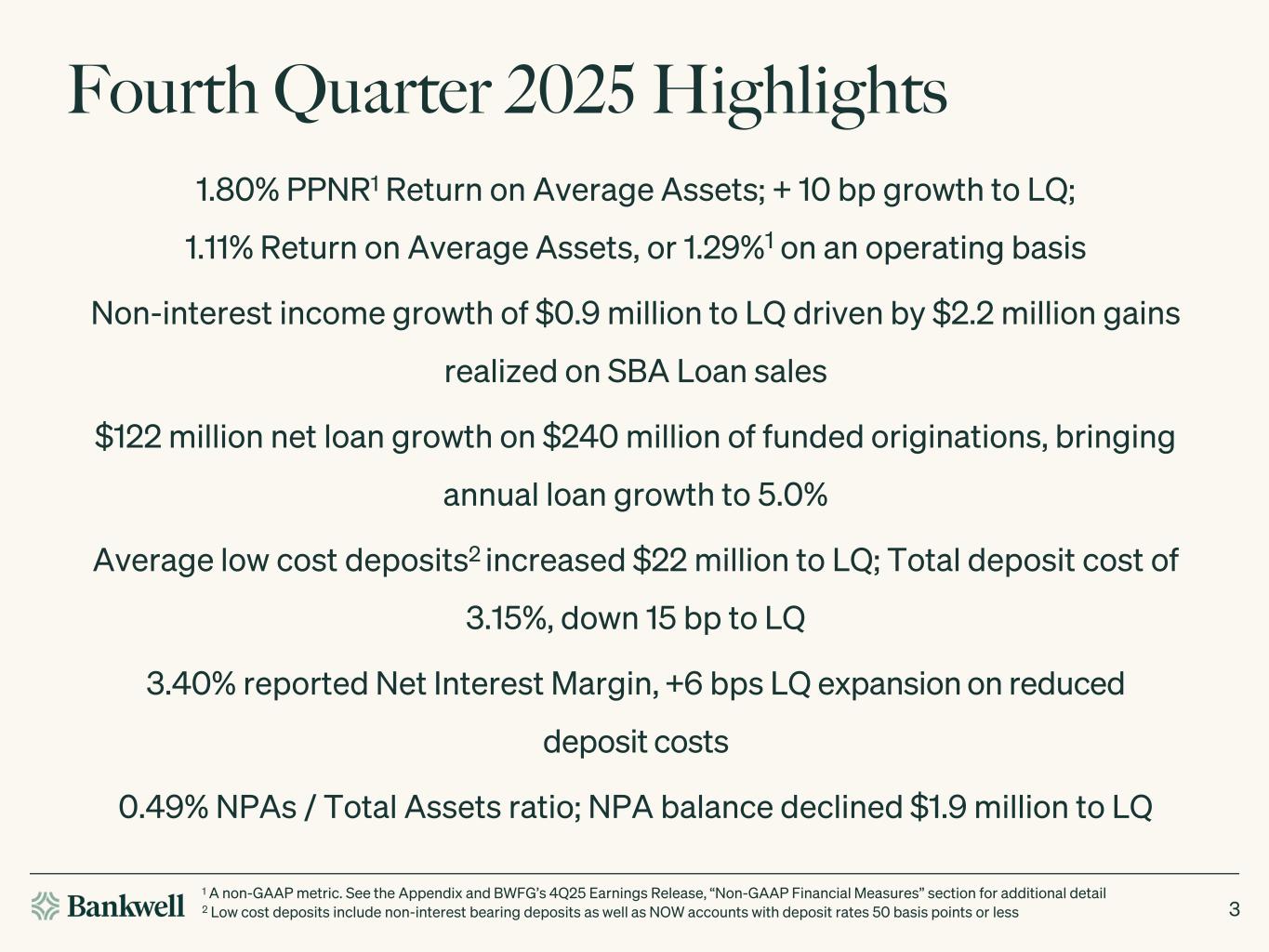
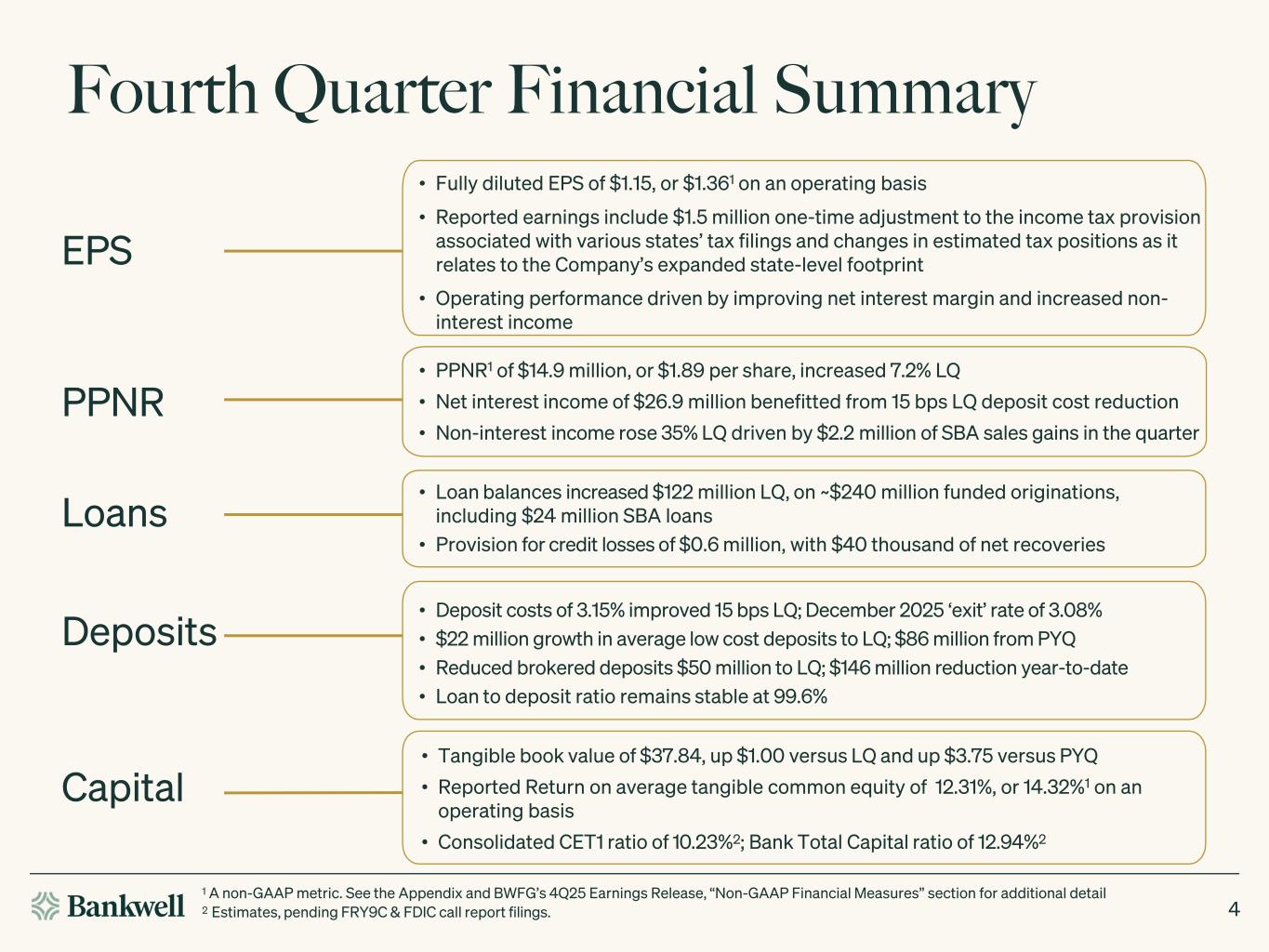
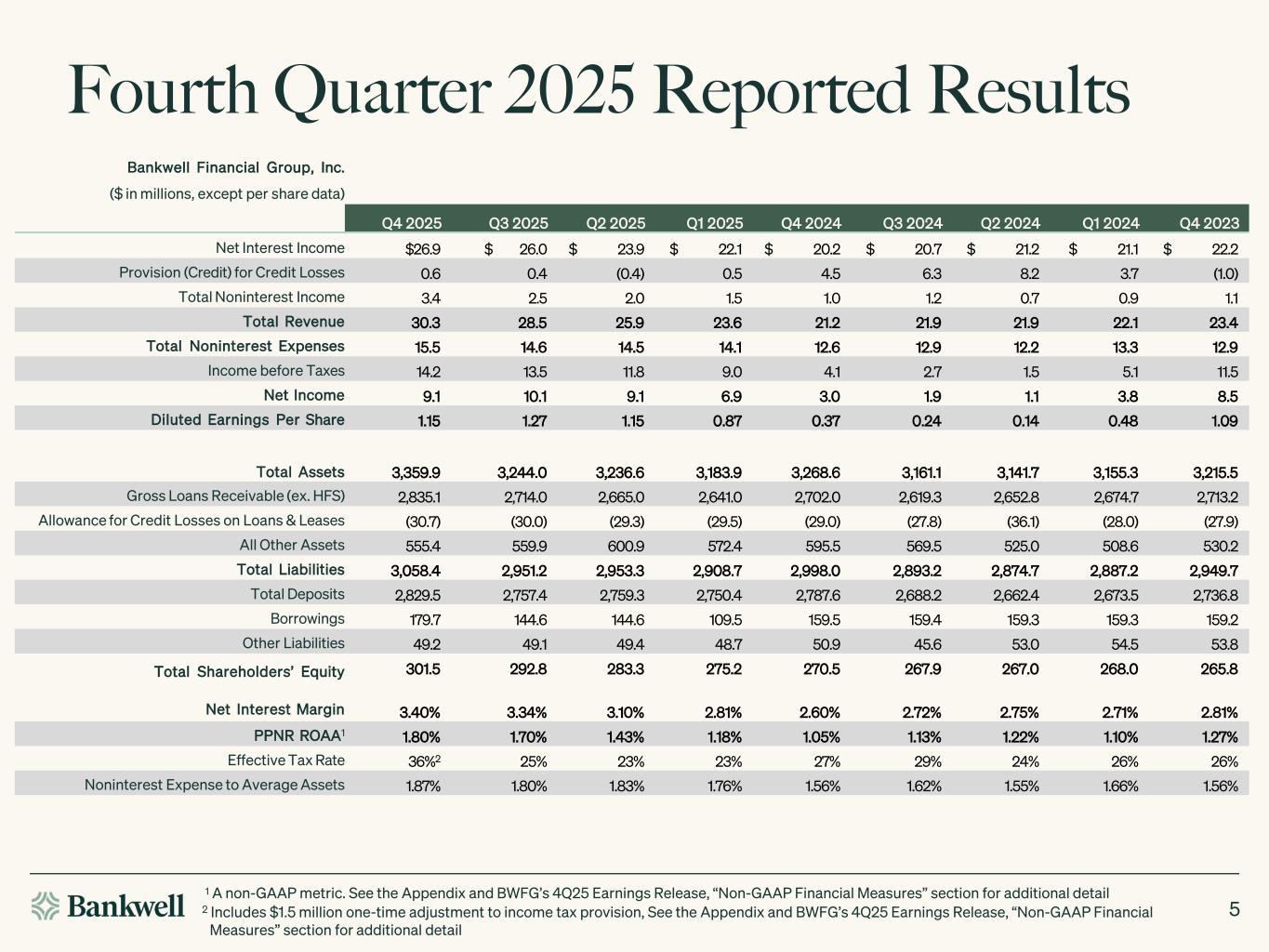
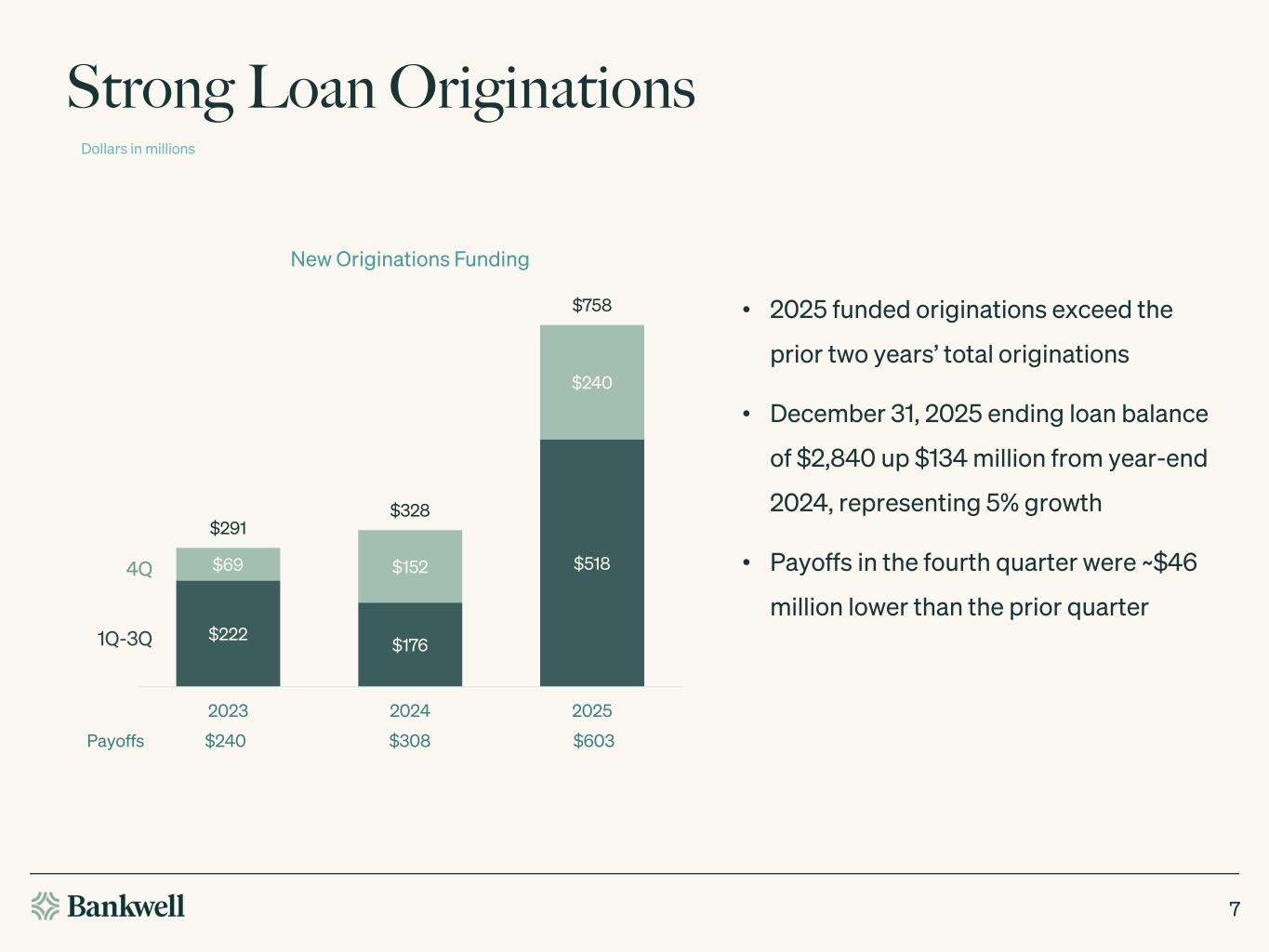
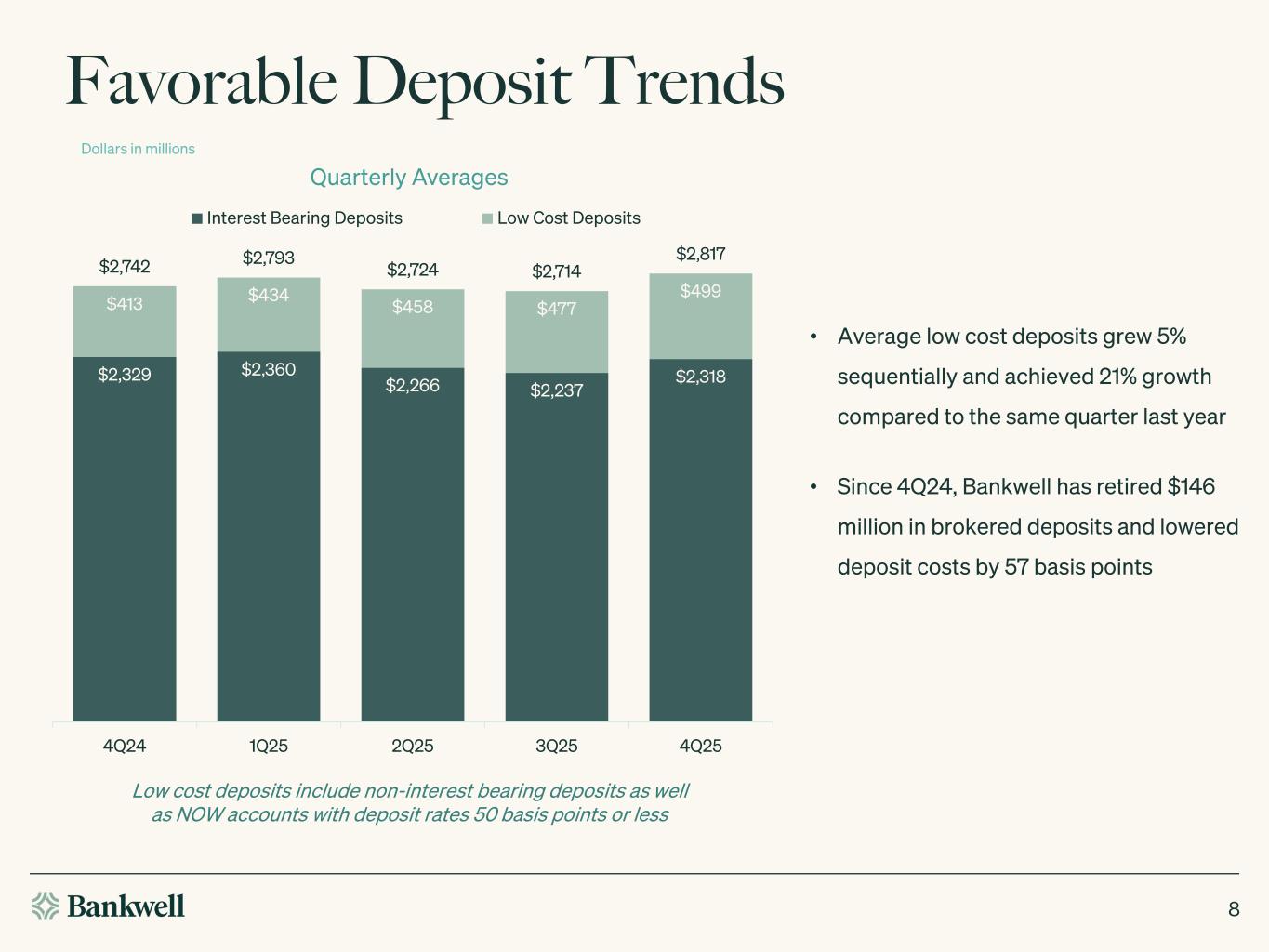
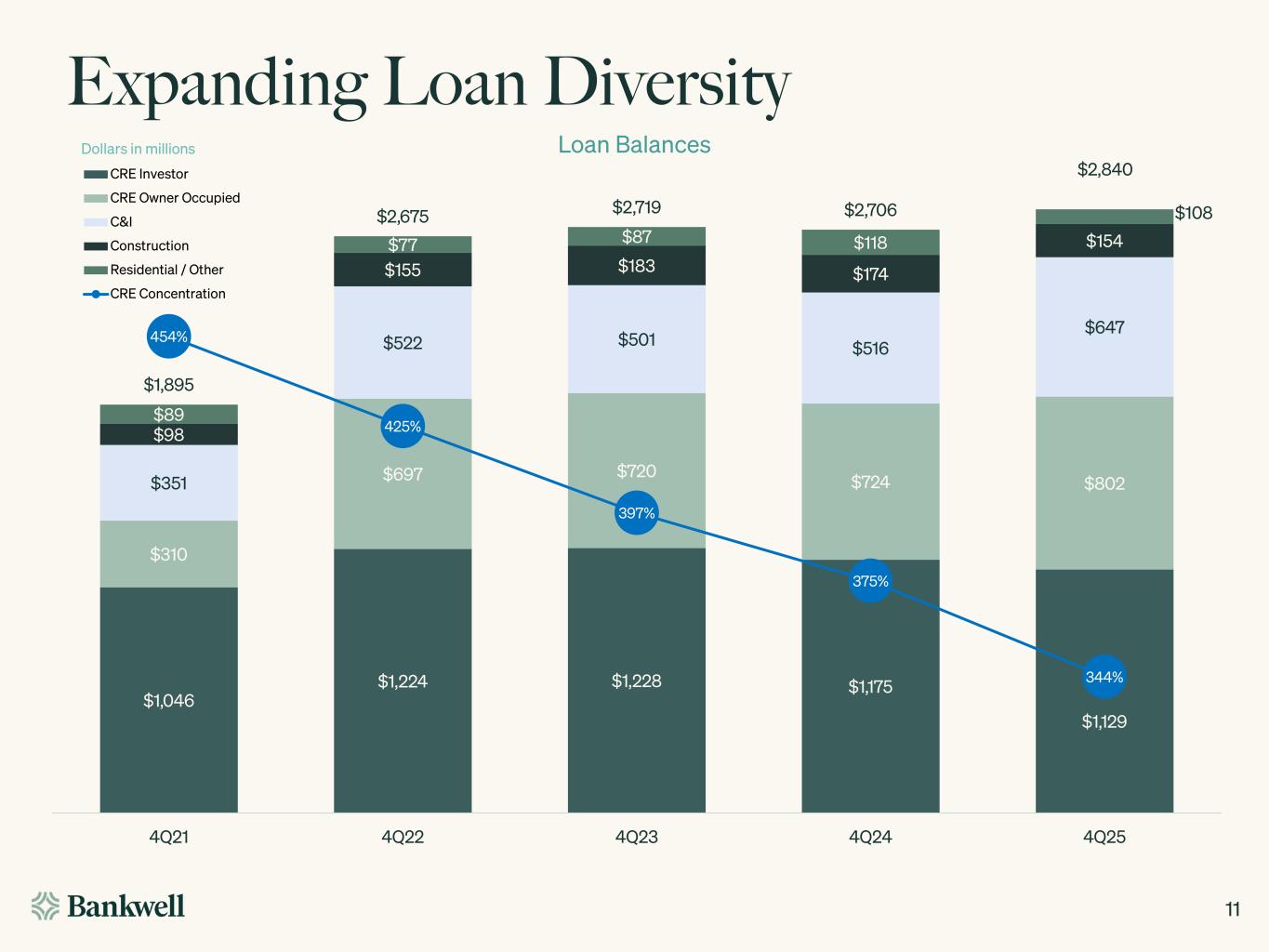
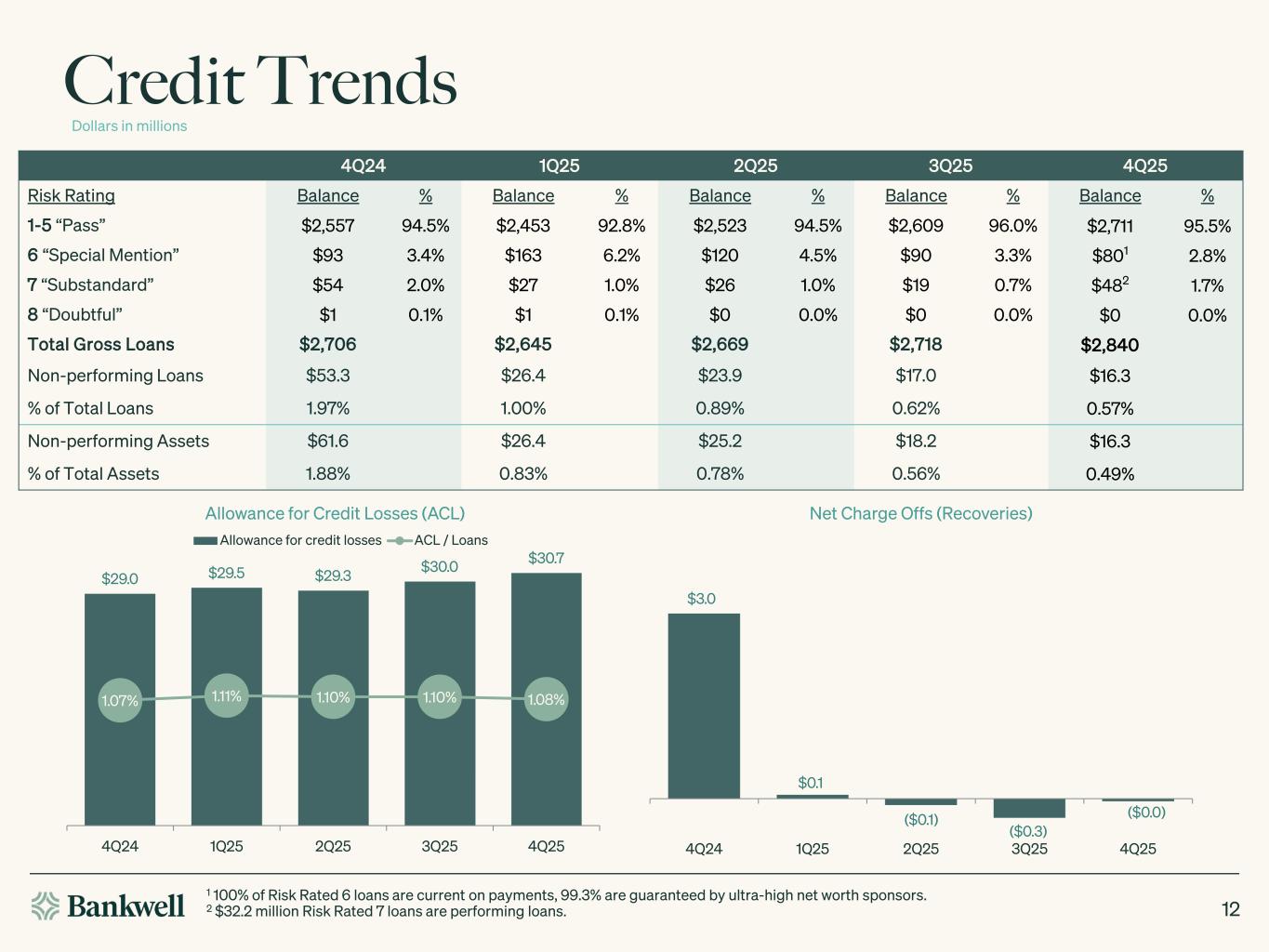
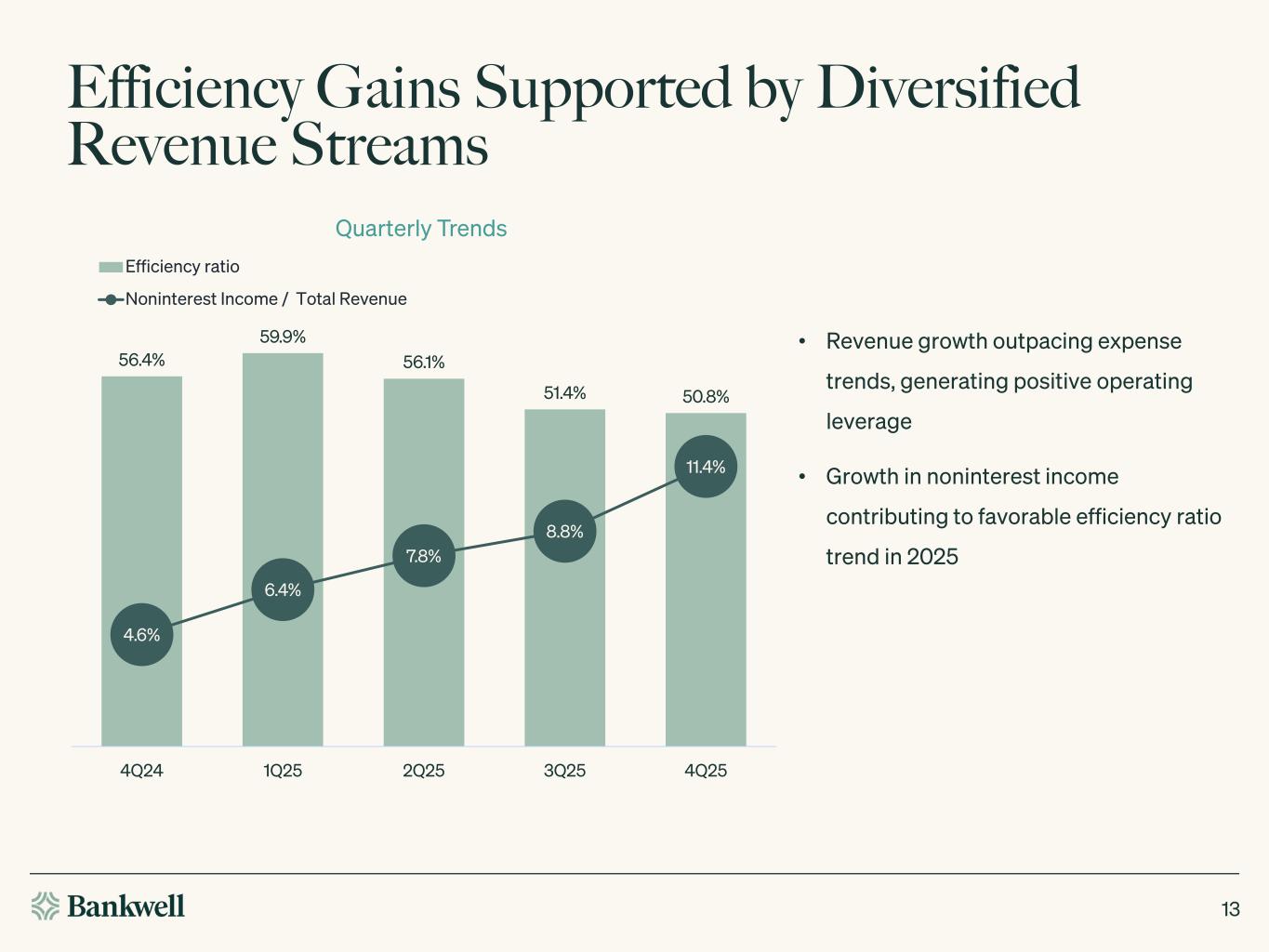
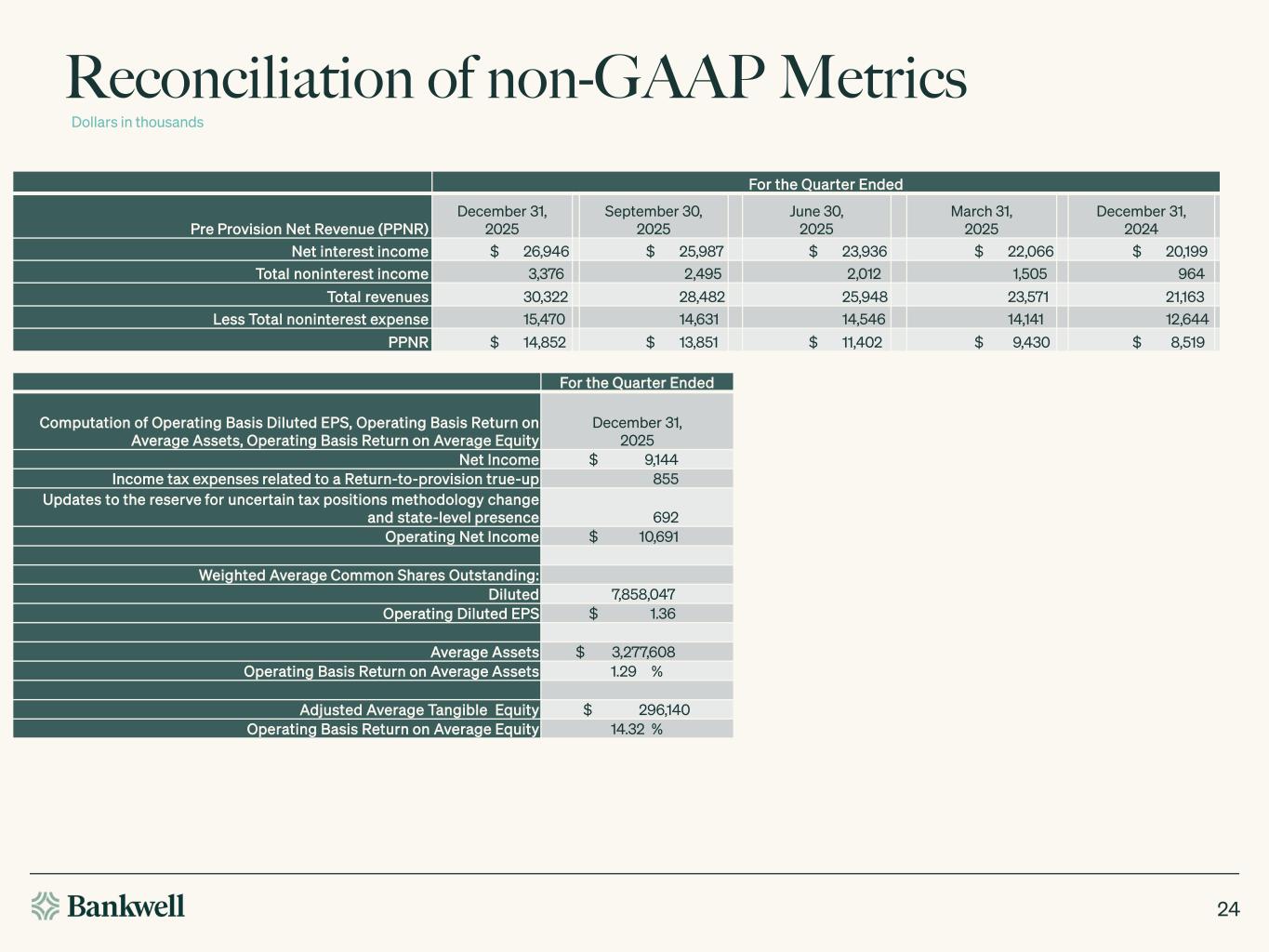
Thanks, Courtney. Good morning, welcome, and thank you to everyone for joining Bankwell's quarterly earnings This morning, I'm joined by Courtney Cicchetti, our Chief Financial Officer, and Matt McNeil, our President and Chief Banking Officer. We appreciate your interest in our performance and this opportunity to discuss our results Our fourth quarter gap net income was $9.1 million, or $1.15 per share, which includes includes a $1.5 million one-time adjustment to the income tax provision associated with various state tax filings and changes in estimated tax positions. This adjustment relates to both current and prior year tax estimates. Excluding this one-time adjustment, operating income for the quarter was $10.7 million, or $1.36 per share on an operating basis. A reconciliation of GAAP and operating results is included in our materials, and we encourage you to review both metrics together. Courtney will walk you through these results in more detail in a moment. Pre-provision net revenue return on average assets was 180 basis points for the quarter, an increase of 10 basis points from the prior quarter, and a 75 basis point increase over Q4 of 2024. This improvement reflects continued expansion of our net interest margin as well as strong growth in non-interest income, driven primarily by our SBA division. We also made further progress in reducing our non-performing asset balances during the quarter to maintain a constructive outlook on credit quality heading into 2026. While our net interest margin has continued to expand this quarter, as we've previously signaled, the pace of that expansion has moderated. This is a result of our intentional increased exposure to floating rate loans. We ended 2025 with floating rate loans comprising 38% of our total loan portfolio, compared to 23% at the end of 2024. On the funding side, we've taken advantage of the lower rate environment to reprice $1.2 billion of time deposits this year and have also reduced rates on key non-maturity interest period deposits. In addition, the mix of our deposits continues to improve. Average low-cost deposit balances increased by $22 million, or 5%, over the prior quarter and by $86 million, or 21%, versus the fourth quarter of 2024. As we note in our investor presentation, low-cost deposits include non-interest-bearing accounts plus NOW accounts with a deposit rate of 50 basis points or less. Loan production remained strong in the fourth quarter. We funded $242 million of new loans, bringing total funded originations for the year to $758 million. Net loan growth for the quarter was $122 million. And for the full year, we generated $134 million of net loan growth, or 5% annual loan growth. With the end of the government shutdown and the reopening of the SBA in November, our SBA division was able to fully resume both originations and sales. As a result, gains on sale increased to $2.2 million for the quarter, bringing full year realized gains to $5.1 million. SBA originations totaled $24 million in the fourth quarter, resulting in $68 million of total originations for the year. As SBA activity is normalized post-government shutdown, we anticipate this business will remain a meaningful and growing contributor to our diversified revenue base and overall profitability. Credit trends in the portfolio continue to improve. Non-performing assets as a percentage of total assets fell to 49 basis points compared to 56 basis points last quarter. This improvement was driven by the sale of a 1.3 million dollar Oreo property and the collection of $400,000 on an SBA guarantee. Finally, our efficiency ratio improved to 50.8% this quarter compared with 51.4% in the prior quarter, underscoring the operating leverage created by faster revenue growth relative to expenses. I'll now turn it over to Courtney for a more detailed review of our financial results.
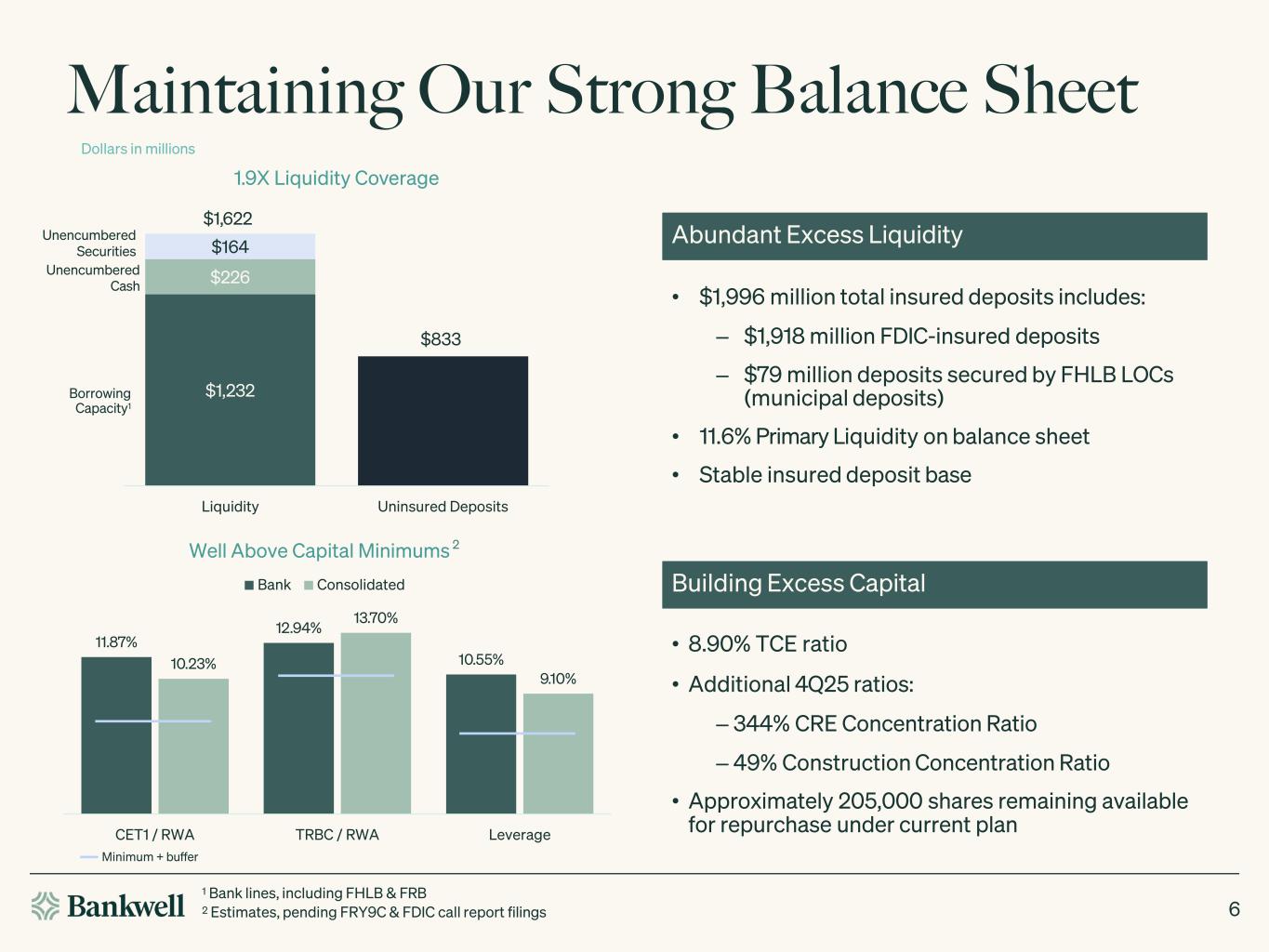
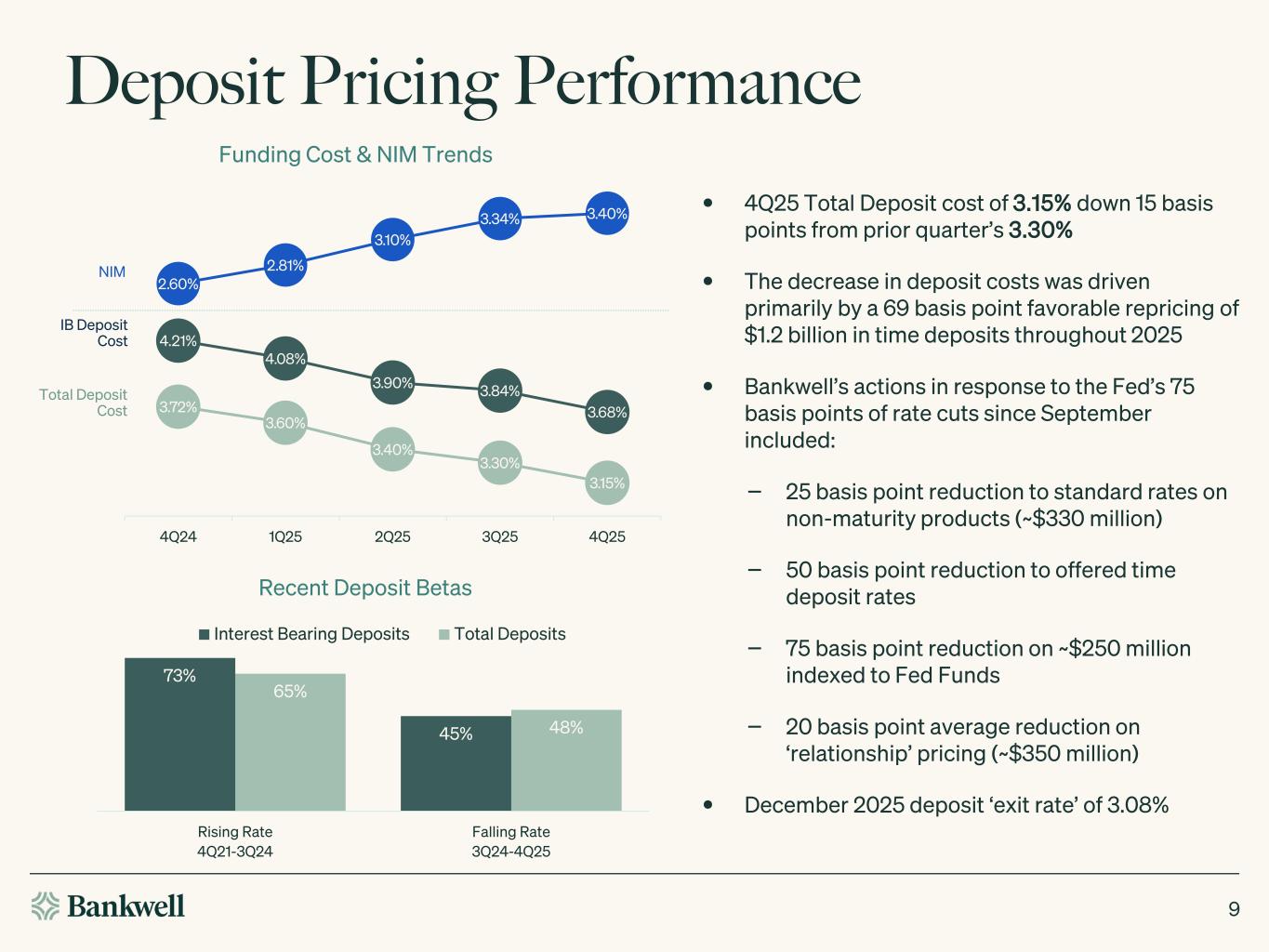
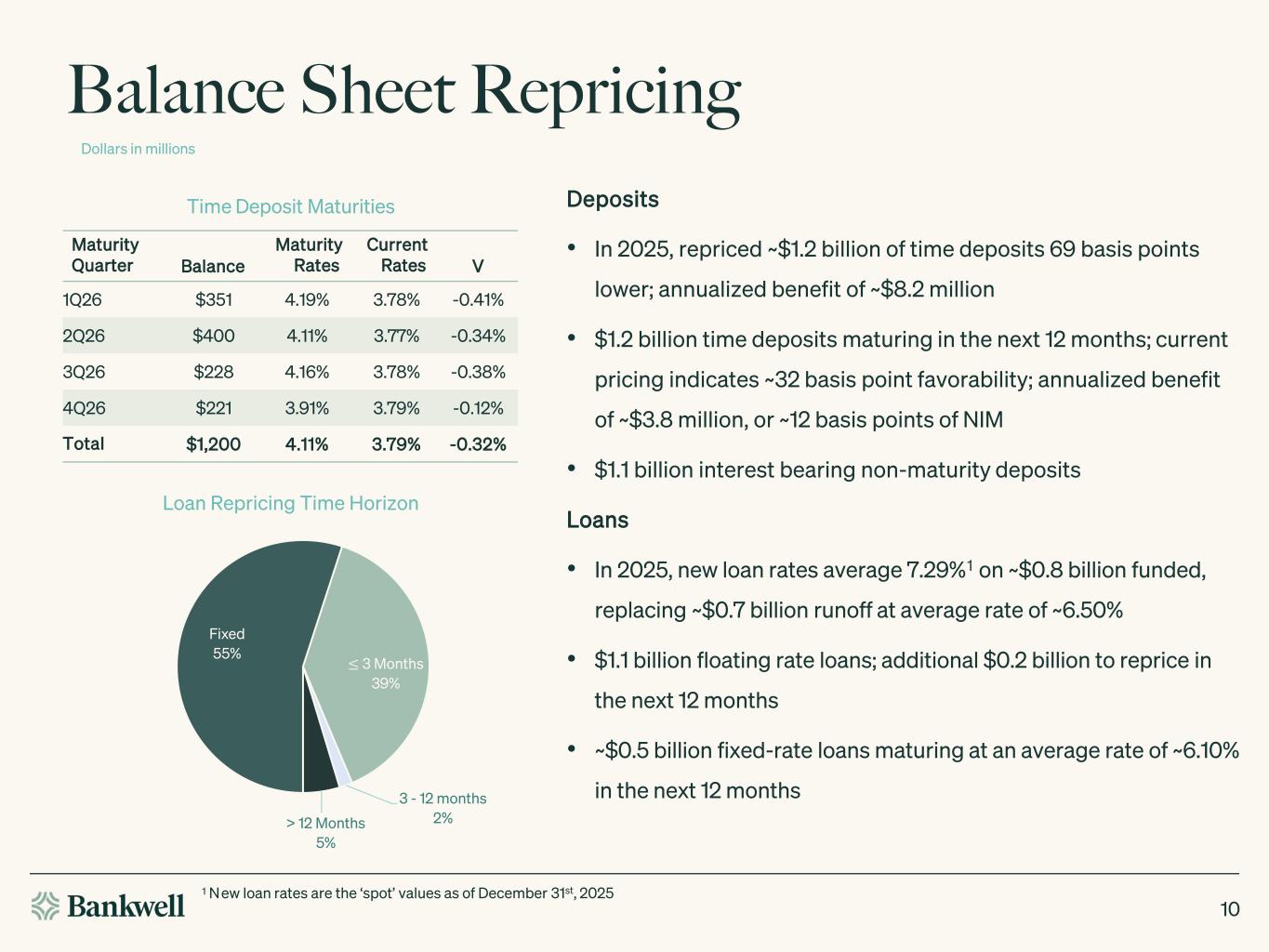
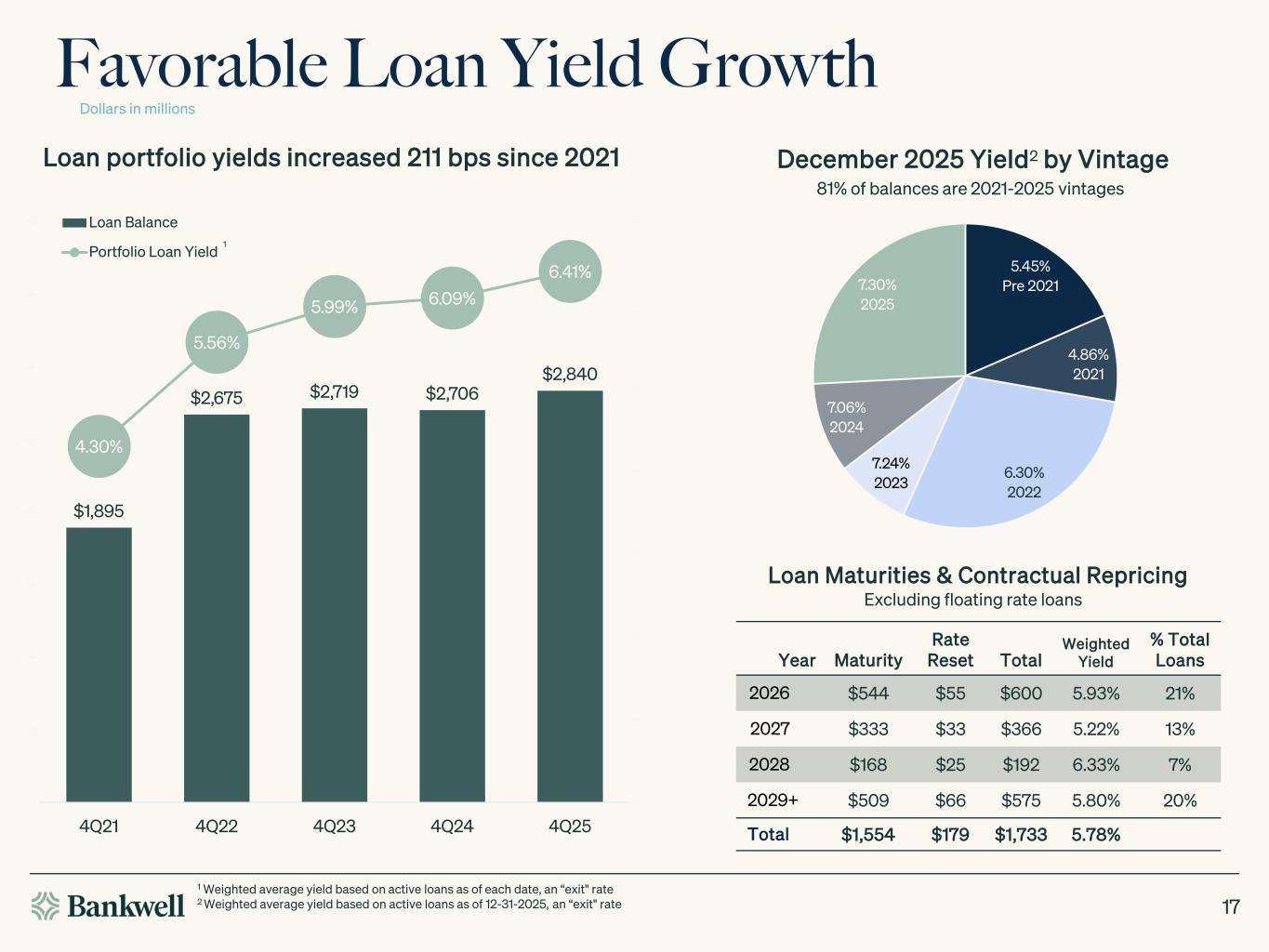
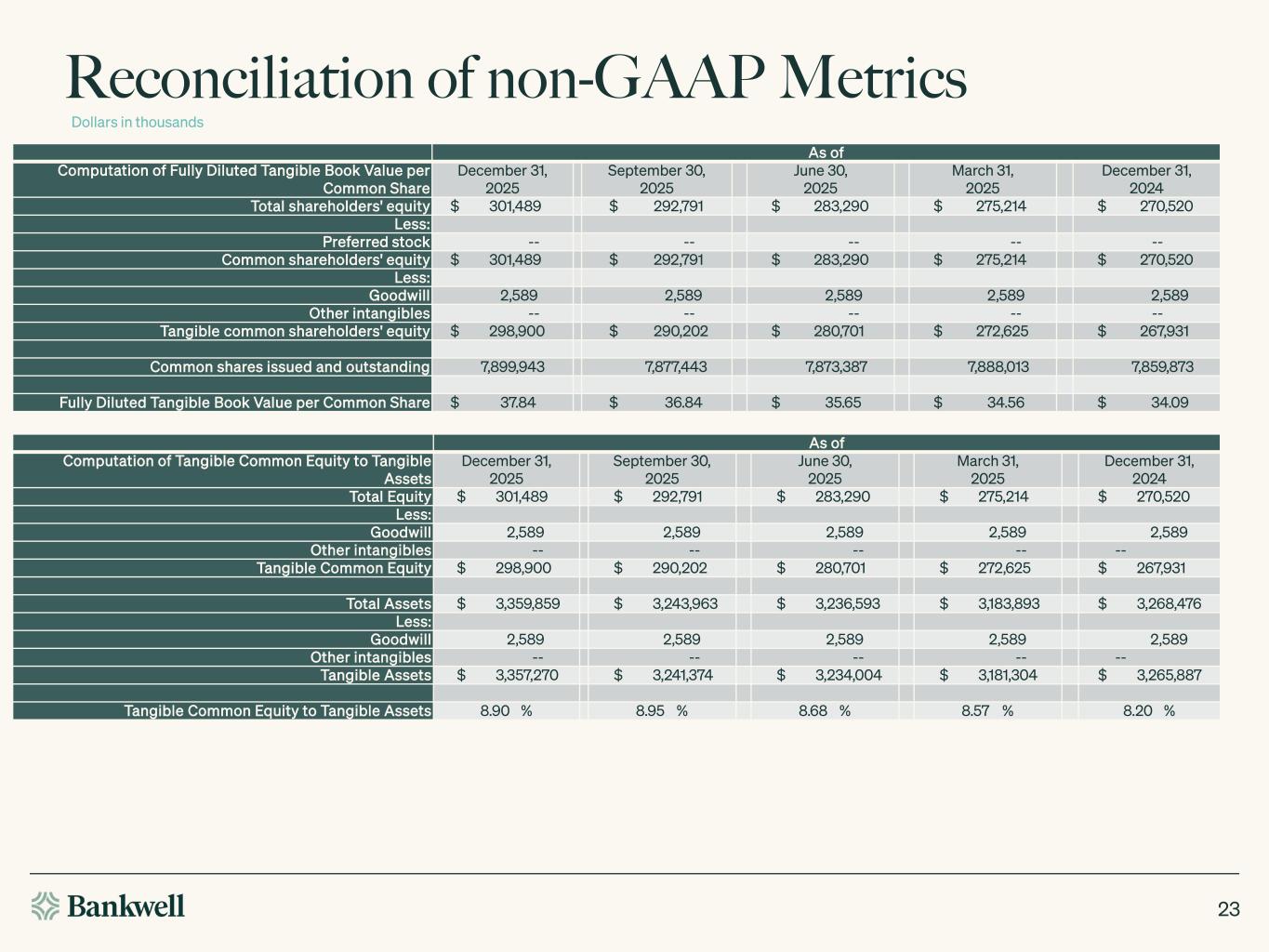
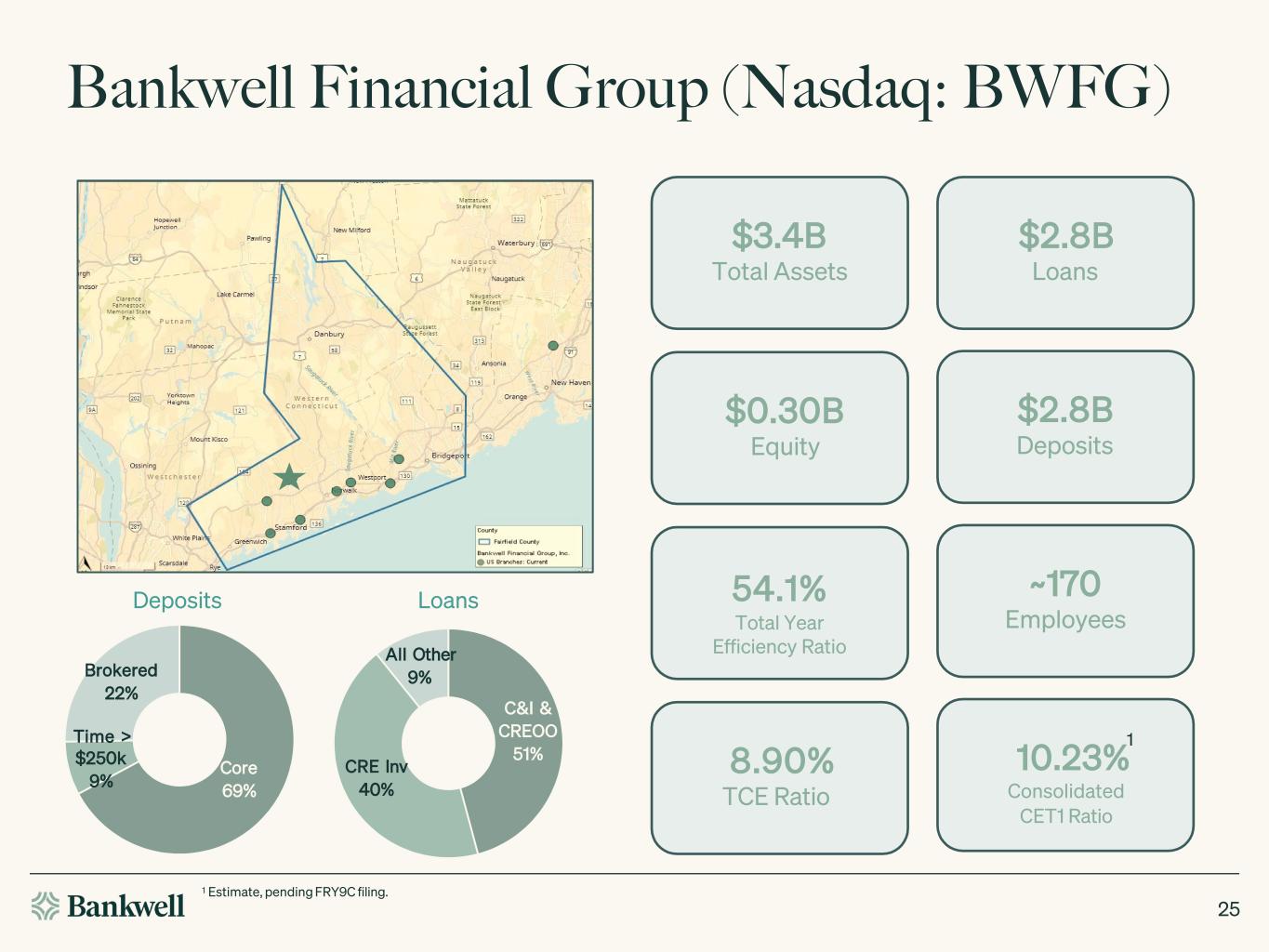
Thanks, Chris. we closed the year on a strong note, delivering fourth quarter gap net income of $9.1 million and a reported EPS of $1.15. Pre-provision net revenue for the quarter totaled $14.9 million, or 180 basis points of average assets. Net interest income reached $26.9 million, while non-interest income increased to $3.4 million, driven by $2.2 million of SBA gain on sale income. Fourth quarter Our net loan growth of $122 million brought full-year loan growth to $134 million, representing 5% growth over year-end 2024. For the full year, we originated more than $900 million of loans, including approximately $68 million of SBA origination. Net interest margin expanded to 340 basis points, up 6 basis points from the prior quarter. The improvement was driven by a 15 basis point reduction in deposit costs, which declined to 3.15%. These funding benefits more than offset pressure on asset yields, which contracted 11 basis points in the quarter to 6.23% as certain rate-sensitive assets reset lower. Since late September, we responded to the Fed's 75 basis points of rate cuts by adjusting our deposit pricing. We lowered offered time deposit rates by 50 basis points, repriced approximately $250 million of indexed deposits at 100% beta and reduced rates on roughly $700 million of non-maturity deposits by an average of 22 basis points. As a result, we exited 2025 with a total deposit cost of 3.08%. We expect $1.2 billion in TAG deposits to reprice favorably over the next 12 months with an average rate reduction of 32 basis points. This repricing is anticipated to provide an annualized incremental benefit of roughly $4 million or about 12 basis points of net interest margin. These estimates do not incorporate the impact of any other future rate changes. Additional detail on our balance sheet repricing and rate-sensitive assets and liabilities can be found on page 10 of our investor presentation. Non-interest income of $3.4 million, an increase of 35% versus the linked quarter, was largely driven by $2.2 million of SBA gain on sale income, representing an approximate $800,000 increase quarter over quarter. As shown on page 13 of our investor presentation, non-interest income now represents 11.4% of total revenue compared to 4.6% in the fourth quarter of 2024. Asset quality continued to improve during the quarter. We've reduced non-performing assets by 1.9 million dollars, bringing the MPA to assets ratio down to 49 basis points. We recorded modest net recoveries and a provision for credit losses of approximately $600,000. Our allowance for credit losses stands at 108 basis points of total loans, while coverage of non-performing loans increased to 188%. Our financial position remains strong. Our balance sheet remains well capitalized and liquid with total assets of 3.4 billion dollars, up 3.6% versus the linked quarter. The holding company and bank remain well capitalized with our estimated consolidated common equity tier one ratio now at 10.2% and bank total capital ratio of 12.9%. Our tangible book value per share also increased reaching $37.84, representing 11% growth over 2024. As previously noted, we recorded approximately 1.5 million dollars of non-recurring income tax expense this quarter. This reflects an $855,000 dollar expense related to a true-up of prior year's state's tax estimates based on final return filings. It also includes a $692,000 P&L impact related to an addition to our FIN48 reserve for uncertain tax positions, driven by a change in estimate and the company's expanded state-level footprint. These adjustments represent a one-time true-up to certain current and prior period estimates. Our 27.4 percent effective tax rate for full year 2025 reflects this one-time expense. On a go-forward basis, we would expect our effective tax rate to be approximately 25%. Finally, in addition to fourth quarter operating net income of $10.7 million or $1.36 per share, we delivered an operating return on average assets of 1.29% versus our reported 1.11% and an operating return on average tangible common equity of 14.32% versus our reported 12.31% now I'll turn the call back to Chris thank you Courtney 2025 was a year where our team demonstrated its ability to execute and make meaningful progress across every dimension of our strategy we entered the year with the clear set of priorities strengthen credit improve the funding
mix build non-interest income generate high quality growth and embrace an innovative mindset as we continue to invest in our people and in technology I'm pleased to say that we delivered on each of these priorities not performing assets ended the year at 49 basis points of total assets we've continued to improve the profile of our funding base reducing our dependence on higher cost sources and growing our relationship driven lower cost deposits our focus on building diversified recurring sources of revenue is bearing fruit with the successful growth of our SBA division and despite a year of heightened prepayments we ended 2025 with year-over-year loan growth of approximately five percent finally we continue to invest in the people technology and capabilities that will carry us forward we've strengthened our teams both in key client facing and operational roles and we're seeing the benefits of those investments. While making these investments, we've also increased scalability. We believe the work done throughout 2025 sets us up for even better results in the coming year and are providing the following guidance for 2026. We expect loan growth of 4 to 5 percent. We anticipate net interest income in the range of $111 to $112 million. We also expect non-interest income to increase to approximately $11-12 million. We estimate total non-interest expense of $64-65 million, which incorporates a prudent level of ongoing investment in our people, infrastructure, and operational capabilities. Before we open the line for questions, I'd like to thank our entire team for their commitment and professionalism throughout the year. Their work has allowed Bankwell to finish 2025 in a position of strength and to enter 2026 with confidence for an even better year ahead. Operator, we're ready for questions.
Operator
This time I would like to remind everyone to ask a question, simply press star one on your telephone keypad. And our first question comes from the line of Freddie Strickland with Huff Group. Please go ahead.
Hey, good morning, just want to start on loan growth, great to see you're expecting a pickup there in 26, I think it's a little bit above what I have previously modeled. Can you talk about the extent to which payoffs versus new originations drive the net new growth number?
Yeah, Teddy, this is Chris.
It was pretty lumpy during the year, we were paying catch up as you know, and now we're primed for that sort of payoff, and I'll let some more detail on that. exactly that buddy you know the the volume of payoffs in 25 especially in the first part of 25 was somewhat unexpected change the way that we were thinking about our we're able to catch up order now that we're you know the new normal is anticipating that runoff back to be a balance sheet a little earlier in the year, you know, anticipate, you know, more volume.
Yeah, just to add to that and not to take away from the question time, but I think what we've shown is that if there's a number we want to get to, we can get to it. It was a matter of prime in the pump, and we can generate, we have enough demand for loans that we can get to a number, you know, when we're ready for it. So, you know, within the constraints of capital, et cetera, obviously.
Okay, great. And I apologize if this is in your answer, it was a little choppy on my end, but just wanted to ask what the makeup in the loan pipeline was today as well.
Looking for a, I mean, like C&I and investor.
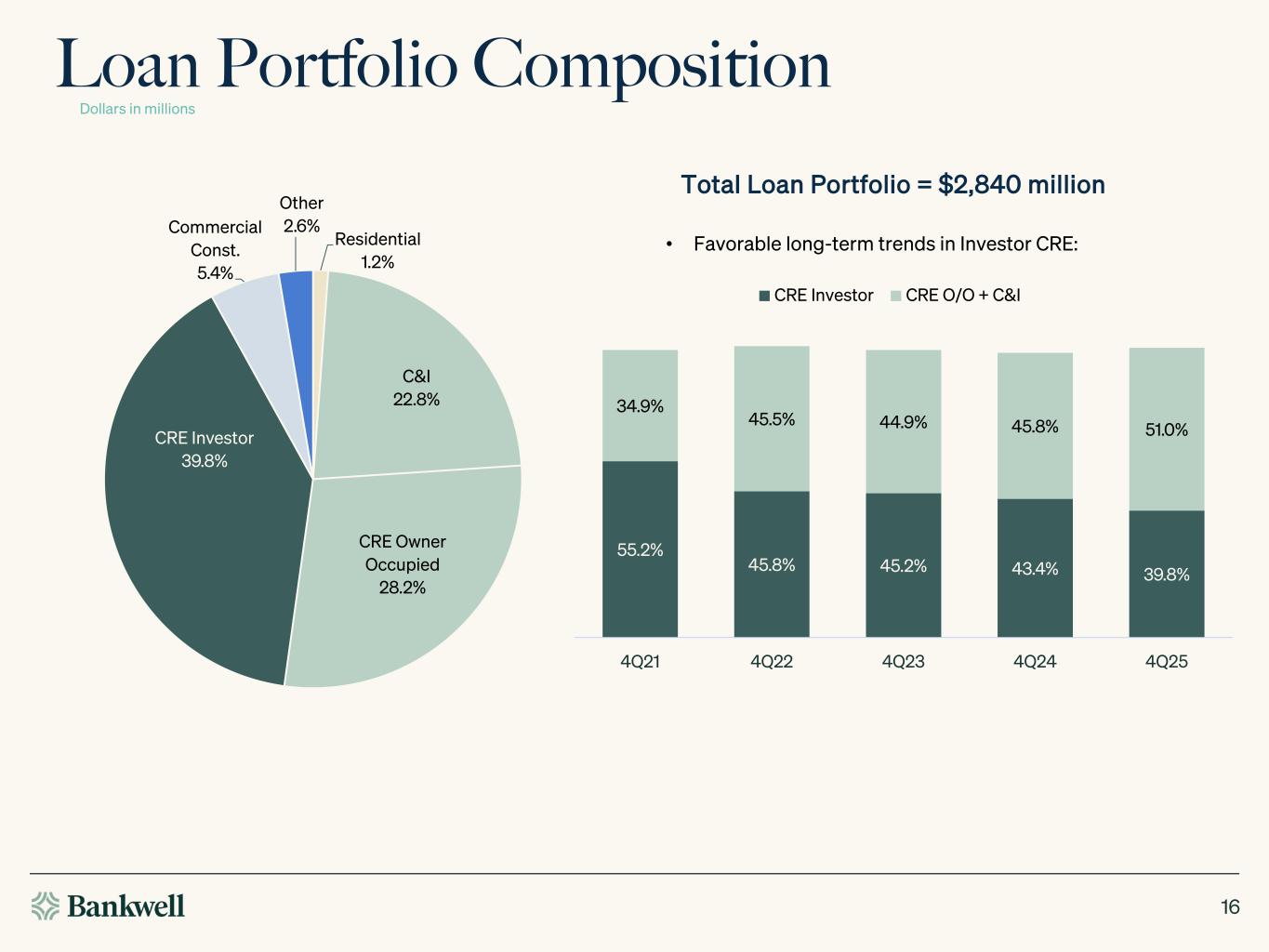
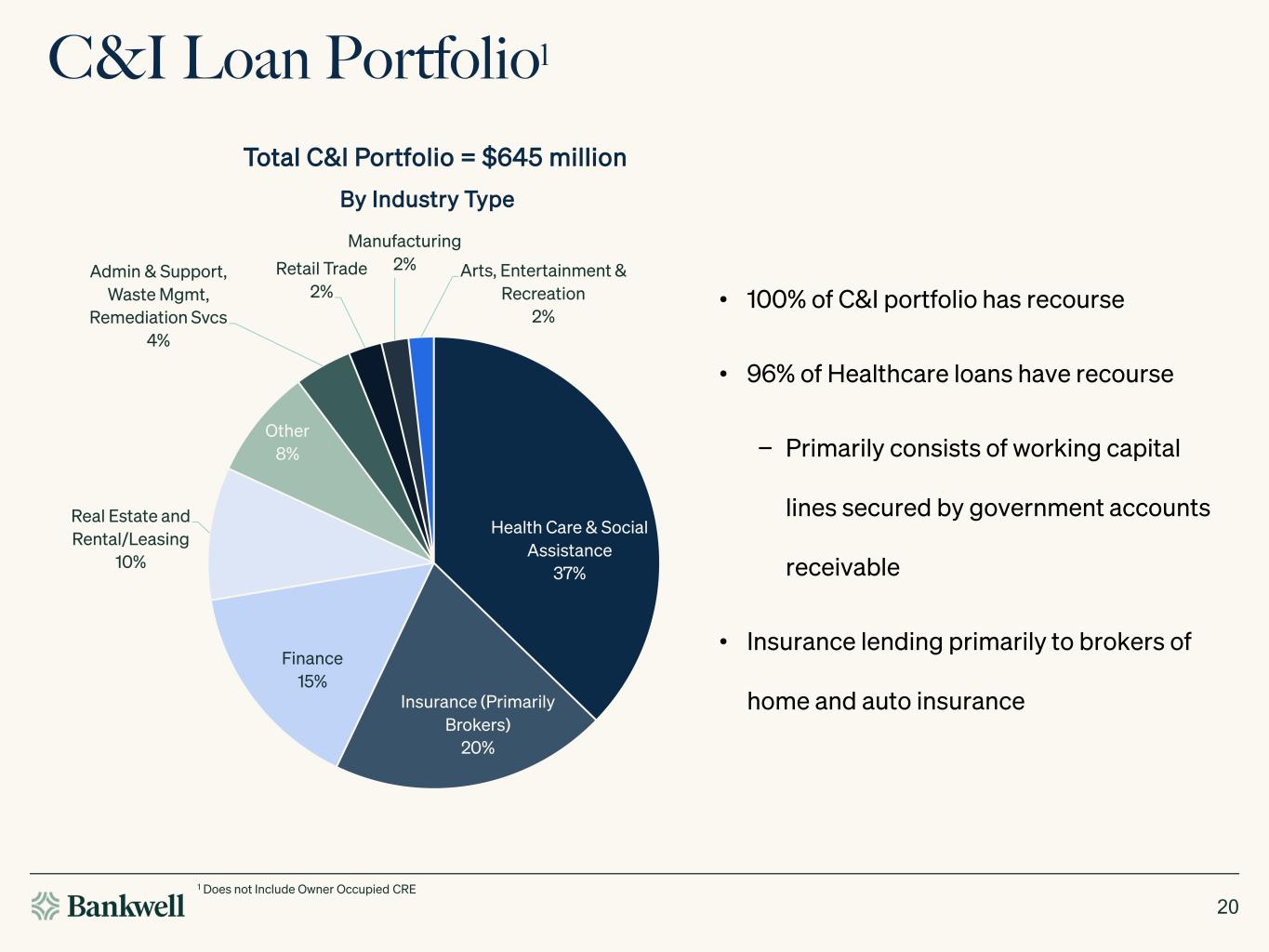
I have you, I'd say it's 60-40 C&I, you know, we've steadily brought down investor creative capital over the past several years, you know, we anticipate, you know, continuing to be strong C&I.
That's it for me, I'll step back on the queue. Thanks for taking my question. Thanks, Teddy.
Operator
Your next question comes from the line of David Conrad with KBW. Please go ahead.
Yeah, thanks, good morning.
A couple quick questions. One, what do you expect the low cost deposit growth to be this coming year?
We're on guidance for that. we obviously expect steady improvement. We've hired people, we've got our own teams, we're making headway, so I don't think we're going to guide you a number, but what do we have for the, what is our number for the year?
Well, if you look at, I'm just looking to the right page, but page 8 of our investor presentation, our average low-cost deposits grew 5% from last quarter, but 21% from the fourth quarter of 24 on an average basis so we were able to put up a good growth on an average basis I mean we certainly like to repeat that again but I admit it seems also very likely would outpace the loan growth I'd say the loan growth I think the way we're looking at is loan growth is a function of deposit growth plus you know how we capital ratios so but then you know and
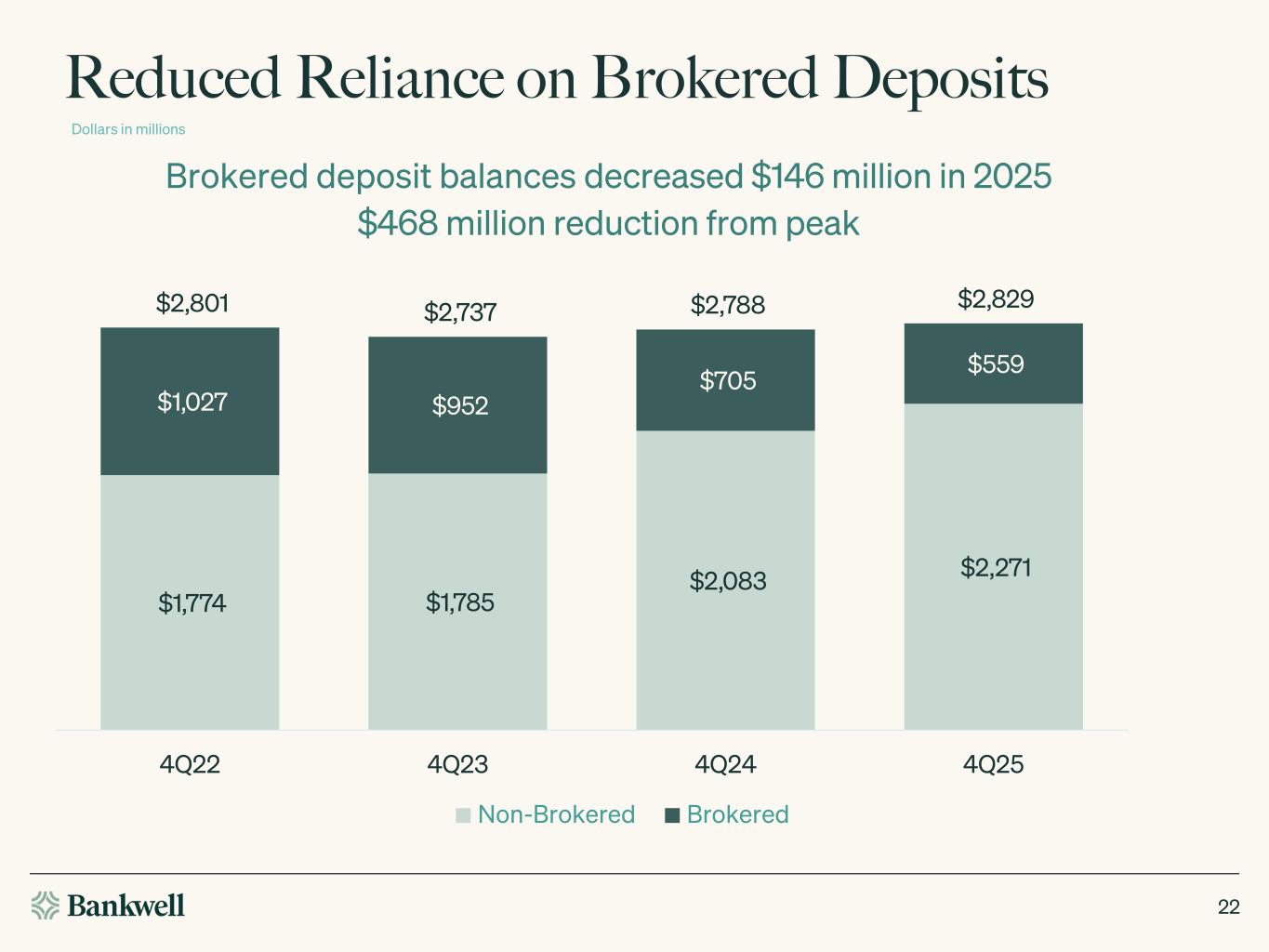
And then, of course, you know, with more deposit growth, we could pay down broker.
I'll point out, David, that the 5% of low-cost deposit growth is on an average basis for the year. So it's very likely that this is a conservative growth number. Got it. And then on the fee income side, kind of with the SBA kind of dominating the number. We're just wondering, should we think about in the guide for the total year, any seasonality of that quarter to quarter, so how should we base that out? I think that we'll see smooth production throughout the year unless there's a government shutdown.
Or in government shutdown.
Yeah. Right, right. Okay. Thank you. Appreciate it.
Operator
Our final question comes from the line of Steve Moss with Raymond James. Please go ahead.
Good morning. Maybe you're just following up on the FDA stuff. On the SBA stuff here, in terms of just, what are your thoughts, and I apologize if I missed this, for originations in SBA in 2026?
I think the way the math works out is to achieve our non-interest income numbers to it's about 100%.
And we finished 25 with 60, and this was the first full year of the SBA division functional. I think $25 million in the final quarter, right?
Yeah, just under $25 million in the final quarter of 2025.
Just wanted to separate you to check that, but appreciate that.
And then in terms of the expense growth outlook here, just kind of curious what you expect to be the drivers on expense growth here in 26th?
The people and processes, we've definitely added across the bank in client and non-client facing as we said on the call. Our headcount went up by more than 10% last year from about 145 to 170 FTE in the expenses that you see that we've guided to. We have some further growth in that. And I just point out that we're aware that we put out a larger expense number, but we want shareholders and you all to have complete transparency is what we're doing. But the guide on revenue and income and profitability has these numbers baked in. So our approach is not, well, if you build it, they will come. We're making these investments while we're putting up, you know, we're operating our way for the quarters, 129 basis points, and the guidance that we have out there probably gets you, depending on what you use for allowance, you know, somewhere north of 120, yeah, next So, we're making the investments, but our profitability is growing.
Okay. Appreciate that caller there.
We have a strong opinion that if you don't invest, stay current, you're out of business. So we want to make sure that we're always ready for the future.
Right. No, definitely appreciate that dynamic.
And I guess the other thing in terms of just kind of low pricing here, you know, curious, you know, how are, you know, new origination coupons holding up these days, if there's been any spread compression just any call you can give on that front no no recent spread compression you know we generate a reasonable amount of floating rate loan so as indices fall the you know the origination coupon on a floating rate loan goes down and you know we price our fixed rate primarily off of Treasury so as those fall you know the coupons down but the credit spread itself. We have seen people requesting and showing us offers at other FIs with lower credit spreads, but we typically are able to keep our due to loan demand spreads in time.
Okay. Great. I appreciate all the call here next quarter. Thank you.
Operator
And with no further questions in queue, this does conclude today's conference call. Thank you for participating.