Operator
Good morning, everyone, and welcome to eHealth Incorporated's conference call to discuss the company's second quarter 2025 financial results. At this time, all participants have been placed in listen-only mode. The floor will open for your questions following the prepared remarks. I will now turn the floor over to Eli Neubren-Mintz, Senior Investor Relations Manager. Please go ahead.
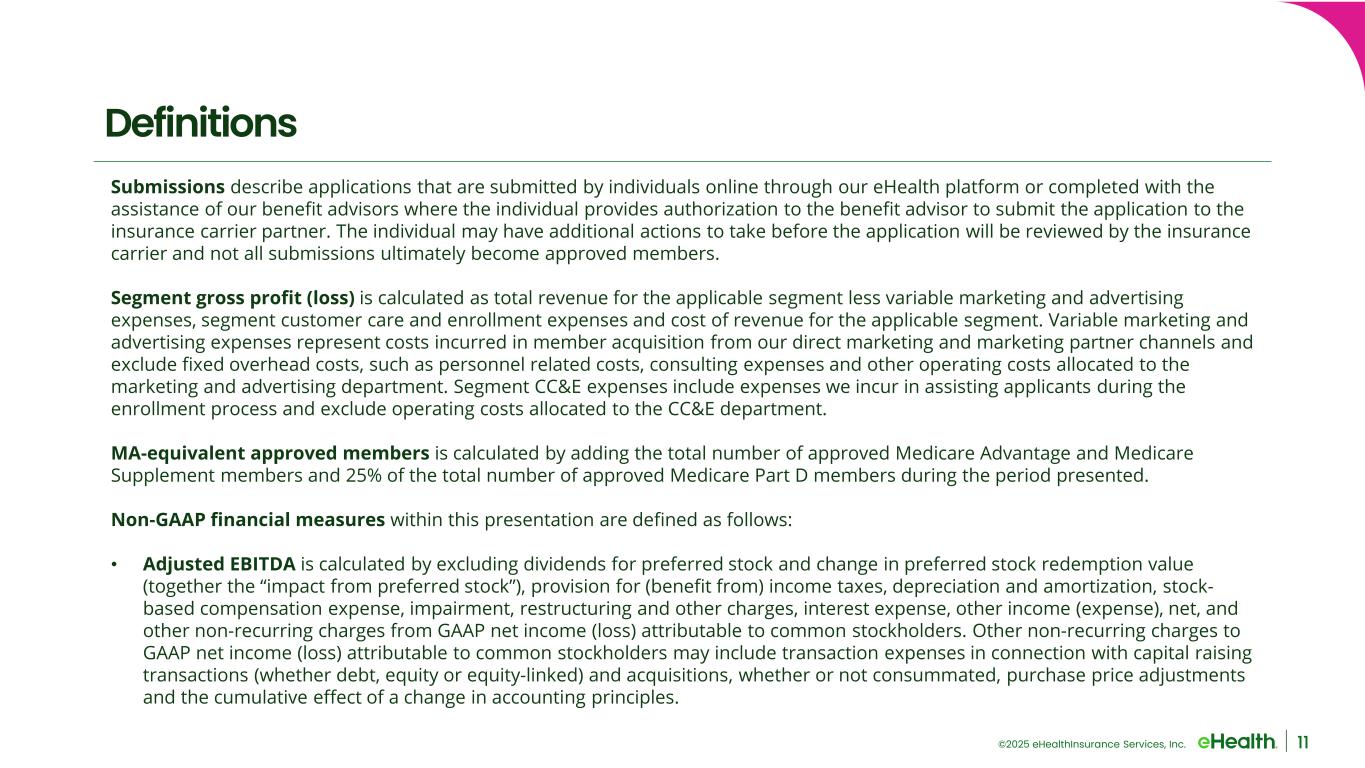
Good morning, and thank you all for joining us today. On the call today, Fran Soysman, eHealth's Chief Executive Officer, and John Dolan, Chief Financial Officer, will discuss our second quarter 2025 financial results. Following these prepared remarks, we will open the line for a Q&A session with industry analysts. As a reminder, this call is being recorded and webcast from the Investor Relations section of our website. A replay of the call will be available on our website later today. today's press release our historical financial news releases and our filings with the sec are also available on our investor relations site we will be making forward-looking statements on this call about certain measures that are based upon management's current beliefs and expectations relating to future events impacting the company and our future financial or operating performance forward-looking statements on this call represent e-health views as of today and actual results could differ materially we undertake no obligation to publicly address or update any forward-looking statements except as required by law the forward-looking statements we will be making during this call are subject to a number of uncertainties and risks including but not limited to those described in today's press release and in our most recent annual report on form 10k and our subsequent filings with the sec we will also be discussing certain non-gap financial measures on this call. Management's definitions of these non-GAAP measures and reconciliations to the most directly comparable GAAP financial measures are included in today's press release. With that, I will turn the call over to Fran Soysman.
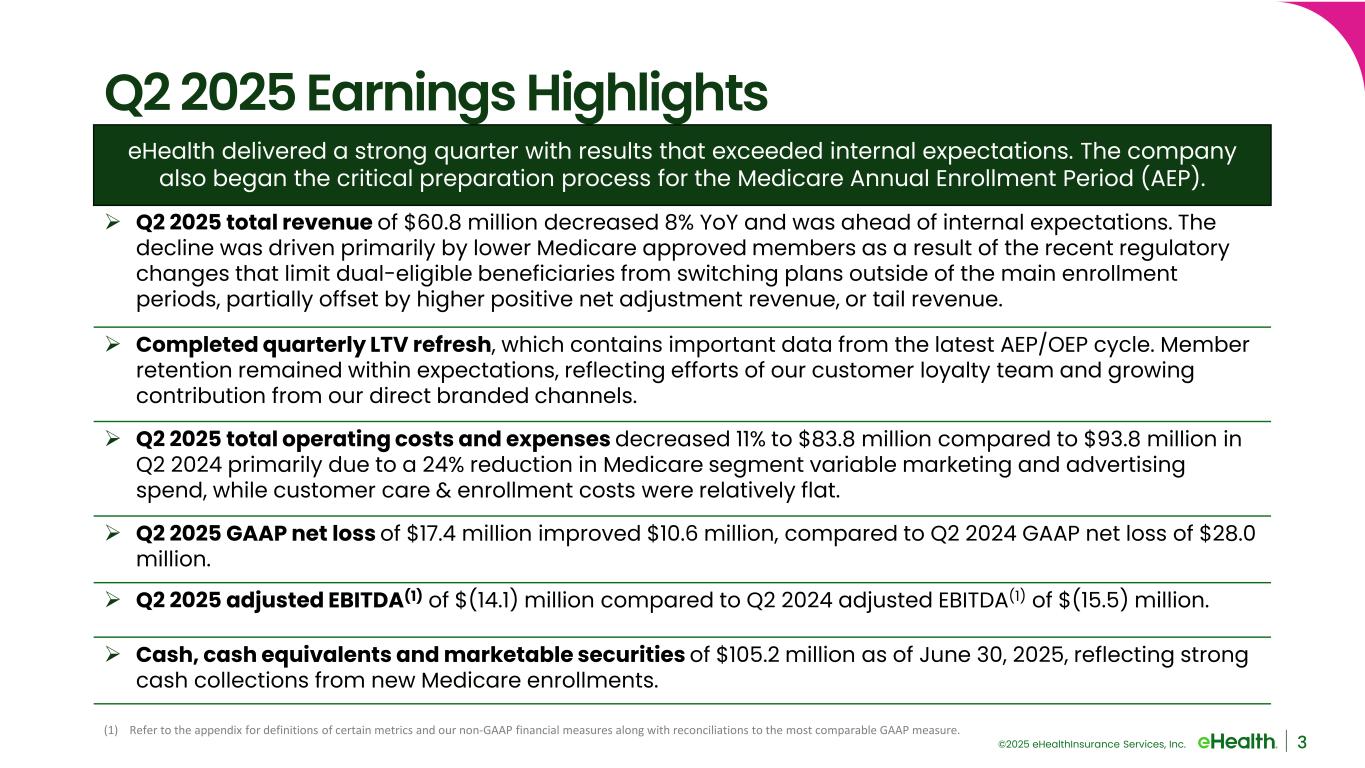
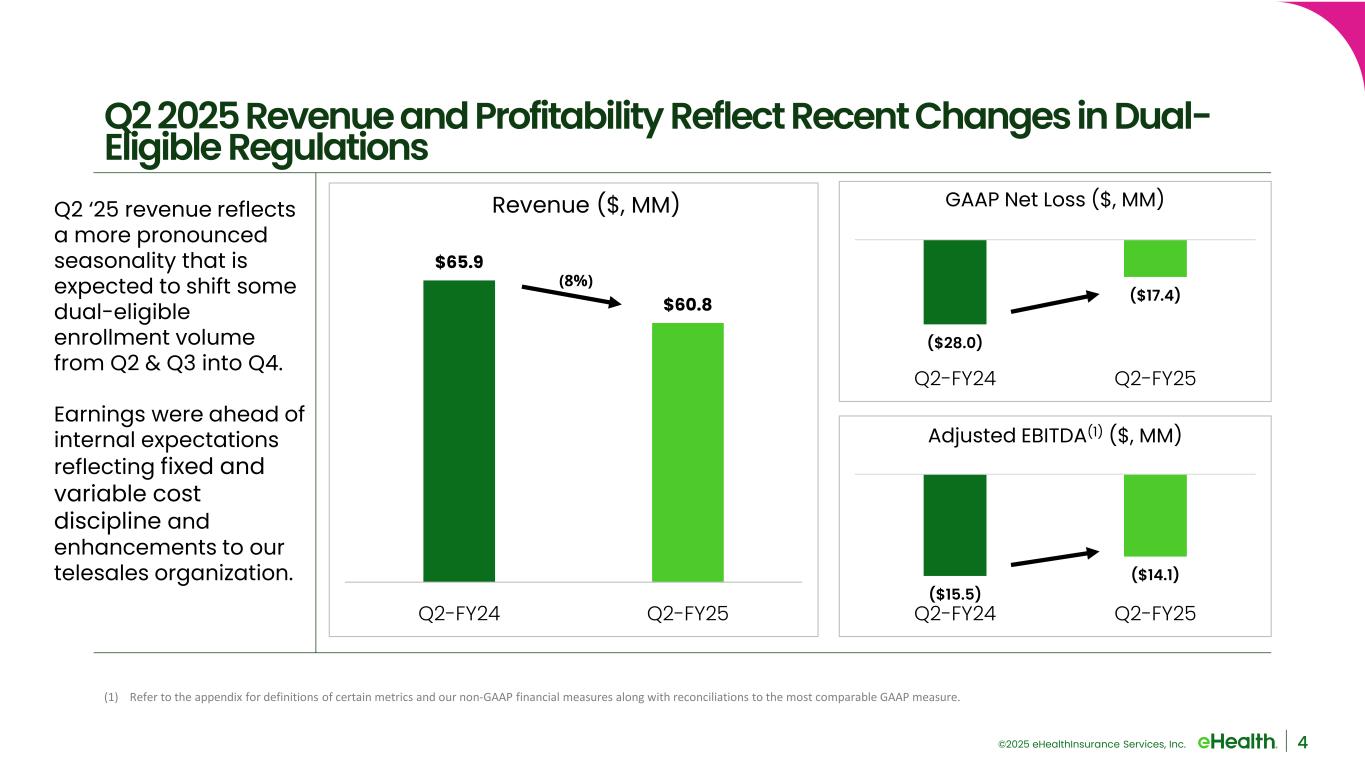
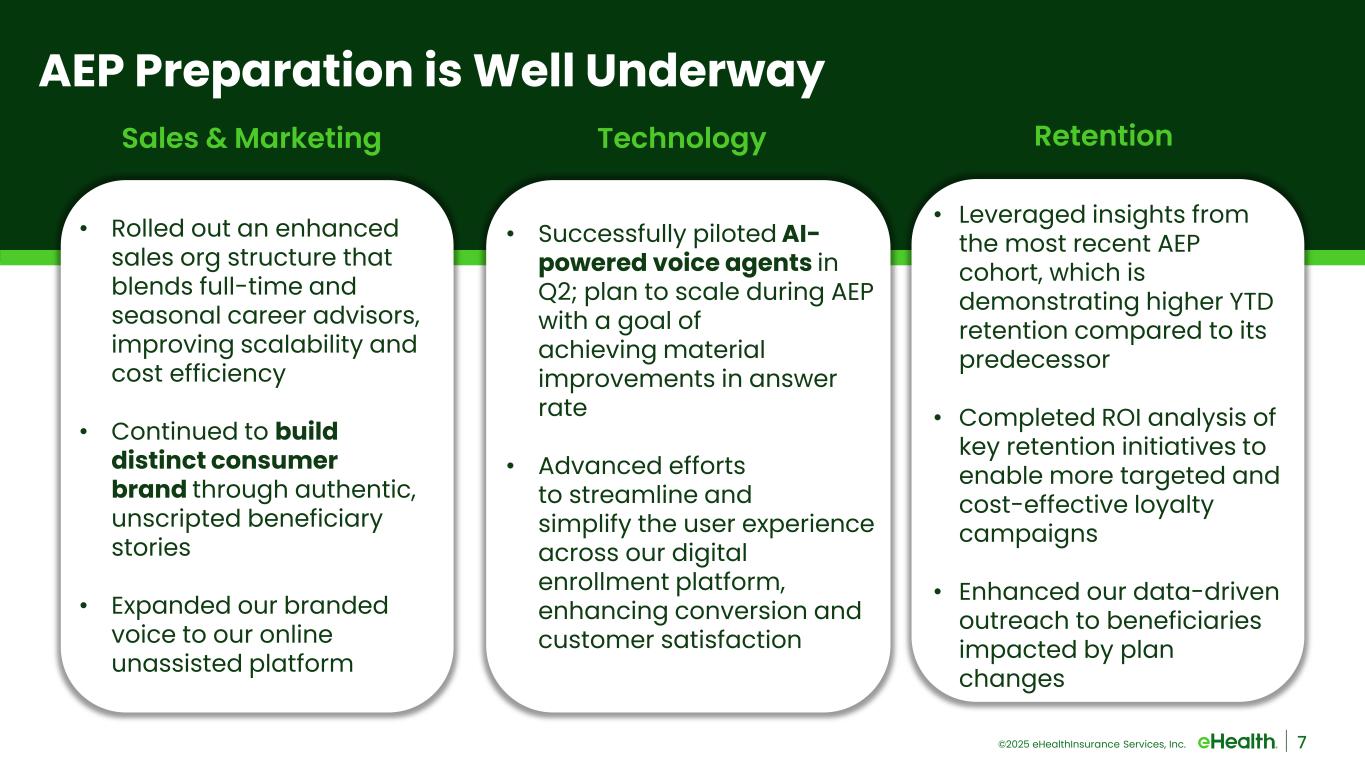
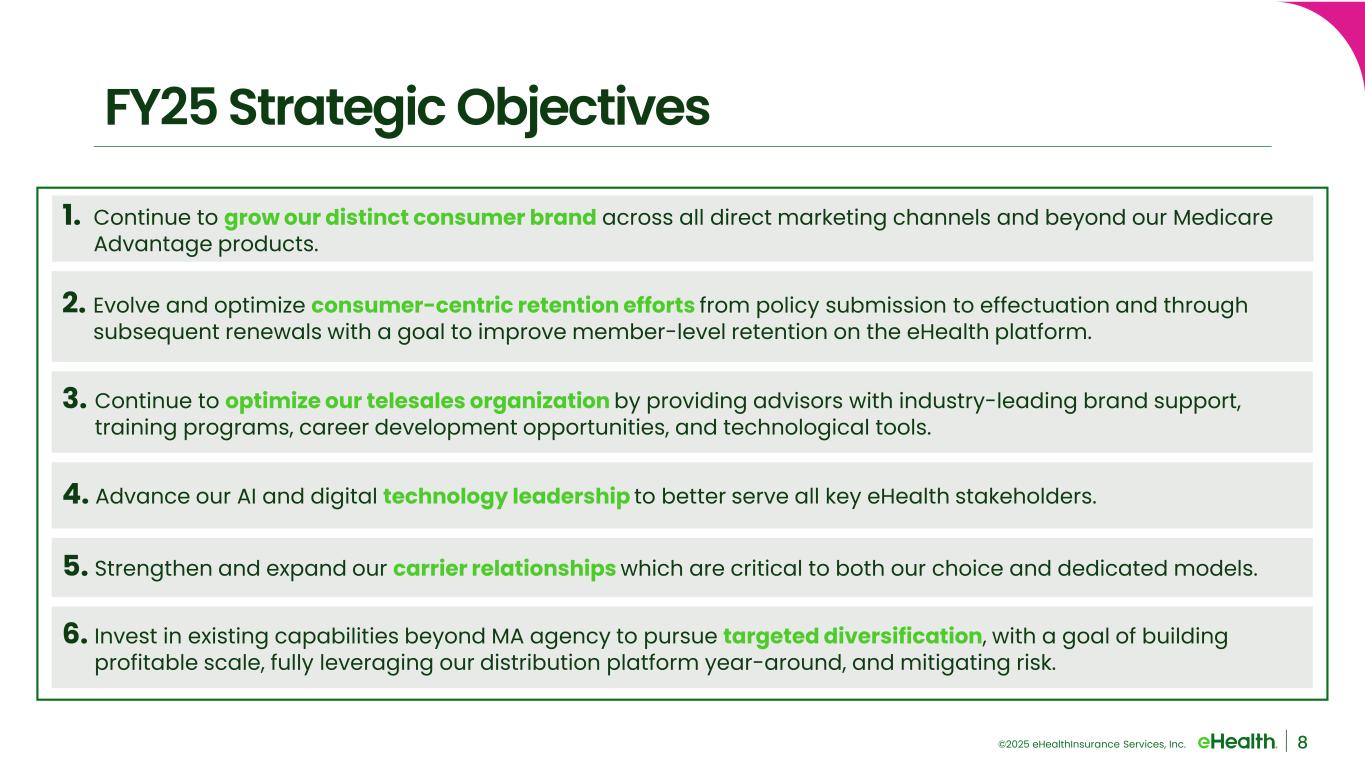
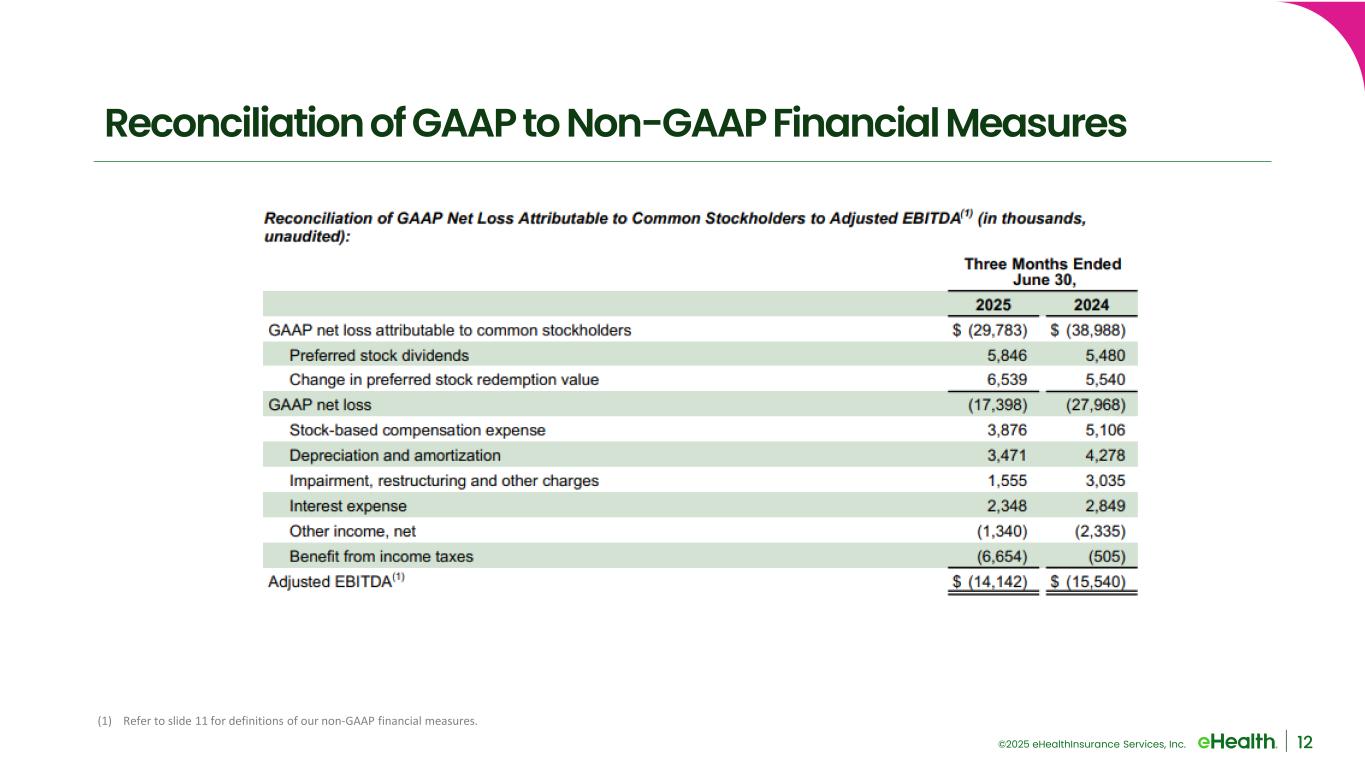
Thank you, Eli, and welcome, everyone. eHealth delivered another strong quarter, once again exceeding our expectations and demonstrating our ability to adapt to an evolving industry landscape. During the quarter, we began preparations for the most critical selling season of the year the medicare annual enrollment period or aep we now have greater but not full visibility into the likely dynamics of the fourth quarter aep and expect to gather additional key insights in the coming weeks these will first come through upcoming broker carrier strategy meetings followed by plan releases which typically occur in october just ahead of the enrollment period. As part of today's earnings report, we are increasing our full-year 2025 revenue and earnings guidance to reflect our strong performance to date while maintaining our AEP forecast in line with our standard approach. As you likely saw in last week's announcement, Derek Duke has been appointed as the next CEO of eHealth. Over the past few years, we've worked hard to transform our business, and I'm proud of the progress this team has made in strengthening our foundation and positioning the company for long-term profitable growth. With that transformation now complete, I'm confident that Derek is the right leader to guide eHealth into its next chapter, focused on greater scale, business diversification, and sustainable cash flow generation. He brings deep leadership experience across managed care and health insurance distribution, having served as CEO, CFO, and COO at his prior companies, including Health Markets, and most recently, Magellan Health. To ensure a smooth transition, I'll be staying on in an advisory role through the end of the year, including the critical AEP, and will continue to serve on the board as a director, providing continuity and support as Derek steps into the CEO role next month. Derek is in the room with us today and is looking forward to meeting with our investors and analysts following this call. Let me now highlight some of the key industry developments since our last earnings call. In June, CMS published the maximum broker commission rates for plan year 2026. Much like the Medicare reimbursement rates for carriers released in May, these commission rates were significantly more favorable than they have been in recent years. Following consecutive years of bigger increases to the maximum rate, the announced rate effectively serves as a correction, bringing us back in line with the 10-year average. The announced 26 commission rates exceeded our expectations, including the rate assumptions embedded in our 2025 guidance. As noted, we have not incorporated any AEP-related impacts into our updated outlook, including this recent broker rate announcement. With respect to the macro MA environment, carriers are communicating persistent margin pressure. They have pointed to utilization trends as well as lower-than-necessary reimbursements, despite the favorable rates for 2026. As a result of these pressures, we believe this year's AEP could be as disruptive and complex as last year's, with meaningful implications for both beneficiaries and our business. As a result, we anticipate additional geographic service area reductions, continued benefit reductions, and the potential for carriers to make certain plans non-commissionable as a tool of plan enrollment control. In contrast, some carriers that made significant strategic corrections last year will be opting for greater plan stability, which may position them to gain market share. This anticipated volatility is a key reason why we are maintaining our underlying AEP expectations as part of our guidance. Medicare Advantage continues to enjoy strong, bipartisan support in Congress, reflecting its critical role in delivering high-quality, affordable healthcare to approximately 35 million seniors. This program has also received early, positive signals from the new administration, reinforcing its stability and importance in the broader Medicare landscape. With consistently higher satisfaction ratings, Medicare Advantage remains a popular and trusted choice among Medicare beneficiaries nationwide. The Medicare Advantage program will likely continue to evolve over the coming years as policymakers, regulators, and health plans work to strengthen its value, improve health outcomes, and ensure long-term sustainability. In the meantime, the near-term challenges that are facing MA organizations represent an opportunity for eHealth to provide valuable assistance to beneficiaries as they navigate this dynamic environment. We believe we are well positioned to further differentiate eHealth and strengthen our brand recognition. In contrast to the volatile environment, we expect eHealth to stand as a source of continuity and trusted service to help ensure our members retain uninterrupted access to quality, affordable health care, including the preferred physicians and hospital networks. Last year, AEP highlighted the strategic advantage of our broad carrier relationships and National Geographic footprint. We successfully navigated benefit plan cancellations and carrier market exits, which enabled us to continue offering high-quality plan options across all of our key markets while delivering exceptional enrollment growth. In contrast, smaller and more regionally concentrated agencies are likely to face continued challenges. We anticipate further consolidation or exits among our peers, creating additional opportunities for eHealth to gain market share and reinforce our leadership position. Turning to our second quarter results, revenue came in ahead of internal expectations driven by better than expected Medicare Advantage enrollment and favorable member retention trends in our Medicare business, which positively impacted tail revenue and lifetime values, or LTVs, for both Medicare Advantage and Medicare Supplement products. Second quarter revenue was $60.8 million, gap net loss was $17.4 million, and adjusted EBITDA was negative $14.1 million. We ended the quarter with $105.2 million in cash, cash equivalents, and short-term marketable securities, reflecting strong collections from new Medicare enrollments. As a reminder, the year-over-year decline in second-quarter Medicare enrollments and related revenue was expected and reflects the impact of recent regulatory changes that limit dual-eligible Medicare beneficiaries from switching plans outside of the main enrollment periods. Prior to the regulation, which was implemented earlier this year, enrollment activity from dual eligible beneficiaries represented a significant portion of our Q2 and Q3 enrollment volume. We now expect some of this MA volume to shift to the fourth quarter AEP. To help mitigate this elevated seasonality in Medicare enrollments, we expanded our focus on insurance products that can be sold year-round, such as Medicare supplement, hospital indemnity plans, and other ancillary options. We also proactively adjusted our telesales staffing model, introduced innovative aging career pathing strategies, and leveraged our industry-leading technology stack, elements I'll return to shortly. During the quarter, we completed our LTV refresh, a critical update that incorporates the majority of data from the most recent AEP and OEP cycle, our highest volume periods of the year. Overall, Medicare retention was in line with expectations, while the most recent AEP cohort outperformed, supported by our retention strategies and the growing strength of our consumer brand. Our loyalty organization's tireless and iterative work played a key role in the improved retention we have seen so far with this cohort. Looking ahead to Q4 and the upcoming AEP, our preparation efforts are progressing well across the organization. Our marketing team is building on last year's success by featuring authentic, unscripted stories for Medicare beneficiaries that highlight the value we bring to the market. As sector disruption continues, our advisors are helping beneficiaries navigate plan changes with clarity and simplicity. We're also expanding our brand message beyond the live advisor experience to include our online consumer platform, Guiding Shoppers to eHealth.com, which can be navigated independently or with licensed advisor support. This reflects the convergence of two of eHealth's core differentiators, our advanced technology that enables end-to-end online shopping enrollment, and our trusted, distinct brand voice. Within our telesales organization, we implemented a more flexible structure that combines full-time and seasonal licensed benefit advisors, and will allow us to adjust capacity more efficiently to the seasonal pattern of the Medicare business. This change was key to our profitability outperformance during Q2, despite the decline in enrollment volume. Our goal is to create an environment that will empower advisors who are interested in seasonal work and will continue returning to us year after year. As part of this initiative, we have developed impactful programs to narrow the conversion rate gap between full-time and seasonal advisors. During the quarter, we also successfully piloted AI voice agents to handle customer calls outside of business hours and to expand capacity during peak hours. The results to date are encouraging. We've seen improvements in call center productivity metrics. Most importantly, we received highly positive feedback from customers who used this new feature. As we approach AEP, we expect the AI screener tool to play an even more important role, especially given the significant call volume spikes we typically experience toward the end of the enrollment period. Following the success of the pilot, we're now deploying the tool at scale and expect AI screening to materially improve answer rates, a meaningful driver in an industry where wait times can exceed an hour during peak periods. Beyond this exciting development, our digital organization continues to make enhancements across our omni-channel platform to streamline and simplify user experience in support of growing adoption of internet use from seniors. Member retention remains a cornerstone of our overall strategy. During the quarter, we conducted a comprehensive ROI analysis of our core retention initiatives, which we expect to allow our loyalty teams to increase the precision in their approach, directing resources towards the programs and member segments that deliver the greatest impact. These efforts are designed to support our members through this dynamic period and reinforce the value of a lifetime relationship with eHealth. Carrier alignment also continues to be critical, as ever, in the lead-up to this enrollment period. This AEP, we expect carrier growth strategies to become increasingly targeted, focusing on their best-performing plans and geographies while de-emphasizing less profitable offerings. Given the sophistication of our marketing capabilities and our enhanced inter-organizational connectedness, we believe we can be more effective than ever in support of these goals for our carrier partners. We continue to work on and have made progress towards improving our capital structure. Our capital strategy has three tenets. first, to address our term loan that matures in February of 2026, second, to increase our access to capital to support profitable growth in our core business and diversification areas, and third, to address our convertible preferred instrument. The process is dynamic, but the option towards which we are currently progressing is expected to achieve the first two objectives while also accomplishing an important task of validating our commission's receivable asset. While we do not expect to achieve the third objective of addressing the convertible preferred at this time. We remain committed to this goal. We will continue working towards achieving a best-in-class capital structure while understanding it might be a multi-step process. In closing, our second quarter performance further demonstrates eHealth's ability to navigate a dynamic environment with agility and focus. This includes making strategic adjustments within our telesales organization to enhance flexibility, as well as leveraging technology and AI to further optimize our capacity. We are encouraged by a year-to-date performance that allows us to raise our 2025 annual revenue and earnings guidance ranges. Additionally, our recently completed LTV refresh reaffirmed the quality of our receivables. We're expecting another dynamic AEP that will present a unique set of opportunities and demands on our organization. We remain confident in our ability to execute on these opportunities through the second half of the year. I'll now pass the floor to John to provide additional details on our financials. John? Thank you, Fran, and good morning, everyone.
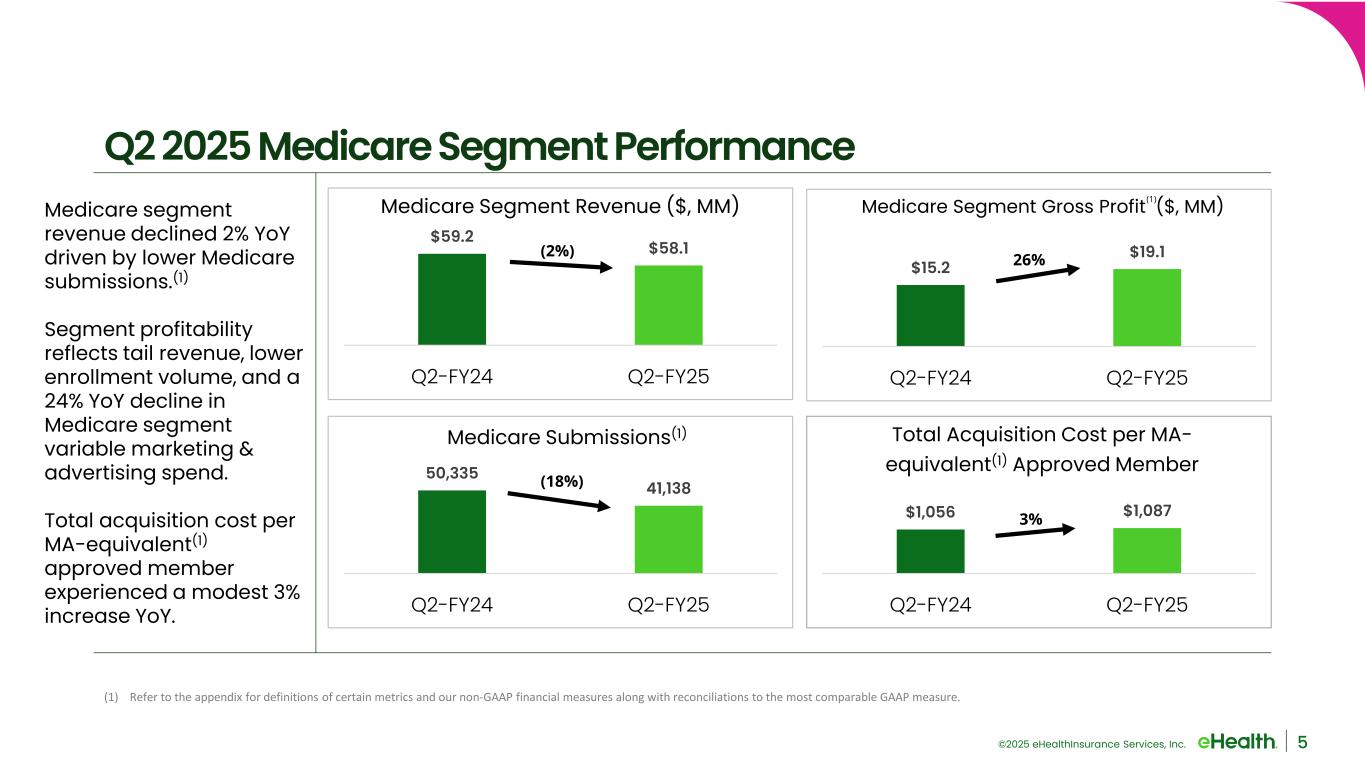
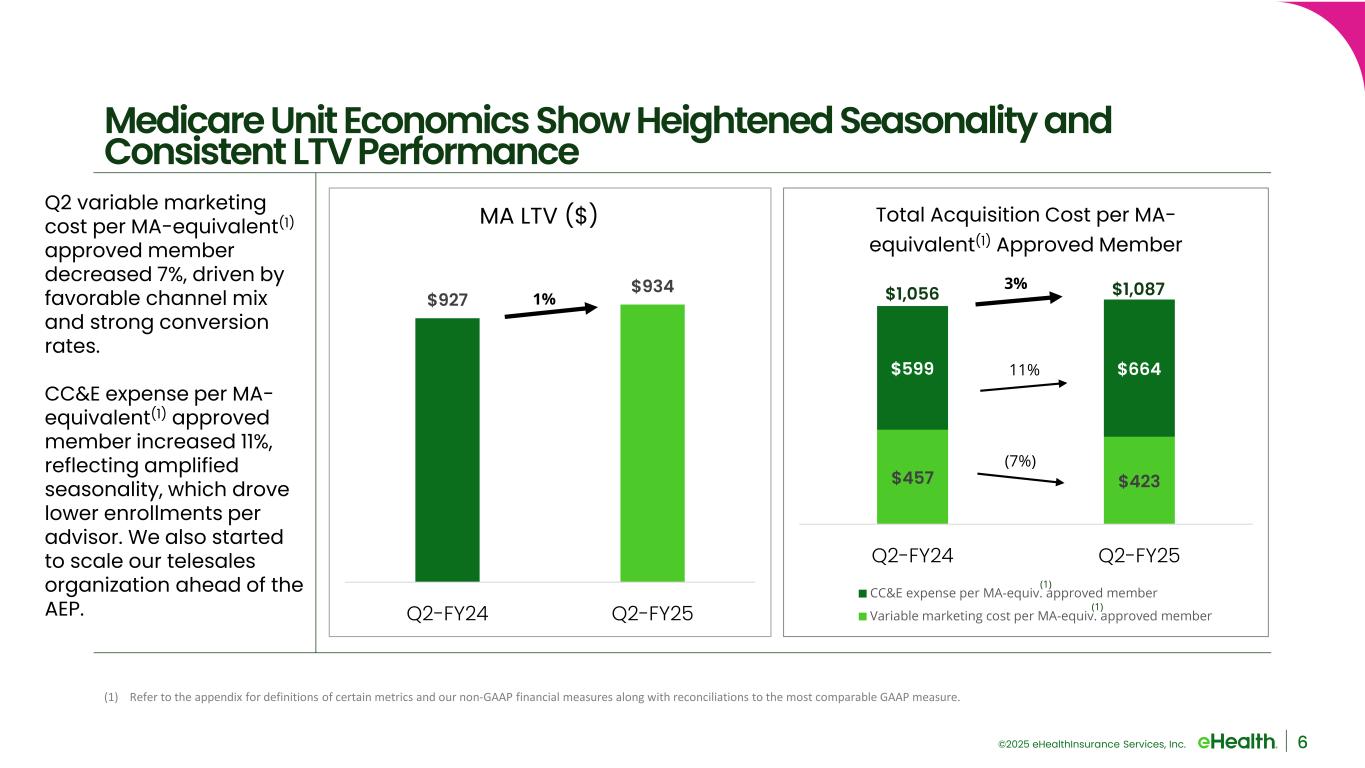
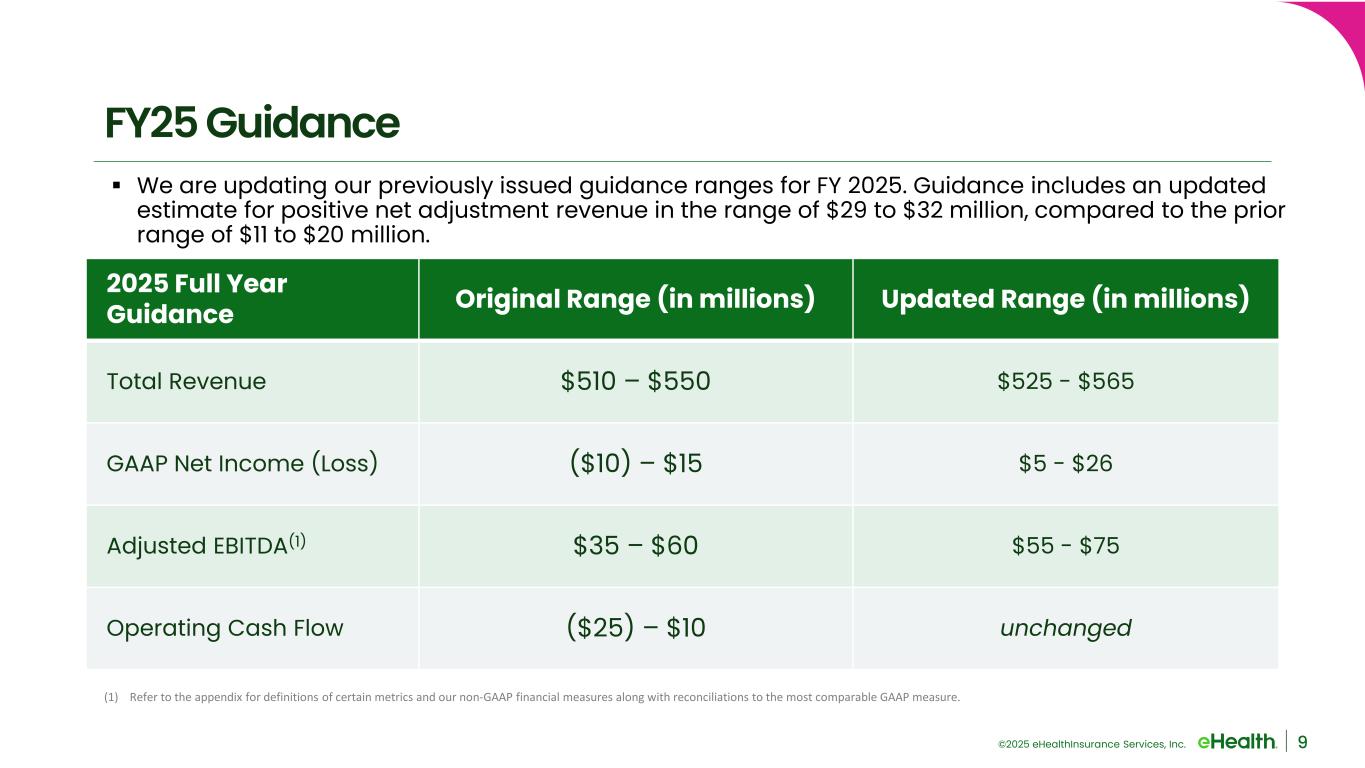
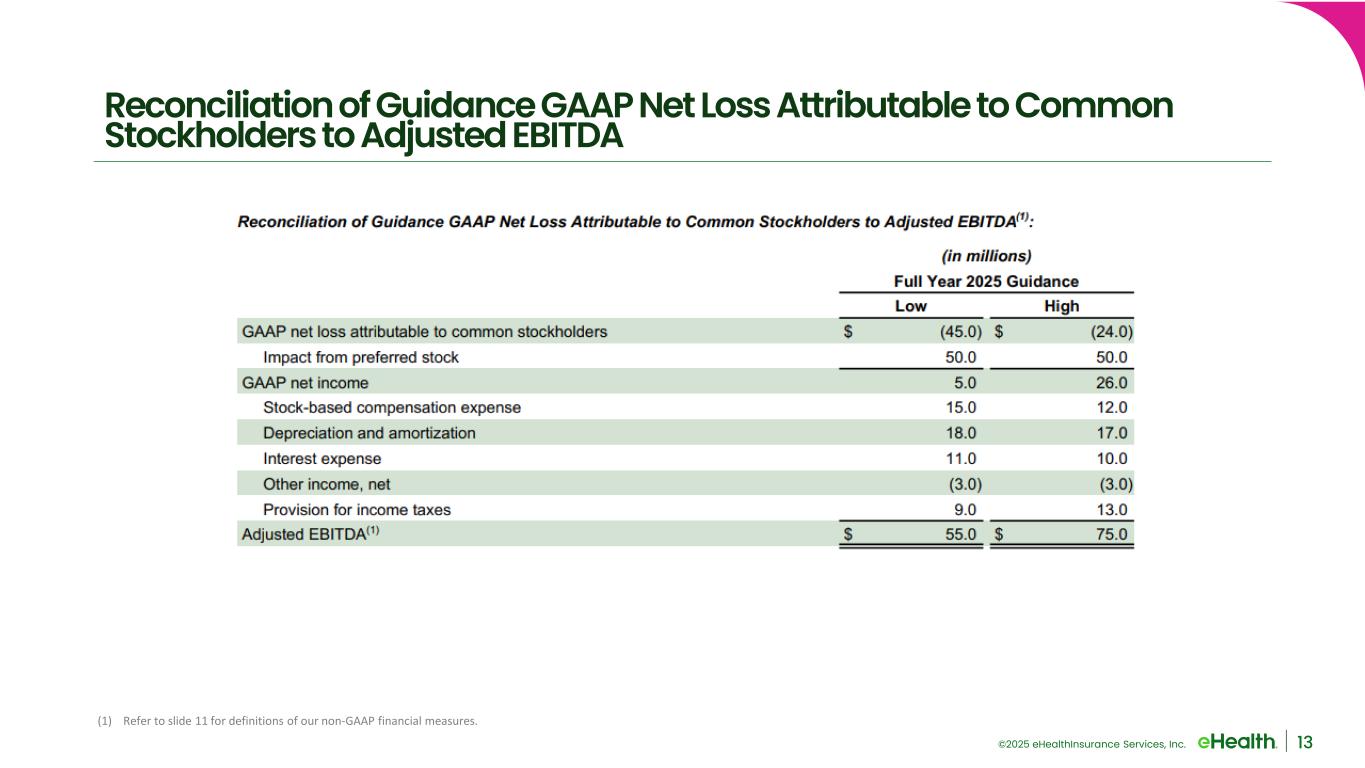
We're pleased to report that we've exceeded our revenue and earnings expectations for the second quarter, reflective of our ability to successfully adapt to a changing macro and regulatory environment. This performance speaks to the agility of our operational model and continued discipline we've applied to managing costs across the business. As I review our results, please note that all comparisons are year-over-year unless otherwise specified. Second quarter revenue was $60.8 million, including $17.8 million in positive net adjustment revenue or TAIL revenue. In our Medicare segment, revenue was $58.1 million, a decrease of 2%, reflecting lower enrollment volumes offset by greater TAIL revenue. Total Medicare submissions across our agency and Amplify Fulfillment Models declined 18%, largely due to changes in dual eligible enrollment rules. We expect some of this volume to shift into the fourth quarter during AEP. Medicare non-commissioned revenue came in at $5.8 million, compared to $8.6 million last year, primarily due to the timing of sponsorship revenue. We also completed our LTV refresh this quarter, which incorporated the latest data from the fourth quarter annual enrollment period and the first quarter open enrollment period. With what continues to be a highly dynamic and evolving environment, we're pleased to report that we continue to record positive TALE revenue in our Medicare segment, specifically related to our Medicare supplement and Medicare Advantage products. That's an important signal. This reinforces our confidence in the assumptions embedded in our LTV model, and we continue to be vigilant in updating our model to reflect the latest market observations. It also reflects the strength of our underlying book, the effectiveness of our revenue recognition policies, and the success of our strategic initiatives aimed at improving member retention and quality. As a result, we believe we are appropriately positioned to navigate another cycle of elevated switching. We're particularly encouraged by the performance of the January 2025 Medicare Advantage cohort enrolled during last year's AEP, which is outperforming its predecessor cohort across several key metrics. These include sent-to-approved ratio, approved-to-paid ratio, initial 90-day retention, and year-to-date retention. MA LTV for Q2 came in at $934, up 1% and within expectations. Second quarter MedSup LTV was $1,435, up 29%, primarily reflecting greater retention trends, lower constraints, and favorable carrier and contract mixes we reduced the constraints used in our med sup ltvs reflecting a tighter range of historical outcomes relative to model driven projections lower constraint contributed approximately seven percent out of the total 29 percent of year-over-year ltv increase to preface our discussion of q2 medicare profitability the second and third quarters are typically characterized by higher variable costs per approved member, as we ramp up investments in sales and marketing ahead of AEP. These investments are spread over seasonally lower volumes, a dynamic that is especially pronounced this year. On an annual basis, we expect these investments to yield attractive returns during the key Medicare enrollment period in the fourth quarter. Second quarter, Medicare segment gross profit increased 26%, or $3.9 million. Notably, Additionally, Medicare's segment gross profit for the first six months of 2025 is up 47%, or $17.6 million compared to the first six months of 2024. Driving those results, Q2 variable marketing costs per approved MA equivalent member decreased 7%, driven by favorable channel mix and strong conversion rates. Conversion improvement was particularly pronounced within our online unassisted channel where they increased 50%. Customer care and enrollment expense per approved MA equivalent member increased 11%, reflecting heightened seasonally lower enrollments per advisor in our decision to maintain high-performing tenured advisor force year-round. That said, CC&E costs came in better than expected, highlighting the increased agility of our telesales organization. Combining advisor and marketing costs, total acquisition costs per Medicare approved member increased by just three percent. We see this modest increase as a positive given the changes to enrollment rules during Q2. Shifting to our employer and individual segment, revenue for the quarter was 2.7 million with segment gross loss of 0.3 million. This compares to revenue of 6.6 million and gross profit of 3.7 million in Q2 last year. The decline reflects lower enrollment volumes combined with increased constraint that we apply to LTVs in our individual and family plan sales and negative adjustment revenue of $1.3 million compared to positive $0.8 million last year, driven by IFP Market Dynamics. Across the business, we continue to manage our cost structure with discipline. Non-GAAP technology and content expenses decreased 13%, and non-GAAP general and administrative expenses remained flat. Combined fixed costs with a combination of non-GAAP technology and content and non-GAAP general administrative were down 1.6 million or 5% as we continue to drive operational leverage moving to q2 profitability net loss for q2 was 17.4 million an improvement compared to the net loss of 28 million in the second quarter a year ago adjusted ebitda was negative 14.1 million compared to negative 15.5 million both of these These metrics are better than expected, including and excluding the impact of tail revenue. On the cash flow side, operating cash flow in Q2 was negative $41.2 million compared to negative $32.2 million last year. We ended the quarter in a strong cash position with $105.2 million in cash, cash equivalents, and short-term marketable securities. Commissions receivable totaled $917 million, up from $831.9 million as of June 30, 2024. Before I close, I want to touch on guidance and what we expect in the near term. We are updating our full-year guidance to reflect our outperformance to date. It's also worth repeating we are not yet incorporating the full impact of the expected commission increase for plan year 2026 and other AEP-related developments. as such our new guidance ranges are as follows total revenue for 2025 is now expected to be in the range of 525 to 565 million compared to our prior guidance range of 510 to 550 million gap net income for 2025 is now expected to be in the range of 5 million to 26 million compared to prior guidance range of net loss of 10 million to net income of 15 million adjusted ebitda for 2025 is now expected to be in the range of 55 to 75 million compared to our prior guidance range of 35 to 60 million we continue to expect operating cash flow to be in the range of negative 25 million to positive 10 million these ranges include estimated positive net adjustment revenue in the range of $29 million to $32 million compared to the prior range of $11 million to $20 million. Looking to Q3, we expect a year-over-year decline in revenue and adjusted EBITDA driven by the same regulatory changes pertaining to dual eligible beneficiaries that impacted our Medicare Advantage enrollment volumes this quarter. As we ramp our telesales organization ahead of the AEP and invest in training our advisors, we also expect to carry greater CC&E costs compared to the second quarter. Our AEP preparedness efforts are progressing well, and I look forward to updating you on our AEP halftime performance when we report third quarter earnings in November. With that, Operator, please open the line for questions.
Operator
Thank you. Ladies and gentlemen, we will now begin the question and answer session. Should you have a question, please press the star followed by the one on your touchtone phone. You will hear a prompt that your hand has been raised. Should you wish to withdraw your question, please press the star followed by the two. If you are using a speakerphone, please lift the handset before pressing any keys. We will move on to our first question that comes from George Sutton of Craig Hallam. Please go ahead.
Thank you. And Fran, congrats on a great career. And welcome to Derek. So, I wanted to make sure I understood the logic of not incorporating the rates in your guidance. You obviously have some conversations with carriers upcoming. Are you anticipating something different than a normal experience in terms of rates going into the AEP?
Good morning, George. Well, first, let me thank you for the kind words, and I can speak on behalf of Derek. He appreciates the welcome as well. The approach we've taken with the race is, until we have greater visibility through our normal interactions with our key carrier partners, and recognizing that, you know, there's obvious margin pressure, we don't want to get ahead of ourselves. We have some preliminaries, and they're encouraging. They're consistent with what we've experienced in the past, but they're not at a point where, you know, we can, feel confident that we could make the entire 10.9 percent in i think you'll see a combination of continued high end of the range or top end of the range and then we'll also see some hybrids that may incorporate some quality metrics and other requirements to achieve the maximum amount so this is evolving and you know i'm but i'm cautiously optimistic that clearly we're going to exceed what we had built into our forecast. That's the important takeaway.
Gotcha. So I wanted to understand on the AI voice agent, which sounds like that was a successful pilot. Obviously, these aren't licensed agents. So my assumption is there's a limited amount that an AI agent can do. Is this really a setup for a later meeting with one of your licensed agents? is that the process?
That's close to the process. The AI agent, the term agent is a technical term, it's not indicative of how we think of our licensed agents. So it's a screening process where they're taking demographic information, confirming the Medicare beneficiary number, other important data, zip code, probably one of the most important pieces of information we gather, because that's going to determine how that call will be routed to a licensed agent. It's going to allow for us to answer more calls, reduce the hold time. George, I have to tell you, when we first started piloting this back in April, I was personally blown away by the quality of the experience and the feedback, most importantly, from beneficiaries who experienced it was so encouraging. And it's evolving so rapidly. It is consistent, high-end experience, and it is so interactive. I mean, even acknowledging a break in a conversation, the AI agent can pick up a hesitation and be polite about it. It's remarkable. We'd love to demo it for you, but we're really optimistic about how this will allow us to improve the customer experience, obviously answer more calls which should improve the conversion rate because there is a correlation between calls answered and conversion effectiveness.
I'll just build George. Hi, it's Michelle Barbeau. Nice to talk with you. Just one other part of your question to confirm is that the screening process then transfers immediately to a licensed advisor versus at a later time and so it's really about exactly as Fran said, right, being able to answer more calls, to collect that information, but then to really efficiently use the time that we have with licensed advisors.
Gotcha. Okay. One other thing, just to clarify your message on the capital structure. So, it sounds like you're working to deal with the term loan. Obviously, it sounds like a receivable securitization may be in play here, given your sizable receivables, but not being able to deal with the convert yet. Can you just give us a little bit more clarity on the message there?
Sure. You're right on all points. Let me start there. But I want to emphasize the second objective, and it's really to gain access to capital liquidity when we need it, right? So we want to have financial agility. The term loan is, you know, that's a given. That matures next February. But we want to have greater financial agility with respect to our capital structure and the approach we're taking, we expect to achieve that. I don't want to, I wouldn't assume that it's a securitization in the conventional sense of that word, but clearly the contract receivable asset, which is largely, you know, the makeup of our balance sheet, plays a vital role in this process. So I think it further demonstrates the credibility of our receivable asset. And that's been something we've been discussing for a couple of years now. When we complete this, I think, reinforce to the market the real value of that receivable. The third piece, you know, it's been a work in progress. And, you know, I would have loved to have been able to get something done on my watch. I don't see that as a possibility at this stage, but, you know, we will continue to work together with our preferred partner and see if there is a path to an outcome that is mutually beneficial and including in the best interest of our common shareholders.
Thanks, guys. Appreciate it.
Operator
There are no there are no further questions at this time so I will now turn the call over to Fran Soysman. Please continue. Oh thank you operator. We do have a sorry Fran we have had someone come up with a question. We will go on to that one more question here from George Hill from Deutsche Bank.
Leslie
Analyst — Deutsche Bank
Hi this is Leslie for George. So in terms of Medicare advantage. There's a lot of expectations for benefit change and potential benefit cuts expected for 2026. Can you talk about how you think about this will impact the market growth and churn overall in 2026?
Hi, Leslie. Thanks for joining. We, you know, again, we're still early in this process. There's more information to be gained from our interactions with our carrier partners. But from the early intelligence, it looks like it's going to resemble last year's, where we saw service area reductions, we saw benefit reductions, we saw plan withdrawals. We may not see the identical thing on a carrier-by-carrier basis. I think there'll be variations of that theme. But importantly, I think carriers recognize that they still have to achieve certain growth objectives because they lose members and sometimes they lose members in products and markets where they don't want to lose them right in profitable markets so they've got to replace that those members and of course throughout the year you have mortality so um there is i would say um balanced growth by product and by market and And we expect to see that as an overarching theme by at least the major carriers. The regional and the local and Medicare Advantage organizations don't necessarily have that option because they're geographically confined. So as far as benefit reductions, I think there's always a balance. these organizations are pretty sophisticated in knowing what beneficiaries value the most in their benefit arrangements and giving them the financial protection. And then there's, you know, their guardrails that are imposed by CMS. So, we do expect where the markets are good, we expect to see value propositions be retained or maintained, but it'll be an interesting AEP. Got it.
Leslie
Analyst — Deutsche Bank
That's helpful. I guess another question is just in terms of the ACA market. That is, we're expecting it going away. It will be going to expire at the end of this year. So, like, could you talk about how you think, expect this impact the overall market in 2026, and can you talk about how heightened regulatory oversight for this market has led to any changes for membership participation? Thanks.
Well, there's a lot in that question. Let me see if I can unpack it a bit. First, we don't see the ACA plans going away. I think the issue is the magnitude of the subsidization that occurs so and that still remains to be seen it wasn't addressed in the one big beautiful bill but there's certain expectations that through the balance of the year either through a continuing resolution or some other means congress will address this it is not a partisan issue it's a bipartisan issue there's red states that governors rely on that subsidization. Otherwise, it creates a burden for the state. So I think you'll see that evolve over the next couple of months. There will likely be some disruption where people no longer are eligible for subsidies or to the magnitude of subsidies they're accustomed to. So it'll be a dynamic open enrollment season for ACA plans, but we're prepared to navigate that. I should emphasize, not only on the ACA plans, but Medicare Advantage plans, when there's volatility and disruption, that plays to e-health strength, right? Because that's when there's more shopping, more people need guidance, and that's what we excel at.
Leslie
Analyst — Deutsche Bank
That's awesome. Thank you.
Operator
There are no further questions at this time, and I will now turn the call over to Fran Soysman. Please continue. you.
Well, thank you, Operator. As we wrap up today's call, I just want to take a moment, my last in this role, to thank all of you for your continued support and encouragement over the years. This quarter's results and our performance throughout the past 18 months are a testament not just to the strength of our strategy, but to the resilience, innovation, and dedication of the eHealth team. True leadership in business isn't measured by scale, but by the standards the company sets through its values, actions, and results. After four years at the helm, I'm stepping down as CEO next month. It's been the privilege of a lifetime to lead eHealth and work alongside such talented people. I will lead my role with full confidence in Derek, in this leadership team, and in our future. What we've built together is strong and the best is yet to come. So thank you for your trust that you placed in me and in eHealth. Thank you, Operator.
Operator
Thank you. Ladies and gentlemen, this concludes today's conference call. Thank you for your participation. You may now disconnect.