Operator
Good afternoon, everyone, and welcome to eHealth Inc.'s conference call to discuss the company's first quarter 2026 financial results. At this time, all participants have been placed in a listen-only mode. The floor will open for your questions following the prepared remarks. If you would like to ask a question during that time, please press star 1 to raise your hand. To withdraw your questions, simply press star 1 again. I'll now turn the floor over to Eli Neubrun-Mintz, Senior Investor Relations Manager.
Please go ahead. good afternoon and thank you all for joining us on the call today derek duke he helps chief executive officer and john dolan chief financial officer will discuss our first quarter 2026 financial results following these prepared remarks we will open the line for a q a session with industry analysts as a reminder this call is being recorded and webcast from the investor relations section of our website a replay of the call will be available on our website later today Today's press release, our historical financial news releases, and our filings with the SEC are also available on our Investor Relations website. We will be making forward-looking statements on this call about certain matters that are based upon management's current beliefs and expectations relating to future events impacting the company and our future financial or operating performance. Forward-looking statements on this call represent eHealth's views as of today, and actual results could differ materially. We undertake no obligation to publicly address or update any forward-looking statements except as required by law. The forward-looking statements we will be making during this call are subject to a number of uncertainties and risks including but not limited to those described in today's press release and in our most recent annual report on Form 10-K and our subsequent filings with the SEC. We will also be discussing certain non-GAAP financial measures on this call. Management's definitions of these non-GAAP measures and reconciliations to the most directly comparable GAAP financial measures are included in today's press release, except where such reconciliation has been omitted in reliance on this unreasonable efforts exception provided under Item 10E1IB of Regulation SK. With that, I will turn the call over to Derek Duke. Thank you, Eli.
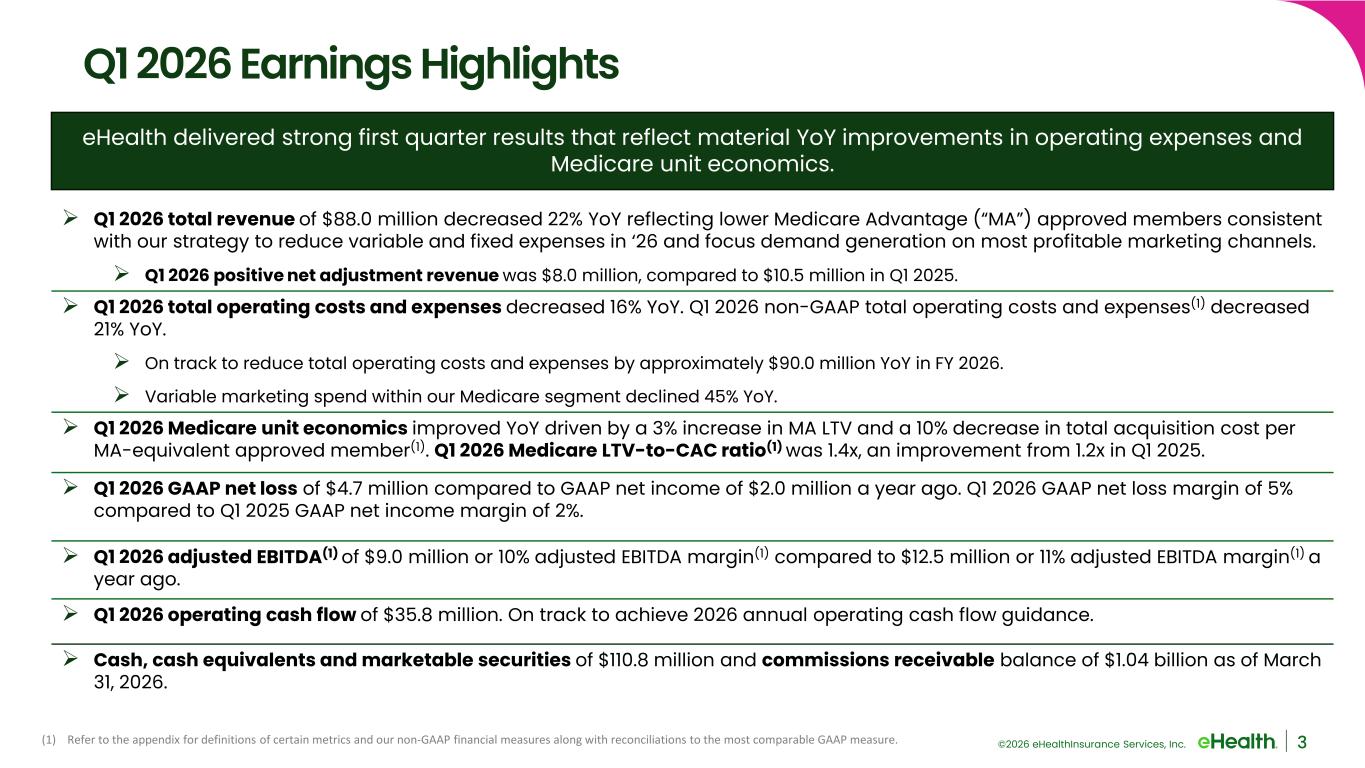
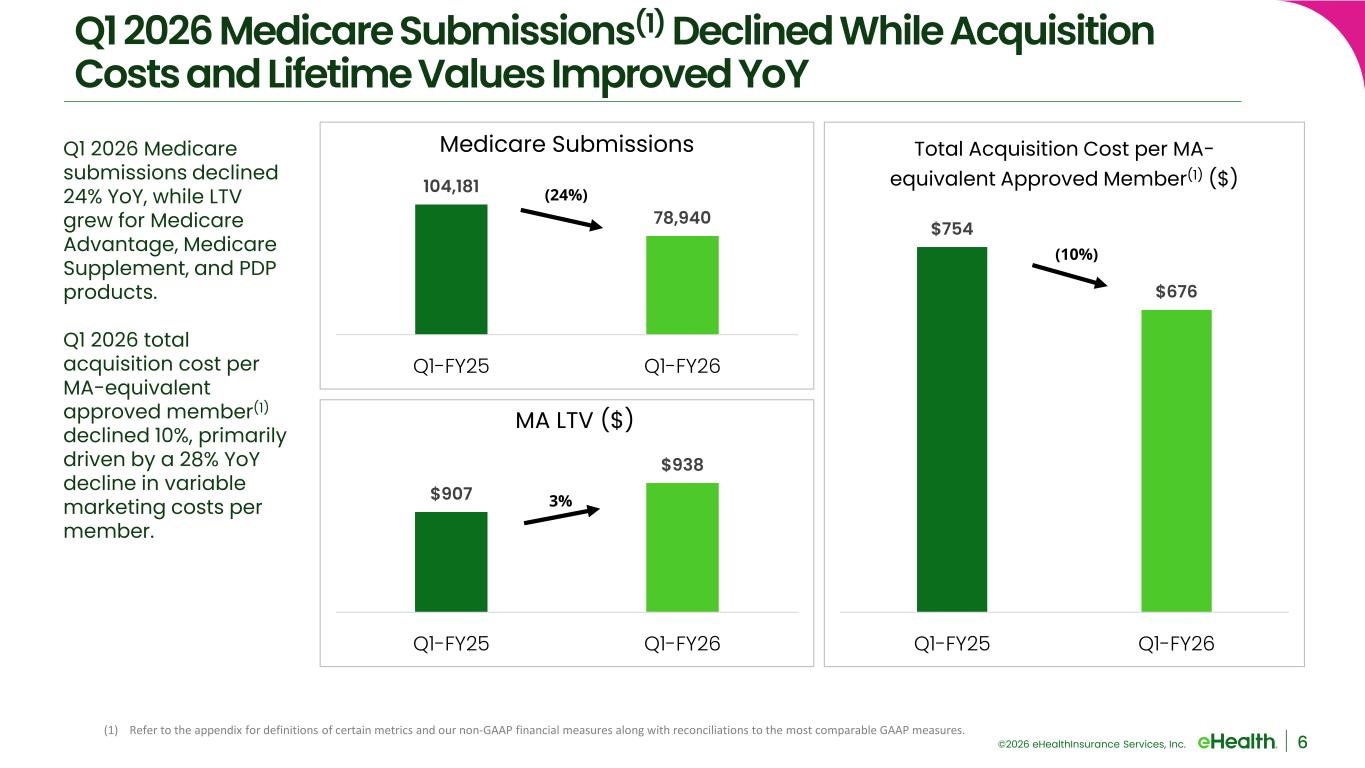
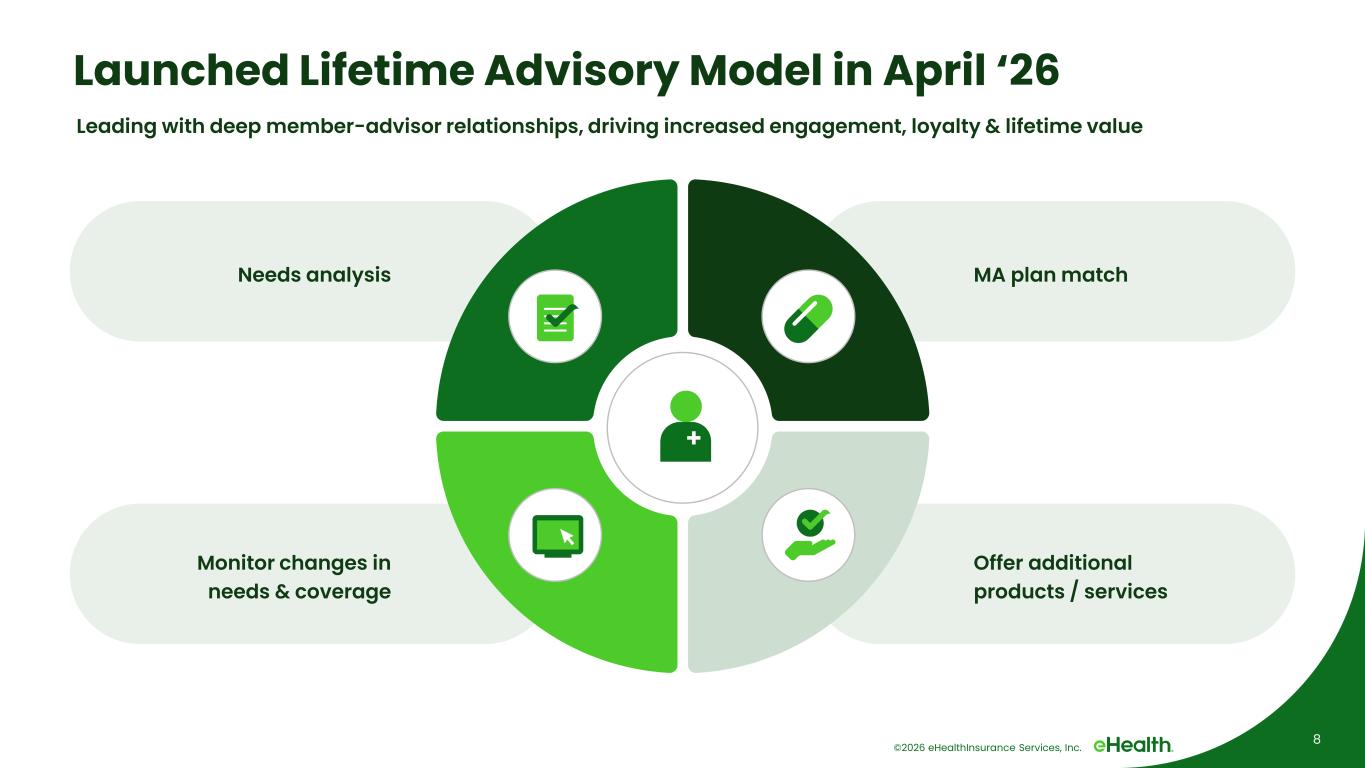
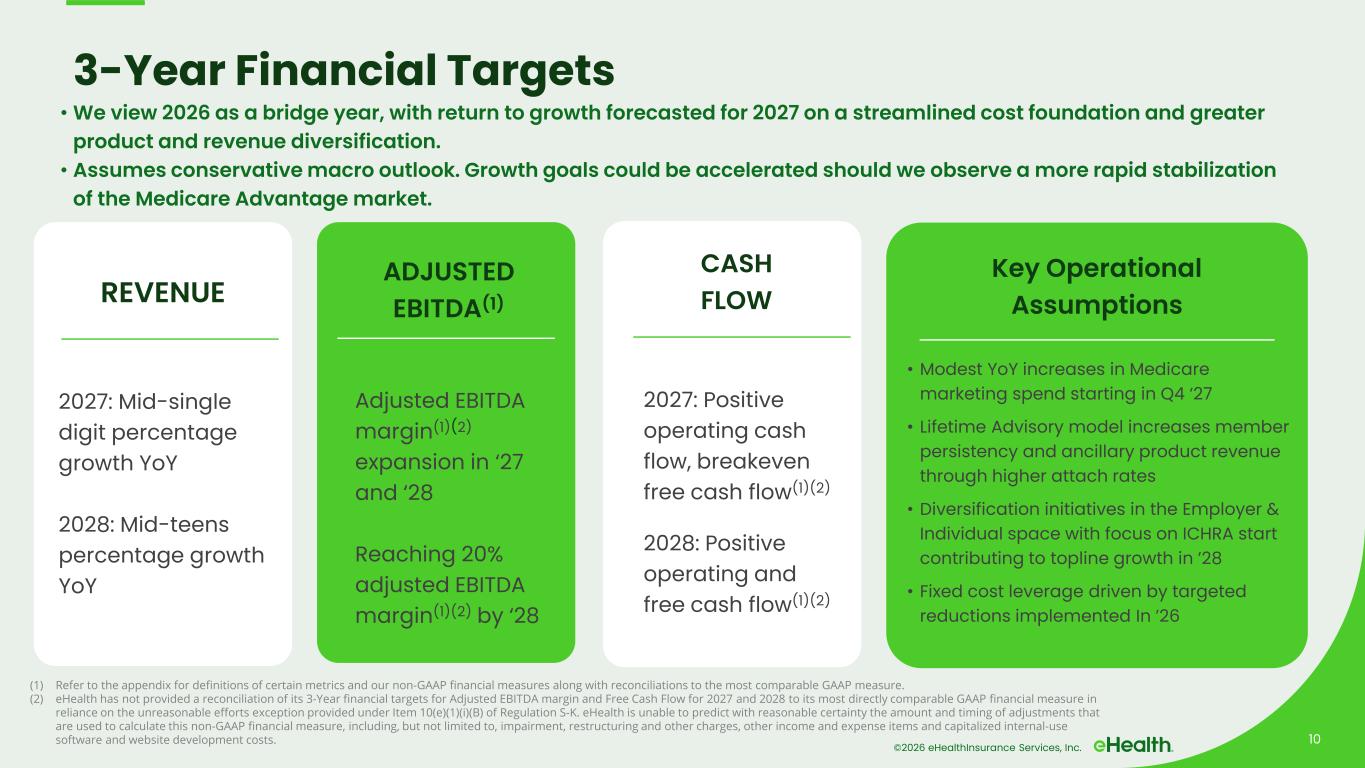
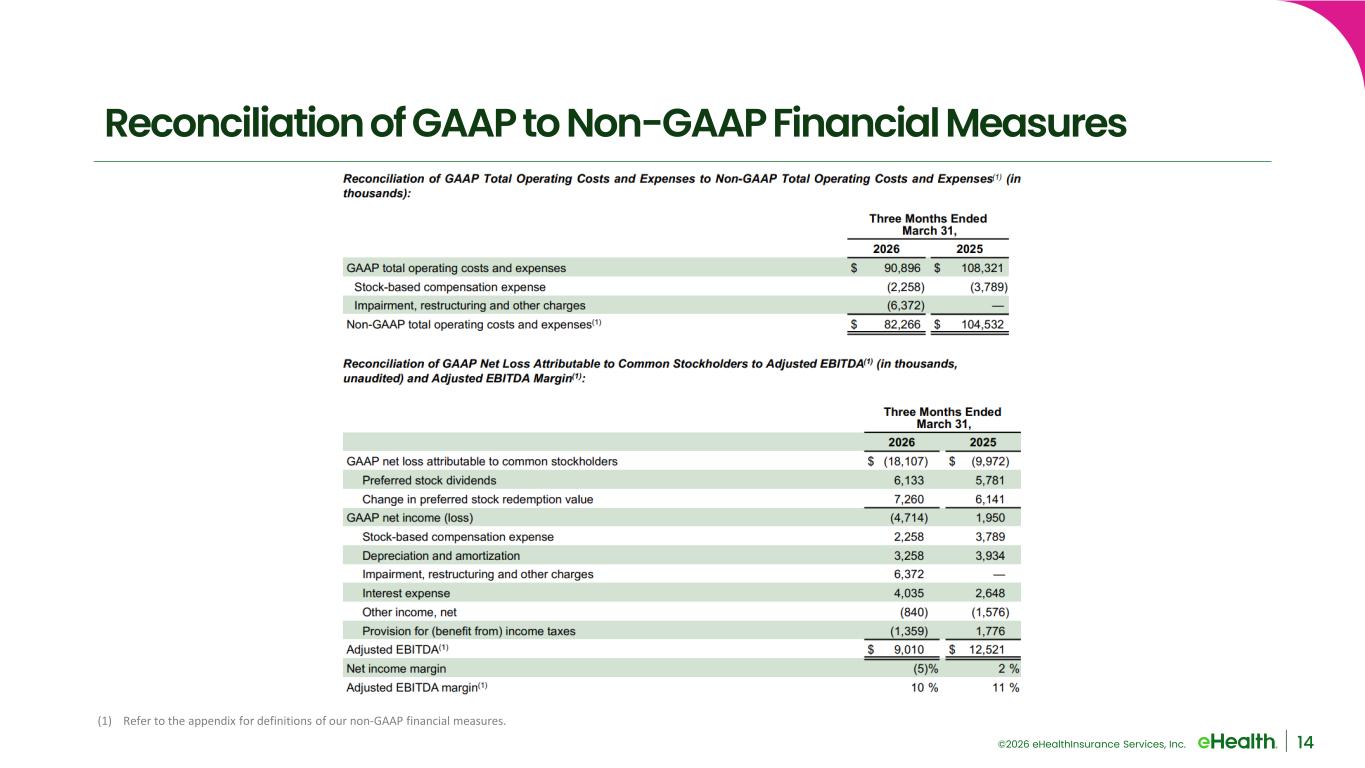
Good afternoon, and thank you for joining us today. We're pleased with our first quarter results, which came in ahead of expectations, driven by stronger than anticipated Medicare enrollment volume at favorable unit economics. During the quarter, we made meaningful progress towards the strategic initiatives we outlined on our last earnings call, including implemented targeted cost reductions and completing critical build and readiness work for initiatives that launched in April. Most notably, we prepared for the rollout of our lifetime advisory model and the introduction of our new final expense insurance product. We are also encouraged by recent industry developments. Last month, CMS finalized the 2027 Medicare Advantage rate, which came in above the initial proposal. While this is just one variable in the system we believe it is an important signal that cms leadership is responsive to industry feedback and focused on long-term program sustainability that said we are early in the planning cycle for the upcoming annual enrollment period carriers are currently developing their 2027 bids including benefit structures and geographic market strategies We anticipate gaining a more comprehensive understanding of the upcoming AEP cycle and individual carrier approaches once bids are submitted. While some carriers may prioritize market share capture this AEP, we believe margin will remain the primary focus for most, and the Medicare Advantage reset cycle will continue. This means further adjustments to plan benefits and service areas, as well as additional plan eliminations. As a result, we expect consumer demand to remain strong and carrier inventory dynamics to remain complex, similar to last year. We believe this environment underscores e-health's value proposition as we help consumers navigate the evolving Medicare landscape. Against this backdrop, we are intentionally evolving eHealth's operating model to foster deeper, longer-lasting relationships between members and advisors. Our goal is to ensure consumers see eHealth not as a one-time enrollment platform, but as a trusted ally throughout their healthcare journey. Central to this evolution is our lifetime advisory model, which I will discuss shortly. From a financial standpoint, our priorities this year are achieving breakeven or better operating cash flow and positioning the company for sustainable, profitable growth once the Medicare Advantage reset cycle is complete. Our revised three-year outlook, which we published today in our earning slides, reflects a return to revenue growth in 2027 alongside adjusted EBITDA margin expansion, positive operating cash flow and break even or better free cash flow. First quarter revenue was 88 million ahead of our expectations. Gap net loss was 4.7 million and adjusted EBITDA was 9 million exceeding our internal plan. Revenue performance was driven by Medicare enrollment volume as well as better than expected revenue outside of core MA agency sales, reflecting progress in our diversification efforts. This includes providing ancillary and post-enrollment services. During the quarter, we implemented headcount reductions and vendor consolidation initiatives. These actions are expected to reduce our fixed operating cost base by approximately $30 million in 2026 compared to 2025, representing roughly a 20% reduction. While we realized some savings in the first quarter, the full impact is expected to become more apparent as we move through the year. Quarter one results also reflect our strategic decision to reduce variable marketing and agent related spend, focusing investment on our best performing channels. First quarter MA LTV increased 3%, while total acquisition cost per MA equivalent approved member declined 10% compared to a year In the first quarter, we moved with urgency to execute on our strategic plan and make the necessary preparations for the launch of our lifetime advisory model. This key initiative is supported by a set of newly released agent-facing technology tools designed to enhance the beneficiary experience. These tools leverage the data and institutional knowledge that we have built up over decades of working with a wide array of beneficiaries. Core components include a customer dashboard that provides a holistic view of the member relationship with eHealth, system-generated recommendations that prompt advisors to engage at the right moments, and dynamic insight-driven scripts embedded directly into the sales and service workflow. Together, these tools are intended to ensure more personalized, proactive conversations, while also driving consistency, scalability, and quality across the advisor experience as the model matures. As part of this strategy, we're expanding the scope of services we provide beyond core MA coverage. eHealth already offers ancillary plan options, such as dental, vision, hearing, and hospital indemnity plans. Last month, we launched final expense insurance offerings. These products enrich our health-based inventory by providing beneficiaries with additional financial protection and ultimately peace of mind. Final expense sales also offer attractive unit economics and a compelling cash flow profile. Over time, we plan to add more products and services that will benefit our members based on findings from consumer-focused groups and industry research. A lifetime advisory model is expected to support consistent year-round engagement and enables more effective cross-selling. Through this strategy, we believe we will increase member lifetime value, improve retention, strengthen unit economics, and build durable brand equity rooted in trust and loyalty. As part of today's earnings release, we're updating our three-year financial targets. I would first like to stress that our decision to pull back on growth in 2026 was intentional and strategic. In this environment, we had the ability to drive higher Medicare enrollment volume, but chose instead to prioritize operating cash flow by focusing on our most profitable marketing channels, building our lifetime advisory model, and taking a focused and disciplined approach to our diversification initiatives. We believe this strategy positions us well to return to growth next year on a stronger foundation. Our three-year forecast reflects mid-single-digit revenue growth on a percentage basis for 2027 as we selectively dial up member acquisition spend. We expect our revenue growth rate to increase to the mid-teens in 2028, supported by our core MA business and a greater contribution from ancillary sales, driven by our new operating model. Beginning in 2028, we also expect our E&I segment to contribute to growth, with a focus on expanding employer coverage through partner-driven ICRA offerings. Adjusted EBITDA margins are expected to increase each year starting in 2027 to reach 20% by 2028. This translates to double-digit percentage adjusted EBITDA growth in 27 and 28, reflecting the benefits of our fixed cost reductions and favorable Medicare unit economics. We forecast achieving break-even or better free cash flow in 2027. Our revenue growth goals could be accelerated should we observe a more rapid stabilization of the Medicare Advantage market relative to our current outlook. We're pleased with our first quarter results and the progress we've made executing against the initiatives outlined on our fourth quarter earnings call. We believe eHealth is well positioned to continue delivering superior service and value for our customers and carrier partners, and we look forward to updating you on further milestones along our path towards sustainable, profitable growth. I will now turn the call over to our CFO, John Dolan, for his remarks.
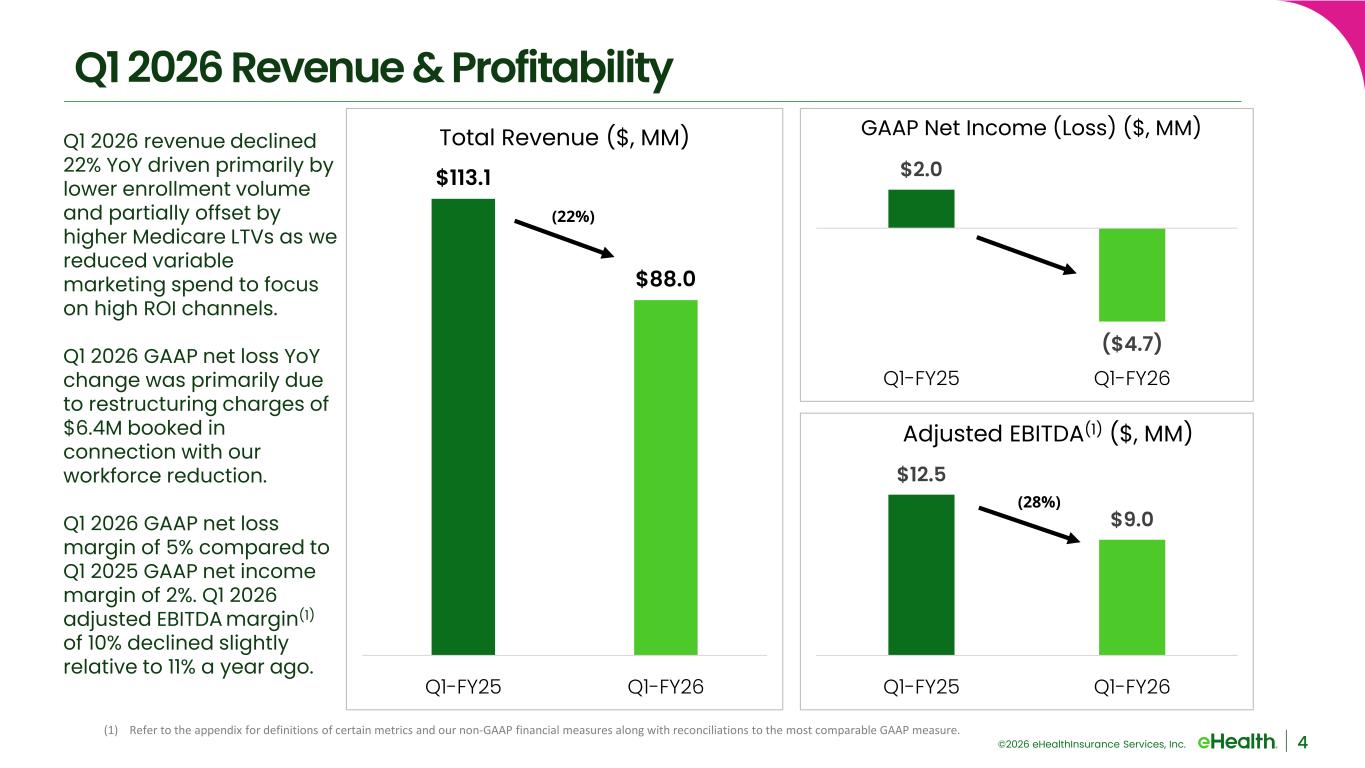
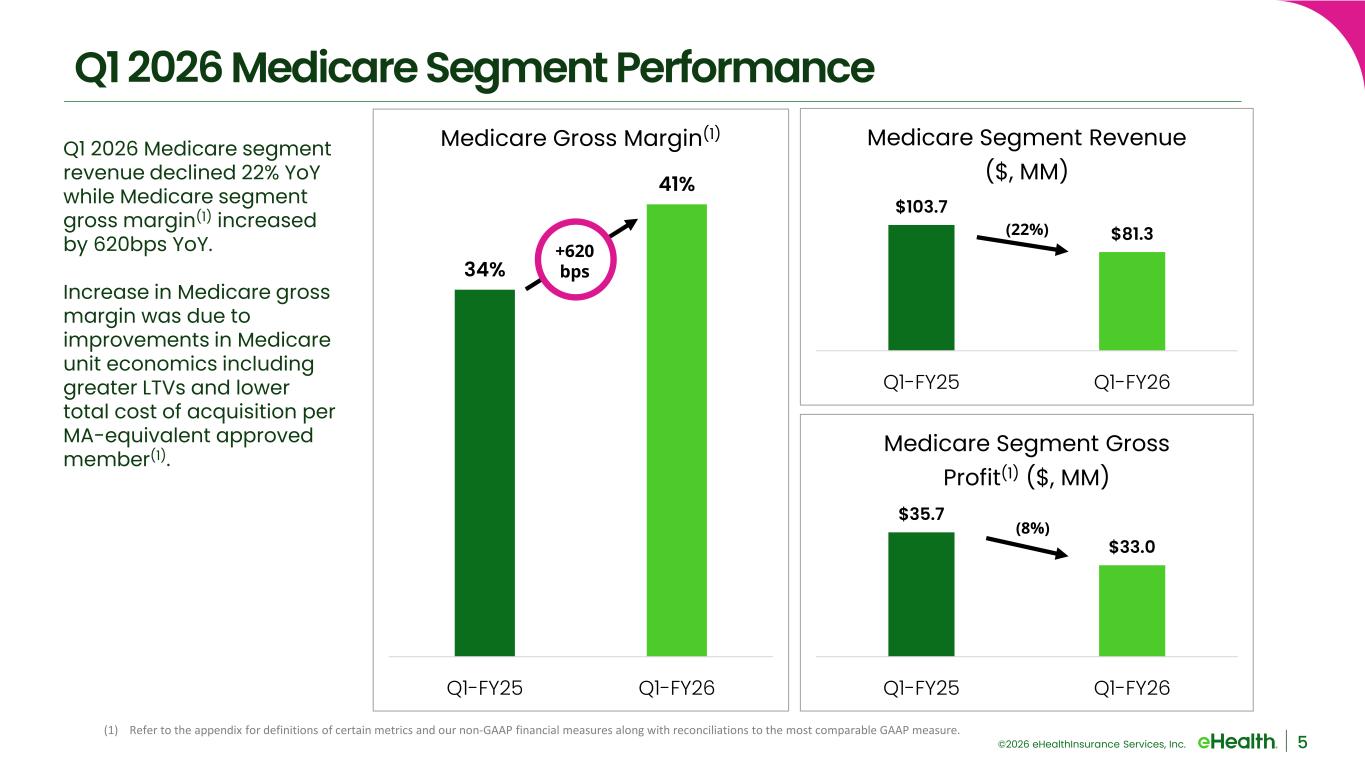
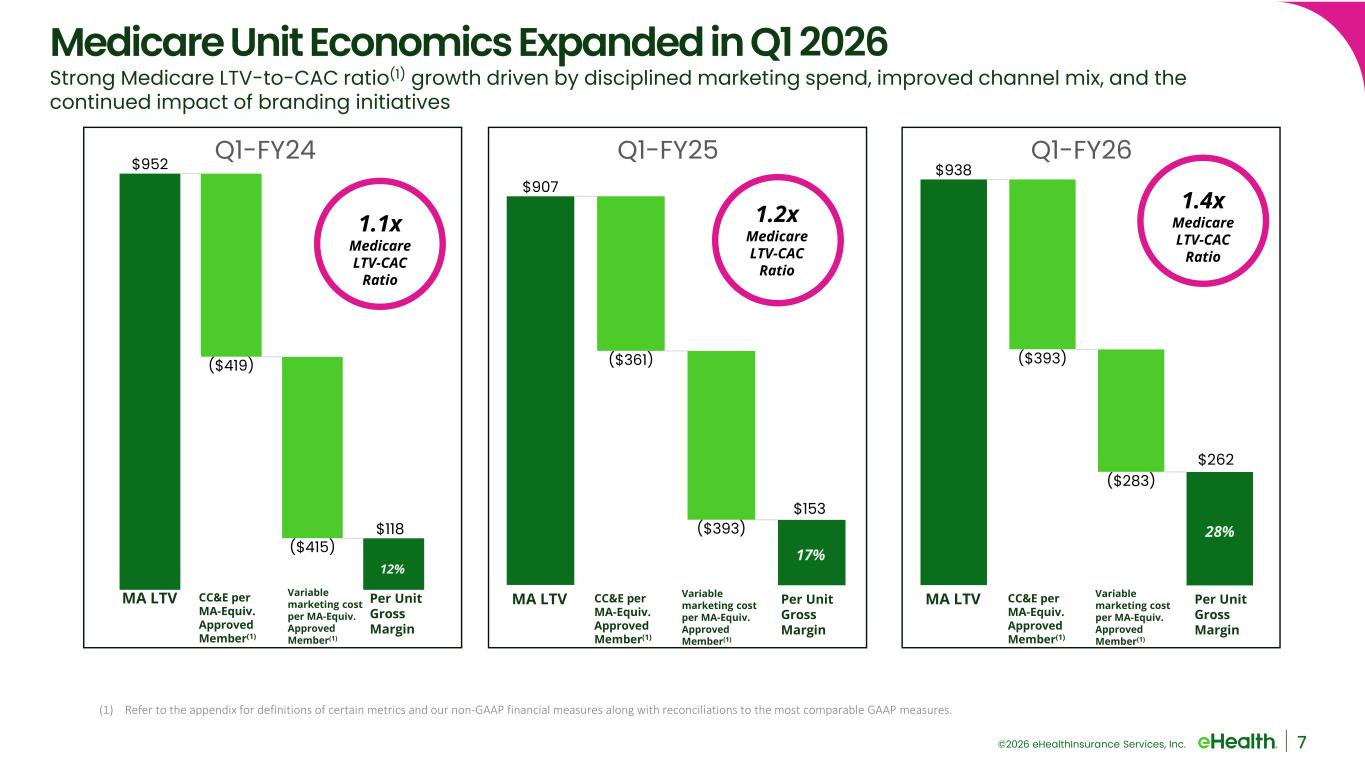
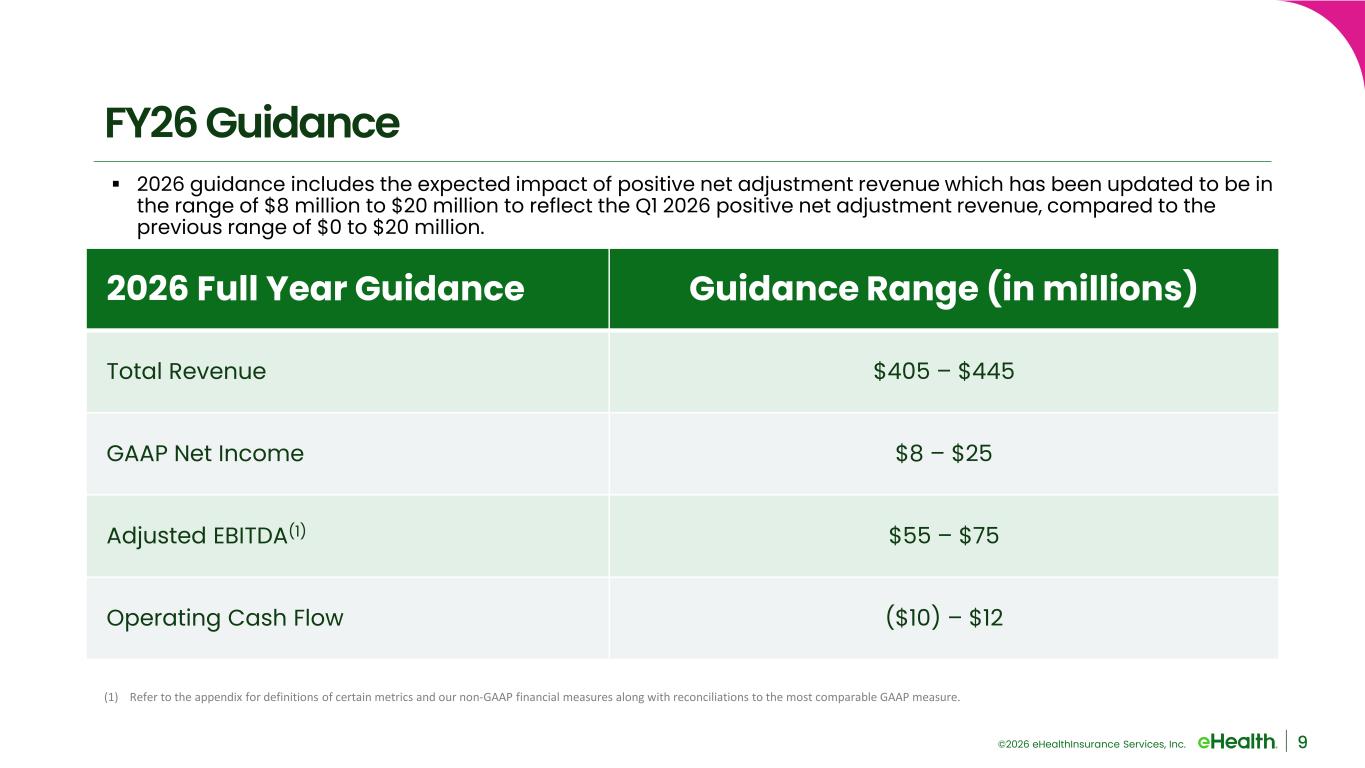
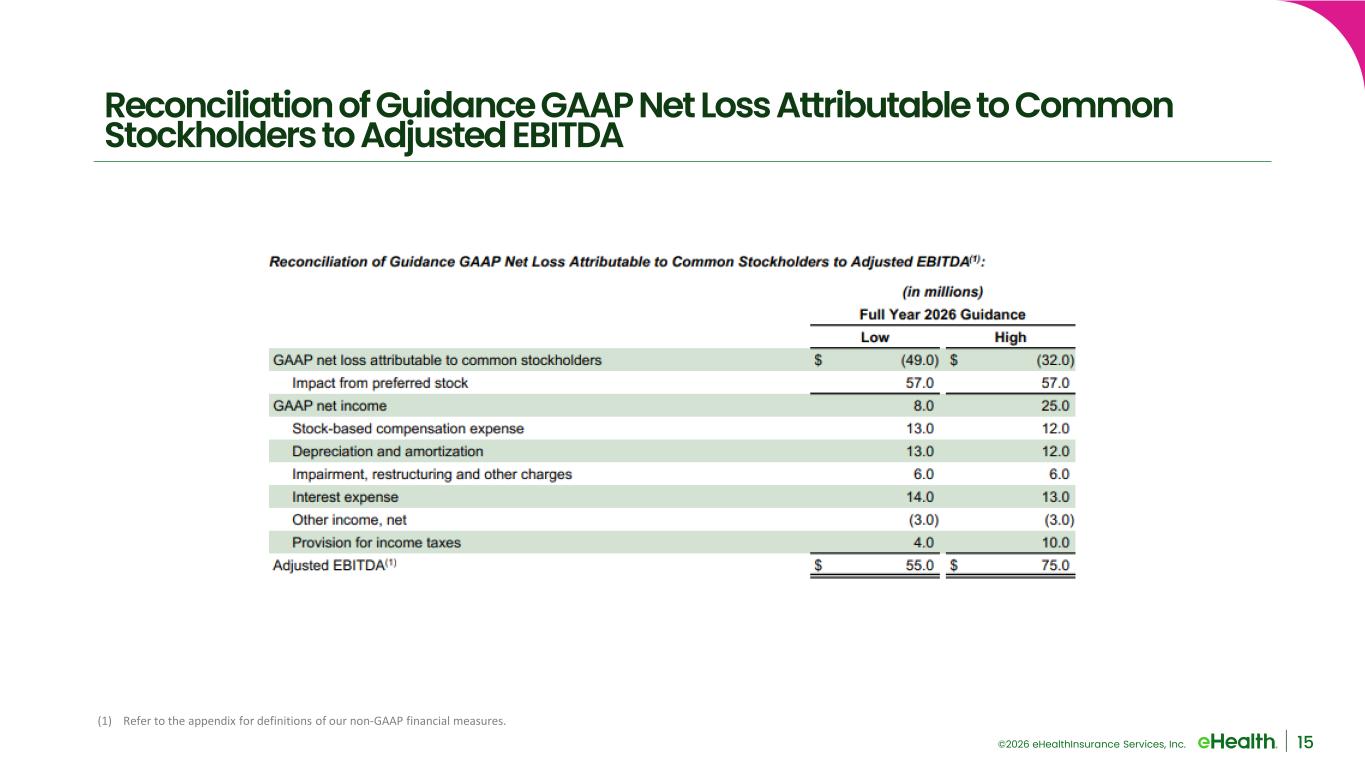
Thank you, Derek, and good afternoon, everyone. We delivered a strong start to the year, meeting our revenue, earnings, and operating cash flow expectations in achieving a greater Medicare enrollment profitability compared to a year ago. Our results were driven by disciplined demand generation, strong sales execution, and a favorable year-over-year trend in lifetime values of Medicare products. We also saw early benefits from the fixed cost reductions implemented earlier this year. As I walk through our first quarter financial results, you will see a consistent theme, higher quality enrollments, greater operating efficiency, and a foundation that we believe will support enhanced cash flow generation over time. Please note all comparisons will be made on a year-over-year basis, unless otherwise specified. First quarter 2026 total revenue was $88 million, representing a 22% decline. Medicare segment revenue also declined 22% to $81.3 million, driven primarily by lower enrollment volume as we reduced variable marketing spend to focus on our best performing channels. Medicare submissions declined 24%, but the revenue impact partially offset by growth in lifetime values for Medicare Advantage, Medicare Supplement, and PDP products. In the first quarter, we recognized $8 million of positive net adjustment revenue, or TAIL revenue, compared to $10.5 million in the prior year. TAIL revenue was driven by our Medicare and ancillary products and represents cash collections in excess of our original lifetime value estimates. Importantly, we continue to hold significant unrecognized positive adjustments related to our existing book of business. First quarter non-commissioned revenue was $8.2 million, which was ahead of our internal expectations and reflects lower carrier sponsorship revenue compared to a year ago. Turning to Medicare enrollment profitability, The first quarter Medicare LTV to CAC ratio was 1.4 times, representing a 17% improvement from 1.2 times. First quarter total acquisition costs per MA equivalent approved member declined 10%, driven by a 28% reduction in variable marketing costs per MA equivalent approved member, partially offset by a 9% increase in customer care and enrollment costs per MA equivalent approved member. The reduction in variable marketing costs per MA-equivalent approved member reflects our more disciplined marketing spend, improved channel mix, and the continued impact of branding initiatives, which have a proven record of enhancing enrollment quality. The year-over-year increase in customer care and enrollment costs per MA-equivalent approved member reflects lower application volume in our decision to retain sufficient agent capacity to support the launch of our lifetime advisory model. This model requires agents to dedicate a portion of their time to member engagement and cross-selling activities. We also plan to have a telesales organization with a higher mix of tenured advisors, which we expect to benefit conversions and enrollment quality. First quarter, lifetime values increased 3% for Medicare Advantage, 19% for Medicare Supplement, and 78% for PDP products compared to a year ago. First quarter, Medicare segment gross profit was $33 million, down 8%. At the same time, Medicare segment gross profit margin increased significantly from 34% to 41%, reflecting improvements in the first quarter Medicare LTV to CAC ratio. Turning to retention, our most recent AEP cohorts, those enrolled in the fourth quarter of 2024 and the fourth quarter of 2025, continue to outperform each of their respective predecessor cohorts. This progress reflects targeted improvements across our sales and marketing organization, along with continuing innovation in our customer online experience, resulting in stickier enrollments. Our overall commission receivable value continued to grow on a year-over-year basis ending just over 1 billion compared to 923 million as of march 31st 2025 or a 12 percent increase looking ahead the launch of our lifetime advisory model is expected to both improve retention at a plan level and foster longer term relationships with our members across multiple products first quarter revenue in our employer and individual segment was 6.7 million down 29 percent from 9.5 million a year ago segment gross profit was 3.7 million compared to 6 million last year from a consolidated profitability perspective first quarter gap net loss was 4.7 million compared to gap net income of 2 million the decline was primarily driven by restructuring charges related to our headcount reduction this quarter first quarter adjusted ebitda was 9 million down from $12.5 million, and the adjusted EBITDA margin was 10 percent compared to 11 percent in the prior year. First quarter non-GAAP total operating expenses, which exclude stock-based compensation and restructuring charges, declined 21 percent to $82.3 million, reflecting organization-wide expense reductions. Non-GAAP marketing and advertising expense declined 38 percent, including a 44% reduction in variable marketing costs, consistent with our lower enrollment volume targets. Non-GAAP customer care and enrollment expense declined 13%, reflecting lower advisor headcount. On the fixed cost side, non-GAAP technology and content expense declined 8%, and non-GAAP general and administrative expense declined 6% compared to a year ago. We expect to see the full benefit of recent fixed-cost initiatives as we progress through 2026. First quarter operating cash flow was $35.8 million, compared to $77.1 million, and ahead of internal expectations. We remain on track to achieve our full-year operating cash flow goals as reflected in our 2026 guidance. The year-over-year decline in first quarter operating cash flow primarily reflects the timing of several working capital items, as well as severance and other one-time costs associated with our fixed cost reduction actions. In addition, carrier sponsorship revenue was lower year-over-year as the prior year quarter benefited from AEP-related sponsorship dollars and shifted into the first quarter. At the end of March 2026, eHealth had $110.8 million in cash, cash equivalents, and short-term marketable securities. Based on our execution year-to-date and with the annual enrollment period still ahead of us, we are maintaining our 2026 guidance ranges for revenue, GAP net income, adjusted EBITDA, and operating cash flow. We are updating our outlook for 2026 net adjustment revenue, which is now expected to be in the range of $8 million to $20 million. We believe we are well-positioned to achieve our financial objectives for the year. Consistent with the framework Derek outlined, we view 2026 as an intentional bridge year, one focused on improving the quality of our revenue, enhancing the efficiency of our operating model, and achieving cash flow generation rather than maximizing volume. Our actions this year, including discipline demand generation, launching our lifetime advisory model, and rationalizing our cost structure, are designed to position eHealth to achieve the three-year financial targets we published today. You can reference these targets on slide 10 of our earnings slides posted on eHealth's Investor Relations site. Our three-year forecast assumes a modest increase in Medicare marketing spending in our best performing channels starting in the fourth quarter of 2027. We expect to amplify the impact of this increased marketing investment through our lifetime advisory model, as growth in our core Medicare commission revenue is complemented by higher cross-sell rates of ancillary products, including hospital indemnity plans and final expense insurance. In addition, we expect to start seeing positive contributions from our ICRA business in 2028. Given our planned revenue growth, we believe we will realize significant operating leverage in the recently implemented fixed cost reductions. Cash flow profitability remains the central objective of our long-term financial strategy, and we believe the progress we're making in 2026 establishes a strong foundation for a return to growth while delivering on our cash flow goals. Macro assumptions behind our three-year forecast are relatively conservative. There could be upside if the Medicare Advantage market recovers faster than we currently anticipate. And with that, we would like to open the call for questions.
Operator
We will now begin the question and answer session. If you would like to ask a question, please press star one to raise your hand. To withdraw your question, press star one again. We ask that you pick up your handset when asking a question to allow for optimum sound quality. If you are muted locally, please remember to unmute your device. Please stand by while we compile the Q&A roster. Your first question comes from the line of Ben Hendricks of RBC Capital Markets.
Thank you, Marion, for Ben. I appreciate you take my questions uh you know i appreciate your commentary on your revenue growth expectations for the next few years i'm curious if you have any tail revenue embedded in these targets and uh if you do realize tail revenue this year would that alter your targeted growth rate hi thanks for the uh thanks for the question john you want to take that yeah sure let me take that question appreciate the question um yeah in our long long range plan we have uh assumed effectively flat tail revenue growth so similar to what we've put into 2026 guidance we have similar assumptions
into the outer years okay so if if you did realize uh tail revenue this year that would lower your growth rate targets for uh 2027 for instance uh not necessarily um if you if you're looking at the growth will be flat on the tail but it would obviously be offset by other other growth I think yeah so so let's let's try again the the assumed tail revenue in our 2026 plan is consistent in the three-year LRP so the revenue growth in the out years is not coming
from increased tail if that's what you're asking yeah so we're already expecting tails this year correct so it's we are expecting to recognize tail this year you can look at our guidance of 8 to 20 million so if you can think about somewhere at the midpoint of that guidance um you know you can assume that a scale for 25 and we are assuming slattish tail revenue for the forecast periods in the outer years as well. So are you saying if we were to recognize tail above and beyond current guidance and choices?
Yeah. Say if you recognized it at the high end of your guidance range, would that lower your expected EBITDA growth in 2027?
I think if we were within the guidance range, no. If we were, if we saw a significant positive development above and beyond our current guidance, yes, obviously, you know, because you would look at 27 over the higher days in 26. But if we are somewhere within our guidance range, no, that would imply similar growth rates and similar EBITDA growth rates.
Yeah, so if you look at our three-year financial targets, the three-year financial targets that we provided, we're assuming zero growth on TAIL, but other revenue streams will be generating that growth. As we said in 27, it's single-digit percentage growth rate, and in 28, it's mid-teens. So TAIL is not contributing to that.
Okay, I got you. That's helpful. So just shifting gears to cash flow, you know, first quarter's typically pretty strong cash collection quarter for you guys. It came in a little bit below last year's number. Obviously, you maintained your cash flow guidance. Wanted to see if there's any timing-related items in there and why you have conviction just hitting that for your guidance.
Yeah, sure. so the um i'd say about 80 percent of the uh the decline year over year is really driven by you know a couple of things lower carrier sponsorship timing um we had some timing and one one time uh items in the in the quarter you know such as uh we had severance related to our fixed cost reductions and then there was some um lower commission collections because of our lower volume so those are the main drivers in the decline but you know it's uh i'd say it's it the cash flow did exceed our expectations and uh we're definitely on track for achieving our 2026 guidance uh ranges all right yeah thank you the bulk of it is timing and the one time cost related
to severance that that accounts for about 80 of that okay that's helpful thank you your next question comes from the line of george sutton uh from craig hallam your line is open thank you you mentioned uh 2026 would be a bridge year uh and you were not going to necessarily chase growth it sounded very similar to how 2025 came out for you so i just want to make sure i understood the deltas year over year in terms of how you're going to market the deltas in revenue expectations and
marketing spin? Just maybe give me a little bit more, George.
Actually, both. You sort of characterize it as we didn't chase growth in 25, try to be responsible about going after the right customers and using the right channels. Sounds like you're doing the same thing in 2026. I'm just trying to understand what's different.
Yeah, well, the difference is the commitment that we've made and the focus that we have on generating positive operating cash flow. And so that, you know, we did not achieve that in 2025, and we believed it was important for us to focus on that in 2026 as we strengthen, again, as we've characterized strengthening the foundation of the company. There's multiple ways that we've gone about that, George, including the Q4, you know, refinancing that we were able to secure to help strengthen the balance sheet. And so the next evolution of that is to be disciplined, again, in our approach in 26 and, again, not chase growth at all costs. We think that's the responsible thing to do in light of the continued market disruption. Again, I think we've been pretty clear in our communicating our view that what's happening in the market is a sort of one event that's occurring over multiple years as carriers make the important decisions that they're making to improve their own financial statements and their margin and we're respective of that and we want to position e-health to be ready to take advantage of you know a return to growth in the future once the market stabilizes and just very quickly George I think that it is correct that a lot of what you are seeing in 26 is continuation of what we started doing in 25.
So, for example, the marketing channels and the focus on brand and direct channels, you will see it being even more pronounced in the fourth quarter AP as we're pulling back from the less profitable channels. And that will continue for the three-year outlook as well. And that's why you see that pre-significant EBITDA growth that we're projecting. But what is also different this year is the lifetime advisory model that we're implementing, and that will mean that in Q2 and Q3, we're really pulling back on what was trending into the market. Those enrollments are not very high-profit enrollments in the first place, so we're going to use the time of agents to engage with our existing members and that will have downstream implications for retention and for ancillary sales. The ancillary sales this year will start contributing, but you will really start seeing much bigger impacts in 27 and 28 in terms of the cross-cell rate impact. So that's layering on what you started seeing in 25, layering on top of that in 26.
Could you just help me understand what the lifetime advisory model will look like from an engagement perspective? Obviously, we've had ancillary offerings before, and those were available to customers. Is it just simply more proactively marketing those to them, or how does the engagement change?
That's a great question, Craig. I'm going to start, and then I'll ask Michelle to contribute as well. So, you know, it's important to understand that historically inside of the e-health operating model, that as new products were put into the platform, the expectation from an operating model perspective was that that would need its own set of advisors. It would need its own demand generation of budget effectively in order to drive growth. The lifetime advisory model doesn't rely on additional marketing spend, doesn't rely on additional agents to sell the product. It's really encouraging and supporting our current advisors to develop a holistic relationship with a member once they engage with a member. So it's not about more product versus what we've had in the past, although our future expectation is that we'll continue to add product and services as we see needs that beneficiaries have.
But the real change here is that we're supporting the advisor to engage with their member and to effectively be a one-stop shop, that that advisor is equipped to engage and meet the holistic needs of the member. michelle sure i will i'll add on and we really think about this it is about putting the consumer first and so it's not just about yes we've done a lot to improve our brand our marketing that will continue but it's really focused on that over 65 segments and so as we bring that member in how do we continue to cultivate that relationship not just to drive sort of the immediate enrollment uh which you know is absolutely also really needed in in this environment in this uh in what's going on in medicare but it's also just doing right by the consumer ensuring that we can use the time and the capacity that we have so we really link that beneficiary to that advisor and through that relationship we cultivate what you asked about right what are those activities the engagement It's follow-up on plan check-ins is going on right now. Do they have their PCP? Can we help with an annual wellness visit? Cross-sell, right, will come in as well. Are there referrals? Are there other people that are really satisfied with our service that we can also? So it's not just relying on marketing, but really kind of setting this up for a long-term relationship.
Operator
And again, if you have a question, please press star 1 on your telephone keypad to raise your hand and join the queue. Your next question comes from the line of George Hill of Deutsche Bank. Your line is open.
Maxine
Analyst — Deutsche Bank
Yeah, hi, this is Maxine for George. Thanks for taking the question. I want to ask about the shift toward higher margin branded marketing channels. Could you give us an update on how much of your Medicare enrollment mix in Q1 came from these branded channels and how does it compare to last year?
Yeah, Michelle, you want to take that?
So I think the question is what percentage of our enrollment volume is coming from our branded channels and how does that compare to a year ago yeah yeah um i will tell you that we continue so first off when we look at sort of how do we maximize you know marketing spend it is really guided on quality on the return like ltb to task right as you saw in in sort of the slide is really the north star so you then focus on what are the best performing channels. Also, even within the channels, you're looking at what are the top performing campaigns and how do you continue to optimize. So we continue to lean into our branded channels with the right mix throughout Q1, Q2, Q3. And kind of similar to what we said earlier, you're going to see that even continue to improve into Q4.
Maxine
Analyst — Deutsche Bank
Got it. Just a quick follow-up. Could you give us some color on the unit economics of crowd-selling ancillary products through the Lifetime Advisory Model and ICCRA versus MA? How should we think about a company's overall margin profile as these products scale? And how much of the mid-teens revenue growth in 2028 is expected to be driven by ICCRA and ancillary products through this model?
Yeah, so the way – again, I'll start, and then John and or Michelle or others can chime in. So the way we think about the ancillary opportunity, again, it's really important to understand that in the lifetime advisory model, there's no additional marketing demand dollars that the company is spending in order to generate the revenue that we're expecting in the ancillary business. The ancillary bucket is a wide array of products, so each product has its own sort of LTV profile based on the unit economics of each. But the way I would just generally encourage you to think about this is that for each cross-sell opportunity, that we have the opportunity to add somewhere between maybe 15% to 20% of LTV to the MA sale when we sell an ancillary plant. So that's how we think about the economics on ancillary. On ICRA, we would just say it's certainly we have it modeled, but it's a little, probably a little early for us to share how we think about each of, you know, the unit economics of that. And it's a small amount of the revenue growth that's in our three-year LRP at the moment.
So it's certainly not material in the plan at this point as it relates to the 28 revenue growth that's in the plan. one of the other things i'd probably add to it is you know some of the ancillary products have a much more favorable cash flow profile which is uh something that we've built into our plan thank you don't know for the questions at this time we have reached the end of the q a session this also concludes today's call thank you for attending you may now disconnect