Operator
Good morning, ladies and gentlemen, and welcome to the Home Bank Corp's first quarter 2026 earnings conference call. All participants will be in a listen-only mode. Should you need assistance, please signal a conference specialist by pressing the SCAR-T, followed by zero. After today's presentation, there will be an opportunity to ask questions. Please note this event is being recorded. I would like to turn the conference over to Home Bank Corp's Chairman President and CEO, John Bordelon, and Chief Financial Officer David Kirkley. Please go ahead, Mr. Kirkley.
Thank you. Good morning and welcome to Home Bank's first quarter 2026 earnings call. The frames, release, and investor presentation are available on our website. I'd ask that everyone please refer to the disclaimer and to learn for those statements in the investor presentation and our FAC file. I'll hand it over to John to make a few comments about the first quarter and outlook for 2026.
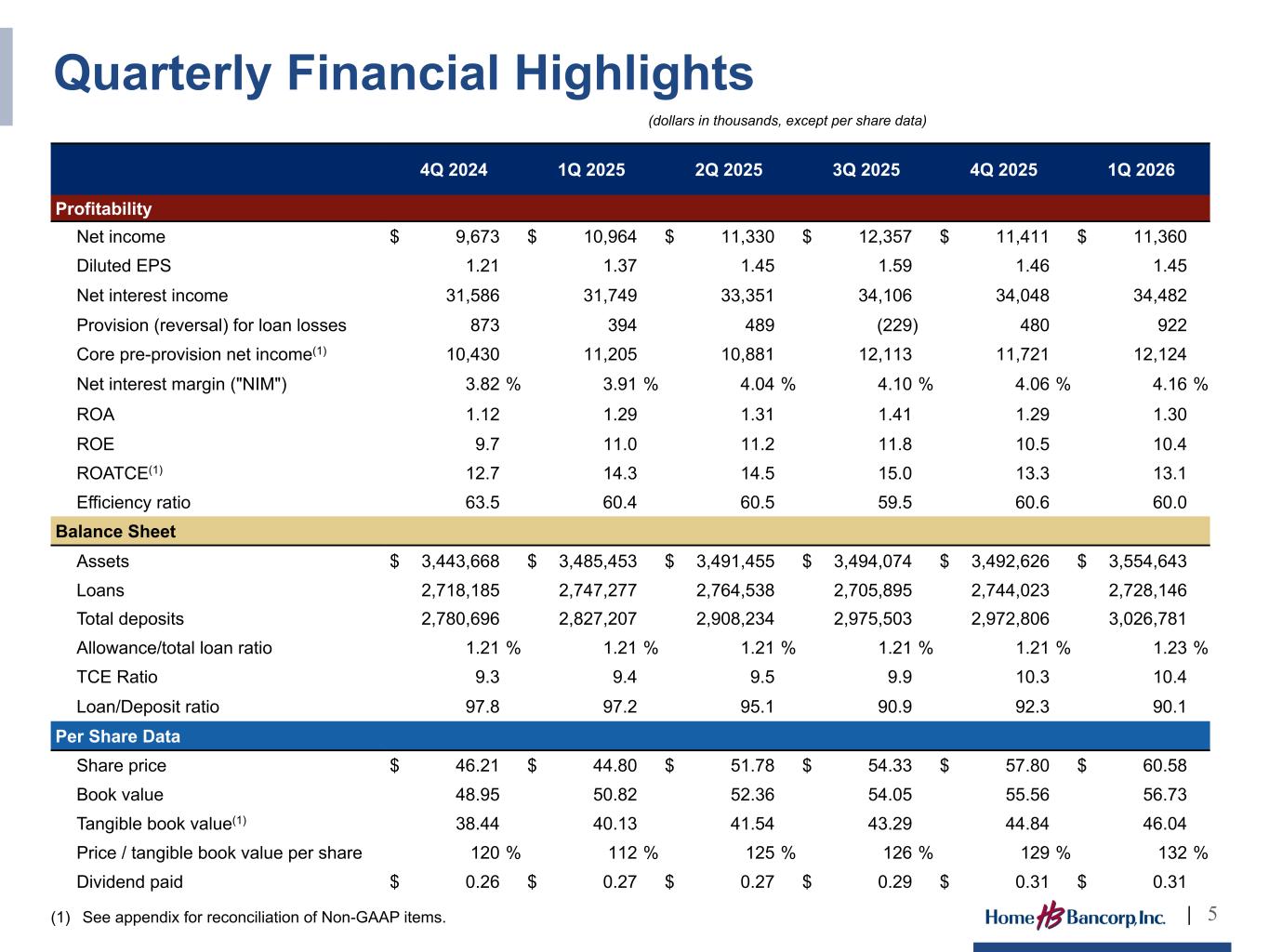
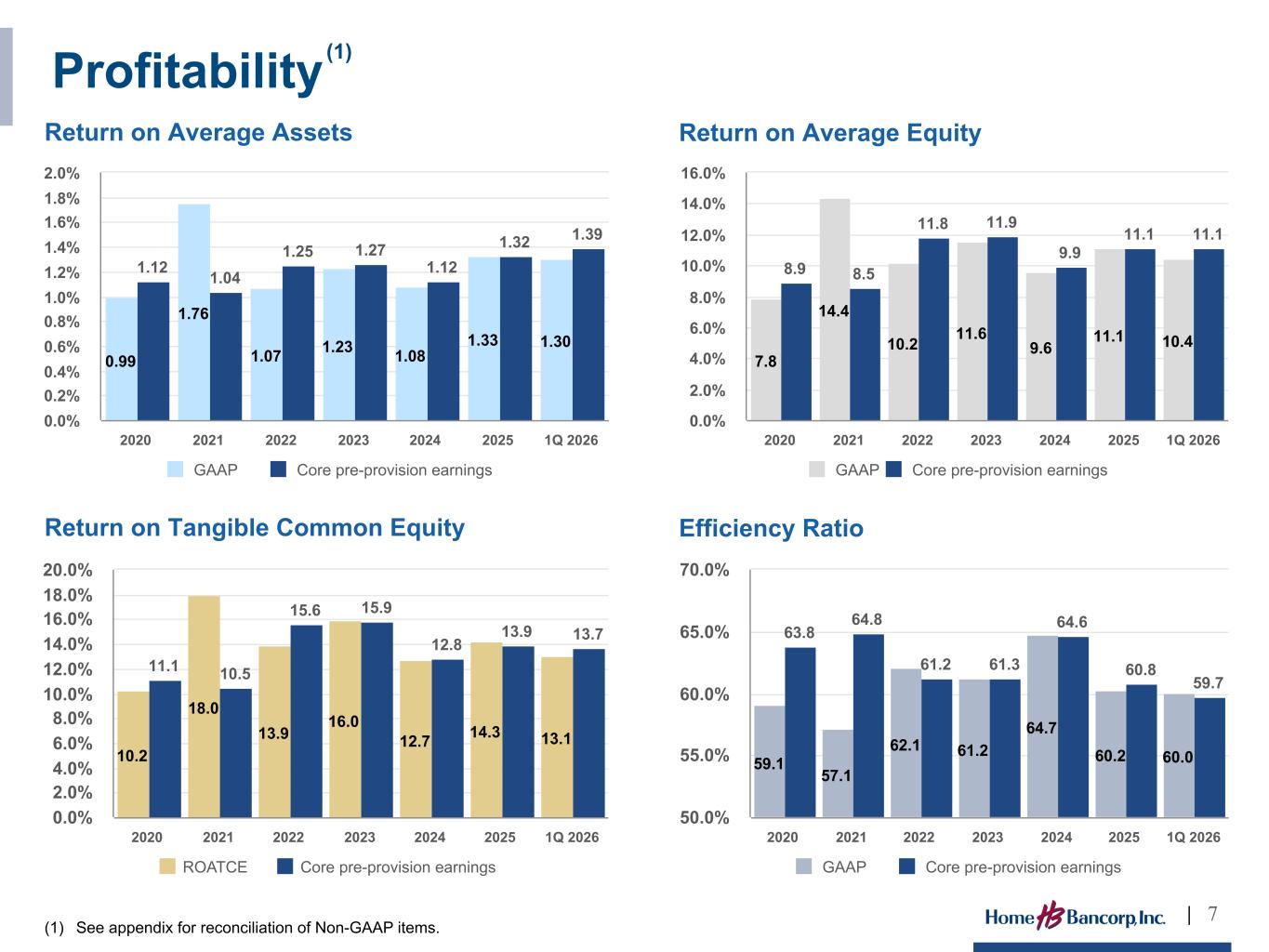
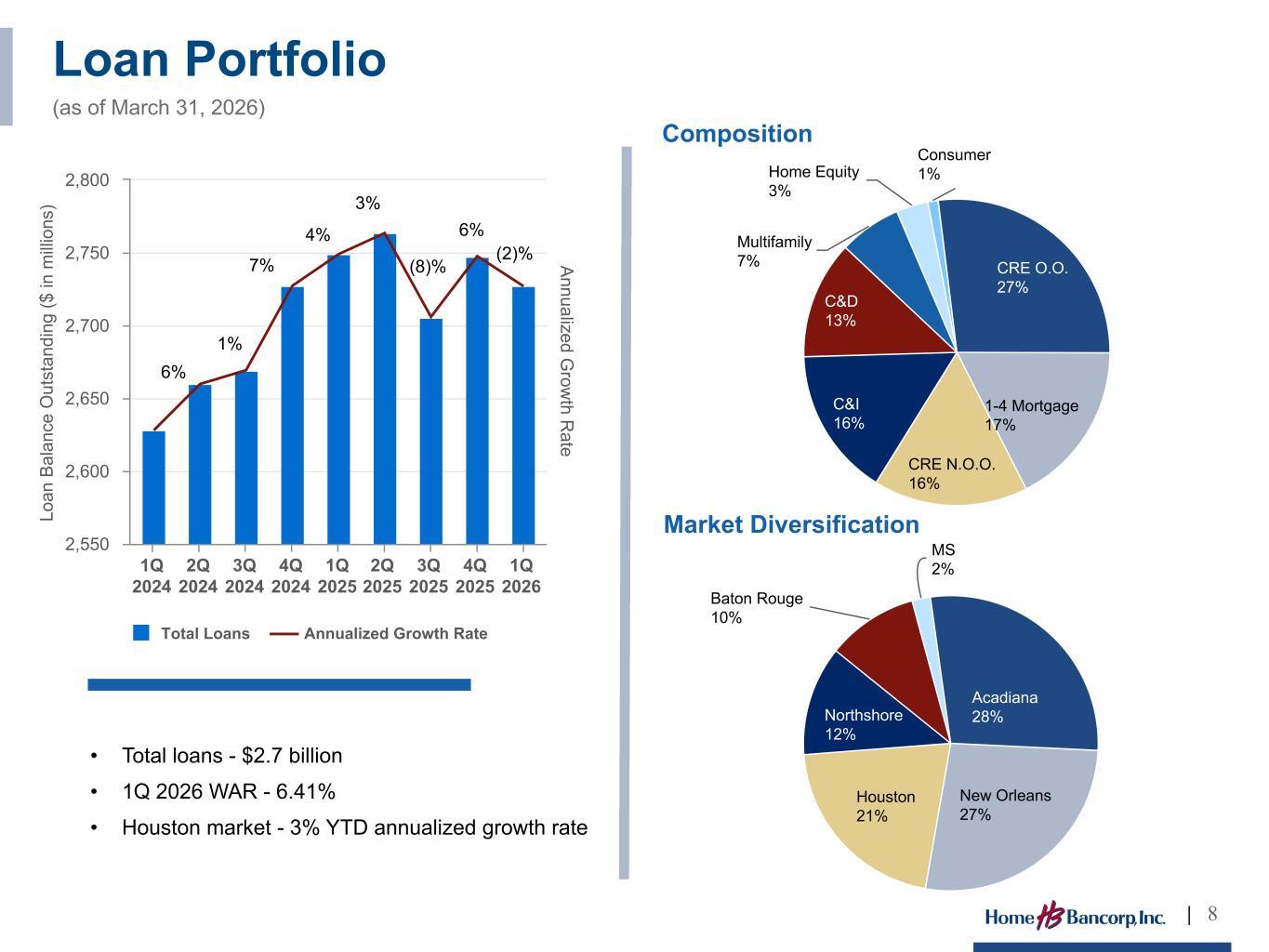
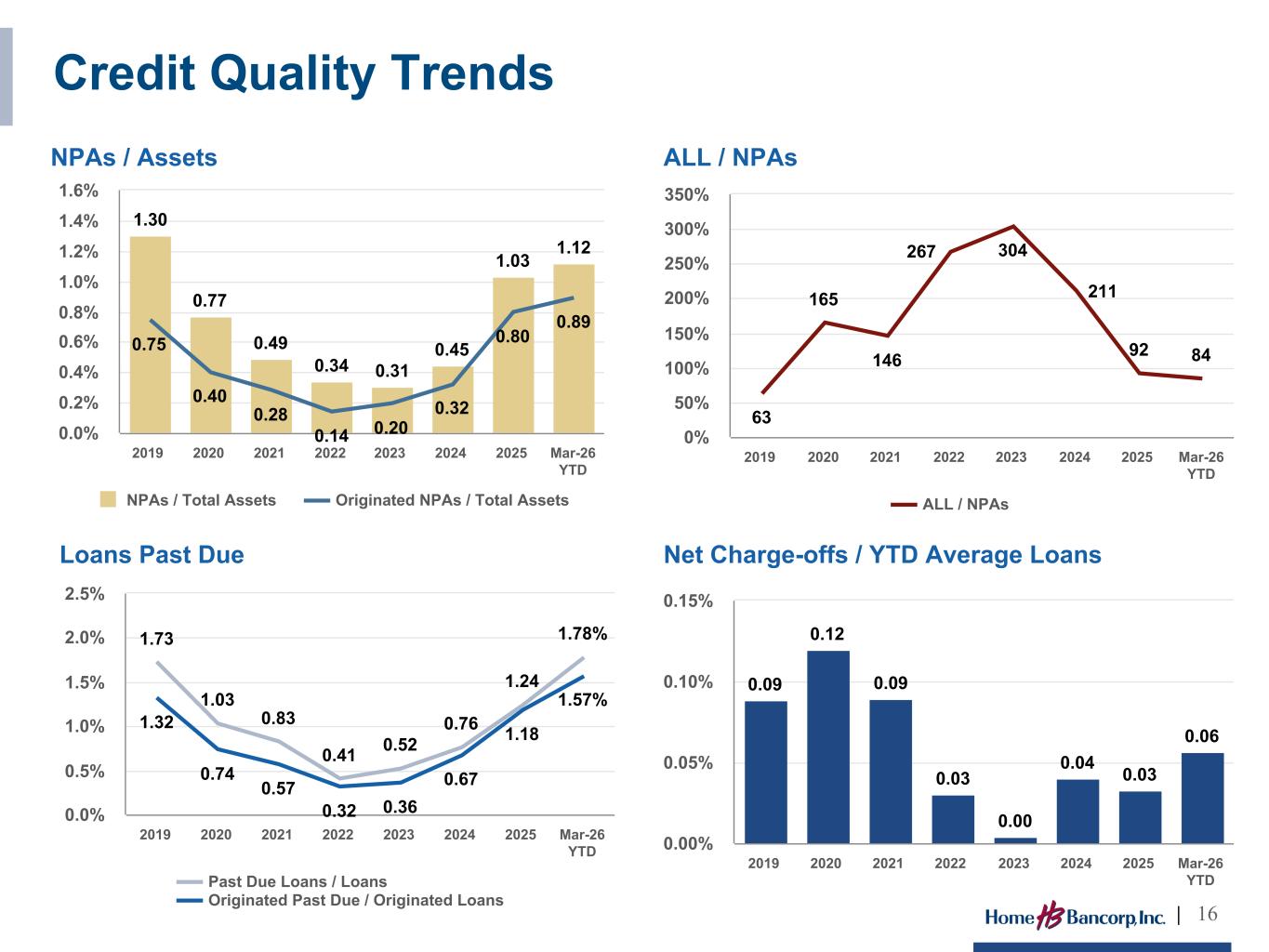
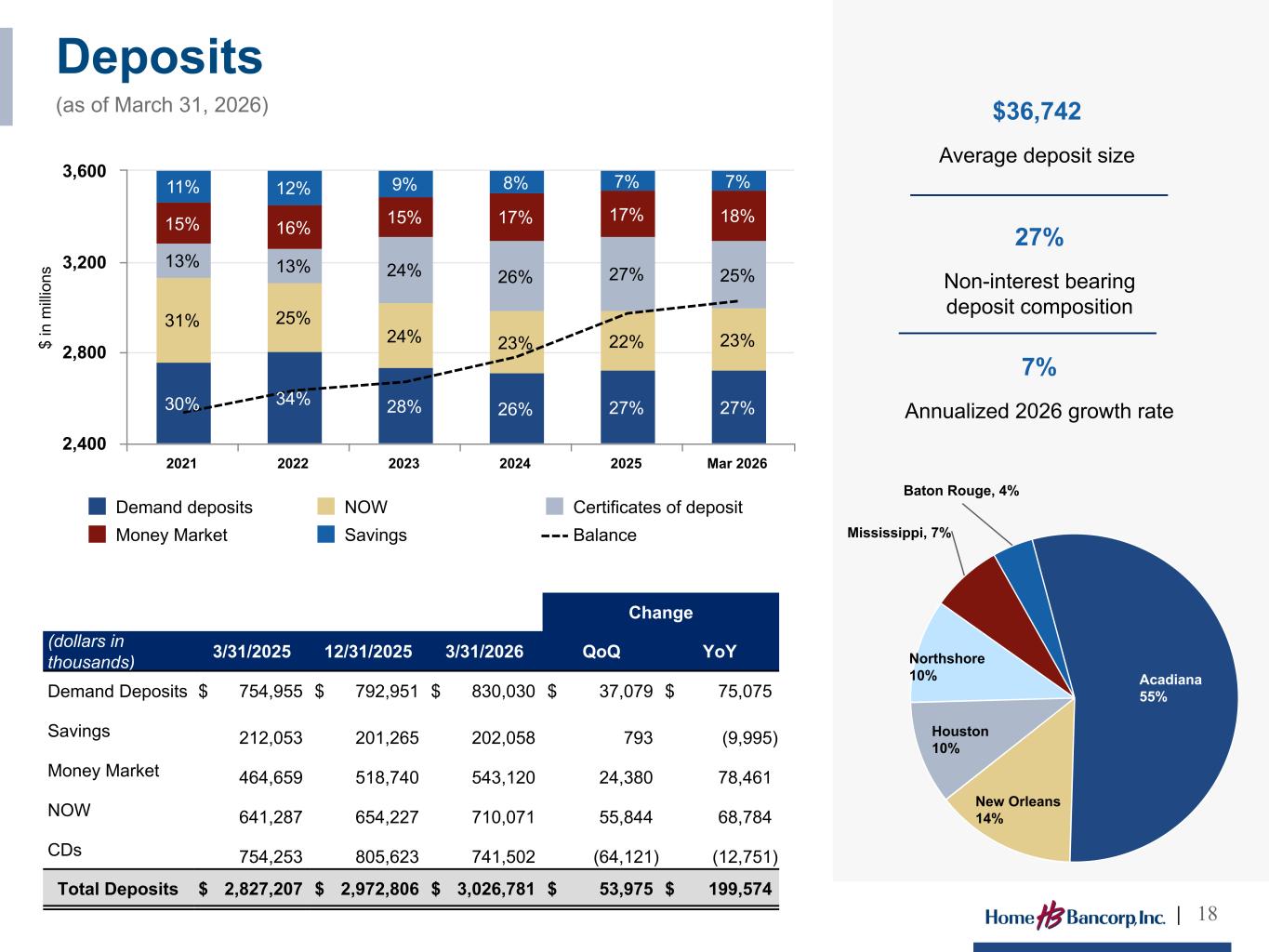
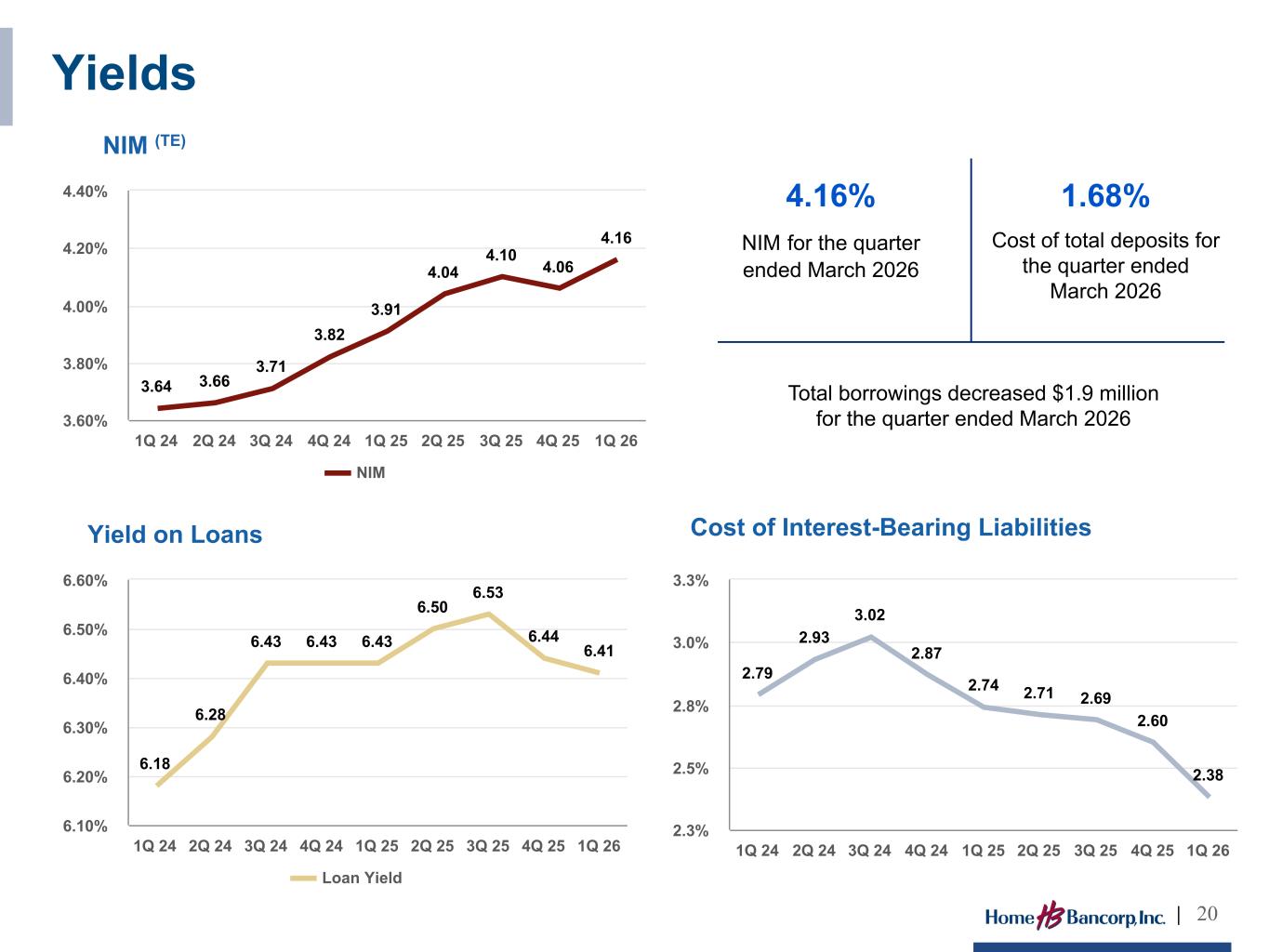
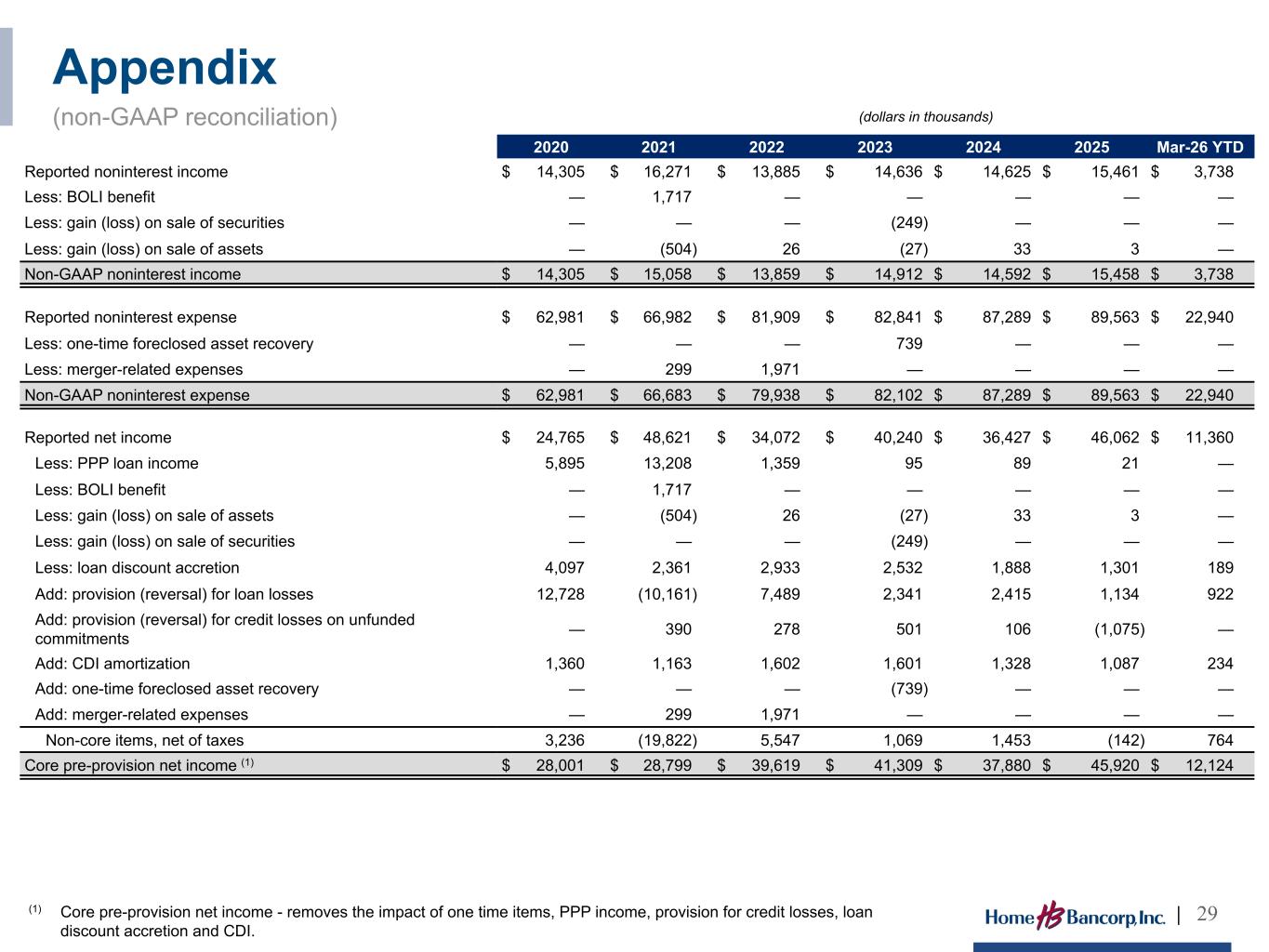
Thanks, David. Good morning, and thank you for joining our earnings call today. We appreciate your interest in the home bank as we discuss our results, expectations for the future, and our approach to creating long-term shareholder value. Yesterday afternoon, we reported first quarter net income of $11.4 million, or $1.46 per share. Sorry, $1.45 per share. Earnings per share were down a penny in the fourth quarter, but increased 6% from a year ago and represented a good start to the year. Debt interest margin expanded to 4.16%, which was 10 basis points higher than the fourth quarter and 25 basis points higher than a year ago. Return on assets also increased to 1.30% in the first quarter. This quarter margin expansion was driven by a 22-basis point decline in our cost of funds, which contributed to a 25-basis point decline in our overall cost of funds. Loans declined by 1% in the first quarter as paydowns continued to outpace new production. We continue to see customers delay projects and transactions while they wait for additional clarity on interest rates. Despite the low balances, we maintain pricing and structured discipline, continue to generate new loan originations out of traffic spreads and risk-adjusted returns. Our loan pipeline has improved in recent months, although the timing and pace of future loan growth remain difficult to predict, giving continued market volatility and uncertainty around interest rates. Core deposits increased by $54 million in the quarter, or 7% annualized, as core deposits increased to $118 million and were offset by non-core CD declines of $64 million. Non-sparing deposits increased to $37 million and continued to represent 27% of our total deposits. As a result of our success on the deposit front, our loan-to-deposit ratio declined to approximately 90%, positioning us well for future growth. The strength of our franchise is especially evident when you consider how we've performed despite a challenging rate in the economic environment. Over the past two years, diluted earnings per share have increased by more than 25%. Return on assets has improved by nearly 20%. Net interest margin has expanded by more than 50 basis points, and our cost of the progress has declined by more than 100 basis points. We also continue to have success in Texas with loans there growing to approximately 21% of our total portfolio compared to 15% when we entered the market through an acquisition in 2022. The new Northwest Houston branch opened during the quarter and gives us full-service presence in one of the fastest-growing areas in the market. The branch square footage allows for significant growth in the region and will help our well-established commercial team continue to build our franchise. Several organizations have already requested to utilize the branch meeting rooms for their companies. The combination of the branch, its location, and our team of bankers should make the Tomball region very successful. Credit remains manageable. Non-performing assets increased during the quarter by $3.8 million, primarily due to the downgrade of three relationships. However, we continue to believe losses of these credits will be immaterial given the collateral protection and guarantor support. Our net charge-offs remain extremely low at just six basis points annual odds. Finally, we're in the middle of our annual visits to all markets and hosting our Canadian-style crawfish boils. As we've done in previous years, executives serve our employees delicious crawfish with all the fixings and refreshments, reflecting our culture of servant leadership that is such an important driver of our success. These gatherings are a great way to embrace that culture and generate enthusiasm. The time in the branches also gives management an opportunity to answer questions from front-line staff and meet customers, both big and small. With that, I'll turn it back over to David, our Chief Financial Officer.
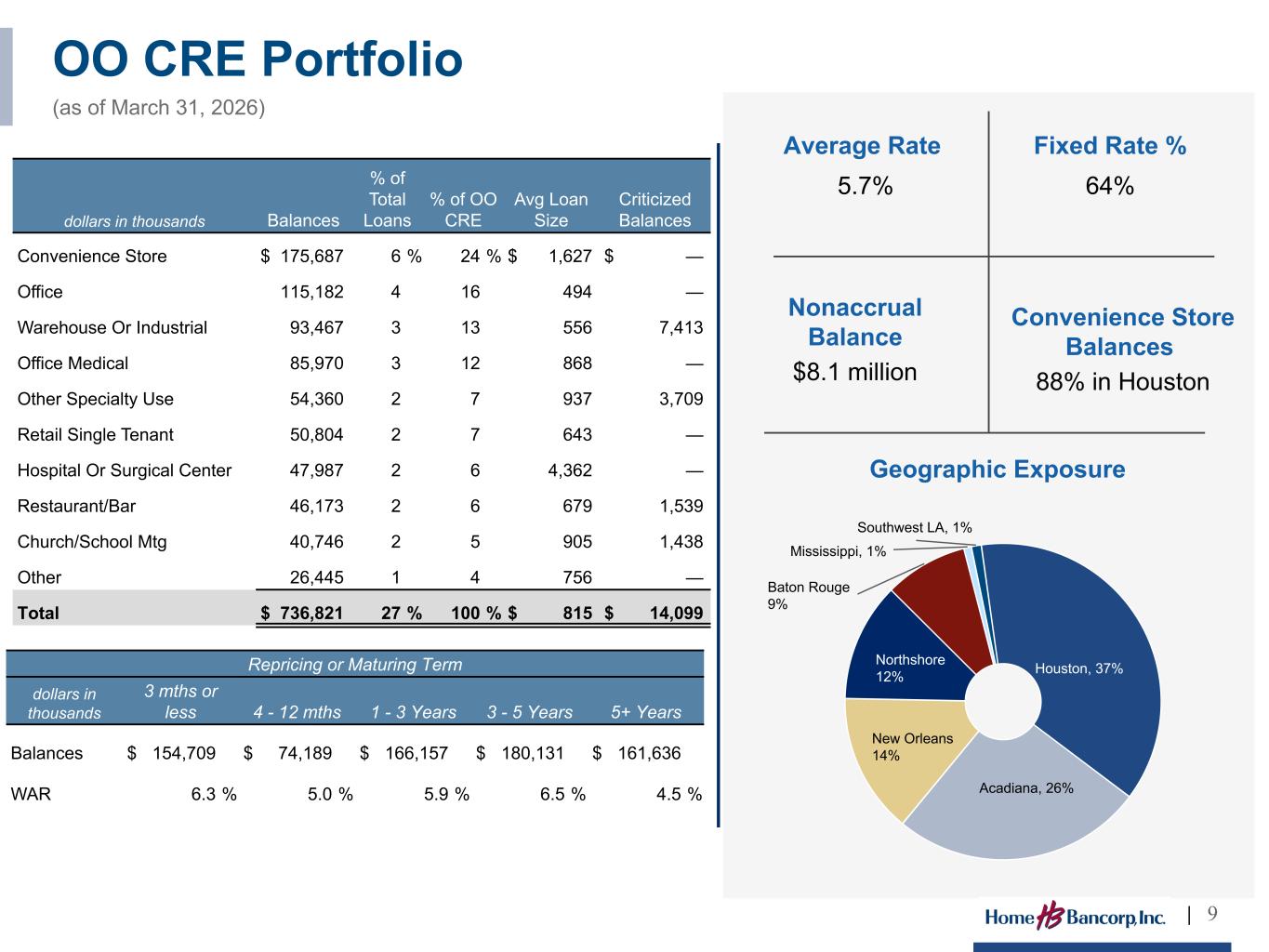
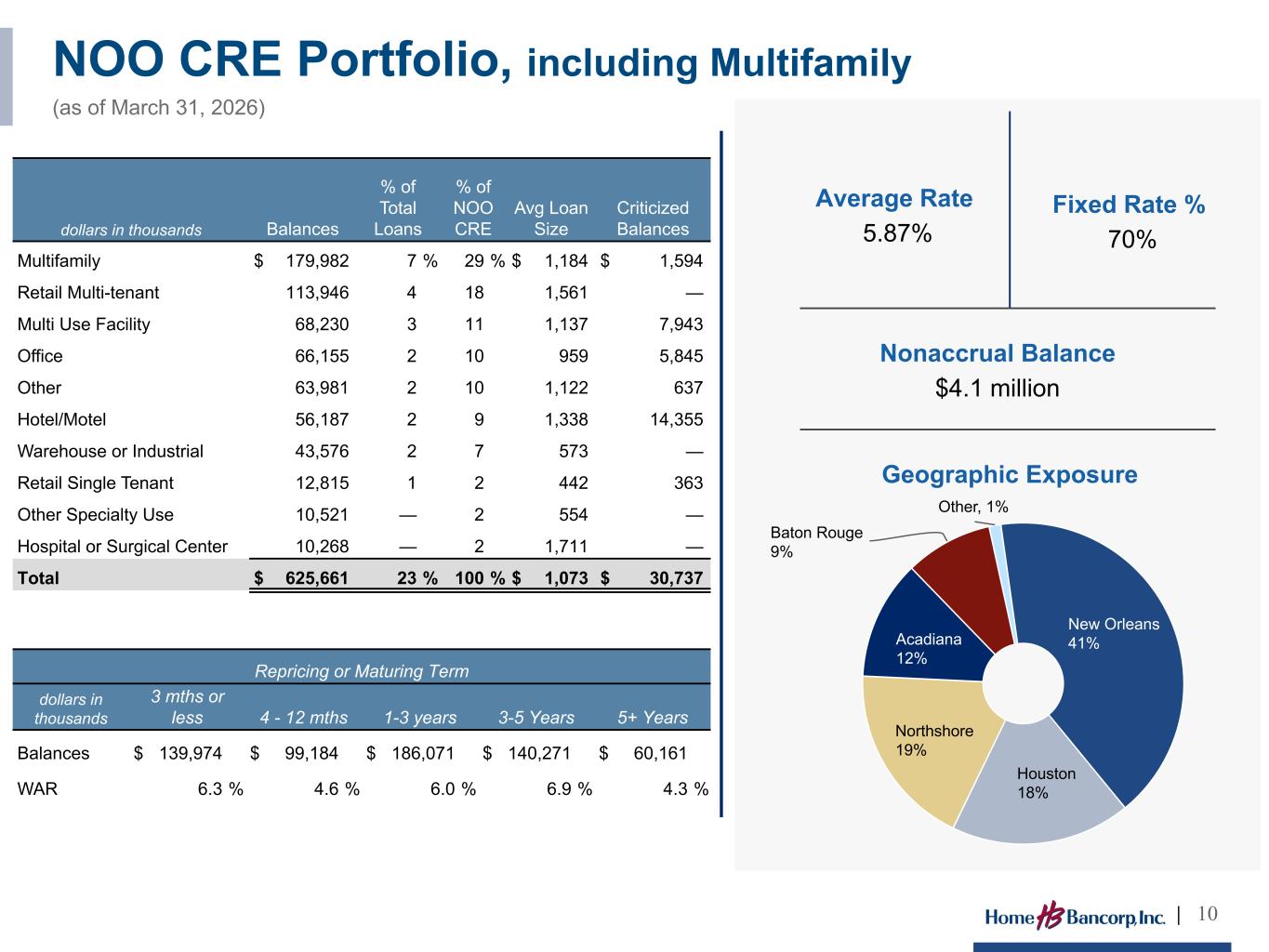
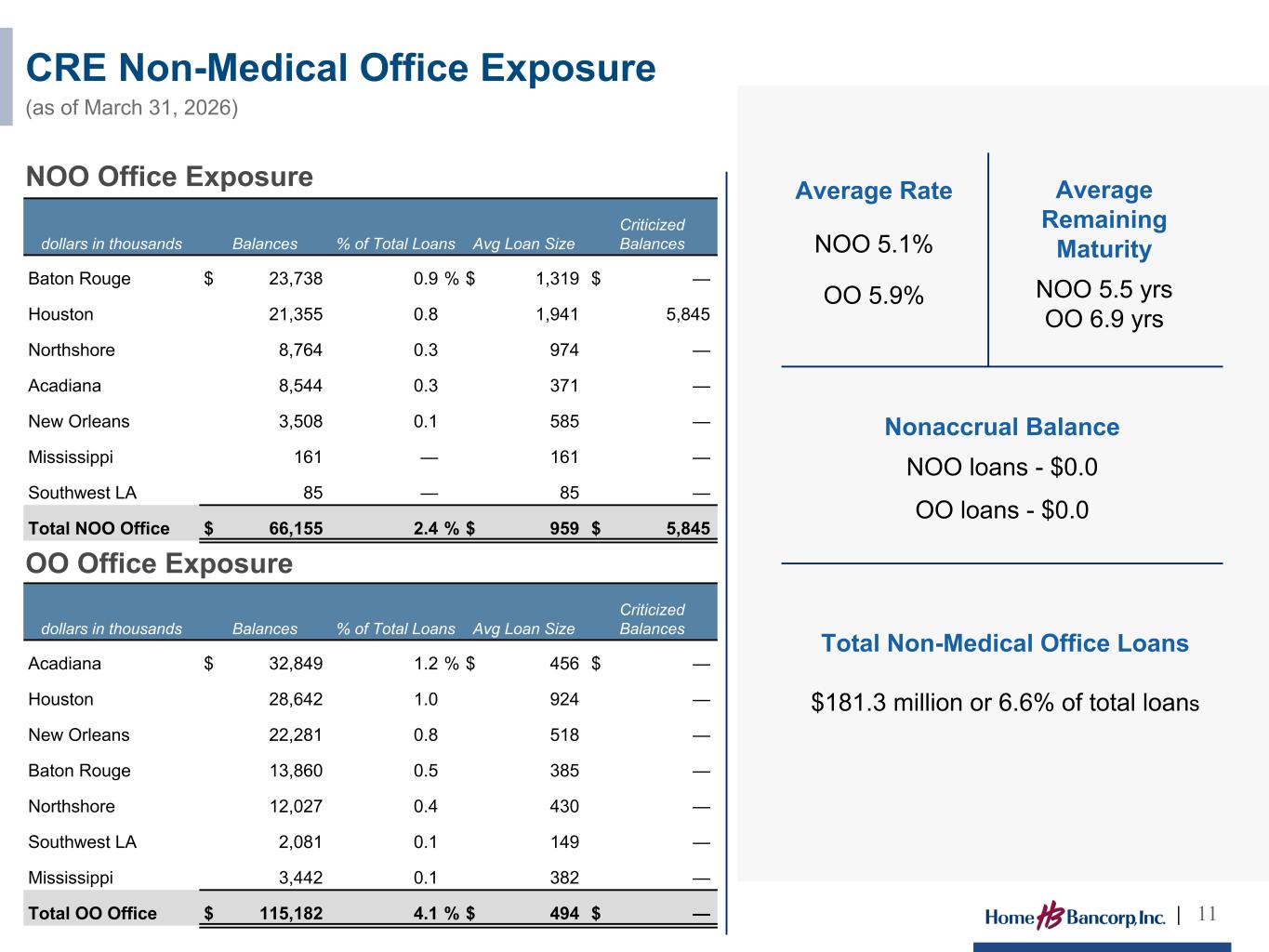
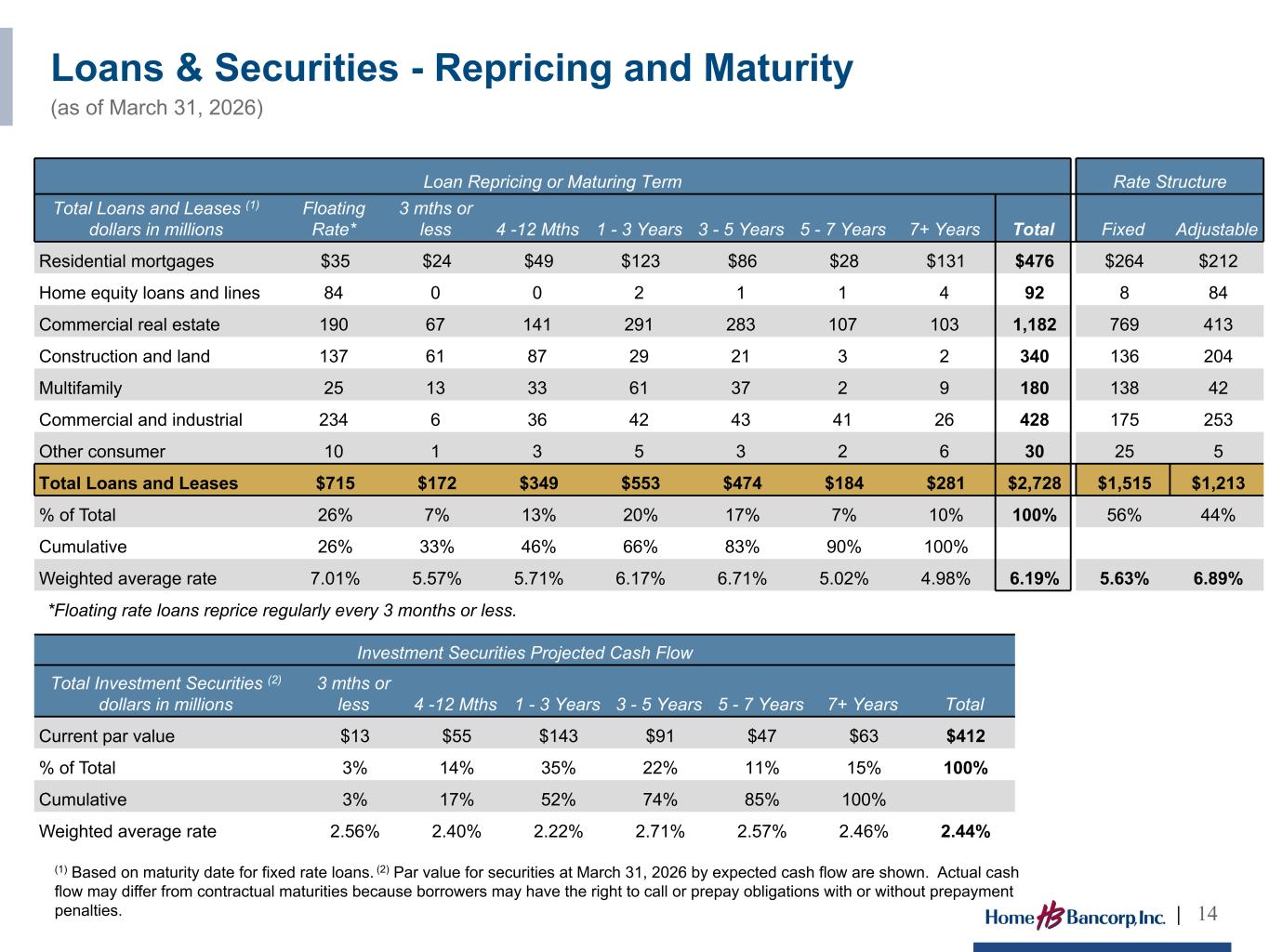
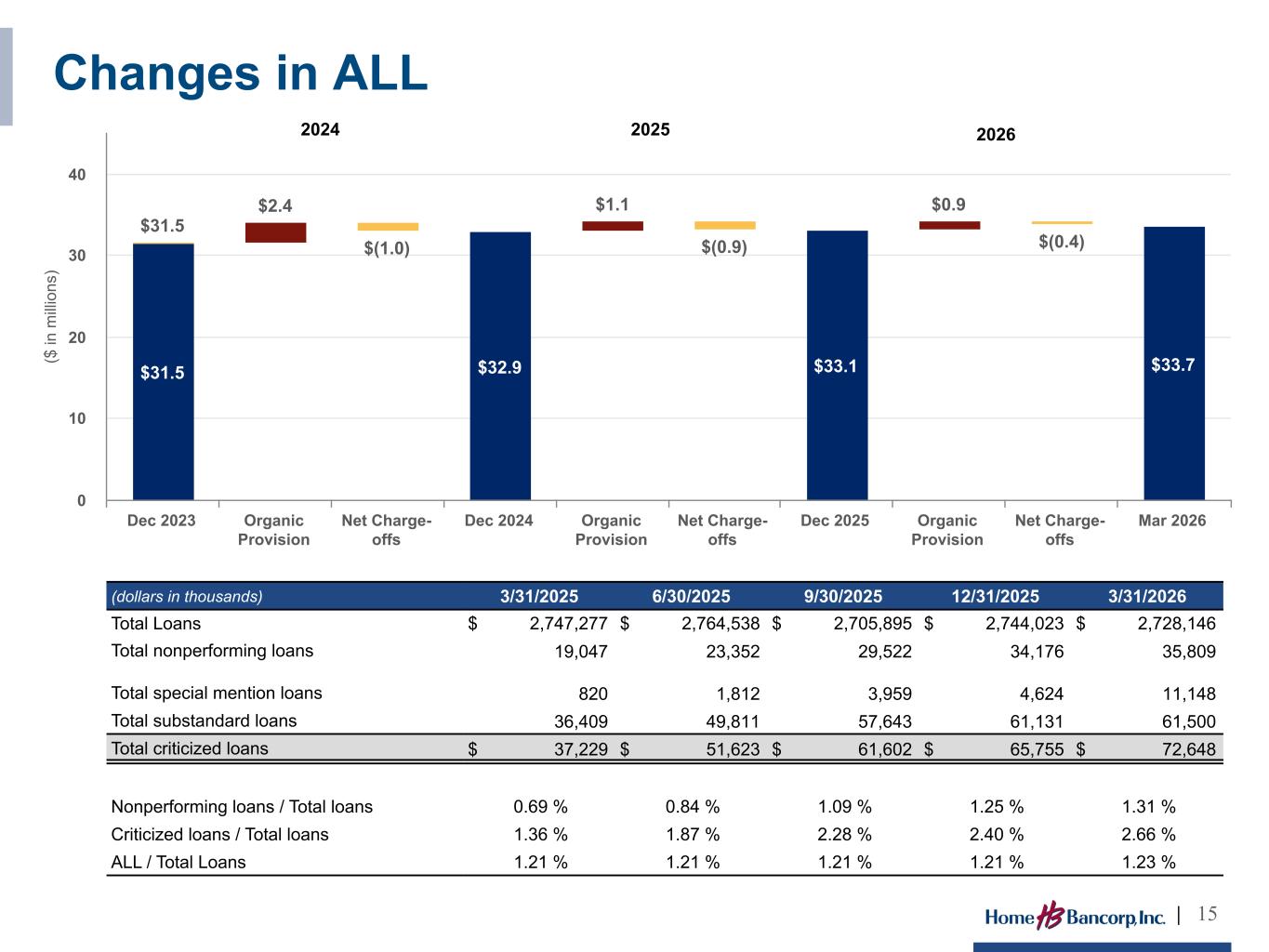
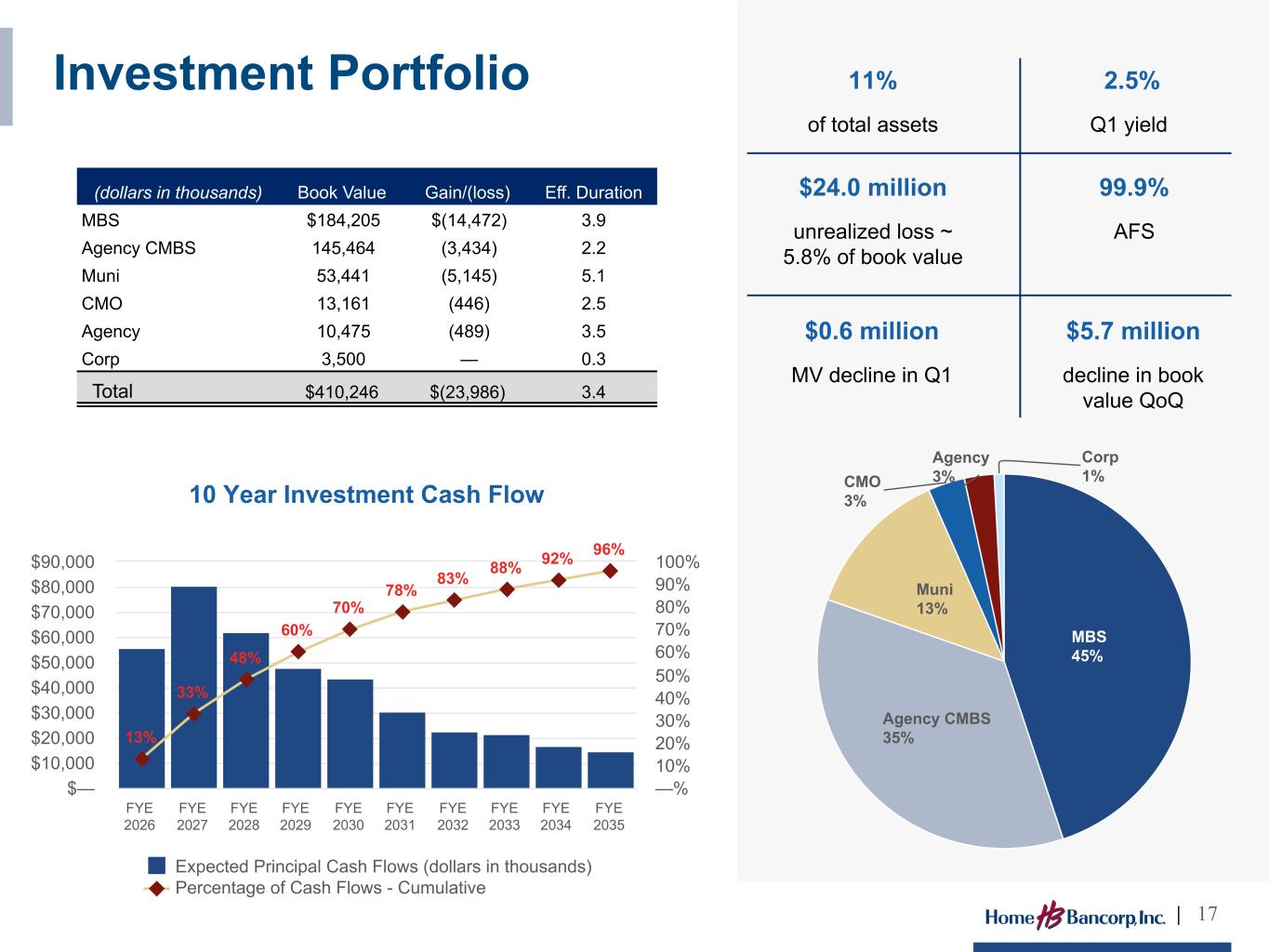
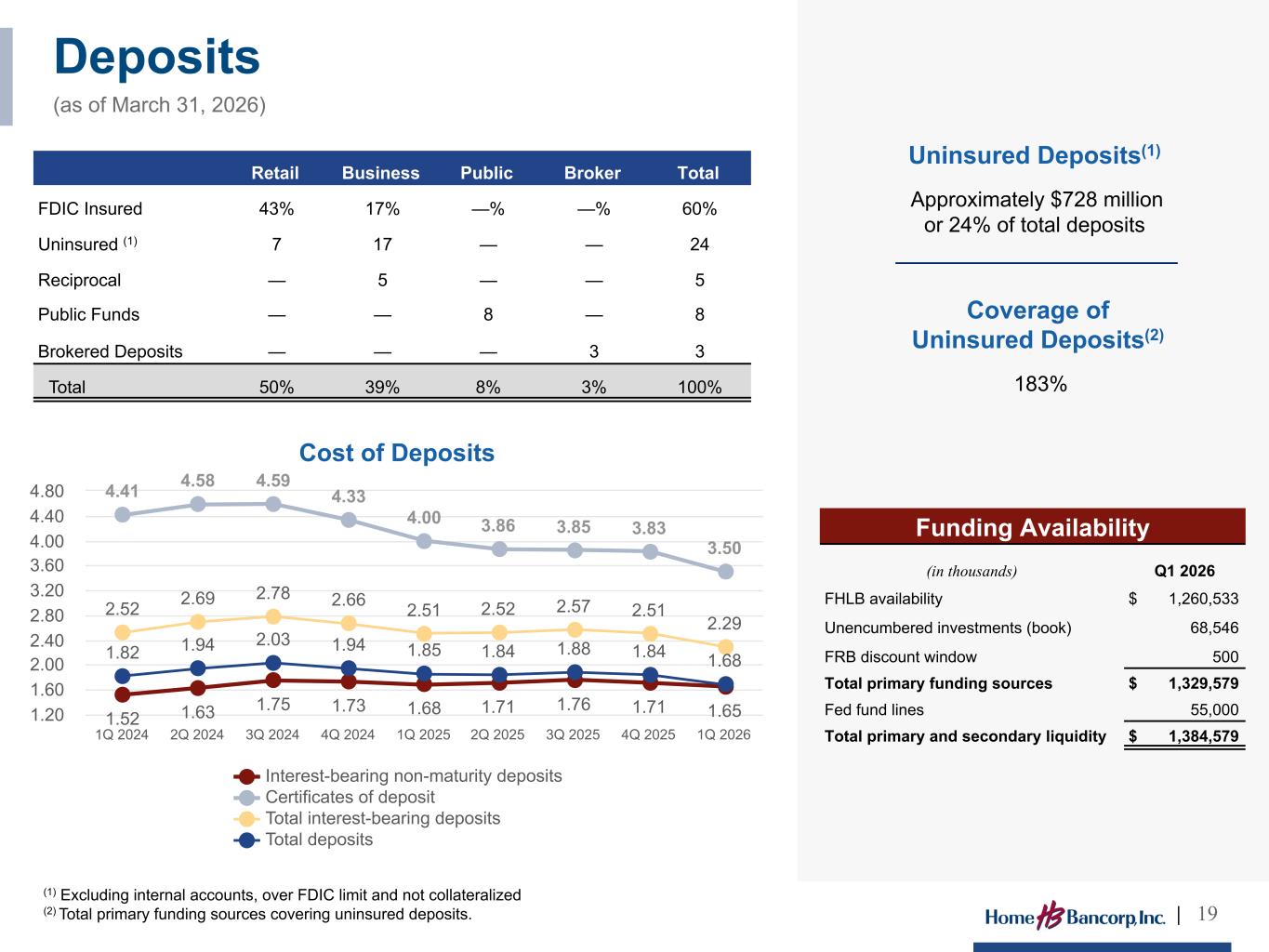
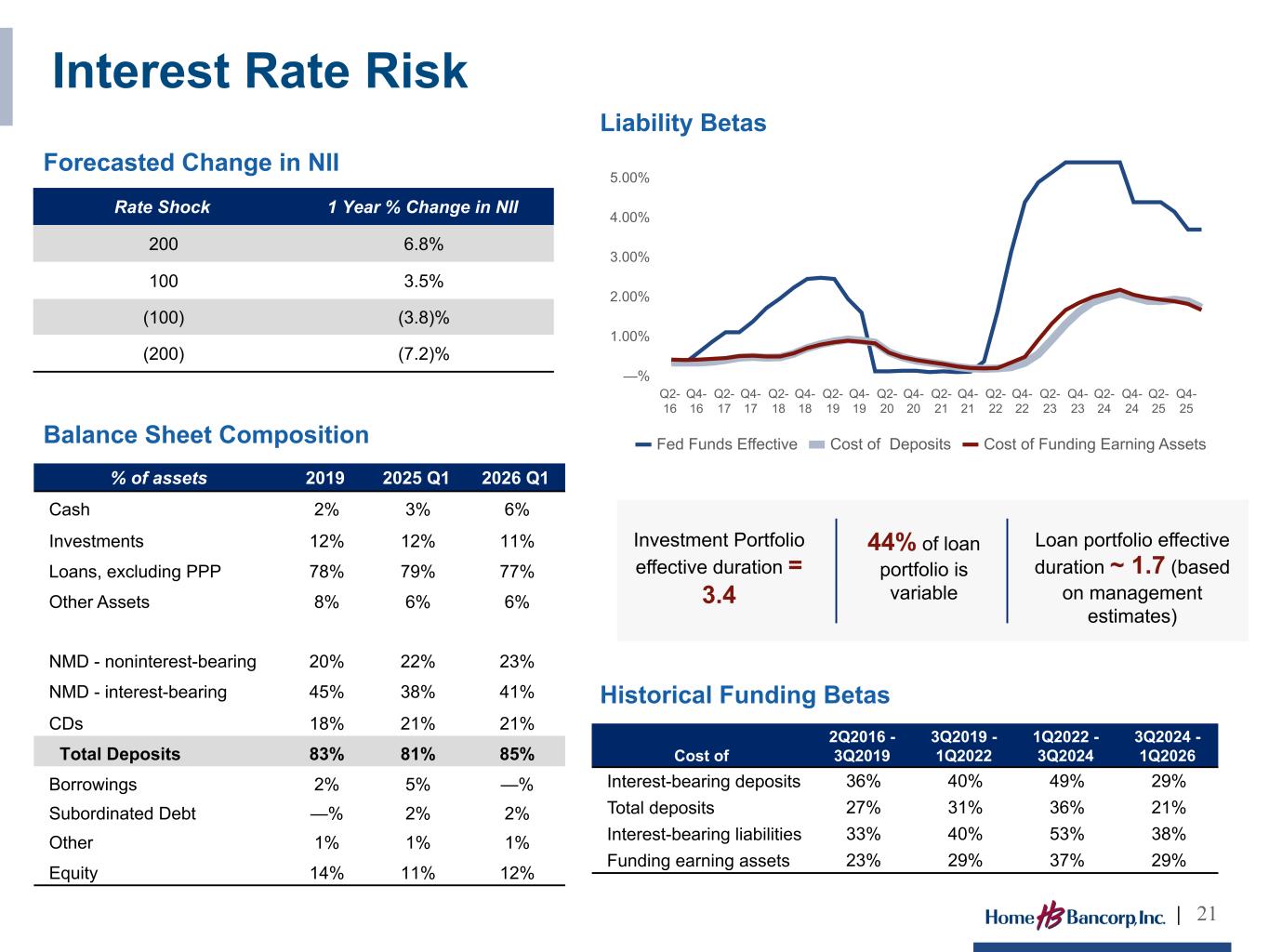
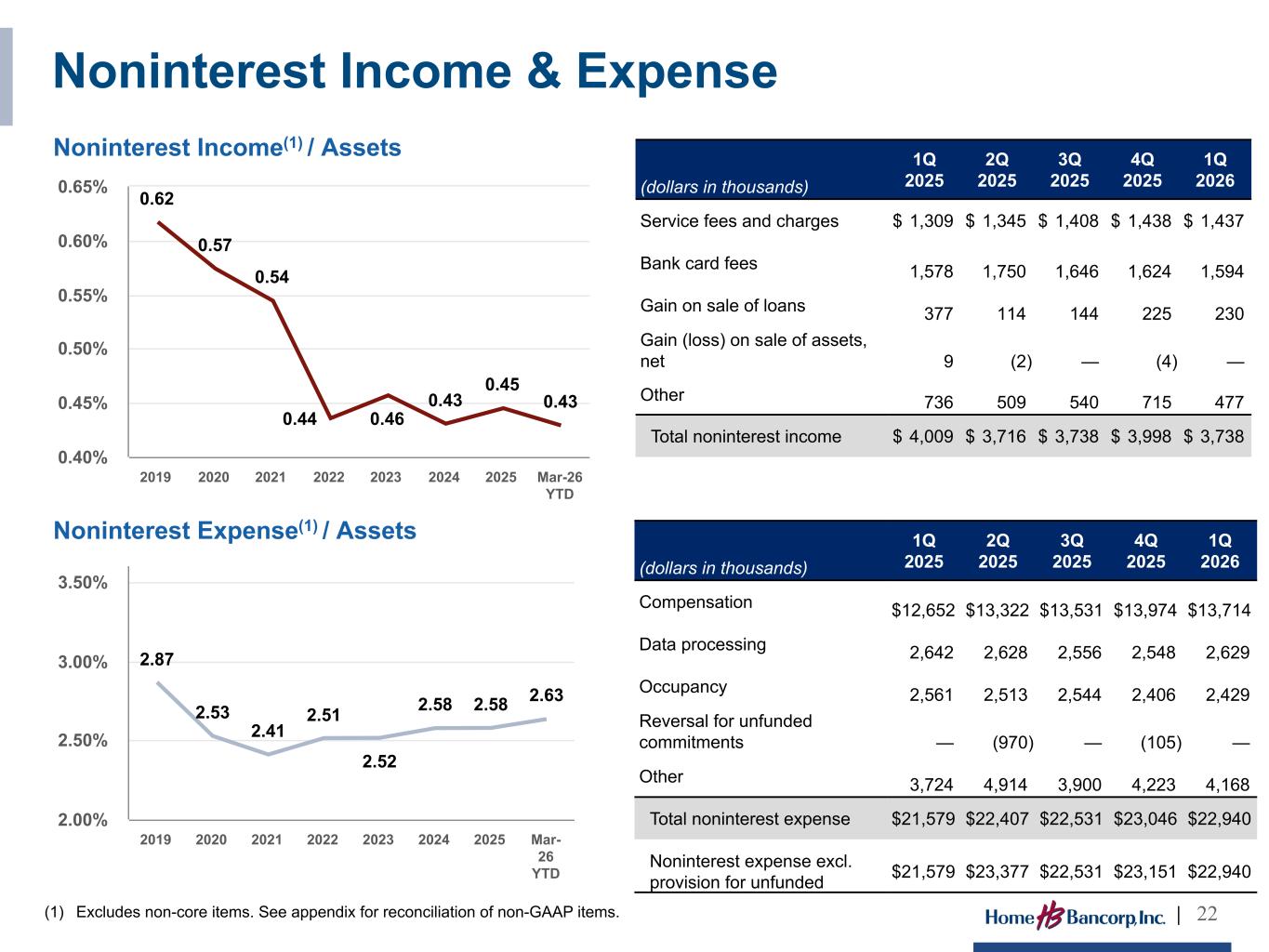
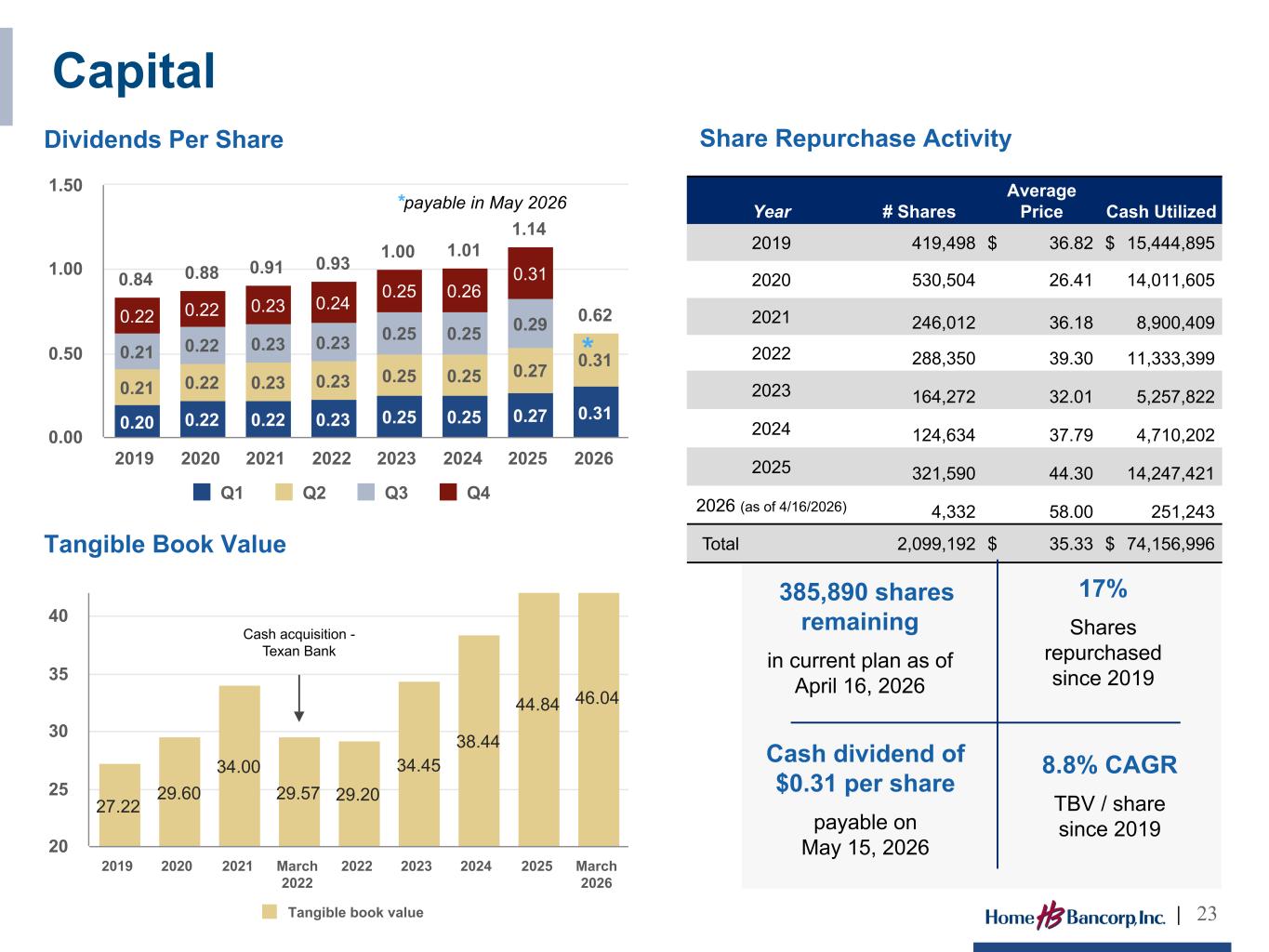
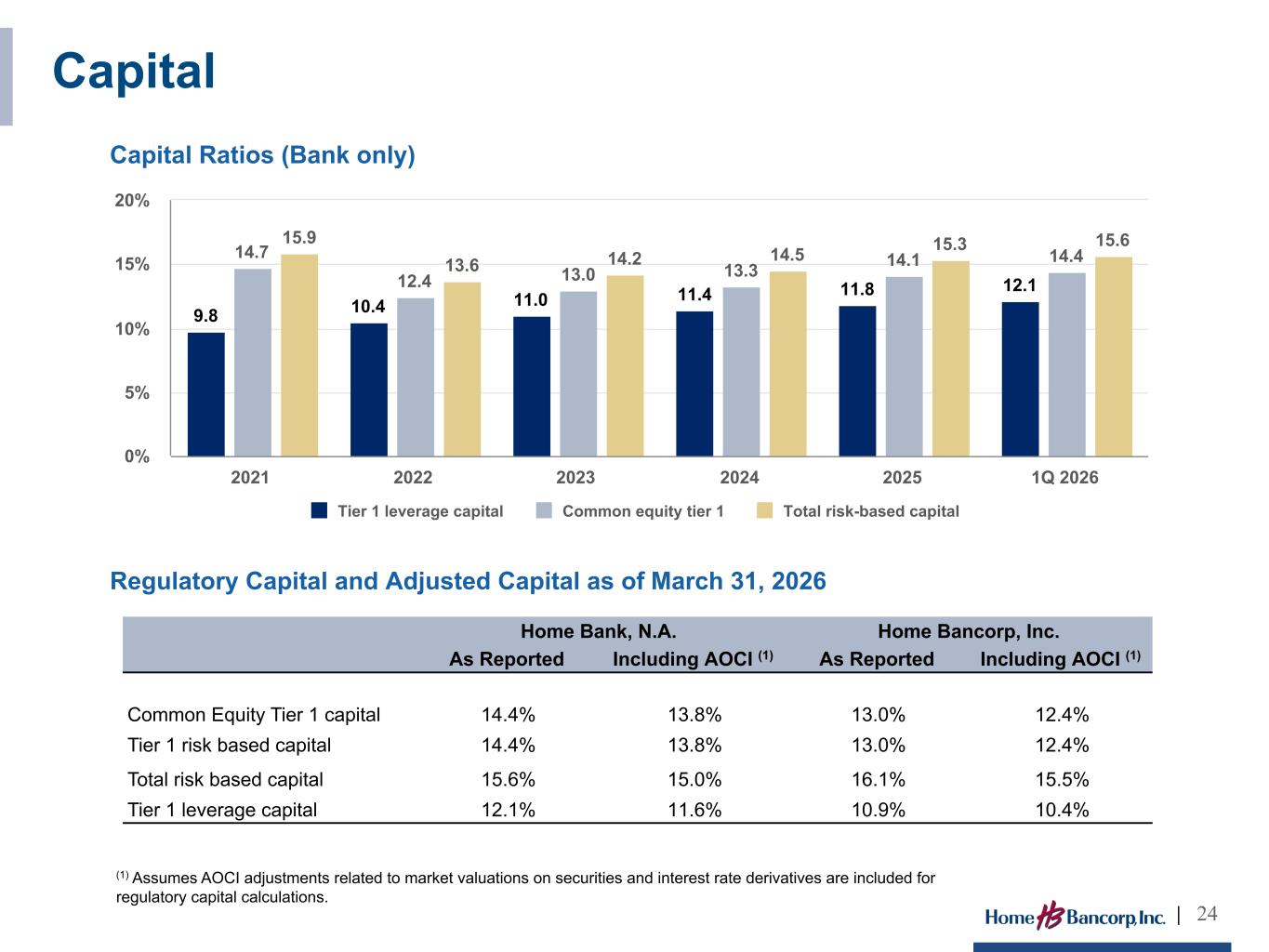
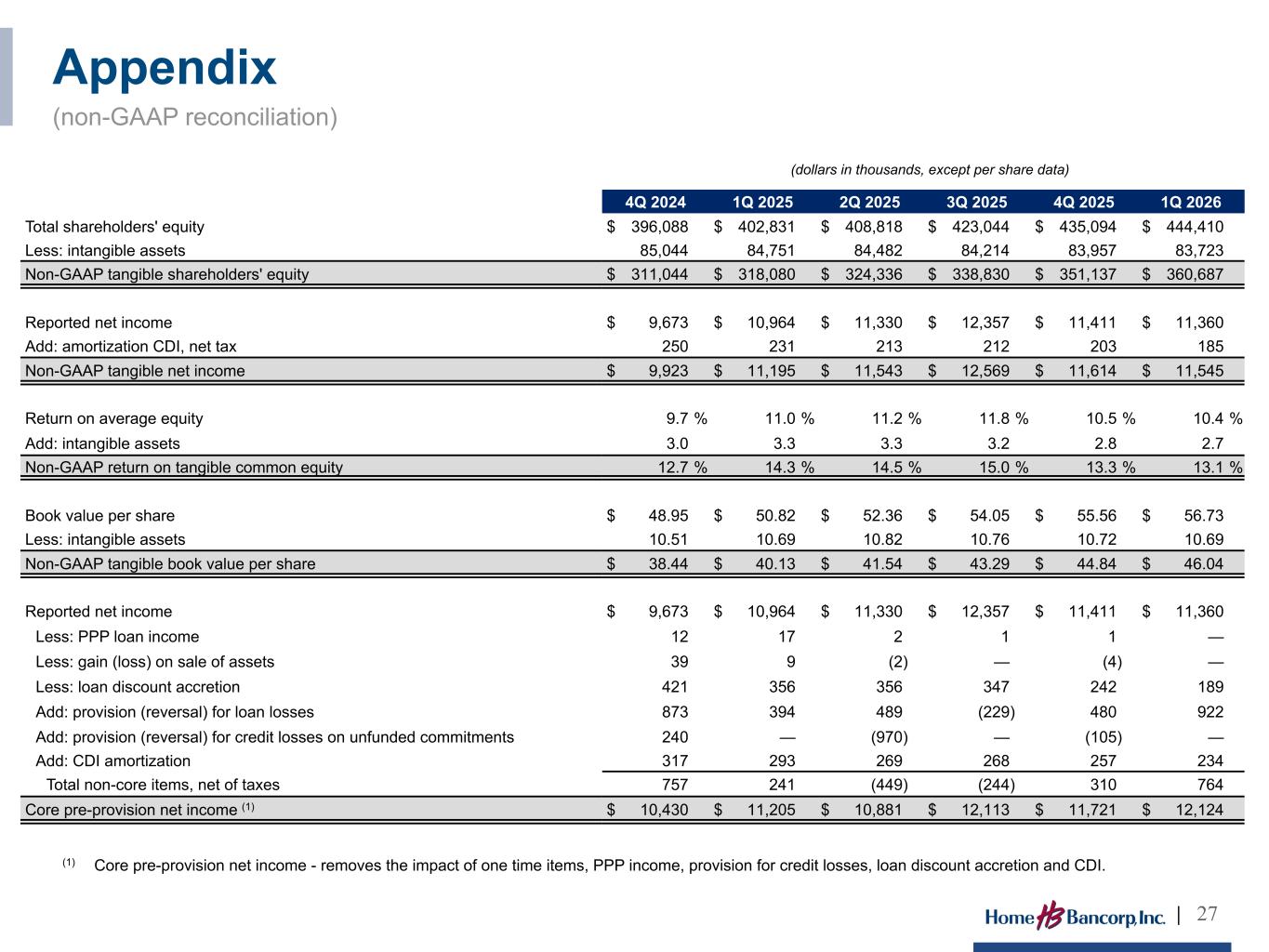
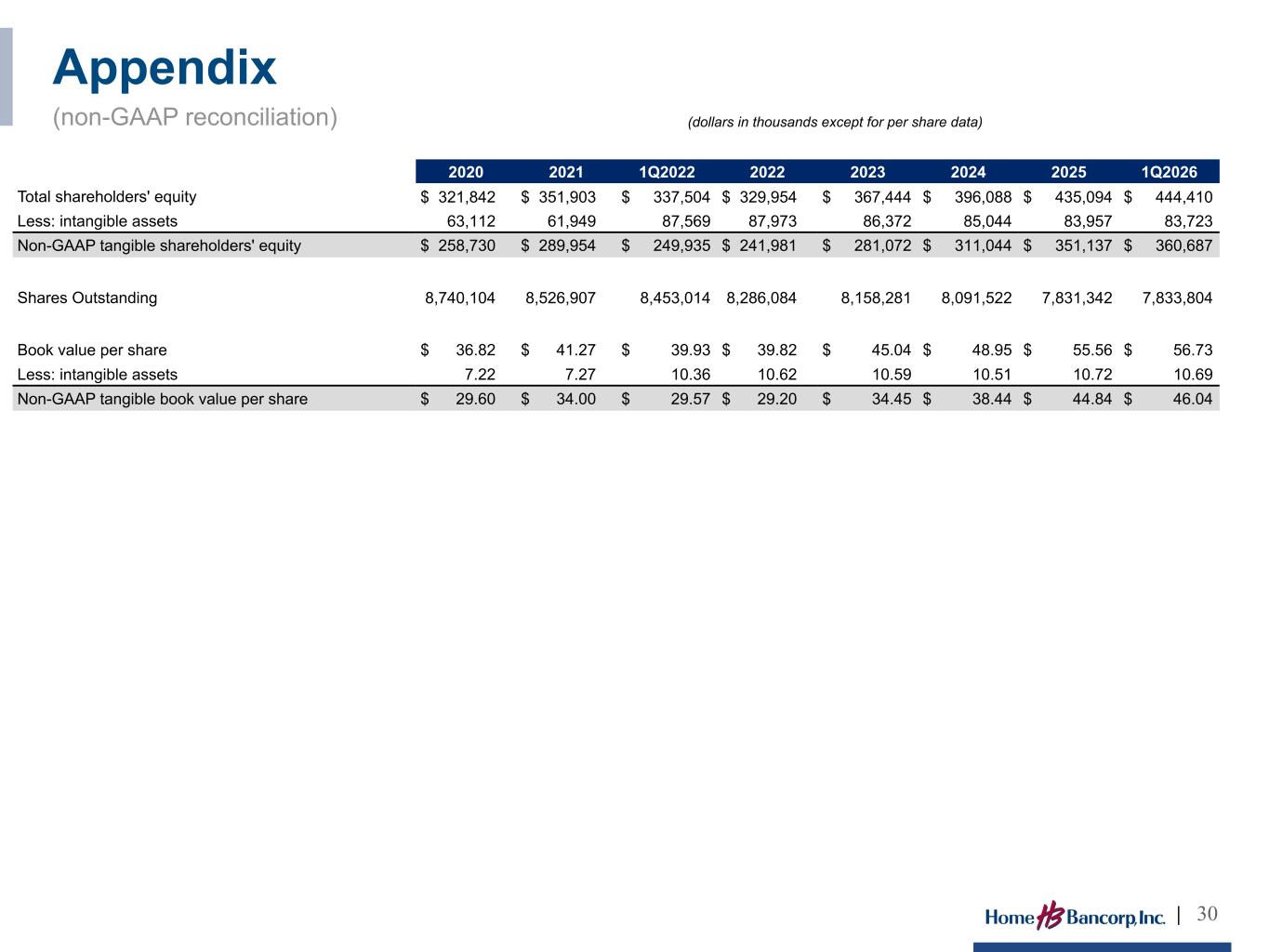
Thanks, John. Please feel free to refer to the investor presentation we have provided as I discuss the company's first quarter financial results. Net interest income totaled $34.5 million in the first quarter, an increase of $434,000 from the fourth quarter and $2.8 million from a year ago. This was the highest quarterly net interest income in Home Bank's history and was driven by both lower funding costs and materially improved balance sheet structure. Slide 20 of the presentation has a two-year history of the yields that drive net interest income and YAM, and you can see the progress we made bringing funding costs down while while keeping loan yields relatively stable. The cost of interest-bearing liabilities peeped in the third quarter of 2024 and has come down to 64 basis points as we proactively reduce our exposure to higher-cost funding. Over the same period, Discipline Underwriting and Loan Portfolio comprise of 56% fixed-grade loans have enabled us to maintain our loan yield within 12 basis points of the peak reached in the third quarter last year. And we're still making progress. In the first quarter, the average cost of interest-bearing deposits declined 22 basis points to 2.29%, while our overall cost of deposits declined by 16 basis points to 1.68%, which is less than half of the current Fed Funds target rate. During the quarter, we had strong deposit growth of 54 million, or 7% annualized, despite a 64 million reduction in CBs, of which 70% were non-core CB customers. The decline in city funding was offset by growth in lower-cost, relationship-based, non-mature deposits. Seasonal fluctuations in public deposits of $43 million contributed to the $118 million growth in non-mature deposits during the quarter. We had solid growth in non-interest-bearing deposits, which increased $37 million quarter-over-quarter, and $75 million year-over-year, and represent 27% of total deposits. Finally, due to our success in growing core deposits, we are able to repay all of our more expensive FHLD advances, which is a minor improvement of $3 million in quarter of four, but a material improvement compared to the $175 million advances we carried at year-end 2024. Given our lower cost of funds and the repricing opportunities on any assets, we continue to believe that is an additional opportunity for new expansion. Slide 14 details expected refluxing opportunities from our loans and investments over time. We continue to see a positive spread of approximately 40 basis points on new loan originations versus paidouts. New investment yields were north of 4% in Q1 versus expected roll-off yield of 2.43% over the next 12 months. Slide 15 and 16 of the presentation provide some additional detail on credit. Non-performing loans increased $1.6 million to $35.8 million for 1.31% of total loans. This was primarily due to the downgrade of three relationships with the largest being $1.4 million, partially offset by the foreclosure of a $2.6 million property at Houston. We reported a provision expense of $922,000 in the quarter compared to $480,000 in the fourth quarter. The increase was primarily due to each other. changes in individual prepared reserves associated with these downgraded credits. Our allowance for loan losses increased to 33.1 million or 1.23% of loans, and we continue to feel very confident in our reserve levels. So our 22 of the presentation has some additional detail on non-interest income and expenses. Non-interest income decreased by 260,000 to 3.7 million, which was slightly below expectations due to lower other income and bank card fees. We continue to expect quarterly non-interest income to be in the range of $3.8 to $4 million. Non-interest expense declined by $106,000 to $22.9 million in line with expectations. We continue to expect non-interest expense to increase modestly beginning in the second quarter as annual raises take effect and technology investments translate. For the remainder of 2026, we expect quarterly non-interest expenses to be between $23.3 and $23.7 million. Slides 23 and 24 summarize the impact our capital management strategy has had on home Since 2019, we have increased adjusted tangible book value per share at an annualized rate of approximately 9.7%, increased ETS at more than an 11% annualized rate, increased our quarterly dividend by more than 50% and repurchase approximately 17% of our shares. Tangible book value per share increased to $46.04 this quarter, up almost $5, or 15% from the first quarter of 2025. And with that, operator, please open the line for some Q&A.
Operator
Thank you. Ladies and gentlemen, we will now begin the question and answer session. If you wish to ask a question, please press PAR 4 by the 1 on your telephone keypad. If you would like to enjoy your question, please press PAR 4 by the 2. If you are using a speakerphone, please lift your handset before pressing any keys. One moment, please, for your first question. Thank you. And your first question comes from the mind of Stephen Scotting from Piper Sandler. Please go ahead.
Hey, thanks, guys. I'm curious, and apologies if I missed any color you gave already, David, but in terms of the NIM trajectory from here, you know, if we were to get no cut, how does that affect kind of, I think, some of your previous statements of expecting expansion for the remainder of 26? Does that actually improve that expectation or make you a little more bullish given your asset sensitive nature, or how do you think about the NIM with this rate environment?
I think, as I mentioned, we have a lot of opportunity for repricing both the loan and investment securities portfolio. And you'll see that with – you've seen that with our stable loan yield and slightly increasing investments. So I still think without any rate cuts, we're still seeing expansion in our loan yield. I'm picking up about 40 basis points on cash flow versus new originations. I think that deposits are probably, without any further rate cuts, probably around the floor. So I still think that there is opportunity without any rate cuts for expanded NIM. I would just add that the deposit side probably will dictate the pace of the growth of that NIM.
We know that we have loans repricing, but assuming rates are the same as they are, I'm not sure exactly where the positive rates are going to have to go for us to sustain the level that we have today.
Yep, that makes sense. And then could you give a little bit of color on kind of what you saw from a production standpoint on the long time, maybe customer demand throughout the quarter? I know you mentioned the strength in the Texas markets. I think you said 3% growth there, but kind of how maybe that demand segmented by time of the month as well as those different markets.
Yeah, the demand, of course, the last three quarters, second, third, and fourth of last year, were, I guess, really hurt by some paydowns, companies selling, businesses selling, whatever. This first quarter was very typical of previous quarters other than the last three years. First quarters, I mean, first quarters typically are relatively flat and people kind of getting their footing and moving forward. The last three years, though, first quarter was much more productive. So I think this is a more natural period where they were looking for lower interest rates and realized they're not going to get it. But I think we'll see a higher demand potentially in second and third and fourth. Assuming also, you know, geopolitical issues throughout the world are not slowing that demand.
Makes sense. And maybe just last thing for me. I'm curious, you know, obviously, but the stock has had a really nice run over the last, you know, year and a half or what have you. Does that allow for any potential, I mean, any conversations to pick up or escalate? or conversely, if nothing's able to happen to you at any point, start to think about partnering with a larger institution.
Absolutely. I think M&A will come a little more into focus. What we did look at over the last three years more so were smaller transactions because we did not have the commodity to be able to utilize our stock. So I think with our stock price trading closer to the 140 attainable, we think we can do a deal this year. So potentially something to a little more size than what we've been looking at for the last three years.
Okay, great. Thanks so much for your time.
I appreciate it. Thanks, David.
Operator
Thank you. And the next question comes from the line of Joey and Janice from Layman James. Please go ahead.
Speaker 2
Good morning. Good morning, Joe. Pretty good quarter on the deposit front. You know, and as you discussed, you're prepared to march at the lowered cost, improved funding mix. Can you talk about what you're seeing in the market from a competitive standpoint?
I would say going back to Q4, when we started seeing the rate cuts, a good portion of the banks did lower their deposit rates accordingly. There are a couple of – and we did as well. We saw a outflow of CDs. I think I mentioned the dollar amount, and we lowered our CD rates. And so we did have some CD runoff from non-core customers. Looking at some of the competitive gear data, we did see a couple of outliers in the 4% range, and we had to adjust our CD rates up slightly. When I say slightly, I'm talking from 365 as our top rate to 385 in most markets, and that stemmed the outflow of CDs for us a little bit. But we are still seeing, with great expectations, cut rate going away, we have seen a couple of other competitors in Houston as well be a little bit more aggressive in the four to four-and-a-quarter range.
Speaker 2
Appreciate that. And, David, just kind of going back to your expense guide, it sounds like you lowered your out-quarter expense guide, you know, from what you said on the prior quarter. Just wondering what's driving that decrease.
Joe, I feel like I didn't change the guidance for the rest of 2026. I'll have to follow up with you individually on that. I feel like I didn't change that guidance at all. So I'll have to check with you.
Speaker 2
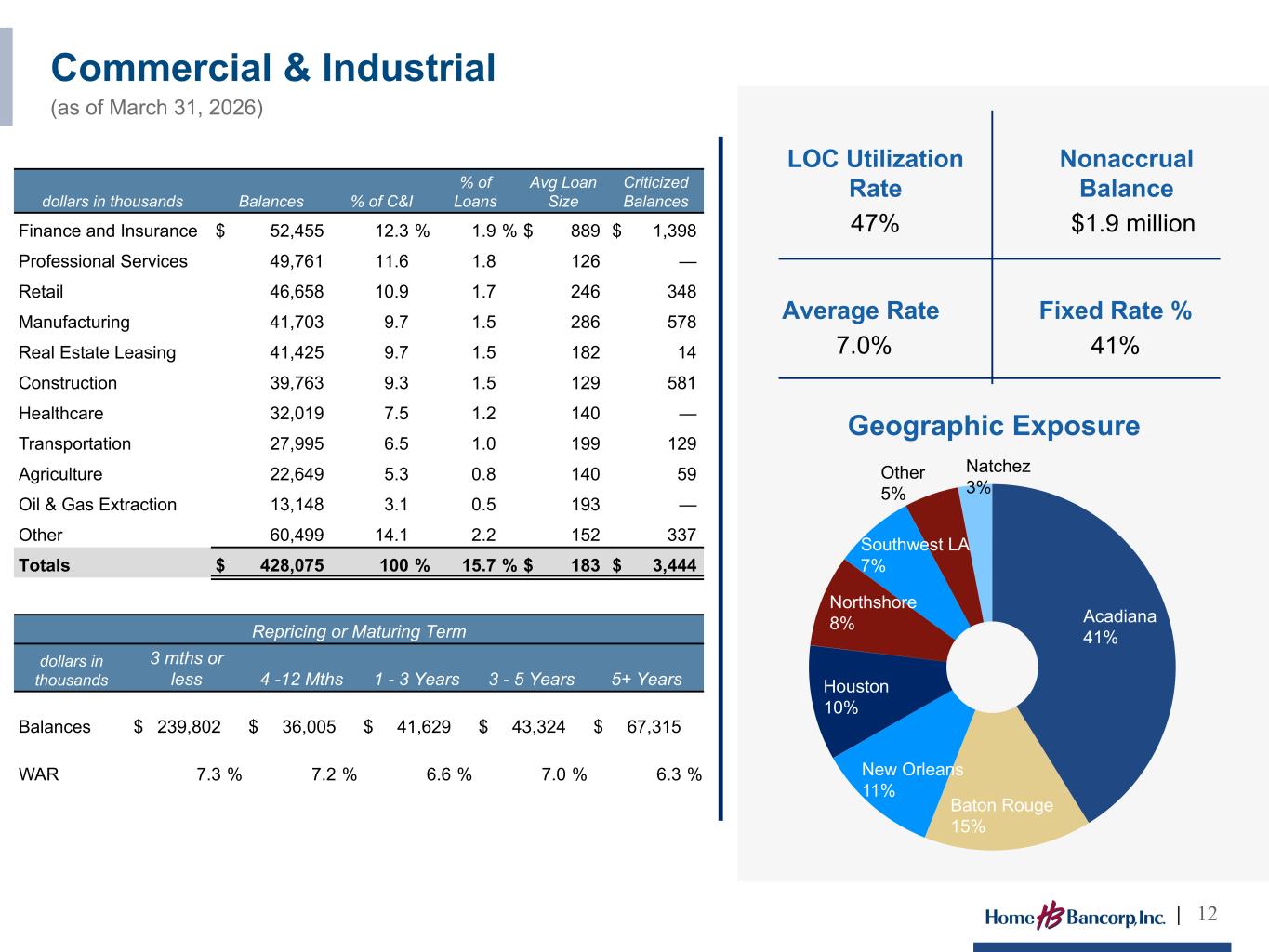
I'll have to double-check that. And just to be clear, you had said 23.3 to 23.7 is the kind of go-forward number? Yes. And then kind of want to hit on the loan book a little – one more time. So in your prepared remarks, you mentioned that the pipeline has improved. I guess I was wondering, are you able to quantify the change to the pipeline versus the end of the December quarter? And then additionally, it looks like CNI utilization dipped about 400 basis points this quarter. You know, in your view, what needs to happen to see some recovery there?
Yeah, I think one of the things that we focused on probably going back two years now is There's a reduction in our appetite for none or occupied. So what you've seen so far in 2026, first quarter, was a reduction in those types of loans. There are some players out there that are very, very competitive on rates, and so we weren't able to hold on to those. So those are a lot of rental properties and things of that nature. So that's where our loan reduction is coming from. So we still have a decent pipeline, but we've lost, I don't remember the number, David, we remain in just two categories. So we anticipate that that runoff maybe slows down a little bit, but that will help us add balance in the second, third, fourth, or maybe even fourth quarter, assuming the rate cuts. I think that may even spur that on a little bit more from the world side.
Speaker 2
Yeah, I appreciate that. Then last one for me here.
Joe, the pipeline increased about $30 million as of March compared to December.
Speaker 2
And what's the – $30 million off what base, if you don't mind?
Speaker 2
So from a percentage standpoint. And then last one for me, you know, while relatively small, it looks like SBA volume has ticked higher this year, while the average deal size has been cut in half versus 2025. Can you talk about your SBA strategy and how it's evolved?
Yeah, it's been a very slow process. We've looked at a lot of C&I-type loans on the SBA side. a lot of the brokers are taking some of the 7A type loans. We haven't I don't think we've originated any 7A loans in the last couple of years so it's been very tough either they don't fit our appetite or very competitive bidding and the prices are such that we're not winning but that's something that we're actually discussing our strategy for SBA it's not going to be a a big part of our portfolio. To make it a big part of our portfolio, we would have to invest in a lot of vendors in that world. And we wanted to have that as a go-to, but not necessarily drive it for significant success.
Speaker 2
Does that have a good question for you? That's great. Thanks for taking my questions. Thank you.
Operator
Thank you. Once again, if you have a question, please press star forward to one. And your next question comes from the line of Feddy's check plan from Hovdi. Please go ahead.
Hey, good morning. Just wanted to touch on loans first. David, I think you mentioned a 40 basis point pickup on the old kind of stuff that's renewing. But I was curious, what's the average rate on new production today? 7%. And then, you know, on the credit side, I was wondering if you could just walk through a little bit more of kind of maybe what's maybe in workout and maybe some changes that we could see later this year just as you kind of work through the credits. I appreciate that you've mentioned in the release that the losses should be in material, but just curious if we could maybe see a directional change in NPAs later this year.
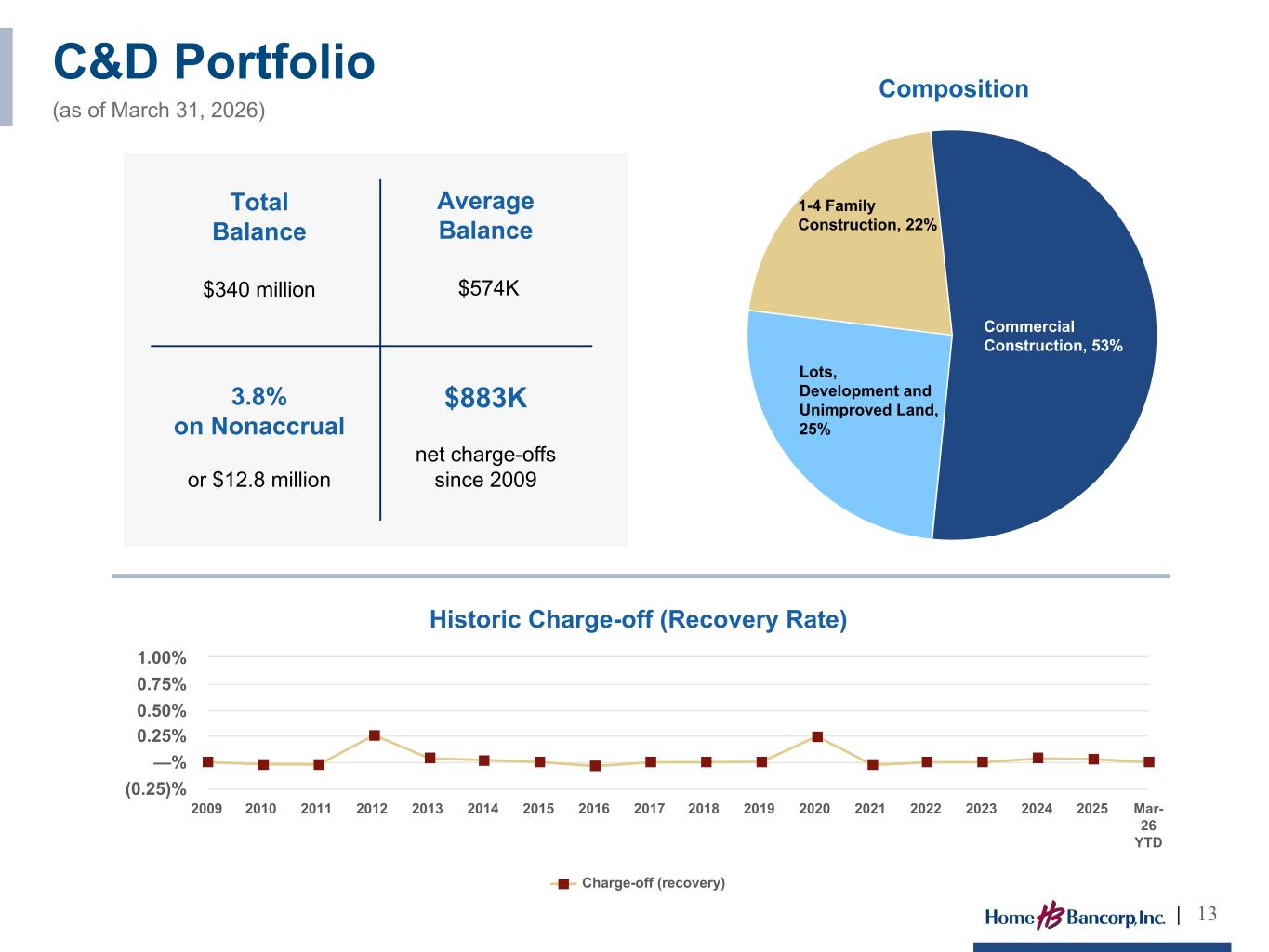
Well, I think, you know, the biggest issue that we've seen probably in the last two or three years is the time it's taken to run these special assets through the process. We had, you know, some that were working on New Orleans that filed bankruptcy the day before the foreclosure, and so we're in year two of collections on that. Our oldest classified asset is trying to refinance outside, and hopefully that happens. And that's been a bad asset for seven years. So the longevity of these and our ability to get them and work them seems to be the biggest problem. Because once we get them, we can work them. Whether we take a loss or we're able to recover our loan bill is irrelevant. and we want to work and get them out and get that money back working. And it's just been a very slow process over the last couple of years in getting that done. So that's why we're having a little bit more accumulation. It's not like we had that much in the quarter, $3 million additional, but we didn't have $3 million of runoff. That's the problem.
And just, you know, one other question on the deposit side. We're good to see, you know, solid DDA growth. You're just curious. I know that's kind of tough in this environment with rates sitting where they're at, but do you think there's an ability to continue to grow, not necessarily, do you see anything on the horizon that could lead that number to continue to climb higher?
I think the biggest change for us has been attracting bankers that are more C&I driven, and so we're getting total relationships, and some of those relationships come with very healthy deposits. And so as long as we continue to do that, and, you know, for a long period of time, we were a CRE bank. And our focus changed about four years ago, away from that, to more of us, you know, investors. And I think that's what you're seeing here is the influx of deposits, not necessarily big loan amounts.
I think that's it for me. Thanks for taking my questions. Thank you. Thanks for having me.
Operator
Thank you. Once again, if you wish to ask a question, please press star 4401 on your telephone keypad. This concludes your question in the end of this session. I would now like to turn the conference back over to Mr. John Bordelon for any closing remarks.
Thank you all for joining us today. We sure appreciate your questions and your concern for home bank work. We look forward to speaking to you in the coming days and weeks, and I hope everyone has a wonderful week. Thank you very much.
Operator
The conference has now concluded. Thank you for attending today's presentation. You may now disconnect.