Operator
Ladies and gentlemen, thank you for standing by and welcome to the second quarter 2025 HII earnings conference call. At this time, all participants are in a listen-only mode. After the speaker's presentation, there will be a question and answer session. To ask a question during the session, please press star followed by one on your telephone keypad. And if you change your mind, please press star followed by two. Please be advised that today's conference is being recorded. If you need further assistance, please press star followed by zero. I would now like to hand the call over to Christy Thomas, Vice President of Investor Relations. Mrs. Thomas, you may begin.
Thank you, Operator, and good morning, everyone. Welcome to the HII Second Quarter 2025 conference call. Matters discussed on today's call that constitute forward-looking statements, including our estimates regarding the company's outlook, involve risks and uncertainties and reflect the company's judgment based on information available at the time of this call. These risks and uncertainties may cause our actual results to differ materially. Additional information regarding these factors is contained in today's press release and the company's SEC filings. We will also refer to certain non-GAAP financial measures. For additional disclosures about these non-GAAP measures, including reconciliations to comparable GAAP measures, please see the slides that accompany this webcast, which are available on the Investor Relations page of our website at ir.hii.com. On the call today are Chris Kastner, President and Chief Executive Officer, and Tom Seeley, Executive Vice President and Chief Financial Officer. I will now turn the call over to Chris.
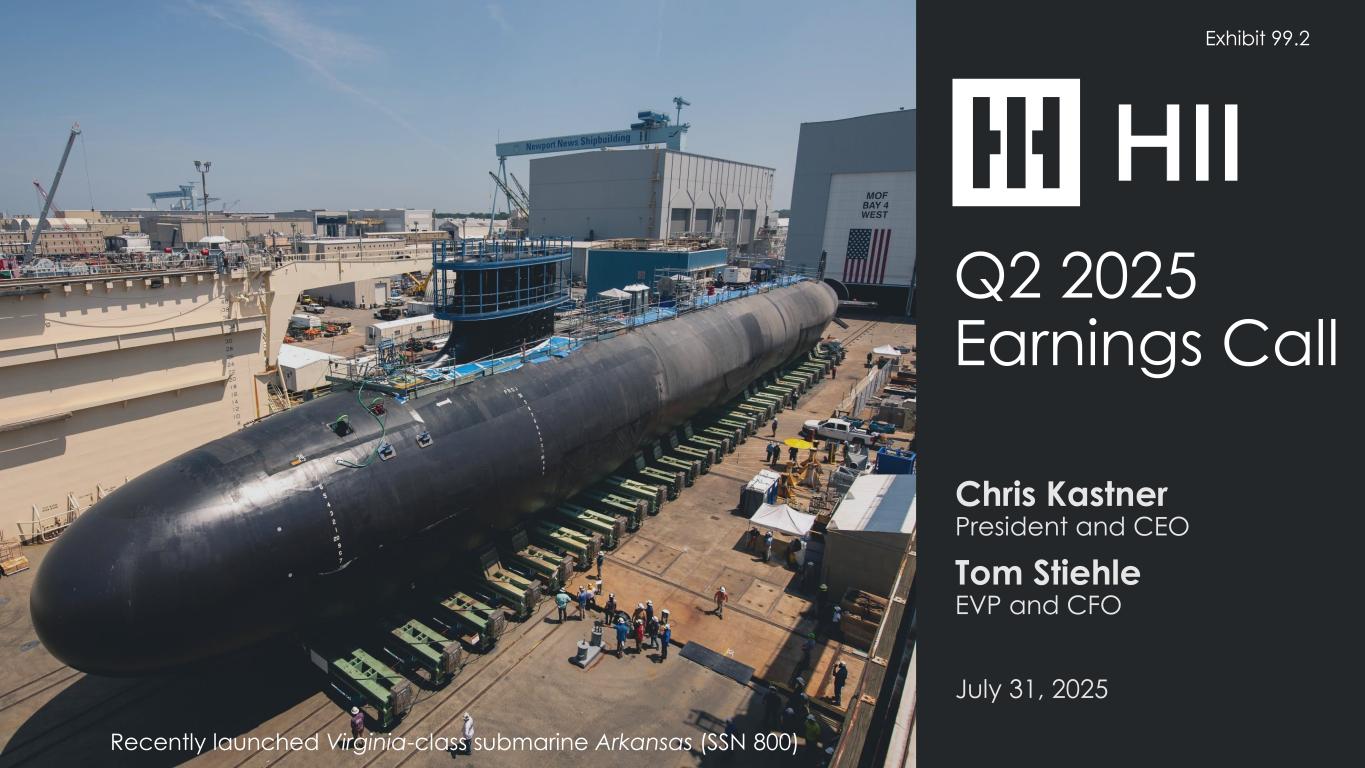
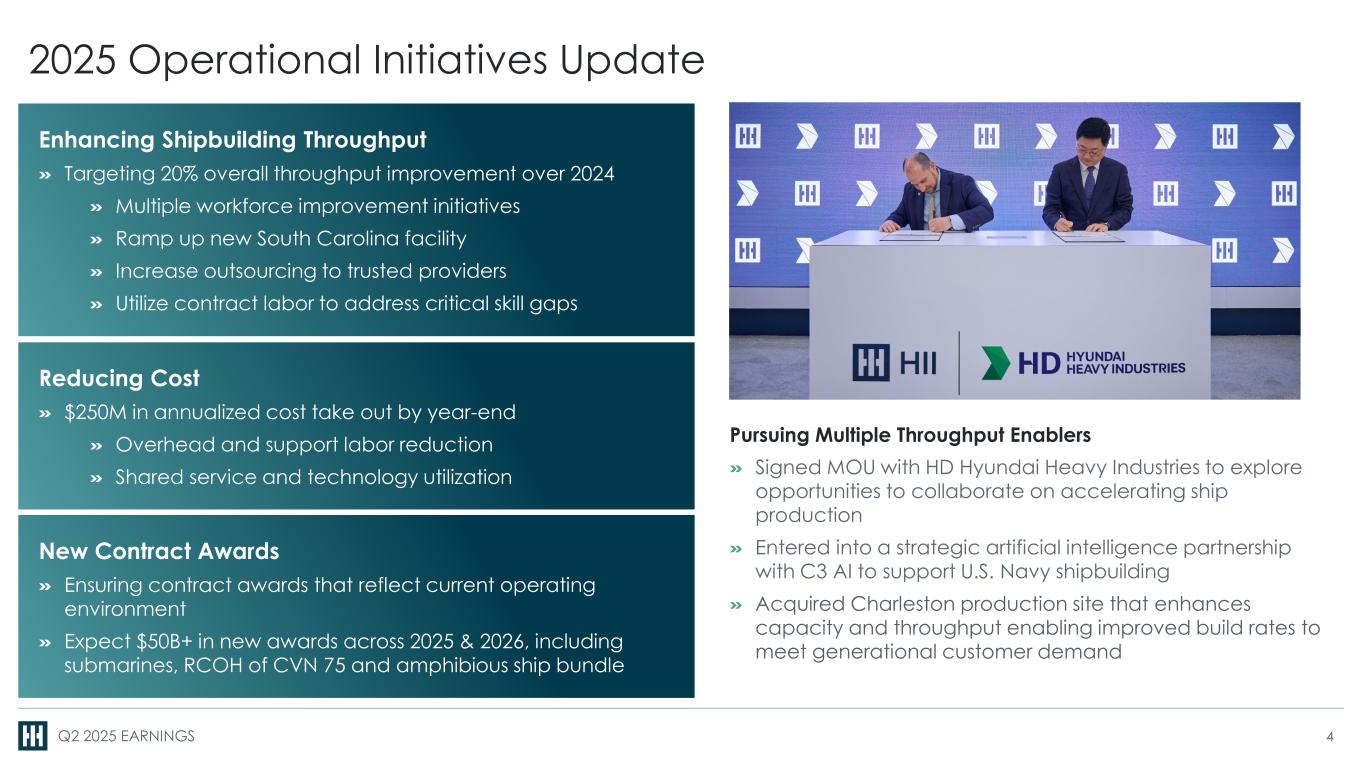
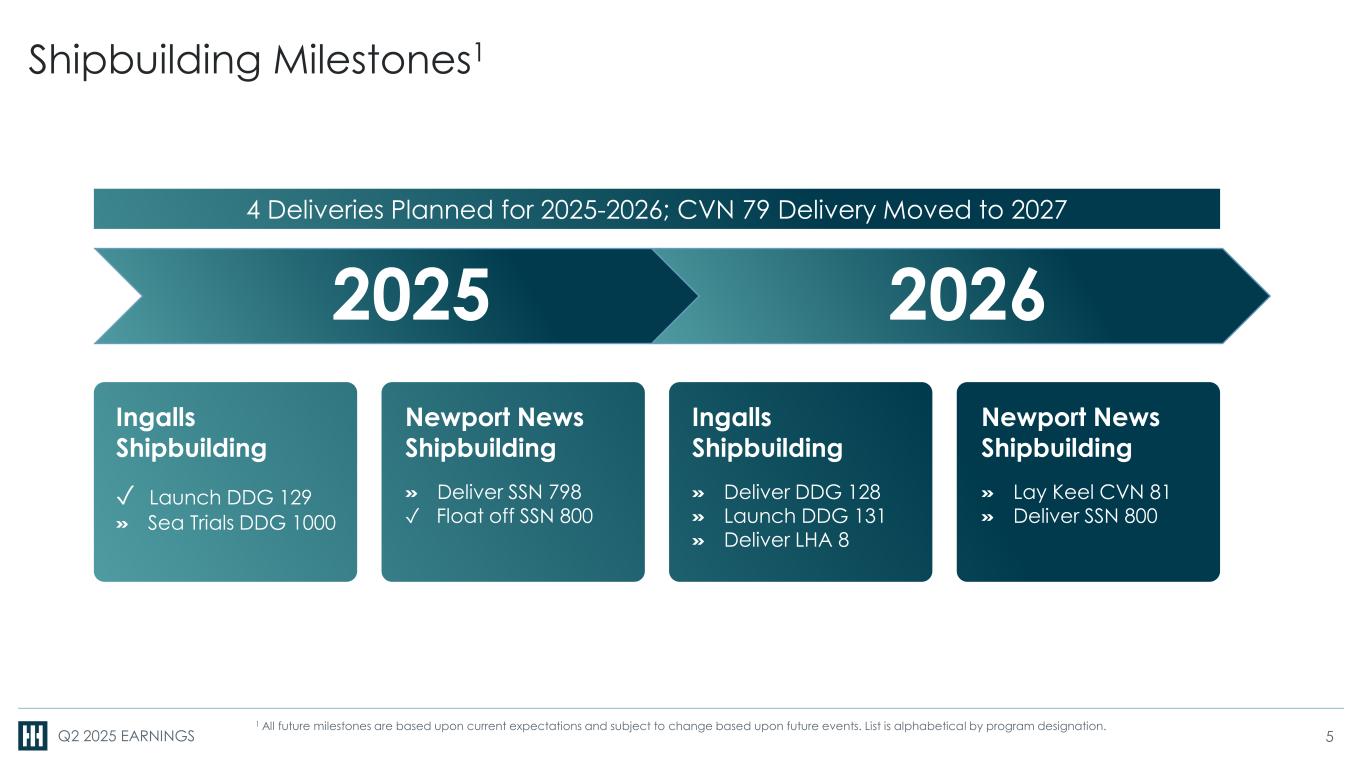
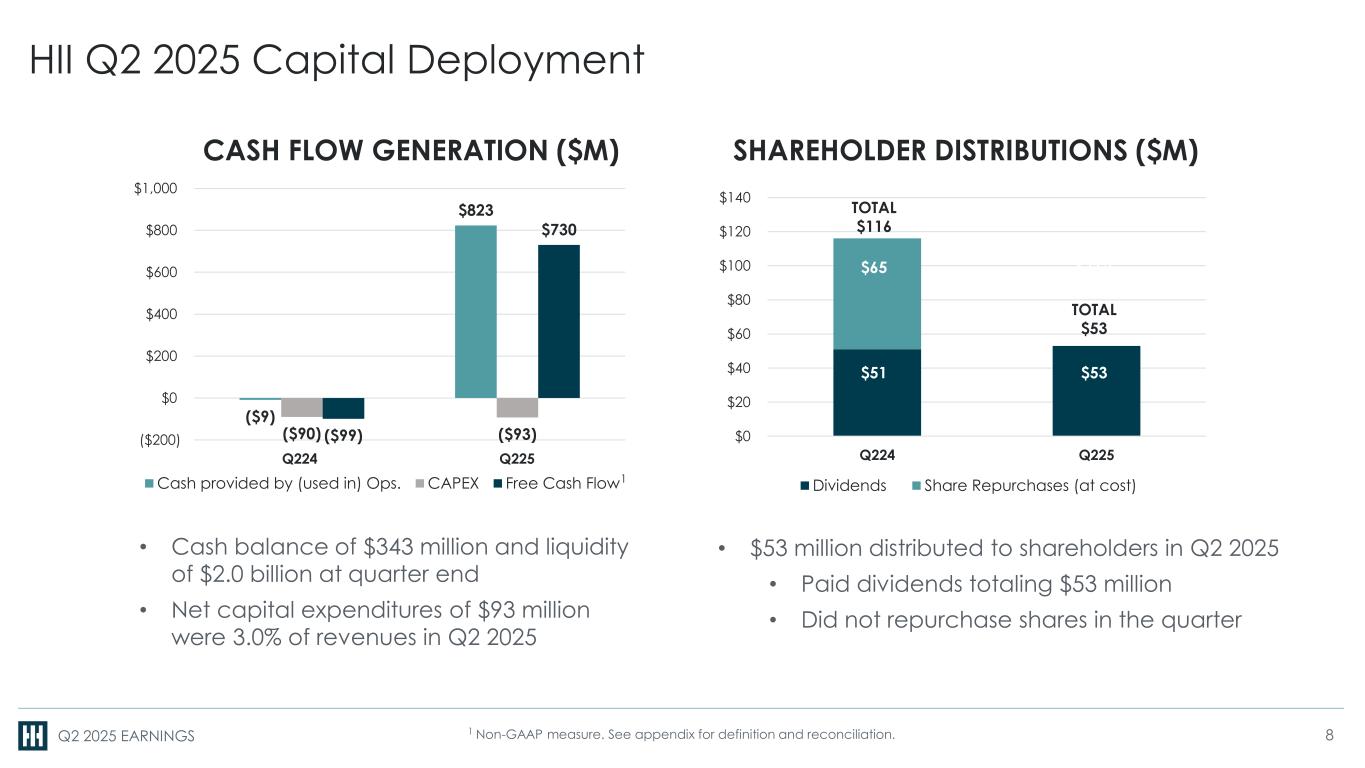
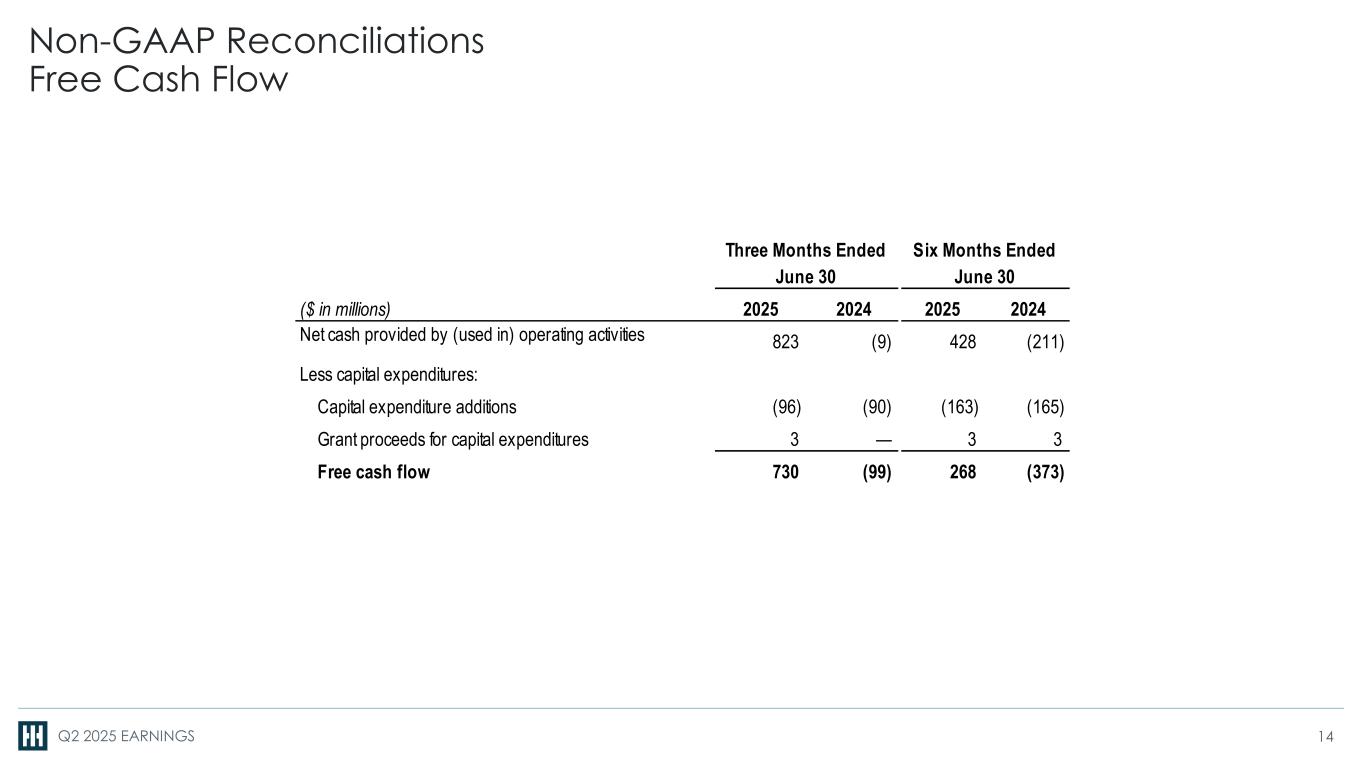
Thanks, Christy. Good morning, everyone, and thank you for joining us on today's call. I'll start by providing a high-level summary of our financial performance, highlighting key achievements, and then I'll provide an update on our operational initiatives. Tom will discuss our quarterly results and full-year 2025 outlook in more depth. This morning, we reported second-quarter sales of $3.1 billion and earnings per share of $3.86, with backlog reaching $56.9 billion. Contract awards of $11.9 billion included DDG 145 and 146, LPD 33, and two Block 5 submarines with associated investments in shipbuilder wages, workforce development, infrastructure, and technology insertion. Free cash flow was $730 million, and we invested $93 million in CapEx. At Newport News in the second quarter, we floated off SSN 800 Arkansas and are on track to deliver SSN-798 Massachusetts later this year. New carrier construction is also progressing, and on CVN-79 Kennedy, we are working with our customer to deliver the most complete and combat-ready ship to the Navy as early as possible and are scheduled to go to sea for our first trials toward the end of the year. CVN-80 Enterprise has received several of the late engine room components that I discussed previously, with the remaining equipment scheduled to come in over the next few months. Receipt of the remaining sequence critical components enables progress acceleration as our shipbuilders integrate the equipment into the ship and unlock associated delayed progress. Moving to Ingalls, in the second quarter we completed main engine light off on DDG-128 Ted Stevens and christen DDG-129 Jeremiah Denton. And we continued to make progress on our Amphib programs as we completed fuel load on LPD-30 Harrisburg and generator light off on LHA-8 Bougainville. Admission technologies, we had another quarter of strong sales of $791 million. Key wins included a contract to provide live training solutions to the U.S. Army's Program Executive Office for simulation training and instrumentation. And in our uncrewed business, we deliver the first two Lionfish small, uncrewed, undersea vehicles to the U.S. Navy under a program that could scale to 200 vehicles. We also announced a commercial sale of Remus 300 UUVs to Hitachi. Notably, our recent announcement of a technology partnership with C3AI is a key strategic highlight for the quarter. This partnership enables us to leverage digital technologies and AI to accelerate shipbuilding throughput with a primary focus on schedule optimization to drive faster delivery. Now on to the operational update, both Ingalls and Newport News' performance was relatively stable in the quarter as we continued to work through ships that were contracted for prior to COVID. As I've indicated previously, the next year and a half will be challenging as we transition out of ships contracted for pre-COVID to our new contracts. As for the first operational initiative, increasing throughput, Ingles is on plan, and Newport News continues to be behind plan, primarily due to CVN80 supply chain issues I previously discussed. Both shipyards increased throughput in the second quarter, and I expect further acceleration on the back half of the year. It's important to note that progress is being made on improving performance due to the sustained and significant investment by the Navy and Congress, along with our internal investments. Leading indicators in the labor pipeline and retention are showing positive trends. And on the supply chain front, we expect continued stability, though risk remains for some major equipment. While these early indicators are encouraging, there is still tremendous work to be done. We know that it will require sustained improvement to achieve our long-term targets. Also, the industrial base is expanding with significant outsourcing taking place, increasing the capacity of the shipbuilding industry as a whole, and our technology efforts to increase efficiency are off to a strong start. The second operational initiative is our $250 million annualized cost reduction effort, and we expect to achieve this by year's end. Finally, regarding the third operational initiative, Contract Awards, we announced the award for two Block 5 submarines and associated investments on April 30th. This award reflects a significant step, solidifying the investment our customers are making in the shipbuilding industrial base and highlighting the critical and urgent need for these submarines. The shipbuilding and Navy teams have now pivoted to negotiated agreements for Virginia Class Block 6 and Columbia Bill 2, and I expect these agreements to be completed later this year. Turning to activities in Washington, the Reconciliation Bill and the FY26 budget include significant support for our shipbuilding programs. Specifically, the Reconciliation Bill includes a second FY26 Virginia-class submarine, two DDG-51 Arleigh Burke destroyers, funding for the amphibious warship bundle, funding for expansion of usv uv production and 4.9 billion for the shipbuilding industrial base additionally the president's budget for fiscal year 2026 is now under consideration by congress and the proposed budget reflects continued investment in our shipbuilding programs with funding provided for the columbia class and virginia class submarine programs for CVN's 80 and 81 construction and CVN 82 advanced procurement, and for the second of three years of funding for the refueling and overhaul of CVN 75. In summary, we had a solid Q2 that was largely consistent with our expectations as we remained focused on executing our operational initiatives, increasing throughput, achieving cost reductions, and capturing new contract awards. And now I'll turn the call over to Tom for some remarks on our financial performance.
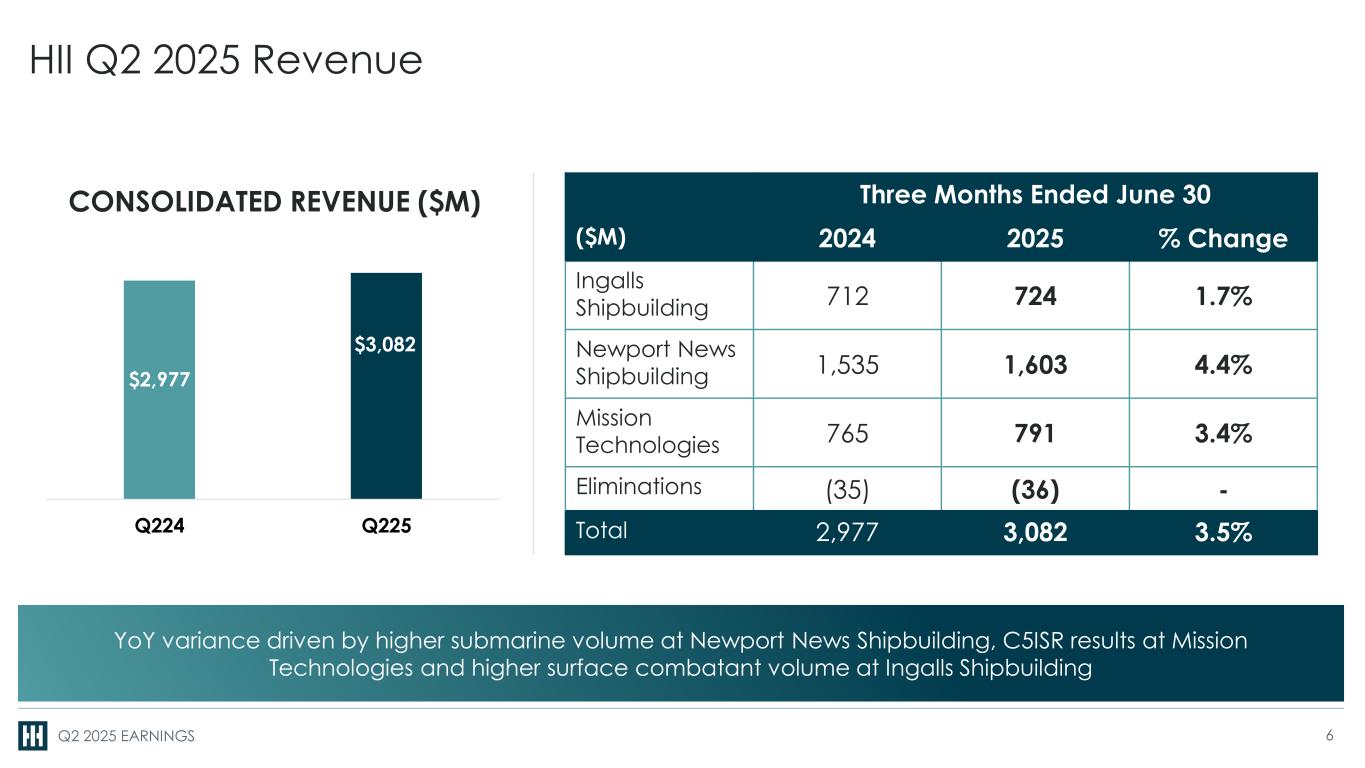
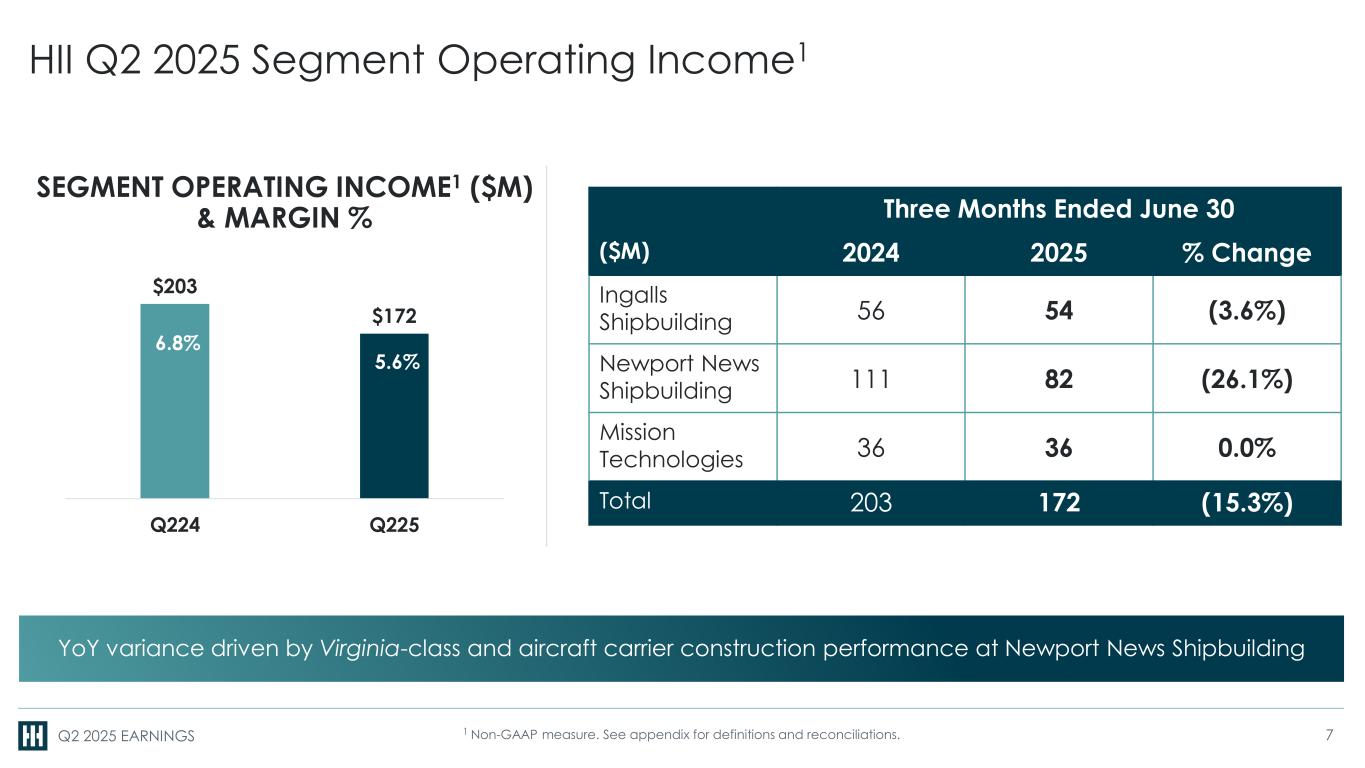
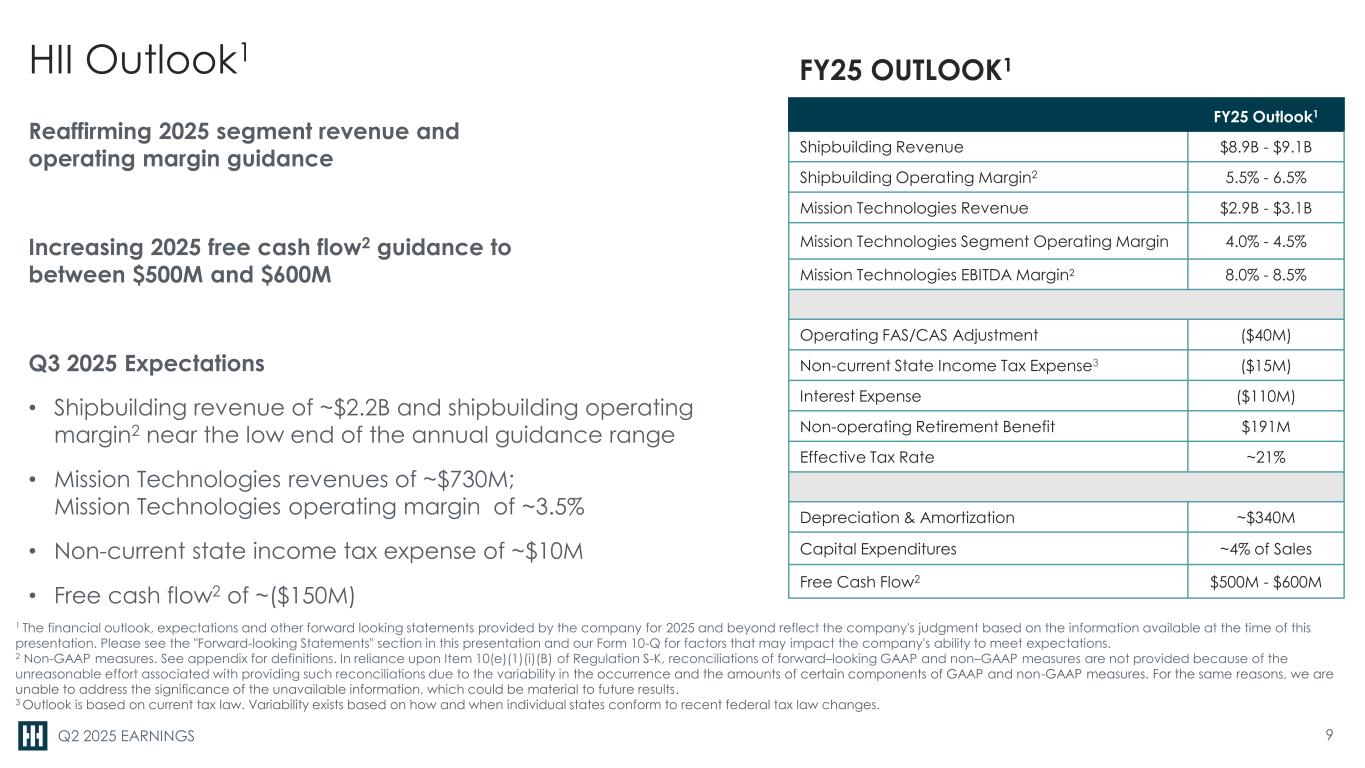
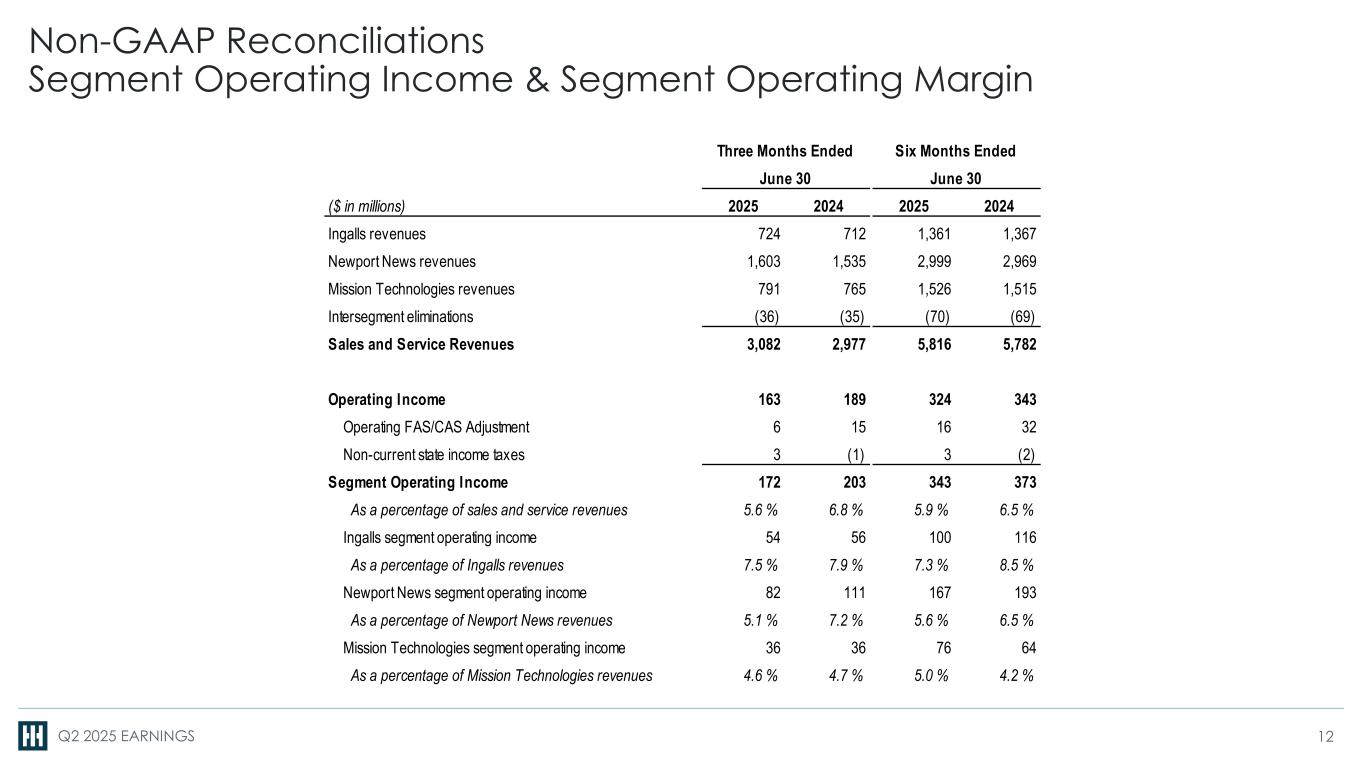
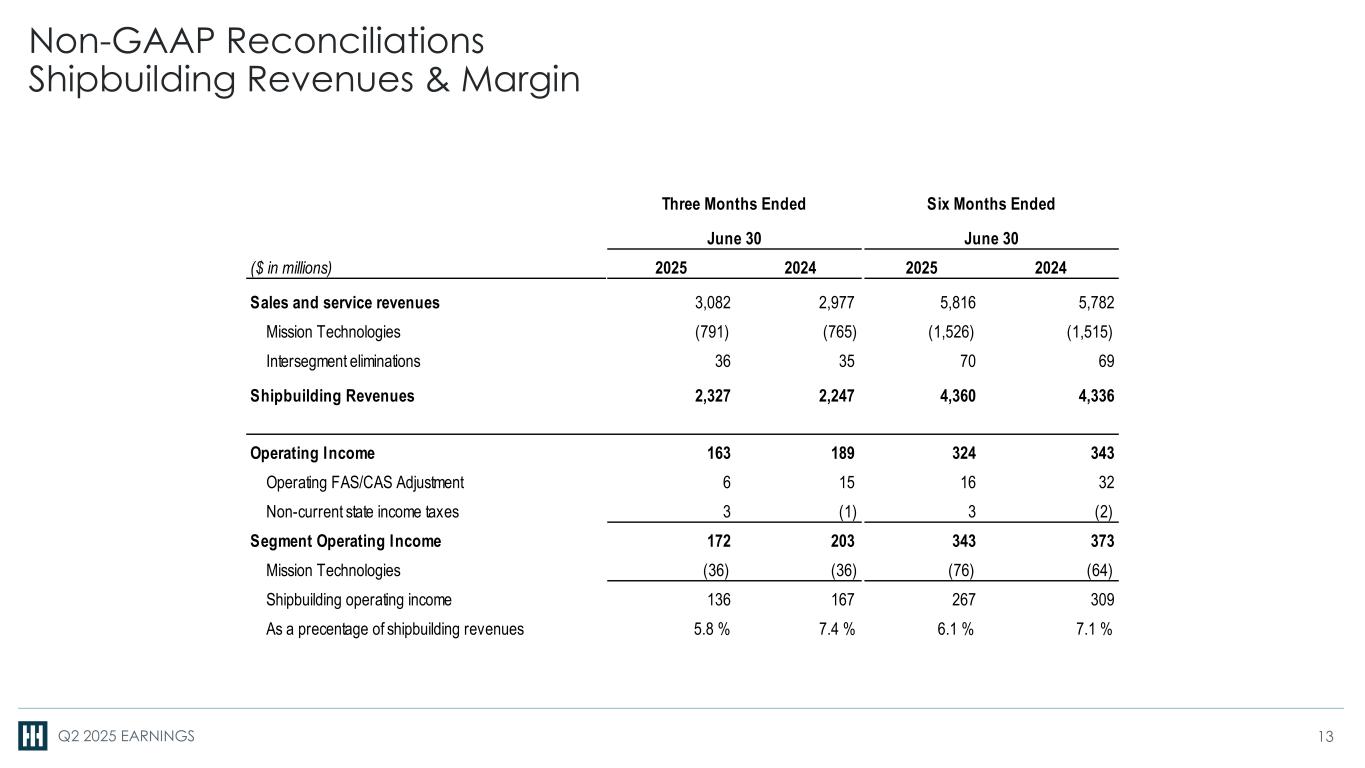
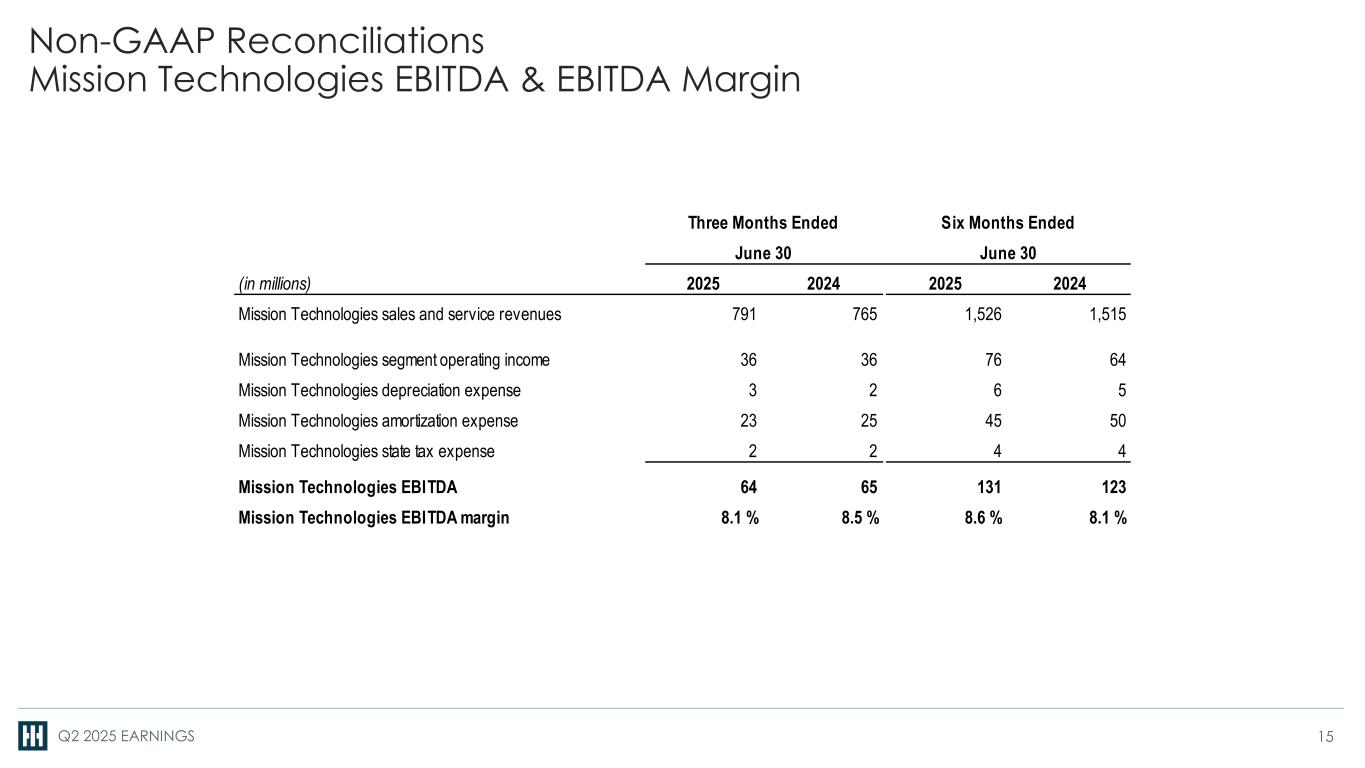
Thanks, Chris, and good morning. Let me start by briefly discussing our second quarter results, and then I'll address our outlook for the year. For more detail, please refer to the earnings release issued this morning and post it to our website. Beginning with our consolidated results on slide 6 of the presentation, our second quarter revenues of approximately $3.1 billion increased, 3.5 percent compared to the same period last year. The higher revenue was attributable to year-over-year growth at all three divisions. Ingalls revenues of $724 million increased by 1.7 percent compared to the second quarter of 2024, driven primarily by higher volume on the guided missile destroyer program, partially offset by lower volume on the LHA and LPD programs. Newport News revenues of $1.6 billion increased by 4.4 percent compared to the second quarter of 2024, driven primarily by higher volumes on both Columbia and Virginia-class submarine programs, partially offset by unfavorable cumulative adjustments on aircraft carriers. Mission Technologies revenues of $791 million increased by 3.4 percent compared to the second Court of 2024, driven primarily by a non-recurring favorable resolution related to a C5 ISR contract, as well as higher live virtual and constructive training volume. Excluding the impact of the noted resolution, Mission Technologies results were generally in line with our prior expectations and the guidance we provided on the first quarter call. Moving on to slide seven, segment operating income of $172 million and segment operating margin of 5.6% in the second quarter of 2025 were both down from prior year results, but were consistent with our expectations for the quarter. At Newport News, segment operating income was $82 million and operating margin was 5.1% compared to $111 million and 7.2% in the second quarter of 2024. The decreases were driven by performance of the Virginia-class submarine program and aircraft carrier construction, partially offset by a favorable contract incentives of those programs, as well as a higher risk retirement on the Columbia-class submarine program. Additionally, prior year results benefited from favorable contract adjustments and incentives on the aircraft carrier refueling and complex overhaul program. For the second quarter of 2025, Newport News ship buildings net cumulative adjustment was negative 17 million this includes a negative adjustment on cbn80 as well as other performance adjustments at angles segment operating income was 54 million and operating margin was 7.5 percent compared to 56 million and 7.9 percent in the second quarter of last year the decreases were driven by lower performance and lower contract incentives on the amphibious assault ship programs which was largely offset by favorable contract adjustments related to the guided missile destroyer program prior year results included a favorable impact related to the delivery of lpd-29 the second quarter net cumulative adjustment at ingles was a positive 4 million and included positive adjustments related to the destroyer program that were largely offset by an unfavorable adjustment related to LHA-8. Mission Technologies operating income and margin were largely consistent year-over-year, with changes in contract mix offsetting the impacts of higher volume. Consolidated operating income for the quarter was $163 million, and operating margin was 5.3% compared to $189 million and 6.3% in the same period last year. The variance was driven by the segment's results I just noted, along with a more favorable operating fast cash adjustment compared to prior year period. Net earnings in the quarter were $152 million, compared to $173 million in the second quarter of 2024. Deluded earnings per share in the quarter were $3.86, compared to $4.38 in the same period last year. Turning to slide 8, cash provided by operations was $823 million in the quarter. Net capital expenditures were $93 million, or 3% of revenues. Free cash flow in the quarter was $730 million. Free cash flow results in the quarter were $480 million better than the midpoint of the guidance we provided on the first quarter call. The overperformance is due to a number of factors, including the timing of incentives, some of which were received earlier than previously anticipated, normal quarterly timing of cash receipts and disbursements, and improvement in quarterly taxes, and capital expenditure timing. I'll discuss our updated 2025 free cash flow guidance in a moment. During the quarter, we did not repurchase any shares. We did pay a cash dividend of $1.35 per share, or $53 million in aggregate. Turning to liquidity and the balance sheet, we ended the quarter with a cash balance of $343 million and liquidity of approximately $2 billion. Our capital allocation priorities are unchanged. We value our investment-grade credit rating and will continue to prioritize prudent debt levels while strategically investing in our shipyards and thoughtfully growing our dividend while continuing to use excess-free cash for share repurchases. Moving on to our outlook on slide 9, we are reiterating our segment revenue and operating margin guidance for the year. We expect shipbuilding revenue between 8.9 and 9.1 billion, and margins between 5.5 and 6.5%. For mission technologies, we expect revenue between 2.9 and 3.1 billion, operating margins between 4 and 4.5%, and EBITDA margins between 8 and 8.5%. Our 2025 guidance is predicated on achieving the operational initiatives we have laid out. As Chris noted, we are progressing on each of these items, and we expect to achieve a meaningful improvement in throughput over the course of the year. Regarding our assumption related to the award of Virginia Class Block 6 and Columbia Bill 2 Submarines, we continue to expect that award to occur this year. If the award were to push into 2026, it would be a headwind. However, we believe we have accounted for a range of timing considerations within our guidance. For 2025 free cash flow, we are updating our guidance to between $500 and $600 million. At the midpoint, this is an increase of $150 million compared to our prior guidance range. The majority of this growth is related to updated cash tax expectations given the recent change in tax law, including R&D expensing and bonus depreciation changes. We are also updating a number of discrete income statement guidance elements. We are revising our operating fast cash adjustment from 43 million to 40 million. Our non-current state income tax expense for the year is now estimated to be approximately 15 million, with approximately 10 million of that expense falling in the third quarter. This update reflects the state impact of recently enacted federal tax law changes that benefited our cash flow expectations and may be further impacted depending on how individual states conform to the recent federal tax law changes. Our interest expense guidance has declined by 20 million from our prior outlook given the strong second quarter cash flow and resulting lower commercial paper usage. Moving on to a preview for the third quarter, for shipbuilding we expect third quarter sales of approximately 2.2 billion and margins near the low end of our annual guidance range. This does imply a stronger fourth quarter, which is consistent with our expectations and timing of milestones. For Mission Technologies, we expect third quarter sales of approximately $730 million, an operating margin of approximately 3.5%. This does imply a sequential decline in revenue. However, a second quarter results did include the non-recurring favorable contract resolution I previously discussed. Finally, we expect third quarter free cash flow to be approximately me negative $150 million as a result of normal business operations and the strong Q2 cash generation. To close, I will echo Chris's sentiment. It was a good quarter as we continue to make steady progress working our way through challenging shifts and executing our 2025 operational initiatives, securing new contracts aligned to the current environment, driving higher throughput, and thoughtfully managing costs. With that, I'll turn the call back over to Christy to manage the Q&A.
Thanks, Tom. As a reminder to everyone on the call, please limit yourself to one initial question and one follow-up so that we can get as many people through the queue as possible. Operator, I will turn it over to you to manage the Q&A.
Operator
Thank you very much. If you would like to ask a question, please press star followed by one on your telephone keypad now. And please ensure your device is unmuted locally. If you change your mind or your question has already been answered, please press star for the . Our first question comes from Doug Harned with Bernstein. Your line is now open. Please go ahead.
Good morning, Doug. You had a big quarter for shipbuilding in Q2 revenues, and you're looking at 20% better throughput this year um you're getting um should be getting some money from the block five award but your guide for shipbuilding revenue is only up three percent i mean how how should we reconcile those things yeah it's a it's a good question doug thank you our throughput increase uh our revenue forecast all takes into consideration um wages getting incorporated um in both shipyards That's already happened at Newport News.
We expect that to happen over the back half of the year at Ingalls. Outsourcing, improving, which actually outsourcing this year should get up to 2 million hours, which is over a million-hour increase from last year. And then our Charleston operations also comes online and provides additional throughput. So you take all that into consideration. Most of that happens in the back half of the year. And if we're able to achieve that, we should achieve, and I'm confident we'll achieve our 20% improvement on throughput, which should lead us to our guidance estimate. You always have to take into consideration material timing. When you're doing your sales comfortable, make all our throughput commitments. If we are able to continue to hire experienced people and our attrition trends continue. But all that works together and conspires together to project towards.
I guess what I'm trying to understand is, and we're looking at this situation where a lot of money is coming in to shipbuilding right now in proposed budgets, current budgets, and you're looking at the higher throughput, just trying to figure out.
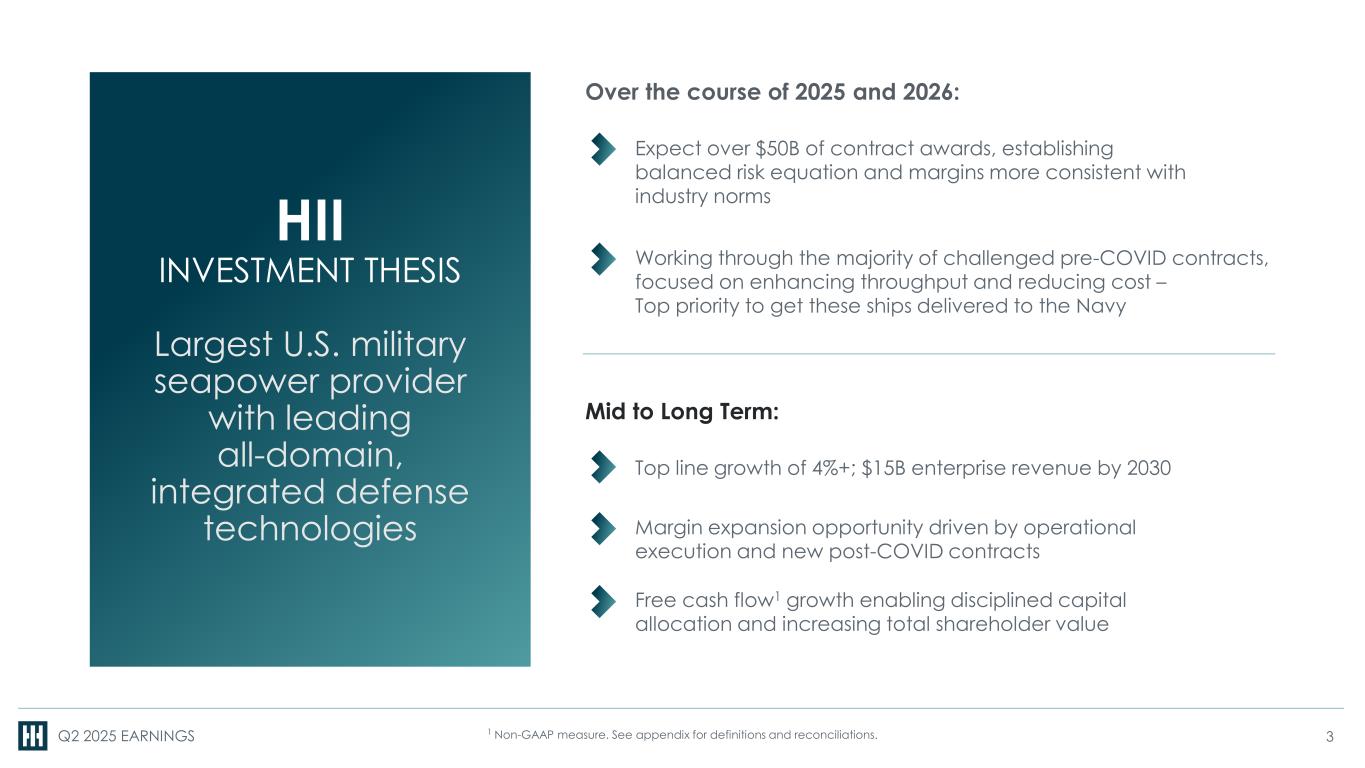
And I know that it's not easy to change shipbuilding revenues in a short period of time, but I'm just trying to understand how we kind of triangulate between the funding trajectories, the throughput, and what this revenue outlook would likely be over at least the coming years. right well so i'm still comfortable with the four percent uh growth revenue outlook and i'm very comfortable that this shipbuilding industrial base is getting rebuilt i think labor is being addressed through through increase in salary uh and and positioning towards more experienced people and attracting more people into the industry i'm very confident the industrial base is expanding uh led by uh the prime contractors that are doing that effort including the acquisition of Charleston. So it's going to happen. The industrial base is growing. The supply chain is becoming more stable. I can't predict when that volume will show up, but it's occurring as we're moving through this year. I don't want to get ahead of ourselves from a guidance standpoint and a sales standpoint, but I'm still comfortable with the 4% growth rate, and it's incumbent upon us to execute.
Okay, very good. Thanks, Doug.
Operator
Our next question comes from Scott Micas with Mellius Research. Your line is now open. Please go ahead.
Good morning, Chris and Tom. Nice results. We have better clarity on the funding environment with the One Big Beautiful Bill sign. The 2026 budget also looks very supportive.
When we think about kind of the appeal of Section 174, that five-year cumulative free cash flow target of 3.6 billion now back on the table but just from 2025 through 2029 yeah we pulled out guidance last year and i would not say it's back on the table right now we're we're we're raised the focus and fixated on showing that we provide guidance a guidance going forward that we can hit right now we have the annual guidance you saw from my remarks up front and uh and the released uh information that that we provided that we raised that from three to five hundred to 500 to 600 in free cash flow, but we're going to stick to an annual guidance right now. And as we get consistent and we have quarter over quarter meeting or exceeding the guides, we'll address that in future discussions. But we don't have a five-year guide on the table right now.
And then, Chris, the Secretary of Navy commented that it might be preferable to have Newport News and Electric Boat each build Virginia's separately rather than teaming. So if the Navy were to pursue that route, just curious, how much capital would you and the Navy need to invest to make that happen? And would you have enough skilled labor or optionality to outsource to support OneVirginia by itself at Newport News?
I think it's always important to evaluate alternatives. Right now, we're happy with the teaming arrangement that we have with General Dynamics on the Virginia class program. It would take additional capital. I don't – it would be significant capital, and we've communicated that to the Navy. We would have enough skilled labor to execute on any job like that, and we're talking about a time horizon that's pretty far out in front of us. So that's probably all I want to say on that. It's always good to look at options, look at alternatives.
Speaker 1
We would need additional, significantly more capital to execute on that, but we'll support the Navy in these initiatives as they work through how they want to proceed all right thanks for taking the questions our next question comes from bottom Ghana with TD Cohen your line is now open please go ahead yes I'm sorry if you covered this a little late but on CBN 79 and the timing slipped to 2027 could you characterize any economic impact from that and was there a negative EAC or could there be because of that
schedule change yeah so we've already taken that uh that schedule uh consideration uh into um our guidance and that was understood when we did the financials there was no material impact related to that uh it should be noted uh that the cb cbn 79 is progressing very well there's only 90 90 compartments left on that that ship we're going to go to go to sea this year there's just a couple systems that are taking a little bit longer and we need to add some capability as well so 79 is progressing very well there's no financial or no material financial impact and we're going to deliver a great shift when it gets finally thank you guys our next question comes from david
Operator
stores with barclays your line is now open please go ahead hi good morning this is josh corn on for David.
I wanted to follow up on the reconciliation funding for shipbuilding, I guess both on the shipbuilding and on man's side. You know exactly how you see that flowing through TU timeline and you know any kind of quantification. Thanks.
Yeah so we tend to look at that together with the FY26 budget. If you look at them together all of our programs are supported and all of that is included in our in our four percent mid to long term guidance relative to shipbuilding sales so we think it's all it's all very positive i think the unmanned stuff is very interesting obviously we have the premier uncrewed underwater vehicle program uh up in our boston organization within in mission technologies and then some very interesting uh programs we're evaluating participating in from a surface standpoint so we think that's positive as well and that could be some some tailwinds if we're successful in that regard so we look at them together it's a significant tailwinds in shipbuilding and we're going to take advantage of okay thanks and then on mission technologies have you had any impact your discussions around doge at this time so we're comfortable with our 25 guidance still there has been some minor restructuring of contracts which would potentially impact 26 we're looking for ways to offset that as of this point we're still comfortable with our revenue growth within mission technologies but that there has been a slowing of of awards and activity although the pipeline still looks very strong at over 90 billion dollars. So we're going to watch it every day and we're offsetting impacts where we can. But as of right now, we're comfortable with our guidance.
Operator
Thank you very much. Just as a reminder, if you would like to ask a question, please press star followed by one on your telephone keypad now. Our next question comes from Seth J.P. Morgan, your line is now open. Please go ahead.
Thanks very much, Ben. Good morning. I think you mentioned earlier, Christy, that the timing of the contracts, or maybe, Tom, you mentioned the timing of the contracts for Block 6 and Bill 2 could affect this year's results. Maybe, you know, if you could tell us a little bit more about that, based on the margin forecast for Q3, it seems like you're, you know, expecting those results and those contracts in Q4. Are they, do you expect them to come together? Do you think they could come separately? If you could give us an update on sort of where things stand and kind of the magnitude of that, you know, within the outlook.
Sure, I'll start and then I'll kick it over to Tom from the details on how he's thinking about it from an outlook standpoint. We quickly repositioned from the Block 5 contract into the Block 6 and the Columbia Build 2 contracts, and we're actively engaged with the Navy and our partners to get that done. The good news is that we had a construct that was put together under Block 5 as we move into Block 6. Now, it's going to take some time. We're working at a very detailed level with them to get these done because they're very important. But it could slip into Q4 and we'll do them incrementally. And as Tom indicated in his prepared remarks, while we do expect them to be done this year, but we also factored it when we think through provide some upside if it gets done or potentially a minor downside. But I'll let Tom talk about details.
Yeah, in February, we had mentioned about the three awards. We're happy to get the FI 2020 anomaly done in the springtime. Those other two awards were planned for the back half of the year. As we mentioned, there is a factoring of, you know, opportunities and risks and how things play out. So that's why we give ranges on revenue and margin and cash. Those awards really would, you know, we wouldn't have any cost in it if they got awarded the back half. Any advancements, any infrastructure, tailwinds or headwinds, that's been factored into guidance right now. You know, so it doesn't impact the current EACs and profitability that I have today. And the range of outcomes I see right now, we feel really comfortable with the $500 to $600 million in free cash flow in the day. So we'll keep you informed. We do anticipate we're working actively with the Navy right now on those requirements. Back after you.
Okay, great. And then just to follow up, just to understand kind of how some of the stuff works, the wage increases that you talked about for Newport News, Did those go into productivity assumptions on existing contracts and thus led to some higher booking rates on contracts, or at least in the mix, some upward pressure on booking rates for existing programs, and that when that comes to Ingalls, we'll see something similar, or is that not the right way to think about it?
That's not necessarily the right way to think about it. We think there's going to be a direct correlation between higher wages and improved retention, which should lead to a more skilled employee and improved performance. But we don't necessarily bake those into the estimates to complete right away. We need to prove it. So we're just going to continue to execute. And if that performance does improve, then we could potentially book up their visit. It's not necessarily a direct link, as you indicated in your statement.
No, that's helpful to have that clarity.
Operator
Our next question comes from Ron Epstein with Bank of America. Your line is now open. Please go ahead.
Good morning, guys. Hey, Ron. What impact, if any, are you guys expecting on the business from the changes in R&D in the tax code? Is that for you up to do some stuff that you might not have done before?
Well, I'll start with the changes of the tax law, right? So obviously that got approved on July 5th, and that kind of works itself through. Rather than amortizing the R&D expense, it gets period expense. So there's tailwinds for that. we see about 150 million dollars of increase and that's where we took a midpoint of 450 now to from three to five hundred which was four hundred of a midpoint up to now 550 midpoint between five and six hundred so we'll get some favoritism on that as you know it's now period expense plus you can do that retroactively since the beginning of this year and then there's a catch-up between 22 and 24 on the amortization so a lot of moving parts just on the tax front alone and that's on On the federal side, it needs to be a $15 million expense this year as opposed to being neutral. And 10 of that 15 will show up in Q3 in the guide that I gave you. So realistically, it provides a couple of more dollars to kind of run the business and invest in the business here. And as you see, we finished up. As we say, we don't think the $147 million, $150 million of tax benefit here have a credit or will...
Got it, got it, got it. And then maybe just a follow-up on the unmanned undersea business that you guys have. I mean, how large is that product line today? And, you know, if you could frame maybe the kind of growth you could see there.
So we haven't specifically identified how large they are. Just not significantly material to the mission technologies portfolio, but we do. And when you look at the opportunities that are presenting themselves in the space, we have 200 vehicles, and there are some, we do expect it, there's some remotely funded. All right.
Operator
Our next question comes from Myles Walton with Wolf Research. Myles, your line is now open. Please go ahead.
Thanks. Good morning. Chris, I was wondering if you could touch on your views of AUKUS and its trajectory. It seems like it may be getting a relook, but it's never quite clear as to what is and what isn't actually occurring. And then as well, if you can just touch on where you think the role of partnerships with international shipbuilders would be most impactful in a positive way to the business and to getting the output of the overall industry up.
Thank you, Mel. Yeah, the AUKUS is still broadly supported simply because it makes great strategic and economic – there's no backup that I see within Australia, the UK, or the United States. There is a Pentagon review going on, and I think that's healthy. They need to look at it to make sure that we're proceeding down the right path. But I fully expect it to continue to be supported across all three countries. From our perspective, we do have a footprint down there now. We've got a great partner in Babcock. We've got some good wins under our belt, and we're competing for some also very interesting wins that should show up over the back half of the year. So it's positive for us. We're going to continue to grow. We're going to continue to have a presence down there with our partner, and I'm still very bullish on AUKUS. From other international shipbuilders, we've taken the steps because we saw this coming. We have developed a strategic relationship with HHI out of Korea to evaluate both defense opportunities and commercial opportunities. Could they help with investments in our current shipyards or other shipyards to increase throughput for the industrial base? Absolutely. We're just going to have to see how that develops over the next couple quarters. I'm pretty bullish on that as well. They're committing, I think that's only positive and just adds to the tailwinds. okay that's great and then just can you touch on how many employees were hired in the uh in the quarter about 2 400 uh more experience and you know i didn't specifically uh talk about uh retention but we've seen month over month improvement uh in in our retention and attrition metrics and since we implemented the uh wage adjustment in newport news there's been a very good trend for the standpoint. Now, we're not going to claim victory yet because it's just a few data points, but our initial assumptions seem to be proving out positively, and we think that's a really good...
That is good, Nancy. Thanks.
Operator
Our next question comes from Noah Oponak with Goldman Sachs. Your line is now open. Please go ahead.
It feels like there's a little bit of a chasm between the very significant change in funding and treatment of your business and the Navy overall by the government in the budgets and, you know, what you're doing here with guidance and sort of your tone on the pace of improvement. Recognizing it's a very long cycle business and a lot of these things will take time i'm trying to sort out how much of that is um it just will take time and 2025 and 2026 still have the pre-covid contracts and you know it's not till beyond that that we see significant improvement in in revenue growth and margin versus i'm wondering if does the block six block two waiting for that award this year make this year just is that a very binary thing where you can't really call for much improvement this year until you know that's in this year and not sliding into early 26th.
I think your first assumption is correct, Noah. I think you've got it. It does take time. We have pre-COVID contracts we're working through. We've assessed the Block 6 and Bill 2 contracts and factored them into the indicated final. So So if it happens, things could potentially get a bit better. If it doesn't, it could be maybe slightly worse, but we're comfortable with how we factored that. So I think you've got it right. It just takes time. We need to get through these pre-COVID contracts. But the tailwinds are real. The demand is real. Expand the industrial base are happening. The maritime industrial-based funding that have been floated to the supply chain have absolutely improved the supply chain. The technology investments that are taking place with AI, with C3AI in the Newport New Shipyard, is going to yield positive results. So it's going to happen. We just need to come through these pre-COVID shifts to transition to the other side.
Chris, can you give us a sense for the split on the labor front, The split between the need to improve new hiring versus the need to improve attrition, because I would think the former, you know, would take a while and have a long learning curve, whereas I would think the latter would maybe flow to the business much more quickly.
That's interesting. They work together, as you would expect. If we can hire more experienced people that are going to stay, then your efficiency is going to get better very quickly. And you can afford to not hire as many people because you're not losing as many. So it's directly related.
And then just, Tom, in the cash flow buildup, the $150 million approximately of cash tax tailwind, does that recur for a while or does it get smaller beyond $25? And then on CapEx, how long are you in the sales range before that starts to come down and become a tailwind?
The guide for this year does have some tailwinds in the out years, too. We're working ourselves through that. It's a bit complicated because, one, it's the timing. If it was enacted, we kind of understand that. The states, obviously, hit different states, how they enact it, when they enact it. We haven't guided anything. Your part two was?
Next, we finished 2-5 in Q1, 3% in Q2, with 2-8 through the first half of the year. We guided 4%. Haven't provided guidance after this year. I know last year when we thought we were going to put all the subs on it, I do envision it to be elevated over the normal, what we term medium to long term of 2.5%. I do envision us being higher than that in the next couple of years, but we haven't provided a specific number. That will be a function as we come through the Columbia Bill 2 and the VCS Block 6. You know, timing and pace, the number of boats, and the level of infrastructure and investment that goes into the Newport News yard will dictate. But I'm comfortable, like we have in the recent past, we'll continue to get participation, meaningful participation from our Navy customer as we invest for high revenues in Newport News.
Operator
Thank you. I am not showing any further questions at this time. I would now like to hand the call back over to Mr. Kastner for any closing remarks. Sure.
Thanks for joining the call today and your interest in HII. We are focused on building on these results and driving value for all...
Operator
Thank you very much. That concludes today's conference call. You may now disconnect.