Operator
thank you for standing by my name is tina and i will be your conference operator today at this time i would like to welcome everyone to the omnicom third quarter 2025 earnings conference call all lines have been placed on mute to prevent any background noise after the speaker's remarks there will be a question and answer session to ask a question simply press star 1 on your telephone keypad to withdraw your question press star 1 again it is now my pleasure to turn today's call over to Greg Lundberg, Investor Relations. Please go ahead.
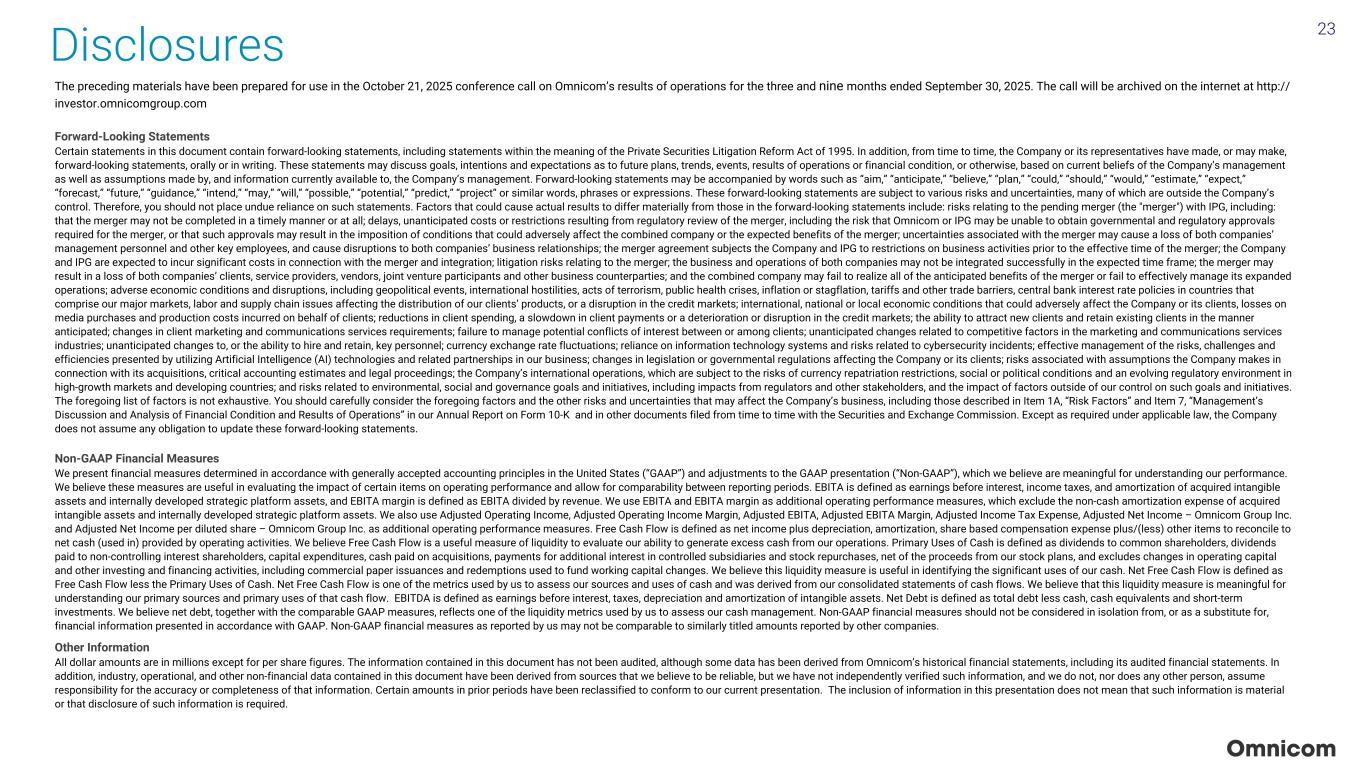
Thank you for joining our third quarter earnings call. With me today are John Wren, Chairman and Chief Executive Officer, and Phil Angelostro, Executive Vice President and Chief Financial Officer. On our website, omc.com, you will find a press release and a presentation covering the information we'll review today. An archived webcast will be available when today's call concludes. Before we start, I would like to remind everyone to read the forward-looking statements and non-GAAP financial and other information that we've included at the end of our investor presentation. Certain of the statements made today may constitute forward-looking statements. These represent our present expectations and relevant factors that could cause actual results to differ materially are listed in our earnings materials and in our SEC filings, including our 2024 Form 10 . During the course of today's call we will also discuss certain non-gap measures you can find the reconciliation of these to the nearest comparable gap measures in the presentation materials we will begin the call with an overview of our business from john then phil will review our financial results and after our prepared remarks we'll open the line for your questions i'll now hand the call over to john thank you greg good afternoon everyone and thank you for joining us today we're very pleased to share our third quarter results.
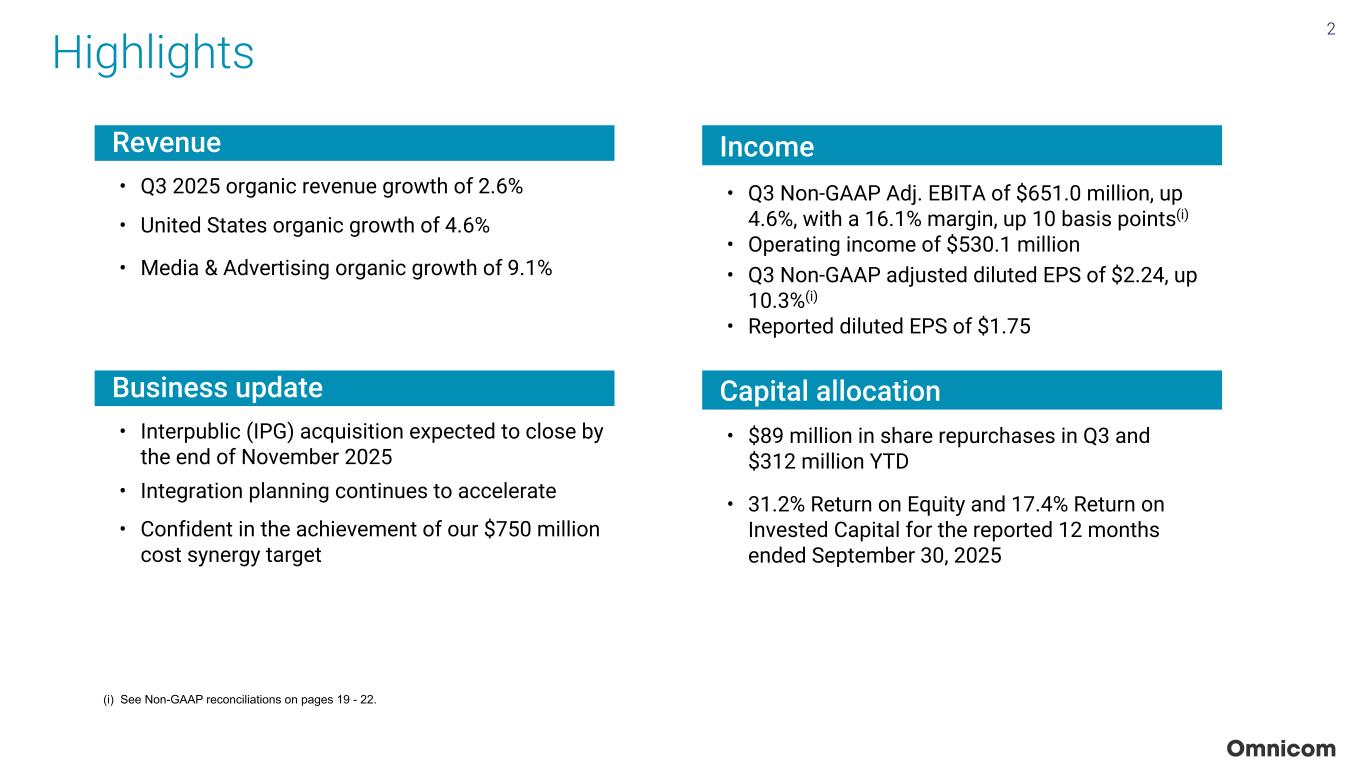
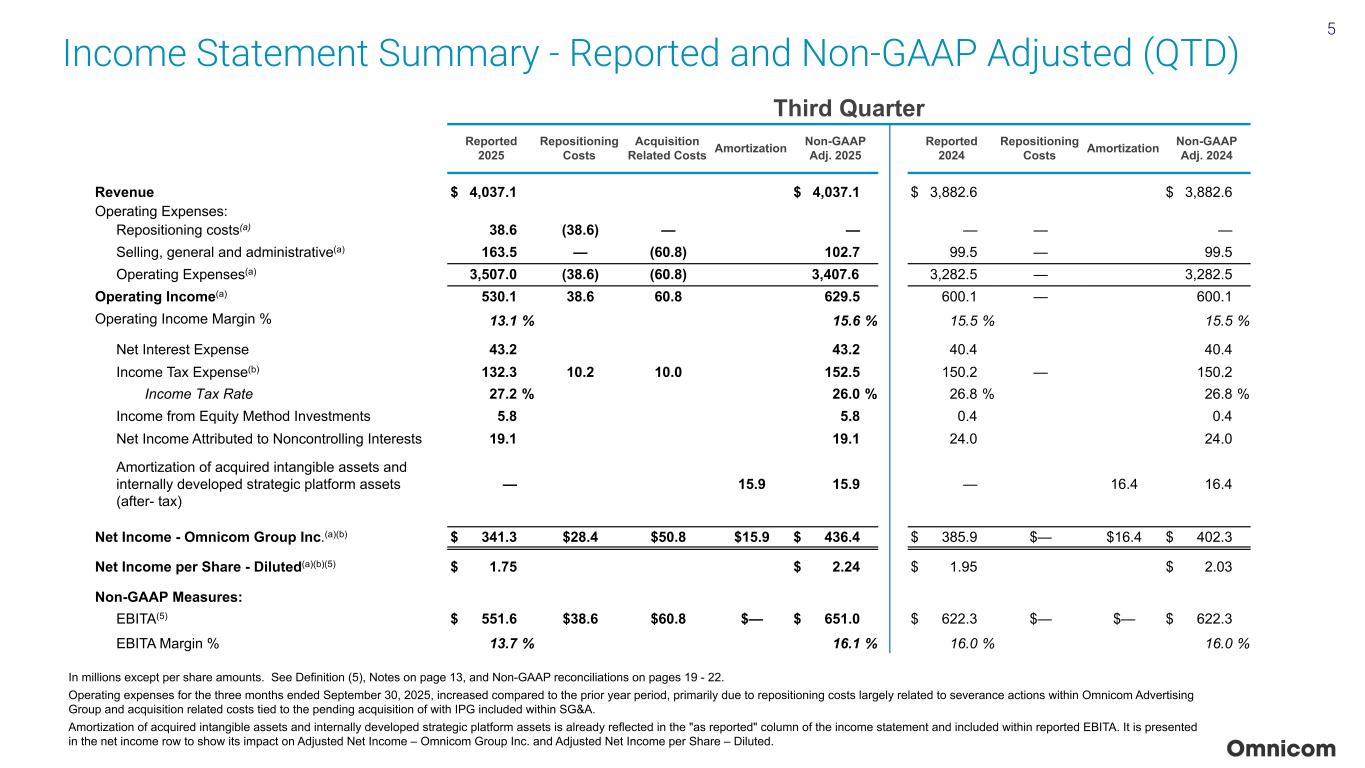
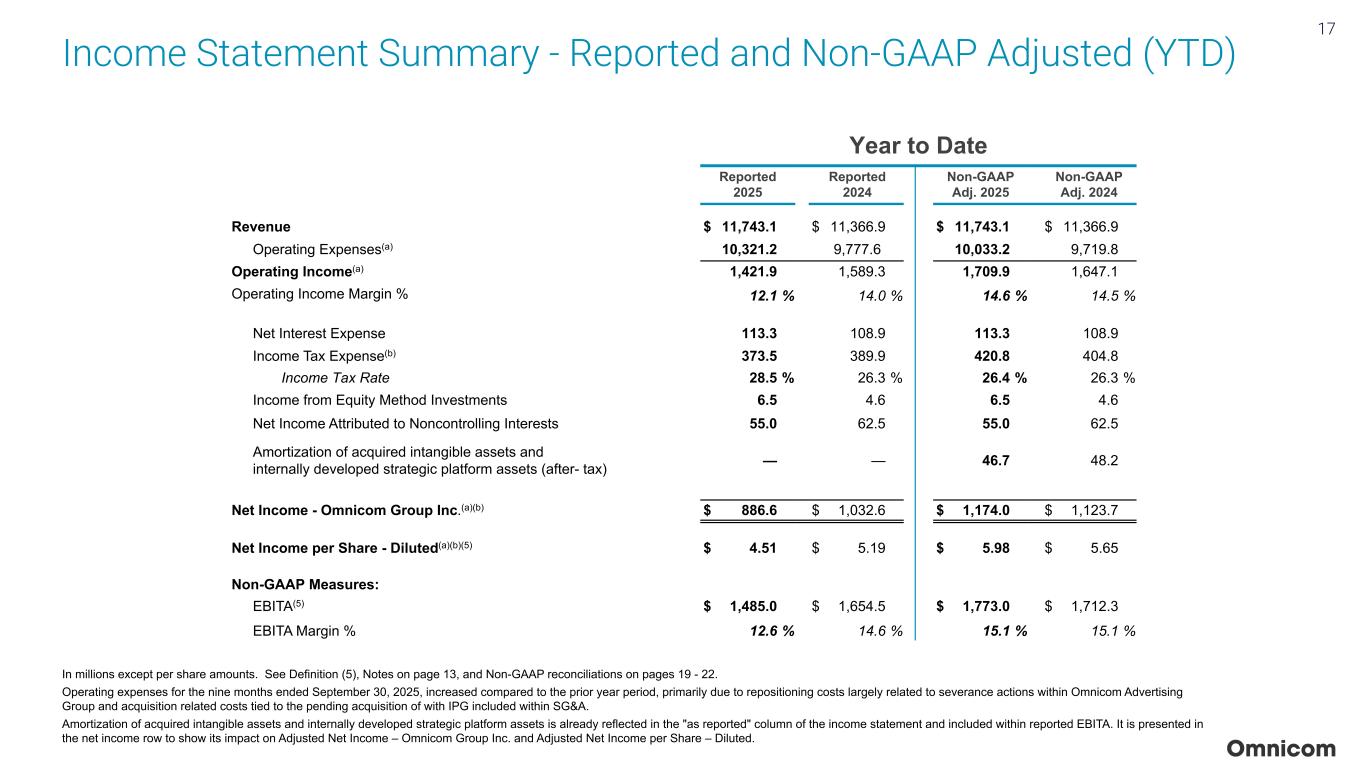
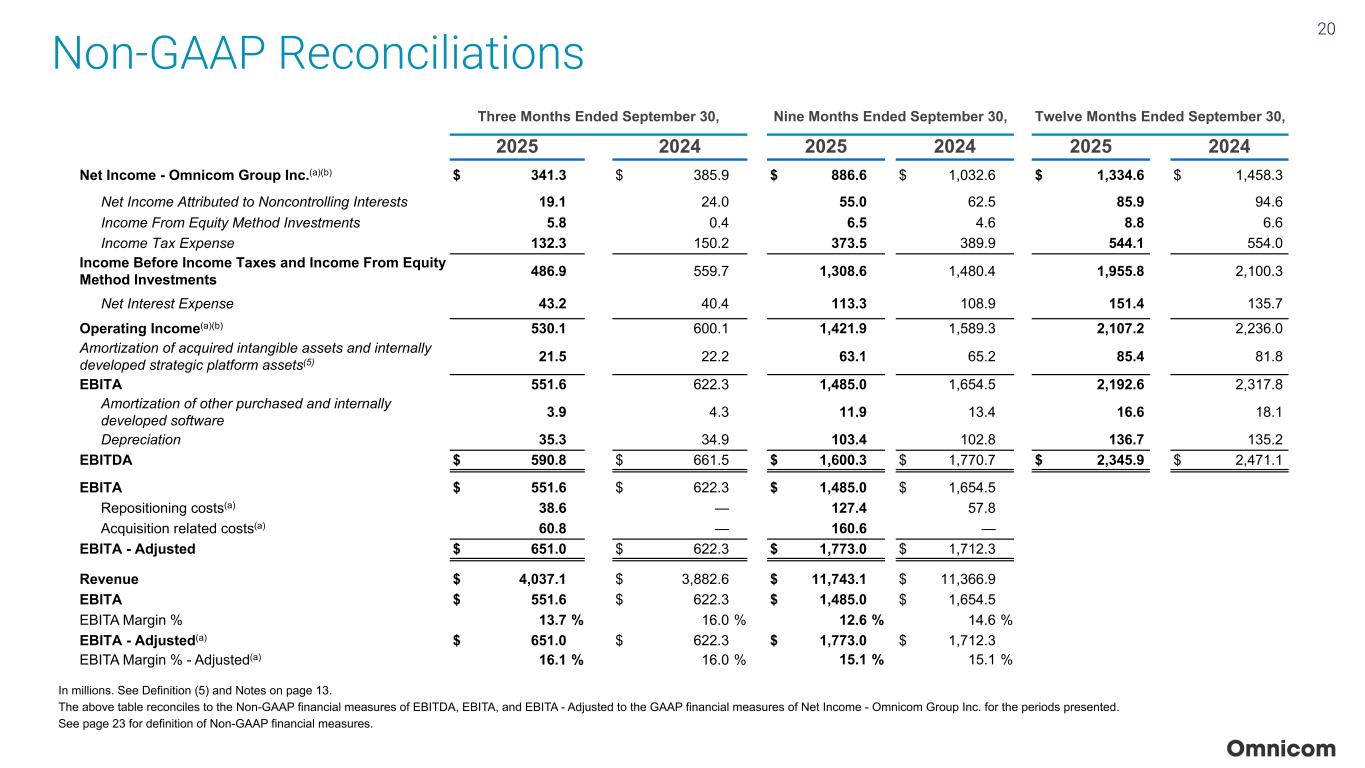
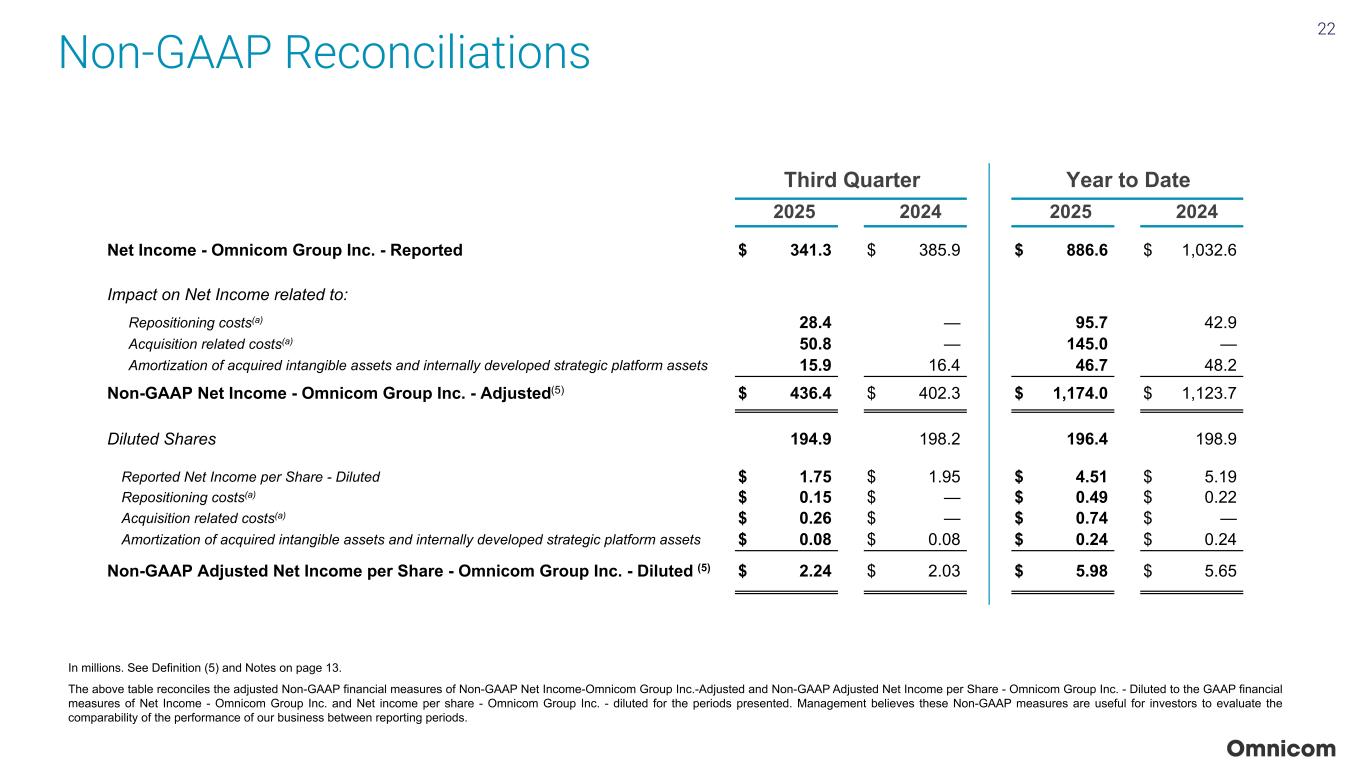
Organic growth was 2.6% for the quarter. For the first nine months, organic growth is 3%, which is in line with our annual guidance. Non-GAAP adjusted EBITDA was $551.6 million, with an adjusted EBITDA margin of 16.1% for the quarter, up 10 basis points from last year. Non-GAAP adjusted net income per share was $2.24 up 10.3% versus the comparable amount in 2024. Our cash flow continues to support our primary uses of cash dividends acquisitions and share repurchases and our liquidity and balance sheet remain very strong. I'd like to provide you an update on our proposed acquisition of Interpublic. During the quarter, we secured antitrust clearance from all outstanding jurisdictions except the European Union. We submitted our filing yesterday, October 20th, and expect this to be the final step in securing EU approval. As a result, we're currently expect to close on the acquisition in late November. Our dedicated integration teams at both Omnicom and IPG have been working tirelessly to ensure we're ready to hit the ground running on day one. We've made significant progress developing detailed plans to deliver a seamless transition for our teams and clients. Our integration team has also made progress as we prepare to launch OmniPlus, our next generation marketing operating system. This operating system unifies unparalleled data assets spanning campaign performance, consumer behaviors, demographic insights, transaction intelligence, and cultural and social indicators. These integrated data sources will be unified through Axiom's RealID, the industry's most robust identity graph. The The collective intelligence of OmniPlus will provide a unified, intuitive experience for both clients and our internal teams. Our objective is clear, empower our clients to accelerate brand growth, expand customer reach and deliver measurable business outcomes. A key part of our operating system is our generative AI layer, which is an agentic entry point to OmniPlus. In the last earnings call, we talked about our agentic framework and how we have been rolling it out across our entire organization. It is now the fastest-growing platform in our company's history, and our teams continue to create intelligent agents and orchestrate them to deliver faster and better outcomes for our clients. We look forward to sharing more details at its official launch at CES 2026. The result of our integration planning is we remain highly confident in exceeding the synergies we expected when we first announced the acquisition. We maintain an extremely disciplined approach to minimizing disruption to our day-to-day operations, ensuring our client teams remain focused and continue to deliver outstanding results. The commitment is reflected in the new business we've won, including American Express, Porsche, InterSnack, White Castle, OpenAI, just to name a few. Similarly, InterPublic saw significant wins with Amgen, Bayer, Antropic, and Paramount. The level of support we're seeing from both new and existing clients reflects the tremendous value they expect to gain from the proposed combination. We are building strong momentum as we approach the closing of the acquisition of Interpublic. I remain extremely excited about the prospects for our growth, for our people, and our clients. As we approach and close the transaction, we will keep you informed of our plans, including our leadership team and organization structure, the combined company's strategic priorities, including its expanded capabilities, services, and products. our progress on achieving the targeted synergies, and our updated financial plans and capital allocation strategy. I will now turn the call over to Phil for a closer look at the financial results. Phil?
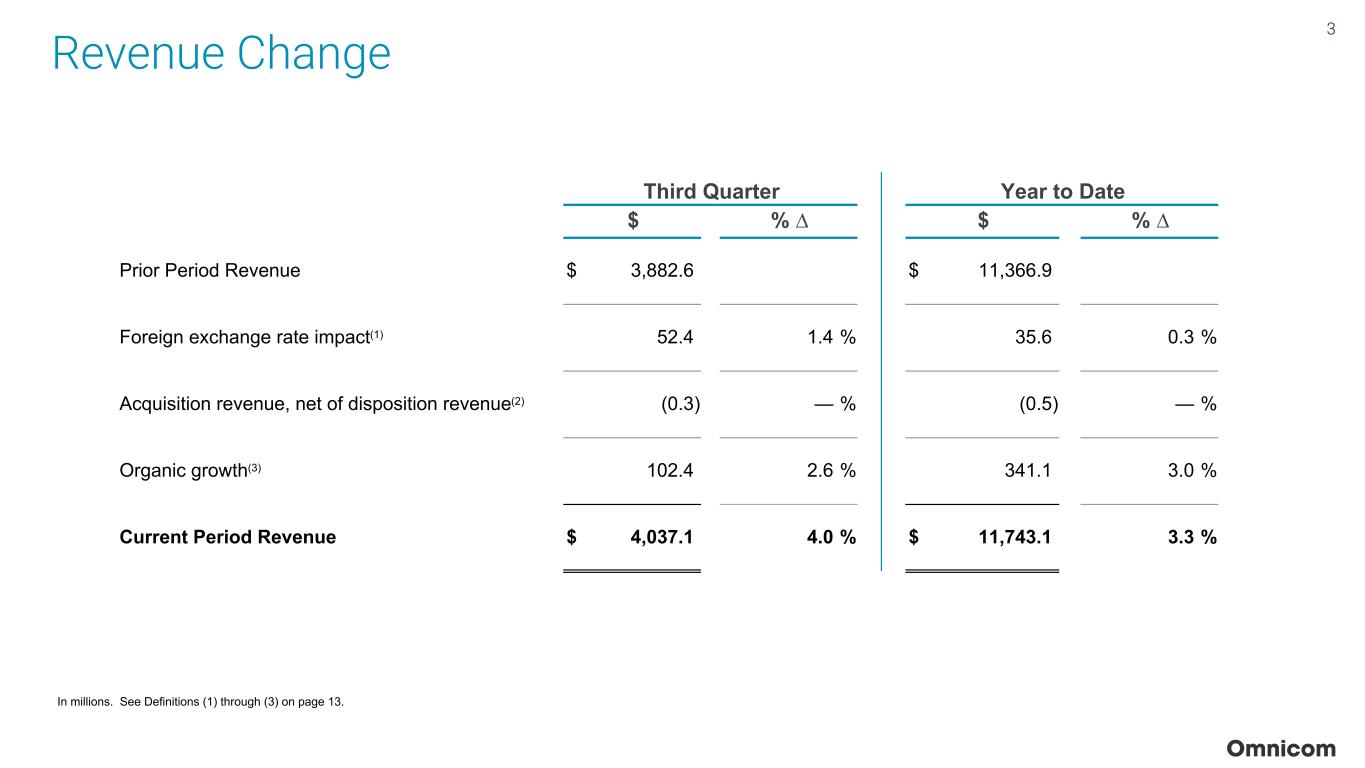
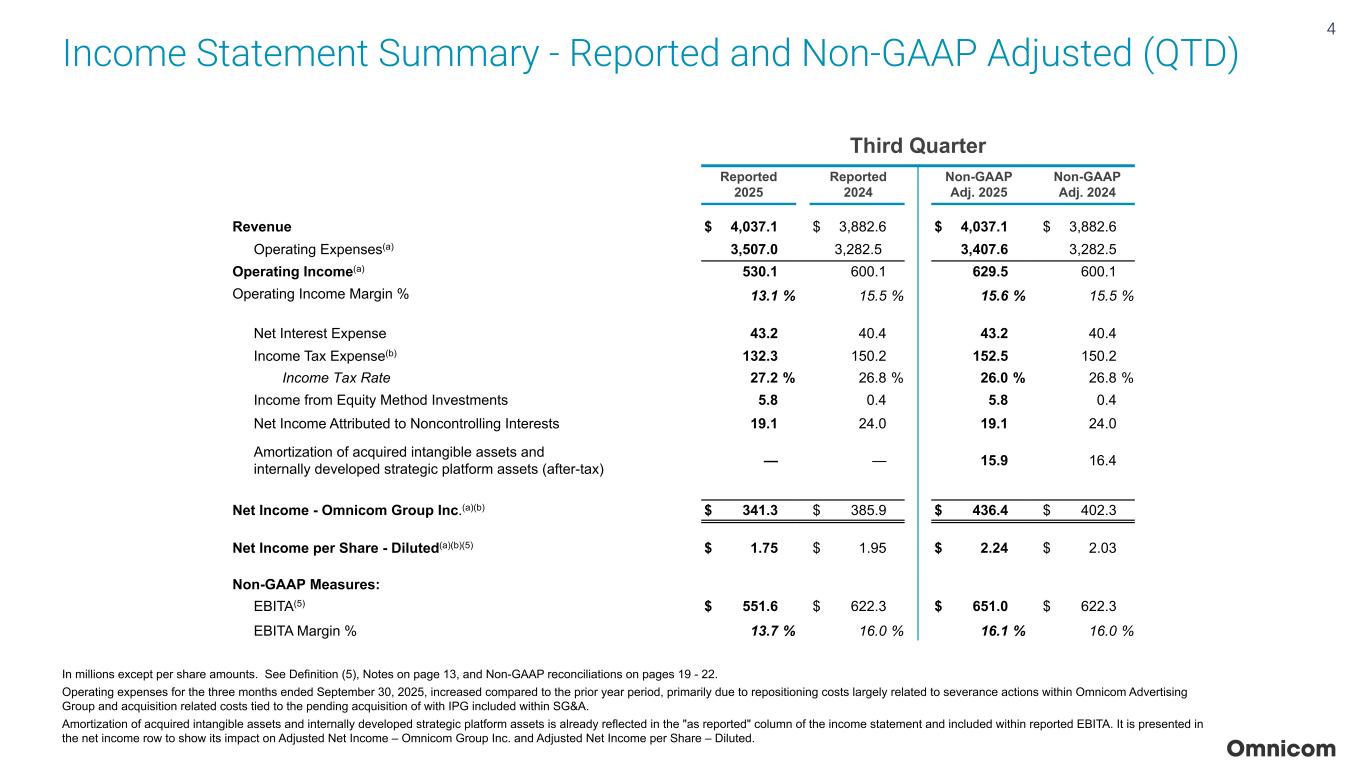
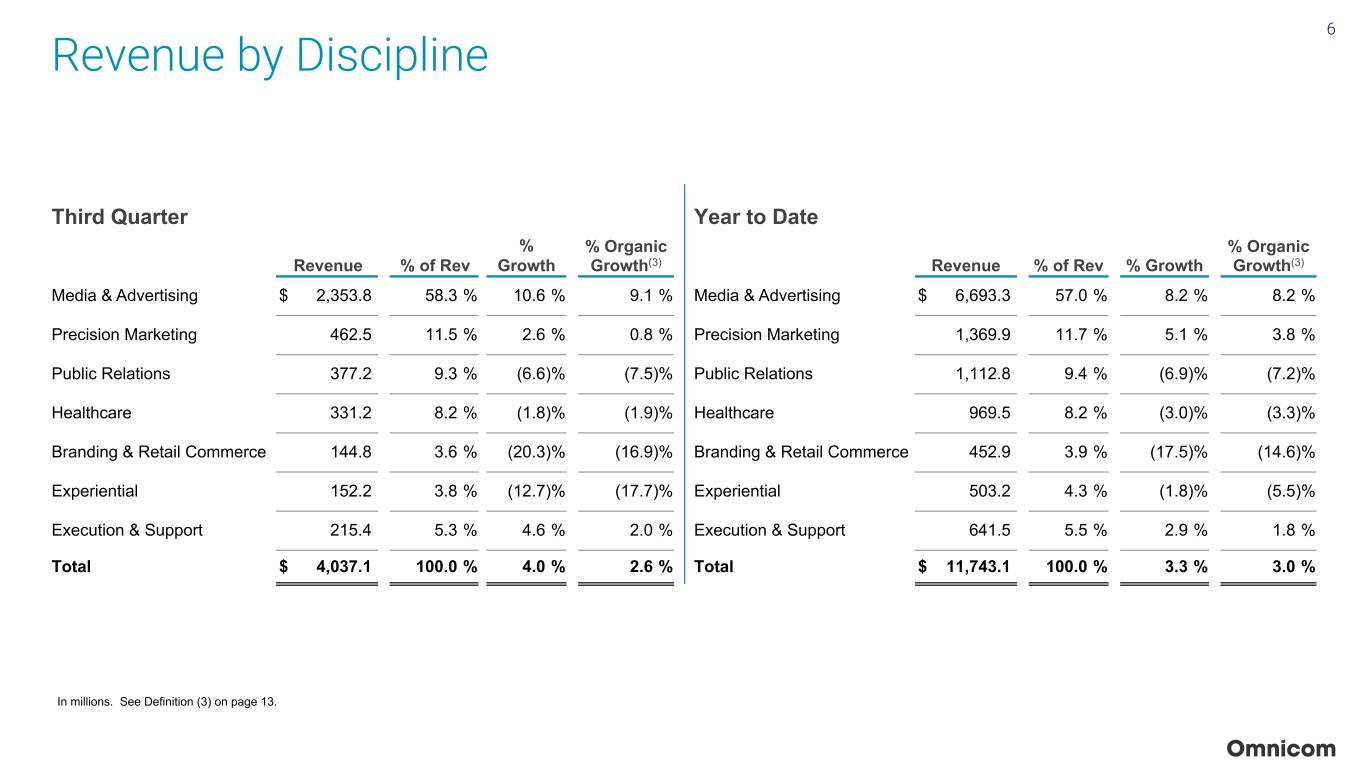
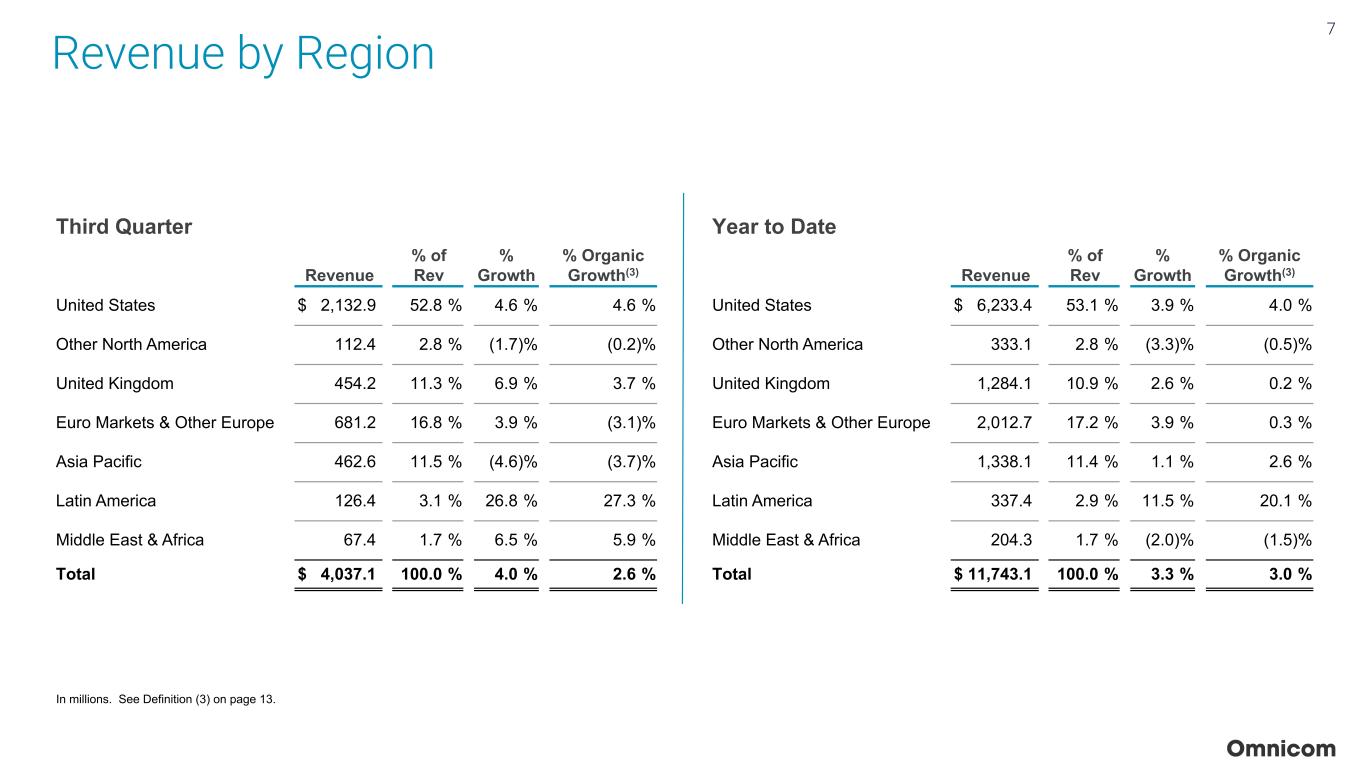
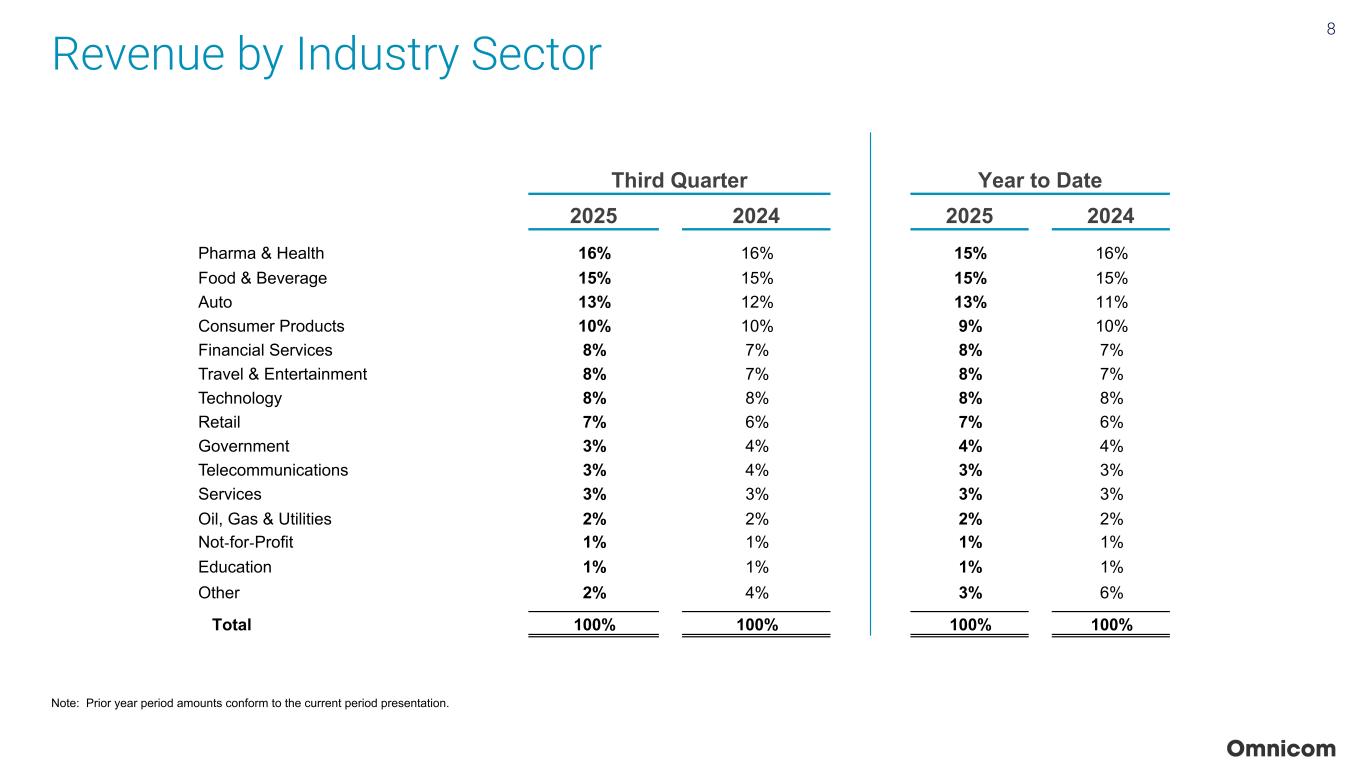
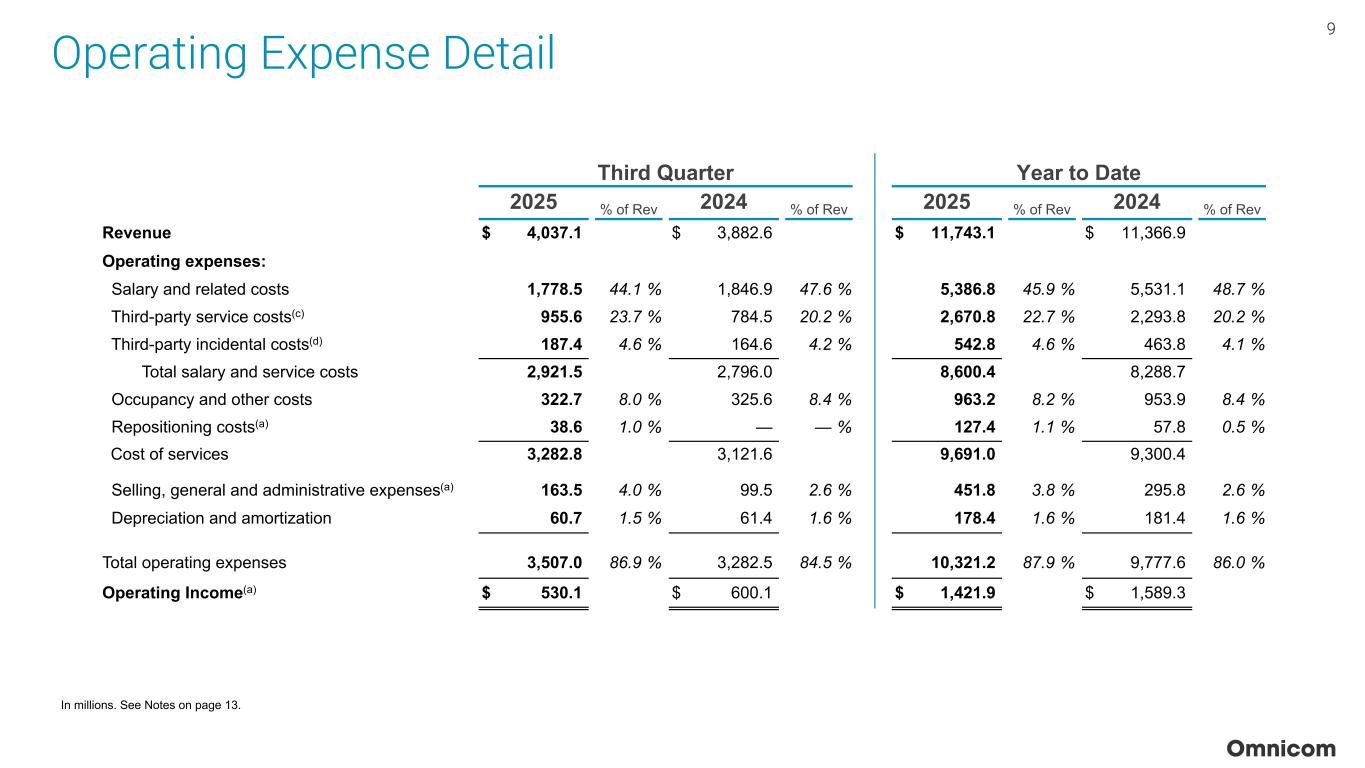
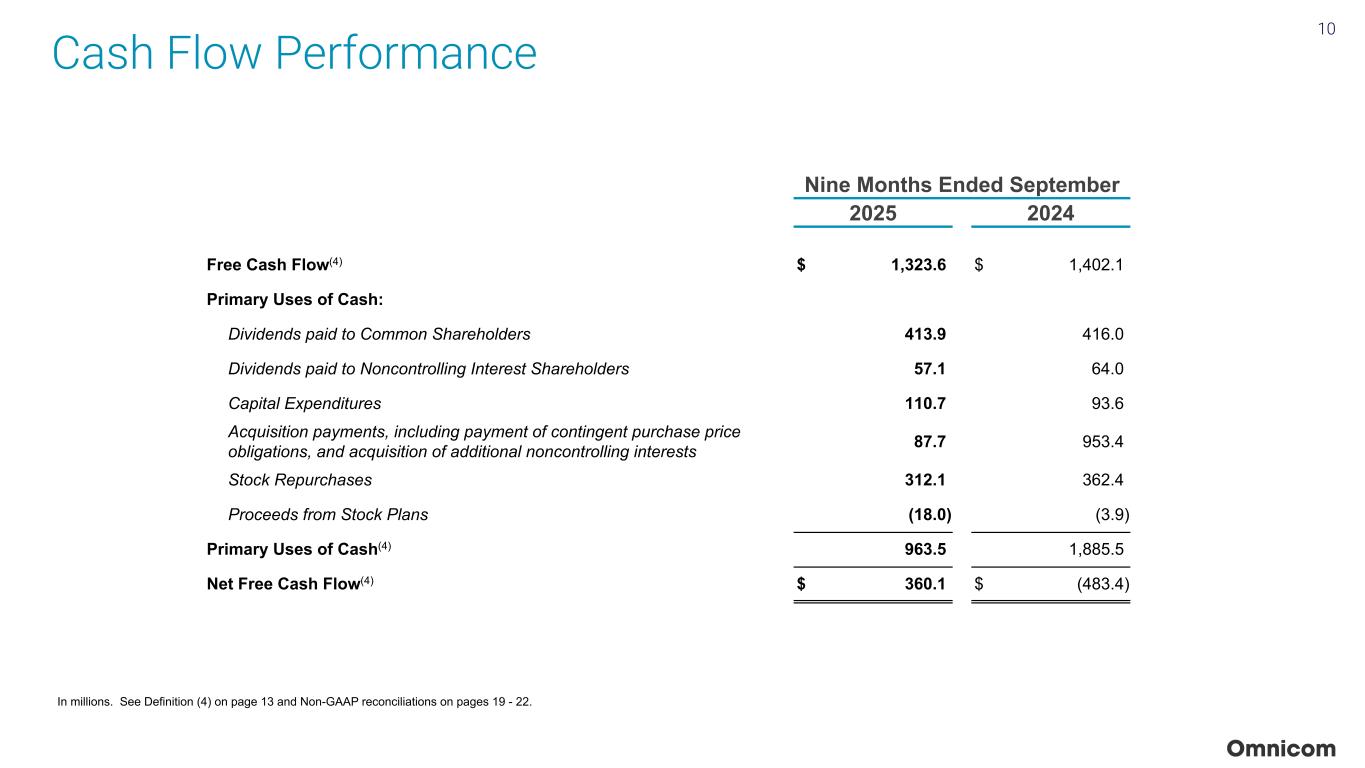
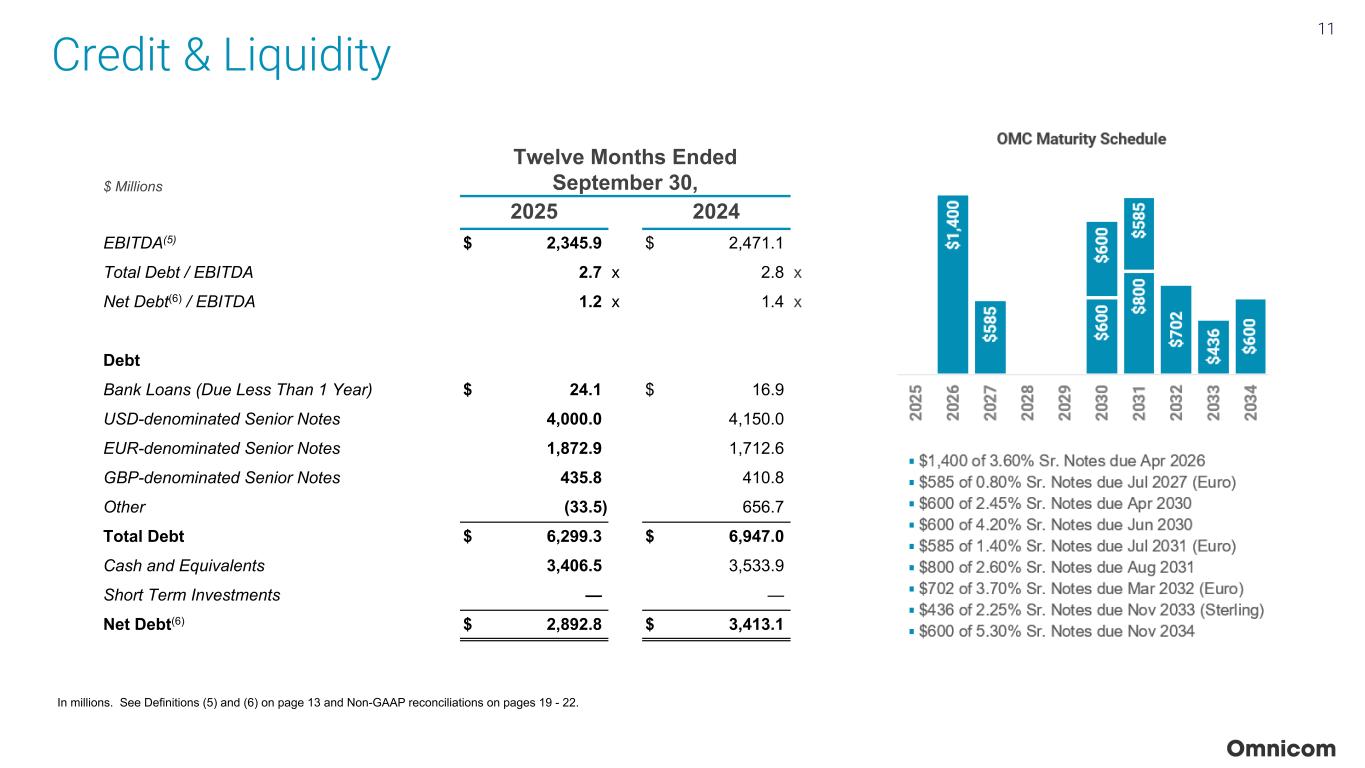
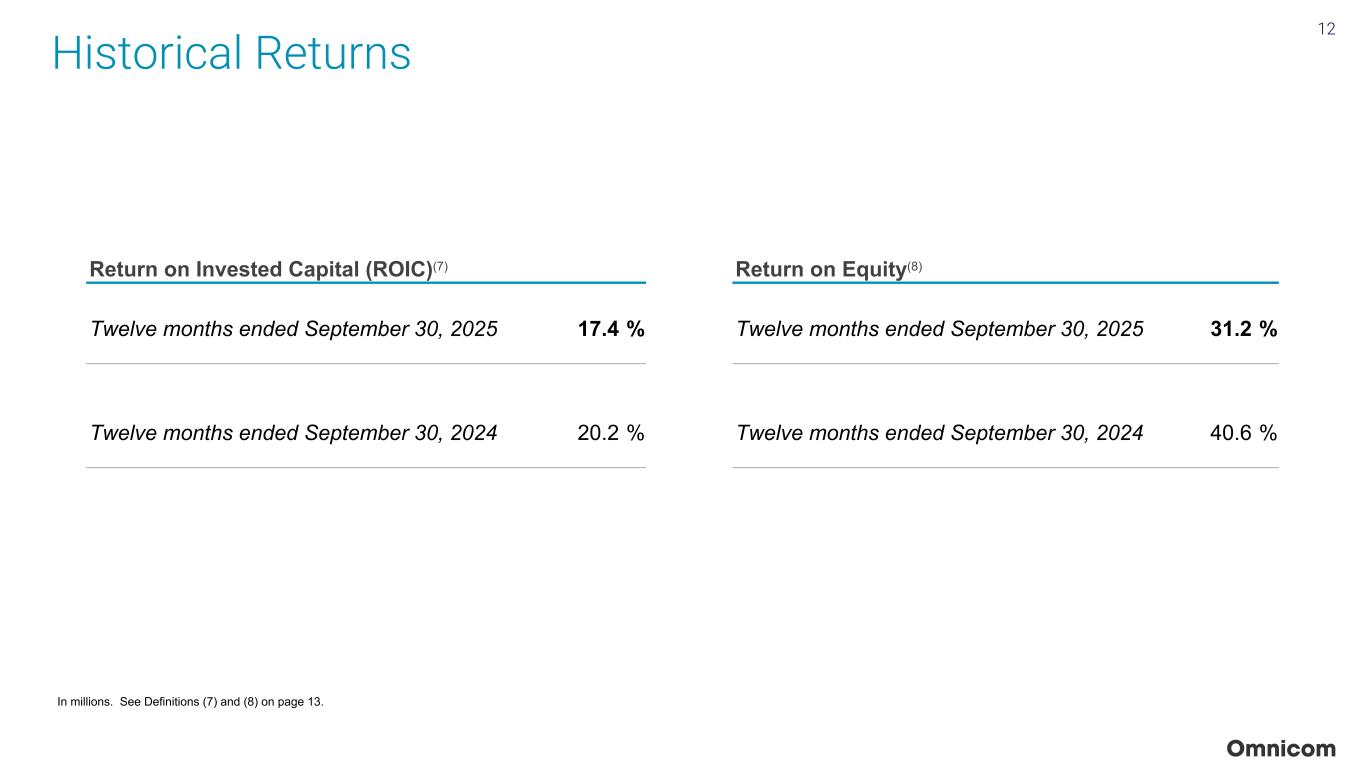
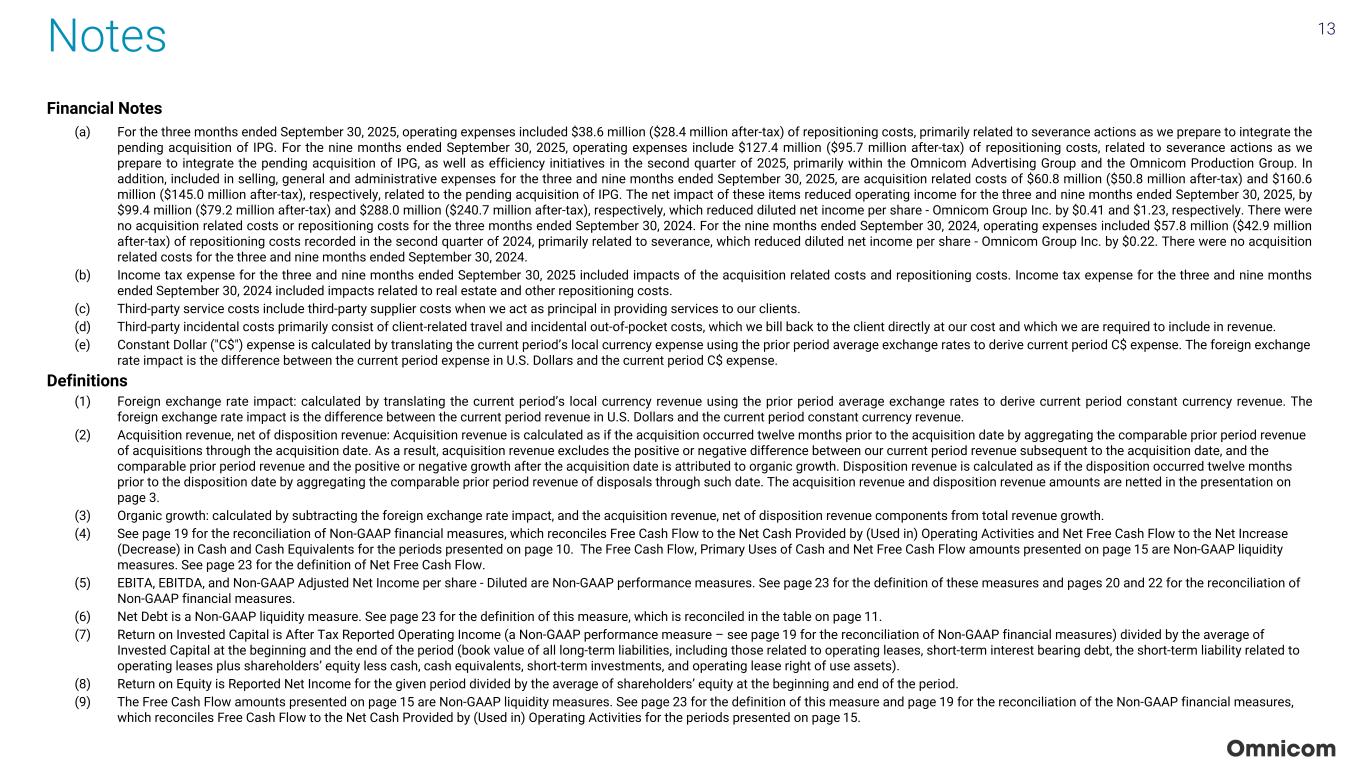
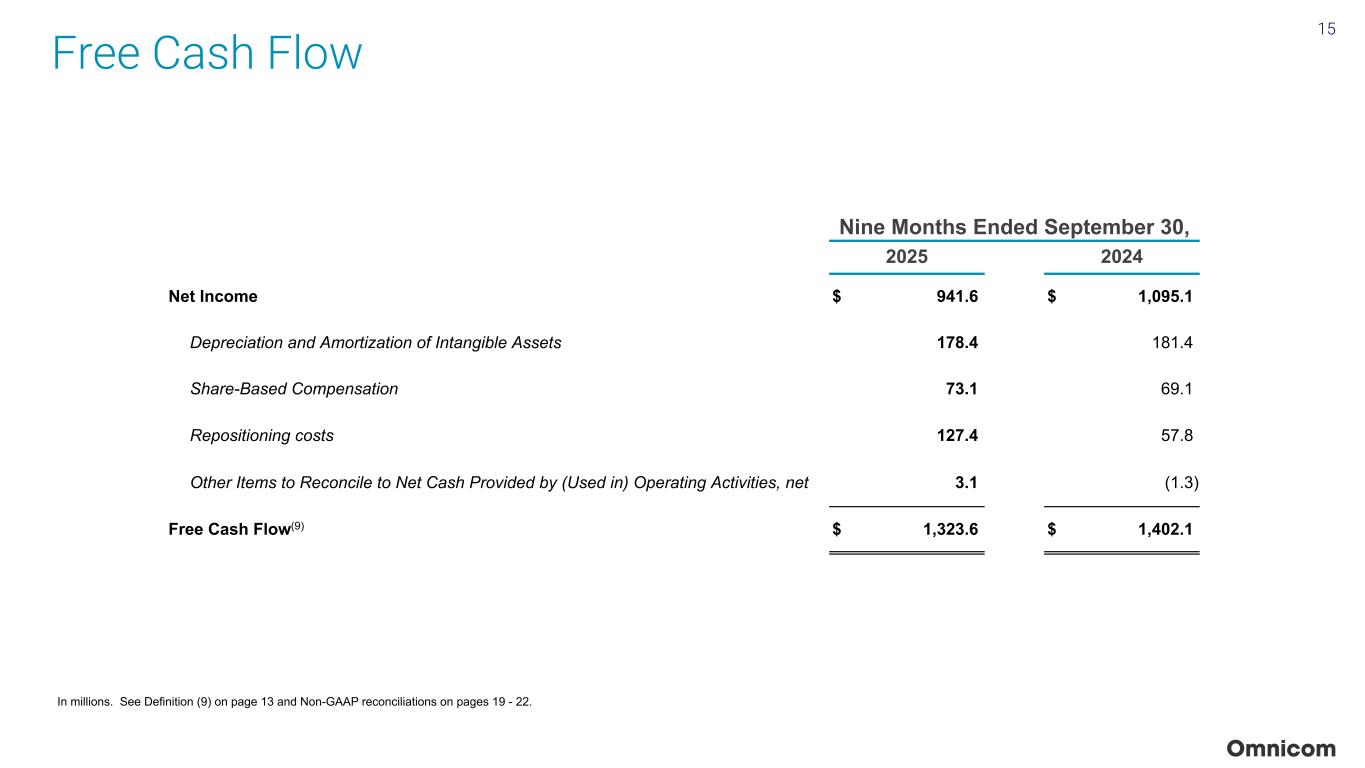
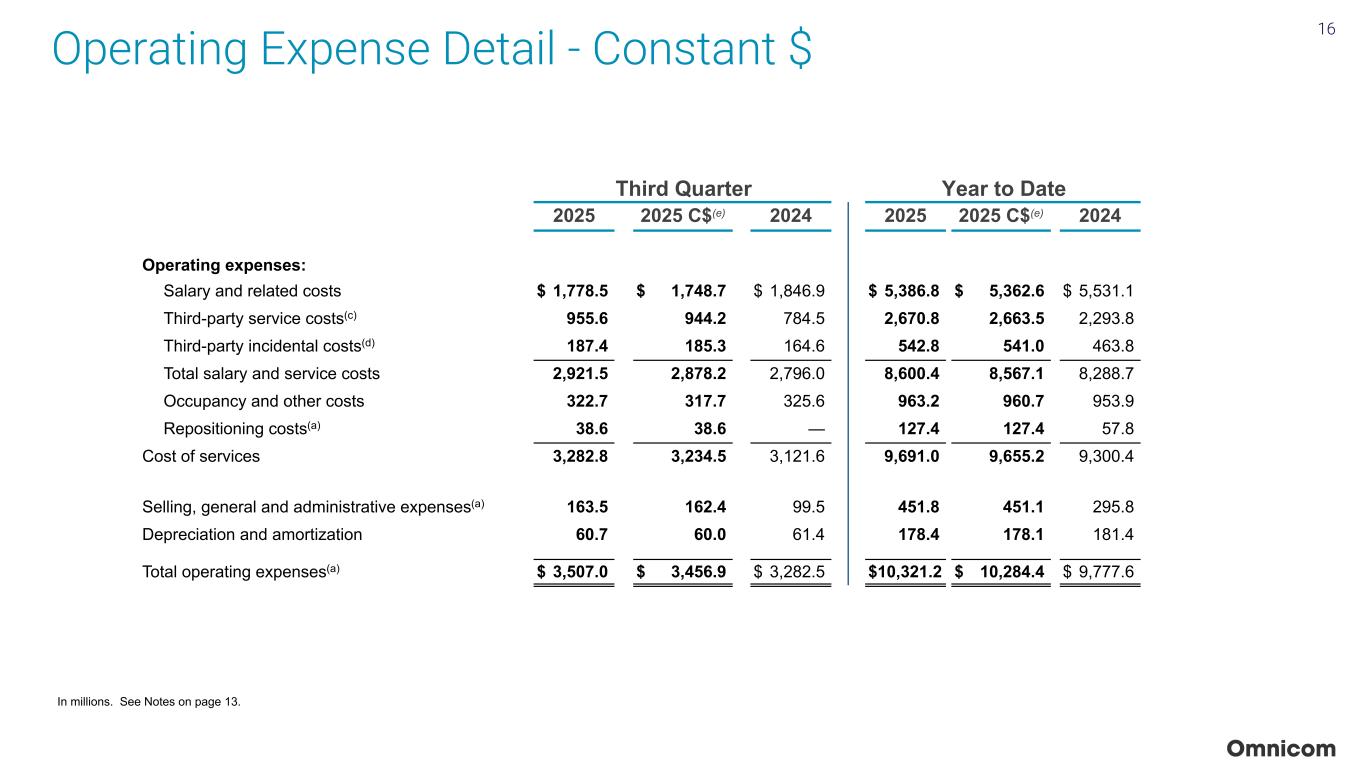
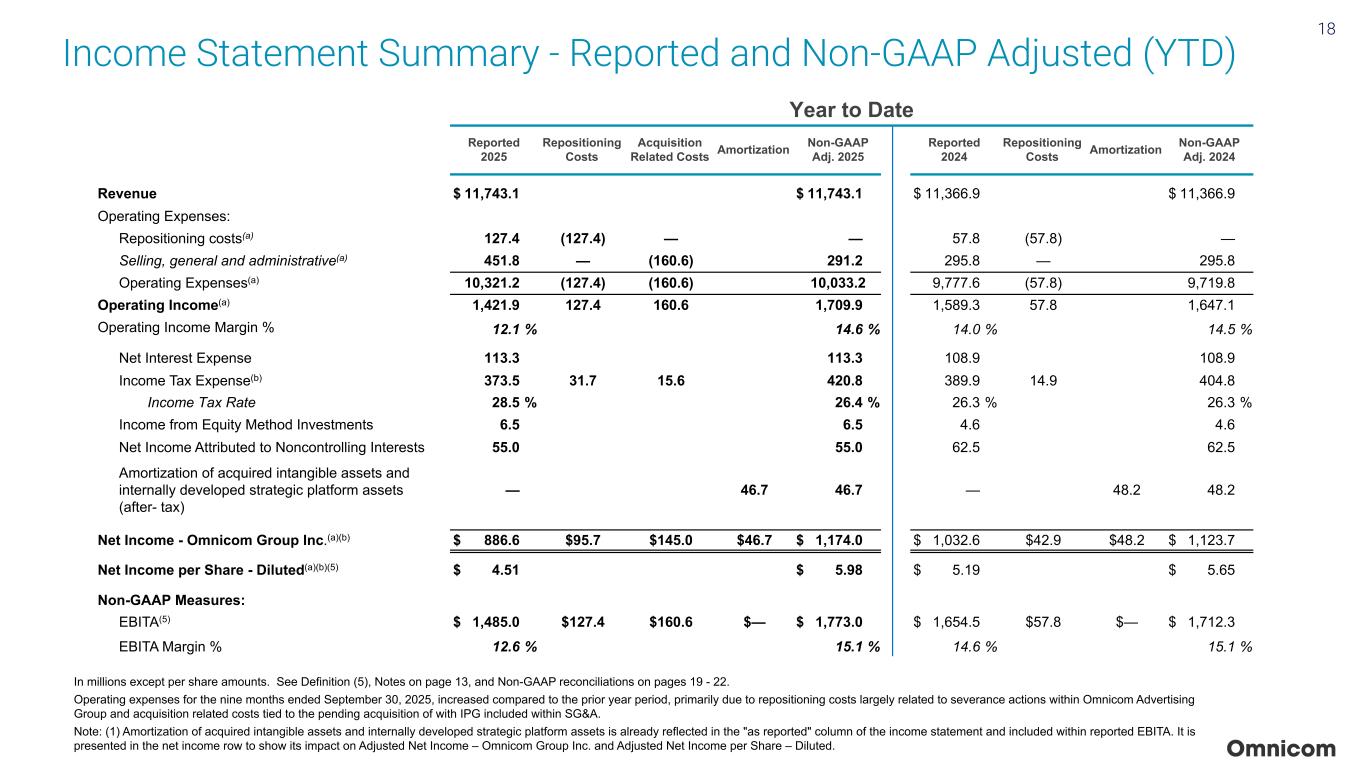
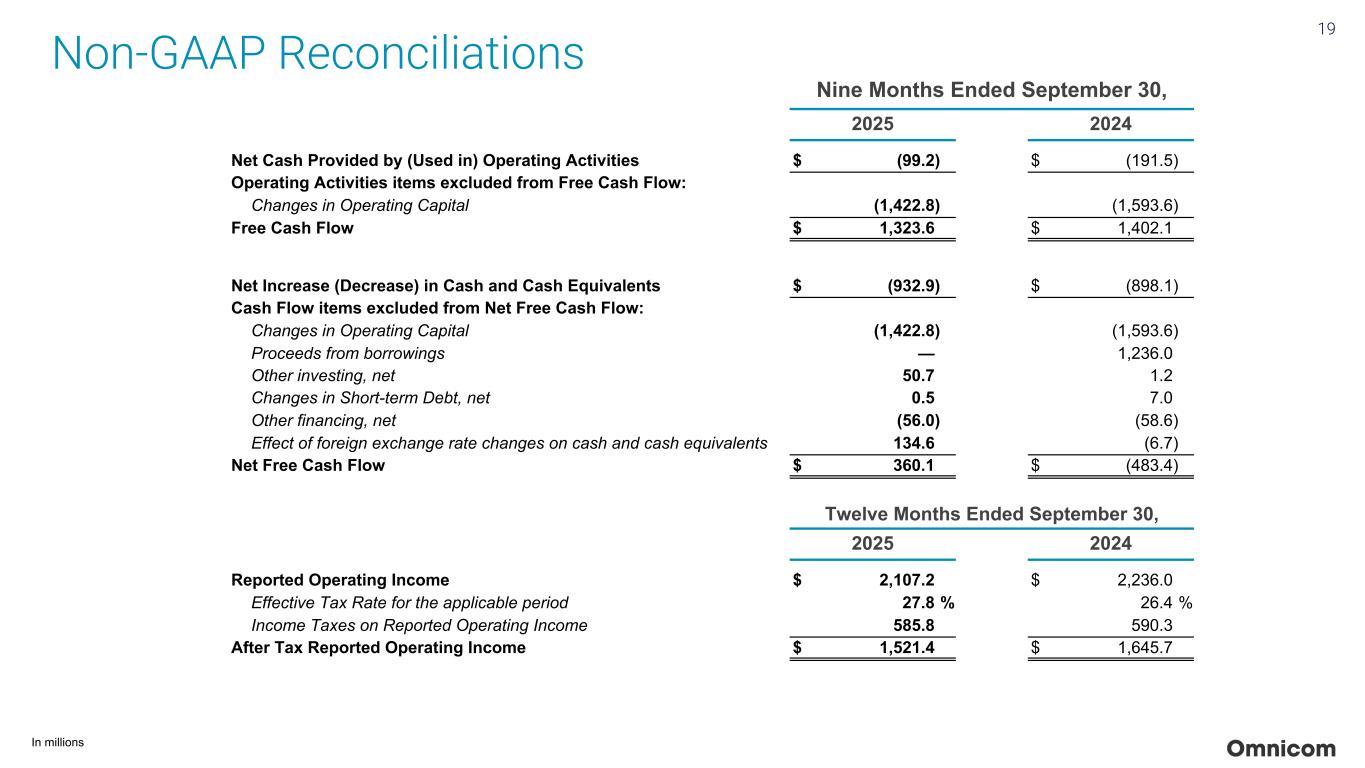
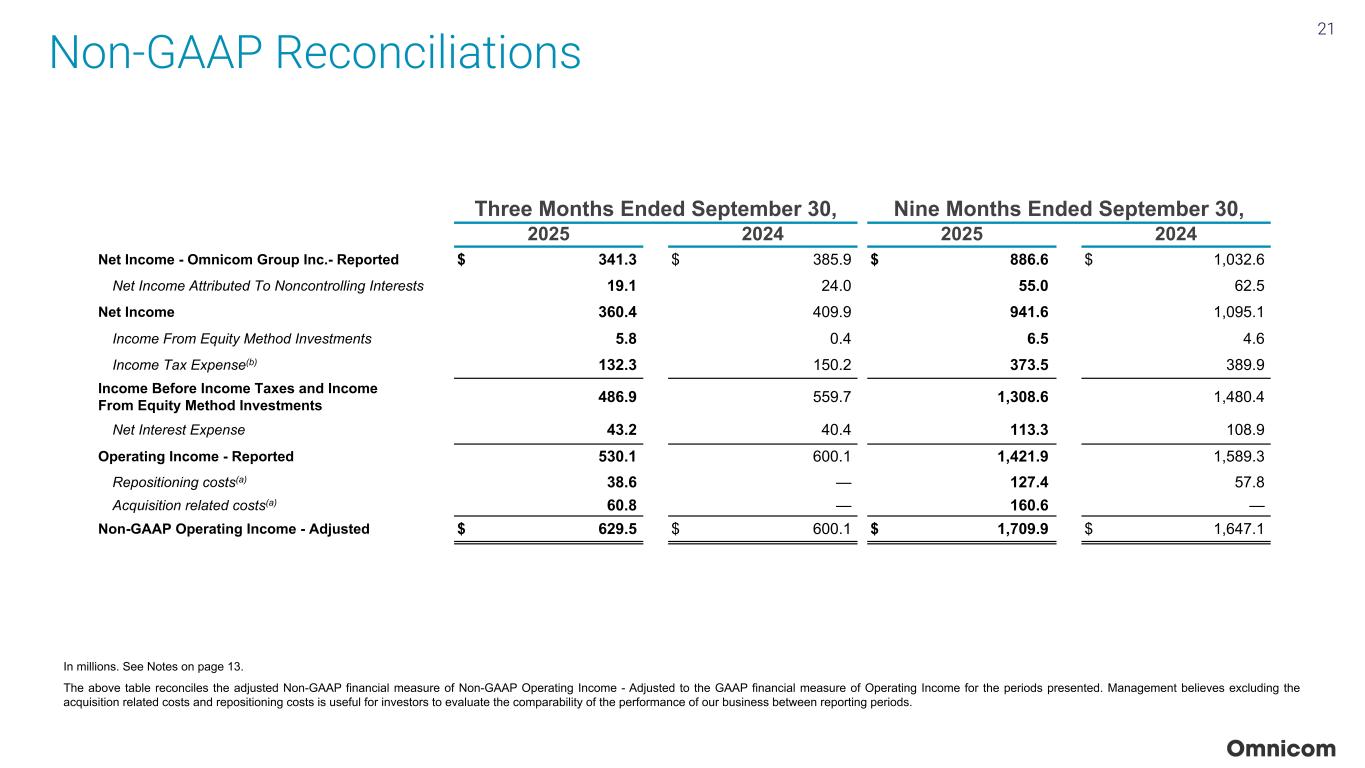
Thanks, John. Let's begin with our revenue growth on slide three. Organic revenue growth in the quarter was 2.6%. Additionally, the impact on revenue from foreign currency translation increased reported revenue by 1.4% as the U.S. dollar weakened relative to most currencies throughout the quarter. If rates stay where they are, we estimate the impact of foreign currency translation on revenue in Q4 to be similar to Q3. The net impact of acquisitions and dispositions on reported revenue was not significant, which is also our expectation for Q4 and for the full year 2025, excluding the IPG transaction. Let's now review our results in more detail, beginning with a summary of our income statement on slide four. We present our reported results on the left, and we present non-GAAP adjusted numbers on Adjusting for acquisition-related expenses and repositioning costs, our Q3 2025 non-GAAP adjusted EBITDA grew 4.6% to $651 million with a margin of 16.1%, up 10 basis points from Q3 of 2024. Our non-gap adjusted diluted EPS grew 10.3% to $2.24 per share. Regarding the two adjustments made to operating expenses, the first reflects acquisition-related expenses related to both regulatory approval work and an acceleration in our integration planning work the second reflects repositioning costs primarily related to severance as we prepare to integrate the pending acquisition of ipg there were no adjustments to operating expenses in q3 of 2024 slide 5 shows reconciliation of these items in detail operating expenses in the third quarter of 2025 include 38.6 million of repositioning costs and 60.8 million of acquisition-related costs. We continue to expect that our non-GAAP adjusted EBITDA margin for the full year 2025 will be 10 basis points higher than our full year 2024 results of 15.5%. Net interest expense in the third quarter of 2025 increased due to a decline in interest income primarily from lower interest rates on our cash investment balances, partially offset by a year-over-year decline in gross interest expense due to the issuance of $600 million of our 5.3% notes to replace the $750 million of our 3.65% notes, which were retired in Q4 of 2024. We estimate that net interest expense will increase by approximately $7 million in Q4 compared to the same quarter last year, primarily due to lower interest income expected on cash investments. Our reported income tax rate was 27.2% in Q3 2025, compared to 26.8% in the prior year. The increased rate is primarily due to the non-deductibility of certain acquisition-related costs in 2025. On an adjusted basis, our Q3 2025 rate was 26%, For full year 2025, we expect the rate on an adjusted basis to be between 26.5% and 27%. Average diluted shares outstanding were down 2% from Q3 2024 due to net repurchase activity. Let's now turn to some key drivers of our performance, beginning on slide 6 with organic revenue growth by discipline. Media and advertising led our growth in the quarter, with revenues up 9%. While creative continued to be impacted by lower levels of project work due to macroeconomic uncertainty, media growth was strong across virtually all geographies. Precision marketing growth was just under 1%. Solid growth in the U.S. was offset by declines in other markets, primarily in Europe. Public relations declined 8%. Approximately $25 million, or 80% of the decline, results from no U.S. national election-related revenue in 2025 vs. 2024, with the majority of the remaining reduction occurring in the U.K. We do expect similar declines in Q4 resulting from the difficult prior year comp to Q4 of 2024, which included spend related to the U.S. national elections. Healthcare was down 6.4 million, or 2% organically. Both our U.S. and European agencies were down 2% organically, as recent new business wins did not fully replace some spending declines in the quarter on client products that are in the process of coming off patent protection. We continue to believe that our agencies in this discipline are well positioned to return to growth in the near future. Branding and retail commerce was again down 17%, as market conditions continued to impact new rebranding projects, new brand launches, and in-store retail commerce. Experiential declined 18% on a difficult comp against the Summer Olympics in 2024, as we expected. And lastly, execution and support grew 2%, driven by growth in our merchandising business, which was partially offset by a reduction in spend in field marketing. Turning to organic revenue growth by geography on slide 7, we saw mixed growth across our regions. Over half of our revenue was generated in the United States, which saw 4.6% growth. UK growth was also solid at 3.7%, while continental Europe, our second largest market, saw a decline of 3.1%. Although our non-euro markets delivered organic growth, it was offset by a decline in our events business related to the challenging comparison in Q3 of 2024, which as we have said, included spend related to the Paris Olympics. Slide 8 is our revenue weighted by industry sector. Relative to 2024, year-to-date 2025 was fairly stable. The only meaningful change was an increase in the relative percentage of total revenue driven by the auto category, reflecting year-on-year new business wins. Other categories are relatively stable. Moving on to expense detail on slide 9, during the quarter, salary-related service costs, our largest expense, declined on a reported basis by 3.7 percent due to our continued efficiency initiatives, including automation initiatives and changes in our global employee mix. Third-party service costs grew in connection with growth and revenue, primarily in the media and advertising and execution and support disciplines. Third-party incidental costs, which are out-of-pocket costs, billed back to clients at our cost, grew in connection with the growth and revenue. Occupancy and other costs decreased 1%, led by a decrease in general office and technology expenses. SG&A expenses increased primarily due to the $61 million of IPG acquisition-related costs in the quarter. Excluding these costs, reported SG&A expenses decreased to 2.5% of revenue. Now please turn to slide 10 for our year-to-date free cash flow summary. The decline relative to last year was driven primarily by the reduction in net income resulting from the impact of both the acquisition related costs and the repositioning costs our free cash flow definition excludes changes in operating capital the nine months ended september 30th 2025 our change in operating capital improved 171 million dollars or 11 percent compared to the same prior year period on the last 12 month basis it improved by 267 million the nine months ended Since September 30th, our primary uses of free cash flow included $414 million of cash to pay for dividends to common shareholders and another $57 million for dividends to non-controlling interest shareholders. Our capital expenditures were $111 million and remained higher than last year due to ongoing investments in our strategic technology platform initiatives. Total acquisition payments were $88 million, all of which represented earn-out payments and the acquisition of additional non-controlling interests. Finally, our share-of-purchase activity was $312 million, excluding proceeds from stock plans of $18 million. This included share-of-purchases of $89 million in Q3. We currently continue to expect to spend close to $600 million on share-of-purchases for the full year. Slide 11 is a summary of our credit, liquidity, and debt maturities. At the end of Q3 2025, the book value of our outstanding debt was $6.3 billion, down from the same prior year period due primarily to the refinancing of our $750 million of 3.65% notes in Q4 of 2024, with a new issuance in Q3 of 2024 of 600,000,000, 5.3% notes due in 2034. Our $1.4 billion April 2026 notes are now classified as current on our balance sheet. We will address refinancing these notes in due course after the closing of IPG and the completion of the debt exchange. Our cash equivalents and short-term investments at the end of the quarter were $3.4 billion. We continue to maintain an undrawn $2.5 billion revolving credit facility, which backstops our $2 billion U.S. commercial paper program. Slide 14 presents our historical returns on two important performance metrics for the 12 months ended on September 30, 2025. UNDICOM's return on invested capital was 17% and return on equity was 31%, both of which reflect our strong performance and our strong balance sheet. These year-over-year calculations were done on a reported basis and the reduction is driven by the impact of the IPG acquisition-related costs and the repositioning costs incurred the 12 months ended September 30th, 2025. It is approaching one year since our public announcement of the IPG acquisition, but as you know, we've been working on planning for the integration for some time. With closing expected by the end of next month, our teams have been accelerating the final planning for the integration so that we're prepared to move forward as one on day one. We're excited to be nearing this important milestone so we can emerge as the most powerful team, platform, and portfolio in the industry. I will now ask the operator to please open the lines up for questions and answers. Thank you.
Operator
Thank you. Also joining the call today is Paolo Juvenko with Omnicom's Chief Technology Officer. At this time, I would like to remind everyone, in order to ask a question, press R followed by the number 1 on your telephone keypad. Our first question comes from the line of Adam Berlin with UBS. Please go ahead.
Hi, good evening. Thank you for taking two questions, please. The first question is, if you do manage to complete the acquisition by the end of November, as you said, when do you think you'll be able to update us in the market on some of the things you talked about at the beginning of the call? So specifically, when do you think we'll be able to see pro forma financials and get some guidance for how the performer business is going to perform? Do we have to wait to four year results or will we have an opportunity to hear from you before then? That's the first question. The second question is, I mean, I think most of the numbers were as expected, but there was a big deceleration in precision marketing. And you mentioned there were some problems in Europe. Can you just give us a bit more detail about what happened in precision marketing in the quarter? and why it was so slow, and, you know, is that going to continue into Q4? What's required for that business to get back to growth again?
Thanks for the questions. On the first one, we're going to be able to articulate what our plans are shortly after we're together, But at the moment, our plans in the preliminary is we're looking to disclose the future operations and what's in the portfolio, probably the week of CES, which is in the beginning of January. And in terms of the financial modeling and things that you'll do, where we're confirming the amount of synergies that we expect to see as a P&L benefit in 2026 and then synergies thereafter, that'll be sometime between then and, at the worst, shortly after we announce the year in earnings. We haven't come to a firm date as of yet. So I can follow up on that. And your second question on precision marketing, there's a lot of puts and takes, as you said, most of them outside the United States. The one unit that we had particular decline year over year is in our Cordero business, which was our consulting business. And it was really most related to government work in some of the major city countries in Europe that we saw at Budback. We're addressing ourselves to that. The rest of the business is very strong and continues to have a very good pipeline of new business coming through.
Okay, thank you very much.
Operator
Your next question comes from the line of David Karnofsky with J.P. Morgan. Please go ahead.
Thank you, John. Maybe just to start, I wanted to confirm the organic guide for the year. I think in your prepared remarks, you said 3% year-to-date growth in line with the outlook. So does that mean you're expecting around 3% for the year, or should we consider the prior 2.5% to 4.5% as still the outlook?
I think we're only prepared this afternoon to talk about what our original guidance was and coming in within it. As you might imagine, there's a lot of different activity going on in the background as we get ready for the closing of the in-public transaction. So we're probably a week or two off in terms of being as analytical and surgical with our operations as we would be if this was a normal calendar. Um, but we're comfortable with our guidance and, um, both EBIT and, um, and Revit.
Um, the other, the other thing to keep in mind, David, we, we're in a position we, we always are in October, um, as we look at it to the fourth quarter, knowing that there's meaningful amount of project work available in in a typical year and um you know where where we finish q4 certainly is going to have a lot to do with how much of that our agencies are able to capture um as we go through the next you know two and a half three months of activity um trying to capture any and every project, you know, our agencies can execute on. So not that much visibility on that project work, which tends to, you know, potentially get in the range of $200 million to $250 million of potential availability if we got it all. But, you know, how we close out the year is always, that always plays a big part in it.
You know, the other point, which I didn't bring up very much because I don't want to seem like I'm making up reasons. If I compare our portfolio as it exists until we close the deal and look to last year, which was an Olympic and a presidential election, And if I took out and compared like for like, without the impact of the presidential election or the Olympics, organic growth on the court would be 4%, or approximately 4%. So the fundamentals of the business are still very strong. That's the only reason I'm even articulating this, not as a reason for why it was 2.6. But just to show the underlying growth of the company, and amazingly, despite all the predictions which started after we announced this proposed transaction, we haven't really lost any significant people, and we certainly haven't lost any business, and we continue to win business. we'll be able to be even stronger when we're able to function together. So far, we've had to pitch everything kind of independently as if we're still two independent companies. But hopefully that will change on the completion of the deal.
Maybe just to that point, I mean, I know you can't pitch together, but I have to assume the combination is a consideration and kind of the recent RFPs. So, you know, is there interest in clients? What's been sort of the kind of response to what is, obviously, the combined offering coming?
Sure. I mean, clients are very positive, the ones that we're engaged with, not just the ones that we're involved with a potential pitch for business. probably the only time we got to communicate was at the direction of a client which is Bayer which wanted to see us pitch separately and then at the very end asked us a few questions or demanded we answered a few questions what would look like post the deal so it's all been encouraging and very positive and just from spending eight months now getting to know the talent and the tools and everything that's there, and now it complements what we have. I'm very excited about the possibility of growth.
Operator
Our next question comes from the line of Stephen Cahall with Wells Fargo. Please go ahead.
Thank you. Good evening. So, media and advertising continued pretty strong growth in the quarter, I think up over 9% organic. So, could you maybe talk about first how creative is performing within that. I think earlier it had been a bit of a drag, and so just curious if it started to improve in the third quarter. And then as we get into a world where it feels like everything's going to be more enabled with AI or generative AI, can you talk a little bit about what that means for the media and the creative side of the businesses? And then just on synergies, IPG has done a nice job of bringing down costs. I think you've also hinted at upside to synergies. So how are you thinking about the incremental synergies from here versus what you've talked about previously as we get so close to the merger.
I have at least three questions in there. I'll try to answer two and throw the other one to Paula. In terms of the creative business versus the media business, the creative business I've categorized as being stable, and the growth is really coming out of the media side of the business without getting more analytic than that. In terms of AI and generative AI, more importantly, I'll throw it over to Paolo, because quite a bit of real stuff is happening.
Sure, Stephen. So with respect to generative AI, it's really affected every facet of our business, and because we've integrated it into every part of our workflow. So just to give you some specific examples, you know, in one of our most recent wins for a large automotive company, our teams used integrated agents, the agent framework that we talked about in not only this call, but in the previous earnings call, throughout the entire pitch process, which includes consumer research, creative concepting, production, and customer journey planning, ultimately enabling our teams to move not just with speed, but to develop really a differentiated creative solution. And we have many examples like this. Within our sports marketing units, we're using agents that are grounded on proprietary data around experiential brand impacts of sporting events, concerts, and festivals, which is allowing them to really contextualize every concept that they explore for the work that they do for clients. You know, our commerce group is using it very effectively, the agents and generative AI, really to, these days, to review historical price impact on key conversion metrics to anticipate future pricing elasticity. So there are many different ways that we're incorporating AI and generative AI across the process. Another good one is actually around our health group, where they continue to kind of rewrite the way drug launches are being done and the processes within that using an AI-first lens, using that generative AI and agents really at the start of the product development process. So the entire ecosystem, frankly, is changing around the use of AI and generative AI. We're seeing a lot of third parties starting to adopt a more agent-based approach to ad tech and martech. And we've been working very closely with a lot of those vendors, the likes of Adobe, the whole ad CT protocol that is being spearheaded by several media organizations. We are set up effectively to adopt those frameworks and to really drive the future of what advertising and marketing looks like.
Oh, synergies. I'm not prepared to disclose them, but I will tell you that we have clearly identified synergies in excess of what I promised at the time we announced the deal. More to come. Thank you. I'm sorry.
Operator
Okay, your next question comes from the line of Cameron McVeigh with Morgan Stanley. Please go ahead.
Hi, thank you. I actually just wanted to ask about the Walmart OpenAI partnership, your view on it, you know, the potential implications, especially in relation to Flywheel's business around sponsored listings on Amazon, and maybe implications on the retail media advertising industry more Yeah, sure.
I'm happy to take that. I enjoyed hearing that. I can certainly give you from a technical lens. I think it helps us. You know, obviously our role is to help our clients drive sales. And, you know, many of the consumers are sitting on other platforms like OpenAI. We're helping to facilitate that and working very closely with the likes of OpenAI and Walmart to understand how do we actually drive the connected tissue in order to get to the ultimate outcome that they're looking for. So ultimately, we see it as a good thing.
Operator
Okay, and your next question comes from Adrian de Saint-Hilaire with Bank of America. Please go ahead.
Thank you very much. Good afternoon. Good evening, everyone. Can you provide a bit more color on the rise of, or the increase, I should say, of third party costs in Q3, which was faster than in Q2? Is that due to faster growth in media, or maybe within media, faster growth in principal trading? And then, John, I'm just curious, in the last call, you talked about the fact that there could be some relief on marketing budgets whenever the situation on tariffs becomes clearer. So three months on, I'm just wondering, like, what's the latest there?
I'll do the last one first, and then I'll defer to Phil on your former question. In terms of marketing budgets, tariffs have certainly been part of the conversation throughout most of the year. I would say it's more to do with supply chain than tariffs in terms of how companies are approaching what they have to sell in the marketplace. And most have been rather ingenious in terms of working through and with the tariffs that are in place. You know, Phil mentioned the stress, I guess, that various automotive companies are facing. That seems to be improving as we get through the balance of the year, but there was a huge pivot on the part of most of them where they were dependent upon getting to electric by 2030. Many of them have changed some of those plans, so they're still somewhat in flux. But that's about it. Other than that, it's been pretty much business as usual. more. The conversations are slightly different, but the outcomes are roughly the same types of budgets and spending. And I'm hopeful that we're going to see, as Phil mentioned, the project or the spending that gets done in the fourth quarter, expecting to...I see some green shoots in things that we've yet to confirm, but clients are talking positively. So that's that. And I'll throw the first question back to Phil.
Sure. So median execution and support certainly are the primary drivers of the increase in third-party service costs. Overall, as revenue grows, these types of variable costs typically grow with it. And, you know, we're happy to have them as long as it results in revenue growth and profit growth as well. Because as you could see, you know, While organic revenue growth was 2.6% overall, EBITDA grew 4.6%, and adjusted EPS grew 10%. The media business continues to perform quite well, meeting the needs of our clients across all of our media service offerings that certainly they are interested in. Proprietary media is one, but keep in mind it's a relatively small proportion of our client's media plan or a client's media spend. And there's quite a bit of other media service offerings that drive media growth in our media business as well.
Operator
And your next question comes from the line of Michael Nathanson with Moffitt Nathanson. Please go ahead.
Thanks. Hey, John, I have one for you. I wonder, when you take a look at the combined revenue growth of interpublic and Omnicom versus, you know, publicists in aggregate, where do you think you can close the gap from that combination of you two to where they are today? So what, what business lines and what, what, what places do you see the most opportunity in combination to close that gap in revenues versus where you guys are today?
Sure. I mean, I think you'd have to acknowledge just from looking from the outside in, the two companies that are growing are both publicists and us. And I expect that to continue as we go forward. I'm not really ready to disclose what I believe the combined company is going to look like. But if you sit back and with all the effort and things that we've been doing in planning this acquisition and the integration of the two companies, we're able to really focus in on those areas that are showing the most growth and lead us to a place where we're able to further differentiate ourselves. So that's a battle that I expect to continue kind of every working day from now on with each of us doing whatever we do. And there's certainly enough business for both of us to continue to grow in a very healthy way. And so I'm not concerned about closing the gap. I mean, as I alluded to earlier, trying to answer another question, if you looked at our portfolio, look at our base and their base from the third quarter of last year, if that's what you're focused on, that is 90 days. Our third quarter last year was improved because of the Olympics and the elections. but they are they happen every two years in the case of the Olympics and every four years in case in the case of the presidential election we go through do the analysis simply to make sure that the rest of our business is growing at a pace similar to what you would say is public sees right we're in that range we would have been four percent versus what they claim to be five percent So, in any 90-day period, you can't really call that a difference, but I think you can point to both of us for the last several years have been healthy performers, and I expect us to be able to even accelerate over what we've been able to do in the past because of the improvement and just the composition of the portfolio.
Operator
And our final question comes from the line of Craig Huber with Huber Research. Please go ahead.
Great, thank you. I have a similar question, John. If you could maybe just touch on, as you look at the combination of IPG coming up here, where do you think the three biggest opportunities are for revenue synergies? I mean, in the past, we've talked about media buying, for example, Flywheel, Axiom, but just walk me through with the three biggest opportunities for running things better here on a combined basis.
Well, certainly, well, our media business probably gets to be 50 to 60 percent bigger than what it is currently, and within that range of activity, there's a great deal of opportunity, and we have some really very talented people when you put the talent from both groups together who are developing offerings and products which, on behalf of clients, do it better, cheaper, and faster. We're also using technology to aid in that effort. That's number one. Our healthcare portfolio, even though it's had a little bit of a bumpy road in the last nine months between, you know, first of all, the loss of Pfizer, which impacted us, which was, you know, on us, and then some of the confusion that came out of the change in the administration here in terms of its slight impact or its impact on aspects of PR. But going forward, we see unbelievably strong assets, which when you look at the industry, we are, we'll punch way above our weight in terms of the people and the offerings and the areas in which we are going to be the leaders in in the area of healthcare and then i'm very encouraged about precision marketing too we hit a bump in the road with our consulting aspect of it which we think we see daylight on and we we have action plans to act on um so those three areas would be where i see The most growth coming initially, as well as the depth of the portfolio and other areas as well, and the agility that will bring us in order to respond and change with client needs in general advertising and some other areas. But the three I would focus on would be media, health, and precision.
And my second question, if I could, can you just talk a little bit further about the tone of business from your various clients in the U.S. and Europe? Has those conversations changed much versus, say, three months ago? Or in general, are your clients feeling better about the environment out there or worse or about the same?
You know, the conversation, you know, touches a lot of new topics. It's general AI, and it's how we're going to use it. And as I mentioned, the automotive industry isn't declining, but, you know, they've reached some difficulties during the course of this year. But fundamentally, the proof is in the pudding, and the budgets haven't really been slashed or cut. And we're hoping to see that continue because of the, as Phil mentioned, the fourth quarter level of projects, which clients have to actually release that funding. They have it. It's been approved for most of them in their plans. We're just waiting for confirmation of it in terms of how we bring it over the finish line between now and December 31st. So it's not, I wouldn't say everybody is in a euphoric mood, but everybody has dealt with most of the challenges that have been thrown at them this year, and people are seeing themselves through to the other side. And we work hand-in-hand with our clients, and when they're prospering, we prosper. When they suffer, we suffer a little bit, but our product is the best, I think, that's out there. And I'm willing to stand by that. I don't know if I've fully answered your question.
No, that's helpful, John. My last question, a little different area I want to ask you. Phil, you know this in particular. I mean, President Trump about four or five weeks ago was out there saying that he wants to give public companies the option to only report earnings twice a year as opposed to four times a year quarterly as it's been for decades here and stuff. And he'll give companies the option to only report twice a year. What is your thought on that? If the SEC does make that change underneath his directive, would you guys look to change that or not?
Phil will answer that, but for me personally, I'd love to be under the same pressure as my foreign competitors are in terms of what the reporting requirements would be.
Yeah, I think time will tell. We'll see what does or doesn't happen. We typically don't like speculating, but as John referenced, the thing that's a little bit unique about our industry, two of what will soon be the three largest players on a global basis are European, and if you take the one or two largest beyond that, there are also international companies that don't report quarterly. So we'd certainly evaluate it if the rules changed and may make things more comparable if we follow the regime that's currently followed by our largest competitors. But it is speculation. I think the current quarterly reporting has been in place for a long time. People are used to it. We're certainly used to it. It helps our internal processes and controls, not just on the actual reporting process, but also on our forecasting and budgeting process. It's a good discipline to have, but it'd be a nice option to evaluate if it came to that.
I mean, it's certainly filled, I think, the sell side and the buy side as well, like the disclosure every quarter and stuff.
I'm sure you guys would obviously consider that heavily in your decision, right, if it comes down to it.
Yeah, absolutely. Great. Thanks, guys. Okay. Thank you all.
Operator
And with no further questions, this does conclude today's conference call. You may now disconnect.