Operator
Good day, ladies and gentlemen, and welcome to the Ziff Davis Third Quarter 2025 Earnings Conference Call. My name is Tom, and I will be the operator assisting you today. At this time, all participants are in a listen-only mode. A question-and-answer session will follow the formal presentation. If anyone should require operator assistance during the conference, please press star zero on your telephone keypad. On this call will be Vivek Shah, CEO of Ziff Davis, and Brett Richter, Chief Financial Officer of Ziff Davis. I will now turn the call over to Brett Richter, Chief Financial Officer of Ziff Davis. Thank you. You may begin.
Thank you. Good morning, everyone, and welcome to the Zip Davis Investor Conference Call for Q3 2025. As the operator mentioned, I am Brett Richter, Chief Financial Officer of Zip Davis, and I am joined by our Chief Executive Officer, Vivek Shah. A presentation is available for today's call. A copy of this presentation, as well as our earnings release, is available on our website, www.zipdavis.com. In addition, you can access the webcast from this site. When you launch the webcast, there is a button on the viewer on the right-hand side, which will allow you to expand the slides. After completing the formal presentation, we'll be conducting a Q&A. The operator will instruct you at that time regarding the procedures for asking questions. In addition, you can email questions to investor at zipdavis.com. Before we begin our prepared remarks, allow me to read the Safe Harbor language. As you know, this call and the webcast will include forward-looking statements. Such statements may involve risks and uncertainties that could cause actual results to differ materially from the anticipated results. Some of those risks and uncertainties include, but are not limited to, the risk factors that we have disclosed in our SEC filings, including our 10-K filings, recent 10-Q filings, various proxy statements and 8-K filings, as well as additional risks and uncertainties that we have included as part of the slideshow for the webcast. We refer you to discussions in those documents regarding Safe Harbor language, as well as forward-looking statements. In addition, following our business outlook slides are our supplemental materials, including reconciliation statements for non-GAAP measures to their nearest GAAP equivalent. Now let me turn the call over to Vivek for his remarks.
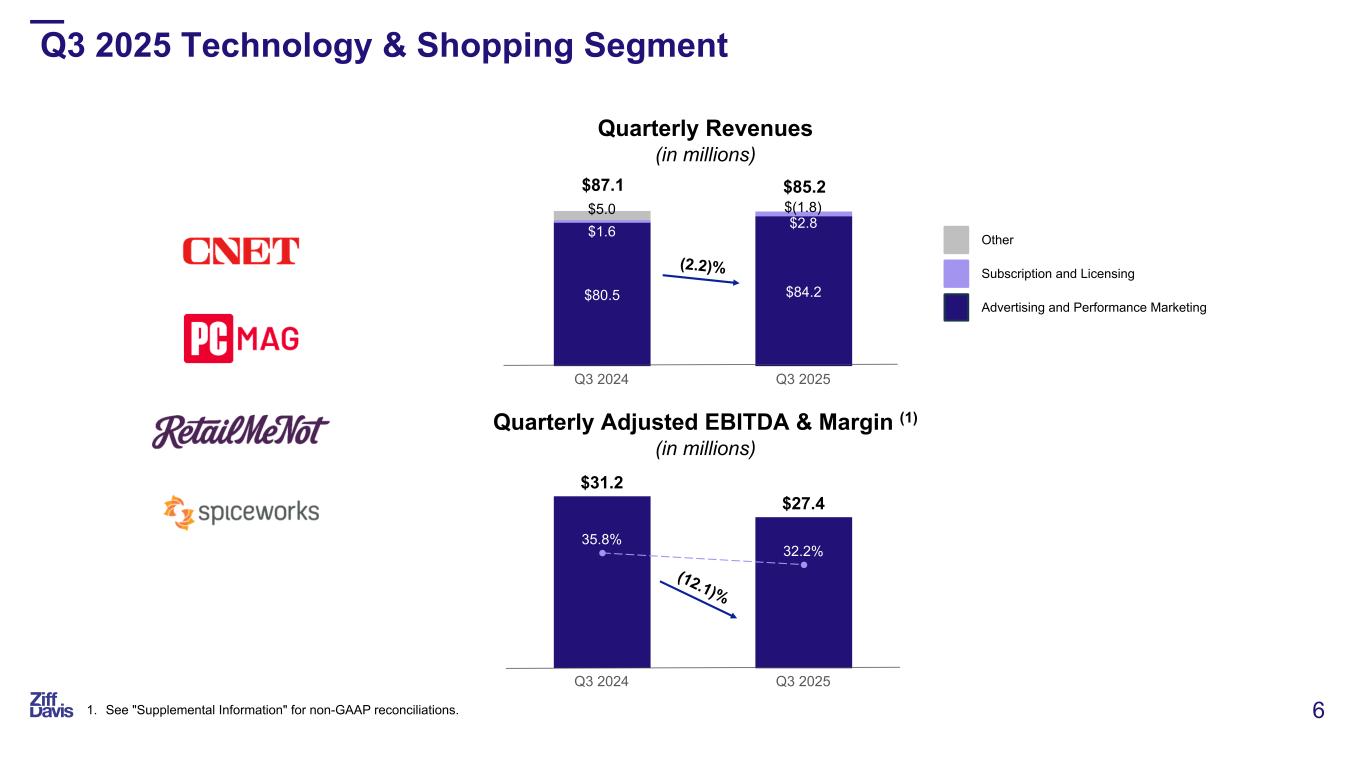
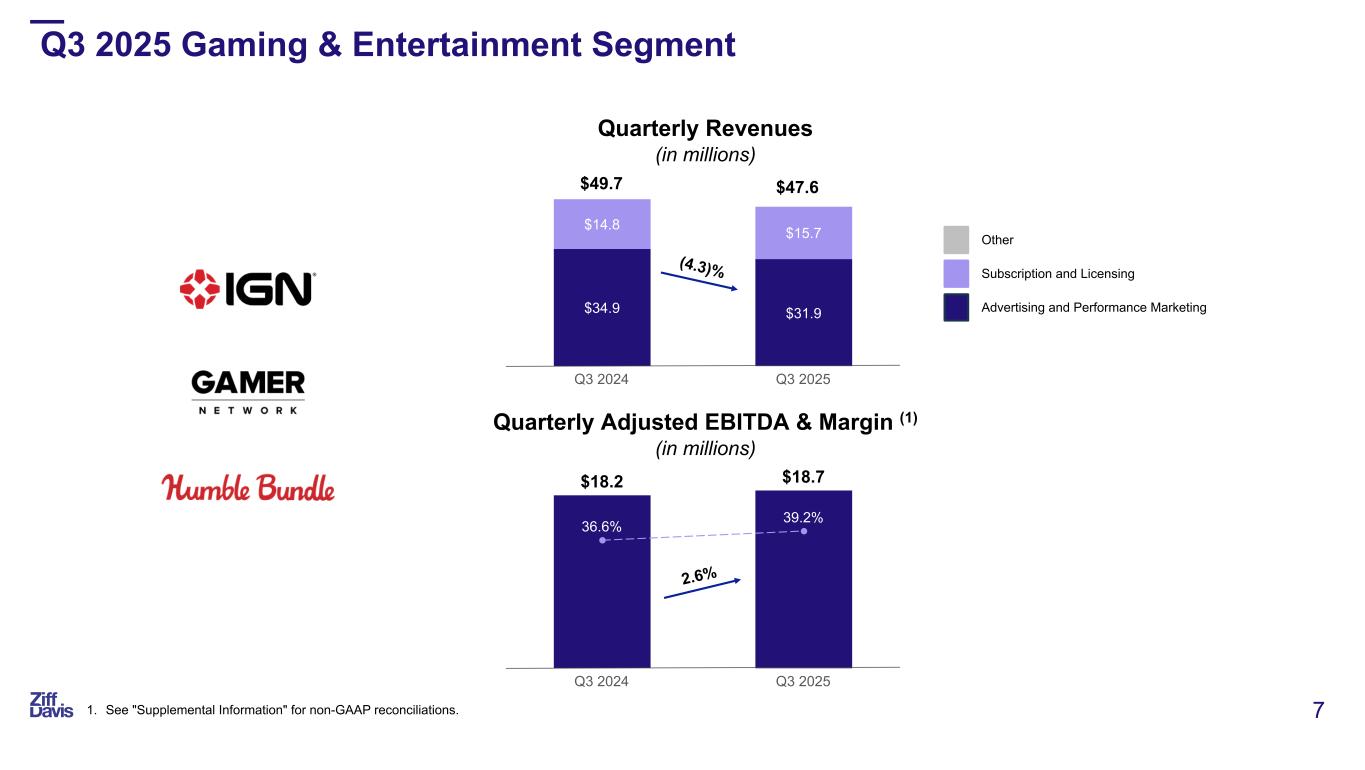
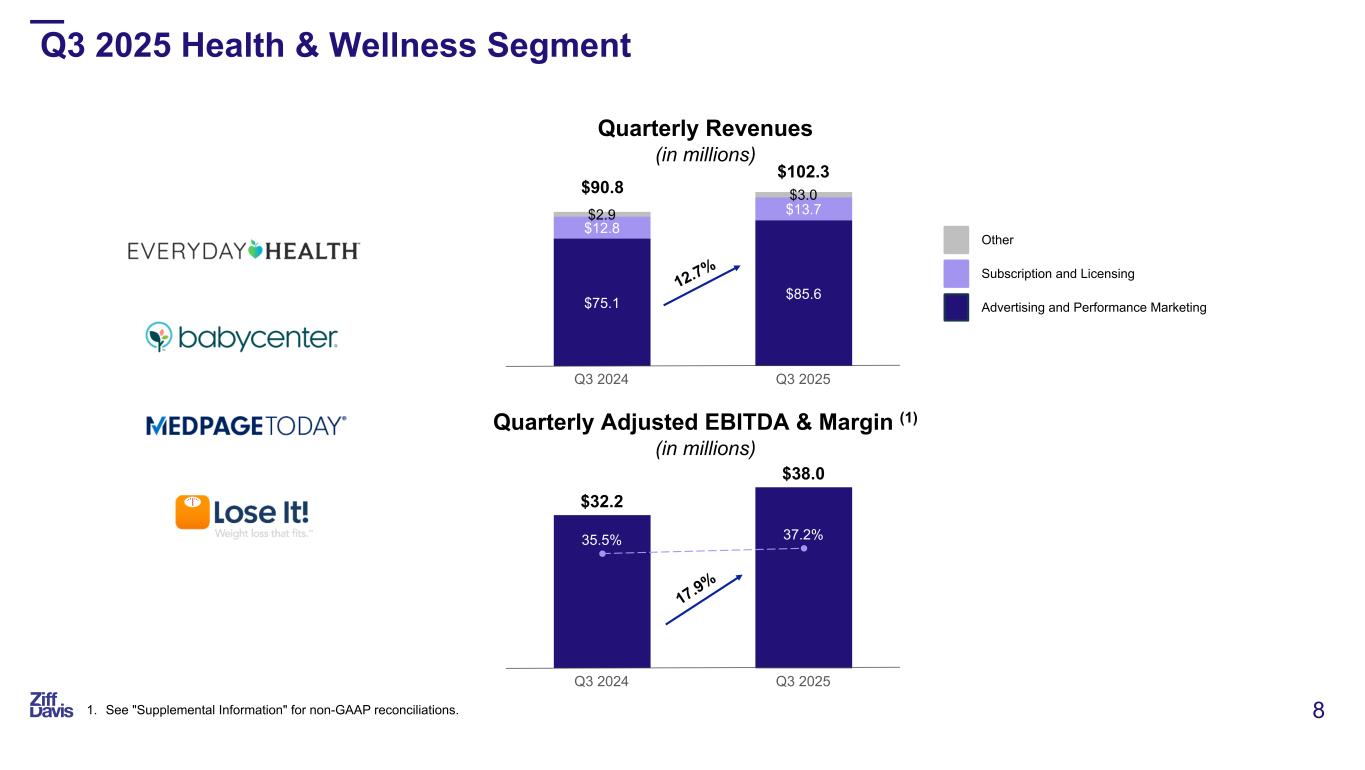
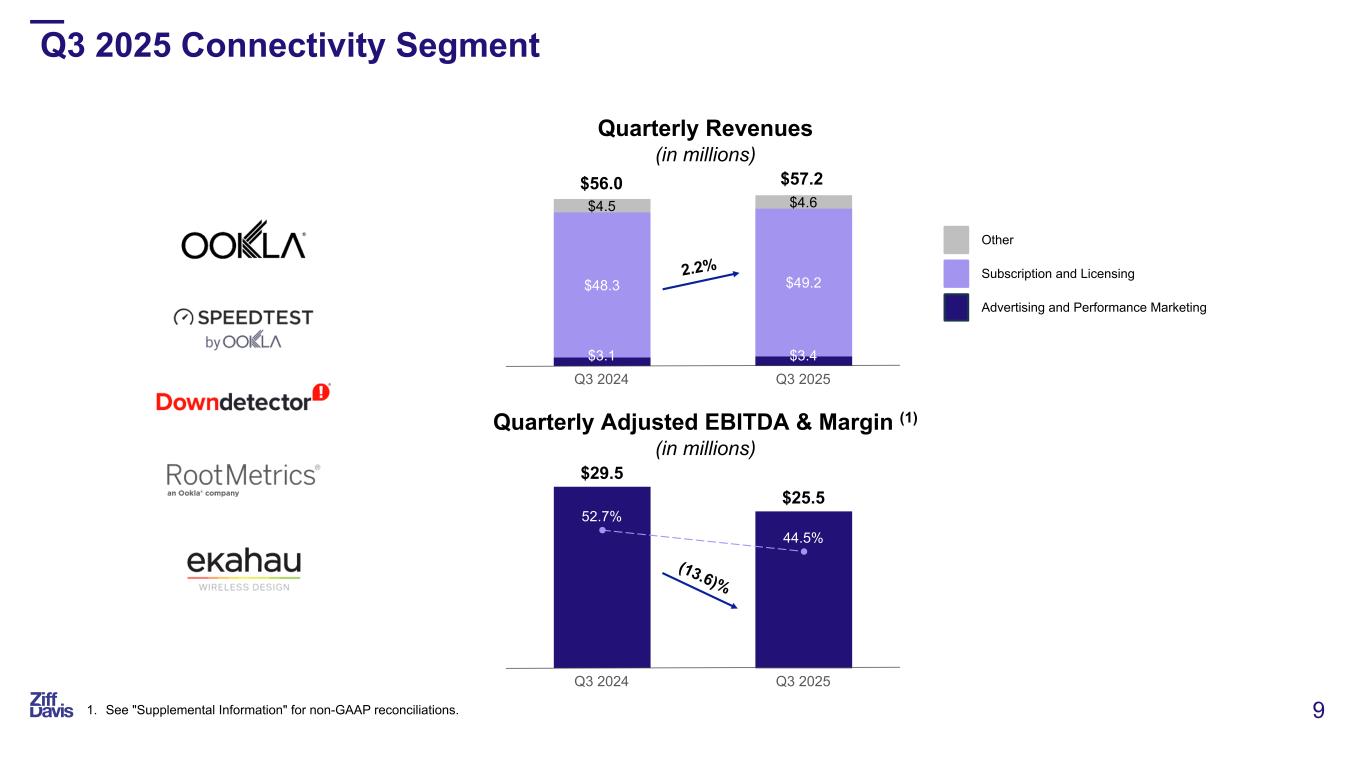
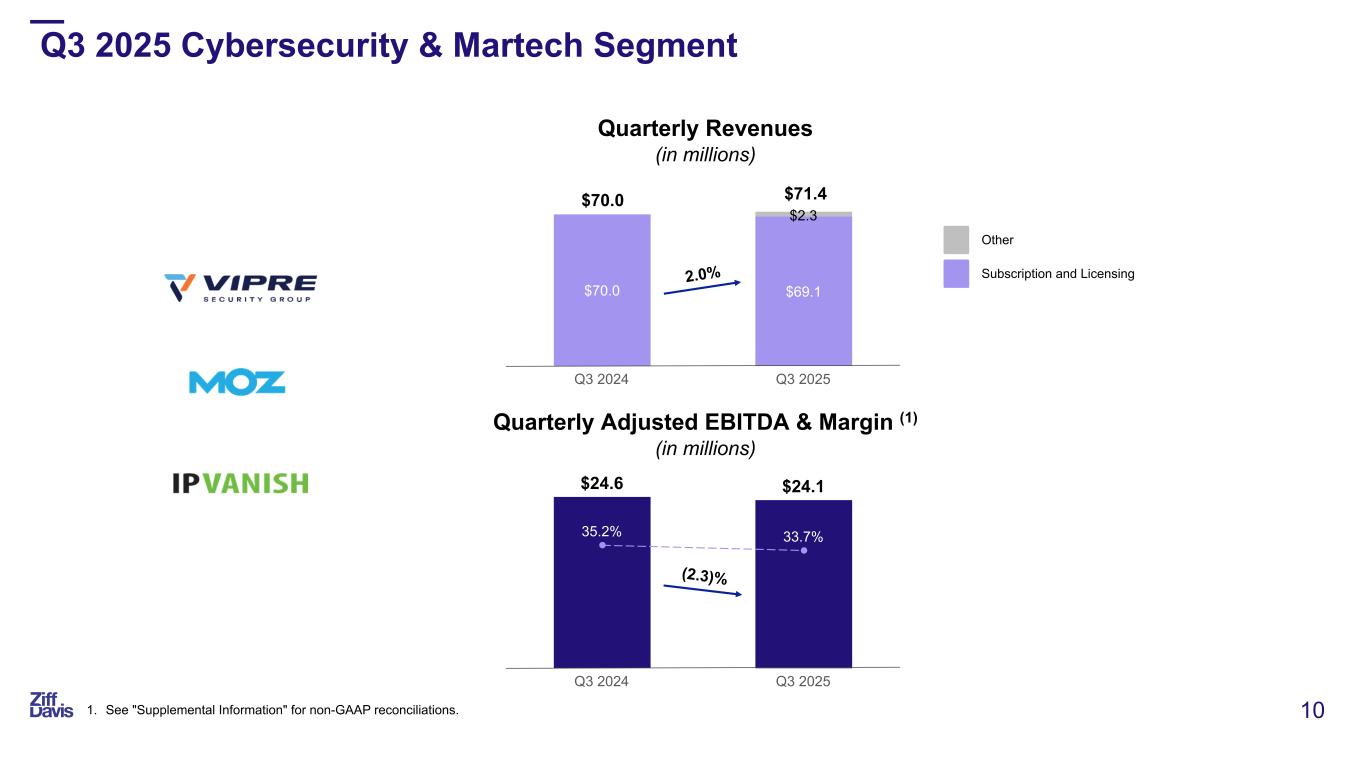
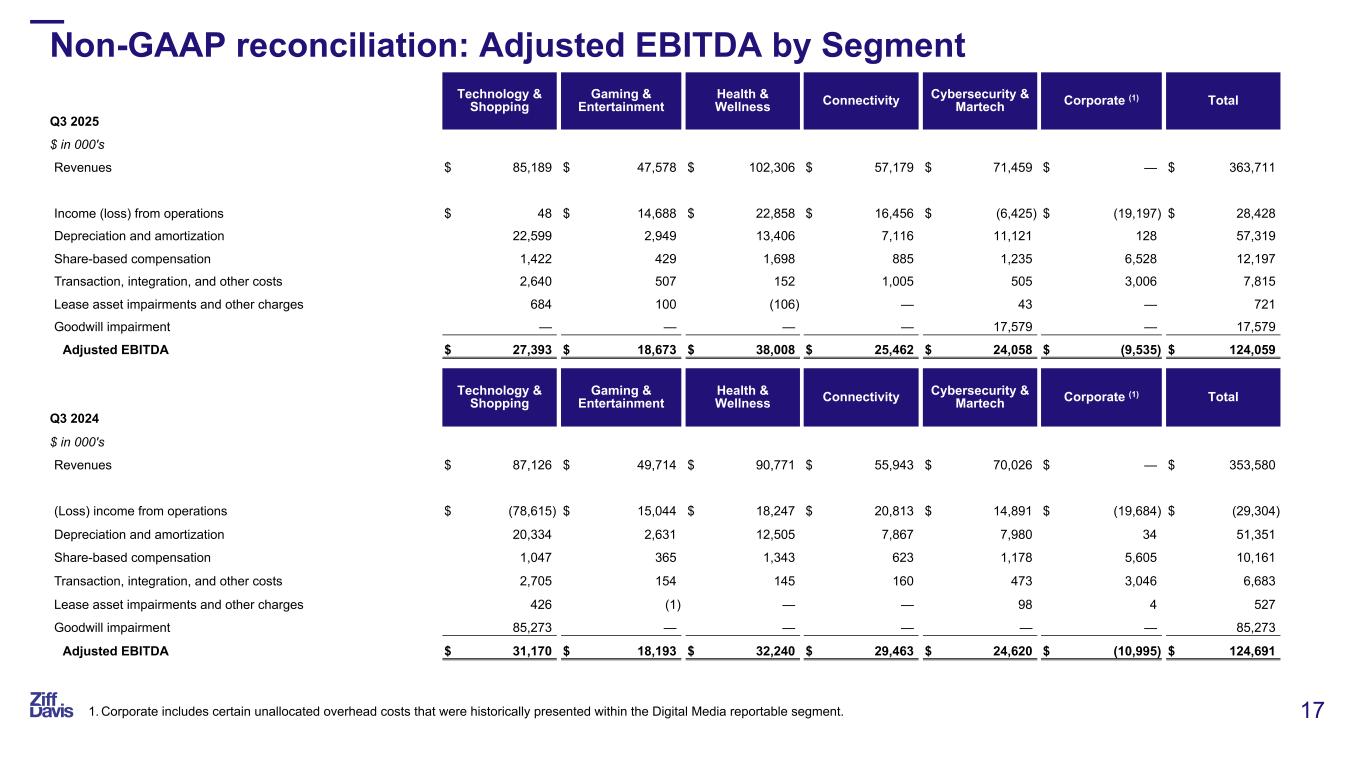
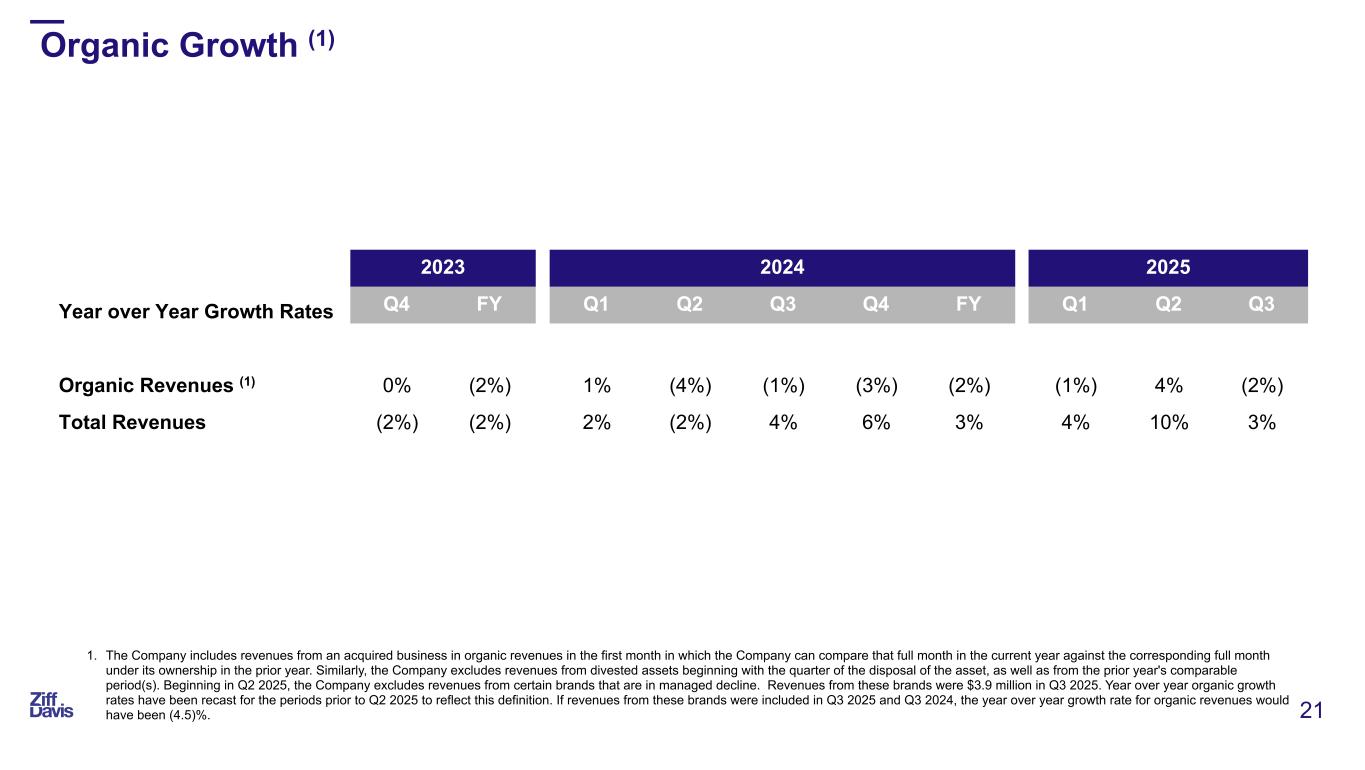
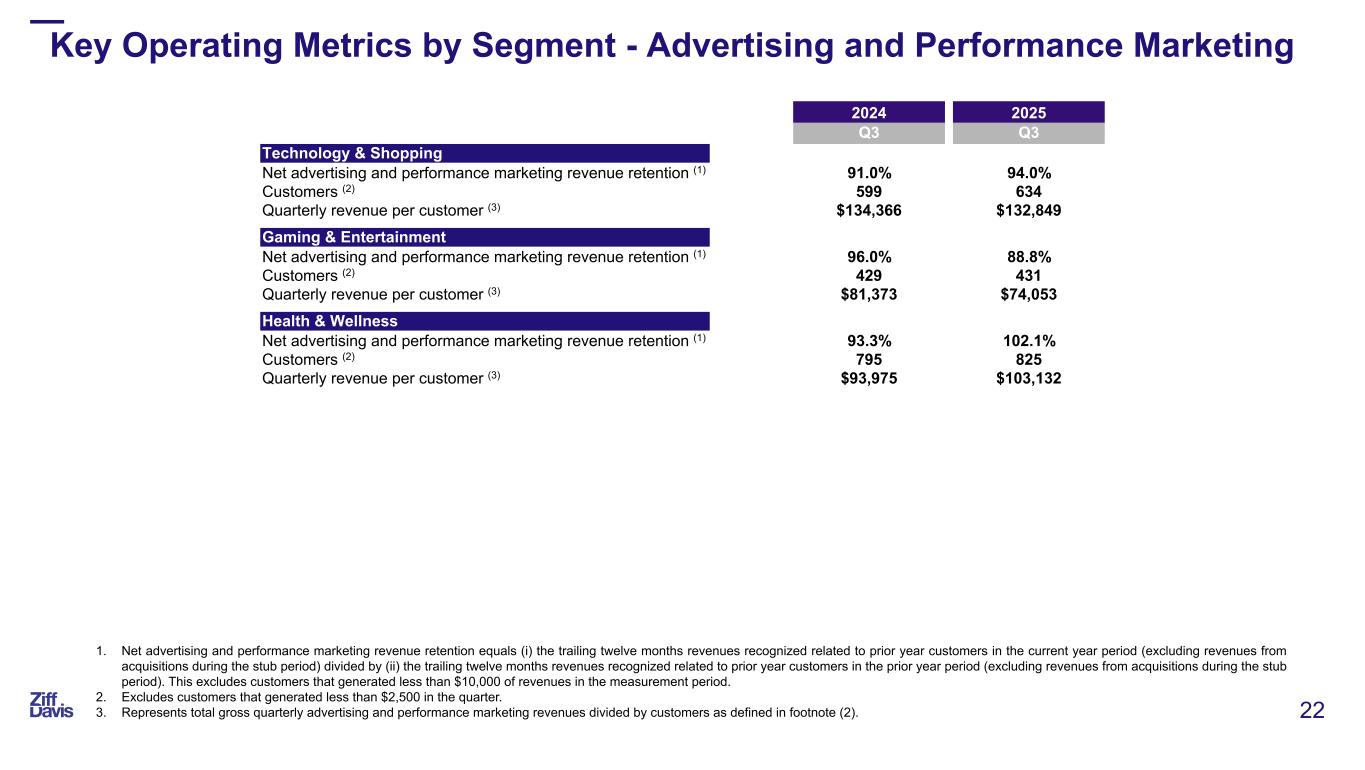
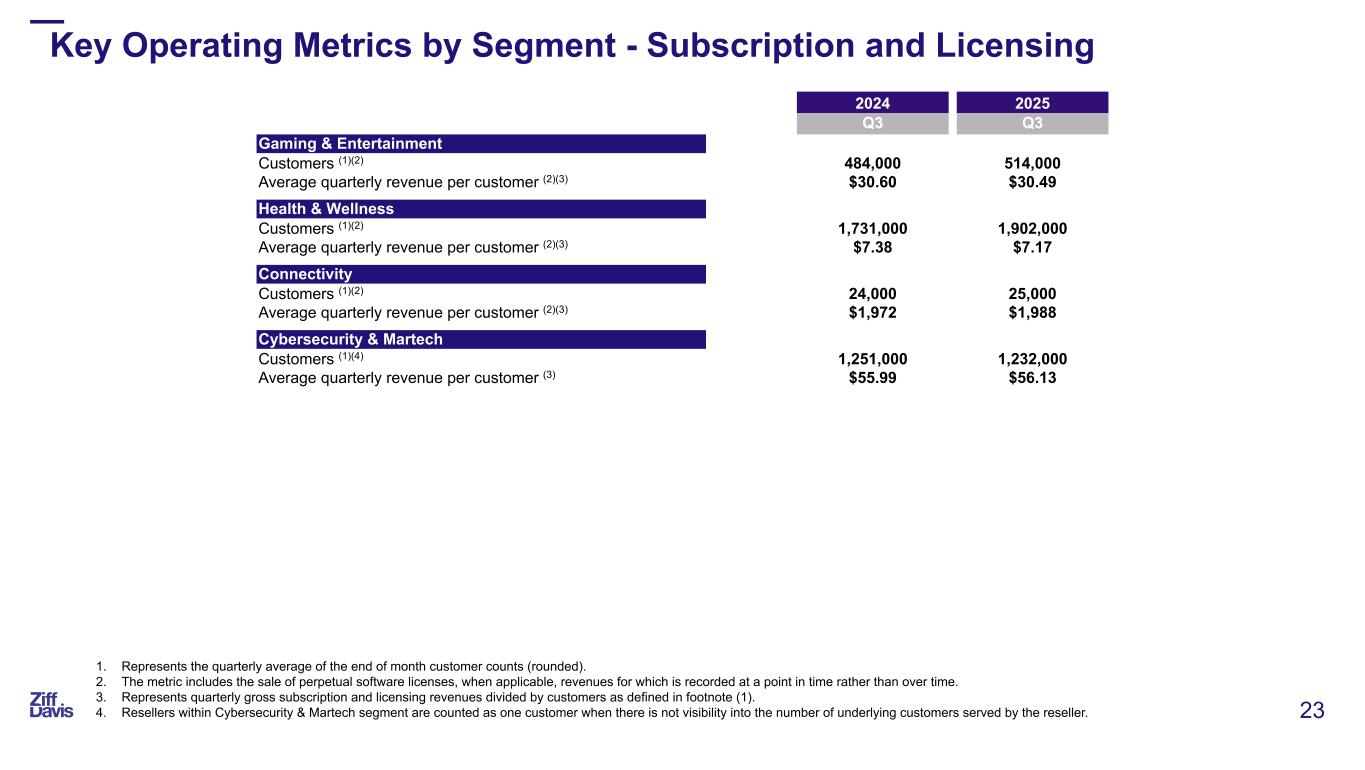
Thank you, Brett, and good morning, everyone. In our third quarter earnings release, we announced that SIF Davis has engaged outside advisors to help us evaluate potential opportunities to unlock value for our shareholders. I'd like to provide some additional context to this disclosure. At the end of fiscal year 2024, we significantly enhanced our segment-level reporting, going from two to five reportable segments. One of our goals with this change was to provide investors with a more comprehensive understanding of the financial characteristics of each of our divisions, and we believe that this reporting has resulted in greater insight into the performance and intrinsic value of these businesses. We've been encouraged by the reaction to this reporting change, including the engagement from public market investors and analysts, some of whom have used the enhanced disclosures to adopt a sum-of-the-parts approach to the valuation of Ziff Davis. We applaud those efforts because we believe they do reveal a meaningful discount in our current market cap relative to the intrinsic value of the company. At the same time, we have also received interest from both strategic and private equity investors in certain of our businesses, presumably doing their own analyses of our various components. In order to properly evaluate this interest, we have engaged outside advisors to assist us in assessing how certain potential transactions could unlock greater shareholder value. While no final decisions have been made to date, our focus remains on maximizing value for all shareholders. There is no assurance that this evaluation will result in any transactions, and we are very willing to continue to operate with the current business structure, which is profitable, growing, and generates strong free cash flow. It's worth noting that proactively evaluating and acting on opportunities to create value for shareholders is embedded in our company's culture and history. You'll recall that in 2021, we undertook a similar process that resulted in the spinoff of our consensus business as an independent public company, demonstrating our willingness to take action when it serves our shareholders' interests and unlocking significant stakeholder value at that time. In that transaction, ConsenSys' post-spinoff enterprise value was close to $2 billion. This was a very positive outcome for shareholders and employees of both companies. If and when there are material developments related to these initiatives, we look forward to providing updates then. And we will, of course, continue to be intently focused on executing against our operating plans. Turning now to our performance in the third quarter. We grew revenues nearly 3%, marking a fifth consecutive quarter of revenue growth. While our adjusted EBITDA fell slightly year-over-year, we grew adjusted diluted EPS by 7% as we increased our share buybacks to capitalize on the current valuation disconnect in the price of Zip Davis stock. Three of our five reportable segments grew revenues in Q3, including a return to growth for our cybersecurity and MarTech segment. So let me share some observations about each of our five segments. Tech and shopping revenue dropped 2% in Q3, with adjusted EBITDA down 12%. This was primarily driven by the continued wind-down of our game publishing activities, which had a negative year-over-year revenue swing of $6.9 million. As you'll recall, we previously announced that we are no longer investing in new game titles, but we have a slate of pre-existing projects, which will launch over the next four quarters. Excluding game publishing, the tech and shopping segment grew in both revenues and adjusted EBITDA, led by CNET. which delivered strong year-over-year growth in licensing driven by new awards, expanded video capabilities and sponsorships, and the continued rollout of our Best Buy partnership that began implementation in Q3 of 2024. Gaming and entertainment revenues were about 4% lower year-over-year, with adjusted EBITDA growth of nearly 3%. Gaming and entertainment's revenues can be lumpy due to the timing of title releases. Year-to-date revenues are up approximately 2%, and we are on track for revenue growth in the seasonally important fourth quarter. Q3 was Humble Bundle's best quarter of the year and was the second highest revenue quarter for the business in the last five years. Humble Bundle's subscription revenues were up 5% year-over-year. Events continue to be a large focus for IGN Entertainment for audiences and advertisers alike. IGN was back at San Diego Comic-Con in July and was once again the studio partner for Gamescom, the world's biggest gaming show held in Germany, every August. Health and wellness's growth accelerated in Q3 with 13% year-over-year revenue growth and 18% year-over-year adjusted EBITDA growth, both representing high watermarks for the division in the third quarter. The growth was balanced across subscription and display and performance marketing revenue. We continue to deliver positive results with our pharma commercialization programs while supporting health-seeking consumers with our digital health and wellness solutions like our Luzit app, which saw strong subscription growth this quarter. Since we acquired Everyday Health, the division has evolved into a multifaceted solutions provider to the pharma commercialization, digital health and wellness, and provider solutions markets. Participation across these verticals is particularly strategic in a world where the line between traditional healthcare and consumer-driven self-care continues to blur. Our ability to deliver positive, tangible results for pharma with both patients and providers continues to place us in a strong, competitive position. The connectivity division delivered 2% year-over-year revenue growth as several deals shifted into the fourth quarter year to date revenues of connectivity are up seven percent and we are confident that revenue growth will accelerate in q4 not just from timing benefits but underlying strength in the pipeline and the introduction of new products continuing our efforts to leverage our platform brand and distribution to launch new offerings the first new product is speed test Certified, which launched in September and provides a highly localized Wi-Fi certification program to target enterprise verticals under the Speedtest brand. Speedtest Certified is off to a promising start with strong global demand, including the certification of our first customer in October. The second new product, which we are planning to launch in Q4, leverages ECHOHO's core capabilities and is designed for rapid network validation, diagnostics, troubleshooting and continuous network connectivity testing. Our initial target customers are internet service provider technicians and IT organizations from which we have already received very promising expressions of interest. Cybersecurity and MarTech revenue grew 2% in Q3, consistent with our forecast that this segment would return to growth in the quarter. Growth was driven by strong performance in cybersecurity, in particular from consumer VPN and consumer cloud backup. I highlighted the momentum in VPN on our Q2 call, and it's great to see the turnaround in this business. In MarTech, we completed the small but exciting acquisition of Symantec Labs, a performance-based customer acquisition platform focused on the SaaS vertical. Symantec is a great complement to the customer generation capabilities we have elsewhere in our MarTech portfolio, as well as in our tech and shopping segment. Across the company, we are leveraging AI to enhance our products and improve operational efficiency. As mentioned on the last call, we developed an AI platform to refine how we serve our advertisers. This platform creates precise audience segments powered by billions of real-time signals from across our portfolio, translating this proprietary data into what we call Moment of Influence Solutions. This quarter, we officially launched two commercial applications of this proprietary platform. In health and wellness, we launched HALO, which activates our deep, first-party data to identify and target high-intent audiences, maximizing campaign ROI. It is operational, and the early client response has been strong. In gaming and entertainment, we introduced Imagine, a first-of-its-kind cognitive AI platform that combines cultural intelligence with predictive audience modeling to help brands understand forecasts and reach entertainment consumers in real time. We're currently in private data with Select Strategic Partners with a full commercial rollout plan for early 2026, aligning with IGN's 30th anniversary. We're also deploying AI to drive efficiency. In our shopping business, for example, 80% of all users submitted coupon codes are now processed automatically with AI, one of many workflow optimizations being implemented company-wide. On capital allocation, we are in a strong position with substantial cash to continue buying back stock at attractive levels and significant leverage capability. Even as we explore potential opportunities to unlock the intrinsic value in our businesses, which we believe is not appropriately reflected in our per share value, we are still committed to an acquisition program that generates attractive cash-on-cash returns for our shareholders. This is a consistent strategy for us. Following the consensus spinoff in late 2021, we closed six M&A transactions in fiscal 2022. And with that, let me hand the call back to Brett.
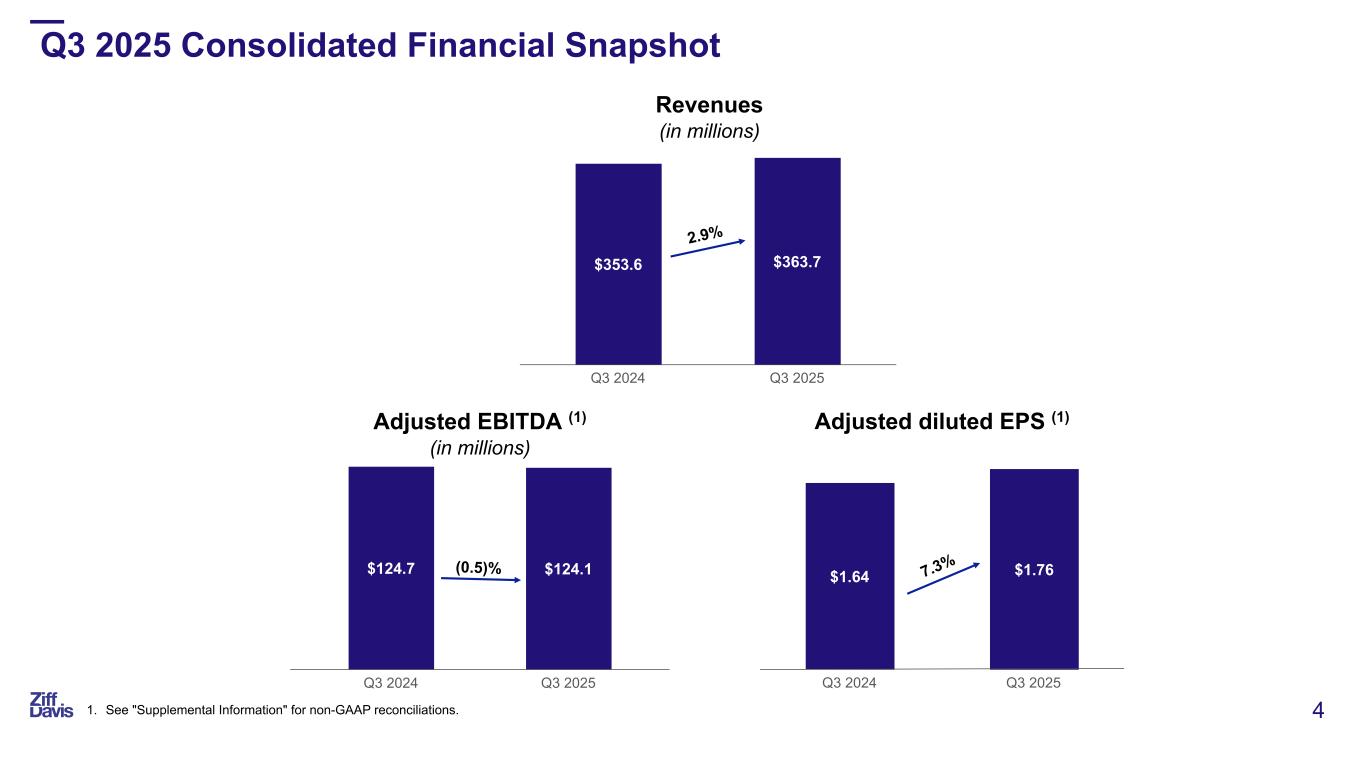
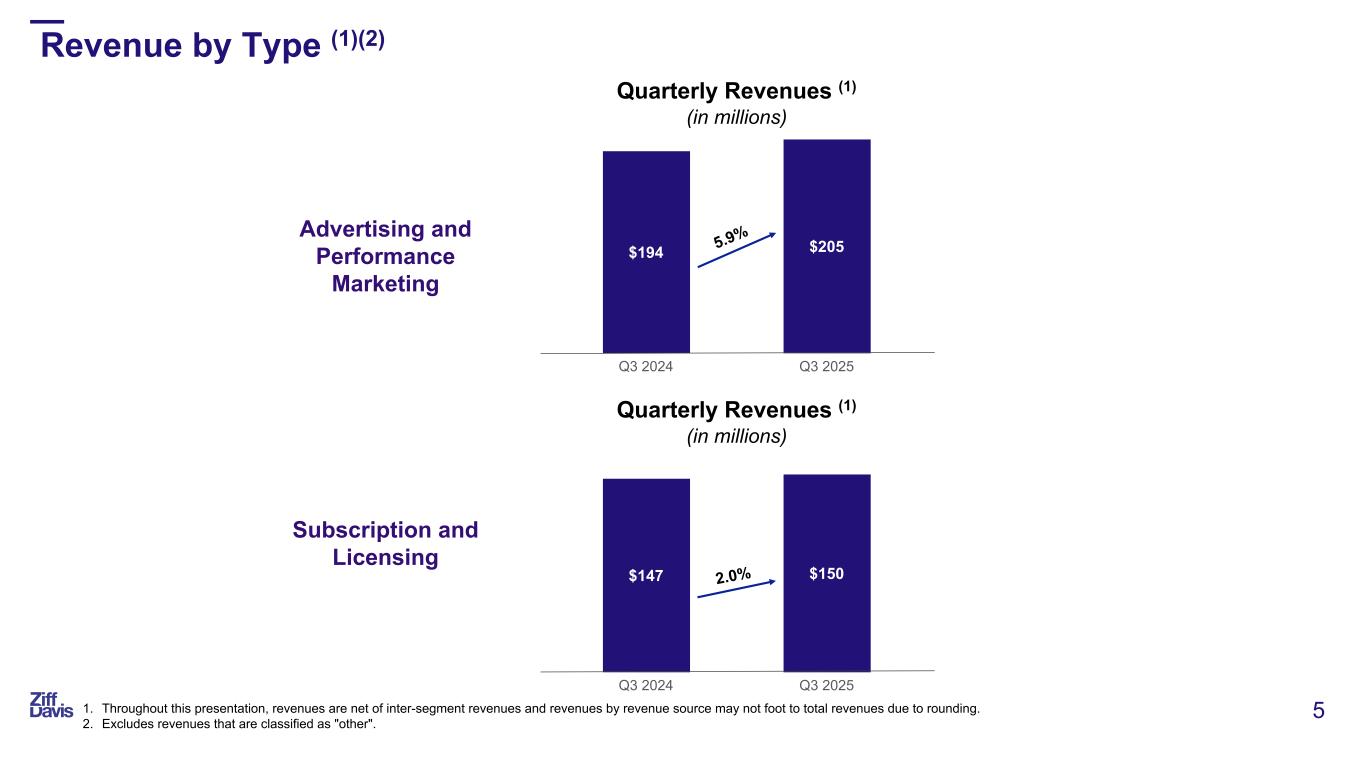
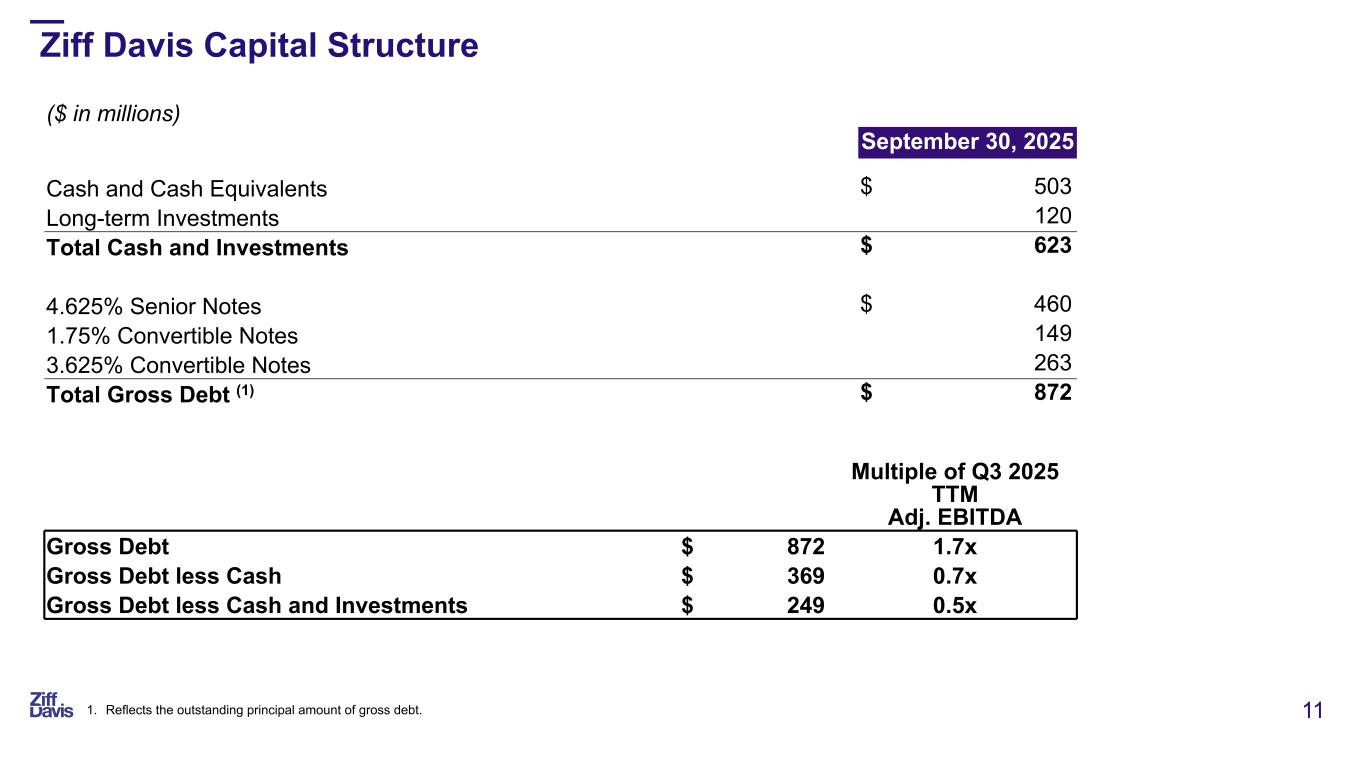
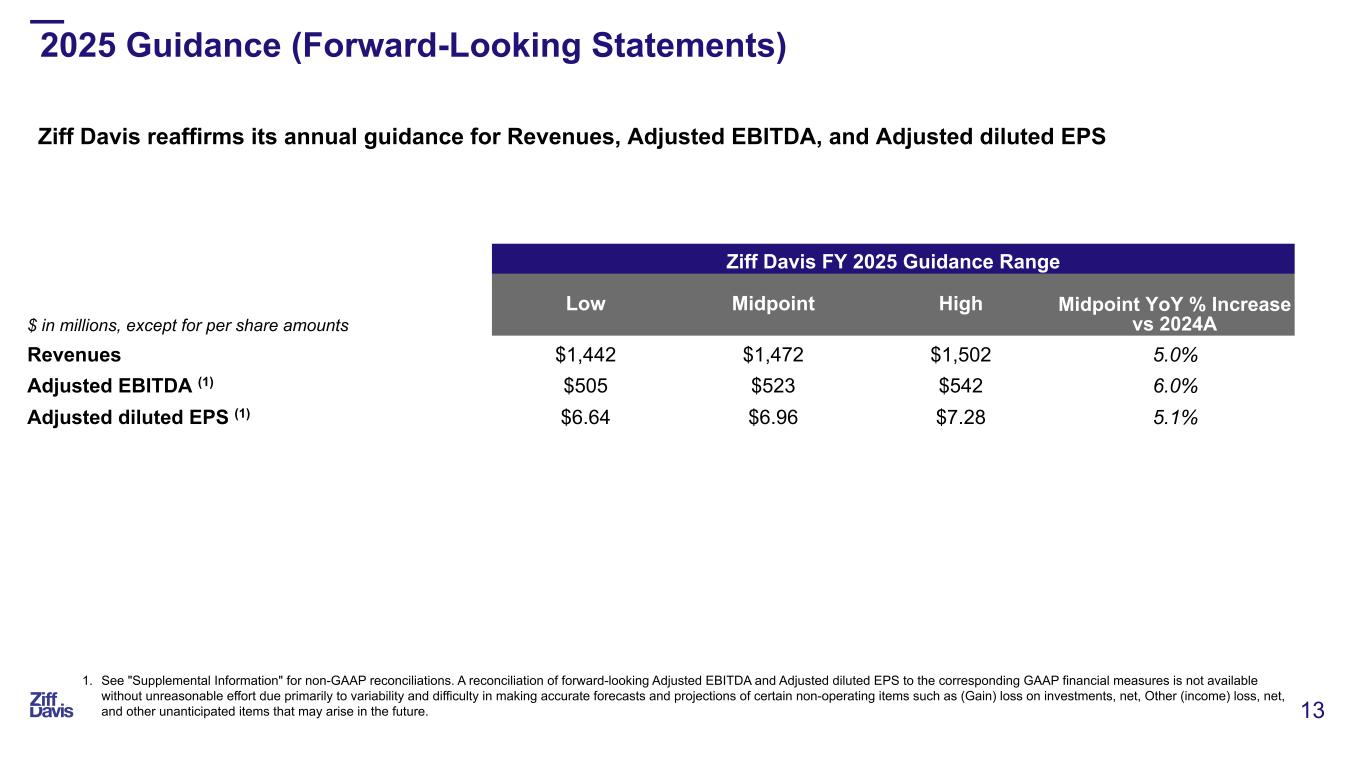
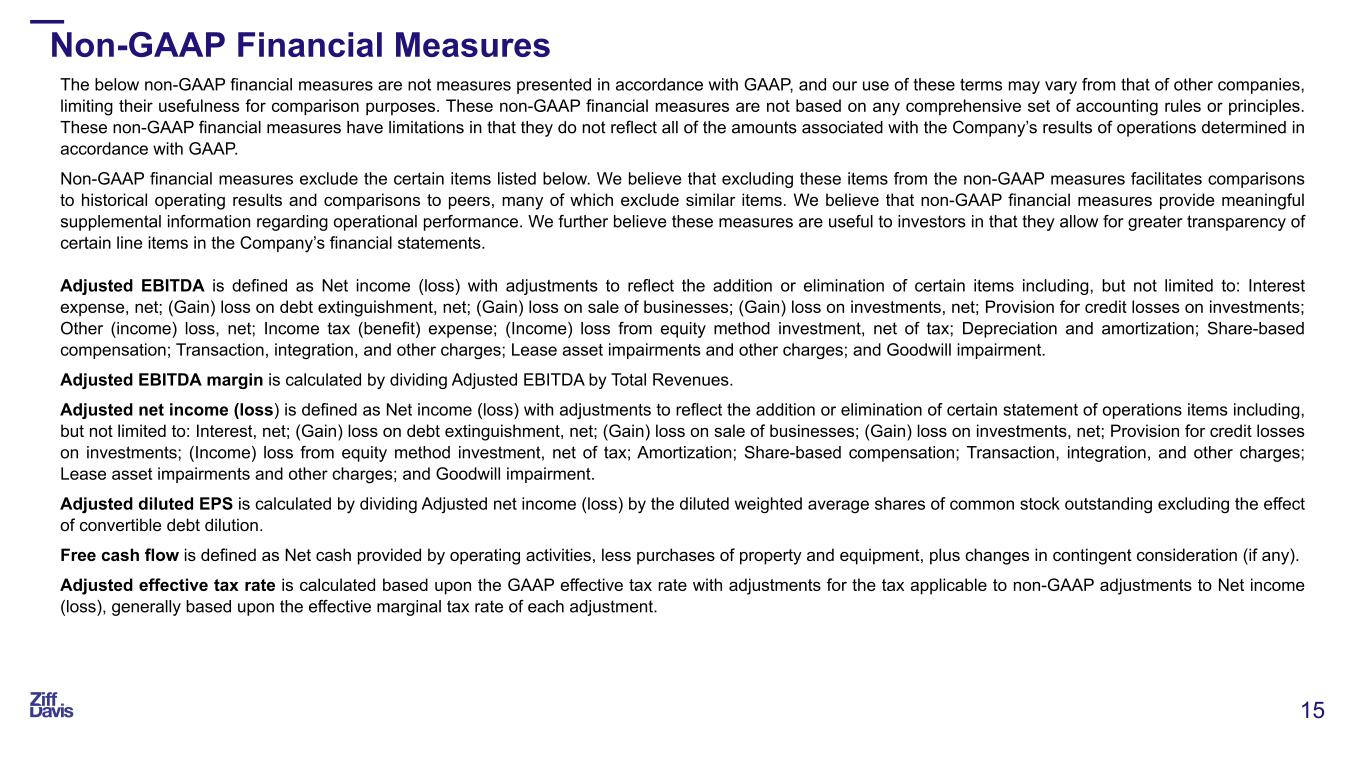
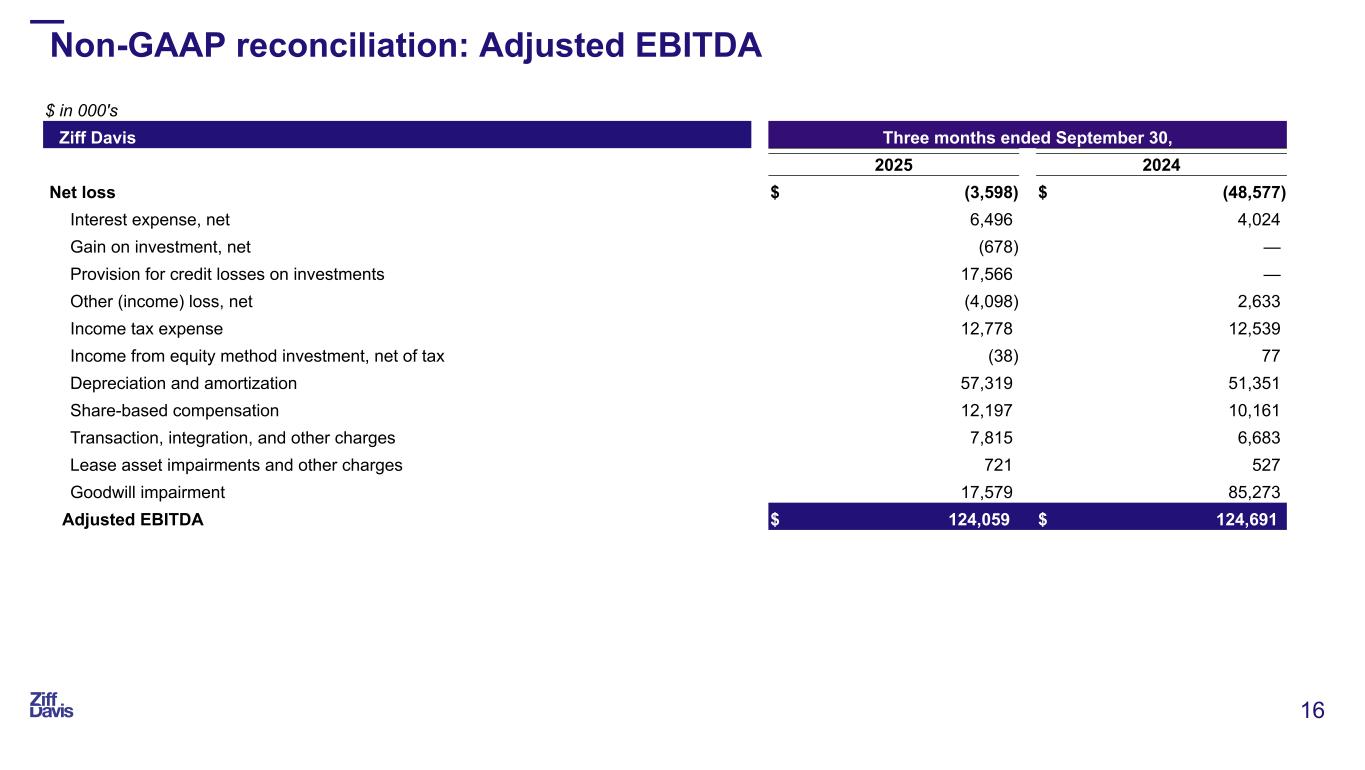
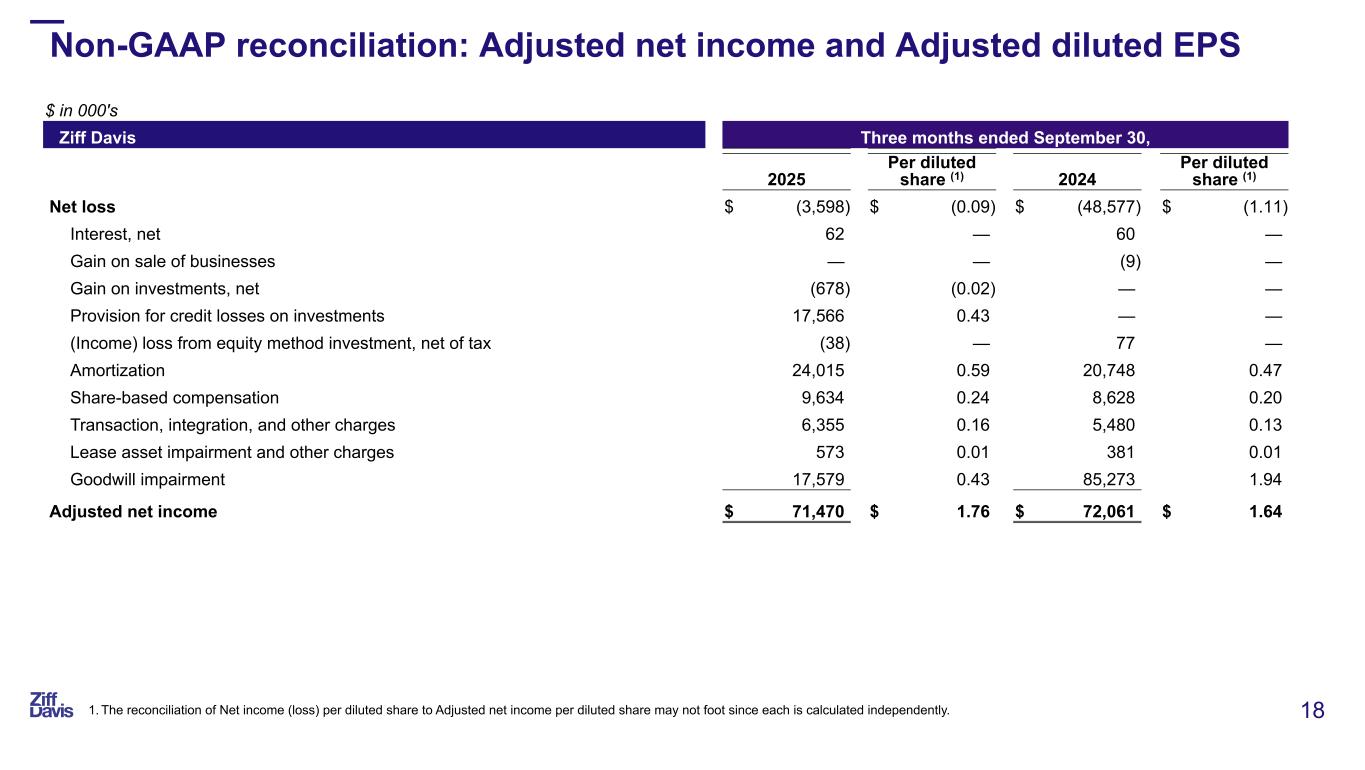
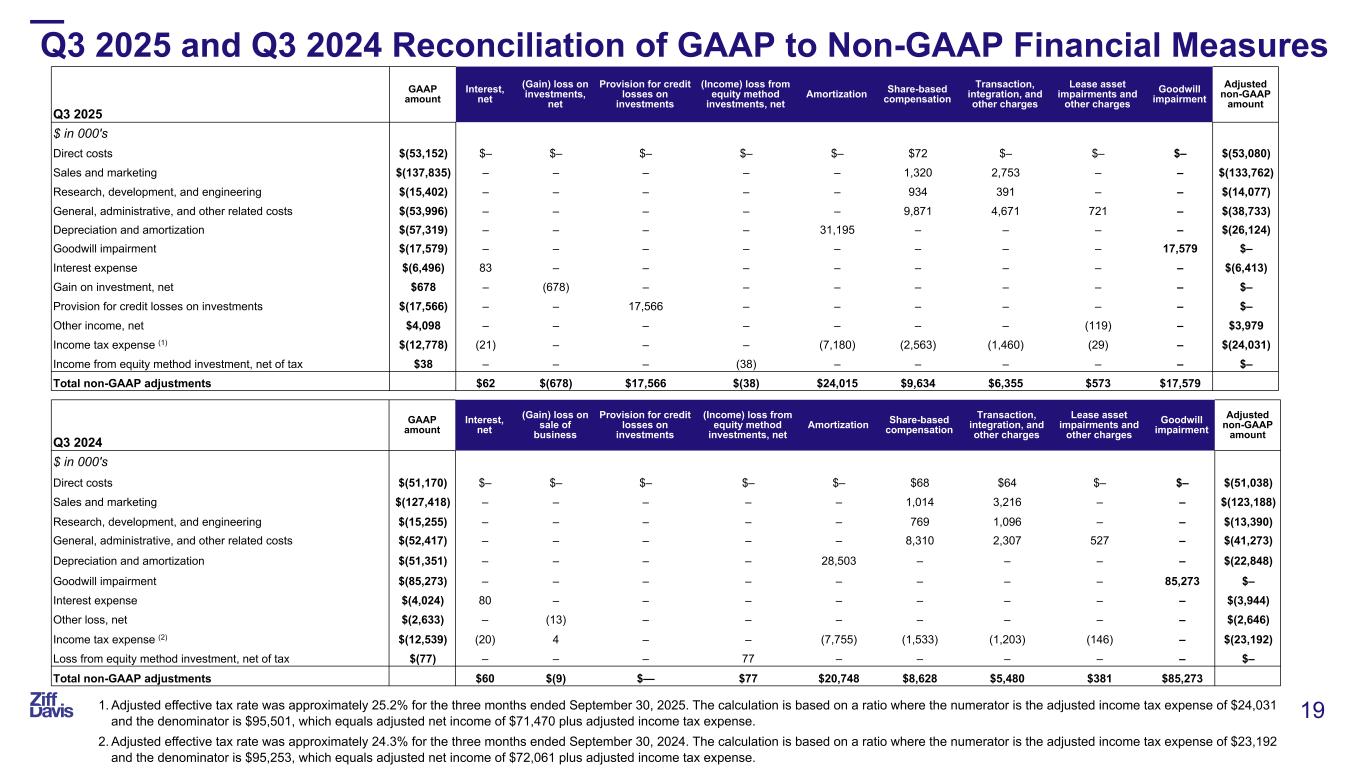
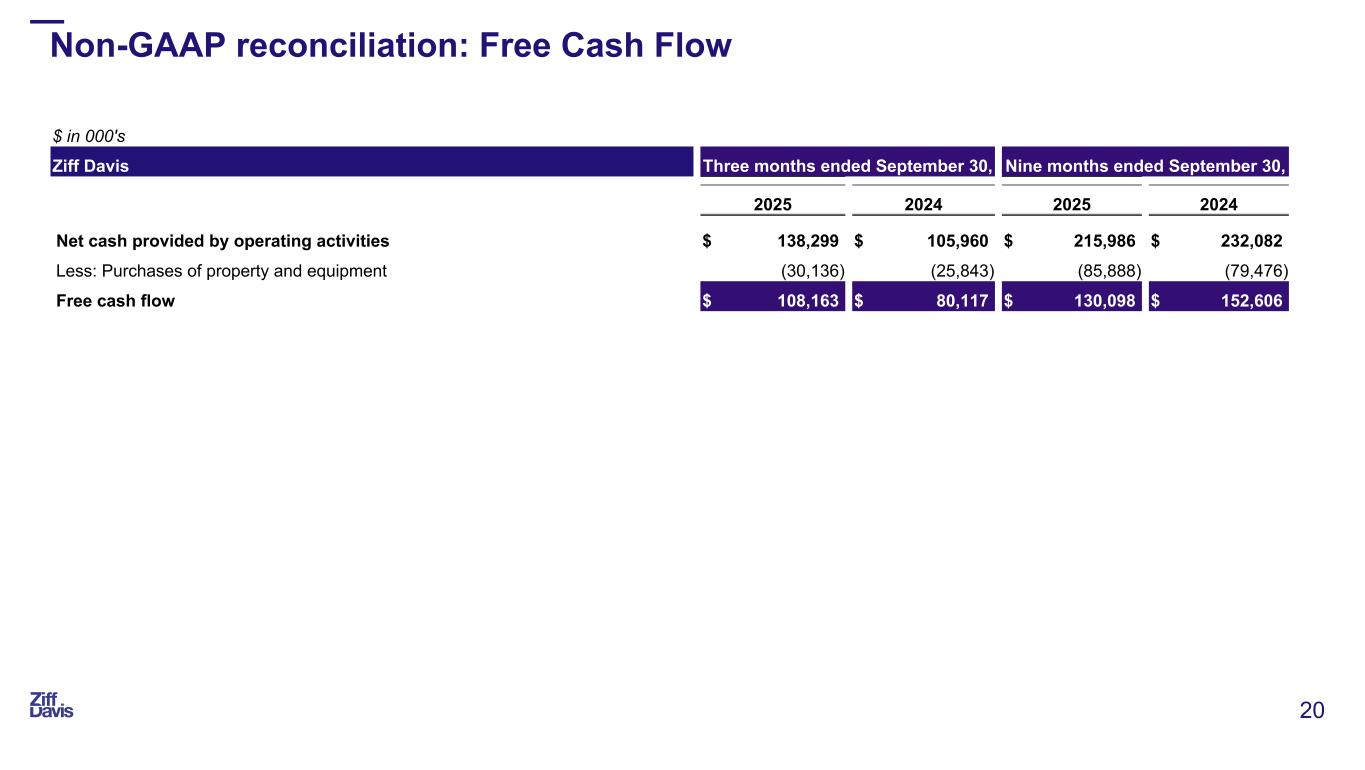
Thank you, Vivek. Let's discuss our financial results. Our earnings release reflects both our GAAP and adjusted non-GAAP financial results for Q3 2025. My commentary will primarily relate to our Q3 2025 adjusted financial results and the comparison to prior periods. Please see slide 4 for the summary of our financial results. Q3 2025 revenues were $363.7 million as compared with revenues of $353.6 million for the prior year period, reflecting growth of nearly 3%. Q3 2025 adjusted EBITDA was $124.1 million, as compared with $124.7 million for the prior year period, reflecting a decline of less than 1%. Our overall adjusted EBITDA margin was 34.1% in Q3 2025. We reported third-quarter adjusted diluted EPS of $1.76, up from $1.64 in Q3 2024, reflecting growth of more than 7%. This increase is due in part to our share repurchases, which reduced third-quarter 2025 adjusted weighted average fully diluted shares by nearly 3.3 million shares, or 7.5%, as compared with the prior period. Importantly, year-to-date, we have delivered growth in revenues, adjusted EBITDA, and adjusted diluted EPS, as well as a significant amount of free cash flow. Slide 5 reflects performance summaries for our two primary sources of revenue, advertising and performance marketing and subscription and licensing. Both of these revenue sources grew year-over-year in the third quarter of 2025. Q3 2025 advertising and performance marketing grew 5.9% as compared with the prior year period, while subscription and licensing revenues grew by 2%. Q3 2025 other revenues declined by $4.3 million year-over-year, reflecting the significant decline in revenues from our games publishing business, which more than offset growth from other products and services. Slide 6 through 10 reflect the Q3 financial results of each of our reportable segments. As Vivek noted, three of our five segments grew revenue in Q3 2025. With regard to adjusted EBITDA, while there are numerous factors that impact margins in each quarter at each business, I want to highlight a few significant items that impacted Q3 2025 adjusted EBITDA at Tech and Shopping, Connectivity, and Cybersecurity and Martech. As we noted, the year-over-year performance of Tech and Shopping was negatively impacted by the performance of our game's publishing business, which is in the process of being wound down. We report this revenue net of the amortization of our game publishing investments, and during the last two quarters, we reported negative net revenue for this business, as this amortization exceeded revenue during the period. This quarter, we reported nearly $7 million less net revenue from publishing than we did during the third quarter of 2024. And this reduction flows through at a very high contribution margin to adjusted EBITDA. In the absence of this impact in Q3, tech and shopping would have had positive adjusted EBITDA growth for the quarter. Connectivity's Q3 2025 adjusted EBITDA margin was impacted by the timing of the contracts that Vivek highlighted in his remarks. However, it also reflects the investment we are making in Connectivity to support its anticipated growth. As Vivek mentioned, Connectivity has already launched one new exciting product to the market with another product launch plan for Q4. Q3 2025 reflects our investments in product development, cloud services, and sales expenses to support these new products ahead of revenue generation from them. Overall, we are excited about the prospects of these new products as we begin to head into next year. Finally, cybersecurity and MarTech adjusted EBITDA was primarily negatively impacted by the timing of certain expenses. In Q2 2025, cyber and MarTech delivered more than 5% year-over-year adjusted EBITDA growth despite a modest decline in revenues. This quarter, despite an increase in revenues compared with the prior year period, CyberMartex adjusted EBITDA declined by approximately $500,000, primarily as a result of these timing issues. Please refer to slide 11 to review our balance sheet. As of the end of the third quarter, we had $503.4 million of cash equivalents and $119.6 million of long-term investments. We also have significant leverage capacity on both a gross and net leverage basis. As of September 30, 2025, gross leverage was 1.7 times trailing 12 months adjusted EBITDA, and our net leverage was 0.7 times and 0.5 times, including the value of our financial investments. During the third quarter, we closed two small acquisitions to expand the capabilities of our connectivity and cybersecurity and MarTech businesses. In the first nine months of 2025, we closed a total of seven acquisitions across our businesses, and we invested a total of $67.3 million net of cash received to support our M&A program. We anticipate we will continue to be an active and disciplined acquirer as opportunities arise to add capabilities to our businesses in an accretive manner. Since our second quarter earnings call, we repurchased 1.5 million shares of our common stock, with certain of these repurchases occurring during the month of October. Through the end of the third quarter of 2025, we repurchased 3 million shares, deploying $109 million, or close to 85% of our year-to-date free cash flow. Overall, through today's date, we repurchased more than 3.6 million shares since the start of 2025. We have nearly 2.75 million shares remaining under our stock repurchase authorization, and we continue to believe that the current trading level of our stock does not reflect the intrinsic value of our underlying businesses. Following this earnings call, we plan to utilize a 10B51 plan to continue to repurchase our shares. Turning to slide 13, we are reaffirming our fiscal year 2025 guidance range. As noted on prior calls, this is a broad range, which we set in February of 2025, and we currently anticipate our key fiscal year 2025 financial performance metrics of revenues, adjusted EBITDA, and adjusted diluted EPS to fall within this range. As we have discussed today, the consolidated financial performance momentum that we experienced in the second quarter of 2025 did not broadly carry forward to our third quarter results and while a number of our businesses continue to show strength we currently anticipate fiscal year 2025 total revenues and adjusted diluted EPS to be within the lower half of our guidance range with adjusted EBITDA expected to be closer to the lower end of our guidance range please note that the fourth quarter is typically our seasonally largest revenue quarter slide 20 includes a reconciliation of free cash flow q3 2025 free cash flow was 108.2 million dollars 35 percent higher than the prior year period as of the end of q3 2025 trailing 12 months free cash flow was 261.2 million dollars we believe that our ability to generate significant free cash flow is a clear indication of the intrinsic value of our businesses and highlights the disconnect we see in our share price overall through the third quarter of 2025 we have delivered year-to-date growth in revenue adjusted ebitda and adjusted diluted eps as well as significant free cash flow based on our current expectations we have maintained our expectation of delivering fiscal year 2025 results within our guidance range and we plan to continue to dedicate our investable resources to our active stock repurchase program while pursuing attractive M&A opportunities. And as Vivek noted earlier, we remain committed to identifying and pursuing all opportunities that we believe offer strong prospects to enhance shareholder value. And we have taken tangible, proactive steps to pursue certain of these opportunities. Although there is no assurance that the evaluation will result in any transactions, we are excited about the potential outcomes that may result from these efforts. With that, I will now ask the operator to rejoin us to host our Q&A.
Operator
Thank you. We will now be conducting a question and answer session. In the interest of time, we ask that you please limit yourself to one question. If you would like to ask a question, please press star 1 on your telephone keypad. A confirmation tone will indicate your line is in the question queue you may press star 2 if you would like to remove yourself from the queue for participants using speaker equipment it may be necessary to pick up your handset before pressing the star keys one moment please while we begin and your first question this morning is coming from robert coolberth from evercore isi robert your line is live please go ahead great Thank you.
Good morning, and thanks for taking our questions, and congratulations on the results. Zach, I know you have some opinions about where the valuation disconnects versus intrinsic value may be most acute. I wanted to ask if you'd be willing to share your thoughts there. And then secondly, I'd imagine you've had some inbound interest from time to time in the past. Is there something unique about this moment that makes this the right time to entertain that interest in a more significant way? Just the volume of interest where you think you could drive some competitive auction dynamics, or have you gotten some of these businesses to a place where you think an exit now makes more sense? Thank you.
So, Rob, thanks for the questions. And I should also thank you. I know in your last note, after our last call, you did do a sum of the parts analysis, which is what we're looking for. And I think to answer your questions, you know, I do think things changed at the beginning of this year when we, for the first time, broke out the company into five reportable segments, which gave the entire marketplace a real view into the different businesses and the different drivers, different growth characteristics, margin profiles, etc. And so look, up until then, I think for a lot of people, they were just trying to feel around and estimate. We did that, as I said, with the public market in mind, with our current investors and prospective investors and with analysts in mind. But what it also did was just attract a lot of attention from strategics and sponsors. And so, look, from our point of view, I would say that that was different than maybe in the past. And so, the decision to engage advisors at this point was really in response to the level of inbound interest. But I would also say that we're at a point where the disconnect between the current value of the company and we believe the intrinsic value of the company, the true value of the company in our own minds is probably at the widest it's ever been. And so with respect to your question on specific businesses, look, we go into this with an open mind, with a goal of unlocking the maximum amount of value. And what I would say is that we believe every one of our divisions should command a multiple, each of them individually, higher than what is the current Zip Davis multiple. So in my mind, this value disconnect isn't just in a couple of places. It really is across the board.
Operator
Thank you. Your next question is coming from Corey Carpenter from JPMorgan. Corey, your line is live. Please go ahead.
Hey, good morning. I had a up to the strategic review and then and then one on AI overviews if I could just Vivette kind of continuing on that theme maybe what all is on the table here it sounds like you know you you think there's a disconnect across all divisions but are there any properties that maybe you think of as core or off limits in terms of divesting and would you consider perhaps the whole company if that was something that you were seeing interest in and then on on AI overviews some of the other publishers called out an impact this quarter on traffic, just as that ramped up a little flatter than expected. I'm curious to hear what you've seen there. Thank you.
Thanks for the questions, Corey. So starting with, you know, is anything off the table? No. We're, as I said, we're going in with an open mind. And so, you know, we don't have a specific preference. As to respect, with respect to your question about the whole company, look, the inquiries have been about specific businesses. And we do believe that exploring opportunities for select units is likely to be far more value accretive than considering a transaction for the entire company. That said, look, to the extent we receive credible interest in the broader company, we have an obligation to evaluate any opportunity that could unlock meaningful value for shareholders. I think with respect to just the ai overviews and traffic might be just worth sort of reiterating what i've said in the past in terms of you know our view that the company is you know pretty well positioned um you know and insulated from fluctuations in search traffic you know 35 percent of of our total revenue is is traffic is web traffic dependent half of that coming from search so roughly, you know, 17.5% revenue exposure. And in AI overviews specifically, AI overviews currently appear in 29% of the queries that drive the lion's share of our traffic, which is actually a tick down. So the prevalence of AI overviews with respect to the queries that are valuable to us is relatively stable. What I will say, so I don't, I'm not thinking as much about AI overview prevalence. I'm thinking more about search volatility. There have been a number of algorithm changes and happening with pretty significant frequency that's creating a fair amount of sort of rank volatility, which is different than I think the AI overviews piece. So that's something we're watching. I think there's a lot of experimentation going on right now in the Google search experience. And so, you know, we're feeling some of those chops and some of those bumps. Thank you very much. Thank you.
Operator
Thank you. And as a reminder, if you wish to join the queue to ask a question at this time, you may press star one on your telephone keypad. And your next question this morning is coming from Sean Patil from SIG. Sean, your line is live. Please go ahead.
Hey, guys. Good morning. I guess you've, as you mentioned, you've prepared the markets for this kind of announcement just with your segment level disclosures, as well as some of your commentary in the past. I'm just curious, what do you prefer and then maybe kind of a separate but related, like what do you think is more likely? Selling pieces of the business, selling the whole company and then um you know if it is just selling off certain pieces what what's your value kind of creation and unlocking kind of thesis or philosophy going forward would it would it be you know we we buy businesses we sell them and then we use that cash to buy back stock or or do further m&a just how do you how do you just think about kind of those things kind of going forward as we as we kind of try to figure out what the business could look like, you know, over the next three to five years.
Thanks, Ryan. All great questions. You know, look, I'll start with your question on preference. And my preference is whatever creates the most impactful and positive outcome for the per share price of Zip Davis. Look, our shareholders have been patient. We feel an overwhelming obligation to really reward that patient. So I would say that the preference is a function of what's going to unlock the most value. And so it's hard to know or say what that's going to be until we get into this process and start to really understand market dynamics. And as you know, many of our businesses are performing really, really well. And so I think we feel optimistic about where that dialogue is going to go. In terms of the larger strategic question you're asking about the company, look, I think that what remains unchanged is that we are, I think, very good at identifying opportunities to use our digital transformation skill set to unlock value in businesses across the landscape. We've done it with digital publishing businesses. We've done it with data businesses. We've done it with software businesses, and that remains unchanged, right? And so I think we're going to continue, however this company evolves, to continue to be a programmatic and serial acquirer to unlock value. Obviously, at this point, and we have done that generally with the view of being long-term holders of those assets, and the market is telling us right now that, hey, look, that may not be the right equation. And so that's where thinking about these options starts to make sense, whether that's the continued model or we revert back to the hold model. I can't say. I think we just have to be flexible. I think we have to be, you know, we have to be thoughtful about all of this. The other thing I'm going to say is that just, you know, we're going to consider all opportunities. So that could be sales. That could be investments. That could be spinoffs. So I think there are various transactional options that we're also going to consider in this process.
And for that, I might just add one short thought. I mean, widening the lens, our overall approach is to provide products and services to the communities we serve effectively and generate profits, cash flow and growth. and use that cash flow to ensure, one, we have a healthy balance sheet, and then allocate that capital to go back to that core philosophy of generating growing cash flows. There'll be times, and there have been times in our journey, where we shift that capital allocation from M&A to share buyback, and now we're adding one more leg to the equation. we're considering other opportunities to unlock value. So I don't think overall the approach changed or sets a new course for the company. We're just reacting to where we are in the broad market.
Operator
Thank you. Your next question is coming from Ross Sandler from Barclays. Ross, your line is live. Please go ahead.
Great. Vivek, I guess a philosophical question. So if we're at the peak of system-wide Google referral traffic hit for the broader open web, the broader industry, and revenue impact or revenue headwind for companies like Ziff Davis or any other publisher might be peaking right now and potentially diminishing in a year or two, why is right now the best time to put the for sale sign up? Has the outlook for your display growth changed dramatically at all? I'm just curious as to why right now, if we're in the peak of that impact. And then, Brett, just a modeling question. I think you said we're going to land in the lower half for revenue, which I think implies like a low single-digit growth rate for advertising in the fourth quarter. Just curious what you're seeing thus far and, yeah, the framing of that guide. Thank you so much.
Yeah, so, Ross, you know, it's an interesting question, and it actually reflects, I think, the dynamics that are existing in other businesses and not ours, right? So I think what I'm suggesting is this whole AI overview narrative really hasn't been relevant to our businesses. I mean, let's take our health and wellness business for a moment. Close to 13% revenue growth in the quarter, year-to-date 12%, adjusted a bit up 18%. This business is doing exceedingly well. I mean, it's sort of exhibit A with respect to, I think, the nature of our businesses relative to maybe others in the marketplace. So I would say it may be a little bit differently, which is we're demonstrating that notwithstanding what seem like large industry headwinds, our businesses are doing exceedingly well. So that's one thing, and I think it's possibly why we have had folks reach out on various parts of the company. I will also point out that two of the segments have nothing to do with Google, and that is connectivity in the cybersecurity and MarTech segments. And as you know, within cybersecurity and MarTech businesses are various businesses. So look, I think that, you know, and then even within tech and shopping, Retail Minada has a different kind of dynamic. So, you know, I think, you know, maybe the issues relating to Google and search, while relevant to a few of our brands, may just not be that relevant to the rest. And so with that recognition in the marketplace, which is, wow, you know what? These businesses are built differently. They have different dynamics. The market, the public market doesn't appreciate that, doesn't see that we do. There's an opportunity here. And I think that's the I think that's what's going on.
And Ross, with regards to your second question, I think it's a fair observation to, and of course, we haven't provided that figure specifically, but looking at what might be implied for advertising in the fourth quarter, I think you said, you know, low single digit. I think first I'd call out probably the most important factor is we'll be lapping the CNET acquisition in the fourth quarter. So we'll be comparing CNET year over year while, you know, up to this point for the most part, it's been a contributor. And Vivek highlighted a couple of things, and I highlighted that, you know, certain of our businesses, the momentum in the second quarter didn't quite carry through. And to just emphasize what Vivek just said, in other businesses like health and wellness, it certainly did. But, you know, a little soft product launch in the marketplace as it relates to gaming and advertising, some search volatility, which impacts tech and shopping. I think it's a fair observation that we'd be looking for subscription growth to outpace advertising growth in the fourth quarter. Thank you.
Operator
Your next question is coming from Rishi Jaluria from RBC. Rishi, your line is live. Please go ahead.
Thanks so much for taking my questions. Look, I appreciate all the color and increased transparency. You know, definitely do agree. Stock seems very undervalued here and anything that can really shareholder value is great. But I want to turn now to maybe the M&A opportunities, because I think it's pretty clear from the way you're talking about, you know, the impact of AI search overviews and maybe AI search as a whole, that you seem to be, your properties seem to be weathering this better than a lot of smaller properties. And maybe I want to think, you know, where is there an opportunity for you to get really aggressive as an acquirer or consolidator with some of these properties out there that don't have that scale, that don't have the platform, don't have the diversity, and even quite candidly don't have the experience of, as you alluded to, weathering all the different search algorithm changes that have happened over the past decade and maybe more than that. Because it really feels like, you know, given where sentiment is today, and maybe we're at peak negativity on the AI search and media, that there really just is an opportunity for you to deploy a lot of capital right now and find some even smaller dislocated properties and really just kind of bring them in. Maybe walk us through how you're thinking about that. What sort of opportunities you see on the market?
Yeah, no, listen, it's a great question. And I think all the following things can be true. We can be buyers of our shares. we can anticipate uh transactions to unlock value for our company and then we can deploy capital um in acquisitions because i agree with your view which is two pieces that that we have built the platforms and approach that is that has worked and weathered the storm others may not have and isn't that a buying opportunity so for sure we agree with that and i'll point out that look we've deployed close to $70 million for acquisitions thus far this year. And that program is not slowing down at all. But there's also no question that a big share of our capital deployment has been going to buybacks. It continues to stand out as, frankly, the best option for our capital. I mean, we can buy what we believe is an amazing company at almost unbelievable multiples. And so So we've continued to do that. I think through just the date, it's 3.6 million shares. It's a significant part of our shares outstanding. And that's going to continue. So look, I think that we're always balancing how we deploy our shareholders' capital in the right way against the realities of the per share price experience for our shareholders and looking to find that balance in this process and going forward.
Really helpful. Thanks, Vivek. Thank you.
Operator
Thank you. Your next question is coming from from Citi. Your line is live. Please go ahead.
Good morning. Excuse me. Maybe the question from a different angle as you kind of go through this process. If you're more willing or think a little bit more about expanding into new verticals or areas of sort of higher growth. And then on the AI side, maybe on licensing in particular, and I know there's a lot going on there, one of your competitors talked about sort of a marketplace model, you know, rather than an all-you-can-eat sort of a pay-as-you-go. So it sounds like there's more interest for the LLMs to come to the table with the CloudFare blocking. Just wanted to get an update on how things are going there and on your approach.
Yeah, two great questions, Agal. So just on the M&A front, look, we've always had a preference for buying leadership brands, CNET leadership brand in tech, IGN leadership brand in gaming retail me not leadership brand in shopping everyday health leadership brand and health etc etc so you know I think we're always looking for brands that have leadership because I will say that leadership brands can define their business models by demand and not supply so much of the conversation is around supply because so much of the media business model has been around programmatic which is a supply driven business model not not a demand-driven business model. And so I think we're going to continue if we were to do things that look for businesses that enhance existing leadership or establish leadership in new categories. With respect to, you know, AI licensing, you know, so we are active, very active with AI licensing discussions and encouraged by sort of this growing market consensus that compensating content owners is just a reality and a necessity. Now, we're not going to sign any deal that doesn't provide fair value exchange for our content because this is setting the right financial precedent is important for a sustainable model. As you pointed out, the CDN layer with Cloudflare and others, we continue to block AI bots. And I think sources do matter. I think if you have a garbage in, you're going to have a garbage out problem in these models. And so I encourage everyone to always look at the sources when you look at the answers. I think you'll be surprised now to see what some of the sources are, because as trusted sources of information block, like we and others are doing, it does create, I think, a quality problem. I'll also point out, we've owned rsl which is real simple licensing which which has a standard um that has been set which essentially adds machine readable licensing terms um to our robots.txt and also the rsl collective which is kind of like a ascap or bmi where there's sort of a you know negotiated collective all to say that i do have a fair amount of optimism that that the future will represent a pretty interesting new business model for content that receives compensation from various AI systems and models. So I am confident in that. I just think that in the early goings of this, you kind of want to set the precedents right.
Helpful. Thank you. Thank you.
Operator
Your next question is coming from Chris Kuntarich from UBS.
Chris, your line is live. Please go ahead. Great.
Thanks for taking the question. Vivek, you called out that the cash that was generated from the consensus transaction, that was put towards six transactions. You were kind of talking in a previous response about going out and acquiring leadership brands. I guess in the event of a spinoff, should we be thinking about kind of a philosophical shift even further kind of on the margin towards targeting a different growth profile of business, maybe kind of expanding from leaders to emerging leaders and looking at something, again, with potentially higher growth profiles? Thanks.
Yeah, you know, look, it's a great question, and it's one we talk about a lot, which is in the end, how do we arrive at the returns profile? One of the challenges for us is that, look, I think in the end, or one of the realities for us is that we really focus on cash on cash returns, not necessarily multiple expansion to drive valuation, right? So we've always said, look, we're just going to be an EPS compounder in double digits. We're not at that target right now. I understand that, but that is our goal and expectation. And so, look, I think to do that, we really do prize earnings and cash flow. And it's sometimes hard with some things that are smaller and growthy for that to be inside of our portfolio and any get any credit. And it may not have the same margin profile and free cash flow characteristics. And so I think we focus a lot on free cash flow, free cash flow yield. And so the degree to which it fits our formula, I think we'll do it. But what we're not signaling here is a change in our formula. formula. I do really think that what we have done an exceedingly good job of is finding investment opportunities where we can unlock a fair amount of cash flow out of those businesses. So I wouldn't want to abandon that in whatever we do and in whatever, you know, this journey take, wherever this journey takes us, I still think we're going to very much be committed to that approach.
It's very helpful. Thank you.
Operator
There are no further questions in queue at this time. I would now like to hand the call back to Brett Richter for any closing remarks.
Thank you, Tom, and thank everybody for joining us today. We appreciate your time and investment in the company. We look forward to speaking with you over the next couple of months and during our fourth quarter call.
Operator
Thank you. This does conclude today's conference call.
You may disconnect at this time and have a wonderful day.
Operator
Thank you, once again for your participation.