Operator
Welcome to the RxL 4th Quarter 2024 Earnings Conference Call and Webcast. My name is Jenny, and I will be your operator for today's call. Please note that this conference call is being recorded. During this call, the company will make certain forward-linking statements within the meaning of federal securities laws, which, by their nature, involve a number of risks, uncertainties, and other factors that could cause actual results to differ materially from those in the forward-looking statements. A discussion of factors that could cause actual results to differ materially is contained in the company's SEC filings as well as in its earnings release. You should refer to a copy of the company's earnings release in the Investor Solution section on the company's website for additional important information regarding forward-looking statements and disclosures and reconcilations of non-GAAP financial measures that the company uses when discussing its results. I will now turn the call over to Drew Wilkerson. Mr. Wilkerson, you may begin.
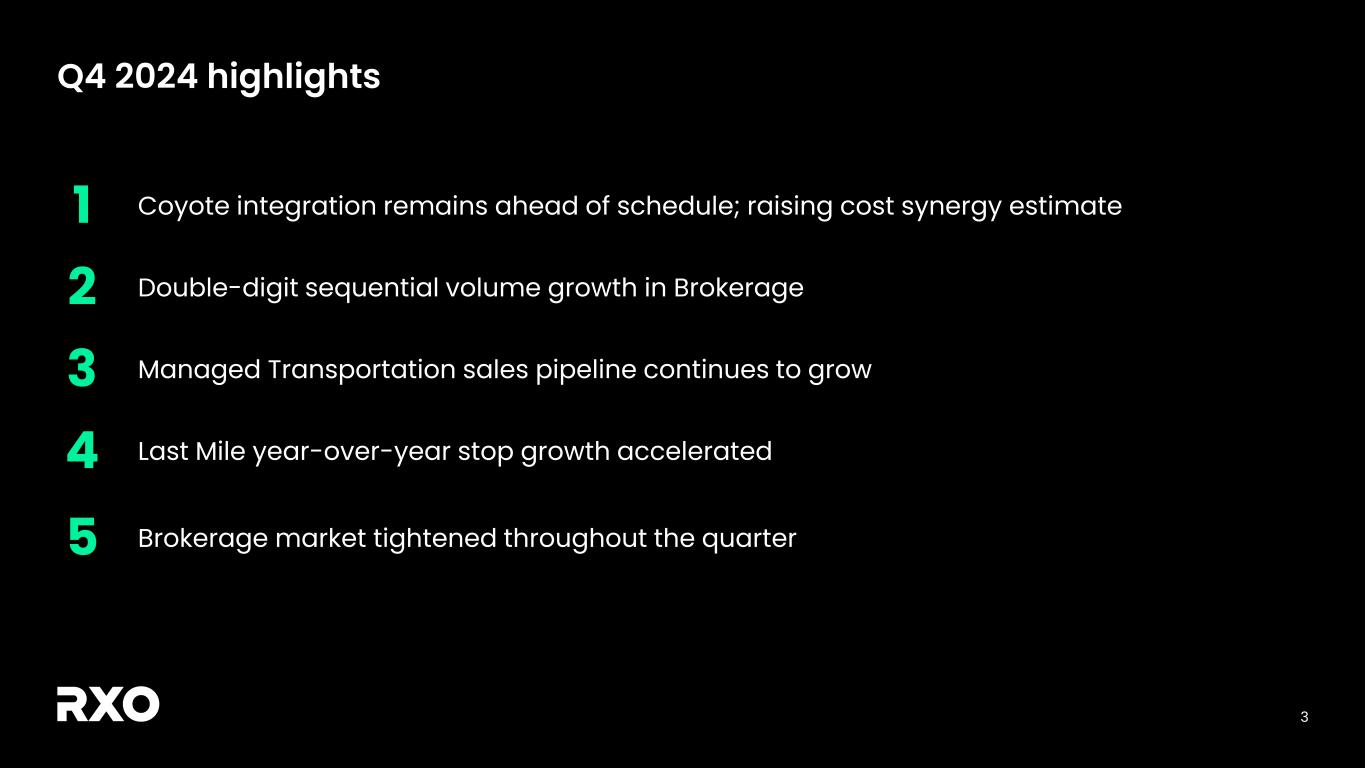
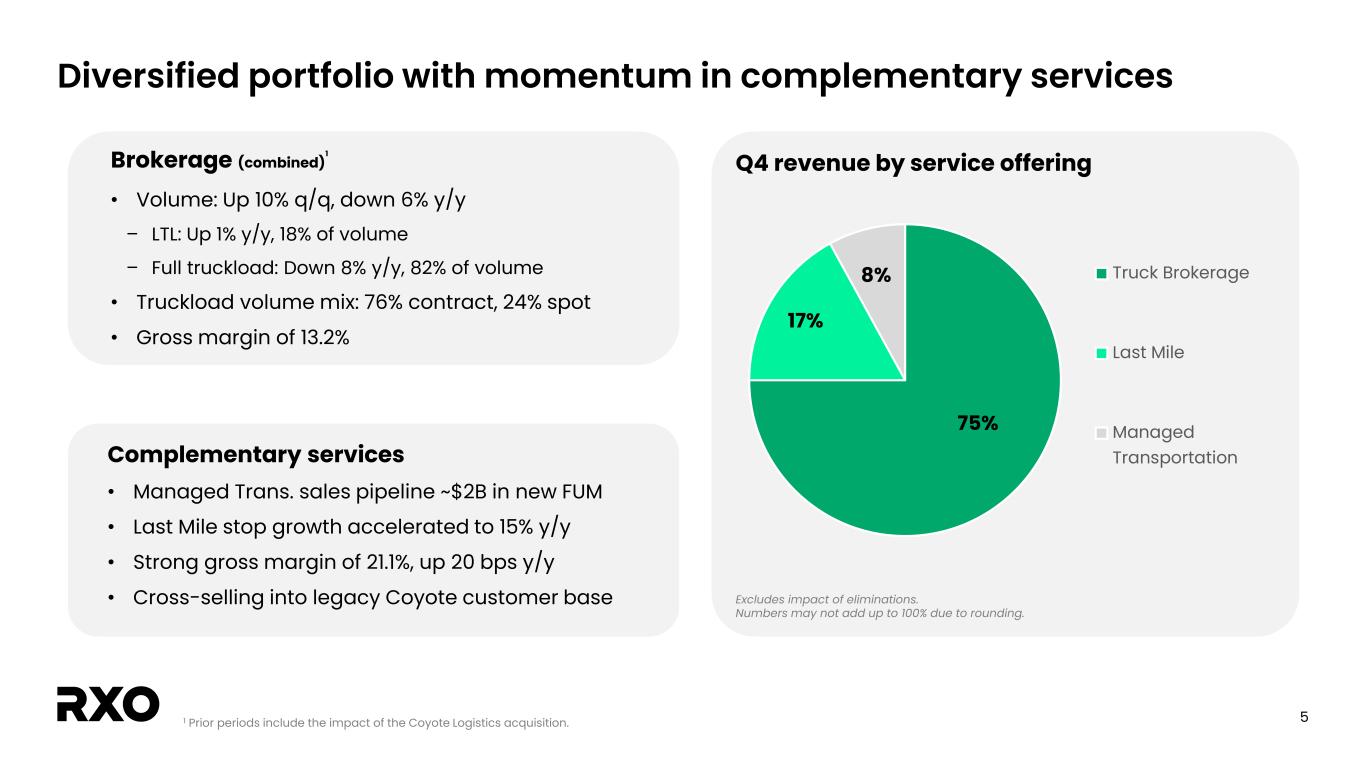
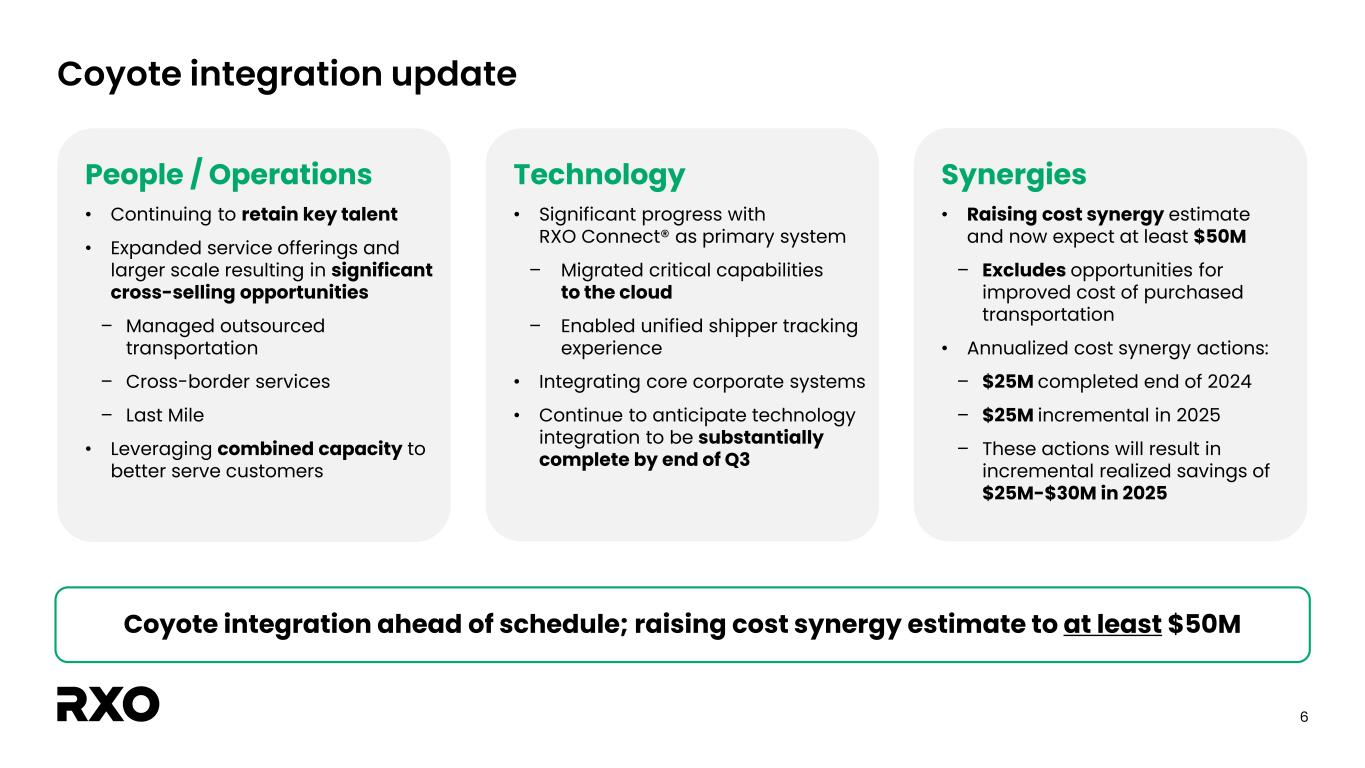
Good morning, everyone, and thank you for joining today. With me here in Charlotte are RXO's Chief Financial Officer Jamie Harris and Chief Strategy Officer Jared Weisfeld. There are four main points I want to convey this morning. First, the integration of Coyote Logistics remains ahead of schedule and we continue to see the benefits of our increased scale and our larger portfolio of service offerings. As a result, we're again raising our estimate for cost synergies, which we now expect to be at least $50 million. As a reminder, this number does not include the significant cost of purchase transportation and cross-selling benefits we expect to see. Second, while the market remained soft, RxO continued to deliver on our financial commitments. Importantly, we achieved these solid results while making significant progress on the Coyote integration. Third, momentum continued within complementary services. Our sales pipeline and managed transportation is now nearly $2 billion, dollars, and we achieved another acceleration in last mile stops, which grew by 15% year-over-year. And fourth, the structural improvements we're making to our business will increase our earnings power and free cash flow over the long term and across market cycles. I'll start by giving you an update about the integration of Coyote. Last quarter, I mentioned that we're ahead of schedule, and that's still the case. We're focused on our people, our customers, our carrier partners, our technology, and synergies. When it comes to people, we're continuing to retain our top talent. Since the acquisition closed, voluntary turnover of director level and above employees was only about 2% across the company. I've been impressed with the engagement I've seen within the workforce. We're operating as one cohesive team, and employees have been reaching out to me regularly to share the wins they've had with customers and carriers. Our larger size and scale are resonating with our employees and with our key external stakeholders. Thanks to the dedication of our people, we were able to deliver on both our financial commitments and the integration. Our people remain focused on taking care of our customers, including executing our bid season strategy and reliably servicing the freight we've been awarded. We had one unified strategy for the vast majority of the bids we participated in. This was made possible by the effective collaboration we have across the team. I mentioned that the integration is ahead of schedule, and one of the key areas that is showing up is in cross-selling. Cross-selling opportunities have exceeded the lofty internal goals we set for ourselves. Customers have been eager to leverage RxO's broad portfolio of services beyond truck brokerage, and we've had several wins with large shippers who are now using more services from RxO, including managed transportation and last mile. We've made significant progress on integrating our technology in the fourth quarter. We migrated critical components of our tech platform to the cloud to achieve greater scalability and flexibility. We launched a unified tracking experience for shippers, as well as a new website that provides customers with instant quotes. We continue to anticipate that the bulk of our tech integration will be complete by the end of the third quarter. The smooth integration so far has enabled us to identify additional synergy opportunities. We now expect to achieve at least $50 million of annualized cost synergies, double our initial estimate. These numbers exclude the significant opportunities for improving our cost of purchase transportation and the impact of our cross-selling efforts. Jamie will talk in more detail about synergies later in the call. The Coyote acquisition positions us well for future organic growth. Now, I'd like to talk about our fourth quarter results, which were in line with our expectations. RSO delivered adjusted EBITDA of $42 million within the guidance range we provided to you last quarter. Brokerage volume for our combined business declined by 6% year over year within the expected range. Less than truckload volume increased by 1%, but was offset by 8% decline in full truckload volume. Importantly, brokerage volume increased by 10% sequentially from the third quarter as a result of our continued focus on providing the best service, solutions, innovation, and relationships in the industry. Brokerage gross margin was 13.2% in the quarter. Momentum continued within complementary services. Our managed transportation and sales pipeline continues to grow and is now nearly $2 billion, up almost 50% from last quarter. Converting that pipeline will provide significant cross-selling opportunities with enterprise customers across RxO. And last mile, stops grew by 15% year-over-year, another acceleration from the third quarter growth rate of 11%. The most well-known retailers of big and bulky goods continue to turn to RxO for last-mile delivery services because of our scale, technology, financial stability, and exceptional service. Complementary services gross margin was 21.1%, and RxO's company-wide gross margin was 15.5% in the quarter. Turning to the overall freight market, we continue to operate in a soft-rate environment, and it was a muted peak season, as we had anticipated. However, during the fourth quarter, conditions tightened significantly, impacting buy rates and gross profit per load. The national load-to-truck ratio and industry tender rejections reached their highest levels in more than two years. While there's still too much capacity in the market compared to the demand we're seeing from shippers, the industry is making progress towards reaching a more balanced state. In the first quarter so far, we've seen a continuation of these dynamics. While we typically see softer market conditions this time of year, in January we also saw impacts from severe weather sustaining the market tightness. We have seen some project opportunities, but not enough to offset the increase in carrier rates. Clearly, the freight environment is still soft. However, for the first time in two and a half years, contract rates are increasing year over year, and spot rates are also starting to catch up. The market still isn't at an equilibrium, but we are moving into an inflationary rate environment. The data is telling us that we're coming off the bottom of the cycle, but we don't know what the shape or pace of the recovery will be. We remain focused on executing our bid season strategy and reliably serving our customers' freight. Jamie and Jared will discuss our outlook in more detail, but we expect the first quarter combined brokerage volume to decline by mid-to-high single-digit percentage year-over-year, with tightening market conditions continuing to impact our buy rates. Importantly, given the strong execution by the team and feedback from our customers, we expect our combined brokerage volume to grow on a year-over-year basis for the full year. I'm confident that RxO is well-positioned for the future. We've made significant structural changes to our business over the last few quarters. We increased our truckload volume by 125% as a result of the Coyote acquisition. which has provided us with better lane density and more freight to award our carrier network. Ultimately, our additional volume, combined with our cutting edge technology, will enable us to achieve significant benefits when it comes to the cost of purchase transportation. We've improved our go-to-market strategy to focus on cross-selling our wide array of services to customers, which is fueling new wins across the company. We enhance our already best-in-class technology platform, which includes pricing algorithms that leverage AI and machine learning. Our employee-facing software is continuously improving productivity and is a significant competitive advantage. The synergy actions we're taking today will improve the efficiency and operating leverage of our business. And lastly, we improved our already strong balance sheet, which provides a solid foundation for future organic and inorganic growth. You're not currently seeing the benefits of these structural changes due to the persistent soft market conditions that have decreased gross profit per load. However, the steps we've taken have significantly increased the long-term earnings power of RxO. We're building this business for the long term, and I'm more confident than ever in our future. Now, Jamie will discuss our financial results in more detail.
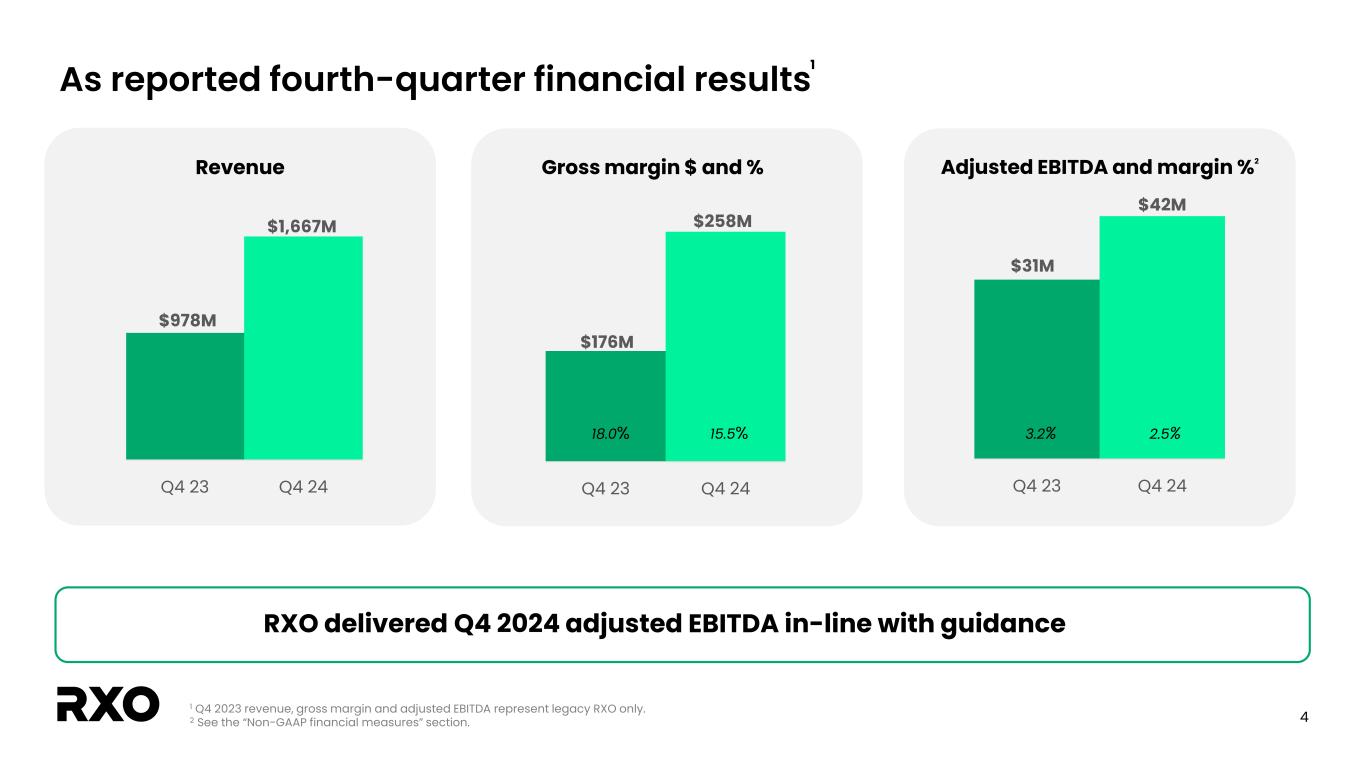
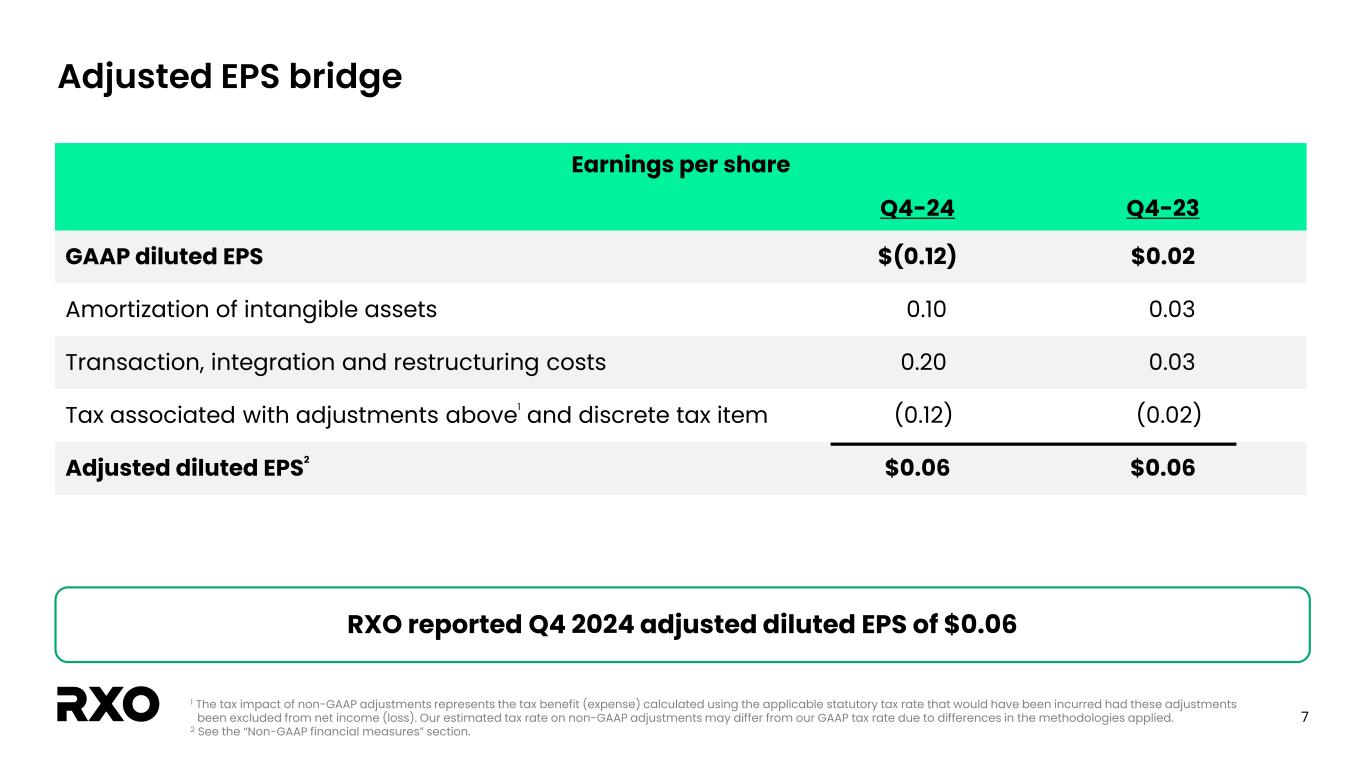
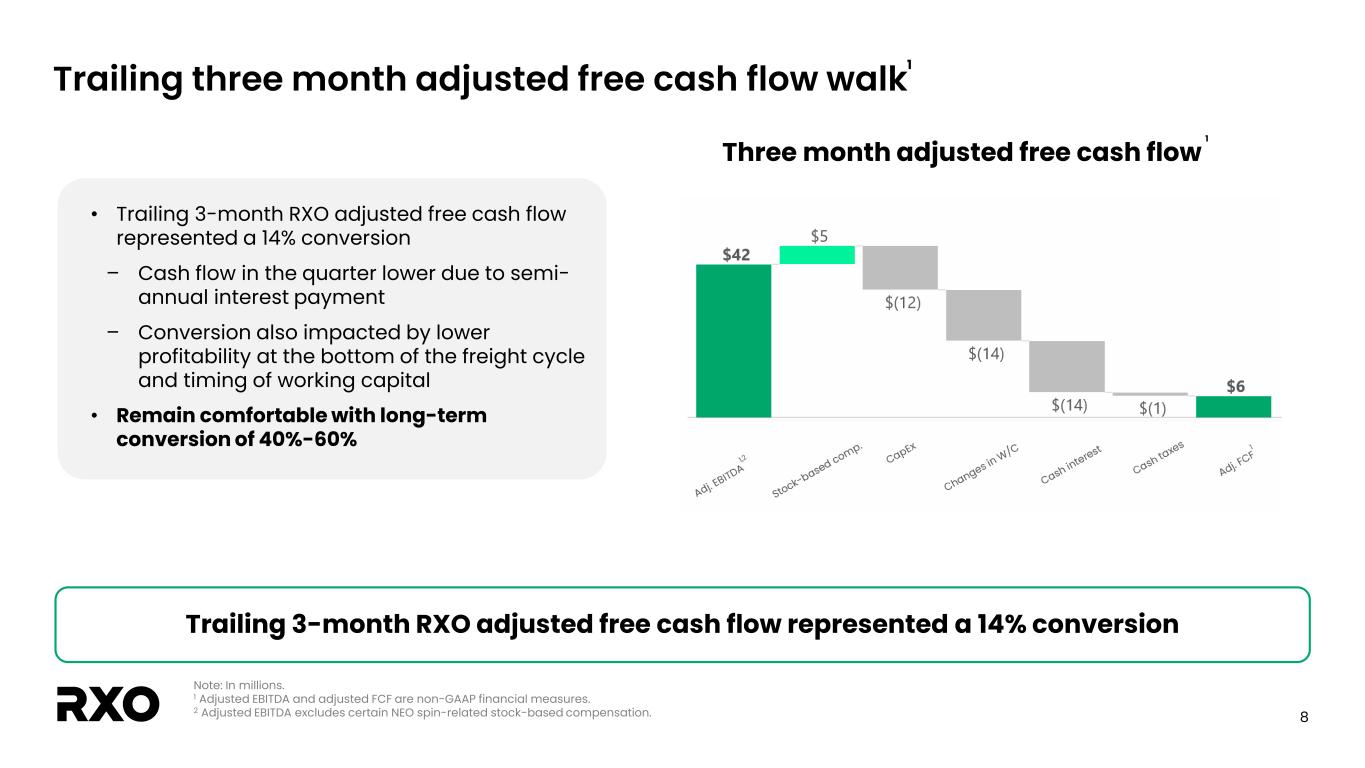
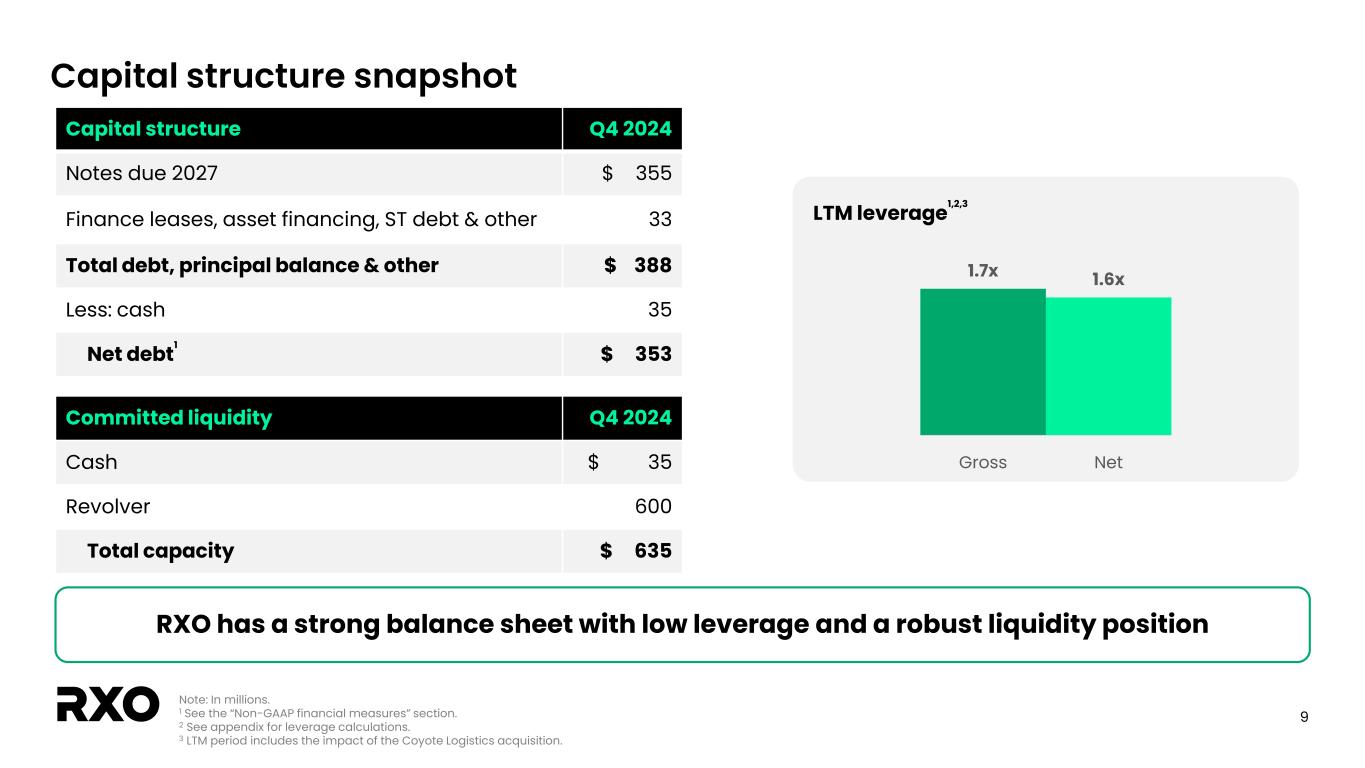
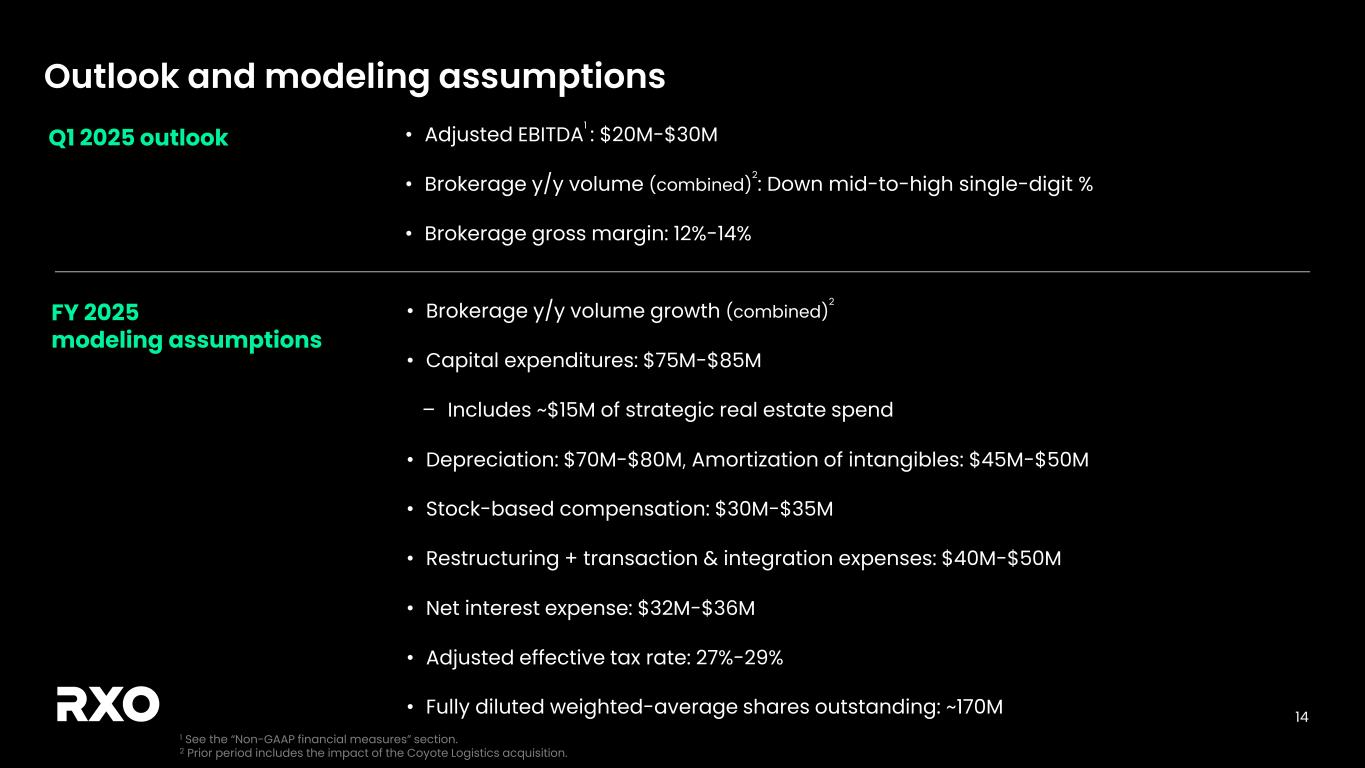
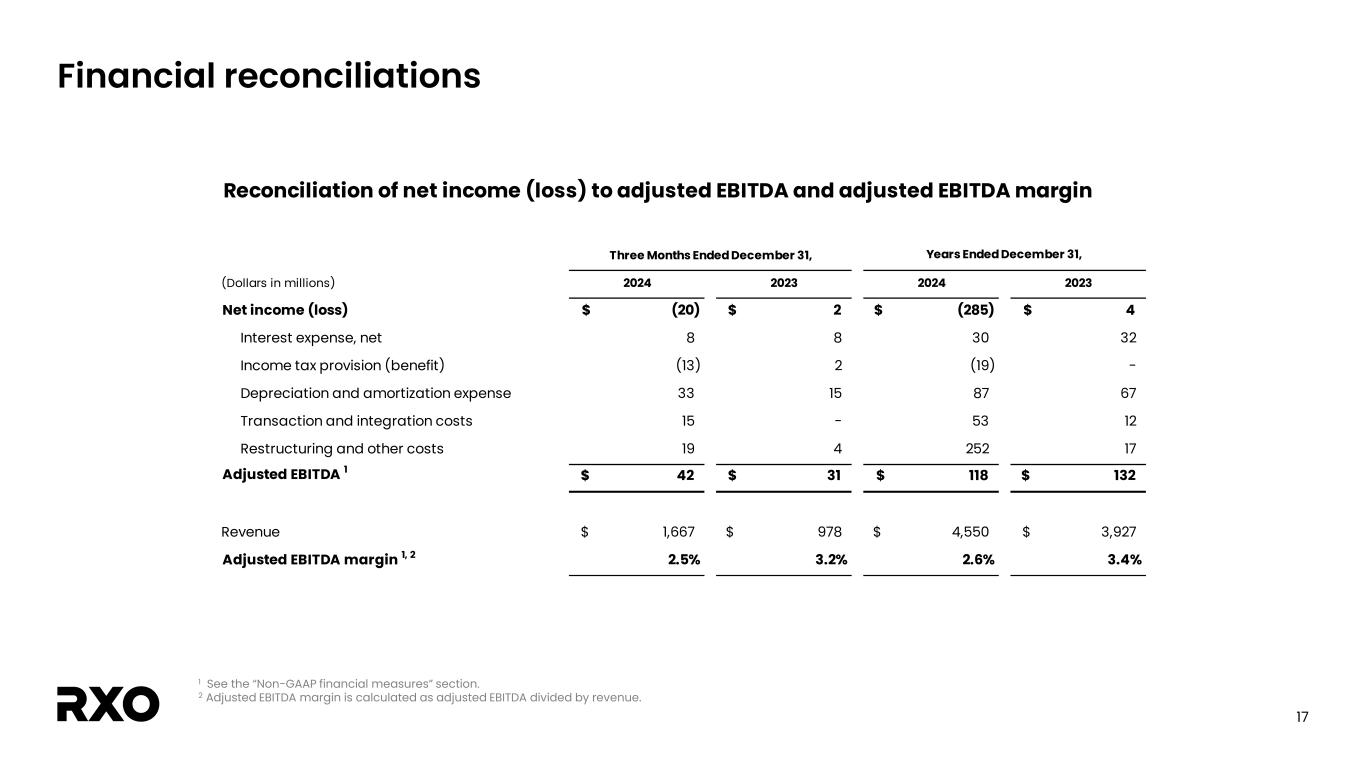
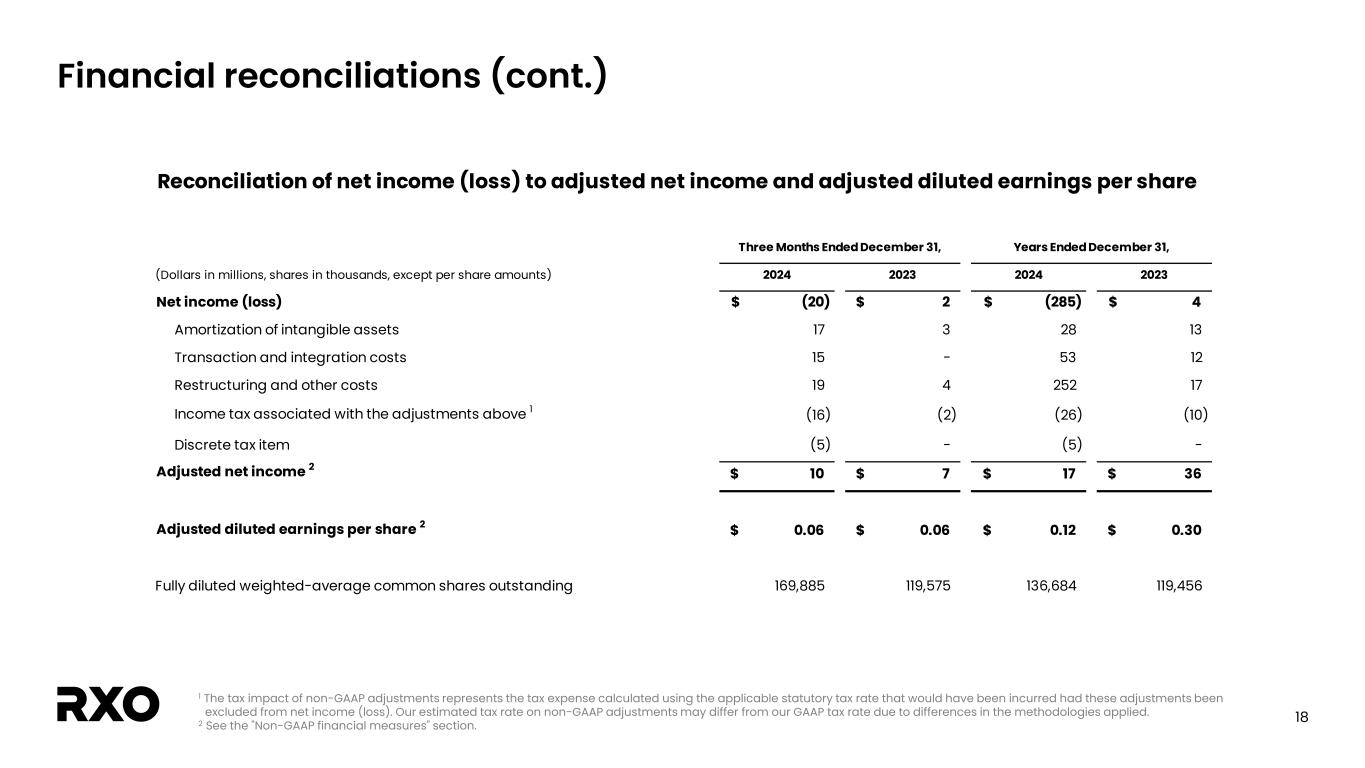
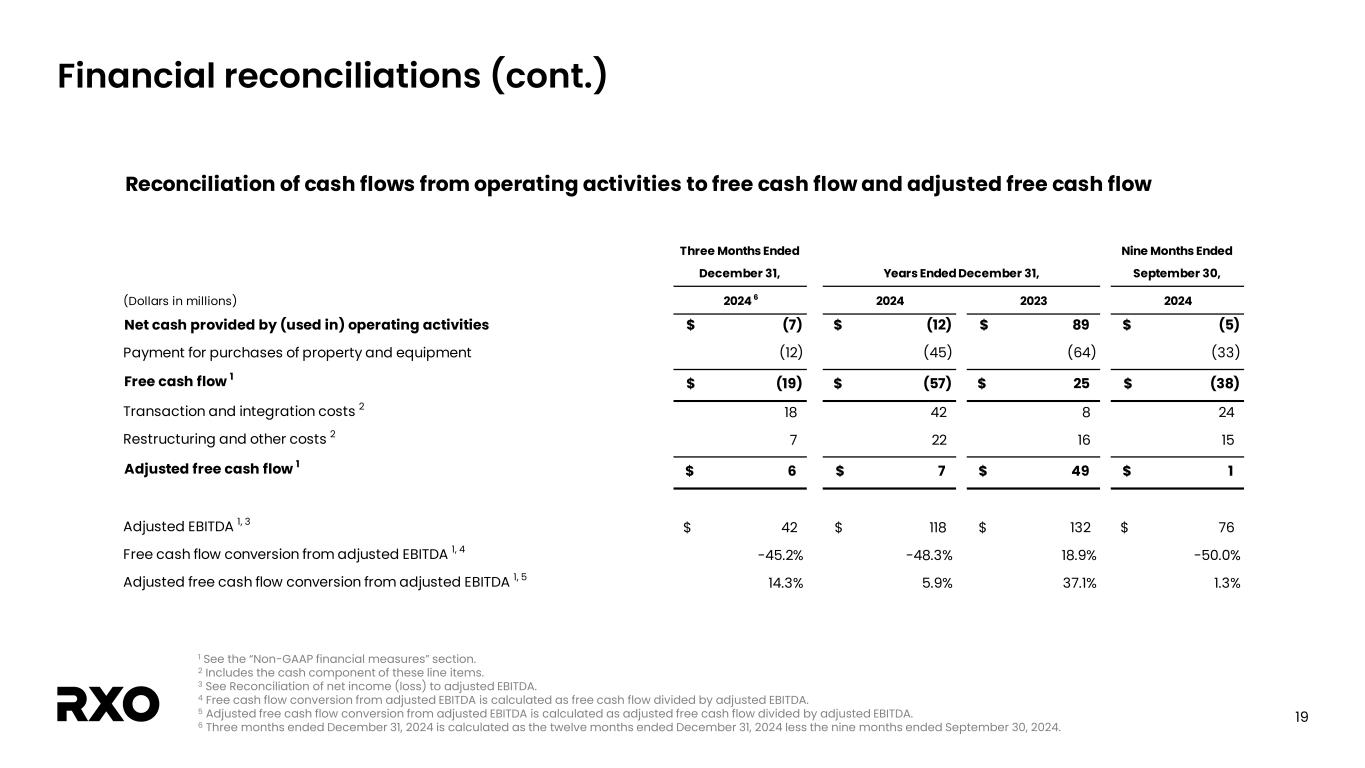
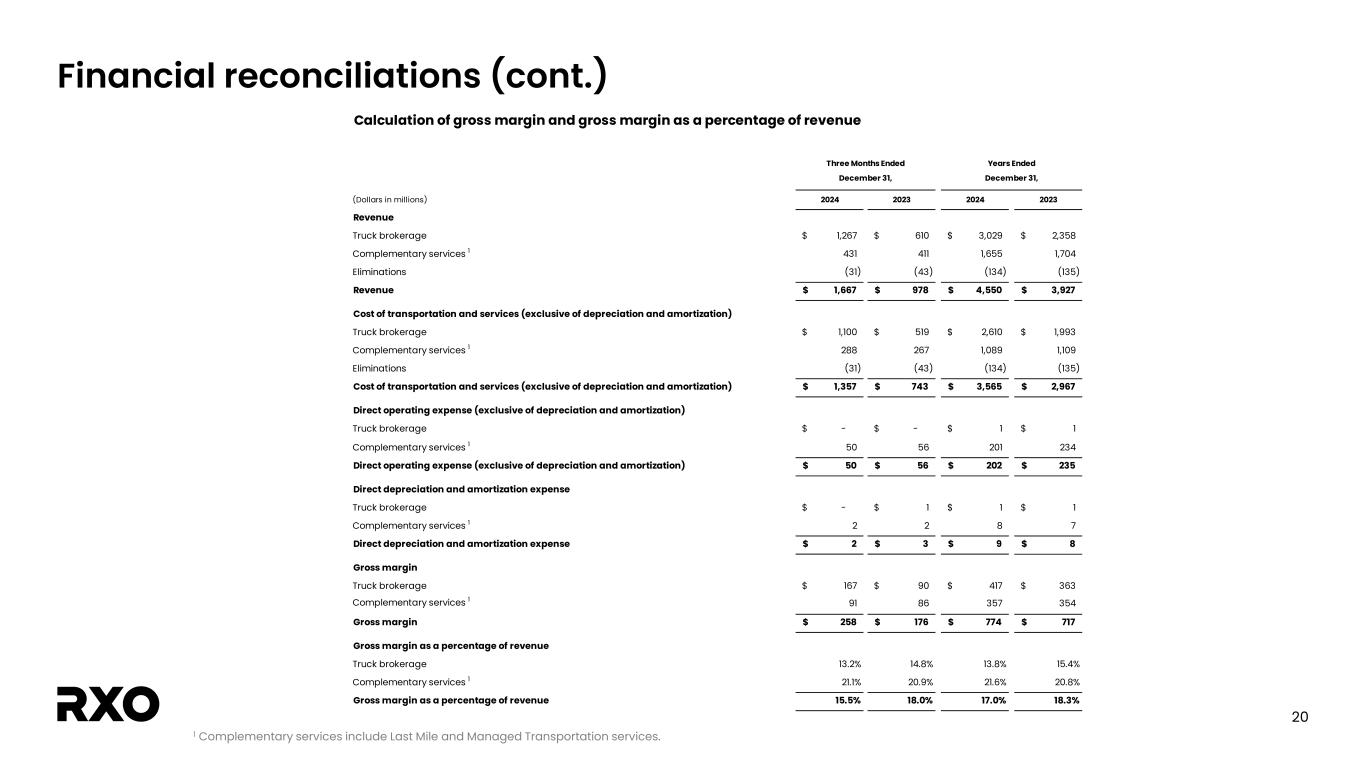
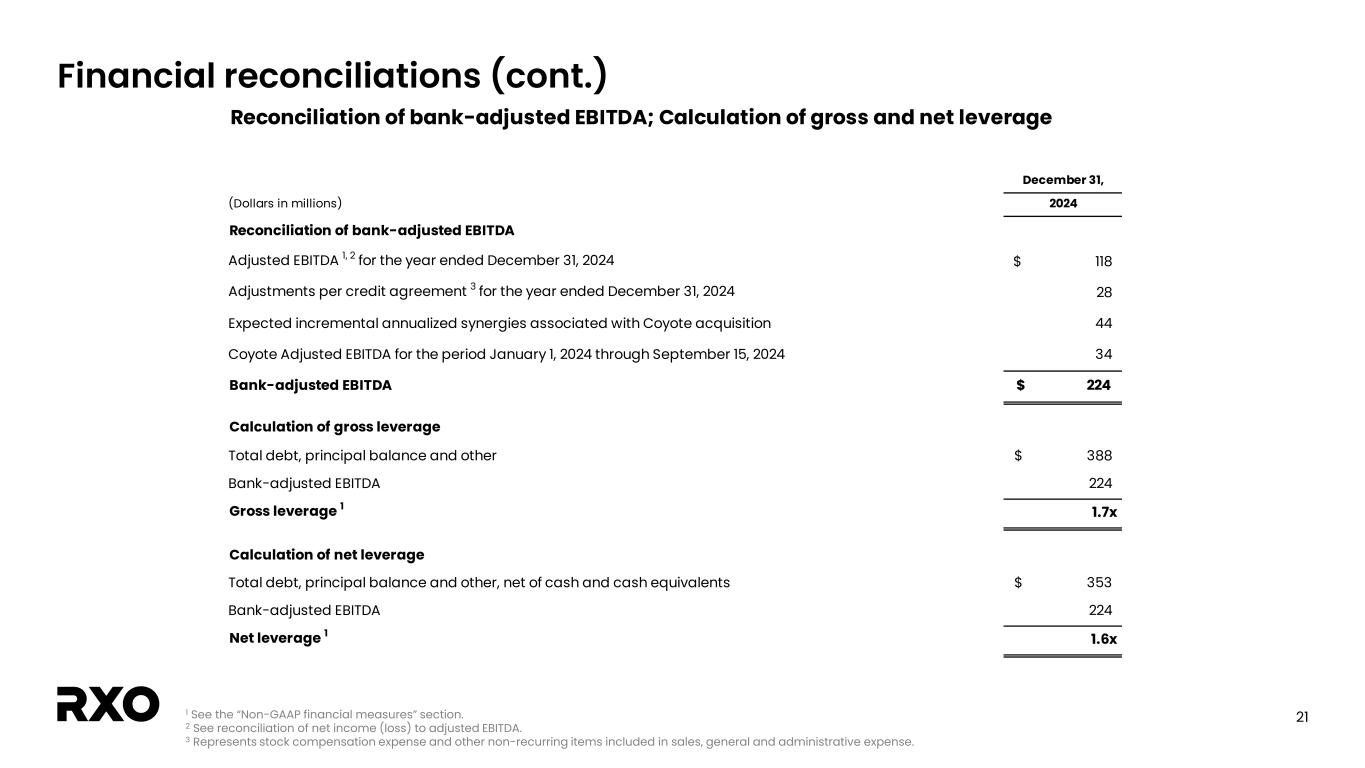
Jamie? Thank you, Drew, and good morning. Let's review our fourth quarter performance in more detail. We're presenting our financials on an as-reported basis, which includes the acquisition of Cody as of September 16, 2024. Unless otherwise noted, my comments referring to periods prior to the closing of the acquisition exclude the impact of the acquisition. Our broker's business is now a significantly larger portion of our overall company. You can see that our revenue and gross profit was significantly higher year over year in the fourth quarter because of the acquisition. Additionally, Coyote's historical gross margin and EBITDA margin were lower than RxO, which also impacted comparisons to prior periods. During the fourth quarter, we generated $1.7 billion in total revenue. Gross margin was 15.5%. Our adjusted EBITDA was $42 million in line with our guidance range. Our adjusted EBITDA margin was 2.5%. Below the line, our interest expense was $8 million. For the quarter, our adjusted earnings per share was $0.06. since. You can find a breeze to adjusted EPS on slide 7 of the earnings presentation. Now I'd like to give an overview of the performance within our lines of business. Brokerage revenue was $1.3 billion and represented 75% of total revenue in the quarter. From a profitability perspective, brokerage gross margin was 13.2%, slightly above the midpoint of our outlook and consistent with our expectations given this is the first full quarter of combined results and because the legacy businesses have different gross margin profiles we wanted to note that legacy rxo brokerage gross margin was approximately 14.5 percent in the quarter this was a strong result given tightening market conditions complementary services revenue in the quarter of $431 million increased by 5% year-over-year and was 25% of our total revenue. Complementary services gross margin of 21.1% remained strong and increased by 20 basis points year-over-year. Our last mile business generated $290 million in the quarter and performed better than our expectations. We are gaining share within the big and bulky category, stops grew about 15% year-over-year accelerating from last quarter's growth rate managed transportation generates 141 million dollars of revenue in a quarter down eight percent year-over-year the decline was primarily attributable to lower automotive volume in our managed expedite business which was softer than we expected let's now discuss cash please refer to slide eight adjusted free cash flow in the fourth quarter with six million dollars this represents a 14 conversion from adjusted ebitda the conversion rate was impacted by our semi-annual interest payment lower profitability at the bottom of the freight cycle and timing of certain working capital cash flows longer term we remain confident in a 40 to 60 conversion through market cycles given the strong free cash flow characteristics of the business. We ended the quarter with $35 million of cash on the balance sheet, higher than the range of $5 to $10 million that we shared with you last quarter. This higher cash balance was solely due to the timing of transaction payments and other costs related to the Coyote acquisition. These payments will be made at the end of the first quarter, so you'll see a lower cash balance in our first quarter earnings report. As you can see on slide nine, our liquidity position continues to be the strongest it's been in our company's history. Our $600 million revolver was undrawn at the end of the fourth quarter. Quarter-end gross leverage was 1.7 times trailing 12 months pro forma adjusted EBITDA. We have significant capacity to deploy our balance sheet in line with our balanced capital allocation philosophy across organic investments, share repurchases, and opportunistic M&A. Let's move to the CODI integration. As Drew mentioned, the integration is progressing well, and we're again increasing our cost synergy estimate. We now expect at least $50 million of annualized cost synergies, $10 million higher than last quarter's estimate. We've moved quickly, and by the end of the fourth quarter, we completed approximately $25 million of annualized cost synergies. We expect to complete the remaining $25 million this year. As a reminder, included in that number is $15 million related to the integration of our technology platforms. The cost synergies tied to the technology integration will be realized in 2026. Putting it all together, based on actions taken, we expect incremental, realized operating expense savings of $25 to $30 million in 2025. Importantly, these synergies exclude opportunities for cost to purchase transportation and the benefits we'll receive from the cross-selling that Drew mentioned, which we believe will be significant. Now let's discuss our expectations for the first quarter. The first quarter is typically our softest quarter of the year. Within brokerage, we're expecting seasonally lower volume. In addition, tightened market conditions impacted our buy rates to start the quarter. Moving to complementary services, we expect continued, weak automotive volumes and managed expedite. In last mile, given the better than expected fourth quarter performance, We're anticipating a larger-than-normal seasonal decline into the first quarter. For the combined company, we expect to generate between $20 and $30 million of adjusted EBITDA in the first quarter. Jared will provide more details on our outlook shortly. Slide 14 includes our 2025 modeling assumptions, which fully reflect the acquisition of Coyote. We expect the following. Capital expenditures between $75 and $85 million. This includes approximately $15 million of strategic real estate spend associated with the expansion of our brokerage operations and headquarters in Charlotte. For 2026, the real estate costs will not recur. In addition, we expect a reduction in CapEx of approximately $10 million following the integration of our tech platforms. This implies a 2026 CAPEX spend of approximately $50 to $60 million, materially lower than 2025. We expect depreciation expense between $70 and $80 million. Amortization between $45 and $50 million. Stock-based compensation expense between $30 and $35 million. Restructuring, transaction, and integration expenses between $40 and $50 million. dollars. Cash outflow associated with restructuring, transaction, and integration activities of approximately 50 to 60 million dollars, which includes actions from prior periods. Net interest expense between 32 and 36 million dollars, and an adjusted effective tax rate between 27 and 29 percent. You should also model an average fully diluted share count of approximately 170 million shares. As we look at the upcoming year, the macro economy remains reasonably healthy. Unemployment remains low. Core inflation has moderated, and many key indicators, including the ISM Manufacturing Index, are moving higher. We'll continue to monitor any changes to trade policy, including tariffs. While recent freight market developments have been encouraging, we're still operating in a prolonged soft-rate environment. Gross profit per load has moved lower, which is impacting our near-term results. That said, we're making structural improvements, which will increase the earnings power of the business. The team is executing well, the integration of Coyote is ahead of schedule, and we're positioning RxO for the long term. Now, I'd like to turn it over to Chief Strategy Officer Jared Weisfeld, who will talk in more detail about our results and our outlook.
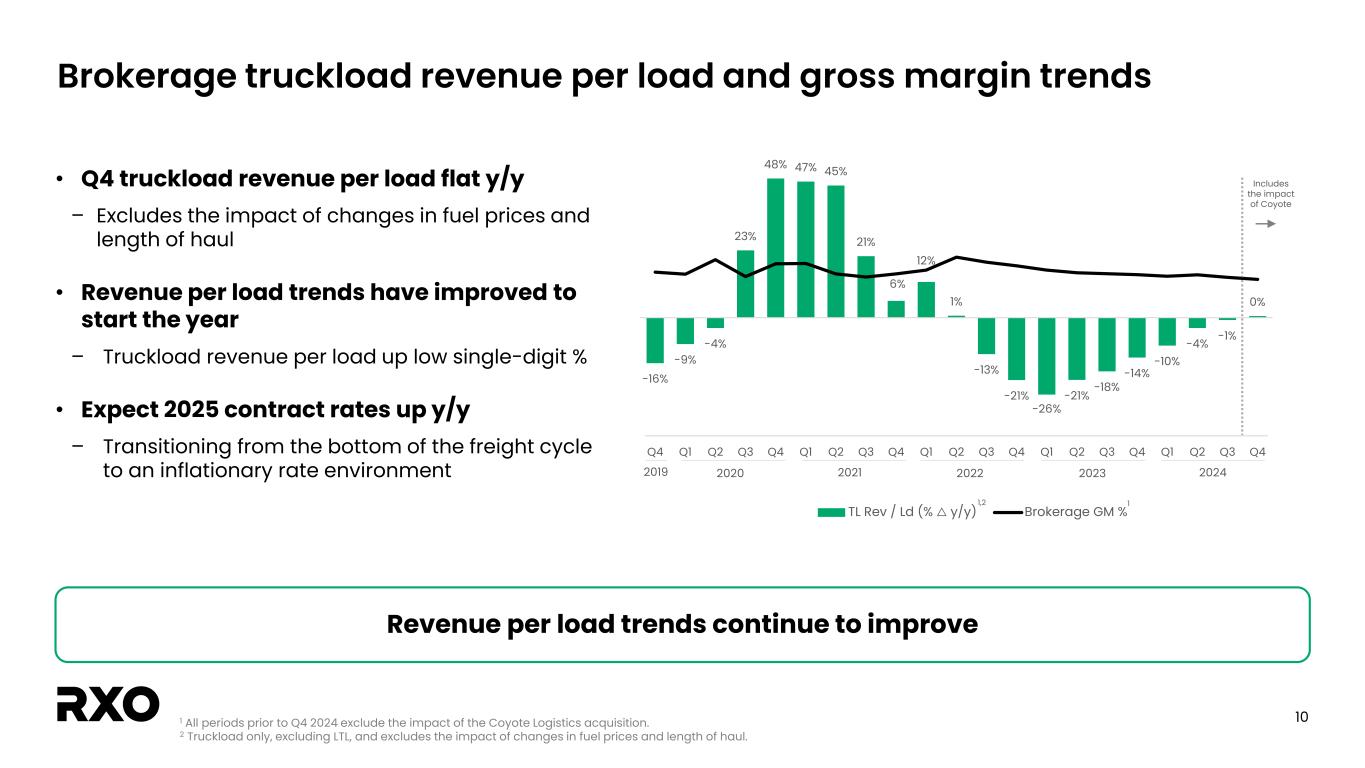
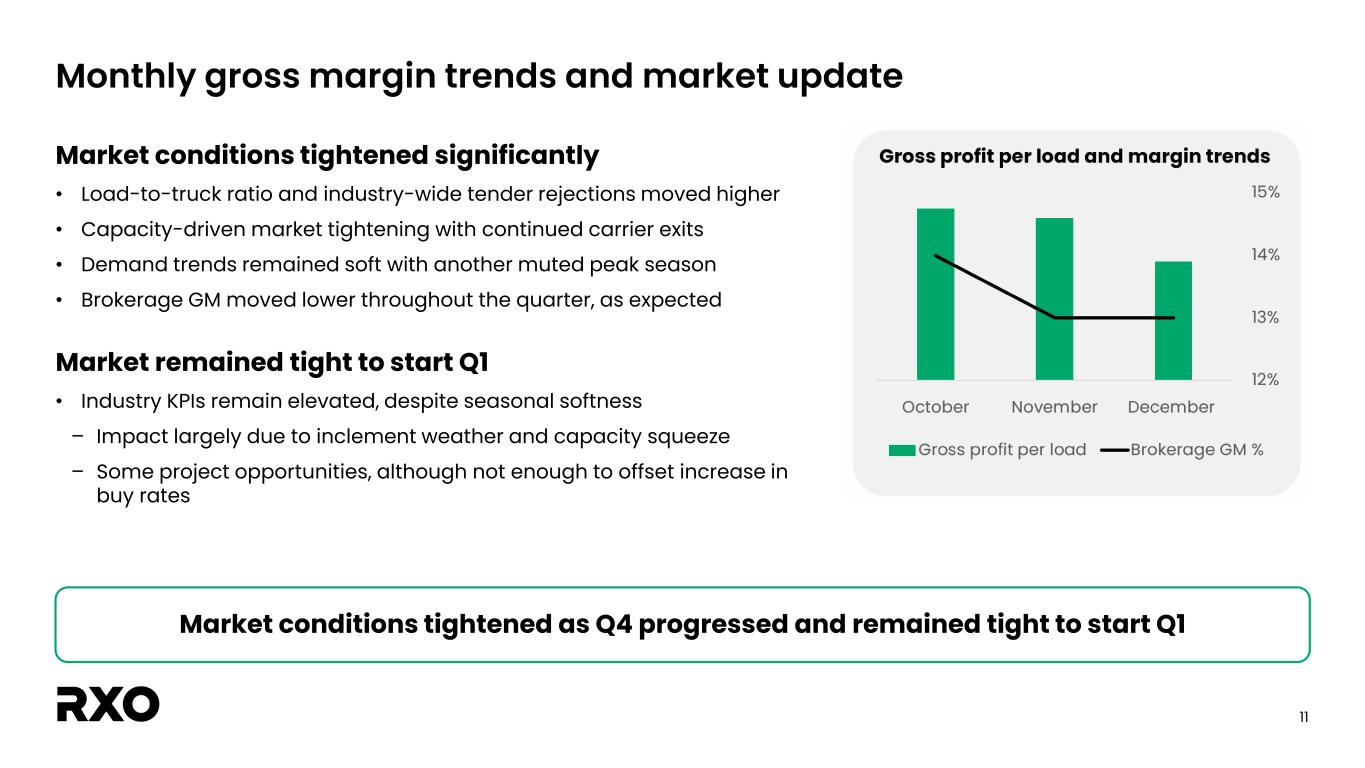
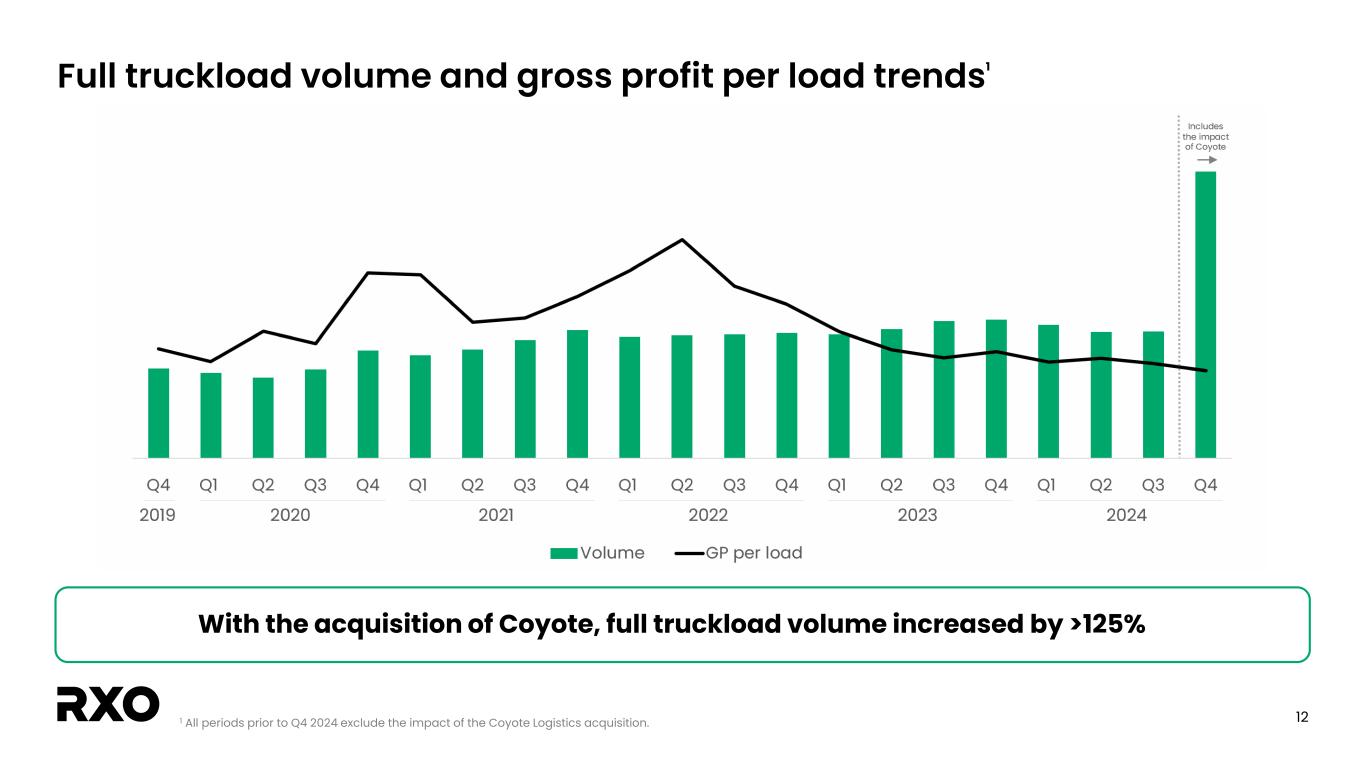
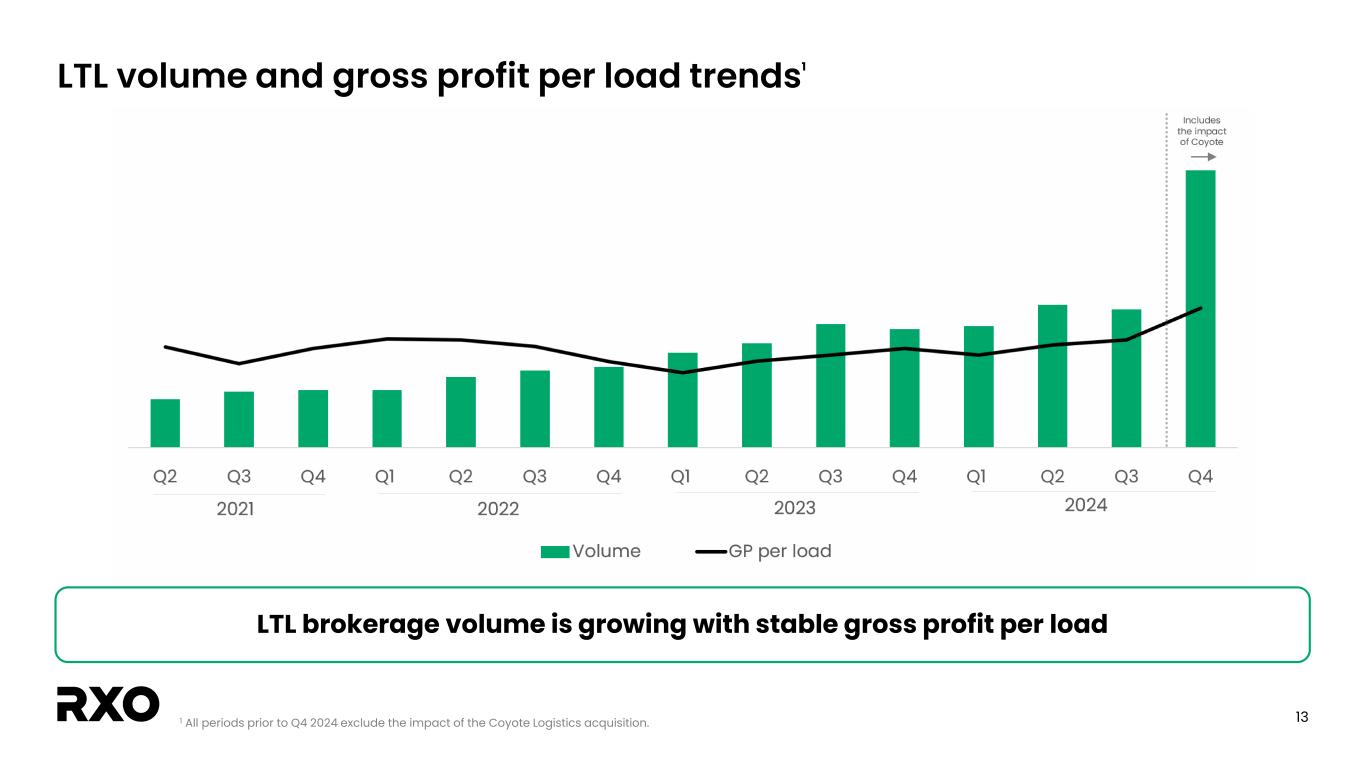
Thanks, Jamie, and good morning, everyone. As I typically do, I'll start with an overview of our brokerage performance in the quarter. To make the comparisons more useful for you, I'll give you pro forma numbers for our combined brokerage business, which include Coyote's results in prior periods. Brokerage volume in the quarter was at the high end of our expectations, up 10% sequentially and down 6% year over year. LTL volume increased by 1% year over year. Contractual LTL volume was up double-digit percentage year-over-year, while transactional LTL volume declined by a high single-digit percentage. LTL represented 18% of our brokerage volume in the fourth quarter, down 300 basis points sequentially and up 100 basis points year-over-year. Full truckload volume was down 8% year-over-year and represented 82% of our brokerage volume. We also maintained a favorable mix of contract and spot business in the quarter. Contract business represented 76% of our full truckload volume, an increase of 300 basis points sequentially and 100 basis points year over year. Our customer mix typically drives stronger contract volume in the fourth quarter. Spot business was 24% of our full truckload volume in the quarter and decreased by 300 basis points sequentially. It was another muted peak season, and spot and special project opportunities decreased after the disruptions from Hurricane Helene and Milton eased. This was in line with the expectations we communicated last quarter. Before reviewing our financial performance and market conditions in more detail, I'd like to talk more about our technology integration. Last quarter, we confirmed that R2O Connect will be our primary operational system. As Drew mentioned, we've made great progress with our best-of-both-world strategy that is integrating Coyote's unique capabilities into RxO's best-in-class tech platform. RxO Connect was built with a microservices architecture, allowing for efficient updates and enhancements. We've already scaled critical capabilities and components and migrated them to the cloud as part of our consolidation efforts. Strategically, we're planning to integrate our coverage technology first and bring all our carrier reps onto one unified system. This will enable us to leverage our proprietary pricing algorithms more effectively and achieve benefits within cost-of-purchase transportation. As we've said before, we believe that cost-of-purchase transportation synergies will be among our largest opportunities. Importantly, while we're making excellent progress with RxO Connect, we're also moving quickly to integrate our core corporate systems, including our CRM and ERP. We continue to anticipate that our technology integration will be substantially complete by the end of the third quarter. Our technology also enables our people to become even more productive. On a rolling 12-month basis, productivity, as measured by loads per person per day, improved by over 16%. I'd now like to review our brokerage financial performance and market conditions in more detail. You can find this information on Slides 10 through 13 of the presentation. starting with revenue per load on slide 10. Please note that starting this quarter and going forward, we'll discuss full truckload revenue per load trends. LTL revenue per load trends are more stable when compared to full truckload, so we thought this would be helpful. We've also excluded the impacts of changes in fuel prices and length of haul on the chart to give you a better view of underlying year-over-year price changes. This has been recast for all historical periods, and prior to the third quarter of 2024 refers to legacy RxO, and starting with the fourth quarter of 2024 includes Coyote. In the fourth quarter, full truckload revenue per load was flat year-over-year. January trends were encouraging, and full truckload revenue per load further improved, up by a low single-digit percentage year-over-year. As Drew mentioned, we are transitioning from the bottom of the freight cycle to an inflationary rate environment. We expect 2025 contract rates to be up low to mid-single digits year over year. Let's move to slide 11 and discuss brokerage monthly gross margin performance and industry trends. Market conditions tightened significantly as the fourth quarter progressed. Specifically, the load-to-truck ratio increased by a full point to approximately 4.5 to 1 for the quarter, and intra-quarter hit a high of 7 to 1. Industry tender rejections also increased to above 6% and briefly hit 10%. These metrics are the highest since the beginning of 2022. The move higher in industry KPIs was capacity-driven as opposed to an improvement in demand. The impacts from Hurricanes Helene and Milton, repositioning of supply, typical seasonality, and continued carrier exits all contributed to the tightening. While there is still too much capacity in the truckload market, carrier exits in the fourth quarter increased significantly when compared to the third quarter. Some weeks in the fourth quarter exhibited the highest number of carrier exits throughout all of 2024, which speaks to the unsustainable unit economics for most carriers. While the market is still soft, we believe it's more balanced than it has been relative to the last few years. We continue to believe that for a robust recovery, capacity will need to continue to exit and demand will need to improve from current levels. Tightening market conditions resulted in higher buy rates as the fourth quarter progressed. Additionally, as Jamie talked about earlier and consistent with our expectations, Coyote has a lower gross margin profile. Brokerage gross margin was 13.2% in the quarter. Of note, legacy RxO's brokerage gross margin was approximately 14.5%. The tightness I just described continued in early January, exacerbated by severe weather across the country, resulting in higher buy rates. Encouragingly, those rates have ease in recent weeks, and we expect gross profit per load to improve throughout the rest of the first quarter. Let's go to slide 12 and look at the quarterly full truckload gross profit per load trends. As you can see on the chart, with the acquisition of Coyote, our full truckload volume increased by more than 125%, significantly increasing our scale. Our truckload gross profit per load moves lower sequentially due to the tightening market conditions that we just discussed combined with customer mix. Moving to slide 13, RxO's LTL brokerage volume continues to outperform the broader LTL market with stable gross profit per load. We've more than doubled the size of our LTL business with the acquisition of Coyote and have significant opportunities with our customers to continue to grow. Coyote's LTL gross profit per load is accretive to our LTL business. I'd now like to look forward and give you some more color on our first quarter outlook, starting with brokerage. We expect year-over-year volume to decline by mid to high single digits. As a reminder, with Coyote, the brokerage business has additional volume seasonality, leading to a greater volume decrease from the fourth quarter to the first quarter. We expect brokerage gross margin to be between 12% and 14% in the first quarter due to the sustained tightening of the freight market. let's now talk about complementary services in managed transportation the business continues to have tremendous momentum with a sales pipeline that is now approaching two billion dollars in the near term managed expedite automotive headwinds continue to impact us in last mile we're expecting another quarter of year over year stop growth although at a slower rate when compared to the fourth quarter given last mile's better than expected fourth quarter results we are anticipating a more than seasonal decline in the first quarter More than half of the sequential decline we expect in adjusted EBITDA in the first quarter is attributable to last mile. Putting it all together, we expect RxO's first quarter adjusted EBITDA to be in the range of $20 to $30 million. This outlook assumes similar freight market conditions and limited spot opportunities. Historically, our adjusted EBITDA increases from the seasonally slow first quarter into the second quarter. Looking to the full year, given strong execution by the team and feedback from our customers, we expect combined brokerage volume to grow on a year-over-year basis. To close, while we're still operating in a prolonged soft-rate environment, our integration of Coyote is progressing well and remains ahead of schedule. While we don't know the shape of the recovery, we're transitioning from the bottom of the cycle to an inflationary rate environment and are confident in structurally higher cross-cycle earnings power. Our balance sheet remains strong with a robust liquidity profile, and we have the capacity for future M&A, which can contribute to additional earnings growth. We are focused on delivering returns for our key stakeholders over the long term. With that, I'll turn it over to the operator for Q&A.
Operator
Thank you. Ladies and gentlemen, we will now begin the question and answer session. Should you have a question, please press the star followed by the one on your touchdown phone. Questions will be taken in the order received. Should you wish to cancel your request, please press the star followed by the two. If you're using a speakerphone, please lift a handset before pressing any keys. Once again, that is store one should you wish to ask a question. Your first question is from Ken Hookster from Bank of America. Your line is now open.
Hey, great. Maybe to Drew and I guess Jamie and Jared, if you want to jump in. But, you know, maybe define the core RxO EBITDA shifts over the past year so we can understand how much has gone on seasonally and what's going on with the market backdrop. And then secondly, with with coyote contribution, maybe talk about the shifts from your original expectations to today. And just real quick on the current market, you've noted kind of we started off with higher PT costs, but it looks like spot rates have really pulled back. Have you noticed any inflection or anything change really, I guess, more recently in terms of maybe shifting that outlook?
So I can give you some seasonality comments as it relates to the combined business. So we talked about from Q1 to Q2, we typically see a seasonality uplift, and that really is across all lines of business. From a brokerage standpoint, we typically see seasonally better volumes. We'll have the benefit on the newer contracts that we're talking about. We talked about moving to an inflationary rate environment with contract rates probably up low to mid-single digits year on year for 2025 when compared to 2024. The new books of business that we're winning will also ramp across complementary services. You'll see managed transportation. We expect better automotive volumes, Q2 versus Q1. And in last mile, Q2 is one of the seasonally strong quarters as weather warms up. So on a combined basis, Q2 and Q4 are typically the seasonally strongest quarters when you think about what the combined business looks like. On your second question, in terms of the higher buy rate environment, you're exactly right. And over the last few weeks, we have seen an improvement in buy rates, and that has been a tailwind for gross profit per load. And we expect gross profit per load for the brokerage business to increase throughout the first quarter.
If I can squeeze a follow-up then, what do you see the broker market growing if you're seeing kind of down mid-single digits in fourth quarter and maybe accelerating to mid-to-high single digits? How do you think the market's compared to that?
I think, you know, one, when you – good morning, Ken, this is Drew – when you look at the brokerage market, I mean, brokerage has been taking share in the for-hire trucking for a long time. I mean, if you go back to 2010, it was less than 10% of the overall market. you know, now is in the low 20s. And we look at the business on through a cycle. When you look at what strong brokers who have financial stability, who bring solutions to customers who are able to operate like an asset like carrier and pull trailers together and bring flexible capacity to customers. I think we're just getting started on brokers taking share. I think, you know, as you look out over the next five years, brokers will have, you know, roughly 30% of the overall for higher trucking market, and it will continue to move higher from there. Thank you. Appreciate the time.
Operator
Thank you. Your next question is from Scott Schneeberger from Altenheimer. Your line is open.
Thanks. Good morning, guys. Just curious, as you look out over 2025 and you anticipate that that volume does grow, just want to get a sense of your confidence level in that and degree of magnitude potentially there, and then I'll follow up.
Good morning, Scott. We're confident. You know, the reason that we were putting it out this quarter is because we're right now in the middle of bid season. And we can say with a degree of confidence based off of the early returns and early results that we're getting from customers. And when you look at the feedback that we're getting from customers that we're still in bid with, that we're confident that we're going to be able to grow volume on a year-over-year basis.
All right, thanks. Just to follow up on that and then on another, obviously tariffs are a big issue. You guys do a bit of business cross-border with our neighbors. Just curious on your initial thoughts on what you're seeing there, how that may affect automotive and other.
Something that we're watching closely. I think if you see tariffs implemented on the short term, you will see inventory pulled forward and pulled across the border, and that'll be a short-term tailwind to the business. If you look at it and tariffs are something that extend out for the intermediate term, it would be a headwind as you would see volume start to slow down. And if tariffs are something that are implemented and held for the long term, we're extremely bullish on the tailwind that that would create for our business because you would see more business that would be nearshored into the U.S., which is the vast majority of our business. Thanks.
And just somewhat of a housekeeping for Jamie. On the CapEx spend, $75, $85, $15 million related to expanding headquarters. Could you elaborate on the Charlotte and then just kind of discuss what's maintenance, what's growth CapEx for this year of that number, the big number? Thanks.
Yeah, so the guy we gave, 75 to 85, you're right, 15 is a strategic real estate. You know, Charlotte has really three big operations. We have a nice-sized brokerage operations here. A lot of back office services are located here, and it does house our corporate headquarters as well. But, you know, we're extending the lease. It's been home for, you know, for these operations for over a decade. kind of it's a one-time you know 2025 spend if you look beyond there's about we believe another 10 million included in 25 that will come out as capex synergies now that's in addition to the 50 million dollars of opex energy we call it out but we think we will drop you know 10 million dollars approximately in going into 26 so the way we think about more of a long-term capex is kind of a 50 to 60 million dollar type number heading into 26 and beyond which you know keeps in line with that one percent of revenue that we talked about you know back at spin great thanks all
thank you your next question is from stephanie moore from jeffrey's your line is now open great good morning everybody this is joe hafling on for stephanie moore at jeffrey's um i wanted to ask a little bit about the incremental synergies as well as um you know kind of going on in the integration front could you maybe provide us um you know kind of a historical walk over the last couple months of you know what has changed from the 25 million to the 40 million to the 50 million you know what have you found in terms of incremental cost saves and maybe on the integration front i know that you know sometimes integrating brokerages um you know there can often be kind of a head count or attrition um you know issue you guys called out you know
really strong on that front can you talk about maybe what's different with the rxo coyote combination and how you've been able to kind of maybe keep um you know the key talent together yes this is jamie um so starting with the synergies first of all the the integration we believe is going very well it's been a great cultural fit uh people are working very well together you know we have upped our synergy target you know from regional 25 to now 50 so we've been able to double that. Last quarter, when we raised it to 40, we had seen a lot more opportunity in the technology synergy space. Now, most of that, as we called out last quarter, will be back half, actually late in the year 2025, so you'll see that benefit really begin to flow through the P&L more in 26. Last raise from 40 to 50 really came from two primary areas, real estate consolidation and we took a hard look at a footprint been able to put some real estate together and then secondly our sourcing or our procurement activities and if you look at these two companies historically a lot of the same type services often the same type vendors so getting some scale out of our contract spend we've been able to work through that and we believe there's more synergies there because of that so you know you think about we're actually very happy with the synergy, you know, outlook right now. And, you know, again, that does not include any synergies from the cost of improved transportation spend, nor does include any synergies that we believe can come from cross-sell.
On the integration piece, Joe, I think it starts with building trust with the employees and building relationships. You hear us talk about relationships all the time and being able to build relationships with them and build trust and show the vision for where we're going. There's a lot of excitement on now working for what's the third largest broker in North America and one that will gain share over the long term through a cycle. There's excitement about being able to serve our customers and offer them more services than what we were able to offer them before. You heard us highlight in prepared commentary that we've got customers that we're doing business with Legacy Coyote that are now in Man is Trans that are now talking to Last Mile and doing business there. So I think being able to sell a wider array of services and the excitement of going to work for somebody who you know who values the work that you're doing, that has built strong relationships and trust and has a vision for continuing to grow the business, there's a lot of excitement and morale across the company is extremely high right now.
Got it. Thanks so much. And, Jared, if I could squeeze one in, was 2024 kind of wrapped up? something you kind of have given in the past is kind of RFO volumes on a, you know, two and three year stack. I was just kind of curious where 2024 landed.
Yeah, we're moving really quickly in the integration as Drew just talked about. So we're really viewing this as one combined business right now, Joe. And I think the, you know, when we look at 2025, we're pretty happy to be able to go ahead and endorse full year volume growth relative to 2024, given the strong execution of the team throughout bid season with one unified strategy. So I'd anchor to that metrics because at this point, we're viewing this as one combined business. Okay. Got it. Thanks so much, guys.
Operator
Thank you. Your next question is from Brandon Aglansky from Barclays. Your line is now open.
Hey, good morning, everyone, and thanks for taking the question. Drew, maybe if I can just come back to Ken's question, because I think it's pretty important here, and there's so many numbers being tossed around this call. So it's a little hard to keep up. But I think at the end of the day, what a lot of investors are trying to figure out here is that your EBITDA or your operating earnings, you know, look pretty low here on a consolidated basis, especially going into the first quarter. And I guess it's just maybe a lot lower than we thought at integration of Coyote. So there's a fear that there's been a deterioration in the core business. And I want to anchor off something you just said, that you'll get back to taking share in the marketplace. So has there been an issue in the last, you know, six to nine months at either RxO or Coyote? And is this something that you think you can rectify and, you know, get back on a much better earnings pace looking forward?
Well, I would start by reminding you, Brandon, if you go back to what we told you our bid season strategy for 2024 was at Legacy RxO, we told you that we were pricing in some sort of recovery. And if that did not happen, that we would sacrifice a little bit of volume and potentially a little bit of EBITDA as well, and that is what played out. The position that we're in with our customers is extremely strong. I said earlier, the feedback that we're getting on the early returns of the bids that we've got is positive, and there's a lot of momentum there. We don't look at this business on a six- to nine-month basis. We never have. We view this business for the long term and what it looks like through a cycle, And if you go back and you look at the history of what we've got of being able to take share through a market cycle, I don't think there's many others that have done it like it. So very proud of what the team has done and confident in what the team is going to be able to continue to do. When you look at the overall earnings, which was the first piece of your question, as I said in my prepared commentary, the biggest thing is a deterioration in gross profit per load. That is what has happened with cost of purchase transportation going up, and the sale rates have come down over the last year and a half. We've now told you that we're entering into a period where rates are going up for the first time in two and a half years on a year-over-year basis, so we're hitting an inflationary rate environment, confident with what's happening there. And when the market turns, I think that you've seen that we are going to be the provider that people turn to for spots, projects, and mini-bids. The last piece of your question was the overall health of the Coyote business. When you look at what we acquired last year, very happy with how they performed versus the market. And I think that brokerages in general, there's been a compression on gross profit per load. Coyote is no different than that. But the opportunity is far bigger than I think what we even realized at the time of acquisition, which is why we've again raised our synergy estimates. We've talked about the cost of purchase transportation. We've talked about cross-selling. So as the market turns, we're better positioned than what we have ever been since we did the spin.
Appreciate that, Drew. And I guess, can you put in the context moving to, I think, a higher contractual mix in the fourth quarter? Maybe this is one for Jared, but if you see rates moving up, don't you want to be moving less contracts at the moment? Or maybe I have that confused. And thank you.
Yeah, Brandon, I think that the part that you're forgetting is if you remember that whenever we announced the Coyote acquisition, we said that there was a large customer that had a heavy contractual mix that was seasonally weighted to the fourth quarter. So I think that's the biggest piece and the large driver for the contractual piece. We talked about in the month of October that we did see some spot loads, some projects and some mini bids as you saw some market tightening.
Operator
Thank you. Your next question is from Tom Radwitz from UBS. Your line is out open.
Yeah, thanks. Good morning. I guess another way you could look at it would just be like, you know, is there a point where you'd see a bigger than normal seasonal step up, you know, if you look at two Q or three Q. So, you know, I guess just to start with any thoughts on that for, you know, one Q versus full year.
Tom, good morning. So when you think about Q1, it's typically our softest quarter. So lowest as a percentage of full year contribution to EBITDA. You know, I'll go back to Ken's question from earlier, if you think about that ramp from Q1 to Q2, we have positive seasonality across all lines of business. What we do know is that we're bouncing off the bottom and we're now in an environment where we're talking about rates moving higher on the contractual side, where our confidence is high in terms of being able to grow year-on-year volumes for the combined business year over year. But when you think about what that shape of the year could look like, it really depends on what the recovery is going to look like, right? So at this point, I think there are just too many variables to start hypothesizing on how second half looks versus first half, when you think about just the nature of the recovery, you know, if it's a sharp recovery, you'll see us pivot pretty quickly to the spot board and be able to go ahead and benefit from all of the strong relationships that we have with our customers that trust us with their spot freight and the special projects. And in that case, you'll see a nice, sharp move higher in gross profit per load. If it's more of a stair sub, you'll see a little bit of a squeeze on the contractual book of business until we get to healthier market conditions.
So it sounds like maybe from where we are today you you would think that if we just you know one team might be kind of a lower than normal percent of the full year do you think that's right if we're assuming i mean i guess we're that makes sense if we're assuming some improvement in cycle through the year yeah i mean i think it's also important to realize that this is a new combined business right so when you look at the rxo plus coyote this is the first year that we're obviously operating as a combined entity right so i don't want to start getting into how to think about q1 as a percentage of the full year in that basis especially as we're coming off the bottom right so to the extent that you have a different shape of recovery whether it's a v or a w or an l right i think it all it all is going to go into that notion of how to think that spot versus contract mix behaves what we do feel comfortable about saying is that q1 should be the low point in terms of percent contribution and the business should move higher as we get into q2 across all lines of business.
Okay. Yeah, fair enough. For a second question, I think looking at, you know, you mentioned, and it's, you know, I think straightforward. So Coyote's gross margin percent is lower than legacy RxO. And you're talking with the technology implementation, you know, I guess, you know, maybe two key, three key that the, you know, carrier focus brokers would get the new technology. Do you think that that technology of RxO will allow a fairly quick step up in Coyote gross margin percent? And that's kind of the key lever, assuming that the Coyote gross margin percent could move towards legacy RxO.
Or do you think there's like a difference in business mix that, you know, that spread might be more kind of structural or more you know take longer to change thank you yeah thank you Tom when you look at the the coyote business there there is a structural difference and the gross margin percent there's there's really three pieces to the coyote business one is large enterprise customer who there's deep relationships with and long-term contracts with that runs at a lower gross margin percentage It is a good chunk of the business. It's a good piece. It is profitable business. It's steady volume. We're able to keep our carrier network moving through it. It's a business that we like and appreciate and want to continue to be able to grow, but it's lower gross margin percentage. The second piece of the business is their SMB business. And on the SMB business, that runs at a strong gross profit per load. But you will see us be able to improve that with the power of purchase transportation. We told you very early on when we did the diligence, one of the things that got us excited was we knew there were lanes that Coyote bought better, and we knew that there were lanes that were legacy RxO bought better, so we would be able to improve margins. And the last piece is their middle market and enterprise business. And similar to the SMB, I think that there is the opportunity to improve those margins as well over time. The last caveat that I would add in is we can improve legacy RxOs' gross profit per load versus market cycle because, again, there are lanes that Coyote was buying better that we'll be able to tap into that capacity as we come on to one platform.
Okay, that's helpful. You mentioned the mix. Can you give a sense of the pro forma mix between enterprise and SMB in brokerage volume? Any rough sense on that?
At the time of spin, we talked about SMB being roughly 40% of the overall business. and we talked about one large customer being around 10 percent of the overall gross margin.
Okay, so combined 40 percent is SMB with RXO Coyote.
A little bit higher than that now, Tom. RXO was not heavy in the SMB, but the 40 percent SMB was Legacy Coyote.
Oh, Legacy Coyote. Okay, so not profile. Okay, thanks for the time.
Operator
Thank you. And your next question is from Chris Weatherby from Wells Fargo. Your line is now open.
Hey, thanks. Good morning, guys. Maybe I wanted to pick up on gross profit per load trends and thinking about some of the moving pieces there. So I know there's some differences between the two businesses, but I guess as you think about balancing volume growth, I know it was up sequentially, gross profit per load was down sequentially. I guess, as you think about the market and maybe a return to growth on a year of year basis, I guess, how should we think about that sequential progress and gross profit per load as we move through the rest of 2025? Do you see a step up in the first quarter? Is that maybe the low water mark? And then we start to see some improvement beyond that.
Hey, Chris, it's Jared. So if you look at the progression from Q3 to Q4, gross profit per load moved a bit lower sequentially. I'd say part of that was attributable to the inclusion of Coyote, which runs at lower gross profit per load, and part of that also is some of the seasonality within that Coyote business driven by customer mix in particular for Q4. And then the market tightened. We had some benefits on the legacy RxO side to start the quarter with some special project and spot opportunities, but as expected, that moved lower. So that really drove the move lower throughout Q4 on gross profit per load relative to Q3. When you think about that bridge from Q4 to Q1, we are expecting a little bit move lower from Q4 to Q1. I'd say a modest decrease on gross profit per load because the market really did start pretty tight here to start the year given the inclement weather across the country. But we do expect gross profit per load to improve as Q1 progresses with January marking the low point. So that's sort of the progression through Q1. And then from Q1, you know, I would think about two factors from Q1 to Q2. Seasonally Q2 is a tighter market with produce season and road check. So I think when you have to really combine that with where we are from a recovery standpoint to get the shape of that gross profit per load. And I go back to the prior question where, you know, when you think about that shape of the recovery, if it's a V-shaped recovery, I think you'll see a strong recovery in gross profit per load. You'll see the spot opportunities. And if it's a more modest recovery, it'll be a little bit of a squeeze.
All right. That's helpful call. Appreciate it. And then I guess when you think about the cost synergies, as you play that out through the rest of the year, any way to think about the cadence of that contribution kind of by quarter or maybe by half as you think about, the progress towards that 50 plus?
Yes, this is Jamie. $25 million had been completed by the end of the year. Of that amount, think about over the course of 25, in the $25 to $30 million range can be realized as we head into this year. Incrementally, that would include some impact from the 25 synergies. But most of the raise, especially around technology, is going to be implemented in the fourth quarter and so you really see that progression more in a q beginning q1 26 and so um the the dollars that we have completed thus far you'll begin to see that roll into 25 but the predominance of the of the majority of the 25 additional 25 will be in the 26 time frame that's helpful thank you very much appreciate it thank you your next question
Operator
is from Ravi Shaker from Morgan Stanley. Your line is now open.
Great. Thanks. Good morning, guys. Jared, I just want to follow up on your commentary on the shape of the recovery. I think you said in your prepared remarks, you're looking for low to mid-single-digit contract rates in 25. I think some of the asset-based carriers, I've hinted that maybe they are already getting and looking for more than that. Do you think that's just ambitious on their part? Do you think that opportunity to get maybe high single digit pushing double digits is available for you as well if the cycle is sharper or do you think there's a little bit of a gap between asset base and asset like pricing the cycle?
Yeah, I can only speak to what we're seeing so far, Ravi, and what we're seeing and what we're hearing from customers gives us confidence that we're talking about low to mid single digit increases for 2025. But to your point, to the extent that the cycle develops here and we start seeing stronger recovery, and it is that type of V-shape, we will absolutely be able to go ahead and see those kind of price increases that you're talking about. And, you know, you know how our model works, and I would just reemphasize that the deep relationships that we have with our customers is what's driven that strong spot volumes over the last 10-plus years.
So when you think about the cycle getting to an inflationary type rate environment and starting to really recover with tender rejections approaching 10% plus, you know in sharp recoveries our spot volume has increased by almost a thousand basis points in 90 days because our customers come to us as the first call understood and maybe as a follow-up I'm sorry if I missed this but can you unpack a little bit as to why Coyote seasonality is so skewed relative to base RxO is it a mix of customers and do they kind of have more in a project business or kind of what's what's the reason for that for fourth quarter yeah this is jamie uh the big the big factor we have one large customer they provide some seasonal uptick in the fourth
quarter uh good piece of business uh strong partnership uh but it's really driven by one particular customer's got a lot of contract business in the fourth quarter under sir thank you.
Operator
Thank you. And your next question is from Jordan Olinger from Goldman Sachs. Your line is now open.
Yeah, hi, morning. I wonder if you could talk about Coyote's operating performance since you bought it. Not talking about integration, I'm talking about the operating performance, better or worse than you thought. And I don't know if you could frame it in terms of standalone EBITDA profitability from a trajectory standpoint. Has it come in generally under expectations? And And then the second question is, the transaction integration restructuring charges afforded a $50 million for the year. Can you talk to what's in those buckets, and does that diminish through the year, or does it stay evenly paced?
Thanks, Jordan. I'll start, and Jamie and Jared will take the second portion. So when you look at how it's performed versus expectations, I don't think when we bought Coyote, we knew exactly what the market was going to do over the next six months. I would say when you look at how Coyote has performed versus what's going on in the market, we're pleased and we're excited. When you look at the opportunity to take our overall volume and grow it by 125% and spread that cost across, spread our overall fixed cost across more loads, we're excited about what that looks like. When you look about getting on one platform and being able to reduce purchase transportation, we're excited about being able to do that. So you look at cross-selling. There is a lot going on within the business that you may not see right now with gross profit per load being compressed at the bottom of the cycle, but the actions that we're taking right now, we're confident in what they're going to do for the long-term piece of the business.
Yeah, so this is Jamie. On the second part of your question around transacting calls, restructuring calls, The majority of the calls, both for 24 and going into 25, are going to be related, obviously, to Cody. The big items are going to be, we've got technology spend that we'll be eliminating as we put the systems together. So we'll have some transaction costs to get rid of some contracts. There will be, like, in the fourth quarter, the biggest spend charge we had was related to some real estate consolidation where we impaired the leases because we were moving out of some space. And then just general restructure, you know, sign out a contract of a vendor, as an example, would be the tight spend.
Operator
Thank you. Thank you. And your next question would be Jason Seidel from GD Callen. Your line is now open.
Thank you, Operator. Drew, Jared, Jamie, good morning. Can you talk a little bit about the tender rejection rates? I think you said it was about 6% in the quarter hitting a high, I think with the hurricanes of about 10%. Where are we currently in the market and where do you think 1Q is going to shape out? And then I guess something that really hasn't been discussed, you guys have a bit of a freight forwarding business. Maybe how should we think about the trends in that business as we progress throughout 25? I'll start with, good morning, Jason.
I'll start with the first as it relates to tender rejections. So you're right, tender rejections in the fourth quarter moved up to about 6.3% and for a couple weeks got as high as 10%. Heading into Q1, what we see now over the last four weeks, despite typical seasonal softness, we're still at over 6%. We're between 6 and 6.5%. So we're sustaining given tightening market conditions. And even though it's come down from that 10, if you look at it on a year-over-year basis to normalize seasonality, it's still up 100, 150 basis points. So I think this dovetails with our commentary that we're coming off the bottom, we're moving to an inflationary rate environment. The question now is the rate of recovery.
And Jason, on the freight forwarding piece, the business has performed well. We have seen some inventory get pulled forward from Asia in that business, and it's a smaller piece of the business, but for what it's done, it's punched above its weight class for the last couple of quarters in contribution. But one thing that they have done as a business, and they really did this, you know, in 2019 and 2020, is they started diversifying a lot of what they did, and there was more domestic pieces, which is why we combined that business with Man is Trans. And if you look at what we've been able to do and what's going through our facility in Laredo, that has picked up. If you look at what we've been able to do from a customs brokerage, that has picked up. So, overall, in forwarding, we're very happy with what the team has done and continue to see nice growth out of the business.
Appreciate the time, gentlemen.
Operator
Thank you. Your next question is from Scott Group from Wolf Foods. Your line is open.
Hey, thanks. Good morning, guys. We're at the hour, so I'll keep it quick. You talk about the managed trans pipeline keep growing. When do we think managed trans revenue starts to grow again? And then, Drew, can you just remind us on Coyote, how big is UPS and does the big drop in Amazon volume, does that have any impact, do you think, on Coyote and some of the seasonality around Q4 in any way? Thank you.
Yeah, the way that we've described the UPS business was that it was around 10% of the overall margin with Coyote business. You know, just like with any customer, Scott, we're not going to break down the ins and outs of the puts and takes of what could drive volume going forward and what could cause declines. You know, we'll continue to do with UPS like we do with all of our other customers to show them great service. We're going to build solutions for them, look for other ways that we can grow with them, help them with our technology, and build strong relationships. If you look at the managed trends and the decline in revenue, a lot of that is driven by the automotive volume. The automotive expedite volume has been down dramatically because supply chains and automotive have been running fairly smooth. So that's the biggest driver. But the pipeline is robust. If you remember last quarter, we highlighted how much freight we were onboarding into managed transportation. And the reason that that's so important, Scott, is because that allows us to drive synergy to the rest of the overall business. Jamie and I were on with a potential managed transportation customer yesterday. We're talking to big customers with a lot of fun that we're looking at onboarding over the next several quarters.
So when do you think that overall managed trans revenue starts to grow again?
I think as we onboard these customers, we've got a lot of onboarding that we did late last year in the Q1 of this year. It takes time to get the full kind of power of that transportation model built in, but we think late first half going into second half, we'll see the impact of that begin to flow through the managed trans model and then the opportunity to get those synergy loads over into the brokerage side of the business. Thank you, guys.
Operator
Thank you. And your last question would be from Daniel Ambro from Stevens. Your line is now open.
Hey, good morning, everybody. Thanks for taking our questions, squeezing us in here. I'll be brief, maybe starting on the near term. Can you help put some guardrails around the 1Q guidance, Jared? I think when we think about the 20 to 30 million goalposts, I guess, what are the variables to get to that higher or low end? I'm guessing January was tight. And so is it if the truck market loosens, we come in at the high end? and gross margin is a swing factor? What are the puts and takes we should be watching as we move to 1Q?
Yeah, good morning, Daniel. I'd say the biggest variable for Q1 in terms of that $20 to $30 million guidance range that we put out is really gross profit per load and more specifically cost of purchase transportation. So we've seen over the last couple weeks buy rates come down a little bit and we'll have some of the newer contracts implemented as the quarter progresses.
But if you think about what will delineate between the bottom half and the upper half, it's really going to depend on cost of purchase transportation and our ability to continue to bring down the buy we do think that gross profit will per load will improve as the first quarter progresses helpful and then jimmy maybe a follow-up on cash flow i think working capital is the drag here in the fourth quarter as the market tightened it probably was a further drag here in january to get a move in truckload rate i guess with the higher capex guides we think about cash burn maybe stepping up in the near term and then related to that i know they're adjusted out but of the transaction costs this year, they're coming in higher than expected. Are those cash costs? Like, how should we think about that impacting cash flow this year? So maybe two questions on cash flow there, thanks.
Yeah, so it's called operating cash flow first. Head in, we did have some timing, it's late in the year. As we look into next year, we are at the bottom of the cycle. And so, if you think about the structure of our company, we've got about $30 million interest spend annually in cash. is we've committed $75 to $85 million of CapEx. You kind of think about $105 to $110 million kind of break-even operating EBITDA to break-even. But once you get above that $110, you've got an opportunity for about 75% flow through, contribution flow through from EBITDA to free cash flow. And so if you think about that and then go to your question about restructuring, we'll use some of that cat at free cash flow to do restructuring charges, coming in at about $50, $60 million for the year. Keep in mind, a portion of that is the cash portion of some of the restructuring charges we took in 24 for P&L purposes as deferred payments. But overall, I mean, if you think about the money we spent, whether legacy, RxO, and now CODI integration, the return on investment is very nice. And so it's a good use of cash. But long term, we remain confident in the 40% to 60% through the market cycles. And the last point on cash, if you think about it, you go back to spend. We've been in a down cycle for most of that period of time. We've actually generated about 43% free cash flow conversion from EBITDA free cash flow, which is a great number at the bottom of the cycle. So if you take that and think about the power of cash flow generation in the up cycle, it can be very significant for the business. And we think that's a value creator for us.
Operator
Thank you. The question and answer session is now closed. I will now hand the call back to Mr. Lopeson for the cruising remarks.
Thank you, Jenny. Our integration of Coyote is ahead of schedule, and we have increased our estimate for annualized cost synergies to at least $50 million. We're delivering on our commitments in the fourth quarter in brokerage. We achieved 10% sequential volume growth. Our complementary services momentum continued, and managed transportation, the sales pipeline is now nearly $2 billion in freight under management, and in last mile, the stops grew by 15% in the quarter. We remain focused on providing the best service, the most comprehensive set of solutions, continuous innovation, and close customer relationships. We continue to be in a soft rate market, but our disciplined execution and the structural changes we've made in our business are positioning RxO well to deliver significant earnings growth and free cash flow across market cycles and over the long term. Thank you all for your time this morning.
Operator
Thank you. Ladies and gentlemen, the conference has now ended. Thank you all for joining. You may always connect your lines.