Operator
Good afternoon, ladies and gentlemen. Thank you for standing by, and welcome to the Central Pacific Financial Third Quarter 2025 conference call. During today's presentation, all parties will be in a listen-only mode. Following the presentation, the conference will be open for questions. This call is being recorded and will be available for replay shortly after its completion on the company's website at www.ctb.bank. I would like to turn the call over to Mr. Jerob Robago, Senior Strategic Financial Officer. Please go ahead.
Thank you, Dustin. And thank you all for joining us as we review the financial results of the third quarter of 2025 for Central Pacific Financial Corp. With me this morning are Arnold Martinez, Chairman, President, and Chief Executive Officer. David Morimoto, Vice Chairman and Chief Operating Officer. Ralph Messick, Senior Executive Vice President and Chief Risk Officer, Dana Matsumoto, Executive Vice President and Chief Financial Officer, and Anna Hu, Executive Vice President and Chief Credit Officer. We have prepared a supplemental slide presentation that provides additional details on our earnings release and is available in the Investor Relations section of our website at cpb.bank. During the course of today's call, management may make forward-looking statements. While we believe these statements are based on reasonable assumptions, they involve risks that may cause actual results to differ materially from those projected. For a complete discussion of the risks related to our forward-looking statements, please refer to slide 2 of our presentation. And now, I'll turn the call over to our Chairman, President and CEO, Arnold Martinez.
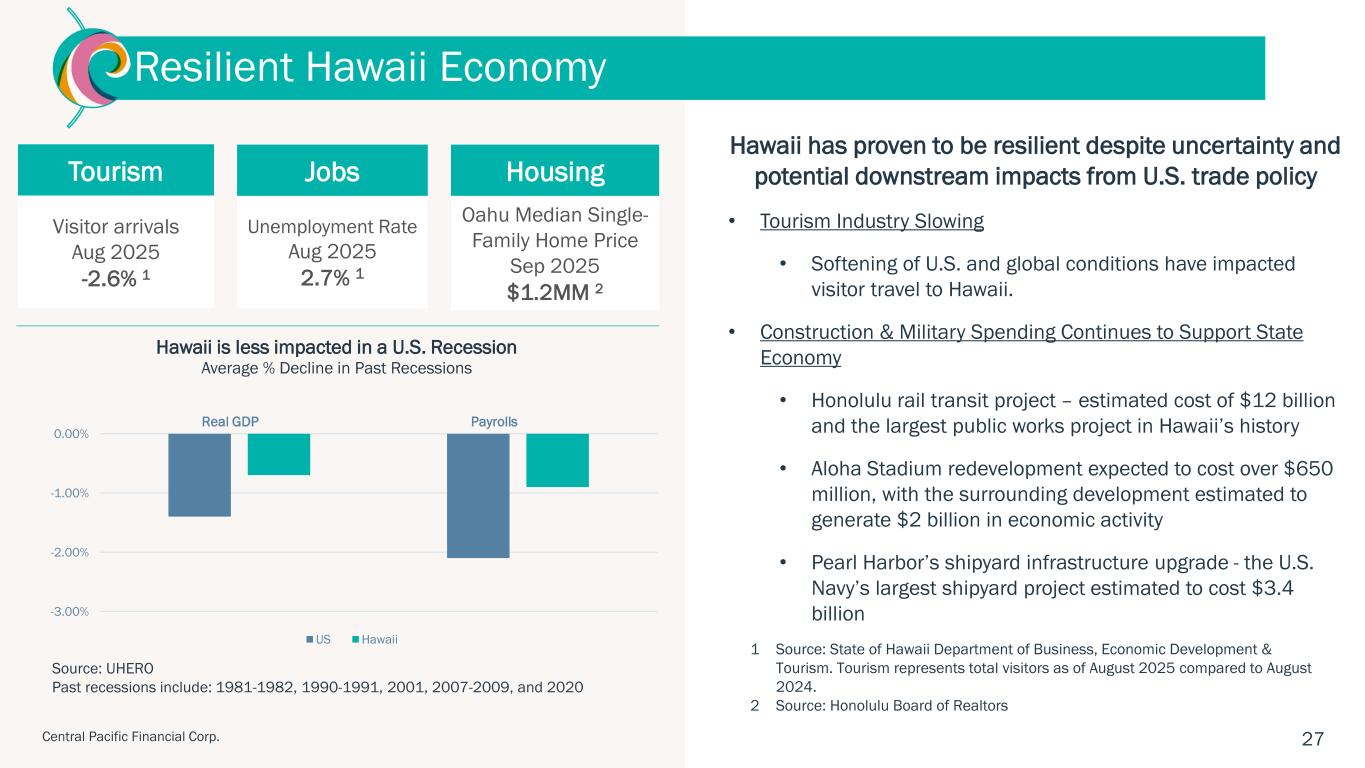
Thank you, Gerald, and aloha to everyone joining us today. I want to begin by expressing our sincere gratitude for your continued interest in support of Central Pacific Financial Corp. We are pleased to report that our bank delivered strong results this quarter. We remain well-positioned to pursue our strategic objectives while maintaining flexibility to navigate economic headwinds with a high-quality, well-capitalized balance sheet and strong liquidity. Our foundation is solid, and our focus is on exceptional customer experience, disciplined growth, sustainable profitability, and long-term value for our shareholders. While Hawaii's economy is experiencing some softness in tourism due to U.S. trade policy, Our market has historically proven resilient. Ongoing construction and military spending continue to provide meaningful support, helping to stabilize the local economy. This quarter, our results were highlighted by deposit and loan growth, margin expansion, and the strategic consolidation of our operations center into our main headquarters, which positions us for improved collaboration among employees and future efficiency. We also announced a strategic partnership with the Kyoto Shinkin Bank, strengthening economic ties between Hawaii and Japan's Kyoto region. This collaboration will create new opportunities for our small and mid-sized customers, enhancing growth prospects, and reinforcing our commitment to supporting business development. At Central Pacific, our vision is to be a bank that people want to invest in, work for, and partner with. For our employees, this means fostering a workplace where talent can thrive. For our customers, this means providing exceptional experience with safe, reliable, and accessible financial solutions that help them achieve their goals. and for our shareholders, this means delivering consistent, attractive returns, distributing income responsibly, and building long-term value. Our governing objective is anchored in disciplined capital stewardship. Our strategy is focused on optimizing bottom-line returns while maintaining a high level of liquidity and prudent levels of capital. We achieve this through thoughtful capital allocation, measured risk-taking, and ethical business practices. Operationally, we are building a resilient business model designed for steady returns rather than short-term gains. Our balance sheet strategy is focused on enhancing composition, improving risk-adjusted returns, shortening duration, and increasing diversification across products and geography. In essence, our focus is on four priorities. Enhancing our products to better serve customers and capture growth opportunities. Building the strongest team possible to execute our strategy effectively. Strengthening the balance sheet to deliver durable profits and solid returns. And growing the business prudently through disciplined programmatic strategies. We are confident that this approach positions Central Pacific for continued long-term success and value creation for our shareholders. With that, I'll turn the call over to David. David?
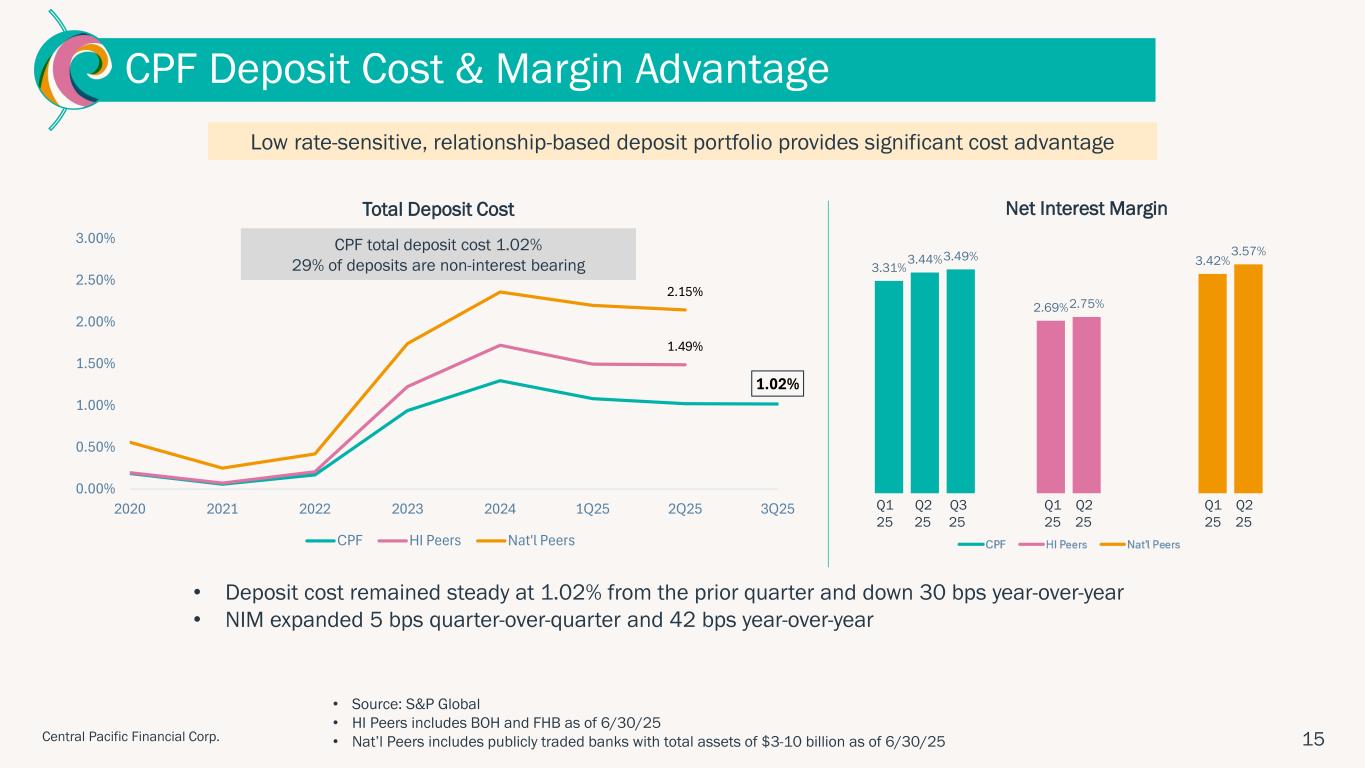
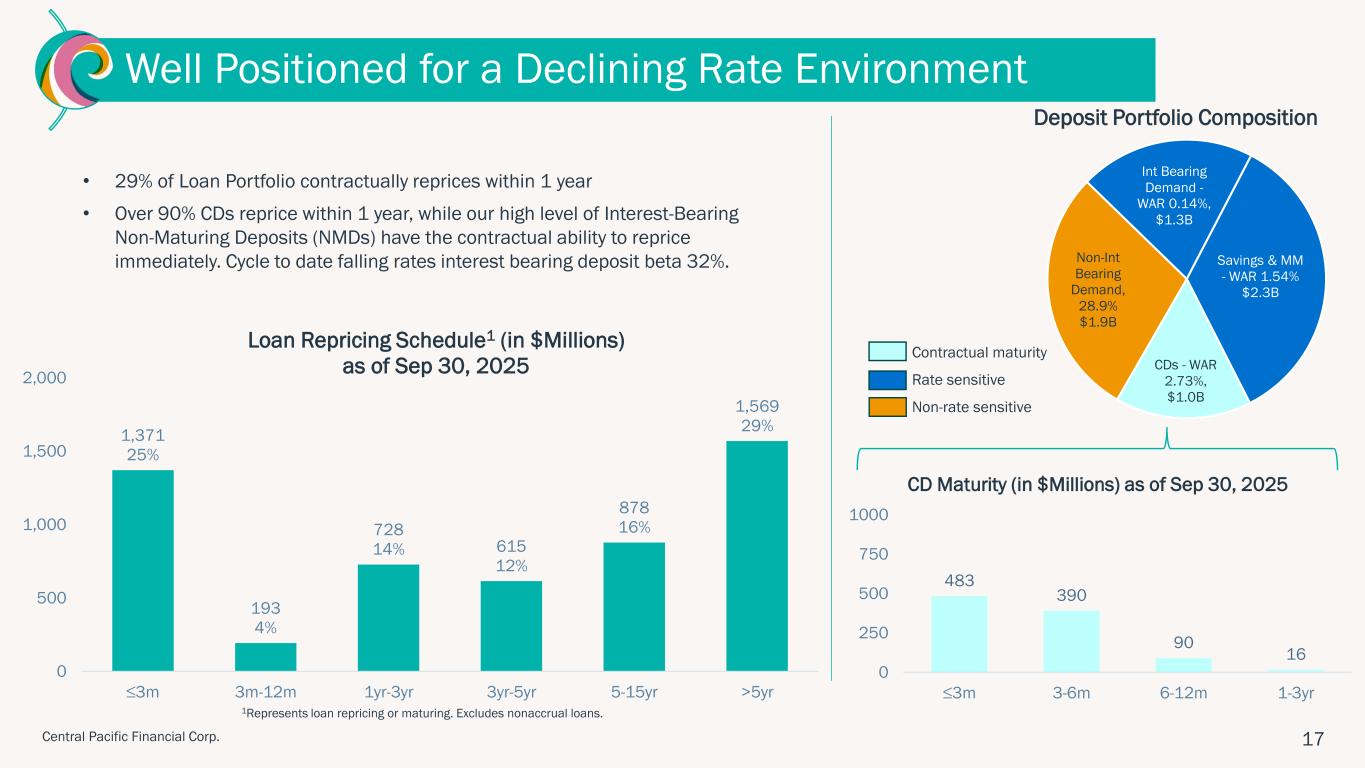
Thank you, Arnold. Our balance sheet growth strategy continues to focus on deepening customer relationships and increasing market share within our core Hawaii market. As expected, in the third quarter we reported solid net growth with loans increasing by $77 million and deposits by $33 million. The Hawaii loan portfolio saw growth in commercial, commercial mortgage, and construction loan types, which was offset by runoff in residential mortgage and home equity. The mainland loan portfolio also saw solid growth in commercial mortgage and construction. While While this quarter's growth was led by Mainland activity, we anticipate a more balanced contribution between Mainland and Hawaii markets moving forward. We continue to operate within our historical range of Mainland loans, maintaining 15-20% of total loans in that segment. Average yields on total loans increased 5 basis points to 5.01% compared with the prior quarter. Our loan pipeline remains healthy and we continue to expect full-year loan growth in the low single-digit percentage range for 2025. Deposit growth of $33 million brought total deposits to $6.6 billion, reflecting both business development wins and deposit stabilization inflation following recent interest rate volatility. While period and non-interest-bearing DDA deposits experience normal fluctuations, we are pleased to see continued growth in average non-interest-bearing deposits. The average rate paid on total deposits remained steady at 1.02% as the Fed rate cut occurred late in the quarter. Overall, these results demonstrate the continued strength and resilience of our balance sheet and our commitment to disciplined growth and long-term value creation for shareholders. With that, I'll turn the call over to Dana.
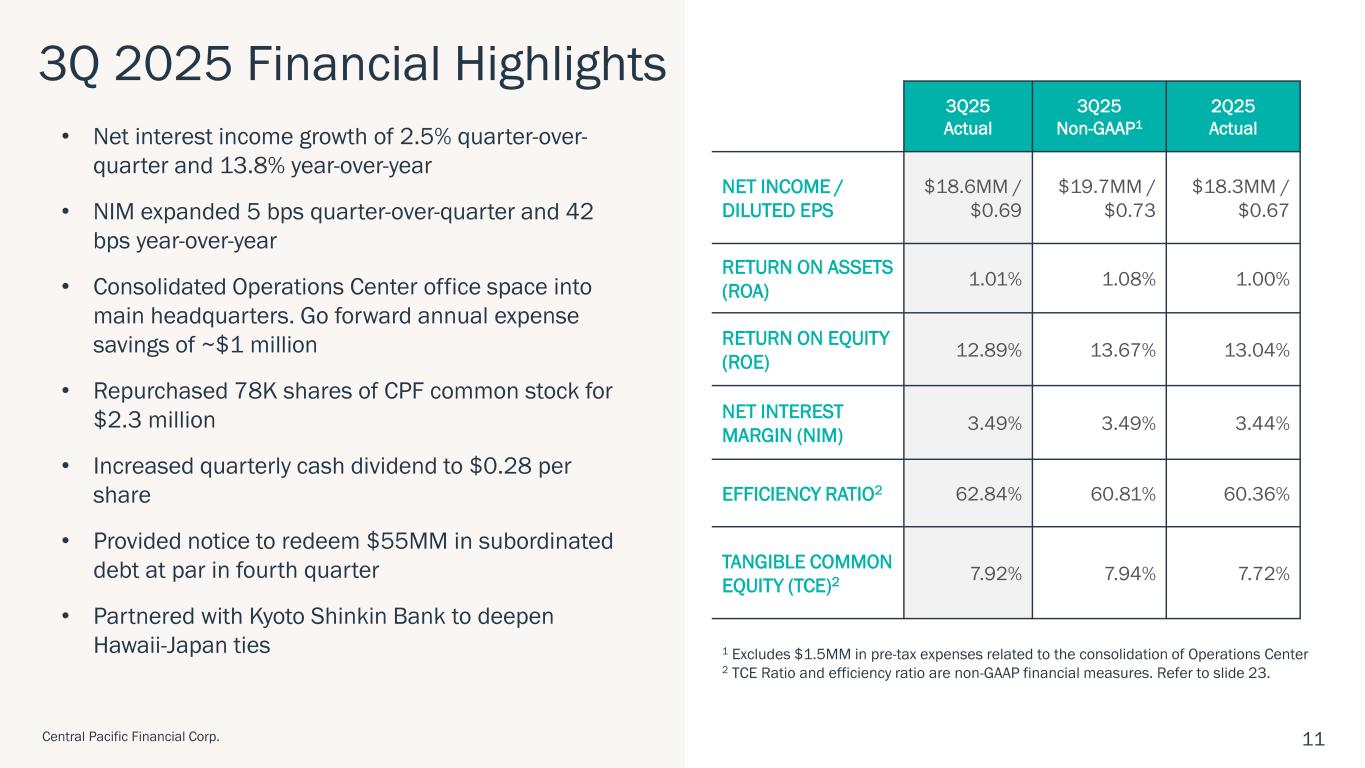
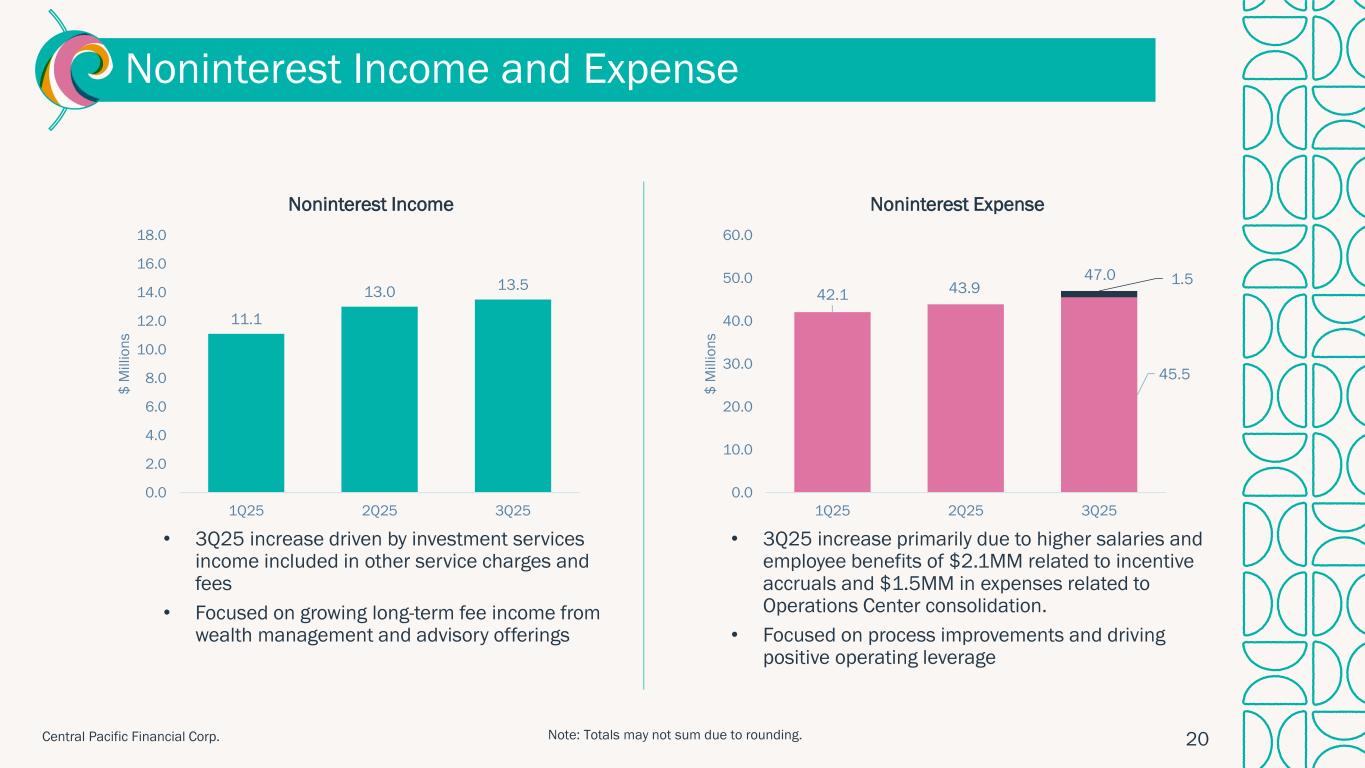
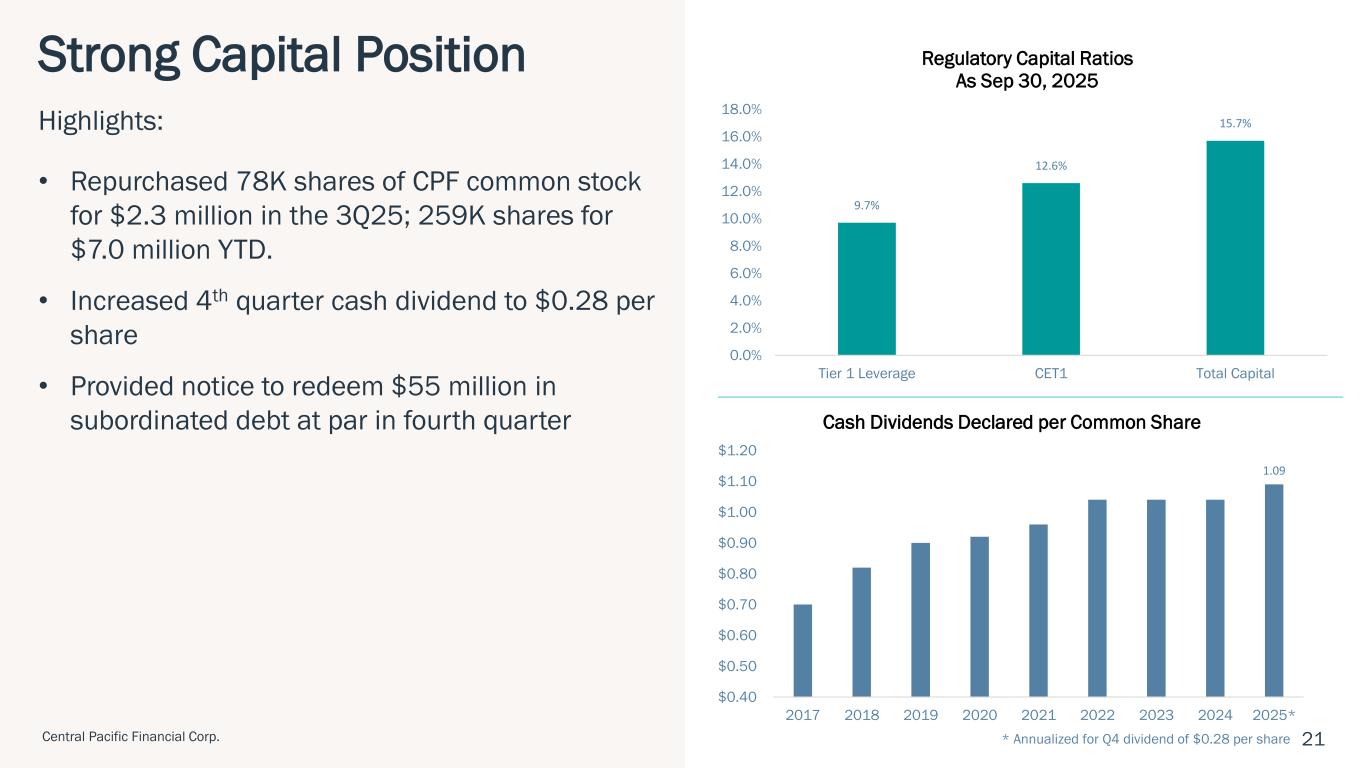
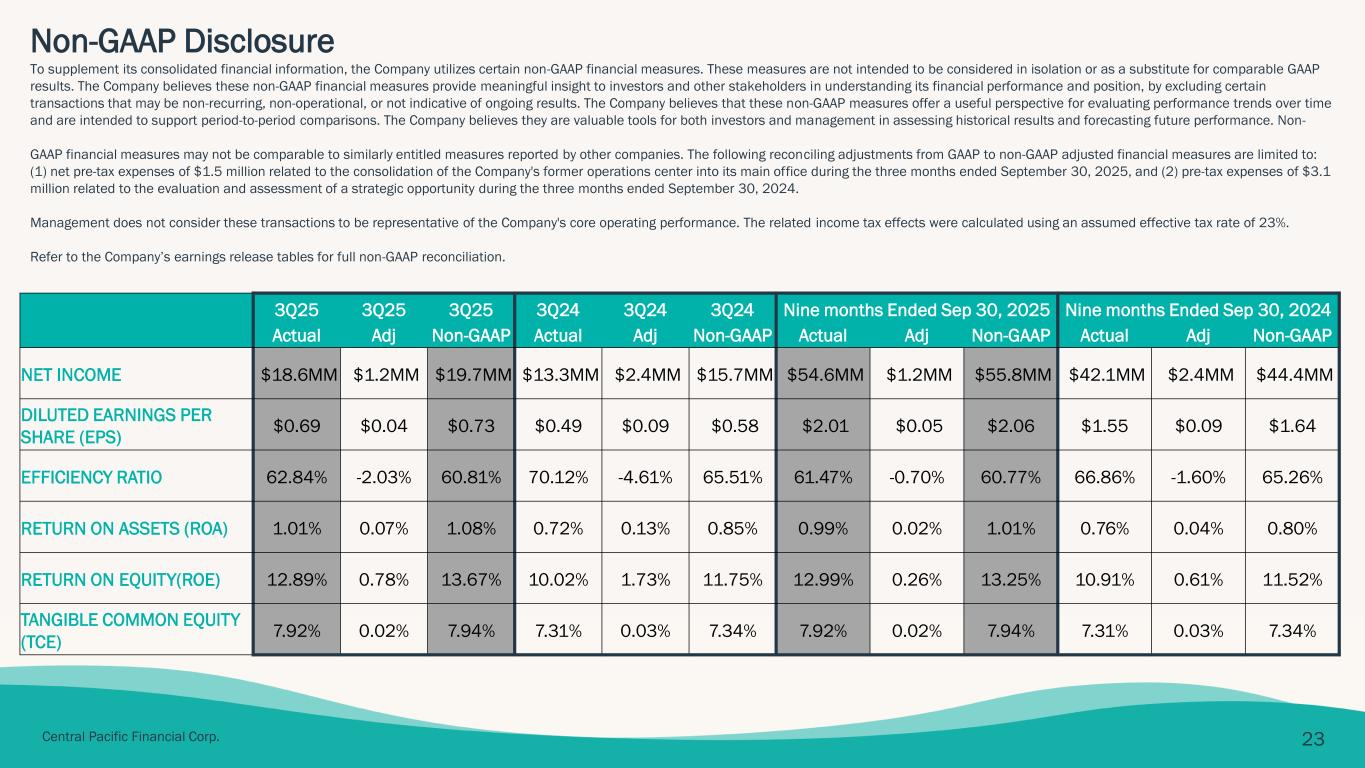
Thanks, David. In the third quarter, we reported net income of $18.6 million, or 69 cents per diluted share, excluding $1.5 million in one-time pre-tax office consolidation costs, adjusted net income was $19.7 million, or $0.73 per diluted share. ROA was 1.01% and ROE was 12.89%, underscoring discipline execution in the current environment. Net interest income rose 2.5% from the prior quarter to $61.3 million, and net interest margin expanded five basis points to 3.49%, primarily driven by higher average yields on loans. There was approximately $230 million in loan portfolio runoff in the third quarter. Our weighted average new loan yield this quarter was 6.9% as compared to our portfolio yield of 5.0%. The investment portfolio also has runoff of about $30 million per quarter, which we are currently reallocating to fund loan growth. We are not planning at this time to do any further material investment securities or loan portfolio restructuring, as we believe our profitability is strong and will be further enhanced over time through ongoing repricing. For the fourth quarter, we are guiding to $62 to $63 million in net interest income and a net interest margin increase of 5 to 10 basis points. Total other operating income was $13.5 million, up $0.5 million from last quarter, primarily driven by higher investment services income from the wealth management group. There is some seasonality in the revenue from wealth, with the third quarter usually being strong. Additionally, Boley income benefited again this quarter from favorable market movements. Our normalized fourth quarter guidance for total other operating income is 12 to 13 million dollars. Total other operating expenses were 47.0 million dollars up 3.1 million from the previous quarter. During the quarter we recorded a net 1.5 million one-time expense related to the consolidation of our operations center which included a 2 million dollar write-off of fixed assets, partially offset by a lease accounting credit. Going forward, we expect to realize total annual savings from reduced lease, operating, and maintenance expenses of approximately $1 million. Additionally, salaries and employee benefits increase by $2.1 million due to higher incentive accruals and commissions tied to stronger production. Our guidance for total Other Operating Expense is $45 to $46 million which anticipates similar levels of incentive accruals in the fourth quarter. During the third quarter, we repurchased approximately 78,000 shares at a total cost of $2.3 million and we have $23 million remaining repurchase authorization as of September 30th. Additionally, fourth quarter to date through October 27th, we have repurchased about 127,000 shares at a cost of $3.7 million. The board increased the fourth quarter dividend by 3.7% to $0.28 per share. The dividend is payable on December 15th to shareholders of record as of November 28th. Finally, on October 1st, we notified holders of our subordinated debt notes that we will redeem the full $55 million outstanding at par on the upcoming call date of November 1st. The subordinated notes, which were fixed for the first five years at 4.75%, would have repriced to floating rate at SOFR plus 456 basis points on November 1st. Our current target CET1 ratio is in the range of 11 to 12% and our TCE ratio in the range of 7.5 to 8.5%. We plan to deploy our capital first by continuing our quarterly cash dividend with about a 40% payout ratio. Then our priority is to fund accretive loan growth and opportunistically continue share repurchases. Overall, we have a healthy capital position and are optimizing our capital structure to provide sustainable long-term value to our shareholders while continuing to maintain prudent capitalization levels to protect against downside macroeconomic scenarios. I'll now turn the call over to Ralph.
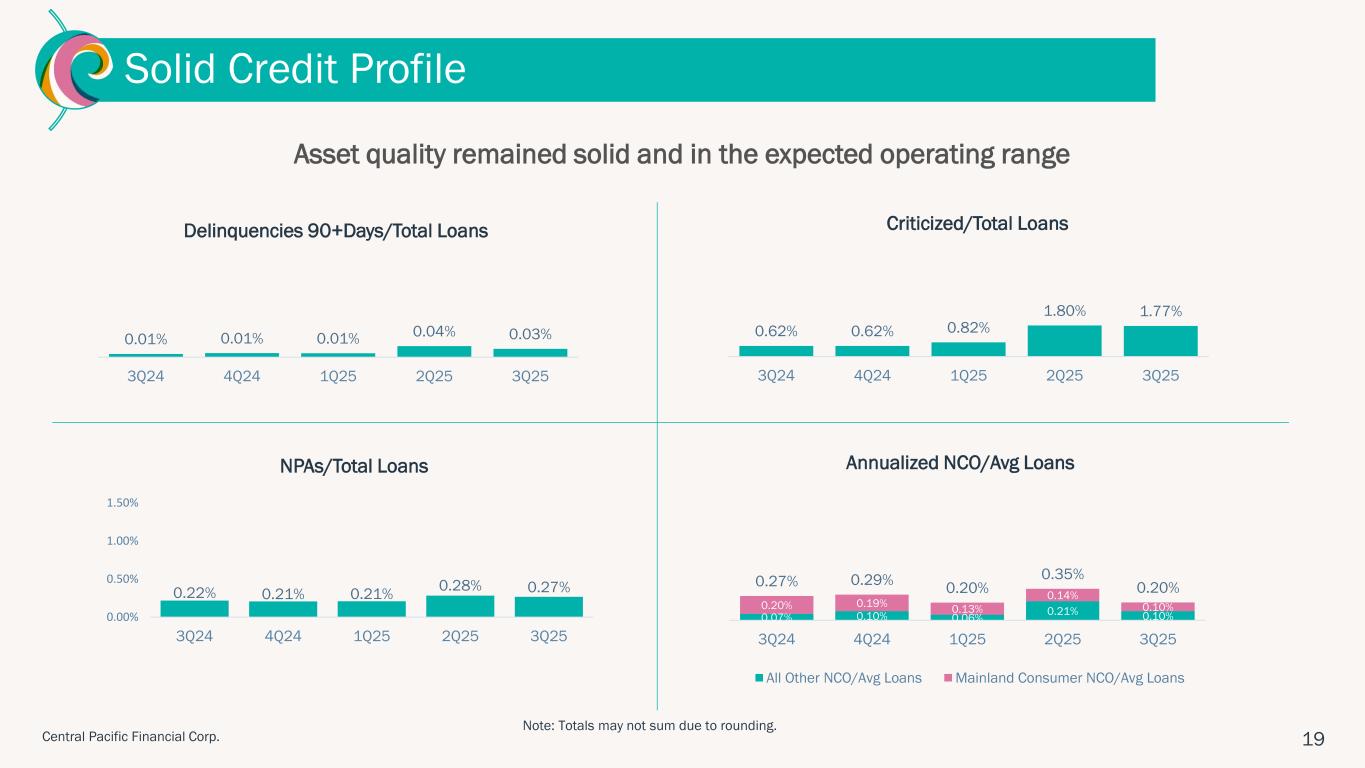
Thank you, Dana. Our risk appetite is informed by our strategic goal of delivering acceptable risk-adjusted returns while maintaining a high level of solvency. We seek accretive growth, balance, and diversification. Credit risk is measured and evaluated against expected results and established guidelines and limits. In the third quarter, we continued to maintain strong credit performance and asset quality. Credit costs stayed within an expected range, and the level of NPAs passed due loans and criticized assets remained low. Net charge-offs were $2.7 million, or 20 basis points, annualized on average loans, with consumer book losses continuing to trend downward. Non-performing assets totaled $14.3 million, or 19 basis points of total assets, down one basis point from the last quarter. Past due loans over 90 days decreased to $1.5 million, representing just three basis points of total loans. Criticized loans declined to 177 basis points of total loans, maintaining low levels. Provision expense for the quarter was $4.2 million, including $3.4 million added to the allowance and $0.8 million to the Reserve for Unfunded Commitment. The decrease in provision expense was primarily driven by lower net charge-offs this quarter. We maintain a strong capital position to support the bank through the credit cycle and against additional impacts that could arise in periods of prolonged stress. At quarter end, our total risk-based capital was 15.7%. Looking ahead, we will continue to take a prudent approach to building our loan portfolio, one that considers a range of outcomes and builds margins of safety to protect against adverse conditions. Let me now turn the call back over to Arnold.
Thank you, Ralph. In closing, our third quarter results reflect discipline execution, strong profitability, and prudent risk management in a dynamic market environment. I'm grateful to our employees for their dedication and innovation, which continue to drive our success. To our customers and shareholders, thank you for your trust and support as we execute our strategy and deliver long-term value. We are now happy to take your questions.
Operator
Thank you. If you'd like to ask a question, please press star 1 on your telephone keypad. If you'd like to enjoy your question or your question has been answered, simply press star 1 again. We'll now begin the question and answer session. And our first question comes from the line of David Feaster from Raymond James. Please go ahead.
Hey, good morning, everybody. Morning, David. I want to start on the growth side. I appreciate some of your commentary, but I did want to get a sense of what drove the declines in loans in Hawaii and what gives you confidence that growth on the islands accelerates. And then, you know, maybe just touching on in that conversation, some of the impacts of the government shutdown in the islands, as well as opportunities to capitalize on some of the disruption as well across your footprint, too.
Yeah, thanks, David. David Morimoto will take that question. Hey, David.
Yeah, again, you know, we did see net growth in the Hawaii market in the areas that we expected. So that would be in construction, C&I, and commercial mortgage. The net growth in those sectors were overcome by runoff in the residential, primarily the residential mortgage and the HELOC portfolios, which are two portfolios that have been under a little pressure as a result of the interest rate environment. With interest rates hopefully continuing to moderate, we are hopeful that we can see some reduction in the runoff in those two portfolios, and that would bode well for future Hawaii loan growth. In addition to that, we do have a healthy Hawaii loan pipeline. There are a number of deals in the pipeline right now. It's just a function of timing. There's a number of loans that are between the fourth closing and the fourth quarter and the first quarter. But we'll need to see how that plays out. But we're cautiously optimistic that forward loan growth will be more balanced between the Hawaii and mainland markets. Okay, that's helpful.
And then, you know, maybe touching on the expense side, I appreciate the color that you gave in the guidance. You know, it's a bit higher than what we've been expecting. It sounds like there's some cost saves with that op center consolidation. You know, I know a decent amount of its incentive accruals, but just kind of curious, as you think about the expenses, where are you investing today? I mean, are you seeing opportunities for new hires? Are there some other key investments that you guys are making? And just how do you think about your ability to drive positive operating leverage going forward?
David, this is Arnold. Let me just maybe start and then I'll turn it over to Dana. And, you know, obviously, as you know, we have been investing in technology, you know, harvesting some of the investments that we've made in the past to be able to drive efficiency. So that continues to be, you know, an area where we focus in on, you know, we have a few systems that we're putting in place today that's going to create a lot of efficiencies for us and just, you know, creates better tools for our employees to be able to support our customers and drive our effectiveness. And then I think, you know, just generally speaking, we are very focused in, you know, the development of our people and looking at areas where we have gaps and building skill levels in order to execute on our strategies as we move forward. So there will be some investment in people for sure, and I appreciate that you brought that up because that's, you know, the people is going to help us execute on the strategies. So, you know, with that kind of overall, I'll turn it over to Dana for additional further comments.
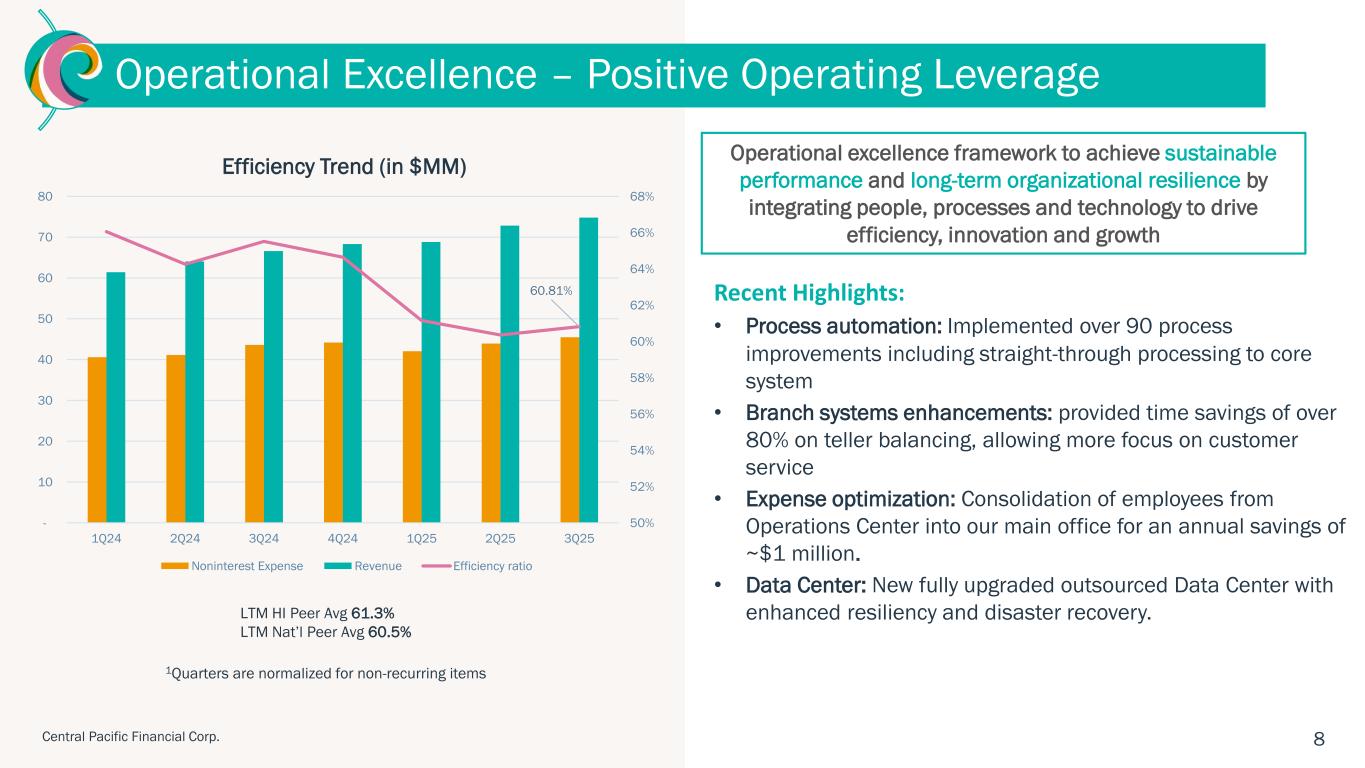
Sure, sure. Hey, David. What I'll add is that, you know, managing expenses and our efficiency ratio continues to be a key focus of ours. This quarter, we were impacted by the one-time expense from our office consolidation, and this will create significant efficiencies going forward. Additionally, this quarter, as we had greater revenue, we needed to increase our incentive and commission accruals. This is a good thing. Our objective continues to be driving our efficiency ratio to the high 50% range and mid-50s over time, and we plan to achieve this through consistent revenue growth while we continue process automation and greater use of technology.
Okay, that's helpful. And then, you know, hoping you could maybe touch on the deposit side of the equation and what you guys are seeing there from a competitive landscape, you know, some of the core deposit growth initiatives that you've got in place, and just, you know, how do you think about your ability to, to, you know, we just got another Fed cut, right? How do you, you know, just given the competitive landscape, how do you think about the ability to pass through some of these and reduce deposit costs with Fed cuts?
Hey, David. It's David again.
Yeah, and the deposit growth, again, we're cautiously optimistic. The fourth quarter is going to be a little more challenging of a quarter because we do have some known outflows. So I think, you know, we're striving to probably keep the positive growth relatively flat year over year. So on a full year basis, whereas we were guiding to low single digit, I think right now it's probably more flattish as a result of what we know at this point in time on the fourth quarter. Having said that, we are optimistic on 2026. You know, we do think we can drive towards low single-digit deposit growth in 2026. And the strategies there are, you know, it's the same strategies that we have been deploying, probably with just a little more rigor going forward. So it is the blocking and tackling of banking. And, you know, we are seeing success in the Hawaii market with those efforts. And then we also are optimistic on Asia. You know, we continue to have initiatives in Japan and Korea, and we're hopeful that those strategies will continue to gain traction in 2026.
That's terrific. Thanks, everybody.
Operator
Our next question comes from the line of Matthew Clark from Piper Sandler.
Please go ahead. hey good morning everyone morning matthew um just on the starting on the on the margin um interest bearing deposit costs up a couple bits but the nim guide implies uh well you're nimic you're calling for nim expansion so um my sense is those costs have rolled over. Do you have the spot rate at the end of September on interest-bearing deposits?
Hey, Matthew, it's Dana. The spot rate on, I have it on total deposits at 930. It was 100 basis points. And if you're also looking for the September month-to-date margin, that was 3.51%. So, we continue to feel like it's moving in the right direction.
Got it. Okay, great. and then you're going to get a two-month benefit from redeeming the sub-debt. When you strip out the sub-debt, it implies the rest of your long-term debt costs are about $623. Can you remind us of the duration of that long-term debt that's left? And I just want to try to forecast the rate.
Sure. Sure. Matthew, we just have a $125 million FHLB advance outstanding, and it matures in February of 2028.
Okay. Got it. Maybe there's some repos in that number. Okay. And then just on the, do you happen to have the, or just on the loan growth this quarter, the mainland piece, theory and construction. Maybe if you could just provide some color on what you originated this quarter. I assume it's all participations and just an update on the size of the SNCC portfolio.
Hey, Matthew. It's David. I'll start off on the mainland part of the question and then I'll turn it to Dana or Ralph on the SNCC details. But what we saw in the third quarter is growth in the industrial and multifamily sectors. That's for both the multifamily, I'm sorry, the commercial real estate and the construction portfolios. So they were in the industrial and multifamily sector. And then maybe just to take a step back on the mainland lending strategy, what I will say is that Hawaii will always be our core banking market. Having said that, CPF has always had some loan exposure on the mainland, and that's really due to some structural factors with the Hawaii banking market. You know, the Hawaii banking market has always been characterized as having more deposit balances relative to good lending opportunities, and a lot of that has to do with Hawaii being largely a service-based economy without large manufacturing. And due to those structural factors, that's why we always have had a portfolio on the Mainland lending provides CPF with geographic diversification, shorter-duration assets, attractive risk-adjusted returns. So having said all of that, the third quarter was the growth was largely, net growth was largely driven by the mainland. You know, what we'll see going forward is very, very much based on opportunities. It'll fluctuate between Hawaii dominant growth versus mainland dominant growth based on opportunities in that particular quarter.
Great. And then just maybe on the SNCC exposure at the end of the quarter?
Yes, this is Ralph. The total SNCC exposure for the bank is around $526 million. And how that breaks out is mainland CRE is about $190 million. And then mainland corporate lending, which is really sort of the large syndicated, broadly syndicated loans, that's around $144 million. And that's been coming down over the past year.
Okay, that's helpful. Thank you. And then the last one for me, just on the special mention and substandard balances, where those stood at the end of September.
Yeah, from a balance perspective, let's see. Special mention was $34.3 million. Classified was $62.1 million. So relatively flat from the prior quarter. And, you know, in general, I think we had mentioned on the last call, we have a couple of large credits that probably represent about, you know, a little over half of that. Both of those loans are secured. They're performing loans. We've done individual sort of assessments. We would expect no loss in the event that they did default, but they are performing. And our expectation is that they'll continue to perform. The sponsors have, I think, meaningful equity, you know, invested in these projects. And I think they're very committed to, you know, working through the situations that they're facing today.
Okay. Great. Thanks again.
Operator
Thank you. Our next question comes from Delana Kelly Mara from KBW.
Please go ahead. hey uh thanks for the question um i was hoping to circle back to the expense side to david's question on on compensation um you'd mentioned some of that increase was related to um step up and bonus accruals i'm just wondering how much of that call it two million was related to that um i appreciate the guidance about q4 but just trying to get a a good run rate as we kind of you know, start the year next year. Thanks.
Hi, Kelly. It's Dana. Of that $2.1 million, about $1.5 million was related to the incentive accruals.
Okay. That's super helpful. And then I appreciate the new color on capital targets. It looks like you're currently, you know, within the range on TCE and above on CT1. Kind of wondering how you guys are thinking about this level here. Does that imply, you know, potentially some more capital return? And, you know, given your outlook for balance sheet growth, it would seem that absent, you know, maybe more aggressive buybacks that would build.
So, I'm wondering how you guys are kind of thinking about managing that and kind of the intermediate term trajectory of capital levels thank you hey kelly let me start off by saying that our target range it considers a number of factors versus our debt rating agency expectations we also further maintain a level to protect against potential downside macroeconomic scenarios and really at this point in the cycle we believe this is prudent. We also regularly perform capital stress tests, and those results are considered in our decision. So, with that said, we are currently slightly above our target range for CT1, and we are taking a more proactive but still prudent approach to capital return. So, as I mentioned in the remarks, you know, the priority is first for loan growth, and we are well positioned to support loan growth. We do plan to also continue share repurchases. The level and extent of those share repurchases will be a function of where the loan growth is and where the market is.
Okay, that's helpful. I guess kind of given this, you know, low single digit outlook, like what would, as we look to next year, you know, make you more confident with the loan growth stepping up to kind of deploy more of that CET1 into that range. Thanks.
Kelly, this is Arnold. I think all of us are expecting that rates are going to decline, and we believe that there's pent-up demand, particularly in Hawaii, the Hawaii market. People are on the sidelines waiting for rates to decline. And so we're pretty confident from the standpoint that assuming rates decline, we are going to see more demand for loans. And so therefore, we believe that if that happens, that's going to be where we're going to focus capital on. That's the most secretive for the company, for our shareholders. but we'll adjust as we move forward and we see how the market opens up and what the opportunities are.
Got it. Thanks. That's helpful. Last question for me. It looks like you have a new Japanese bank partner. Just if you could remind us about, you know, the potential opportunities that you see leveraging, you know, now your third relationship that you have with the bank over there.
Yeah, thanks, Kelly. this is Arnold. Yeah, you know, we're really excited about it. It's something that we've been working on for a little bit. You know, we have a couple other relationships in Japan, but we didn't have anyone in the Hangtai area, you know, the Kyoto region, but also includes neighboring areas like Osaka and Kobe. And as you know, we have, you know, given our history and the ties that we have with Japan, starting with the Sumitomo Limited, when we first started, when the bank was first founded, you know, those relationships are important. And we have a lot of business, business of Japanese corporations that have operations in Hawaii. So we believe the, you know, the Kyoto region was an area where we didn't have a relationship with, and we're excited that we can now kind of move forward and hopefully facilitate our customers working together to create economic opportunities, maybe in Hawaii, but also maybe in the Kyoto region.
Thanks for the caller. I'll step back.
Operator
Thank you. There are no further questions. I will now turn to call back over to Gerald Robago for closing remarks.
Thank you, Dustin. And thank you all for joining our third quarter 2025 earnings call. We appreciate your continued engagement and look forward to updating you on our progress next quarter.
Operator
The meeting has now concluded. Thank you all for joining. Give me now this content.