Operator
Hello, everyone. Thank you for joining us and welcome to the First Horizon Third Quarter 2026 Earnings Conference Call. After today's prepared remarks, we will host a question and answer session. If you would like to ask a question, please press star one to raise your hand. To withdraw your question, press star one again. I will now hand the conference over to Tyler Craft, Head of Investor Relations. Tyler, please go ahead.
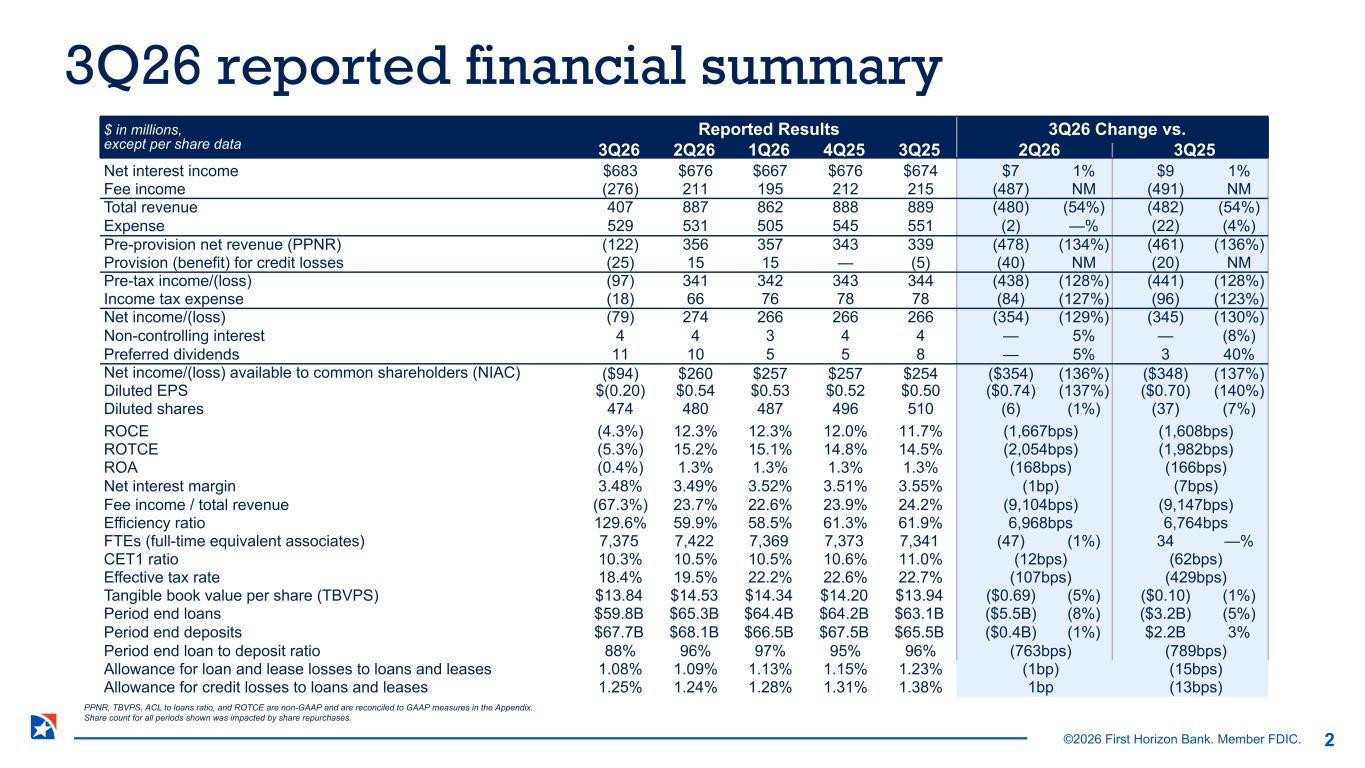
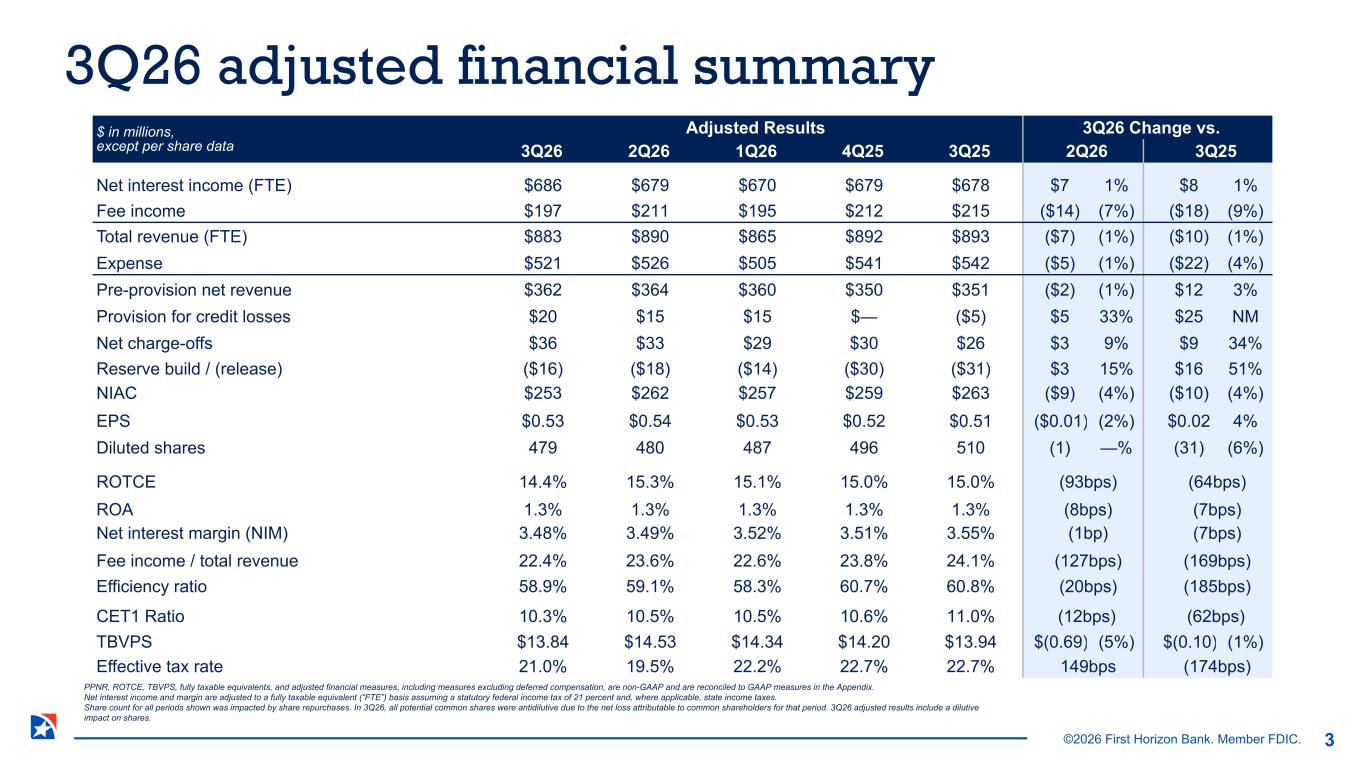
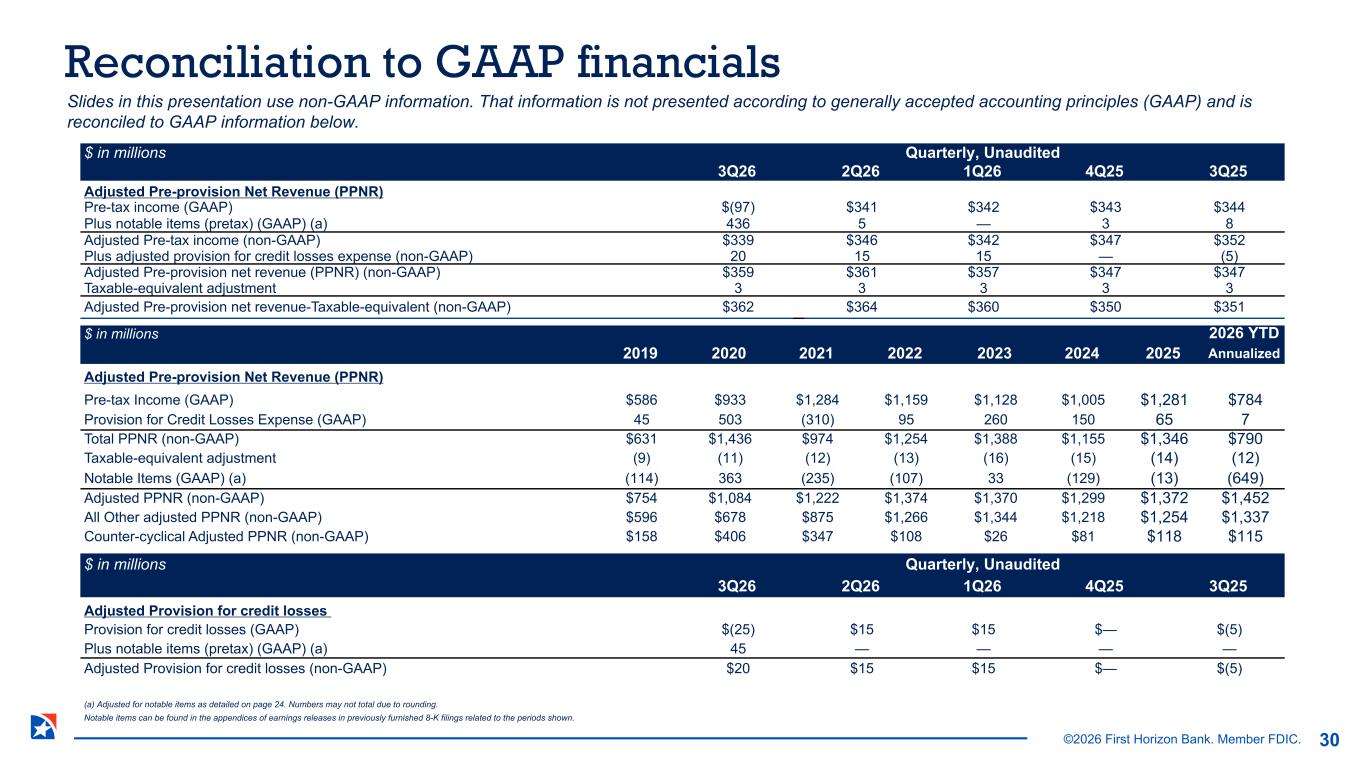
Thank you, Erica. Good morning. Welcome to our third quarter 2026 results conference call. Thank you for joining us. Today, our Chairman, President, and CEO, Brian Jordan, and Chief Financial Officer, Hope Domchowski, will provide prepared remarks after which we'll be happy to take your questions. We're also pleased to have our Chief Credit Officer, Thomas Hung, here to assist with questions as well. Our remarks today will reference our earnings presentation, which is available on our website at ir.firsthorizon.com. As always, I need to remind you that we will make forward-looking statements that are subject to risks and uncertainties. Therefore, we ask you to review the factors that may cause our results to differ from our expectations at the end of our presentation and in our SEC filings. Additionally, please be aware that our comments will refer to adjusted results which exclude the impact of notable items and to other non-GAAP measures. Therefore, it's important for you to review the GAAP information in our earnings release, pages 2 and 31 of our presentation, and the non-GAAP reconciliations at the end of our presentation. And last but not least, our comments reflect our current views, and you should understand that we are not obligated to update them. And with that, I'll hand it over to Brian.
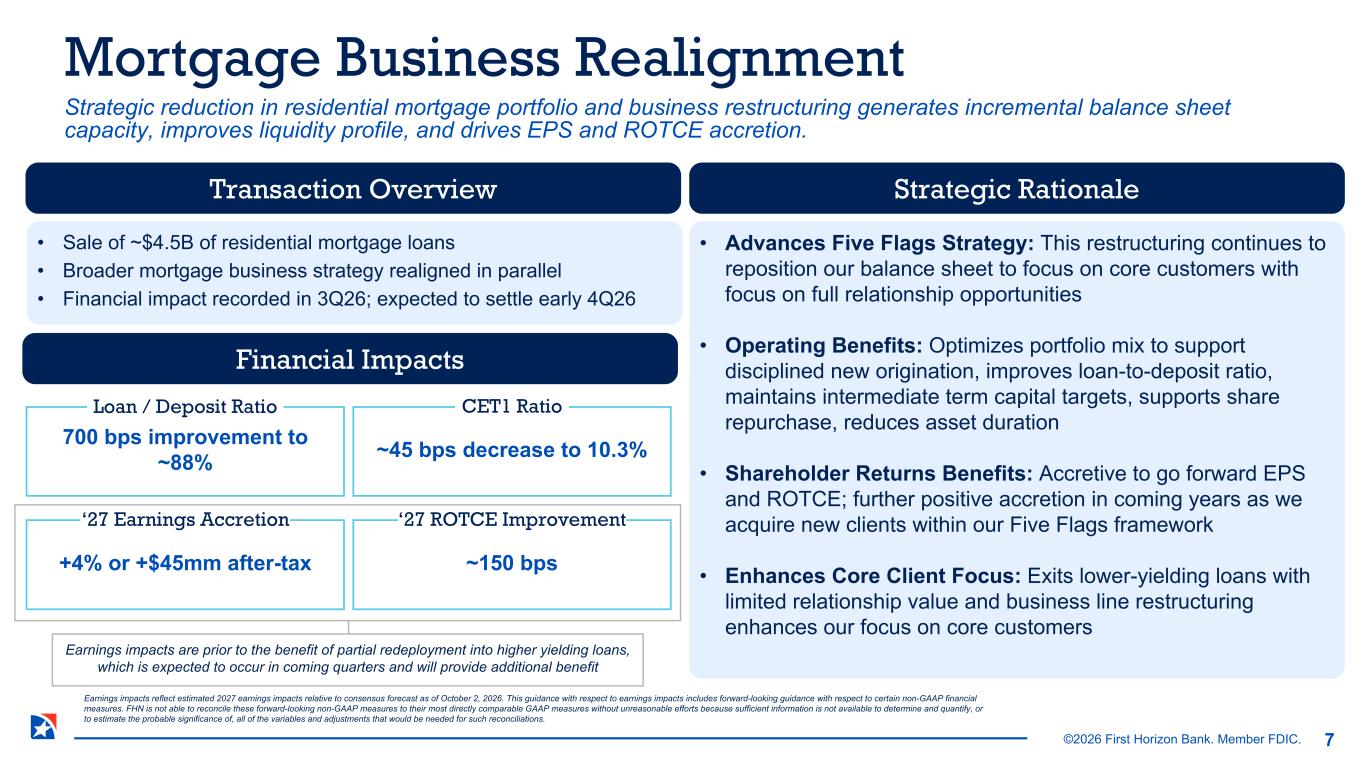
Thank you, Tyler. Good morning, everyone. Thank you for joining us. Our adjusted results this quarter are highlighted by EPS of 53 cents, which is a 4% increase year over year. Over the last year, we've grown our commercial loan portfolio to nearly $2 billion in line with our strategy of growing the balance sheet to generate sustainable returns and drive the most value for our client. This quarter, we initiated the sale of approximately $4.5 billion of targeted residential mortgage loans as part of our broader realignment of the mortgage business. We entered into an agreement in October and expect to settle the transaction early in the fourth quarter. This transaction, along with the business line restructuring, is aligned with the strategy we have discussed consistently throughout the past year of prioritizing full client relationships, enhancing the profitability of our balance sheet, and driving improved earnings and returns through the cycle. This repositioning offers several important strategic advantages. It will serve our goal to utilize balance sheet capacity to profitably serve our clients, and it will immediately enhance our goal of delivering top-tier financial returns. We continue to see steady C&I commercial and commercial real estate loan demand across our geographic footprint from both current and new customers. As outlined in our slides, the transaction will reduce our loan-to-deposit ratio to roughly 88% while maintaining strong capital ratios in line with our stated targets and allowing us to maintain our current share repurchase program. The financial impact will produce an approximately 4% EPS accretion in 2027 without considering the upside impact of deploying proceeds and incremental lending. As noted, we have conviction that this liquidity will support further growth and new core client relationships lending, which will meaningfully enhance our returns going forward. I'll turn the call over to Hope to walk through the results in more detail before I provide some closing thoughts. Hope?
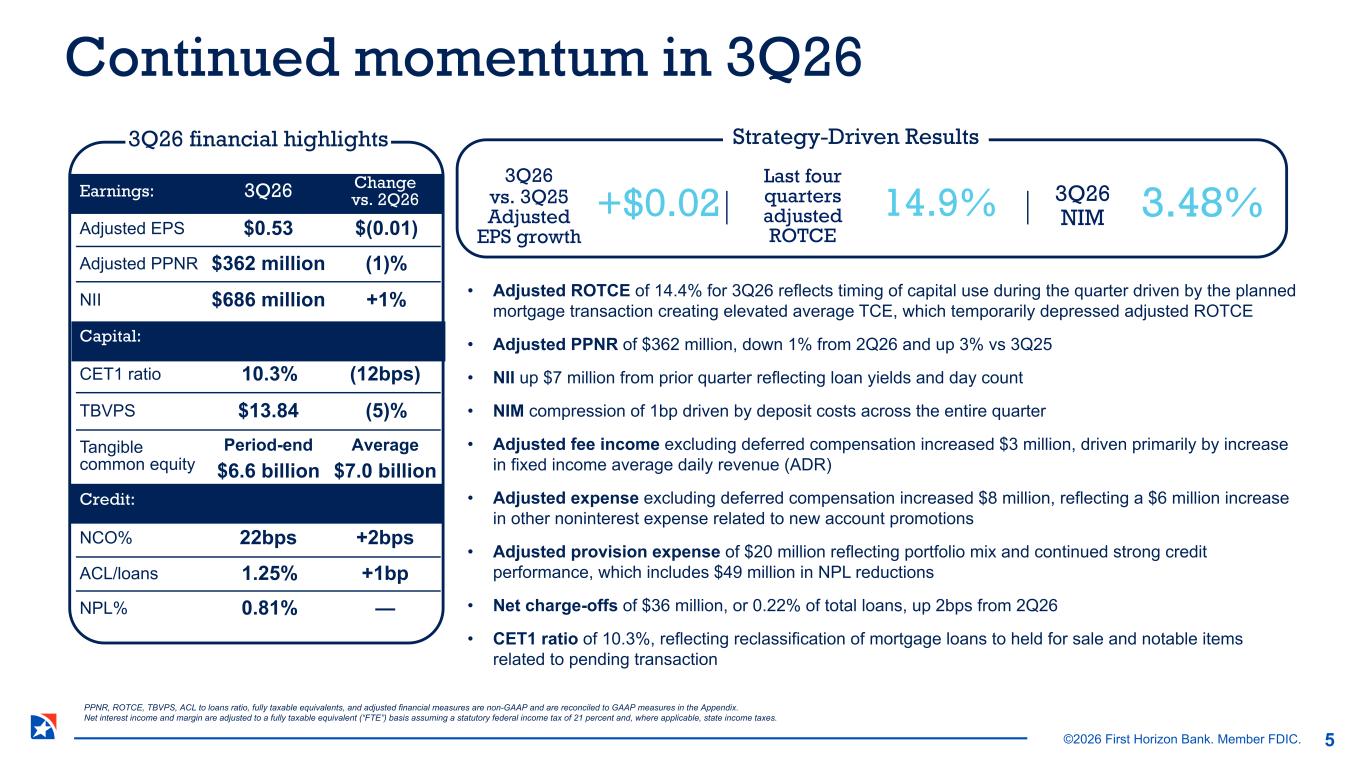
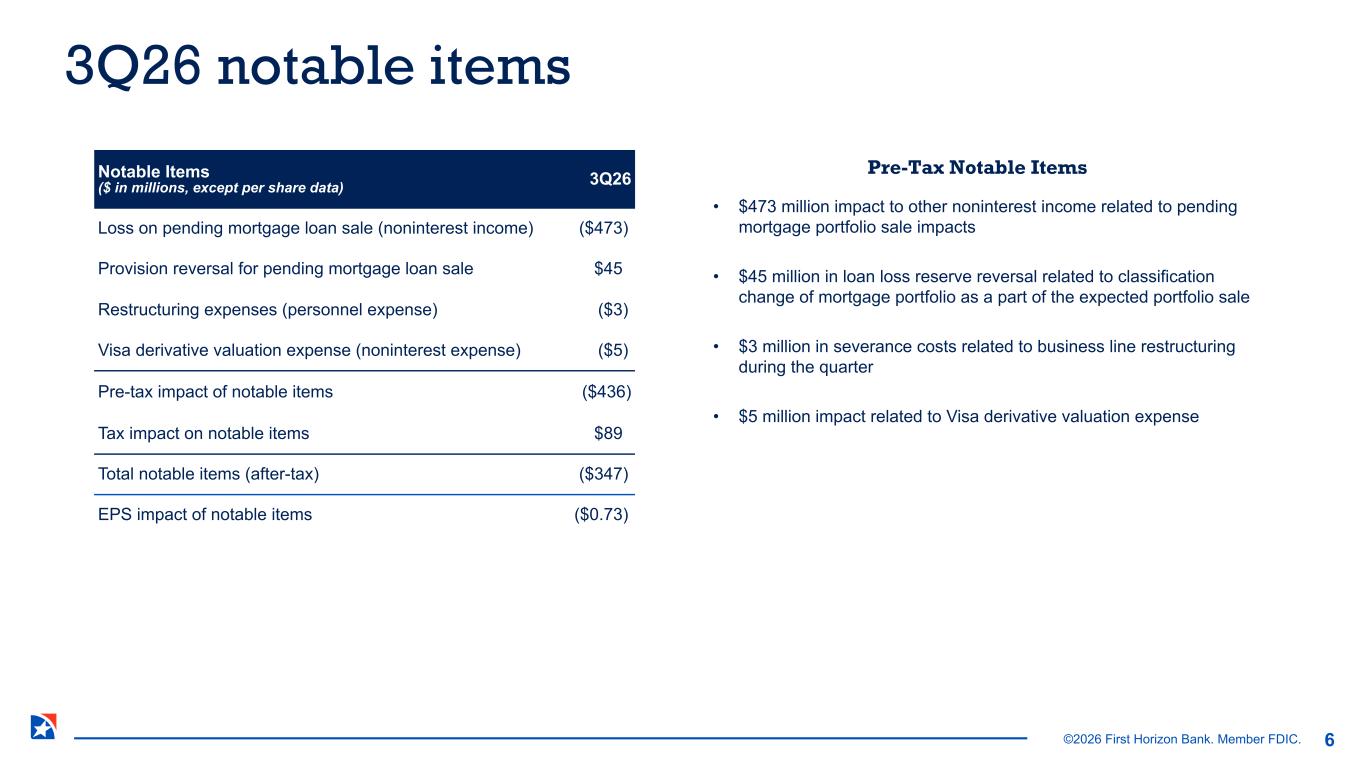
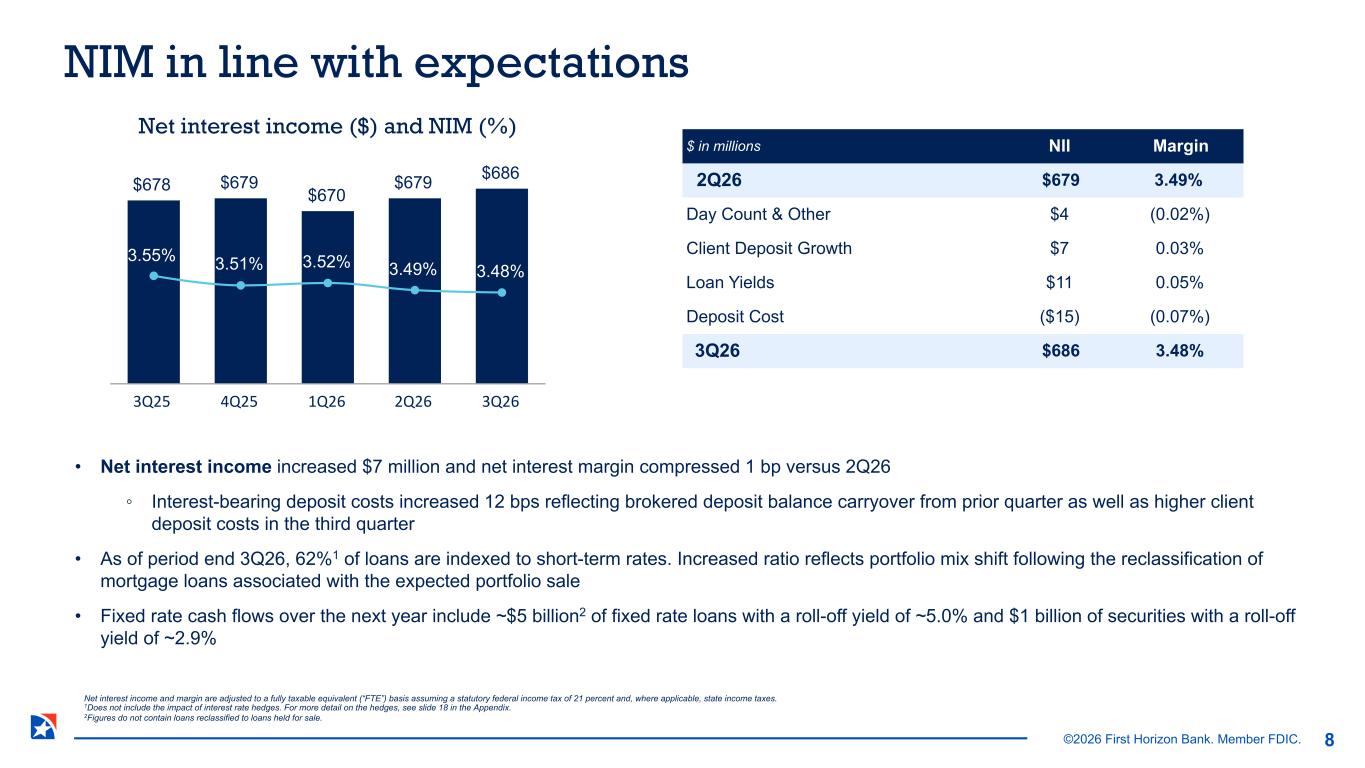
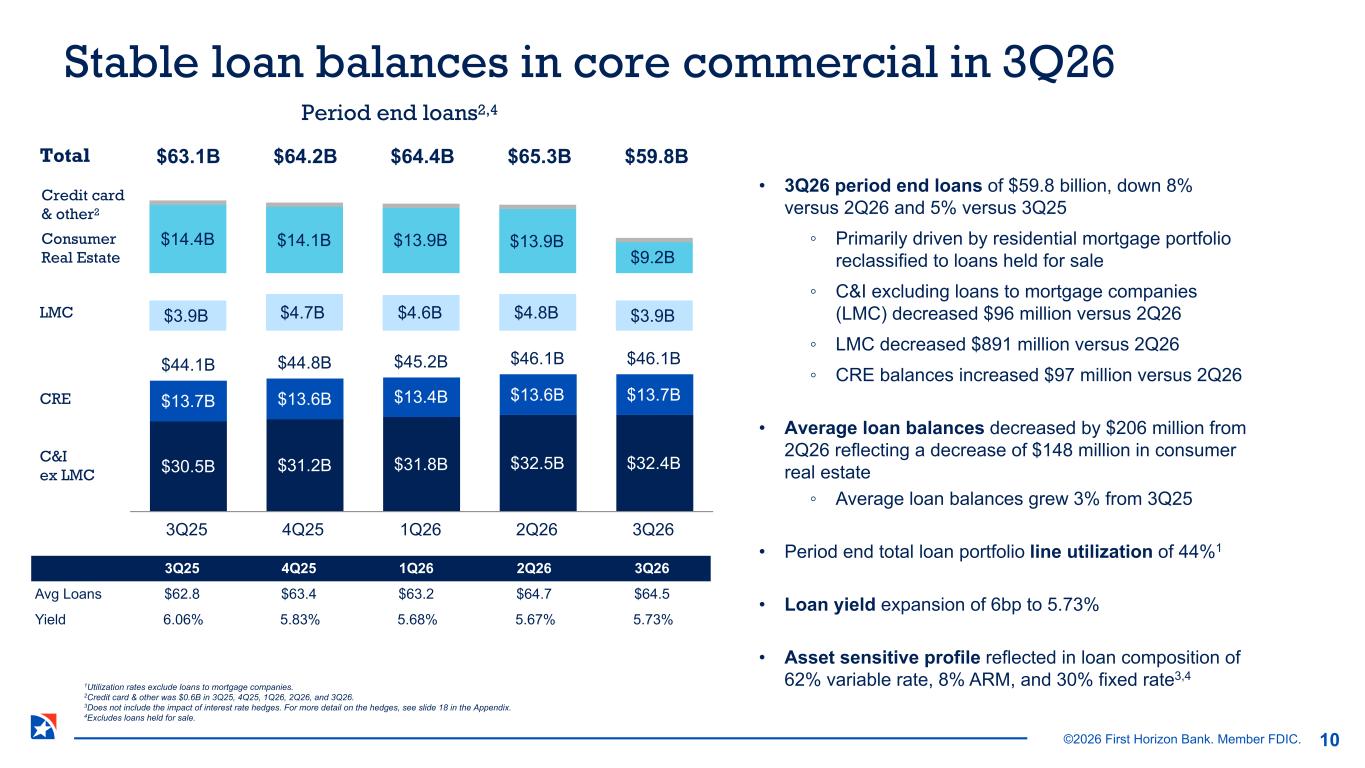
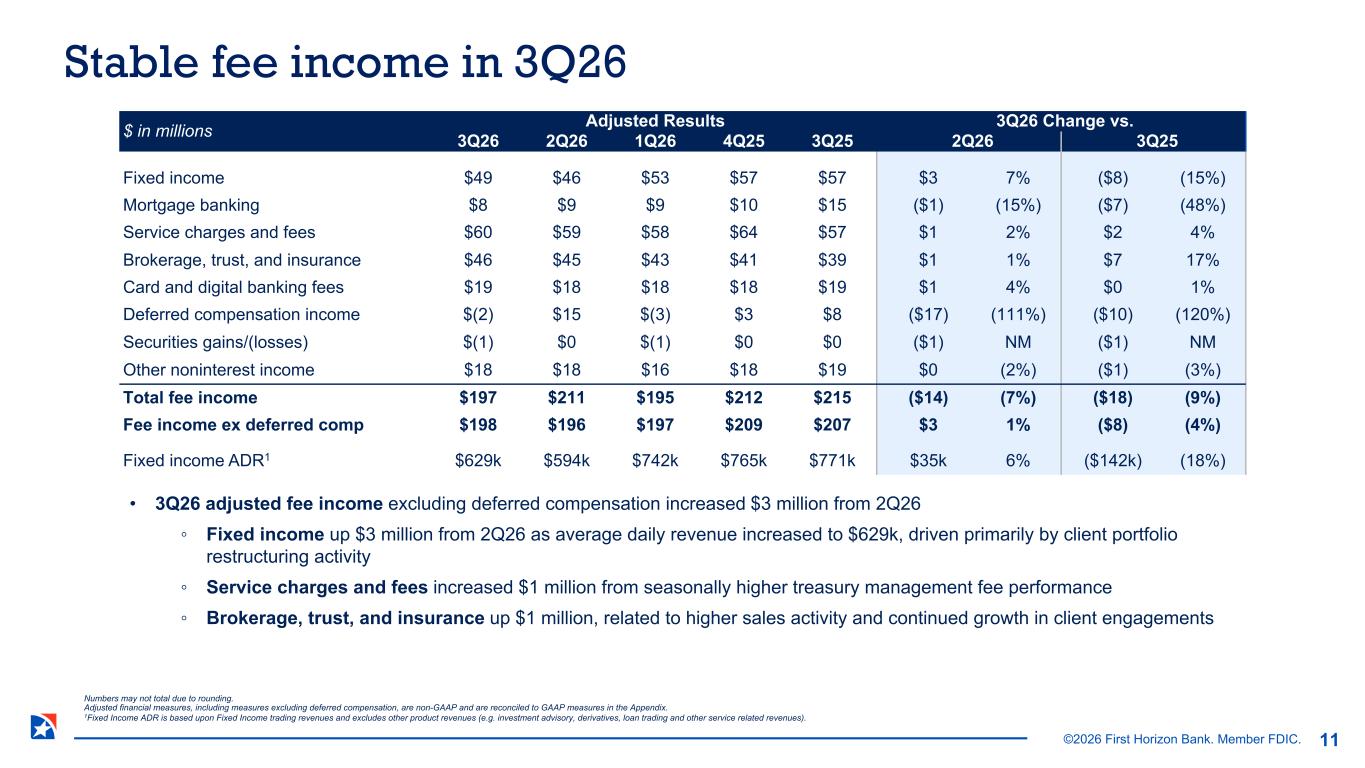
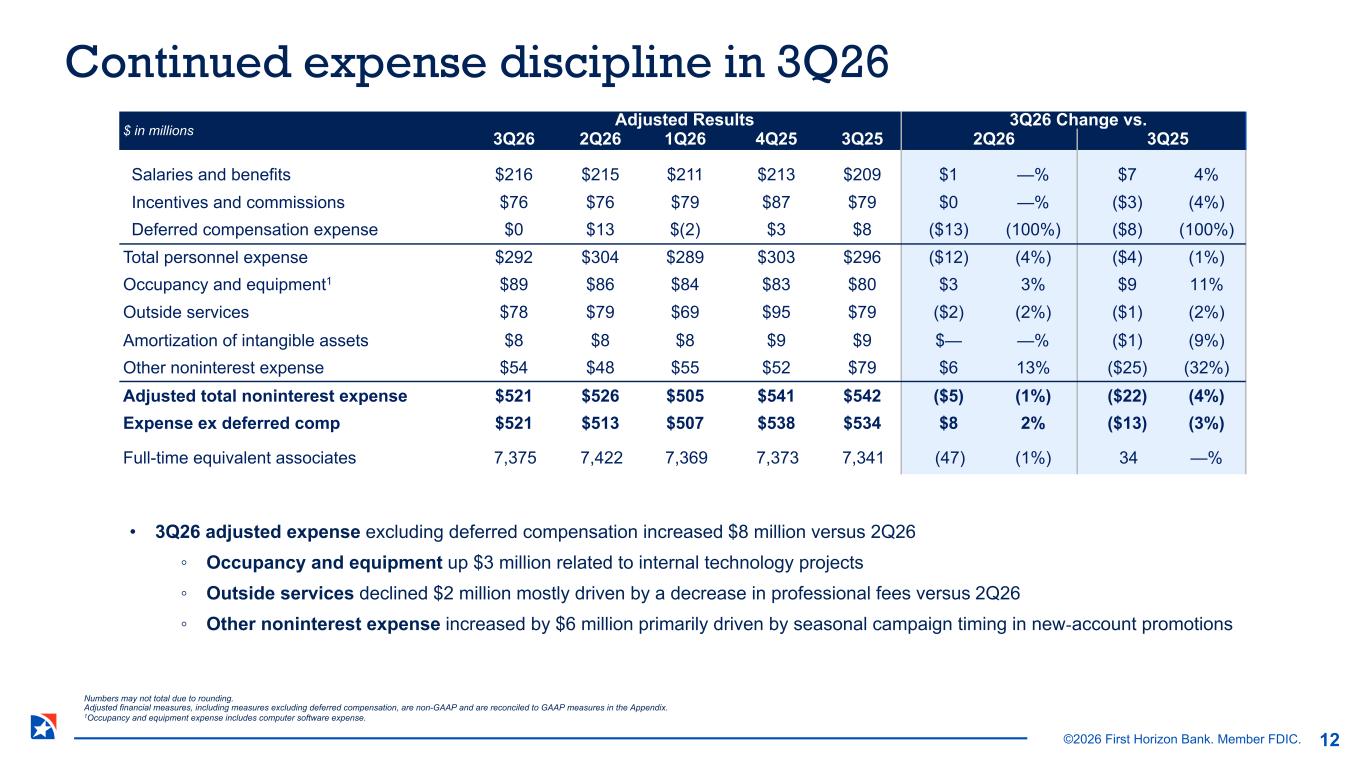
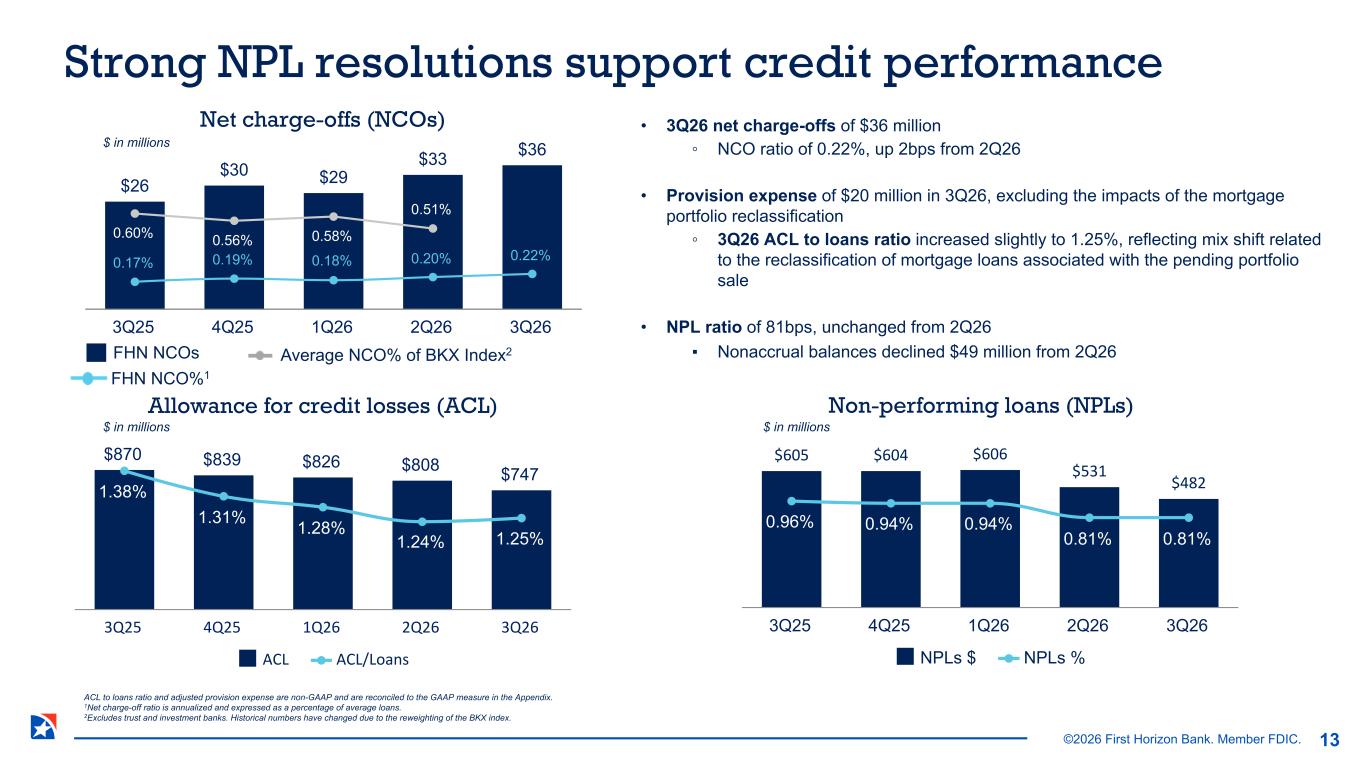
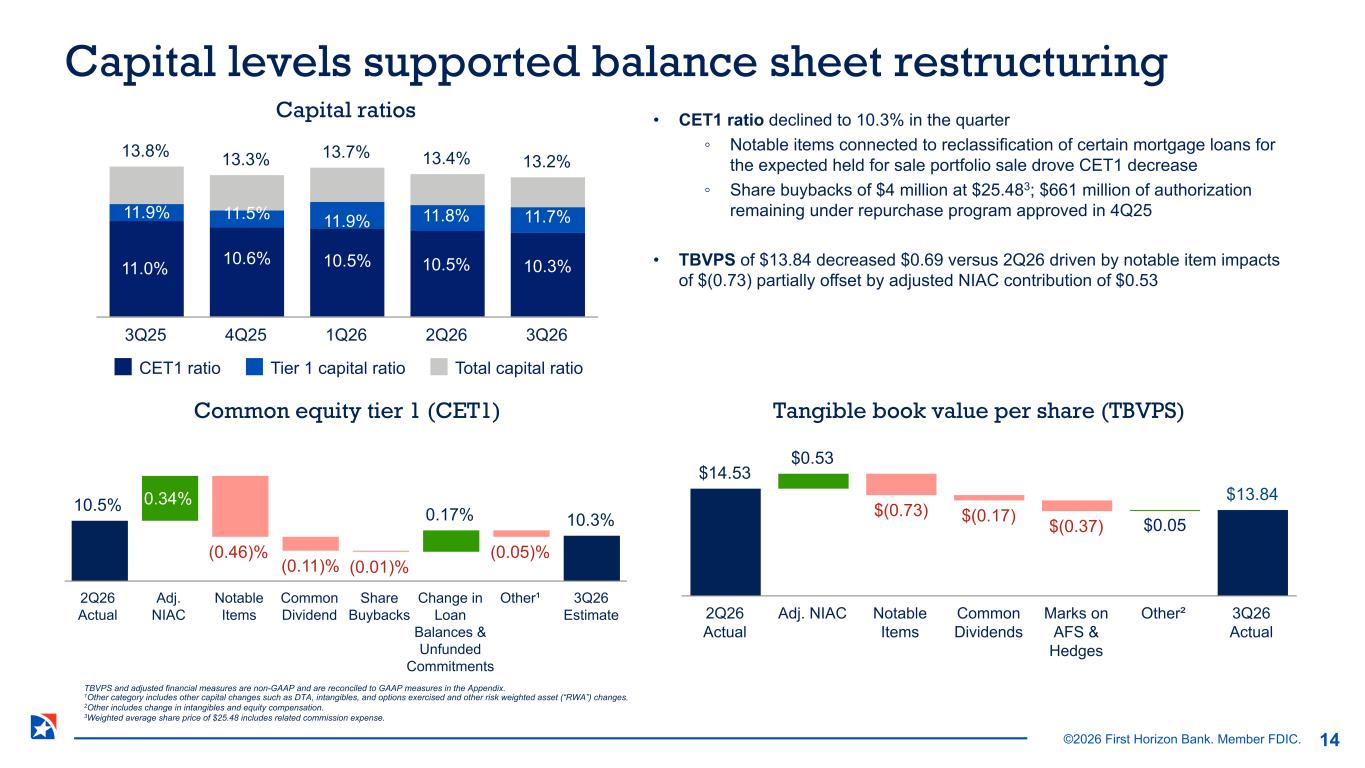
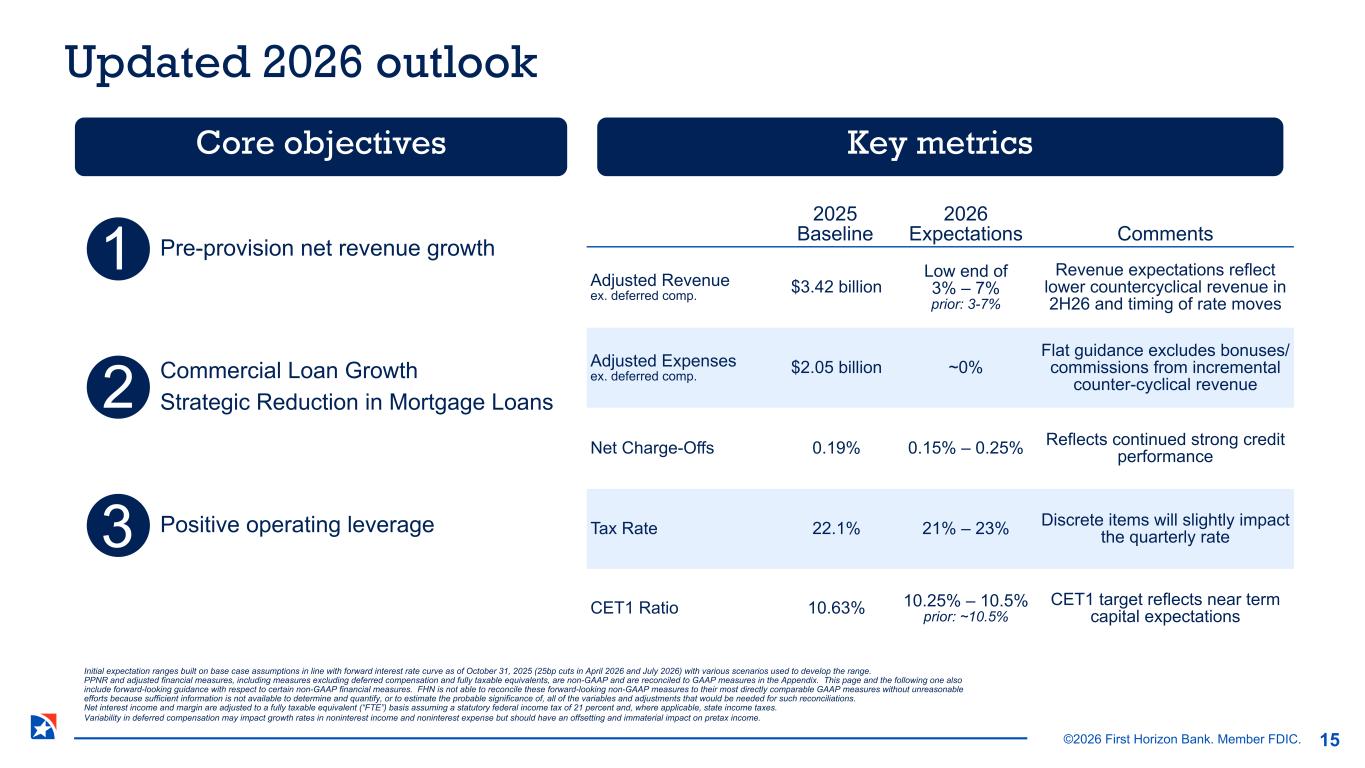
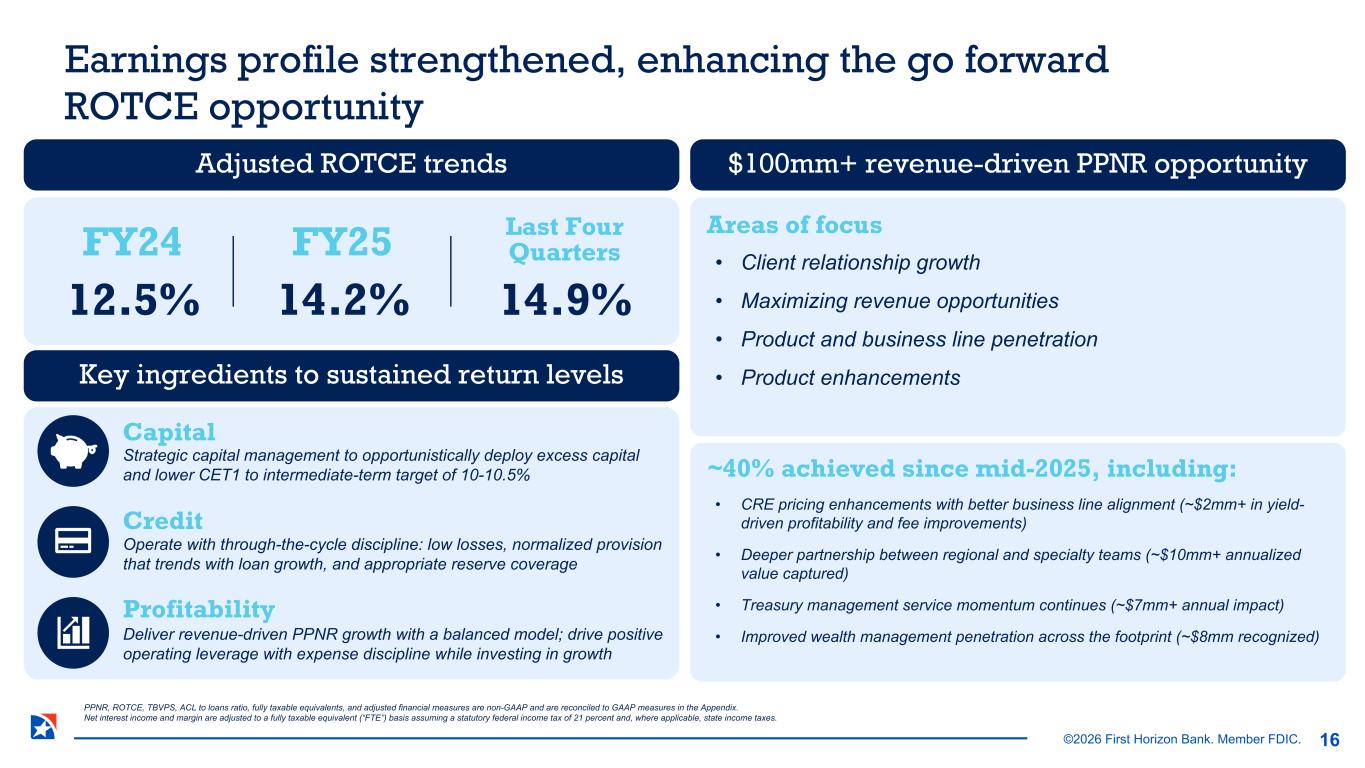
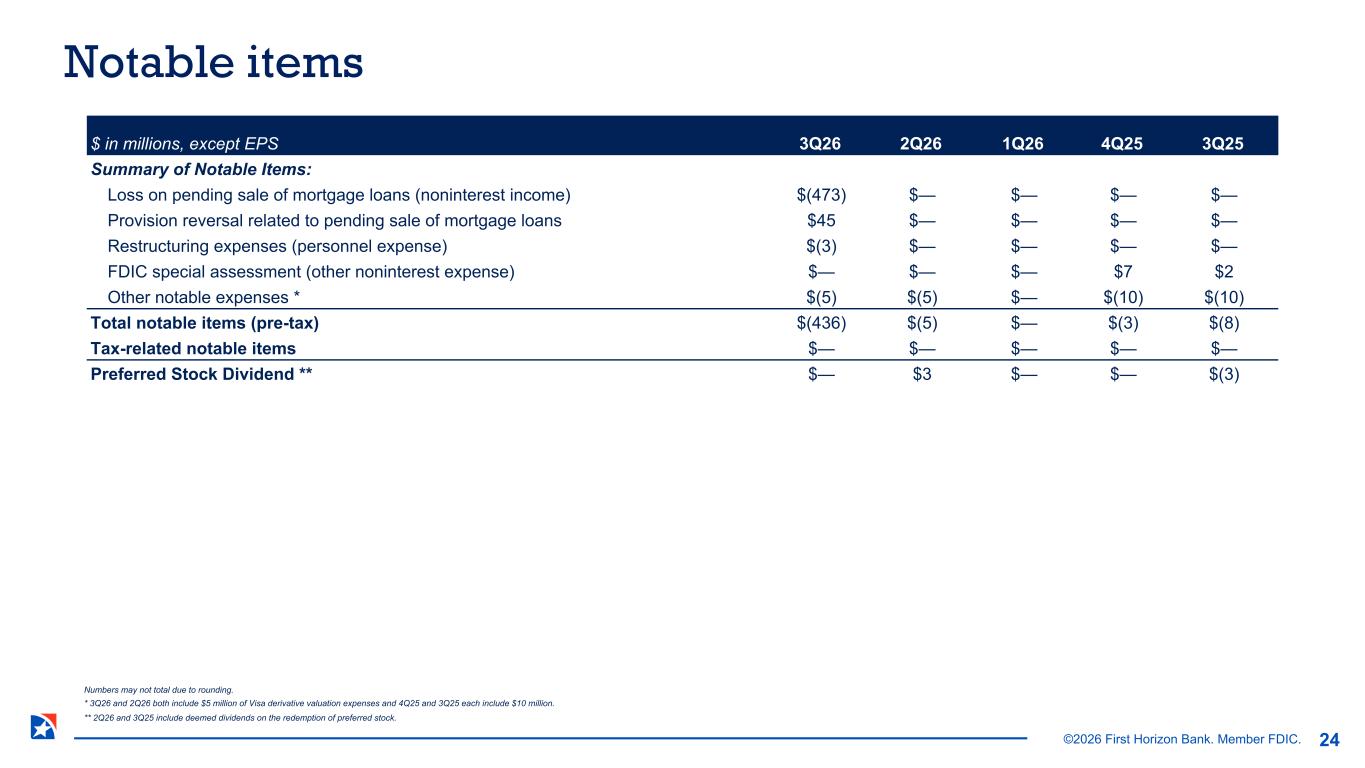
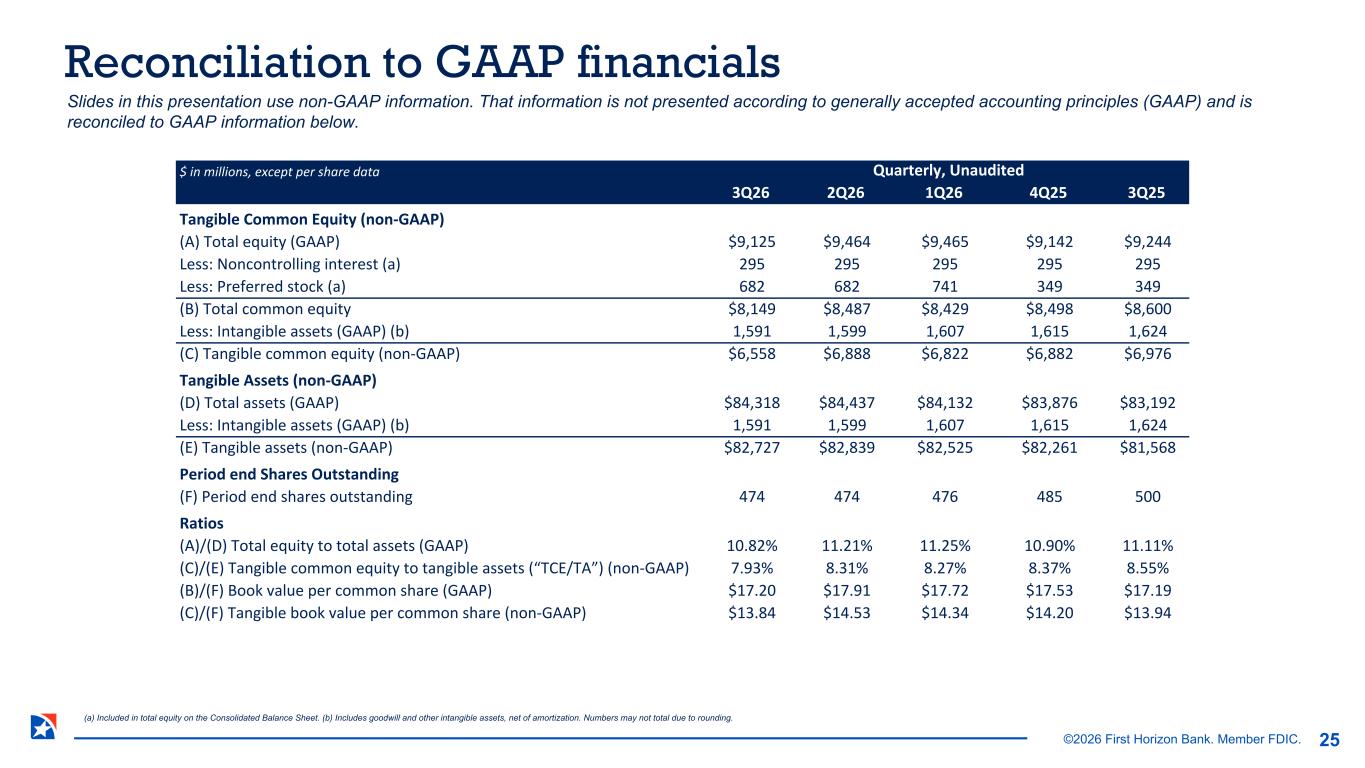
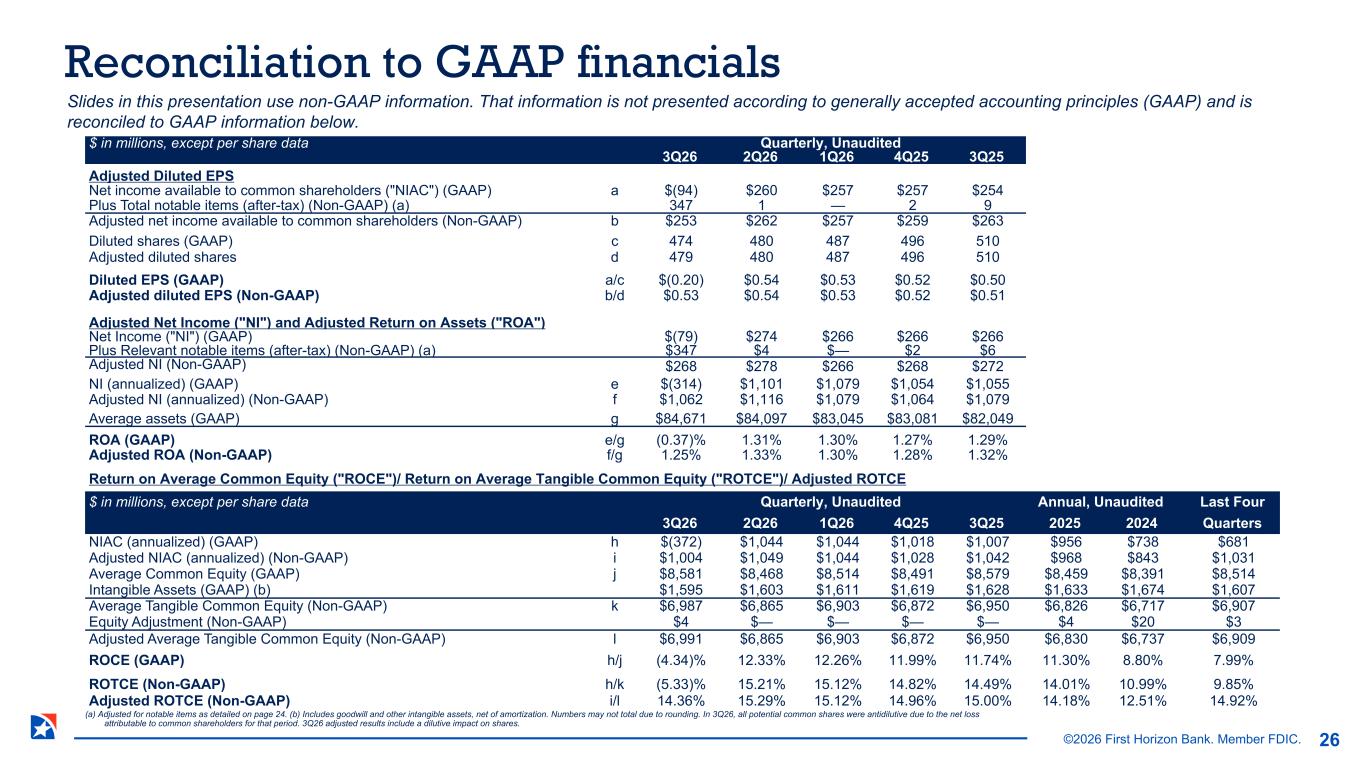
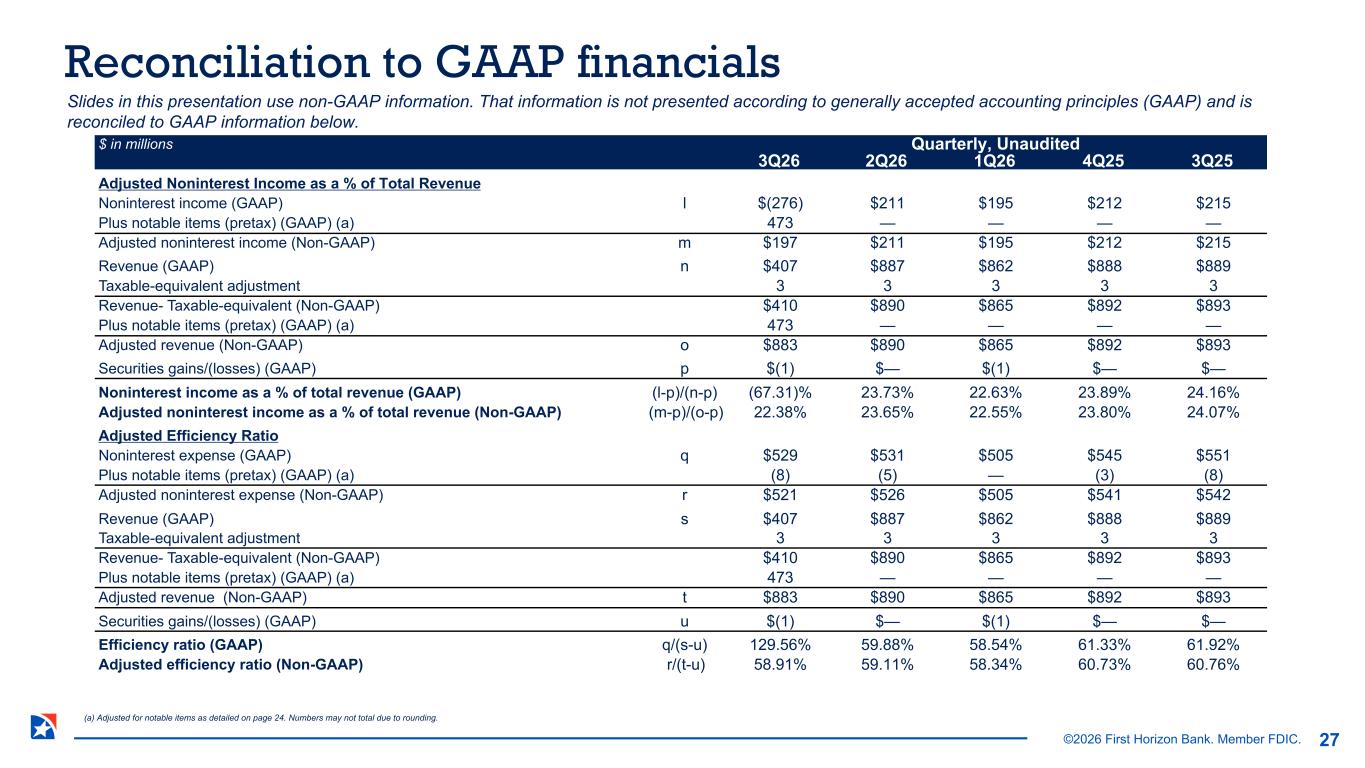
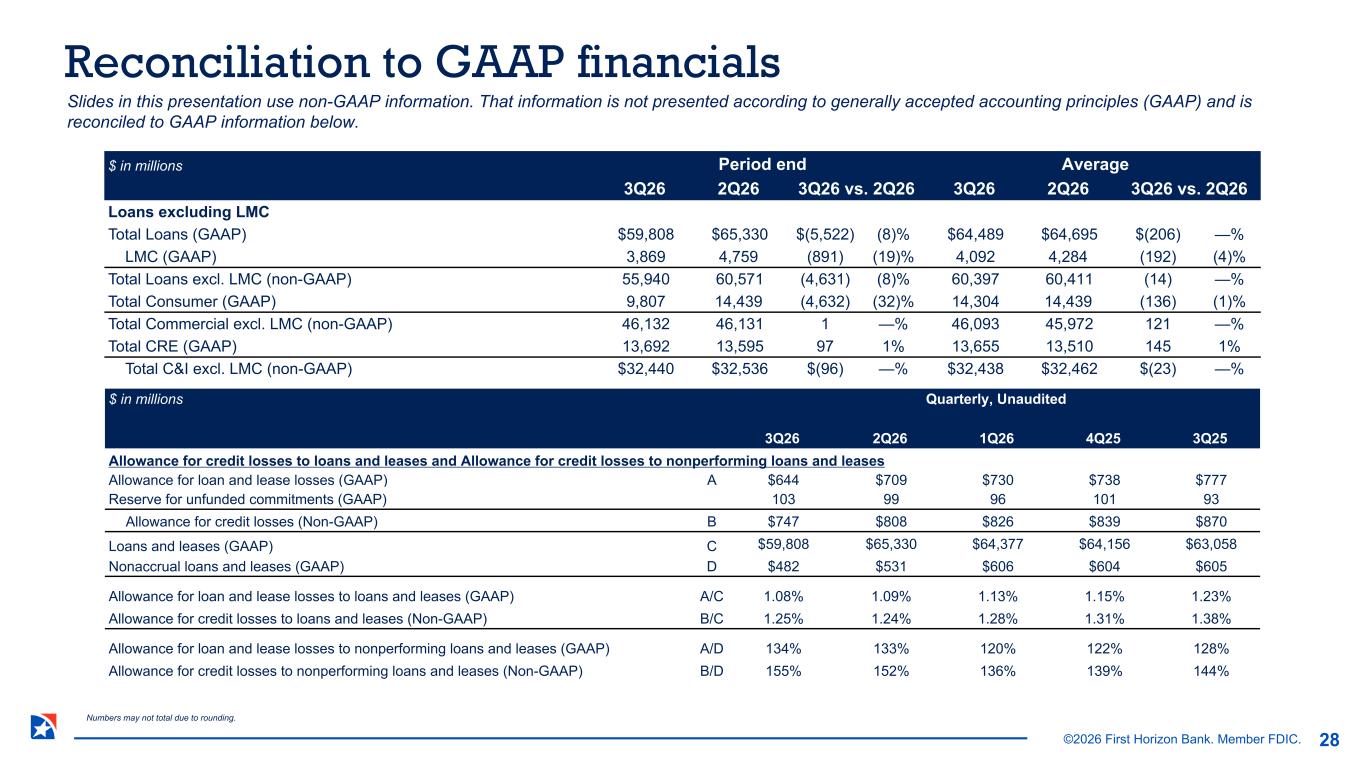
Thank you, Brian. Good morning, everyone, and thank you for joining us today. Starting on slide five, we provide key highlights of our performance this quarter. In the quarter, adjusted EPS declined to 53 cents on lower fee income and slightly higher provision expense in the quarter. Our adjusted ROPSI decreased to 14.4% in the quarter. This is primarily due to the temporary impacts of the timing of capital use in the quarter, which resulted in an elevated average TCE ahead of deployment as part of the mortgage loan reclassification at quarter-end. We continue seeing momentum with our strategic focus on relationship banking with client deposits up more than $1 billion this quarter and NIM remaining in line with our expectations at 3.48%. On slide six, we cover notable items in the quarter, which includes the impacts of reclassifying the loans associated with our mortgage portfolio sale, which I will discuss more in just a moment. Additionally, we recognized costs associated with reorganizing parts of our business, which includes reductions in our mortgage line of business to align mortgage production more closely with core clients. On slide seven, we covered the expected mortgage portfolio sale in more detail. This transaction further ensures our balance sheet is aligned with our strategic focus on delivering relationship-oriented banking and focusing on safety and soundness, profitability, and growth. The loans in this transaction have minimal deposits of approximately $200 million and are concentrated in the lowest yielding portion of our mortgage portfolio with an overall weighted average coupon rate of 3.85%. This transaction is expected to settle early in the fourth quarter and result in selling approximately 4.5 billion in lower yielding mortgage loans with limited deposits and relationship balances at an approximate 10% discount all in. Excluding further upside of yields from incremental lending, we expect the transaction to be accretive going forward with 2027 earnings per share benefit of around 4% and improved ROC-Z of approximately 150 basis points. Share buybacks will resume in Q4 in line with our CET1 targeted ratios for the year. This transaction puts our liquidity into an improved position as our loan-to-deposit ratio moves to approximately 88%. It provides immediate improvement to NIM and a future upside as we redeploy to higher-yielding loans while continuing to focus on client relationship growth with deposits and fees. Deployment into incremental lending in the coming quarters and years will further improve these results. On slide eight, we walk through our net interest income and margin performance in the third quarter. Our margin compressed by one basis point remaining settled in the high 340s. This reflects the rate of environment evolving into a flat two-up expectation. We grew NII by $7 million this quarter, reflecting higher loan yields and includes customer deposit growth, replacing broker deposits over the course of the quarter. We believe that the flexibility created by our mortgage portfolio transaction this quarter supports continued margin strength into next year and through the cycle, and we expect NIM to improve into the $350s. 350s. On slide 9, we covered details around our deposit performance in the quarter. Period end balances decreased by $0.4 billion compared to prior quarter, driven primarily by a decrease in broker CDs as we grew new client deposits approximately $1.5 billion. The average rate paid on interest-bearing deposits increased to 2.45%, which is a 12 basis point increase from the prior quarter. This reflects higher average broker deposits and higher customer deposit costs in the third quarter, which includes impacts from the resetting index client deposits. Our exit rate for the quarter on a spot and a September average basis is low single digit basis points above the average for the quarter and we do expect that the environment for deposits will remain competitive as we enter into a rate increase cycle we will focus on betas through the cycle targeting approximately 60 percent as always we remain focused on growing our core deposit base and prioritizing relationship growth as a way to sustainably and profitably grow our balance sheet. On slide 10, we cover our quarterly loan growth. Period end loans decreased $5.5 billion from the prior quarter, driven primarily by the reclassification of mortgage loans for the $4.5 billion mortgage portfolio sale. Loans to mortgage companies decreased $891 million in the quarter, which steadily decreased in the quarters as rates rose. C&I, excluding loans to mortgage companies decreased $96 million and commercial real estate grew $97 million. Total line utilization ended the third quarter essentially unchanged from Q2 at 44%. This dipped in July and August before rising again in September to near prior quarter levels. Commercial lending remained competitive through the quarter. Spreads on new lending are typically in the mid-100s to mid-200 basis points in the current environment. Turning to slide 11, we detail our fee income performance for the quarter, which increased $3 million from the prior quarter, excluding deferred compensation, and is down $8 million year-over-year. We saw a 6% quarter-over-quarter increase in fixed income revenues due to an increase in average daily revenue to $629,000. Higher ADRs were driven primarily by favorable restructuring activity during the quarter. On slide 12, we cover adjusted expenses that excluding deferred compensation increased $8 million from prior quarter. Other non-interest expense increased by $6 million driven by the timing of new account promotions and occupancy equipment increased due to internal technology projects and AI investments. Turning to credit on slide 13, NPLs remain flat at 81 basis points on a 49 million reduction in non-accrual balances driven by strong resolutions during the quarter. Net charge-offs increased by 3 million to 36 million, bringing our net charge-off ratio to 22 basis points. Excluding the mortgage restructuring impact, our provision for credit losses was $20 million in the quarter. Our ACL to loans ratio increased by one basis to 1.25. This primarily reflects mixed shift associated with the reclassification of mortgage loans associated with our mortgage portfolio transaction. On slide 14, we ended the quarter with CET1 of 10.3%, which is down slightly from the prior quarter and reflects the impact of notable items, including the mortgage transaction we discussed. Our tangible book value per share ended the quarter at $13.84 and is down 5% quarter over quarter, also reflecting the impact of the mortgage portfolio transaction. Our tangible common equity to total assets ratio remains strong at 7.93 percent. Now I'll wrap up with slides 15 and 16. We shared some refinements to our 2026 outlook that include the impacts of the expected mortgage transaction as well as the revenue impacts from the current rate environment. We continue making progress towards the 100 million plus PPNR opportunity discussed over the last 18 months and believe our balance sheet restructuring will provide further catalysts for return growth in 2027. And with that, I'll give it back to Brian.
Thank you, Hope. The results in the third quarter position first rising for continued success, meaningful upside opportunities, and deepening strategic alignment. Over the past year, we have shared with you how our strategic framework provides clarity for our associates on the results we expect, understanding of the ways we earn our right to win, precision on the types of clients that value our approach, discipline on how we go to market, and urgency on the opportunities we have to further enable our strategy. Our third quarter results, which include an important business restructuring, a strategic portfolio transaction, and consistent banker engagement with our clients to deliver deeper relationships and drive profitability enable us to deliver enhanced profitability going forward. Thank you to our associates who continue to work hard at delivering these objectives. I reiterate my gratitude to our clients and shareholders who continue to be central to the First Horizon story. Erica, with that, we can open it up for questions.
Operator
We will now begin the question and answer session. Please limit yourself to one question and one follow-up. If you would like to ask a question, please press star one to raise your hand. To withdraw your question, press star one again. We ask that you pick up your handset when asking a question to allow for optimum sound quality. If you are muted locally, please remember to unmute your device. please stand by while we compile the q a roster your first question comes from the line of john arfstrom with rbc capital markets your line is open please go ahead thanks good morning everyone good morning john hey good morning um just a question on the realignment brian not being critical but you know why now and how did you determine the size of the sale the four and a half billion and anything more left to do or is this it yeah so the why now is is it it one became
clear that we're in a cycle of of rising interest rates um we we sized the portfolio based on trying to extract out or sell what was essentially non-relationship portfolio assets. And the intent there was mainly to create capacity on our balance sheet to fund continued growth and investing in longer, deeper relationship opportunities that we see in the marketplace. And we believe that we have the asset generation capability to put that to use. So we looked at the portfolio. We tried to exclude anything that was related to private client or wealth. We tried to basically extract a portfolio that was very minimal relationship outside of a loan transaction. And as Hope pointed out, when you do that, you come up with about $4.5 billion dollars of loans, about 200 or so million dollars, excuse me, million dollars of deposit base and a low yielding portfolio. So the timing was it was a low yielding set of assets, non-relationship. We thought we could use the capacity for other and deeper relationships. And then the tangential benefit is it gives us much greater flexibility in terms of how we think about competing in the deposit markets and the use of wholesale deposits on a go-forward basis. So we think it has very positive profitability characteristics. In terms of the work left to be done at this point, basically we should settle the transaction in the next few days to a week. We have to deliver some loan files and we have a signed agreement, so the transaction is essentially done at this point.
Yeah. Okay, good. And then maybe for you, Hope, can you frame the assumptions around the 4% 2027 EPS accretion? I think you both mentioned some upside as you redeployed the proceeds, but what are you assuming right now in terms of the drivers of that 4% lift?
Good morning, John. Thank you. The 4% is really the immediate lift, which is a portion of it going to pay down wholesale funding and the rest going into our securities rate at a very, you know, floating rate securities as we continue to, as Brian mentioned, redeploy this into loan. So that 4% is really as we get the cash in in the next week or so, immediately putting that to work between paying down our wholesale funding and putting it in our securities portfolio in short term floating rate.
All right. Thank you very much.
And John, I'll add while you're dropping and off, I'll add that you should start to see that if we get this closed, we'll start.
Operator
Your next question comes from the line of Ryan Nash with Goldman Sachs. Your line is open. Please go ahead.
Brian, good morning, Hope. Morning, Ryan. You noted that you expect a 60% beta from the rate hike. I think that implies about a 15 basis point or so deposit costs increased. You know, when we look in this quarter, obviously deposit costs were up 12 without a rate hike. So can you maybe just help us better understand the 12 basis point increase, how much was related to the hike, how much were client deposit costs actually up, and do you expect there to be residual pressure outside of the rate-driven increases that we've seen? Do you expect those to persist? I have a follow-up.
Thanks, Ryan. Starting with the 60% beta comment, that is through the cycle. And so quarter to quarter, depending on when you have a rate increase early or late in the quarter, that is not meant to be a quarter in, quarter out. We also only had two weeks of this rate hike baked into this quarter. When we look at the rate competition, I've said this previously, the summer months is the most competitive time for us. It's when we mentioned now three years running that we bring new customer deposits specifically in private client retail, some of our commercial clients in at a promo rate. You'll see the six million of expenses that we paid out this quarter, which is the cash offers associated with those private client and consumer offers. And then you start to walk those back. So I do think a portion of what increased in Q3 is similar to the last two years when we start to lead with rates before we deepen that client and walk it back. As far as exactly what I expect in Q4, Ryan, it really depends on the rate scenario. Do we see one hike do we see two is it earlier in the quarter or later that's why i really focus on the beta part of it because i do think there'll be noise quarter to quarter if there has been in past rising and decreasing rates on how that leads and lags in a quarter but as i said in my prepared remarks we expect margin to be in the 350s next quarter and continuing to focus on expanding that with the redeployment of this mortgage sale into higher yielding assets Ryan, one follow-on thought is in the third quarter, we did have a higher average balance of wholesale deposits, and they did pull the aggregate rate with this transaction, and that should take it.
and Long said that over time, technology, it started with the internet and cell phones and mobile technology provides a lot more clarity and upward. There's going to be some upward move. I know here recently, there's been a lot of focus on agentic AI and tools like Muse and other things like that impacting deposit costs. And while that may be a long-term adoption trend, It's not something that we expect to have a lot of impact in the very near term, that that will take a lot of time. And fundamentally, I do believe that customer relationship stickiness is that one, our focus on relationships and all that will help us ameliorate some of the upward drift and deposit costs over time. It will not eliminate it, but will help ameliorate some of that. But at the end of the day, we think that we have the ability in this rising rate environment, a percent or so, it gives us more flexibility. So we think we're extraordinarily well positioned to navigate this.
Gotcha. Appreciate all that color. And, Brian, you've been relatively upbeat on loan growth, maybe outside of warehouse C&I balances and CRE had a little bit of growth, a little bit of shrinkage. Maybe just talk a little bit about the performance and given the freed up balance sheet capacity, how are you feeling about, you know, the ability to lean in a little bit further on loan growth?
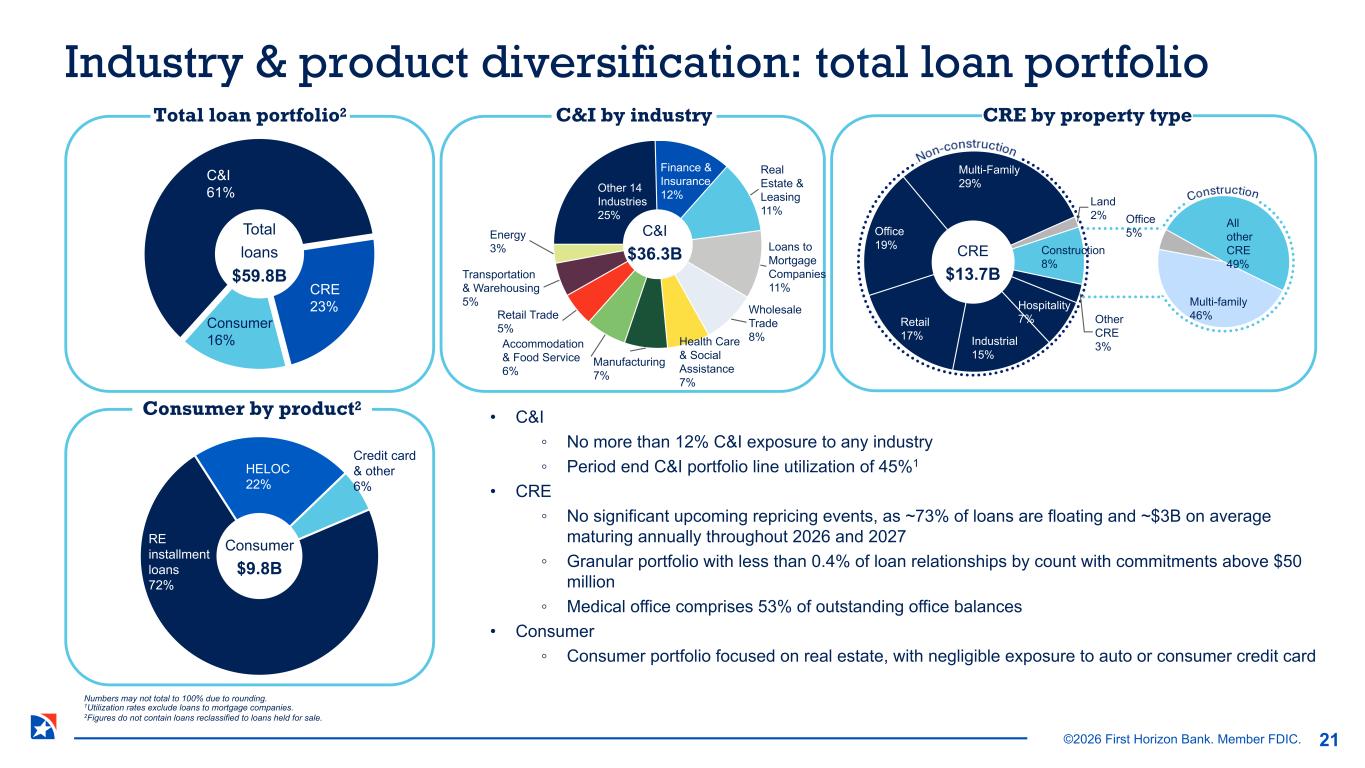
Yes, I still am upbeat. And if you, you know, you get, you know, sort of a political environment where the consumer is feeling under some degree of stress and that there are parts of the economy that are somewhat weaker than others. But generally speaking, demand in the economy is still pretty good. GDP growth, GDP now, Atlanta Fed, I think is still around 4% for the fourth quarter. So underlying activity is still pretty good. And we think that loan demand will continue to be reasonably steady. If you look at the mix of our balance sheet, you pointed out mortgage warehouse lending came down during the quarter. C&I was relatively flat. We're still seeing some funding up in commercial real estate deals. We follow the market in terms of prognosticating about what the future of rates will do, but it will have some marginal impact on me to create additional lending simply because more deals will not pencil out. But at the end of the day, we feel good about our asset generation We have a unique set of businesses that are in many ways are national in our specialty lines of business, whether it be mortgage warehouse lending, where we can continue to, we think, win additional market share, our franchise finance business, our trucking and transportation businesses. So we think our asset generation capability, that against a backdrop, we're going to be smart about what the economy gives us. We're going to pick our spots and participate. And we think that this economy, while saw inflation.
Thanks, guys. Appreciate all the color.
Operator
The next question comes from the line of Ibrahim Punawala with Bank of America. Your line is open. Please go ahead.
Morning. How are you doing, Amy?
Good, good, Brian. I guess maybe just on this restructuring, maybe I missed it. When we think about the loan-to-deposit ratio shifting to 88%, I know you've been very reluctant, Brian, to deploy deposits to low-yielding government securities.
But as we think about where it's resetting now, how should, like, is that the new normal, and does that also sort of set the stage for you to be able to become a $100 billion plus asset bank with a mid-to-high 80s loan-to-deposit ratio feels the right place to be? if you yeah thanks for the question um we do as i mentioned in my prepared remarks we will um put a good portion you know into securities uh immediately but we do expect to redeploy that into loan growth the intention is not to grow our securities portfolio as we think about where loan growth will come from one of the comments brian and i have made consistently on this call in conferences is our ability to grow loans previously was dependent our ability to grow deposits balance both sides of the balance sheet so this does allow us to have some additional growth on the loan side with the deposit side slightly lagging um you know whether it's either quarter to quarter year or year 88 88 percent loan to deposit ratio gives a little bit more ability to loosen up those reins for the for the right side of the balance sheet to grow as we think about where we redeploy this we are as i mentioned in my prepared comments we are going to put it in floating rate securities we are expecting rate increases in the coming quarters so that will also increase the immediate payback as we as we see that forward curve play out
it positions us with a slightly more asset sensitive balance sheet which is which is a positive we think in this rising rate environment and and we're we're not with with any in any measure reducing our desire to continue to grow the right side of our balance sheet to grow our development deep and we've talked a lot continue to management products to penetrate operating account relationships and to continue to broaden and deepen with our credit customers and we think that freeing up the opportunity to take this pool of largely non-relationship assets and move it off the balance sheet and create capacity to put more relationship-generating assets on the balance sheet is going to be a net positive for that loan-to-deposit ratio.
One additional comment on that is that the mortgage sale does shorten our duration and make our immediate asset sensitivity about 100 basis points higher in the near-term in a rising rate environment.
Got it. So, the action, obviously, from a client relationship, ROTCE asset sensitivity understood and maybe given just the change in the rate outlook or what's happened from the for the markets talk to us about the mortgage warehouse business obviously it's been an attractive business for you but maybe how are you thinking about it today given where rates have headed and talk just the health of the underlying clients like are you seeing consolidation in that space? Just how should we think about where that may tend over the coming quarters or over the next couple of years?
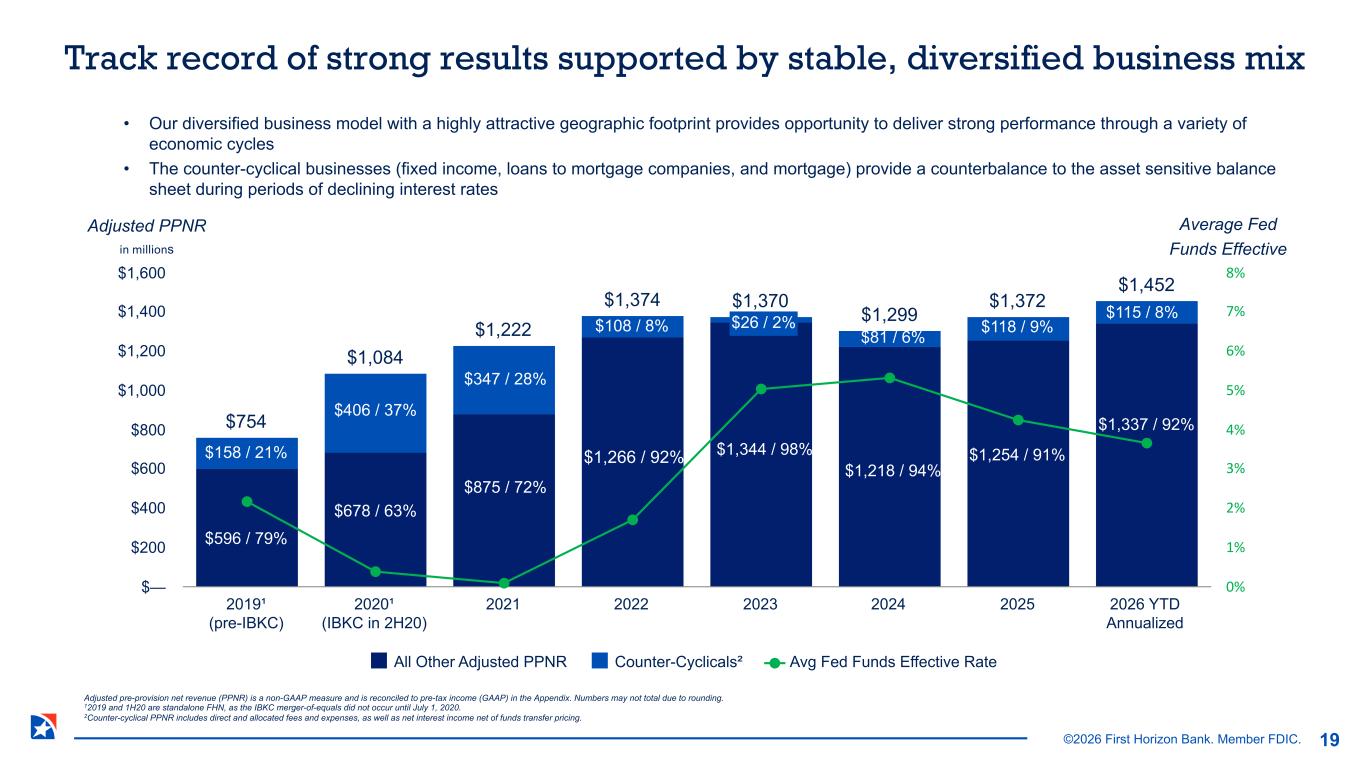
Yeah, I'll come right back to the mortgage warehouse question. I want to add one other benefit. And this repositioning of the balance sheet does not impact our ability to continue to repurchase or return capital, repurchase stock, and we're comfortable in this 10 and a quarter, 10 and a half range, and we intend to resume. With respect to mortgage lending or mortgage warehouse lending. The third quarter was unique in some ways. We talk about our counter-cyclical businesses and how through the cycle, we tend to be less asset sensitive than stated in terms of the disclosures because we have these counter-cyclical businesses that perform in opposite direction. The third quarter was unusual in the sense that we started to see the impact on the counter-cyclical businesses well in advance. And so we think it's likely to be a little less in the lending. We'll see how. At the end of the day, the mortgage warehouse lending business came down about $900 million in the quarter. We think it peaked sometime in the second quarter of this year. So that is a very unusual dynamic. We think that we have built share in that business to serve that customer set, and we will continue to be there. We are positioned with strong participants, and while, Tom, I don't know what you would add to that?
Yeah. Good morning, E.B. I would add the rapid rate increase cycle only a handful of years ago. And so they're well aware of kind of what would happen in that environment again if we were to see multiple rate increases. So in terms of sizing their companies appropriately from an infrastructure and fixed cost, fixed expenses standpoint, we're working with very experienced operators. And so I would continue to expect very strong credit performance even in the face of multiple rate increases.
What I'll add to what Tom and Brian already said is this is not an NDFI line. We do table fund. So, we have the underlying notes at close. So, should something happen to one of our clients, we have those notes. We can sell them. And so, we don't have the same risk that some of the different mortgage warehouse structures have. We continually talk about we've had one basis points of charge off annually in this business as long as we can go back and calculate because we hold the collateral at closing. The other one is that we always point to is this typically stays on our balance sheet 19 days per note. It's just from the time the deal closes to the time it is delivered to the other side. So if we were to see something happen in this business, we had concern, we can bring those lines down pretty quickly.
Got it. Thank you for all the answers. Thank you.
Operator
The next question comes from the line of Michael Rose with Raymond James. Your line is open. Please go ahead.
Hey, good morning, everyone. Thanks for taking my questions. Just wanted to talk about the $100 million plus PPNR opportunity. I think the slides say you're about 40% of the way through. How should we think about the repositioning and the $45 million in after-tax benefits in relation to that? Should we think about this as in addition or should we think about it as maybe just accelerating the progress and the path that you're already on. Thanks.
Think about the $45 million, to use your word, in addition or incremental to the $100 million.
Okay, perfect. And then maybe if you can just outline from here the extra 60% to get to the original amount, what is still left to happen and how does the rate picture kind of potentially impact the timing? Thanks.
Some of it is just timing when you annualize it as you deepen with customers. We've talked a lot about our treasury management success with deepening with existing commercial clients. On average, when you deepen a treasury management relationship with a client, it can take three to nine months to actually get that treasury management relationship moved over because of their payroll, their AP, their AR. It is a long process for them to move that all over. So some of that is just the annualization. When we say it's 40%, that's kind of an exit rate, and then you pick that up on a full year. The other is we continue to see great success with wealth. We keep talking about how we've rolled out a new partnership with LPL. We've hired new wealth advisors. We're continuing to see that work as we deepen with some of our commercial business owners and others that already are a first-rising client, and then we introduce them to the wealth side of it. I would say those are the two biggest that we still have the tail on. We've continually talked about loan-only relationships, low economic profit, low only, and not renewing those at renewal if we can't get the profitability up or deepen the relationship. This mortgage sale goes hand-in-hand with that. These are mortgages that were seasoned on our balance sheet where we did not deepen the relationship. So Brian's first question, this is additive to the number, but is completely in line with how we've been rethinking our portfolio to increase profitability for every single dollar we lend out.
That's very helpful, Hope. I don't want to get ahead of myself and ask about 2027, but just given the benefits from the repositioning, how much opportunity is there as we think about incremental investment in the franchise, in things like you mentioned, Hope, just on treasury management wealth, also leaning into commercial loan growth? Basically, how should we think about positive operating leverage for next year? I know it's early, but just trying to better understand the outlook there. Thanks.
We do not expect to, you know, have a significant reinvestment like we did three years ago coming out of the termination. We believe we have the right run rate of expenses. We continually say we'll be inflationary from here on out for expense growth year over year, and we expect positive operating leverage next year.
Yeah, we see, Michael, we see we see a number of opportunities to continue to invest. So our plans today would include refreshing banking centers, building new banking centers, continuing to hire, to invest in. And we feel good about our ability to control our expense base. We think we have enough levers in that. We will feel some of the impacts of inflation and certain things like health care costs and general inflationary type costs, but we think we can maintain a reasonable growth rate in 27 and going into 2028 as well.
Very helpful. Thanks for taking my question.
Operator
The next question comes from the line of Bernard von Gizicchi with Deutsche Bank. Your line is open. Please go ahead.
Hi, guys. Good morning. Just on commercial real estate, it seems expectations have improved throughout the year. I just wonder if you could just share some thoughts on forward expectations and how that outlook for higher rates impacts that at all.
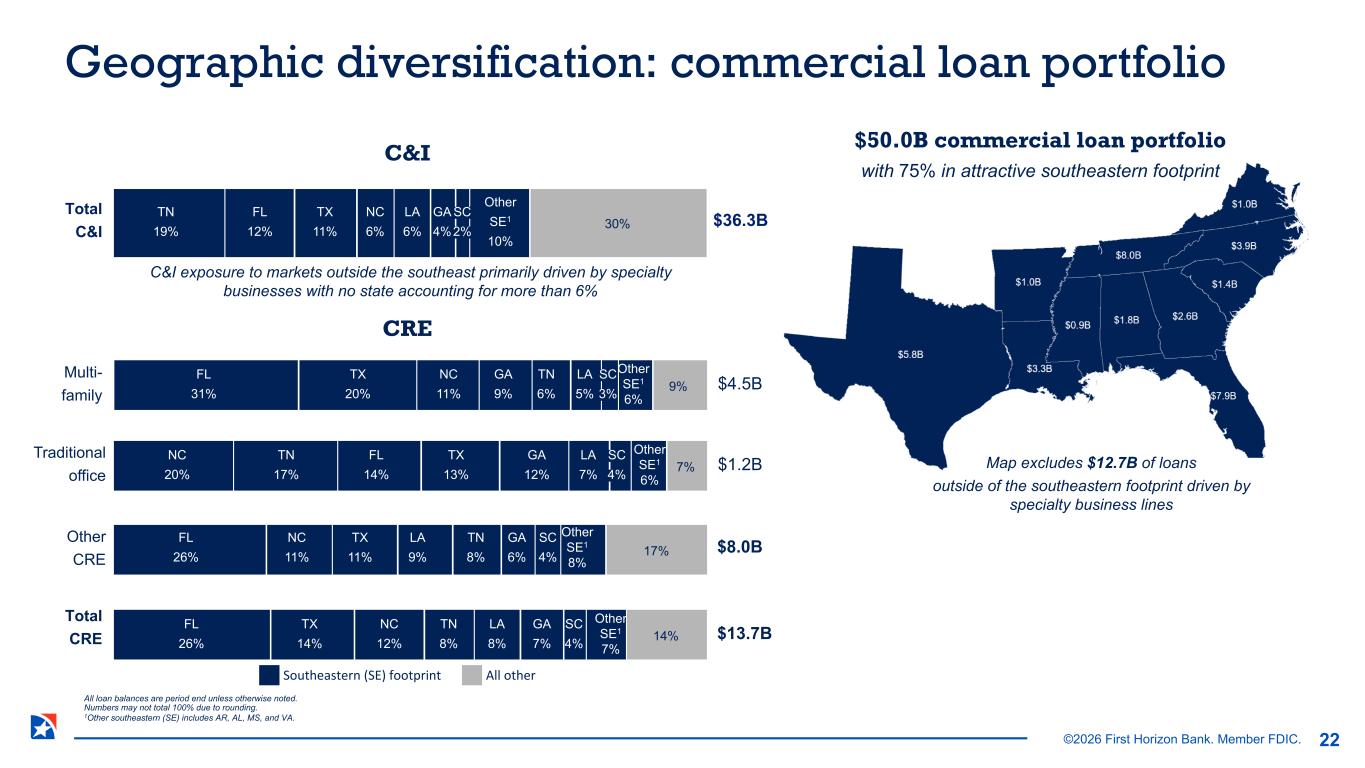
Yeah, sure. Good morning, Bernie. I'm happy to answer that one. The commercial real estate group has had a lot of momentum, but most importantly, we've remained very disciplined in how we manage that book. And so my expectations are, you know, if rates go up, I would expect this to continue to perform very well. And I think that two main reasons are point two. One is, if you look at our strong loss history, if you go back to the start of 2023 when we were seeing our peak interest rates, since then our CRE net charge us of our average 17 basis points. And so I think that speaks to even in a high rate environment, our discipline really holds up. And those numbers I mentioned are on projects underwritten in a very low post-COVID rate environment. Obviously, the more recent vintages are underwritten to higher interest rates. The other thing I'd point to is, you know, especially on the multifamily side, I think the real root cause has been supply and absorption rate. On the supply side, CoStar shows since the peak in 2022, starts at down 70 percent, units under construction at down 50 percent. So there's a lot more supply coming on. And then on the absorption side, with what consumers are dealing with right now on top of elevated home prices and higher interest rates, renting is relatively more attractive than buying. And so I think the absorption will be there as well.
Okay, thank you. And then just as a follow-up, maybe just on the fixed income side, it seemed maybe it came in a little bit better than expected, I mean, just given the rate vol during the quarter. and you did highlight some higher client restructuring activity. I'm just wondering, is that maybe just specific to the quarter? Do you think that kind of continues? Just kind of, you know, some thoughts on the go-forward expectations on some of those trends.
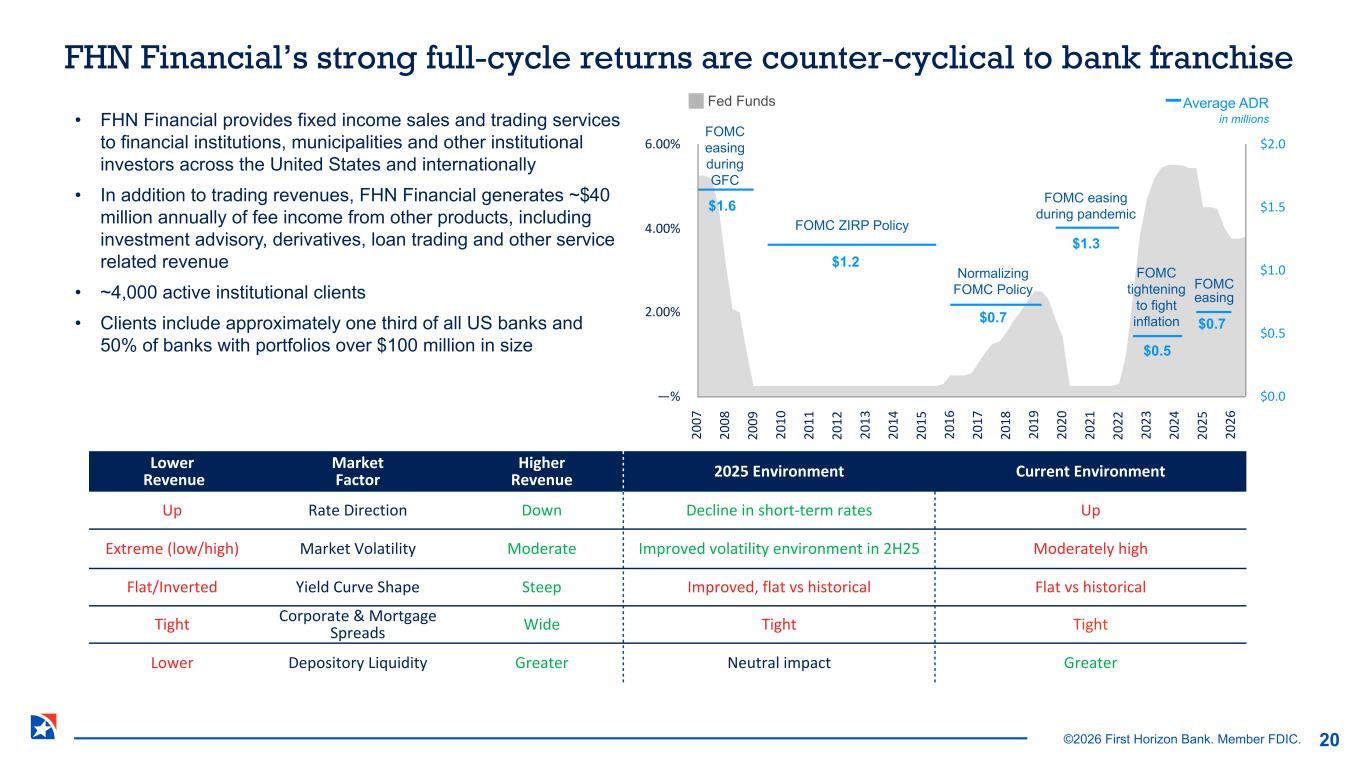
We have continued to see, you know, in this business over time that as you enter a rising rate environment, a quick rising rate or quick decreasing rate, some of our clients will try to get ahead of that and restructure their balance sheet. We saw this when rates were decreasing about this time last year. And so I do think depending on how quickly rates increase, if we do, I don't know where the forward curve is this morning, but yesterday it had one and a half increases in the back half of the year. I do believe that we could see additional restructuring, but it really is very related to how quickly rates move up and down and our clients' appetite to try to hedge that in advance.
Great. Thanks for taking my questions. Thank you.
Operator
The next question comes from the line of Ryan Kenney with Morgan Stanley. Your line is open. Please go ahead.
Hey, good morning. Thanks for taking my questions. Can you unpack what you're seeing in terms of non-interest bearing deposit balances and mix shift? On one hand, you could argue customers are already broadly optimized, you're growing operating accounts, you're deepening relationships. But on the other hand, we have some rate hikes in the forward curve. So how do you think about NIP mix? And is there a scenario where NIP balances and IP balances can grow?
On the first part, we're not seeing mix shift, and we haven't seen it for well over a year now. Customers that were rate sensitive had already taken advantage of that in a rising rate scenario, and we had stabilized. What we are seeing is the cost of inflation has them have less money in their operating and checking accounts, right? They're spending it more quickly, so their average balance, their average days. We absolutely believe that we have a franchise. We have a product set and bankers that can continue to grow deposits, both in non-interest bearing and interest bearing, as you saw this quarter. There's always seasonality in deposits with commercial clients when they pay their annual taxes, or there's seasonality around consumer and private client, around tax season or bonus season. But we absolutely believe we will continue to grow both of those in the coming quarters and years as we refocus on strong relationship business with our clients.
Yeah, if I had to take a side on the trade, I'd say customers are much more optimized today than they were a year. There's a lot of data out there about rates. There's very good transparency in the marketplace. And as Hope said, most of the makeshift spending patterns.
And as a follow-up, in terms of your capital priorities, so you use some capital for the mortgage sale. Seems like looking forward, you'll use some capital for resuming buybacks, for loan growth. Is it a fair interpretation that this means less of a priority to maybe use capital for a depository acquisition?
Well, I think that's one of the tangential benefits is I've talked about over the optionality about doing, I think that that makes that significantly less of our view and in many ways deals with, one, investing in customer growth, customer and balance sheet activity, two, being smart with our capital and repatriating it to shareholders pay opportunistically a little over $660 million, a good place to have a lot of optionality and returning capital.
Operator
The next question comes from the line of Janet Lee with TD Cowan. Your line is open. Please go ahead.
Good morning. I want to unpack a little bit about the decline in core CNI ex-LMC. You talked about how the line utilization dipped in July and August before rebounding again in September. Is there any more things that could explain the decline in CNI outside of those July and August being summer months?
No, not particularly. The loans to mortgage companies is really seasonally driven as well as just other core CNI, as you would expect. There were increases in some sectors and decreases in others. There wasn't any major driver in one direction or the other.
It's speculation slash projection, but I think customers are like all of us. I see headline fuel cost inflation going up significantly during the course of the summer. Diesel fuel supplies, you see a lot of competitive dynamics. And I think people are just being thoughtful about, you know, where are we in the economy? What's next? And I don't read anything into it of a negative bent at this point. I think it's just ordinary. Increase the level of lines that are outstanding in the quarter, and I'm fully growing there.
Right. So it seems like you're expecting for commercial lending growth momentum to increase versus the third quarter. on the mortgage scale. So it looks like the 4% EPS accretion seems like a floor since that's not assuming any benefit from partial deployment into higher yielding loans. Can you help us quantify what partial means here? Of the $4.5 billion coming off the balance sheet, how much should we expect to redeploy into CNI and CRE? Is mid-single-digit kind of growth still a right place to be?
Well, yes, I think the pro forma is invested in securities. And my working assumption is that over the next two to three years, we can deploy half of the four and a half billions. We call it a little over two billion loan growth activity over the next two to three years. Again, it's dependent upon what the economy gives us and how interest rates and inflation impact things, but we think with our asset generation capability.
Operator
Your next question comes from the line of Jared Shaw with Barclays. Your line is open. Please go ahead.
Hey, good morning. So, you know, just going back, I guess, to the bigger strategic view with this sale um should we expect any additional bigger moves to execute on that five flag strategy or is it more of like you know executing on the blocking and tackling like hope mentioned around treasury management and wealth management and things like that yeah i i think in terms of a big balance sheet um profile changing things i wouldn't expect anything else at this point.
I think you used a great phrase, blocking and tackling. The $100 million is a blocking and tackling exercise. Hope did a great job describing some of the actions, our relationship with them on cycles. And it really is hundreds, if not thousands of bankers every single day interacting on sort of the premise that I laid out in my prepared comments that we want to broaden and deepen customer relationships and thinking about how we proactively look for opportunities to deliver more valuable advice, counsel, and support for our customers and at the same time deepen our relationship. But it is a blocking and tackling exercise.
Okay, thanks. And then just a follow-up for me, more bookkeeping.
When we look at the securities portfolio, apart from what you're going to be putting in from this sale, what's um what's the cash flow been looking like there and and what's your your new reinvestment uh rate versus the roll off on that yeah jared we have that in our deck i'm just trying to turn to the page i think it's approximately one uh billion of securities with a roll-off yield of currently 2.9 percent and as of today you know floating rates in the mid 450s mid mid four sorry, SOFR plus. If we do see rate increases, obviously that 2.9 gets higher as a reinvestment, that mid-fours moves up 25, 50 basis points, et cetera, SOFR and Fed funds move up in the future quarters.
Great. Thank you. Thank you.
Operator
Your next question comes from the line of Anthony Allion with J.P. Morgan. Your line is open. Please go ahead.
Hi, everyone. Can you help on PAC what drove the reduction to the revenue outlook. You've tailwinds to NII from the bottom of slide eight, and you noted a few times hope that NIM is expected to increase to the 350s in 4Q. But is that not enough to offset the lower counter cyclical revenue in 4Q?
Yeah, thank you for the question. I think we're sitting right at about 4% for the first nine months of the year. If you look at Q4 of last year's, it's not as much about momentum quarter over quarter, but we had a really strong Q4 last year in our counter-cyclicals. It was a high point for mortgage warehouse balances, which is typically a low point of the year that they had a significant increase in Q4. We also saw really strong ADR in FHN Financial that we do not expect to repeat in Q4 this year.
Thank you. And then on expense, you saw a step up in expense, ex-deferred comp in 3Q, but you're still pointing to flat for the full year expense range. I think that would imply a step down in 4Q. What's driving that and the unchanged expense outlook? I ask because if I look at the past few years, 4Q expense has been up sequentially. Thank you.
A few things in that is the timing of our – was a high point. If you look at non-interest expense in Q2, Q3, and Q4, there is absolutely seasonality in that line. The other is really as we think about completing multiple technology and AI investments, we're starting to see the expense realization come in. And the third part of that, as we talked about, we had a restructuring of our mortgage business, as well as some other smaller restructurings in the quarter that reduce our go forward run rate for personnel and associate costs with that.
Operator
Thank you. Thank you.
Operator
Your next question comes from the line of Timur Brezier with UBS. Your line is open.
Please go ahead. hi good morning um more on the restructuring um good morning just the the near-term opportunity in terms of wholesale reduction versus securities purchase i guess what portion of the proceeds are going towards reducing wholesale the exact number yet i think it's really we're looking through all the scenarios as we mentioned our prepared remarks we just closed on this transaction last week, and we expect to close this month, so we're still in the early phases of putting that all back to work.
I do think it's more mixed into securities and wholesale funding. As Brian mentioned earlier, we did end the quarter with higher wholesale funding than we needed due to the way you ladder that out. You make a 30-day, 60-day commitment. We brought in more client deposits so that wholesale funding will come down beyond just the impact of the sale.
Got it. And then maybe bigger picture, I guess, what does this restructuring transaction say, if anything, about First Horizon's willingness to remain independent? And does this broadly change anything from a strategic optionality standpoint going forward?
I think in broad terms, it increases our option. Our profitable customer is flexible in terms of our capital repatriation. And while I've said many, many times over the last couple of years, we're going to continue to operate the business with a long-term vision of creating value for and our associates, we're not changing or reducing, in our view, any optionality we have.
I just need to clean up my words per my legal advisement here. We finalized last week and we settled this month. Apparently, I got my legal terms backwards on the transaction. So, I just got a little note from our legal team. I just want to clean up my language there.
We signed a sale agreement. We'll close it. Correct.
I want to make sure it's appropriately recognized in the transcript.
Yep. Thank you. Thank you.
Operator
Your next question comes from the line of David Chiaverini with Jeffries. Your line is open. Please go ahead.
Hey, guys. Good morning. This is Brooks Dutton for David Chiaverini. Good morning. Good morning. You mentioned that the sale adds about 100 basis points of near-term asset sensitivity and the proceeds going into floating rate securities. You guys still have some received fixed swaps maturing in 2027. And then in the hiking cycle, would you restructure or unwind any of those hedges or let them run off and keep the extra asset sensitivity?
I'll say we're always evaluating what our options, you know, bringing down the duration of the portfolio was a positive to this transaction, But we are not, as Brian mentioned earlier, we're not in the near term looking at any other transactions at this time. But we're always reevaluating our balance sheet based on changing rates environments, whether it's increasing, decreasing flat. So that is part of our regular cadence to look at our asset sensitivity and make sure that we're hedged correctly on both sides of the balance sheet.
And I know this is somewhat repetitive, but as I mentioned earlier, we do think about the counter-cyclical businesses in terms of our aggregate sensitivity business, so we're never quite as we look at balance sheet derivatives, we look at it in time. We'll make those decisions.
Great. Thank you for the question.
Operator
Your next question comes from the line of Casey Hare with Autonomous Research. Your line is open. Please go ahead. Thanks.
Good morning, guys. Just one morning meeting. The 60% beta, I guess my question is, why is that not lower through the cycle? I mean, that very much lines up with what you guys did in the last hike cycle. And it sounds like you guys are, you know, with the stronger liquidity profile, you're more willing to let loan growth pick up and deposit growth kind of lag. So that would give you the opportunity in theory to do better than that 60% deposit Just wondering why that's still the target and whether or not that's conservative.
Target's a little bit lower than what we saw through the last rising rate cycle because we had the banking crisis in there. we actually topped out closer to 70, so it is slightly down from that. I think it's an early guess, Casey. The question is how much, you know, as we've talked about every call, it is a competitive environment for deposits. How much loan growth is there in the environment impacts what the competitive nature of deposits is. Is the balance sheet going to shrink at any point in that cycle? And so I say use as a proxy, but absolutely we would love to beat it.
Operator
Great. Thank you.
Operator
Your next question comes from the line of Edward Najarian with Hovde Group. Your line is open. Please go ahead.
Good morning, Hovde and Brian. Most of my questions were answered. Just a quick question on capital deployment and stock buybacks. Brian, you mentioned that you're going to continue to, you know, you're going to resume the stock buybacks. You were buying back, you know, very rapidly, really through the first quarter, a little bit less in the second quarter, and then stopped in the third quarter. Now you're down to 10.3% on CET1. I guess two questions. First is, the moment this transaction closes, you know, next week or whenever that is, to what extent does that enhance the 10.3% CET1? Do you step up when these things go off and then, you know, to what extent is that? And then, Brian, could you give us any sense of how rapidly or, you know, what kind of focus you have on buying back stock in the near term? And is there sort of a low threshold, whether it's 10.25 or whatever it is, that you don't want to drop below on CET1? Thank you.
Yeah. Yeah, so it's been a long time ever. Good to talk to you.
Yeah, Brian, it's been a long time. Good to talk to you again.
Buyback is one of those things that we're opportunistic about. And as we look at capital, we look at it relative to a number of risks in the balance sheet, everything from our stress test capitalization. And we think we're very comfortable in that 10.25 to 10.5 range post this transaction. We expect to continue to generate a fair amount of capital, which will support growth. We expect that we have the ability to continue to repatriate capital hard floor there's not a hard ceiling we continue to as a board to sit down every quarter as we go through our our financial performance and the outlook on the economy to evaluate where we are but given this transaction of the loans and the economy credit so on and so forth we do think we have this buyback. We have been opportunistic over the course of a significant amount of stock and clearly when it's, in our view, on sale in the market over the last, we will continue to use that.
Thanks. Hope, is there any kind of a projection or levels we should think about where CET1 would be, you know, the moment, the day that these loans actually leave the balance sheet?
No, it's not a material impact that we've already marked on. That's how we use capital this quarter. I talked about in my opening remarks that average TCE was much higher than period end TCE. We marked these all at quarter end when we entered into an agreement to sell these, and so that has already happened. And what we did have to do is stop all share buybacks. You know, when you're in a discussion of something like this, regardless of what your capital target is, you cannot be in share buybacks. We do not do an ASR. We stay active in the market throughout the quarter so that we have leverage to say, you know, you mentioned the prior quarter. We had really significant loan growth in prior quarter, which we put that capital use in and then use the delta to figure out how we get within our CET1 target. We don't set a dollar amount at the beginning of each quarter or with our board for in quarter. We really look at how do we deploy capital to loans first and then shareholder second, targeting that CET1 is kind of our denominator on that calculation.
Operator
Okay. Okay, great. That's very helpful. Thank you. All right. Thank you.
Operator
Your next question comes from the line of Christopher Maranick with Breen Capital. Your line is open. Please go ahead.
Thanks. Good morning. I wanted to ask a question to Tom about C&I losses, and I know we've got the broader guide for losses for the year, but just curious at the C&I level that we've seen this quarter and last quarter, is that still a good number in the near term, or would you expect that to change either side?
Yeah, good morning. CNI net charge-offs have been fairly consistent. Obviously, quarter-to-quarter there's some ups and downs, but it's remained relatively consistent. I don't have any reason to believe it would materially deviate one way or the other in the upcoming quarters. Probably not surprising. Where it's coming from is generally things that are more closely tied the discretionary consumer spending in the current environment so uh discretionary consumer retail trade uh uh some manufacturing that that's essentially kind of uh where we've been seeing it but it's largely this is brian chris this is it's largely you've seen okay great thank you both for that and then just a related question the balances we've seen on the unfunded cni we could still interpret that as a kind of net growth of customers both new and existing on the platform yeah yeah in terms of putting unfunded commitments onto the balance sheet is net growth and customer
Operator
broadening and deepening yeah customer relationships and new customers yeah that's right very well thanks for taking all of our questions this morning no thank you your next question comes from the line of ben gerlinger with city your line is open please go ahead all right good morning just actually want to follow up a little bit on casey's question about deposit betas like isn't the loan sale here gives you liquidity or reduces your loan to deposit ratio like isn't that kind of the positive here is that your overall beta shouldn't be as pressured to kind of in theory hot money s type clients looking for more yield or is it
potentially like you might have it's continued loan or deposit balance growth i'm just kind of curious on why the bay wouldn't be like a step lower over this next hike cycle well i hope can give you a mechanical answer that i'll give you my 40 000 foot view and it is we're forecasting out a cycle and and the competitive landscape and and what happens is is a little bit unknown to us like it is to everybody else. And so we're placing a forecast out there that's in line with what we've seen in past cycles. We are going to optimize our deposit pricing capability as best we can. I've said in the past to note, we're not playing solitaire in the marketplace and that we're going out there competing to broaden and deepen customer relationships. We're looking to acquire new customers. And so we think in a context plus or minus 60% that we can operate in that area. And that is our outlook. I would not try to read too much into or fly spec whether that's 58 or 62 at this point because there are too many unknowns in the operating environment. But we are, every single day, looking for how we strike that balance, providing real value to customers and prospective customers and do it.
What I would add to that, Ben, is you asked the question about hot money. We don't chase hot money. We do not have a large CD portfolio. We don't have a national deposit franchise where we market higher rates across our footprint. But we do have clients that want to be treated fairly and get a fair value. And so if they see the rates moving up, they're going to call their banker here and say, hey, I've seen this or I've been called from other bankers. So a lot of it is protecting your back book and protecting your client relationship. We do run an asset sensitive balance sheet. And so a lot of our clients, as was asked a lot of credit questions, their cost of funding is going to go up with each rate hike. To the extent that they have interest bearing deposits with us, they're going to try to offset that as an earning asset. And so don't think about it as chasing hot money. We continue to put in our earnings deck that we retain 90 plus percent of clients each quarter in the depository space. But that requires us to pay them fairly once they're in, not just reward a new customer with top of market. That's how we retain those relationships.
Operator
Got it. Thank you. Thank you.
Operator
Your next question comes from the line of Chris McGrady with KBW. you. Your line is open. Please go ahead.
Oh, great. Thanks for squeezing me in. Brian, you obviously have the capital. You have the capital to do this trade. I'm interested in the discussion about earnbacks with this. Obviously, there's earnings initially and earnings over time, but relative to buying back the stock, and the answer might be you could do both, but the earnback on paper looks long, but just any color behind that decision would be great. is the minimum.
That is your immediate return if we just put this all in securities and you don't see significant rising rate environment. So when we think about the payback, we are assuming that, as Brian said earlier, approximately half of this is redeployed into loans in the coming years and that payback comes significantly in line. I'm not sure what assumptions you were using, Chris, in your question there, but I do want to reiterate what we put in the ADEC is the immediate impact in the current rate scenario.
Yeah, the earn back, if you just assume we invested in floating rates, short-term securities, that is a longer earn back. If you assume like we believe we can, that we can invest in incremental customer relationships over the next couple of years. Got it.
To put that in line with my earlier comments, we talked about securities being SOFR plus 50 currently, and we talk about our loan deployment being in the SOFR plus mid-100s to mid-200s. And so for every dollar that you redeploy, you pick up much more, 100 plus basis points more on average than what will be in the securities day one. So what we try to do is tell you what the immediate impact is, and then it's upside from there as to how quickly we redeploy it at 100, 150, or 200 basis points higher than what it will be in the securities day one.
Operator
Great. Thanks. Thank you.
Operator
The last question comes from the line of Russ Anderson with Evercore. Your line is open. Please go ahead.
Good morning. This is Russ Anderson on for John Pencari. Thanks for taking my question. Just on, you know, Tom, you touched on the credit performance and of CRE and the multifamily supply picture. Could you just talk a little bit more about what you're seeing and updated property valuations and refinancing. You know, borrowers having to bring more equity to the table or cash flows generally supporting renewals on existing terms.
Yeah, we actually continue to see a very robust market for refinancing Cree development deals. Some of this is commercial banks.
It was a little choppy, but...
You want to repeat that? That'd be great. Yeah, I'm happy to repeat that. But what I was saying is, overall, the refinance market has actually remained pretty solid. We've seen a number of our deals taken out by commercial banks, but also by private credit. And much more often than not, without any additional equity coming in, that's because overall property values have held up, I think, relatively well expectations, even in markets with the greatest oversupply, like the markets in Texas, where we've seen updated appraisals, generally speaking, kind of where we've seen, where we have seen decreases, even kind of the higher cases of those, it's been about a negative 20%. And considering we've been very consistent in always underwriting to about 40% equity becoming the deals. And so 60% LTC, we've been able to absorb any of those decreases and still maintain a healthy amount of equity in our deal. So I was pointing to, I think that's a big contributor, this discipline we've kept and not chasing the market. That's why even in peak interest rates, we have continued to perform very well in our CRE portfolio.
Great. That's it for me. Thanks for taking my question.
Operator
There are no further questions at this time. I will now turn the call back to Brian Jordan, Chairman, President, and CEO, for closing remarks.
Thank you, Eric, for your interest and patience as we try to work through some of the complexity of this quarter. We think we're very, very well positioned for the fourth quarter and then 27. Please reach out if there's anything at all we can do to give you additional information. Hope everyone has a wonderful day.
Operator
This concludes today's call. Thank you for attending. You may now disconnect.