Operator
Welcome to the S&T Bancorp third quarter 2025 conference call. After the management's remarks, there will be a question and answer session. Now I would like to turn the call over to Chief Financial Officer Mark Kochvar. Please go ahead.
Great. Thank you. Good afternoon, everyone. Thank you for participating in today's earnings call. Before beginning the presentation, I want to take time to refer you to our statement about forward-looking statements and risk factors. This statement provides the cautionary language required by the Securities and Exchange Commission for forward-looking statements that may be included in this presentation. A copy of the third quarter 2025 earnings release, as well as this earnings supplement slide deck, can be obtained by clicking on the Materials button in the lower right section of your screen. This will open up a panel on the right where you can download these items. You can also obtain a copy of these materials by visiting our Investor Relations website at stbancorp.com. With me today are Chris McComish, S&T's CEO, and Dave Antillik, S&T's President.
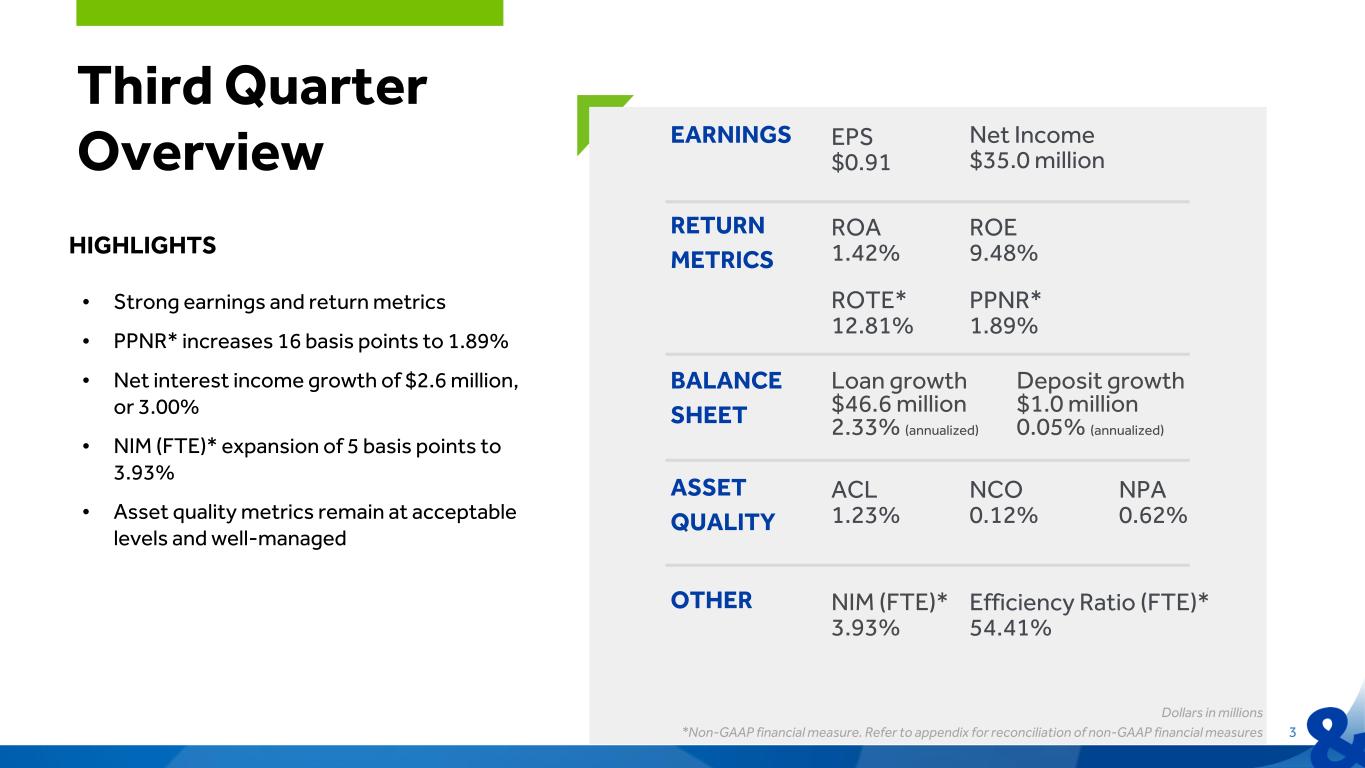
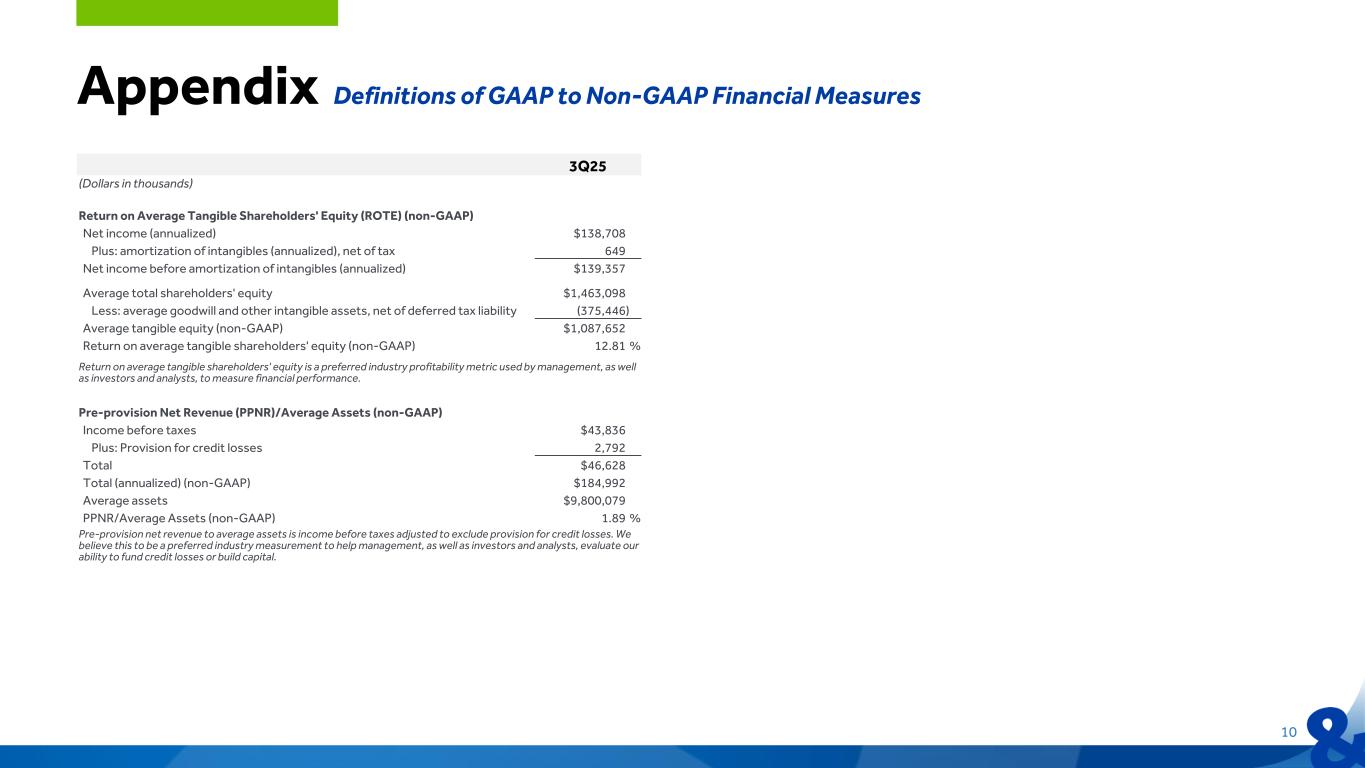
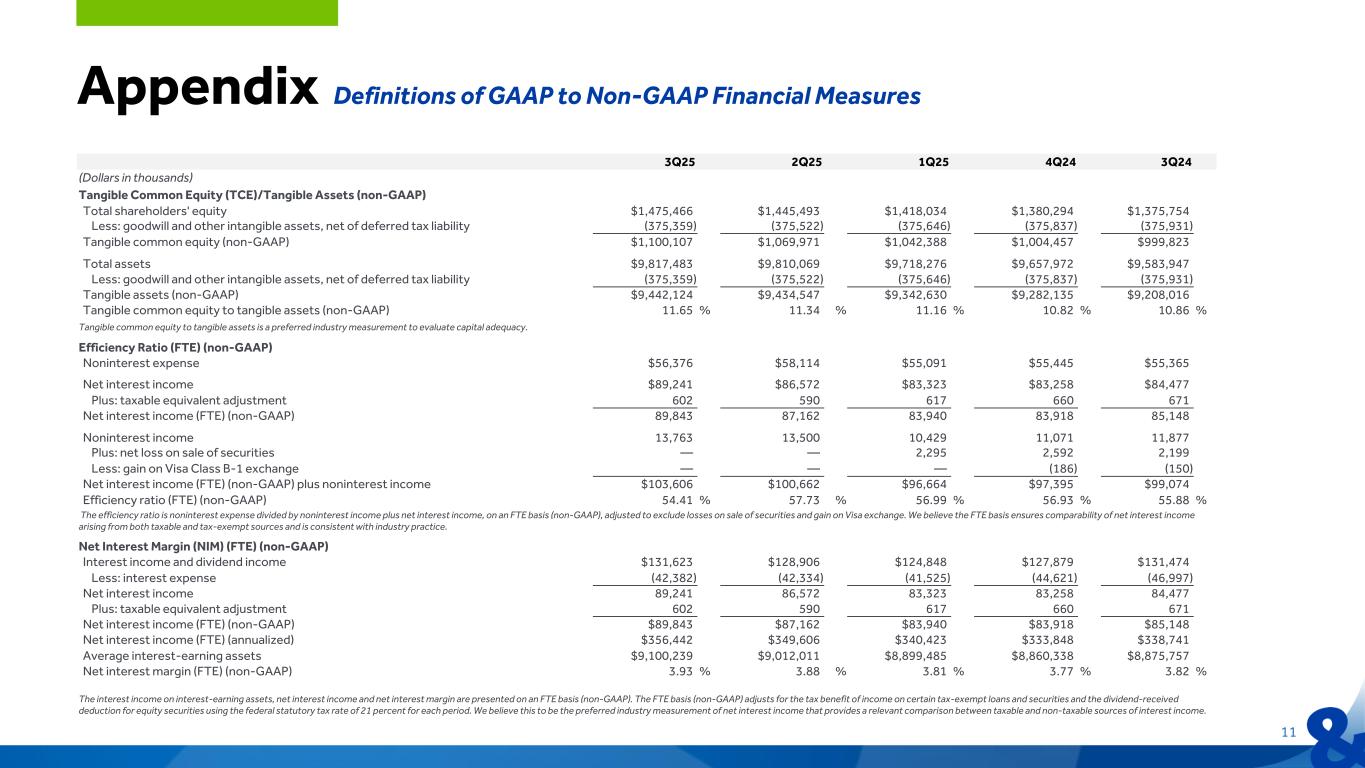
And I'd like to turn the call over to Chris. Mark, thank you. And good afternoon, everybody. I'm going to begin my comments on page three and welcome all of you to our call, especially our analysts. We appreciate you being here with us and look forward to your questions. I also want to thank our employees, shareholders, and others listening to the call, to our leadership team and employees. I want to thank you for all you do. These results are yours and you should be very proud. Before my remarks on our performance, I want to take a moment to congratulate and thank Christine Tretti, our former board chair, for her years of service at S&T. As you may be aware, Christine is our new U.S. Ambassador to Sweden, a well-deserved appointment in recognition of her years of service to our country. I also want to welcome and congratulate Jeff Grubb, another longstanding S&T board member, as he takes on the role of lead independent director of our board. We all look forward to working even more closely with Jeff as we move the company forward. Overall, we feel very good about the quarter as it reflects a lot of the work and strategic focus of our team over the past few years, positioning S&T for long-term success. You will see that focus in the numbers we discussed today, including first, by strategically repositioning our balance sheet over the past couple of years to reduce asset sensitivity, we've enhanced our ability to drive consistent net interest income growth through the interest rate cycle. Second, while total deposits ended basically flat at quarter end, our continued investment in our deposit franchise delivered a solid deposit mix with non-interest-bearing deposits representing 28 percent of total deposits additionally average dda growth in the quarter was over 50 million dollars versus q2 helping to drive our net interest margin expansion which was already at a very healthy level last while we did see an increase in that npas in the quarter this was over a very low base and the final numbers remain in a very manageable range Together, these strategic initiatives have created a solid platform for current strong performance and confidence in our future. Additionally, from a capital standpoint, our earnings drove further tangible book value growth of more than 3% again this quarter, above our already robust capital levels. This capital level gives us a lot of flexibility around acquisitions as well as share buyback opportunities. I will remind everyone again, we have a very clear path to $10 billion and above through organic growth in the coming quarters. In summary, I'm very excited about how we are executing, delivering for our customers and building our company for the future. Looking at the quarter, Q3 was another quarter of strong earnings and returns. EPS of 91 cents and net income of $35 million, while ROA came in at 1.42%, up 10 basis points from Q2, and PPNR at a very solid 189 was up 16 basis points. PPNR was aided by both NIM expansion, increasing to a robust 3.93%, up five basis points length quarter, while net interest income rose more than 3%. Asset growth was a little lighter than Q2 due to some higher payoffs, while NPAs did increase over a very low base. Charges remained low and the ACL decreased by one basis point late quarter. Dave Antolk is here with us and he will add more color in a few minutes on asset growth and asset quality. Again, while customer deposit growth was somewhat muted dda balances remained an impressive 28 while total deposits can well while contributing meaningfully to our net interest income and net interest margin improvements expense expenses were well managed combined with our revenue growth the efficiency ratio dropped to 54.4 another strong number i'm going to stop there i don't want to take any more of dave or Mark's Thunder, and I'll turn it over to them for more details, and I look forward to your questions.
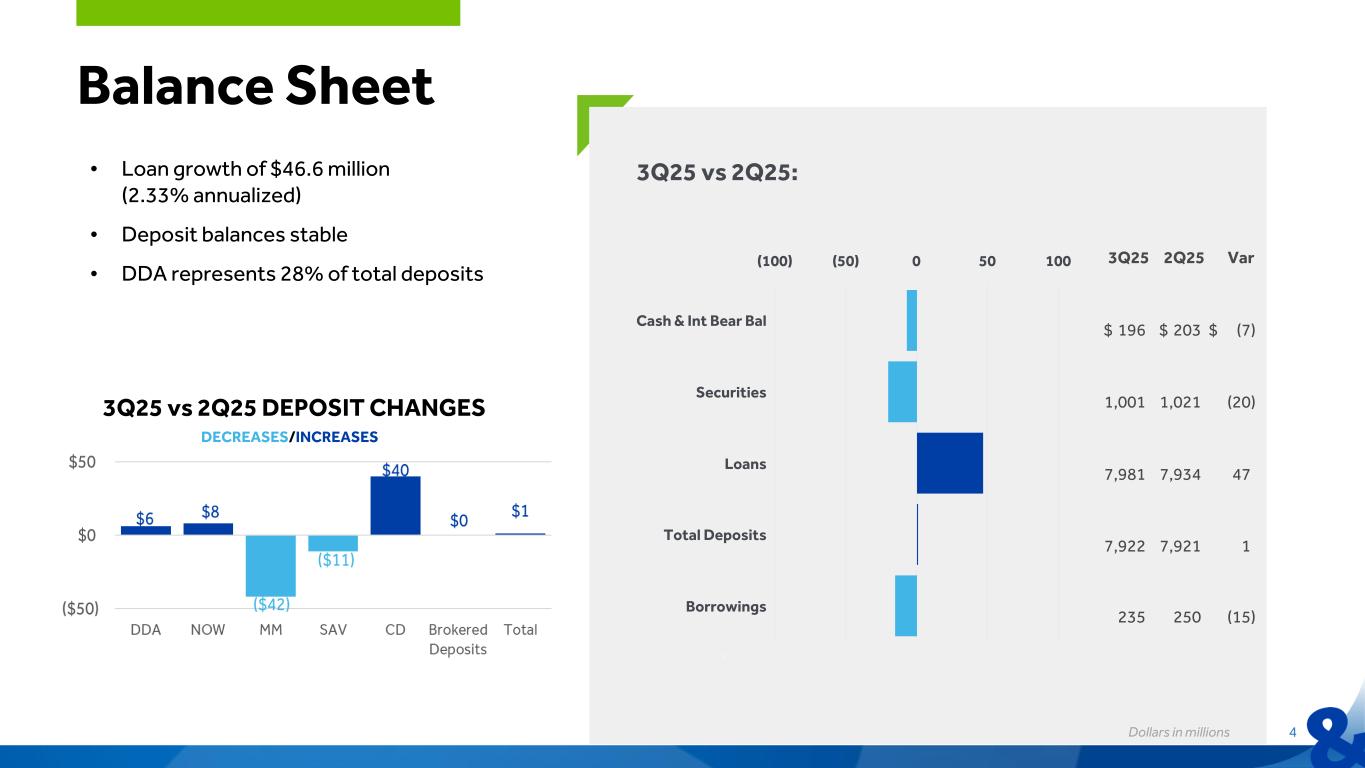
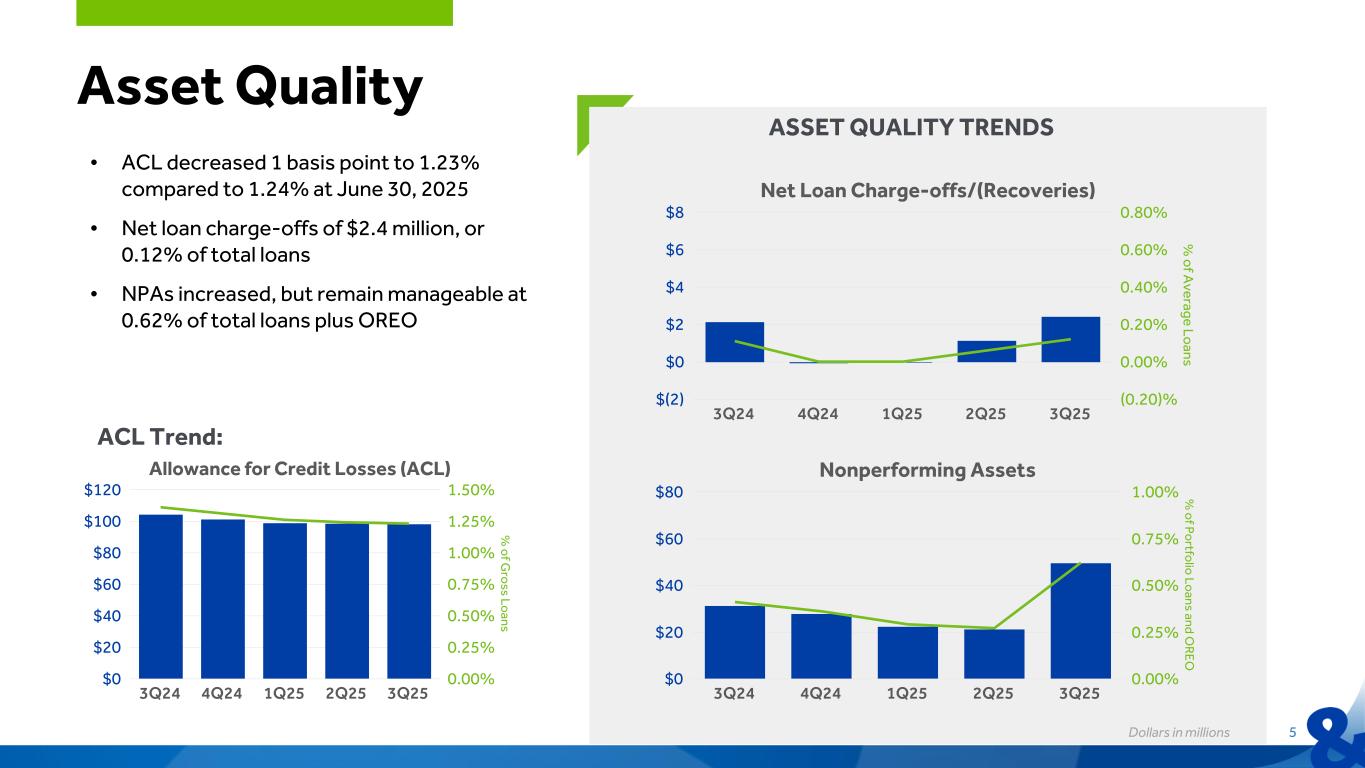
Thank you, Chris, and good afternoon, everyone. Continuing on slide four, total unbalances grew by $47 million, or 2.3% annually during the quarter. This growth was largely driven by CRE activities, resulting in $133 million of increased balances in that category. Much of this growth was the result of construction loans converting to permanent commercial real estate loans as projects were completed during the quarter. As a result, commercial construction balances declined by $78 million. Looking forward, unfunded construction commitments grew by $37 million during the quarter, pointing towards continued growth in CRE for the balance of the year and beyond. Asset classes experiencing the most growth during the quarter included multifamily, flex mixed-use manufacturing, and retail. Offsetting our CRE growth were declines in our C&I balances of $46 million. These declines were driven by a combination of modest seasonal utilization reductions, coupled with higher-than-anticipated payoffs, as Chris mentioned, and credits that we chose to exit. During Q3, total commercial loan payoffs were higher than the previous two quarters and higher than Q3 of 2024. Turning to consumer loan activity, we saw overall growth in line with our expectations at $37 million or approximately 6% annualized. Consumer pipelines were down slightly from Q2 to Q3, but still in line with our forecast and in support of continued growth at the pace that we've seen in recent quarters. Commercial pipelines continue to grow and sit at the highest point in five quarters. Given our experience in Q3 and anticipated new loan and payoff activity in Q4, we are guiding to mid-single-digit loan growth in Q4. Turning to asset quality on page five, our allowance for credit losses decreased by one basis point and remains appropriate for the level of credit risk in our loan book. Overall, criticized and classified assets were up moderately quarter over quarter and are in a range where we expect them to remain for the foreseeable future. During the quarter, MPAs increased to 62 basis points of total loans. It's important to note that this level of MPL follows a period of exceptionally low levels and is well within an acceptable range. I'll also note that we do not have concern with any particular asset class, geography, or industry. The increase was primarily a result of two CRE credits and one CNI credit that migrated during the quarter. We have asset resolution strategies in place for several NPLs, and in support of those strategies, recognized charges of $2.4 million in the quarter and established additional specific reserve of $2.7 million. Looking forward, we expect NPLs to stabilize and potentially reduce over the balance of 2025 and into the first quarter of 2026. Taking a broader look at leading credit risk indicators, we see nothing in our credit risk rating stack, credit scoring, or delinquency that points to additional downward pressure on our credit results. I'll now turn it over to Mark. Hey, thanks, Dave.
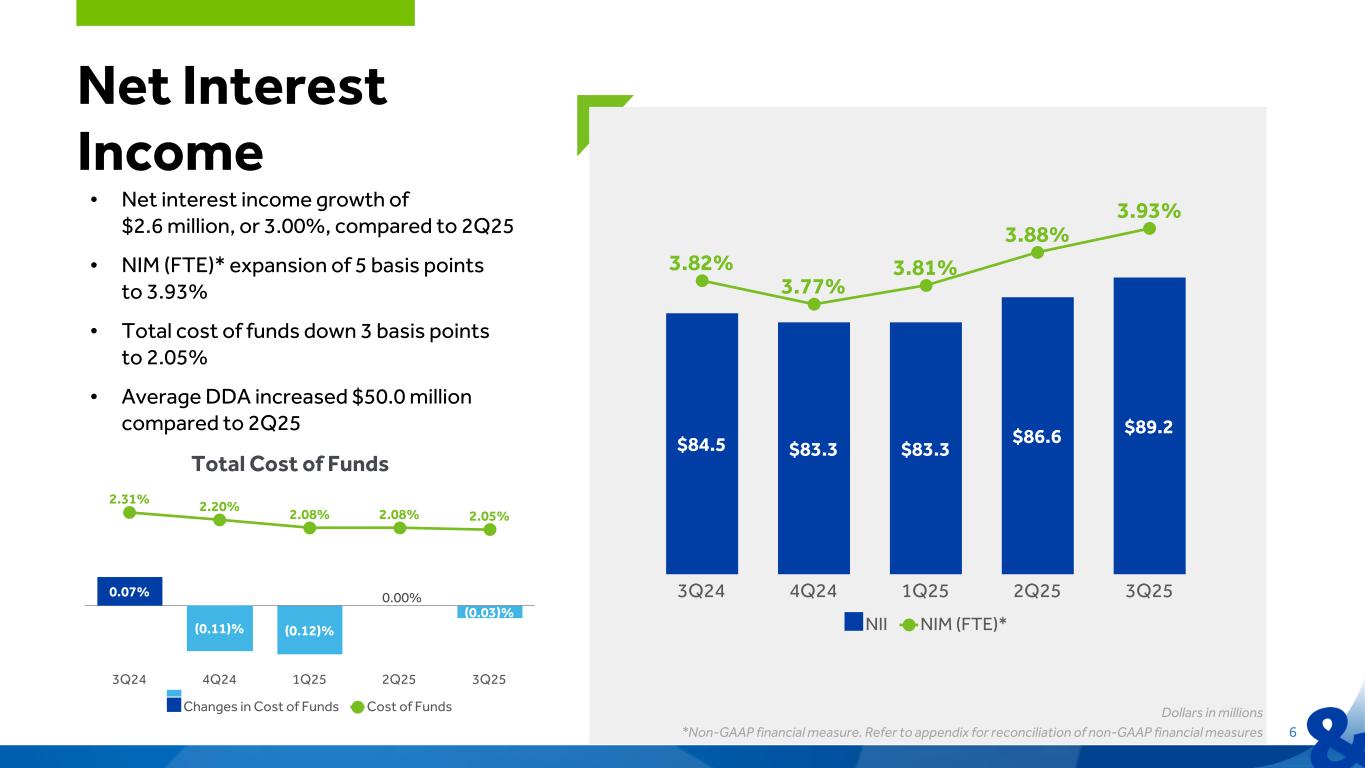
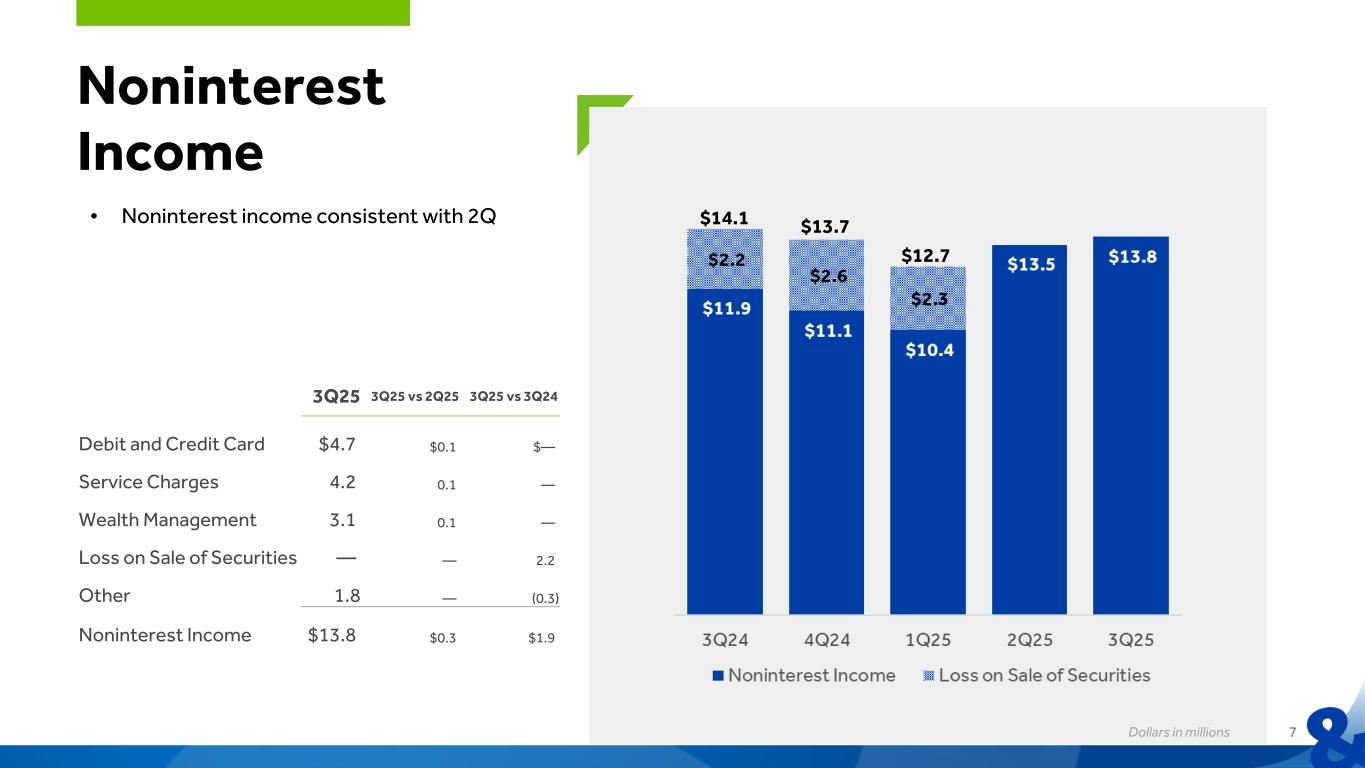
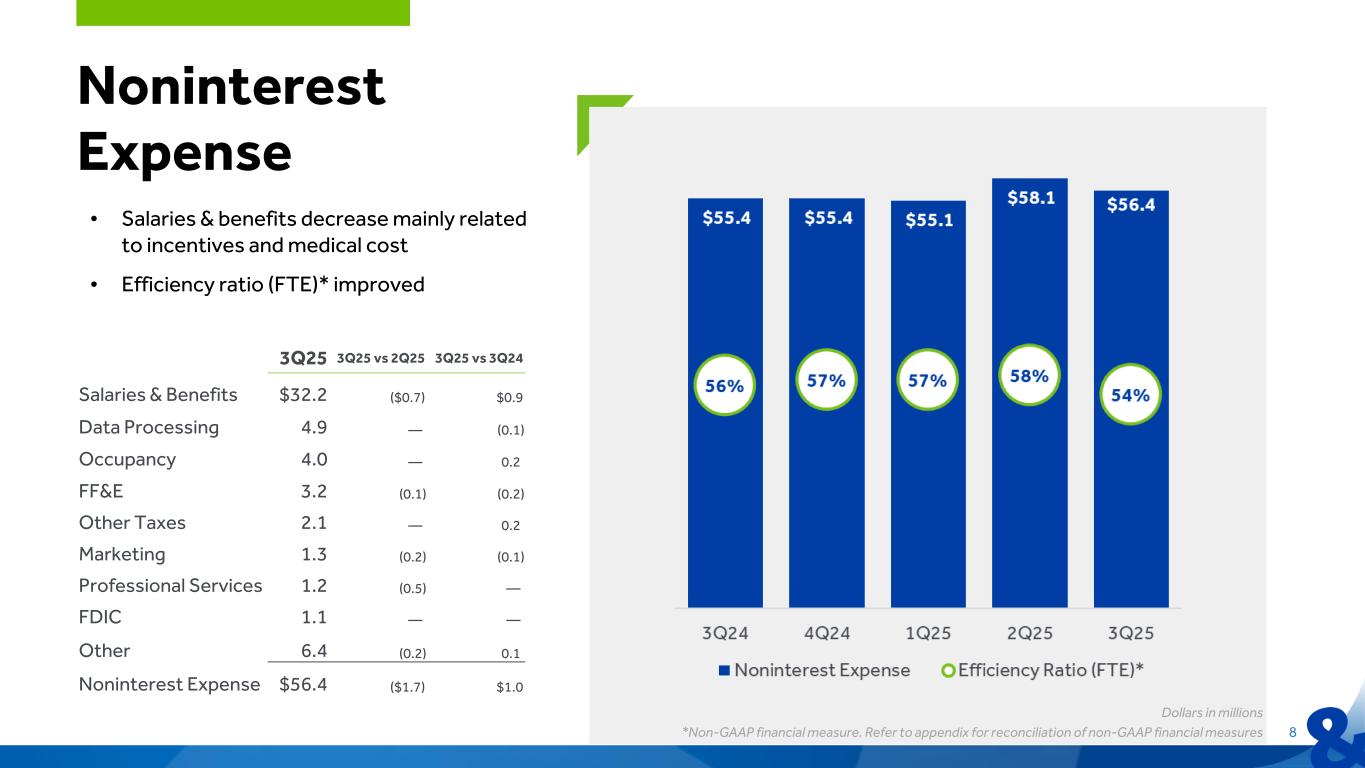
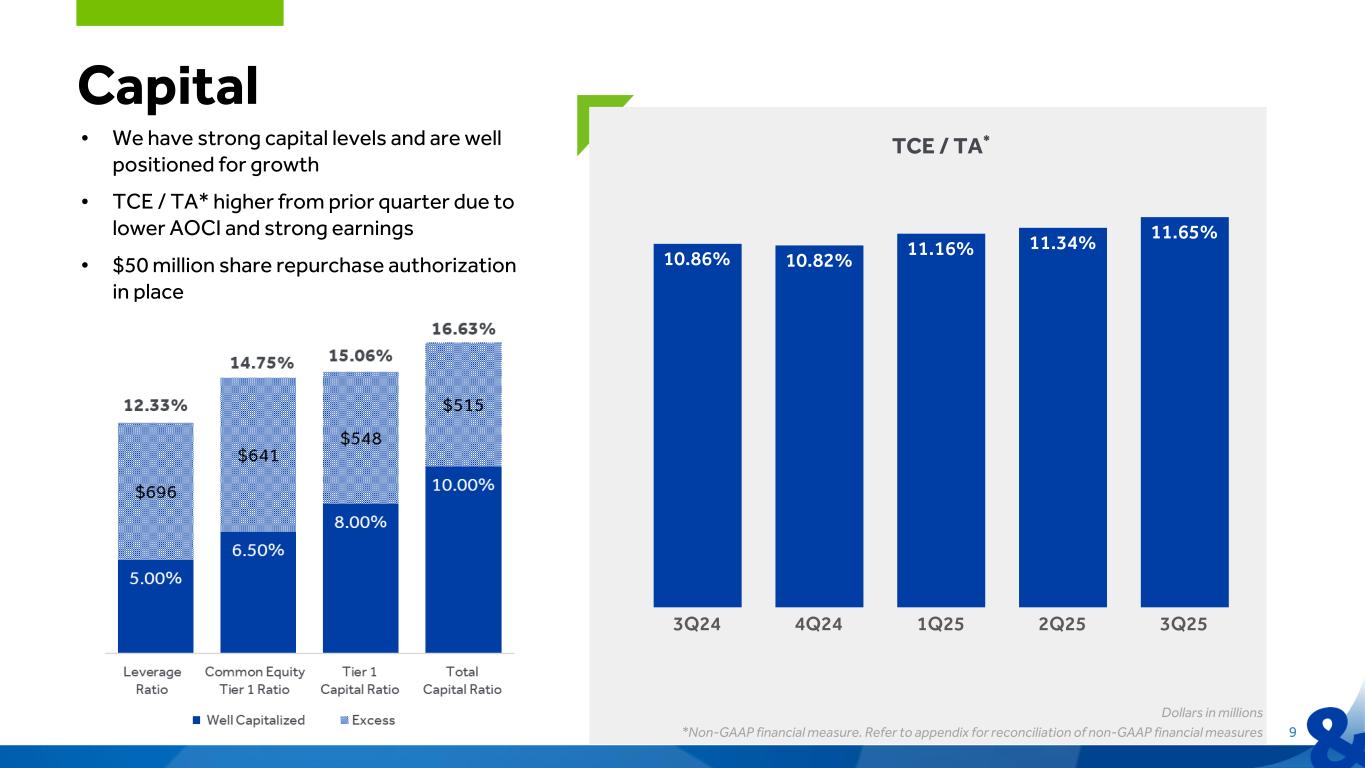
Third quarter net interest income improved by 2.6 million or 3% compared to the second quarter. A net interest margin expanded by five basis points and combined with loan growth to produce good quarterly revenue growth. The net interest margin improvement came from a one basis point earning asset increase combined with a three basis point decrease in cost of funds. That was mostly due to CD repricings and the higher average CDA balances of 50 million that Chris mentioned. Fed rate change came very late in the quarter and we not see any meaningful impact from that in these results. We continue to expect that our more neutral interest rate risk position and pricing discipline will mitigate any rates down impact, both what has happened so far and what is expected over the next several quarters. Next on non-interest income, we saw a slight increase, 0.3 million for Q3, with small improvements in our major customer fee categories. Our expectations for fees going forward remains at about $13 to $14 million per quarter. On the expense side, expenses were more in line in the third quarter, declining by $1.7 million compared to the second quarter. Favorable variances were concentrated in salaries and benefits, primarily in incentives and medical. Additionally, professional services decreased by about a half a million, mostly due to the timing of some projects. Our quarterly expense run rate is still expected to be approximately $57 to $58 million for the next several quarters. Capital to TCE ratio increased by 31 basis points this quarter with AOCI improvement contributing about seven basis points. A regulatory ratio is increased by about 15 basis points due to strong retained earnings growth. Our TCE and regulatory capital ratios position us well for the environment and will enable us to take advantage of both organic or inorganic growth opportunities. We also have a share repurchase authorization in place for $50 million. Thank you. At this time, I'd like to turn the call back over to the operator to provide instructions for asking questions.
Operator
The floor is now open for questions. If you have any questions, please press star 1 on your phone. And we ask that while asking your question, please pick up your phone and turn off speakerphone for enhanced audio quality. Please hold while we poll for questions. Your first question comes from the line of Justin Crowley with Piper Sandler. Please go ahead.
I wanted to start out on loan growth in the corridor and kind of looking forward. I know you went through some of this, but could you give more of a sense for the puts and takes here between origination activity and maybe how impactful paydowns were, which I think you called out?
Yeah, so pay downs were up quarter over quarter, and again, higher than what we experienced in Q3 of last year. So the end result was a little lighter than what we had expected. CRE activity remains strong. As I mentioned, the construction commitments grew during the quarter, pointing towards better growth in Q4 and in the Q1. Consumer, we believe, will remain at somewhere in the mid-single digit, similar to the 6% that we experienced in Q3. And we're working hard to drive better CNI growth. I talked in earlier quarters about recruiting teams. They're getting up to speed and bringing opportunities to fruition. So we feel like that mid-single digit number is appropriate for us, especially given the growth of the deposit franchise. guys. We don't get too far ahead of our funding sources, but we think that's an appropriate level of growth for our bank.
Okay, and like taking that mid-single digit versus maybe the mid-to-high that's been discussed before, is that a function of the paydowns? Is that primarily what that is, or is it also what you're seeing on the deposit side, maybe it's a combination of the two?
It's a combination of all those factors plus demand in the market. There's still a fair amount of uncertainty. If you think about the budget impasse in Washington, we have the double whammy here in Pennsylvania because we've got a state budget impasse as well. So until some of those things get settled out, I think the interest rate environment is helping us and we're helping to tell that story to our customers around fixed rate borrowings, but there's still enough uncertainty out there that mid-single-digit growth feels more appropriate for us from both a credit and funding perspective.
Okay, got it. That's helpful. And then shifting a little bit on the margin, and I hear you on the NIM being able to hold relatively stable, but as we get into next year with more Fed cuts on the way, how do you see that playing out over more the intermediate term in terms of the effect on NIM? Maybe also just any color on flexibility with things like swaps continuing to roll off or anything else?
Yeah, I mean, I think for the next several quarters, probably into, you know, through the first half of next year, I feel like we're fairly, we're pretty well positioned to handle any of the potential rate cuts because of the, you know, the funding mix that we have, our ability to reduce deposit rates, still CD repricings in the offing, and then also the received fixed swap book that we have that will continue to mature its ladder over the next several quarters. Assuming the Fed kind of finishes up by mid-summer, I think that will be a little bit of a reset and we'll need to look more closely at how customer behavior, especially on the deposit side, evens out what the shape of the curve is. And those things could put some pressure on the margin just on a go-forward basis in a more stable rate environment. But I think a lot of things have to shake out before then. But for the next three quarters or so, we think we're in a pretty good spot to handle the rates down should it come.
Okay. And then on the deposit side, as we continue to get these cuts, do you have any funding or any deposits that are indexed directly to Fed funds and would reprice right away?
Not on the deposit side. We've been pretty proactive and have a decent discipline with respect to the exception pricing that we have with our customers. So we act fairly quickly on those, but we don't have any contractually indexed deposits. Okay, helpful. We have a small amount tied to a three-month T-bill, but that's maybe $100 million, $150 million. Very small.
Okay. And then I know we talk about it a lot, but on M&A and the higher levels of activity we're seeing, Chris, could you give us an update just on that side of things for you folks?
Are a lot more conversations taking place, or how has that all been trending from your side? yeah um there the conversations are in the market is is still active um you know pennsylvania and ohio maybe not as much as other geographies but there's still a good number of questions a good number of conversations that it's a key part of the you know the ongoing outreach and engagement that we have okay and you hit on the geographies and i know you've cast um you know, somewhat of a wide net in terms of what could make sense.
But, you know, does that leave areas like, you know, in the Mid-Atlantic or, you know, D.C. or Maryland?
Yeah, exactly. You know, I would think about Mid-Atlantic, you know, east, excuse me, west through Ohio. Our marketplace today is Pennsylvania and Ohio, but we certainly, you know, are interested in places, you know, further south and east.
Awesome. Thank you so much. I'll leave it there. Thank you.
Operator
Your next question comes from the line of Daniel Tomeo with Raymond James. Please go ahead.
Thank you. Good afternoon, guys. Yeah, maybe first, just on the deposit side, you know, you touched on it, Mark, with your expectation for your ability to maintain the margins in the next several quarters. But just curious what you're seeing on the competition side kind of recently, last few months, and what you're thinking in terms of betas for these cuts that, you know, the September cut and any future cuts that we have coming.
We did, after the first cut here in September, or last cut in September, we did see a little bit more competitive pressure than we had expected, particularly on the CD side. there seemed to be a little bit of reluctance on the part of many competitors to reduce some of those short-term rates as much as we had expected. So we made some adjustments in how we handle some of the exception pricing there. We think that with several cuts, we'll catch up. I think there's a little bit of psychology going through the forehandle and customers being attached to getting that forehandle rate. So I think that'll improve, assuming the Fed keeps on going with multiple cuts. On the beta side, our loan beta overall is kind of around 40%. So we're targeting right around there or a little bit better over time with the CDE repricing included to be able to match that. That's an important part of getting us to have that more stable new.
Great. Appreciate that. Um, and on the, uh, on the 10 billion threshold, you know, with the slower growth in the quarter, it seems like you should be able to stay under 10, uh, next quarter and then, you know, organically, if, uh, if that's the way you pass, it would be sometime next year.
And then maybe one for you, uh, Chris on profitability. Um, you guys We're in the quarter, you know, kind of pretty regularly now for the last few quarters. It seems like that should be relatively sustainable with credit being certainly in a good place. But is that something you think you can stay above that 140 bogey?
Yeah, I think in that range is certainly the way we're targeting things. to your point, Danny, is credit continues to behave and we stay focused on that. And then as Mark talked about, if margins hold up as we expected in this down rate environment, that's certainly a reasonable number and something that we are staying focused on.
Great. Okay. Well, thanks for the color. I'll step back. Appreciate it.
Operator
Your next question comes from the line of David Bishop with the HVD group. Please go ahead.
Yeah, thank you. Good afternoon, gentlemen. Hey, David. Hey, I appreciate the color regarding the operating expense forecast. I'm curious, as you budget out into next year, any prospects or plans to, you know, recruit or add additional bankers? I'm just curious how much is based into the numbers and how much of a lift that may influence that on an inflationary basis if you are successful. Thanks.
Well, we certainly expect to add bankers, and the expectation is that those bankers pay for themselves. So there's a real focus internally on improving productivity. So things like leveraging artificial intelligence, making sure that we have processes streamlined, become really important to managing operating expenses. But we certainly do expect to add in the customer facing roles.
Got it. And then I think you mentioned capacity for the share buyback. Just curious appetite for share repurchases at the current valuation.
Yeah, I mean, we think there might be some better opportunities. We've seen a downdraft in bank stocks overall and us in particular over the past month. So we certainly think that that's something that we're going to look a lot closer at here as we get into the rest of the quarter.
Got it. Then one final sort of housekeeping question. I know there's been a lot of chatter about loans to the NDFI sector. Just curious if there's any exposure you wanted to call out. Thanks.
No. Yeah, nothing material. We do have some exposure to some REITs that are technically NDFIs, but nothing that looks like where the problems have surfaced in some of the larger regional banks. That's a space we don't play in.
Great. Appreciate the color.
Operator
Your next question comes from the line of Kelly Motta with KBW. Please go ahead.
Hey, good afternoon. Thanks for the question. Most of mine have been asked and answered at this point, but I guess piggybacking on the credit question, you did have the migration, although it sounds like you feel levels are low and you feel overall good. Is there any specific areas, understanding you guys don't really have exposures to NTFIs, that you would direct analysts to watch more carefully, either at S&T or just in the bank space more broadly?
No, I think, in fact, Kelly, beyond what I mentioned relative to kind of budget crisis, credit is performing as we would have expected and here in western pennsylvania there are things like a big data center that's being built outside of indiana here in homer city pennsylvania that should add additional opportunity for growth and improving credit health in the region as you know some very large investments are made um we obviously look through our concentrations relative to commercial real estate. We're very comfortable with where we stand from a diversification perspective, both construction versus permanent and all the asset classes. And then we're closely managing our CNI book to make sure that we're not getting too far out on our risk scale. So that's some of what led to the decline in CNI balances in Q3 were, you know, decisions that we made relative to exiting credits. So I don't know that there's any one thing that I would point you towards other than kind of general economic and, you know, political environment, specifically the budget impasses in Pennsylvania and at the national level.
Got it. That's helpful. I guess the last question for me would be on the funding side, your loan-to-deposit ratio sits right just a touch above 100. If you appreciate the color on the loan outlook, if you look ahead, where are you seeing opportunities to raise core funding and the drivers of that?
Yeah, Kelly, excuse me, it's Chris. As we've talked about, building the growth of our deposit franchise is a key driver of our performance in the area of focus and that entails everything from you know incentive plans to product mix to adding staff dave earlier asked about bankers that includes treasury management professionals and in teams and so it's it's a critical part of who we are and you know we feel really good about our deposit mix and we feel very good about the process that we use around being proactive relative to exception pricing in ensuring that our bankers are able to be responsive both in the branches with consumers as well as our commercial and business bankers. So it's a core part of what we think about and focus on every day. And we know improving that loan-to-deposit ratio is really important to us as we move forward to capitalize on our growth opportunities as mark talked about we did see with the with the most recent rate cut you know some increase in competitive intensity and uh and we'll you know we'll have to be able to respond to those things as well got it thank you um again most of mine were asked so i appreciate all the callers today thank you so much thank you thank you kelly your next question comes from matthew briefs with Stevens.
Operator
Please go ahead.
Hey, good afternoon. Hey, Matt. Hey, the first one for me, you know, is it fair to think that the $10 billion crossing will happen, you know, either in the first quarter of 26 or second quarter 26 without having to manage the balance sheet below that, you know, too strenuously? Or is there room to kind of push it even further out?
No, I don't think so. I think I think it'll be certainly the first half of next year. I don't think there's any – we're going to be pretty close here at the end of the year, but I don't think we'll have to try very hard to stay under at the end of the year, but we're not of a mind to do that long term. So, I think we just go ahead after we get past 25.
Got it. The other thing, Matt, that we are watching is some of the changes or the proposed changes in Washington relative to regulatory relief or changes in thresholds and that kind of thing. That won't impact the Durbin cost, which we've talked about, which is in that $6 to $7 million range, but it certainly, you know, it makes us feel good about the fact that regardless, we're prepared, but it might give us some additional flexibility to run the company.
And then I'm sorry to harp on the NIM, but it does seem like, you know, on the back of of recent cuts we could get another two to three 25 cuts in relatively short order i think at last count you have something like 39 or 40 floating rate loans um how do you see the margin all right i guess you know my my gut is that the margin has near-term downside before before deposits start to catch up and and you get some of that back but i was curious on the timing difference between you know floating rate loans and your ability to act on act on deposits if you could help me on the NIM.
Yeah, I think our floating has decreased some, especially when you figure in the swap exposure we have. So, it's closer to 30% net. So, I think that gives us a little bit of relief. So, we run in the models. I mean, there is some risk if that competitive piece of the deposit side that we've talked about expands beyond CDs and really starts to bore into money market and the interest-bearing demand sector. But the modeling we've done so far doesn't have that sort of air pocket that you alluded to. We think we can still maintain that fairly quickly with the Fed changes.
Okay. The credits that went non-performing, could you just give us some insight as to what business lines or behind the C&I credit and what sectors the commercial real estate credits were attached to and any kind of underlying factor? Was it, you know, higher rates and just kind of a strain that way, or was it more idiosyncratic?
Yeah, Matt, I don't want to get into specific details on these credits because they are active workouts. The C&I credit was a manufacturer. The two CRE credits were, you know, really a function of, you know, kind of construction-related risk. But as I mentioned, we've got asset resolution plans in place that we hope to execute on over the next couple quarters. And again, we don't see anything generally or specifically tied to any industry geography or asset class that gives us kind of additional heartburn in terms of more downside risk.
I appreciate that. Chris, maybe last one for you. You know, on M&A, you had mentioned kind of geographic preferences. You know, I guess beyond that, what do you make an attractive target? What business lines or deposit composition are you looking for? I guess I'm looking for some color on the strategy component to M&A, beyond geography.
Yeah, so strategically, we obviously, I mean, I'm a big believer that acquisitions are focused primarily on the deposit franchise. And that type of opportunity would help with the funding mix that we have today, as well as give us a core group of customers to expand relationships around. So we think about it a couple of ways. One, you know, there's geographic expansion that could be into, you know, faster growing areas than where we are today. Then you've got geographic overlap that would, you know, create some potential efficiencies for us. Both of those things could be important to us. But, you know, kind of the key driver really is thinking about that deposit franchise. There may be a line of business that may help us expand our CNI capabilities, for example, or our focus on small business, some of that is unique to a specific transaction. So we think about the balance sheet makeup of the company, first and foremost, a heavy emphasis on the deposit side of the balance sheet, understanding credit risk, and then does it – I appreciate all that.
Operator
I would like to turn the call over to Chief Executive Officer Chris McComish for closing remarks.
Well, listen, thanks, everybody, for your good questions and your engagement. We really appreciate it and your interest in our company and all you're doing to support what we're trying to do. We look forward to being with you again next quarter. In the meantime, we're going to go back to work and see what you can do to grow the bank. Have a great day.
Operator
Ladies and gentlemen, this concludes today's call. Thank you all for joining. You may now disconnect.